
Judge, 1903-01-24 · page 7 of 16
Judge — January 24, 1903 — page 7: what you’re looking at
What you’re looking at
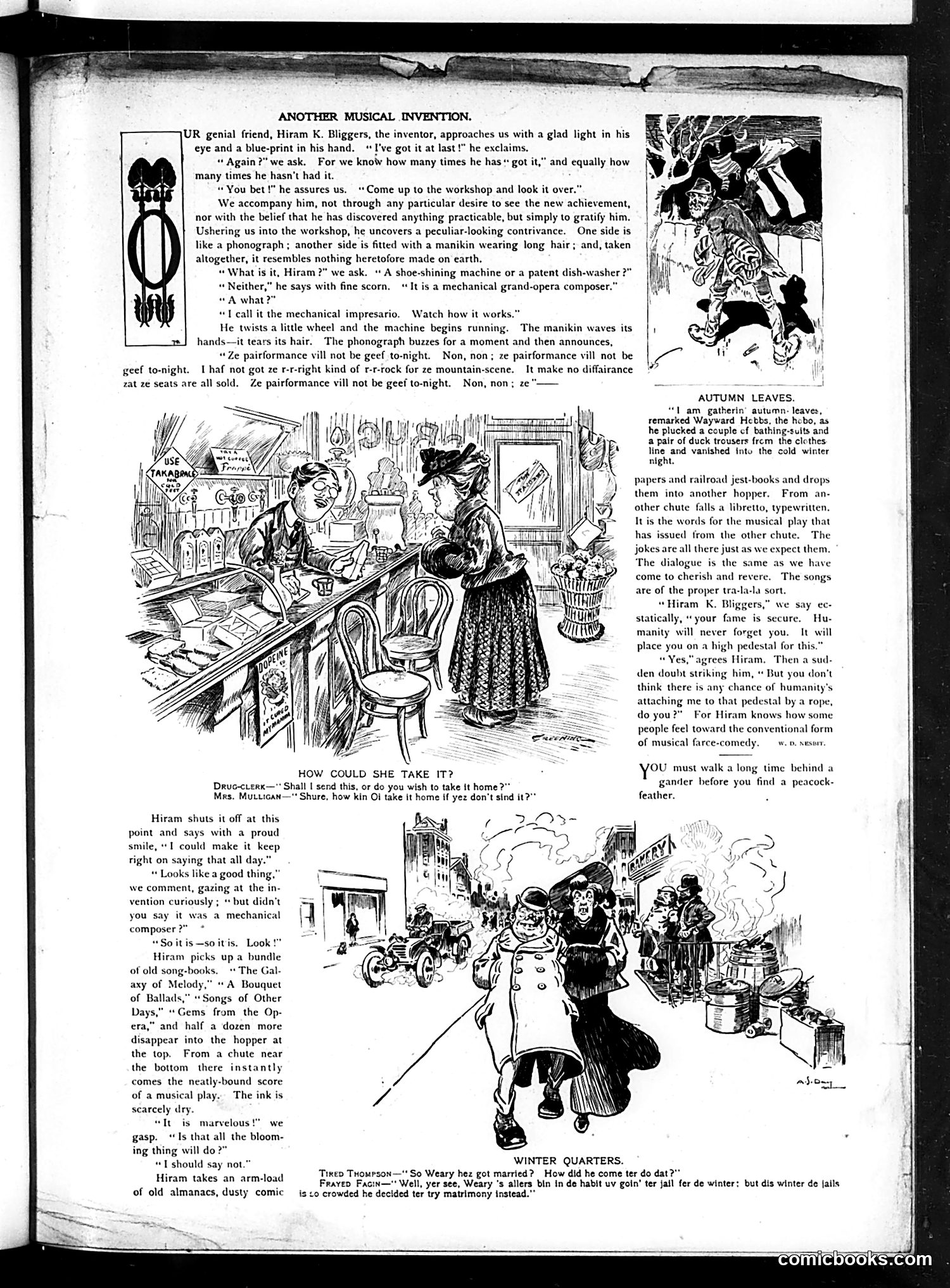
This page satirizes both automated mass production and formulaic opera composition. The central cartoon depicts **Hiram K. Bliggers**, an recurring character representing incompetent inventors, unveiling a "mechanical grand-opera composer"—a machine that churns out operas by processing old songbooks into standardized musical plays with predictable plots and dialogue. The satire targets two things: (1) the era's fascination with mechanical innovation as solution to everything, and (2) the perceived mediocrity and formulaic nature of contemporary musical theater. The machine's actual output—a frustrated impresario canceling performances—mocks both the pretension of grand opera and the cynical commodification of art. The accompanying jokes ("Autumn Leaves," "How Could She Take It?," "Winter Quarters") are unrelated ethnic humor typical of the period, featuring working-class or immigrant characters in comedic situations.
📄 Transcribed text from this page (OCR, searchable)
Machine-transcribed from the original scan — historical spelling and the odd misread are preserved.
ANOTHER MUSICAL INVENTION. UR genial friend, Hiram K. Bliggers, the inventor, approaches us with a glad light in his eye and a blueprint in his hand. «I've got it at last !” he exclaims. “ Again?” we ask. For we know how many times he has“ got it,” and equally how many times he hasn't had it. «You bet!" he assures us. ‘Come up to the workshop and look it over.” We accompany him, not through any particular desire to see the new achievement, nor with the belief that he has discovered anything practicable, but simply to gratify him. Ushering us into the workshop, he uncovers a peculiar-looking contrivance. One side is like a phonograph ; another side is fitted with a manikin wearing long hair; and, taken altogether, it resembles nothing heretofore made on earth. “ What is it, Hiram?” we ask. “A shoe-shining machine or a patent dish-washer ?” “Neither,” he says with fine scorn, “It is a mechanical grand-opera composer.” « A what? “Tcall it the mechanical impresario. Watch how it works.” He twists a little wheel and the machine begins running. The manikin waves its hands—it tears its hair. The phonograph buzzes for a moment and then announces, «Ze pairformance vill not be geef to-night. Non, non; ze paitformance vill not be geef to-night. Uhaf not got ze r-r-right kind of r-r-rock for ze mountain-scene. It make no diffairance zat ze seats are all sold. Ze pairformance vill not be geef to-night. Non, noi AUTUMN LEAVES. “1 am gatherin’ autumn: leaves, remarked Wayward Hetbs. the hobo, as he plucked a couple cf bathing-suits and a pair of duck trousers frm the clothes line and vanished into the cold winter night. papers and railroad jest-books and drops them into another hopper. From an- other chute falls a libretto, typewritten. It is the words for the musical play that s issued from the other chute. The jokes are all there just as we expect them. The dialogue is the same as we have come to cherish and revere. The songs are of the proper tra-la-la sort. We say ec- statically, “your fame is secure. Hu- manity will never forget you. It will place you on a high pedestal for this.” “Yes,” agrees Hiram, Then a sud- den doubt striking him, “ But you don’t think there is any chance of humanity's attaching me to that pedestal by a rope, do you?” For Hiram knows how some people feel toward the conventional form of musical farce-comedy. —_w. 0. nesurr HOW COULD SHE TAKE IT? . ‘OU must walk a long time behind a Druc-ccerx—"* Shall | send this, or do you wish to take it home?” gander before you find a peacock- Mrs. Mututcan—" Shure, how kin Oi take it home if yez don’t sind it?”* feather. Hiram shuts it off at this point and says with a proud smile, “I could make it keep right on saying that all day. * Looks like a good thing,” we comment, gazing at the in- vention curiously ; * but didn’t you say it was a mechanical compo: _ "So it isso itis. Look! Hiram picks up a bundle of old song-books. The Gal- A Bouquet jongs of Other Gems from the Op- era,” and half a dozen more disappear into the hopper at the top. From a chute near the bottom there instantly comes the neatly-bound score of a musical play. The ink is scarcely dry. “Tt is marvelous!" we gasp. “Is that all the bloom- ing thing will do 2” "TT should say not.” WINTER QUARTERS. Hiram takes an arm-load Tixeo THourson—" So Weary hez got married? How did he come ter do dat?" uN Fravep Facin—" Well, yer see, Weary ’s allers bin in de habit uv goin’ ter jail fer de winter; but dis winter de {ails of old almanacs, dusty comic is +o crowded he decided ter try matrimony instead."