
A complete issue · 16 pages · 1903
Judge — January 3, 1903
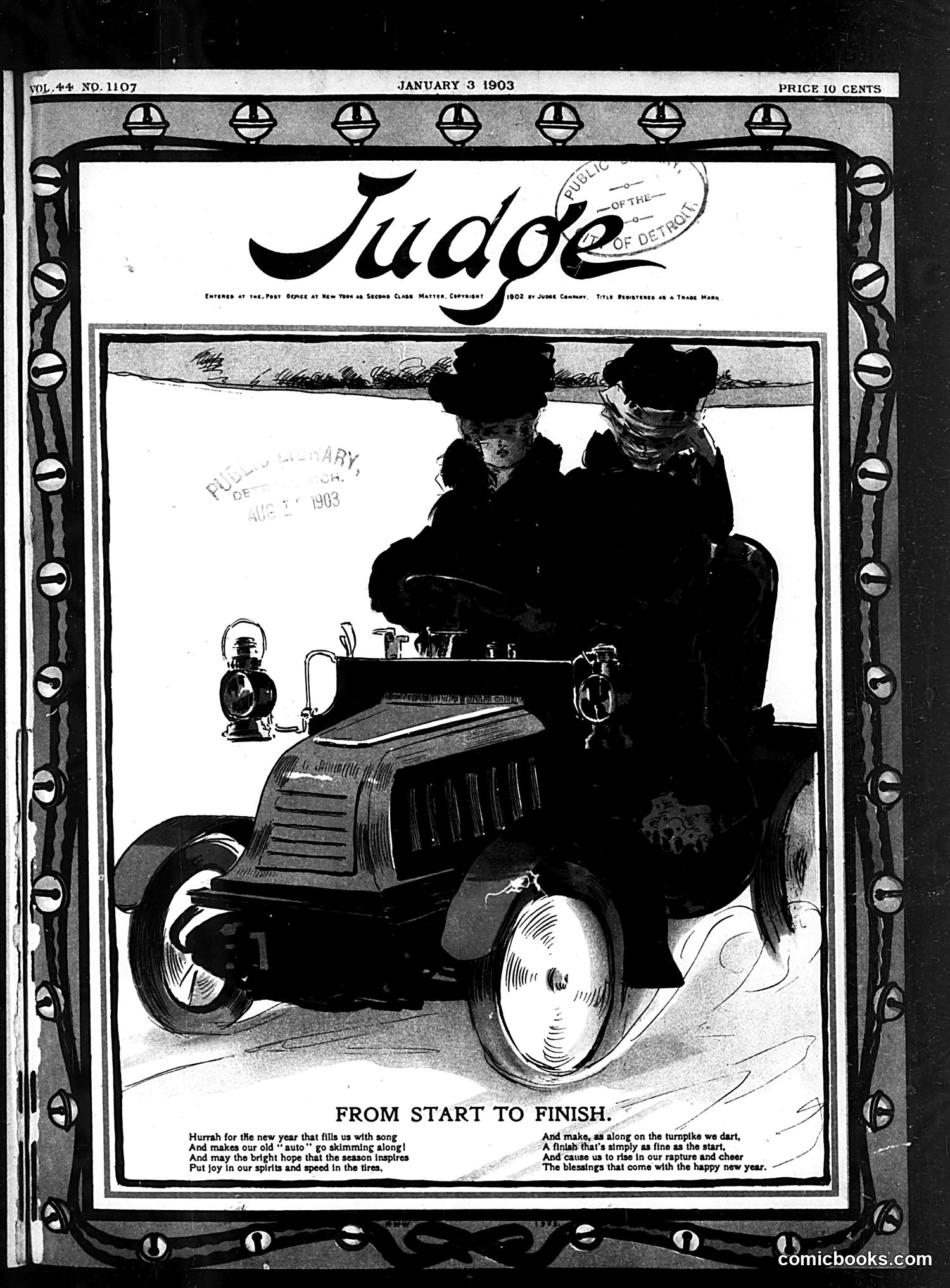
This is a New Year's cover illustration titled "From Start to Finish." It depicts two elegantly dressed women in a motorcar—a still-novel technology in 1903—driving confidently forward. The accompanying verse celebrates the new year with optimism, expressing hope that the season will inspire "joy in our spirits and speed in the time." The satire likely comments on **women's increasing independence and modernity**. The motorcar, a cutting-edge symbol of progress and freedom, is operated by fashionable women rather than men—a progressive image for 1903. The "from start to finish" metaphor suggests women navigating their own course through the new year and new century, rather than being passive passengers. This reflects early-1900s anxieties and enthusiasm about changing gender roles and technological advancement.
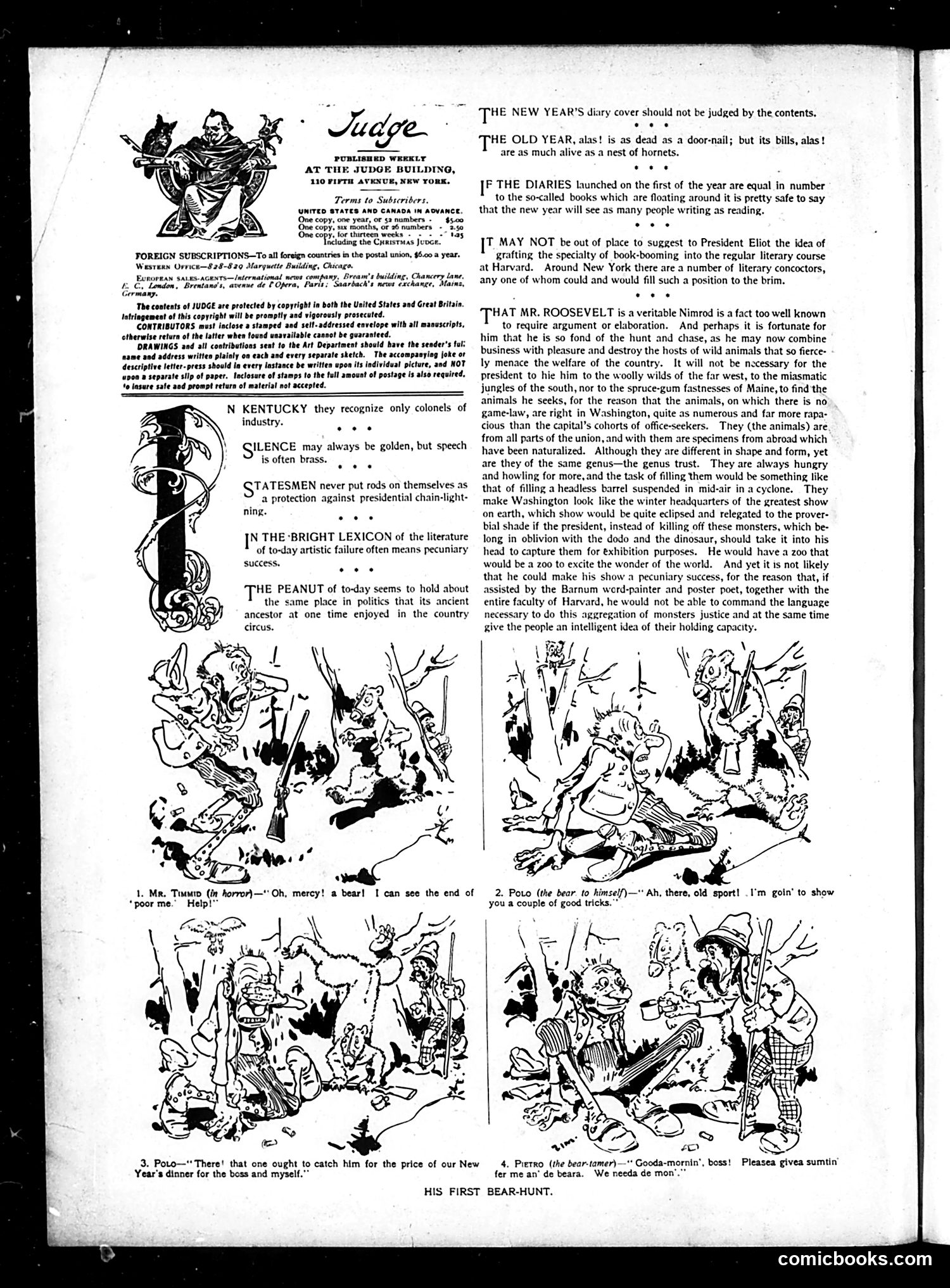
This page satirizes President Theodore Roosevelt's hunting interests. The text argues it would be inappropriate for Roosevelt to capture wild animals for exhibition purposes—suggesting he'd turn the White House into a zoo. The satire criticizes Roosevelt's well-known enthusiasm for hunting and outdoor pursuits, implying such activity conflicts with presidential dignity. The four comic panels below titled "His First Bear Hunt" appear to depict a comedic hunting scenario, though the specific narrative is difficult to parse from the small illustrations alone. The humor likely mocks either Roosevelt's hunting prowess or his obsessive dedication to the sport. The page also includes editorial snippets and decorative typography typical of Judge's satirical format, commenting on contemporary political and social topics in brief, witty observations.
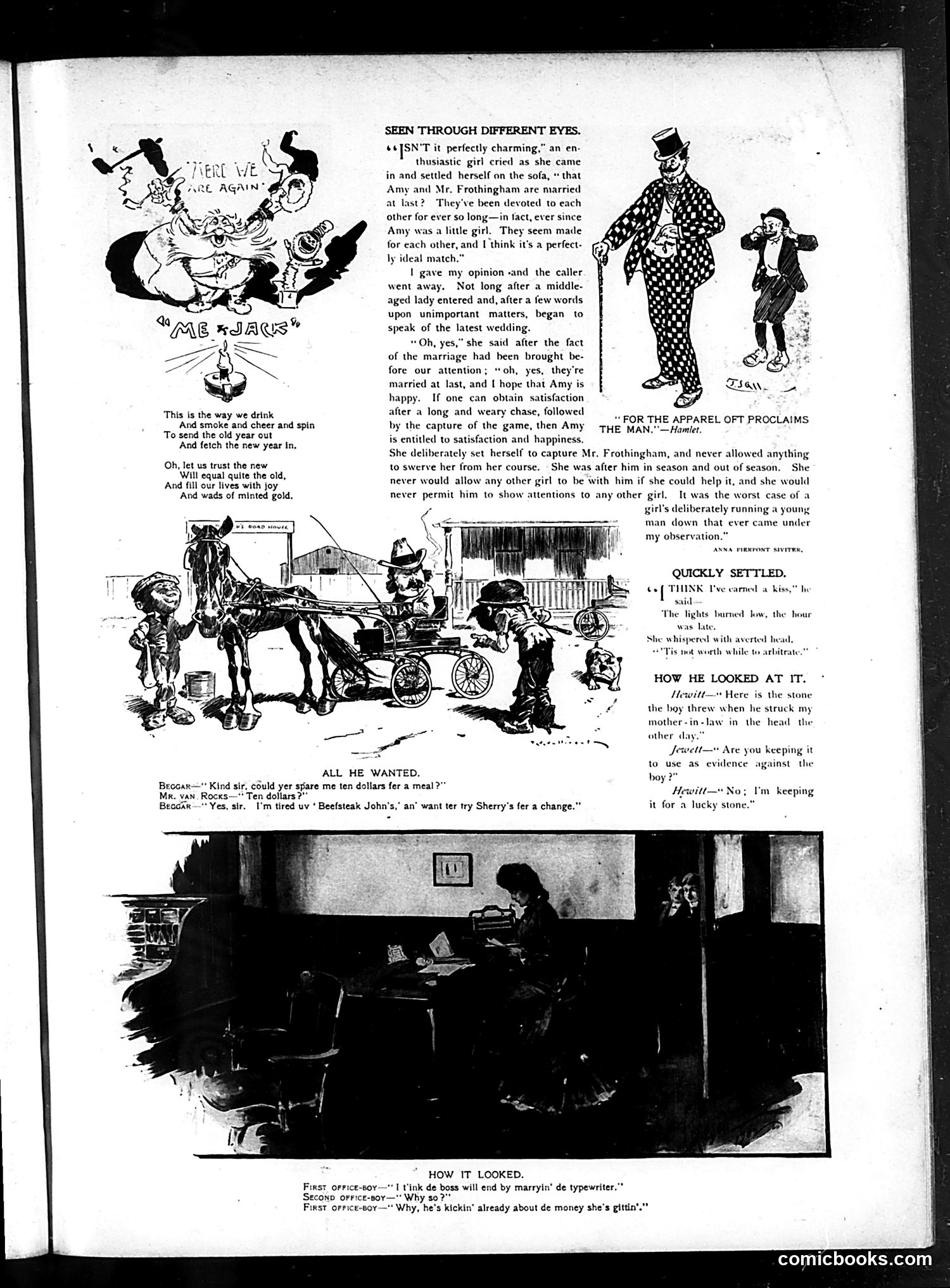
This page contains several satirical sketches about contemporary social customs and relationships. The main narrative, "Seen Through Different Eyes," satirizes Amy and Mr. Frothingham's recent marriage, mocking the couple's devotion—she pursues him relentlessly while he appears indifferent. The satire suggests this "perfect match" is actually one-sided obsession disguised as ideal romance. Additional sketches mock everyday absurdities: "All He Wanted" shows a beggar requesting ten dollars for a meal, revealing how people make increasingly elaborate excuses. "How It Looked" satirizes office romance, with employees gossiping about a coworker's typed love note. The page employs the magazine's characteristic approach—using brief, humorous vignettes to critique contemporary social behaviors and relationship dynamics without targeting specific political figures.
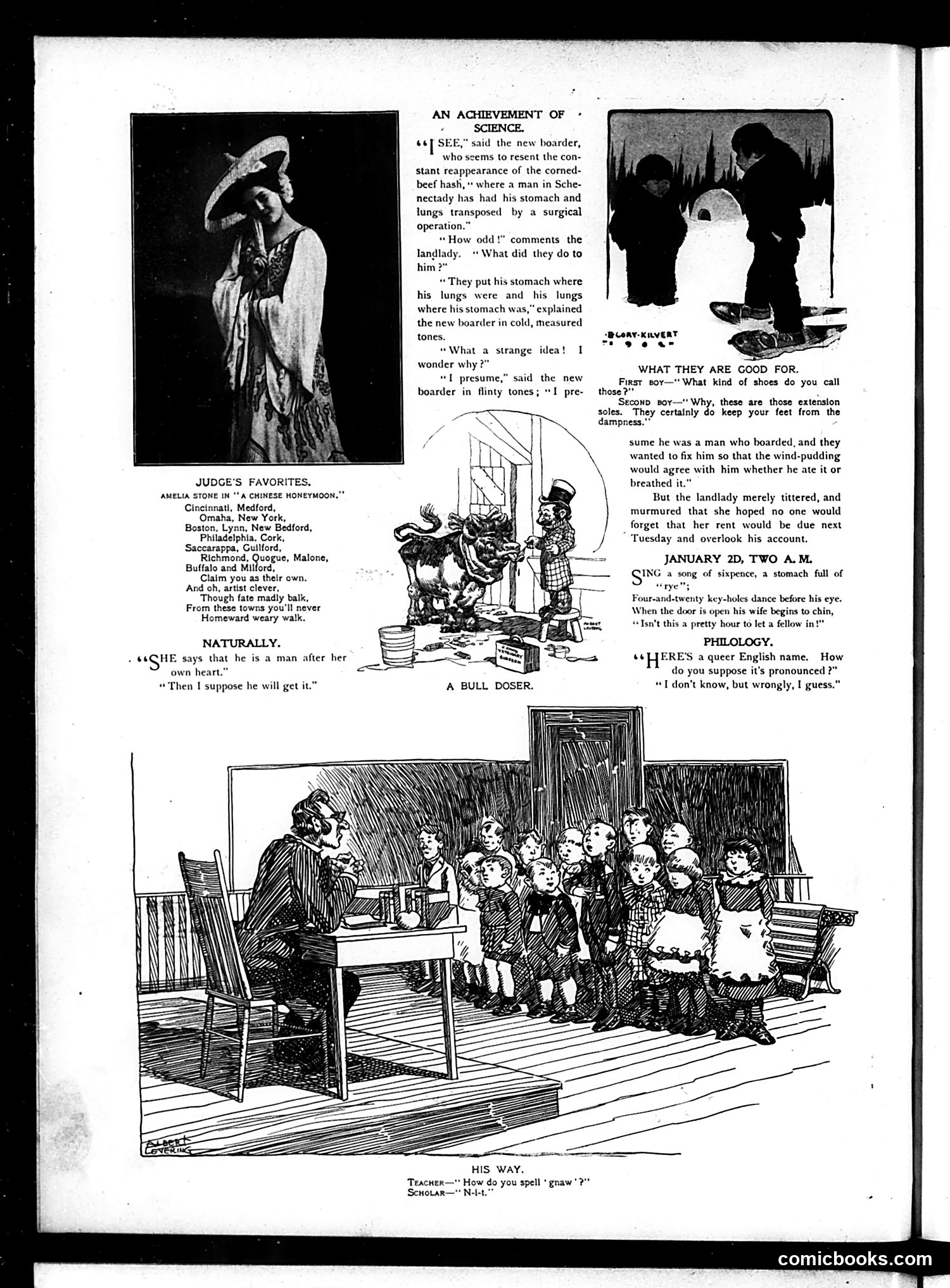
This page contains several unrelated humorous items rather than political cartoons: **"Judge's Favorites"** lists women's names with associated cities—appears to be commentary on popular actresses or notable women of the era. **"An Achievement of Science"** satirizes medical innovation: a new boarder horrifies others by describing a surgical procedure where a patient's stomach and lungs were transposed. The joke mocks both the strangeness of modern medicine and the boarder's graphic, unsettling dinner conversation. **"What They Are Good For"** features practical jokes about galoshes/overshoes and their utility. **"A Bull Dozer,"** "Naturally," "January 2d, Two A.M.," and **"His Way"** are miscellaneous brief humorous sketches and one-liners typical of Judge's miscellaneous humor sections. These lack specific political or social references identifiable from the page alone.
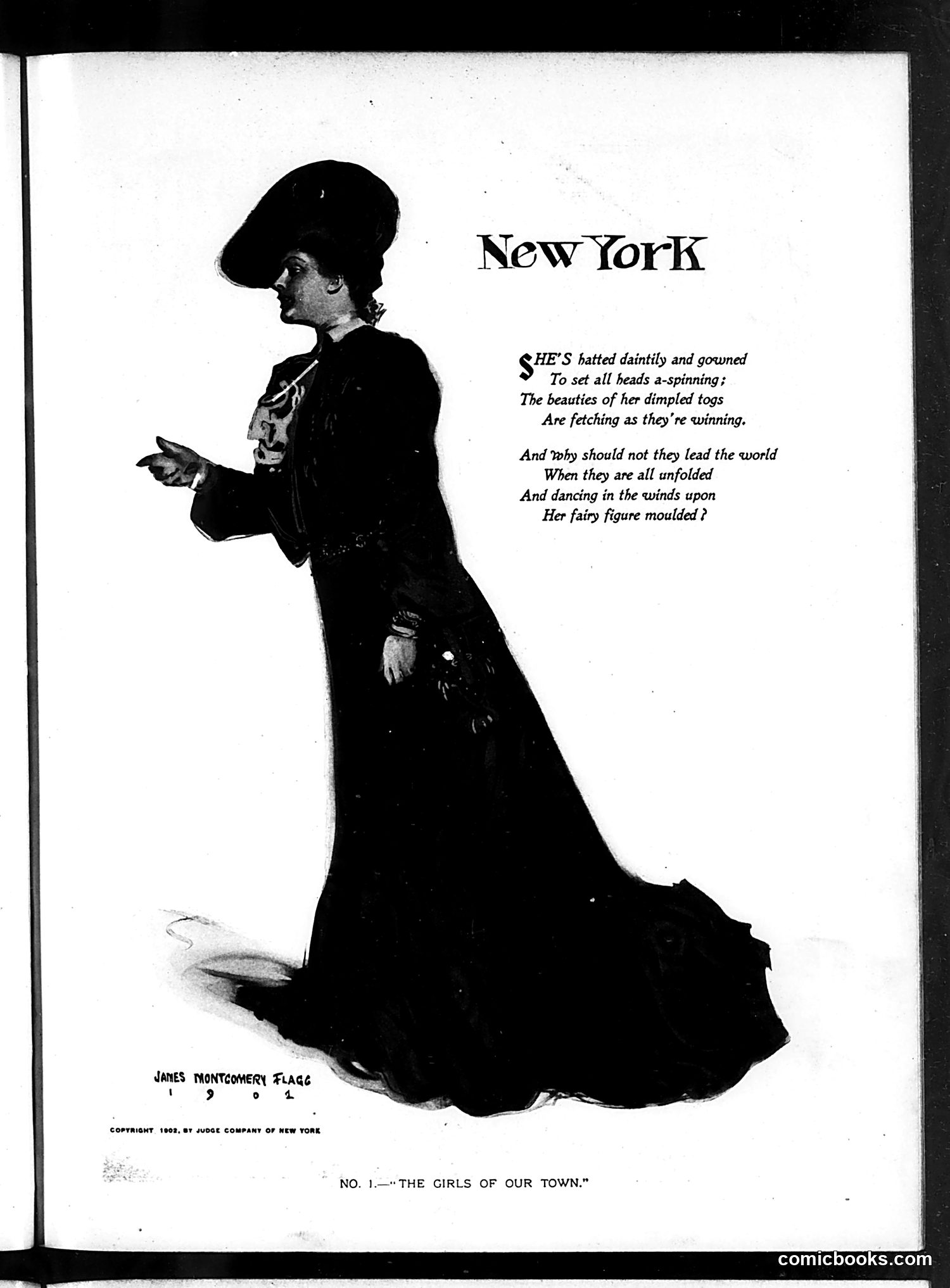
This is an illustration by renowned artist James Montgomery Flagg from Judge magazine's "Girls of Our Town" series. The image depicts an elegantly dressed woman in profile wearing fashionable early-1900s attire: a large decorative hat, fitted dark coat, and trailing skirt. The accompanying verse celebrates her fashionable appearance and social influence, suggesting that well-dressed women ("the beauties of her dimpled togs") naturally "lead the world." The satirical point appears to be a gentle mockery of how society—particularly New York society—prioritized women's fashion and appearance as measures of their importance and influence. This reflects turn-of-the-century attitudes about the "Gibson Girl" aesthetic and society women's role as arbiters of taste and style, while humorously suggesting this fashion-driven prominence was somewhat frivolous.
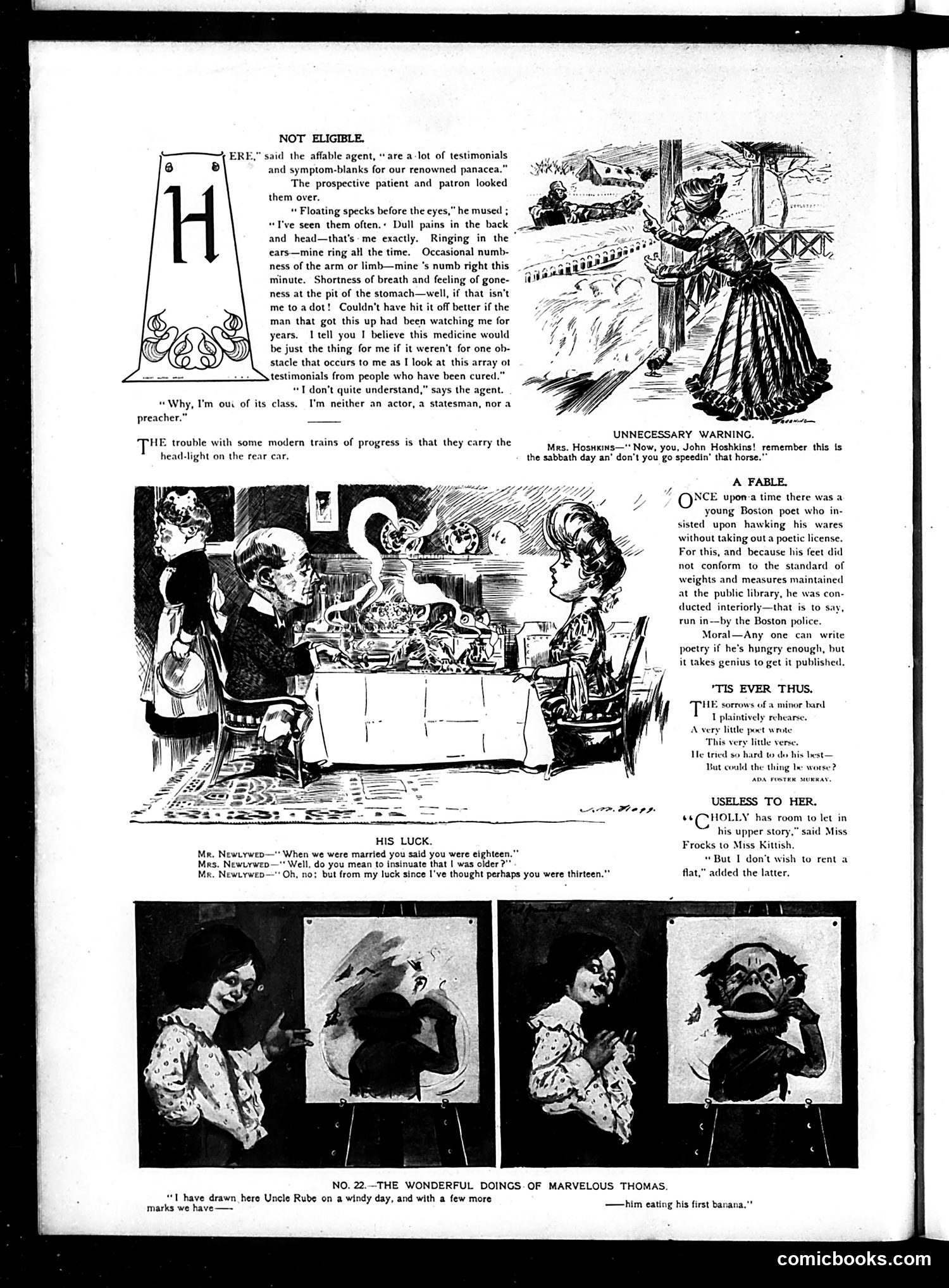
This page contains multiple unrelated satirical items typical of Judge magazine's format: **"Not Eligible"** mocks patent medicine advertising. A patient reads testimonial symptom-blanks that perfectly match his ailments, but refuses the "cure" because he's not a famous person—the testimonials come only from "actors, statesmen, [and] preachers." The satire targets both fraudulent medicine marketed through celebrity endorsements and the absurdity of excluding ordinary people from fake cures. **"Unnecessary Warning"** briefly mocks spousal nagging about safe driving ("don't speed that horse"). **"A Fable"** satirizes Boston's literary pretensions: a poor poet is arrested for selling unlicensed poetry and having feet that don't meet library weight standards. It jokes that hunger, not talent, drives poetry-writing. Additional short jokes mock minor poets, marital misunderstandings about age, and landlord disputes. The page is primarily humor content with no identifiable political figures—just social satire about American life, medicine, literature, and relationships circa early-20th century.
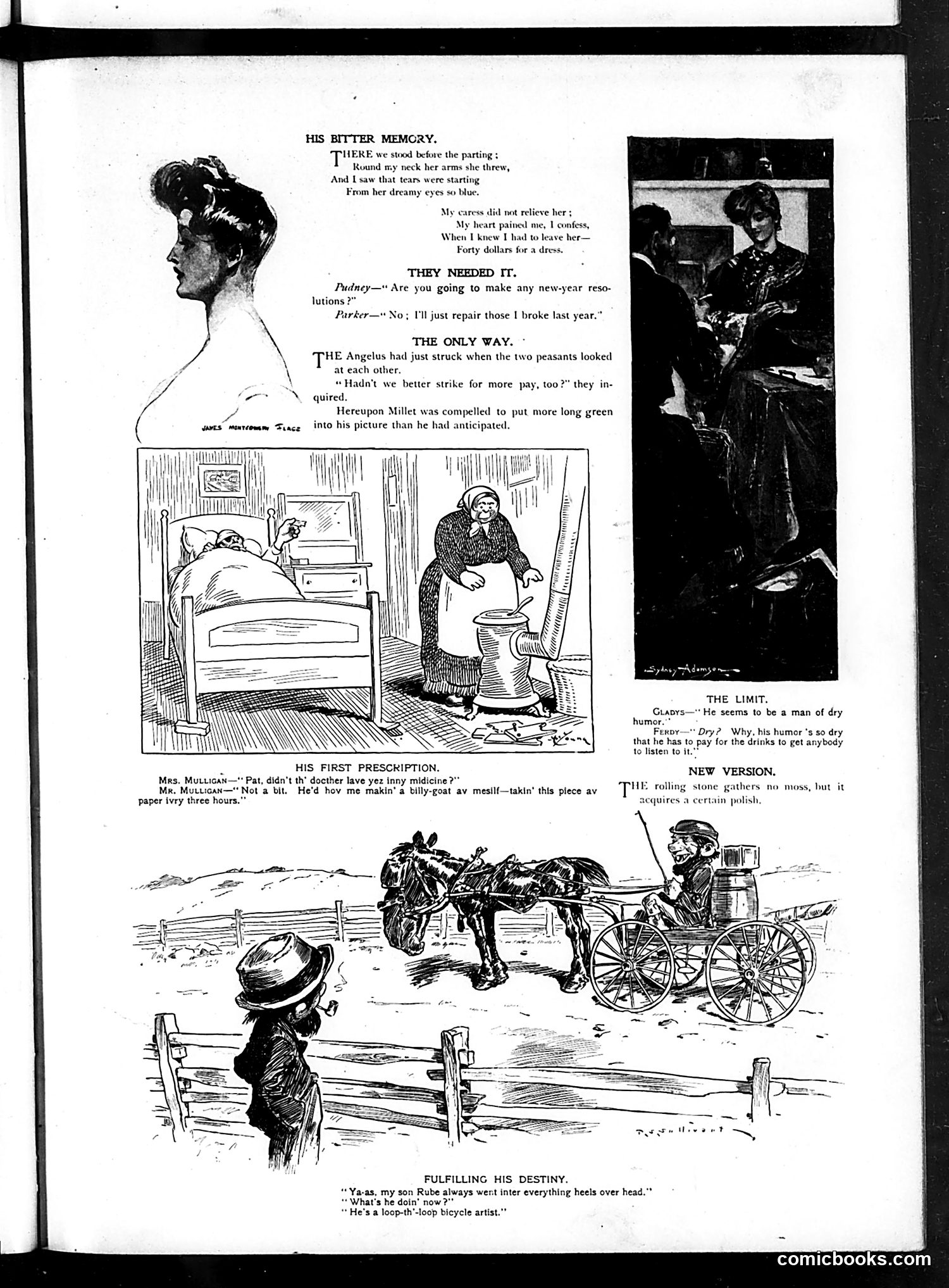
This page contains several satirical vignettes mocking common social situations: **"His Bitter Memory"** ridicules sentimental romance—the man's tearful parting is undercut by the reveal that he's actually upset about spending forty dollars on a dress. **"They Needed It"** jokes about New Year's resolutions being pointless; the character simply plans to repair last year's broken items rather than improve himself. **"The Only Way"** references Jean-François Millet's famous painting "The Angelus," suggesting that even peasants in classical art would demand higher wages—a jab at labor agitation and socialism. **"His First Prescription"** mocks Irish dialect humor (typical for the era) about a doctor's odd medical advice. **"The Limit"** is a standard "dry humor" pun. **"New Version"** plays on the proverb about rolling stones, applying it to polishing/refinement. **"Fulfilling His Destiny"** uses Irish-American vernacular to joke about a reckless boy becoming a stunt cyclist. The overall tone is light, working-class humor with ethnic stereotyping common to early 1900s American satire.
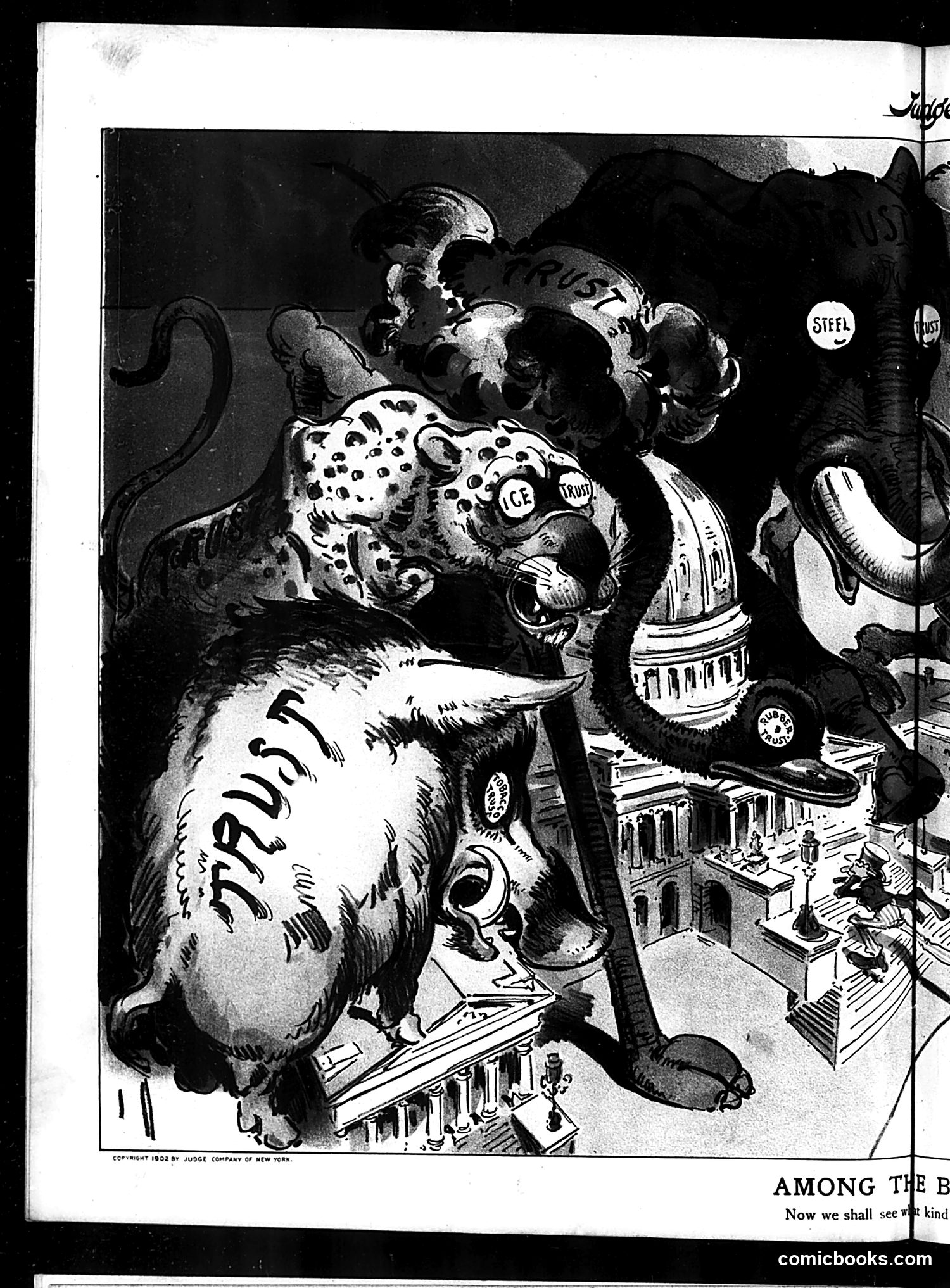
This appears to be a satirical cartoon from *Judge* magazine depicting what looks like various political or social figures as animals (possibly monkeys or apes) in an urban setting. Labels visible include "STEEL," "TRUST," and what appears to be "ICE"—likely referencing major industrial monopolies or trusts of the Gilded Age era. The cartoon seems to satirize powerful corporate interests or industrialists, representing them as bestial or primitive creatures wreaking havoc in a city. The architectural elements and detailed urban setting suggest commentary on industrial power's impact on civilization. However, the OCR text is too corrupted to identify specific individuals or read the article's explanatory text. Without clearer labeling or accompanying text, I cannot confidently identify which particular figures or trusts are being targeted, though the anti-monopoly sentiment is evident.
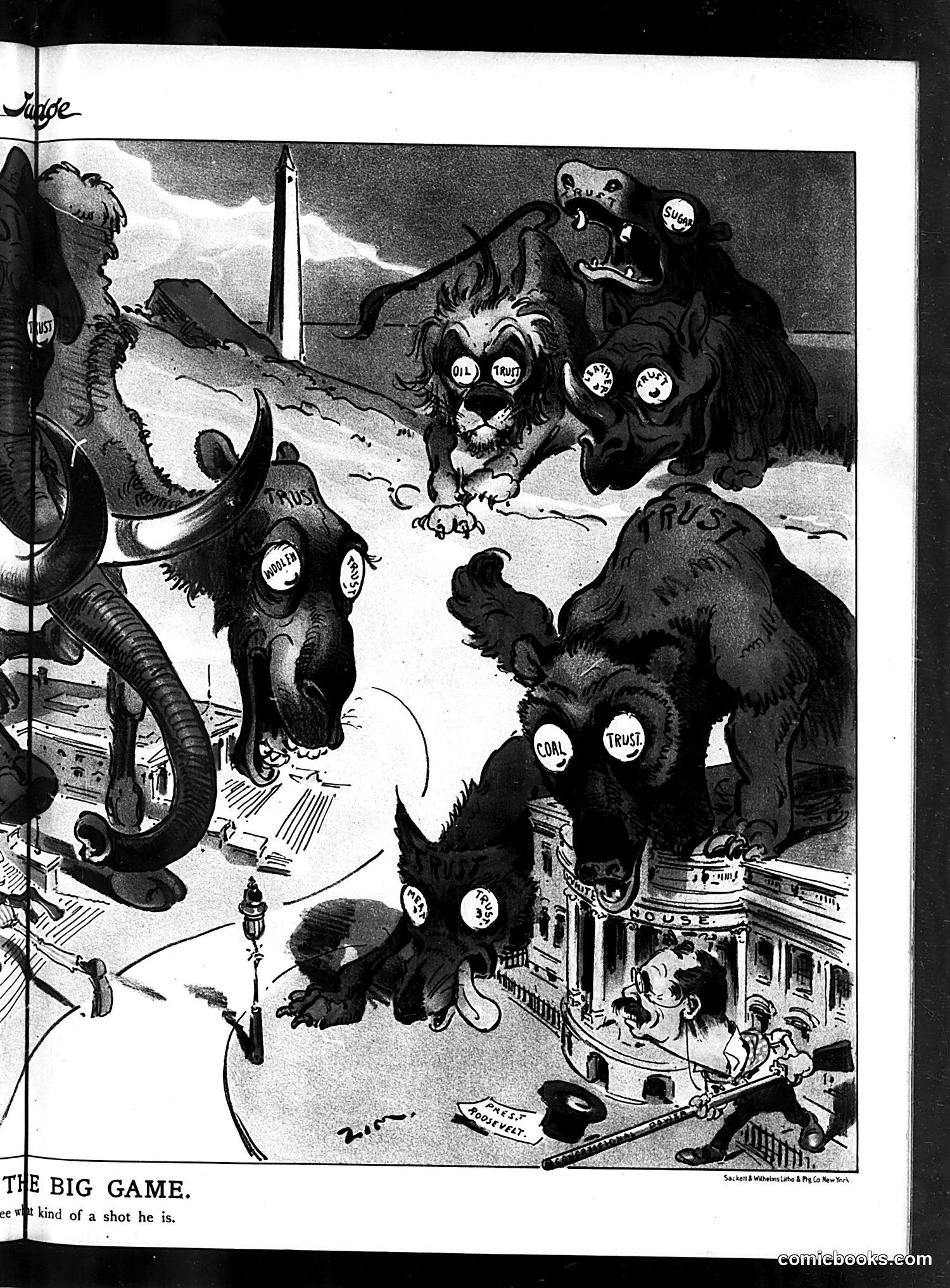
This satirical cartoon depicts various predatory animals labeled with trust-related labels ("OIL TRUST," "COAL TRUST," "SUGAR," etc.) surrounding the White House. The beasts appear menacing and are positioned as though circling prey. The cartoon critiques the monopolistic power of major industrial trusts in early 20th-century America—specifically oil, coal, and sugar cartels. By depicting them as dangerous wild animals, Judge magazine portrays these corporate entities as threats to democratic government itself. The White House at cartoon's center suggests the federal government is either powerless against or potentially captured by these economic powers. This reflects the Progressive Era's anti-trust sentiment, when politicians and satirists regularly attacked corporate monopolies as corrupting American democracy.
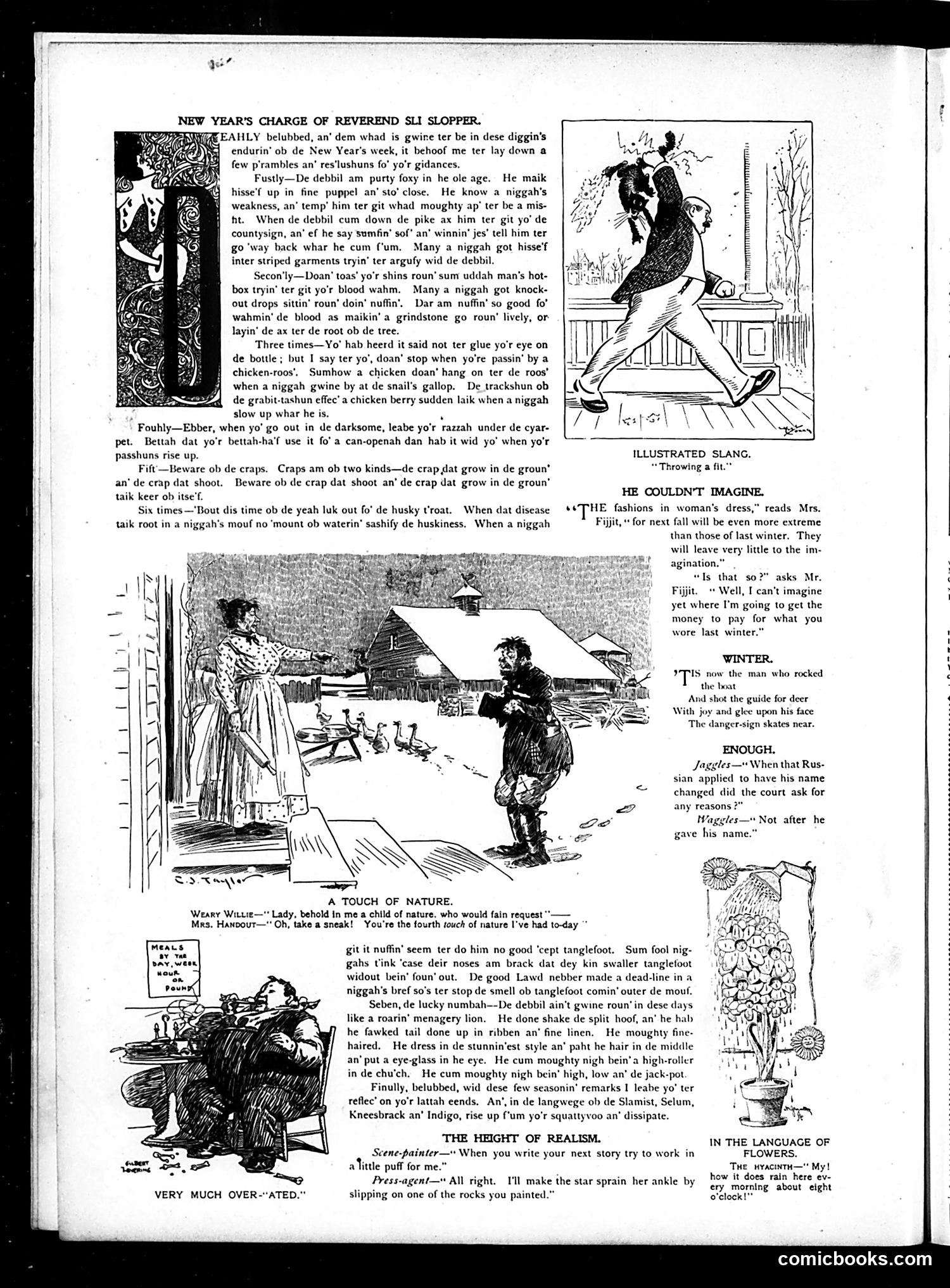
This page from Judge magazine features "Reverend Sli Slopper," a caricatured Black preacher delivering New Year's moral advice in exaggerated dialect. The satire employs deeply racist stereotypes common to 19th-century American humor. The "sermon" mocks African American speech patterns and uses caricature to present stereotypical vices—gambling ("craps"), alcohol ("tanglefoot"), and violence—as supposedly characteristic concerns requiring clerical intervention. The accompanying illustrations reinforce these stereotypes through exaggerated imagery. The other brief comedic pieces on the page ("He Couldn't Imagine," "Winter," "Enough," "A Touch of Nature," "The Height of Realism," and "In the Language of Flowers") are unrelated sketches using standard period humor formulas. This represents Judge's editorial stance: entertainment through racial caricature that dehumanizes Black Americans, presenting them as objects of ridicule rather than equal citizens.
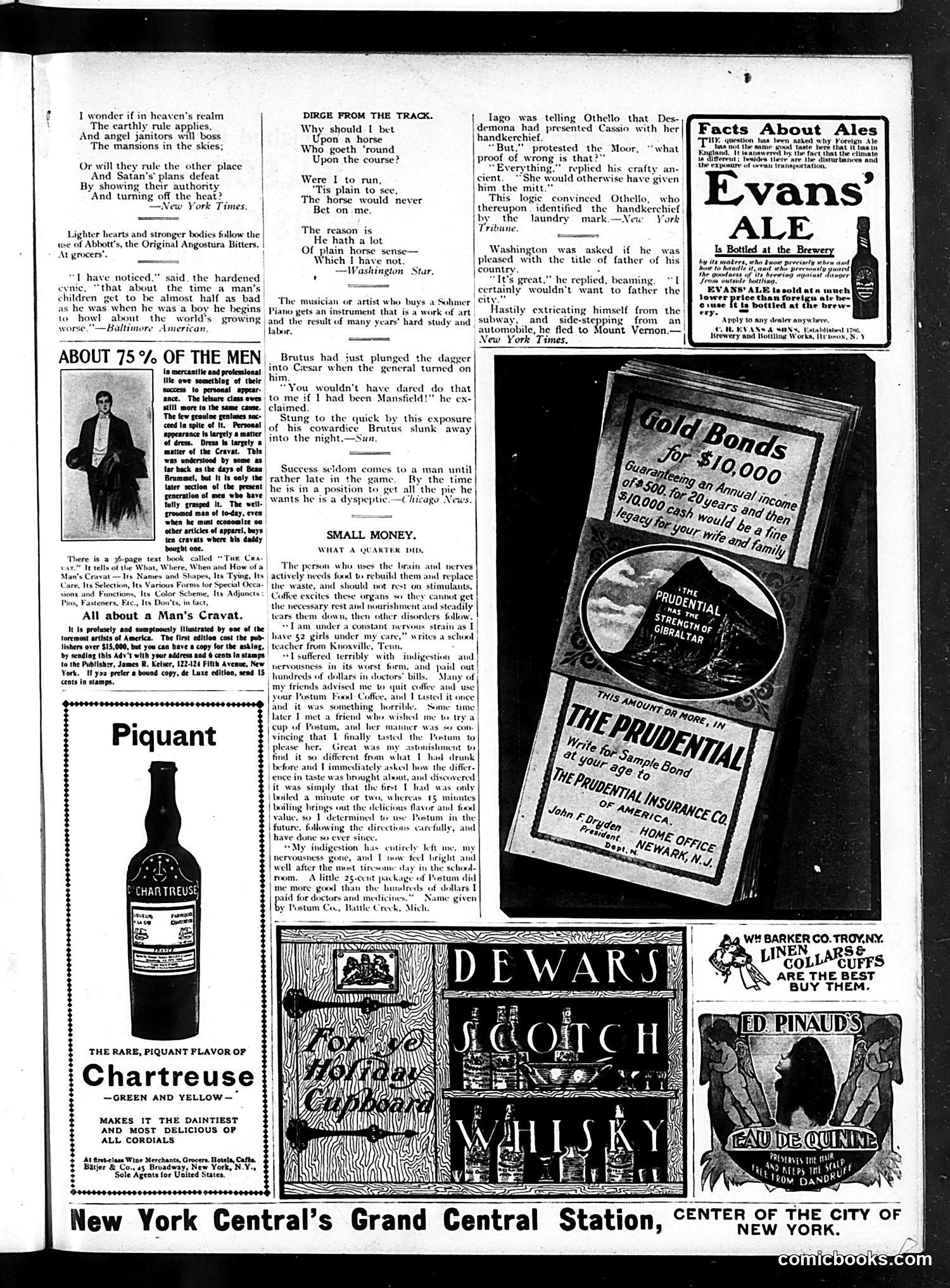
This page from *Judge* magazine is primarily **advertising with scattered humorous filler content** rather than political cartoons. The text snippets are short jokes about: - **Betting on horses** (two brief verses mocking the logic of wagering on animals) - **Celestial bureaucracy** (a satirical poem asking if heaven has janitors and authority figures like Earth) - **Men's fashion** (praising the evolution of the cravat as a status symbol) - **Coffee's health effects** (a testimonial promoting Postum, a caffeine-free coffee substitute) - **Shakespeare's *Othello*** (a brief, crude joke about the handkerchief plot) The advertisements dominate: Evans' Ale, Prudential Insurance, Chartreuse liqueur, Dewar's Scotch, and other products typical of early 20th-century publications. **No significant political satire is present.** The humor is lightweight, focused on everyday absurdities and product promotion rather than social commentary. This reflects *Judge*'s evolution toward commercialized content.
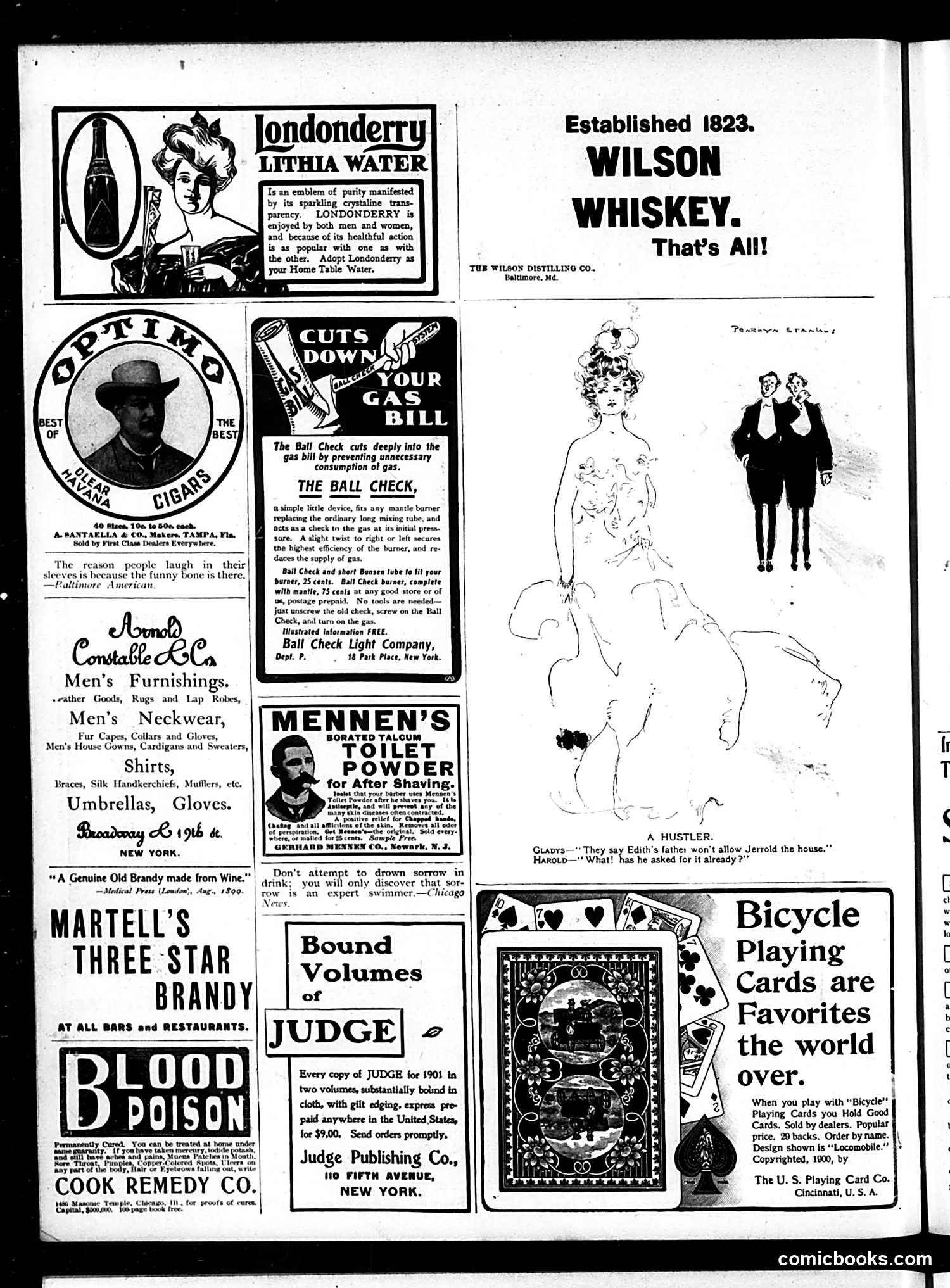
This page is primarily **advertisements** with one small cartoon at center-right. ## The Cartoon A brief comic labeled "A HUSTLER" shows two figures (Gladys and Harold) discussing a third person named Jerrold. Gladys mentions Edith's father won't allow Jerrold in the house; Harold responds that Jerrold has already asked for "it"—presumably Edith's hand in marriage. The humor relies on the double meaning: a "hustler" is someone aggressively pursuing something (here, marriage), and Harold's punchline suggests Jerrold moved so fast he proposed before being formally invited. ## Advertisements The page features various product ads typical of early 1900s publications: whiskey, brandy, men's furnishings, cigars, talcum powder, gas-saving devices, and playing cards. These reflect contemporary consumer goods and social conventions of the era. **Context note**: The page shows how Judge mixed satirical content with commercial advertising to fund publication.
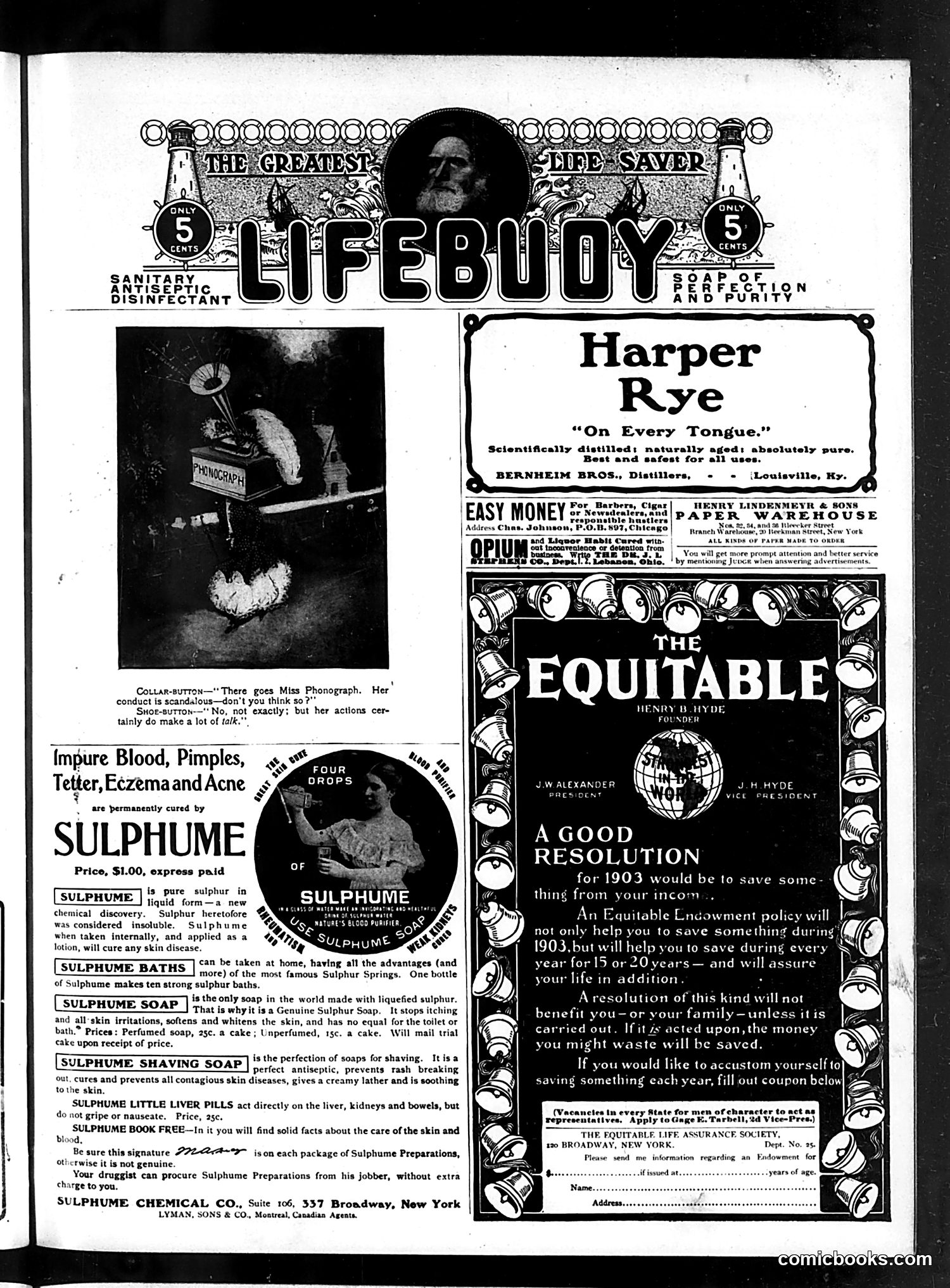
This page is primarily **advertising**, not political satire. The dominant content consists of commercial advertisements from early 1900s. The one cartoon present is a brief two-panel joke about "Miss Phonograph." The humor plays on the newly invented phonograph's ability to reproduce sound: a woman's scandalous conduct is compared to the machine's indiscriminate reproduction of whatever is recorded. The joke is that while her *actions* may not be inherently wrong, her *talk about them* spreads widely—like a phonograph broadcasting everything it captures. It's a mild commentary on gossip and modern technology's amplification of social chatter. The rest of the page features period advertisements for Sulphume (a patent medicine for skin conditions), Harper Rye whiskey, insurance policies, and other commercial products typical of the era.
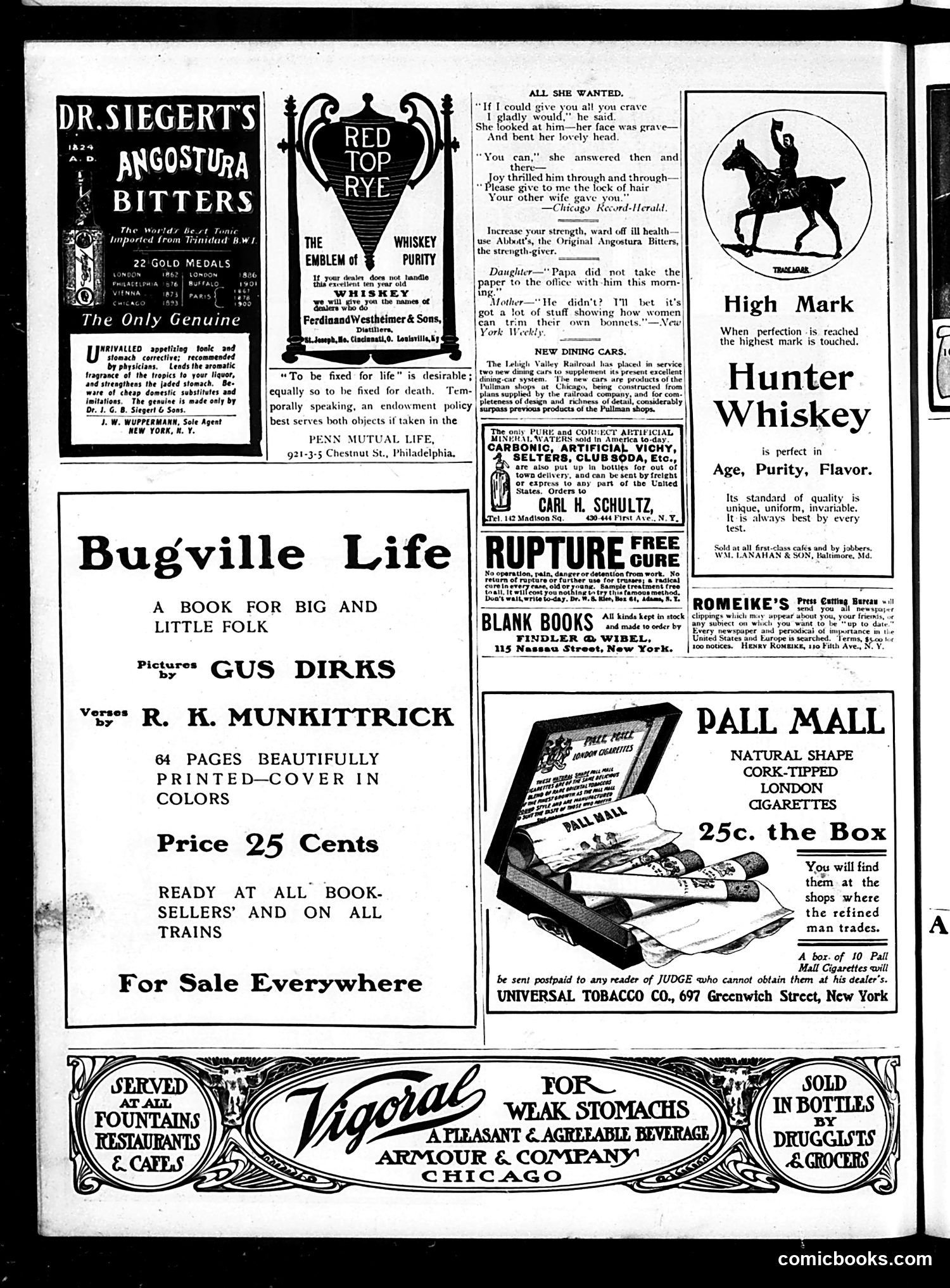
This page is primarily **advertising**, typical of early 20th-century magazines. The substantive editorial content consists of three brief humor pieces: 1. **"All She Wanted"** (top): A sentimental joke from the *Chicago Record-Herald*. A man offers a woman "all you era[?]" (likely "all you crave"), but she asks only for "the lock of hair / Your other wife gave you"—a joke about infidelity and a wife's bitter knowledge of her husband's affair. 2. **"New Dining Cars"** (middle): A brief joke about the Lehigh Valley railroad's new dining cars, contrasting "To be fixed for life" (desirable marriage) with being "fixed for death" (an insurance policy serving both purposes). 3. **Domestic humor** (right side): A daughter notes her father didn't take the newspaper to the office, implying he's embarrassed by articles about women's independence. The remaining content consists of period advertisements for whiskey, bitters, cigarettes, books, and patent medicines—standard Judge fare with no particular political satire evident on this page.
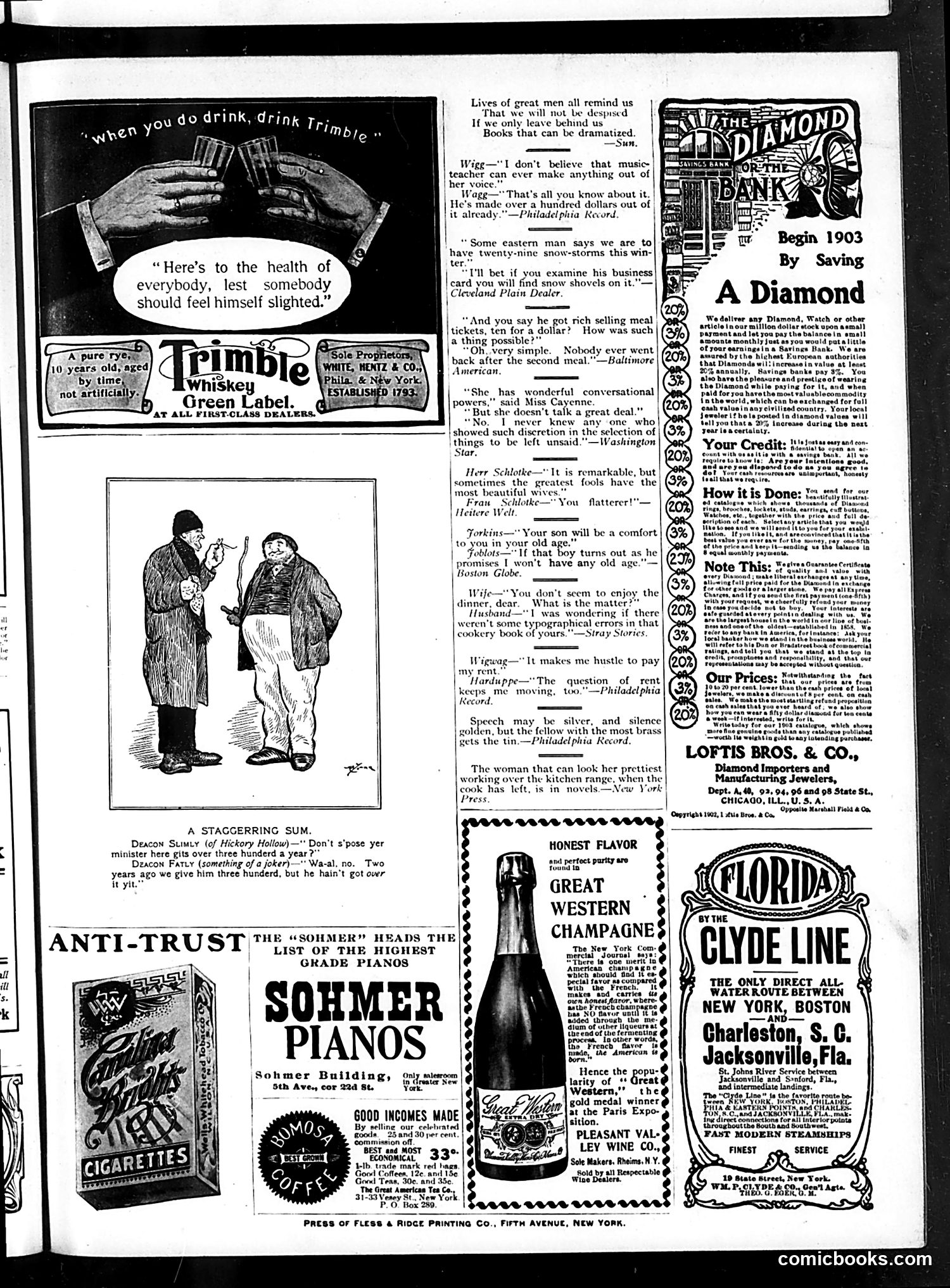
This page primarily contains **short humorous anecdotes and jokes** rather than political cartoons. The content reflects early 1900s American wit: **"A Staggering Sum"** depicts two rural deacons discussing their minister's salary—a joke about modest clergy compensation in small towns. **Other jokes** mock contemporary social concerns: a music teacher profiting from a student's poor voice, a man getting rich selling discounted meal tickets (because customers never return), and a son unlikely to provide comfort in old age. **The satirical edge** targets: incompetent professionals profiting anyway, consumer gullibility, and generational anxiety about youth. One joke critiques wives who remain beautiful despite kitchen drudgery as purely fictional fantasy. **The remainder of the page is advertising**—for Trimble whiskey, Sohmer pianos, Western Champagne, and steamship lines—typical of Judge's revenue model. The humor assumes readers share skepticism about authority figures, business schemes, and social pretense.
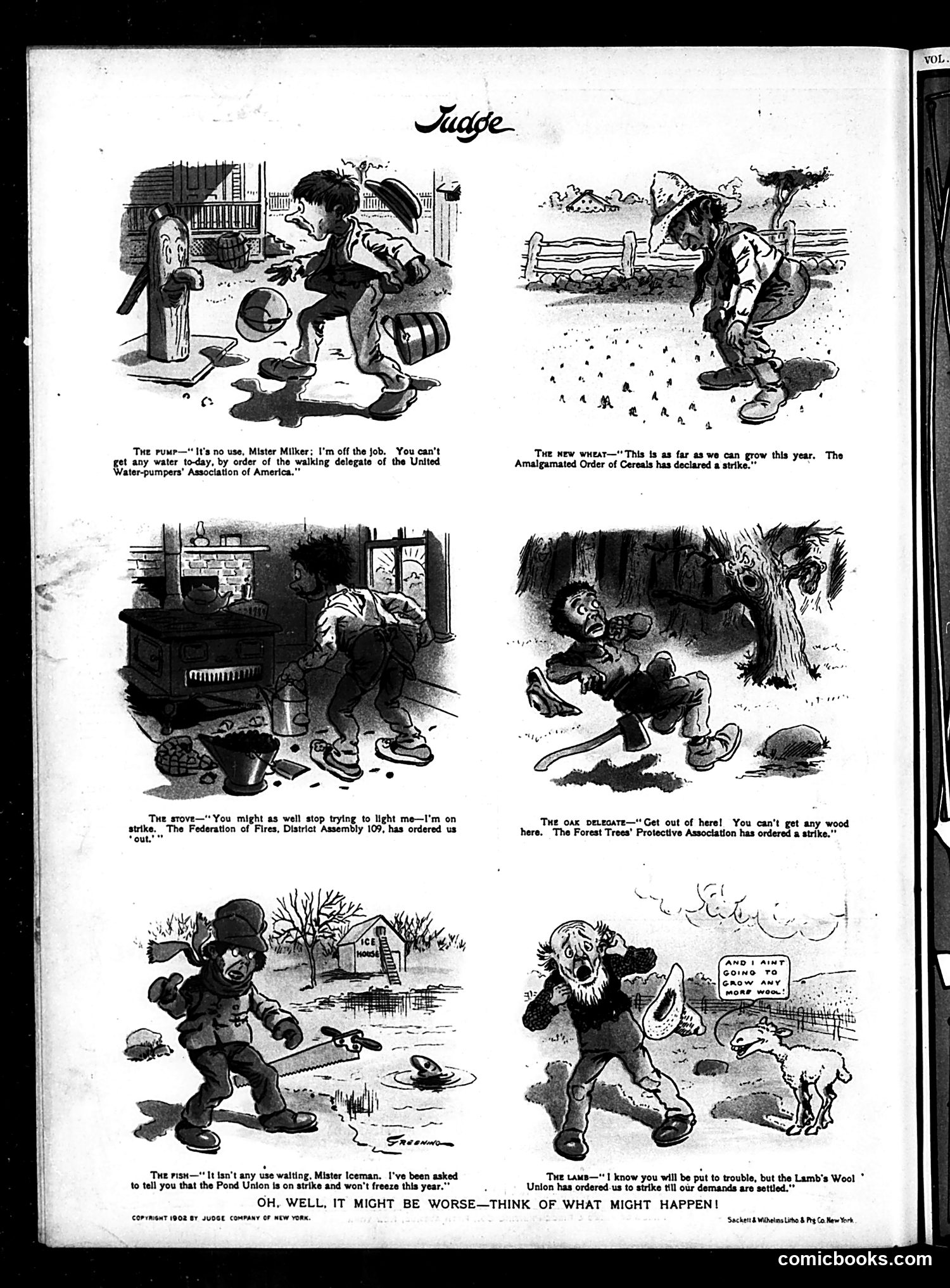
This is a six-panel satirical cartoon mocking the labor movement's proliferation of strikes in early 1900s America. Each panel depicts an essential resource or service personified as having "unionized" and declared a strike: - **The Pump** (water workers) - **The Stove** (Federation of Fires) - **The New Wheat** (Amalgamated Order of Cereals) - **The Oak** (Forest Trees' Protective Association) - **The Fish** (Pond Union) - **The Lamb** (Lamb's Wool Union) The cartoon ridicules union organizing by absurdly extending strike logic to inanimate objects and animals—implying labor activism had become excessive and ridiculous. The caption's sarcasm ("it might be worse—think of what might happen!") suggests fear-mongering about labor unrest. This reflects Judge's anti-labor stance during an era of significant American labor disputes and unionization efforts. The satire targets what the magazine viewed as unreasonable strike demands disrupting essential services.