
A complete issue · 16 pages · 1902
Judge — December 13, 1902
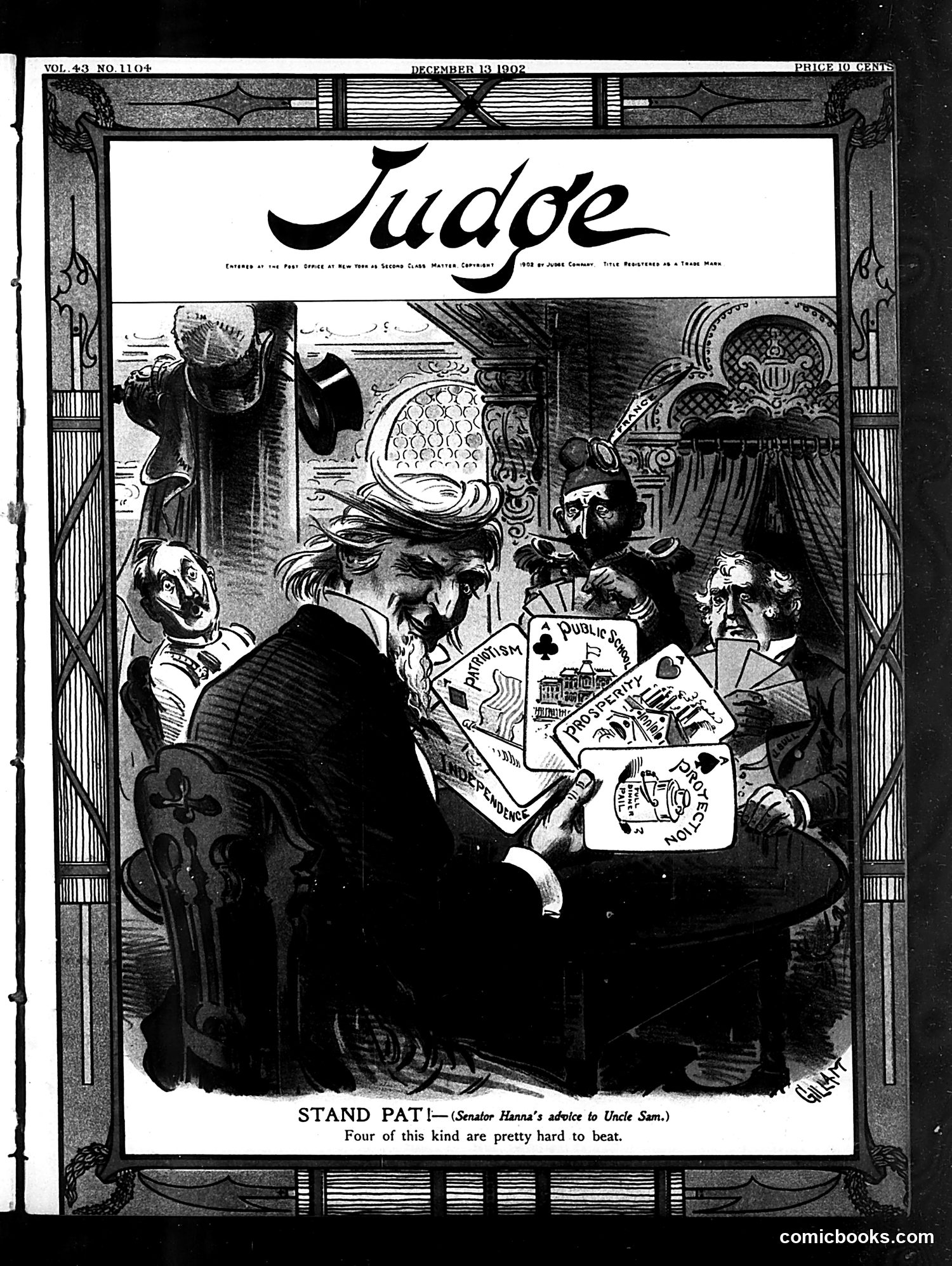
This cartoon satirizes Senator Mark Hanna's advice to "Uncle Sam" (the U.S. government). Hanna, a powerful Republican kingmaker, is shown dealing cards labeled with various political positions—"Patronage," "Public Service," "Prosperity," and "Protection"—suggesting he controls government policy like a card game. The title "Stand Pat" is a poker term meaning to keep your current hand without drawing new cards. The satire criticizes Hanna's conservative political strategy of maintaining the status quo rather than pursuing reform or change. The caption claims "Four of this kind are pretty hard to beat," mocking Hanna's confidence in his political establishment while implying his approach is mere gambling with the nation's interests rather than principled governance.
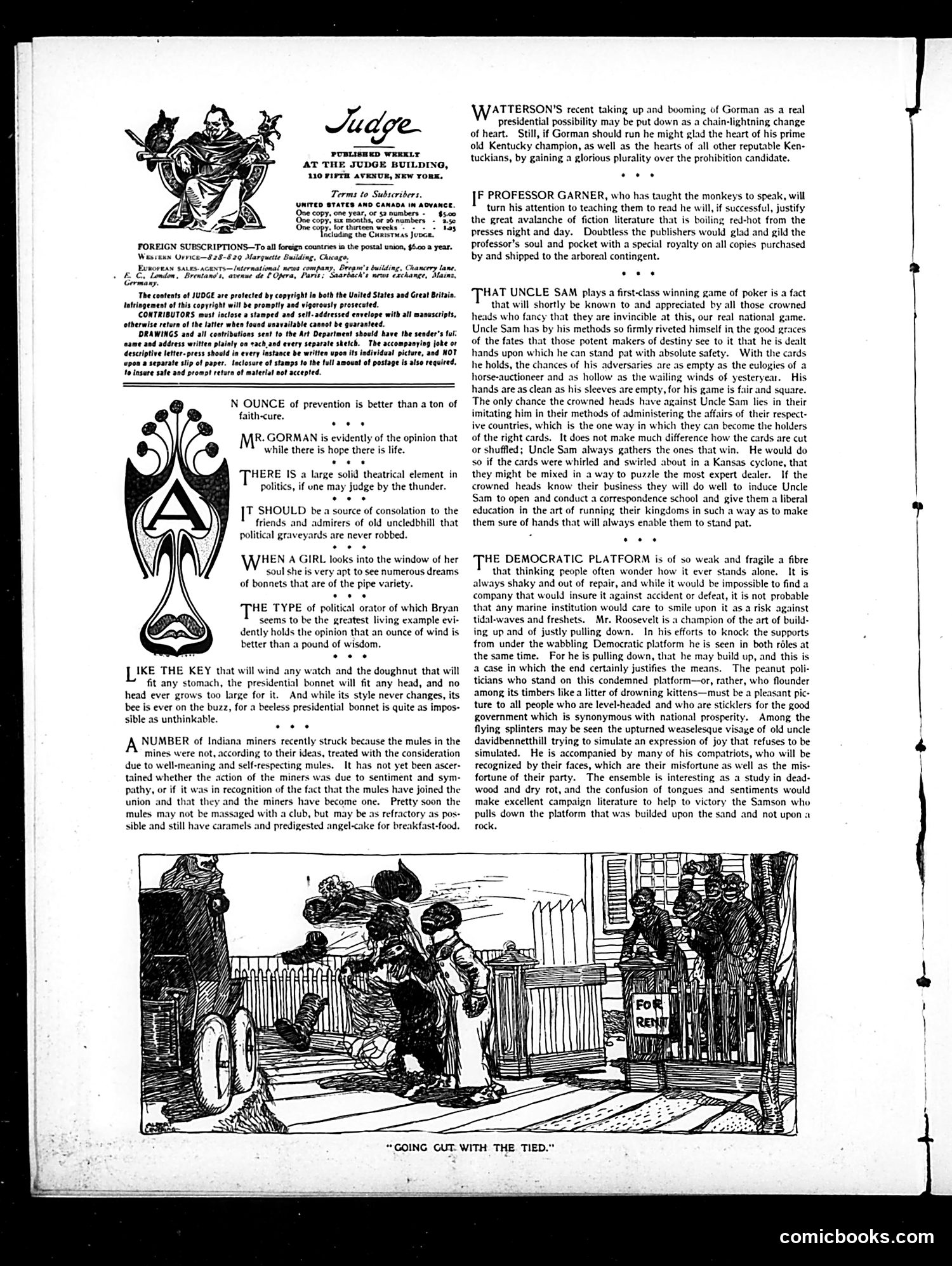
This satirical page from Judge magazine contains several political commentaries typical of early 20th-century American humor: **Top Section:** The editorial pieces mock various political figures and situations. References include Watterson (likely a politician), Gorman, and Uncle Sam playing poker—a metaphor for America's diplomatic maneuvering. The poker commentary satirizes how politicians attempt to manipulate outcomes through cunning rather than honest methods. **Bottom Cartoon ("Going Cut with the Tied"):** Depicts what appears to be a traffic or safety violation scenario, likely critiquing either reckless driving or disregard for public safety regulations—a growing concern during the automobile age. The overall tone is cynical toward political manipulation and institutional hypocrisy, using anthropomorphized figures (Uncle Sam) and metaphorical scenarios to critique contemporary governance.
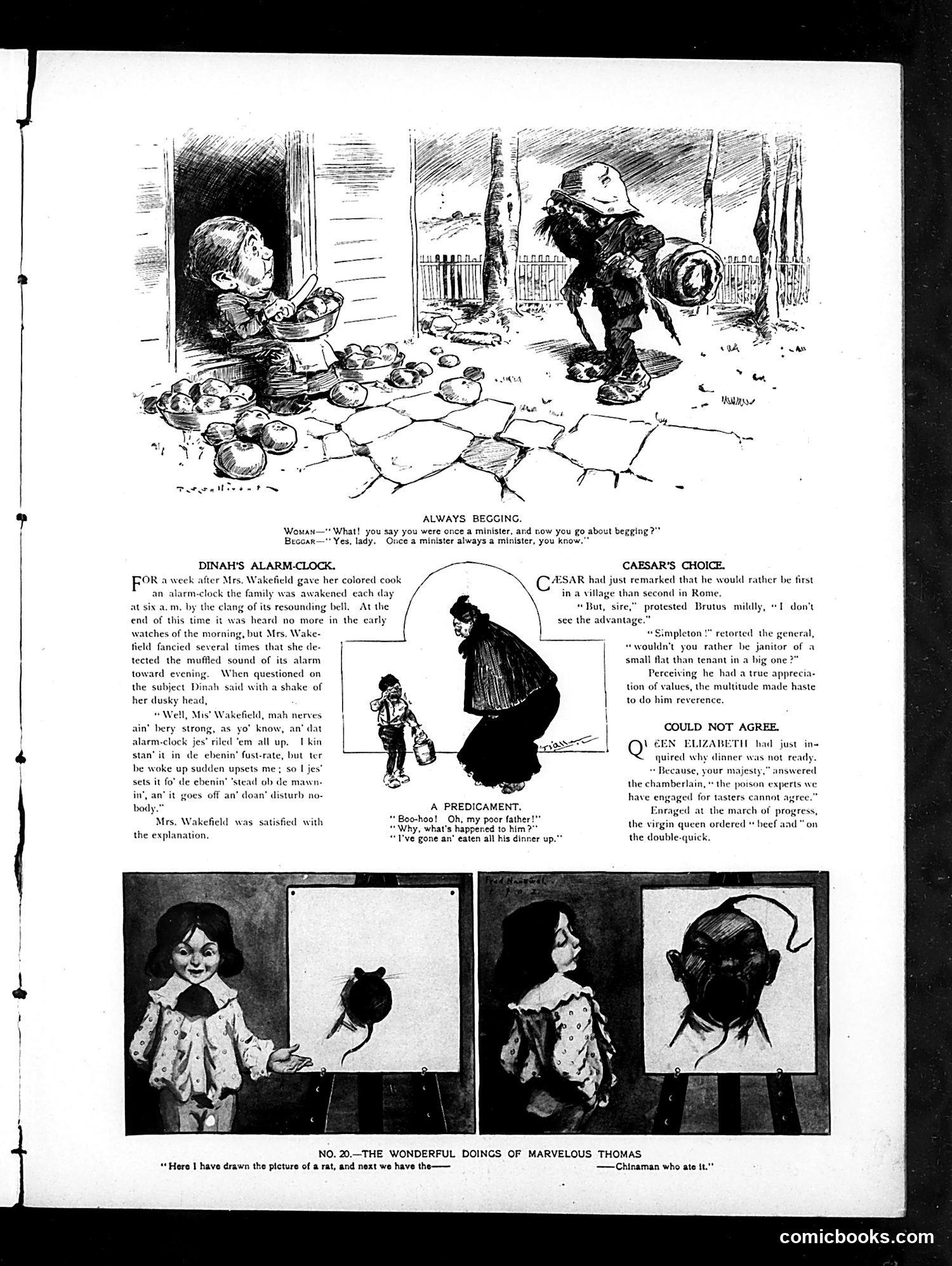
This page contains three distinct satirical pieces: **"Always Begging"** (top sketch): Mocks the contradiction of a beggar who claims former respectability. A woman asks why he begs despite claiming to have been a minister; he responds that ministers always beg—sharp social commentary on clergy fundraising practices. **"Dinah's Alarm-Clock"** and **"Caesar's Choice"** (middle): Two brief humorous anecdotes about domestic servants and their employers' pretensions, poking fun at social hierarchies and class assumptions. **"The Wonderful Doings of Marvelous Thomas"** (bottom): Shows a child drawing pictures—apparently a rat, then claiming to have drawn something else. The caption suggests this is about childish deception or misrepresentation, likely mocking exaggerated claims or fraud. The overall theme appears satirizing social pretense and dishonesty across class lines.
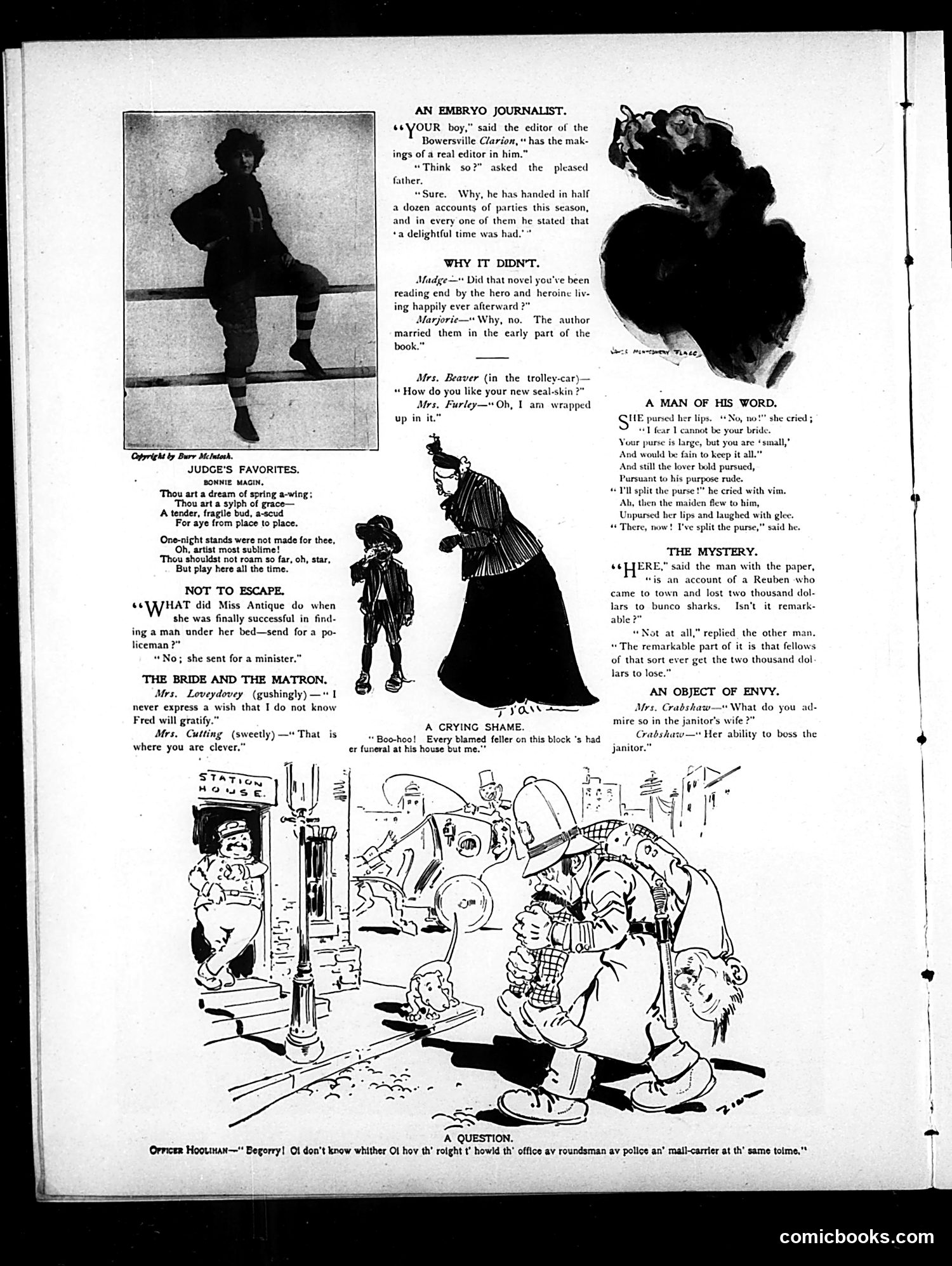
This page contains several short satirical pieces and illustrations typical of Judge's humor: **"An Embryo Journalist"** mocks an editor at the Bowersville *Clarion*, suggesting he possesses editorial qualities despite limited experience. **"Bonnie Mason" poem** appears to be light verse about a woman with spring-like qualities. **"Why It Didn't"** and **"The Bride and the Matron"** are brief comedic dialogues poking fun at domestic situations and romantic expectations. **"A Question"** (bottom cartoon) depicts what appears to be police or authority figures in a humorous domestic scene, likely satirizing bureaucratic absurdity. The overall tone is gentle, domestic satire typical of early-20th-century humor magazines—mocking everyday situations, relationships, and small-town life rather than addressing major political issues.
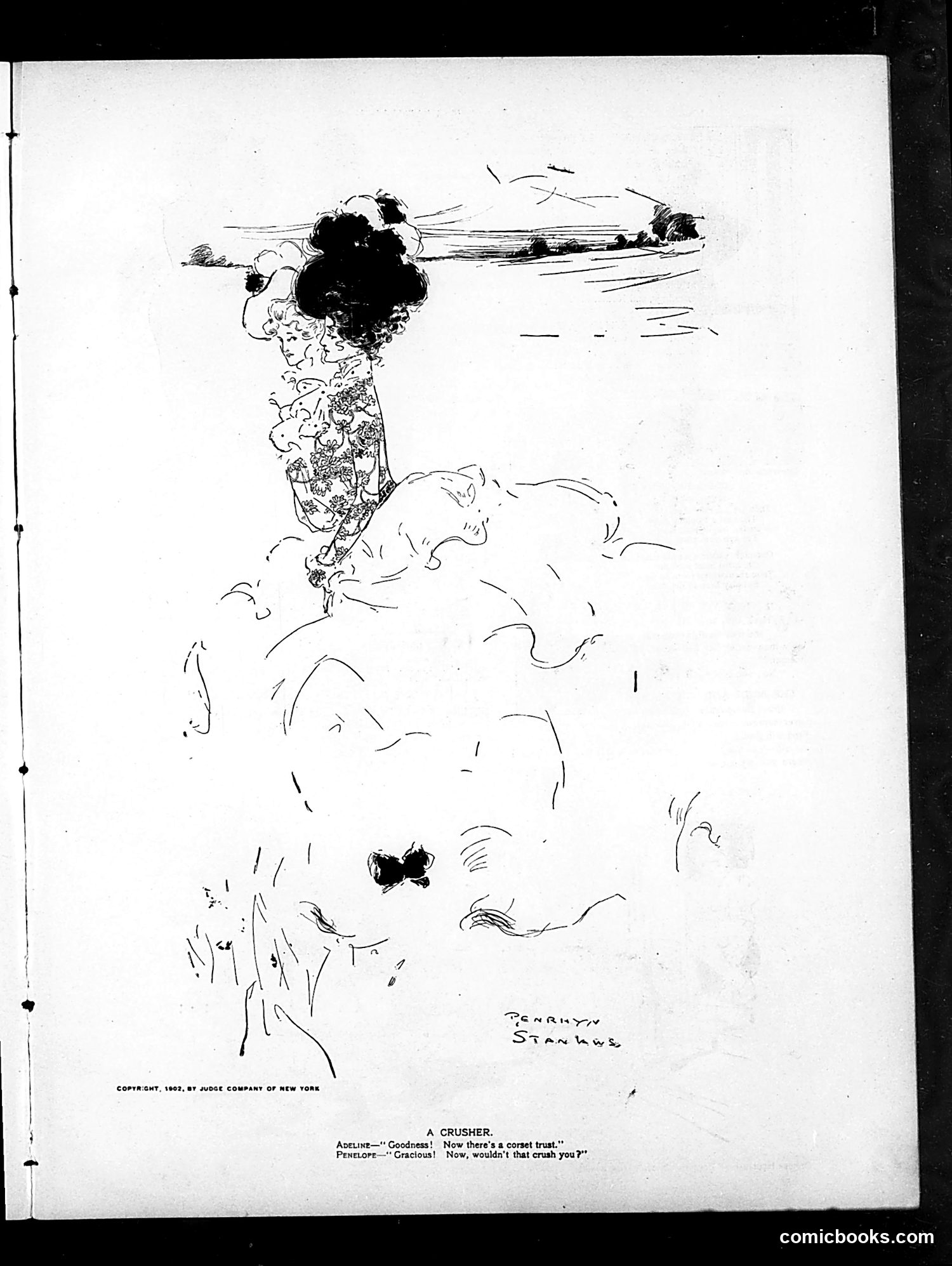
This early 20th-century cartoon satirizes the "corset trust"—referring to monopolistic corset manufacturers consolidating into large corporations. Two women (Adeline and Penelope) discuss this business consolidation. The humor operates on a double meaning: "crusher" references both the trust's market dominance and the literal crushing effect of corsets on women's bodies. Penelope's response plays on this pun—wouldn't such a trust "crush you" both figuratively (economically) and literally (physically)? The cartoon reflects Progressive Era anxieties about corporate monopolies ("trusts") while simultaneously making light of women's fashion constraints. The figure at top wearing an ornate corset visually reinforces the literal crushing referenced in the joke.
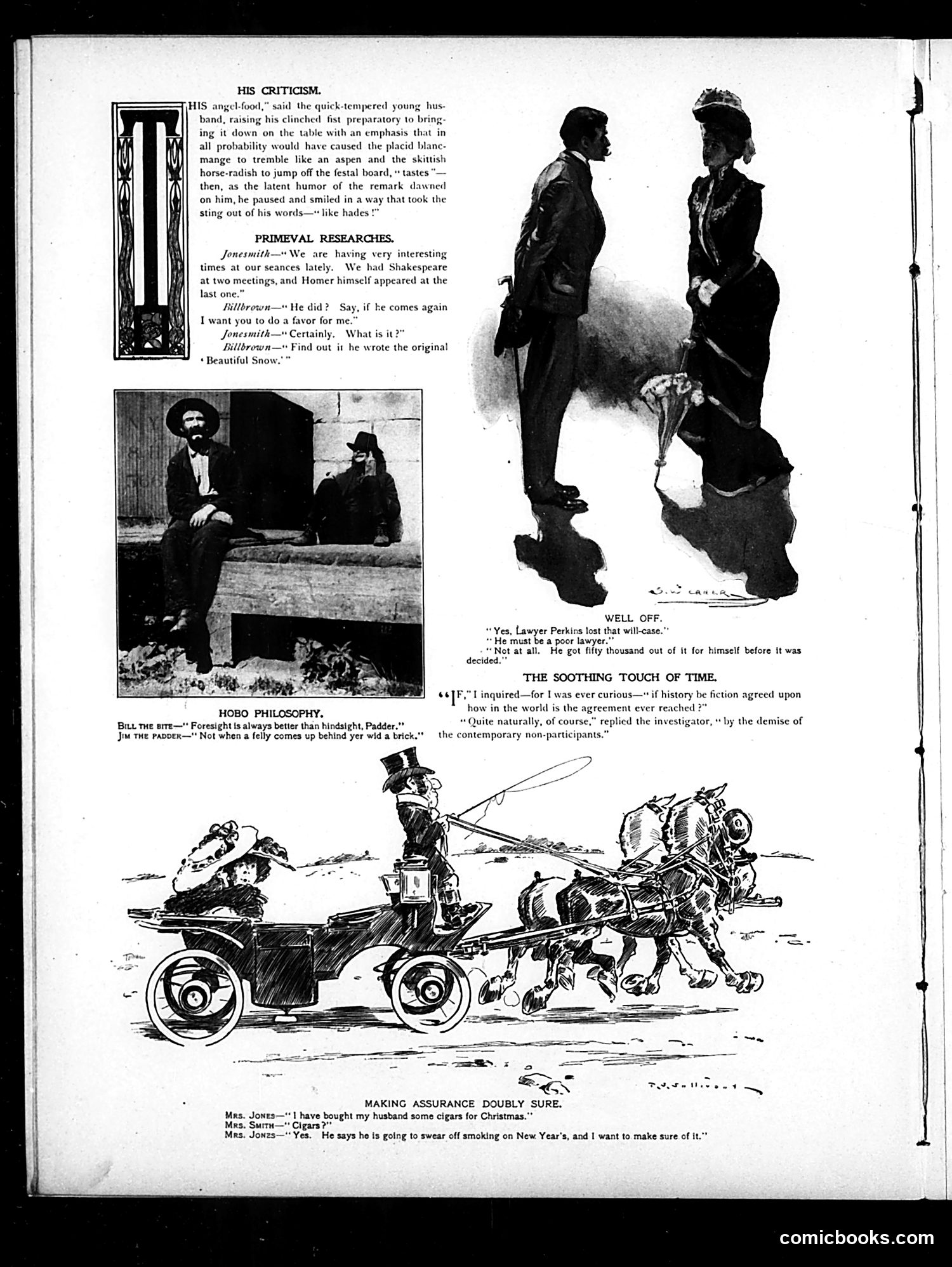
This page contains multiple short satirical pieces typical of early 20th-century American humor: **"His Criticism"** mocks domestic disputes—a husband nearly strikes the table over his wife's cooking, then laughs at his own anger. **"Primeval Researches"** satirizes spiritualism séances (then popular), joking that someone contacted Homer and Shakespeare. The humor turns on asking Homer to verify authorship of "Beautiful Snow," a sentimental Victorian poem—absurdly attributing it to ancient Homer. **"Well Off"** cynically observes that lawyers profit regardless of case outcomes; Perkins lost the will-case but extracted fifty thousand dollars personally anyway. **"Hobo Philosophy"** presents tramps as folk-wisdom dispensers, contrasting foresight versus hindsight, with the punchline that hindsight doesn't matter when "a felly comes up behind yer wid a brick." **"Making Assurance Doubly Sure"** jokes that Mrs. Jones buys her husband cigars before his New Year's smoking resolution, ensuring he'll smoke them immediately—undermining his willpower through advance planning. The cartoons reflect period preoccupations: spiritualism, legal corruption, class humor about hobos, and domestic life.
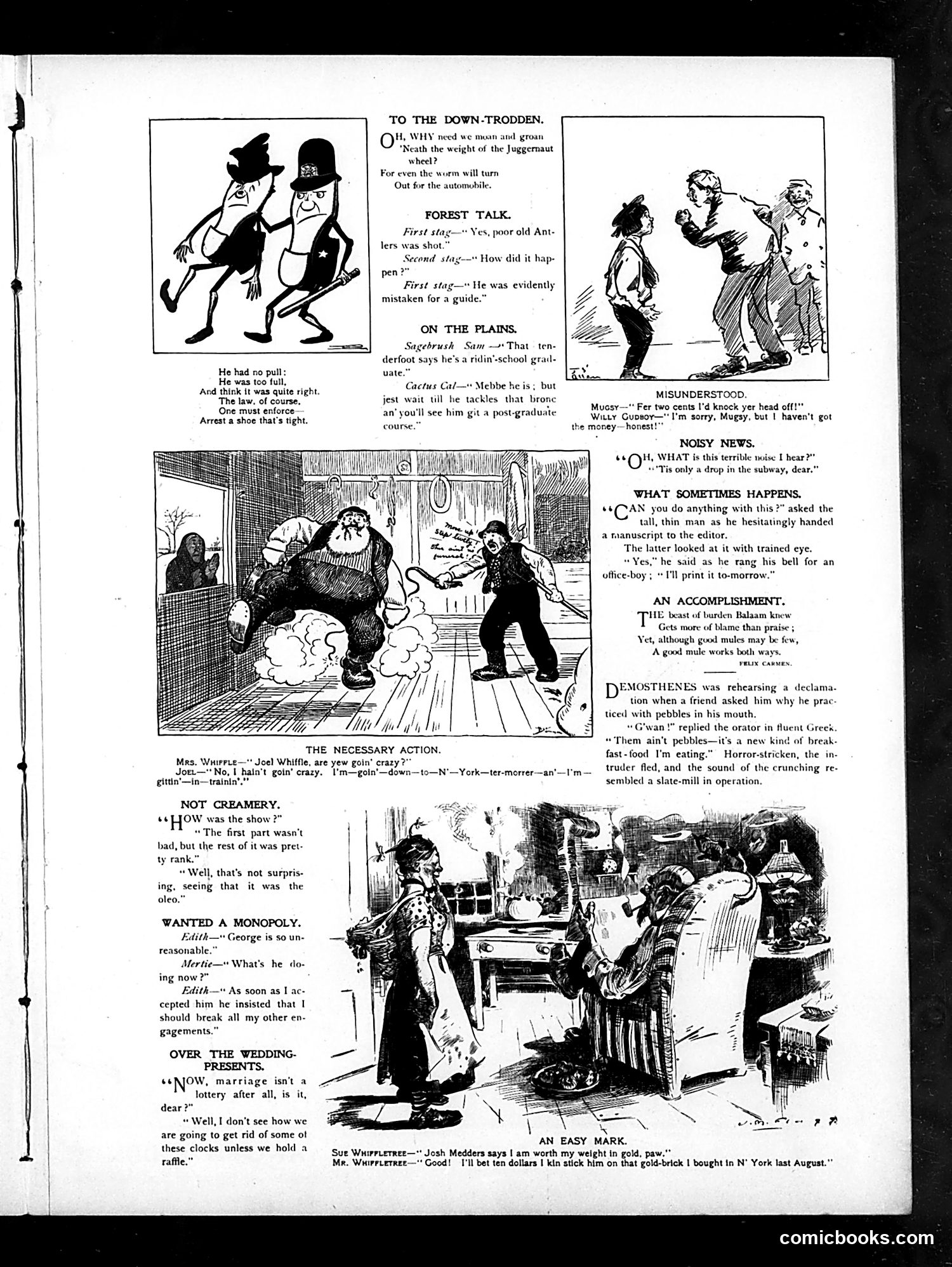
This page contains multiple brief satirical sketches typical of early 20th-century American humor magazines: **Main themes:** 1. **Automobile satire** ("To the Down-Trodden"): Mocks the new automobile as a social equalizer—even the powerless can now flee oppression. 2. **Rural/frontier humor**: Several sketches lampoon country folk and their misadventures (mistaken hunters, inexperienced riders on the plains). 3. **Urban/modern life jokes**: Subway noise, manuscript rejections, wedding gift clutter. 4. **Social climbing and courtship humor**: A man demanding exclusivity from his fiancée; matrimonial gift problems. 5. **Gender/marital dynamics**: Women outsmarting men in financial dealings (the gold-brick con). The overall tone reflects urban, educated readers' amusement at rural simplicity, modern inconveniences, and relationship complications—typical Judge magazine fare targeting middle-class city dwellers.
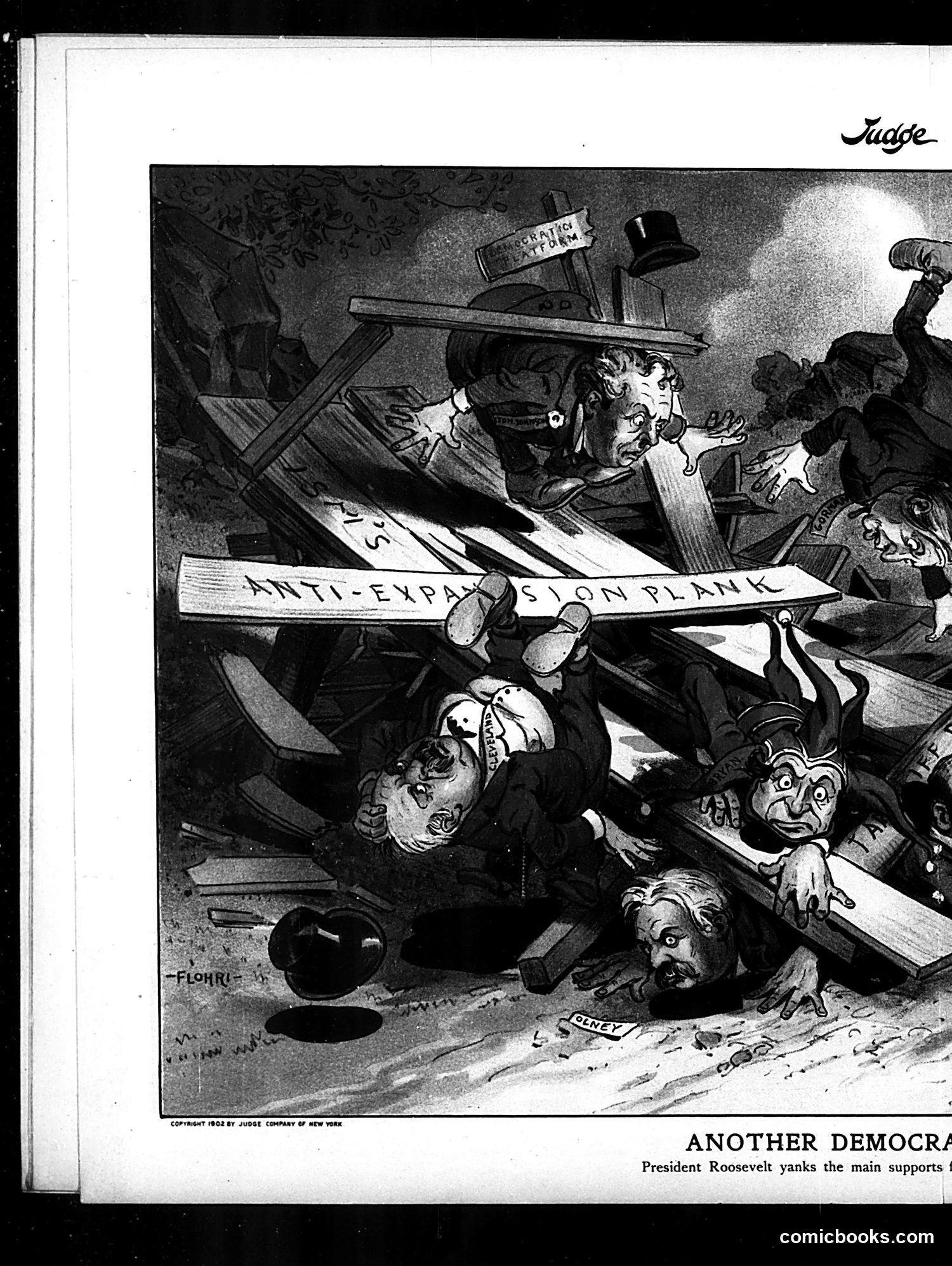
This 1902 Judge magazine cartoon satirizes President Theodore Roosevelt's attack on the Democratic Party's structural foundations. The central caricatured figure (Roosevelt, identifiable by top hat and prominent teeth) stands atop a wooden structure labeled "ANTI-EXPANSION PLANK," yanking out support beams while Democratic figures below scramble in panic. The cartoon criticizes Roosevelt for undermining the Democratic Party's core policy position opposing imperial expansion—a major political issue of the era following the Spanish-American War. The collapsing structure represents how Roosevelt's aggressive expansionist policies are literally destabilizing Democratic opposition to them. The grotesque caricatures of frightened Democrats huddled beneath symbolize their political weakness against Roosevelt's forceful presidency. This reflects early-1900s partisan warfare over America's imperial ambitions.
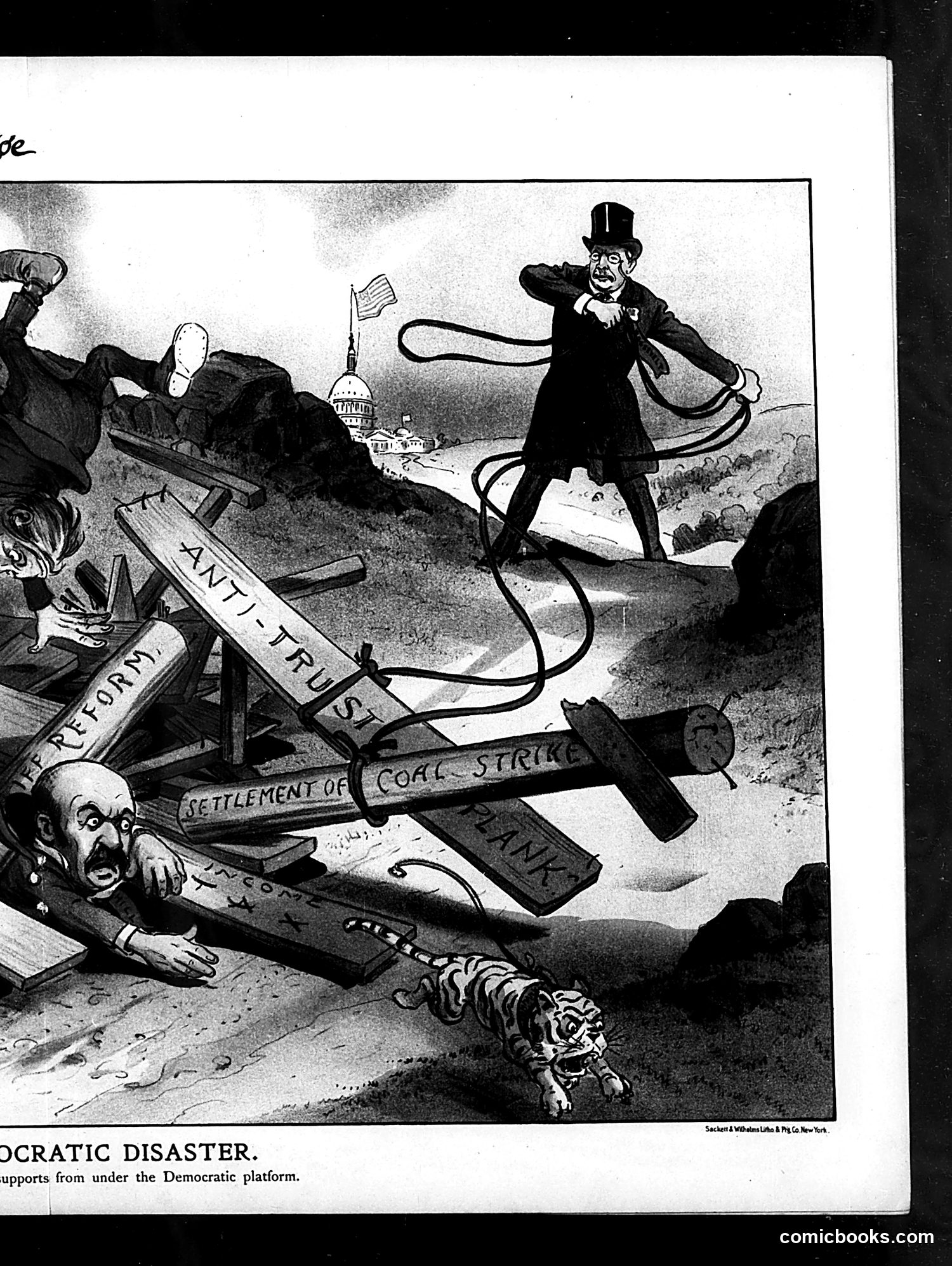
This **Judge** magazine cartoon titled "Democratic Disaster" satirizes internal collapse of the Democratic Party. A well-dressed man (likely representing a Democratic leader or politician) uses a whip labeled "Anti-Trust" to manage chaos below. The "Democratic platform" is literally crumbling—visible planks include "Settlement of Coal Strike" and "Anti-Trust," suggesting key campaign promises are failing. The figures on the ground appear distressed, with one caricatured face suggesting ethnic stereotyping common to period political cartoons. A small tiger or cat at the bottom remains unclear in meaning. The cartoon critiques Democratic inability to deliver on promises, particularly regarding labor disputes (coal strike) and antitrust reform—major early 20th-century political issues. The visual metaphor shows the party literally collapsing under its own contradictions.
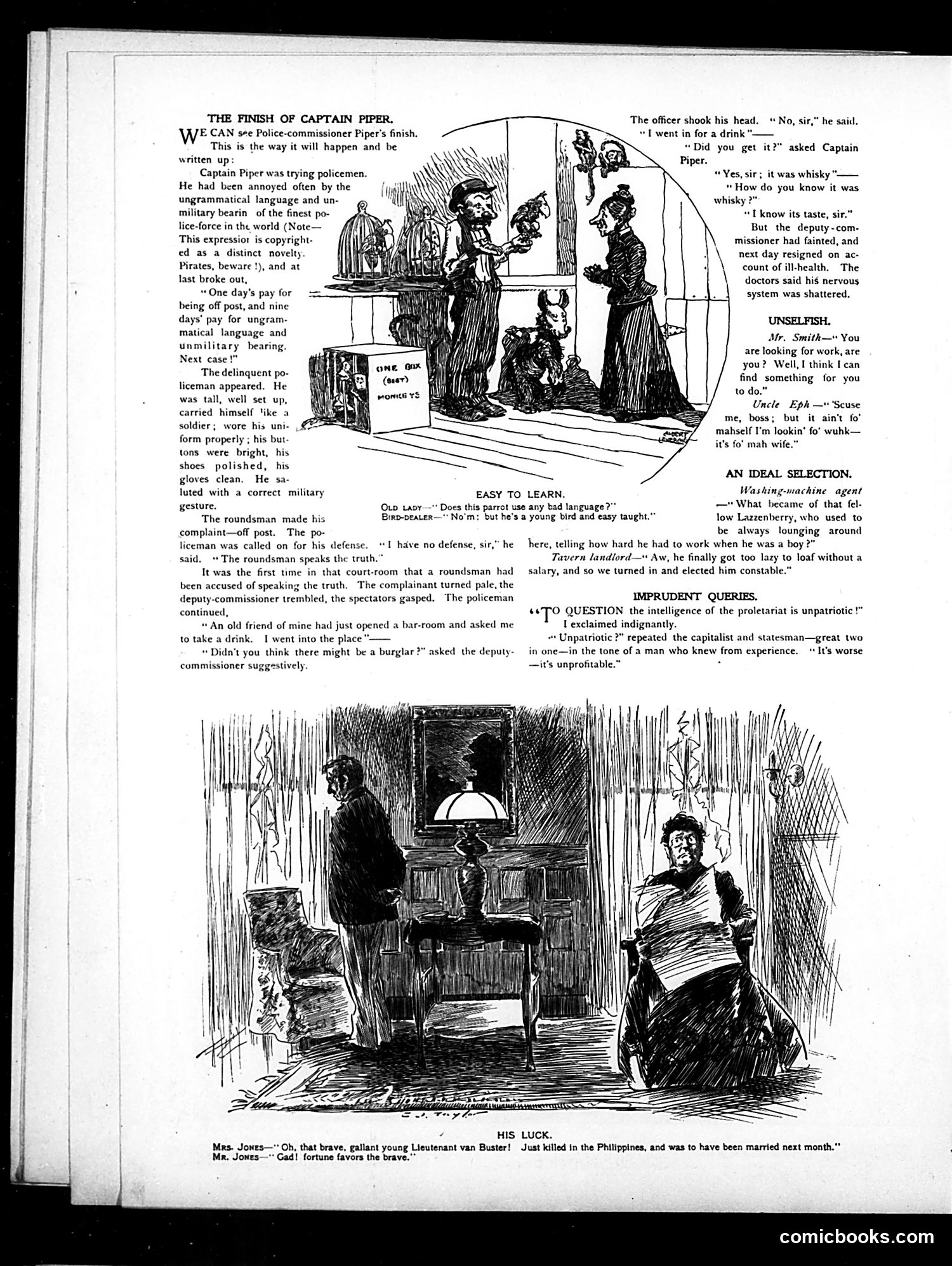
This page contains multiple satirical cartoons critiquing New York City police administration, likely from the early 1900s. **"The Finish of Captain Piper"** mocks Police Commissioner Piper's attempt to discipline officers for "ungrammatical language and unmilitary bearing." The satire: when a well-groomed, articulate officer honestly admits leaving his post to have a drink, the deputy-commissioner faints and resigns. The joke exposes how absurd it is to punish proper speech while overlooking actual misconduct—the system collapses on its own illogic. **"His Luck"** darkly jokes about Lieutenant van Buster's death in the Philippines, ironically calling it "fortune" since he avoided an unwanted marriage. **Remaining cartoons** mock working-class dialect ("Uncle Eph"), satirize lazy men who become constables, and joke about capitalists viewing worker intelligence as "unprofitable" rather than merely unpatriotic. The overall theme: institutional incompetence, class hypocrisy, and the gap between stated rules and actual practice in early-20th-century America.

This is a **straightforward advertisement**, not satire or political commentary. It's a full-page ad from *Judge* magazine promoting Schlitz brewery's achievement of selling over one million barrels annually. The ad emphasizes Schlitz's market dominance in Milwaukee—then America's premier brewing center—and attempts to justify premium pricing by highlighting their elaborate production methods: fifty years of doubled costs, plate-glass cooling rooms with air filters, extended aging periods, filtration, and post-sealing sterilization. The tagline "That is why Schlitz Beer doesn't cause biliousness" (digestive upset) represents the health-conscious marketing pitch of the era, when breweries competed partly on claims of purity and safety. The ornate Art Deco border and prominent branding reflect early-20th-century advertising design. This reflects Milwaukee's historical status as America's brewing capital before Prohibition.
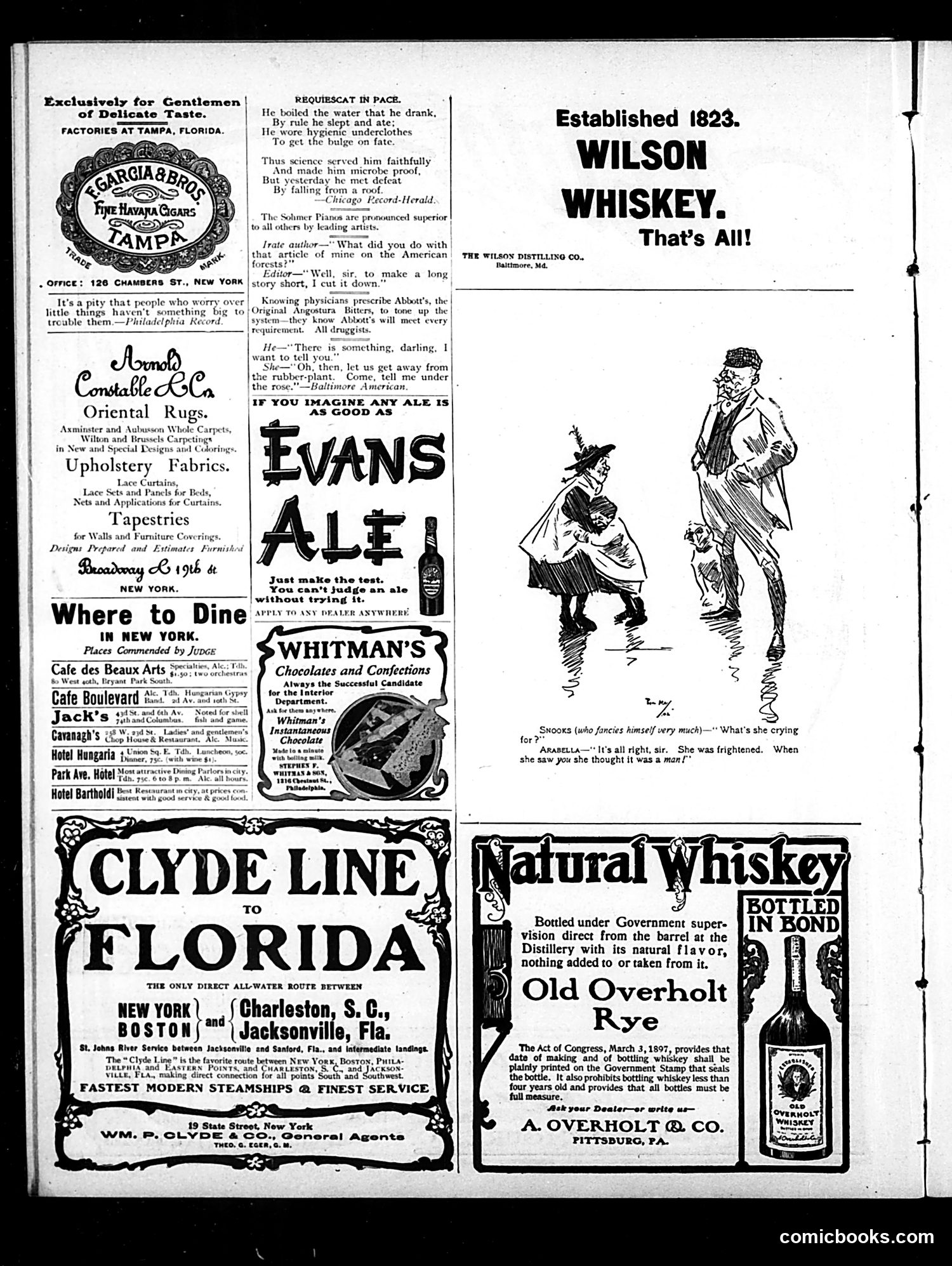
This page is primarily **advertising**, with minor comedic content interspersed. The ads promote luxury goods (cigars, Oriental rugs, whiskey, steamship travel) targeting affluent male readers. The small cartoon jokes include: - A quip about a man wearing "hygienic underclothes" for protection who dies anyway from falling—mocking the era's health-fad obsession - A newspaper editor rejecting an author's article by literally cutting it down - A romantic couple discussing secrets "under the rose" (in private) - A joke about a woman frightened by an unattractive man ("Snoods"), mistaking him for something else The whiskey ads emphasize government regulation and purity—referencing the **1897 Congressional Act requiring age dating on bottles**, reflecting Progressive Era food/drug safety concerns. "Natural Whiskey" branding suggests authenticity versus adulterated spirits, a significant consumer issue of that period. Overall, this reflects early 1900s advertising culture targeting gentlemen of means, with light social satire about courtship, vanity, and modern anxieties.
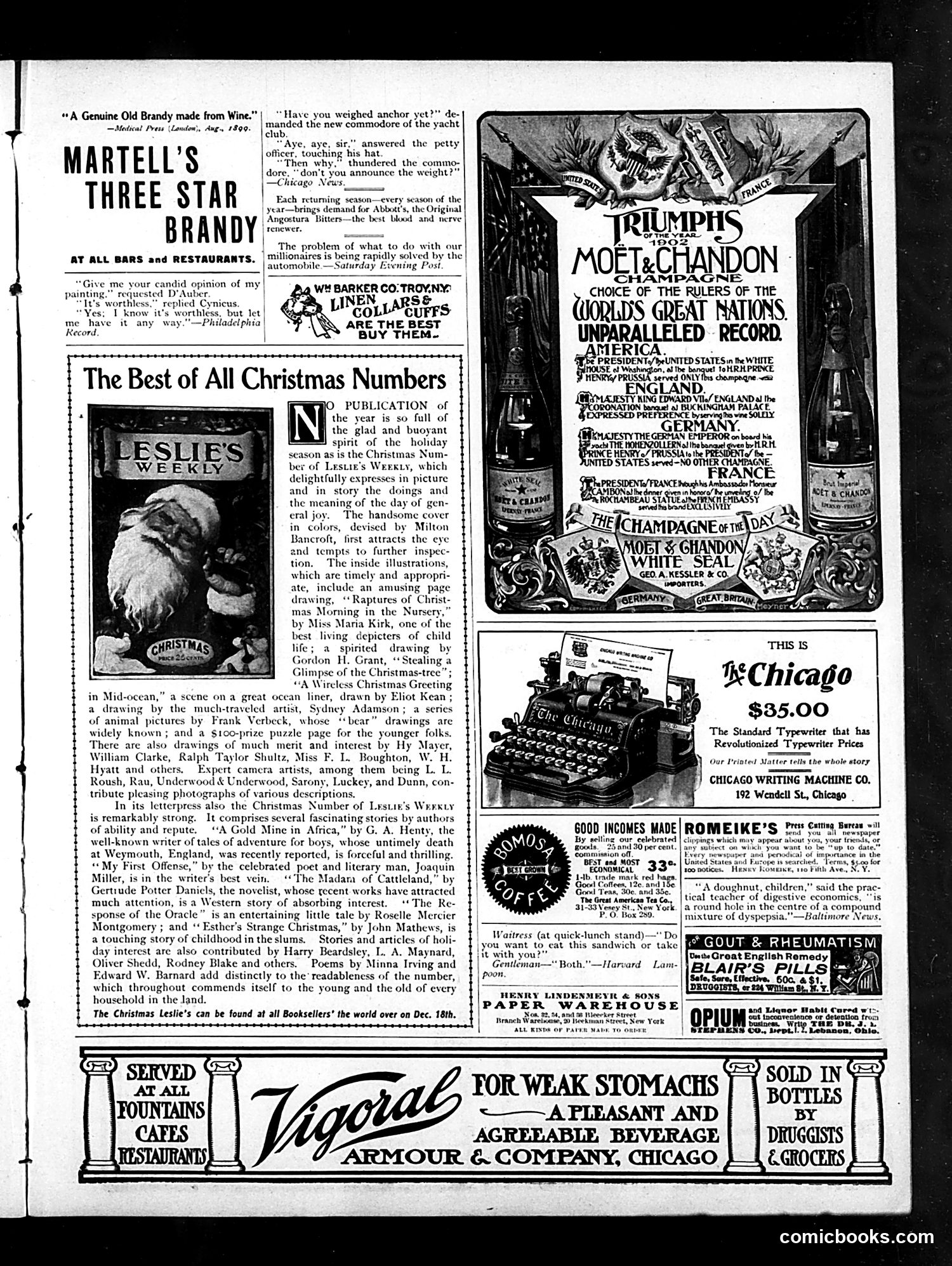
This page is primarily **advertising and promotional content** from Judge magazine, not political satire. The main sections include: **Martell's Brandy & Related Ads**: Period product advertisements emphasizing quality ("Genuine Old Brandy"). The small joke about a yacht commodore weighing anchor is trivial wordplay. **"The Best of All Christmas Numbers"**: A lengthy promotion for *Leslie's Weekly* magazine's Christmas edition, listing contributing artists and story authors. This celebrates the publication's artistic merit and literary talent. **Other Advertisements**: Includes typewriters, champagne (Moët & Chandon), medicinal tonics, and digestive products—typical early-1900s advertising reflecting period consumer goods and patent medicine marketing. The page contains **no significant political cartoons or satire**. It's essentially a magazine page dominated by paid advertisements and promotional material typical of this era's publications. The humor present is minimal and non-political—simply light commercial copy meant to sell products and magazine subscriptions to readers.
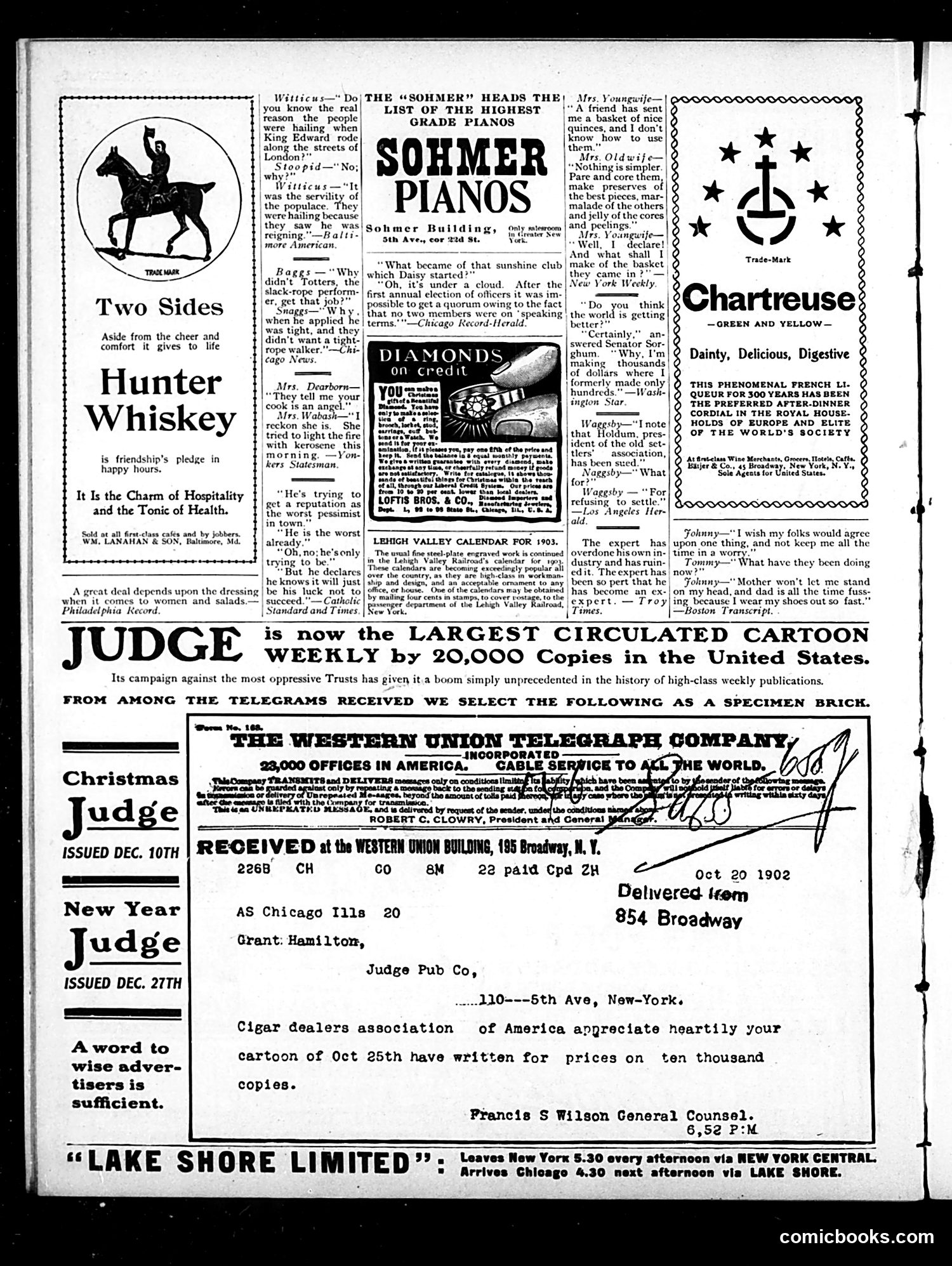
This page from Judge magazine (circa 1902) contains several brief satirical comics and advertisements typical of the publication's format. **Key Content:** The cartoons mock social pretension and marital dynamics. "Two Sides" satirizes servility toward royalty. "Hunter Whiskey" presents domestic humor about cooking incompetence. Multiple short jokes target pompous businessmen, failed social clubs, and pestering experts. **Social References:** The jokes reflect turn-of-the-century American attitudes: deference to British royalty, gender-based domestic stereotypes (wives' cooking failures, husbands' authority), and skepticism toward self-proclaimed experts. References to "sunshine clubs" and business associations suggest commentary on contemporary social organizations. **Advertisements:** The page prominently features Sohmer Pianos, diamonds-on-credit, and Chartreuse liqueur—luxury goods marketed to the magazine's affluent readership. A Western Union telegram and railroad advertisement appear alongside. The page primarily serves as a specimen of Judge's circulation success and advertiser appeal rather than presenting sustained political satire.
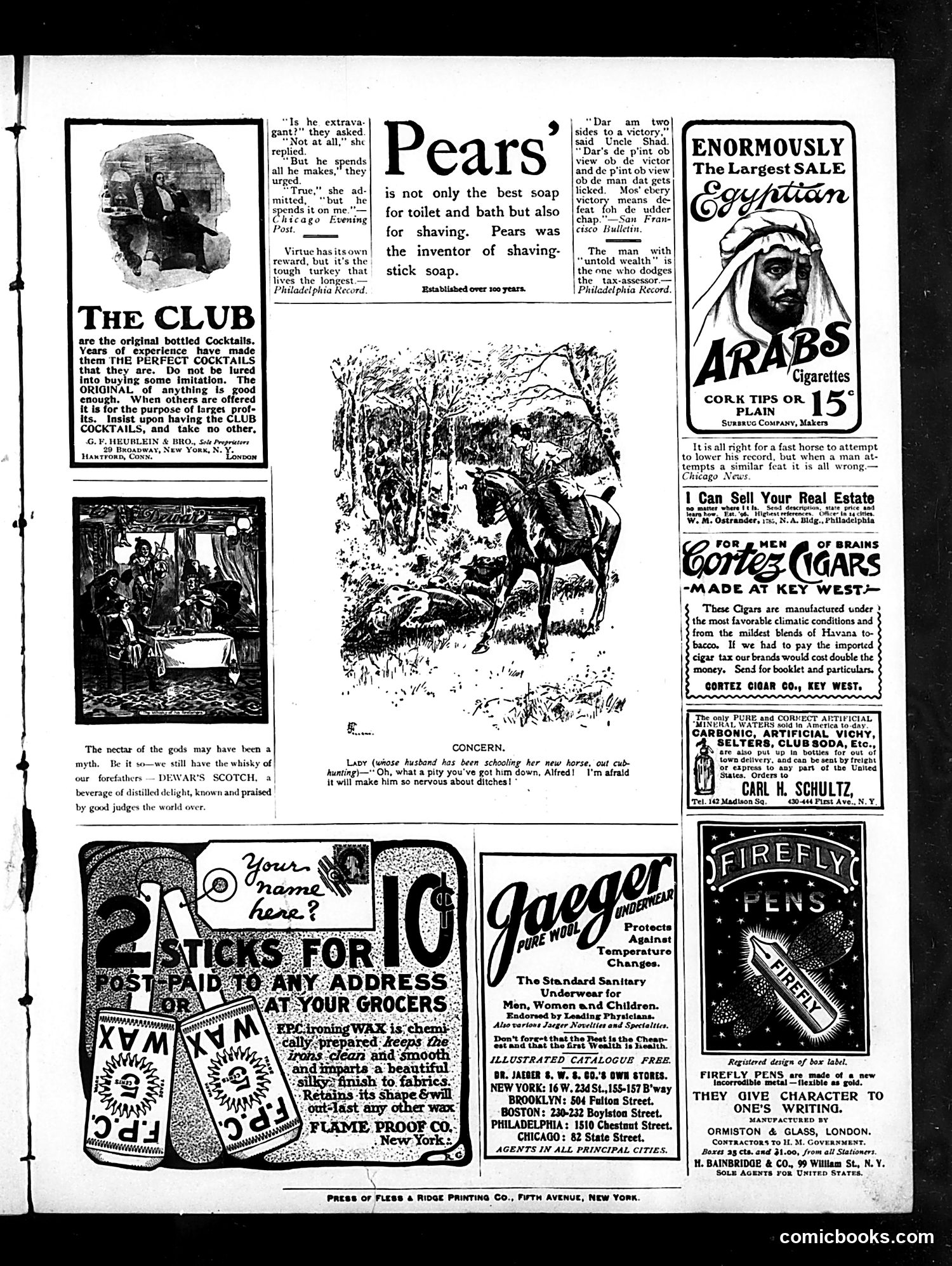
This page is primarily **advertising**, with one small cartoon and satirical text snippets typical of Judge magazine's format. ## The Cartoon The central image labeled "CONCERN" depicts a lady worried her husband's new horse training will make it nervous about ditches—a gentle domestic humor piece with no political significance. ## Satirical Text Snippets Brief, unmarked jokes appear throughout: - A woman defends her extravagant husband: he spends all he makes "on me" - Virtue's reward is poor; longevity belongs to the "tough turkey" - A Black dialect joke about "de p'int ob view" of winners versus losers - "Untold wealth" belongs to those dodging tax assessors These reflect early-20th-century Judge humor: mild domestic comedy, cynicism about morality, and racial caricature (common but offensive by modern standards). ## Advertisements The page is dominated by product ads: Pears soap, Club cocktails, Dewars Scotch, various patent medicines, cigars, and writing instruments—typical period advertising with exaggerated health claims. **No significant political cartoon or social commentary appears on this page.**
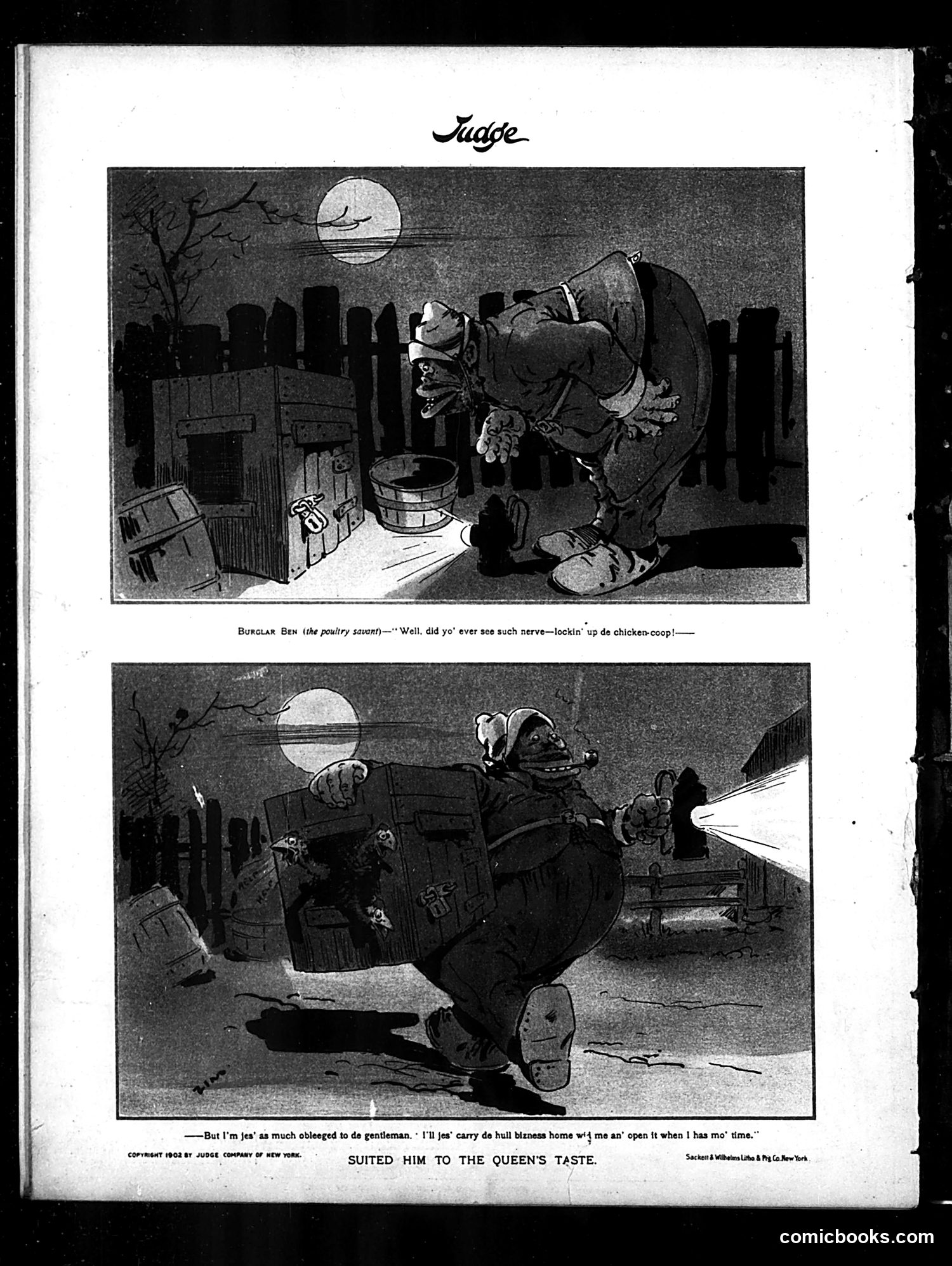
This two-panel cartoon titled "Burglar Ben" depicts a Black character stealing from a chicken coop at night. The humor relies on racist caricature and dialect: Ben claims he's "obliged to de gentleman" and will "carry de hull bizness home" to open later—a play on the phrase "opening a can of worms." The joke appears to be a crude pun connecting chicken-stealing (a stereotype applied to Black Americans) with the phrase "Queen's taste," suggesting that even chicken theft could be presented as refined behavior. The cartoon uses exaggerated physical caricature and broken dialect typical of early-20th-century American racist humor in Judge magazine. It reflects period attitudes depicting Black people as criminals and buffoons for entertainment.