
A complete issue · 16 pages · 1902
Judge — December 6, 1902
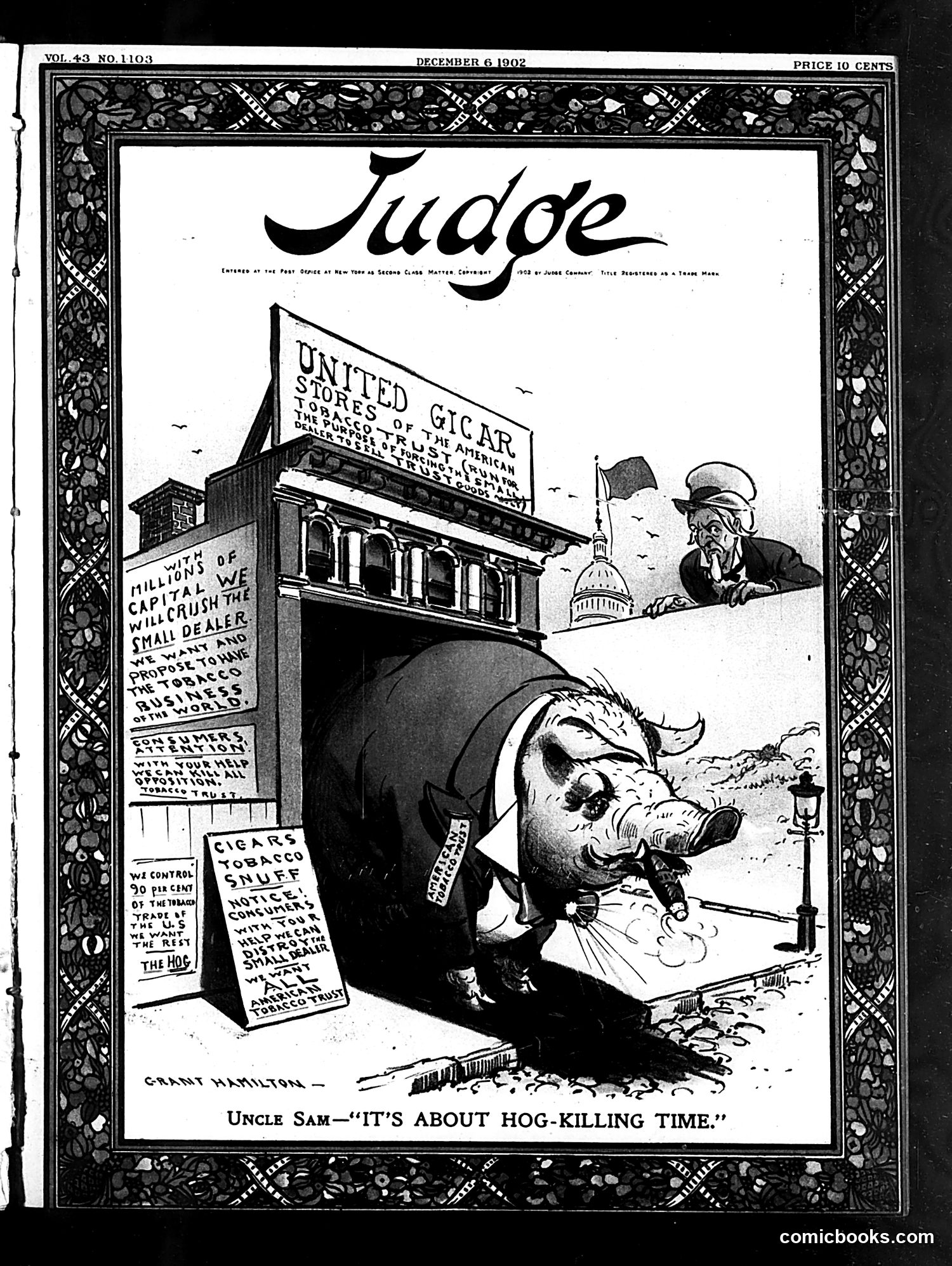
This December 1902 *Judge* cartoon depicts Uncle Sam preparing to slaughter a hog, with the Capitol building visible behind him. The signage references tobacco trusts and monopolies—"United Cigars," "Stores of Gigantic Tobacco Dealers," and signs about controlling trade and protecting consumers from "tobacco trusts." The satire targets big business monopolies, particularly tobacco trusts that were dominant political issues of the Theodore Roosevelt era. "Hog-killing time" is a metaphor for breaking up these large corporations. The cartoon advocates for antitrust action, positioning Uncle Sam as ready to eliminate what the cartoonist viewed as predatory business practices threatening fair competition and consumer protection.
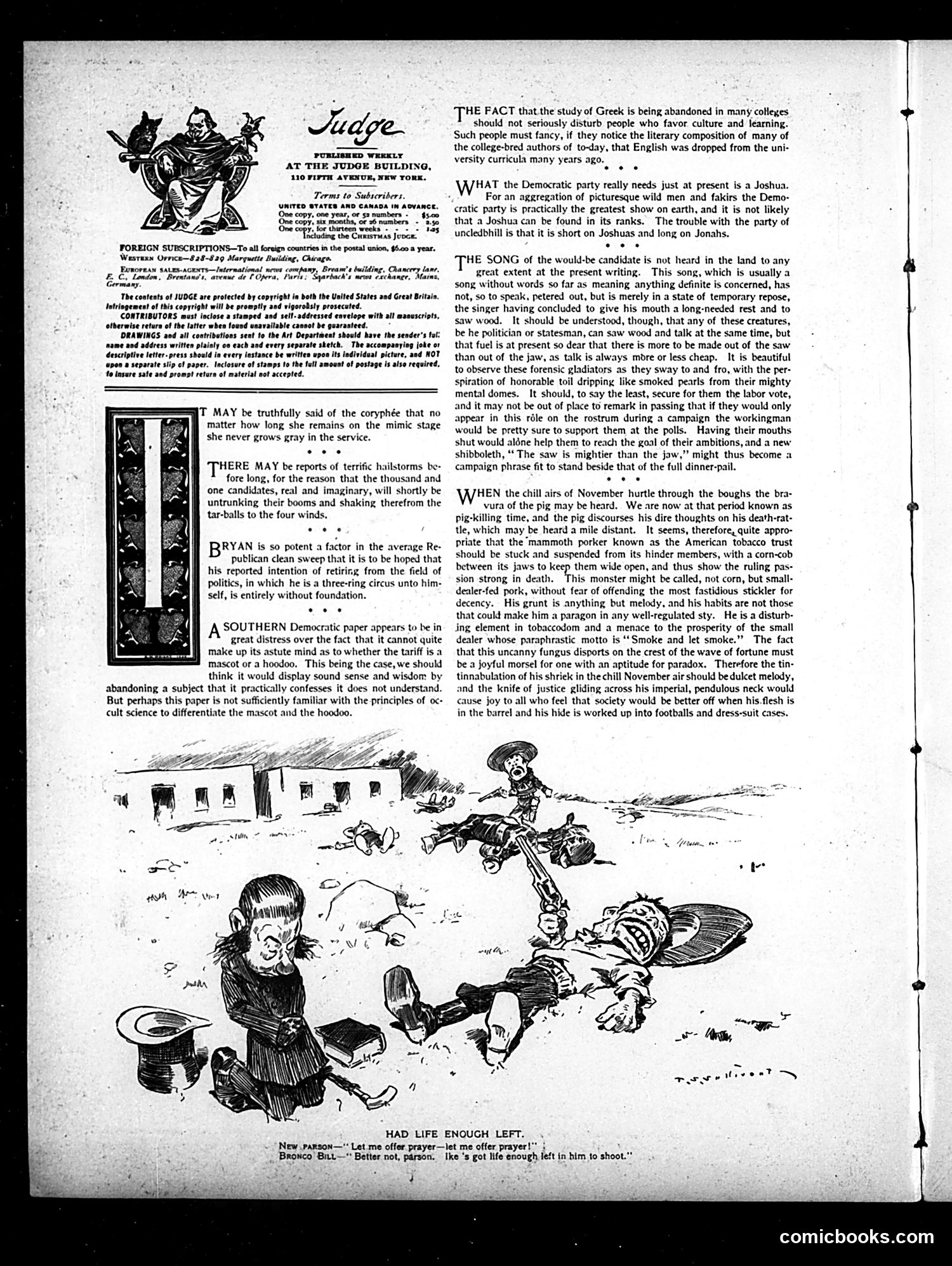
This page features editorial commentary on early 20th-century American politics. The main cartoon titled "HAD LIFE ENOUGH LEFT" depicts a violent confrontation, with a caption referencing "Bronco Bill" and dialogue about shooting—likely satirizing Western frontier violence or a contemporary political figure known by that nickname. The editorial text discusses the Democratic Party needing "a Joshua" (implying strong leadership), Bryan's potential political retirement, and Southern Democratic concerns. References to "the song of the would-be candidate" and labor politics suggest this addresses a specific election cycle. The cartoon's crude, exaggerated style targets political figures through caricature. Without the publication date clearly visible, the specific election and identities remain unclear, though the content reflects turn-of-the-century political anxieties about party leadership and regional divisions.
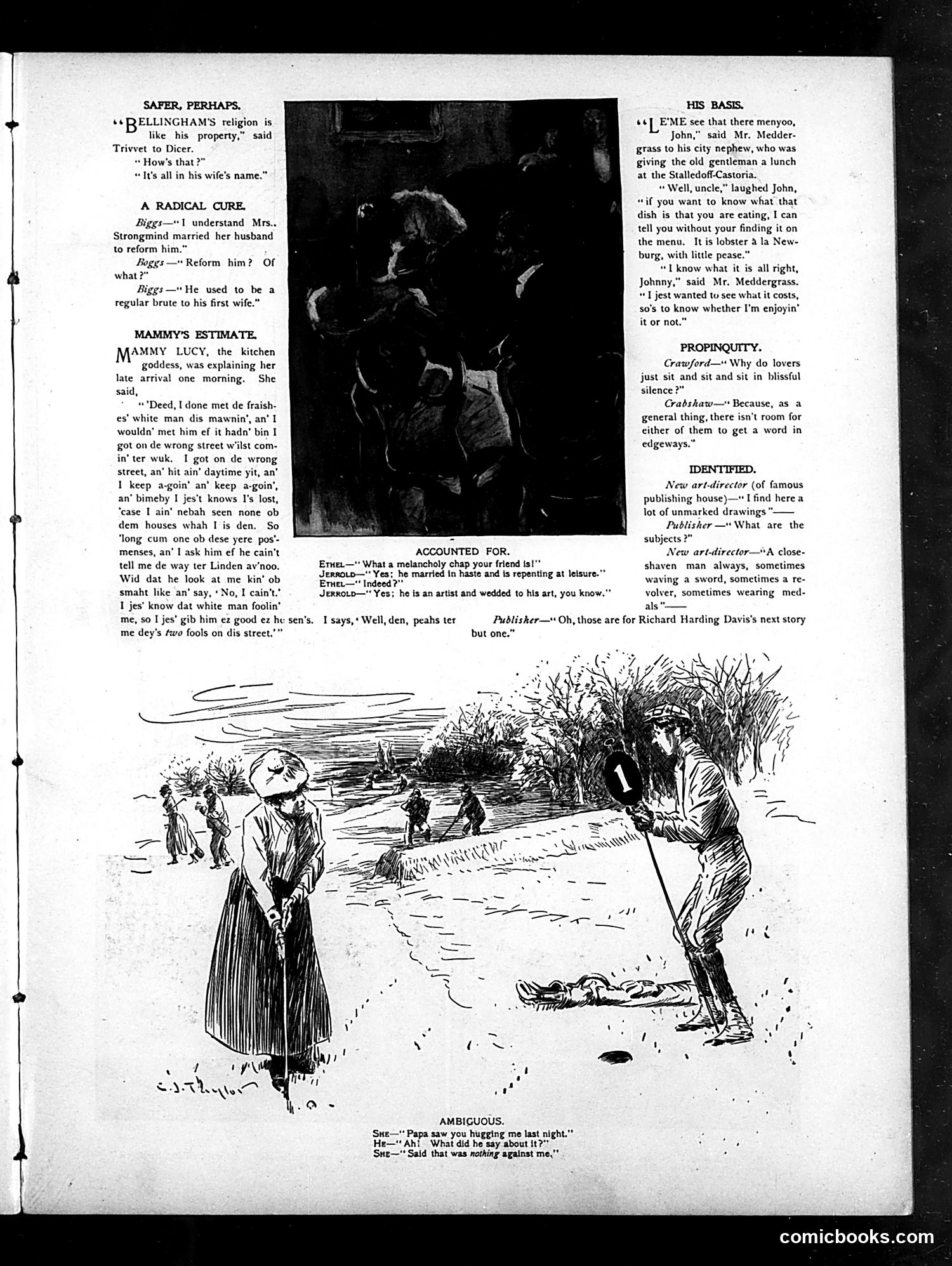
This page contains several brief humor pieces rather than political cartoons. The sketches mock social conventions and character types: **"A Radical Cure"** satirizes a man reformed by marriage—he's no longer brutal to his wife. **"Mammy's Estimate"** presents dialect humor featuring a Black domestic worker critiquing a white man's behavior and intelligence, reflecting the racist comedy conventions of the era. **"Accounted For"** mocks an artist husband's melancholy as mere pretense. The bottom illustration shows a golf scene with ambiguous dialogue about overnight activities, suggesting marital infidelity humor. These pieces represent Judge's typical early-20th-century satirical style: domestic comedy, racial stereotyping, and commentary on marriage and gender roles. The content reflects period attitudes now recognized as offensive.
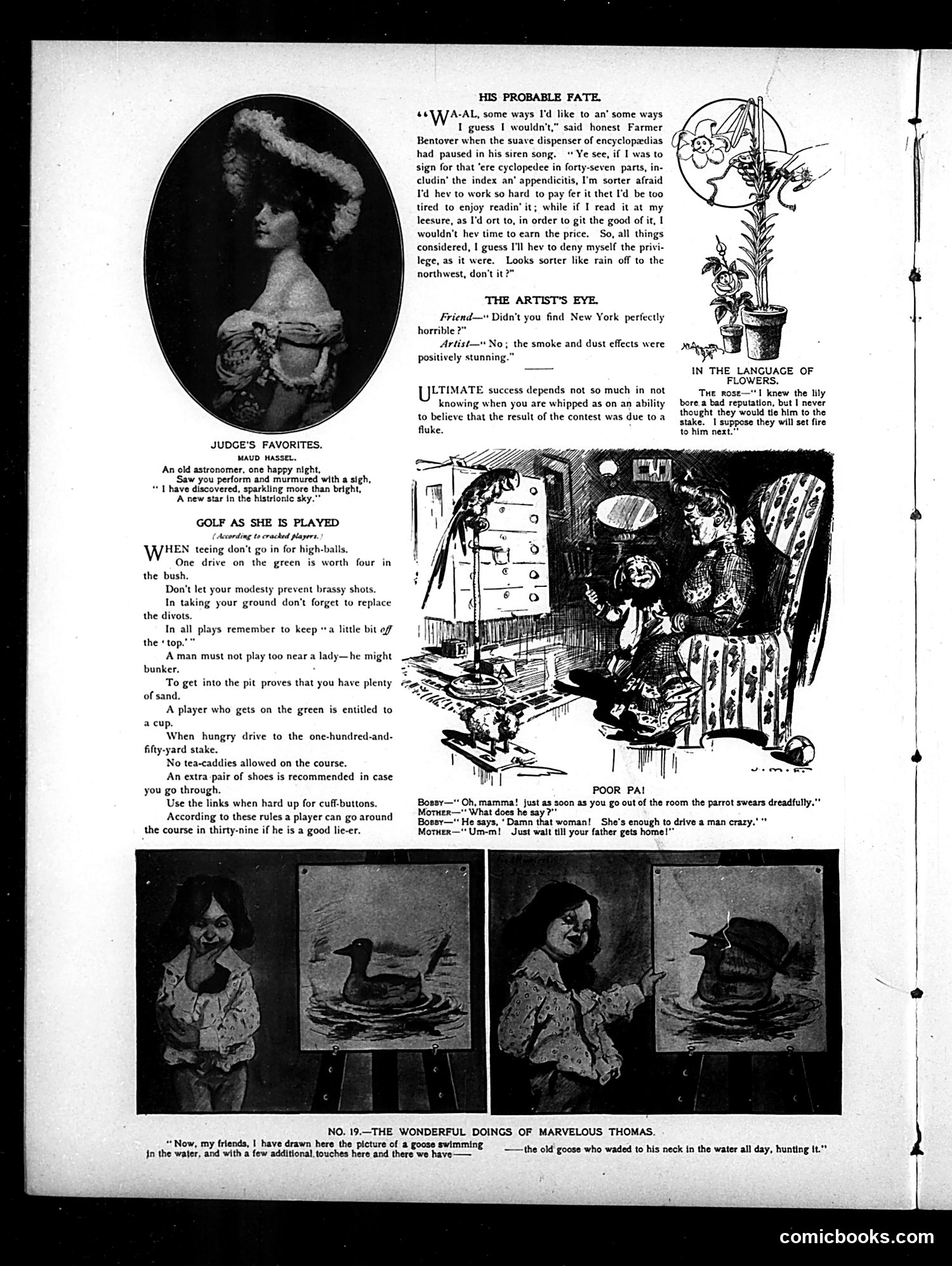
This page contains several unrelated humorous pieces typical of Judge's satirical format: 1. **"His Probable Fate"** mocks an encyclopedia salesman's pitch to a reluctant farmer, satirizing aggressive door-to-door sales tactics common in this era. 2. **"The Artist's Eye"** jokes about New York's unpleasant conditions (smoke, dust) as artistic inspiration. 3. **"Golf as She Is Played"** provides genteel etiquette rules for female golfers, reflecting early 20th-century attitudes about women's sporting participation and propriety. 4. **"Poor Pat"** features a parrot's irreverent commentary on a woman driver, playing on period anxieties about women operating automobiles and the stereotype of women as dangerous drivers. 5. **"The Wonderful Doings of Marvelous Thomas"** appears to be a serial sketch about a character drawing a goose. The page reflects common Judge themes: rural/urban contrasts, technological change, and gender roles.
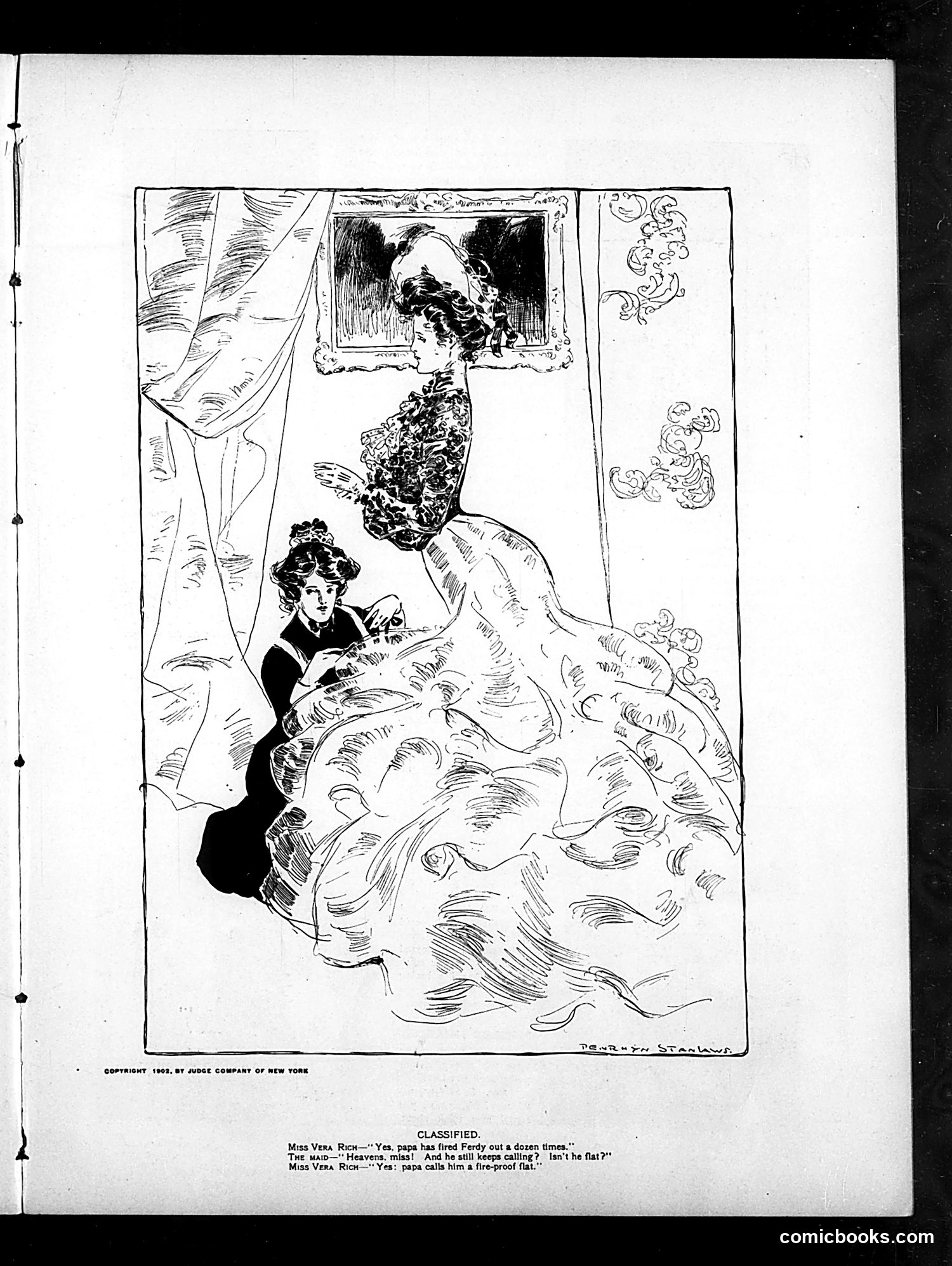
This 1902 Judge cartoon satirizes a wealthy young woman's persistent suitor. "Miss Vera Rich" complains that her father has rejected a persistent caller named "Ferdy" repeatedly ("fired him out a dozen times"), yet he continues visiting—he's "flat," a period slang term meaning broke or without money. The joke's punchline plays on "flat": her father calls Ferdy a "fire-proof flat" because no amount of rejection ("firing") can discourage this impoverished suitor from his courtship attempts. The cartoon mocks both the fortune-hunting persistence of poor suitors targeting wealthy heiresses and the exasperation of wealthy fathers dealing with such romantic parasites. The elaborate dress and interior setting emphasize the class contrast central to the satire.
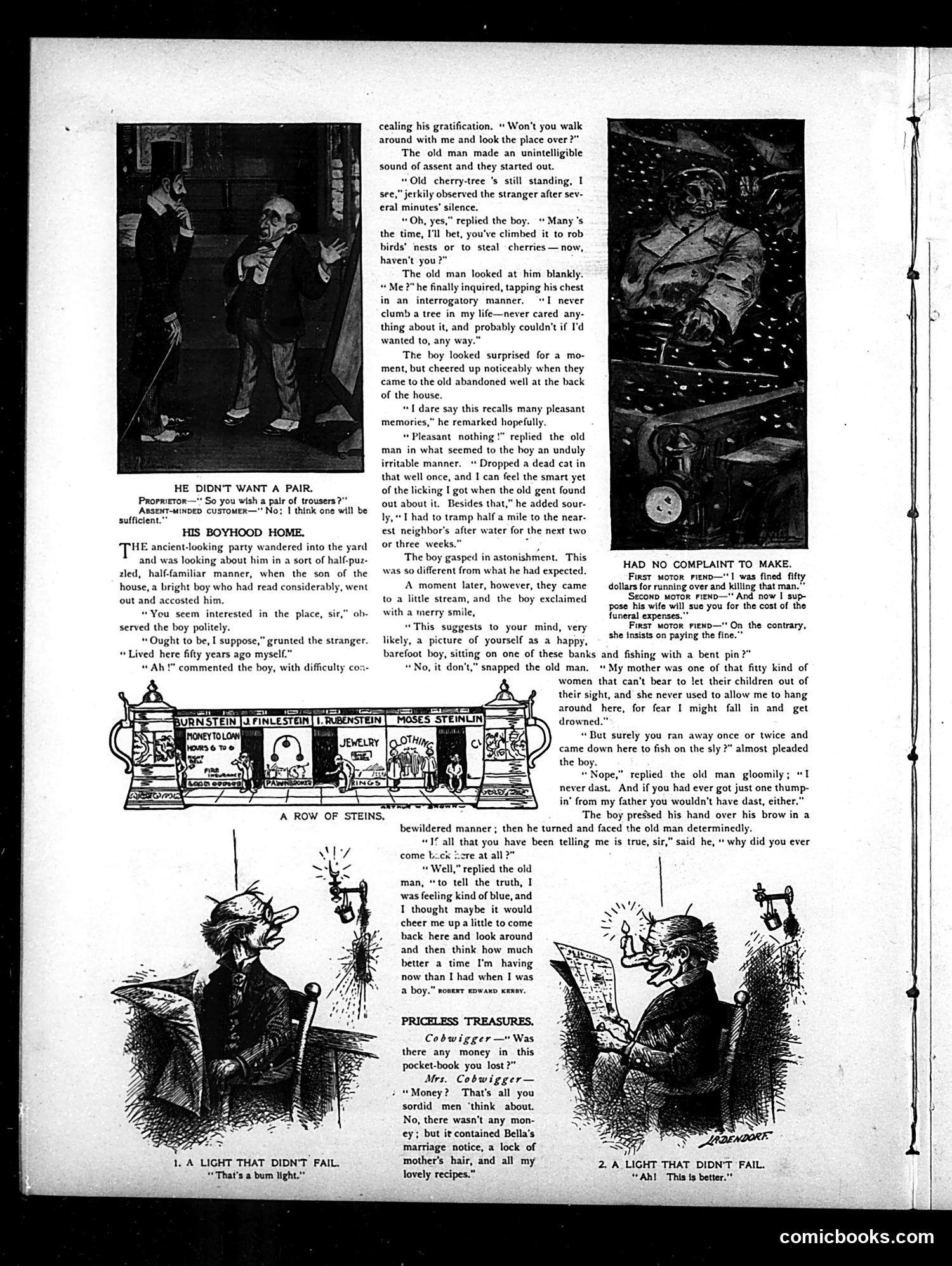
This page contains several humorous sketches satirizing **romantic nostalgia and sentimental mythology**. The main story, "His Boyhood Home," mocks the common literary trope of the nostalgic visitor. A boy expects an old man revisiting his childhood home to reminisce fondly about climbing trees, fishing, and youthful freedom. Instead, the man reveals an unhappy past: he never climbed trees, dropped a dead cat in the well (earning a beating), and was kept under strict parental control. The boy's idealized expectations of rural childhood adventure—drawn from sentimental literature—collide with the man's actual grim reality. The smaller sketches continue this theme, deflating sentimentality: a tailor's customer wants only one trouser leg; motorists show no regret over deaths; a woman treasures a marriage notice over money. **The satire targets** Victorian and popular literature's romanticized portrayal of childhood and rural life, suggesting actual experience was often considerably less idyllic than cultural mythology suggested.
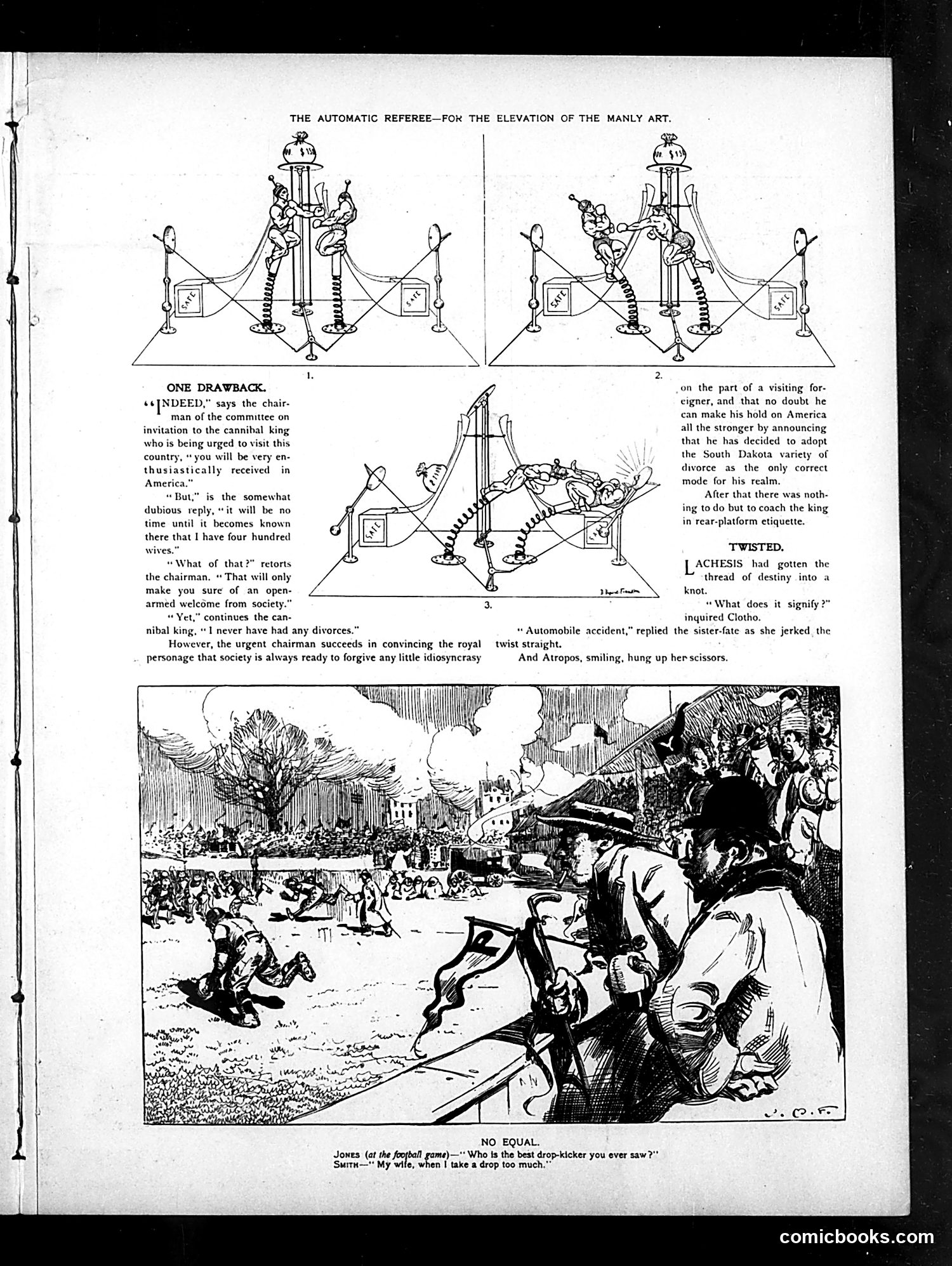
**Top Section ("The Automatic Referee"):** Three technical drawings mock boxing as a "manly art" by depicting increasingly absurd mechanical referee contraptions. This satirizes efforts to legitimize and regulate boxing, then a controversial sport seeking respectability. **Middle Dialogue:** A conversation between a committee chairman and a "cannibal king" satirizes American attitudes about marriage and divorce. The joke: Americans will welcome a foreigner with multiple wives but no divorces, yet society simultaneously obsesses over divorce scandals. This reflects Progressive-era anxieties about changing marriage norms and American hypocrisy regarding morality. **Bottom Cartoon ("No Equal"):** A football joke where a wife is compared to a "drop-kicker" (scoring technique) because she "drops too much"—likely referencing alcohol consumption or spending habits. **"Twisted" Section:** References the Fates from Greek mythology commenting on an automobile accident as "twisted destiny"—contemporary satire of newfangled automobiles and modern dangers. The page targets American social pretensions, marital instability, and early 20th-century modernization anxieties.
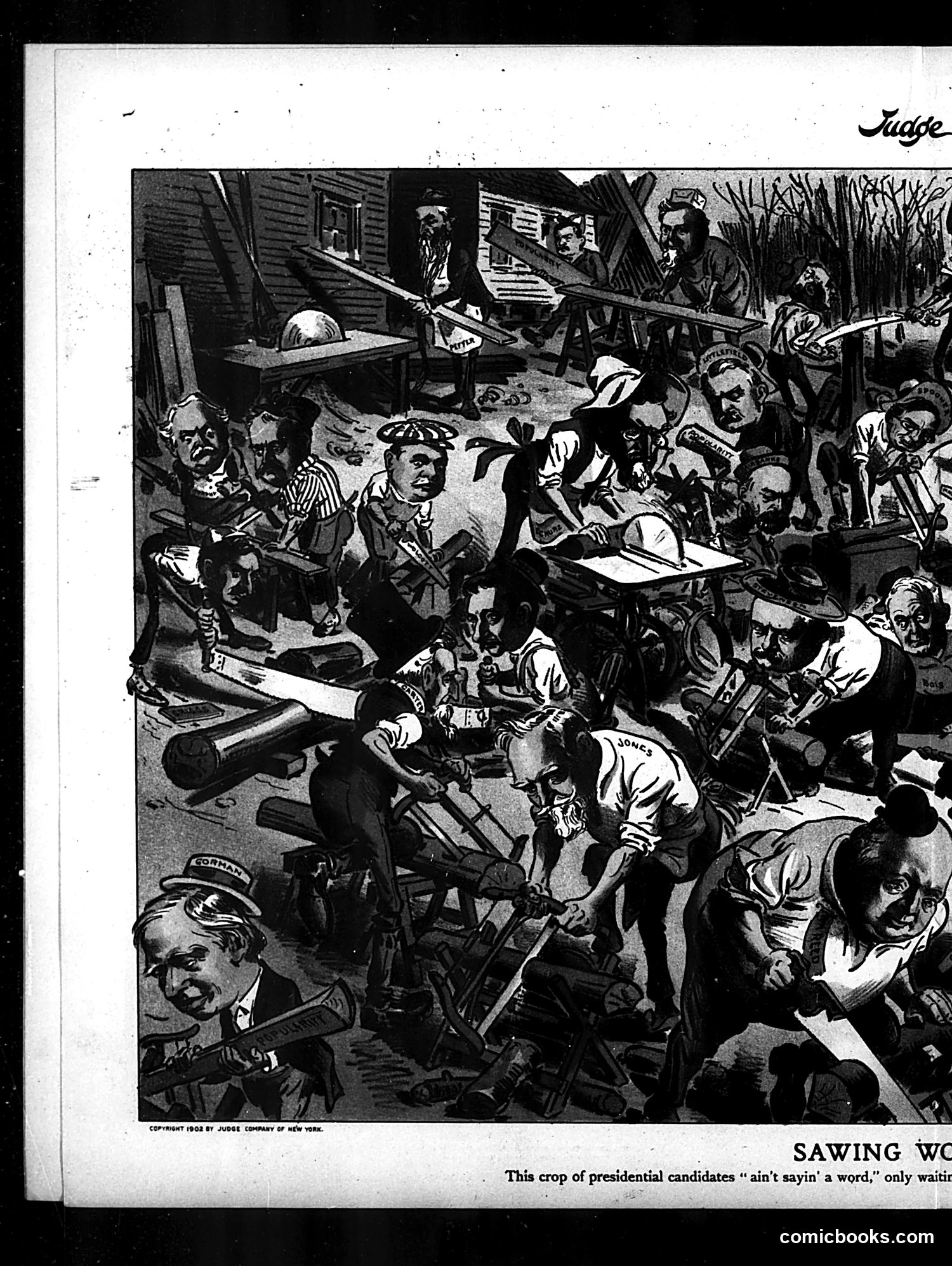
This Judge cartoon satirizes presidential candidates during an election cycle. The title "Sawing Wood" is a period idiom meaning to do nothing or make no progress—suggesting these candidates are all talk without substance. The crowded scene depicts numerous caricatured figures (likely representing various presidential hopefuls) engaged in busy but pointless activity around a woodsaw. The caption states they "ain't sayin' a word, only waitin'"—mocking candidates who avoid taking clear political positions while jockeying for nomination support. The satire targets the vagueness and non-committal nature of campaign rhetoric. Without clearer identifying labels in the visible text, specific candidates remain unclear, but the general critique of evasive electioneering is unmistakable. This reflects common Judge magazine criticism of politicians' tendency toward empty speechmaking.
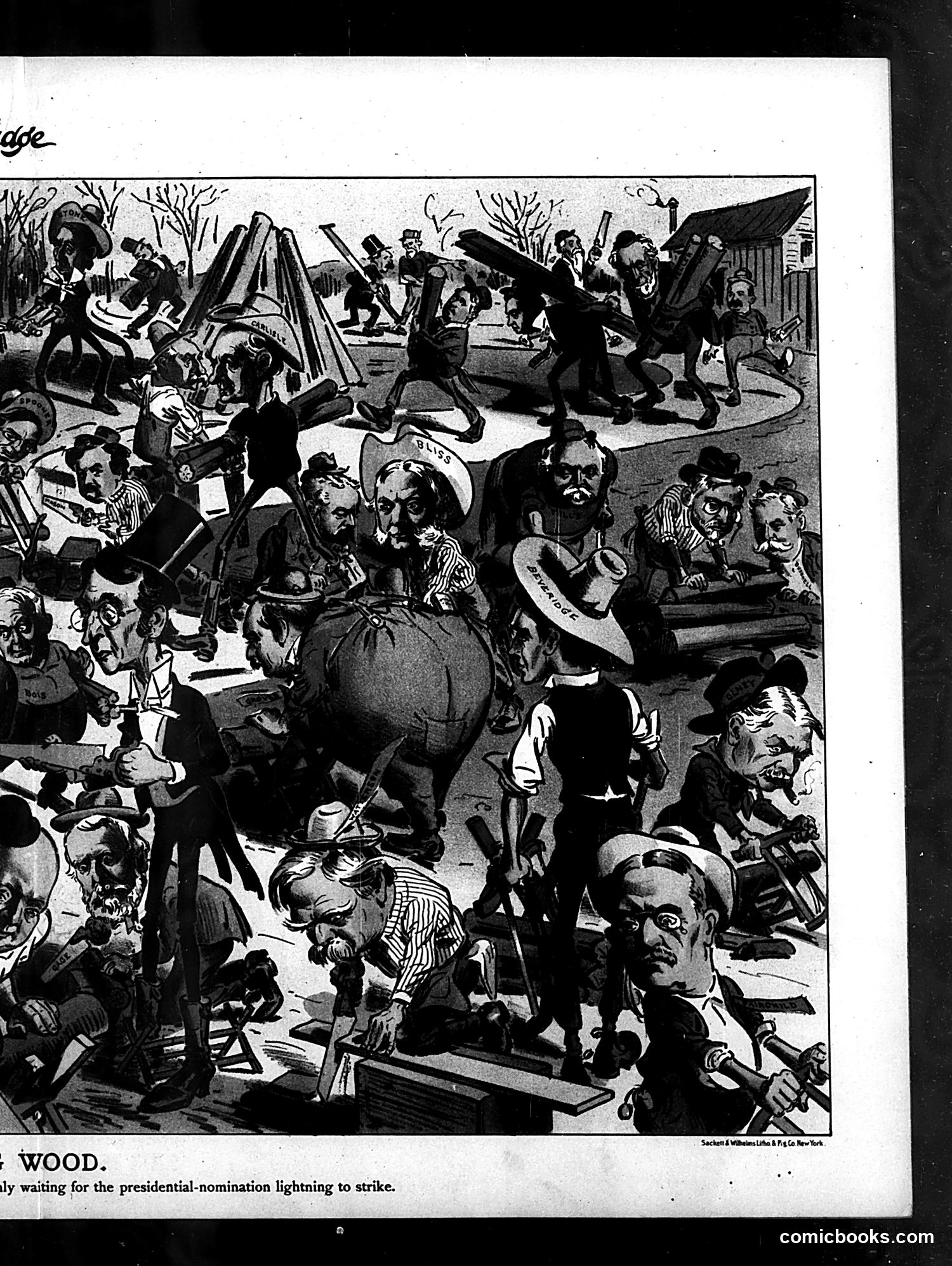
This political cartoon from *Judge* magazine satirizes the chaos and anticipation surrounding a presidential nomination process. The crowded, chaotic scene depicts numerous figures—many with exaggerated facial features typical of period caricature—engaged in frantic activity around what appears to be a construction or convention site, with bare trees suggesting winter. The caption references "waiting for the presidential-nomination lightning to strike," suggesting candidates and political figures are in tumultuous, disorganized competition for the nomination. The cartoon likely critiques the disorder, desperation, or absurdity of the nomination process itself. Without a visible date or clearer identifying details, the specific election year remains unclear, though the artistic style suggests early-to-mid 20th century.
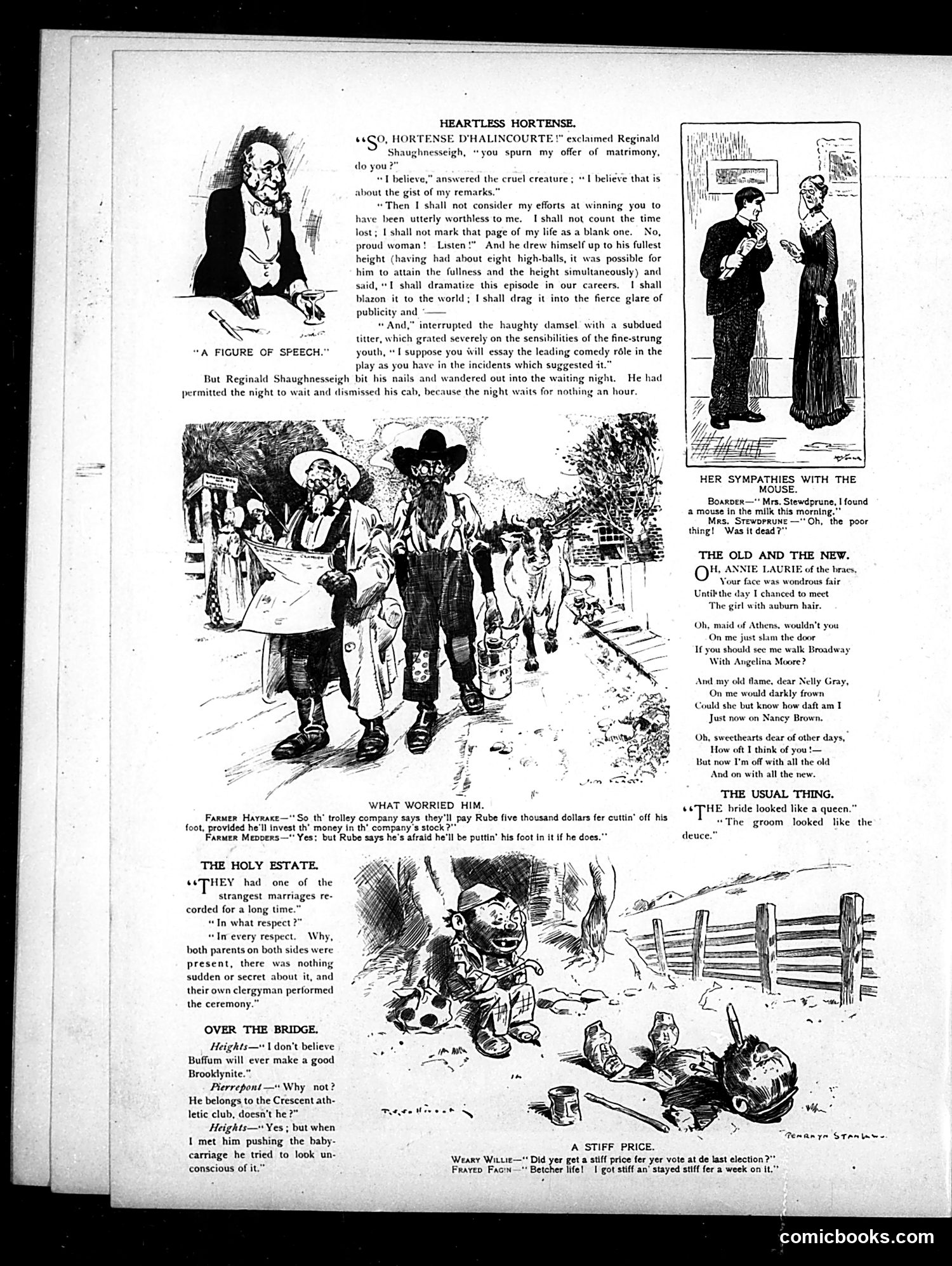
This Judge magazine page contains multiple short comedic sketches satirizing American social conventions of the era. **"Heartless Hortense"** mocks overly dramatic young men: Reginald Shaughnesseigh, rejected by Hortense, theatrically vows to dramatize their failed romance for public consumption—a pompous, self-important response to rejection. The humor lies in his absurd grandiosity and alcohol-fueled bravado (he's had "eight high-balls"). **The remaining sketches** are brief comic vignettes about everyday life: a farmer worried about losing a foot in an accident and then investing the settlement foolishly; a woman's sympathetic concern for a drowned mouse; nostalgic musings about past romantic interests; cynical observations about marriages and Brooklyn social climbing; and political corruption—a voter admitting he sold his ballot vote and "got stiff" (drunk) on the payment. The satire targets male vanity, rural ignorance, sentimental excess, and urban moral compromises—typical Judge magazine fare mocking American society across class lines.
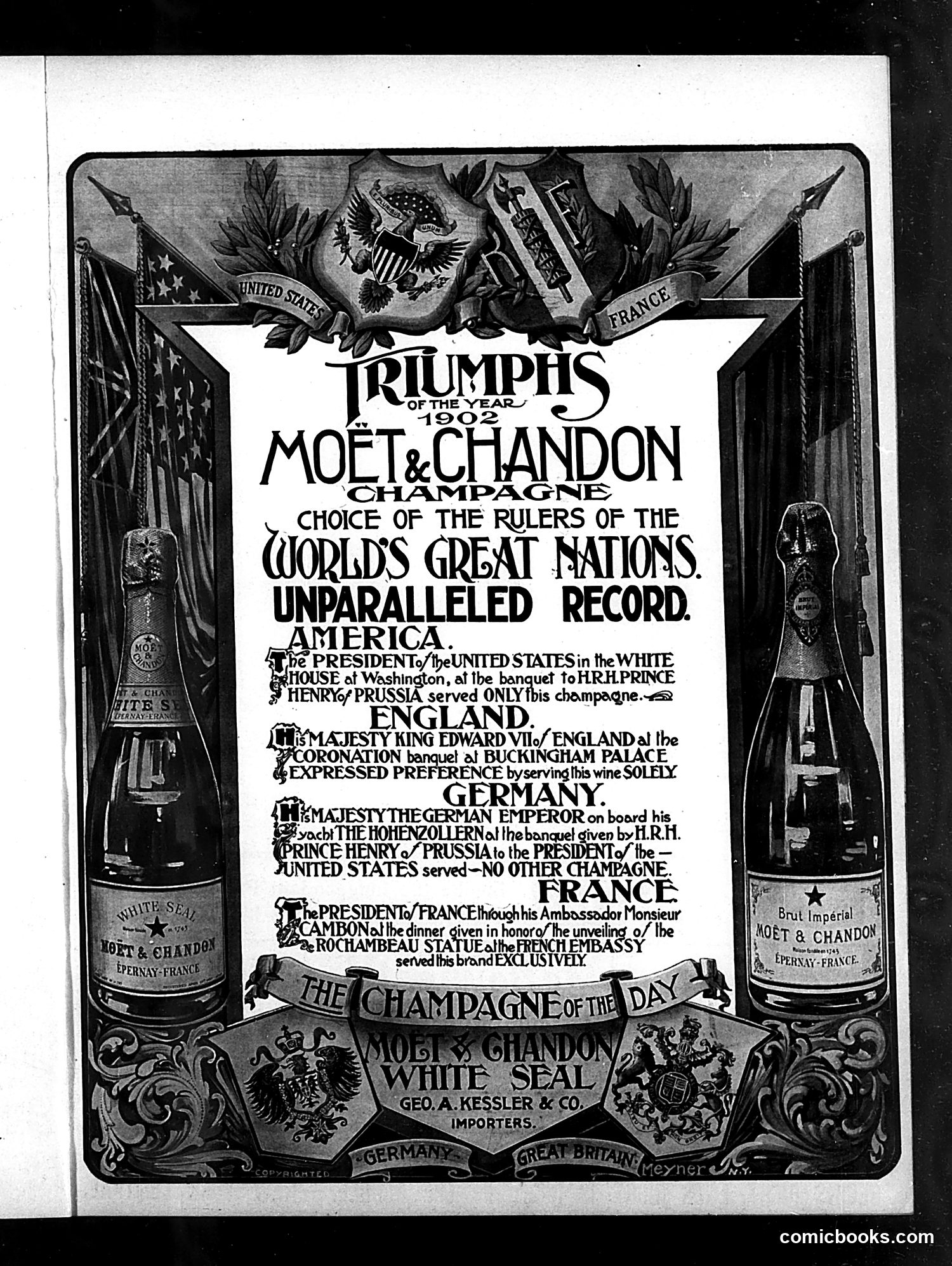
This is primarily a **champagne advertisement** disguised as patriotic boasting, from *Judge* magazine (1902). The ad promotes Moët & Chandon champagne by claiming it was served at prestigious state dinners across world powers: the U.S. White House, British royal coronation, German imperial yacht, and French embassy. Each claim is embellished with official-sounding details about which dignitary chose it. The satire lies in the *implicit critique*: the ad suggests that champagne—a French luxury good—was the choice of *all* the world's great nations, undermining American independence and self-sufficiency. By having world leaders preferentially select a French product, the advertisement ironically mocks American pretensions to power while actually promoting French goods as superior. The ornate framing with eagles, flags, and heraldic symbols exaggerates the nationalism the ad claims to celebrate, making the contradiction between patriotic rhetoric and foreign product preference the joke.
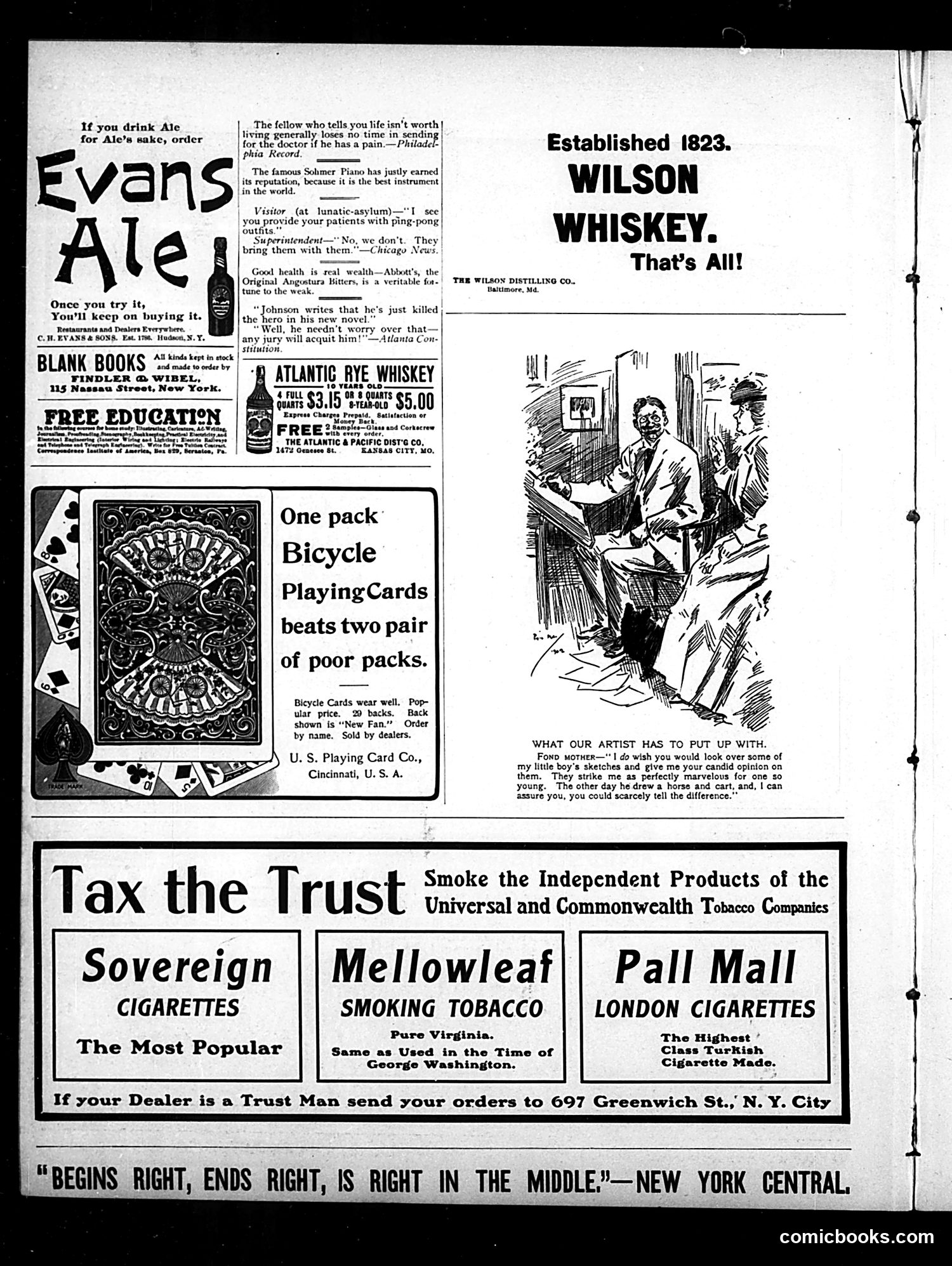
This page is primarily **advertising and light humor** typical of early 20th-century Judge magazine. The content includes: **Main Cartoon:** "What Our Artist Has to Put Up With" depicts a mother pestering an artist to critique her son's drawings, claiming they're "marvelous for one so young." The joke satirizes **parental blindness to mediocrity**—the mother brags that a crude horse-and-cart sketch is indistinguishable from reality, a common target of period humor. **Anti-Trust Messaging:** A prominent advertisement promotes independent tobacco brands (Sovereign, Mellowleaf, Pall Mall) as alternatives to trust companies, reflecting **Progressive Era anti-monopoly sentiment** popular in Judge's readership. **Short Jokes:** Scattered one-liners mock asylum patients, novelists, and doctors—typical period humor with no specific political reference. The page reflects early 1900s consumer culture and mild social criticism rather than sharp political satire.
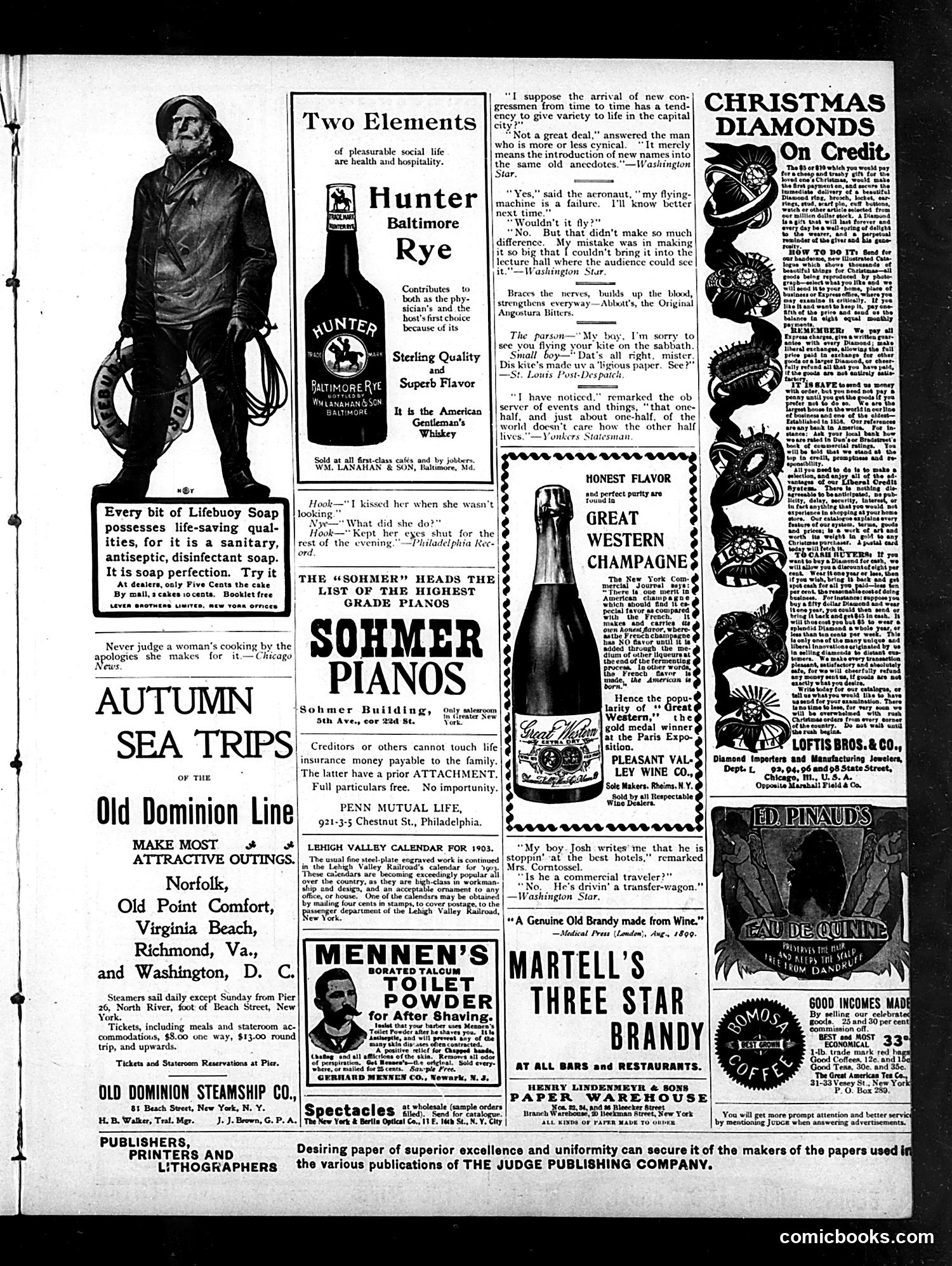
This is primarily a **advertising page** from an early 1900s satirical magazine rather than a political cartoon. The left side features an illustration of a man with a rope (a sailor or aeronaut), promoting Lifebuoy Soap's antiseptic properties. The page contains scattered **brief satirical quips** about Washington social life—jokes about Congress bringing "variety" to the capital, and observations about human nature. These appear alongside product advertisements for alcohol (Hunter Baltimore Rye whiskey, Great Western Champagne, Martell's brandy), luxury goods (Sohmer pianos, Christmas diamonds on credit), and travel services (Old Dominion steamship line). The humor is genteel and disconnected—wit for wealthy readers considering consumer purchases. There's no unified political message, though one quip subtly mocks wealth inequality ("one-half of the world doesn't care how the other half lives"). The page reflects early 1900s consumer culture: luxury goods marketed through wit and lifestyle association rather than modern advertising techniques.
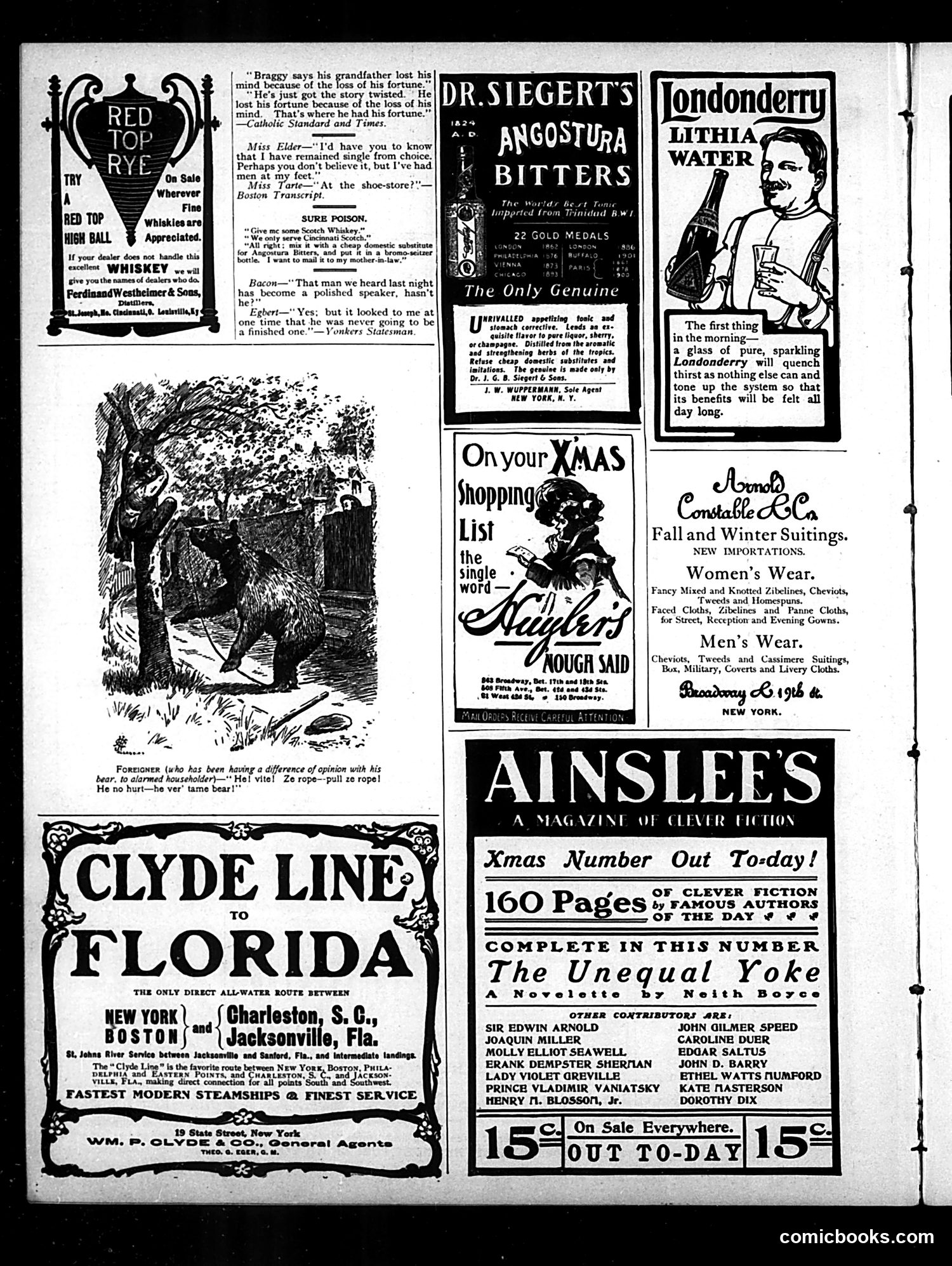
This page is primarily **advertising and magazine promotion**, not political satire. The main content consists of period advertisements (whiskey, bitters, shipping lines, clothing) and promotion for *Ainslee's Magazine*. The small cartoon labeled "Foreigner" depicts a humorous scenario: a foreign man with a bear has gotten into a dispute with a frightened householder. The foreigner reassures him by pulling a rope, claiming the bear is tame—a simple sight-gag playing on language barriers and the absurdity of keeping a "tame" bear. The text snippets scattered throughout are brief jokes about bachelor life, speaking ability, and fortune—common lightweight humor of the era. There is **no identifiable political content or social satire** on this page. It represents typical early-20th-century magazine filler: commercial advertising mixed with mild domestic humor aimed at a general audience.
This page contains **short humorous anecdotes** rather than political cartoons. The jokes satirize workplace and domestic life: 1. **"Manager" dialogue**: A proprietor learns his salesman won't lie about products anymore. When told the man earns ten dollars, the proprietor offers eleven—implying he's buying back the employee's dishonesty. The satire targets corrupt business practices of the era. 2. **"Young fellow" joke**: A merchant's son acts knowledgeable; when questioned, the merchant reveals he's his son. The humor suggests nepotism and unearned confidence in business. 3. **"Cooking" anecdote**: A husband boasts his wife lets him cook to satisfy her, masking his actual role as primary cook. Satire of marital dynamics and male pride. 4. **"Jack, dear"**: A wife threatens pining; her husband tells her to "spruce up" instead—mocking sentimental romance and henpecking tropes. The remainder is **period advertising** for products like Sulphume (a sulphur-based skin treatment), Harper Rye whiskey, and other remedies typical of early 1900s magazines.
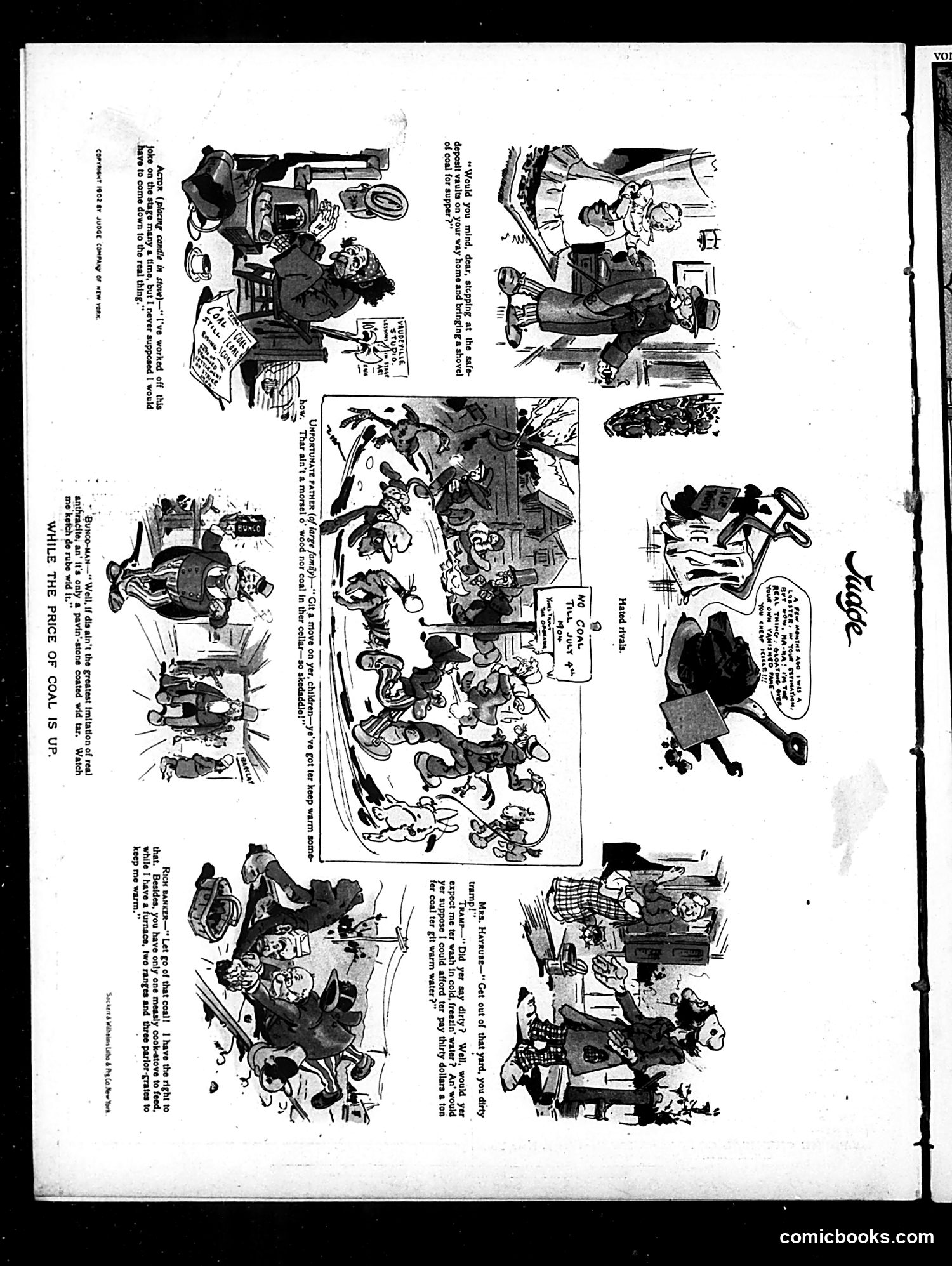
This Judge magazine page satirizes a severe coal shortage and price crisis afflicting America. Multiple cartoons depict social classes responding differently to scarcity: **Upper class** (banker) demands coal priority for home furnaces and multiple stoves, dismissing a poor person's single cook-stove need. **Working poor** must send children to scavenge fuel; a tramp defends his dirt by noting he cannot afford thirty dollars per ton for hot water. **Middle class** (actress) resorts to burning candles in stoves—something she performed on stage but never expected to do in real life. **Con artists** exploit desperation by selling fake coal (tar-coated pavestones) to the gullible. The title "While the Price of Coal Is Up" anchors the satire: the cartoon exposes how coal monopolies create suffering across society while the wealthy hoard supplies. The piece critiques both inequality and the moral corruption exploitation enables.