
Judge, 1902-12-06 · page 3 of 16
Judge — December 6, 1902 — page 3: what you’re looking at
What you’re looking at
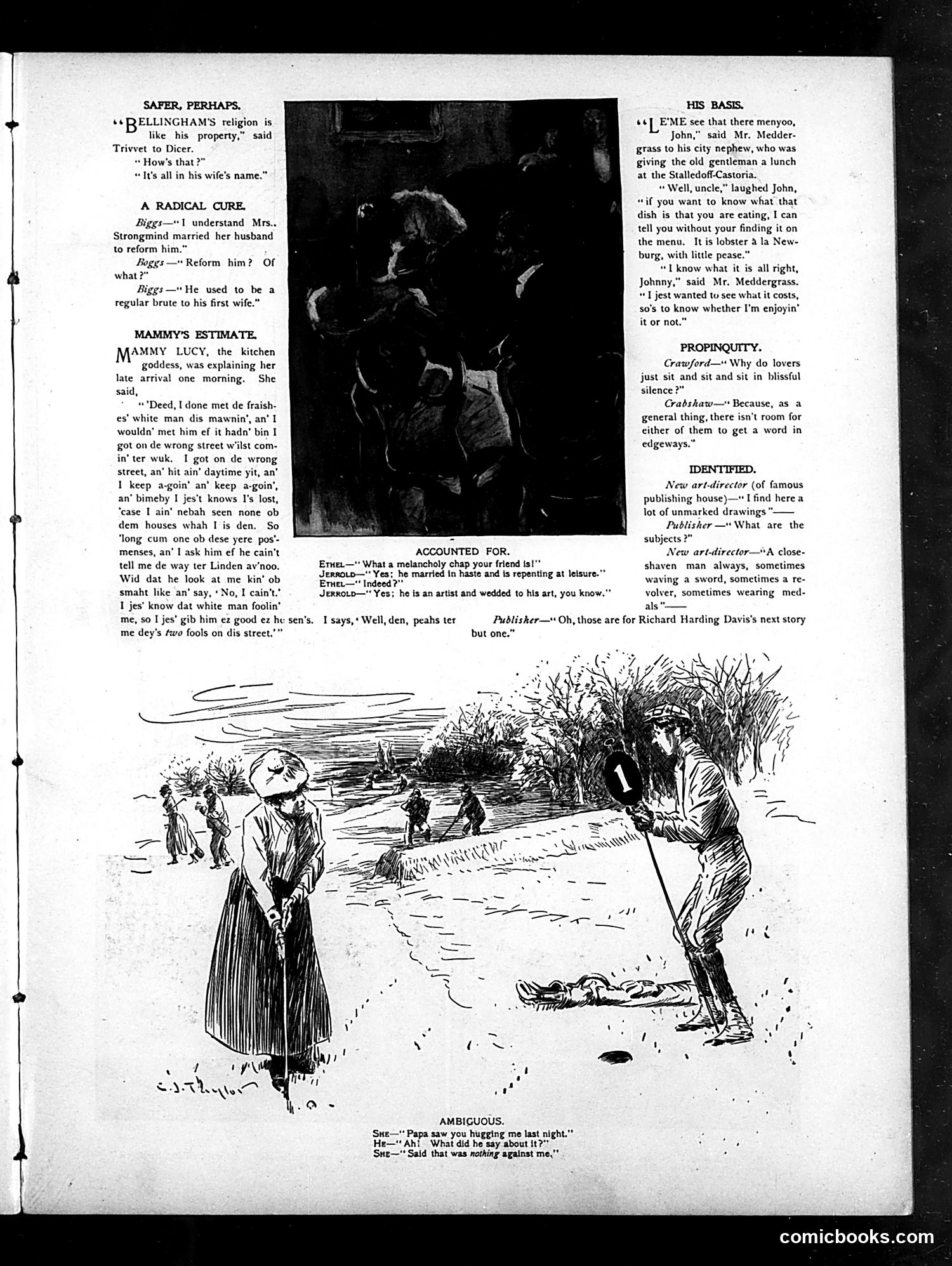
This page contains several brief humor pieces rather than political cartoons. The sketches mock social conventions and character types: **"A Radical Cure"** satirizes a man reformed by marriage—he's no longer brutal to his wife. **"Mammy's Estimate"** presents dialect humor featuring a Black domestic worker critiquing a white man's behavior and intelligence, reflecting the racist comedy conventions of the era. **"Accounted For"** mocks an artist husband's melancholy as mere pretense. The bottom illustration shows a golf scene with ambiguous dialogue about overnight activities, suggesting marital infidelity humor. These pieces represent Judge's typical early-20th-century satirical style: domestic comedy, racial stereotyping, and commentary on marriage and gender roles. The content reflects period attitudes now recognized as offensive.
📄 Transcribed text from this page (OCR, searchable)
Machine-transcribed from the original scan — historical spelling and the odd misread are preserved.
SAFER, PERHAPS, ‘6 BELLINGHAM'S religion is like his property,” said Trivvet to Dicer. “ How's that?” “It's all in his wife's name.” A RADICAL CURE. Biggs—«1 understand Mrs.. Strongmind married her husband to reform him.” Boggs —" Reform him? Of what ?” Biggs —"He used to be a regular brute to his first wife.” MAMMY’S ESTIMATE. MAMMY LUCY, the kitchen goddess, was explaining her late arrival one morning. She said, Deed, I done met de fraish- es’ white man dis mawnin’, an’ I woulda’ met him ef it hada’ bin I got on de wrong street w'ilst com- in’ ter wuk. I got on de wrong street, an’ hit ain’ daytime yit, an’ 1 keep a-goin’ an’ keep a-goin’, an’ bimeby I jes't knows I's lost, ‘case Iain’ nebah seen none ob dem houses whah I is den. So ‘long cum one ob dese yere pos’- menses, an’ I ask him ef he cain't tell me de way ter Linden av'noo. Wid dat he look at me kin’ ob smaht like an’ say, “No, I cain’ 1 jes’ know dat white man foolin’ me, so I jes’ gib him ez good ez he me dey’s wo fools on dis strect.’” ACCOUNTED FOR. Erex— What a melancholy chap your friend is!"" Ermet—"* Indeed ?" Jerrovo—" Yes; he is an artist and wedded to his art, you know." sen’s. I says,* Well, den, peahs ter . 7 ry SAT RAO AMBIGUOUS. ‘Sue—" Papa saw you hugging me last night.” He. hi What did he say about it?”” Sue—" Said that was nothing against me," married in haste and ts repenting at leisure." HIS BASIS. +6] EME see that there menyoo, John,” said Mr. Medder- grass to his city nephew, who was giving the old gentleman a lunch at the Stalledoff-Castoria. “Well, uncle,” laughed John, “if you want to know what that dish is that you are eating, I can tell you without your finding it on the menu. It is lobster ala New- burg, with little pease.” “L know what it is all right, Johnny,” said Mr. Meddergrass. “1 jest wanted to see what it costs, so’s to know whether I'm enjoyin’ it or not.” PROPINQUITY. Crawford—" Why do lovers just sit and sit and sit in blissful silence ?” Crabshaw—* Because, as a general thing, there isn’t room for cither of them to get a word in edgeways.” IDENTIFIED. New art-director (of famous publishing house)—" I find here a lot of unmarked drawings” Publisher — What are the subjects 2” New art-director—*A close- shaven man always, sometimes waving a sword, sometimes a re- volver, sometimes wearing med- als «Oh, those are for Richard Harding Davis's next story comicbooks.com