
A complete issue · 16 pages · 1902
Judge — October 11, 1902
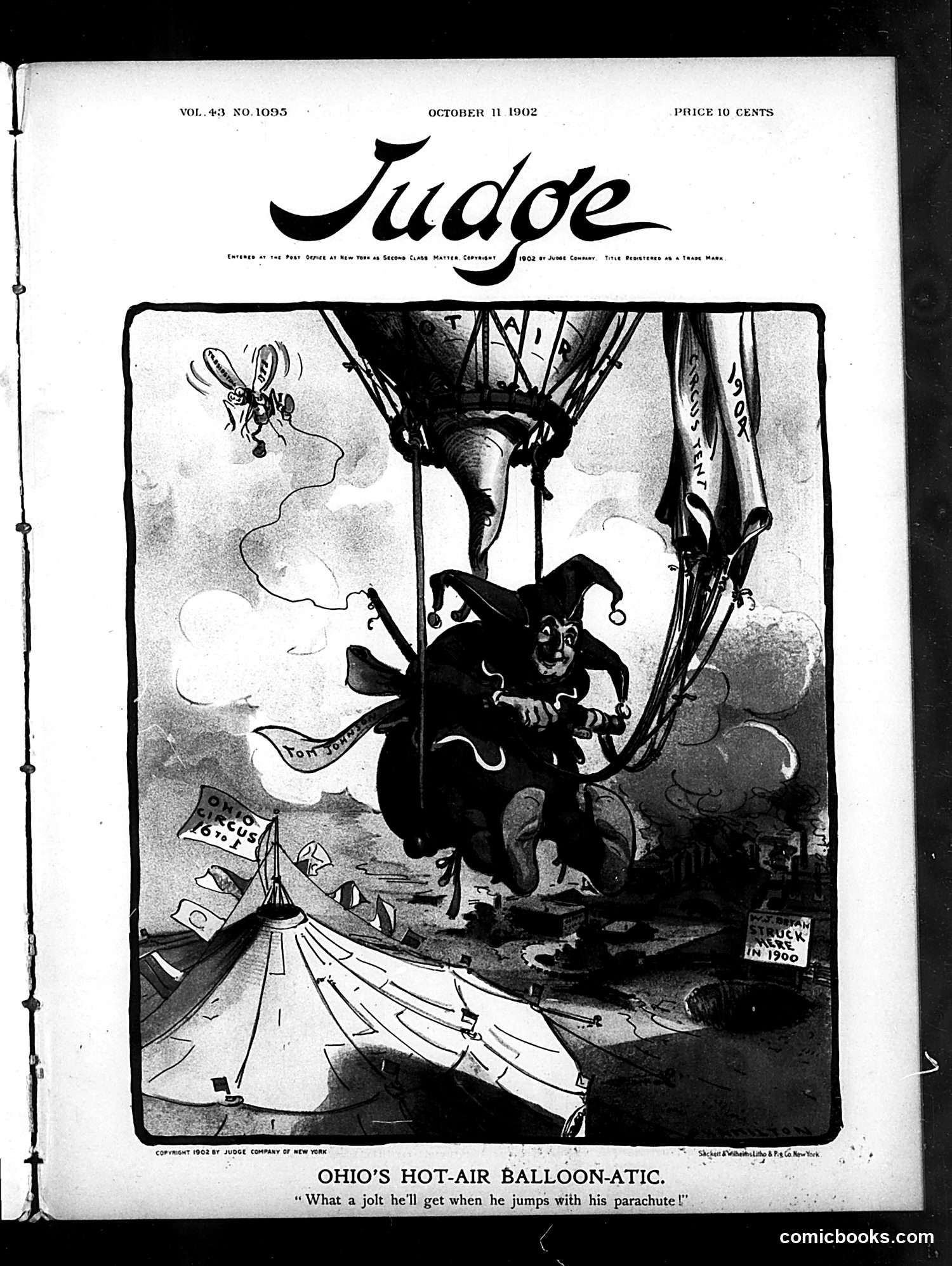
This October 1902 Judge cartoon satirizes Ohio politics, likely referencing the state's gubernatorial race. The demonic figure in the balloon basket represents a politician engaging in inflated rhetoric—"hot air"—while ascending. The caption's joke ("What a jolt he'll get when he jumps with his parachute!") suggests the speaker will face harsh consequences or public backlash when his exaggerated promises prove false. The scattered papers and documents below indicate abandoned or discarded political positions. The devil-like character implies corruption or moral bankruptcy in Ohio's political establishment. The attic setting (a cramped, cluttered space) further mocks the state's political discourse as chaotic and insubstantial—all bluster with no substance.
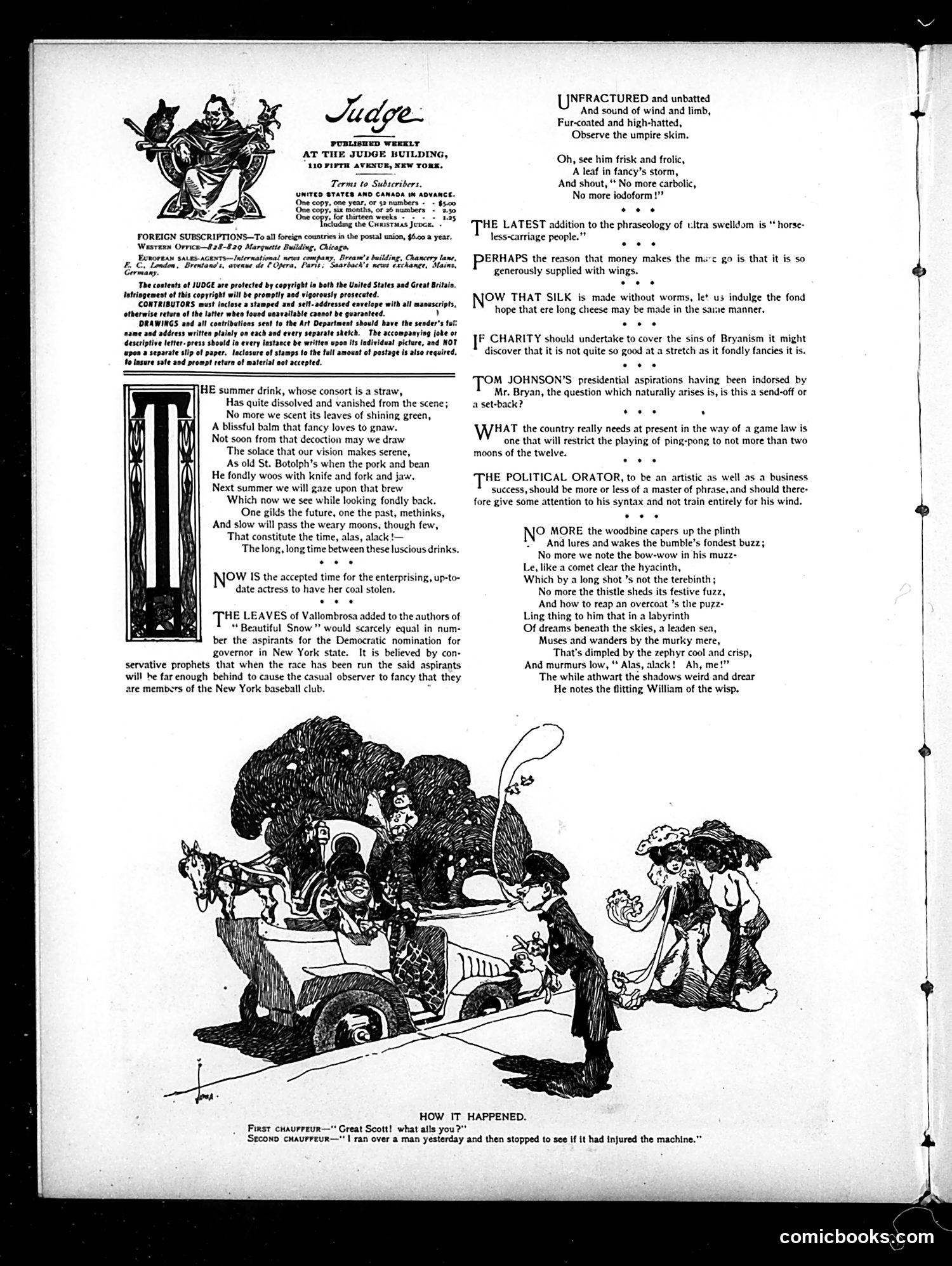
This page contains satirical commentary on early 20th-century American society and politics. The text critiques various social trends: "ultra weekism" (excessive leisure), silk production methods, charity's hypocrisy regarding Bryanism (likely referring to William Jennings Bryan's populist politics), and the need for restrictive gaming laws. The bottom cartoon titled "How It Happened" depicts a motor car accident with two chauffeurs. The joke plays on the emerging automobile culture and class distinctions—one wealthy passenger's chauffeur hits a pedestrian, and the drivers discuss whether the car or person was damaged. This satirizes the carelessness of wealthy motorists and their servants' priorities: protecting expensive machines over human welfare—a common Judge theme mocking industrial-age callousness and class indifference.
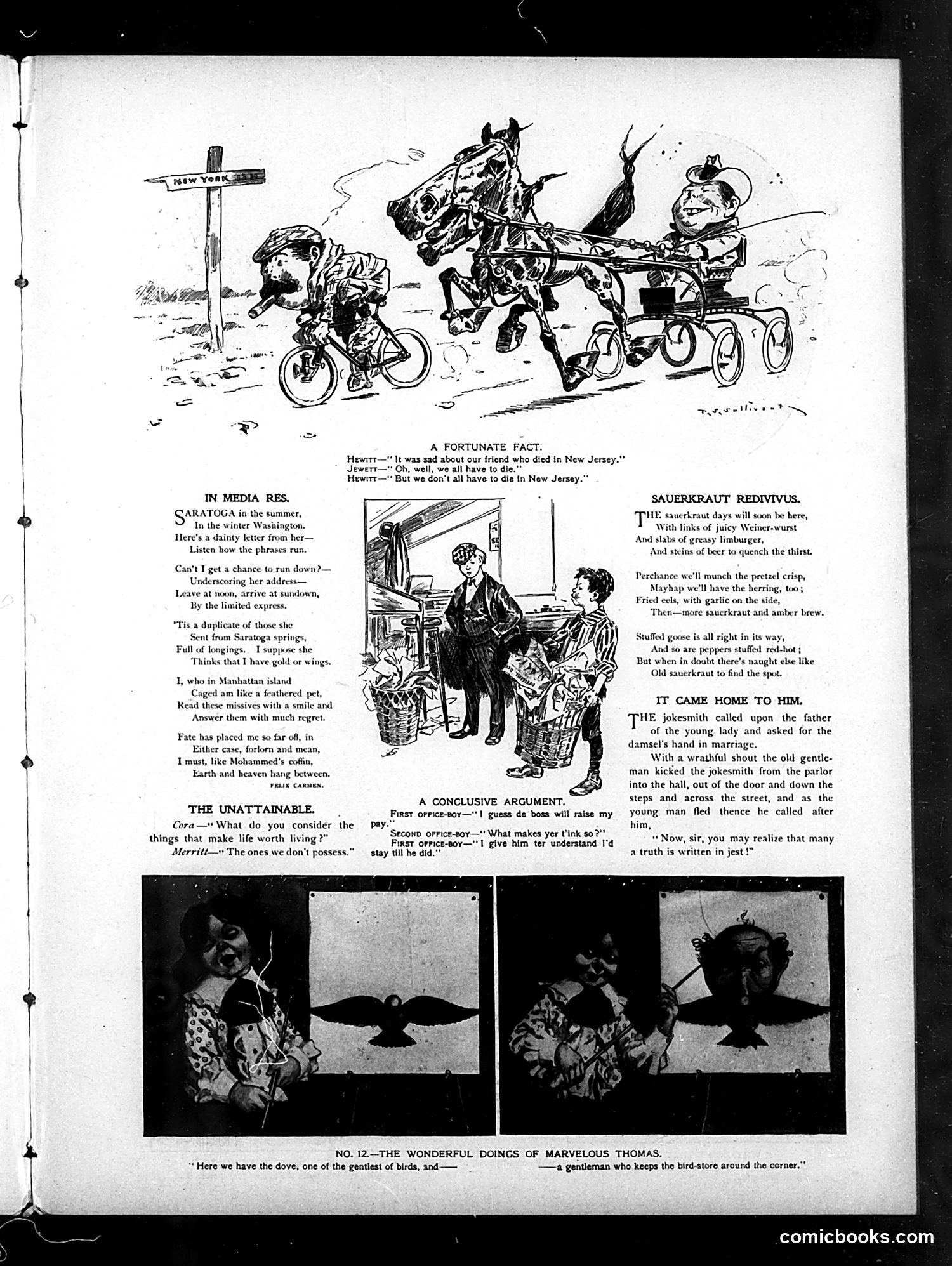
This page contains several satirical pieces typical of early 20th-century humor: **Top cartoon**: Shows a man on a bicycle confronted by a caricatured figure with exaggerated features driving a horse-drawn vehicle, referencing conflicts between new automobile/cycling technology and traditional transportation—a common satirical theme of the era. **"A Fortunate Fact"**: A brief joke about death in New Jersey, suggesting regional stereotypes. **"In Media Res" and other poems**: Light verse about summer travel and romantic mishaps, common Judge material. **"A Conclusive Argument"**: Office humor about worker-boss dynamics. **Bottom photographs**: Appear to be trick photography showing a man with a dove, illustrating "The Wonderful Doings of Marvelous Thomas"—likely a magic or illusion feature. The page reflects Judge's typical mix of social commentary, wordplay, and visual gags targeting educated urban readers.
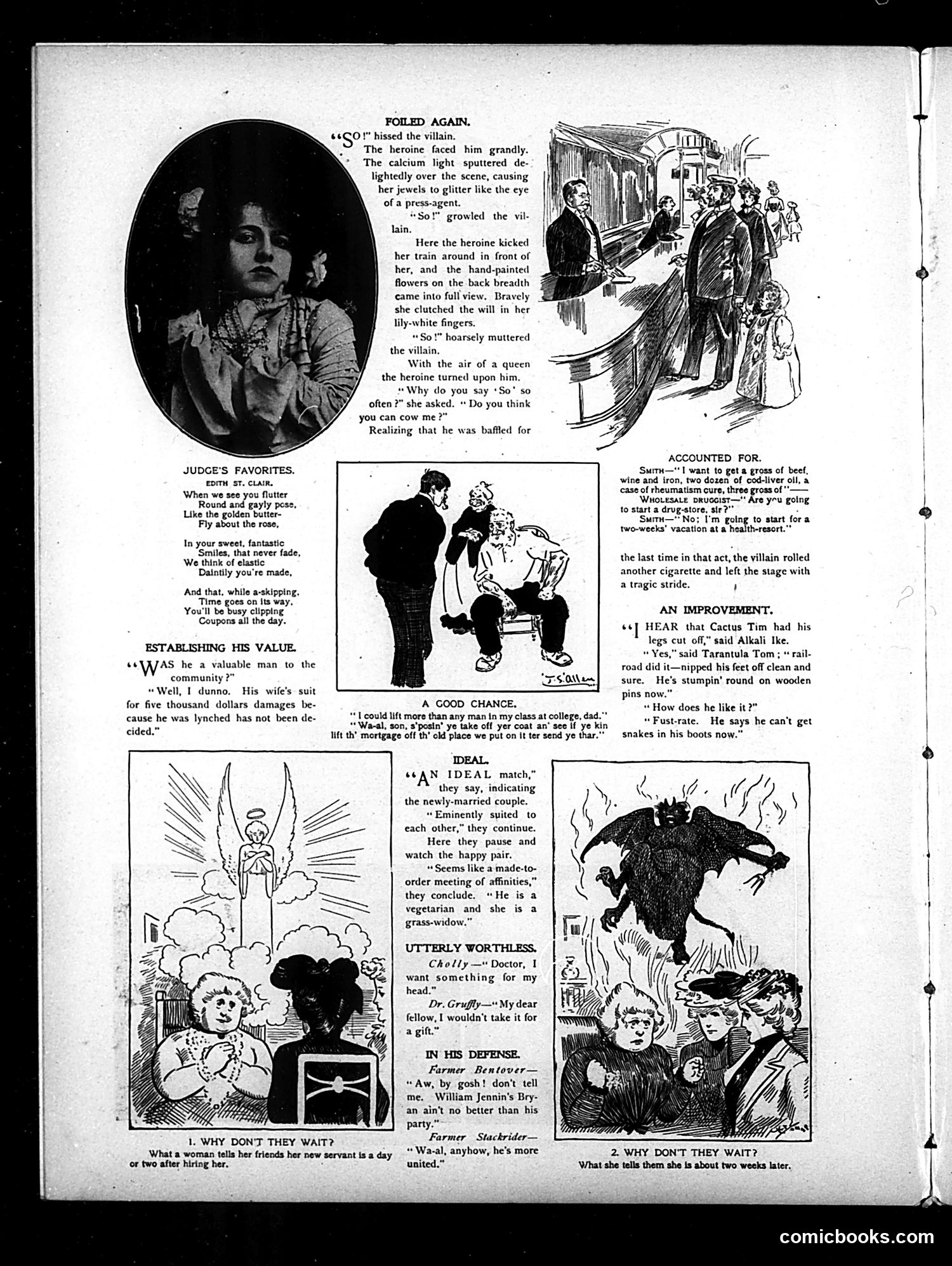
This appears to be a fiction/humor page rather than political satire. The content includes: **"Foiled Again"** — A serialized story about a villain and heroine with melodramatic plot elements (calcium lights, jewelry, train scenes). The illustration shows the heroine confronting the villain. **Several joke sections** with titles like "Judge's Favorites," "Establishing His Value," "A Good Chance," "An Improvement," "Ideal," and "Utterly Worthless" — these appear to be brief humorous anecdotes about everyday situations (marriages, servants, doctors, farmers). **Cartoons** with captions like "Why Don't They Wait?" — illustrating domestic or social humor scenarios. The page's humor relies on wordplay, domestic situations, and social observations typical of early 20th-century American magazines. There's no evident political commentary or specific contemporary event being referenced.
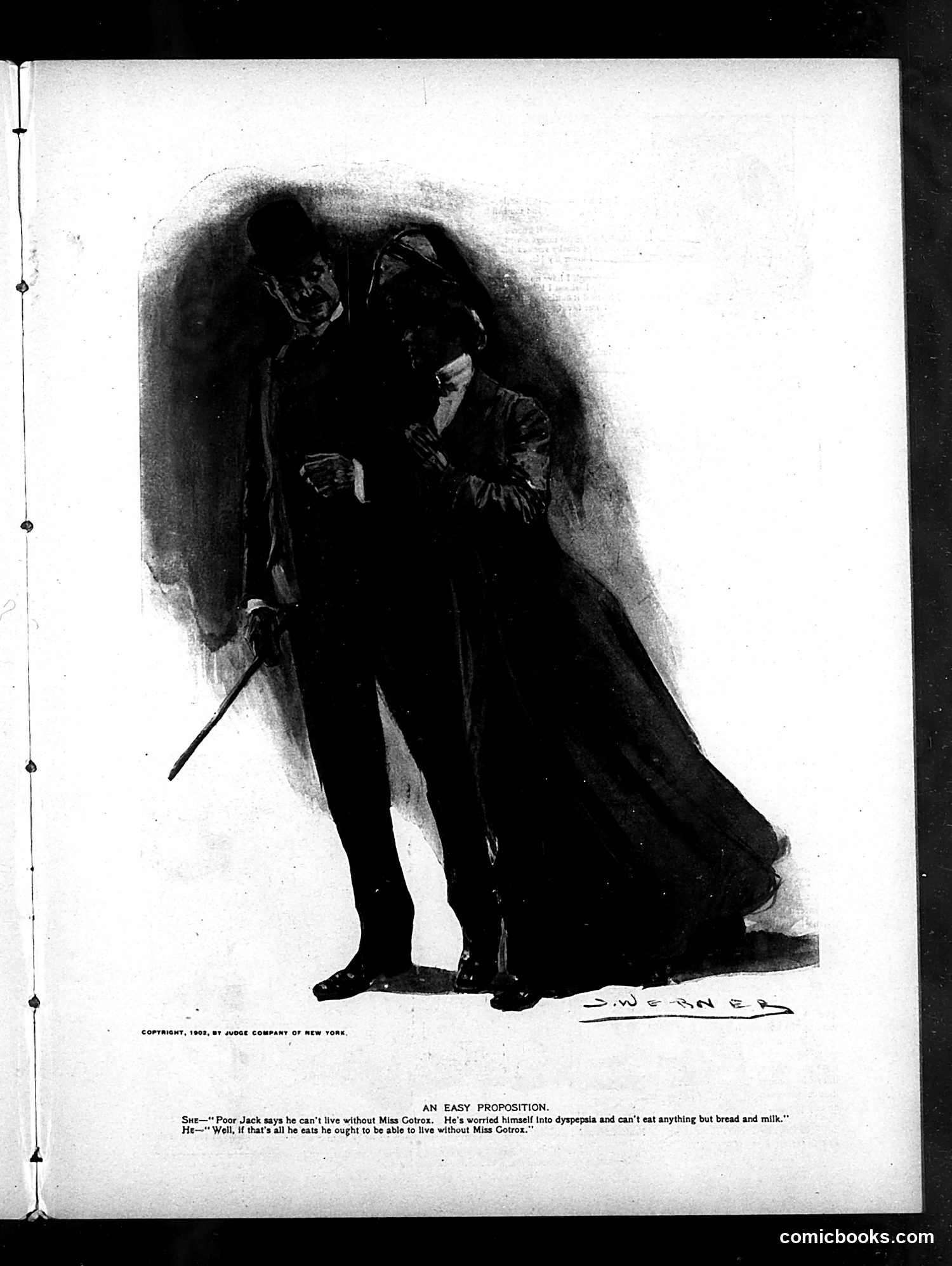
This 1902 Judge cartoon satirizes romantic obsession. A man ("Poor Jack") is so lovesick over a woman named Miss Gotrox that he's developed dyspepsia (indigestion) and can only eat bread and milk. The joke's punchline is cynical: if he's reduced to such a meager diet anyway, he should easily afford to live without her—suggesting that romantic devotion is economically irrational. The cartoon mocks both Jack's emotional excess and, implicitly, the artificial desperation men perform in courtship. The silhouetted figures and period dress are typical of Judge's satirical style, using exaggeration to critique contemporary social behavior, particularly the melodramatic romanticism of the era.
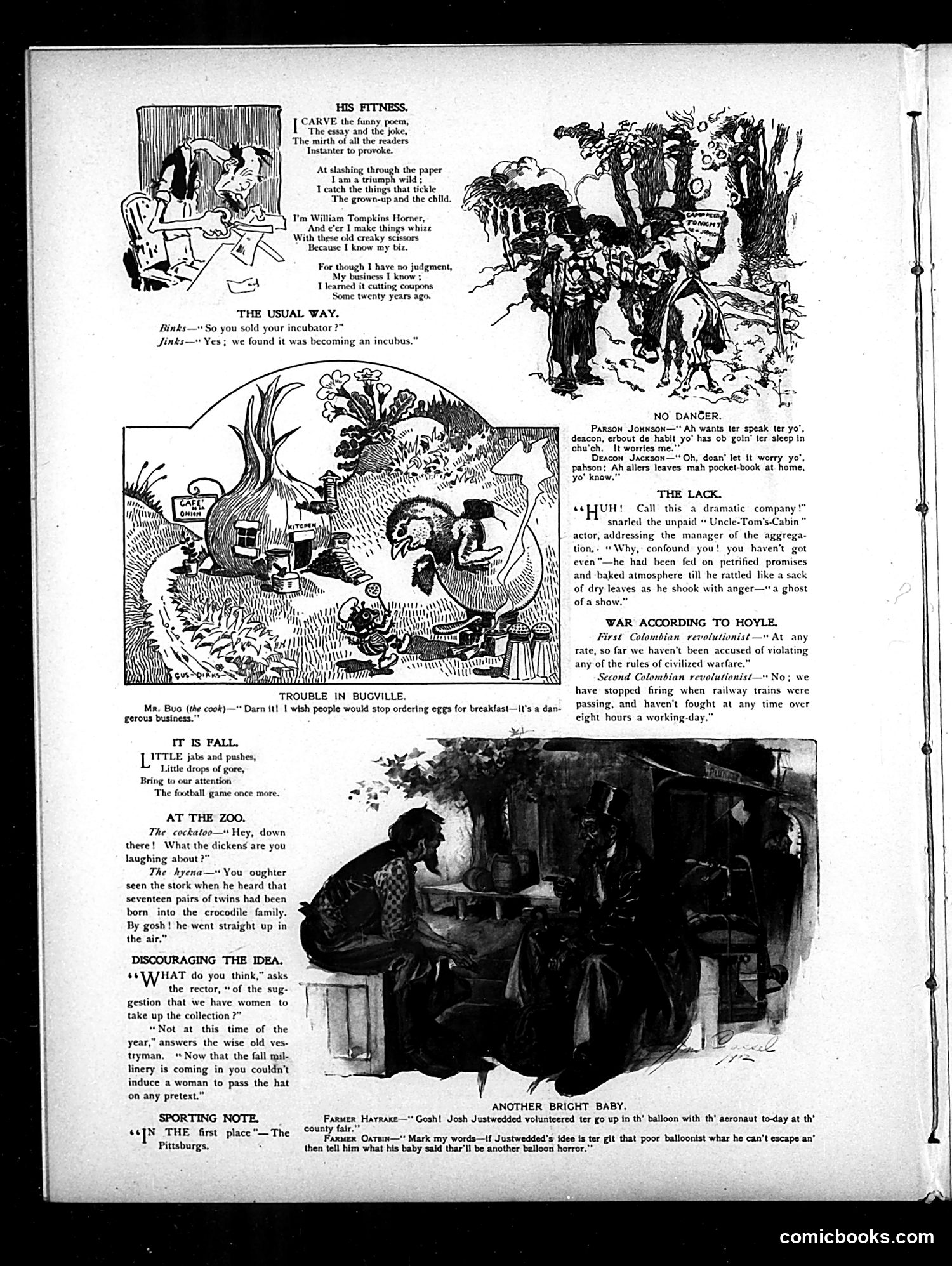
This page contains several humor pieces typical of Judge's satirical style, circa early 1900s: **"Trouble in Bugville"** mocks workplace concerns through insect characters—Mr. Bug (cook) complains about egg orders being "dangerous business," a pun on labor safety issues. **"The Usual Way"** and **"Another Bright Baby"** reference a running character "Justwedded," poking fun at newlyweds and their naiveté. **"War According to Hoyle"** satirizes Colombian revolutionists claiming adherence to "civilized warfare" rules—likely referencing actual Colombian conflicts of the 1900s. The joke undercuts their claim by noting they simply stopped firing when trains passed (suggesting accidental compliance rather than principle). **"The Lack"** mocks struggling theater actors performing "Uncle Tom's Cabin," depicting poverty-stricken performers. Other pieces ("At the Zoo," "Fall," "Sporting Note") are light observational humor about zoos, football, and church collections—no deep political content. The page reflects Judge's mix of social satire and gentle domestic comedy.
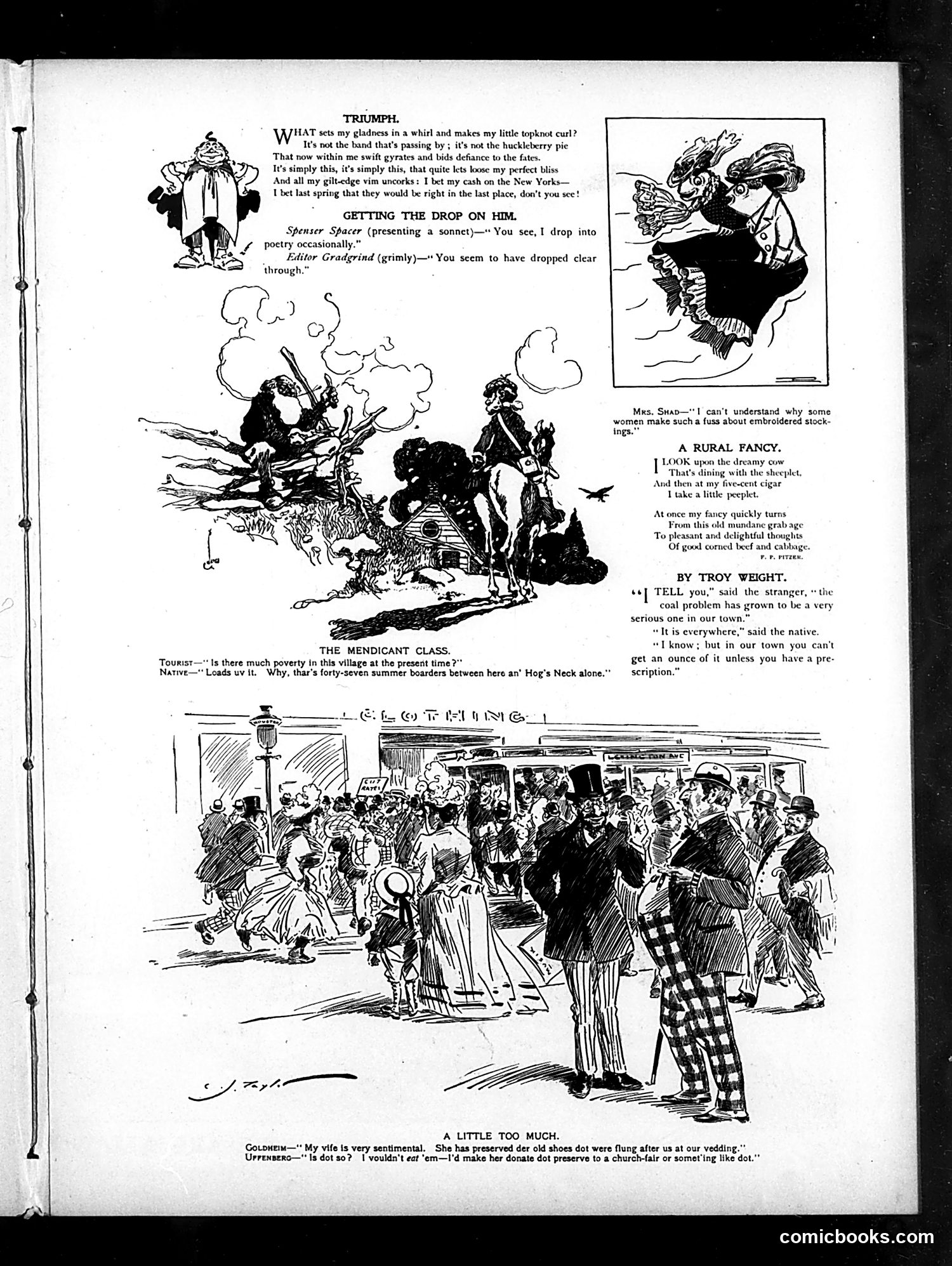
This page contains multiple satirical cartoons and jokes typical of early 20th-century American humor: **"Triumph"**: A bettor boasts about wagering that the New York baseball team would finish last—and winning. The joke mocks overconfidence in sports predictions. **"Getting the Drop on Him"**: An aspiring poet pitches verses to an editor, who dismisses him by saying he's "dropped clear through"—a pun suggesting the poet failed completely. **"The Mendicant Class"**: A tourist asks about poverty; the native complains about "forty-seven summer boarders"—wealthy seasonal visitors are presented as a parasitic class draining the rural community. **"A Rural Fancy"** and **"A Little Too Much"**: Domestic humor about absent-minded daydreaming and overly sentimental wives preserving wedding-day shoes. **"A Rural Fancy"**: Commentary on romanticizing rural life while fantasizing about city food (corned beef and cabbage). The page reflects Judge's focus on class commentary, failed ambitions, and domestic satire aimed at middle and upper-class readers.
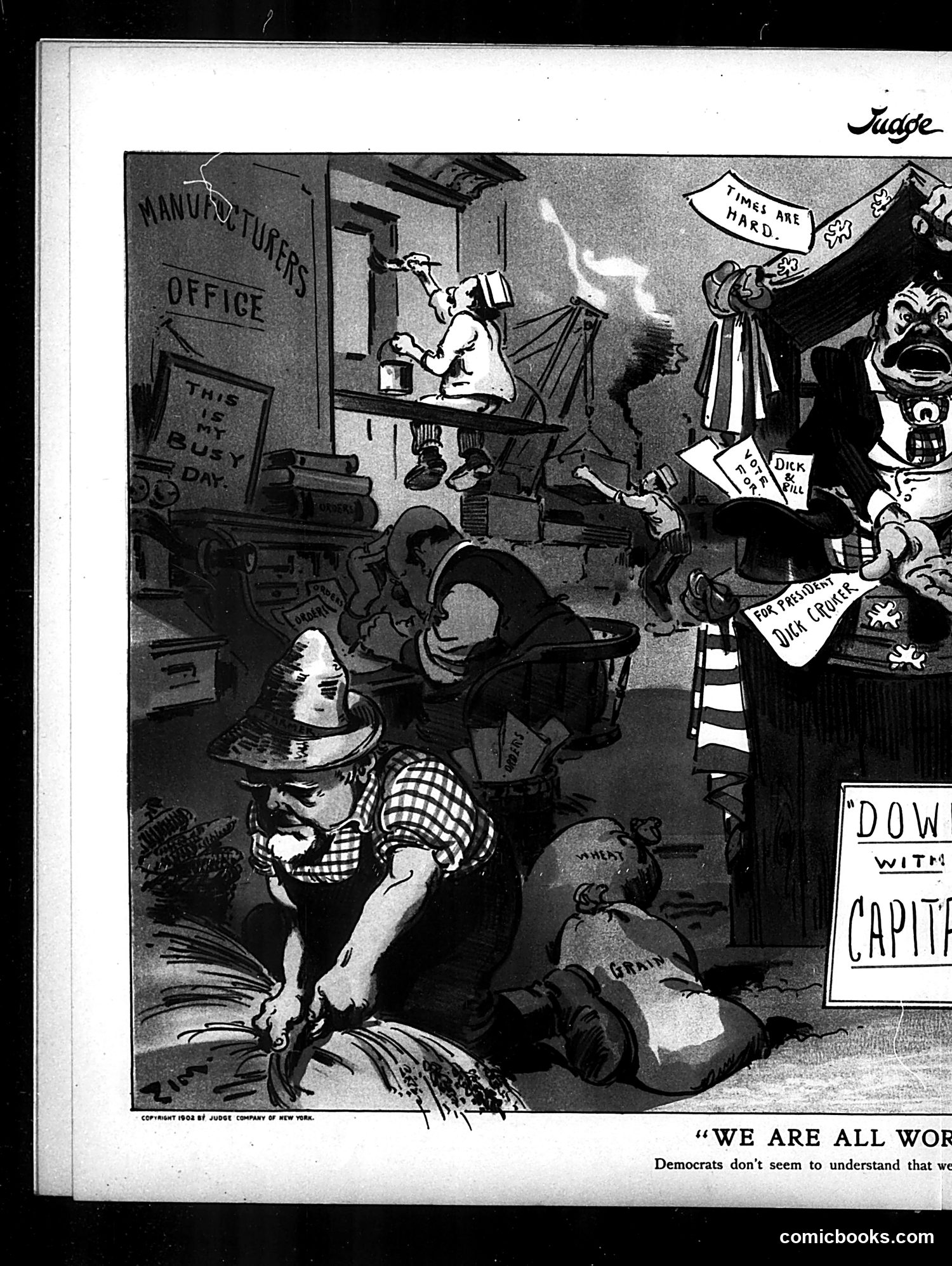
This page from *Judge* magazine contains a political cartoon satirizing Democratic Party management during what appears to be a labor or economic crisis. The main illustration shows a chaotic "Manufacturers' Office" scene with workers in disarray—some collapsed on the ground labeled "GRAIN" and "WHEAT," others struggling amid machinery. A figure at a desk appears overwhelmed by the disorder. On the right, caricatured Democratic leaders gesture frantically at signs reading "TIMES ARE HARD" and "DICK FOR PRESIDENT," suggesting they're promoting political solutions while the economic situation deteriorates. The caption beginning "WE ARE ALL WOR[KING]" and incomplete text below indicate Democrats fail to grasp some economic principle. The cartoon critiques Democratic responses to industrial/agricultural hardship, likely from the late 19th or early 20th century.
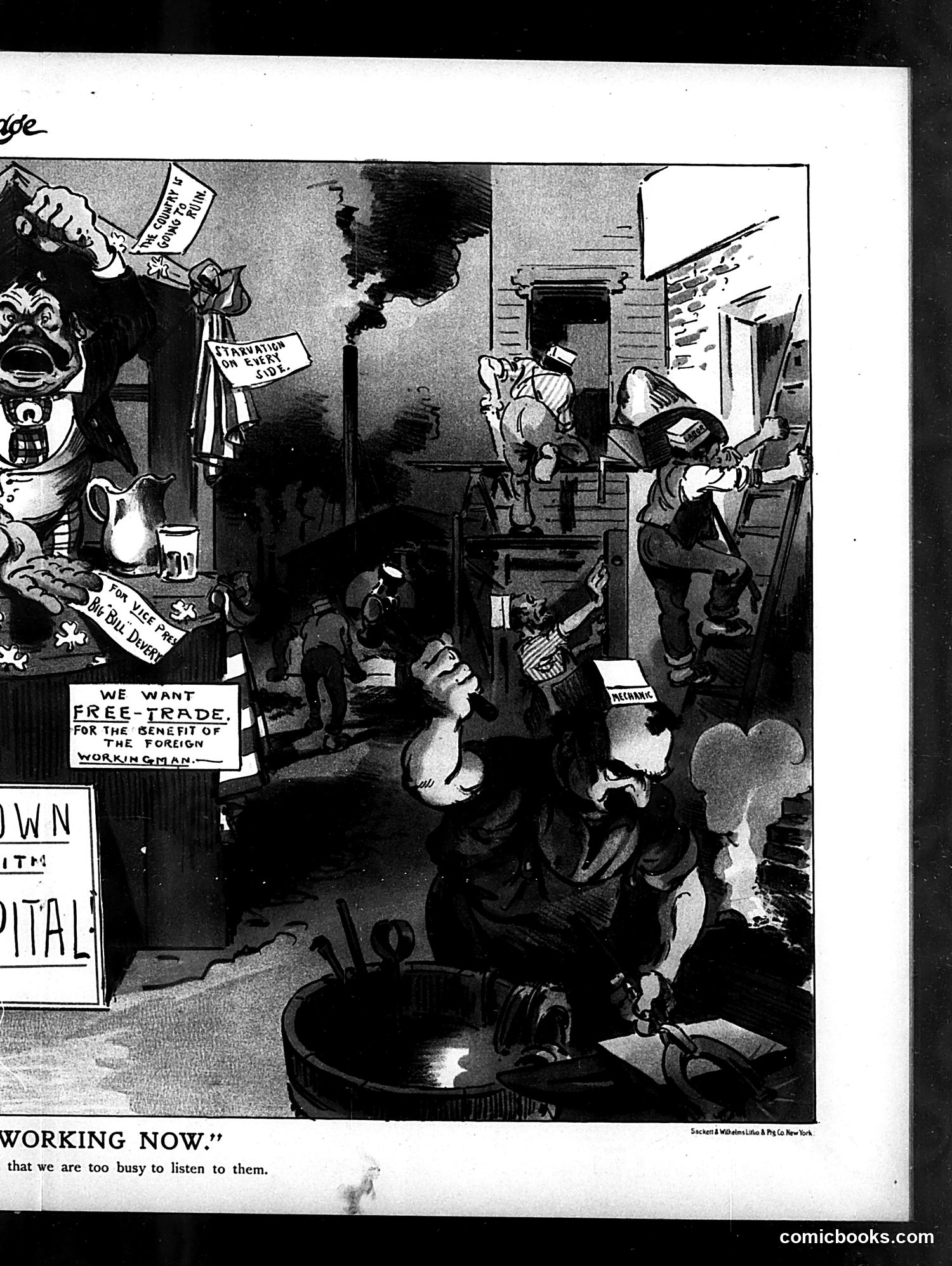
This appears to be a late 19th or early 20th-century satirical cartoon criticizing American indifference to foreign labor concerns. The image shows a caricatured fat figure (likely representing American capitalism or wealth) ignoring pleas from foreign workers below, who hold signs reading "WE WANT FREE-TRADE FOR THE BENEFIT OF THE FOREIGN WORKINGMAN." The satire cuts two ways: it mocks both American business interests who claim free trade benefits workers abroad, while simultaneously depicting Americans as self-absorbed and dismissive of foreign labor's actual suffering. The caption emphasizes this hypocrisy—Americans claim to support free trade for foreign workers' benefit while being "too busy to listen to them." The cartoon critiques the disconnect between pro-free-trade rhetoric and genuine concern for international labor welfare.
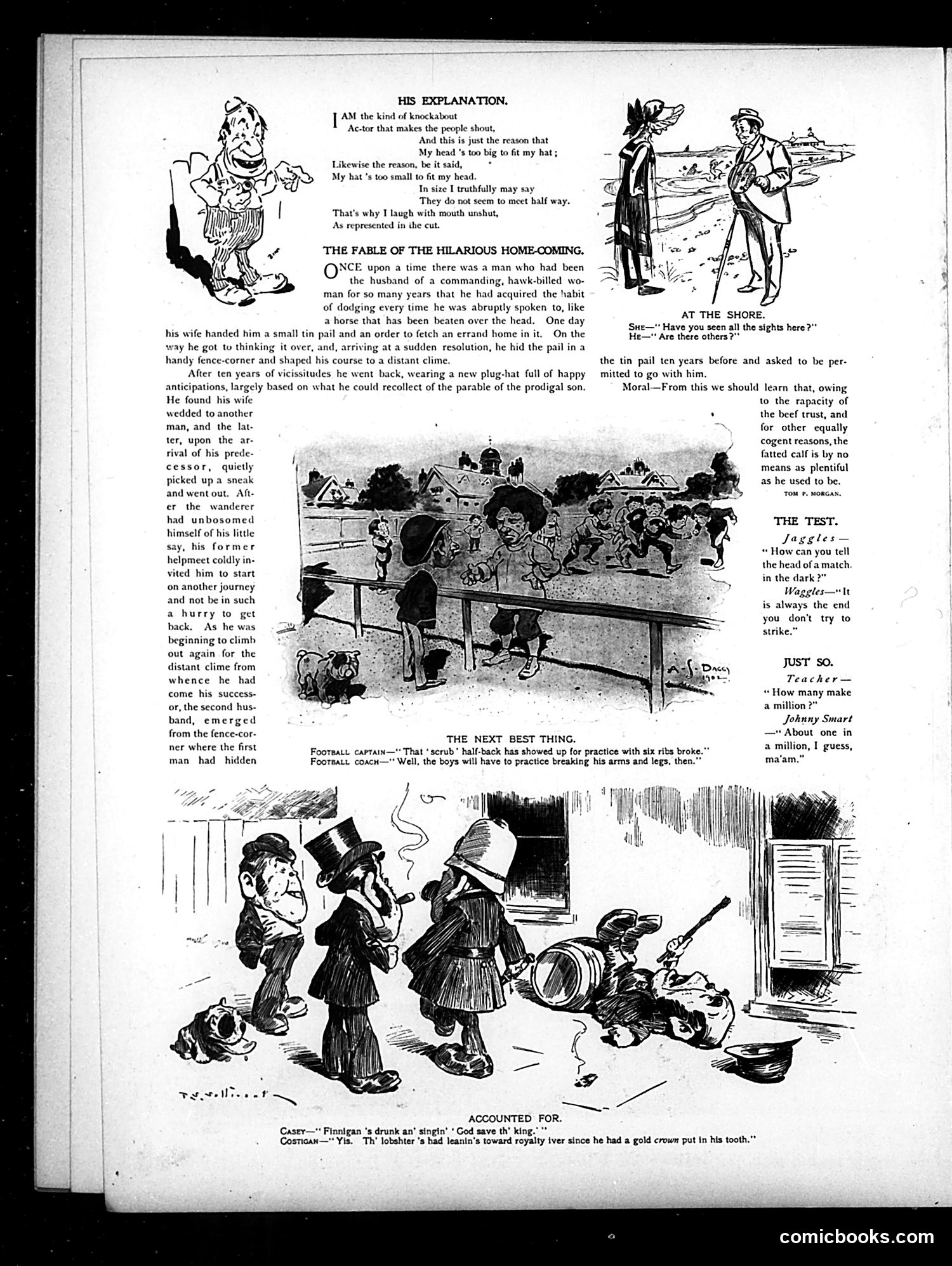
This page contains multiple unrelated satirical pieces typical of Judge magazine's format: **"His Explanation"** features a knockabout actor whose oversized head won't fit his hat—a visual gag about a vaudeville-type performer known for physical comedy. **"The Fable of the Hilarious Home-Coming"** satirizes the Biblical prodigal son parable. A henpecked husband escapes his domineering wife, returns after ten years expecting forgiveness, only to find her remarried. The "moral" pivots to contemporary economics: the "fatted calf" is scarce because of the beef trust's monopoly practices—a reference to real Progressive-Era concerns about meat industry monopolies controlling prices. **Other brief items** include wordplay jokes ("The Test"), a classroom quip about millions, and football humor about injured players. **"Accounted For"** jokes about an Irish drunk ("Finnigan") singing "God Save the King"—attributed humorously to his having a gold tooth crown, suggesting dental work made him loyal to royalty. This relies on ethnic Irish stereotypes common to the era.
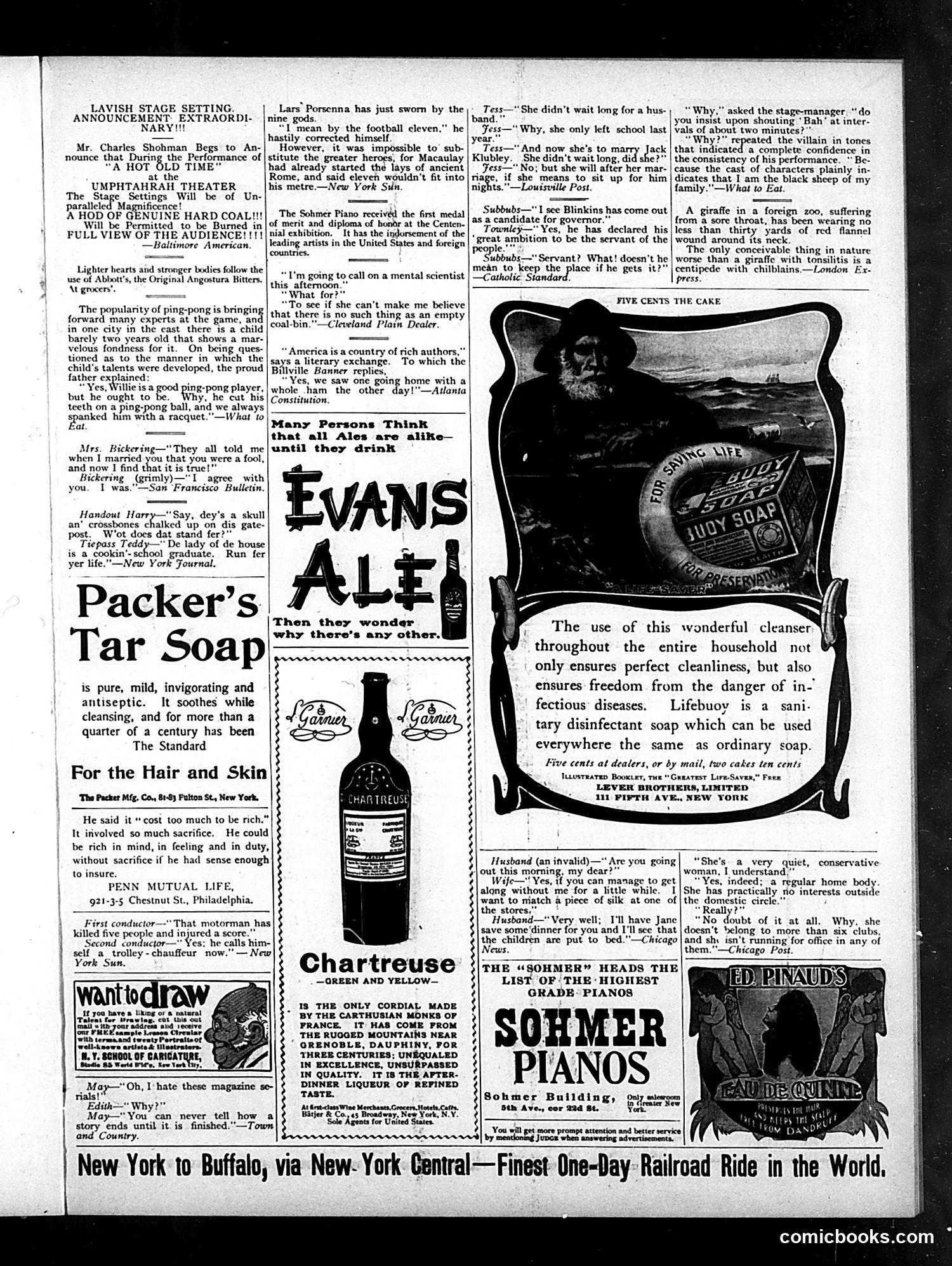
This page is primarily **advertisements and filler jokes** rather than political satire. The cartoons and quips mock everyday social situations: **Key humor pieces:** 1. **"A Hot Old Time" theater announcement** – satire of overwrought theatrical marketing. The "extraordinary" feature is merely burning a hod of coal on stage—mocking inflated promises in theater advertising. 2. **Ping-pong child anecdote** – jokes about the fad popularity of ping-pong (a new game at the time), with absurdist humor about a toddler supposedly skilled at the sport. 3. **Marriage/courtship jokes** – typical period humor about wives' complaints, quick engagements, and marital dissatisfaction. 4. **"Trolley chauffeur" quip** – dark humor about a reckless motorman who's killed people, now self-importantly calling himself a "chauffeur." The page contains **no apparent political cartoons or significant social commentary**, instead featuring light domestic humor interspersed with patent medicine and product advertisements—typical of Judge magazine's content during this era.
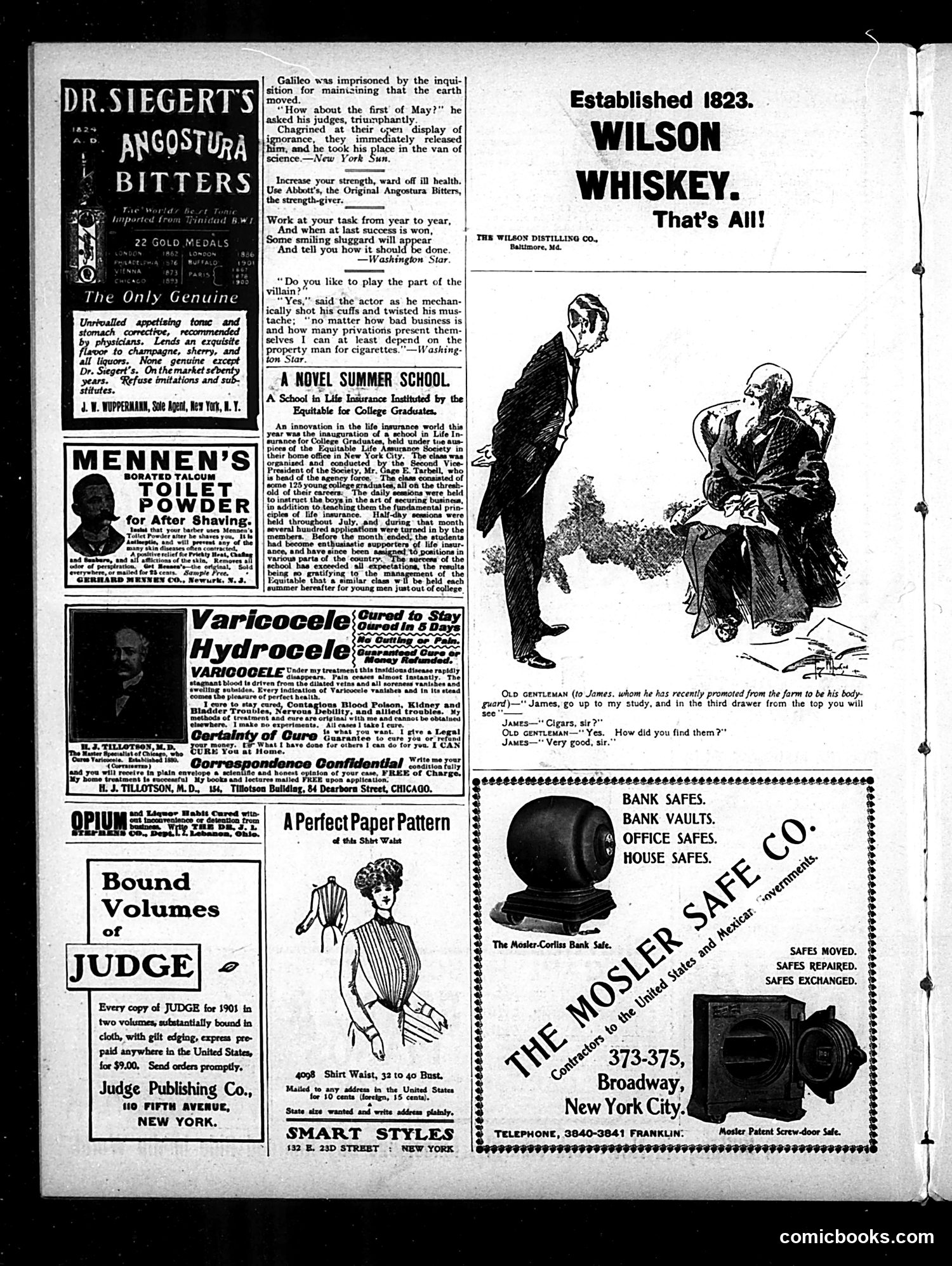
This page is primarily **advertisements and filler content** with one cartoon. The main illustrated piece shows a gentleman instructing his newly promoted bodyguard, James, to retrieve cigars from his study desk. James's clever deduction that the "something in the third drawer" must be cigars—rather than asking what item—is the joke's punchline. It's mild workplace humor playing on the assumption that a wealthy man's study drawer naturally contains cigars. The page is dominated by **period advertisements**: Dr. Siegert's Angostura Bitters, Mennen's toilet powder, medical treatments for venereal diseases, Wilson Whiskey, a life insurance summer school, sewing patterns, the Mosler Safe Company, and bound volumes of Judge magazine itself. Several short **satirical quotes** appear (about Galileo, work, actors playing villains) reflecting Judge's typical editorial voice—genteel social commentary on American manners and pretension. The content reflects **early 1900s concerns**: men's grooming products, insurance innovation, medical advertising (including treatments now considered quackery), and workplace propriety.
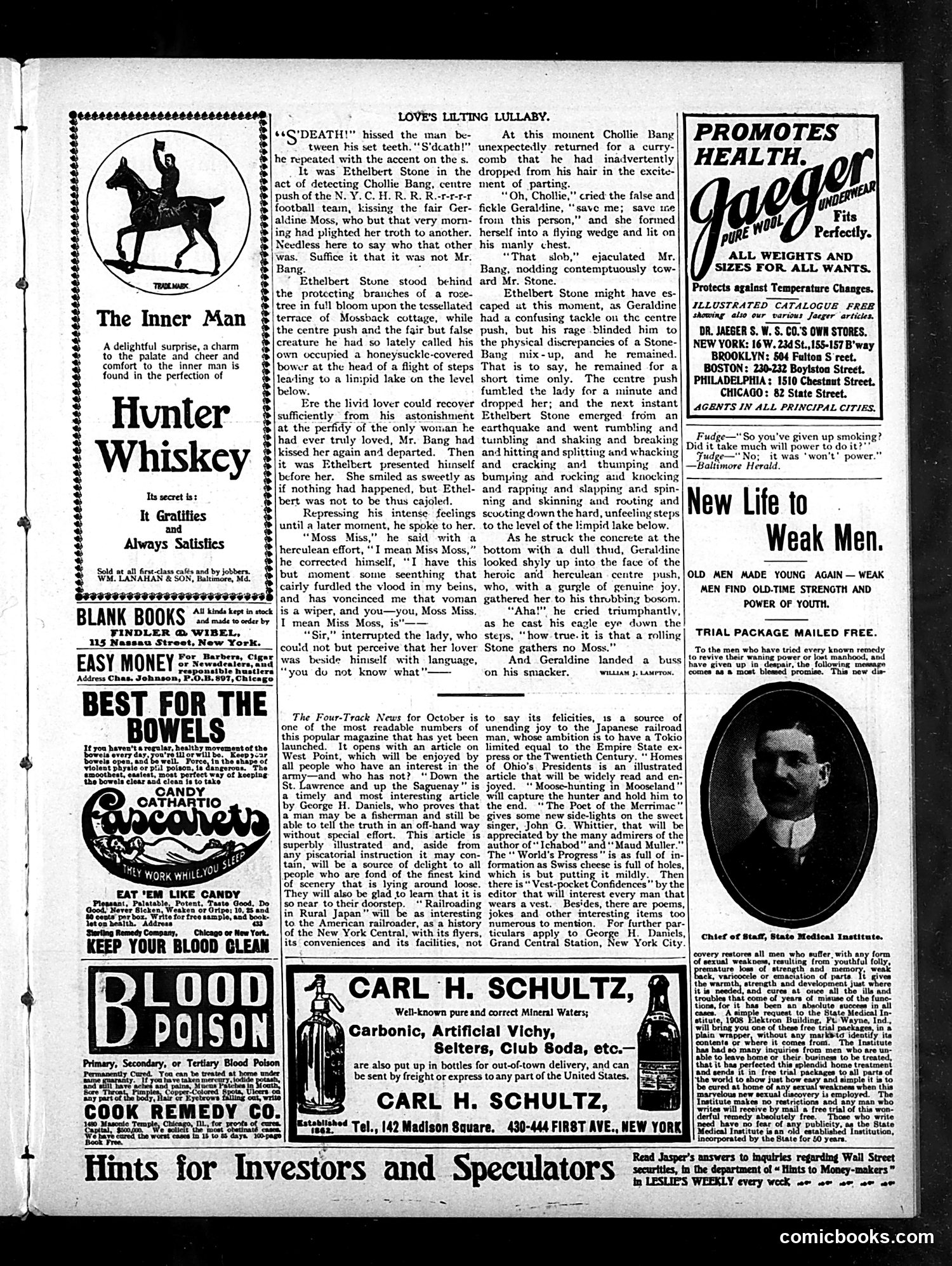
This page contains "Love's Lilting Lullaby," a comedic short story parodying melodramatic romantic fiction popular in the era. The satire targets overwrought Victorian literature through exaggerated dialogue and absurd situations. The plot involves Ethelbert Stone discovering his beloved Geraldine Moss kissing Chollie Bang (a football player). Stone confronts her with deliberately mangled, theatrical speech ("S'dcath!" and garbled declarations about women), satirizing the pretentious language of romantic heroes. The climax—Stone tumbling down steps after a confusing physical altercation—parodies the overwrought violence in cheap fiction. The humor relies on mocking both melodramatic romance conventions and the stilted, affected speech characters adopt when attempting sophistication. The story ridicules readers who enjoyed such sentimental, dramatically overwrought tales. The surrounding page contains medical and commercial advertisements typical of the period.
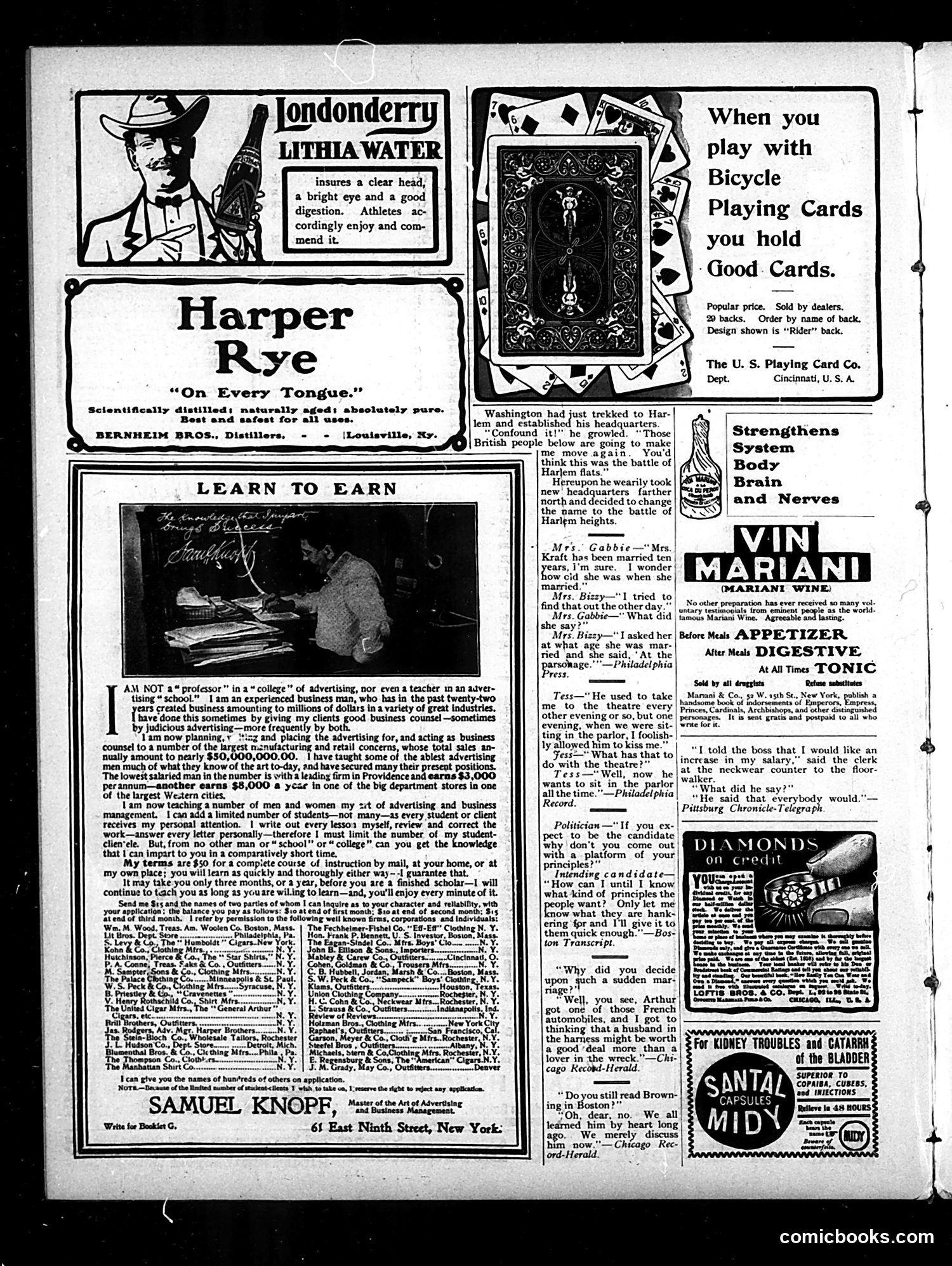
This page is primarily **advertising**, not political satire. It contains multiple product advertisements (Londonderry Lithia Water, Harper Rye whiskey, Bicycle Playing Cards, Vin Mariani wine, Santal capsules) alongside a substantial "LEARN TO EARN" recruitment ad by Samuel Knopf, who offers advertising and business instruction courses. The only cartoon-like content appears to be a small illustrated anecdote about Washington trekking to Harlem and establishing headquarters, joking about renaming battles (Harlem Flats/Harlem Heights). This is a **mild historical pun** referencing the actual Revolutionary War Battle of Harlem Heights, using the premise of Washington's movements to make wordplay about geographic names. The page also includes brief dialogue snippets (Mrs. Gabbie/Bissy) that appear to be **society humor** about marriage ages—typical light domestic comedy of the era. Overall: a commercial page with minimal satirical content.
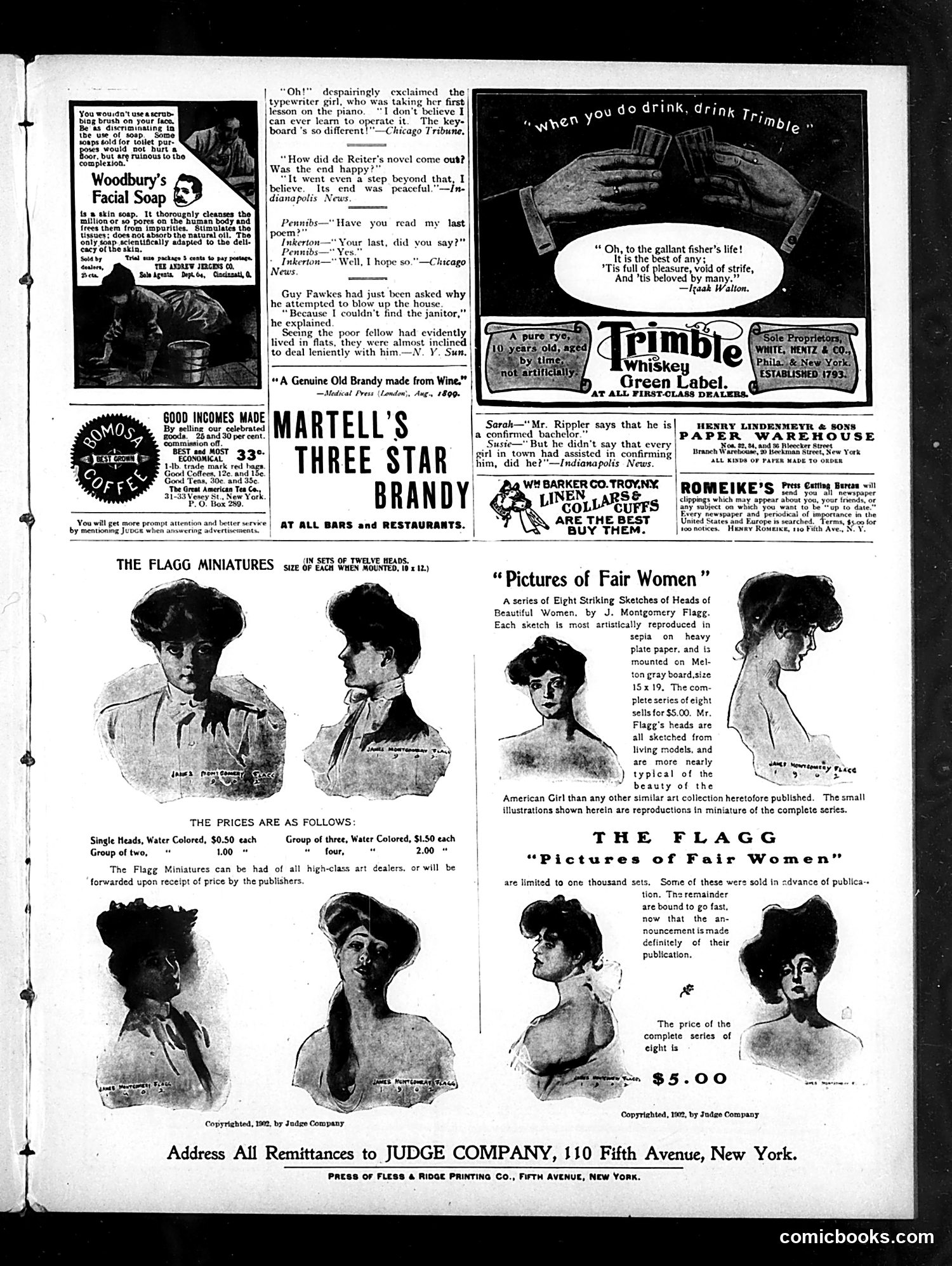
This is primarily a **advertising and humor page** from Judge magazine (circa 1902), not a political cartoon. The content includes: **Humor snippets:** Brief jokes about typewriter girls, novels, Guy Fawkes, and bachelor confirmations—typical light satirical fare mocking contemporary social situations and writing. **Main advertising focus:** The page heavily promotes J. Montgomery Flagg's "Pictures of Fair Women"—a commercial art series of eight portrait sketches selling for $5.00. Flagg was a celebrated illustrator of the era; this represents early 20th-century art merchandising. **Supporting ads:** Woodbury's Facial Soap (targeted at women), Martell's brandy, coffee/tea sales, and clipping services. **Context:** The page reflects early 1900s consumer culture, with advertisers targeting specific demographics (women concerned with complexion, affluent drinkers). The "fair women" series represents how beauty imagery was commercially packaged and sold as collectible art to the middle class. No significant political content or satirical targets are visible.
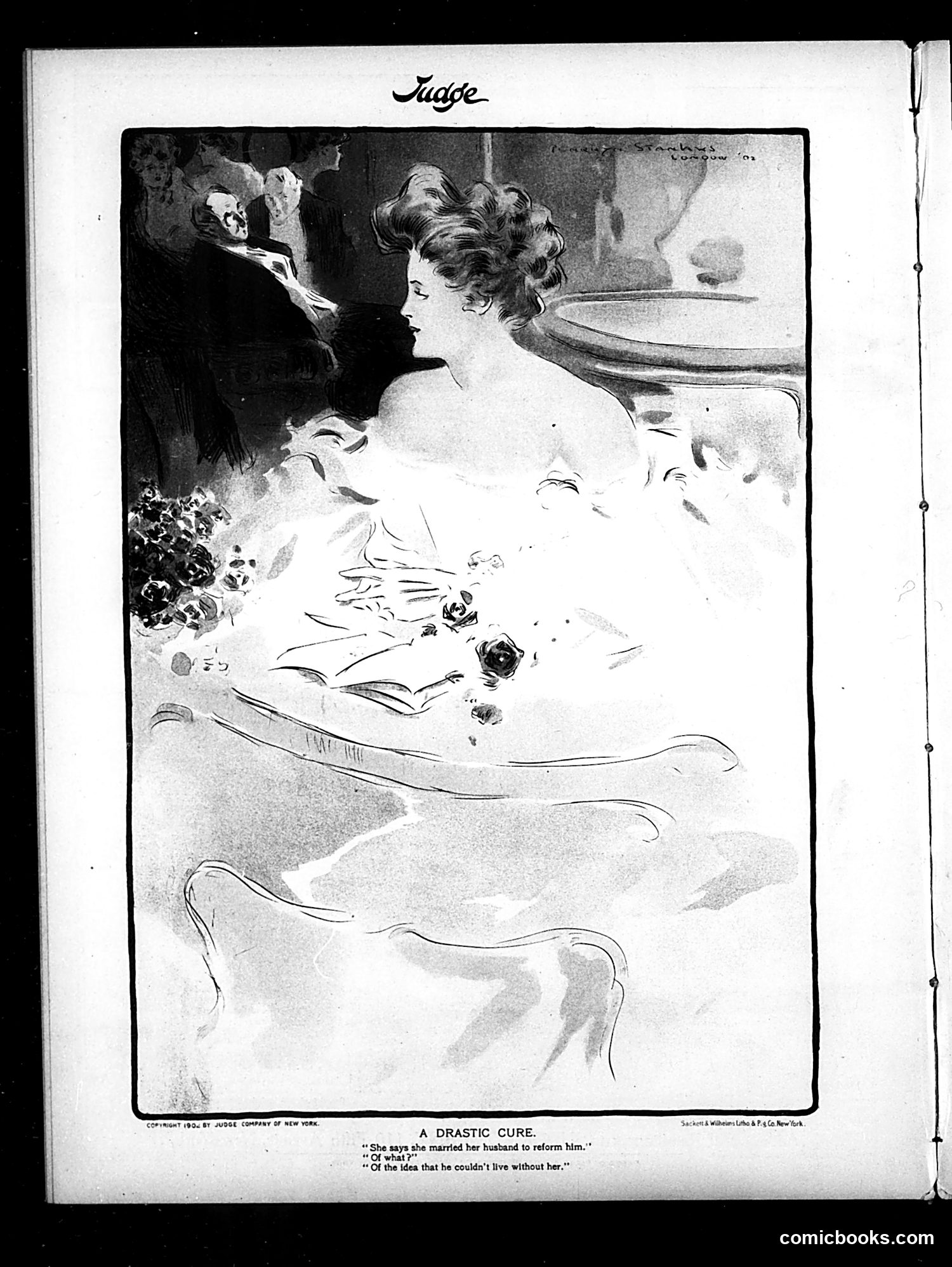
This Judge magazine cartoon satirizes marriage and women's expectations. The illustration shows a fashionable woman in an elaborate gown, depicted in an elegant but somewhat detached pose. The caption's dialogue reveals the joke: a wife married her husband hoping to reform him, but what she actually "cured" him of was the idea that he couldn't live without her—implying he's now quite content to live independently of her. The satire targets the common assumption that marriage would transform a man, while the punchline suggests the husband has instead become emotionally distant or indifferent to the wife. It's commentary on romantic delusions and the gap between wives' hopes for marital influence and the actual outcomes of marriage.