
A complete issue · 16 pages · 1902
Judge — September 27, 1902
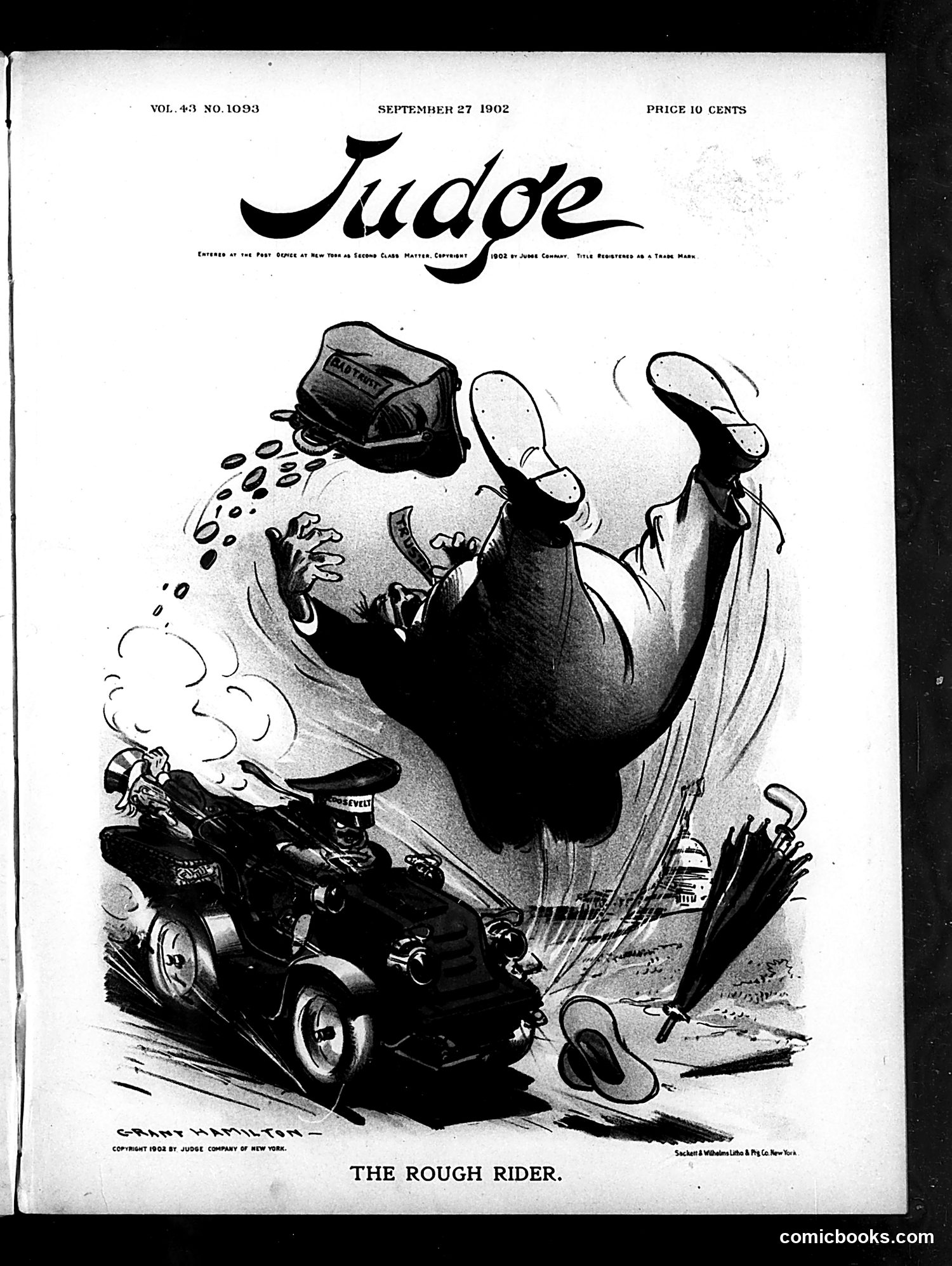
This cartoon by Grant Hamilton satirizes Theodore Roosevelt, depicted as a reckless "rough rider" careening out of control in an automobile. The figure wears Roosevelt's characteristic wide-brimmed hat and mustache. The scattered debris, overturned objects, and the Capitol building visible on the right suggest political chaos or reckless governance. The title references Roosevelt's famous cavalry unit from the Spanish-American War, but here applies it mockingly to his aggressive presidential policies. The automobile—still novel in 1902—symbolizes dangerous, uncontrolled speed and modernism run amok. The cartoon critiques what contemporaries viewed as Roosevelt's impulsive, destructive approach to power, attacking his tendency toward aggressive action without proper restraint or consideration for consequences.
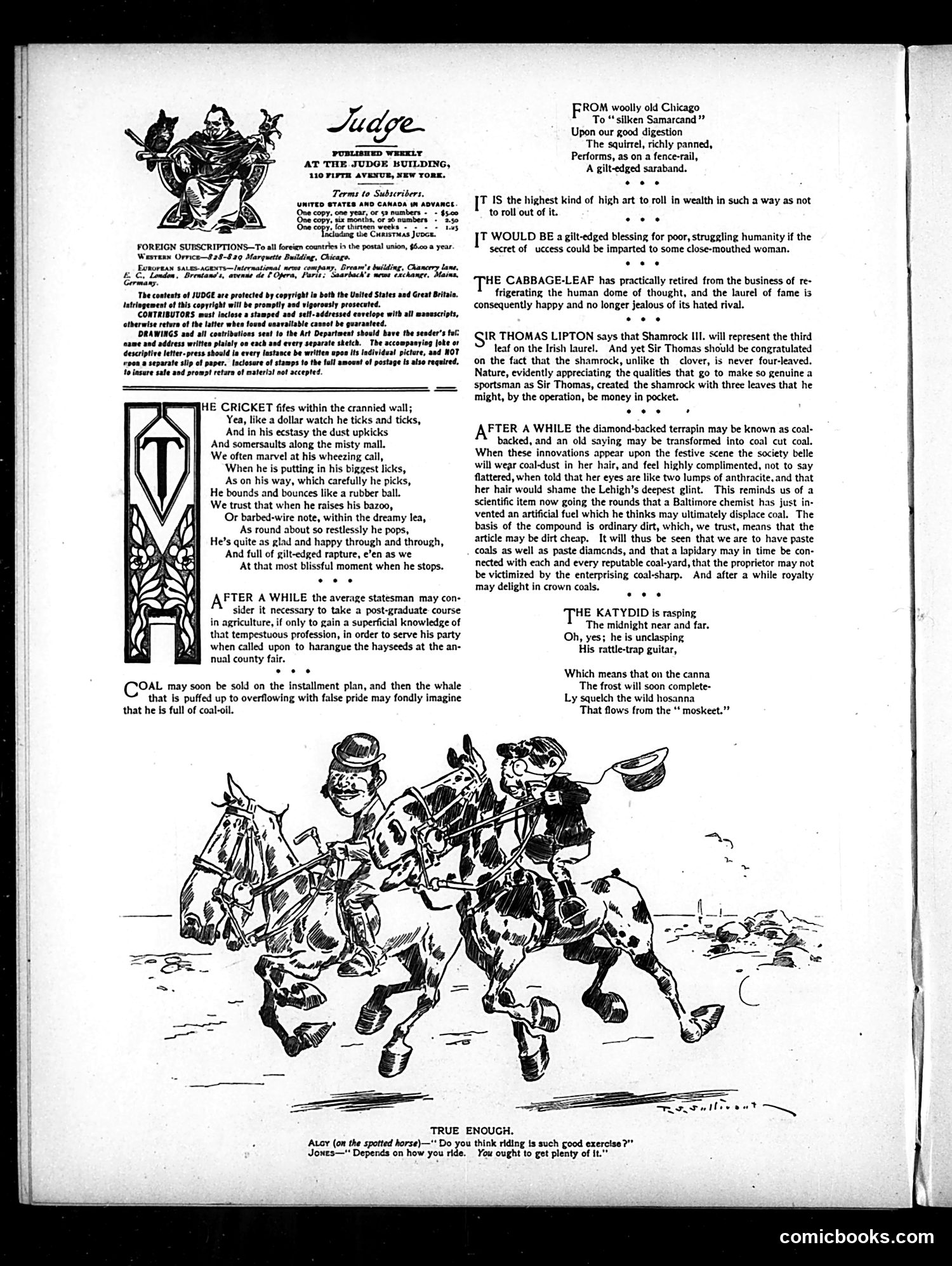
This page contains several satirical pieces typical of Judge's editorial commentary. The main cartoon, titled "TRUE ENOUGH," depicts two men on horseback in chaotic motion. The caption presents a dialogue where Aloy asks Jones if riding is good exercise, and Jones replies that it depends on how you ride and getting plenty of it—a crude double entendre joke. The editorial text addresses various topics including wealth inequality, women's suffrage sympathies, and Sir Thomas Lipton's representation in Irish affairs. References to "Shamrock III" and the Irish Laurel suggest nautical/sporting competition context. Other pieces critique coal industry practices and mock artificial fuel innovations. The overall tone reflects Judge's typical irreverent social and political satire of the early 20th century, though specific current events referenced remain unclear without additional dating information.
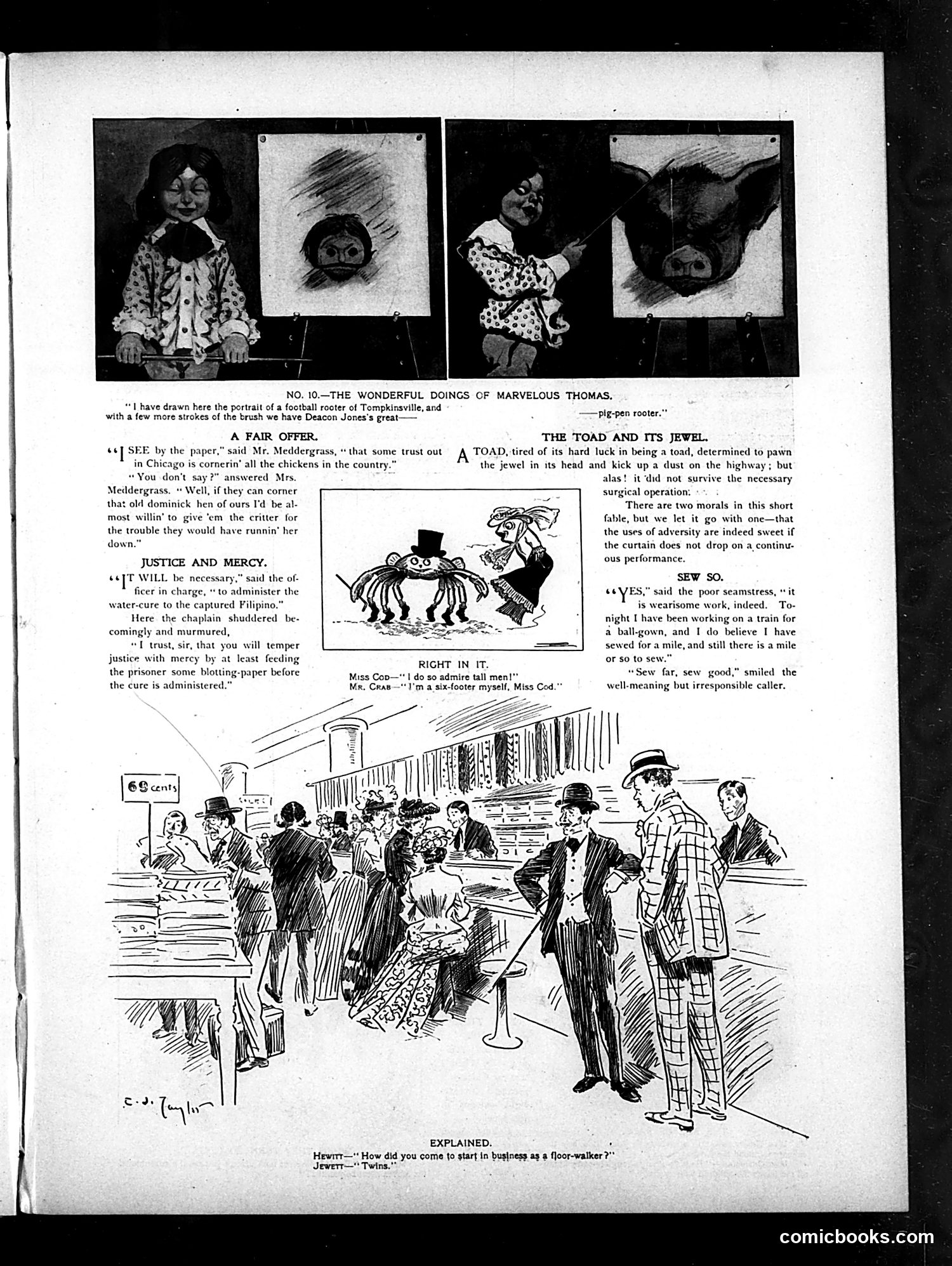
This Judge magazine page contains multiple satirical pieces: **Top section:** "The Wonderful Doings of Marvelous Thomas" shows a child's drawings, apparently mocking someone named Thomas (possibly a public figure of the era) through childlike artistic critique. **Middle stories:** "A Fair Offer" and "The Toad and Its Jewel" are moral fables with accompanying illustrations. The toad story satirizes those who sacrifice themselves for abstract ideals without practical benefit. **Bottom cartoon ("Right in It"):** A street scene labeled "60 cents" shows well-dressed men and women in what appears to be a commercial district. The dialogue joke about "twins" suggests wordplay about a floor-walker's origins—likely mocking social pretension or occupational origins of service workers. The page reflects Judge's typical style: combining illustrated morality tales with social satire targeting class pretensions and urban commercial culture of the early 20th century.
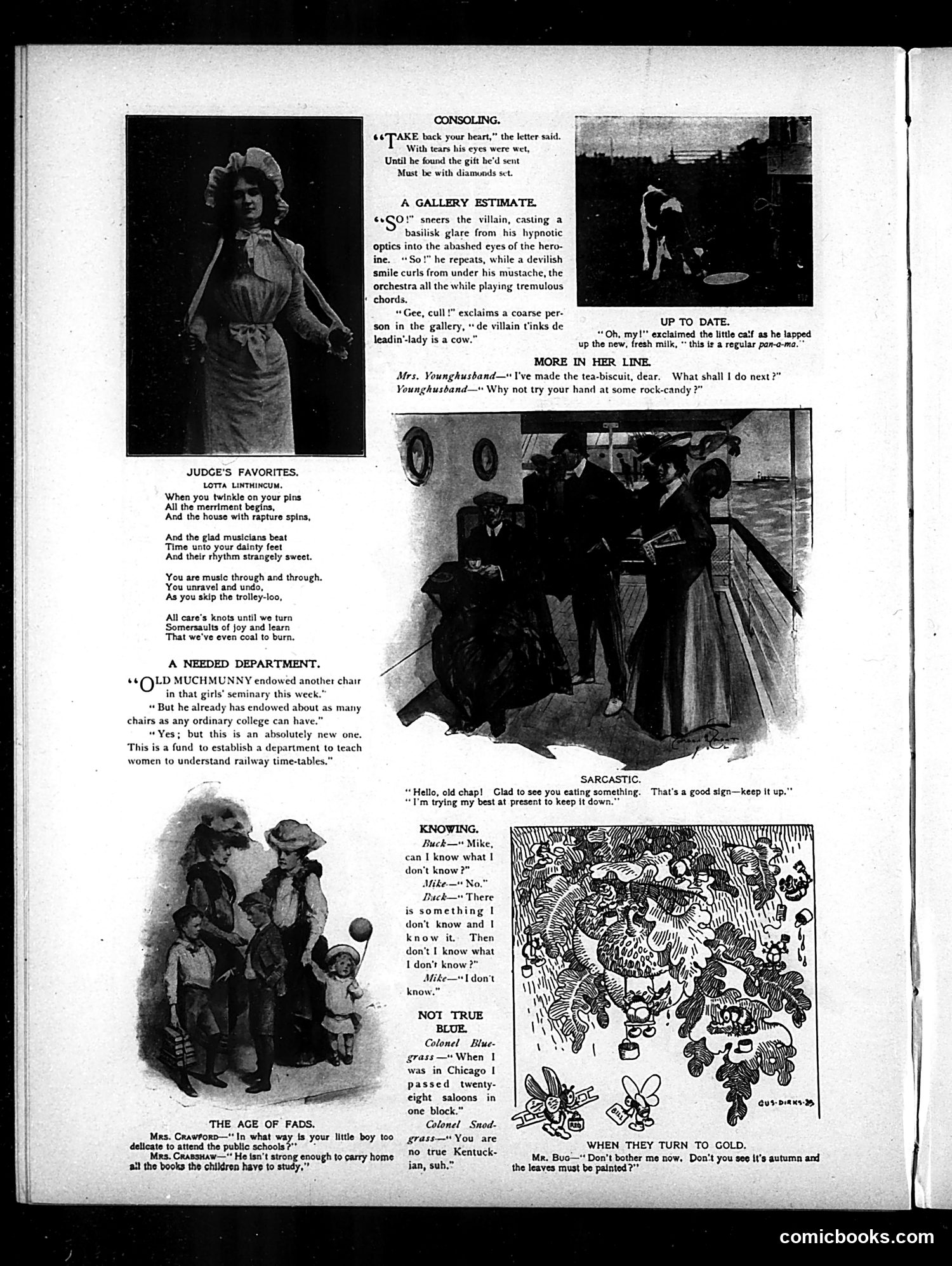
This page contains several distinct satirical pieces typical of early 20th-century Judge magazine humor: **"Consoling"** mocks romantic sentiment with a cynical take on gift-giving and courtship. **"A Gallery Estimate"** depicts a villain character ("Col") whose theatrical villainy—hypnotic stare, devilish smile, tremulous music—is so overwrought that a gallery patron dismisses the "leading lady" as a "cow." This satirizes melodramatic stage acting conventions. **"Judge's Favorites"** includes Lotta Linthicum verse celebrating female musicians. **"A Needed Department"** jokes about an endowment for teaching women to read railway timetables—satire on both women's education and the era's transportation modernization. Other segments ("The Age of Fads," "Knowing," "Not True Blue") contain period humor about social conventions, Chicago saloons, and Kentucky life—typical Judge fare mixing sarcasm about contemporary manners and regional American character.
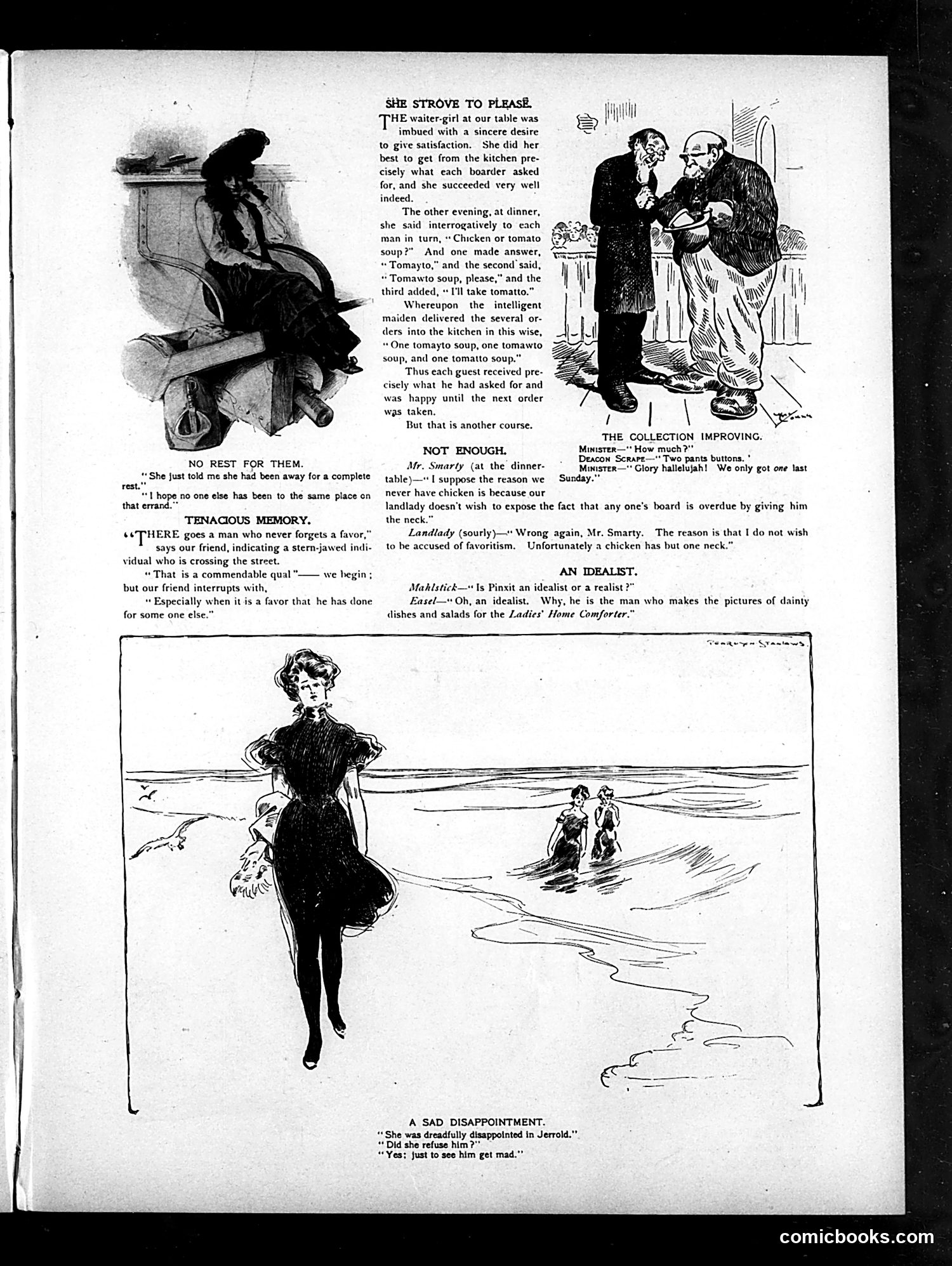
This page contains several brief satirical vignettes mocking social behaviors and attitudes of the era: **"She Strove to Please"** jokes about a waitress who takes boarders' pronunciations of "tomato" literally, serving them as three distinct dishes rather than understanding they wanted the same soup. **"Tenacious Memory"** satirizes selective memory—a man who never forgets favors *he's done* for others, implying self-serving narcissism. **"The Collection Improving"** mocks church donations: a deacon proudly reports collecting two pants buttons instead of the previous one, suggesting a poor/declining congregation. **"Not Enough"** features the landlady's sharp retort to an insulting boarder's joke about her serving cheap food—she claims not to blame the chicken but herself, since "a chicken has but one neck" to give him. **"An Idealist"** defines an idealist as someone (likely an illustrator for *Ladies' Home Journal*) who paints unrealistically idealized food images. **"A Sad Disappointment"** shows a woman who rejected her suitor merely to provoke his anger—satirizing female manipulation. The humor targets misunderstandings, social pretension, financial struggles, and domestic discord.
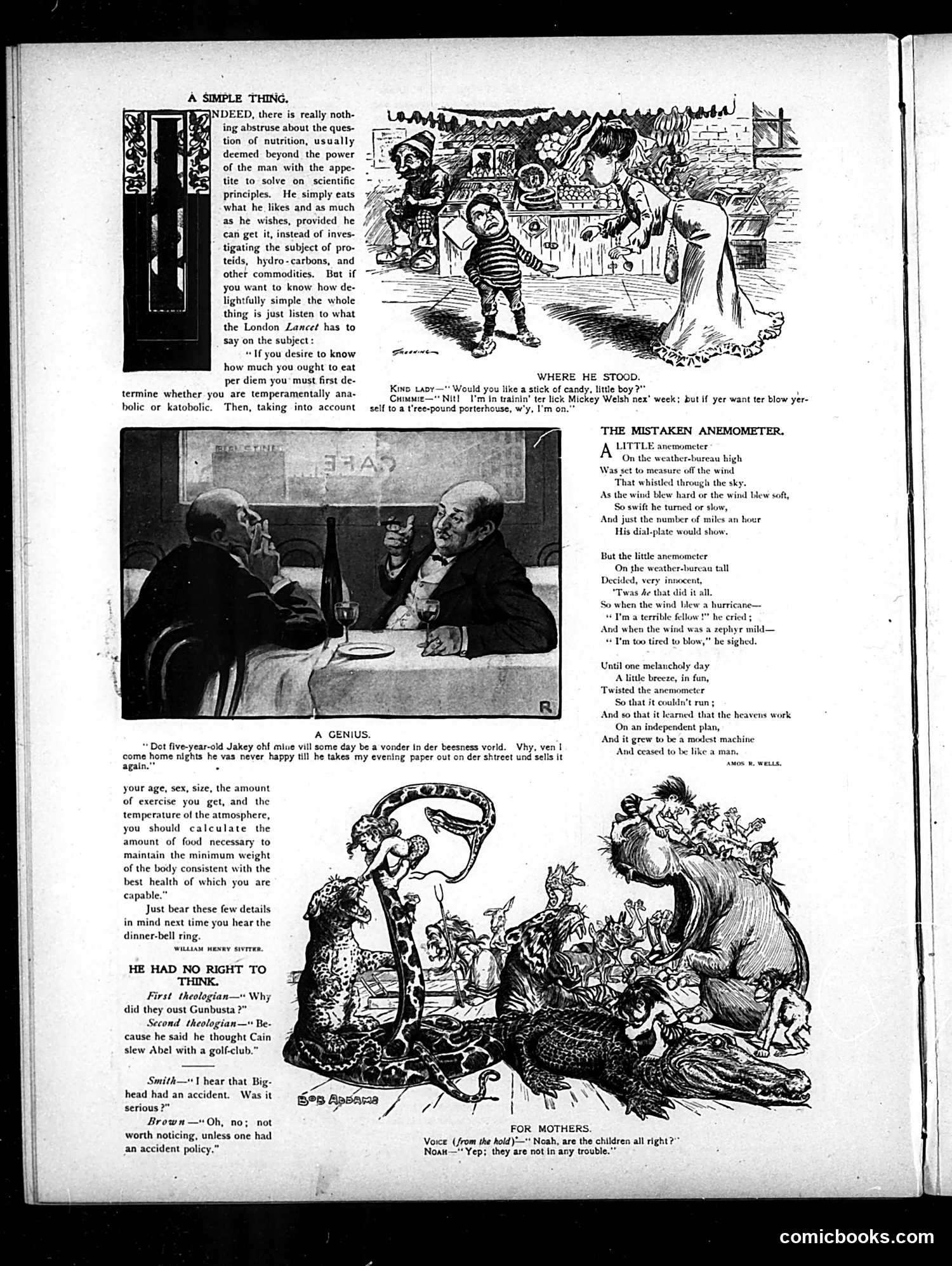
This page contains multiple satirical pieces typical of Judge's style: **"A Simple Thing"** mocks popular nutrition advice by contrasting scientific terminology (proteids, hydro-carbons) with ordinary eating habits. The London Lancet quote ironically complicates simple eating with pseudo-scientific jargon about being "temperamentally anabolic or katobolic." **"Where He Stood"** is a brief comic dialogue where a street urchin ("Chimmie") declines candy but boasts about training to fight "Mickey Welsh" and challenges someone to buy him a three-pound porterhouse steak—satirizing working-class child culture and appetites. **"The Mistaken Anemometer"** (by H.G. Wells) is a moral fable where a weather instrument mistakes itself for causing wind, learning humility when a breeze proves it's merely a tool. It satirizes human arrogance. Minor pieces include "A Genius" (Yiddish-accented immigrant humor about a child selling newspapers) and "He Had No Right to Think" (mocking theological literalism about Cain's weapon). The page reflects Judge's blend of social satire, educational mockery, and period dialect humor.
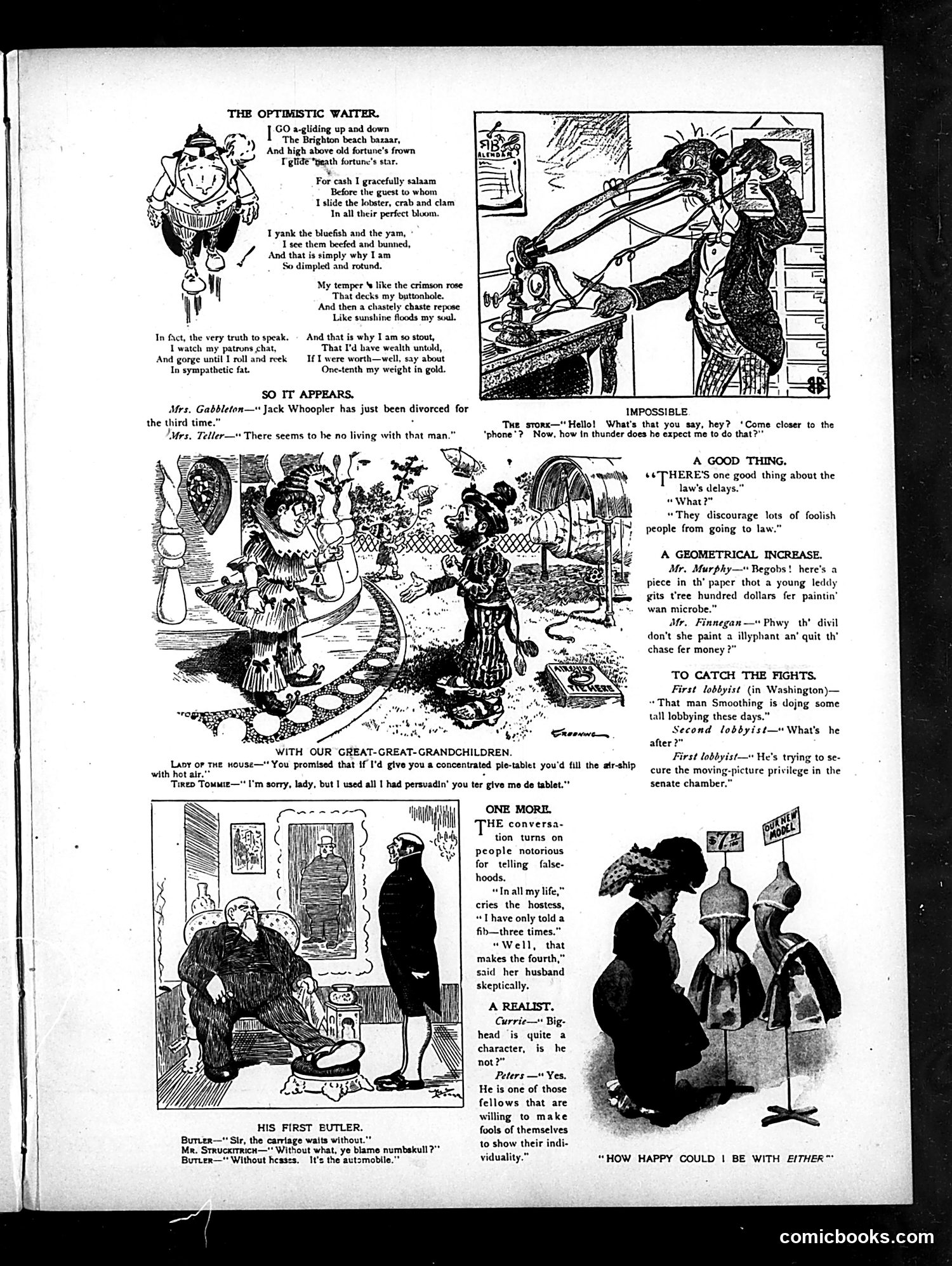
This page contains several brief satirical vignettes typical of early 20th-century American humor: **"The Optimistic Waiter"** mocks a portly waiter who justifies his obesity through poetic philosophy—he claims his good temperament comes from eating the restaurant's fine food. The satire targets working-class pretension and self-deception about gluttony. **"So It Appears"** jokes about divorce, suggesting repeated marriage failures indicate an incompatible personality. **"His First Butler"** plays on the "horseless carriage" (automobile) as a new technology, with a confused butler misunderstanding what "carriage" means. **"A Realist"** satirizes hypocrisy: a hostess claims she's told only three lies, and her husband points out she's just told a fourth by making that claim. The remaining snippets mock lobbying in Washington, legal delays, and people obsessed with displaying their individuality. These are gentle, observational humor pieces targeting social pretension, marital discord, and emerging technologies—typical Judge magazine fare.
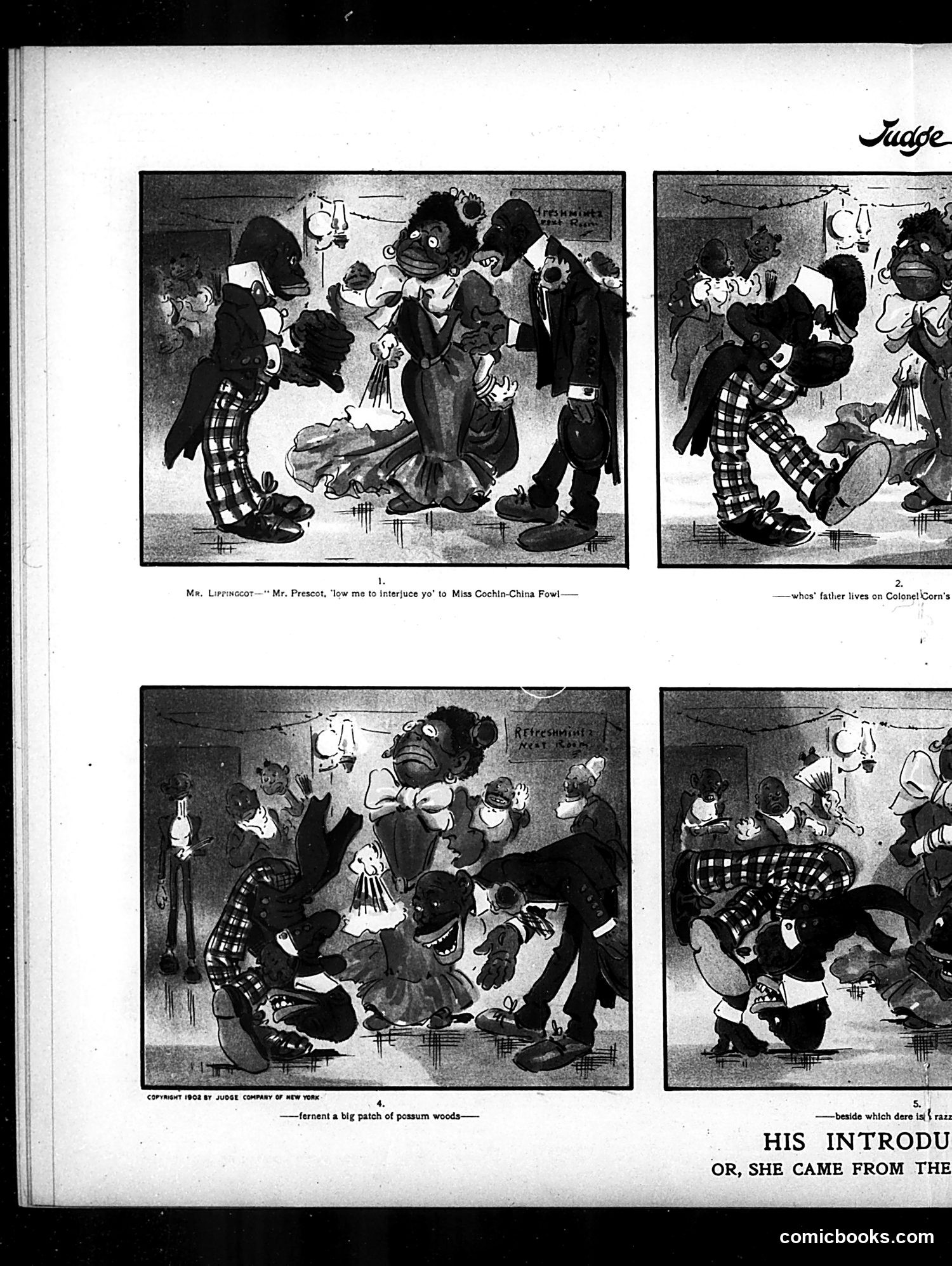
This Judge cartoon satirizes late 19th-century racial attitudes through animal caricature. The four panels depict African American figures with exaggerated simian features introducing a woman named "Miss Cochin-China Fowl" (a chicken breed, reinforcing dehumanizing animal metaphors). The humor relies on racist tropes: minstrelsy-style dialect ("'low me to interjuce yo'"), absurd genealogies (her father living on "Colonel Corn's" land, near "possum woods"), and the visual equation of Black people with animals. The elaborate introductions mock formal social conventions while the grotesque caricatures were considered comedic by the magazine's audience. The title fragment "His Introduction / Or, She Came From The" suggests a narrative about courtship or social climbing, likely using racist stereotypes as punchlines throughout.
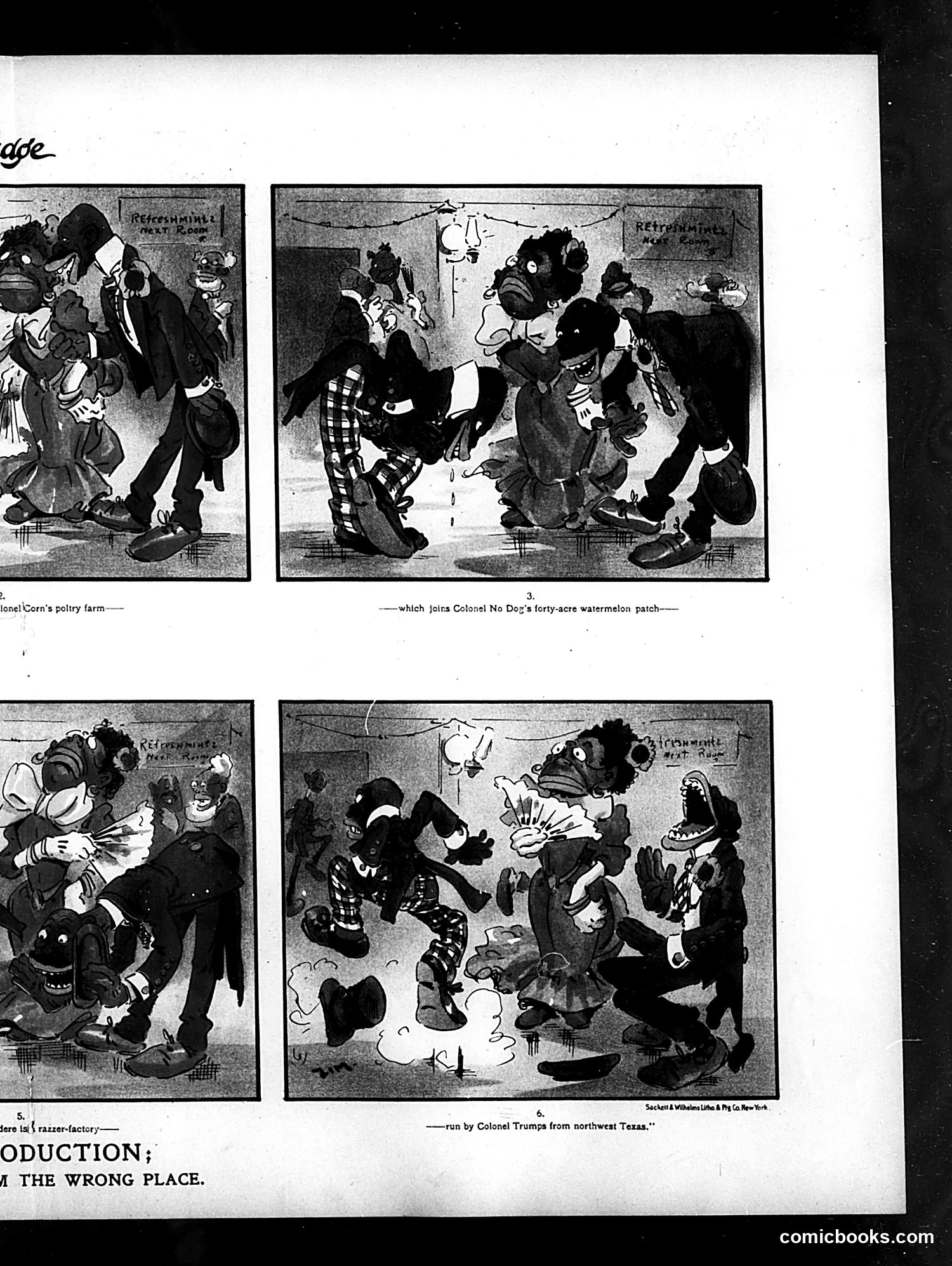
This is a four-panel satirical comic about three colonels operating adjacent farms in Texas. The humor centers on mixing up farm operations: Colonel Corn runs a poultry farm, Colonel No Dog operates a watermelon patch, and Colonel Trumps runs a "razor-factory." The joke appears to be about confusion or chaos resulting from these incompatible operations being located next to each other—livestock, crops, and manufacturing don't mix well spatially. The exaggerated caricatures and frantic scenes suggest comedic mishaps ensuing from this poor planning. The title "Production in the Wrong Place" confirms the satire targets misallocated resources or businesses. Without additional context, the specific historical references to these "colonels" remain unclear, though the comic mocks poor business judgment and spatial planning.
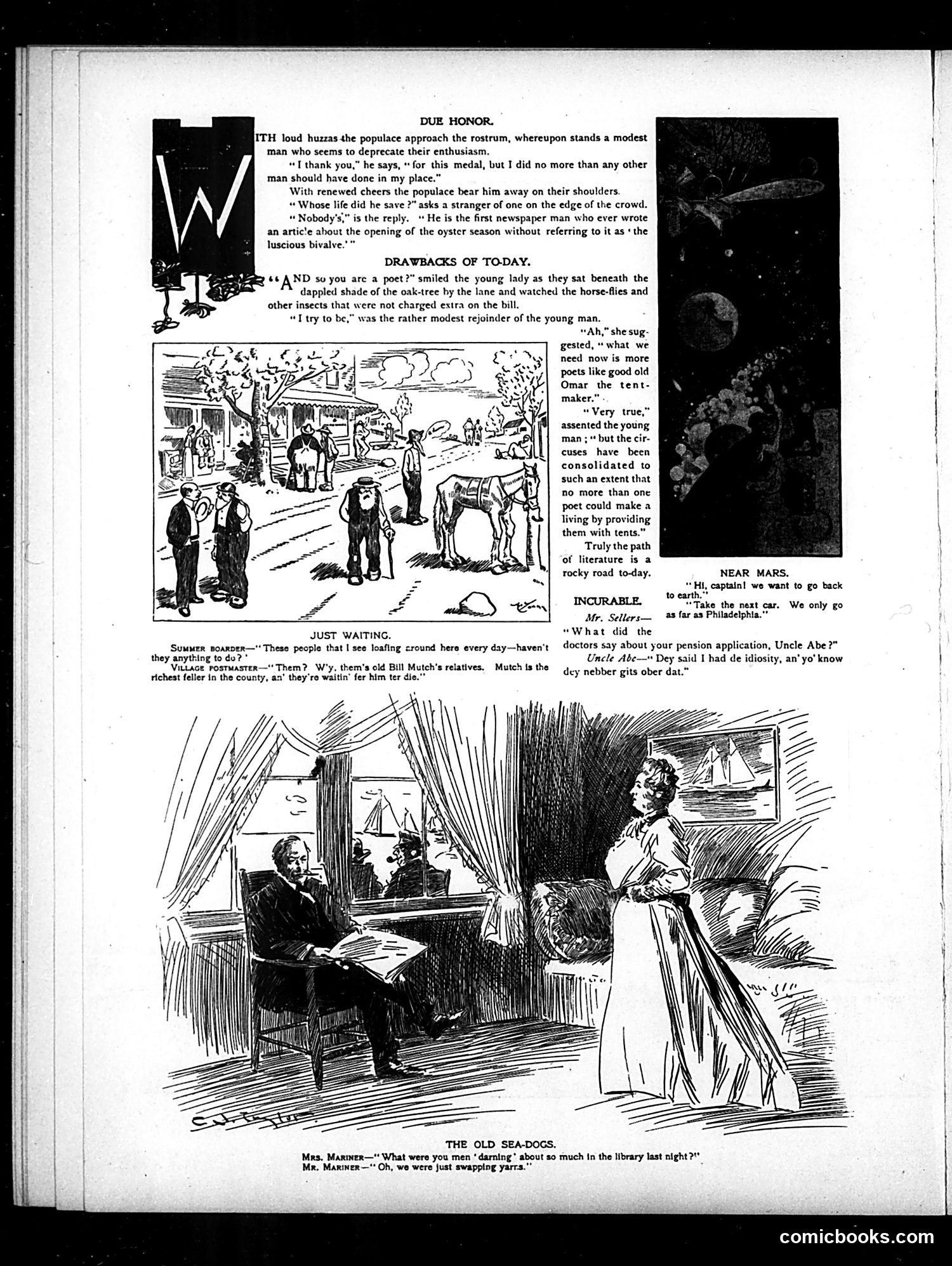
This page contains several unrelated satirical vignettes typical of Judge magazine: **"Due Honor"** mocks newspaper sensationalism. A modest man is celebrated as a hero, but the "heroic" act was merely a journalist writing about oyster season *without* using flowery language like "luscious bivalve"—a dig at overwrought food writing conventions. **"Drawbacks of Today"** presents a young poet lamenting that modern circus consolidation means fewer tents need poets. This satirizes economic consolidation's impact on traditional livelihoods and romanticizes Omar Khayyam (the classical Persian poet). **"Just Waiting"** depicts rural relatives lounging around a rich man's property, waiting for his death to inherit—commenting on familial opportunism and idleness. **"The Old Sea-Dogs"** shows a domestic misunderstanding: a wife misinterprets "darning" (complaining) as actual sewing, when men were telling tall tales ("swapping yarns"). The humor relies on wordplay, economic anxieties of the period, and observations of everyday human behavior and greed.
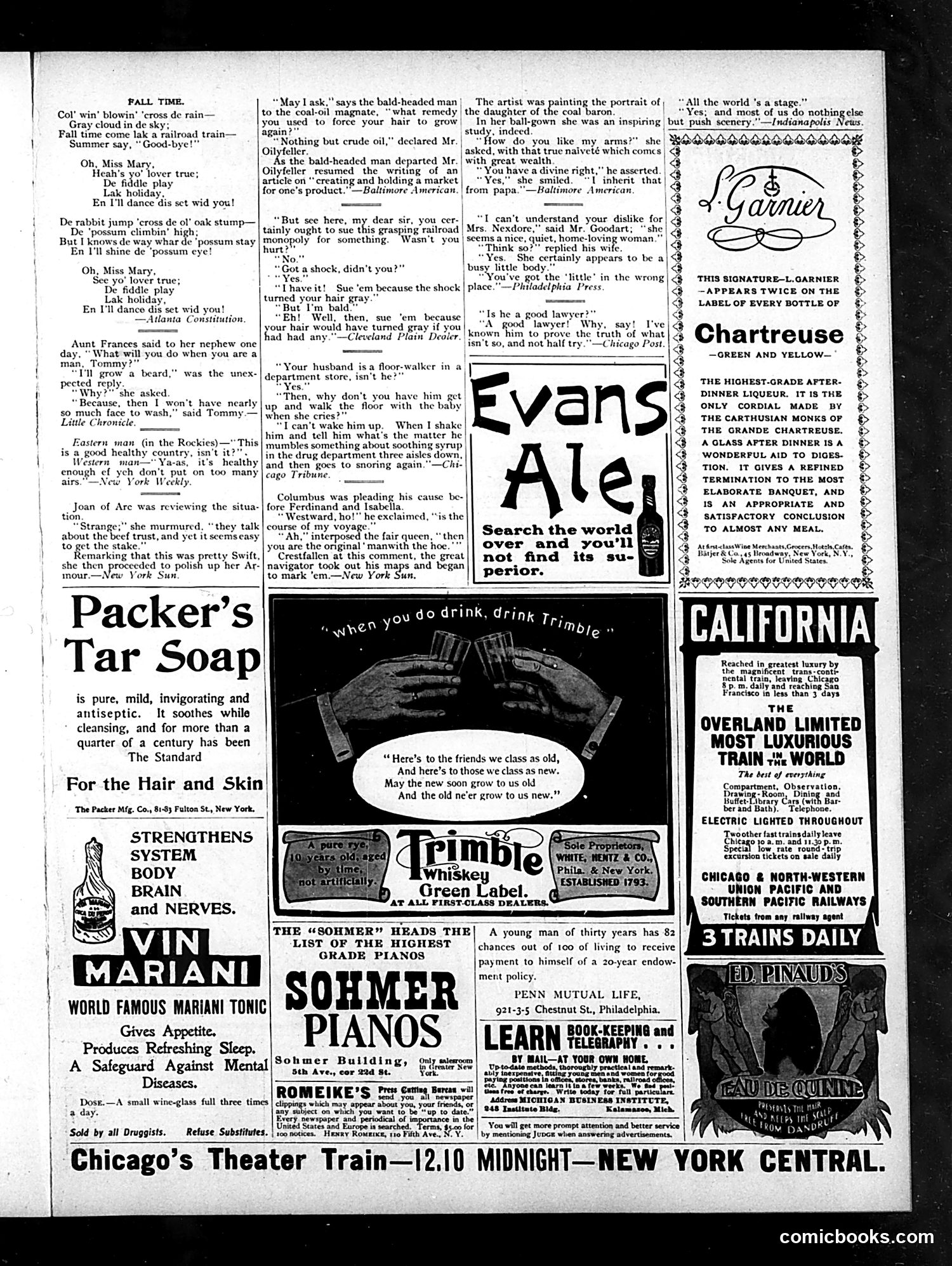
This page from *Judge* magazine consists primarily of **short humor pieces and advertisements** rather than political cartoons. The content reflects early-20th-century American comedy sensibilities: **Humor pieces** include dialect stories (a "Fall Time" rural sketch in African American vernacular), jokes about bald men and hair loss, marital humor, and quips about lawyers and social climbing. One piece references **Columbus and Ferdinand/Isabella**, making a joke about the explorer being "the original 'man with the hoe'"—likely a literary reference to Millet's painting, suggesting Columbus as a laborer rather than hero. The satirical edge is mild: gentle mockery of monopolies, lawyers' dishonesty, and social pretension. There's a brief jab at "grasping railroad monopoly"—reflecting Progressive-era anti-monopoly sentiment. **Overwhelmingly, this is an advertising page** featuring hair/skin products (Packer's Tar Soap), Vin Mariani tonic, pianos, trains, and whiskey—typical early-1900s patent medicines and luxury goods. No major political figures or events are depicted or referenced with clarity.
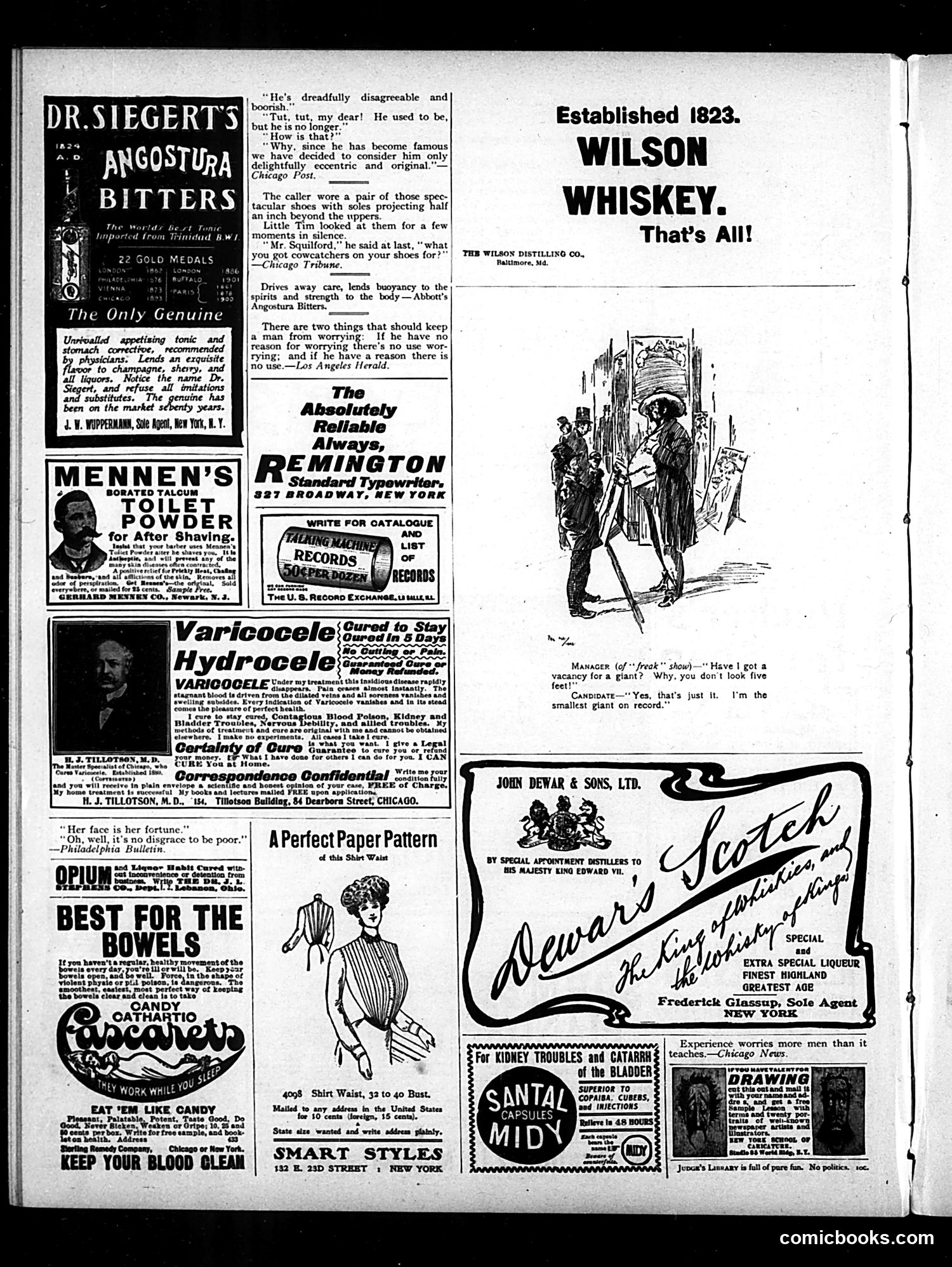
This page is primarily **advertising**, typical of early 20th-century magazines, interspersed with brief satirical jokes. The small cartoons and text snippets mock social pretension and human folly: 1. **"He's dreadfully disagreeable and boorish"** joke: Social hypocrisy—once someone becomes famous, society rebrands their bad behavior as "eccentric and original." 2. **Little Tim's "cowcatchers" joke**: Child's innocent mockery of fashionable but absurdly oversized shoe soles projecting beyond the uppers—a real style detail being ridiculed. 3. **Giant/dwarf casting gag**: A man claiming to be "the smallest giant on record"—wordplay exploiting the contradiction for theatrical work. 4. **"Her face is her fortune"** exchange: Satirizes women's limited economic options and appearance-based value in society. The bulk consists of patent medicines (Angostura Bitters, Varicocele treatments, Santal capsules), alcohol ads, and ladies' fashion patterns—reflecting period advertising practices and contemporary health/social concerns.
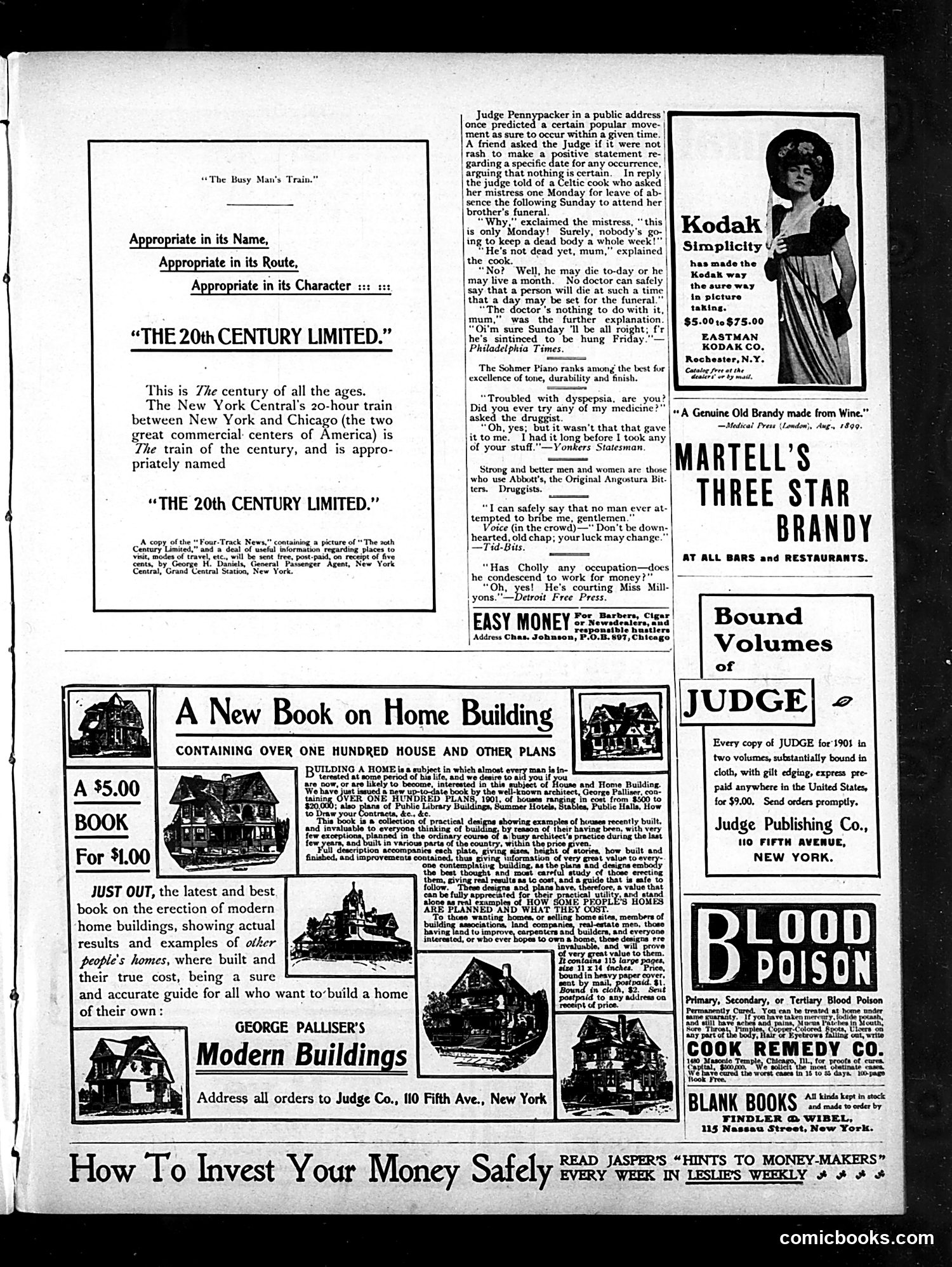
This page is primarily **advertising and filler content** rather than political satire. The main features are: **"The Busy Man's Train"** section contains a humorous anecdote about Judge Pennypacker (likely a historical public figure) who predicted an event's timing. The joke contrasts his certainty about future occurrences with a Celtic cook's practical logic: she books her brother's funeral for Sunday because he's "sintinced to be hung Friday"—making the funeral date certain by virtue of an execution date. **"The 20th Century Limited"** celebrates the New York Central Railroad's new 20-hour train between New York and Chicago, calling it appropriately named for "the century of all the ages." The page otherwise fills with period product advertisements (Kodak cameras, Martell's brandy, piano instruction books) and smaller jokes about bribes, dyspepsia remedies, and courtship—typical filler for early 1900s magazines. No significant political commentary is visible.
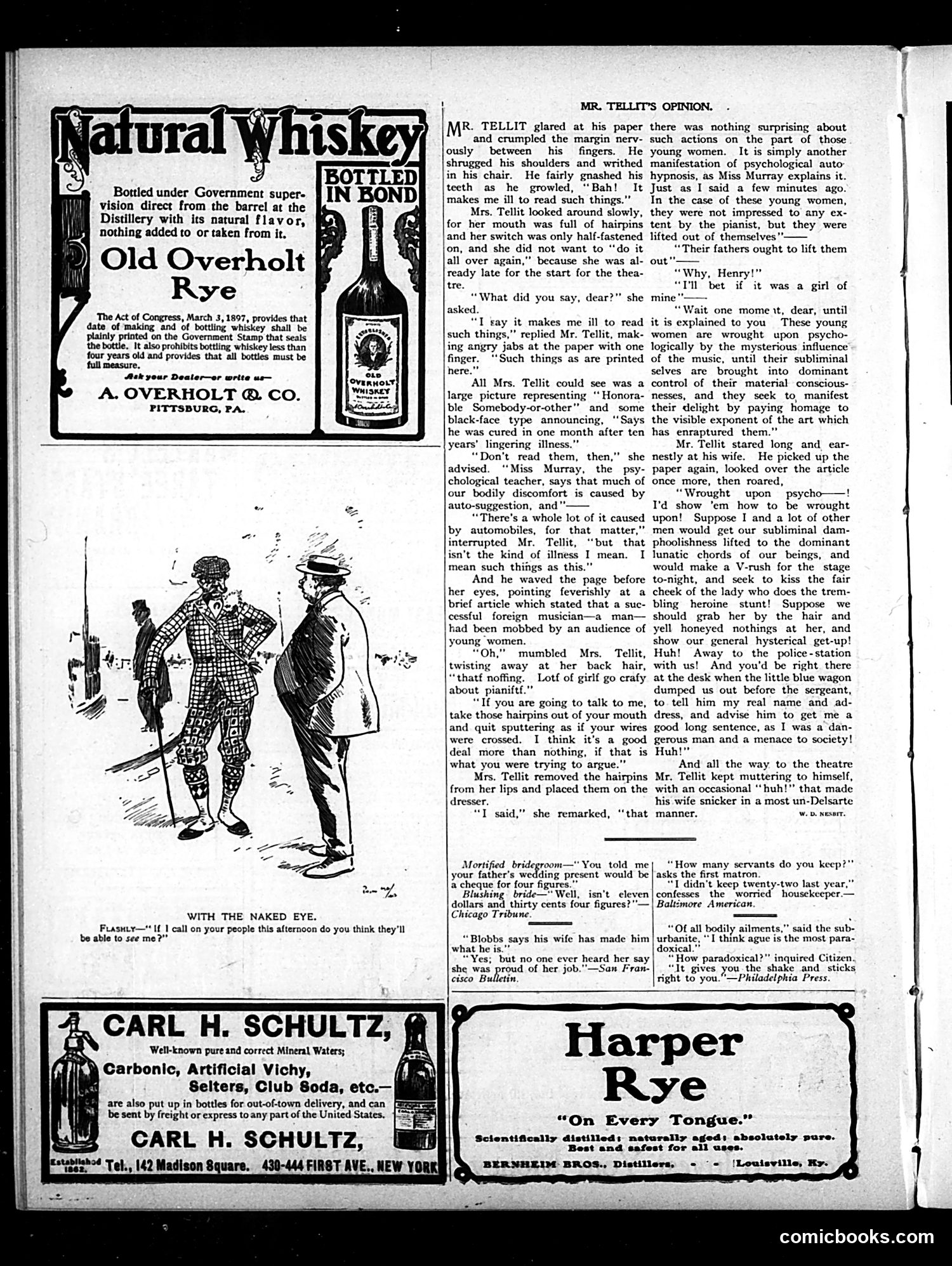
This page primarily contains **advertisements and humor columns** rather than political satire. The main content is "Mr. Tellit's Opinion," a domestic comedy sketch where a husband is scandalized by a newspaper article about young women mobbing a foreign musician. The humor relies on early-1900s gender dynamics: Mr. Tellit is outraged by the women's behavior and wants his daughter "lifted out" of such situations, while Mrs. Tellit—preoccupied with her hair and theater—dismisses it as normal fan behavior. She invokes "Miss Murray's psychological theories" about auto-suggestion, which annoys him further. The joke satirizes **contemporary pseudo-scientific psychology** (then fashionable) and **generational attitudes**: the husband's old-fashioned moralism clashes with the wife's modern, psychologically-informed dismissal of concern. The cartoons and brief jokes ("With the Naked Eye," "Mortified Bridegroom") are generic period humor unrelated to specific political events. The advertisements promote whiskey and mineral water.
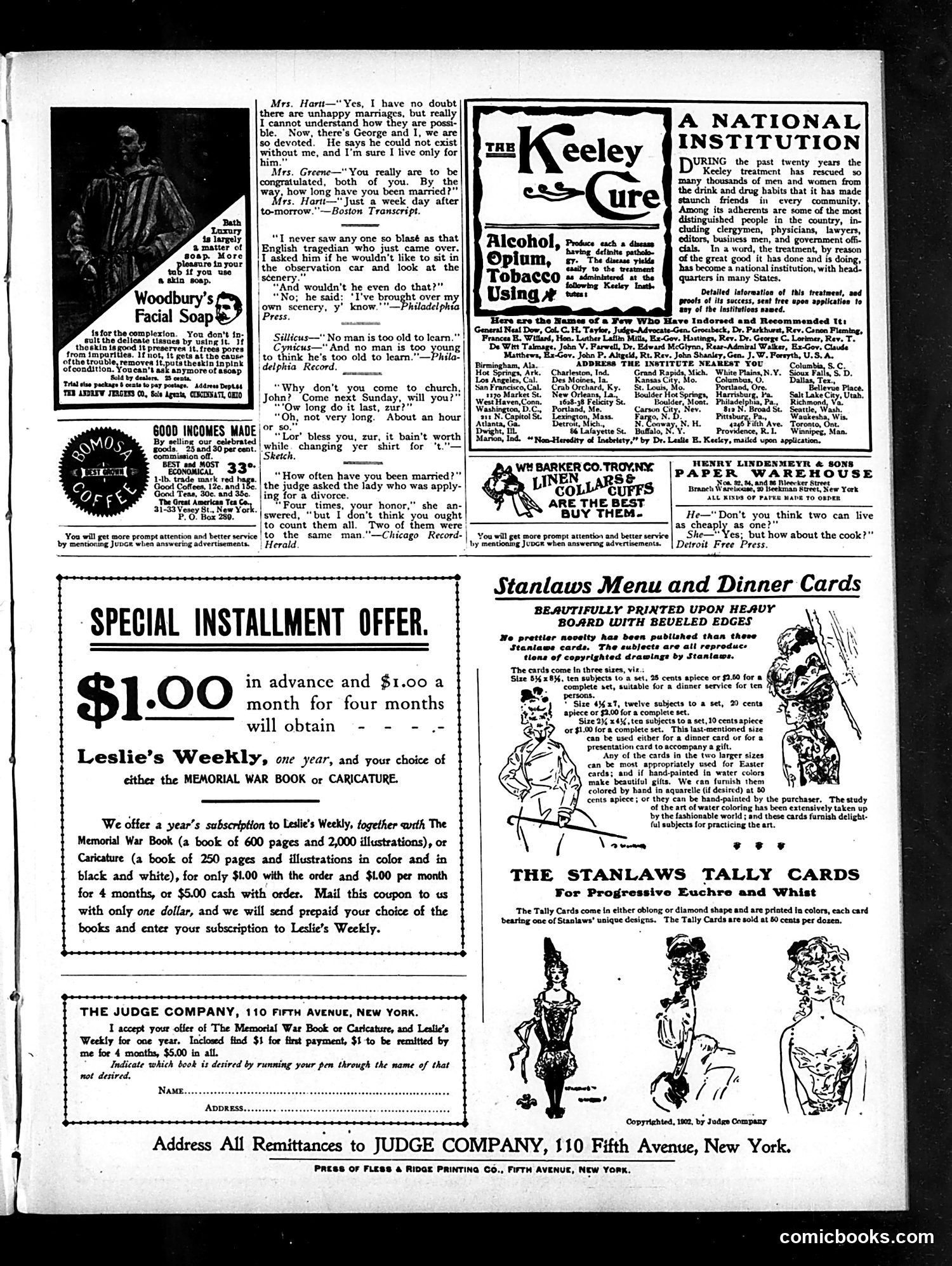
This page is primarily **advertising and filler content** for *Judge* magazine, not a cohesive satirical cartoon. The page contains several **brief comedic anecdotes** on standard topics: a newlywed wife's blind devotion (questioned after only one week of marriage), a vain English actor refusing to look at actual scenery, and divorce jokes. These are light domestic humor typical of the era—no specific political figures or events are referenced. The dominant content is **advertisements**: the Keeley Institute (a real treatment center for alcohol and drug addiction), Leslie's Weekly subscription offers, soap and coffee ads, and stationery cards. The Keeley ad notably lists testimonials from prominent figures (judges, clergymen, business leaders) endorsing the treatment. The page represents how *Judge* filled space with **commercial partnerships and generic humor** rather than pointed political satire. Without visible artist signatures or specific topical references, this appears to be standard magazine filler from the era.
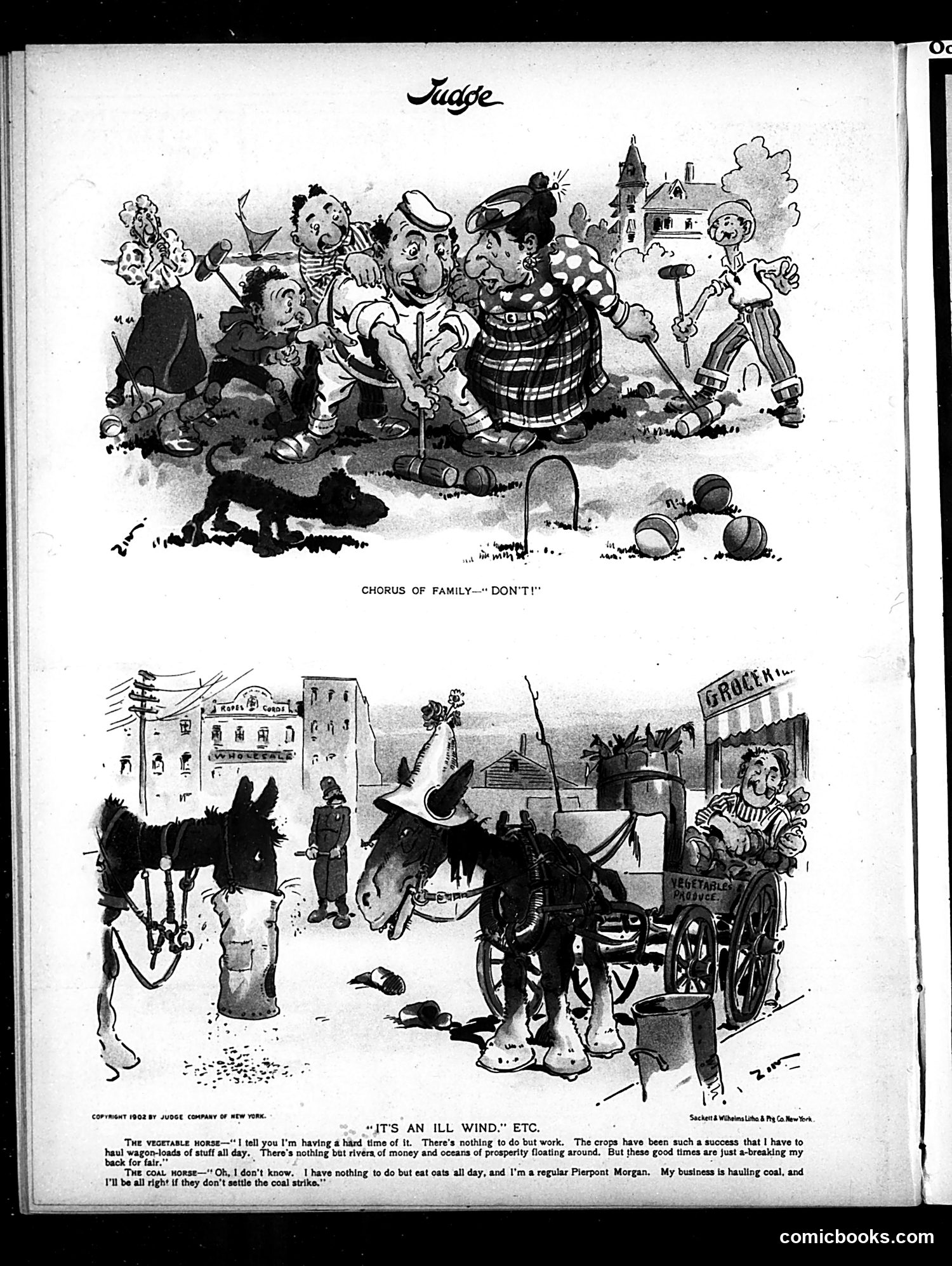
This 1902 satirical page mocks the economic anxieties of working-class Americans during a period of prosperity. **Top cartoon:** A family chorus warns "Don't!" as children play dangerously with toys and explosives, satirizing parental concern amid industrial-age hazards. **Bottom cartoon:** A "vegetable horse" (likely representing a working-class person or laborer) complains about exhaustion from successful harvests requiring constant work, while a coal-hauling donkey boasts about profiting during good times—but worries the resolution of the ongoing coal strike will ruin his business. The satire criticizes working people's contradictory position: prosperity creates grueling labor, yet workers fear losing income when strikes end or conditions normalize. The cartoon mocks both the horse's complaint and the donkey's precarious fortune, suggesting workers benefit from instability and labor disputes rather than sustainable prosperity. It reflects anxieties about the 1902 coal strike and broader tensions between labor and capital.