
Judge, 1902-09-27 · page 10 of 16
Judge — September 27, 1902 — page 10: what you’re looking at
What you’re looking at
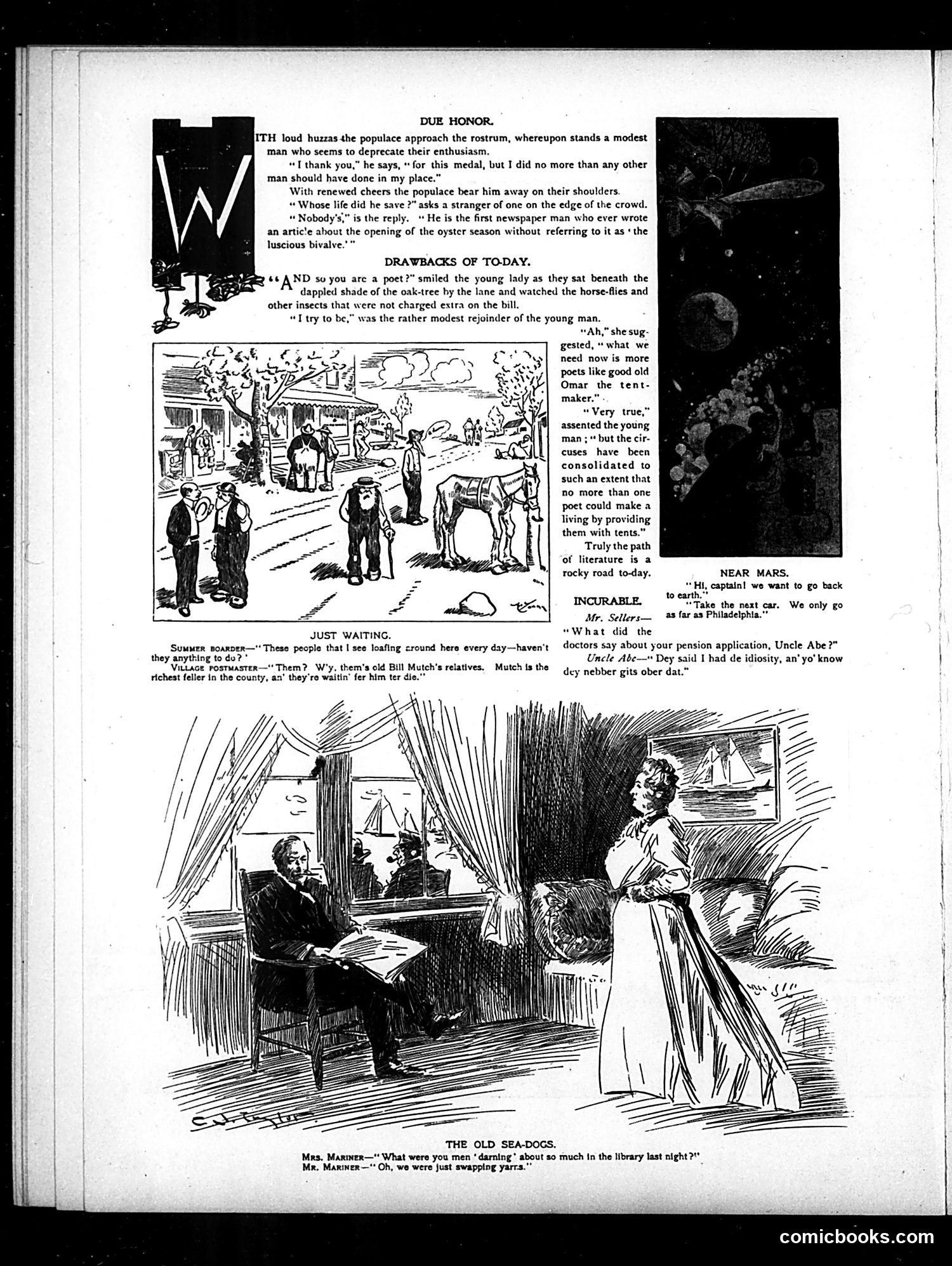
This page contains several unrelated satirical vignettes typical of Judge magazine: **"Due Honor"** mocks newspaper sensationalism. A modest man is celebrated as a hero, but the "heroic" act was merely a journalist writing about oyster season *without* using flowery language like "luscious bivalve"—a dig at overwrought food writing conventions. **"Drawbacks of Today"** presents a young poet lamenting that modern circus consolidation means fewer tents need poets. This satirizes economic consolidation's impact on traditional livelihoods and romanticizes Omar Khayyam (the classical Persian poet). **"Just Waiting"** depicts rural relatives lounging around a rich man's property, waiting for his death to inherit—commenting on familial opportunism and idleness. **"The Old Sea-Dogs"** shows a domestic misunderstanding: a wife misinterprets "darning" (complaining) as actual sewing, when men were telling tall tales ("swapping yarns"). The humor relies on wordplay, economic anxieties of the period, and observations of everyday human behavior and greed.
📄 Transcribed text from this page (OCR, searchable)
Machine-transcribed from the original scan — historical spelling and the odd misread are preserved.
DUE HONOR. ITH loud huzzas the populace approach the rostrum, whereupon stands a modest man who seems to deprecate their enthusiasm. “T thank you,” he says, “for this medal, but I did no more than any other man should have done in my place.” With renewed cheers the populace bear him away on their shoulders. “Whose life did he save ?” asks a stranger of one on the edge of the crowd. “ Nobody's,” is the reply.“ He is the first newspaper man who ever wrote an artice about the opening of the oyster season without referring to it as ‘the luscious bivalve.’ ” DRAWBACKS OF TO-DAY. = 66 AND su you arc a poet?” smiled the young lady as they sat beneath the dappled shade of the oak-tree by the lane and watched the horse-flies and other insects that were not charged extra on the bill, “T try to be,” was the rather modest rejoinder of the young man. “Ah,” she sug- gested, “what we need now is more poets like good old Omar the tent- maker.” “Very true,” assented the young man ;“ but the cir- cuses have been consolidated to such an extent that no more than one poet could make a living by providing them with tents.” Truly the path of literature is a rocky road to-day. NEAR MARS. ” Hi, captain! we want to go back INCURABLE, 7 TLL. the next car, We only go Mr. Sellers— *8 ar as Philadelphia.” JUST WAITING. “What did the Summer poarver—"' These people that I see loafing cround here every day—haven't doctors say about your pension application, Uncle Abe ?” they anything to do?’ Uncle Abe—* Dey said I had de idiosity, an’ yo’ know Vittace postuaster—' Them? W'y, them’s old Bill Mutch’s relatives, Mutch Is the richest feller in the county, an’ they're waitin’ fer him ter die.”” dey nebber gits ober dat.” \ i" E ze THE OLD SEA-DOGS. Mrs. Manmer—" What were you men ‘darning* about so much in the library last night?" Mr. Mariner—‘* Oh, we were just swapping yarrs.”” comicbooks.com