
A complete issue · 18 pages · 1902
Judge — September 20, 1902
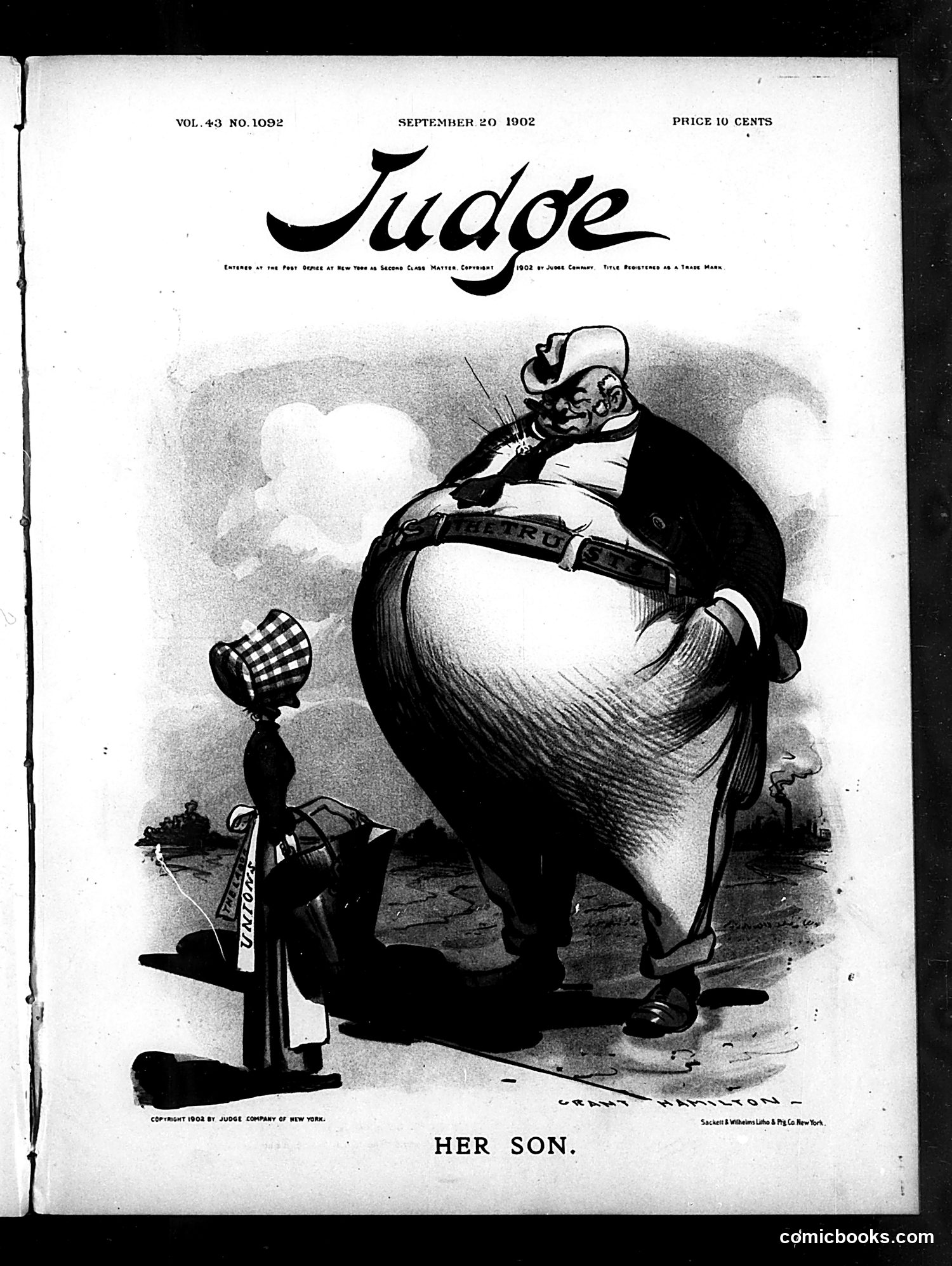
This political cartoon, titled "Her Son," depicts a grossly obese man in formal dress with an exaggerated belly. The figure appears to be a caricature of a wealthy or politically powerful individual, likely representing American industrial excess or corrupt leadership of the Gilded Age/Progressive Era. The small figure at left—labeled with what appears to be a ribbon or banner—seems to represent "America" or the American people, depicted as tiny and dwarfed by this bloated authority figure. The satire suggests that America's leadership has become grotesquely self-serving and disconnected from ordinary citizens. The specific identity of "her son" remains unclear without additional context, though the cartoon criticizes wealth inequality and political corruption—common Judge magazine targets of this period.
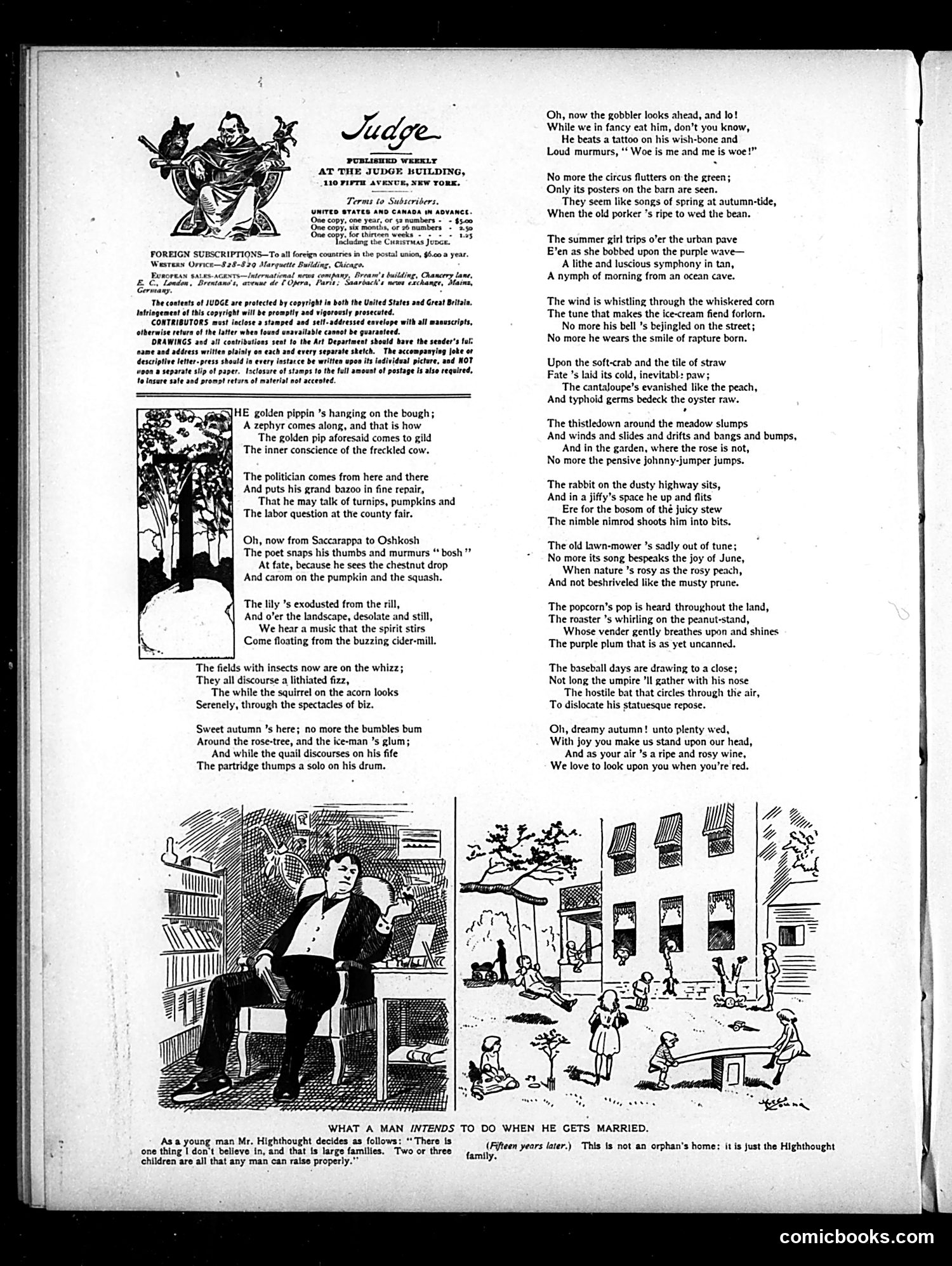
This page combines poetry and social commentary. The main poem uses autumn imagery as metaphor for life's decline—seasons changing, animals preparing for winter, natural vitality fading. This reflects a melancholic Romantic sensibility common to late 19th/early 20th-century literature. The bottom cartoon titled "What a Man Intends to Do When He Gets Married" satirizes the gap between bachelor expectations and married reality. A well-dressed man declares his intention to maintain a large family on modest means through property accumulation. The accompanying street scene shows crowded urban tenement life—the actual outcome for working-class families attempting this fantasy. The satire critiques both naive male optimism about marriage and economics, and the harsh realities of urban poverty and family planning in this era.
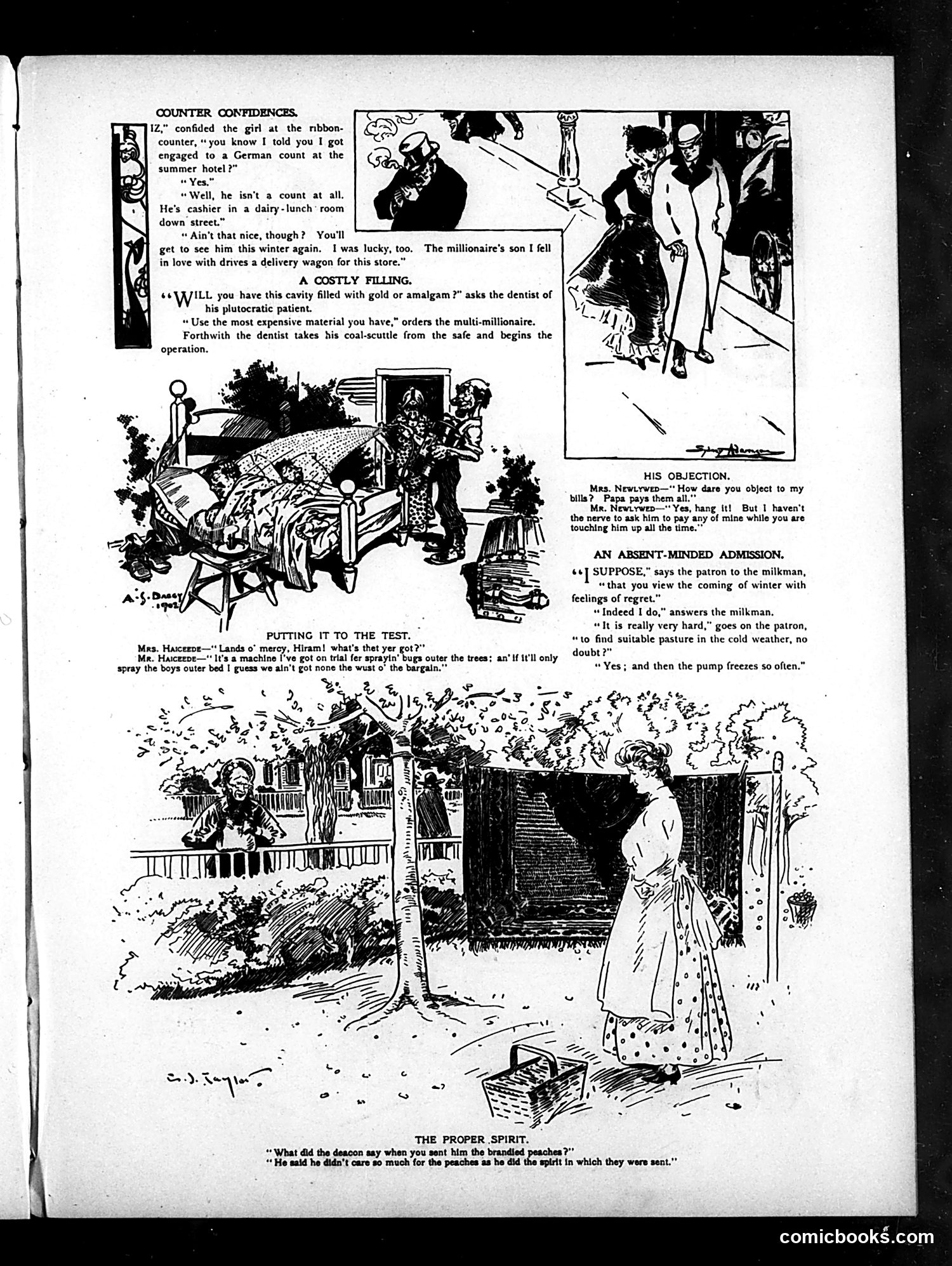
This page contains three short humorous sketches satirizing wealthy Americans and social pretense: **"A Costly Filling"** mocks a millionaire who demands expensive dental work—gold or amalgam—revealing vanity masquerading as necessity. **"Putting It to the Test"** depicts Mrs. Harcee trying to trick a milkman into adulterating milk to test its quality, suggesting the wealthy's paranoid distrust of servants and tradespeople. **"An Absent-Minded Admission"** shows a patron complaining to a milkman about winter deliveries, inadvertently revealing he hasn't paid his bills—a joke about wealthy debtors' shamelessness. **"The Proper Spirit"** features a woman unconcerned that her deacon sent her inferior peaches, caring only about the "spirit" of the gift. The recurring theme mocks the hypocrisy and moral weakness of the affluent classes.
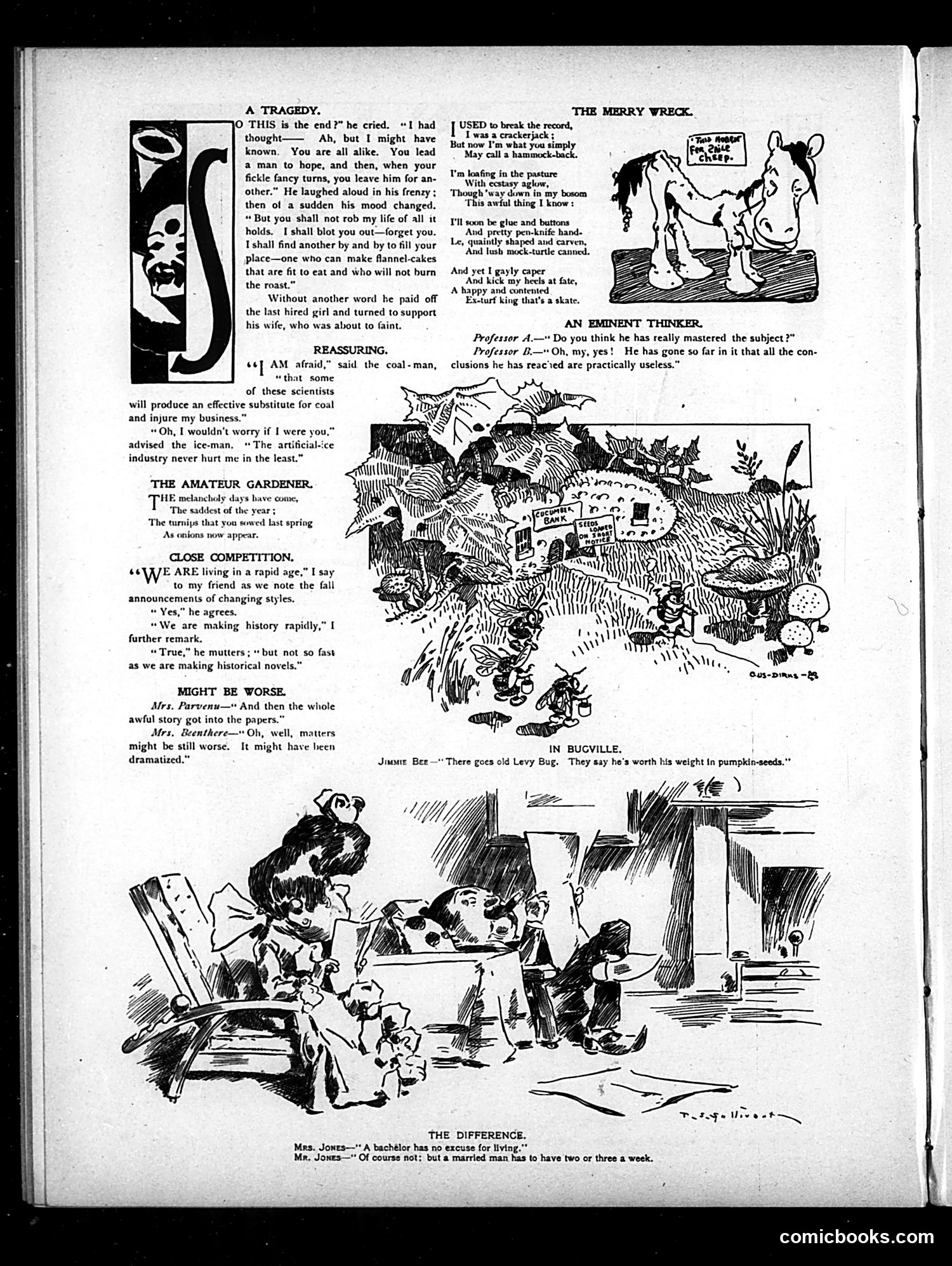
This page contains several short satirical pieces and cartoons typical of early 20th-century humor magazines: **"A Tragedy"** and **"Reassuring"** are brief comedic dialogues about coal scientists and industrial substitutes—topical humor about emerging technology concerns. **"The Merry Wreck"** shows a donkey, likely satirizing someone through animal caricature, a common Judge technique. **"The Amateur Gardener"** and **"Good Competition"** are short witty observations about seasonal changes and social progress. **"In Bugville"** depicts anthropomorphic insects (Levy Bug), using animal characters for humor. **"The Difference"** compares bachelor and married life excuses—a timeless domestic humor theme. The cartoons use pen-and-ink drawing style typical of the era. Without clearer context on specific current events or individuals referenced, most appear to be timeless social commentary rather than topical political satire.
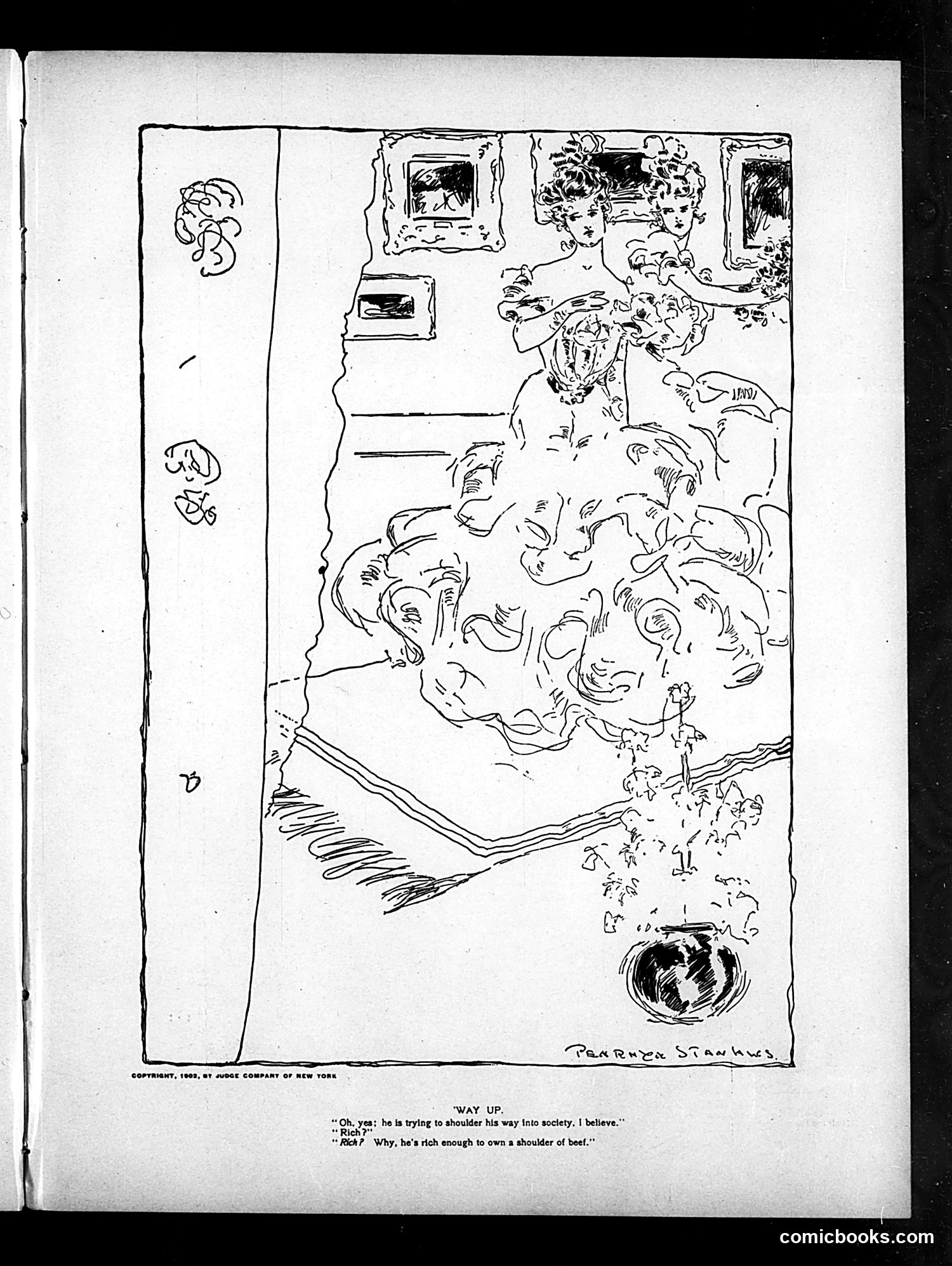
This cartoon by Penrhyn Stanlaws satirizes the relationship between money and social acceptance. The scene depicts a wealthy man attempting to gain entry to high society (represented by the elegant interior with well-dressed figures). The joke hinges on a pun: when one character says the man is "trying to shoulder his way into society," the response equates his wealth to merely owning "a shoulder of beef"—a cheap cut of meat. The satire suggests that despite having money, this nouveau riche outsider lacks the breeding or cultural refinement that "old money" society demands. His wealth alone cannot purchase genuine social status or acceptance among the established elite. This reflects early 20th-century anxieties about industrialization creating new fortunes without corresponding social legitimacy.
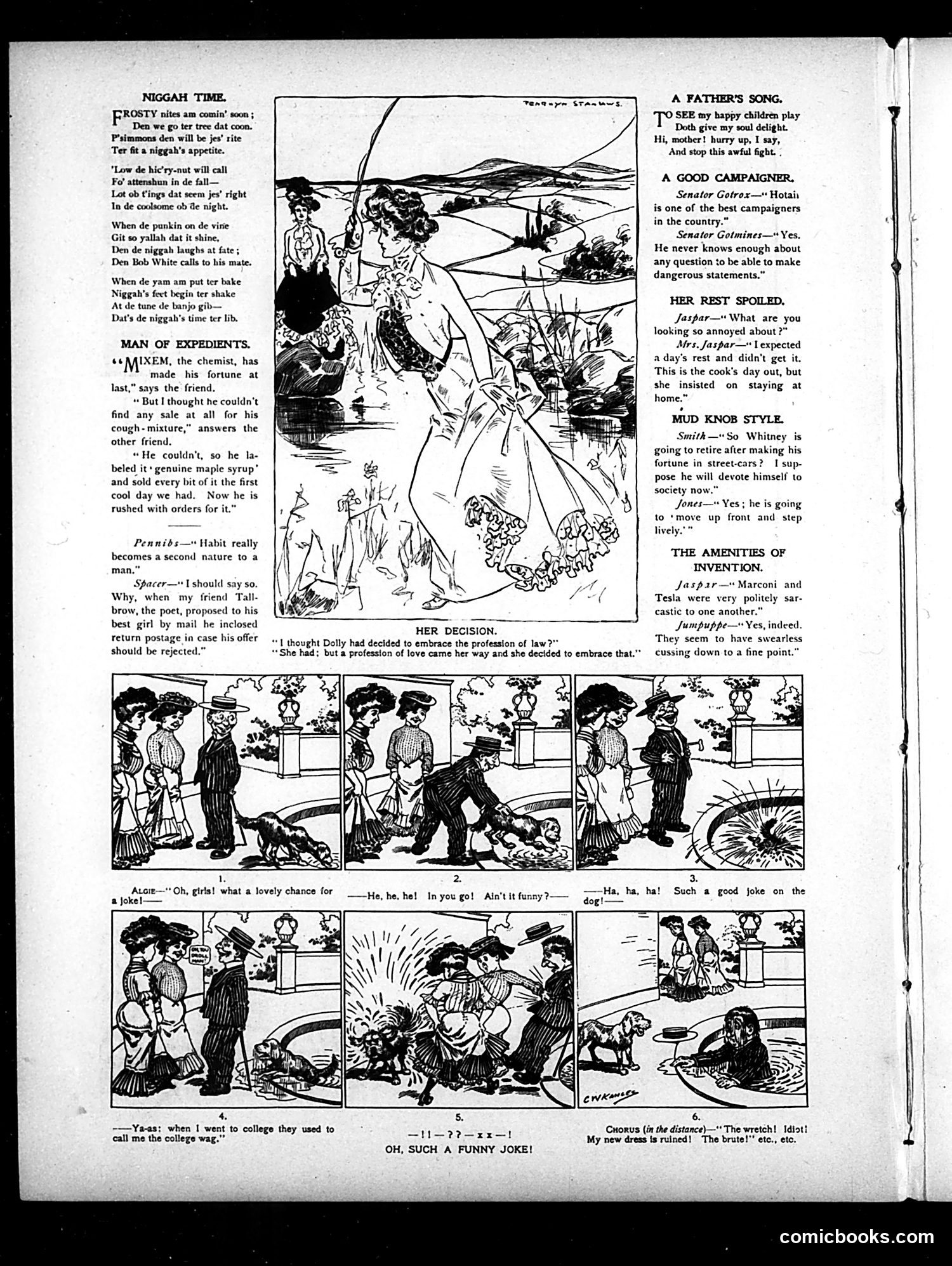
This page contains multiple satirical pieces typical of early 20th-century Judge magazine: **"Niggah Time"** uses racist dialect humor (common to the era) depicting African Americans' supposed contentment with simple pleasures—harvesting persimmons, eating yams, hearing banjos. The satire targets either racial stereotypes themselves or, less likely, mocks those who hold such views. **Other brief satirical items** mock contemporary figures and social types: a chemist who succeeds by relabeling his failed product, a poet who includes return postage with a marriage proposal, a female law student who abandons her profession for love, and politicians (Senators "Gotrox" and "Gotmines") who succeed through ignorance rather than knowledge. **The comic strip "Oh, Such a Funny Joke!"** shows a practical joke involving a dog that escalates into chaos, ending with someone's dress ruined—illustrating how pranks backfire. The humor relies on wordplay, character types, and social commentary typical of 1900s-era American satire, though much relies on now-offensive racial material and gender stereotypes.
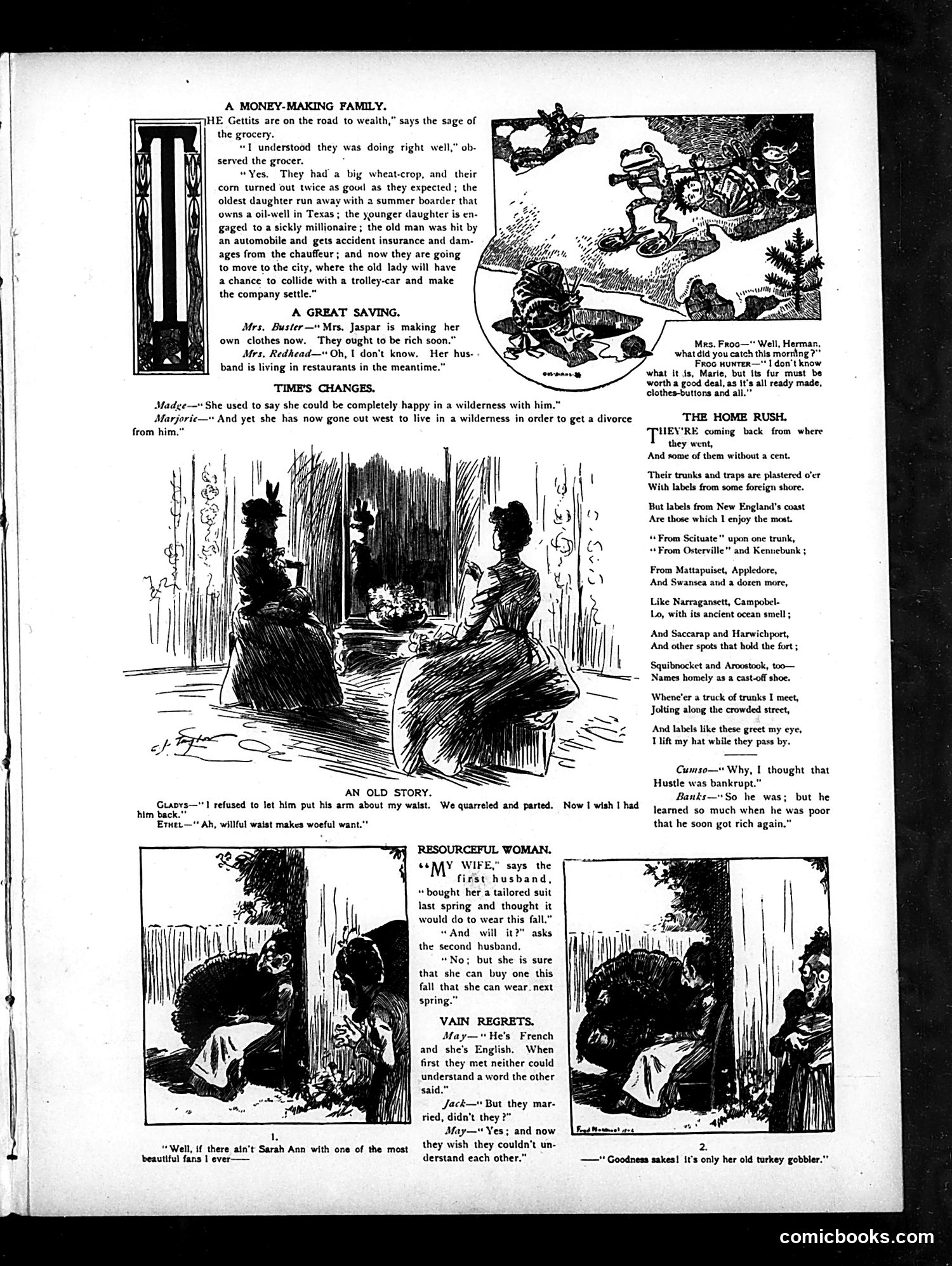
This page contains multiple short humorous pieces satirizing American society's wealth-obsession and changing social customs. **"A Money-Making Family"** mocks the Gettis family's relentless pursuit of wealth through increasingly absurd means—a good wheat crop, an oil-well-owning son-in-law, engagement to a sickly millionaire, and deliberately causing accidents (automobile collision, trolley-car collision) to collect insurance. The satire targets both the nouveau riche's desperation and insurance fraud as a get-rich-quick scheme. **Other pieces** joke about marital disappointments ("Times Changes"), women making their own clothes to save money while husbands eat in restaurants, and language barriers in international marriages. **"The Home Rush"** celebrates returning vacationers from New England coastal towns—poking fun at their pretentious foreign labels while affirming genuine local pride. The overall message: American society is increasingly mercenary, materialistic, and willing to abandon dignity for profit. The humor reflects turn-of-the-century anxieties about economic mobility and changing values.
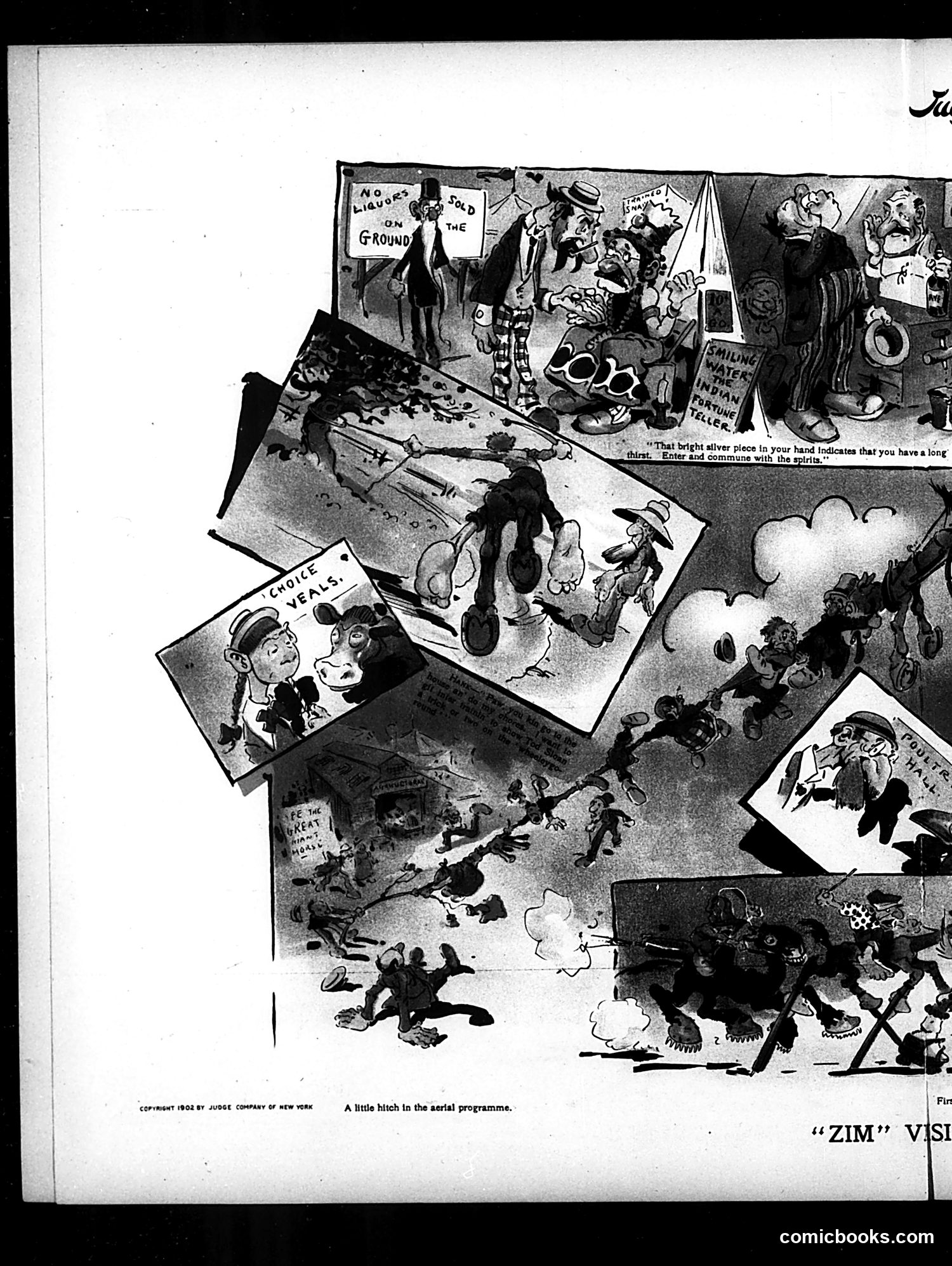
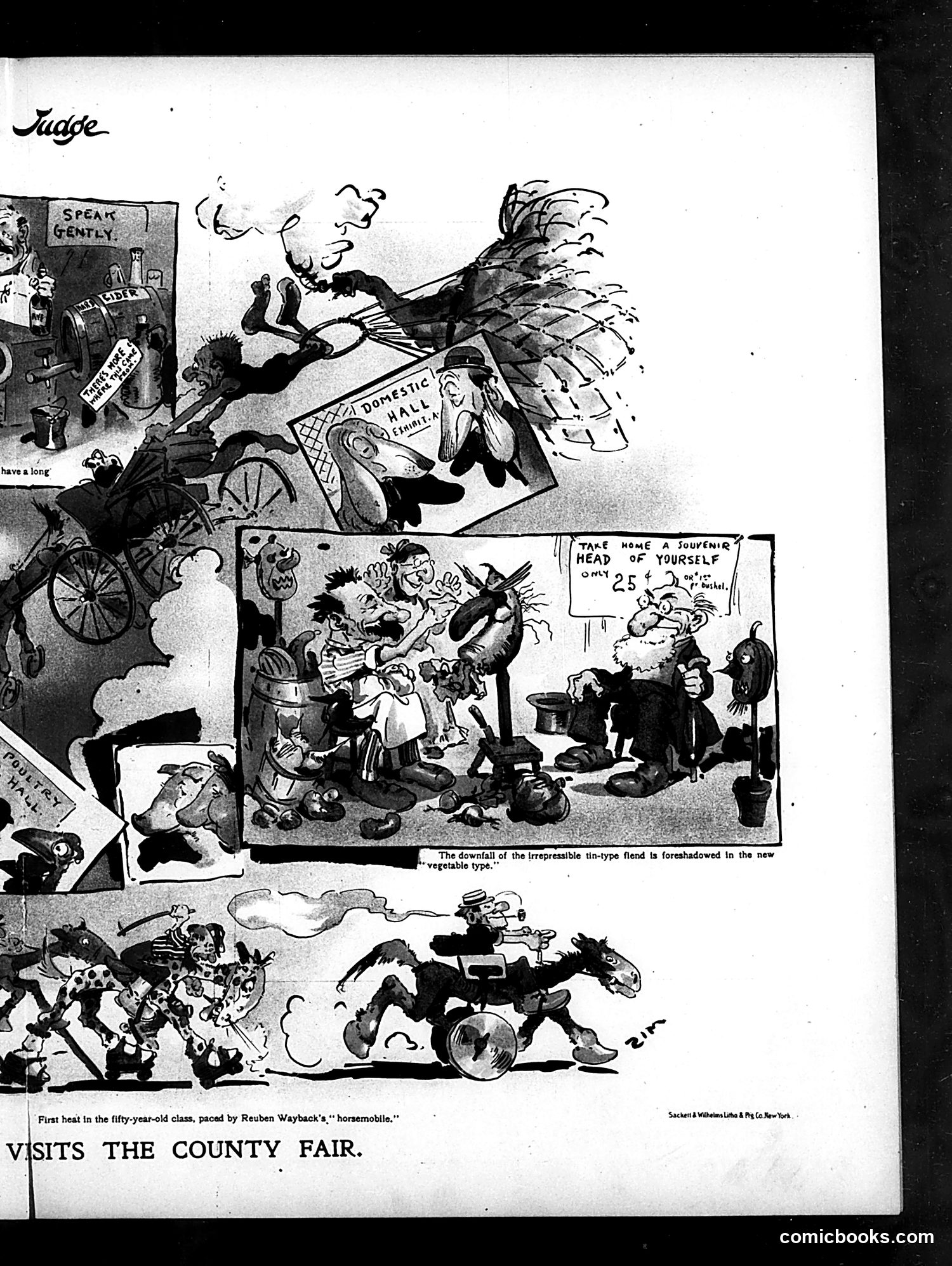
This comic strip satirizes a county fair visit, featuring what appears to be an exaggerated rural character ("Reuben Wayback") and his bizarre "horsemobile" contraption. The humor centers on absurd, slapstick scenarios typical of early-20th-century Judge magazine. Key elements include: - **"The irrepressible vegetable type"** — likely references an overgrown produce specimen or agricultural mishap - **Reuben Wayback's "horsemobile"** — a makeshift vehicle combining horses with mechanical elements, parodying early automotive failures - **"Fifty-year-old class" racing** — mocking outdated technology competing against modernity - **Souvenir gag** — crude humor about taking "heads" home The satire targets rural/agricultural culture's clash with industrial progress, a common Judge magazine theme. The exaggerated character design and chaotic fair scenes exemplify the magazine's irreverent cartoon style.
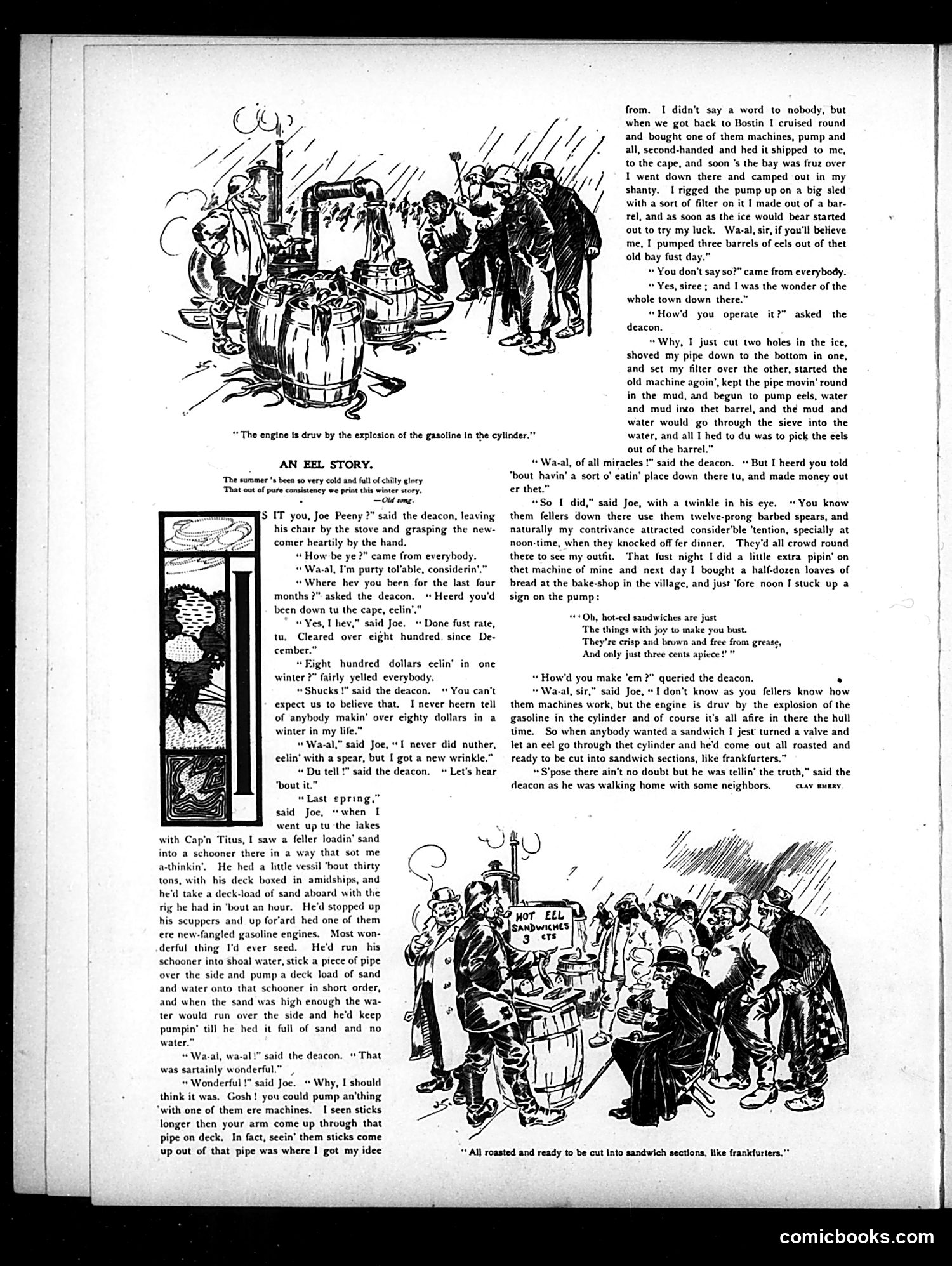
This is a humorous tall tale satirizing both rural New England dialect humor and the era's fascination with new gasoline engine technology. Joe Peeny, a Cape Cod fisherman, claims he invented a gasoline-powered pump to harvest eels from frozen bay mud—an absurdly implausible contraption that supposedly sucked up three barrels of eels in one day. The satire works on two levels: First, it mocks the "rustic wisdom" genre popular in period magazines, where simple country folk supposedly outwit city folk through ingenious improvisation. Second, it gently ridicules contemporary technological mania—the unquestioning belief that gasoline engines could solve any problem, no matter how ridiculous the application. The deacon's skeptical reactions ("You can't expect us to believe that") signal readers that this tall tale is intentionally absurd. The final illustration showing roasted eels as "sandwich sections like frankfurters" completes the joke: Joe's unlikely fishing success now fuels an equally dubious food business.
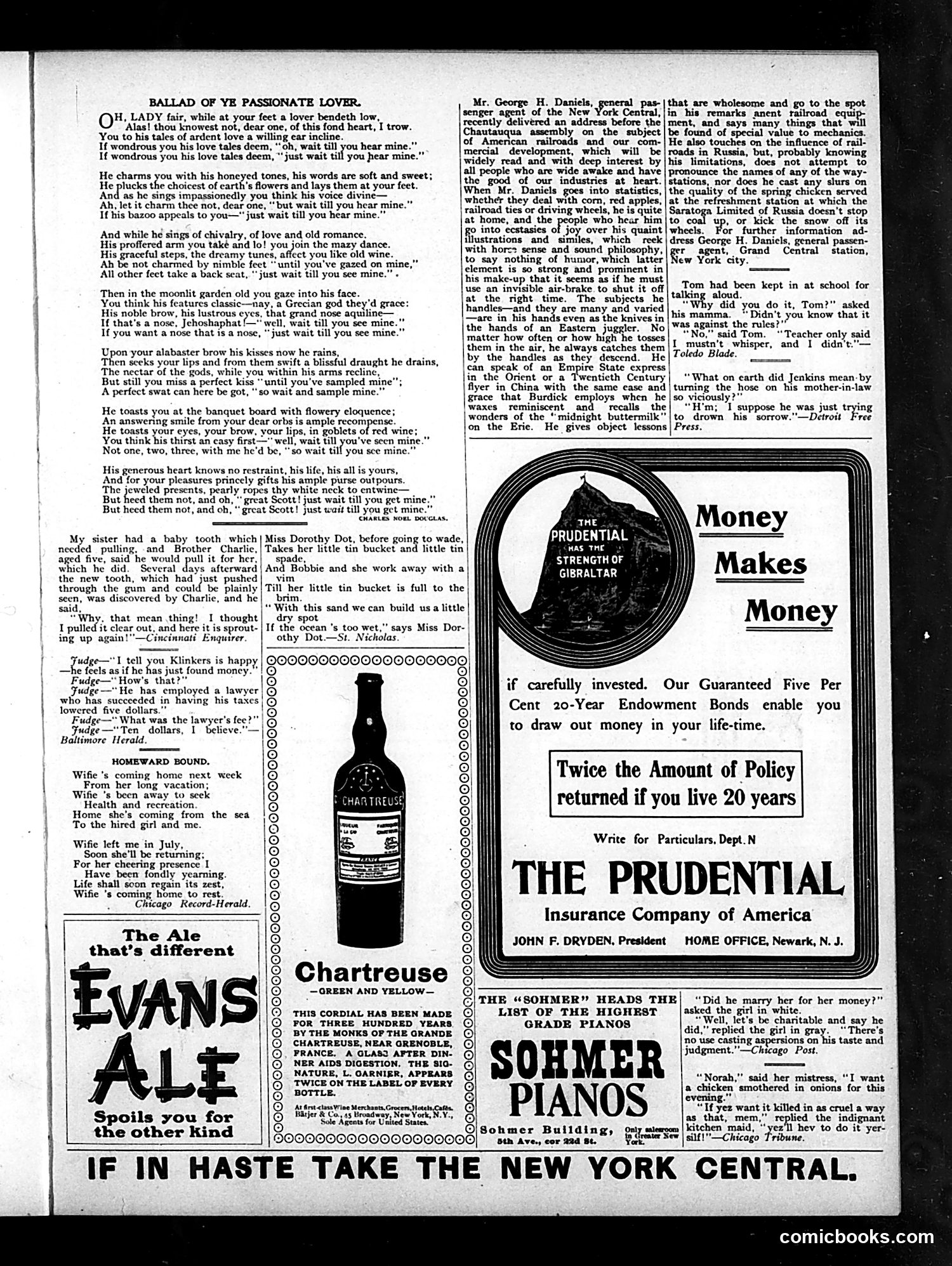
This page is primarily **advertising with satirical poetry content**, not a political cartoon. The main piece is a humorous poem mocking romantic suitors who boast excessively. The speaker describes a lover delivering elaborate compliments—about his voice, appearance, dancing, kisses, and gifts—but consistently undercuts himself with the refrain "just wait till you see/hear mine," suggesting the suitor's own features are even better. **The satire targets male vanity and insincere courtship**: the lover's flowery language and generosity are revealed as self-aggrandizing performance rather than genuine devotion. Each compliment loops back to self-praise, exposing the hollowness of romantic posturing. The page also includes miscellaneous humor (a child's confusion about a new tooth, jokes about lawyers) and advertisements for Evans Ale, Chartreusse liqueur, Sohmer Pianos, and Prudential Insurance. These fill the remaining space typical of *Judge* magazine's format.
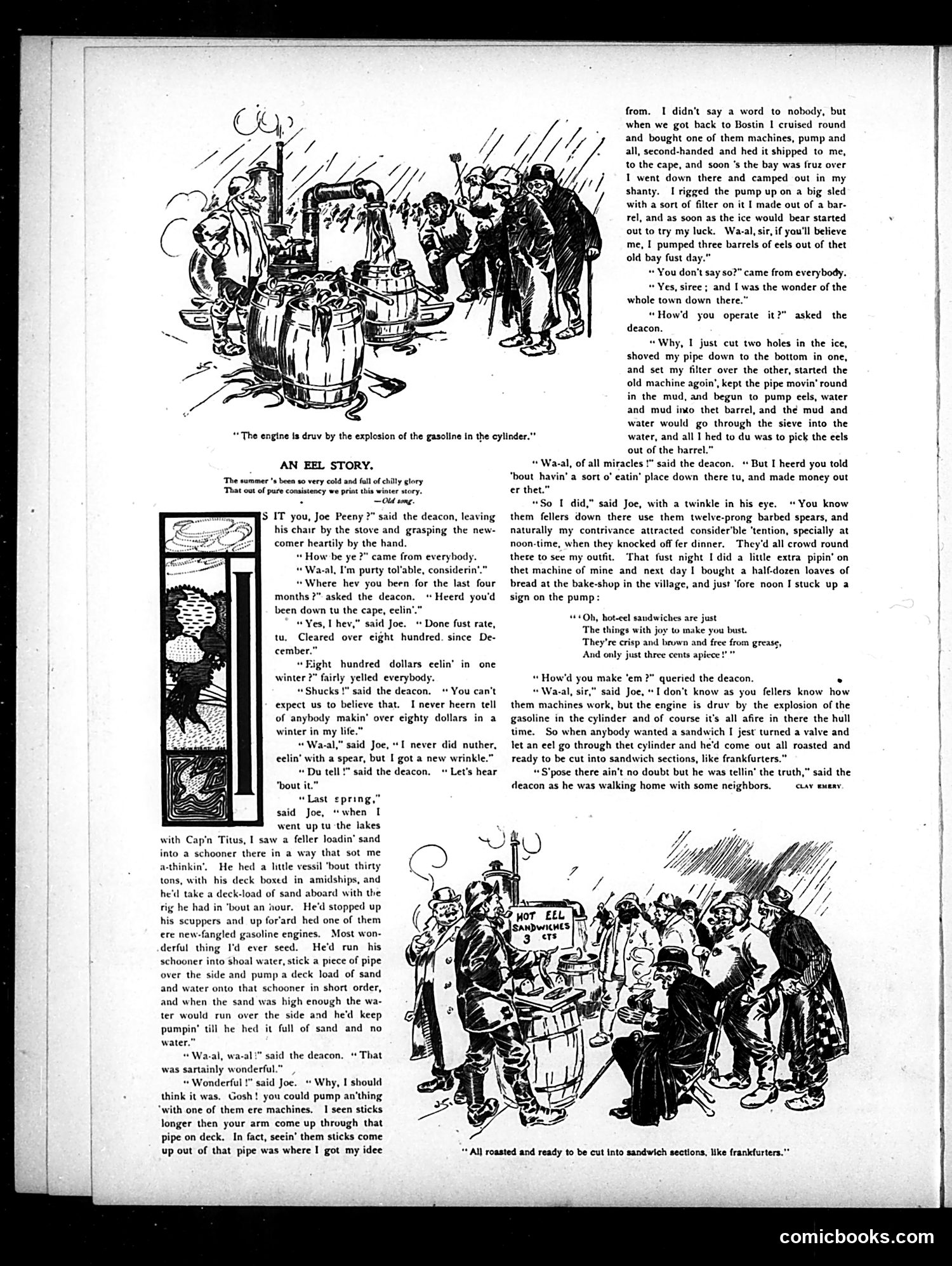
This humorous tall tale satirizes the era's enthusiasm for new gasoline-engine technology by presenting an absurdly implausible application. Joe Penny describes using a gasoline-powered pump—initially designed for loading sand onto ships—to harvest eels from a frozen bay by pumping mud and water through a filter. The satire targets two things: (1) the uncritical wonderment many felt toward mechanical innovation, and (2) the exaggerated boasting common in working-class storytelling. The deacon's incredulous reactions ("You can't expect us to believe that") represent rational skepticism, yet Joe's increasingly elaborate claims—including a profitable sandwich stand—escalate the absurdity. The cartoon above illustrates Joe's contraption in operation. The joke's appeal lay in mocking both technological naïveté and the tall-tale tradition itself, presenting an obviously impossible scheme as rural ingenuity.
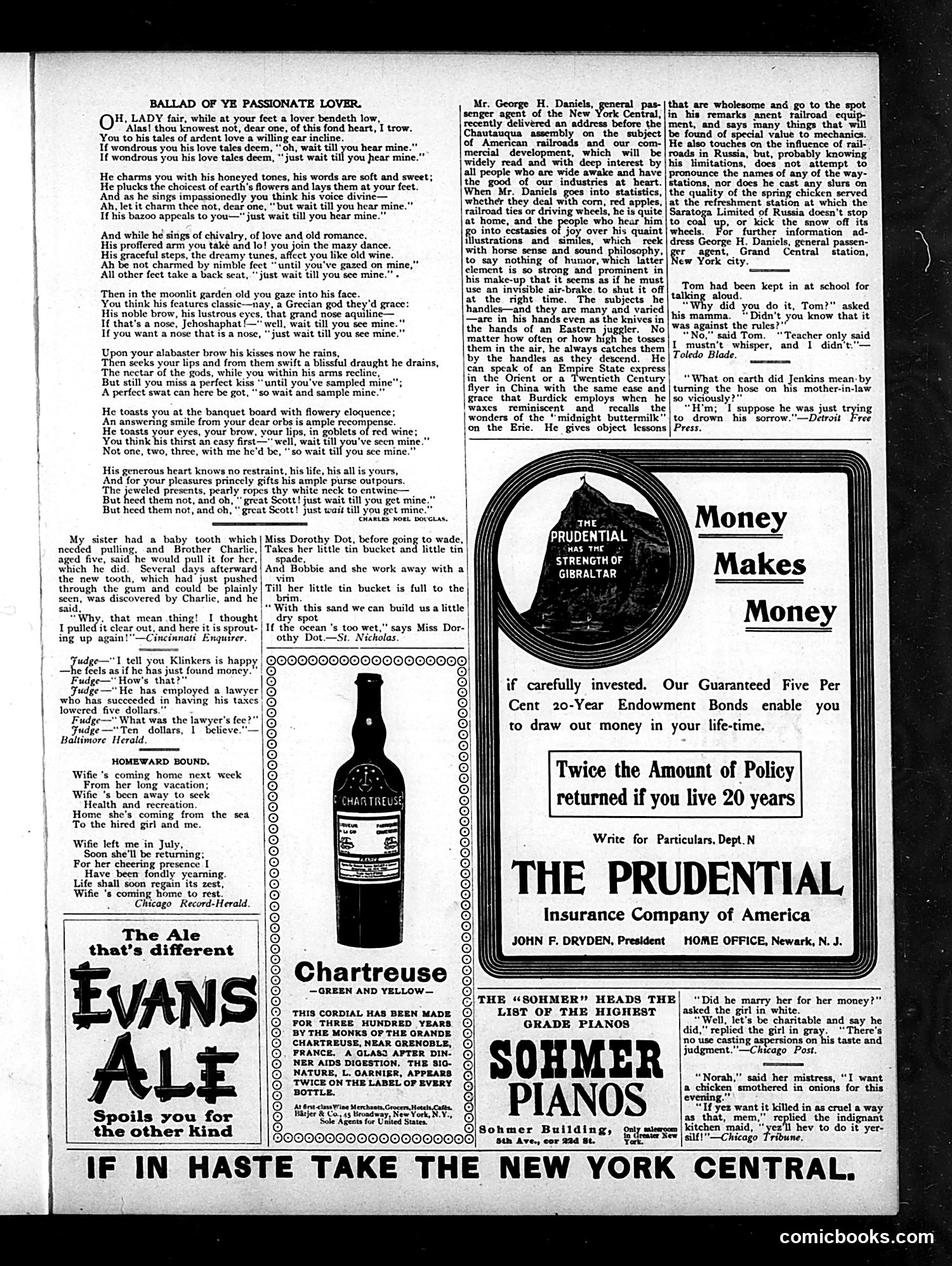
This page is primarily **poetry and humor pieces**, with **advertisements** interspersed. ## Main Content: "Ballad of Ye Passionate Lover" A lengthy comic poem mocking romantic clichés. A suitor praises his beloved through familiar tropes (honeyed words, classical features, gentle kisses, lavish gifts), but the conceit is that the lover repeatedly boasts *his own* attributes are superior—"just wait till you see/hear mine." The satire targets overwrought romantic declarations and male vanity, suggesting passionate lovers are actually conceited bores making everything about themselves rather than their beloved. ## Supporting Material Brief joke items mock domestic life (a child pulling out teeth, a lawyer's fees exceeding his value, a husband dreading his wife's return from vacation). ## Advertisements Evans Ale, Chartreuse liqueur, Prudential Insurance (endowment bonds), and Sohmer Pianos fill the margins—typical Judge magazine filler targeting middle-class readers. The overall tone is **lighthearted mockery of romantic posturing** and **domestic relations**, standard fare for early-20th-century American humor magazines.
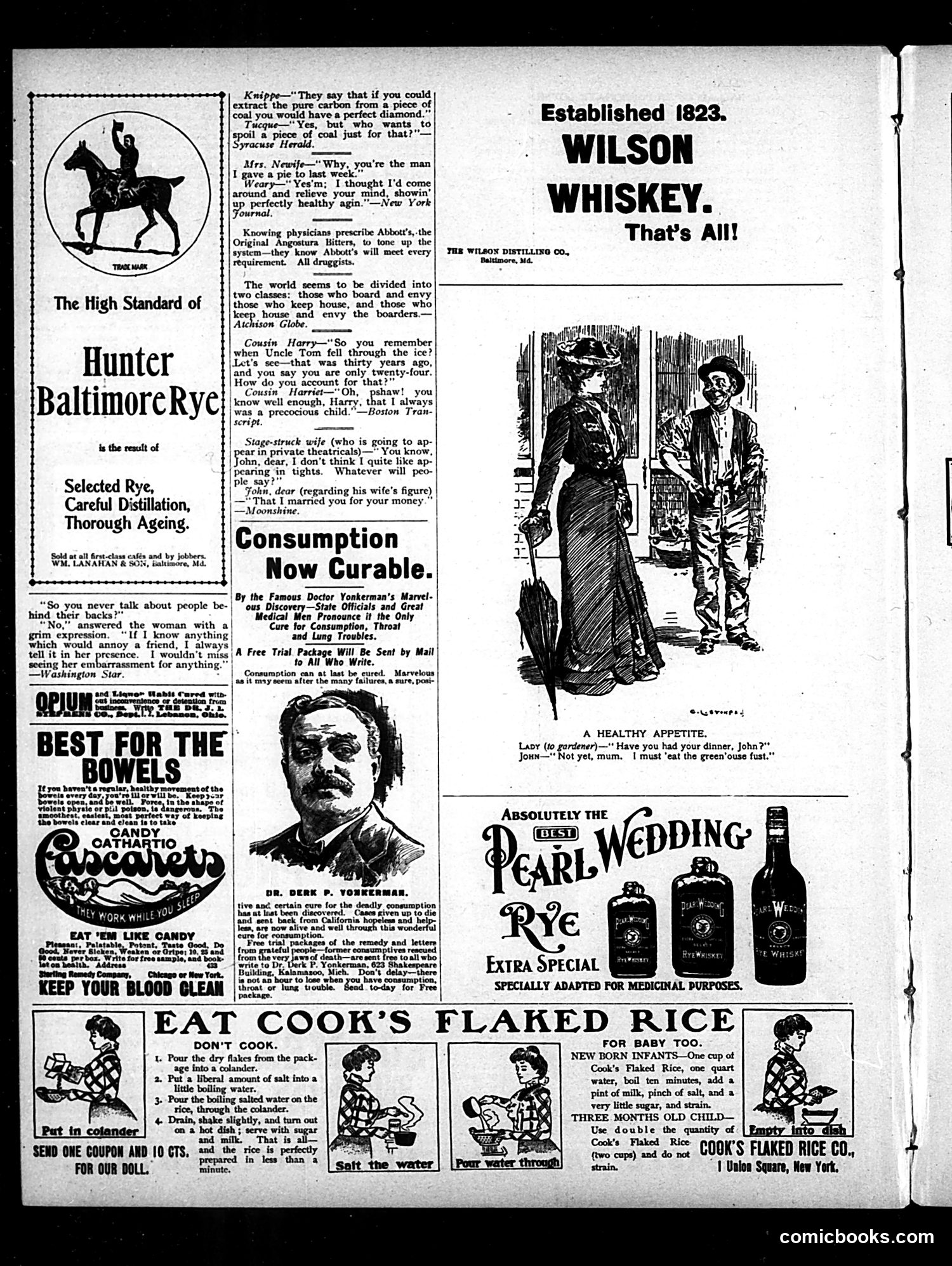
This page from Judge magazine (early 20th century) mixes **short comic vignettes with period advertisements**, typical of the era. ## Comic Sections: The small jokes scattered throughout mock everyday social pretenses and human nature. Examples include a woman claiming she was a "precocious child" to explain age inconsistencies, and a stage-struck wife worried about appearing in tights—her husband quips he "married you for your money," mocking vanity and materialistic marriages. ## Key Advertisement: The largest non-ad content promotes **Dr. Yonkerman's "cure" for consumption** (tuberculosis), claiming miraculous results. This reflects the period's widespread medical quackery—desperate TB patients were duped by false remedies before antibiotics existed. ## Other Ads: Period products like Abbott's Bitters, Cook's Flaked Rice, and Wilson Whiskey appear—typical commercial placements. The whiskey notably emphasizes medicinal purposes, reflecting Prohibition-era marketing tactics and the false medicinal claims common to alcohol advertising. The overall tone is lighthearted mockery of social pretense alongside exploitation of genuine public health desperation.
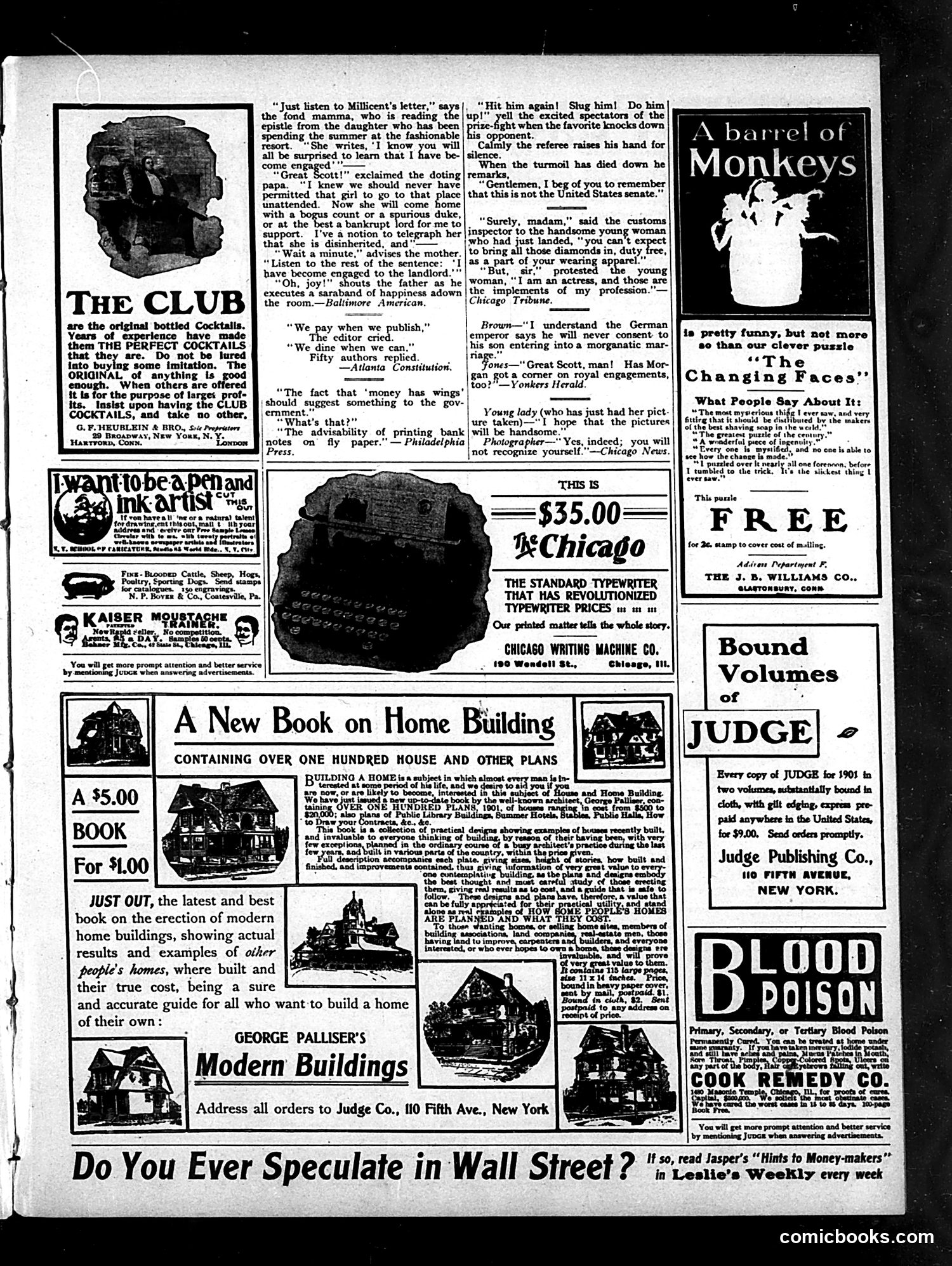
This page is primarily **advertising** interspersed with brief humorous vignettes typical of Judge's satirical style. The cartoons and jokes mock: 1. **Upper-class pretension**: A mother reads her daughter's letter boasting of engagement to a "count" — only to learn he's a "bankrupt lord." The father's delight at avoiding financial ruin satirizes social climbing and the emptiness of aristocratic titles. 2. **Press hypocrisy**: Editors claim they "pay when we publish" and "dine when we can" — mocking financial instability and editorial dishonesty. 3. **Customs and gender**: A female actress claims diamonds are "implements of my profession," evading duty through performative arguments. 4. **Photography vanity**: A retoucher promises results so altered the subject won't recognize herself. The page reflects early 1900s American anxieties about European nobility, media credibility, and social pretense. Most content is product advertisements (cocktails, typewriters, home-building guides) with humor serving as editorial filler between ads.
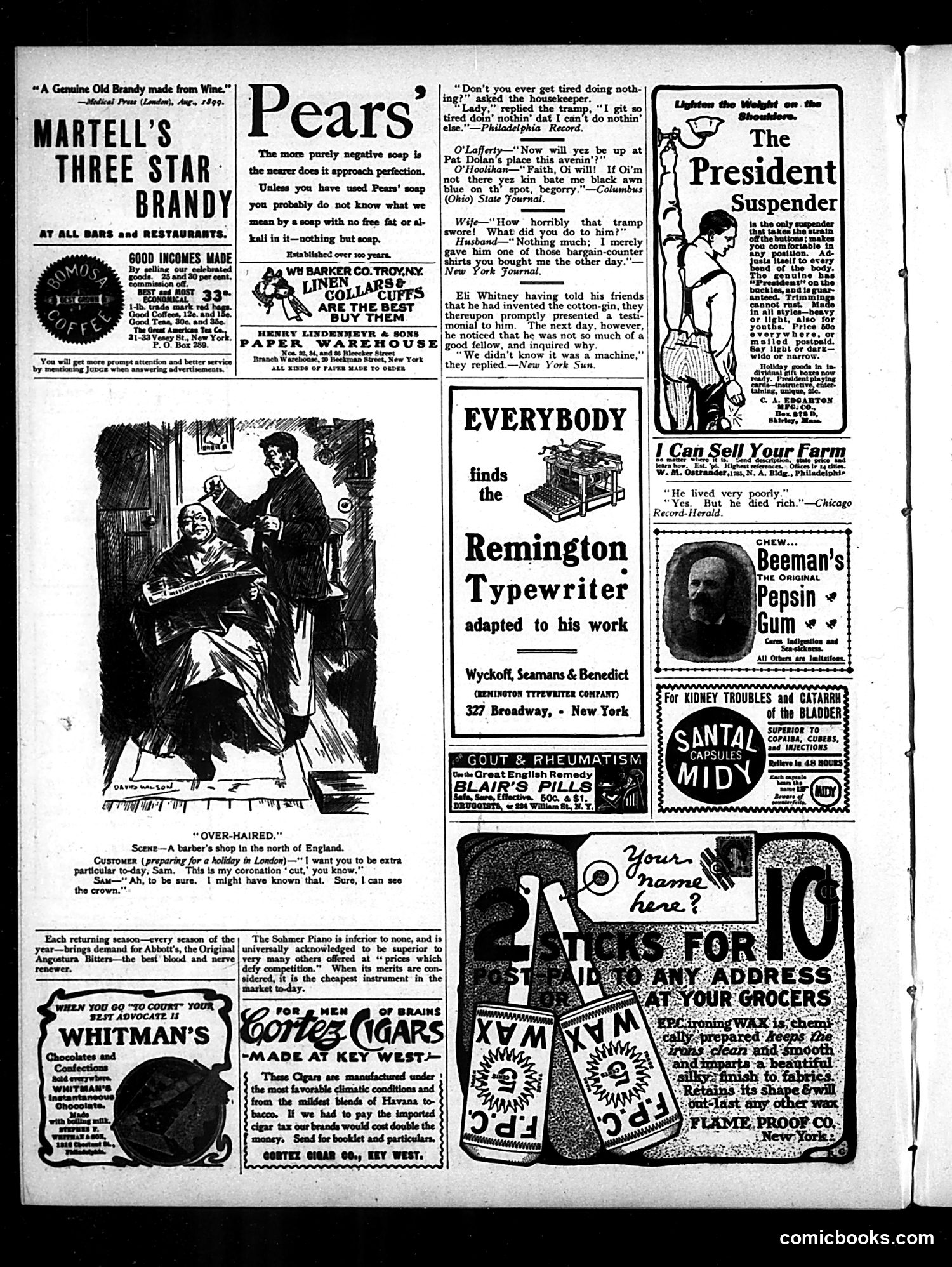
This page is primarily **advertising** with a few brief humorous anecdotes interspersed. The main cartoon ("Over-Haired") depicts a barber shop scene in northern England. A customer preparing for a holiday in London asks the barber to give him an especially fine "coronation cut." The barber dryly replies he can already see the crown—a visual pun on the customer's baldness. The joke relies on the contrast between the customer's vanity about his appearance and his obvious hair loss. The other content consists of short jokes with Irish dialect humor and product advertisements (Martell's brandy, Pears' soap, Remington typewriters, patent medicines). The anecdotes use stereotypical working-class and immigrant voices for comedic effect, typical of period humor. The page reflects late-19th-century advertising practices and comedy conventions that modern readers would find dated and, in some cases, offensive.
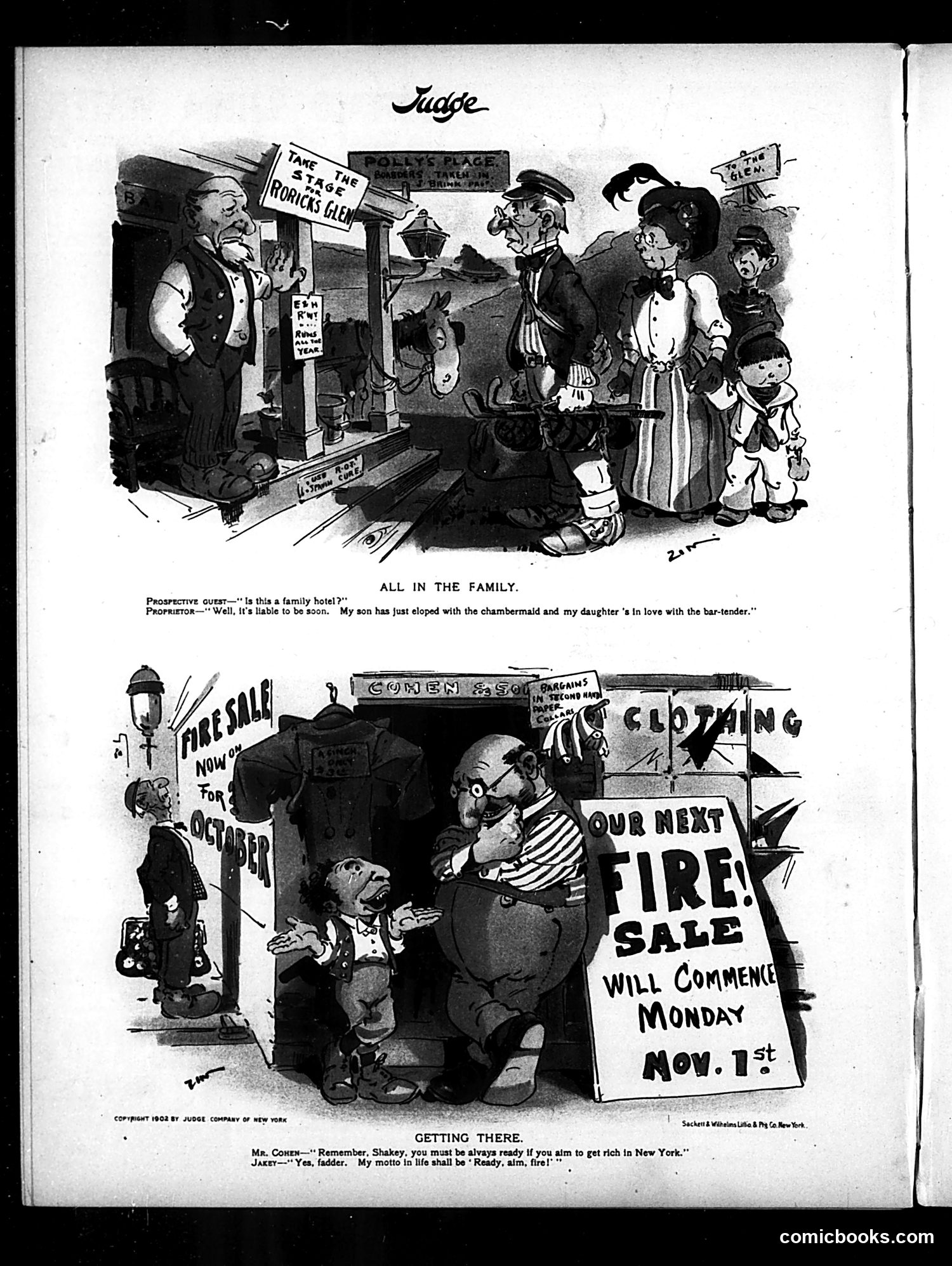
This page contains two satirical cartoons mocking social pretension and ambition in early 20th-century America. **"All in the Family"** jokes about a hotel's disrepute. A prospective guest asks if it's respectable; the proprietor admits his son eloped with a chambermaid and his daughter pursues the bartender—implying the establishment caters to morally questionable behavior and that the owner's family epitomizes such conduct. **"Getting There"** satirizes immigrant (likely Irish, suggested by "fader") parents coaching their son toward wealth through ruthless ambition. The father advises constant readiness to "get rich in New York"; the son's motto becomes "Ready, aim, fire!"—a militaristic catchphrase suggesting wealth acquisition requires aggressive, combative tactics rather than honest labor. Both cartoons mock class anxieties: one targets nouveau-riche hotel owners; the other stereotypes working-class immigrant parents encouraging their children toward success through morally questionable means. The humor relies on period attitudes about respectability and immigrant ambition.