
Judge, 1902-09-20 · page 10 of 18
Judge — September 20, 1902 — page 10: what you’re looking at
What you’re looking at
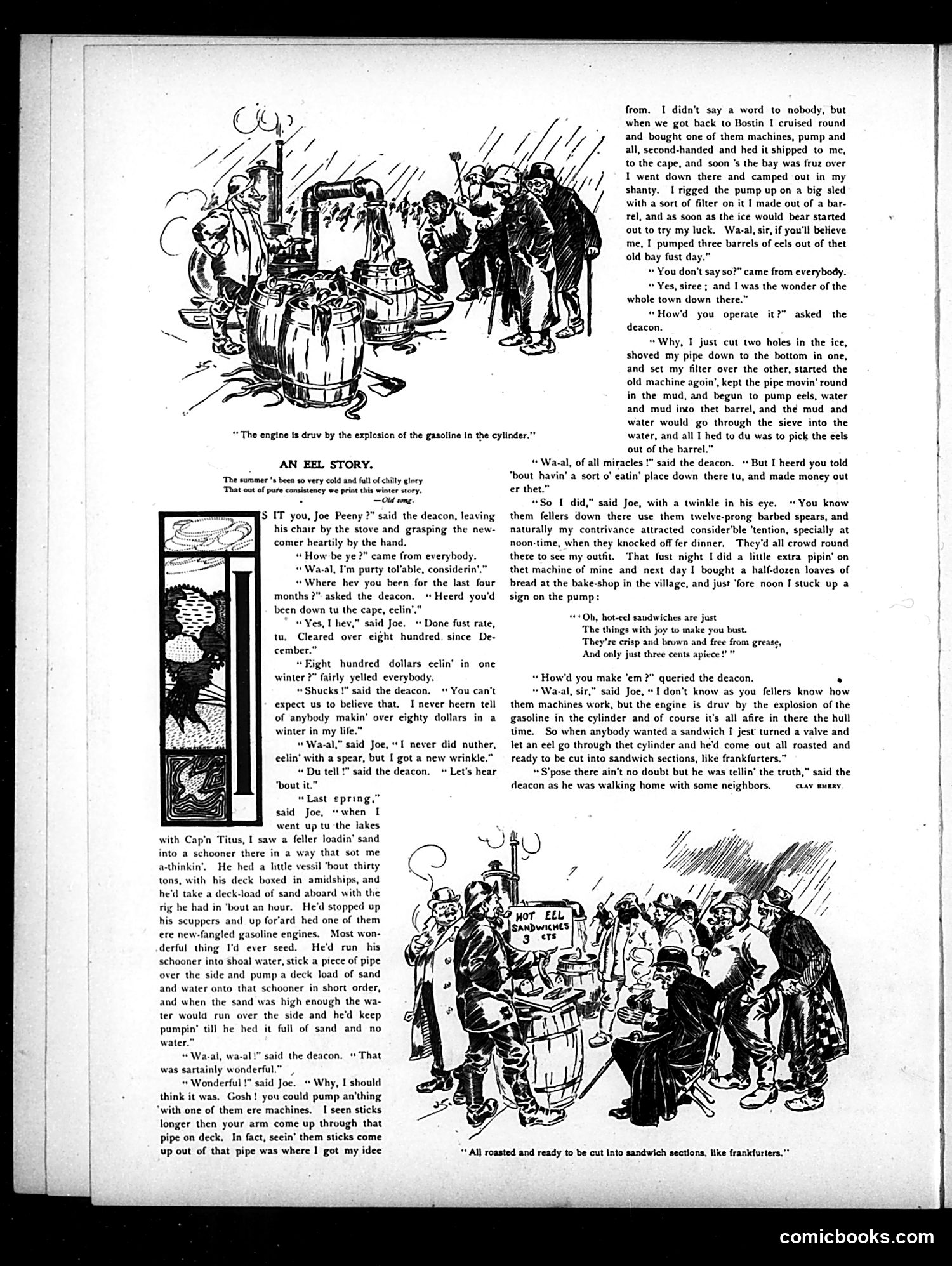
This is a humorous tall tale satirizing both rural New England dialect humor and the era's fascination with new gasoline engine technology. Joe Peeny, a Cape Cod fisherman, claims he invented a gasoline-powered pump to harvest eels from frozen bay mud—an absurdly implausible contraption that supposedly sucked up three barrels of eels in one day. The satire works on two levels: First, it mocks the "rustic wisdom" genre popular in period magazines, where simple country folk supposedly outwit city folk through ingenious improvisation. Second, it gently ridicules contemporary technological mania—the unquestioning belief that gasoline engines could solve any problem, no matter how ridiculous the application. The deacon's skeptical reactions ("You can't expect us to believe that") signal readers that this tall tale is intentionally absurd. The final illustration showing roasted eels as "sandwich sections like frankfurters" completes the joke: Joe's unlikely fishing success now fuels an equally dubious food business.
📄 Transcribed text from this page (OCR, searchable)
Machine-transcribed from the original scan — historical spelling and the odd misread are preserved.
“The engine is druv by the explosion of the gasoline In the cylinder.”* AN EEL STORY. The summer's been 40 very cold and fall of chilly glory ‘That out of pure consistency we print this winter story. 3 Old some. S IT you, Joe Peeny 2" said the deacon, leaving his chair by the stove and grasping the new- comer heartily by the hand. « How’ be ye ?" came from everybod: “ Wa.al, I'm purty tol'able, considerin’. Where hev you been for the last four months?” asked the deacon. “Heerd you'd been down tu the cape, eelin’.” "Yes, L hey,” said Joe. Done fust rate, tu, Cleared over eight hundred. since De- cember.” ight hundred dollars eelin’ in one winter 2” fairly yelled everybody. “ Shucks !" said the deacon. “You can't expect us to believe that. I never heern tell of anybody makin’ over eighty dollars in a winter in my life “Waal,” said Joe, “I never did nuther, eelin’ with a spear, but I got a new wrinkle.” “Du tell !" said the deacon, Let's hear “bout it.” “Last epring,” said Joe, “when I went up tu the lakes with Cap'n Titus, I saw a feller loadin’ sand into a schooner there in a way that sot me a-thinkin’. He hed a hittle vessil ‘bout thirty tons, with his deck boxed in amidships, and he'd take a deck-load of sand aboard with the rig he had in ‘bout an hour. He'd stopped up his scuppers and up for'ard hed one of them ere new-fangled gasoline engines. Most won- derful thing I'd ever seed. He'd run his schooner into shoal water, stick a piece of pipe over the side and pump a deck load of sand and water onto that schooner in short order, and when the sand was high enough the wa- ter would run over the side and he'd keep pumpin’ till he hed it full of sand and no al, wa-al!” said the deacon, “ That was sartainly wonderful.” Wonderful !" said Joe. Why, I should think it was. Gosh! you could pump an'thing “with one of them ere machines. I seen sticks longer then your arm come up through that pipe on deck. In fact, seein’ them sticks come up out of that pipe was where I got my idee ** All roasted and ready to be cut into sandwich sections, like frankfurters.”’ from. I didn’t say a word to nobody, but when we got back to Bostin I cruised round and bought one of them machines, pump and all, second-handed and hed it shipped to me, to the cape, and soon ’s the bay was fruz over I went down there and camped out in my shanty. I rigged the pump up on a big sled with a sort of filter on it I made out of a bar- rel, and as soon as the ice would bear started out to try my luck. Wacal, sir, if you'll believe me, I pumped three barrels of eels out of thet old bay fust day.” * You don't say so?” came from everybody. “Yes, siree; and I was the wonder of the whole town down there.” “How'd you operate it?” asked the deacon. “Why, I just cut two holes in the ice, shoved my pipe down to the bottom in one, and set my filter over the other, started the old machine agoin’, kept the pipe movin’ round in the mud, and begun to pump eels, water and mud into thet barrel, and the mud and water would go through the sieve into the water, and all I hed to du was to pick the eels out of the barrel.” * Waal, of all miracles !" said the deacon. « But I herd you told “bout havin’ a sort o' eatin’ place down there tu, and made money out er thet.” “So I did,” said Joe, with a twinkle in his eye. “You know them fellers down there use them twelve-prong barbed spears, and naturally my contrivance attracted consider’ble ‘tention, specially at noon-time, when they knocked off fer dinner. Thcy’d all crowd round there to see my outfit, That fust night I did a little extra pipin’ on thet machine of mine and next day I bought a half-dozen loaves of bread at the bake-shop in the village, and just ‘fore noon I stuck up a sign on the pump: “Oh, hot-cel sandwiches are just The things with joy to make you bust. They're crisp and brown and free from grease, And only just three cents apiece !? " « How'd you make ‘em ?” queried the deacon. . “Wazal, si said Joe, “1 don't know as you fellers know how them machines work, but the engine is druv by the explosion of the gasoline in the cylinder and of course it's all afire in there the hull time. So when anybody wanted a sandwich I jest turned a valve and let an eel go through thet cylinder and he'd come out all roasted and ready to be cut into sandwich sections, like frankfurters.” “S'pose there ain't no doubt but he was tellin’ the truth,” said the deacon as he was walking home with some neighbors. cay eugey comicbooks.com