
Judge, 1902-09-20 · page 2 of 18
Judge — September 20, 1902 — page 2: what you’re looking at
What you’re looking at
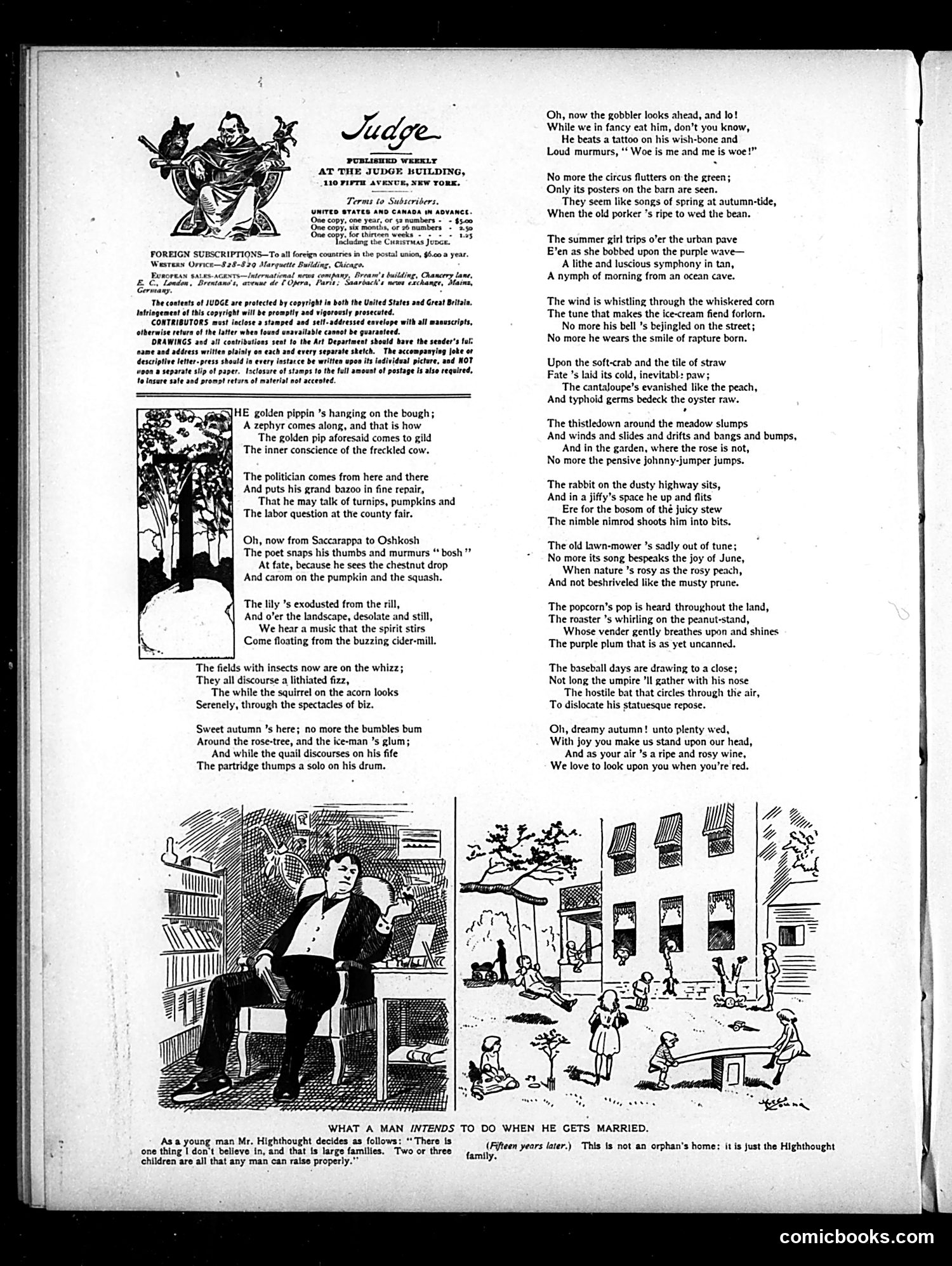
This page combines poetry and social commentary. The main poem uses autumn imagery as metaphor for life's decline—seasons changing, animals preparing for winter, natural vitality fading. This reflects a melancholic Romantic sensibility common to late 19th/early 20th-century literature. The bottom cartoon titled "What a Man Intends to Do When He Gets Married" satirizes the gap between bachelor expectations and married reality. A well-dressed man declares his intention to maintain a large family on modest means through property accumulation. The accompanying street scene shows crowded urban tenement life—the actual outcome for working-class families attempting this fantasy. The satire critiques both naive male optimism about marriage and economics, and the harsh realities of urban poverty and family planning in this era.
📄 Transcribed text from this page (OCR, searchable)
Machine-transcribed from the original scan — historical spelling and the odd misread are preserved.
PUBLISHED WEEKLY AT THE JUDGE BUILDING, 110 FIFTH AVENUE, NEW YORK. Terms to Subscribers, UNITED STATES AND CANADA IN ADVANCE. for thirwen weeks = == = lading the Camisticas Junce. FOREIGN SUBSCRIPTIONS—To all foreign countries in the postal union, $6.00 a year. Wastexx Orrice—$28-$29 Marguette Building, Chicage. Punoresx saies-scexts—/ntrrnational news company, Brean building, Chancery lane, ‘Londen. 'Drestans'n, ateunt de FOpera, Parke: Saarbacl’s mews change, Bains, HE golden pippin ’s hanging on the bough; A zephyr comes along, and that is how The golden pip aforesaid comes to gild The inner conscience of the freckled cow. The politician comes from here and there And puts his grand bazoo in fine repair, That he may talk of turnips, pumpkins and The labor question at the county fair. Oh, now from Saccarappa to Oshkosh The poet snaps his thumbs and murmurs “ bosh ” At fate, because he sees the chestnut drop And carom on the pumpkin and the squash. The lily ’s exodusted from the rill, {| And o'er the landscape, desolate and still, We hear a music that the spirit stirs Come floating from the buzzing cider-mill. The fields with insects now are on the whizz; They all discourse a lithiated fizz, The while the squirrel on the acorn looks Serenely, through the spectacles of biz. Sweet autumn ’s here; no more the bumbles bum Around the rose-tree, and the ice-man ’s glum; And while the quail discourses on his fife The partridge thumps a solo on his drum. Oh, now the gobbler looks ahead, and lo! While we in fancy eat him, don’t you know, He beats a tattoo on his wish-bone and Loud murmurs, “* Woe is me and me is woe!” No more the circus flutters on the green; Only its posters on the barn are seen. They seem like songs of spring at autumn-tide, When the old porker ’s ripe to wed the bean. The summer girl trips o’er the urban pave E’en as she bobbed upon the purple wave— A lithe and luscious symphony in tan, A nymph of morning from an ocean cave. The wind is whistling through the whiskered corn The tune that makes the ice-cream fiend forlorn. No more his bell 's bejingled on the street; No more he wears the smile of rapture born. Upon the soft-crab and the tile of straw Fate ’s laid its cold, inevitabl: paw; The cantaloupe’s evanished like the peach, And typhoid germs bedeck the oyster raw. The thistledown around the meadow slumps And winds and slides and drifts and bangs and bumps, And in the garden, where the rose is not, No more the pensive johnny-jumper jumps. The rabbit on the dusty highway sits, And in a jiffy’s space he up and flits Ere for the bosom of thé juicy stew The nimble nimrod shoots him into bits. The old lawn-mower ’s sadly out of tune; No more its song bespeaks the joy of June, When nature ’s rosy as the rosy peach, And not beshriveled like the musty prune. The popcorn’s pop is heard throughout the land, The roaster ’s whirling on the peanut-stand, Whose vender gently breathes upon and shines The purple plum that is as yet uncanned. The baseball days are drawing to a close; Not long the umpire ’Il gather with his nose The hostile bat that circles through the air, To dislocate his statuesque repose. Oh, dreamy autumn! unto plenty wed, With joy you make us stand upon our head, And as your air ’s a ripe and rosy wine, We love to look upon you when you're red. WHAT A MAN INTENDS TO DO WHEN HE GETS MARRIED. Asa young man Mr. Highthought decides as follows: “There is one thing I don't believe in, and that is large families. Two or three (11 children are all that any man can raise properly.”” (Fifteen years later.) This is not an orphan’s home: it is Just the Highthought ily. comicbooks.com