
A complete issue · 20 pages · 1902
Judge — July 5, 1902
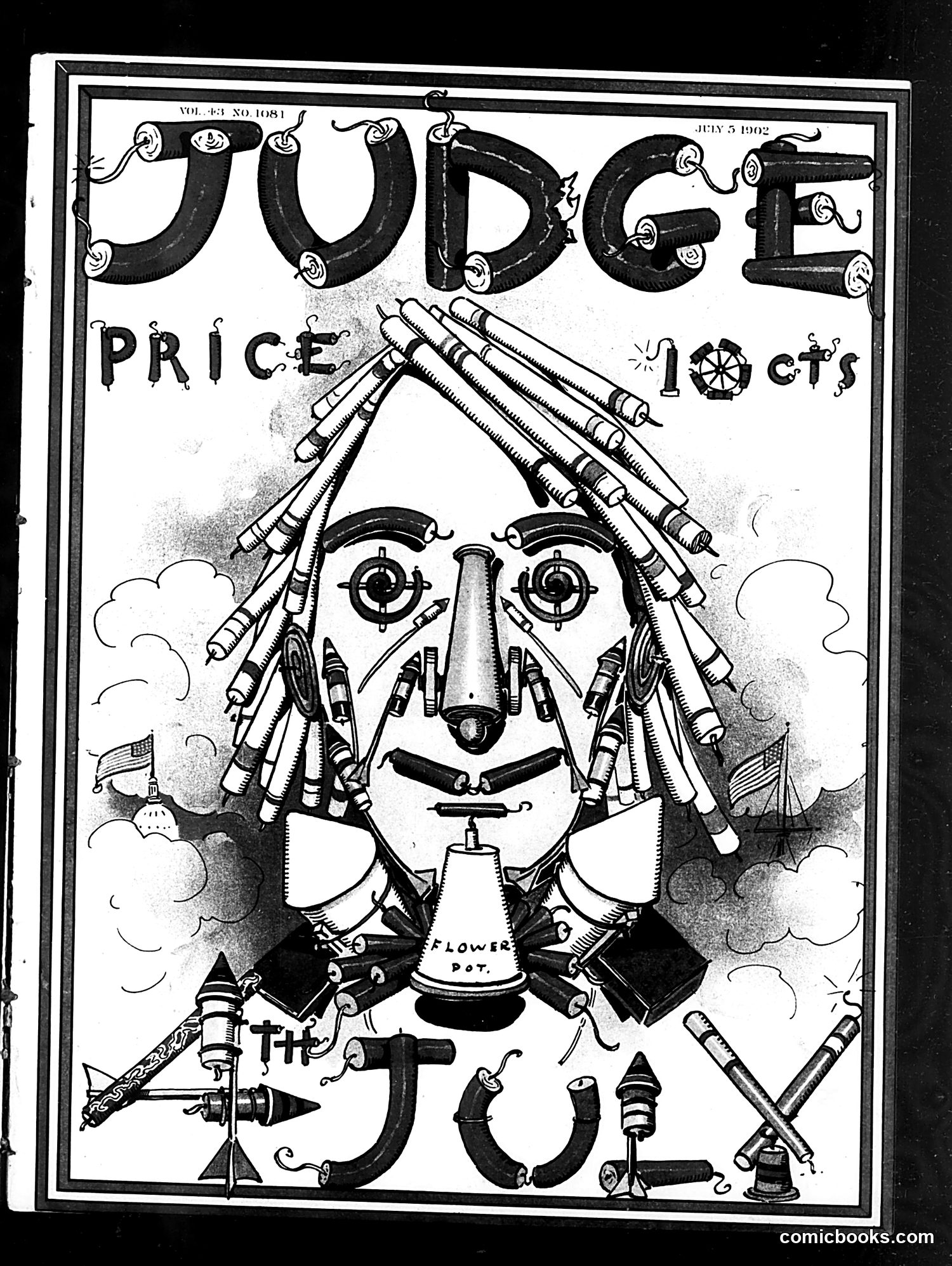
This cover depicts a grotesque head composed of military weaponry—cannons form the hair, rifles create facial features, and shells and explosives serve as decorative elements. A "Flower Pot" label appears near the base, with a cross symbol and what appear to be naval vessels in the background clouds. The satire likely critiques American militarism or imperial expansion during the early 1900s, a period when the U.S. was engaged in the Philippine-American War (1899-1902) and expanding global military presence. The transformation of a human head into weaponry suggests the satirist's view that military interests were dominating political thinking and national identity. The "flower pot" may ironically suggest attempts to cultivate or legitimize this militarism.
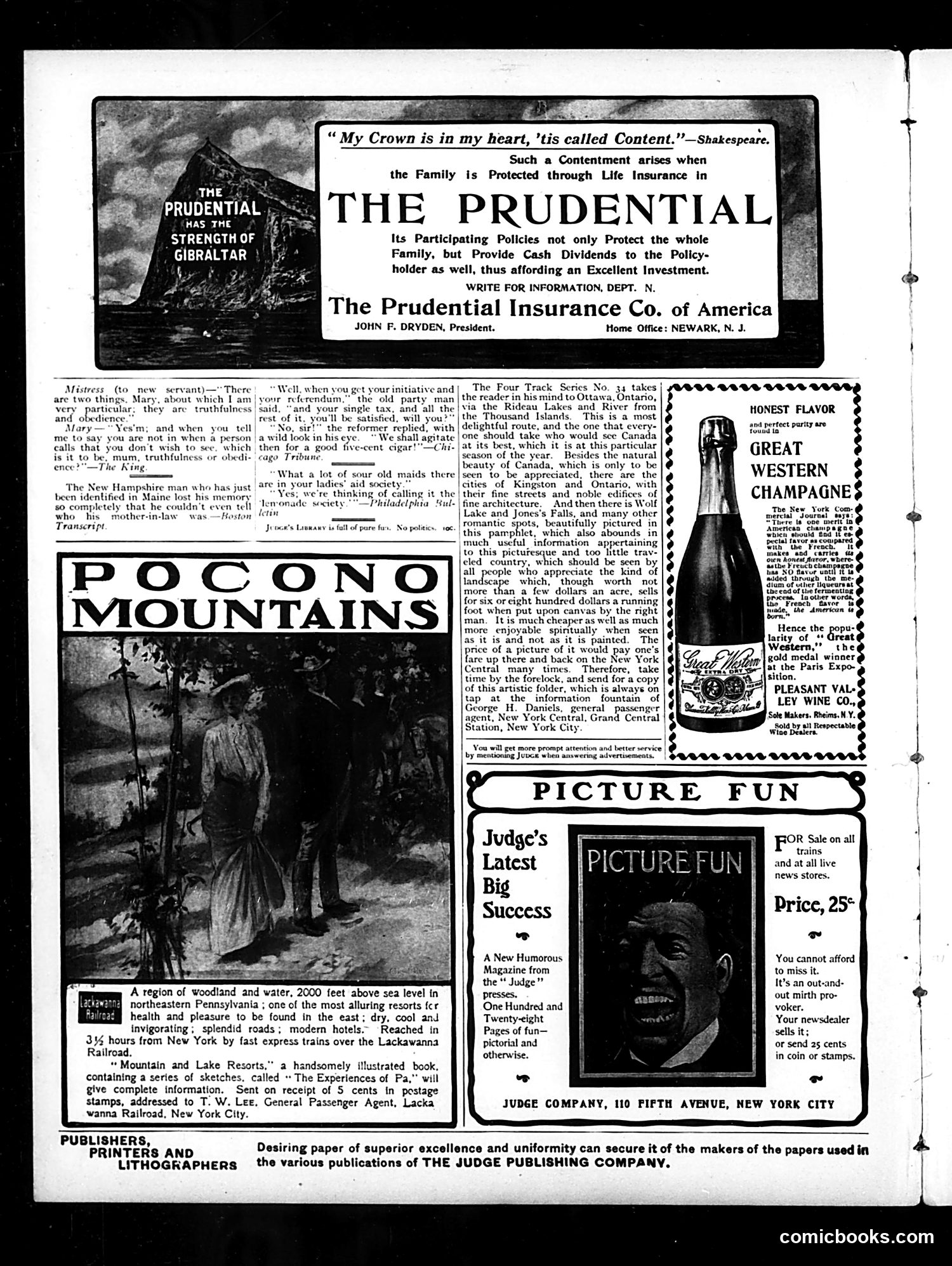
This page is primarily **advertising and travel promotion** rather than political satire. The main content features the **Pocono Mountains** advertisement, highlighting it as a woodland resort 2,000 feet above sea level in northeastern Pennsylvania, accessible by train from New York. The ad emphasizes natural attractions and health benefits. The page also includes advertisements for **The Prudential Insurance Company**, **Great Western Champagne**, and **Picture Fun magazine** (described as "A New Humorous Magazine from the 'Judge' Press"). There is minimal satirical content visible. The opening dialogue snippet appears to reference a referendum and party politics, but lacks sufficient context to identify specific figures or events. Overall, this represents a typical magazine page mixing editorial snippets with commercial advertisements.
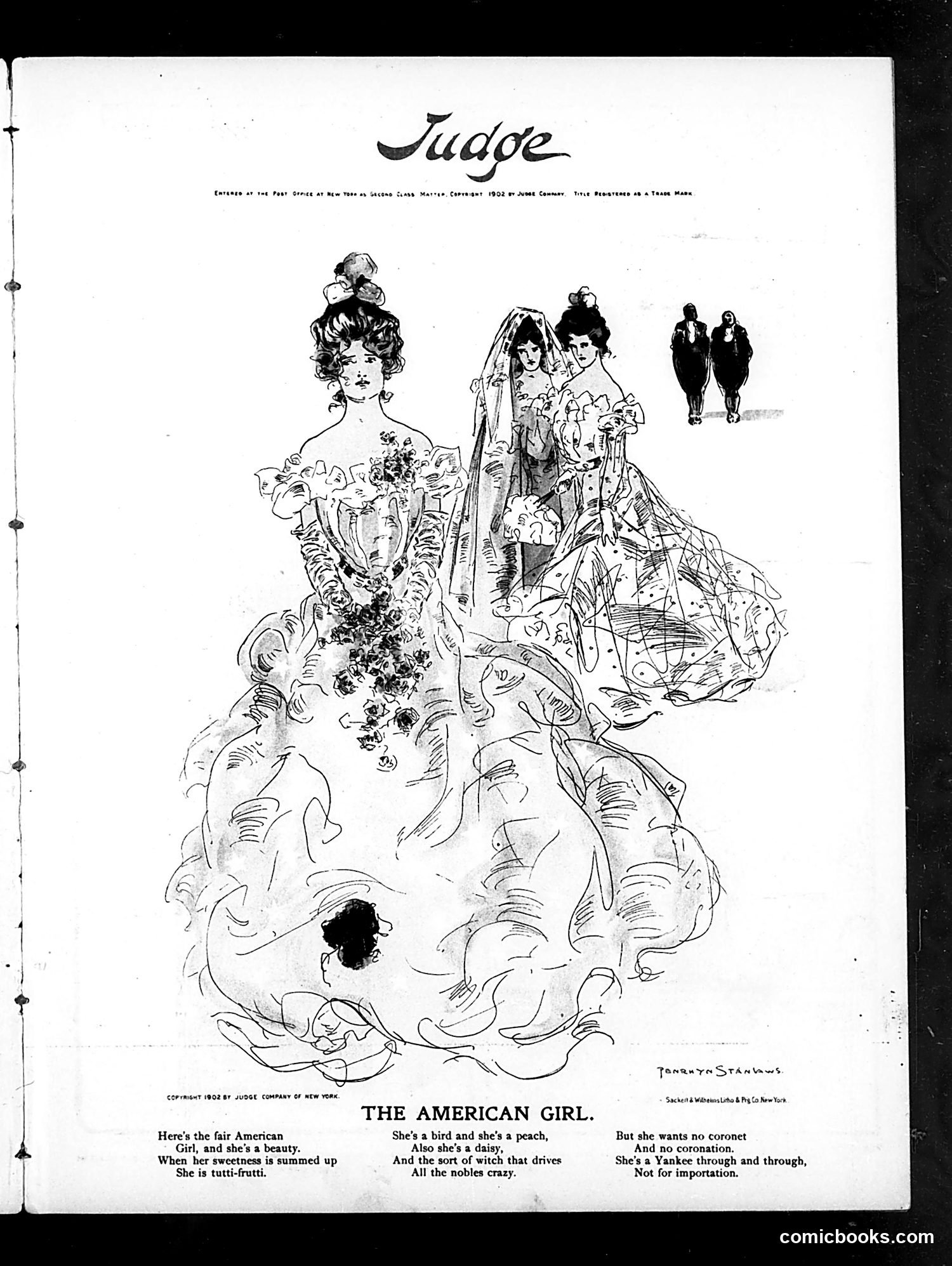
This illustration celebrates American femininity and independence, a common theme in early 20th-century American satire. The central figure depicts an idealized "American Girl"—fashionably dressed, confident, and physically present in public spaces. The accompanying poem contrasts her with European aristocratic traditions: she's "a bird and a peach" (slang for attractive and desirable), spirited and uncontrollable ("the sort of witch that drives all the nobles crazy"), yet distinctly American. Crucially, "she wants no coronet / And no coronation"—rejecting Old World hierarchy and formality. The small figures in the background appear to represent European aristocrats, emphasizing the satirical point: American girls represent democratic values and modern independence rather than inherited nobility or rigid social convention.
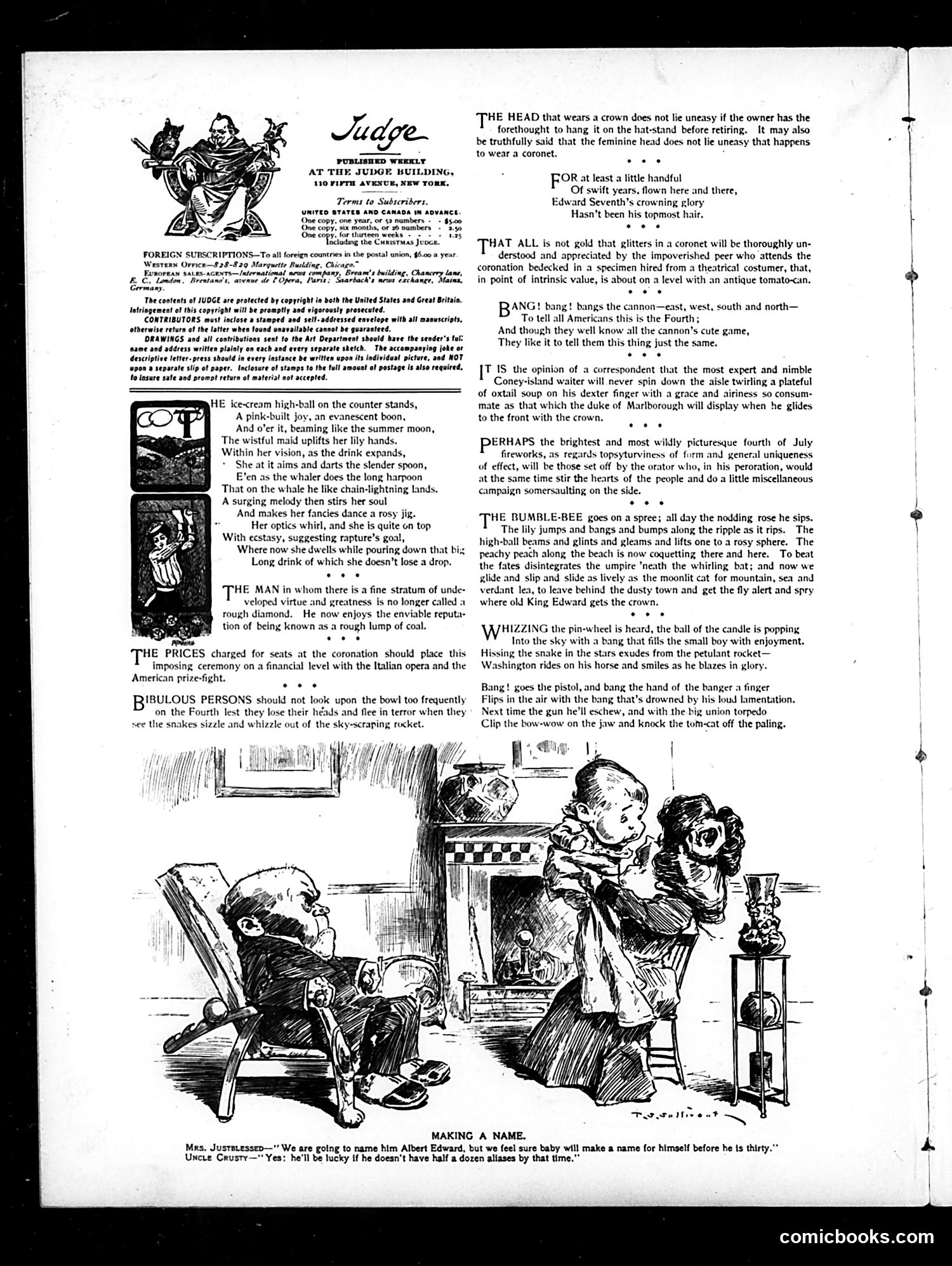
This page contains satirical commentary about the Fourth of July coronation ceremony and related social observations. The main cartoon, titled "Making a Name," depicts a domestic scene where a woman holds a baby while speaking to a man in a chair, discussing naming their child "Albert Edward" after the heir to the British throne. The satire targets American pretentiousness—specifically the affectation of adopting British royal names and customs. The joke suggests that Americans, while proud of their independence, ironically emulate British aristocracy. Additional text mocks wealthy Americans' obsession with coronation ceremonies and their social aspirations. The surrounding commentary critiques specific behaviors: excessive drinking, poor table manners among the wealthy, and the general ridiculousness of Americans imitating British pageantry and titles.
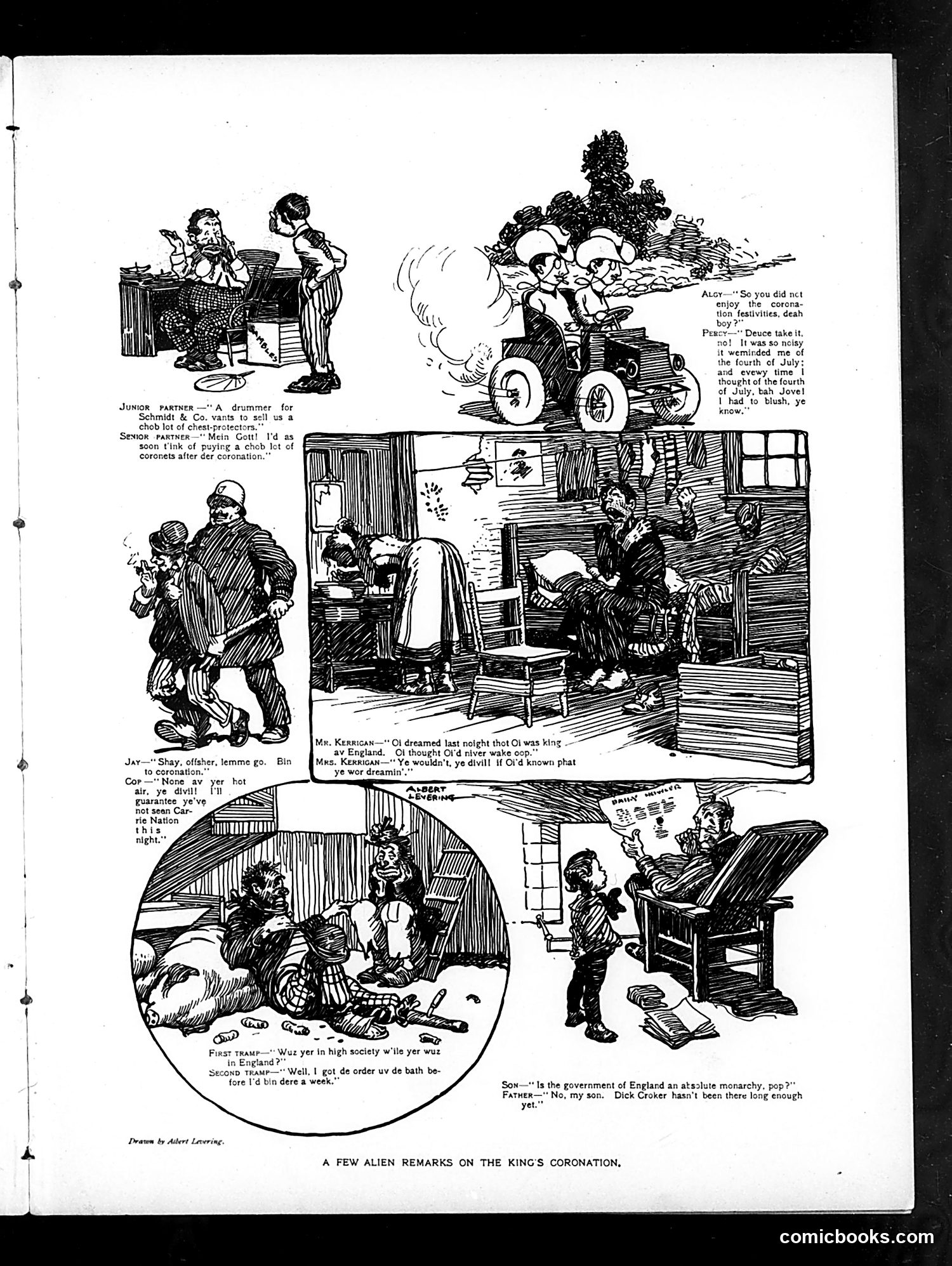
This page satirizes the 1902 British coronation of King Edward VII through the eyes of Irish and working-class immigrants to America. The humor relies on ethnic stereotypes (Irish dialect, drunkenness) commenting on British pageantry they find absurd or irrelevant. Key jokes include: Irish characters mocking the coronation's grandeur; a reference to Carrie Nation (American prohibition activist); tramps boasting of receiving the "Order of the Bath" (a real British honor, played as a pun); and a final gag about Irish-American political boss Dick Croker, suggesting even absolute monarchies can't resist American political corruption. The satire targets both British imperial pretension and immigrant outsider perspectives, using working-class voices to deflate the coronation's importance. The drawings credit "Albert Levering" as artist.
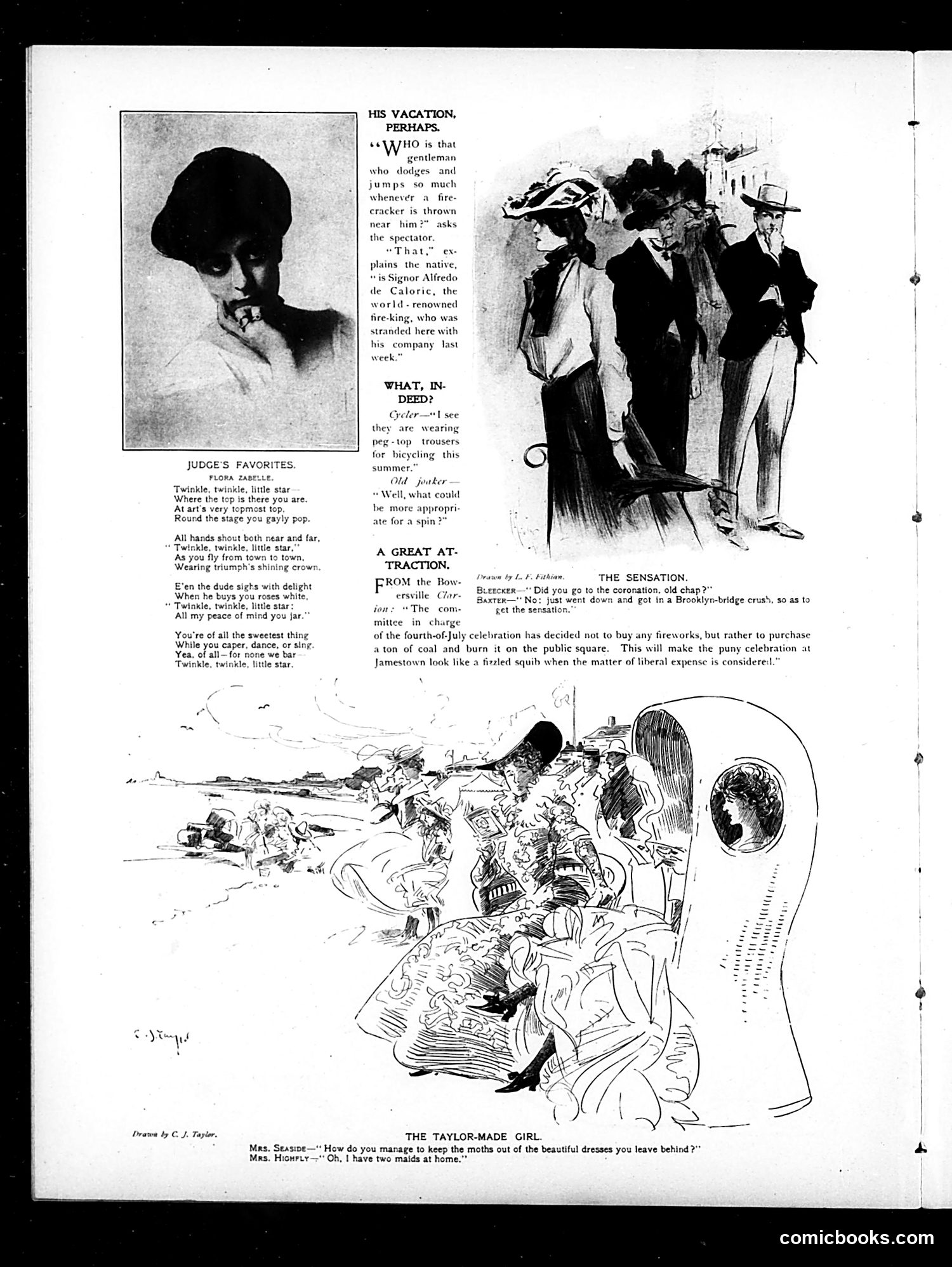
This page contains several satirical pieces from early 1900s America: **"His Vacation, Perhaps"**: Mocks a supposedly famous "fire-king" performer (Signor Alfredo de Caloric) stranded in town, who ironically flinches at firecrackers—undercutting his professional credentials. **"What, Indeed?"**: Jokes about the fashionable "peg-top trousers" trend for cyclists, with a character sarcastically asking what else one could wear for a bicycle ride. **"A Great Attraction"**: Satirizes the Jamestown Fourth-of-July celebration committee's decision to burn coal instead of buying fireworks for cost reasons—making their event look cheap compared to more lavish celebrations. **"The Sensation"**: Social humor about attending crowded public events like the coronation or Brooklyn Bridge crush. **"The Taylor-Made Girl"**: Jokes about wealthy women who employ maids specifically to preserve their expensive dresses while wearing simpler ones at home. The page exemplifies Judge's satirical humor targeting social pretension, fashion absurdities, and economic disparities of the Edwardian era.
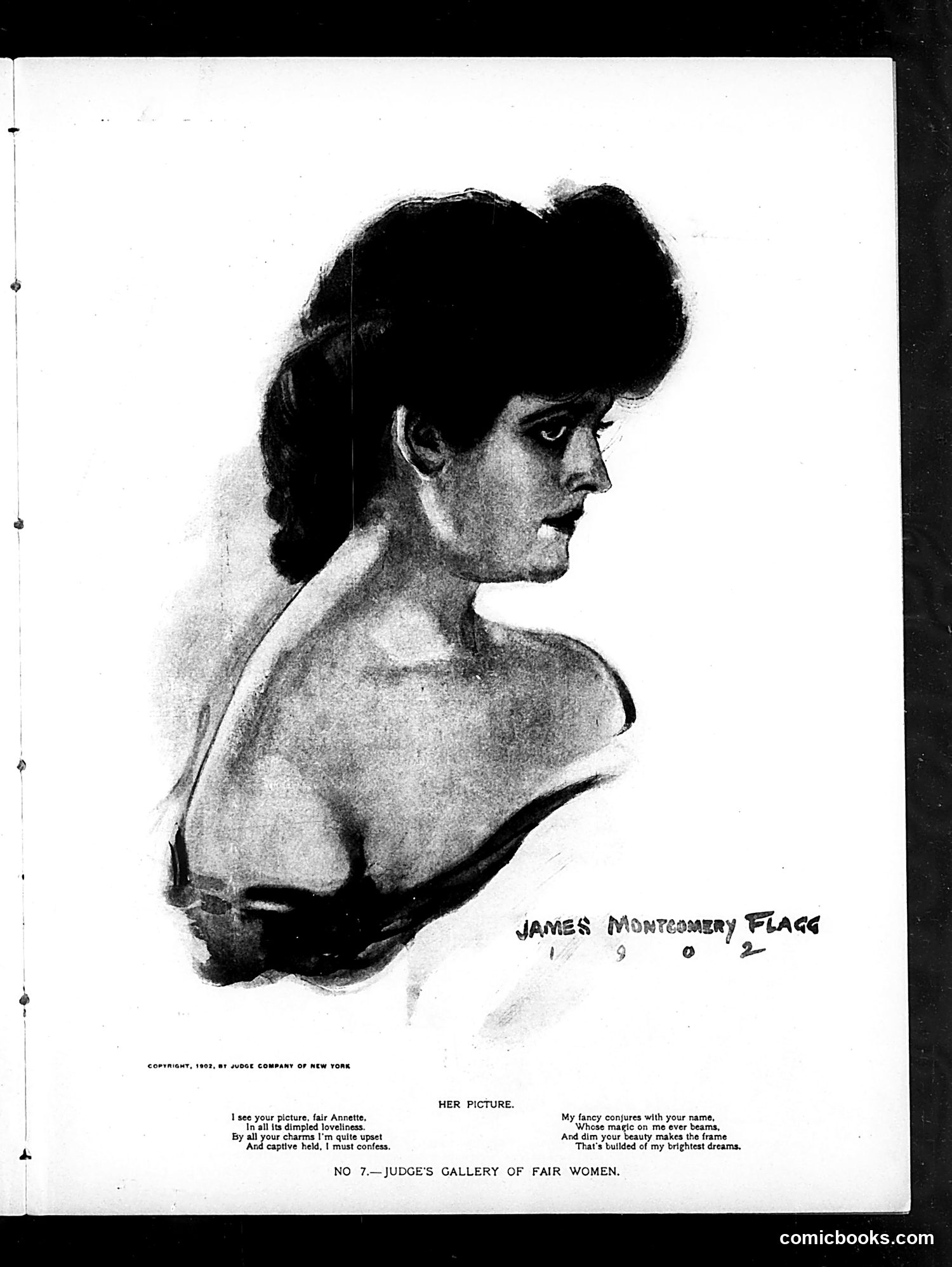
This is a 1902 Judge magazine page featuring a portrait sketch labeled "James Montgomery Flagg 1902," presented as part of "Judge's Gallery of Fair Women." The page is primarily a **romantic tribute rather than satire**. It displays a profile portrait of a woman with the accompanying sentimental verse praising her beauty and charm. The poem uses conventional Victorian romantic language—"dimpled loveliness," "captive held," "brightest dreams." This appears to be a **gallery feature celebrating attractive women**, a common magazine format of the era. The artist credit suggests Flagg (who later became famous for WWI propaganda posters) provided the illustration. Rather than political satire, this represents Judge's lighter content—aesthetic appreciation and romantic sentiment aimed at the magazine's readership. The "fair women" gallery format reflects early 1900s periodical conventions mixing serious satire with lighter lifestyle features.
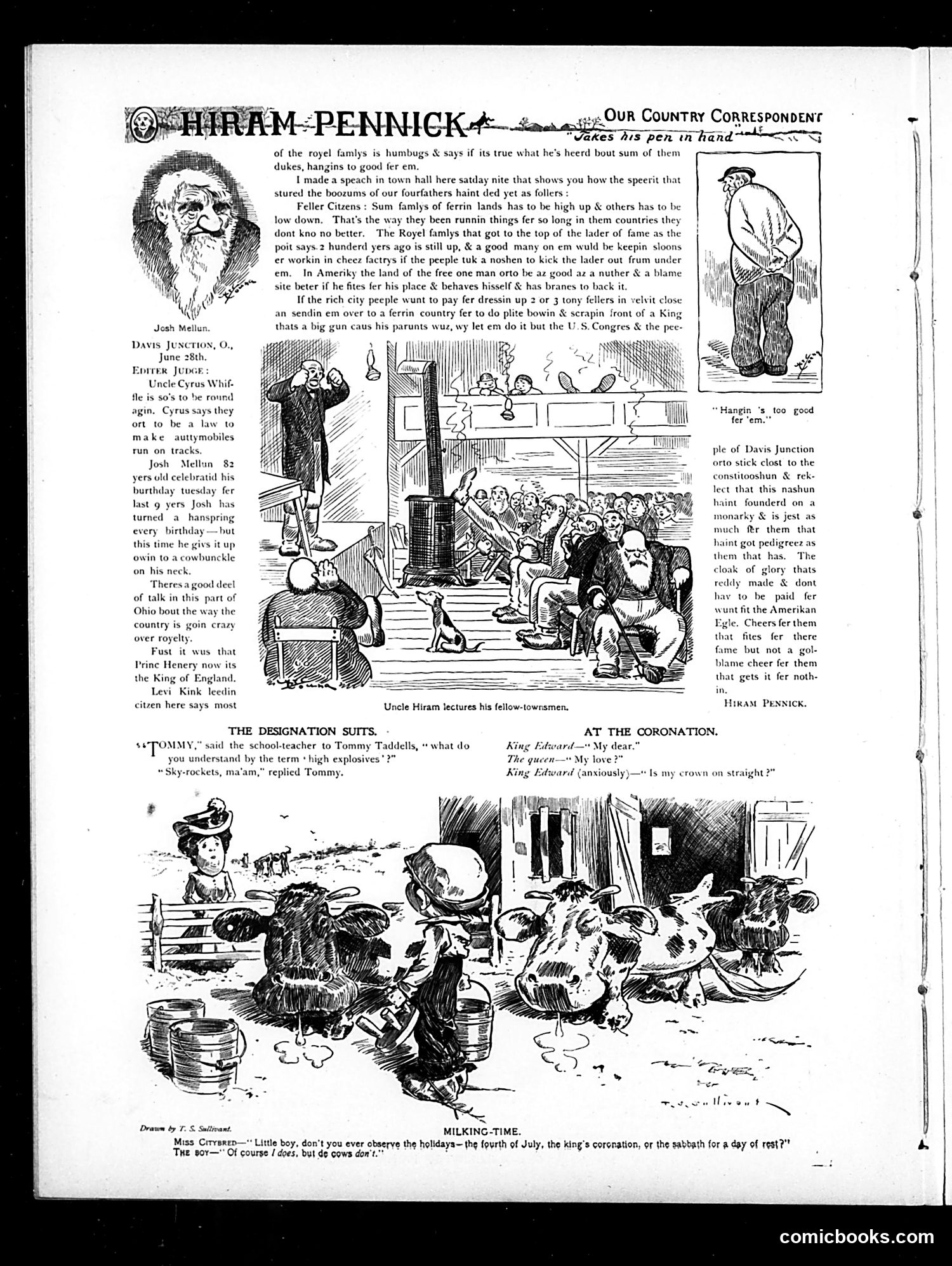
This page from the satirical magazine *Judge* contains three distinct pieces of humor: **"Uncle Hiram" column (top)**: A rustic correspondent critiques European monarchy and defends American egalitarianism. "Hiram" sarcastically argues that foreign aristocrats maintain power through tradition alone, while in democratic America, anyone of merit should succeed. The joke satirizes both excessive reverence for British royalty among some Americans AND crude anti-aristocratic sentiment. **"The Designation Suits" (middle)**: A schoolteacher asks a boy what "high explosives" means; he answers "sky-rockets." Simple wordplay humor. **"At the Coronation" (lower right)**: King Edward asks if his crown sits straight—likely referencing Edward VII's recent coronation (early 1900s), mocking royal vanity. **"Milking-Time" (bottom)**: A boy tells Miss Cutters the family observes holidays—except cows don't, so milking happens anyway. This satirizes rural indifference to national observances. The page's recurring theme: American practicality and democratic values versus Old World formality.
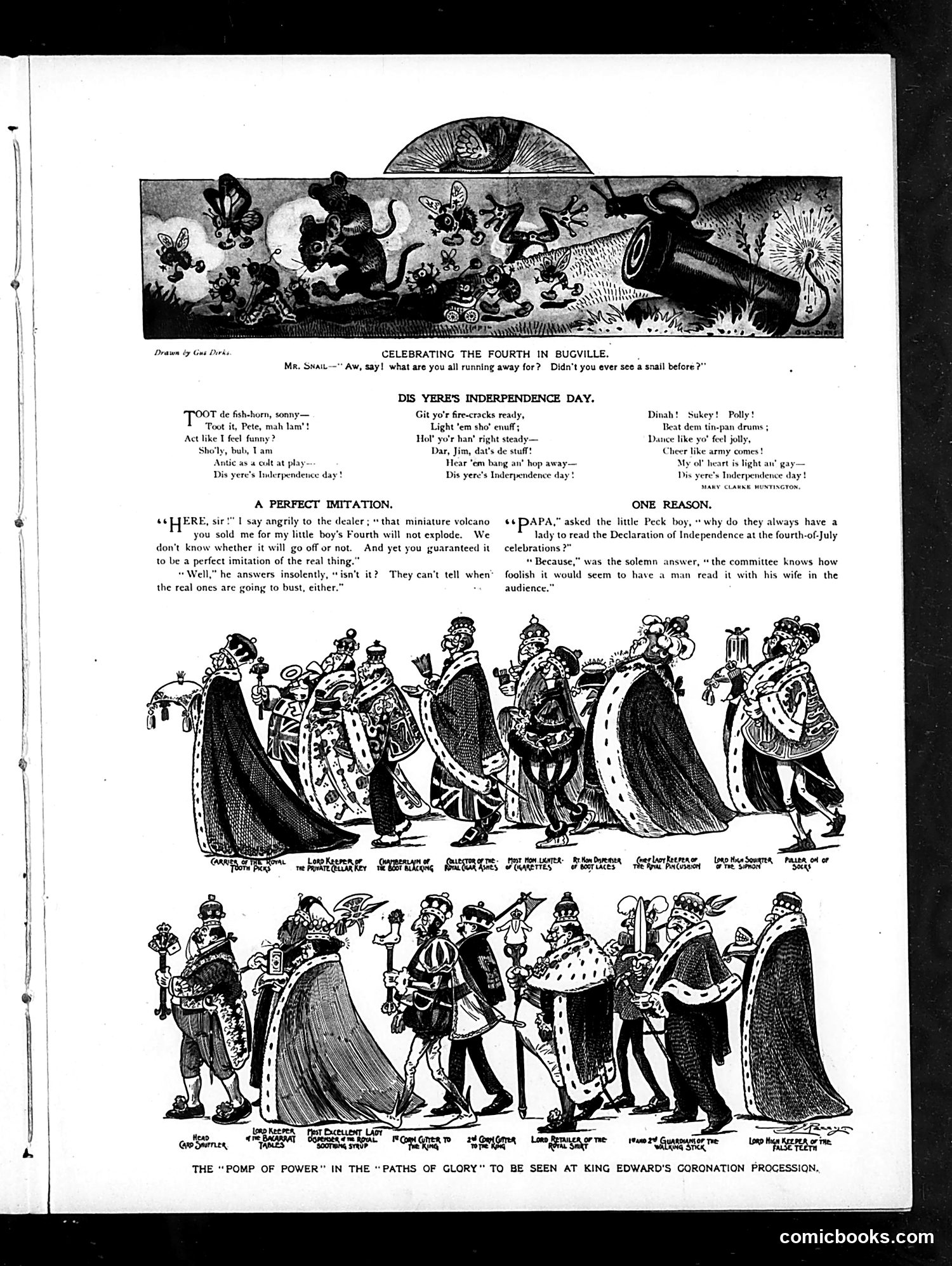
This page contains three separate satirical pieces: **Top cartoon:** "Celebrating the Fourth in Bugville" depicts anthropomorphic animals (bugs/insects) celebrating Independence Day. Mr. Snail addresses fleeing creatures, asking if they've never seen a snail before—the joke being that snails are notoriously slow, so the panicked animals' flight is absurdly exaggerated. **Middle poems and text:** Humorous pieces about Fourth of July celebrations, including a joke about a defective toy volcano that "won't explode"—satirizing both cheap merchandise and the unpredictability of actual fireworks. Another joke mocks the tradition of having women read the Declaration of Independence at celebrations, suggesting it's done to avoid marital embarrassment if a man performed poorly. **Bottom section:** "The Pomp of Power" depicts elaborately robed royal and noble figures, likely satirizing King Edward's coronation procession with caricatured British nobility in their ceremonial regalia. The page uses humor to lampoon consumer goods, gender roles, patriotic traditions, and aristocratic pageantry.
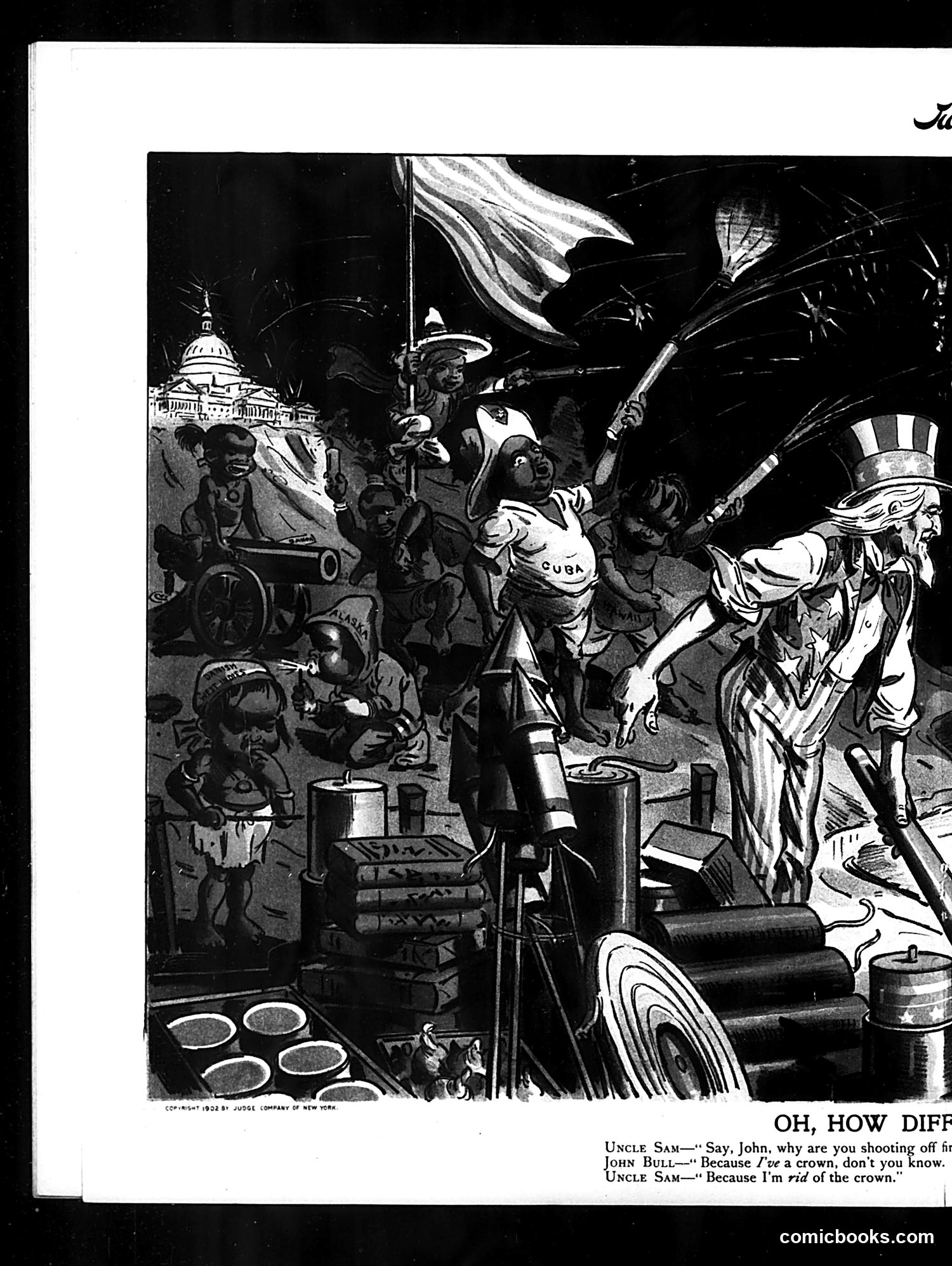
This Judge magazine cartoon depicts Uncle Sam (personifying the United States) confronting "John Bull" (Britain's traditional symbol). The dialogue satirizes American independence sentiment: John Bull shoots cannons because he has a crown (representing monarchy), while Uncle Sam responds he's "rid of the crown"—meaning America rejected monarchical rule. The cartoon appears to reference American anti-British sentiment, likely from the early 20th century when tensions existed over American sovereignty and democratic ideals versus British imperial authority. The Capitol building visible in the background reinforces American government symbolism. The satire celebrates American republicanism as liberation from European monarchical systems.
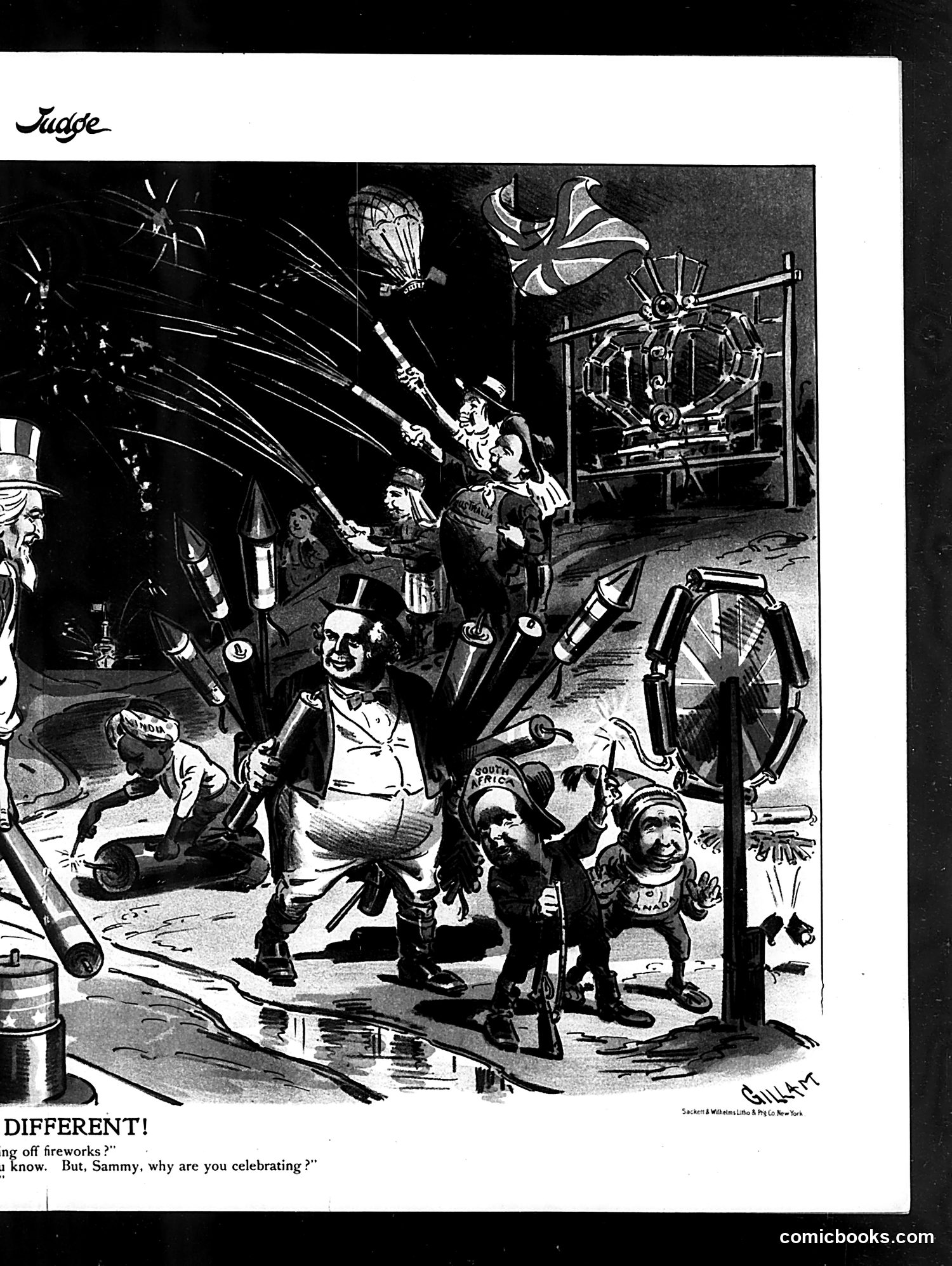
This appears to be a satirical cartoon from *Judge* magazine depicting a Fourth of July celebration scene. The central figure is a portly man in formal dress (likely representing a wealthy industrialist or politician) celebrating with fireworks and festive decorations, while working-class figures—including children labeled or appearing to be immigrants—surround him asking why he's celebrating. The satire critiques class inequality: the wealthy celebrate independence and prosperity while the poor struggle. The dialogue ("why are you celebrating?") suggests ironic questioning of whether the lower classes have reason to join the celebration, implying they don't share in the nation's supposed freedoms and benefits. The exaggerated caricatures and crowded composition emphasize the contrast between classes during a patriotic holiday.
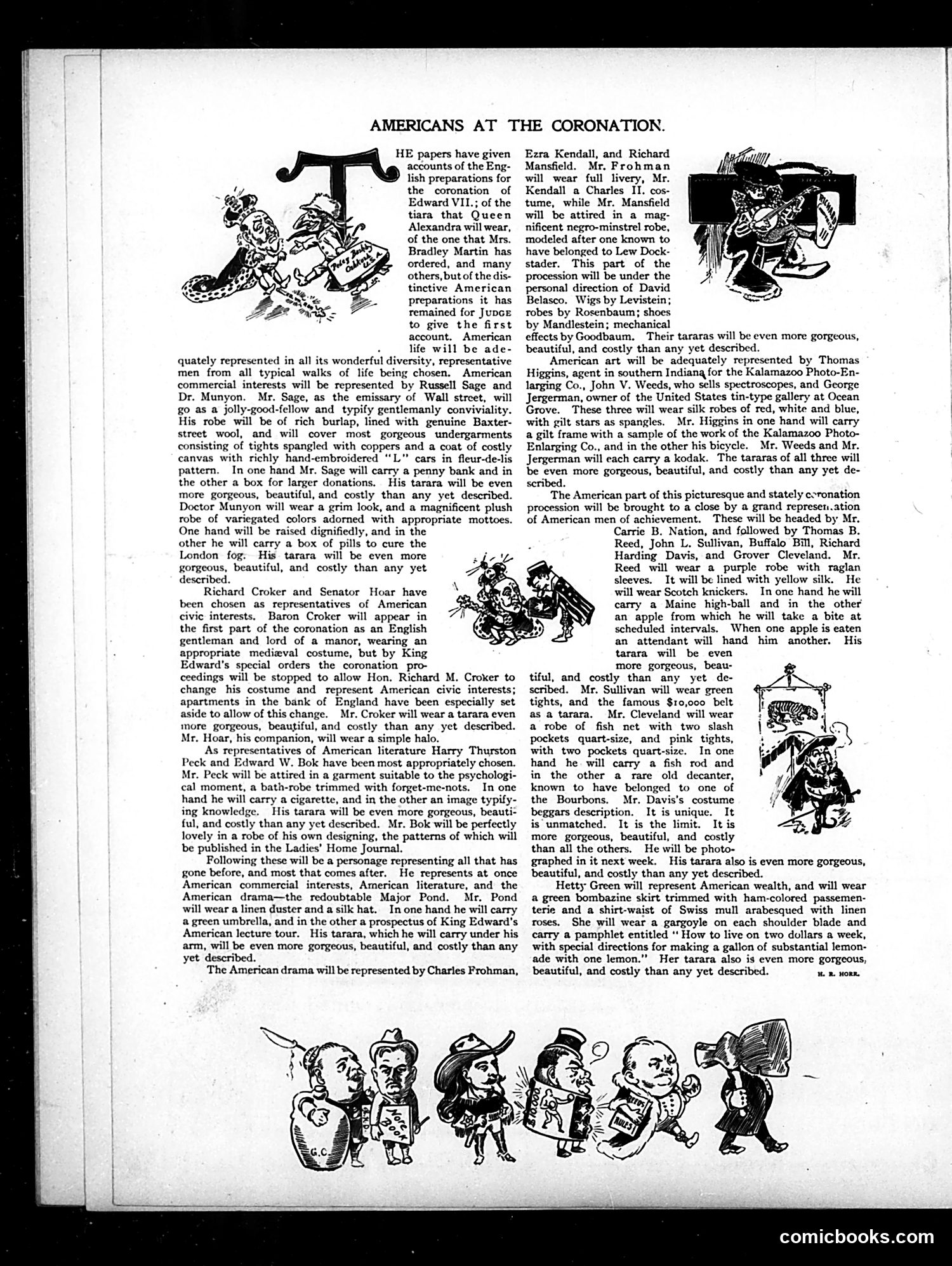
This Judge magazine satire mocks American representatives attending King Edward VII's 1902 coronation by imagining absurdly inappropriate costumes that reveal their true natures. The joke targets prominent American figures: **Russell Sage** (Wall Street financier) wears burlap with copper-spangled tights, carrying a penny bank—mocking his wealth obsession. **Dr. Munyon** (patent medicine promoter) carries a box of pills. **Richard Croker** (Tammany Hall political boss) wears medieval costume, exposing his corrupt "lord" pretensions. **Senator Hoar** receives only a "simple halo"—possibly ironic commentary on his reputation. Literary figures **Harry Thurston Peck** and **Edward Bok** appear in ridiculous garb. Theater impresario **Major Pond** carries an umbrella and lecture-tour prospectus. The repeated joke—each character will wear an even "more gorgeous, beautiful, and costly" tiara than the last—satirizes American materialism and pretension at a formal European state occasion. The satire suggests these Americans cannot help but expose their mercenary, gauche nature even when trying to represent their nation respectfully.
This page is primarily **advertisements and commercial content** rather than political satire. The main pieces are: 1. **ED. PINAUD'S products** (hair/grooming items) - occupying significant space with period marketing language 2. **EVANS' ALE** - beverage advertisement 3. **DR. SIEGERT'S ANGOSTURA BITTERS** - medicinal liqueur ad 4. **SOHMER PIANOS** - musical instrument promotion 5. **Chartreuse liqueur** - after-dinner drink advertisement 6. **Great Lakes of America steamship** and **Buffalo-Chicago service** ads The page also contains what appears to be a short story or narrative piece titled "When Patrick Chased the Greasy Pig" at the top, but this appears humorous rather than overtly political. **Verdict**: This is a typical Judge magazine page mixing entertainment content with period advertising. No significant political cartoons or satire are visible.
This page primarily contains **advertisements and commercial notices** rather than political satire. The main content includes: **Top Left:** An article celebrating the June 15, 1902 inauguration of the "Twentieth Century Limited" railroad between New York and Chicago—a 20-hour express service, presented as a modern achievement. **Cartoons:** Two small humorous vignettes with ethnic dialect humor typical of the era—one featuring working-class characters discussing weddings, another about African American characters and cigars. These reflect period attitudes rather than political commentary. **Advertisements:** The bulk of the page advertises various products: Wilson Whiskey (established 1823), Blood Poison remedy, Cathartic laxatives, Remington typewriters, and a new folding Kodak camera ($6). **"The Deadly Five-Center"** cartoon mocks cheap cigars versus expensive ones. The page demonstrates how Judge mixed light humor with commercial advertising—typical of early 20th-century magazines. There is no apparent unified political message or sustained satire across the page.
This cartoon satirizes British parliamentary protocol and the role of ceremonial functionaries. A citizen is being ejected from Parliament's entrance by a yeoman of the guard. The citizen protests that he must be allowed in because he is "the man wot cries 'Ear, 'ear" at the right moments during speeches—the person responsible for prompting applause and approval from the gallery. The satire mocks how essential this seemingly minor role is to parliamentary decorum. Without someone to cue the "hear, hear" responses at appropriate points, the proceedings would lack their orchestrated dignity. The joke suggests that British parliamentary tradition relies heavily on such artificial theatrical conventions, and that this humble functionary is paradoxically indispensable to the functioning of government, despite his low status.
This page contains **advertisements and a humorous medieval-themed story**, not political cartoons. ## Main Content: **"Stockholder Cigar" ad**: A straightforward pitch offering stock certificates worth 40% of purchase price with cigars—an early example of customer loyalty marketing disguised as investment opportunity. **"Ye Kyng's Champyonne"**: A mock-medieval narrative (written in exaggerated Old English) about Sir Knyghte Otto Mobyle, an automobile driver competing as the king's champion. The satire lies in the anachronism: a man in a car (with goggles, strange cloth garments, a motorized "steede") thrust into a medieval jousting tournament. It's a playful jab at the nascent automobile age, treating motorcars as absurd intrusions into traditional society. The humor appeals to Judge's early-1900s readers simultaneously fascinated and skeptical of new technology. **"Stanlaws' Smartest Girl"**: Advertisement for art prints. No identified political figures or specific historical events appear on this page.
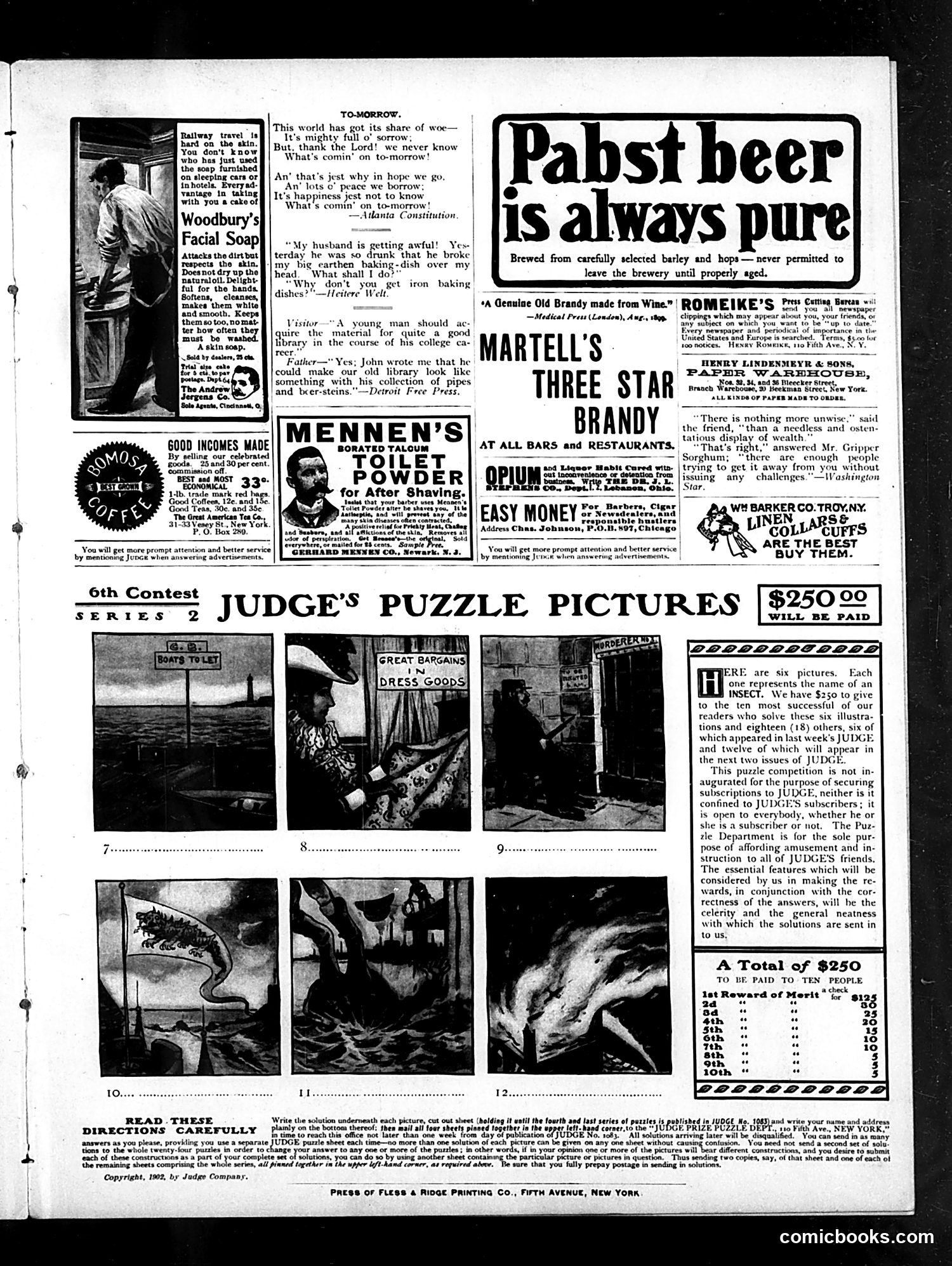
This page is primarily **advertising and puzzle content** rather than political satire. The main feature is the "Judge's Puzzle Pictures" contest (6th Contest, Series 2), offering $250 total prize money to readers who identify insects depicted in six illustrated images. The page includes various product advertisements typical of early 1900s magazines: Woodbury's Facial Soap, Pabst beer, Martell's brandy, Mennen's talcum powder, and coffee sales opportunities. These ads use period marketing language emphasizing product purity and quality. Interspersed are brief humor columns with jokes about marriage ("Why don't you get iron baking dishes?"), wealth display ("needless and ostentatious display of wealth"), and domestic life. A poem titled "To-Morrow" reflects on life's uncertainties. The puzzle contest itself—not a cartoon—dominates the lower half, with instructions for solving six illustrated insect rebuses. This represents Judge's educational entertainment format, offering monetary incentives for reader engagement across multiple issues.
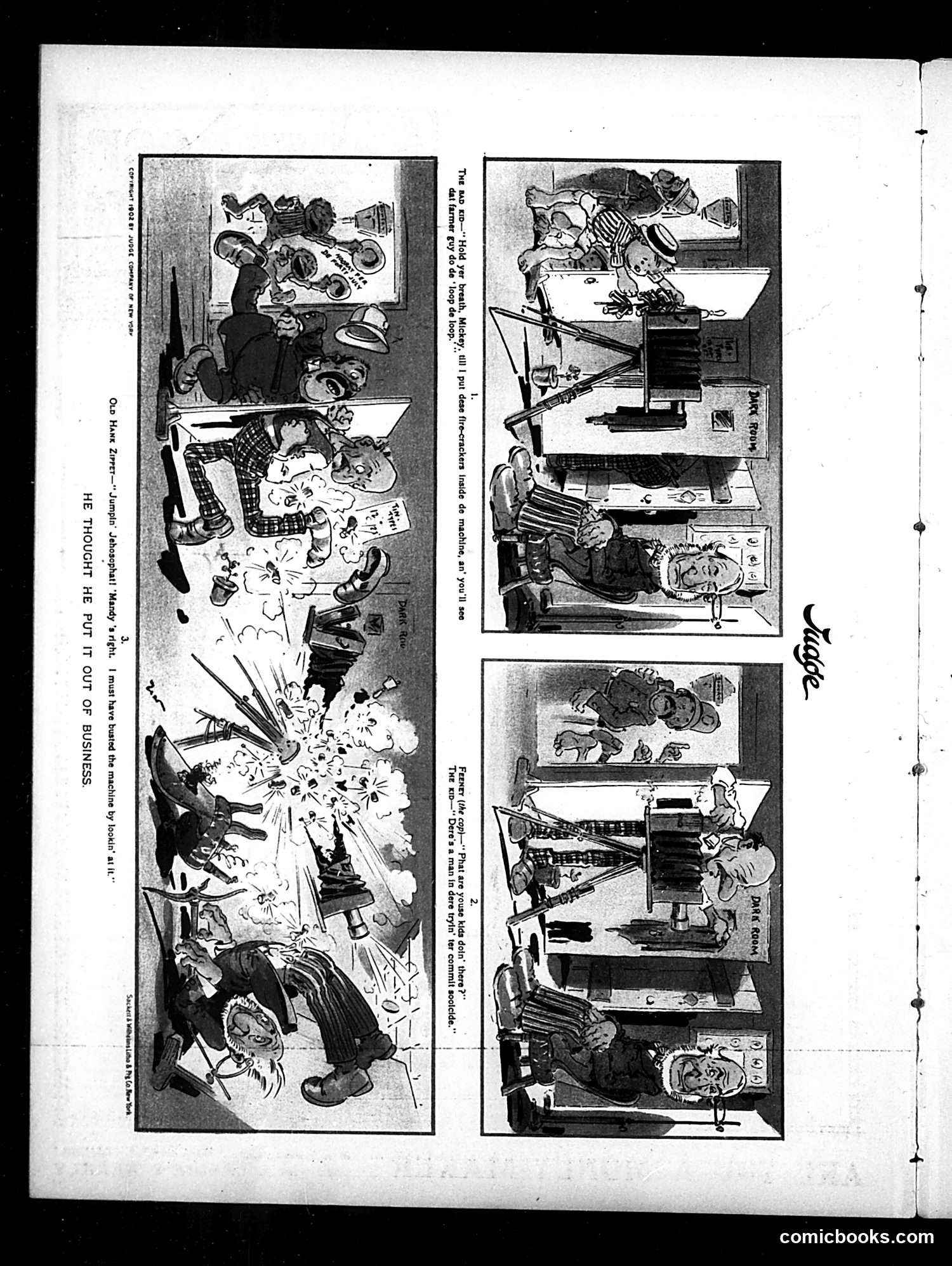
This page contains a multi-panel satirical comic strip depicting slapstick chaos. The narrative appears to involve a mechanical device (possibly an airplane or flying contraption) that malfunctions spectacularly. **Key elements:** - A policeman (Mick Feeney) discovers children near the contraption - A farmer attempts to operate the machine, performing a "loop de loo" (loop-the-loop) - The final panel reveals the operator believes he has broken the machine merely by looking at it—a joke about mechanical incompetence or the device's fragility **The satire:** The humor targets mechanical/technological mishaps and the absurdity of someone causing destruction through sheer bumbling. The title "HE THOUGHT HE PUT IT OUT OF BUSINESS" suggests ironic commentary on carelessness or industrial incompetence. The dialect-heavy dialogue ("youse," "dere's") and working-class characters reflect early 20th-century Judge magazine's comedic conventions, appealing to readers through exaggerated ethnic/class humor.
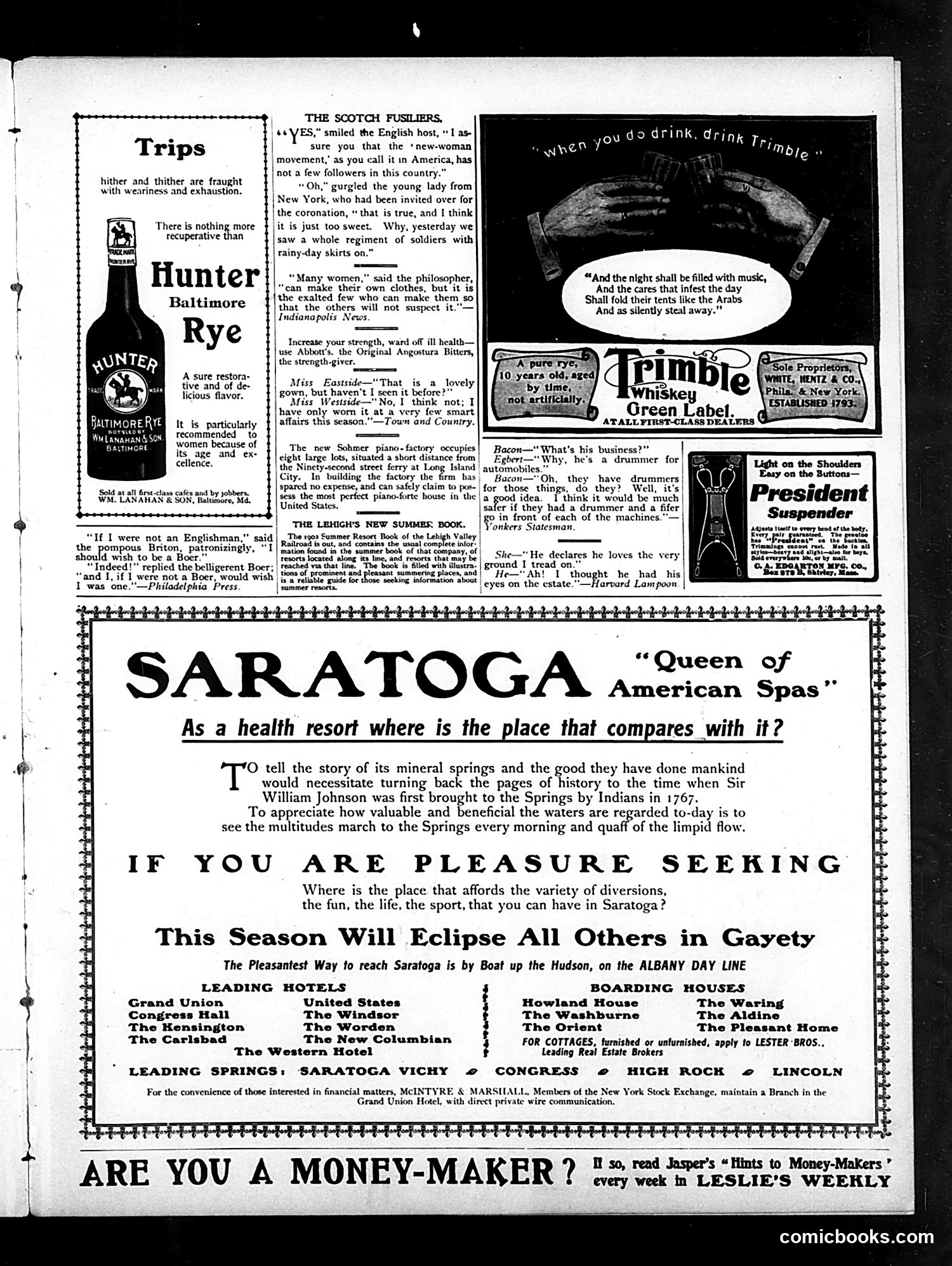
This brief satirical piece mocks the "New Woman" movement—the early feminist push for women's independence and equality gaining traction in America and Britain around the turn of the 20th century. **The Joke:** An American woman visiting England for the coronation mistakes Scottish soldiers wearing traditional kilts for evidence that British women have adopted men's clothing as part of the women's liberation movement. She calls the kilts "rainy-day skirts," misidentifying military dress as feminist fashion. **The Satire:** The humor derives from the woman's naive American perspective and her eager enthusiasm for seeing "new womanhood" everywhere. The cartoon gently mocks both the American woman's gullibility and the somewhat ridiculous rhetoric surrounding women's fashion reform, by having her confuse an entirely different (and male) tradition with progressive gender politics. The surrounding advertisements and other brief comic snippets on this Judge magazine page are standard period fare—whiskey ads, piano promotions, and Saratoga Springs resort marketing.
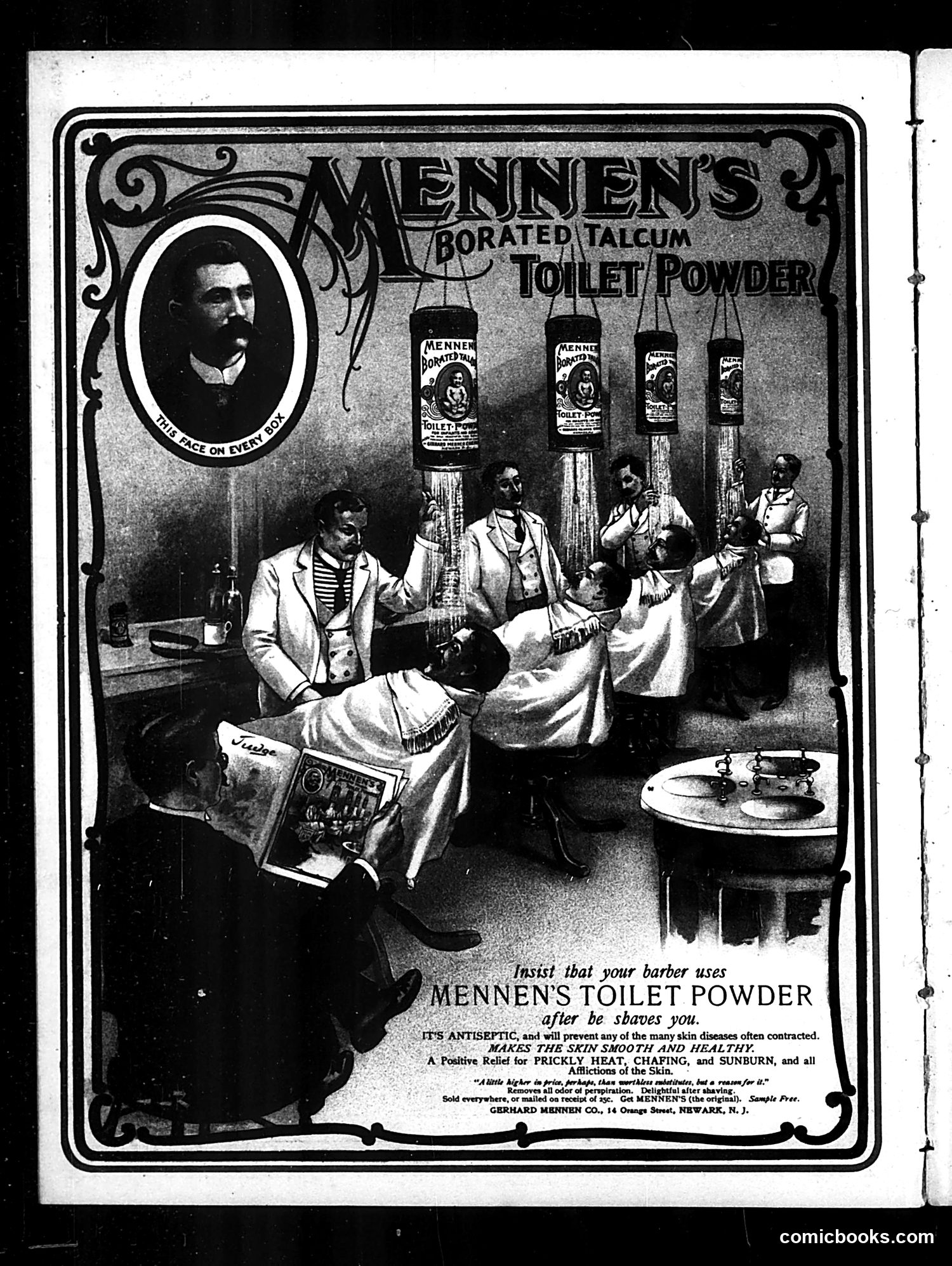
This page is primarily a **product advertisement** rather than political satire. It promotes Mennen's Borated Talcum Toilet Powder, marketed for use after shaving. The advertisement features a barbershop scene with multiple figures attending to a customer. The large portrait in the upper left appears to be **Gerhard Mennen**, the product's founder (referenced in the company name at bottom). The accompanying text emphasizes the product's antiseptic properties and claims it prevents skin diseases, soothes irritation from shaving, and treats conditions like prickly heat and sunburn. The advertisement's tagline—"A little higher in price, perhaps, than worthless substitutes, but a reason for it"—attempts to justify premium pricing through quality assurance, a common advertising strategy of the era.