
A complete issue · 16 pages · 1902
Judge — February 15, 1902
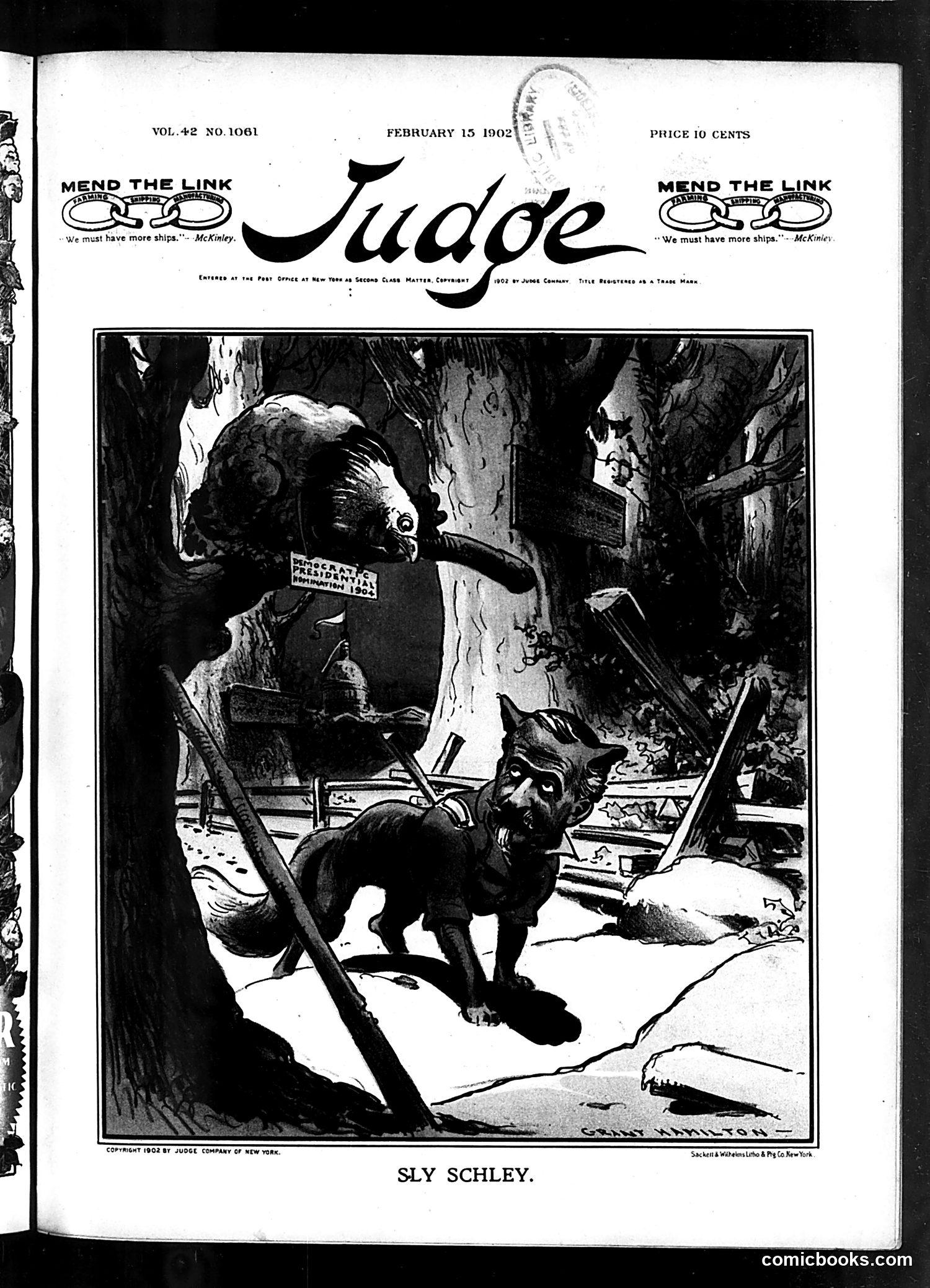
This cartoon satirizes Admiral William Scott Schley, a prominent U.S. Navy officer. The image shows a devil-like figure in a cave or mine setting, appearing to scheme or manipulate. The title "Sly Schley" suggests dishonest or cunning behavior. This likely references controversies surrounding Schley's role in the Spanish-American War (1898), particularly disputes over credit for naval victories. Schley was involved in contentious debates about his conduct and the accuracy of his reports, which generated significant public controversy and satirical commentary. The demonic characterization emphasizes Judge magazine's critical view of Schley's reputation for what the cartoonist perceived as deceptive or self-serving conduct.
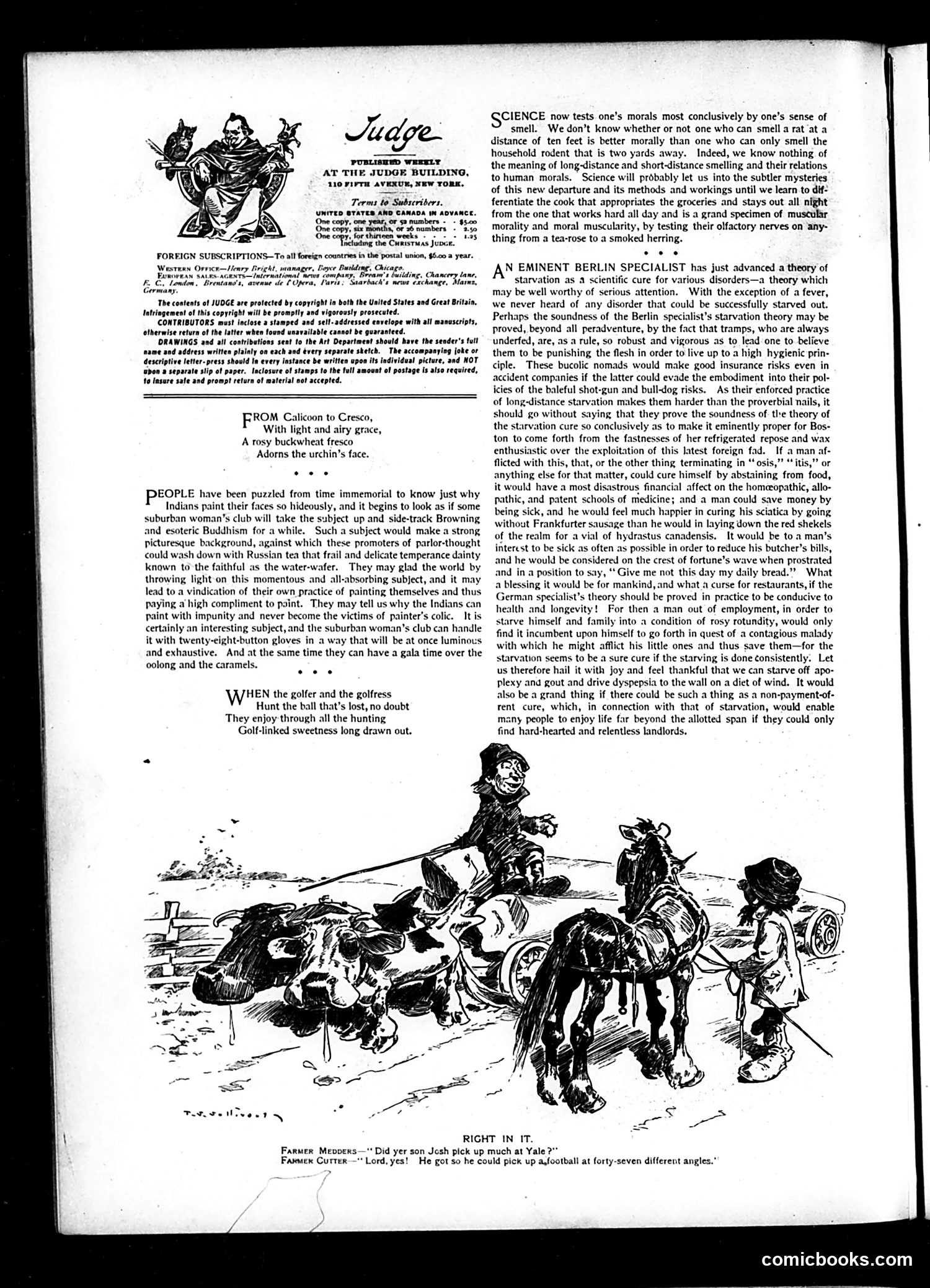
This page contains two distinct sections: **Top**: Editorial text discussing science's role in testing morality through smell and a Berlin specialist's "starvation cure" theory for various diseases. The satire mocks pseudoscientific medical fads—particularly the notion that deliberately starving patients could cure ailments. The author sarcastically suggests this would ruin finances, harm medicine's reputation, and create "hard-hearted and relentless landlords." **Bottom**: A cartoon titled "RIGHT IN IT" shows a farmer asking another farmer if his son Josh picked much hay, receiving the reply that Josh picked up a football at forty-seven different angles instead. This rural humor jokes about a boy's incompetence or distraction during farm work, likely mocking early football enthusiasm among farm youth as an impediment to agricultural labor.
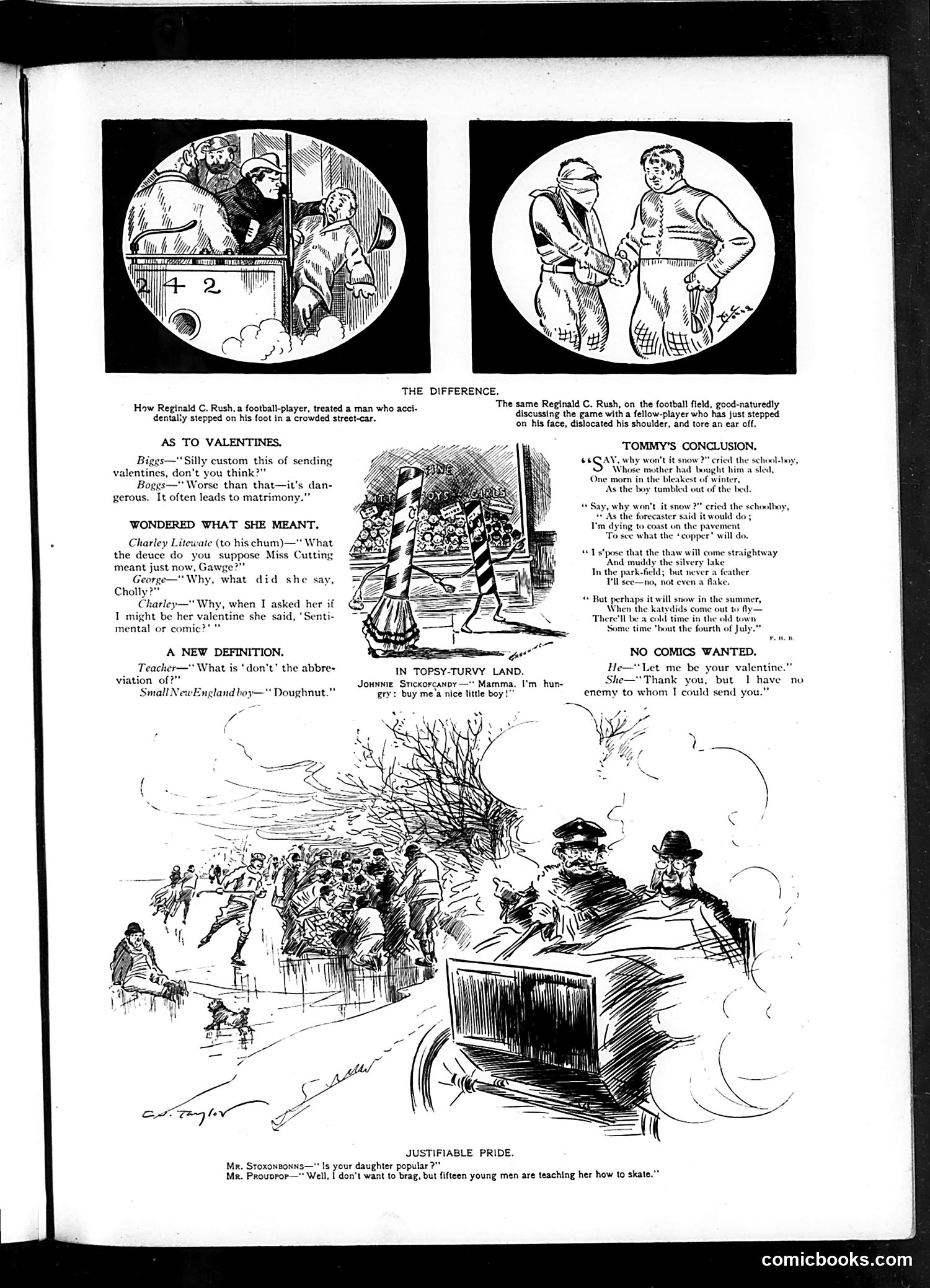
This page contains several humorous sketches satirizing early 20th-century social behaviors: **"The Difference"** contrasts Reginald C. Rush's behavior after accidentally injuring a man in a crowded streetcar versus his conduct discussing football with a fellow player—implying men treat strangers callously but show courtesy to social equals. **"To Valentines," "Wondered What He Meant," and "A New Definition"** are brief comedy snippets about courtship misunderstandings and changing slang usage. **"In the Country"** and **"No Comics Wanted"** present romantic rejection scenarios. **"Justifiable Pride"** (bottom) jokes about parental concern: a father boasts his daughter is popular, while the mother insists she's merely learning to ice-skate from fifteen young men—satirizing either parental delusion or the danger of unsupervised youth socializing. The page emphasizes class distinctions and courtship anxieties of the era.
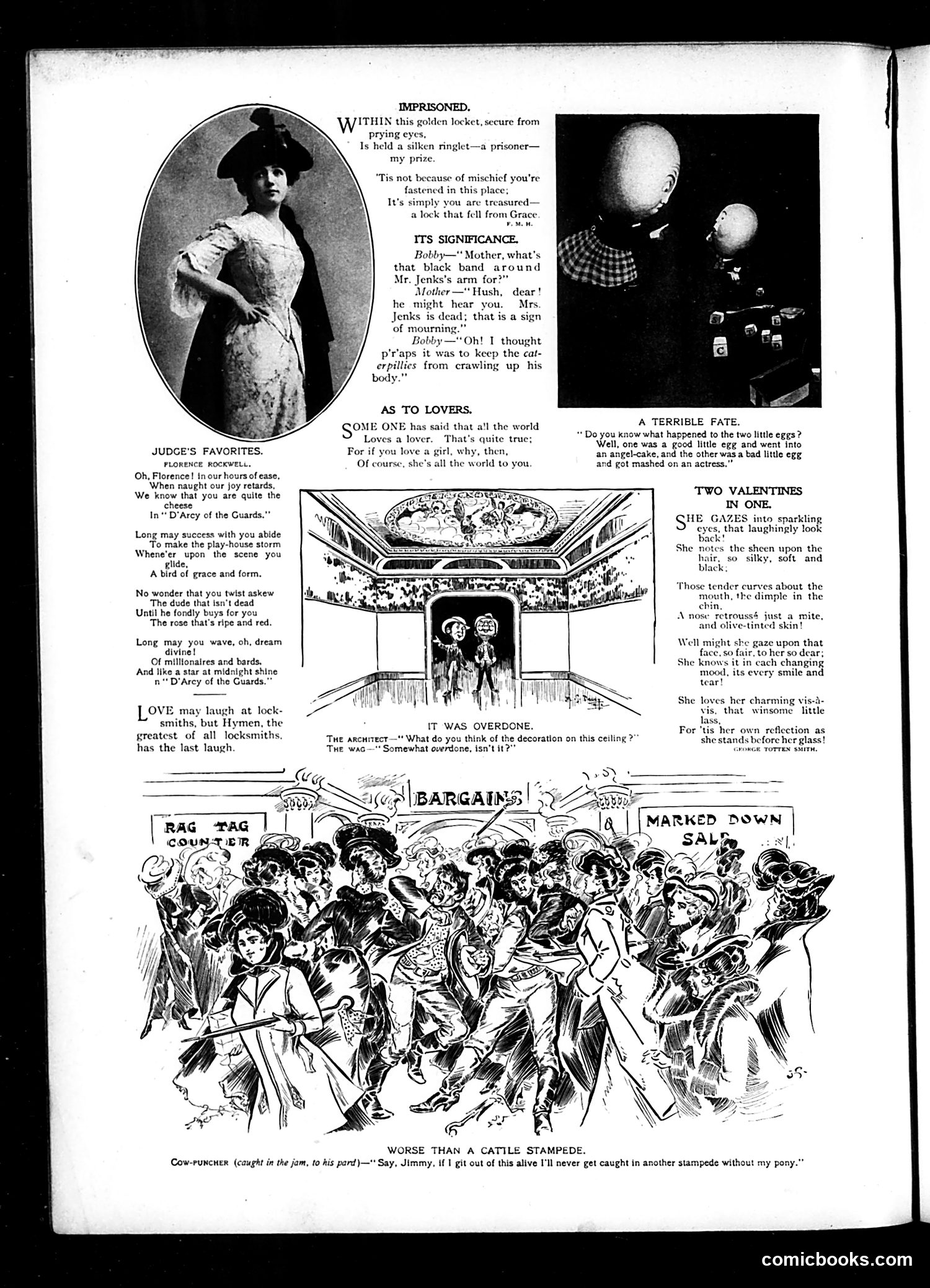
This page contains several unrelated satirical pieces and poetry rather than a unified political cartoon. **"Imprisoned"** appears to reference a prisoner held in a locket—likely social commentary on confinement or constraint, though the specific reference is unclear. **"Judge's Favorites"** and other verse sections are romantic poetry with conventional late-Victorian sentiments about love and courtship. **The theater interior illustration** shows an architect's perspective, with dialogue mocking decorative excess—satire of architectural pretension. **"Worse Than a Cattle Stampede"** (bottom) depicts a chaotic bargain sale with crowds trampling each other. The caption jokes that a stampede is preferable to a shopping frenzy—satirizing the frenzied consumerism and undignified behavior of bargain hunters, particularly women, which Judge magazine frequently mocked as absurd social excess.
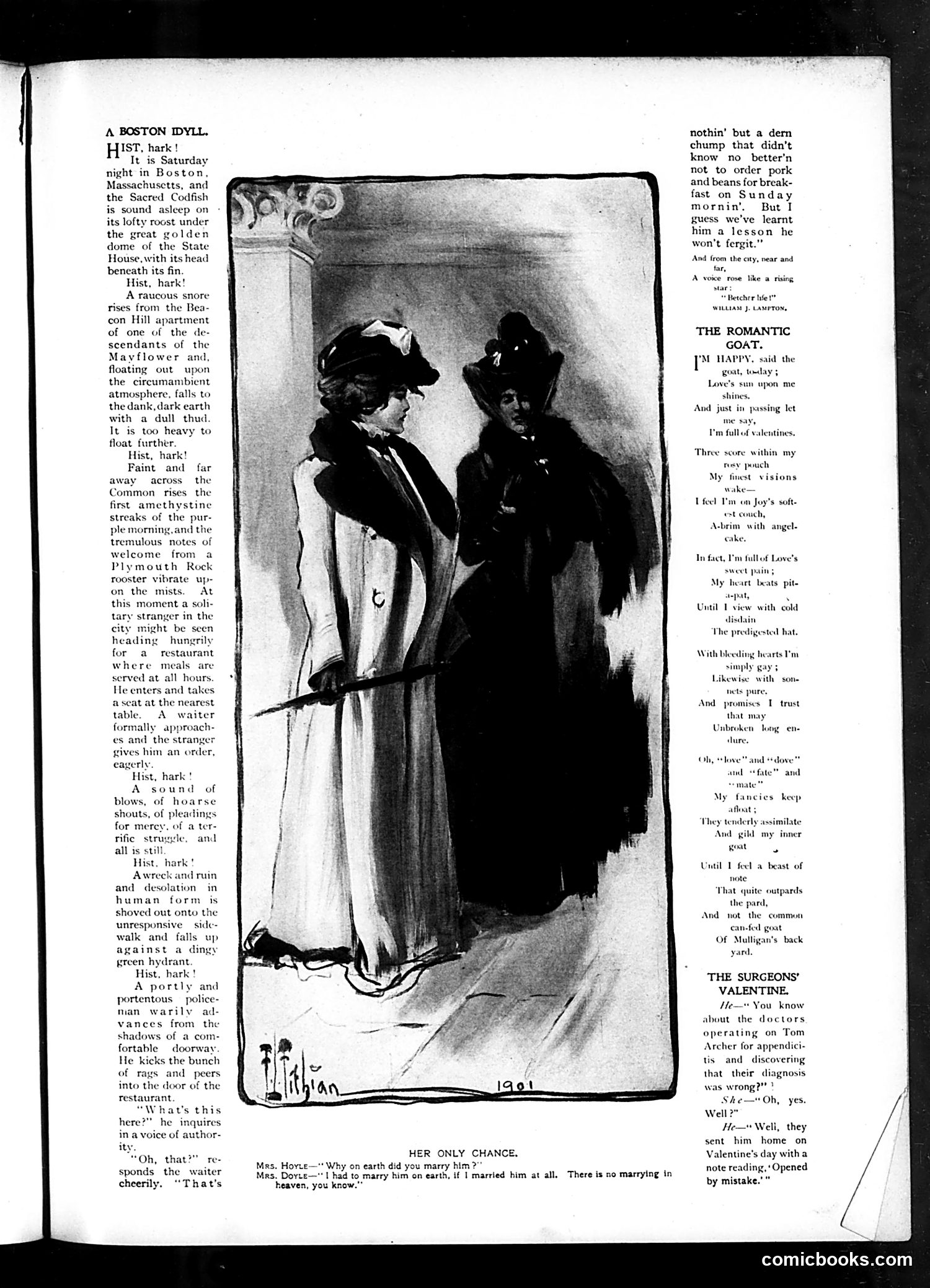
This 1901 Judge magazine page contains three satirical pieces about Boston society and relationships. **"A Boston Idyll"** mocks Brahmin Boston pretension through mock-heroic narration of a working-class man ordering pork and beans (considered a lower-class meal) at a restaurant on Sunday morning. A Beacon Hill resident—representing old-money Boston lineage ("descendants of the Mayflower")—violently ejects him. The joke satirizes both working-class ignorance of social codes and upper-class snobbery about food and propriety. **"Her Only Chance"** is a brief joke about a woman who married her husband on Earth rather than in Heaven because "there is no marrying in Heaven"—a mild theological gag about marriage in the afterlife. **"The Romantic Goat"** is sentimental verse about a lovestruck goat, likely parodying overwrought Romantic poetry popular at the time. **"The Surgeons' Valentine"** jokes about doctors who mistakenly operate on a patient, sending him home on Valentine's Day with a note reading "Opened by mistake"—wordplay on valentines being "opened."
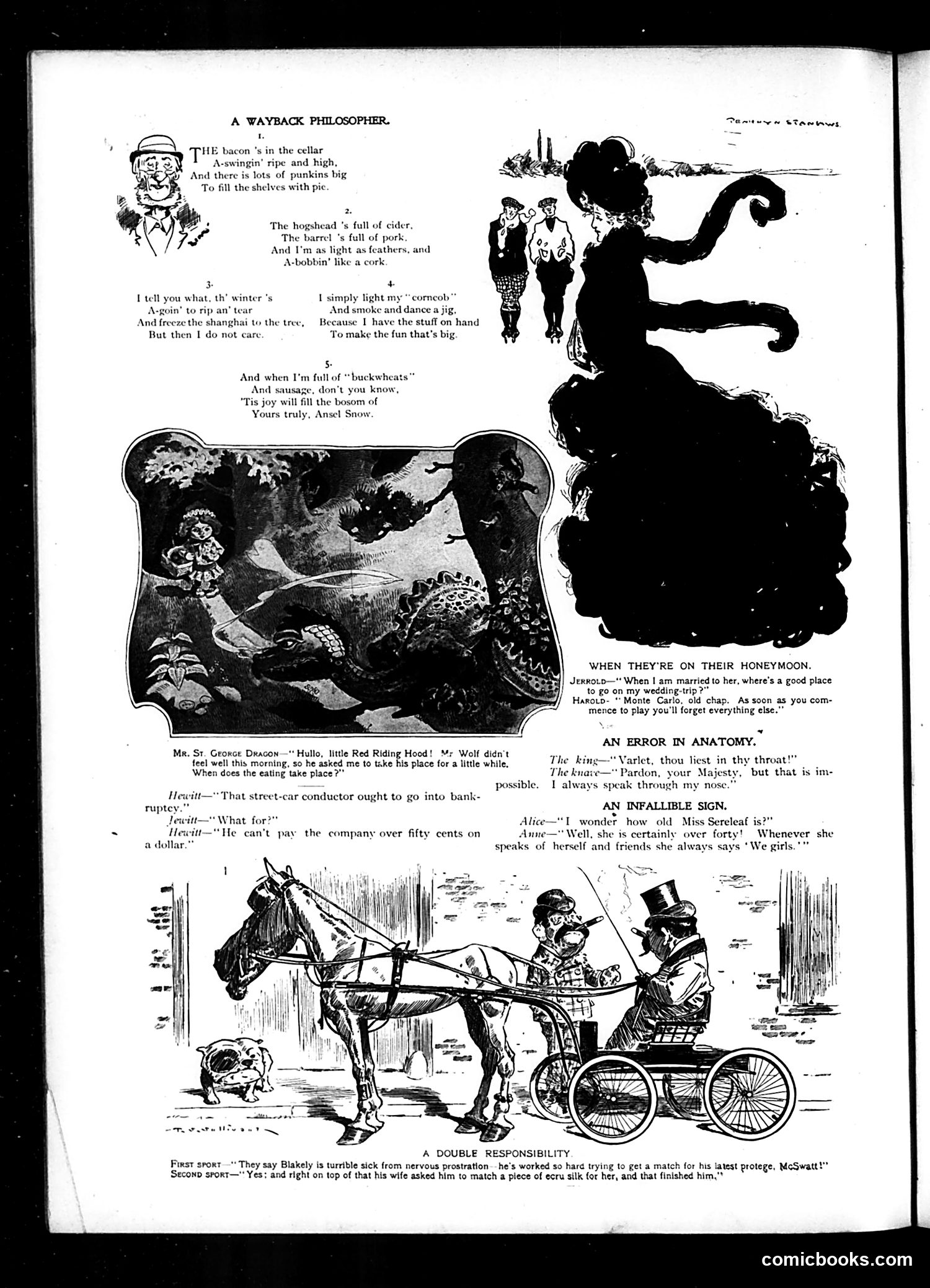
This page collects several brief humorous pieces typical of early 20th-century American satirical magazines: **"A Wayback Philosopher"** presents a rural character contentedly listing autumn provisions (bacon, cider, pork, pumpkins)—celebrating simple country abundance while dismissing winter's hardships. The satire mocks either rustic simplicity or perhaps nostalgic romanticization of rural life. **"When They're on Their Honeymoon"** jokes that a groom should take his bride to Monte Carlo casino, where gambling will make him forget his marriage entirely—dark humor about marital boredom. **"An Error in Anatomy"** and **"An Infallible Sign"** are brief one-liners: the first about someone who speaks through their nose; the second suggesting women over forty habitually say "we girls" (mocking age-denial). **"A Double Responsibility"** depicts a man exhausted both from matchmaking efforts and his wife's mundane errand requests—satirizing domestic burden as equally taxing as serious work. The page emphasizes Judge's typical formula: quick jokes targeting marriage, gender relations, social pretension, and everyday frustrations rather than specific political events.
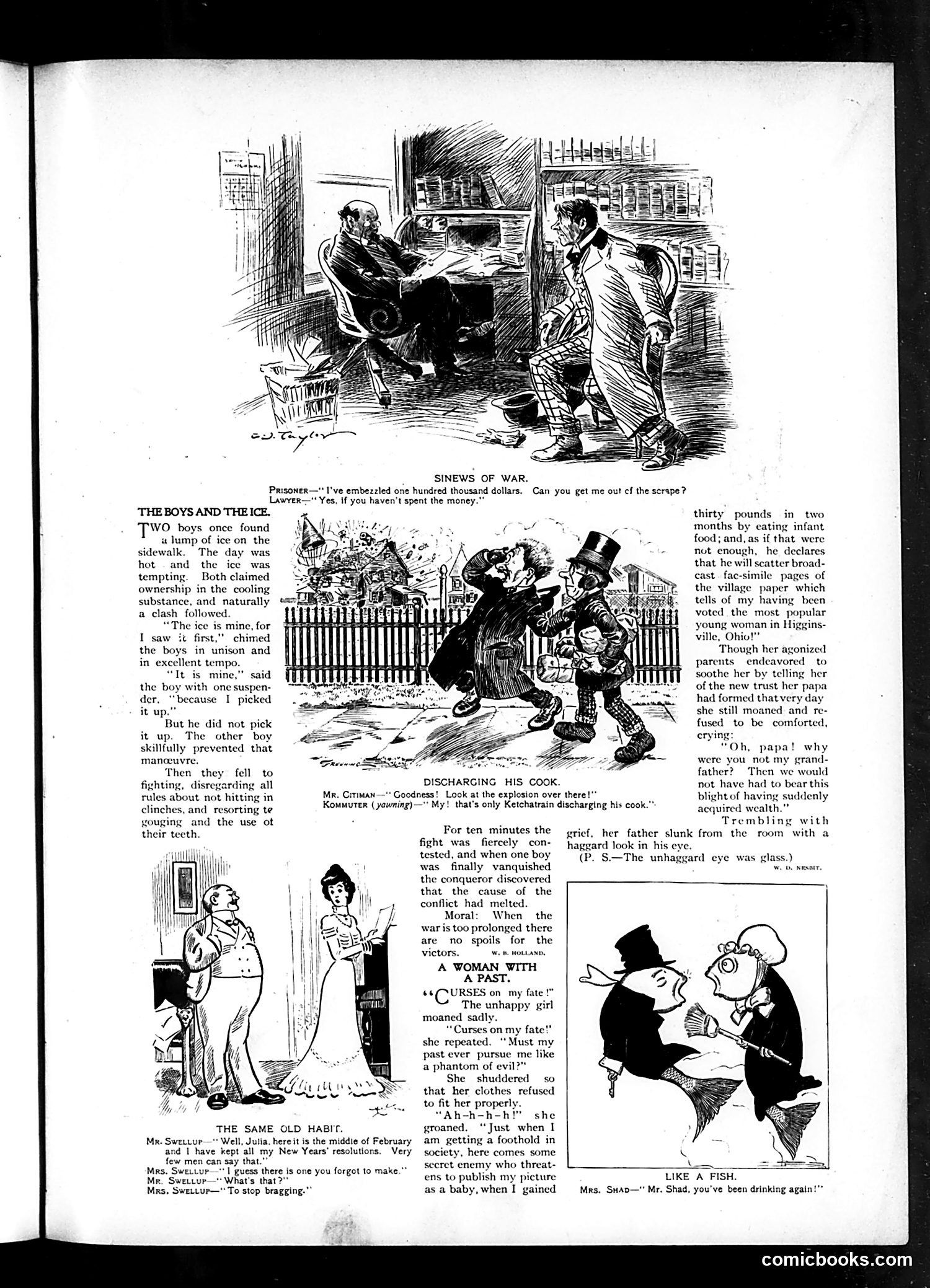
This page contains several satirical pieces targeting turn-of-the-century American social issues: **"Sinews of War"** mocks wealthy criminals, showing an embezzler seeking legal help—the lawyer's joke is that bribery ("if you haven't spent the money") is the solution, satirizing corruption in the justice system. **"The Boys and the Ice"** is a moral fable: two boys fight over melting ice, and by the time one wins, the prize has disappeared. This appears to allegorize pointless conflict (possibly referencing prolonged wars with no real gains). **"A Woman with a Past"** satirizes nouveau riche anxieties. A woman from Higginsville, Ohio, newly wealthy through her father's trust, is mortified that her humble origins—childhood photos, village newspaper records of her youth—might become public knowledge. The satire targets both social climbing and the embarrassment of sudden wealth acquisition. **"The Same Old Habit"** and **"Like a Fish"** are brief domestic humor sketches about marital habits and drinking. The common thread: anxiety about social status and the consequences of one's history in a rapidly changing society.
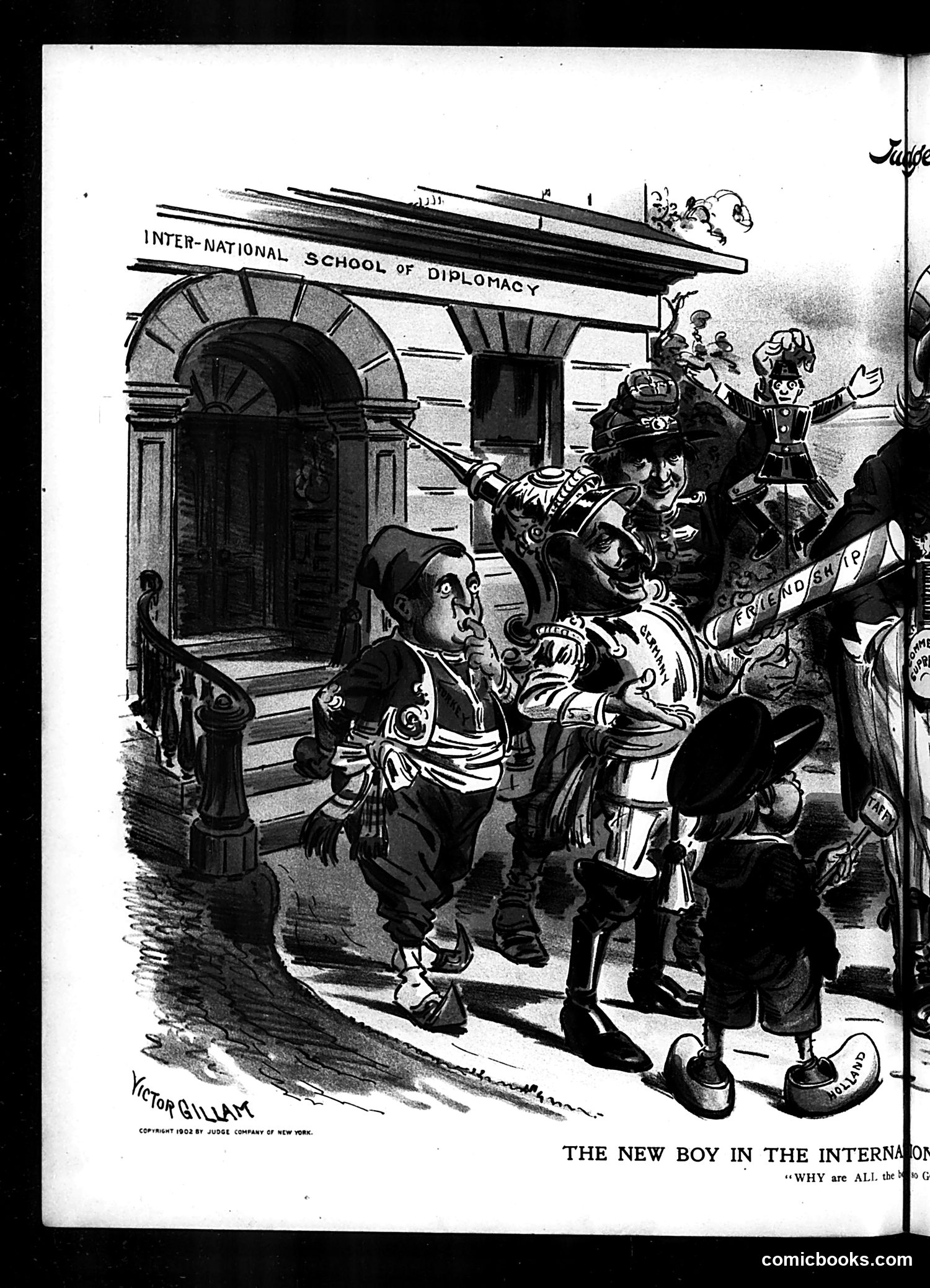
This is a political cartoon by Victor Gillam titled "The New Boy in the International [School of Diplomacy]." The image shows military-uniformed figures (appearing to represent various European powers based on their ornate uniforms and insignia) confronting a smaller, uncertain figure on the left—likely representing a newer nation or emerging power. The caption "Why are all the new..." (text cut off) suggests the cartoon satirizes how established diplomatic powers treat newcomers to international affairs. The "School of Diplomacy" setting indicates commentary on international relations and power dynamics. The intimidating stance of the uniformed figures toward the hesitant new arrival suggests mockery of how inexperienced nations face pressure or hazing from established powers in diplomatic circles. The exact historical context and identities remain unclear without the complete caption and date.
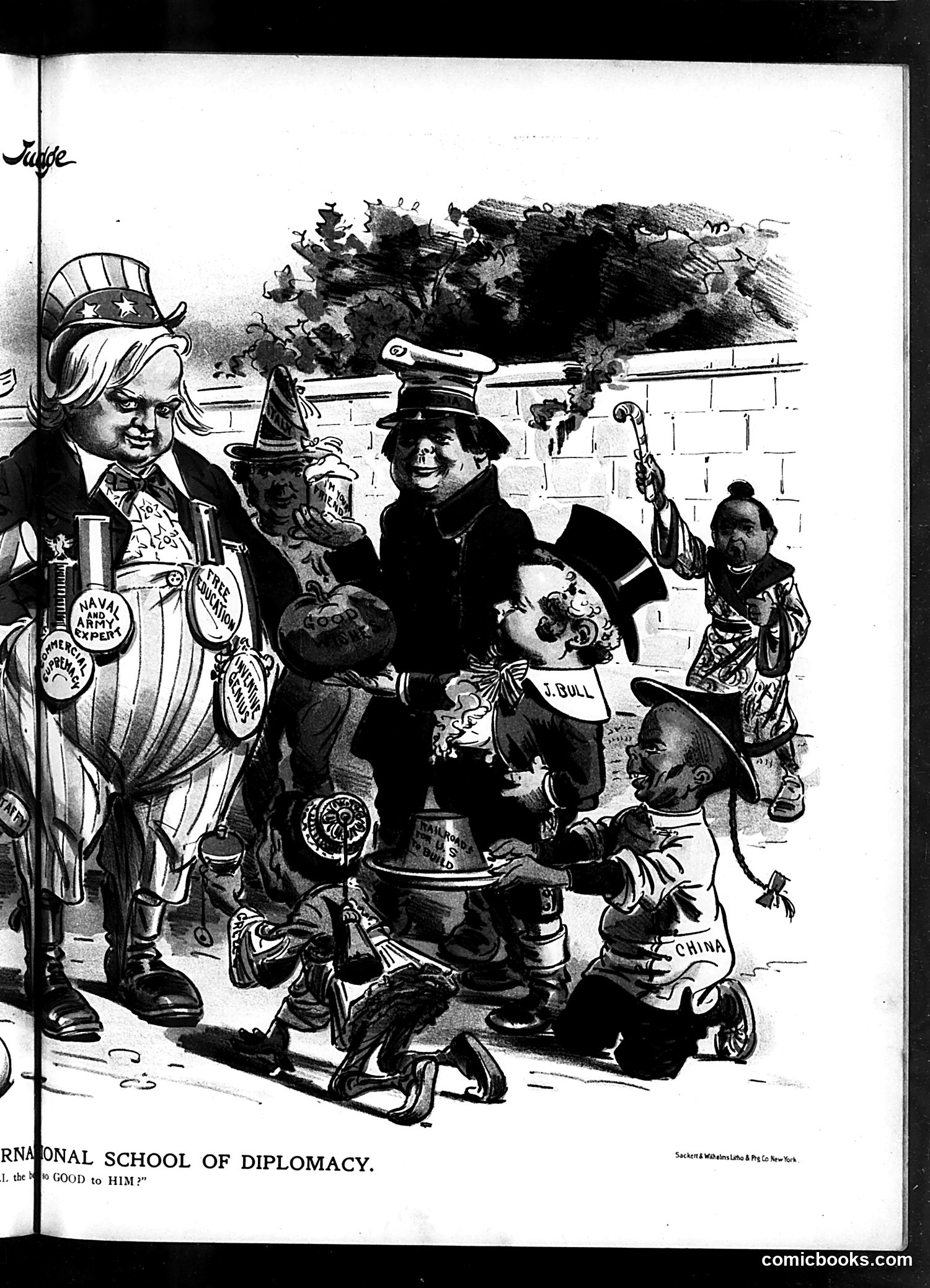
This political cartoon satirizes diplomatic relations, likely from the early 20th century. A large Uncle Sam figure (identifiable by his stars-and-stripes top hat and patriotic attire) presides over a "school" where smaller caricatured figures represent other nations—one appears labeled "China." The figures wear various national costumes and military dress. The cartoon's title asks "Is it good to him?"—suggesting skepticism about whether America's diplomatic efforts or interventions genuinely benefit other nations. The "school of diplomacy" metaphor implies America is instructing or controlling other countries rather than engaging as equals. The caricaturing and hierarchy (Uncle Sam towering over smaller figures) critiques American imperialism or heavy-handed foreign policy during the era of American imperial expansion.
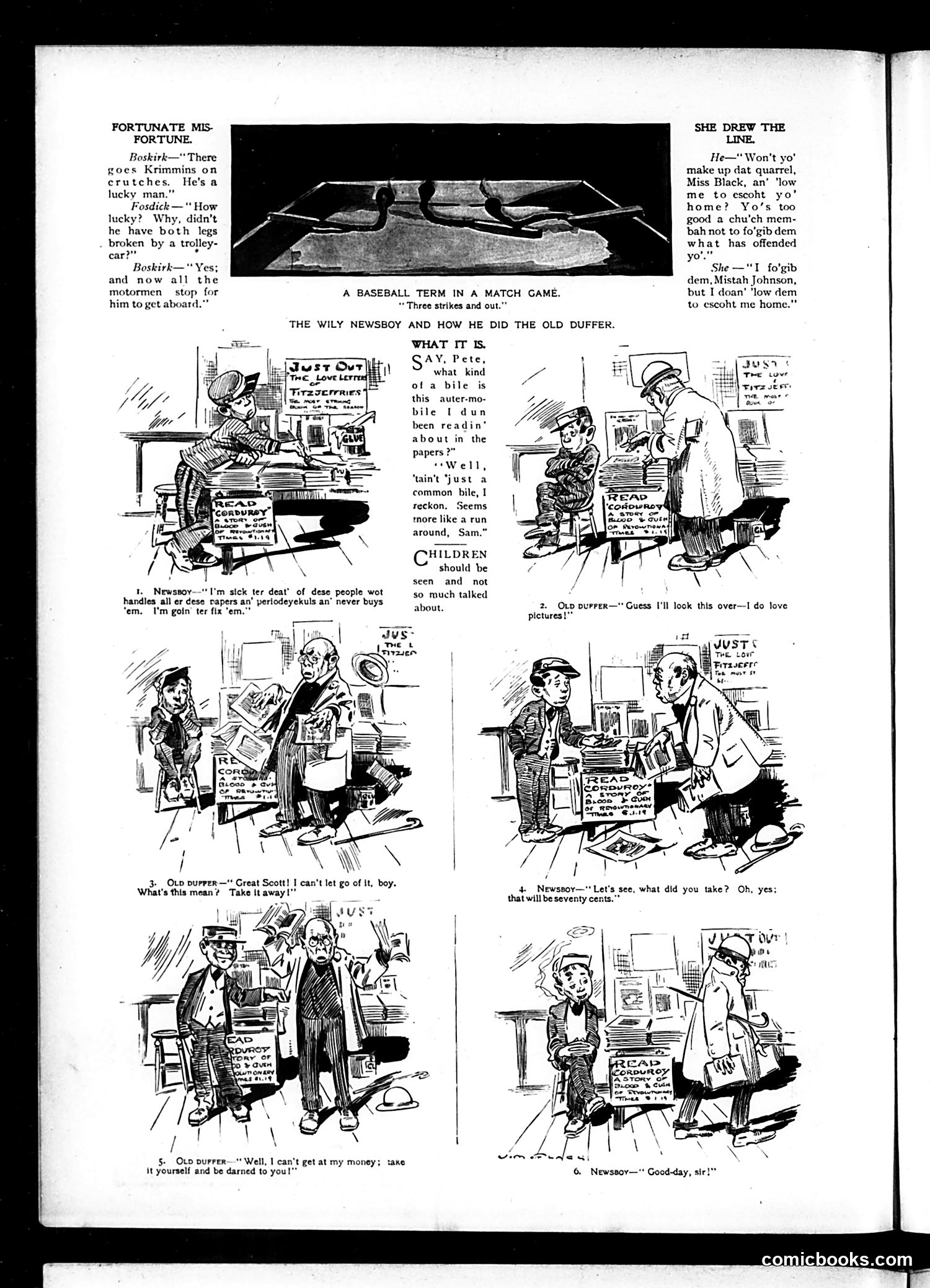
This page contains two separate satirical pieces from Judge magazine: **"Fortunate Misfortune"** (top left): A brief joke about a man named Krimmins who broke both legs in a trolley accident. The humor hinges on ironic fortune—motormen now stop for him to board, whereas they wouldn't before his injury. **"The Wily Newsboy and How He Did the Old Duffer"** (main feature): A six-panel comic strip satirizing the relationship between newspaper vendors and elderly customers. A newsboy complains about people who read papers in shops without buying them. He devises a scheme: he shows the old man (the "duffer") pictures from papers, lets him read extensively, then charges him 70 cents. Unable to reach his money due to physical limitation, the old man surrenders it in frustration. The satire targets both the newsboy's cunning exploitation and the elderly man's vulnerability—depicting working-class urban commerce and generational conflict in early 20th-century America.
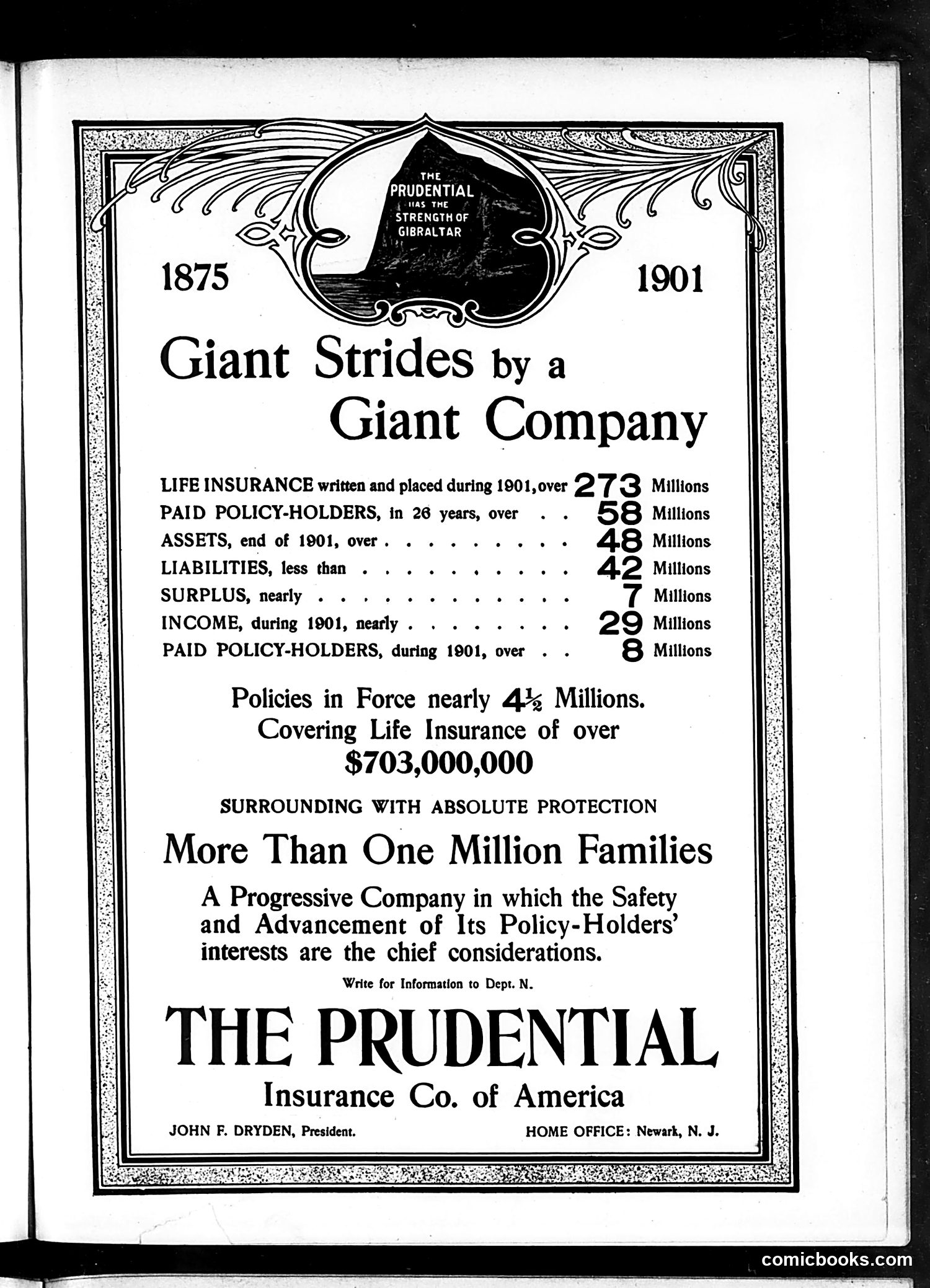
This page is a full-page advertisement for The Prudential Insurance Company of America, not a cartoon or satire. It uses the tagline "The Prudential has the strength of Gibraltar" (referencing the Rock of Gibraltar as a symbol of stability) to promote the company's financial metrics from 1901. The ad emphasizes growth over 26 years, listing assets, liabilities, surplus, and insurance in force to project reliability and trustworthiness to potential customers. The claim of protecting "more than one million families" appeals to middle-class security concerns of the era. This represents typical early-1900s corporate advertising strategy: establishing credibility through impressive numbers and reassuring metaphors about institutional strength.
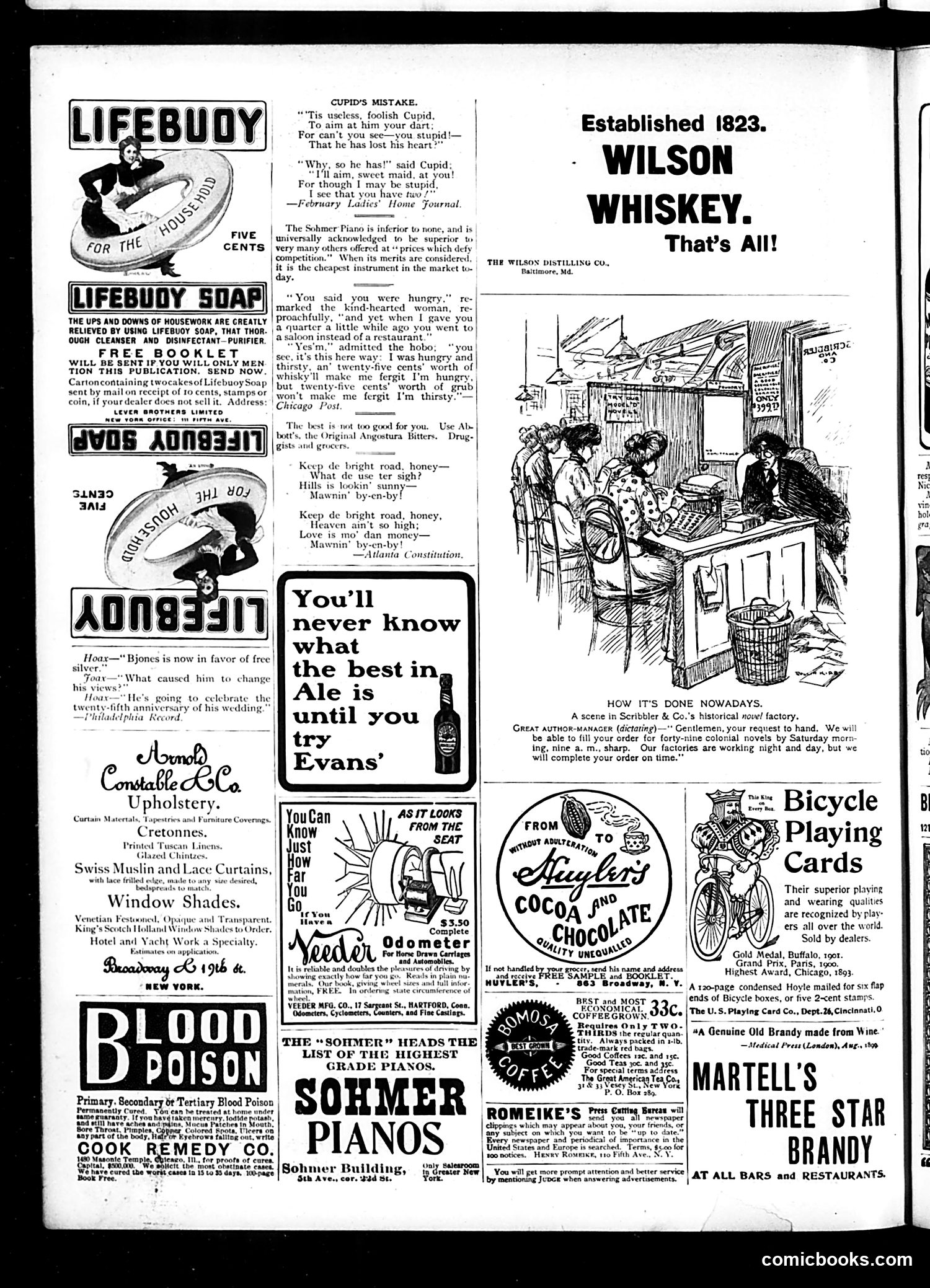
This page is primarily **advertisements** with one satirical cartoon. The main comedic piece is "HOW IT'S DONE NOWADAYS," depicting a "Scribbler & Co.'s historical novel factory" where an Author-Manager dictates assembly-line production of "forty-nine colonial novels by Saturday morning." **The satire targets:** Mass-market publishing's commercialization—the joke is that literature is now factory-produced on deadline like industrial goods, with "factories working night and day." This mocks the era's growing pulp fiction industry and the sacrifice of quality for quantity. The other notable item is a brief joke about Cupid's poor aim, and domestic humor about a hobo preferring whiskey to food. **The advertisements** (Lifebuoy Soap, Wilson Whiskey, Sohmer Pianos, Evans' Ale, etc.) reflect early 1900s consumer products and marketing strategies, showing how Judge balanced satirical content with revenue.
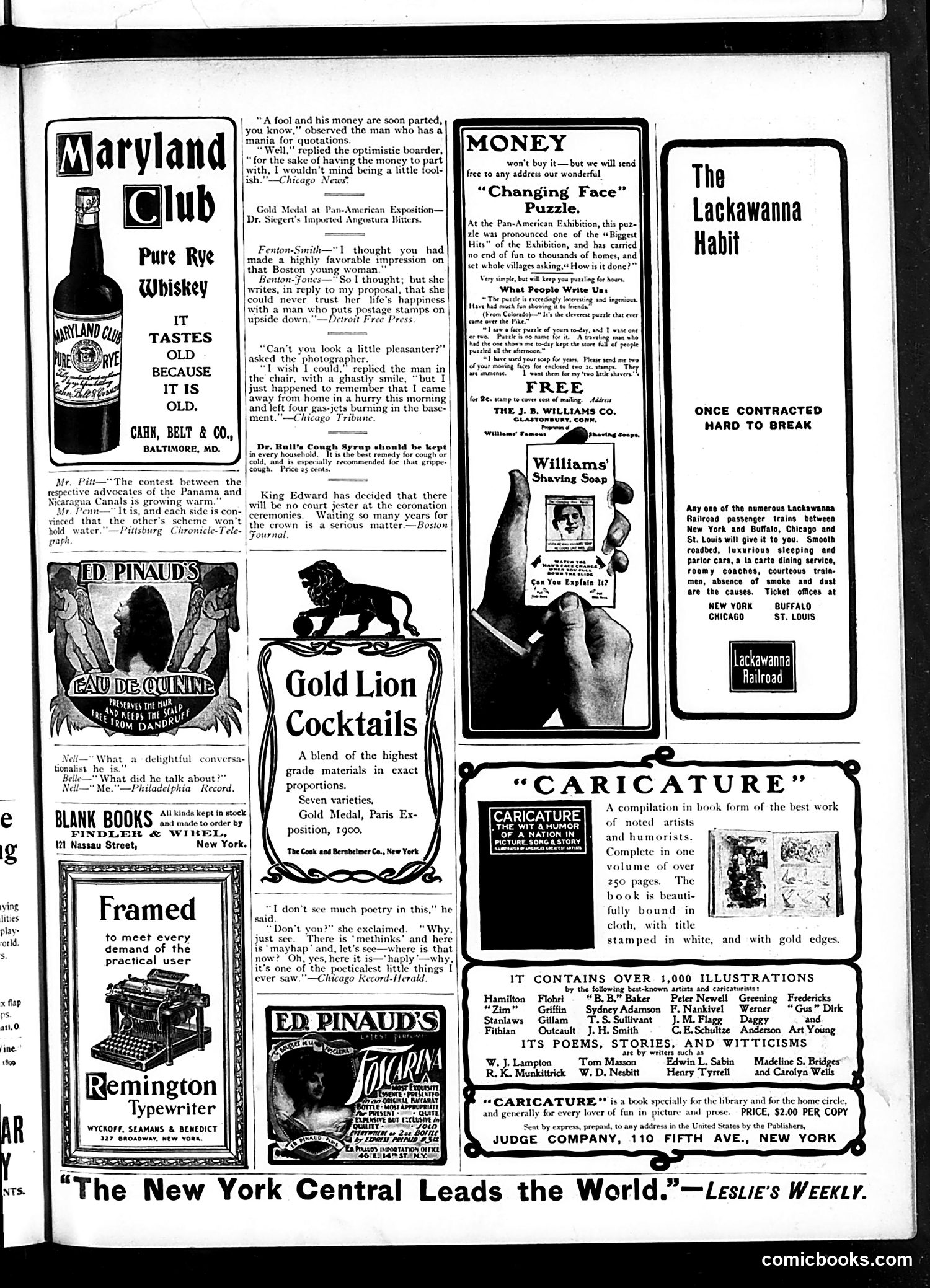
This page is primarily **advertising**, with brief humorous snippets scattered throughout—typical of Judge magazine's format. The main content consists of **product advertisements** (Maryland Club whiskey, Gold Lion cocktails, Remington typewriters, Williams' shaving soap, the Lackawanna Railroad) interspersed with **short jokes** on topics like photography, letter-writing etiquette, and King Edward VII's coronation (referenced as deciding against court jesters). One notable item: a joke about **Panama vs. Nicaragua canal debates**, reflecting the early 1900s political controversy over which route America should use. The wordplay ("won't hold water") puns on engineering feasibility. The page advertises a **"Caricature" book**—a compilation of American satirical art and humor from noted cartoonists, suggesting Judge's self-promotion of its own illustrated content. No specific political figures are caricatured here. This is primarily a **commercial page** showcasing Judge's advertising base and lighter humor, rather than substantive political satire.
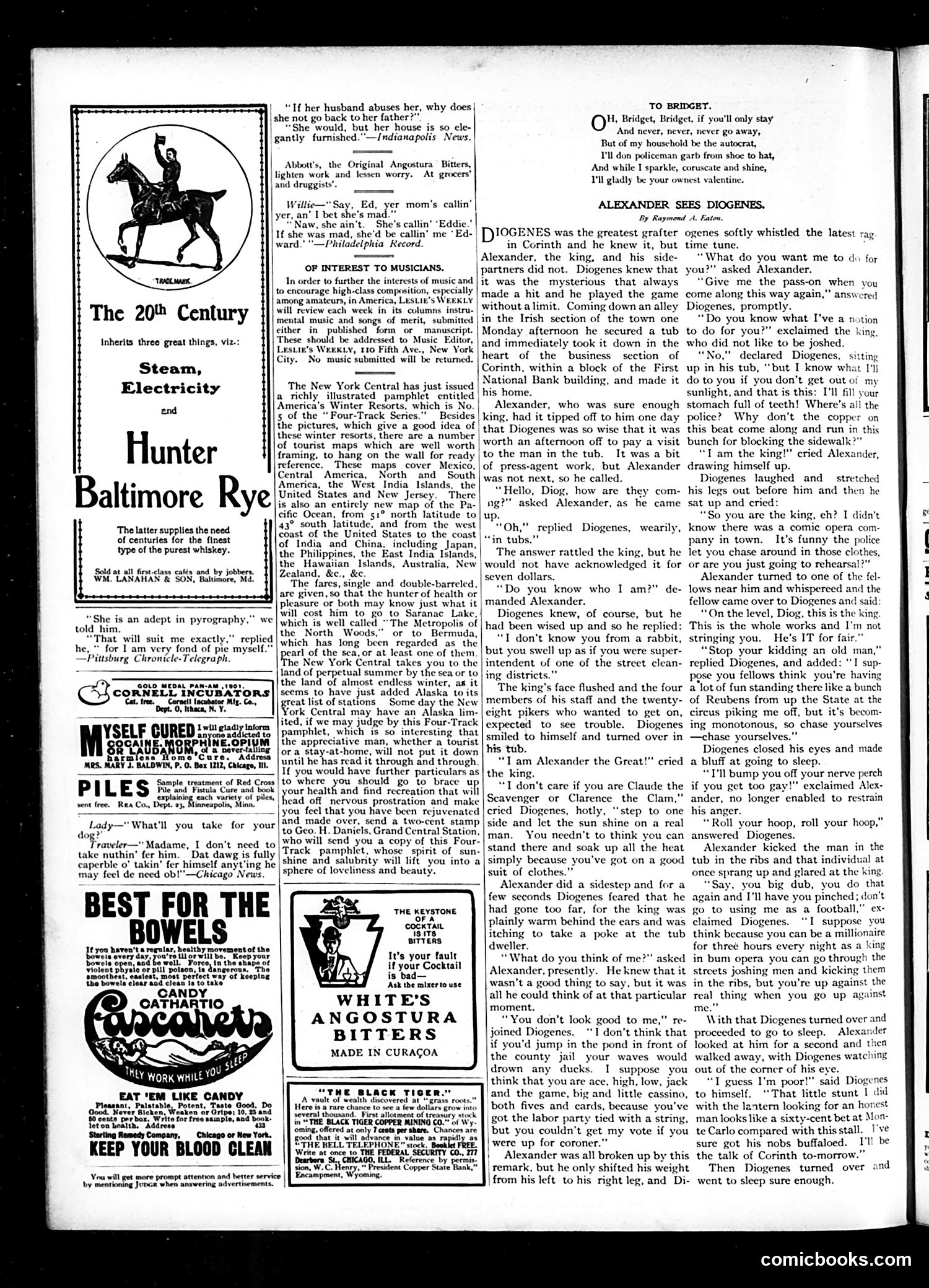
This page is primarily **advertisements and filler content** rather than political satire. The main items are: 1. **"The 20th Century" ad** for Hunter Baltimore Rye whiskey, claiming it fulfills a need from past centuries—a straightforward product advertisement. 2. **"Alexander Sees Diogenes"** story—a humorous dialogue between Alexander the Great and the cynical philosopher Diogenes, illustrating their famous historical encounter where Diogenes reportedly told Alexander to stop blocking his sunlight. The joke plays on Diogenes's indifference to power and wealth. 3. **Various small ads and jokes** about medical products (piles cures, opium treatment), musical submissions, and travel pamphlets. The page lacks significant political commentary. The few jokes are domestic humor (about wives, dogs, pyrography) with no identifiable satirical targets. This appears to be a typical Judge issue page mixing advertisements with light entertainment rather than substantive social criticism.
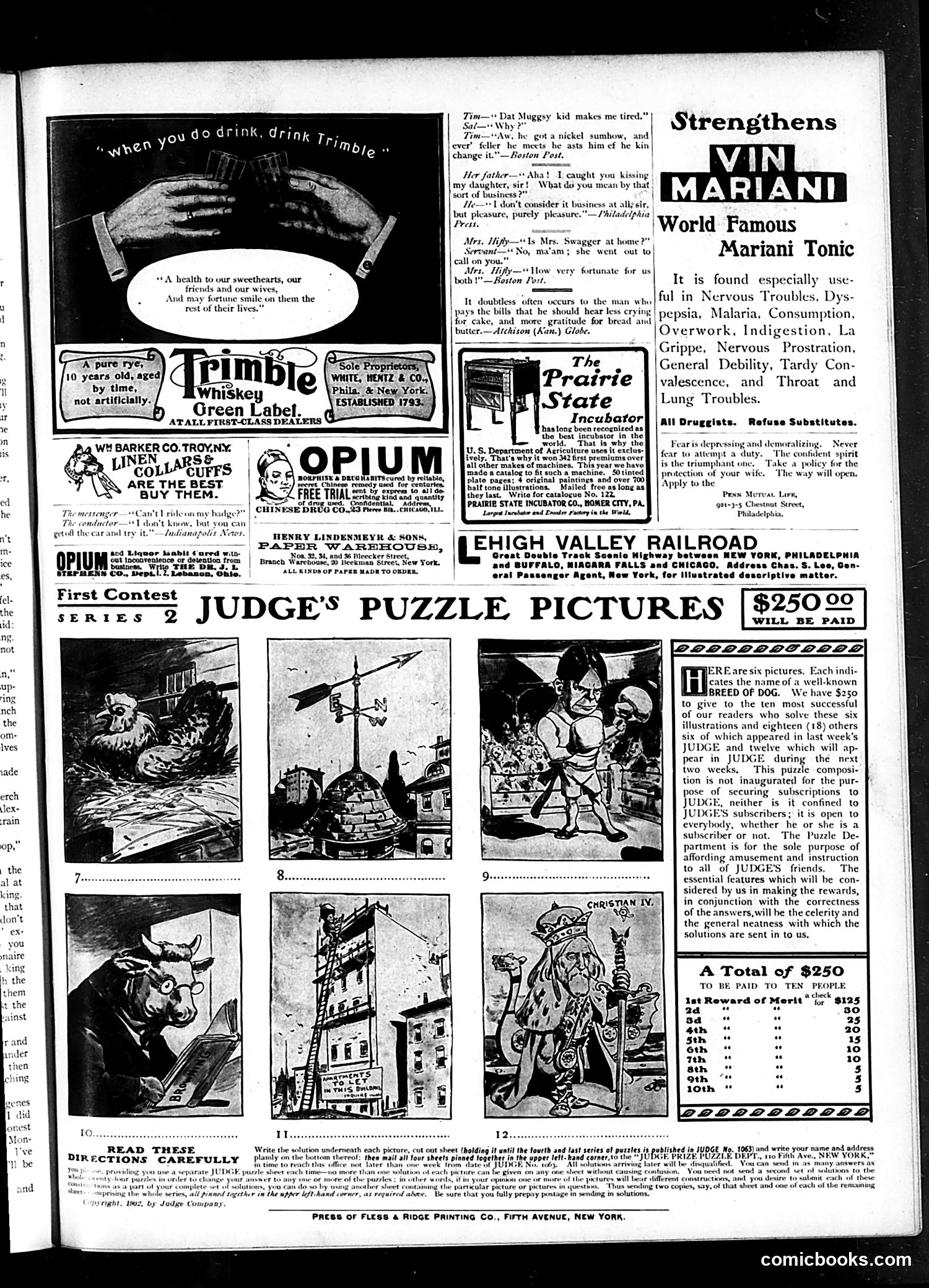
This page from *Judge* (a major American satirical weekly) consists primarily of **advertisements and a puzzle contest**, with minimal political satire. The top section contains brief humor snippets mocking domestic life—a man tired of a boy named "Muggsy," a father catching his daughter kissing, complaints about wives' spending habits. These are gentle, conventional jokes about courtship and marriage. The bulk of the page advertises patent medicines (Vin Mariani tonic, Opium remedies), whiskey, railroad services, and agricultural equipment—typical turn-of-century ads. The Vin Mariani ad lists ailments it supposedly treats: malaria, consumption, nervousness. The centerpiece is **Judge's Puzzle Pictures Contest**, offering $250 total ($25 per person to ten winners) for readers identifying dog breeds in illustrations. The contest emphasizes it's open to all readers, not just subscribers. There is **no significant political cartoon or satire** on this page—it's primarily a commercial/entertainment publication showcasing period advertisements and a reader engagement contest.
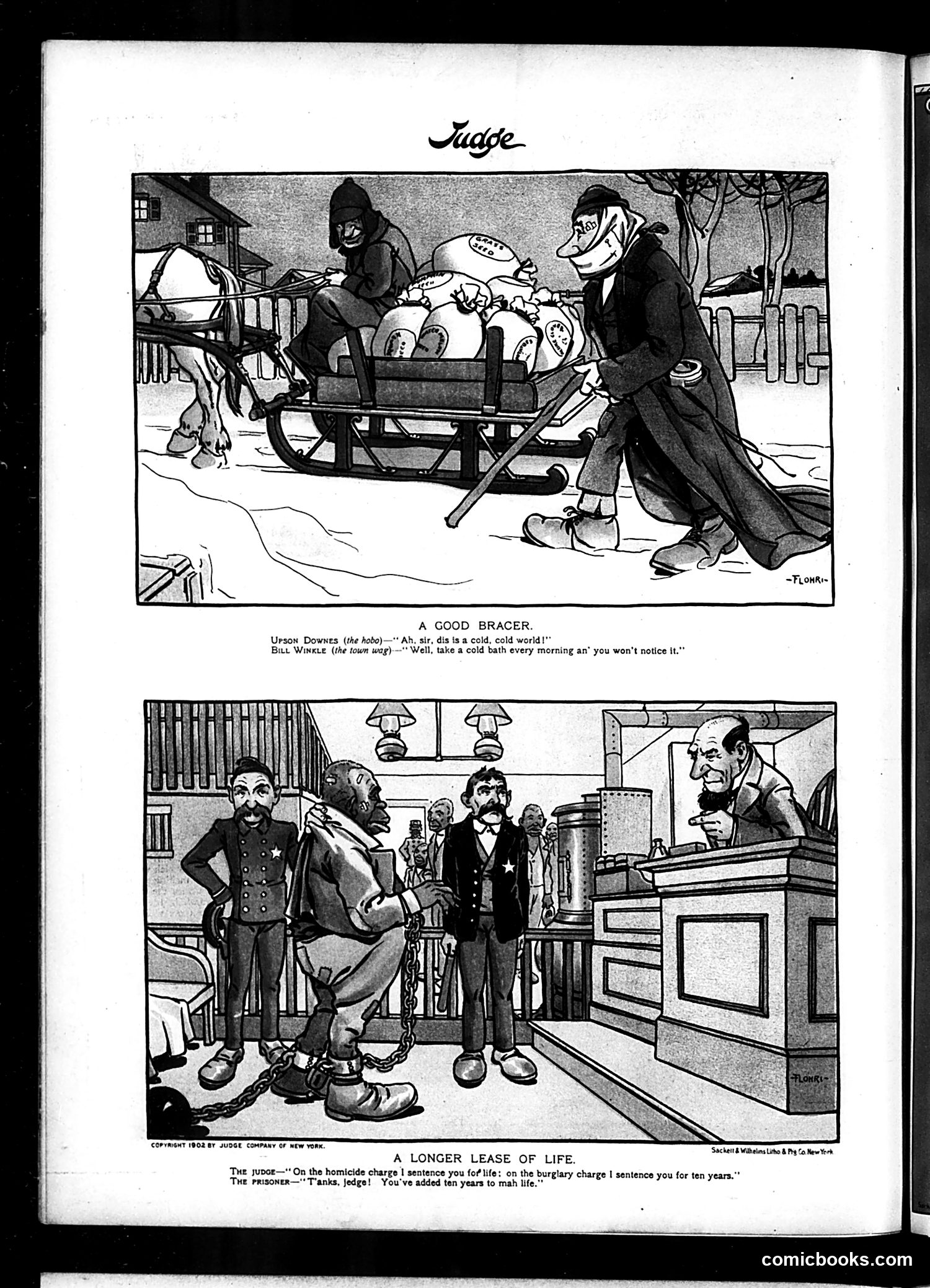
**"A Good Bracer" (top):** A homeless man complains about the cold world to a well-dressed man pulling a sleigh laden with provisions. The "town wag" responds with cruel advice: take cold baths daily and you'll stop noticing the cold. The joke mocks callous attitudes toward poverty—offering a poor person discomfort as a "solution" rather than actual help. **"A Longer Lease of Life" (bottom):** A judge sentences a prisoner to additional years in jail for a burglary charge. The prisoner responds that these added years have extended his life—implying prison provides shelter, food, and safety he lacked outside. This satirizes how desperate poverty makes incarceration preferable to freedom, critiquing both economic inequality and harsh criminal sentences. Both cartoons use dark humor to expose indifference toward the poor and marginal figures in early 20th-century America.