
A complete issue · 16 pages · 1901
Judge — October 12, 1901
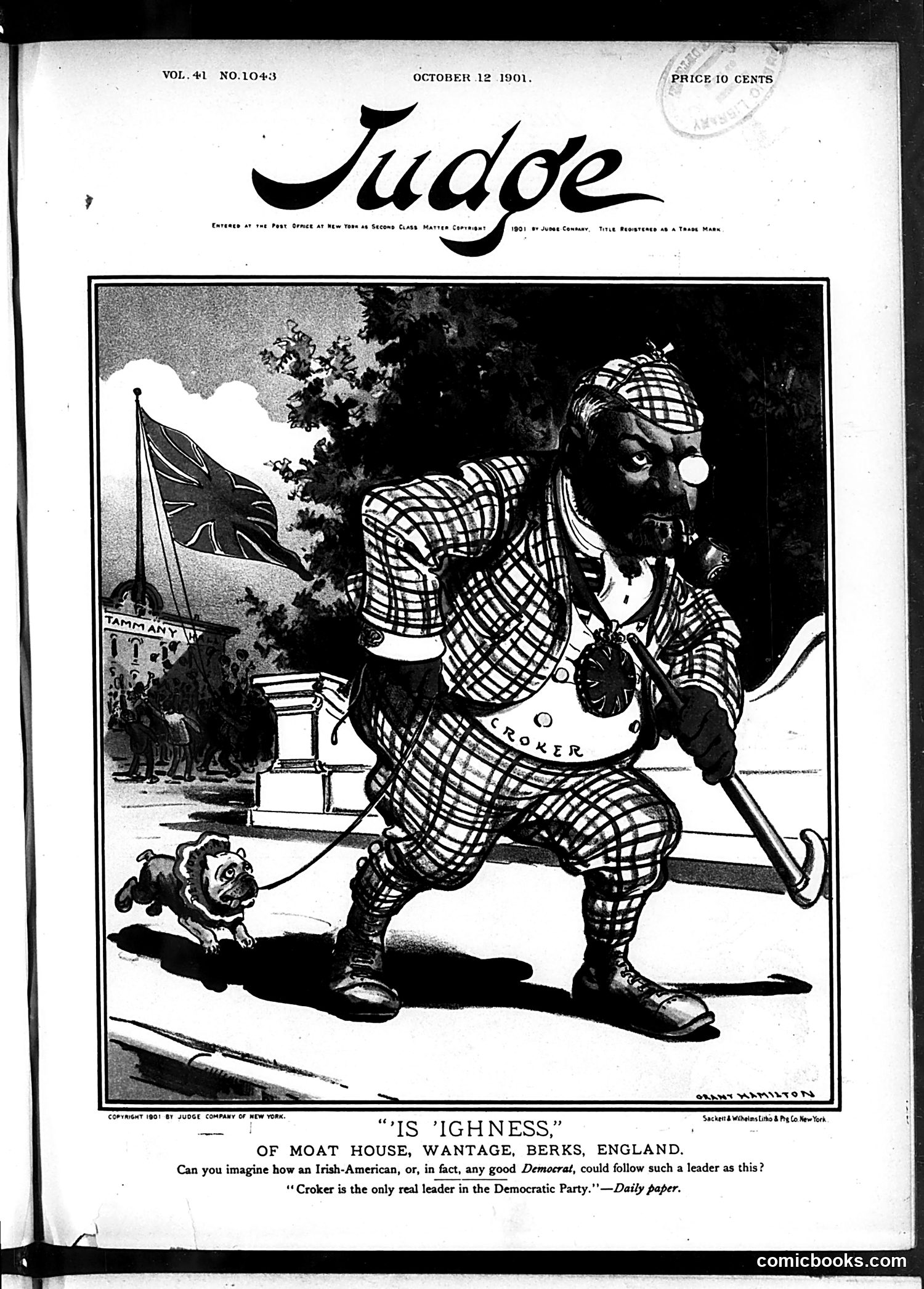
This political cartoon satirizes a figure labeled "His 'Ighness" from Moat House in Wantage, Berkshire, England. The caricatured character, dressed in Scottish plaid and wearing a tam o'shanter cap, is depicted as an absurdly pompous leader being followed by a small bulldog. The accompanying text poses a rhetorical question: whether any Irish-American or Democrat could follow such an obviously ridiculous leader. The quoted line—"Croker is the only real leader in the Democratic Party"—suggests this targets Richard Croker, a prominent Tammany Hall political boss. The cartoon mocks both Croker's leadership pretensions and his supporters, using the grotesque caricature and the diminutive, struggling bulldog as visual metaphors for the absurdity of following such a figure.
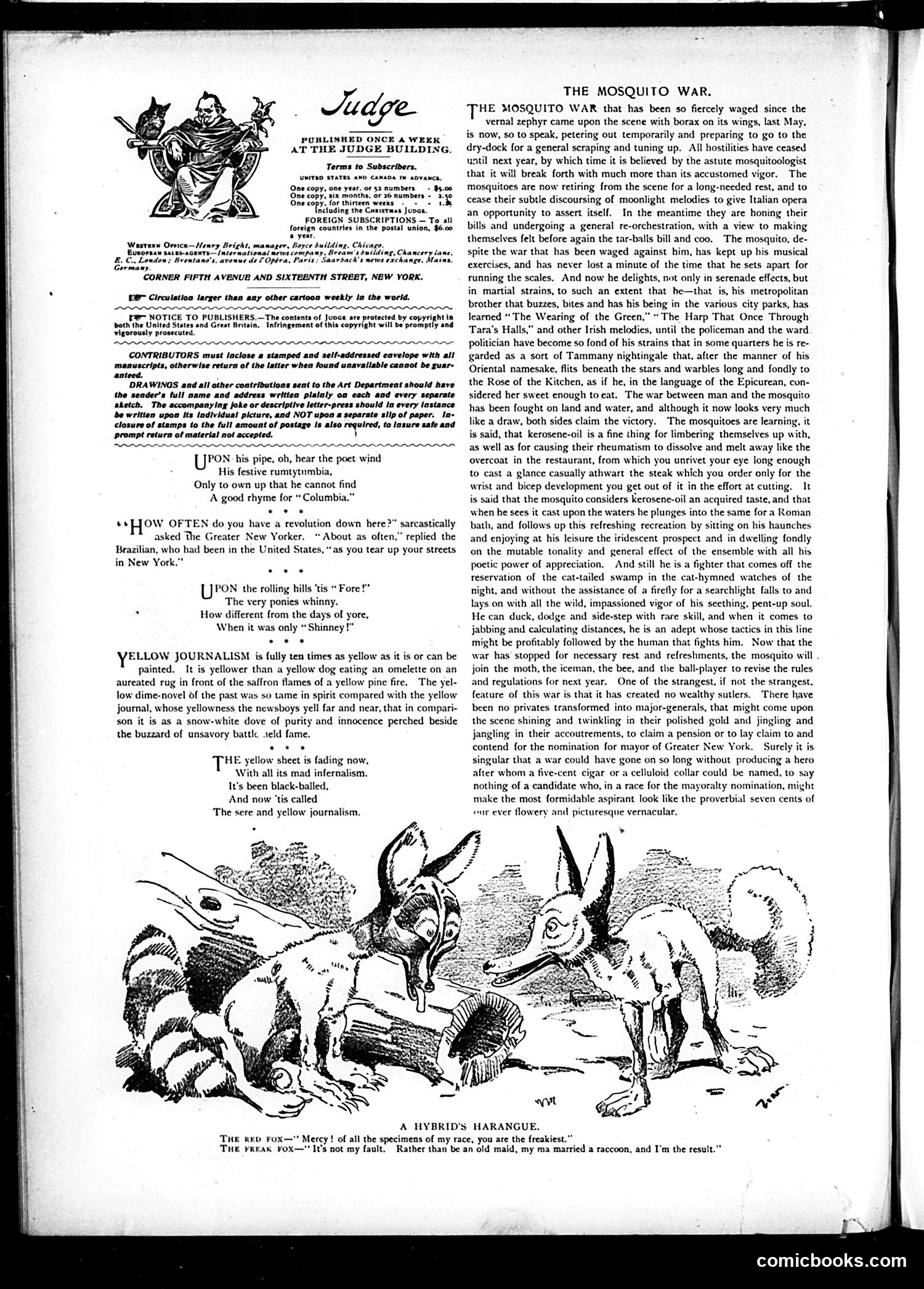
This page contains two distinct articles. "The Mosquito War" is a humorous essay about New York City's battle against mosquitoes—described as retiring from their summer haunts and engaging in "orchestral" efforts with Italian opera references. The satirical tone mocks how seriously the city treats the pest problem. Below is a cartoon titled "A Hybrid's Harangue" featuring two dog-like creatures (one labeled "red fox," one "freak fox"). The dialogue jokes about mixed parentage: the red fox calls the other a freak, but the freak responds that being half-raccoon offspring is preferable to being "an old maid." This satirizes anxieties about hybrid identity and racial mixing through animal metaphor—common in period satire—though the specific social target remains unclear.
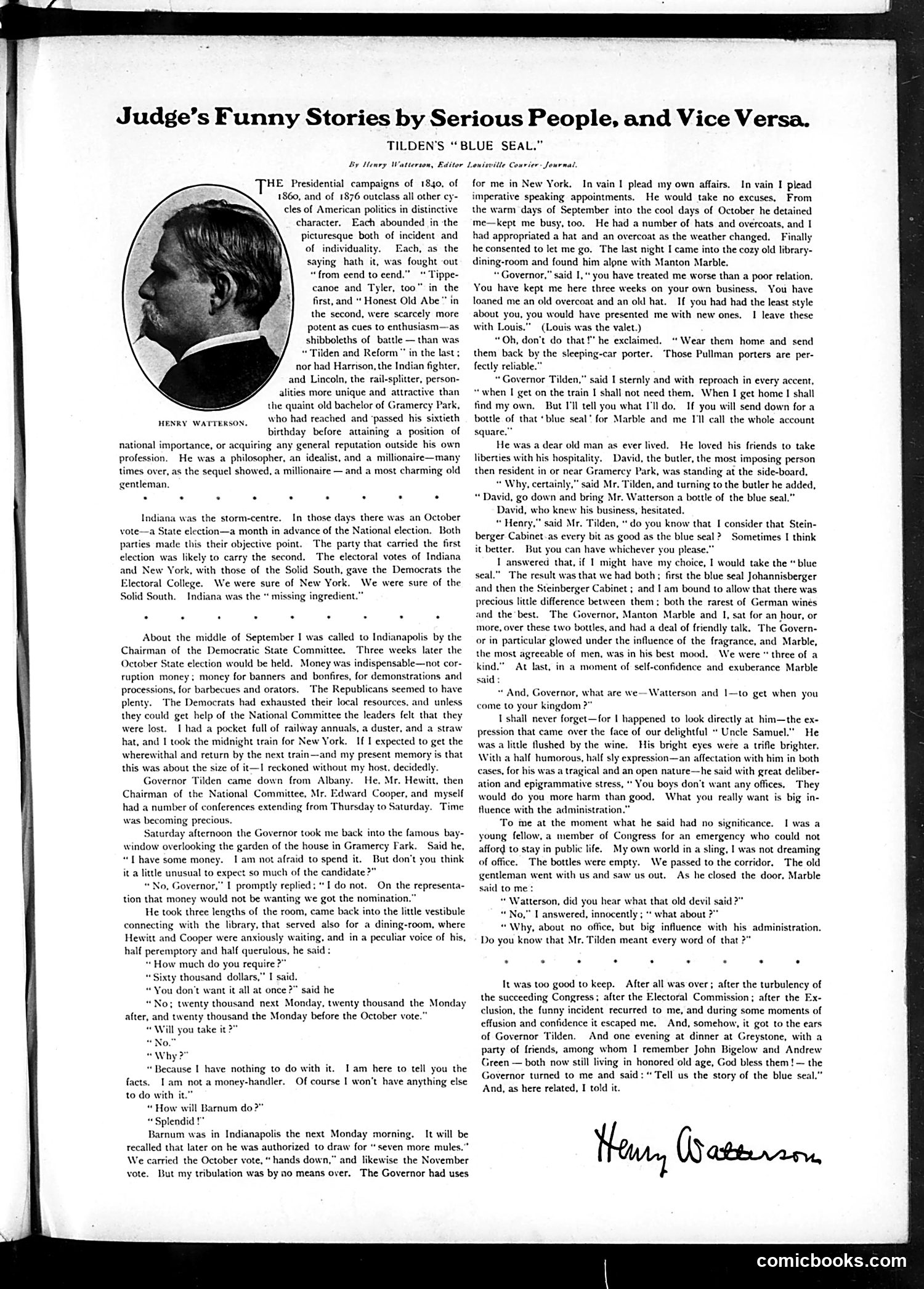
This satirical piece by Henry Watterson mocks Democratic presidential candidate Samuel J. Tilden during the 1876 election campaign. The story describes Tilden's overly cautious approach to politics—his reluctance to commit resources or take decisive action during the critical Indiana campaign. The "blue seal" serves as the satire's central joke: Tilden refuses to wear new clothes, insisting on keeping old, worn garments. This represents his stingy, timid political strategy. Watterson uses this humorous anecdote to criticize Tilden as passive and ineffectual, suggesting his penny-pinching and hesitance cost Democrats the election. The cartoon's target is Tilden's perceived weakness as a candidate—his unwillingness to invest adequately in securing victory.
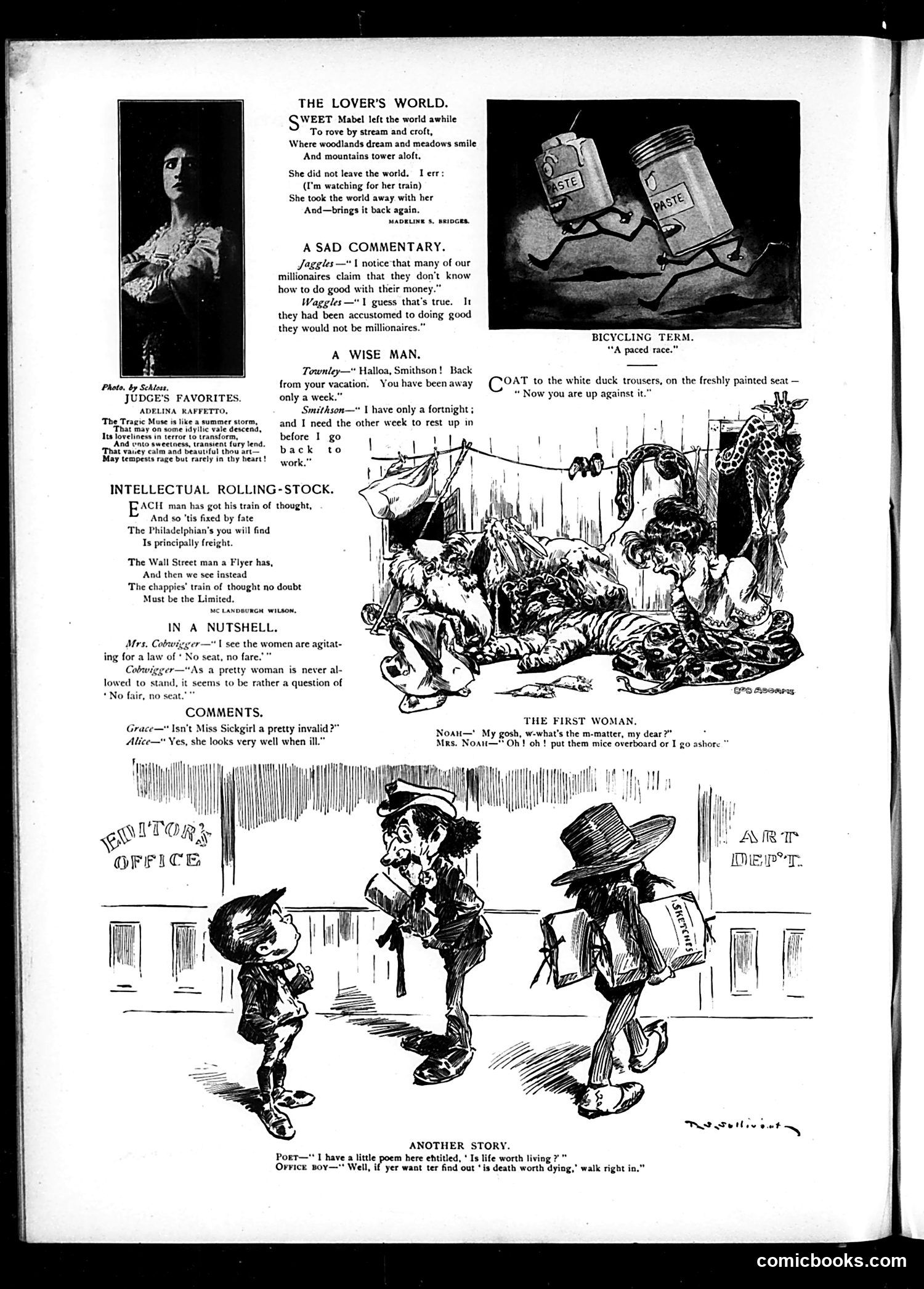
This page contains several satirical sketches and poems typical of Judge's social commentary: **"The Lover's World"** mocks romantic idealization—a woman leaves the world only mentally, taking it "back again." **"A Sad Commentary"** jokes about millionaires' philanthropy: wealthy people wouldn't be rich if they actually knew how to spend money charitably. **"Intellectual Rolling-Stock"** satirizes Wall Street financiers as having no original thought, merely following market trends like sheep. **"Bicycling Term"** shows feet pedaling in "paced race"—likely commenting on cycling's fashionable craze. **"The First Woman"** depicts domestic tension between Noah and Mrs. Noah about mice. **"Another Story"** at bottom shows a poet pitching work to an editor, with the punchline equating life's worth to death—dark humor about struggling artists. The cartoons collectively mock wealth, finance, gender relations, and artistic pretension.
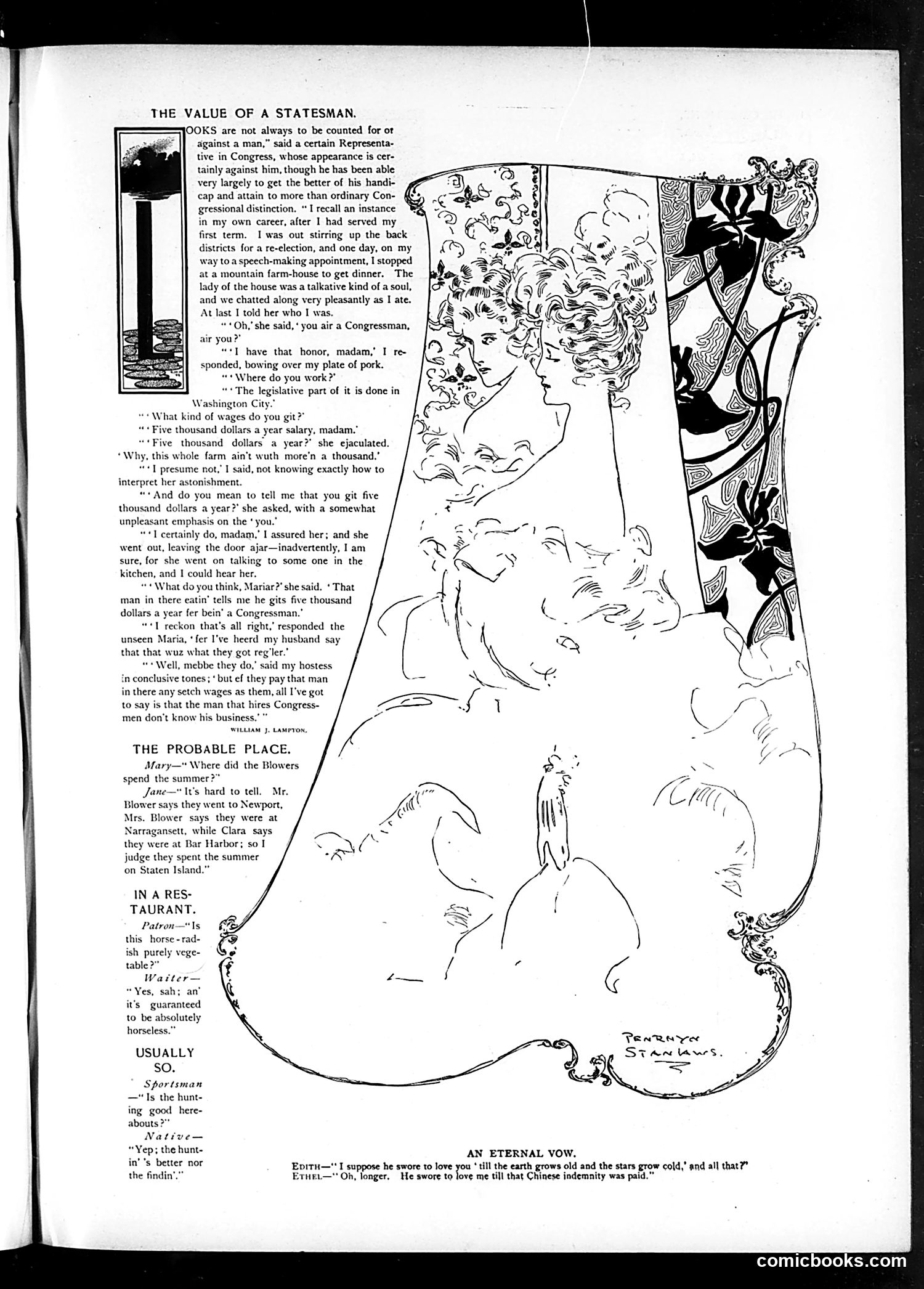
**"The Value of a Statesman"** (main story by William J. Lampton): A congressman tells of visiting a rural farmhouse seeking re-election support. When he mentions earning $5,000 annually, the farm wife is astounded—the entire farm isn't worth that much. After he leaves, she tells her husband (overheard) that "the man that hires Congressmen don't know his business." The satire mocks both the perceived overpayment of congressmen relative to their actual value and rural voters' incredulity at such wages. The page also contains three brief humorous dialogues satirizing social pretension: wealthy people lying about summer destinations, a waiter's absurd restaurant patter, and a woman's cynical wedding vow—joking that her husband swore eternal love, but only until "the Chinese indemnity was paid" (likely referencing post-Boxer Rebellion reparations, circa 1901). All ridicule middle-class hypocrisy and empty rhetoric characteristic of Judge's satirical approach.
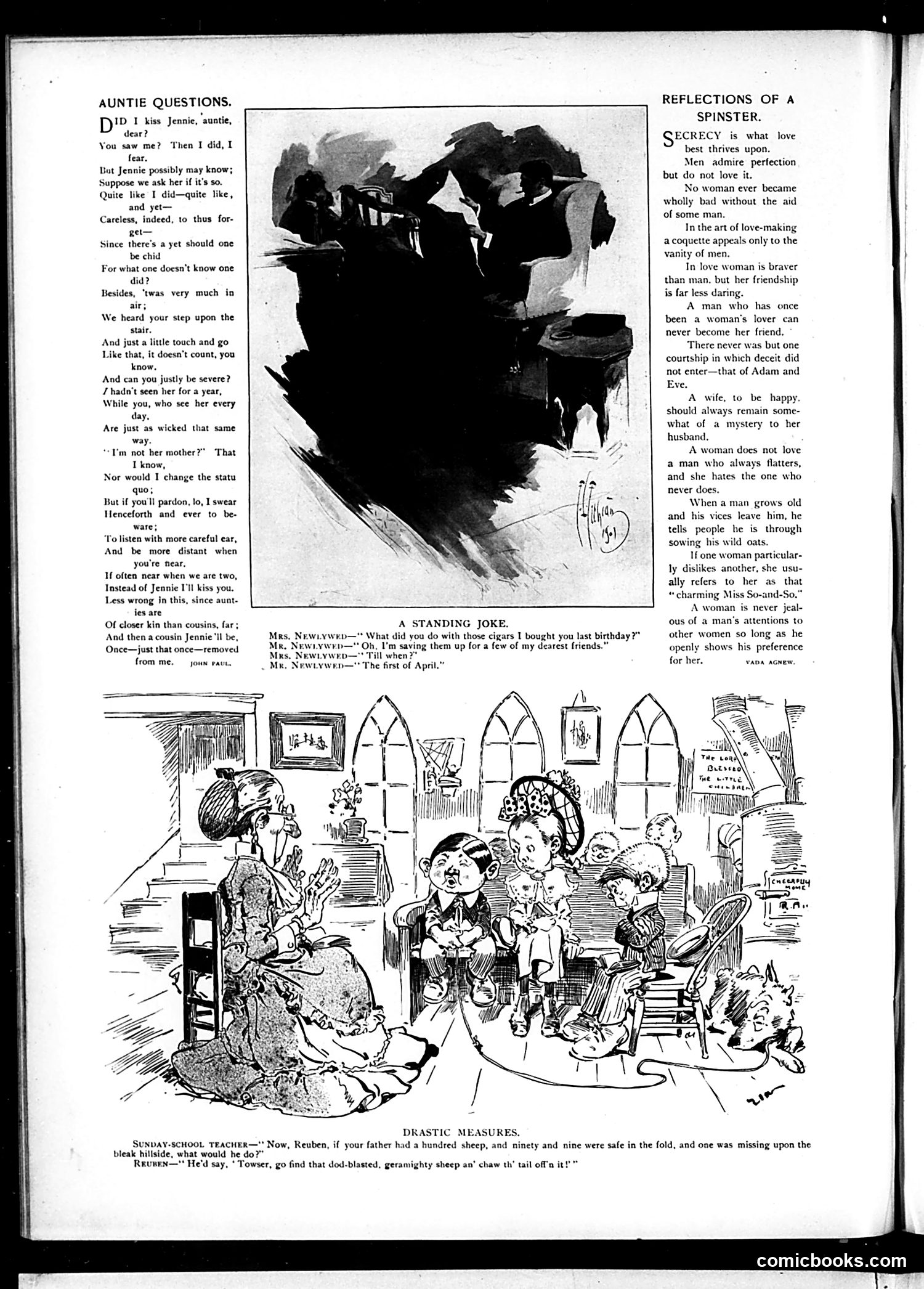
This page contains three distinct pieces of period humor: **"Auntie Questions"** (top left): A young man nervously explains to his aunt that he kissed his cousin Jennie. He argues the kiss "doesn't count" because it was brief and unplanned, then turns the tables by pointing out the aunt herself flirts with him. He promises future restraint—or jokingly offers to kiss the aunt instead since she's closer kin. The satire mocks Victorian courtship anxieties and the supposed propriety of family relations. **"A Standing Joke"** (center): A newlywed husband claims he's "saving" expensive cigars his wife gave him for "dearest friends" on April 1st (April Fools' Day). The joke satirizes newly married men's tendency to prioritize their friends over wives, while hinting he's being dishonest about the cigars. **"Drastic Measures"** (bottom): A Sunday-school teacher poses a biblical parable about lost sheep to a boy named Reuben, who responds with crude rural practicality, suggesting violent revenge on the stray sheep. The humor comes from the child's earthy, unchristian response to a moral lesson.
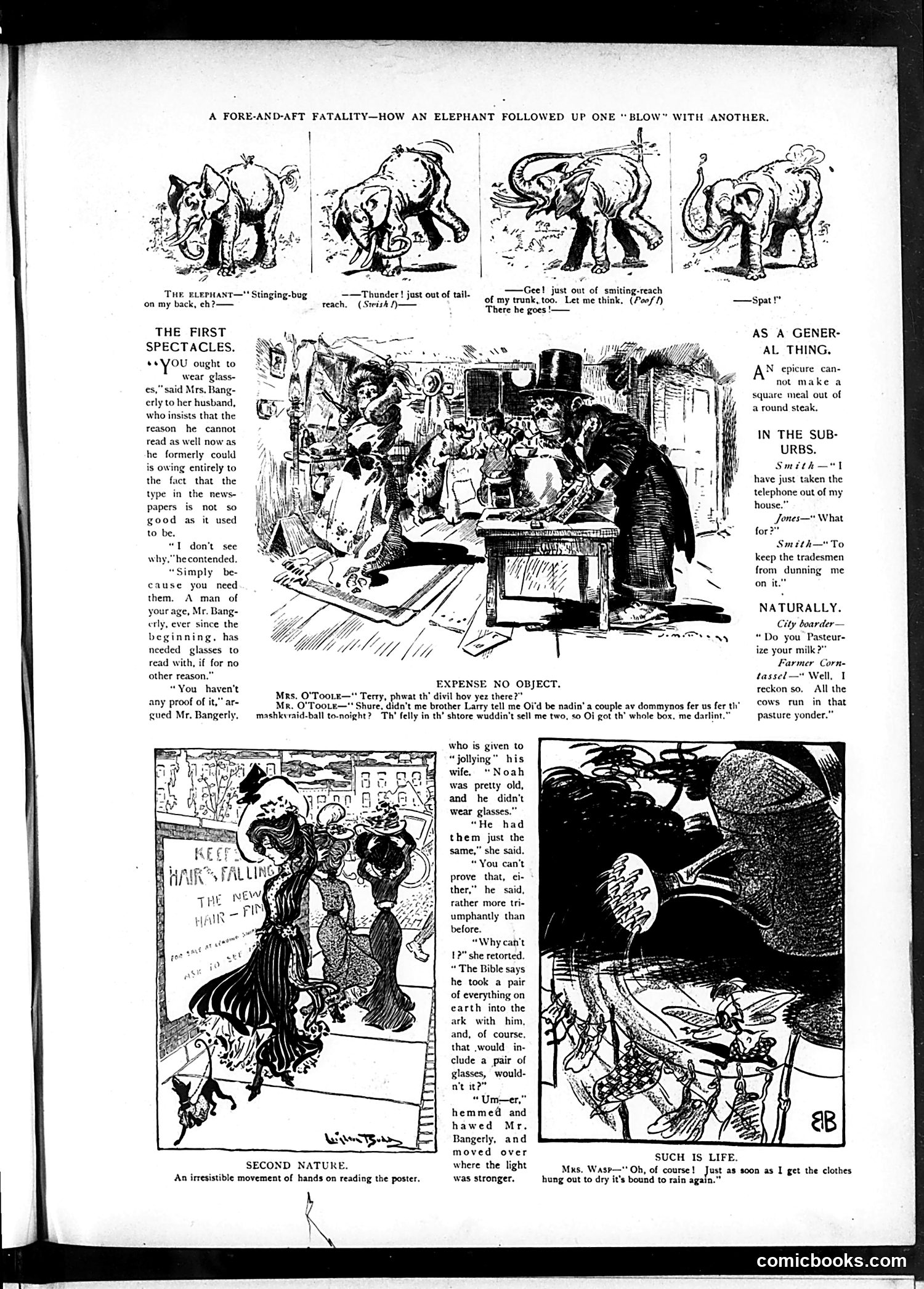
This page from the satirical magazine *Judge* contains several unrelated comic vignettes typical of early-20th-century American humor: **Top section**: An elephant comic strip showing the animal's literal interpretation of fighting—it "follows up" a blow (punch) with another, using its trunk as a weapon, playing on the phrase's double meaning. **"The First Spectacles"**: A domestic humor piece where Mr. Bangerly insists he doesn't need glasses because newspapers' type quality has declined. His wife counters that even Noah wore glasses (since he took "a pair of everything" on the ark). The joke relies on literal, pedantic logic defeating his excuse. **"Expense No Object"**: Irish immigrant humor featuring the O'Tooles, using thick dialect and malapropisms. The joke involves misunderstanding "dominoes"—Mrs. O'Toole apparently thinks they need multiple sets for tonight's game. **Other sections**: Brief domestic humor snippets about milk pasteurization, telephone complaints, and laundry timing—all representing commonplace modern inconveniences that were the magazine's stock material. The page exemplifies *Judge*'s mixture of visual gags, ethnic stereotypes, and middle-class domestic comedy.
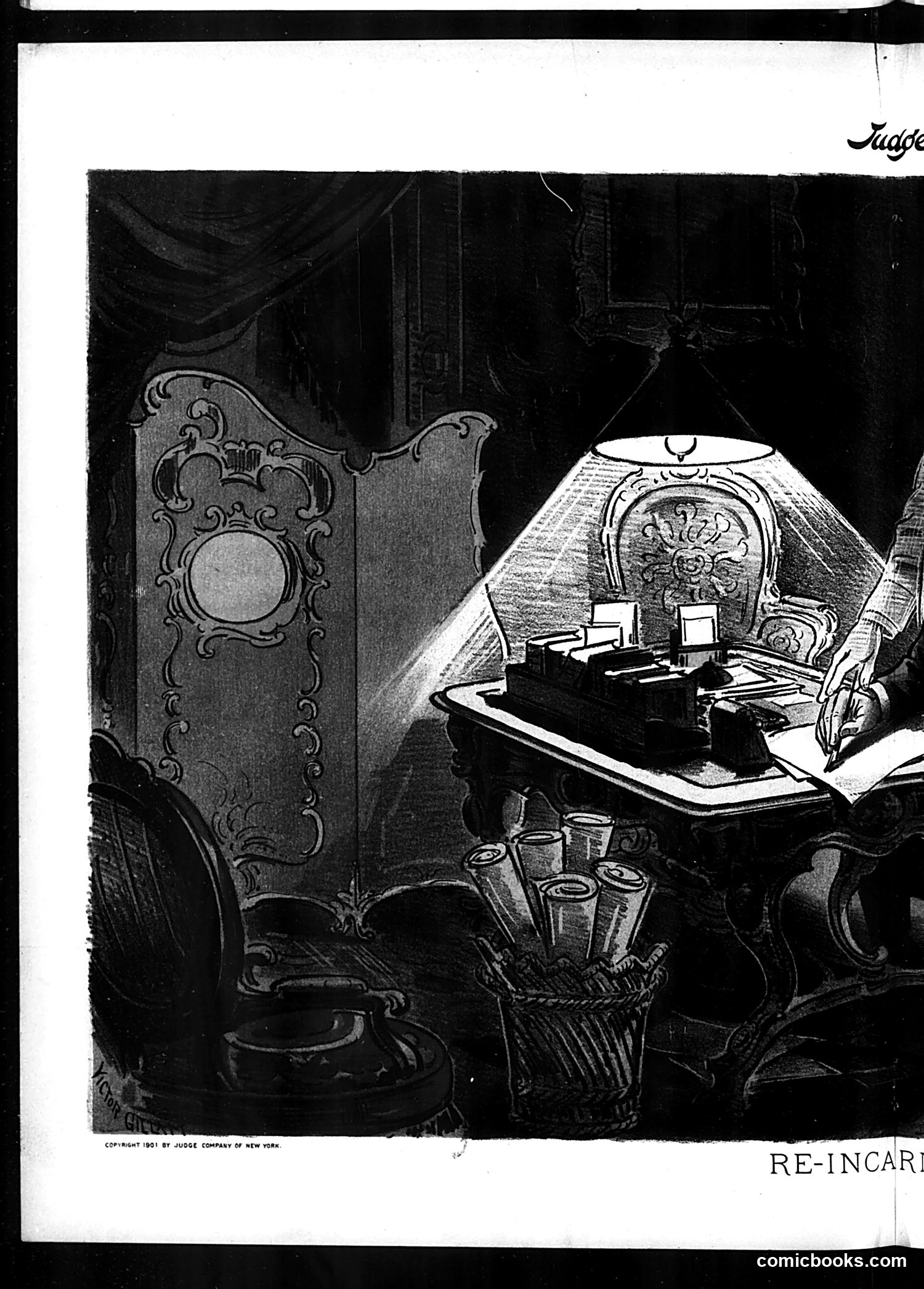
This appears to be a satirical cartoon from *Judge* magazine showing a luxurious office or study scene. A hand (likely representing a wealthy or powerful figure) is writing or signing documents at an ornate desk, illuminated dramatically by light from above. The setting includes elaborate period furniture, decorative elements, and what appears to be formal business materials. The title "RE-INCARI" (partially visible) suggests reincarnation or rebirth themes, though the complete context is unclear from the visible text. The cartoon likely satirizes wealth, power, or business practices of the era, using the dramatic lighting and ornate setting to emphasize the subject's importance or pretension. Without complete caption text, the specific political or social target remains uncertain.
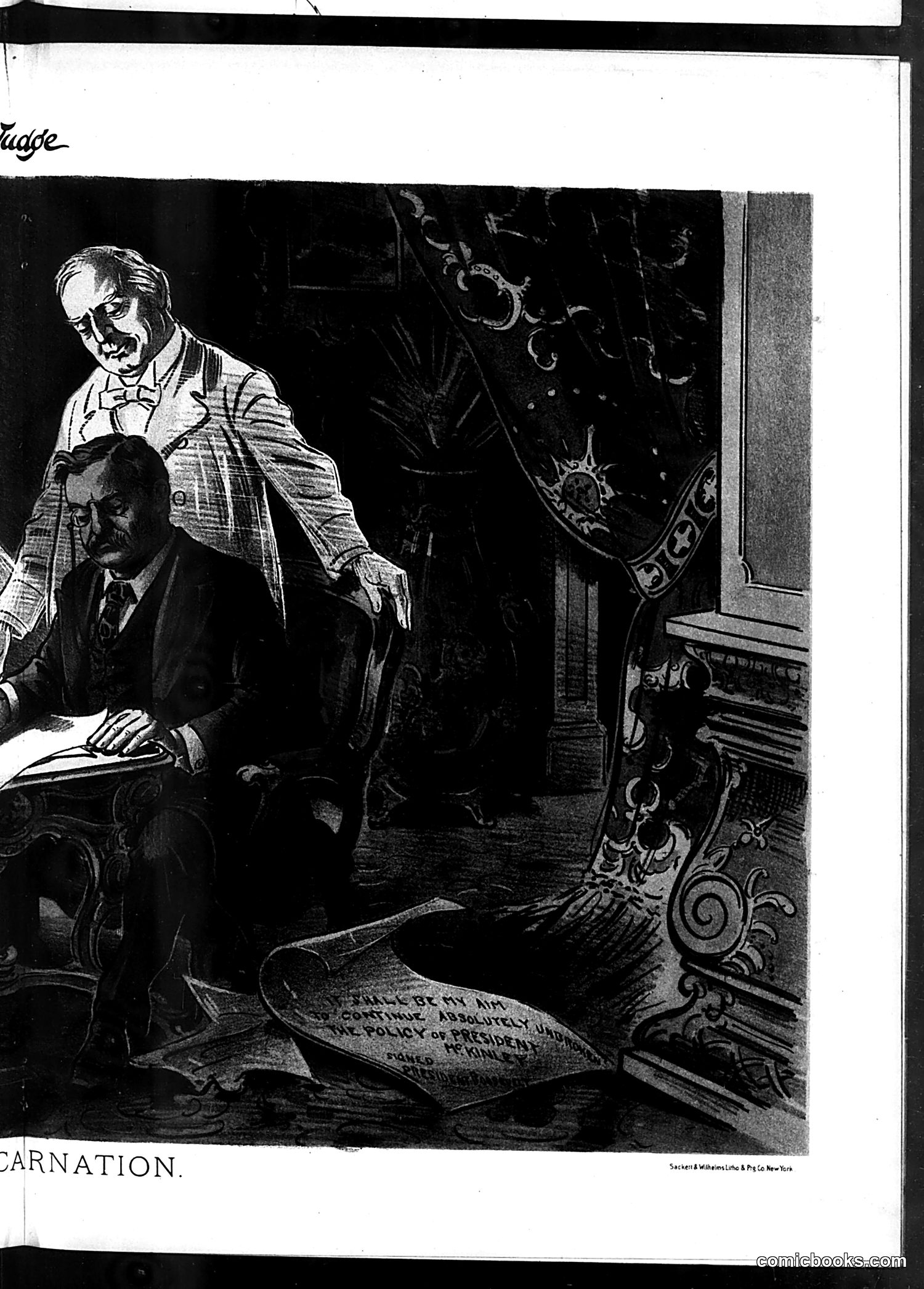
This Judge magazine cartoon depicts two men in an ornate interior. The standing figure (appearing prosperous, wearing a plaid jacket) looms over a seated man who reads documents. The title "Carnation" and visible text fragment mentioning "continue absolutely... not of President" suggest this satirizes a political controversy, likely involving presidential authority or succession. The cartoon's composition—with the standing figure positioned dominantly above—implies a power dynamic or coercion. The elaborate architectural details in the background suggest an official or formal setting, possibly government. However, without the full OCR text or publication date clearly visible, the specific political incident referenced remains unclear. The satire appears to critique either executive overreach or backroom political pressure, but exact identities and context require additional information.
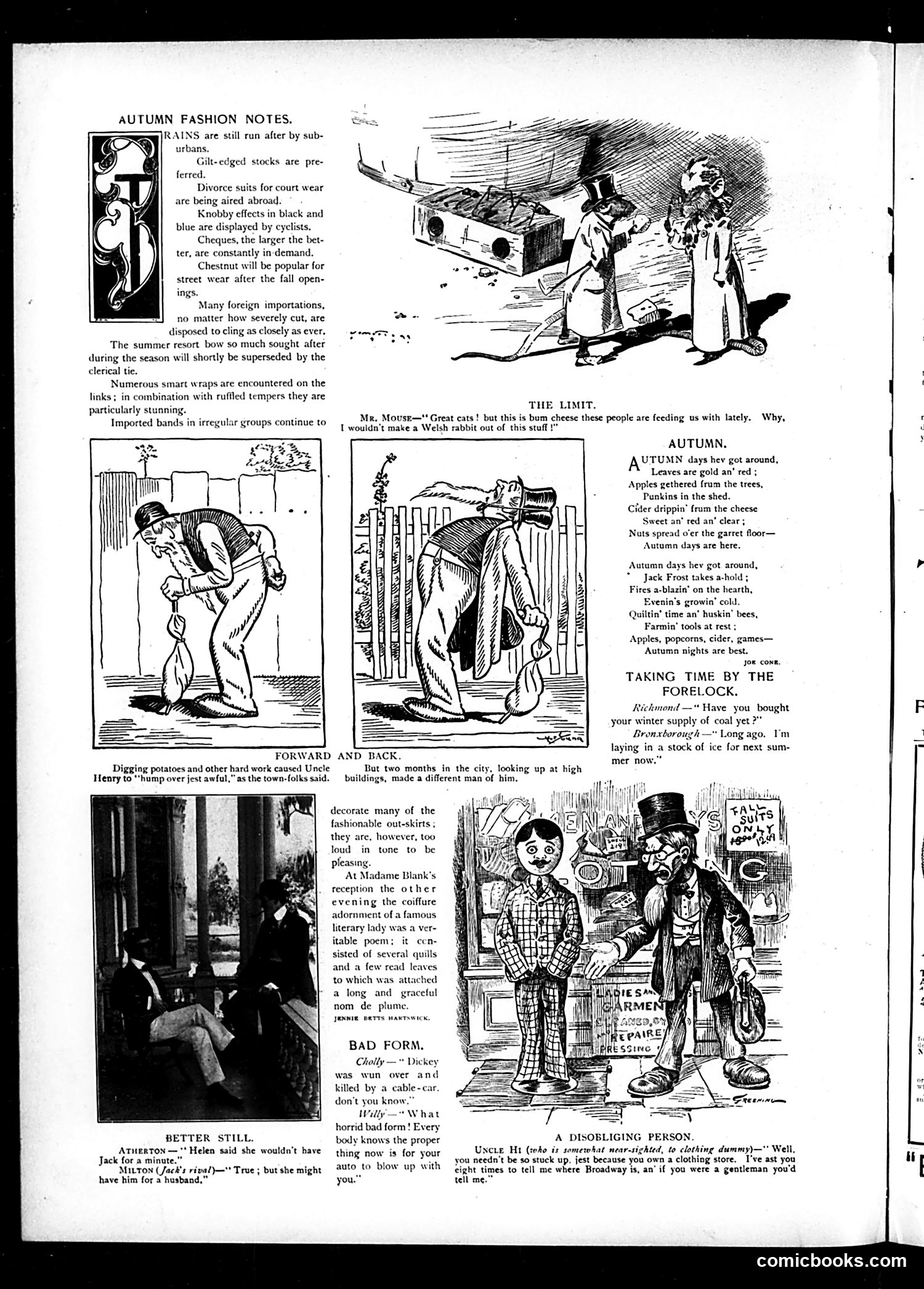
This Judge magazine page combines fashion commentary with satirical humor typical of the era. The **"Autumn Fashion Notes"** section at top left uses dry wit to mock contemporary fashion and social trends—divorce suits being "aired abroad," cyclists displaying "black and blue" effects (bruises), and fashionable women's wraps that "cling as closely as ever" regardless of tailoring. The cartoons below satirize rural-urban contrasts and social pretension. **"Forward and Back"** depicts Uncle Henry, a country laborer exhausted from farm work, transformed by merely two months in the city gazing at tall buildings. The joke mocks both rural simplicity and urban affectation. **"Bad Form"** and **"Better Still"** offer society-page humor about etiquette and marriage prospects among the well-to-do. **"A Disobliging Person"** shows a clothing store owner refusing directions to Broadway—satirizing merchants who won't help customers unless they're buying something. The accompanying poem celebrates autumn harvest imagery in folksy dialect, providing sentimental contrast to the page's satirical tone.
This page is primarily **advertising**, typical of Judge magazine's revenue model. The content consists of various product advertisements (soap, hair tonic, playing cards, pianos, insurance) interspersed with short humorous anecdotes. The few satirical elements are mild social observations rather than political cartoons: - **"Sweet Closed Lips"** jokes that a woman appears demure only while being photographed—a gentle jab at artificial femininity and photography's pretense. - **Canal-boat anecdote** contrasts polite manners with working-class practicality (politeness is useless with mules). - **Yellow journalism critique** satirizes sensationalist newspapers prioritizing "news" over facts. - **"Conceited young man"** mocks intellectual pretension. These are typical period humor—social commentary on propriety, class differences, and vanity—rather than substantive political satire. The page reflects Judge's primary function: entertaining advertising vehicle for an affluent readership.
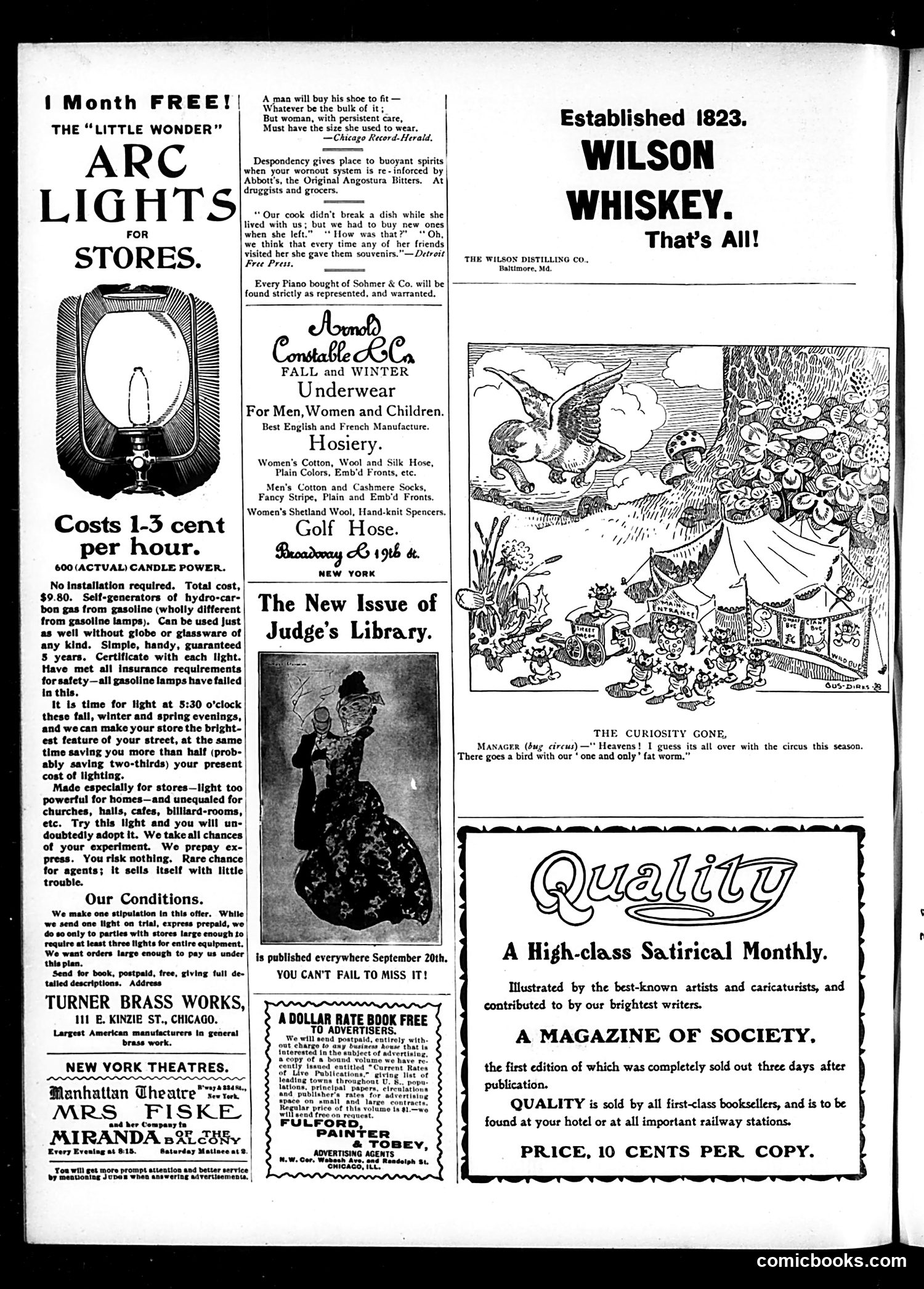
This page is primarily **advertising with one small cartoon**. The cartoon titled "THE CURIOSITY CONE" depicts a circus manager speaking to someone, with the caption: "Heaven! I guess we are all over with the circus this season. There goes a bird with our 'one and only' fat worm." **What it means**: The joke appears to be a visual pun about circus attractions. A bird (literally depicted flying away) has taken the circus's prized "fat worm"—their sole remaining curiosity or attraction. The humor lies in the circus manager's exasperation that their last draw has literally flown away. It's a play on the old circus tradition of displaying oddities and curiosities to audiences; here, even their final attraction has abandoned them, suggesting the circus season is over and business is finished. The cartoon mocks the declining appeal of circus attractions, suggesting they've lost even their most basic draw to nature itself.
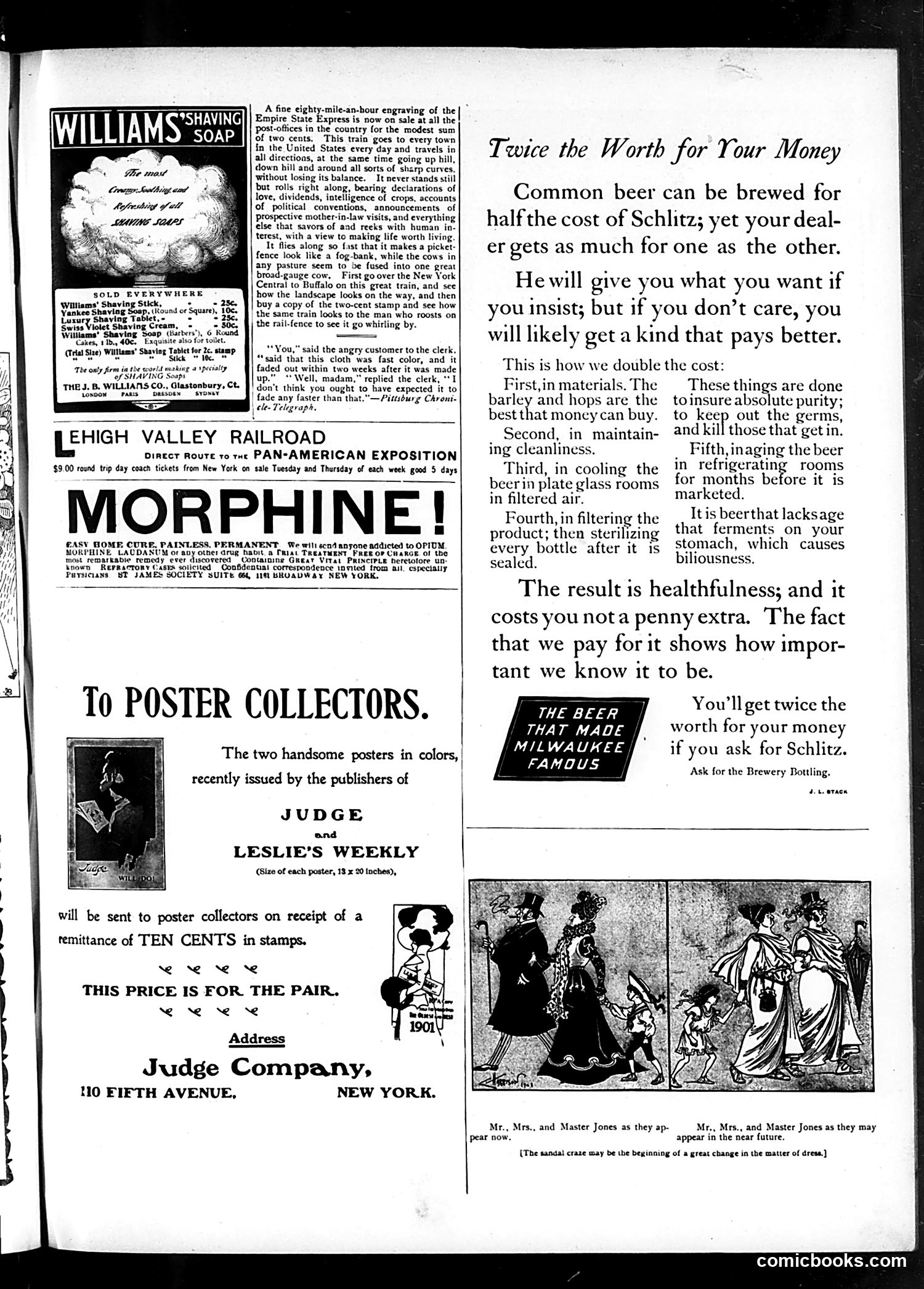
This page contains primarily **advertisements and promotional content** rather than political satire, though it reflects early 1900s commercial culture. The main items include: **Williams Shaving Products** — Standard grooming ads typical of the era. **Schlitz Beer Advertisement** — The dominant content, arguing that Schlitz costs more but delivers superior quality through rigorous purity processes (filtered materials, sterilization, aging). This appeals to consumer awareness of product standards, contrasting with cheaper competitors. **Morphine "Cure" Advertisement** — A jarring reminder that early 1900s advertising permitted claims for addiction treatments now recognized as fraudulent. **Railroad and Poster Offers** — Travel and collectibles promotion. **Small cartoon at bottom** — Appears to show domestic scenes labeled "Mr., Mrs. and Master Jones as they appear now" versus "as they may appear in the near future," suggesting satire about fashion or social change, though the specific reference is unclear. The page primarily documents commercial messaging and acceptable advertising practices of the early 1900s rather than explicit political cartoons.
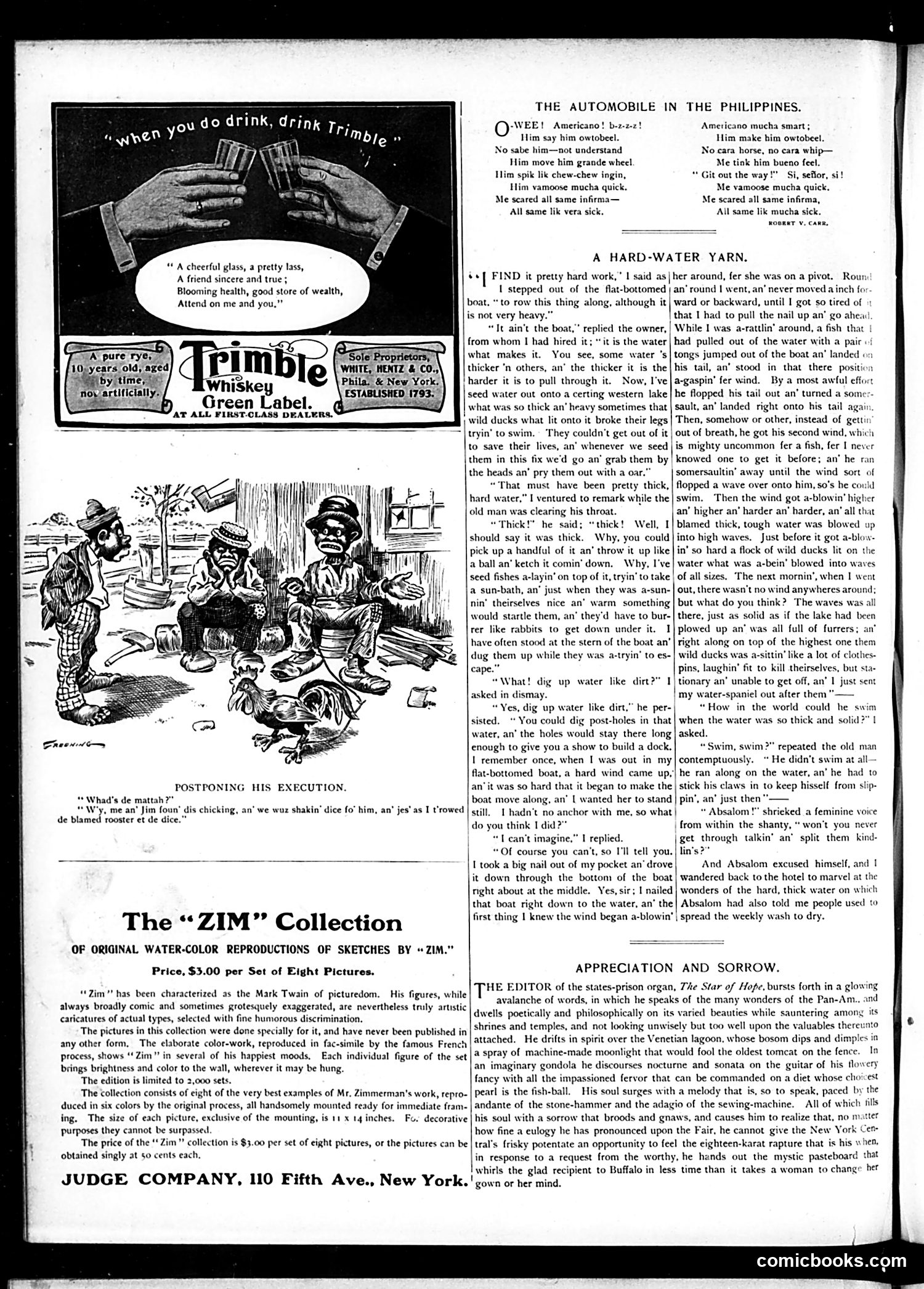
This Judge magazine page contains several distinct satirical pieces: **Top Left - Trimble Whiskey Ad:** A straightforward liquor advertisement using a toasting motif. **Center Cartoon - "Postponing His Execution":** Two Black men are shown gambling over a chicken. One explains they found it and were "shakin' dice" to decide its fate when the rooster ate the dice. The humor relies on crude racial stereotyping and dialect caricature common to early 20th-century American satire—portraying Black Americans through exaggerated speech and comic misfortune. **Right Column - "The Automobile in the Philippines":** A short story describing an American encountering a Filipino boatman's tall tale about impossibly thick water. The Filipino uses stereotypical broken English ("Americano! b-2-2-2!"). The satire mocks both the implausible yarn-spinning and American colonial attitudes toward Filipino workers. **Bottom - Advertisement for "Zim" Collection:** Promotional material for water-color sketch reproductions by artist Zimmerman, styled as the "Mark Twain of picturedom." The page reflects period attitudes combining casual racism with lighthearted humor aimed at American readers.
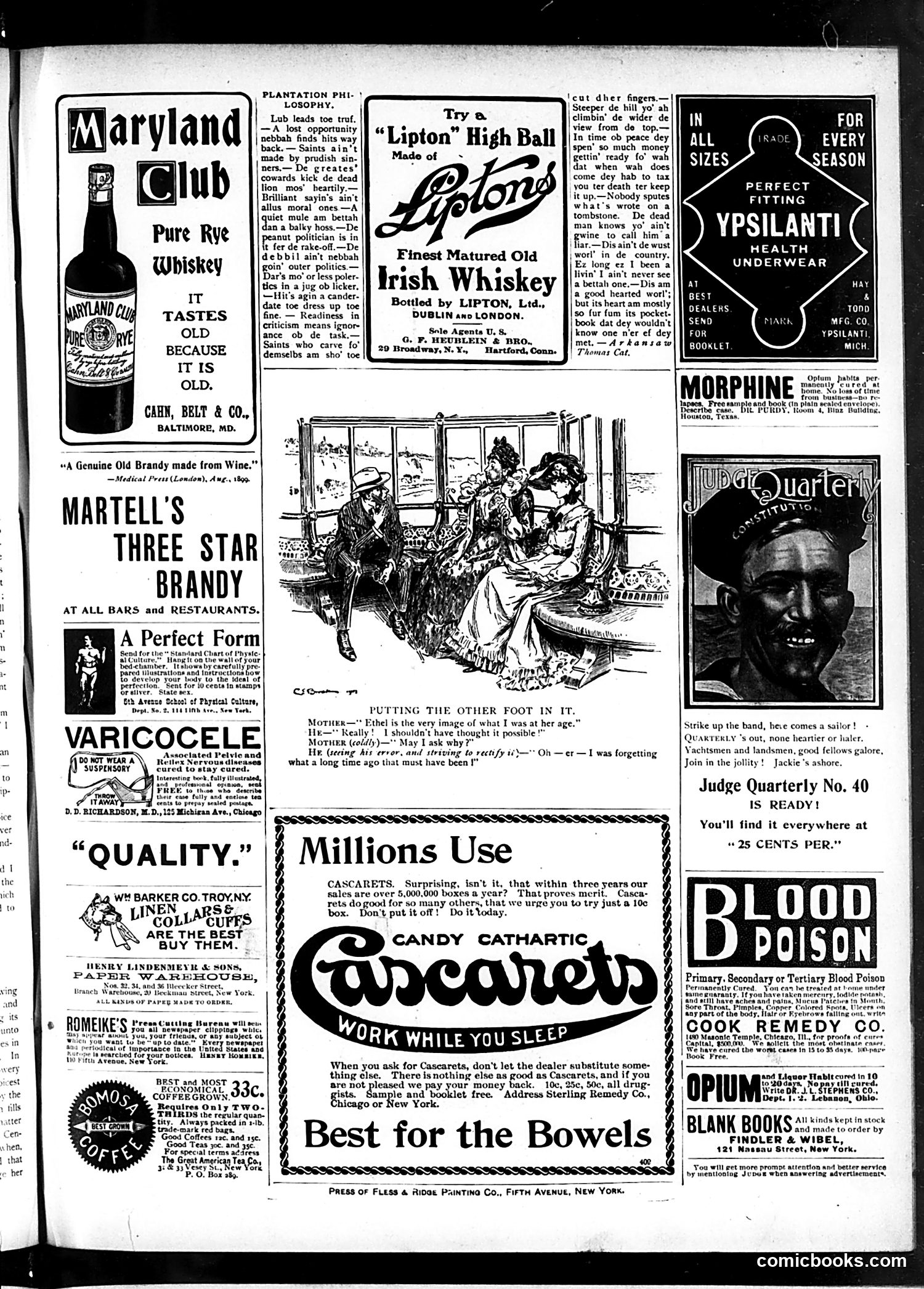
This page is primarily **advertising**, typical of early 1900s magazines. The main editorial content is a single cartoon titled "Putting the Other Foot in It," depicting a social embarrassment: a man compliments a woman's appearance, then awkwardly realizes he's inadvertently insulted her by comparing her to her younger self—implying she's aged significantly. The humor relies on the universal awkwardness of unintended insults. The page also includes "Plantation Philosophy"—dialect-heavy, stereotypical observations attributed to unnamed Black speakers. These represent the casual racism standard in that era's "humor." Numerous advertisements dominate: whiskeys (Maryland Club, Lipton's Irish Whiskey, Martell's Brandy), patent medicines (Cascarets laxative, Morphine, "Blood Poison" cure), underwear (Ypsilanti), and other products. The **Judge Quarterly No. 40** promotion appears, along with advertisements for questionable "remedies" typical of the period before FDA regulation—including opium products and venereal disease treatments, reflecting both the era's medical ignorance and exploitation of desperate patients.
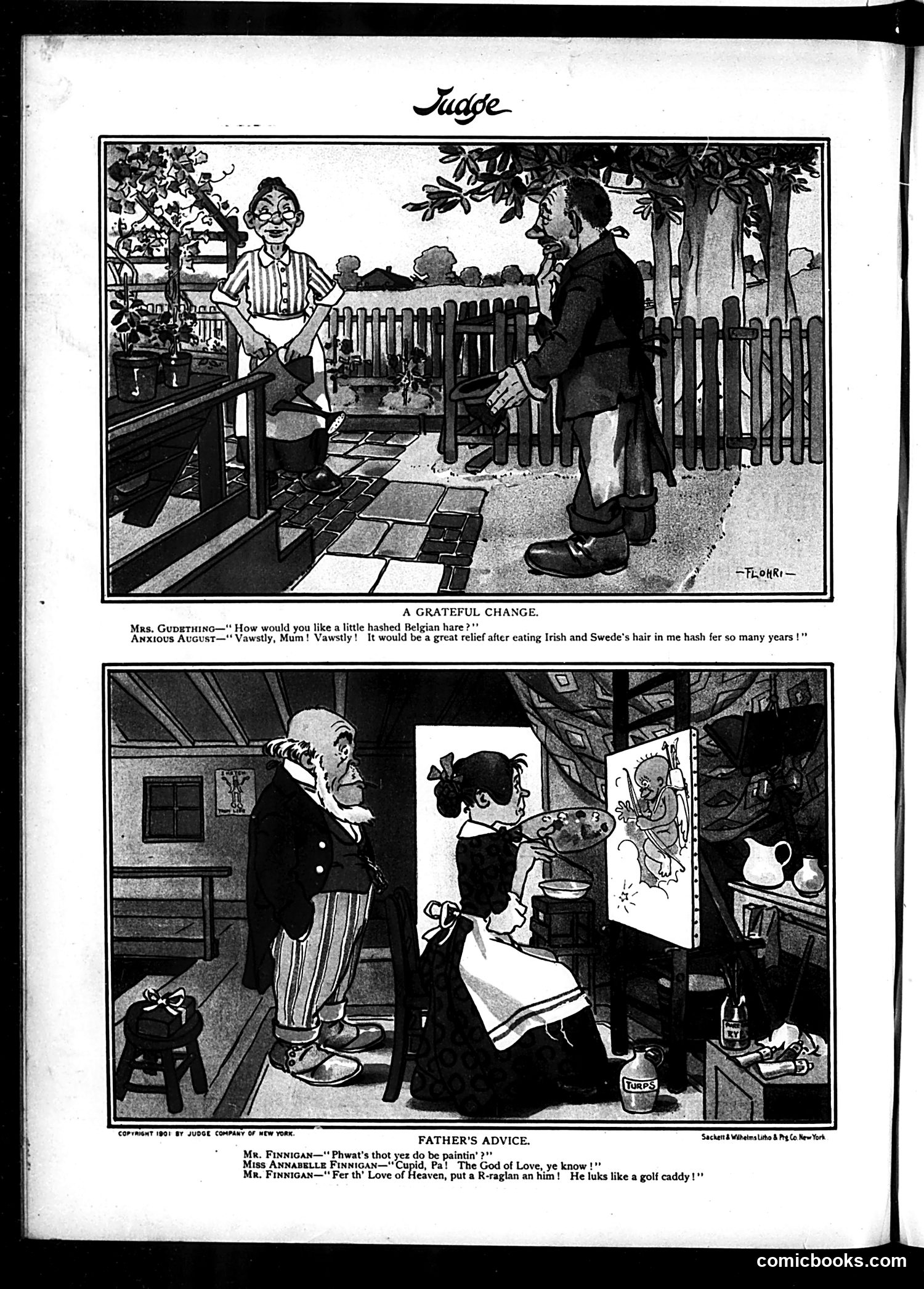
This page contains two satirical cartoons: **"A Grateful Change"** mocks food adulteration scandals. Mrs. Gupthring offers "hashed Belgian hare" to "Anxious August," who expresses relief—suggesting he's been unknowingly eating "Irish and Swede's hair" in his hash for years. This references early 1900s food safety concerns and consumer anxiety about what actually went into processed foods. **"Father's Advice"** depicts an Irish-American family. The daughter (Miss Annabelle Finnigan) paints Cupid, but her father insists she put a "R-raglan" (a type of coat/garment) on the figure because "he luks like a golf caddy"—implying the poorly-drawn figure resembles a working-class laborer rather than a classical god. The humor plays on immigrant families' unfamiliarity with high art and refined culture. Both use ethnic stereotypes (Irish dialect, working-class figures) typical of early Judge satire.