
Judge, 1901-10-12 · page 5 of 16
Judge — October 12, 1901 — page 5: what you’re looking at
What you’re looking at
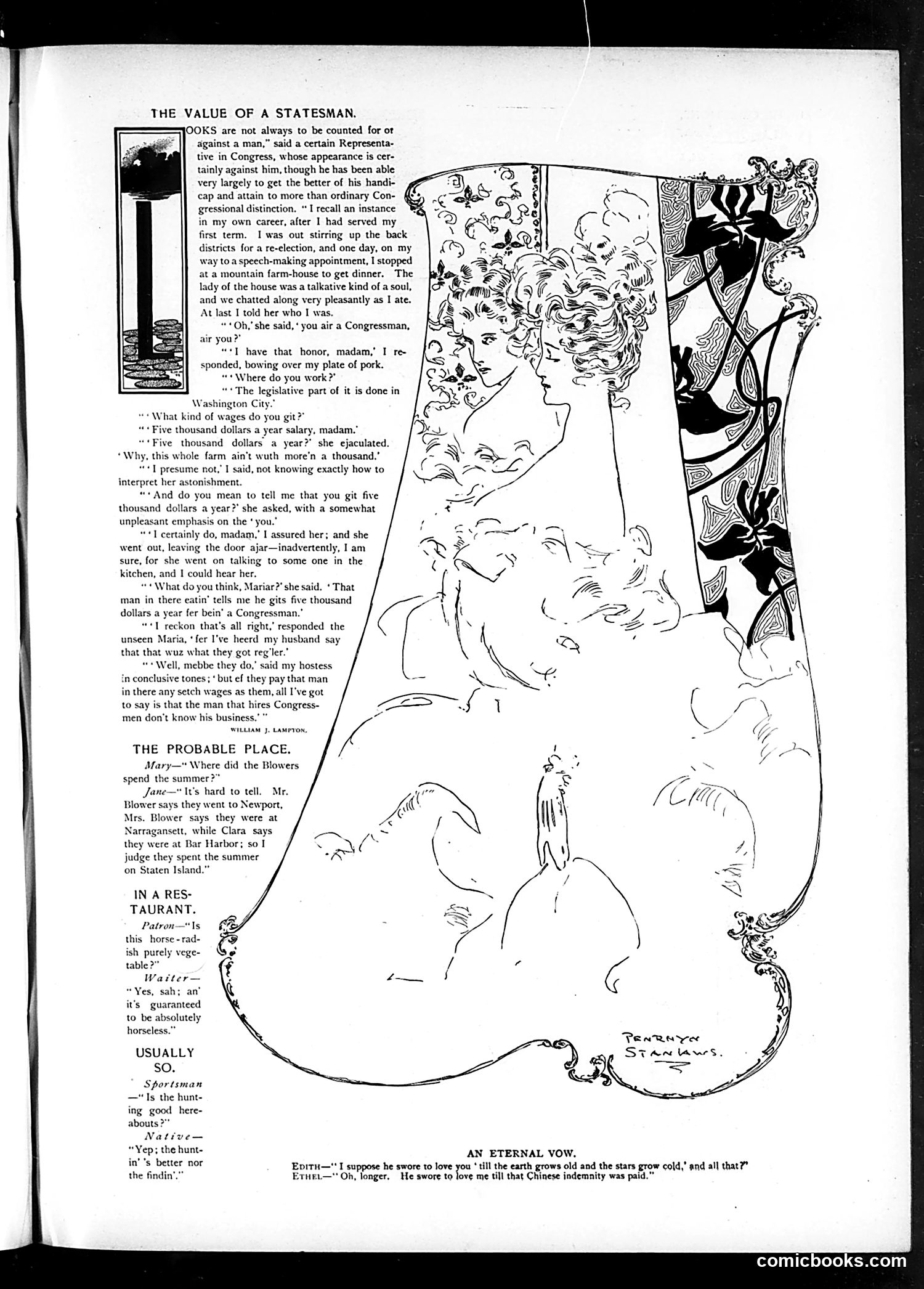
**"The Value of a Statesman"** (main story by William J. Lampton): A congressman tells of visiting a rural farmhouse seeking re-election support. When he mentions earning $5,000 annually, the farm wife is astounded—the entire farm isn't worth that much. After he leaves, she tells her husband (overheard) that "the man that hires Congressmen don't know his business." The satire mocks both the perceived overpayment of congressmen relative to their actual value and rural voters' incredulity at such wages. The page also contains three brief humorous dialogues satirizing social pretension: wealthy people lying about summer destinations, a waiter's absurd restaurant patter, and a woman's cynical wedding vow—joking that her husband swore eternal love, but only until "the Chinese indemnity was paid" (likely referencing post-Boxer Rebellion reparations, circa 1901). All ridicule middle-class hypocrisy and empty rhetoric characteristic of Judge's satirical approach.
📄 Transcribed text from this page (OCR, searchable)
Machine-transcribed from the original scan — historical spelling and the odd misread are preserved.
THE VALUE OF A STATESMAN. JOOKS are not always to be counted for ot against a man,” said a certain Representa- tive in Congress, whose appearance is cer- tainly against him, though he has been able very largely to get the better of his handi- cap and attain to more than ordinary Con- gressional distinction. “I recall an instance in my own career, after I had served my first term. I was out stirring up the back districts for a re-election, and one day, on my way toa speech-making appointment, I stopped at a mountain farm-house to get dinner. The lady of the house was a talkative kind of a soul, and we chatted along very pleasantly as I ate. At last I told her who I was. “+Oh,' she said,‘ you air a Congressman, air you?” “*T have that honor, madam,’ I re- sponded, bowing over my plate of pork. “* Where do you work ?” “*The legislative part of it is done in Washington City.” ~+What kind of wages do you git?” * Five thousand dollars a year salary, madam." | Five thousand dollars a year?’ she ejaculated. ‘Why, this whole farm ain't wuth more'n a thousand.” “+1 presume not,’ I said, not knowing exactly how to interpret her astonishment. “*And do you mean to tell me that you git five thousand dollars a year?’ she asked, with a somewhat unpleasant emphasis on the ‘ you.’ “*T certainly do, madam,’ I assured her; and she went out, leaving the door ajar—inadvertently, Iam sure, for she went on talking to some one in the kitchen, and I could hear her. “* What do you think, Mariar?’ she said. *‘ That man in there eatin’ tells me he gits five thousand dollars a year fer bein’ a Congressman.” “+1 reckon that's all right,’ responded the unseen Maria, ‘fer I've heerd my husband say that that wuz what they got reg’ler.” “*Well, mebbe they do, d my hostess. in conclusive tones ; ‘ but ef they pay that man. in there any setch wages as them, all I've got to say is that the man that hires Congress- men don’t know his business.’ ” WILLIAM J. LastrTON. THE PROBABLE PLACE. Mary—" Where did the Blowers spend the summer?” Jane—" I's hard to tell. Mr. Blower says they went to Newport, Mrs, Blower says they were at i Narragansett, while Clara says } they were at Bar Harbor; so I , judge they spent the summer j on Staten Island.” IN A RES- TAURANT. Patron—"\s this horse -rad- ish purely vege- table?” Watter— “Yes, sah; an’ it's guaranteed to be absolutely horseless.’ USUALLY so. Sportsman —Is the hunt- ing good here- abouts?" Native— “Yep; the hunt- in’'s better nor the findin’.” AN ETERNAL VOW. ou ‘till the earth grows old and the stars grow cold,’ and all that?” I suppose he swore to love Tove me till that Chinese indemnity was pald.” “Oh, longer, He swore to comicbooks.com