
Judge, 1901-10-12 · page 2 of 16
Judge — October 12, 1901 — page 2: what you’re looking at
What you’re looking at
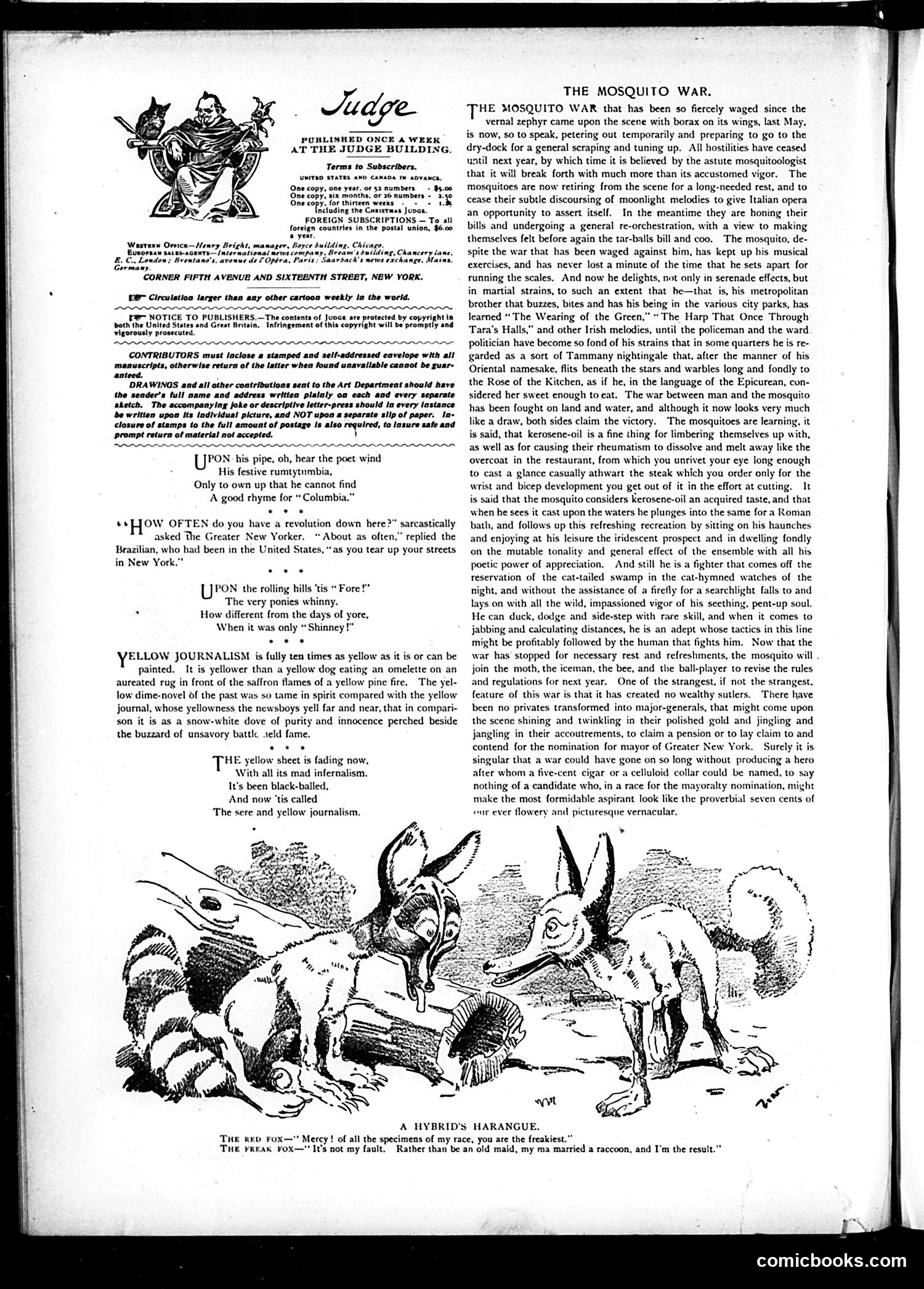
This page contains two distinct articles. "The Mosquito War" is a humorous essay about New York City's battle against mosquitoes—described as retiring from their summer haunts and engaging in "orchestral" efforts with Italian opera references. The satirical tone mocks how seriously the city treats the pest problem. Below is a cartoon titled "A Hybrid's Harangue" featuring two dog-like creatures (one labeled "red fox," one "freak fox"). The dialogue jokes about mixed parentage: the red fox calls the other a freak, but the freak responds that being half-raccoon offspring is preferable to being "an old maid." This satirizes anxieties about hybrid identity and racial mixing through animal metaphor—common in period satire—though the specific social target remains unclear.
📄 Transcribed text from this page (OCR, searchable)
Machine-transcribed from the original scan — historical spelling and the odd misread are preserved.
PUBLISHED ONCE A WEEK AT THE JUDGE BUILDI2 Terms to Subscribers. FOREIGN SUBSCRIPTIONS — To all foreign countries in the postal union, $6.00 a year. per, Boyce bu sewed comipaam ‘Optra, Parit ting. Chicage CORNER FIFTH AVENUE AND SIXTEENTH STREET, NEW YORK. (8&7 Circulation larger than any other cartoon weekly 1a the world. TW- NOTICE TO PUBLISHERS.—The contents of Juocs both the United States and Great Britain. lafringement of this ected by copyright in vigorously prosecuted, ‘will be promptly and CONTRIBUTORS must Inclose # stamped and self-addressed eavelope with all manuscripts, otherwise retura of the latter when found unavallable cannot be guar- anteed. DRAWINGS aad all other contributions sent to the Art Department should have the seader’s full name and address written plalaly oo each and every separate sketch. The accompanylag joke or descriptive letter-press should In every lastance be written upon Its Individual picture, and NOT upon a separate slip of paper. la- closure of stamps to the full amount of postage Is also required, to lasure safe and prompt retura of material aot accepted. ' [PON his pipe, ob, hear the poet wind His festive rumtytumbia, Only to own up that he cannot find A good rhyme for “Columbia.” 6s LJOW OFTEN do you have a revolution down here?" sarcastically asked the Greater New Yorker. “About as often.” replied the Brazilian, who had been in the United States, ‘as you tear up your streets in New York.” ae PON the rolling hills ‘ts The very ponies whinny. How different from the days of yore, When it was only **Shinney !* YELLOW JOURNALISM is fully ten times as yellow as itis or can be painted. It is yellower than a yellow dog eating an omelette on an aureated rug in front of the saffron flames of a yellow pine fire. The yel- low dime-novel of the past was so tame in spirit compared with the yellow journal, whose yellowness the newsboys yell far and near, that in compari- son it is as a snow-white dove of purity and innocence perched beside the buzzard of unsavory battle eld fame. THE yellow sheet is fading now, With all its mad infernalism. It's been black-balled, And now ‘tis called The sere and yellow journalism. THE MOSQUITO WAR. THE MOSQUITO WAR that has been so fiercely waged since the vernal zephyr came upon the scene with borax on its wings, last May, is now, so to speak, petering out temporarily and preparing to go to the dry-dock for a general scraping and tuning up. All hostilities have ceased uatil next year, by which time it is believed by the astute mosquitoologist that it will break forth with much more than its accustomed vigor. The mosquitoes are now retiring from the scene for a long-needed rest, and to cease their subtle discoursing of moonlight melodies to give Italian opera an opportunity to assert itself. In the meantime they are honing their bills and undergoing a general re-orchestration, with a view to making themselves felt before again the tar-balls bill and coo. The mosquito, de- spite the war that has been waged against him, has kept up his musical exercises, and has never lost a minute of the time that he sets apart for running the scales. And now he delights, not only in serenade effects. but in martial strains, to such an extent that he—that is, his metropolitan brother that buzzes, bites and has his being in the various city parks, has learned “The Wearing of the Green,” “The Harp That Once Through Tara's Halls,” and other Irish melodies, until the policeman and the ward politician have become so fond of his strains that in some quarters he is re- garded as a sort of Tammany nightingale that, after the manner of his Oriental namesake, flits beneath the stars and warbles long and fondly to the Rose of the Kitchen, as if he, in the language of the Epicurean, con- sidered her sweet enough to eat. The war between man and the mosquito has been fought on land and water, and although it now looks very much like a draw, both sides claim the victory. The mosquitoes are learning, it is said, that kerosene-oil is a fine thing for limbering themselves up with, as well as for causing their rheumatism to dissolve and melt away like the overcoat in the restaurant, from which you unrivet your eye long enough to cast a glance casually athwart the steak which you order only for the wrist and bicep development you get out of it in the effort at cutting. It is said that the mosquito considers Kerosene-oil an acquired taste, and that when he sees it cast upon the waters he plunges into the same fora Roman bath, and follows up this refreshing recreation by sitting on his haunches and enjoying at his leisure the iridescent prospect and in dwelling fondly on the mutable tonality and general effect of the ensemble with all his poetic power of appreciation. And still he is a fighter that comes off the reservation of the cat-tailed swamp in the cat-hymned watches of the night, and without the assistance of a firefly for a searchlight falls to and lays on with all the wild, impassioned vigor of his seething, pent-up soul. He can duck, dodge and side-step with rare skill, and when it comes to jabbing and calculating distances, he is an adept whose tactics in this line might be profitably followed by the human that fights him. Now that the war has’ stopped for necessary rest and refreshments, the mosquito will join the moth, the iceman, the bee, and the ball-player to revise the rules and regulations for next year. One of the strangest, if not the strangest, feature of this war is that it has created no wealthy sutlers. There have been no privates transformed into major-generals, that might come upon the scene shining and twinkling in their polished gold and jingling and jangling in their accoutrements, to claim a pension or to lay claim to and contend for the nomination for mayor of Greater New York. Surely it is singular that a war could have gone on so long without producing a hero after whom a five-cent cigar or a celluloid collar could be named, to say nothing of a candidate who, in a race for the mayoralty nomination, might make the most formidable aspirant look like the proverbial seven cents of ‘onr ever flowery and picturesque vernacular. A HYBRID's HARANGUE, THE RED FOX. THe yRrak YOX—" It’s not my fault. * Mercy ! of all the specimens of my race, you are the freakiest.” Rather than be an old maid, my ma married a raccoon, and I'm the result.”” comicbooks.com