
Judge, 1901-10-12 · page 6 of 16
Judge — October 12, 1901 — page 6: what you’re looking at
What you’re looking at
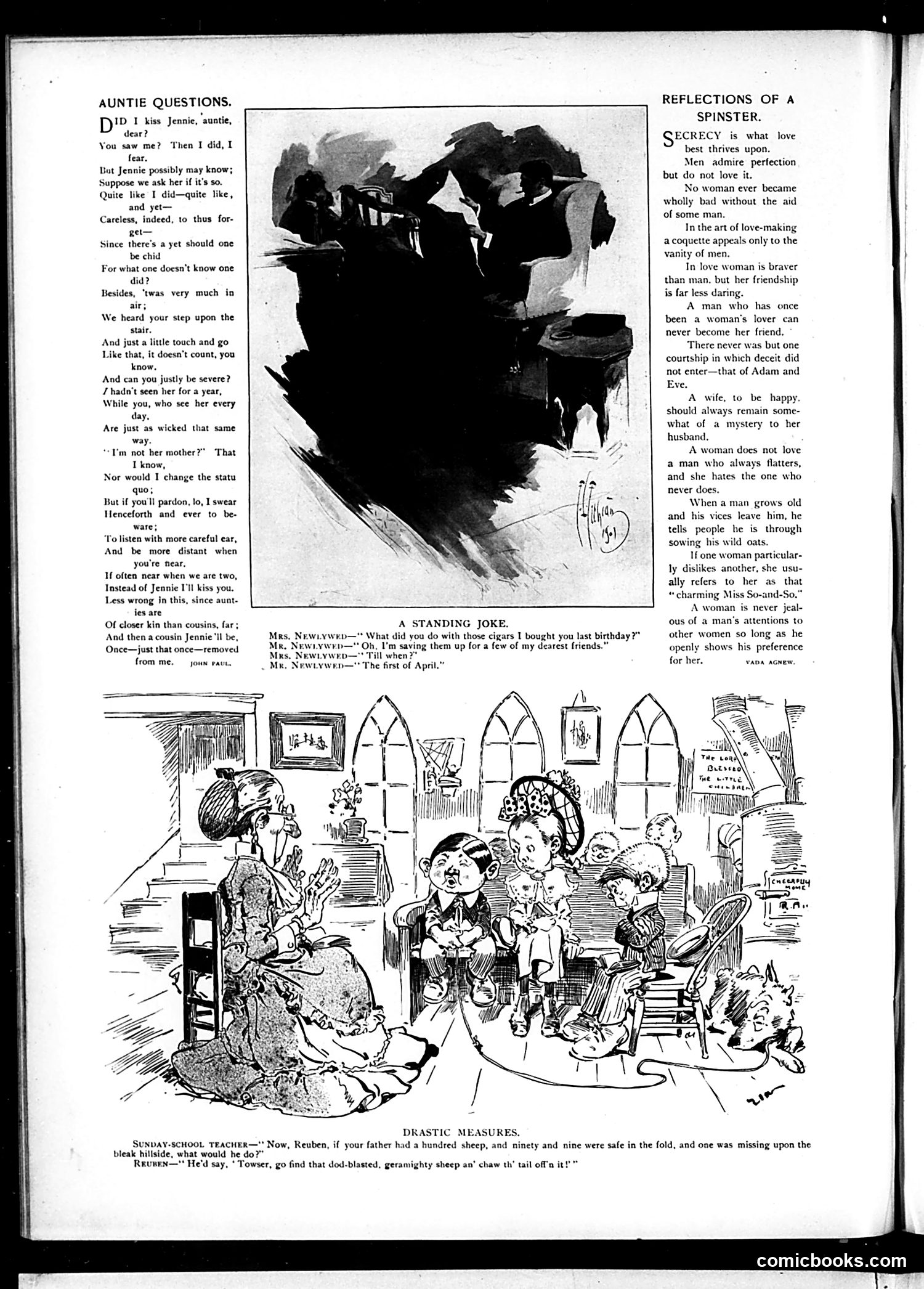
This page contains three distinct pieces of period humor: **"Auntie Questions"** (top left): A young man nervously explains to his aunt that he kissed his cousin Jennie. He argues the kiss "doesn't count" because it was brief and unplanned, then turns the tables by pointing out the aunt herself flirts with him. He promises future restraint—or jokingly offers to kiss the aunt instead since she's closer kin. The satire mocks Victorian courtship anxieties and the supposed propriety of family relations. **"A Standing Joke"** (center): A newlywed husband claims he's "saving" expensive cigars his wife gave him for "dearest friends" on April 1st (April Fools' Day). The joke satirizes newly married men's tendency to prioritize their friends over wives, while hinting he's being dishonest about the cigars. **"Drastic Measures"** (bottom): A Sunday-school teacher poses a biblical parable about lost sheep to a boy named Reuben, who responds with crude rural practicality, suggesting violent revenge on the stray sheep. The humor comes from the child's earthy, unchristian response to a moral lesson.
📄 Transcribed text from this page (OCR, searchable)
Machine-transcribed from the original scan — historical spelling and the odd misread are preserved.
AUNTIE QUESTIONS. ID I kiss Jennie, ‘auntie, dear? You saw me? fear. Bat Jennie possibly may know; Suppose we ask her if it’s so. Quite like I did—quite like, and yet— Careless, indeed, to thus for- get— Since there’s a yet should one be chid For what one doesn't know one did? Besides, ‘twas very much in air; We heard your step upon the stair. And just a little touch and go Like that, it doesn’t count, you know, And can you justly be severe? Thadn't seen her for a year, While you, who see her every day, Are just as wicked that same way. “-T'm not her mother?” I know, Nor would I change the statu quo; But if you'll pardon, lo, I swear Henceforth and ever to be- ware; ‘To listen with more careful ear, And be more distant when you're near. Then I did, ‘That If often near when we are two, Instead of Jennie I'll kiss you, Less wrong in this, since aunt- ies are Of closer kin than cousins, far; And then a cousin Jennie ll be, Once—just that once—removed from me. jouw rave. SUNDAY-SCHOOL TEACHER— bleak hillside, what would he do? Rrunen—" He'd say, * [is A STANDING JOKE. Mrs. 1LyWED—"* What did you do with those cigars T bought you last birthday?” Mr. Newnywen—" Oh, I’m saving them up for a few of my dearest friends.” Mrs, NewLyweo—" Till when ?* Mx. NewLywep—" The first of April.” l/\g ( hi ill - REFLECTIONS OF A SPINSTER. SECRECY is what love best thrives upon. Men admire perfection but do not love it. No woman ever became wholly bad without the aid of some man. In the art of love-making a coquette appeals only to the vanity of men. In love woman is braver than man, but her friendship is far less daring. A man who has once been a woman's lover can never become her friend. There never was but one courtship in which deceit did not enter—that of Adam and Eve. A wife, to be happy. should always remain some- what of a mystery to her husband. A woman does not love a man who always flatters, and she hates the one who never does. When a man grows old and his vices leave him, he tells people he is through sowing his wild oats. If one woman particular- ly dislikes another, she usu- ally refers to her as that “charming Miss So-and-So.” A woman is never jeal- ous of a man’s attentions to other women so long as he openly shows his preference for her. VADA AGNEW. DRASTIC MEASURES. Now, Reuben, if your father had a hundred sheep, and ninety and nine were safe in the fold, and one was missing upon the Towser, go find that dod-blasted, geramighty sheep an’ chaw th’ tail off'a it!" comicbooks.com