
Judge, 1901-10-12 · page 3 of 16
Judge — October 12, 1901 — page 3: what you’re looking at
What you’re looking at
This satirical piece by Henry Watterson mocks Democratic presidential candidate Samuel J. Tilden during the 1876 election campaign. The story describes Tilden's overly cautious approach to politics—his reluctance to commit resources or take decisive action during the critical Indiana campaign. The "blue seal" serves as the satire's central joke: Tilden refuses to wear new clothes, insisting on keeping old, worn garments. This represents his stingy, timid political strategy. Watterson uses this humorous anecdote to criticize Tilden as passive and ineffectual, suggesting his penny-pinching and hesitance cost Democrats the election. The cartoon's target is Tilden's perceived weakness as a candidate—his unwillingness to invest adequately in securing victory.
📄 Transcribed text from this page (OCR, searchable)
Machine-transcribed from the original scan — historical spelling and the odd misread are preserved.
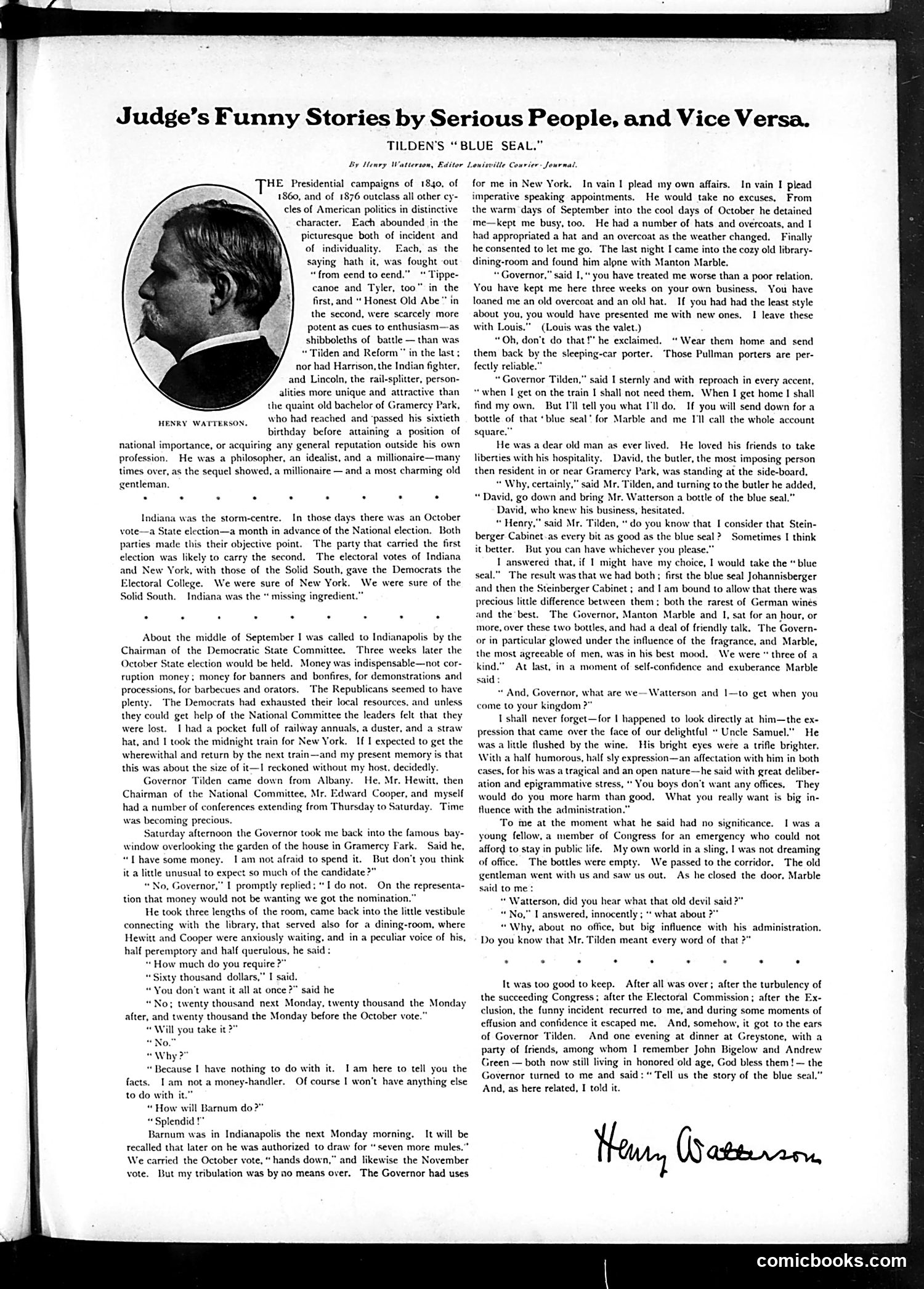
Judge’s Funny Stories by Serious People, and Vice Versa. TILDEN’S “BLUE SEAL.” By Henry Watterton, Editor Lewisville Convier- Journal. THE Presidential campaigns of 1840, of 1860, and of 1876 outclass all other cy cles of American politics in distinctive character. Each abounded in ‘the picturesque both of incident and of individuality. Each, as the saying hath it, was fought out from eend to cend.” * Tippe- canoe and Tyler, too” in the first, and “ Honest Old Abe” i the second, were scarcely more potent as cues to enthusiasm—as shibboleths of battle — than was. “ Tilden and Reform” in the last ; nor had Harrison, the Indian fighter, and Lincoln, the rail-splitter, person- alities more unique and attractive than the quaint old bachelor of Gramercy Park, who had reached and ‘passed his sixtieth birthday before attaining a position of national importance, or acquiring any general reputation outside his own profession. He was a philosopher, an idealist, and a millionaire—many times over, as the sequel showed, a millionaire — and a most charming old. gentleman. Indiana was the storm-centre. In those days there was an October vote—a State election—a month in advance of the National election. Both parties made this their objective point. The party that carried the first election was likely to carry the second, The electoral votes of Indiana and New York, with those of the Solid South, gave the Democrats the Electoral College. We were sure of New York. We were sure of the Solid South. Indiana was the “ missing ingredien About the middle of September I was called to Indianapolis by the Chairman of the Democratic State Committee. Three weeks later the October State election would be held. Money was indispensable—not cor- ruption money; moncy for banners and bonfires, for demonstrations and processions, for barbecues and orators. The Republicans seemed to have plenty. The Democrats had exhausted their local resources. and unless they could get help of the National Committee the leaders felt that they were lost. I had a pocket full of railway annuals, a duster, and a straw hat, and I took the midnight train for New York. If I expected to get the wherewithal and return by the next train—and my present memory is that this was about the size of it—I reckoned without my host. decidedly. Governor Tilden came down from Albany. He. Mr. Hewitt, then Chairman of the National Committee, Mr. Edward Cooper, and myself had a number of conferences extending from Thursday to Saturday. Time was becoming precious. Saturday afternoon the Governor took me back into the famous bay- window overlooking the garden of the house in Gramercy Fark. Said he, “Thave some money. 1am not afraid to spend it. But don’t you think it a little unusual to expect so much of the candidate 2” No, Governor,” | promptly replied: “I do not. On the representa- tion that money would not be wanting we got the nomination.” He took three lengths of the room, came back into the little vestibule connecting with the library, that served also for a dining-room, where Hewitt and Cooper were anxiously waiting, and in a peculiar voice of his, half peremptory and half querulous, he said : “How much do you require ? “Sixty thousand dollars,” I said. * You don’t want it all at once ?” said he “No; twenty thousand next Monday, twenty thousand the Monday after, and twenty thousand the Monday before the October vote.” “Will you take it?" “No. Why?” “Because | have nothing to do with it. facts. [am not a money-handler. to do with it.” * How will Barnum do?” “ Splendid !" Barnum was in Indianapolis the next Monday morning. It will be recalled that later on he was authorized to draw for “seven more mules.” We carried the October vote, “ hands down,” and likewise the November vote. But my tribulation was by no means over. The Governor had uses Tam here to tell you the Of course I won't have anything else for me in New York. In vain I plead my own affairs. In vain I plead imperative speaking appointments. He would take no excuses, From the warm days of September into the cool days of October he detained me—kept me busy, too. He had a number of hats and overcoats, and I had appropriated a hat and an overcoat as the weather changed. Finally he consented to let me go. The last night I came into the cozy old library dining-room and found him alpne with Manton Marble. Governor,” said I," you have treated me worse than a poor relation. You have kept me here three weeks on your own business. You have loaned me an old overcoat and an old! hat. If you had had the least style about you, you would have presented me with new ones. I leave these with Louis.” (Louis was the valet.) “Oh, don't do that!" he exclaimed. “Wear them home and send them back by the sleeping-car porter. Those Pullman porters are per- fectly reliable. “ Governor Tilden,” said I sternly and with reproach in every accent, “when I get on the train I shall not need them, When I get home I shall find my own, But I'll tell you what I'll do. If you will send down for a bottle of that ‘blue seal’ for Marble and me I'll call the whole account square.” He was a dear old man He loved his friends to take liberties with his hospitality. David, the butler, the most imposing person then resident in or near Gramercy Park, was standing at the side-board, “ Why, certainly,” said Mr. Tilden, and turning to the butler he added, “ David, go down and bring Mr. Watterson a bottle of the blue seal.” David, who knew his business, hesitated. “ Henry,” said Mr. Tilden, “do you know that I consider that Stein- berger Cabinet.as every bit as good as the blue seal? Sometimes I think it better. But you can have whichever you please.” I answered that, if 1 might have my choice, I would take the “blue seal.” The result was that we had both ; first the blue seal Johannisberger and then the Steinberger Cabinet ; and | am bound to allow that there was precious little difference between them ; both the rarest of German wines and the'best.. The Governor, Manton Marble and I, sat for an hour, or more, over these two bottles, and had a deal of friendly talk. The Govern- or in particular glowed under the influence of the fragrance, and Marble, the most agreeable of men, was in his best mood. We were “ three of a kind.” At last, in a moment of self-confidence and exuberance Marble said: ever lived, ~ And, Governor, what are we—Watterson and 1—to get when you come to your kingdom ?” Ishall never forget—for | happened to look directly at him—the ex- pression that came over the face of our delightful “* Uncle Samuel was a little flushed by the wine. His bright eyes were a trifle brighter. With a half humorous, half sly expression—an affectation with him in both cases, for his was a tragical and an open nature—he said with great deliber- ation and epigrammative stress, “ You boys don’t want any offices. They would do you more harm than good, What you really want is big in- fluence with the administration.” To me at the moment what he said had no significance. 1 was a young fellow, a member of Congress for an emergency who could not afford to stay in public life. My own world in a sling, I was not dreaming of office. The bottles were empty. We passed to the corridor. The old gentleman went with us and saw us out. As he closed the door, Marble said to me: “ Watterson, did you hear what that old devil said 2” * No,” I answered, innocently ; “ what about ? “Why, about no office, but big influence with his administration. Do you know that Mr. Tilden meant every word of that ?” It was too good to keep. After all was over; after the turbulency of the succeeding Congress; after the Electoral Commission; after the Ex- clusion, the funny incident recurred to me, and during some moments of effusion and confidence it escaped me, And, somehow, it got to the ears of Governor Tilden. And one evening at dinner at Greystone, with a party of friends, among whom I remember John Bigelow and Andrew Green — both now still living in honored old age, God bless them! — the Governor turned to me and said: “Tell us the story of the blue seal.” And, as here related, I told it. Hein (dactirere comicbooks.com