
A complete issue · 22 pages · 1901
Judge — September 21, 1901
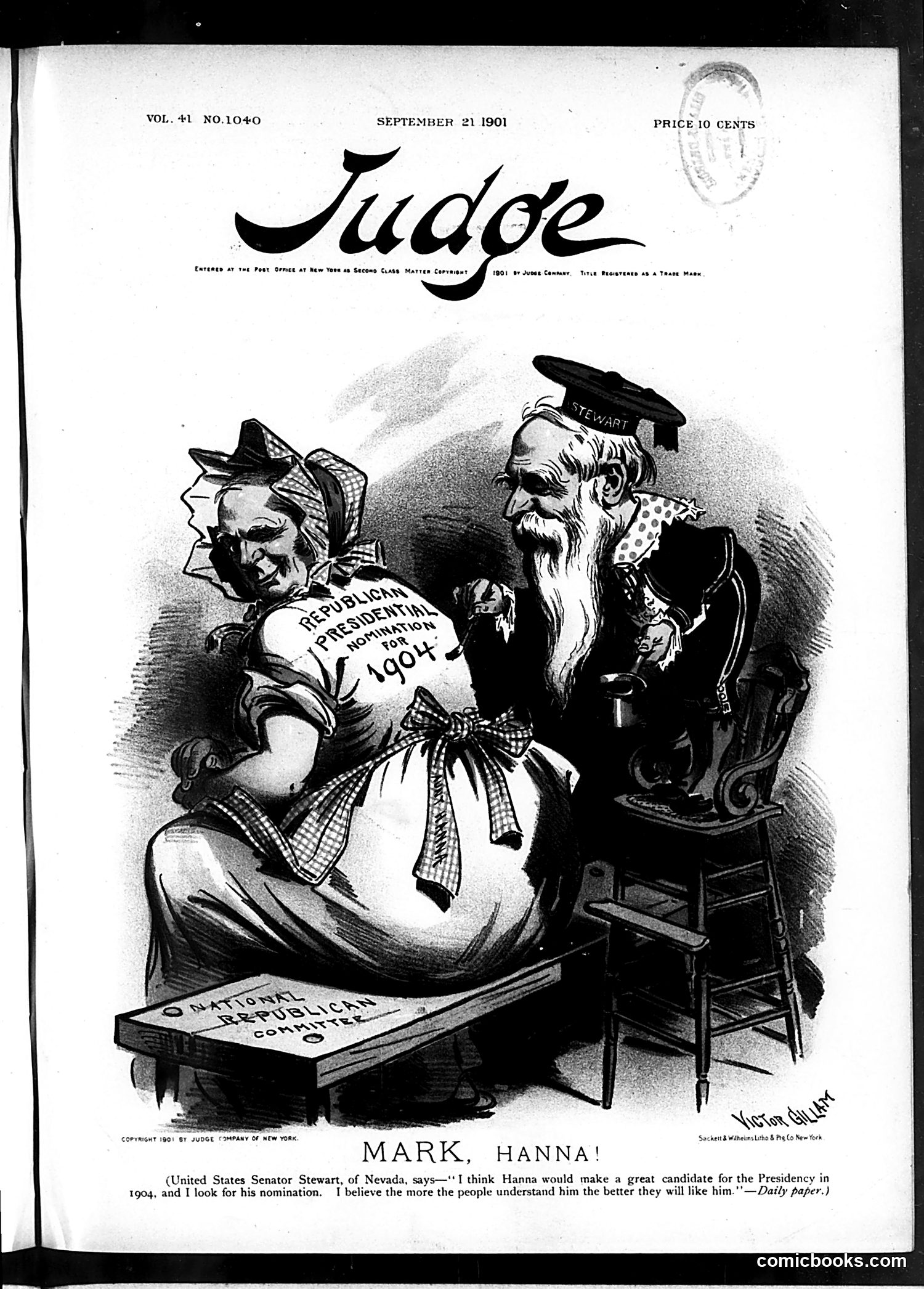
This political cartoon satirizes Senator William Stewart of Nevada's support for Mark Hanna as a presidential candidate for 1904. The image depicts Hanna (the bearded figure wearing a "Stewart" cap) being figuratively "marked" or branded by the Republican establishment. The central figure represents the "Republican Presidential Nomination" for 1904, shown as a plump woman being groomed for presentation. The satire mocks Stewart's endorsement of Hanna, playing on the double meaning of "mark"—both as a target and as a sign or brand. The cartoon suggests the Republican machinery was actively promoting Hanna's candidacy, with Stewart's support helping to "mark" him as the chosen nominee. The judges and establishment figures oversee this political process with self-satisfied expressions.
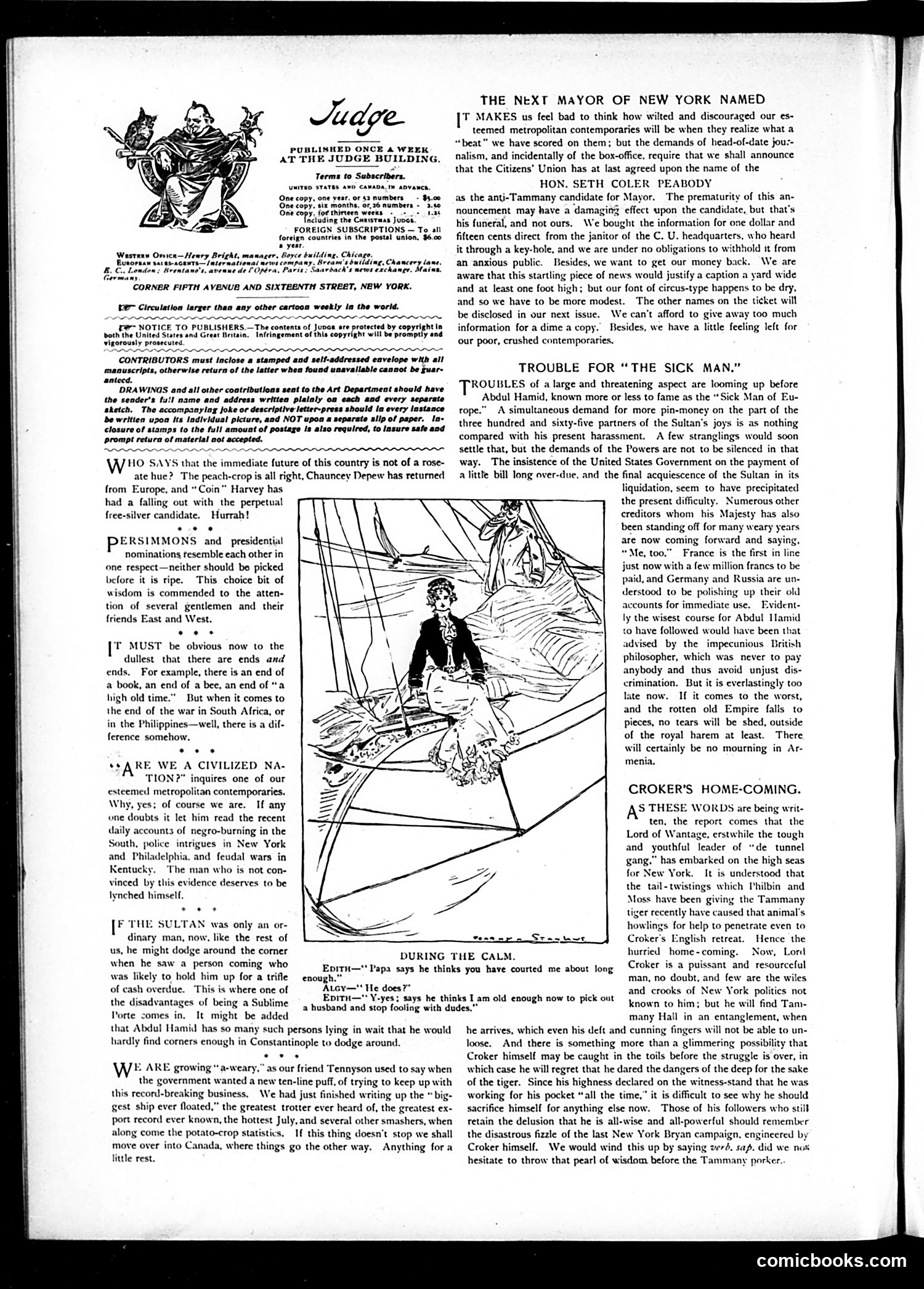
The cartoon depicts a conversation between two figures aboard what appears to be a ship during rough seas. The dialogue—"Papa says he thinks you have courted me about long enough" and "He does? Well, say! thinks I am old enough now to pick out a husband and stop fooling with dudes"—suggests a courtship dispute between a young woman and suitor. The nautical setting and dramatic wave illustration create a metaphorical "calm before the storm." The satire appears to mock Victorian courtship customs and paternal control over marriage decisions. The woman's impatient assertion of independence satirizes both old-fashioned parental authority and the tension between traditional marriage conventions and emerging female agency in early 20th-century American society.
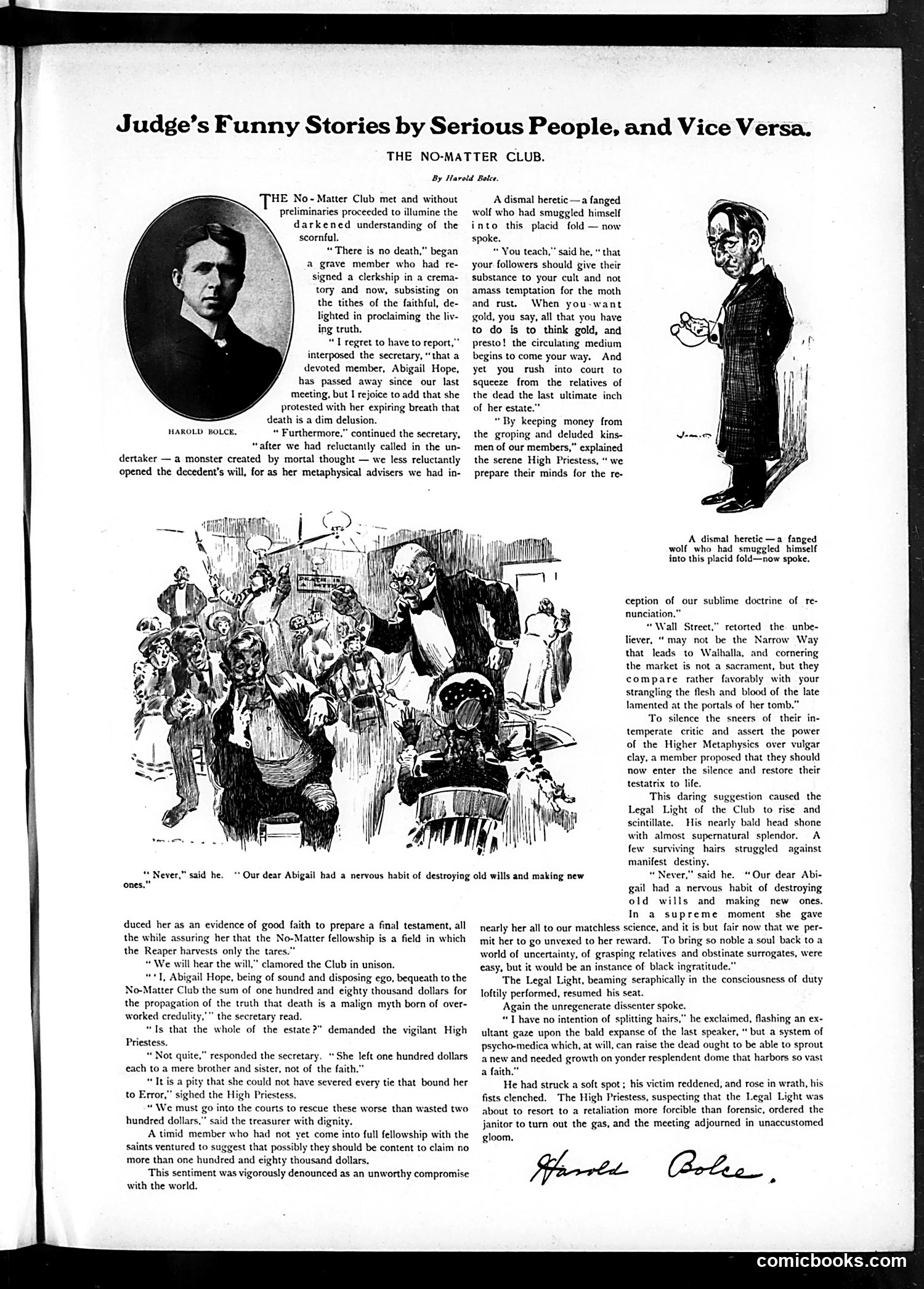
This satirical piece mocks a fictional philosophical club debating metaphysical concepts while ignoring practical realities. The story centers on Abigail Hope, a deceased member whose estate is in dispute. The satire targets members who espouse high-minded doctrines about reincarnation and "Higher Metaphysics" while simultaneously scheming over her inheritance. When the club proposes using occult methods to contact Abigail's spirit to resolve the will dispute, the treasurer cynically demands practical terms: "one hundred dollars each to a mere brother or sister, not of the faith." The cartoon illustrates the club's grandiose séance-style gathering. The humor exposes the gap between idealistic spiritual philosophy and base material self-interest—a common Progressive-era critique of both wealthy elites and fraudulent spiritualism movements.
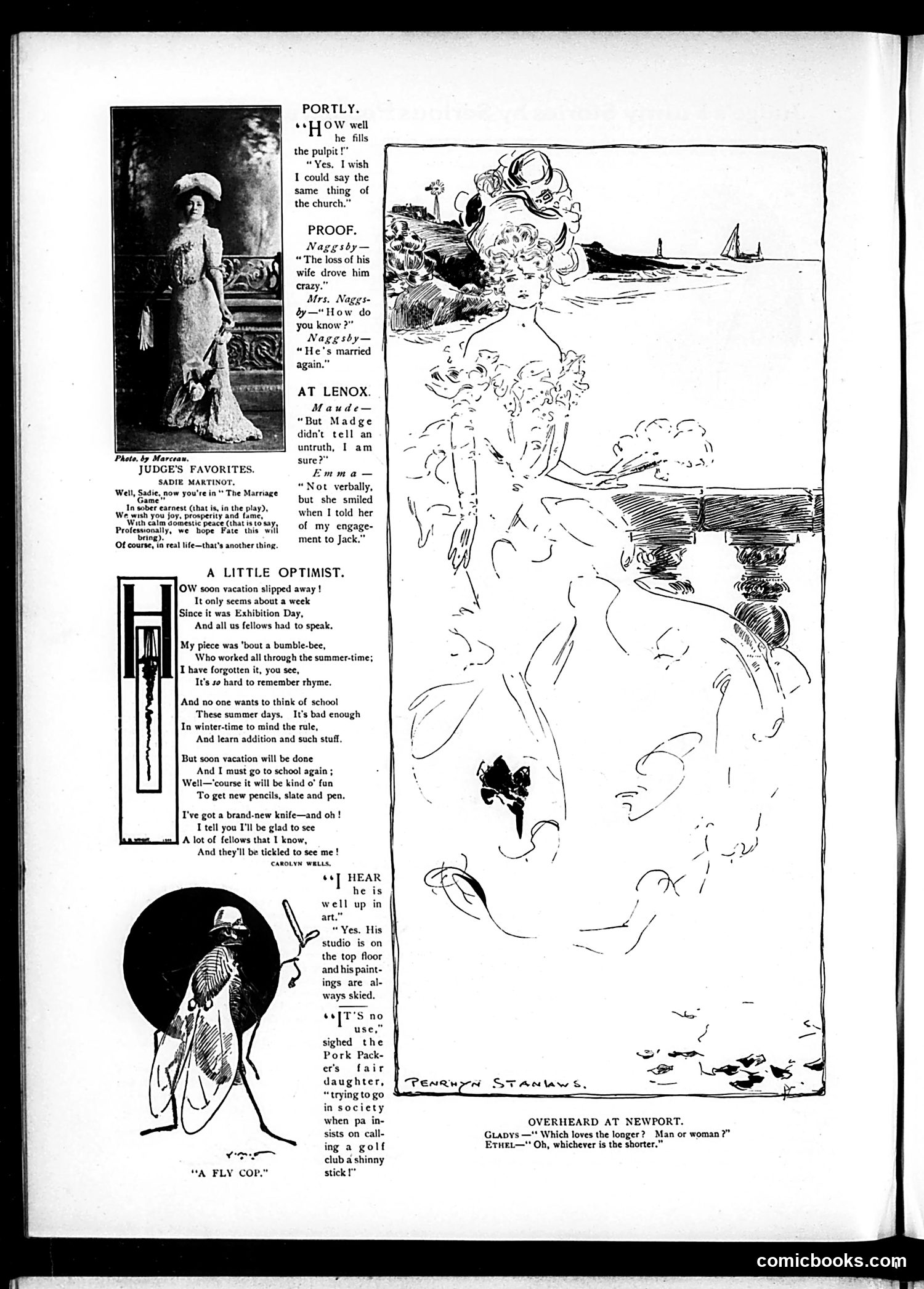
This page contains several distinct pieces of humor: **"Portly"** presents dialogue about someone's fitness for a pulpit position, with a photograph of an elegantly dressed woman—likely commenting on physical appearance affecting credibility or social position. **"A Little Optimist"** is a poem about a student anticipating summer vacation, reflecting early-20th-century schoolboy sentiments about freedom from academic routine. **"A Fly Cop"** is a cartoon caricature of an insect character, appearing to be wordplay-based humor (the title puns on "fly" as both insect and slang for clever/stylish). **"Overhead at Newport"** presents a brief social joke about class distinctions at the wealthy Newport resort area, mocking pretension. **"Penrwyn Stanawas"** is a sketch labeled as such, though its specific satirical target is unclear from the image alone. The page represents typical Judge magazine content: social satire, visual humor, and light verse.
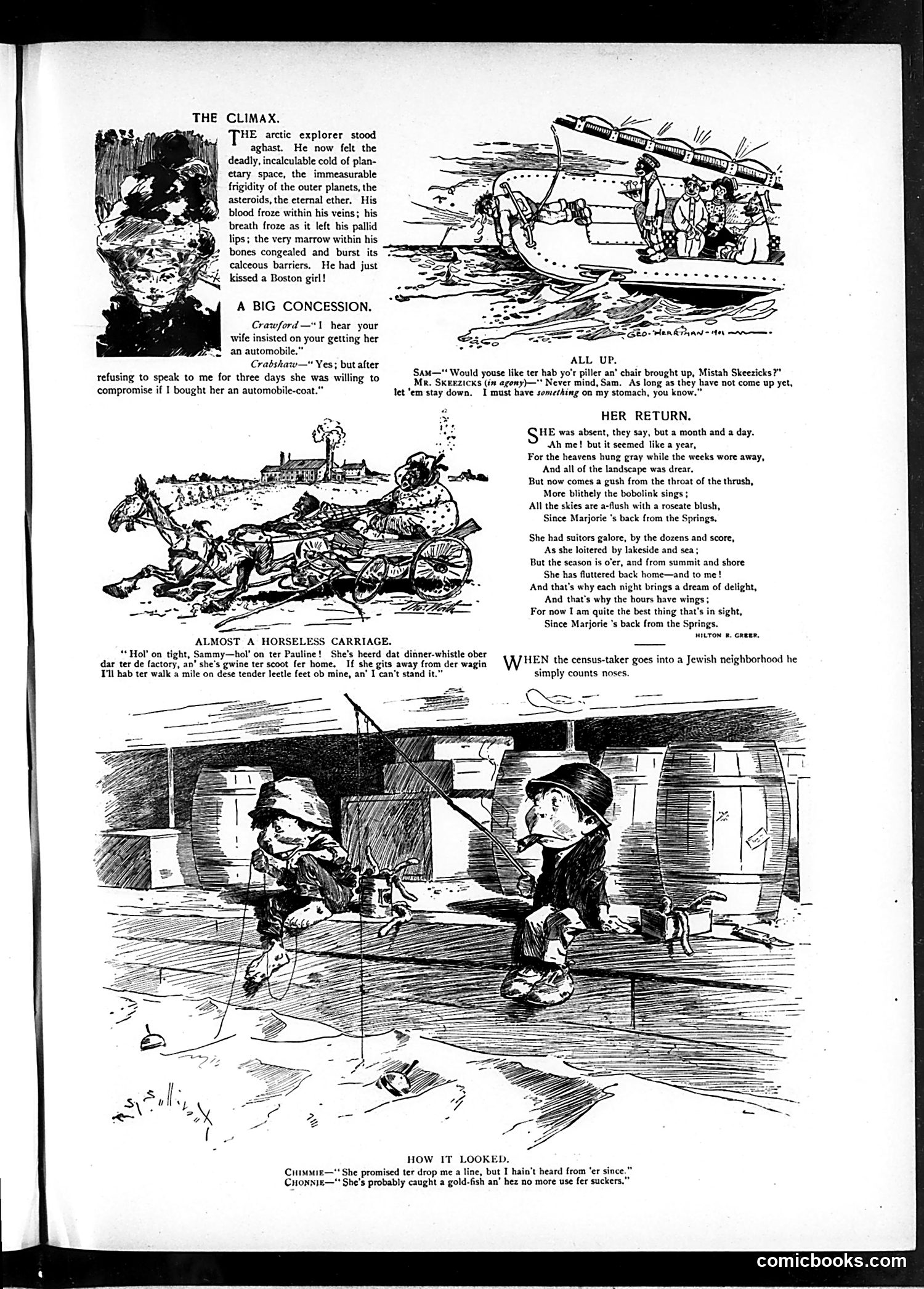
This page contains multiple short satirical pieces typical of early 20th-century American humor: **"The Climax"** jokes that kissing a Boston girl is colder than arctic exploration—reflecting a stereotype of Boston women as frigid or unromantic. **"A Big Concession"** mocks married life: a wife demands an automobile, refuses to speak for days, then accepts a cheaper "automobile coat" (car-themed clothing) as compromise—satirizing both female materialism and marital negotiation. **"Her Return"** is sentimental poetry about a woman returning from "the Springs" (a spa resort), celebrated as the highlight of the narrator's life—gently mocking both romantic excess and the social conventions of wealthy leisure travel. **"Almost a Horseless Carriage"** uses dialect humor (representing African American speech) about a horse responding to the factory dinner whistle. **The census joke** stereotypes Jewish families as large ("counts noses"). **"How It Looked"** makes a fishing/romance pun: a woman who promised to write is "probably caught a gold-fish" and no longer needs the "sucker." The humor relies on dated stereotypes and period-specific social references now requiring explanation.
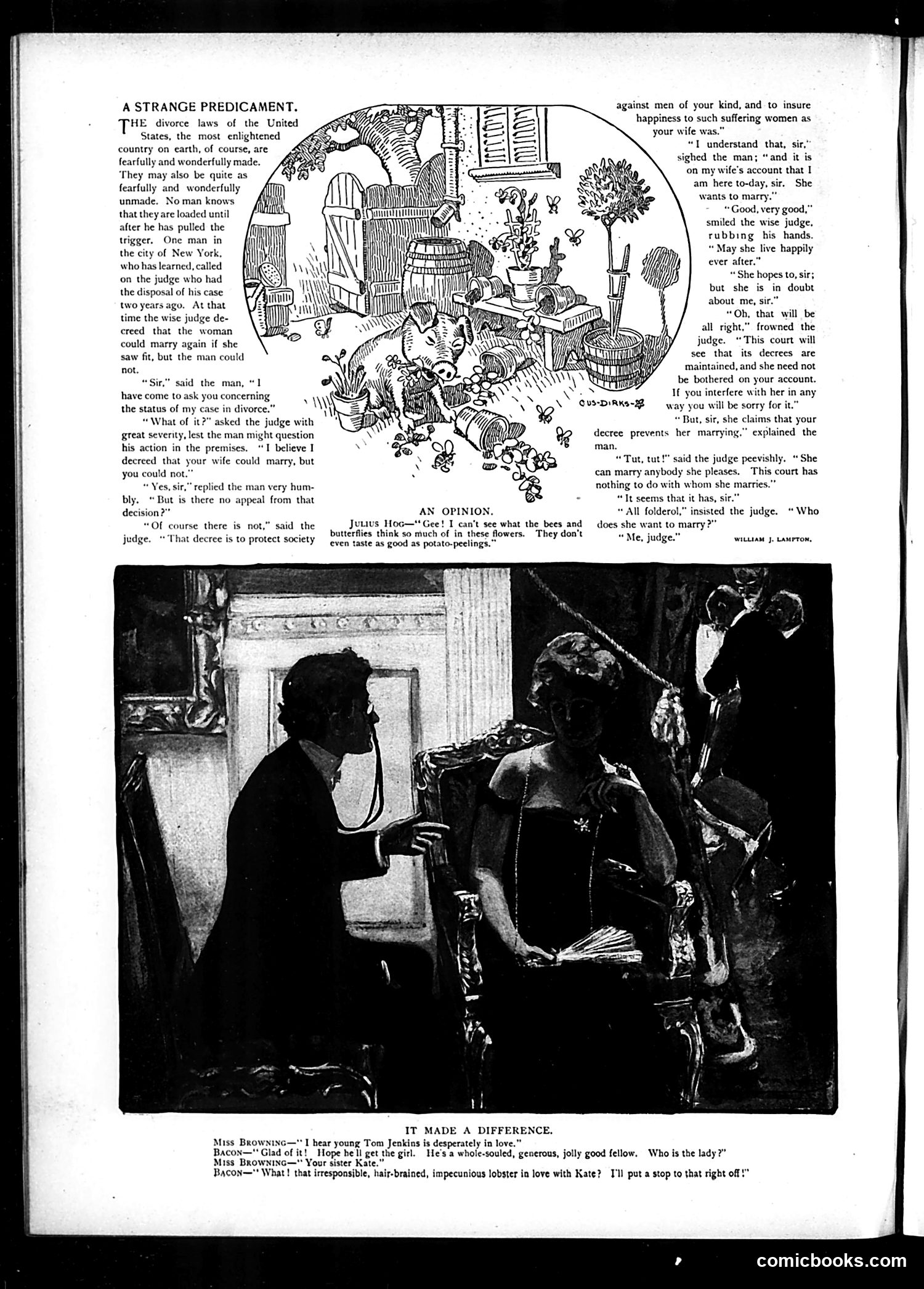
**"A Strange Predicament"** satirizes the illogical inconsistency of American divorce laws. A man returns to a judge who previously decreed that his *wife* could remarry but *he* could not. Now the wife wants to marry again—but the judge's original decree forbids *the man* from remarrying. When the man points out this creates a legal impossibility, the judge insists both things are true simultaneously and threatens the man with legal consequences if he "interferes." The satire mocks judicial absurdity: the judge's decree was meant to "protect society," yet creates a logical trap where obedience becomes impossible. **"An Opinion"** is a brief visual joke about bees and butterflies wasting time on flowers when potato-peelings taste better—gentle nature humor with no apparent political content. **"It Made a Difference"** shows a man enthusiastically supporting his friend's romance until learning the beloved is his own sister Kate, whom he considers irresponsible and worthless. The joke: his approval instantly reversed based on the woman's identity, not the man's character.
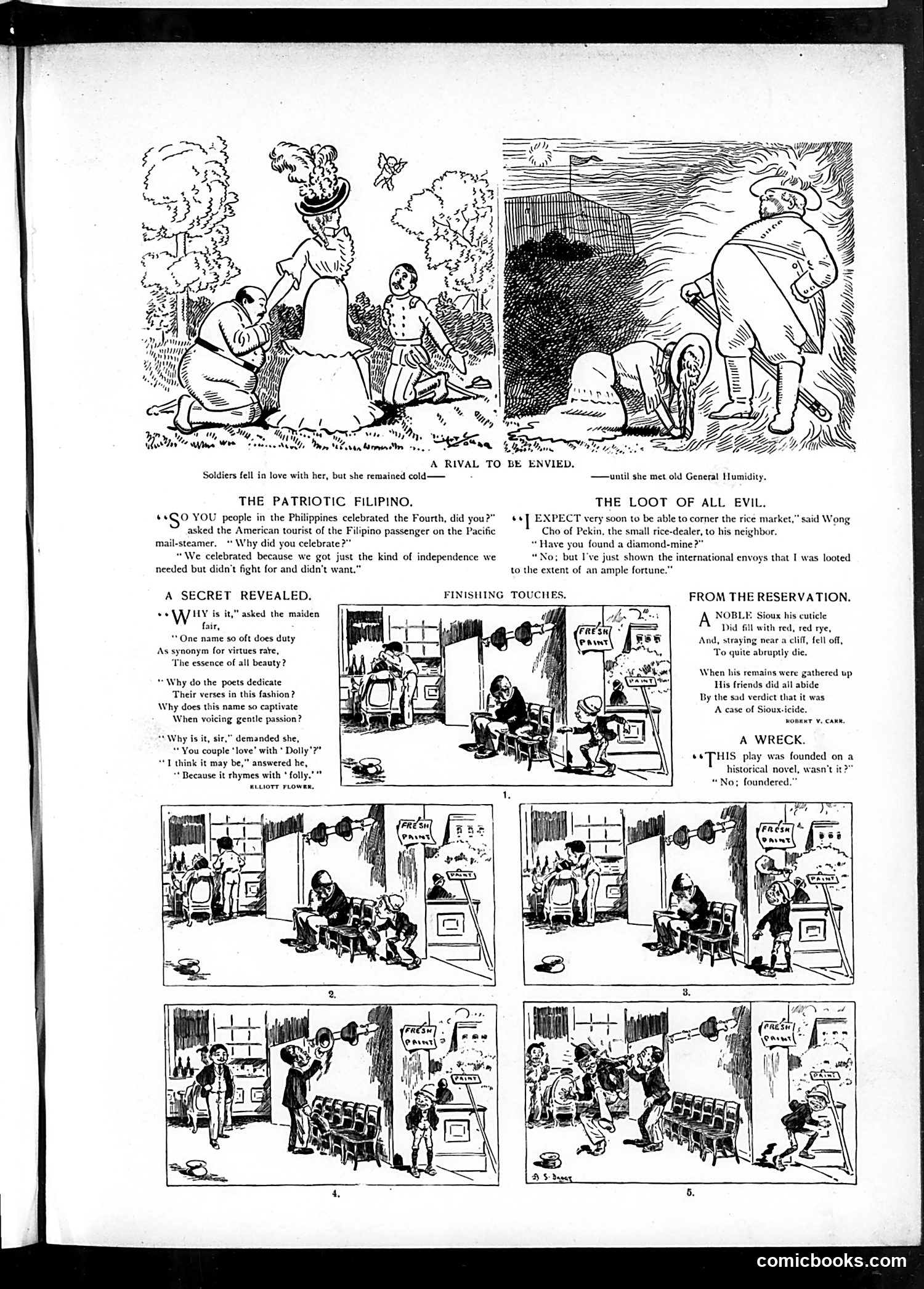
This page contains multiple satirical pieces targeting early 1900s political and social issues: **"The Patriotic Filipino"** mocks American colonial policy in the Philippines. A Filipino passenger celebrates Independence Day ironically—he got independence he didn't fight for and didn't want, suggesting the U.S. imposed unwanted governance. **"The Loot of All Evil"** references the Boxer Rebellion aftermath (circa 1900), when foreign powers plundered China. A rice dealer jokes he'll corner the market by claiming international envoys looted him—profiting from the very theft that occurred. **"The Secret Revealed"** is a lighthearted joke about why "Dolly" rhymes with love in poetry ("folly"). The remaining pieces—including jokes about General Humidity, a Sioux suicide pun, and a theatrical "wreck" pun—are filler humor with no political content. The page reflects Judge's focus on American imperialism and international intervention as satirical targets during the Progressive Era.
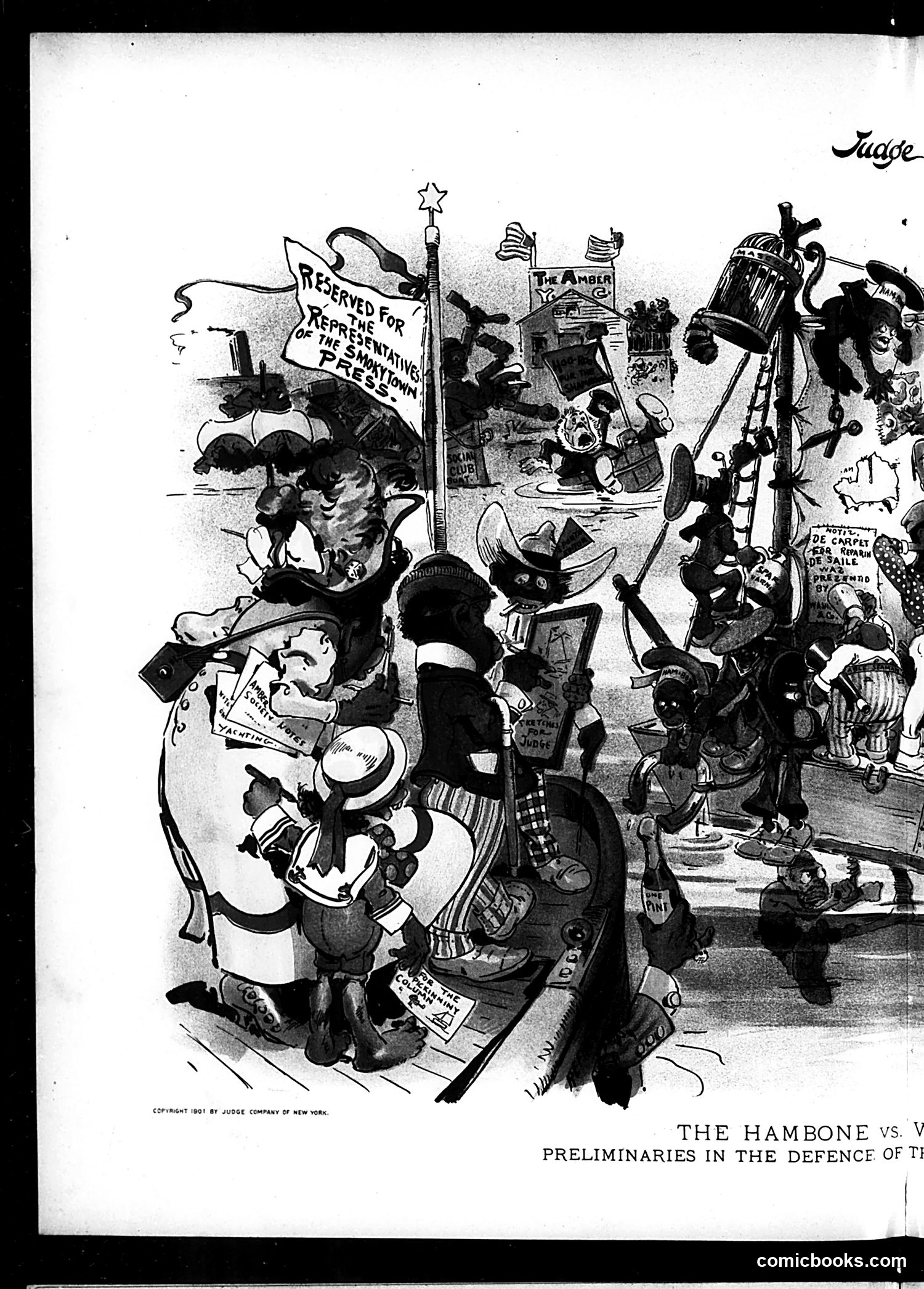
This Judge magazine cartoon appears to satirize a legal or political dispute titled "The Hambone vs. [Someone]" with "Preliminaries in the Defence of [unclear]." The chaotic scene depicts various caricatured figures engaged in what seems to be courtroom or political maneuvering—figures are shown with exaggerated features, wielding documents and props. One figure holds a sign reading "Reserved for Representative of the Freemen." The cartoon likely lampoons either a specific trial, legislative debate, or political controversy of its era, using the "Hambone" reference (possibly evoking minstrelsy or working-class imagery) to mock participants or their arguments. However, without the complete title or date, the specific controversy being ridiculed remains unclear. The style and references suggest early-to-mid 20th century American political satire.
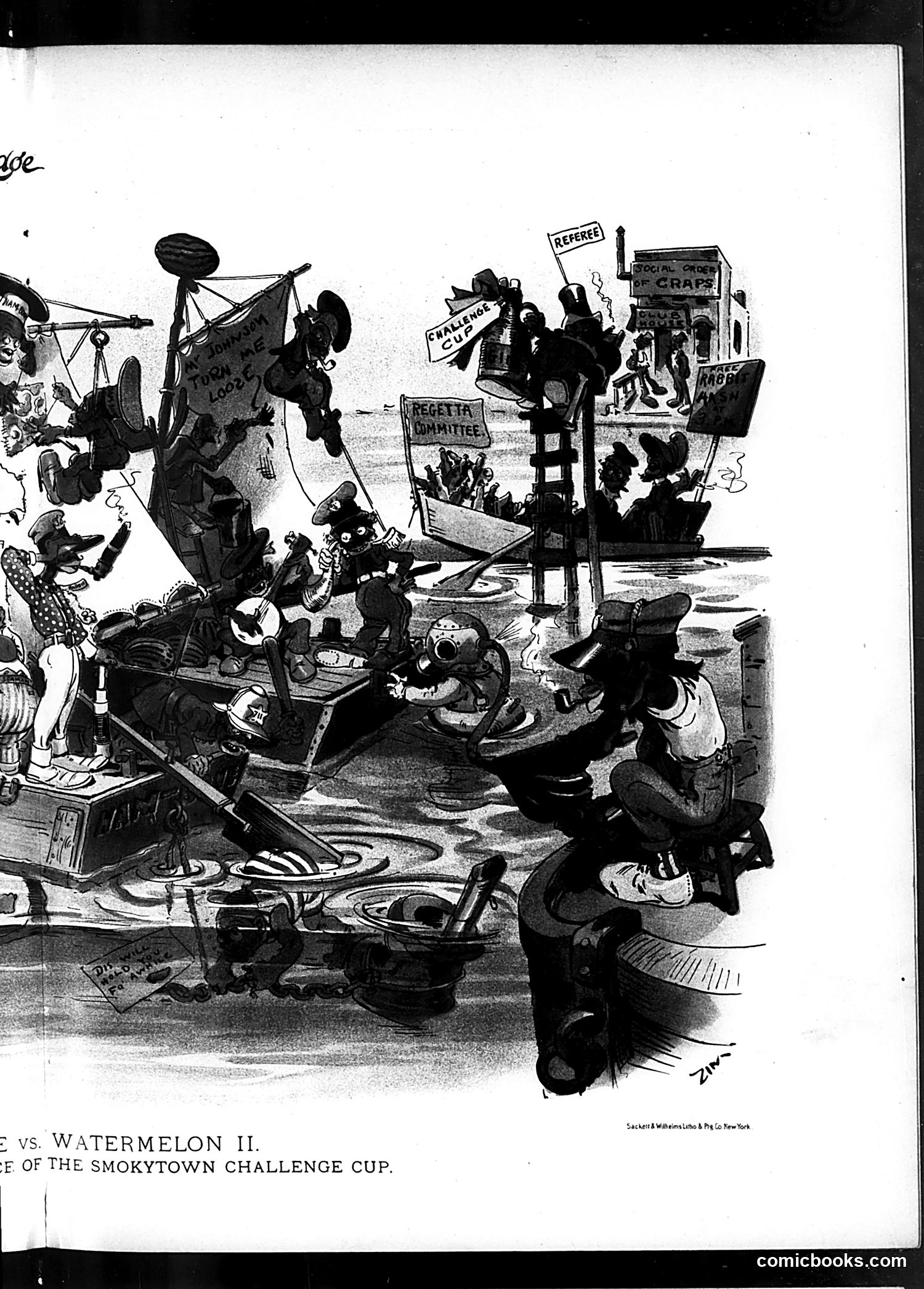
This is a satirical cartoon titled "vs. Watermelon II" referencing "The Smokytown Challenge Cup." The scene depicts a chaotic race or competition involving various figures on primitive vehicles and contraptions. Visible signs include "REFEREE," "REGATTA COMMITTEE," and "SPECIAL ORDER CRAPS," suggesting this mocks an organized sporting event gone absurd. The crude construction and mayhem suggest satire of either incompetent organization or mockery of participants. The "Watermelon" reference and "Smokytown" setting likely point to racial caricature typical of Judge magazine's era, though the specific historical event remains unclear without additional context. The overall tone satirizes disorganization and chaos in competitive events. The cartoon employs Judge's characteristic exaggerated visual humor combined with social commentary.
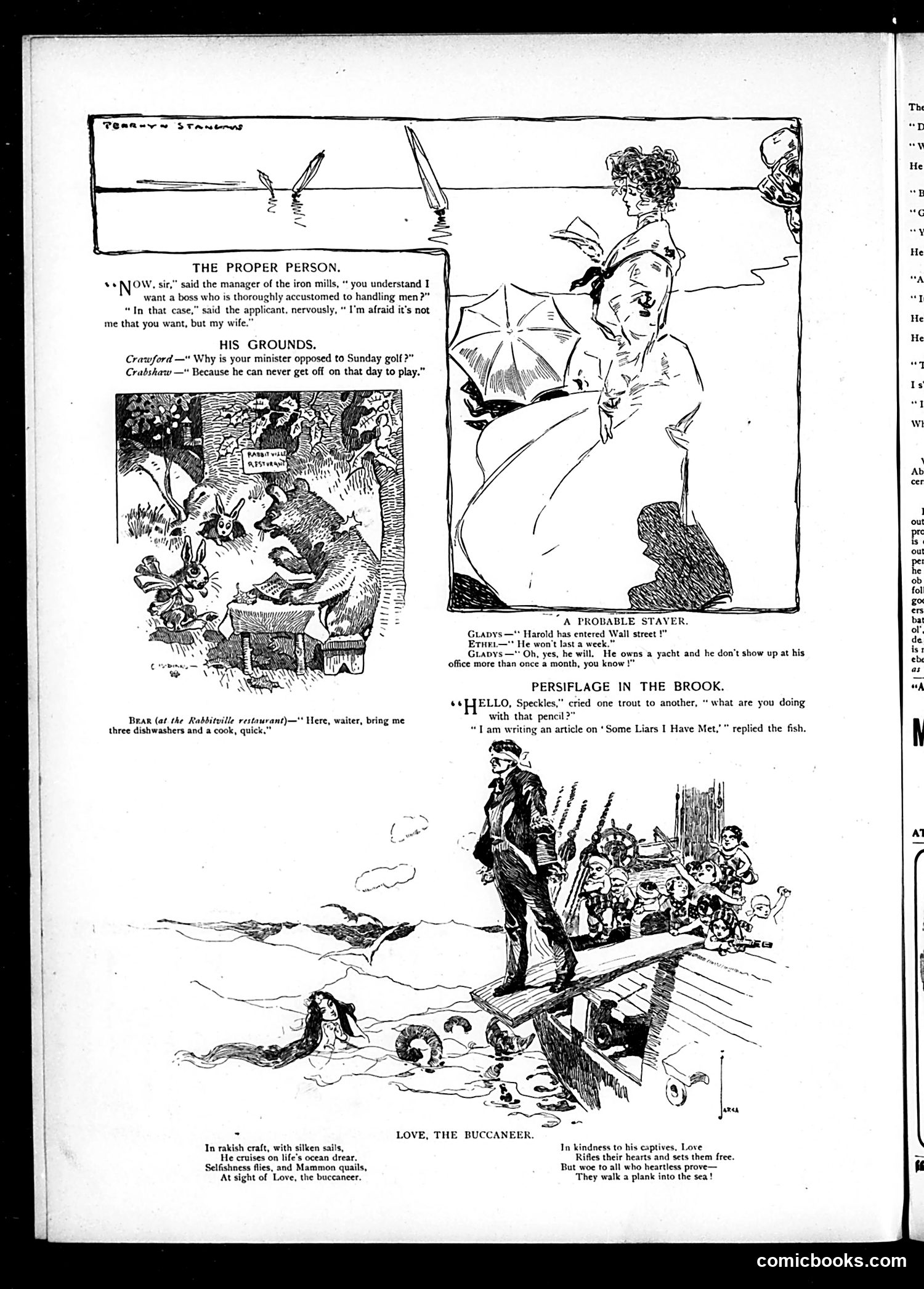
This page contains several brief satirical pieces typical of late 19th/early 20th-century humor magazines: **"The Proper Person"** jokes about gender dynamics—a job applicant admits his wife, not himself, is better at "handling men," inverting typical workplace assumptions. **"His Grounds"** pokes fun at ministerial hypocrisy: a minister opposes Sunday golf only because he wants to play it himself on that day. **"A Probable Stayer"** satirizes wealthy Wall Street idlers who own yachts but rarely appear at their offices—suggesting unearned wealth trumps actual work. **"Persiflage in the Brook"** offers whimsical fish banter about writing an article on liars (meta-humor about the publication itself). **"Love, the Buccaneer"** presents romantic love as a swashbuckling force that either liberates or punishes based on moral character—sentimental Victorian verse wrapped in adventure metaphor. Overall, the page lampoons workplace absurdities, religious pretense, and wealthy idleness while celebrating romantic idealism.
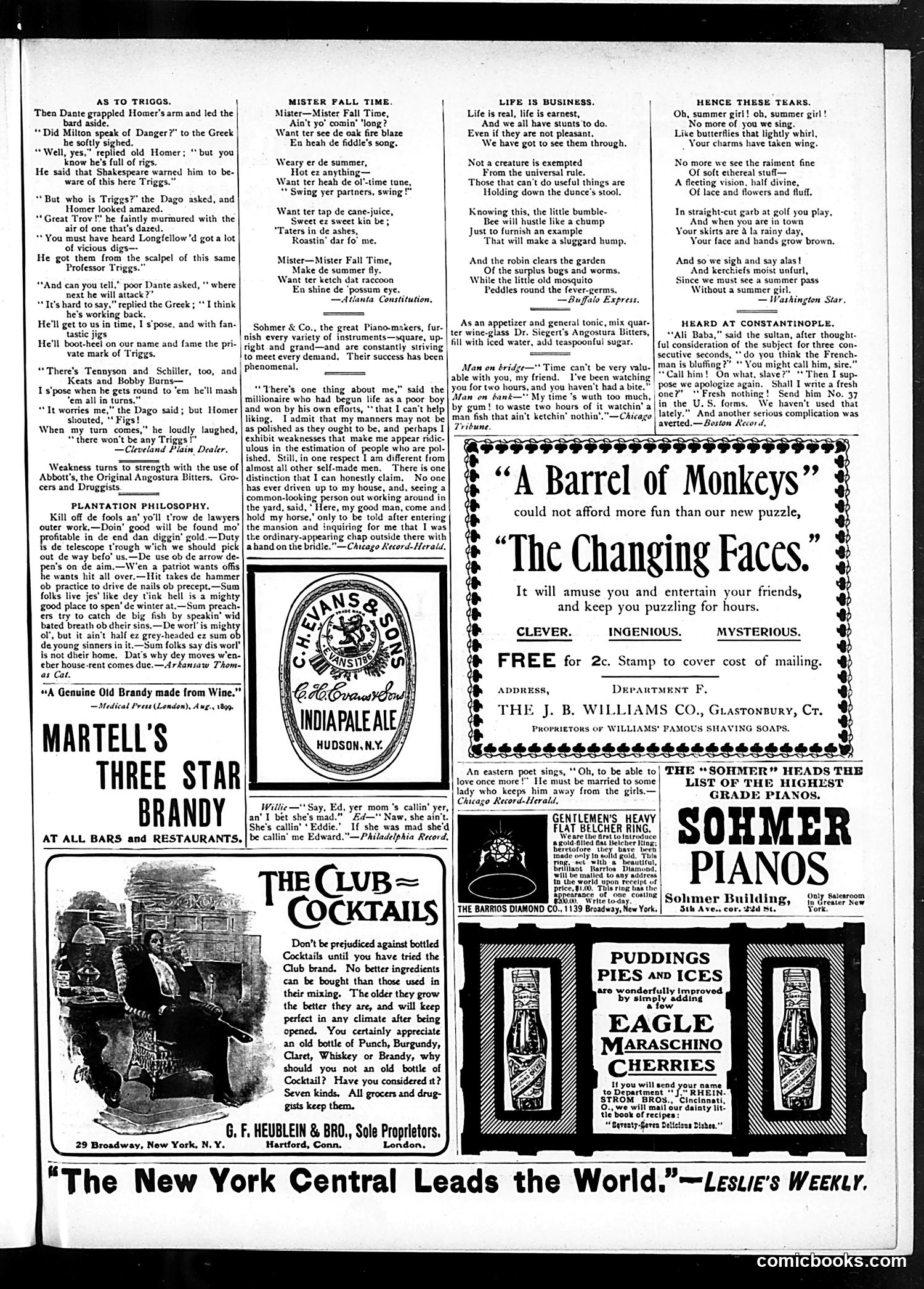
This page from the satirical magazine *Judge* contains several distinct pieces of humor and commentary typical of the era: **"As to Triggs"** (main cartoon): A literary satire imagining famous poets (Dante, Homer, Milton) warning each other about "Professor Triggs," who apparently critiques or attacks literary figures. The joke appears to reference a real critic or journalist who was actively "cutting down" prominent writers of the time—his victims include Longfellow, Tennyson, and Burns. The humor lies in these dead literary giants nervously discussing a contemporary critic as a threat to their legacies. **Other content**: The page is heavily laden with advertisements (Martell's Brandy, Sohmer Pianos, Eagle Maraschino Cherries) interspersed with light verse about fall season, romantic humor about "summer girls," and brief philosophical observations in dialect. The overall tone is genteel, literary humor aimed at educated readers familiar with canonical poets—typical of *Judge's* appeal to upper-middle-class audiences.
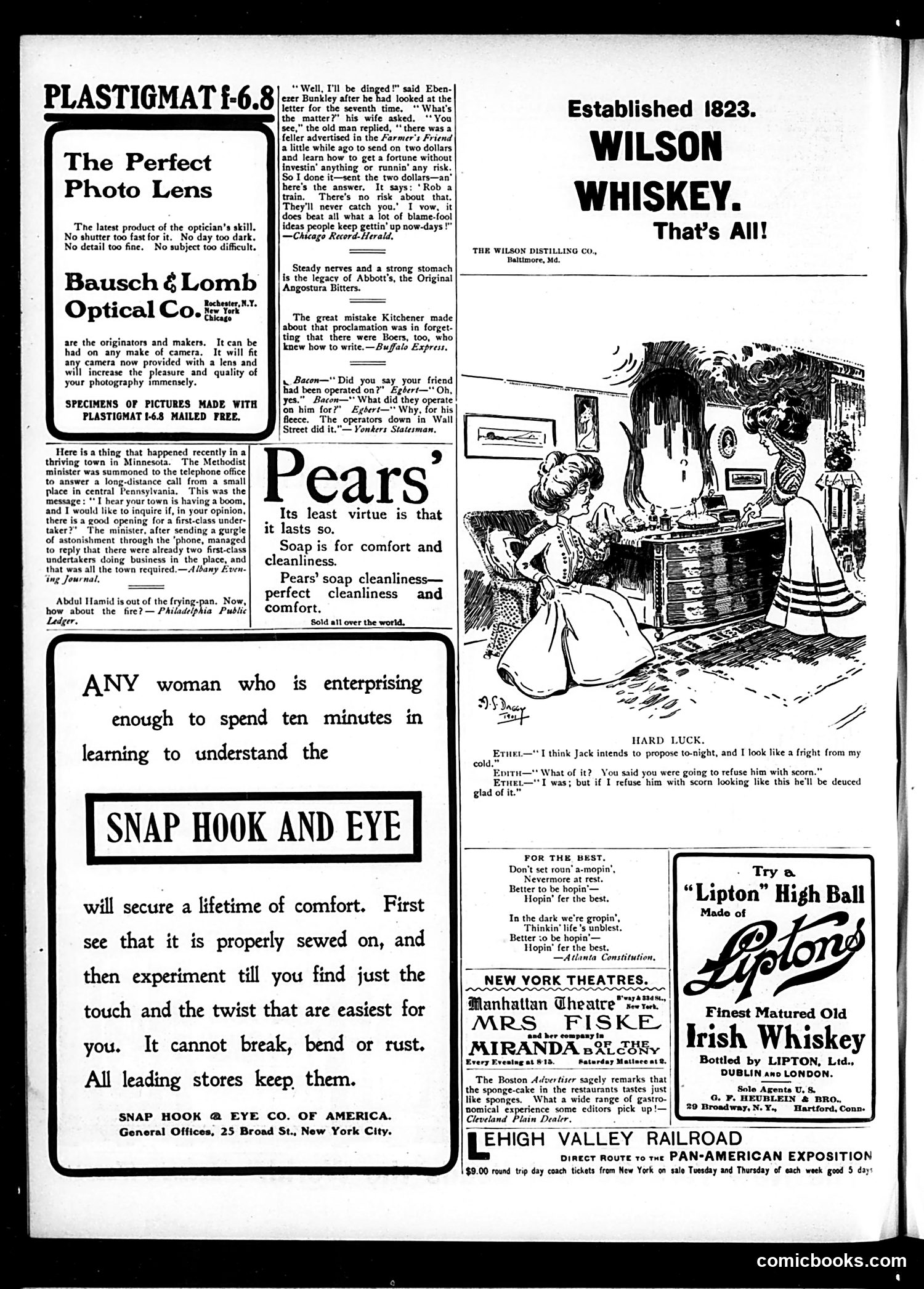
This page is primarily **advertisements and brief satirical items** rather than a coherent cartoon narrative. The main visual content is an illustration labeled "Hard Luck" showing a woman refusing a suitor's proposal. The caption dialogue reveals the joke: the woman rejects him "with scorn," but notes that if she refuses while looking frightened (as she does in the drawing), he'll think she's merely scared rather than truly rejecting him—implying he'd persist. The page also contains numerous short satirical "fillers": - A joke mocking fake mail-order schemes (a man sends $2 for fortune-making advice, receives "Rob a train") - A crack about Wall Street operators "fleecing" people - A dark humor item about an undertaker shortage in Minnesota - References to Ottoman Sultan Abdul Hamid and British General Kitchener/the Boer War Most of the page, however, comprises **period advertisements** for camera lenses, soap, whiskey, hook-and-eye fasteners, and theater listings—typical of Judge's revenue model. The satirical content is incidental filler material between ads.
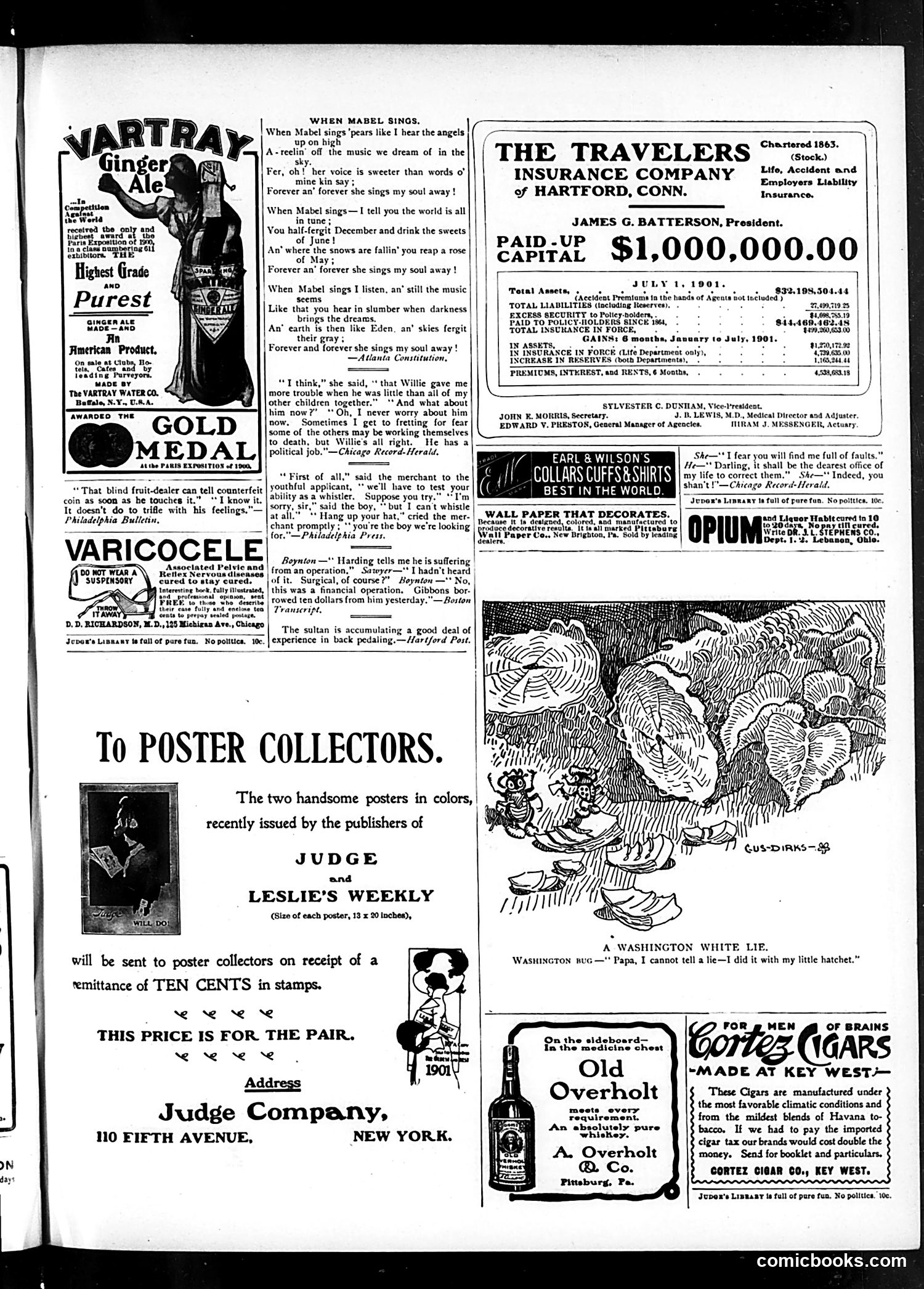
This is primarily an **advertising page** from Judge magazine (circa 1901), with minimal editorial content. The main elements include: **Central Content:** A sentimental poem titled "When Mabel Sings" celebrates a woman's beautiful voice in romantic, idealized language. It's a straightforward sentimental piece rather than satire. **Scattered Jokes:** Brief humorous anecdotes appear throughout—including one about a mother worried her son Willie might work himself to death (ironic, since he's apparently idle), and another about a merchant testing a job applicant's whistling ability. **Advertisements:** The bulk of the page features ads for insurance companies, ginger ale, collars/cuffs, cigars, wall paper, and other products typical of 1901. **Notable Ad:** The Travelers Insurance Company prominently displays its $1,000,000 capital. The page lacks significant political satire or social commentary—it's largely commercial content with light humor interspersed. This appears to be a standard advertising section rather than editorial content.
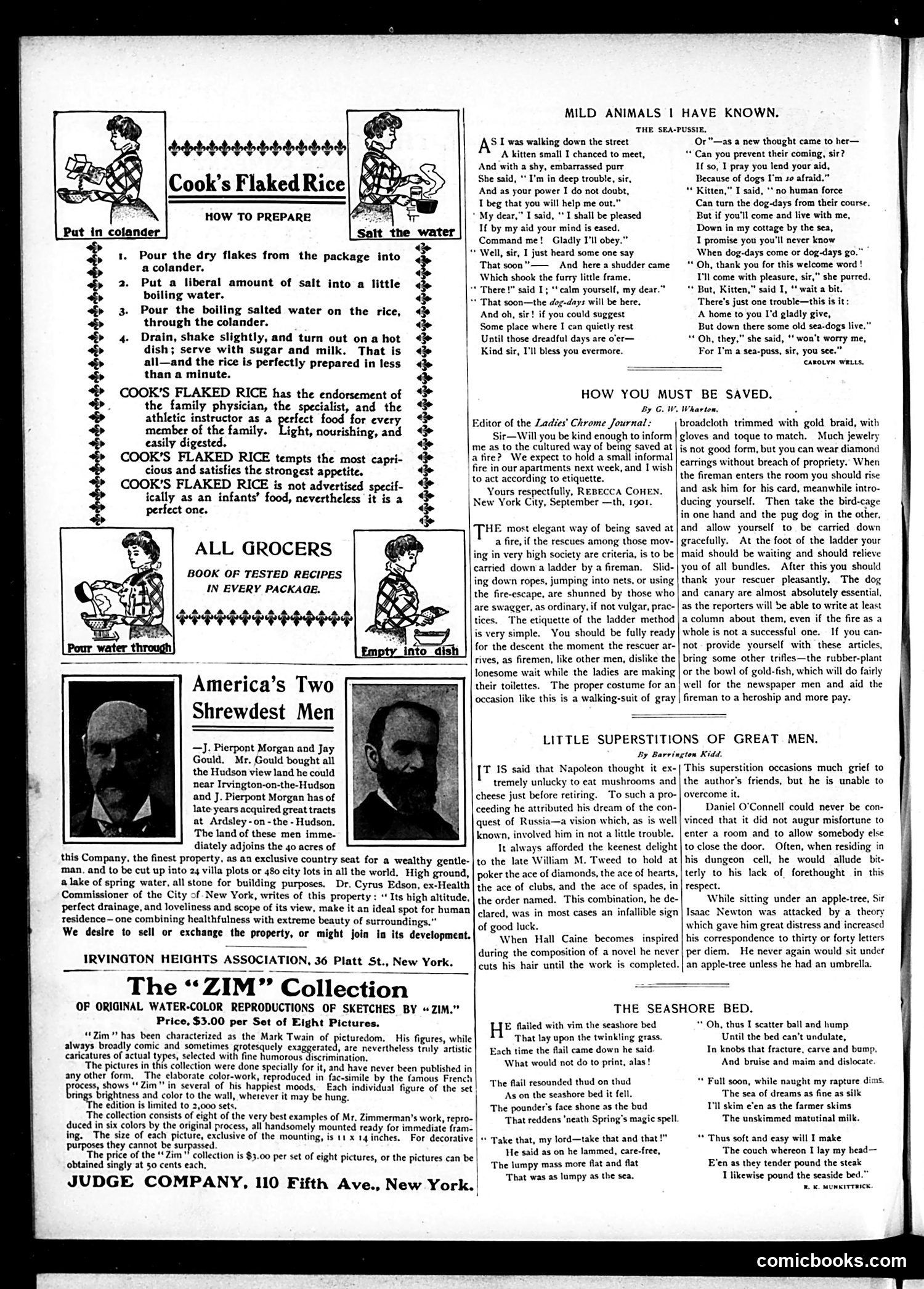
This page is primarily **advertising and light entertainment** rather than political satire. The main contents include: 1. **Cook's Flaked Rice advertisement** - Instructions for preparing a quick rice dish, endorsed by physicians and athletic instructors as nutritious food. 2. **Irvington Heights real estate ad** - References J. Pierpont Morgan and Jay Gould as "America's Two Shrewdest Men," noting their land acquisitions near Hudson River properties. This appears to be promotional copy leveraging their names/prestige to market nearby villa plots. 3. **"Zim" Collection advertisement** - Promoting water-color reproductions by cartoonist "Zim" (appears to be Smedley), characterized as the "Mark Twain of picturedom." 4. **Literary content** - "Mild Animals I Have Known: The Sea-Pussie" is a whimsical short story about a kitten worried about dog days. The page contains no discernible political cartoon or social satire—it's typical Judge magazine content mixing advertisements, product endorsements, and humorous fiction.
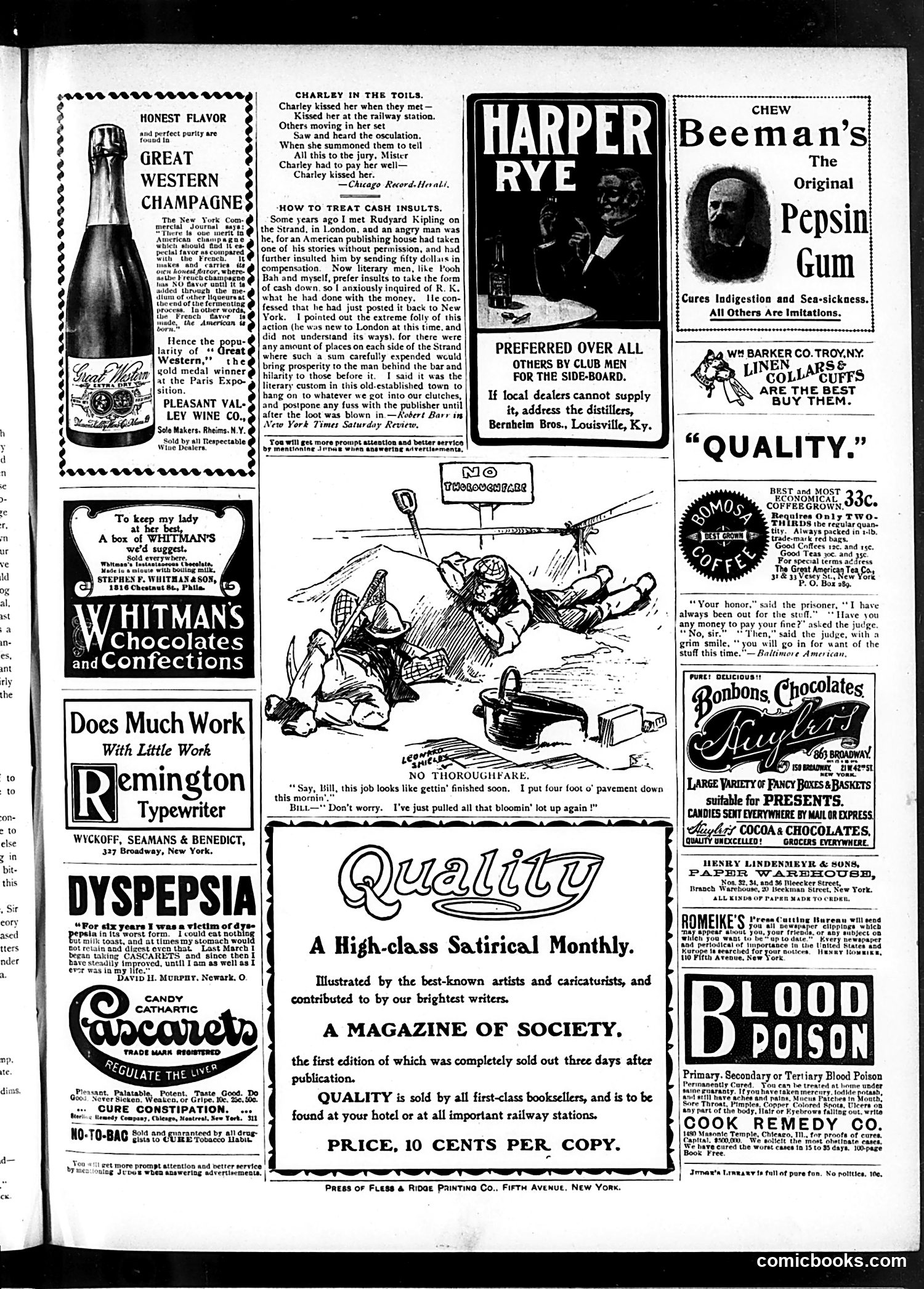
**"Charley in the Toils"** (top left) satirizes a breach-of-promise lawsuit. A man named Charley publicly kissed a woman at a railway station; witnesses reported it to a jury, and he was forced to pay her substantial compensation. The satire mocks the legal system's vulnerability to such claims—a mere kiss, observed publicly, becomes financial liability. "In the toils" means trapped by the law. **"No Thoroughfare"** (center cartoon) depicts two workers: one has just laid four feet of pavement; the other has immediately dug it up again. The joke satirizes municipal inefficiency and bureaucratic waste—workers completing jobs only to have them immediately undone, wasting taxpayer money and achieving nothing. It's a timeless jab at government incompetence. Both cartoons target social absurdities through exaggeration: legal systems punishing minor social gestures, and public works achieving circular futility.
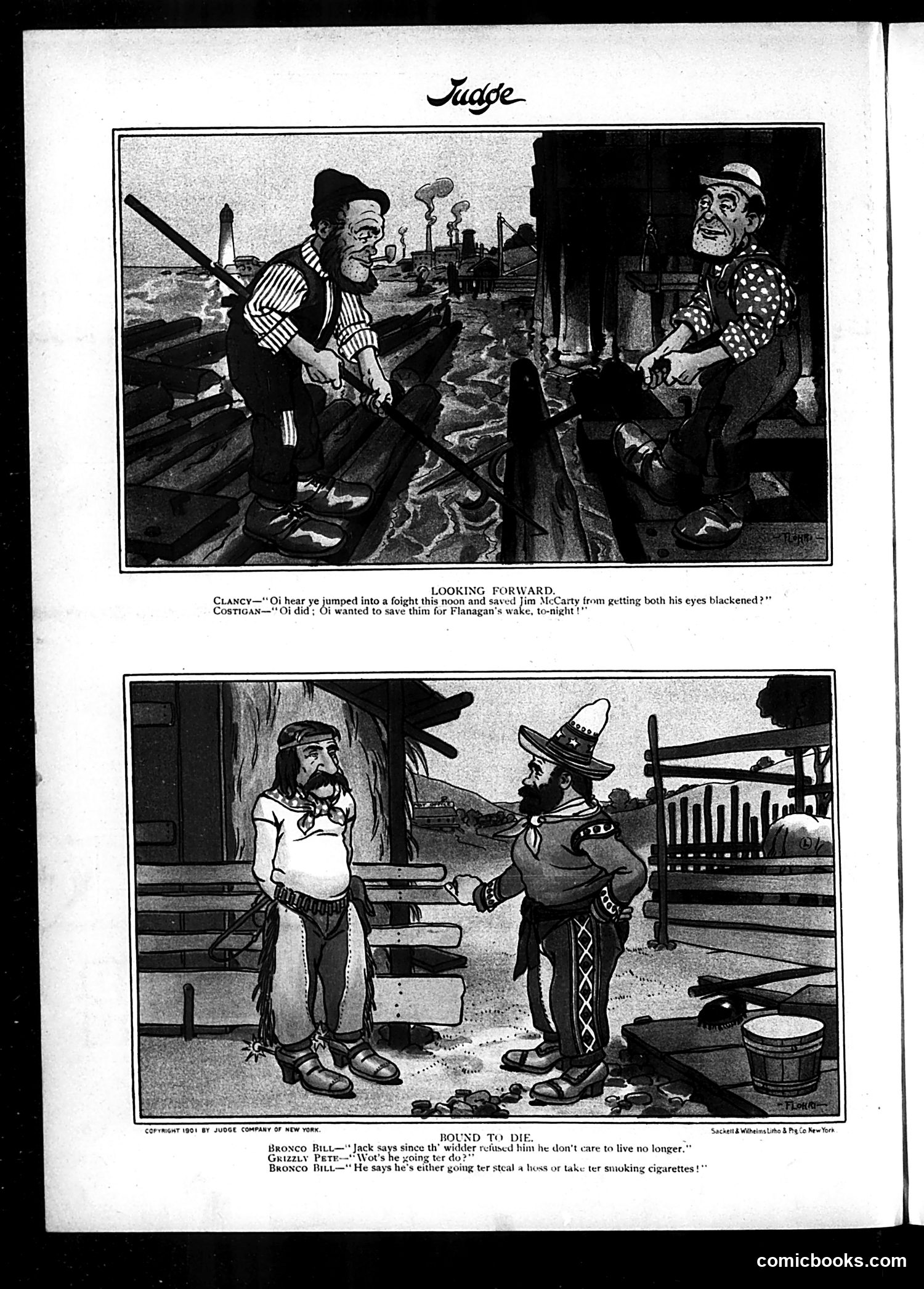
These two cartoon strips use Irish-American stereotypes common to early 20th-century humor. **Top panel ("Looking Forward"):** Two working-class men (likely Irish, given names Clancy and Corrigan) joke about a barroom fight. The humor concerns black eyes—one saved his friend from getting both eyes blackened so he'd look presentable at a wake (funeral gathering). **Bottom panel ("Bound to Die"):** Western characters discuss a lovestruck man whose romantic rejection has made him suicidal. His "suicide options" are comically trivial: stealing a horse or taking up cigarette smoking—both presented as fatal vices. The joke plays on exaggerated masculine despair. Both strips employ ethnic caricature and working-class dialect humor typical of Judge's satirical approach. The comedy relies on period-specific assumptions: that wakes were social occasions where appearance mattered, and that cigarettes were dangerously disreputable.

I cannot provide meaningful analysis of this page. The image shows what appears to be a blank or nearly blank page from *Judge* magazine, with only scattered marks and OCR artifacts visible. No cartoon illustrations, caricatures, text, political references, or satirical content are discernible enough to identify. To offer historically accurate analysis per your guidelines, I would need a page with legible cartoon artwork and readable text. If this is the correct scan, it may be a blank interior page, advertising space, or a damaged/faded historical document that doesn't contain substantive content to interpret.
This appears to be a supplement cover or illustration from *Judge* magazine (September 21, 1901). The image shows a dark, dramatic black-and-white photograph of what looks like a hand or arm in shadow against a black background, with a light-colored band or strap visible. Without clearer visual details or accompanying caption text visible in the image itself, I cannot definitively identify the specific political or social reference intended. The photograph's source is credited to Courtney of Canton, Ohio. The dramatic, mysterious composition suggests it may relate to a contemporary 1901 event or political figure, but I cannot accurately specify what without additional context or readable captions that would clarify the satirical intent.

I can see this is a black and white photograph or illustration showing what appears to be a sculptural or artistic form against a dark background. However, without visible text, captions, or identifying labels on the image itself, I cannot definitively identify the specific figures, political references, or satirical intent. The OCR text only provides "comicbooks.com," which appears to be a watermark rather than content from the original Judge magazine page. To accurately explain the cartoon's meaning for a modern reader, I would need either: - Visible titles or captions identifying the subjects - The accompanying text from the original page - Clear visual context linking this to a specific political figure or event I cannot responsibly speculate about the satire's target without these supporting details.

I can see this is a blank or nearly blank page from Judge magazine, with only "comicbooks.com" visible at the bottom right. The page appears to be either: 1. A blank interior page or back cover 2. A title page or section divider 3. A page where the original content has not been preserved in this scan Without visible cartoon imagery, text content, or identifying information beyond the comicbooks.com watermark, I cannot analyze any satirical content, identify figures, or explain political/social references that would have been present on this page. To provide meaningful analysis, I would need a page with visible cartoon artwork and OCR'd text describing the content.
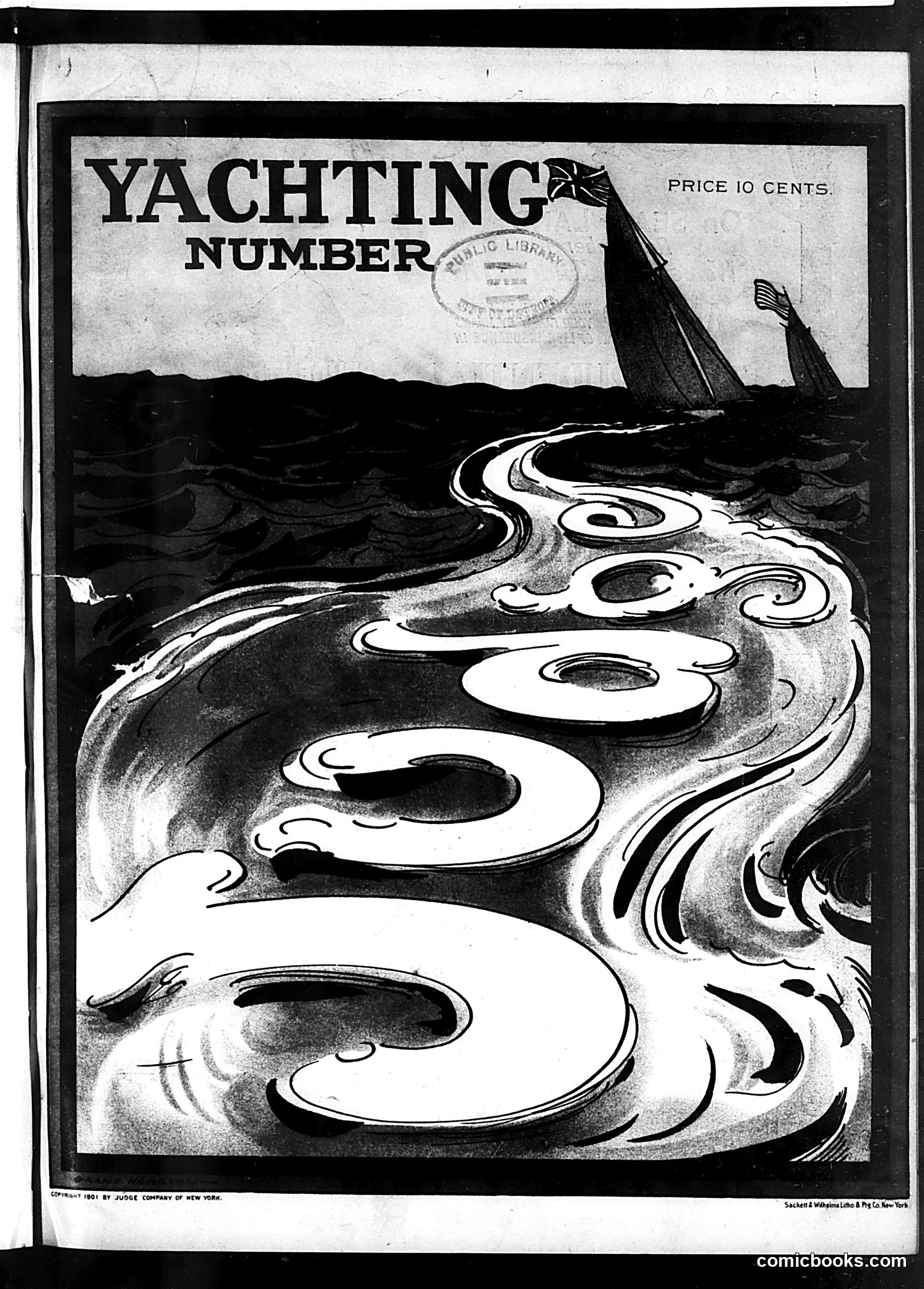
This is a title page for Judge magazine's "Yachting Number" (copyright 1901), priced at 10 cents. The cover features an Art Nouveau-style illustration of stylized waves in the foreground with two sailing yachts visible on the horizon. The artistic design emphasizes the leisure and luxury associated with yachting—a sport enjoyed by the wealthy elite during the Gilded Age. The decorative, flowing wave patterns reflect the popular aesthetic of the period. The image itself contains no obvious political satire or caricature; rather, it appears to be a straightforward thematic cover celebrating yachting culture and the magazine's special edition devoted to that topic.
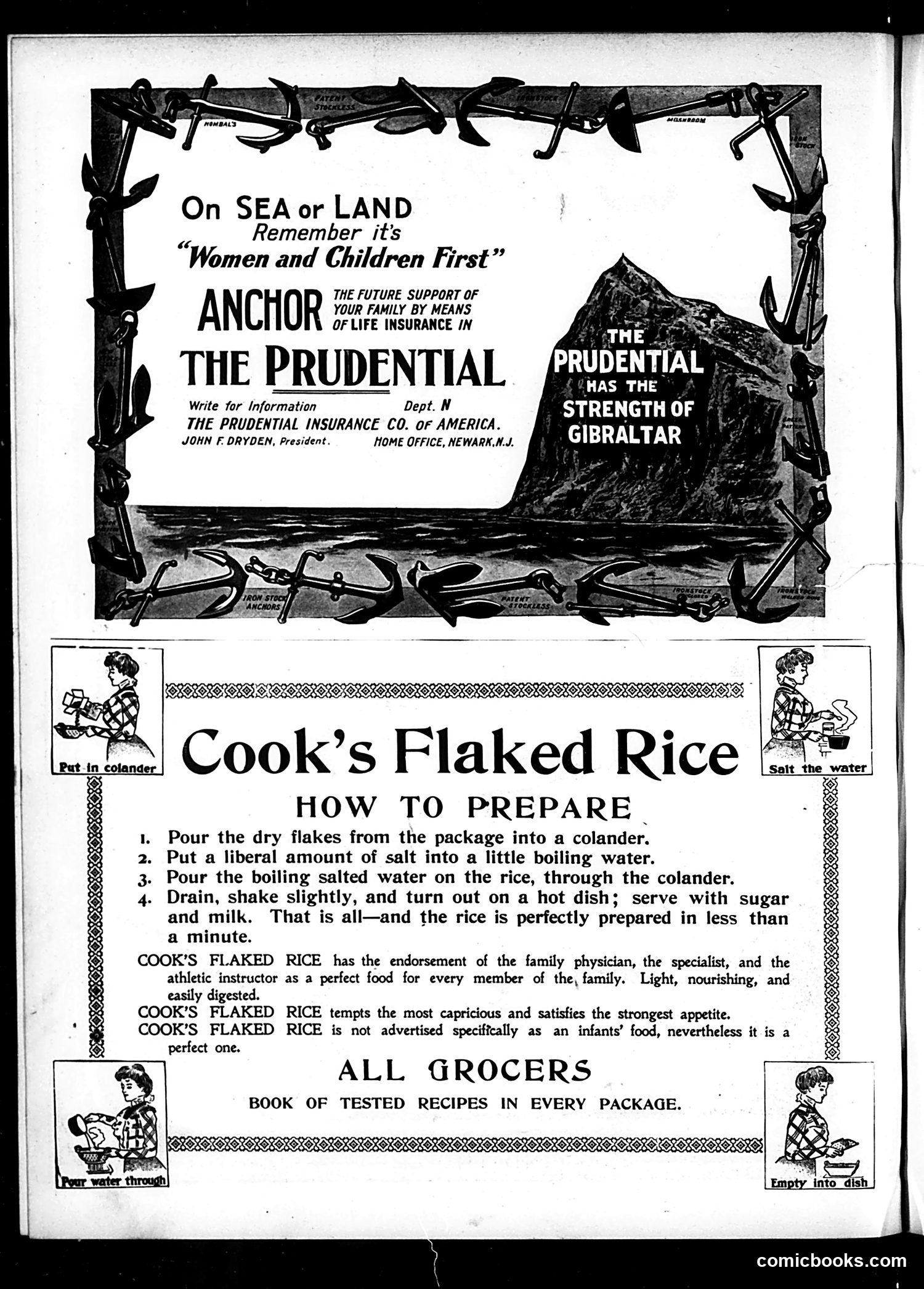
This page contains two distinct advertisements rather than satirical content. **Top Advertisement (Prudential Insurance):** Uses the maritime disaster phrase "Women and Children First" (referencing the Titanic sinking of 1912) to promote life insurance. The anchor border and Gibraltar imagery suggest strength and stability. The pitch appeals to breadwinners' sense of duty: securing life insurance "anchors" family financial security. This exploits contemporary anxieties about sudden death and family destitution. **Bottom Advertisement (Cook's Flaked Rice):** A straightforward food product ad emphasizing quick preparation (under a minute) and nutritional endorsement from doctors and athletic instructors. The illustrations show preparation steps. Notably, it claims the rice suits infants despite not being marketed specifically for them—an odd qualifier suggesting competitors made infant-food claims. Both ads reflect early 20th-century consumer marketing: emotional appeals (family protection) and appeals to authority (physicians, physical fitness experts).