
A complete issue · 16 pages · 1901
Judge — September 14, 1901
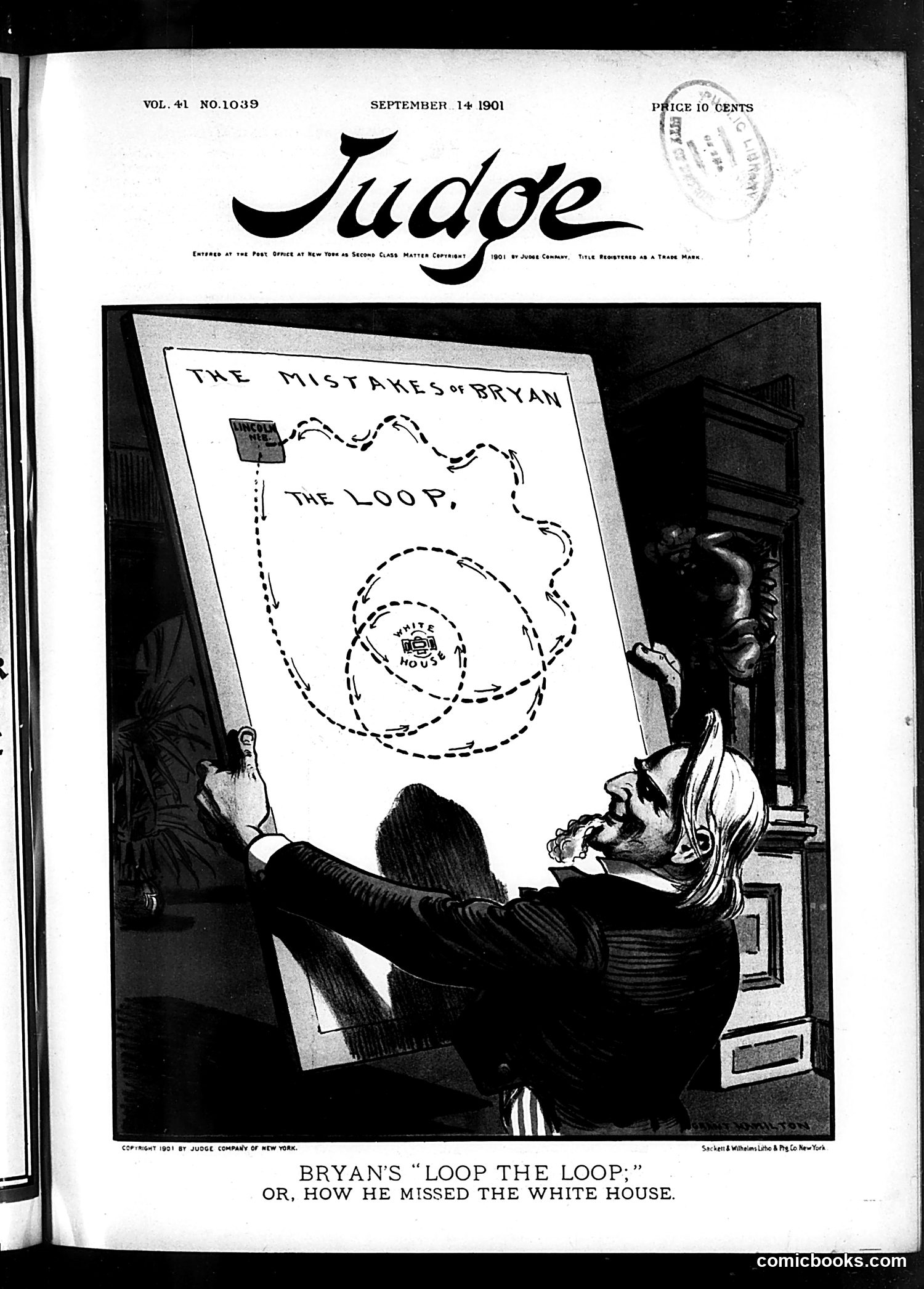
This political cartoon satirizes William Jennings Bryan's failed 1900 presidential campaign against William McKinley. The figure (appearing to be Bryan) studies a diagram titled "The Mistakes of Bryan" showing "The Loop"—a convoluted path that misses the White House at its center. The satire mocks Bryan's campaign strategy as confused and ineffective, depicting his political approach as literally circling around the goal without reaching it. The White House, shown in the diagram's center, represents the presidency Bryan failed to win. This reflects the Republican victory of 1900 and mocking contemporary criticism of Bryan's campaign tactics and messaging. The visual metaphor of "the loop" suggests Bryan repeatedly made the same strategic errors.
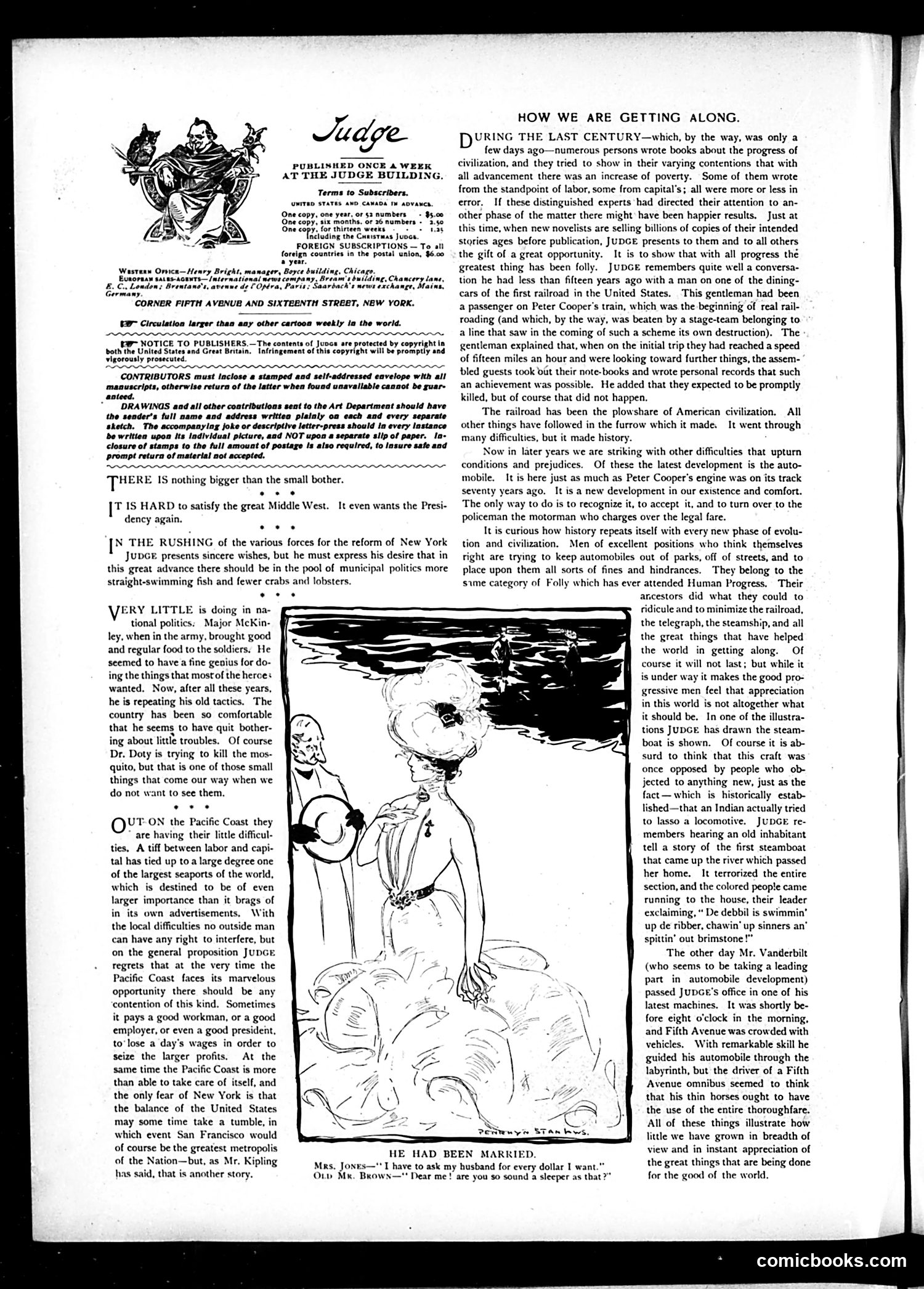
This page critiques America's progress during the railroad era. The central cartoon, titled "He Had Been Married," depicts a woman riding atop a man's shoulders, illustrating marital dependency and burden—a commentary on societal relationships during rapid industrialization. The accompanying text discusses how railroad development, despite bringing civilization, has created new social problems: labor disputes, capital conflicts on the Pacific Coast, and urban congestion (the Fifth Avenue automobile traffic reference). The satire argues that while Americans celebrate technological progress—steamboats, locomotives, automobiles—they've overlooked the human costs: poverty, labor unrest, and infrastructure strain. The "marriage" metaphor suggests progress and its consequences are inseparably bound, with society bearing an uncomfortable load.
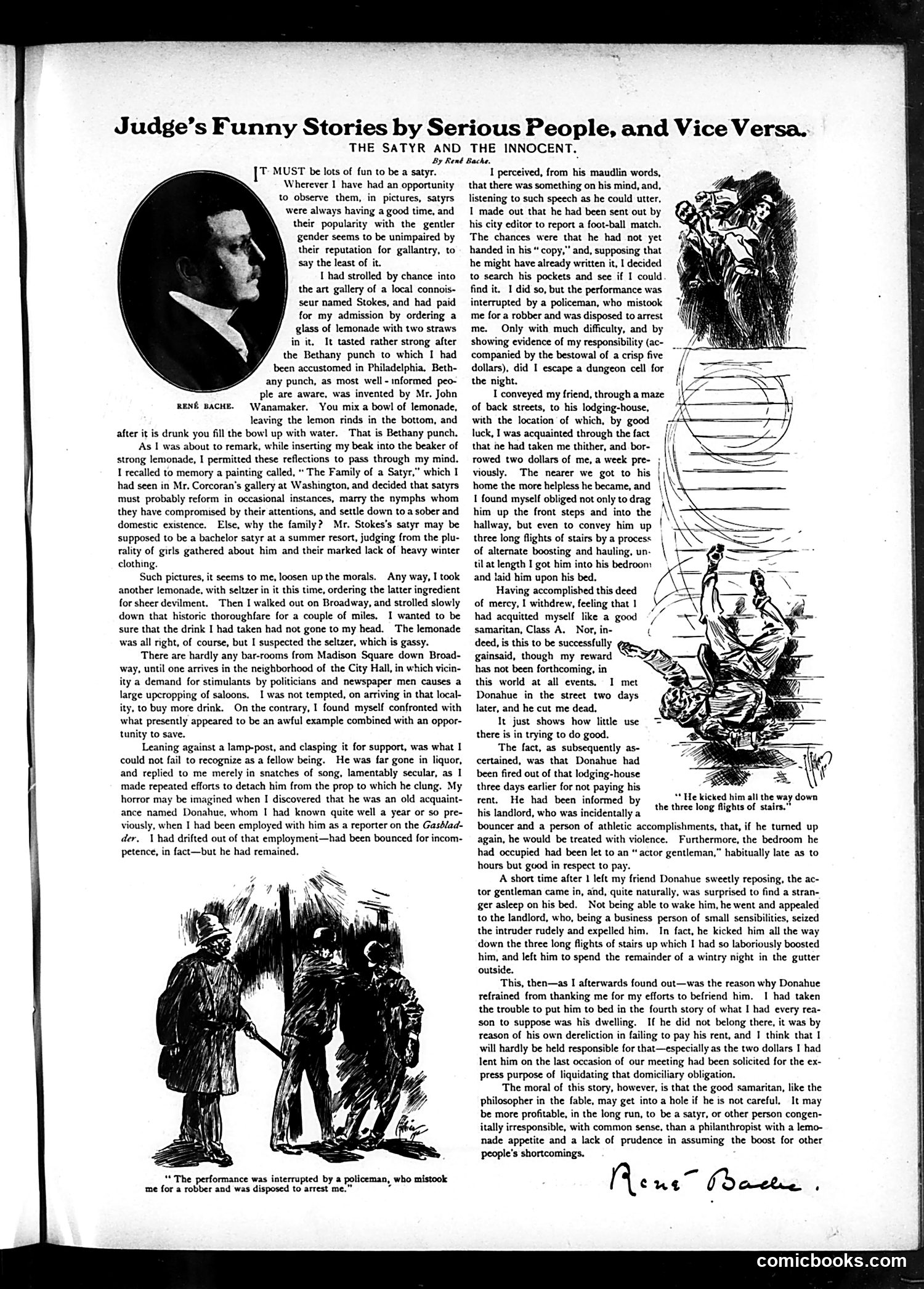
This story satirizes well-meaning charitable impulses that backfire. The narrator, a self-described "satyr" or cynic, attempts good deeds but creates worse outcomes. The main anecdote concerns rescuing an intoxicated vagrant named Donahue from the streets. After bringing him home and putting him to bed, the narrator later finds Donahue has been evicted by his landlord (whom Donahue hadn't paid rent). The landlord was a "bouncer" at a lodging house—an "actor gentleman" who violently expelled Donahue down multiple flights of stairs into the winter gutter. The satire's point: attempting unsupervised charity toward someone with deeper problems (unpaid debts, housing instability) can ironically worsen their situation. The moral warns against "philanthropist with a lemonade appetite" assuming society's ills are simple to fix.
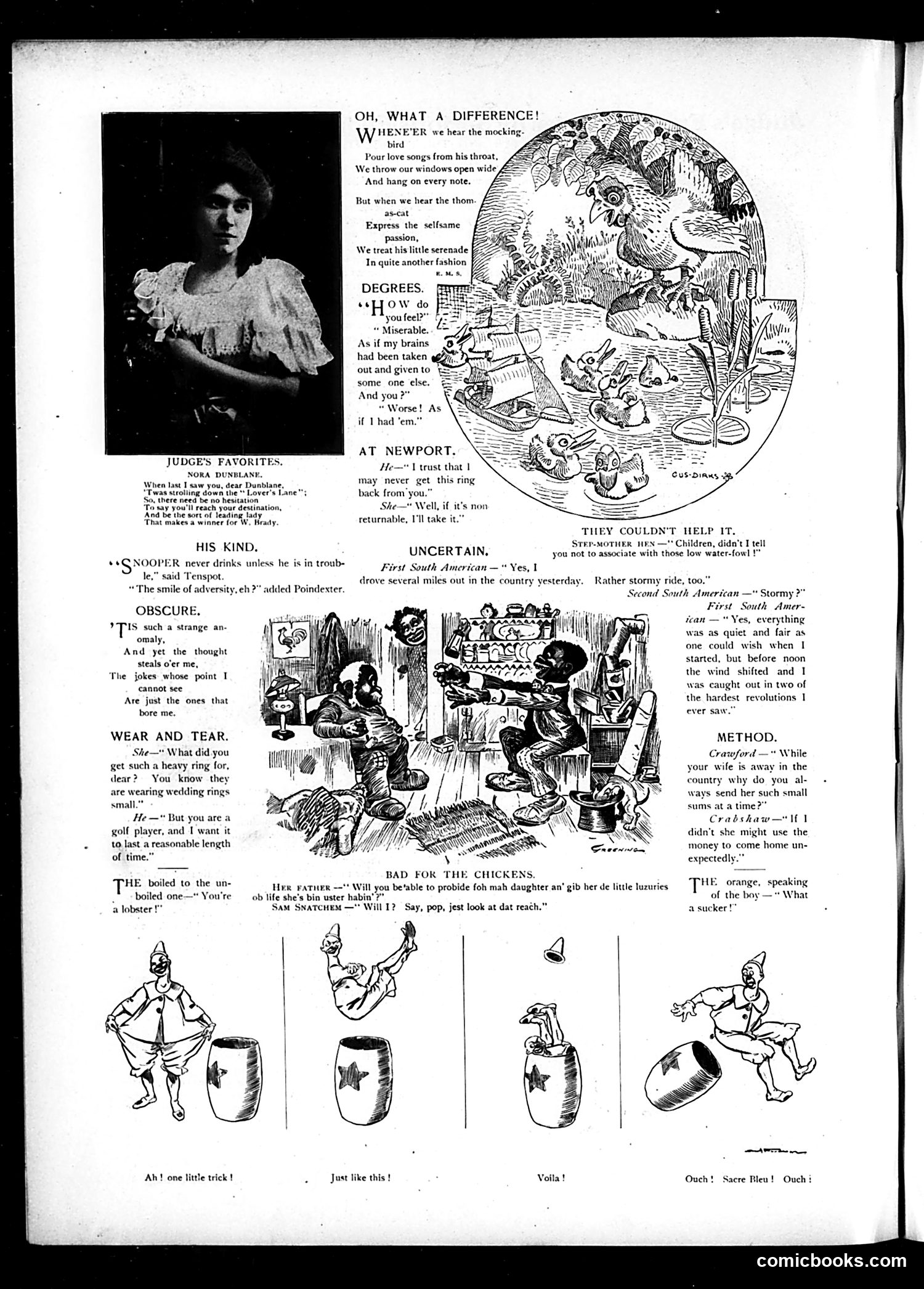
This page contains several satirical pieces typical of Judge magazine's humor. The top section includes poetry and jokes about social behavior—mocking pretension ("Judge's Favorites"), hypocrisy ("His Kind"), and gender dynamics ("Wear and Tear"). The central illustration depicts a domestic scene with working-class figures in cramped conditions, likely satirizing poverty or lower-class life. The bottom sequence shows a slapstick routine with a figure repeatedly falling into or interacting with a barrel, captioned with exclamations ("Ah! one little trick!", "Just like this!", "Voila!", "Ouch!"). This appears to be visual comedy rather than political satire. The "At Newport" and "Uncertain" sections contain brief humorous dialogues about upper-class and rural life, using regional dialects and stereotypes for comedic effect. Overall, the page mixes social commentary with absurdist physical comedy.
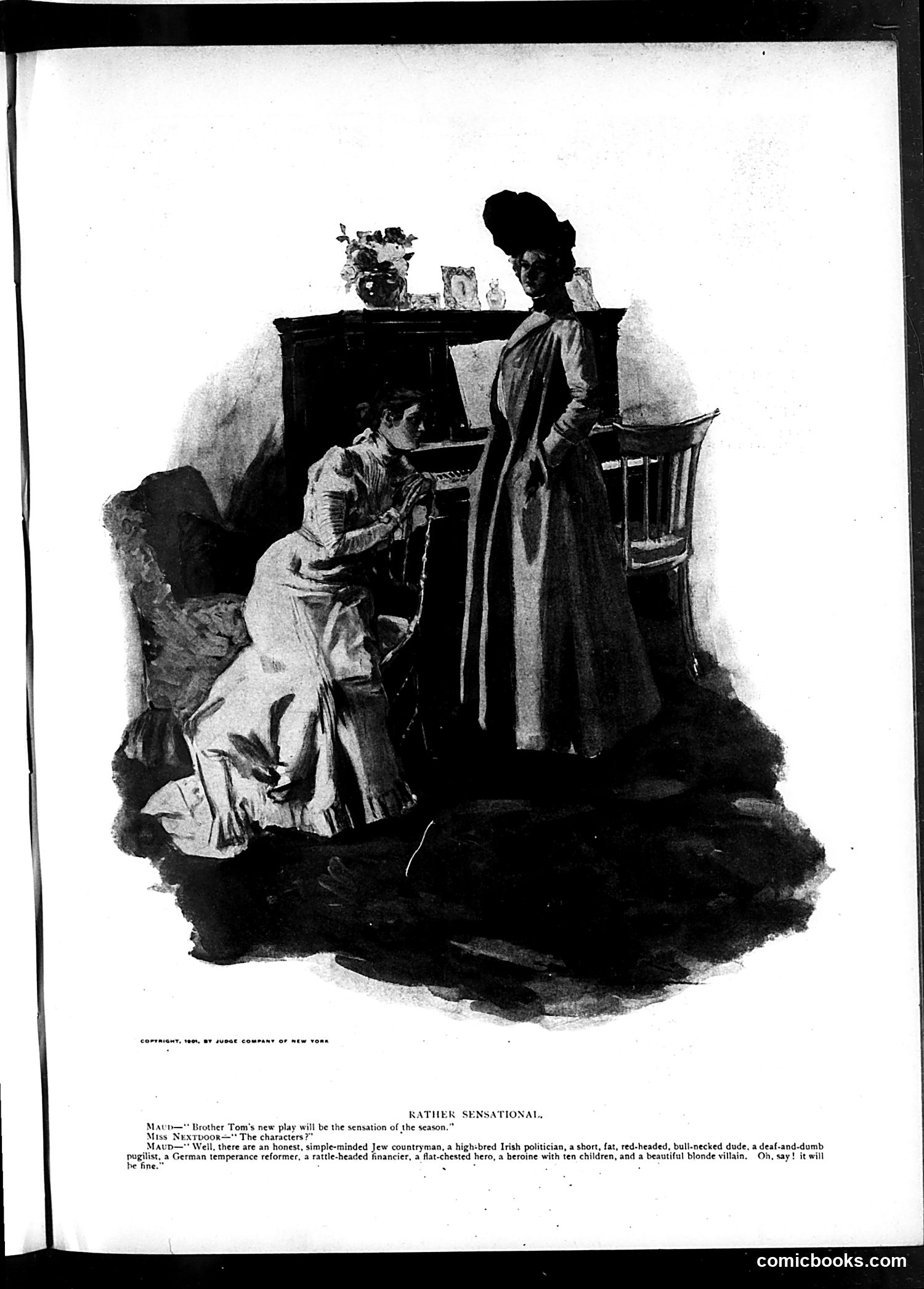
This cartoon satirizes theatrical advertising and stereotyping in late 19th-century plays. Two women discuss a new play by "Brother Tom," with one breathlessly promoting it as "the sensation of the season." The joke targets both the play's reliance on crude ethnic and social caricatures (a Jewish countryman, Irish politician, German temperance reformer, etc.) and the absurdity of theater marketing that packages such stereotypes as entertainment. The characters listed represent common theatrical types of the era—each defined by exaggerated, reductive traits. The satire cuts two ways: mocking both the play's shallow character construction and the theater industry's assumption that audiences would find these tired stereotypes compelling. The "beautiful blonde villain" caps the list of predictable archetypes, highlighting how formulaic such productions were. The illustration shows a woman at a piano discussing the play with her neighbor, embedding the satire in everyday social conversation about entertainment.
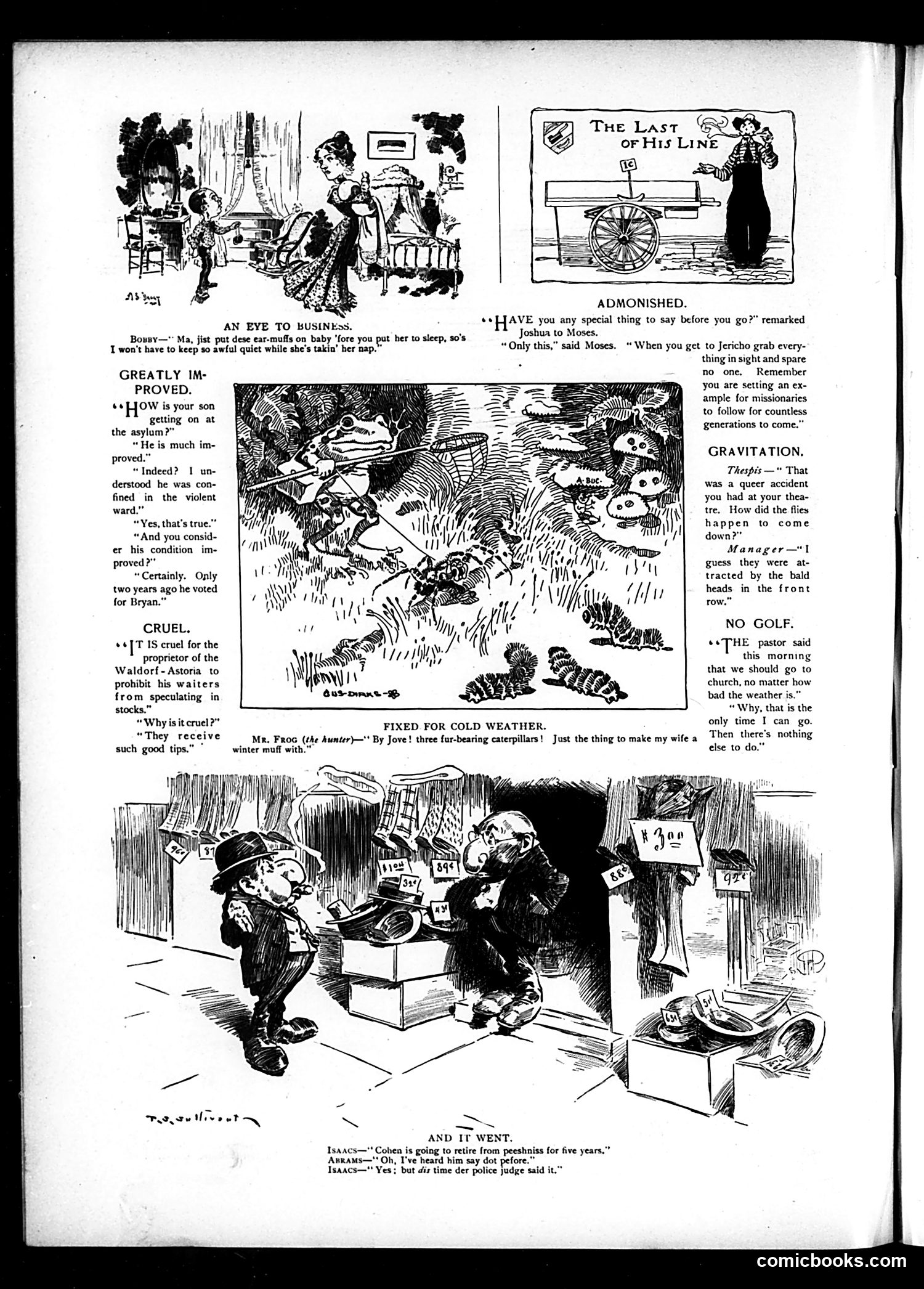
This page contains multiple satirical cartoon jokes typical of early 20th-century American humor: **"An Eye to Business"** mocks a mother's parenting priorities—she wants her baby quiet during naps, so she puts ear-muffs on the infant. **"Greatly Improved"** jokes about a mental patient whose condition supposedly improved after voting for William Jennings Bryan (likely referencing Bryan's 1896 or 1900 presidential campaigns), suggesting Bryan supporters were mentally unstable—a common Republican attack. **"Cruel"** criticizes wealthy hotel proprietors forbidding waiters from stock speculation, though waiters receive substantial tips. **"Fixed for Cold Weather"** depicts someone collecting fur-bearing caterpillars for a winter muff—absurdist humor about nature. **"Gravitation"** uses theater slang to joke about flies attracted to bald heads. **"No Golf"** satirizes a pastor who only skips golf when weather is bad, not for church. **"And It Went"** plays on a Jewish character (Cohen) retiring from business—the punchline being a police judge's ultimatum makes retirement mandatory. The page reflects period attitudes including casual antisemitism and political mockery.
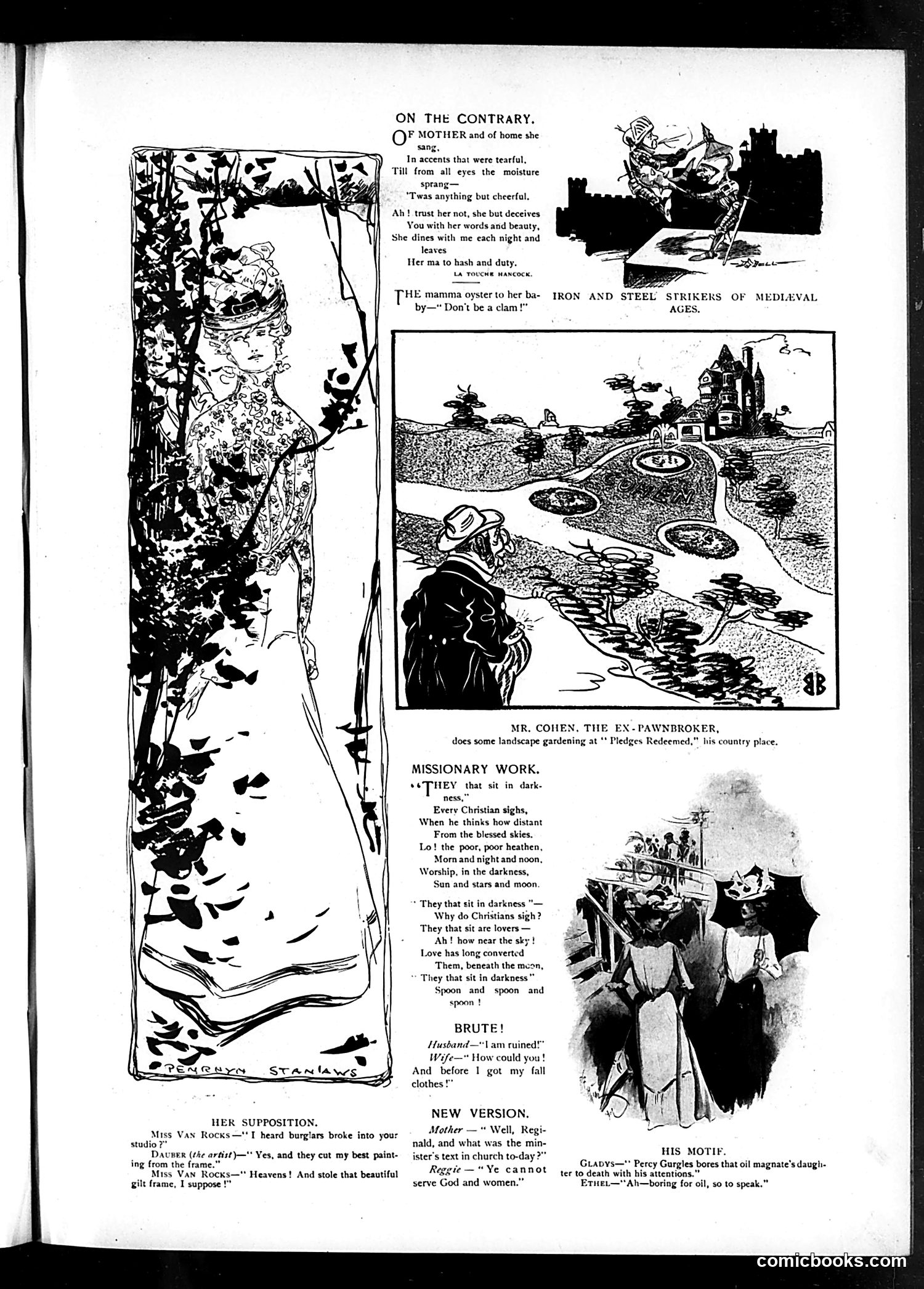
This page contains multiple unrelated satirical pieces typical of Judge's format: **"On the Contrary"** mocks a woman who sentimentally sings about home and mother while neglecting her own mother at home—exposing hypocrisy through contrasting words and actions. **"Iron and Steel Strikers of Medieval Ages"** appears to be a visual joke comparing medieval warfare to industrial labor disputes, though the exact reference is unclear without additional context. **"Mr. Cohen, the Ex-Pawnbroker"** likely satirizes a Jewish character (Cohen) attempting to reinvent himself as a gentleman landscaper—common ethnic humor of the era, though the specific point is unclear. **"Missionary Work"** uses double entendre: it describes Christian concern for distant "heathens" worshiping in darkness, then reveals the poem's actual subject is young couples courting in darkness—a cheeky critique of selective moral concern. **"Brute!"** and other short pieces are domestic humor about marriage and infidelity, standard Judge fare. The page reflects early 20th-century American attitudes including casual ethnic stereotyping, cynicism about romance and morality, and social class commentary.
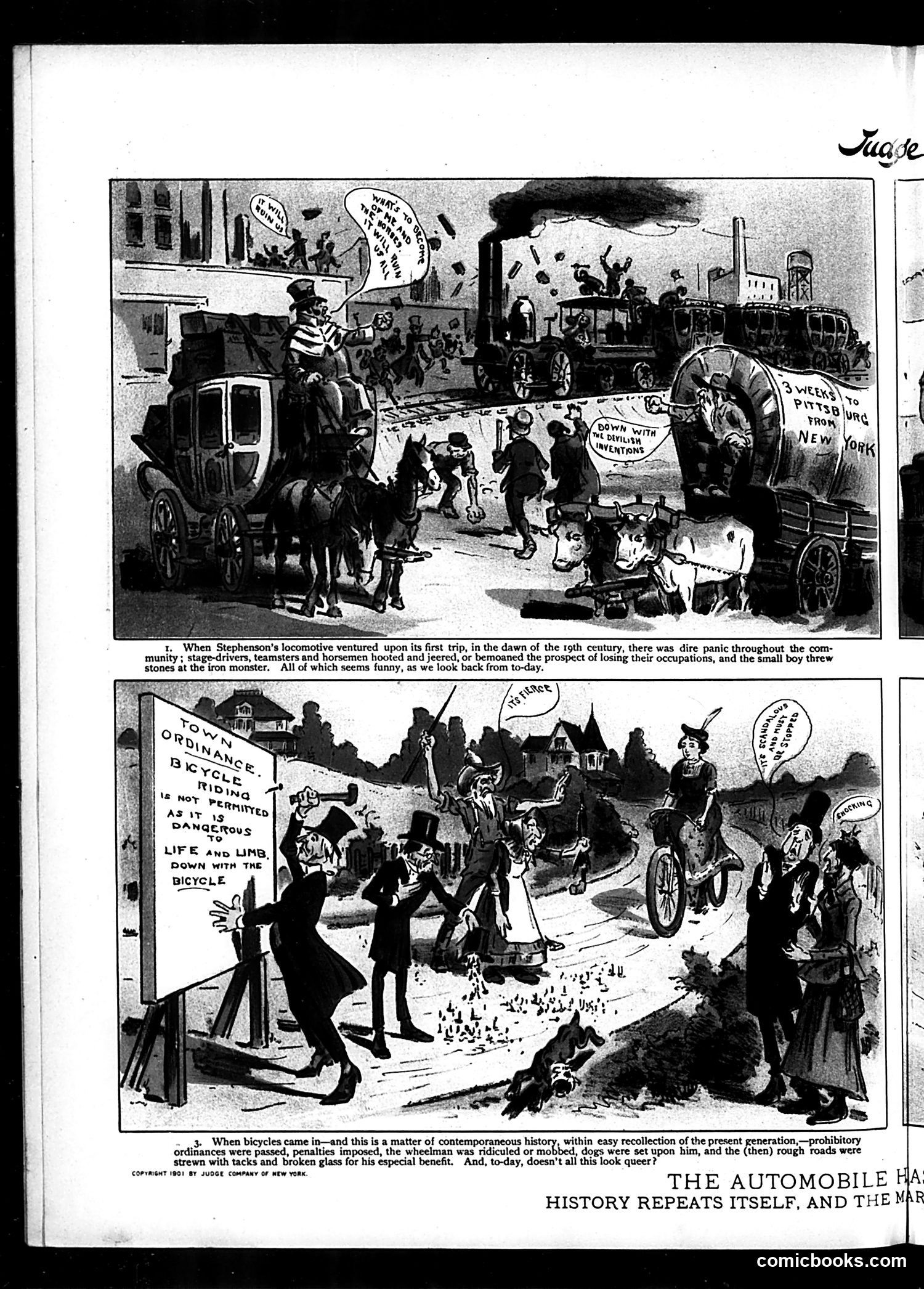
This Judge magazine page uses historical parallels to satirize contemporary resistance to automobiles. The cartoons depict two earlier technological disruptions: **Top panel**: Stephenson's early locomotive (early 1800s) faced panic from stage-drivers, teamsters, and horsemen who feared job loss. Crowds jeered and children threw stones at the "iron monster." **Bottom panel**: When bicycles arrived (late 1800s), they were similarly opposed—banned by ordinance, riders ridiculed and mobbed, roads sabotaged with tacks and broken glass. **The satire's point**: The page argues that automobile opposition is merely history repeating itself. Just as people now laugh at the absurd panic over locomotives and bicycles, future generations will laugh at current automobile opposition. The implicit message: resistance to technological progress is foolish and inevitable—the automobile will prevail regardless of current objections from traditional workers (horsemen, teamsters) and fearful authorities. The headline promises this theme continues: "HISTORY REPEATS ITSELF, AND THE..." (text cuts off).
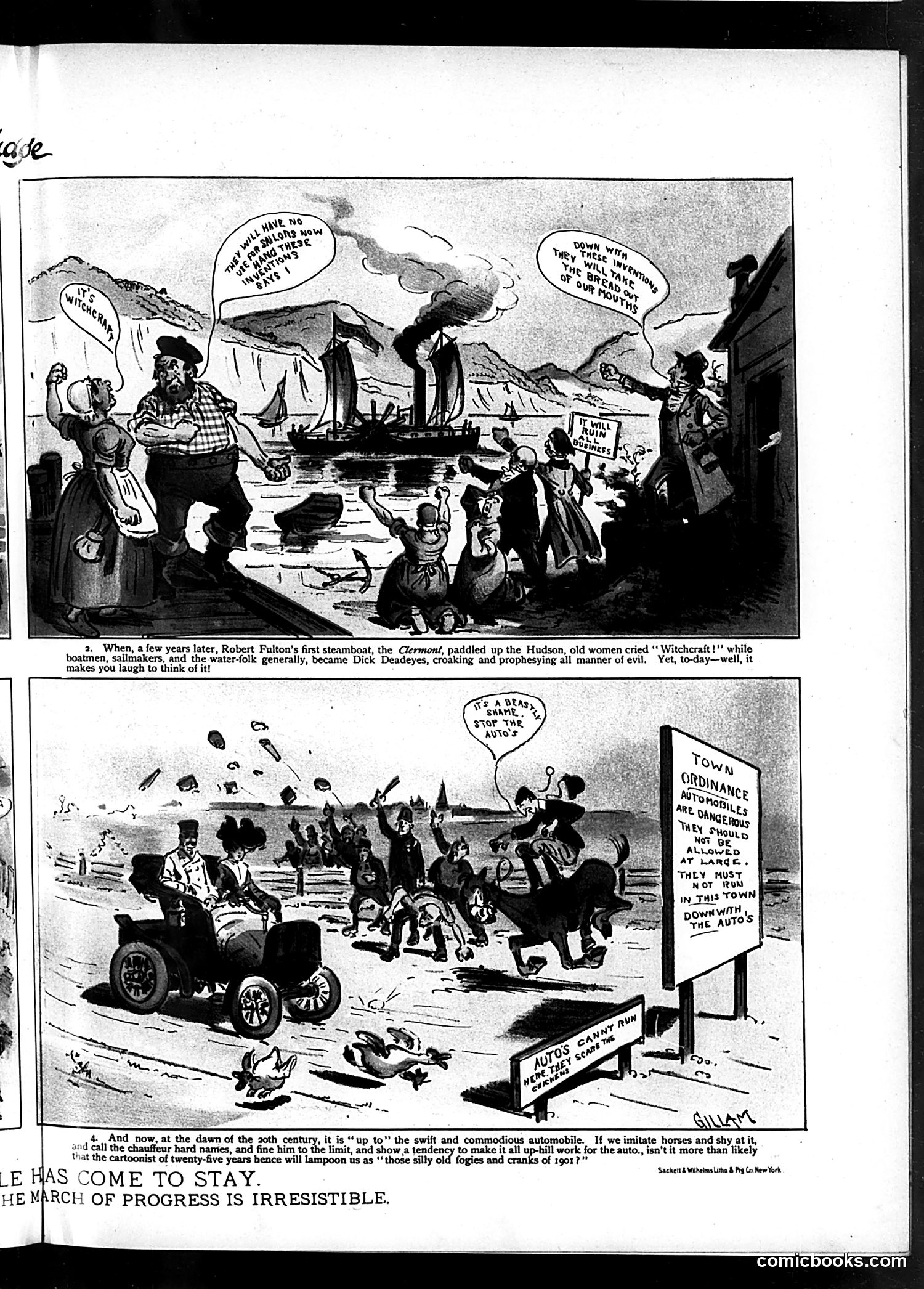
This two-panel cartoon satirizes resistance to technological innovation by drawing a historical parallel. **Panel 1** references Robert Fulton's steamboat *Clermont* (early 1800s), depicting public hysteria—women crying "Witchcraft!" and boatmen like "Dick Deadeyes" prophesying doom. The caption notes this seems laughable in retrospect. **Panel 2** shows early-1900s automobiles causing chaos in a town with an ordinance restricting them. Pedestrians, horses, and townspeople react with alarm and resistance. **The satire's point**: The cartoon mocks contemporary opponents of automobiles by suggesting they're as foolishly backward as those who once feared steamboats. It argues progress is inevitable and that future generations will ridicule current "fogies and cranks" (1901) for resisting cars—just as we laugh at those who called steamboats witchcraft. The cartoon advocates for accepting automotive technology despite public fear and resistance, framing opposition as inevitable but ultimately futile nostalgia.
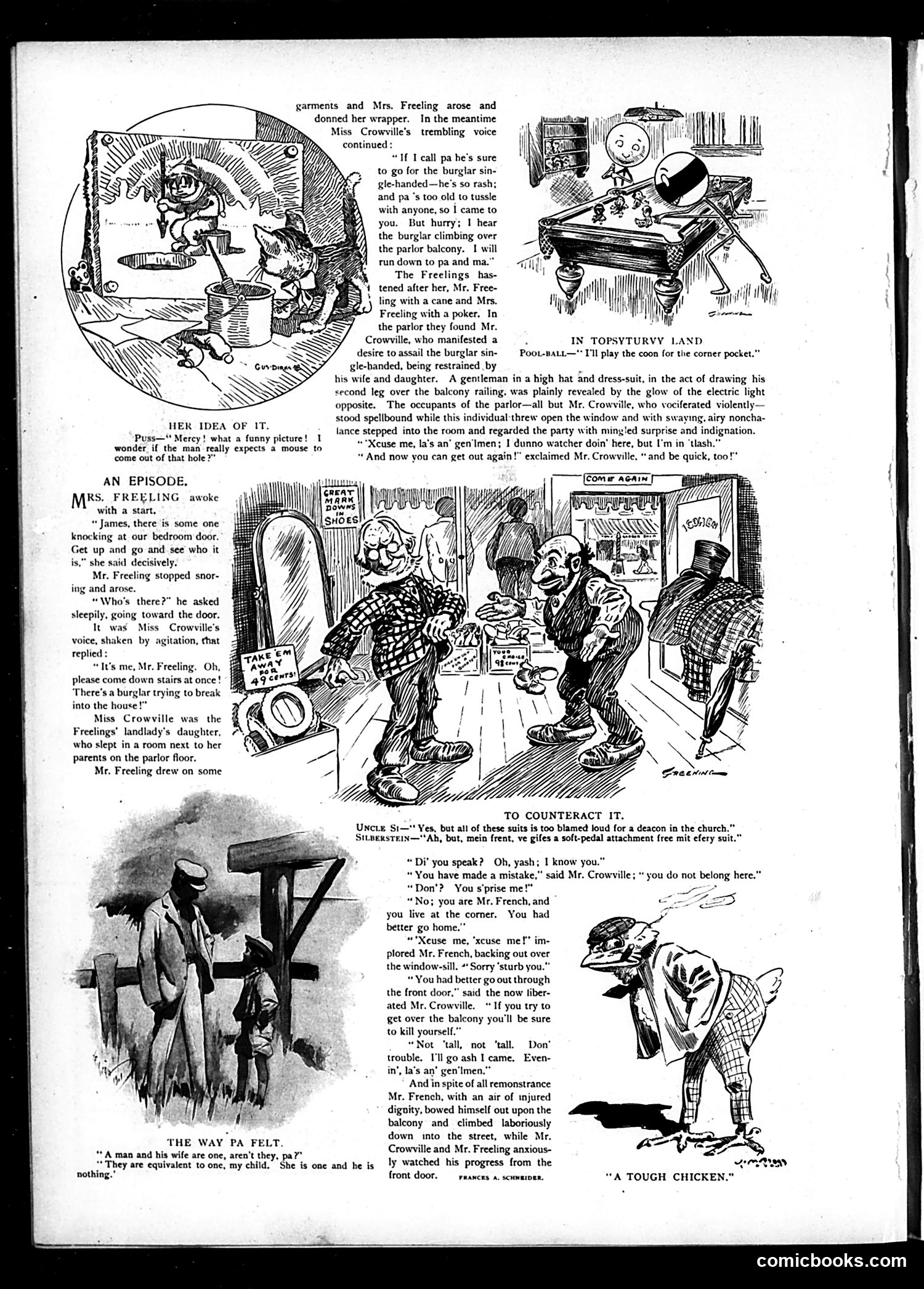
This page contains humorous domestic fiction illustrated with satirical cartoons. The main story depicts a comedic home invasion: Miss Crowville alerts the Freelings to a burglar, but the "burglar" turns out to be Mr. French, a neighbor who drunkenly climbed over the wrong balcony. The humor derives from mistaken identity and slapstick—the elderly Mr. Freeling preparing to fight, the intruder speaking in exaggerated dialectal English ("'Xcuse me"), and his dignified retreat back down the balcony. The racial caricature labeled "In Topsyturvy Land" reflects period attitudes typical of Judge's satirical content, depicting African Americans in stereotypical dialect and subservient roles—standard (though offensive by modern standards) comedic fodder for the era. The sidebar cartoons offer commentary on domestic life and gender relations, showing wives' authority over husbands and satirizing tailoring and marital dynamics. The overall tone is light domestic comedy aimed at middle-class readers.
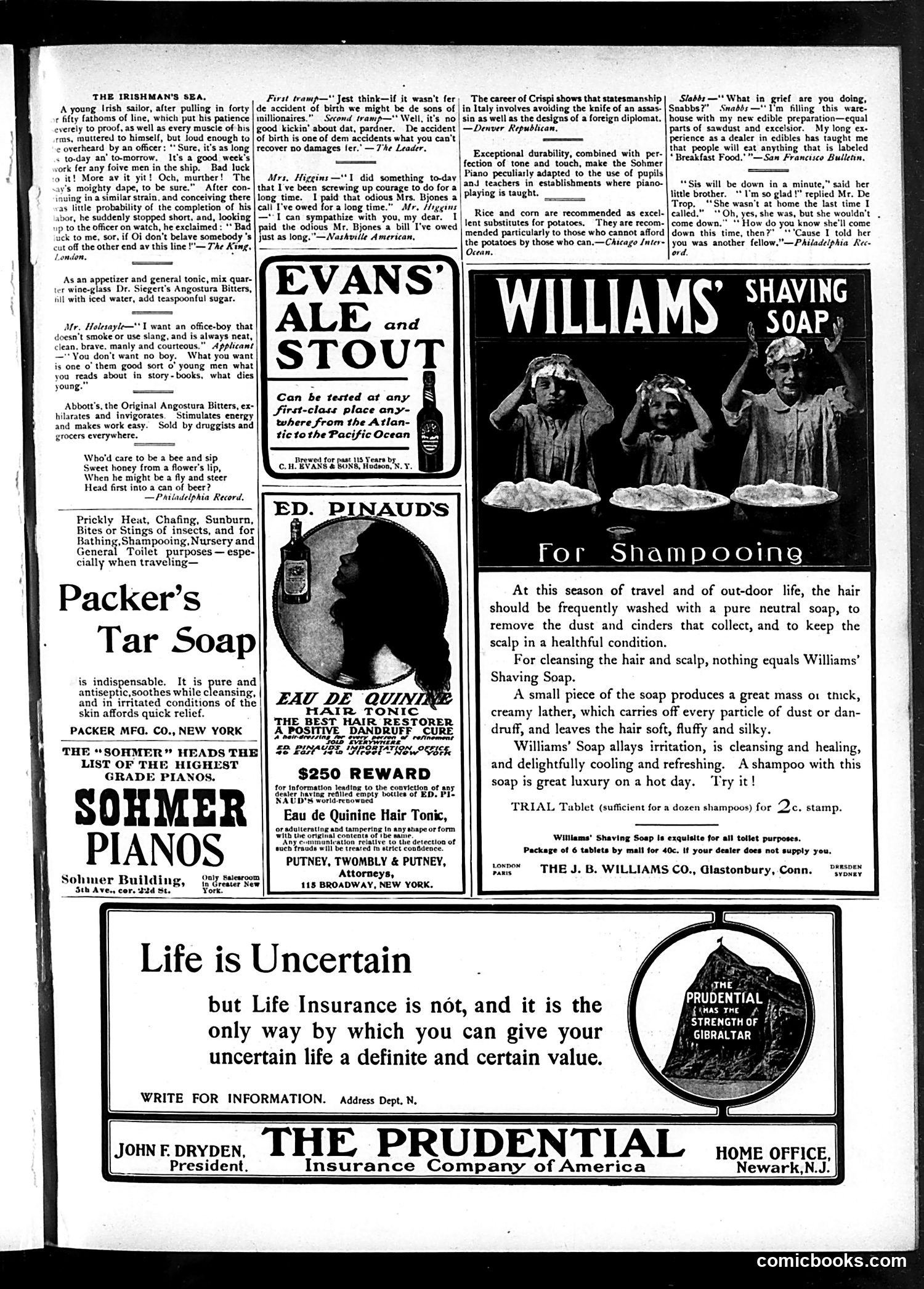
This page is primarily advertising with minimal cartooning. The notable satirical content consists of short humorous anecdotes rather than political cartoons: **"The Irishman's Sea"**: A joke featuring a stereotypical Irish sailor character complaining about hauling an extremely long fishing line, eventually concluding someone must have "cut off the other end" — absurdist humor based on the character's exasperation. **Other Brief Jokes**: Include an office-boy applicant who sarcastically points out the employer wants an idealized fictional character (not a real person), and two tramps joking that accidents of birth determine wealth. The page is dominated by product advertisements (Angostura Bitters, Packer's Tar Soap, Williams' Shaving Soap, Sohmer Pianos, Prudential Life Insurance, etc.), which was typical Judge magazine content. The humor relies on ethnic caricature and working-class comedic stereotypes common to early 20th-century publications.
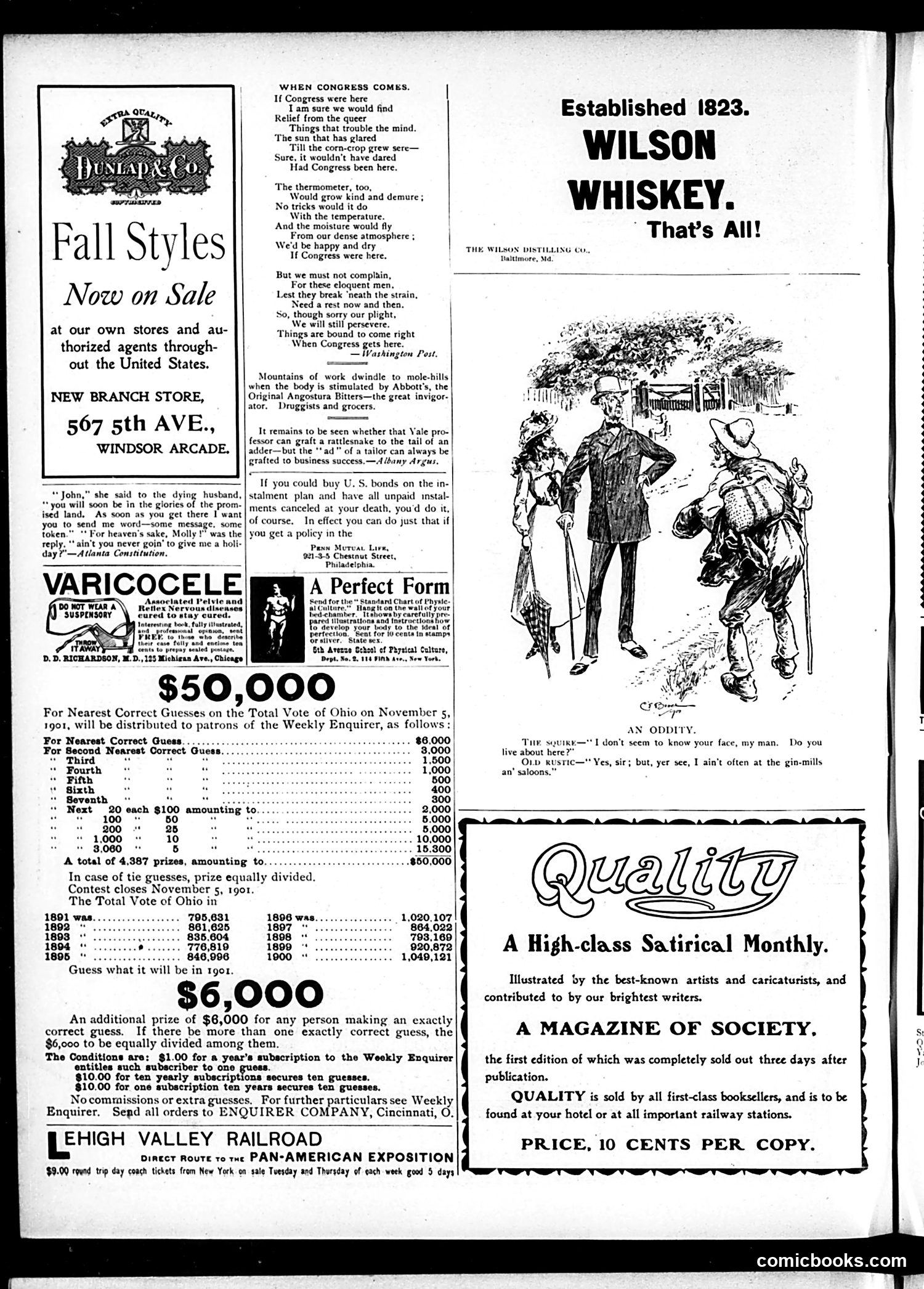
This page is primarily **advertisements and contests** rather than political satire, though it opens with a humorous poem. **"When Congress Comes"** (top left) is a satirical poem from the *Washington Post* mocking Congress's ineffectiveness. It jokes that if Congress were in session, it could miraculously solve everyday problems—drought, heat, humidity—implying Congress is so incompetent it's useless even for actual legislation. The satire suggests Americans would rather Congress stay away than attempt to govern. **The cartoon** (center-right, labeled "An Oddity") depicts a rural or working-class man claiming he rarely visits saloons, apparently surprising an aristocratic gentleman. This reflects period class-consciousness and stereotypes about lower-class drinking habits. The remainder consists of **product advertisements** (Wilson Whiskey, Fall Styles clothing, Abbott's Bitters) and a **$50,000 contest** asking readers to guess Ohio's total vote count for November 5, 1901—likely an election or referendum prediction scheme. The page reflects *Judge*'s mix of light political commentary with commercial content.
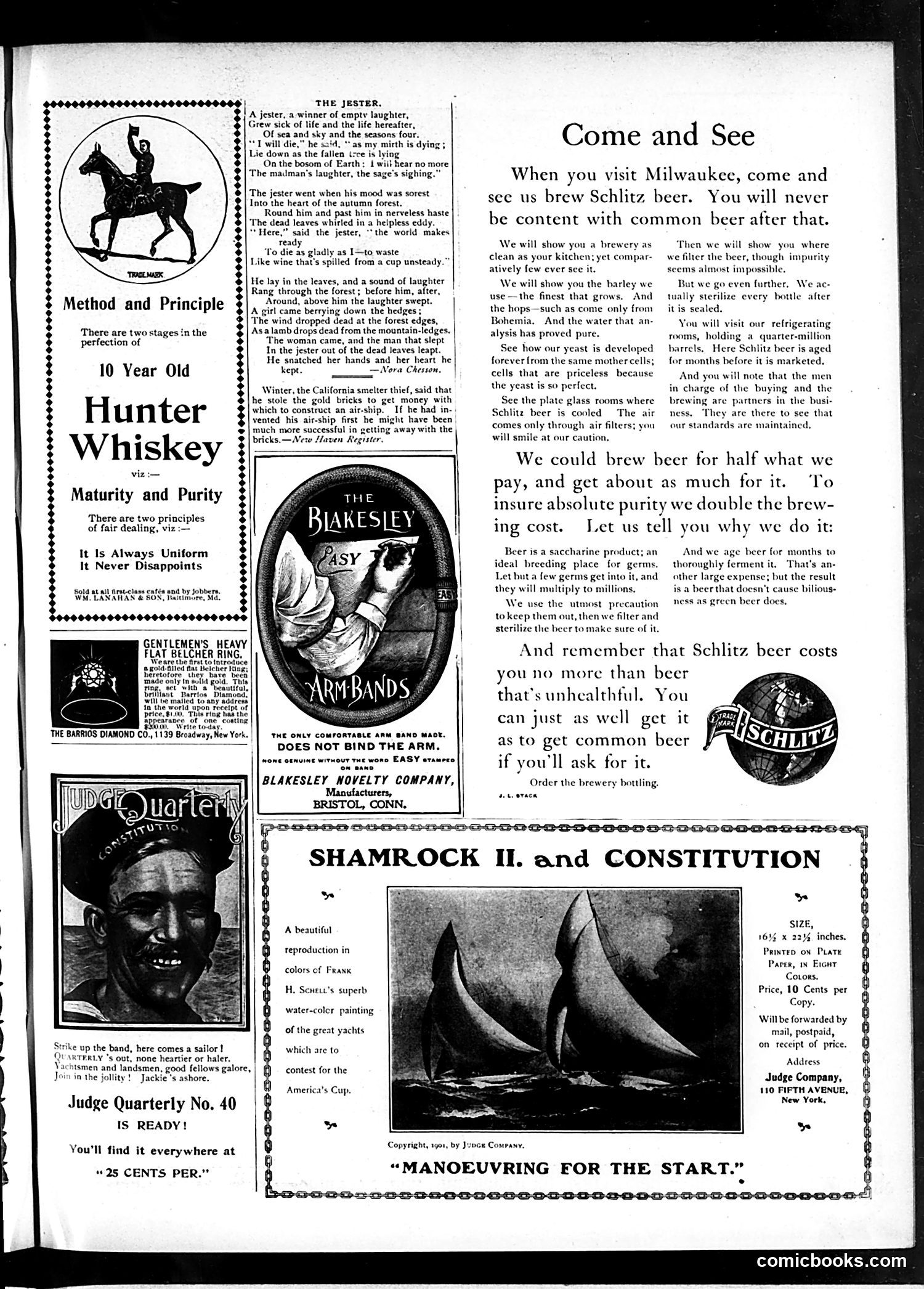
This page is primarily **advertising**, dominated by a Schlitz beer advertisement that occupies the right half. The ad emphasizes Milwaukee's Schlitz brewery's superior purity standards—doubled brewing costs, plate glass rooms, air filtering, sterilization, and aged storage—contrasting itself with "common beer." The left side contains **commercial ads** (Hunter Whiskey, jewelry, Judge Quarterly magazine) and a poem titled "**The Jester**" by Nora Chesson. The poem tells of a melancholic jester seeking death in an autumn forest who is revived by encountering a woman—a romantic parable about life's redemptive power. A brief satirical item mocks a "California smelter thief" (Winter) who stole gold bricks claiming he needed funds for an airship, suggesting his invention would have been more useful than the theft. The page reflects early 1900s concerns: industrial purity claims (food safety), leisure consumption (beer, whiskey), and serialized literary culture. The jester illustration at top-left is decorative, not satirical commentary.
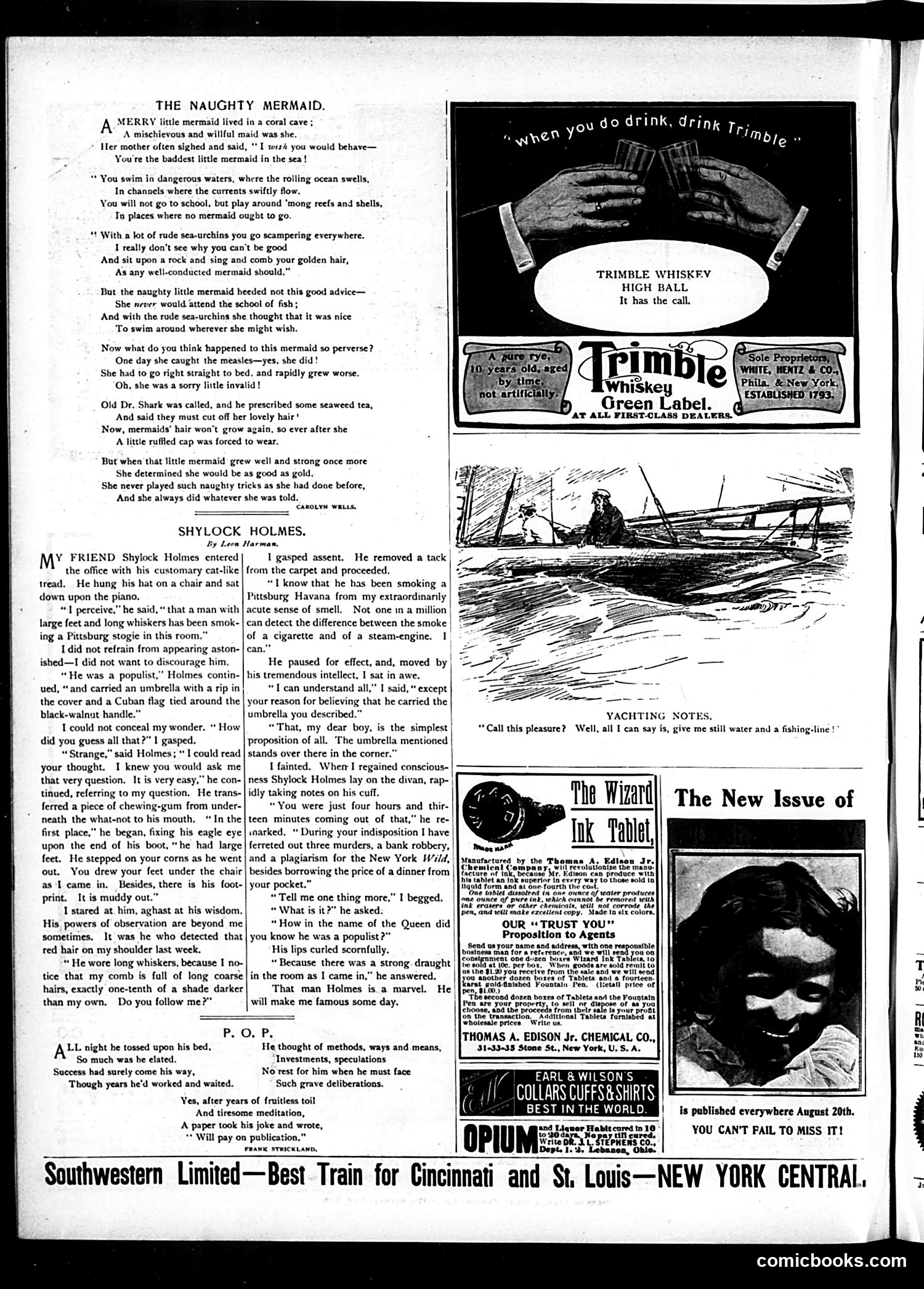
This page contains two humorous fiction pieces typical of Judge magazine's content. **"The Naughty Mermaid"** (by Carolyn Wells) is a morality tale in verse about a disobedient young mermaid who ignores her mother's warnings about swimming in dangerous waters and associating with "rude sea-urchins." When she catches measles, Dr. Shark prescribes seaweed tea and cuts off her hair—which won't regrow. The punishment reforms her completely. The story satirizes Victorian parental authority and the belief that misbehavior automatically results in consequences. **"Shylock Holmes"** parodies Sherlock Holmes, the famous detective. Here, "Holmes" makes absurdly obvious deductions (a man has large feet because he left a muddy footprint) while his narrator treats these as miracles of observation. The humor relies on exaggerating Holmes's reputation for brilliant deduction to absurd levels—his greatest "insight" is noticing an umbrella literally standing in the corner. Both pieces are light, family-friendly humor typical of early 1900s Judge magazine content.
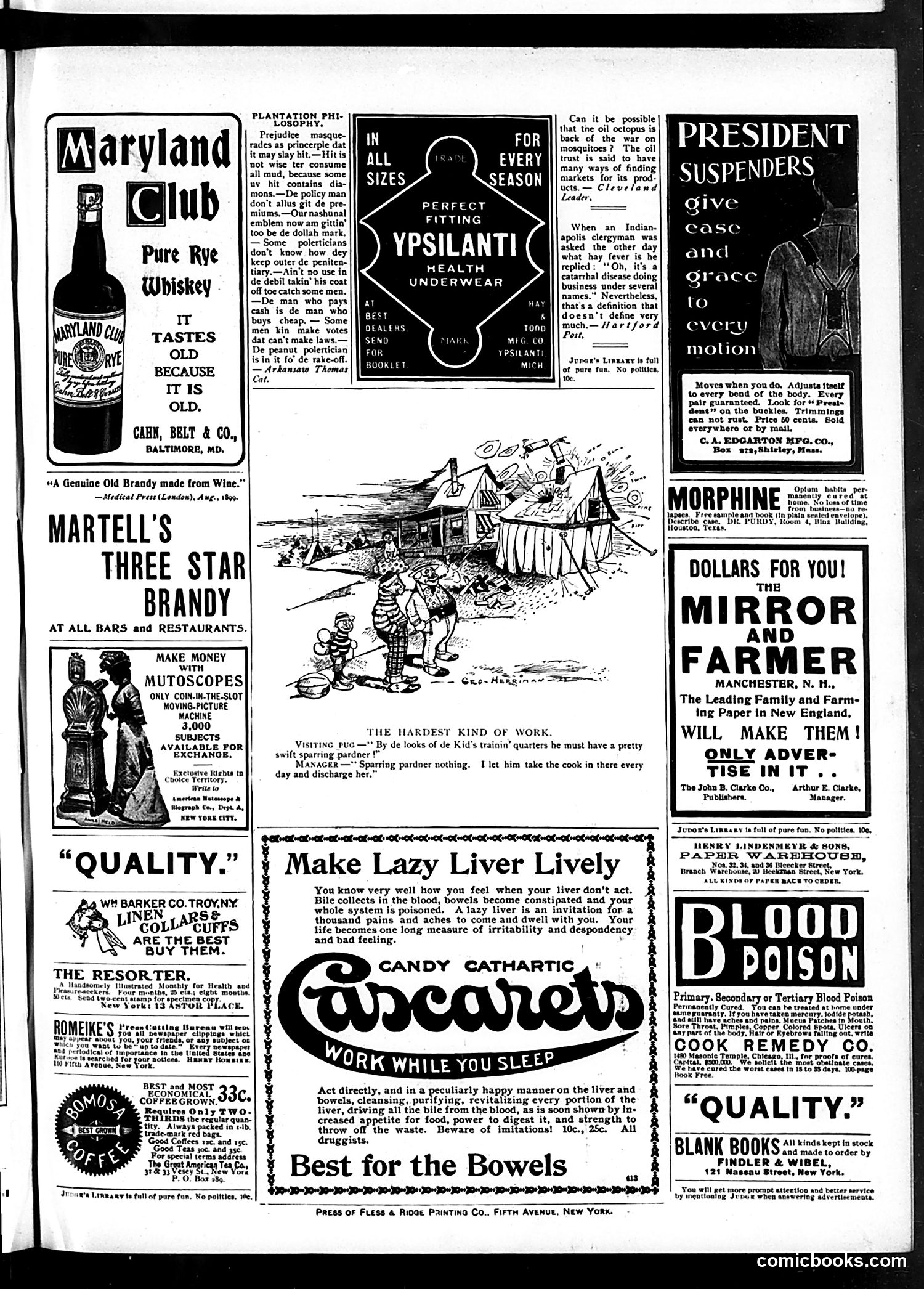
This page is primarily **advertising**, not editorial or satirical content. It contains multiple commercial advertisements typical of early 20th-century publications. The page includes ads for: - Alcohol (Maryland Club Rye Whiskey, Martell's Brandy) - Patent medicines (Cascaret candy laxative, blood poison treatments, liver remedies) - Clothing (Ypsilanti underwear) - Farm publications and other goods There are two small **cartoon vignettes** with captions: 1. "THE HARDEST KIND OF WORK" — depicts a farm manager discussing a cook with someone, suggesting domestic/farm labor humor 2. Another cartoon about a pug dog's "training quarters" These are gentle humor pieces, not political satire. The "Plantation Philosophy" column quotes rural dialect humor (a common early 1900s feature), but contains no clear political commentary visible here. The page reflects Judge's evolution toward commercial content and lighter humor rather than its original satirical political focus.
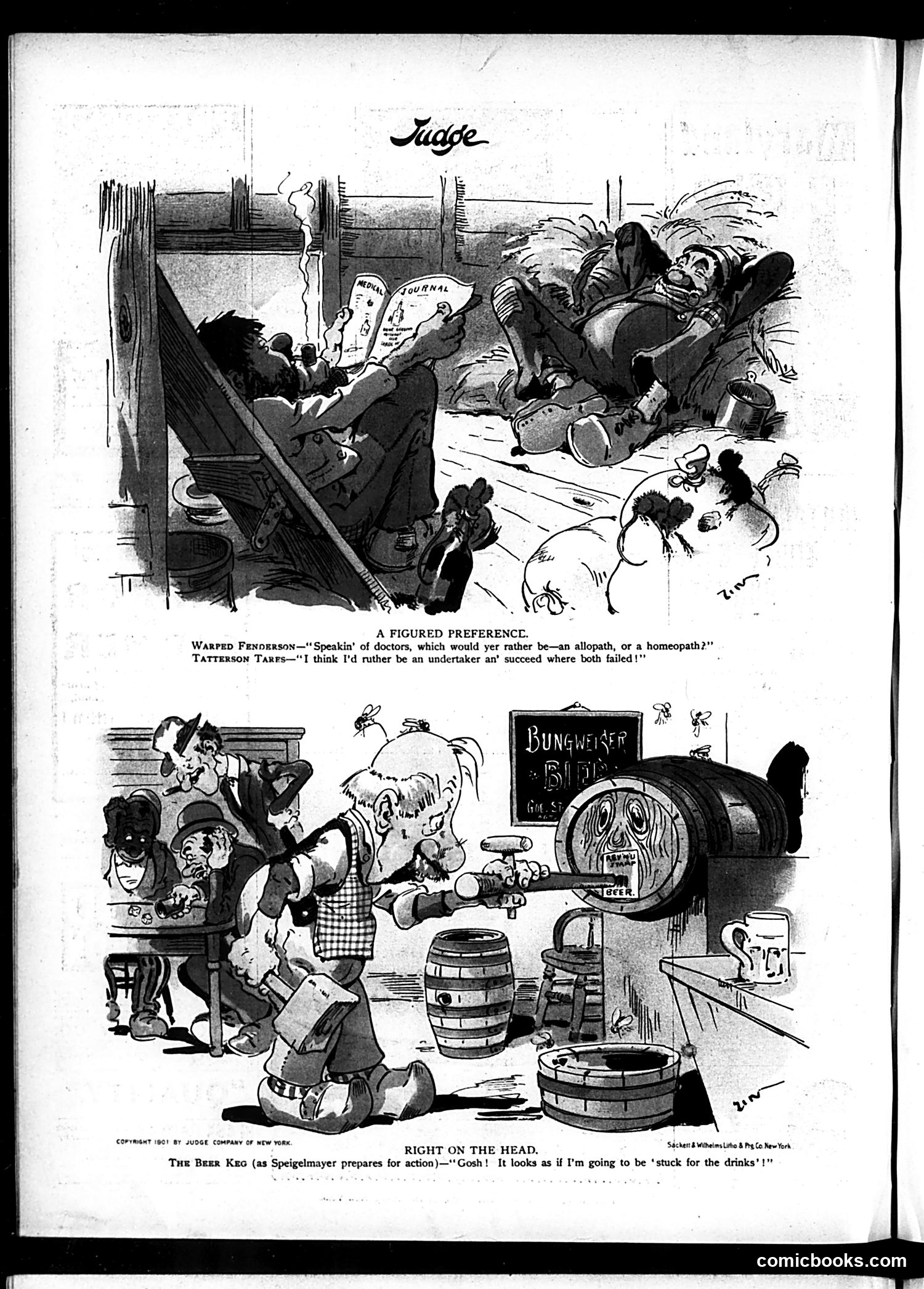
**Top Cartoon ("A Figured Preference"):** Two men—Warren Fenderson and Tatterson Tarrs—discuss medical practitioners. The joke mocks both allopathic doctors (traditional medicine) and homeopathic doctors (alternative medicine using diluted substances), suggesting both are ineffective. The punchline: becoming an undertaker would be more successful since patients die regardless of which doctor treats them. This reflects genuine medical debate of the era about competing treatment philosophies. **Bottom Cartoon ("Right on the Head"):** A character called "The Beer Keg" watches Speigelmayer prepare for action with beer barrels and taps visible. The joke plays on "stuck for the drinks"—a pun suggesting he'll be literally tapped (like a barrel) and thus obligated to pay for drinks. This appears to be ethnic humor, typical of Judge's era, mocking German-American characters and beer culture. Both exemplify Judge's satirical humor circa 1901.