
Judge, 1901-09-14 · page 2 of 16
Judge — September 14, 1901 — page 2: what you’re looking at
What you’re looking at
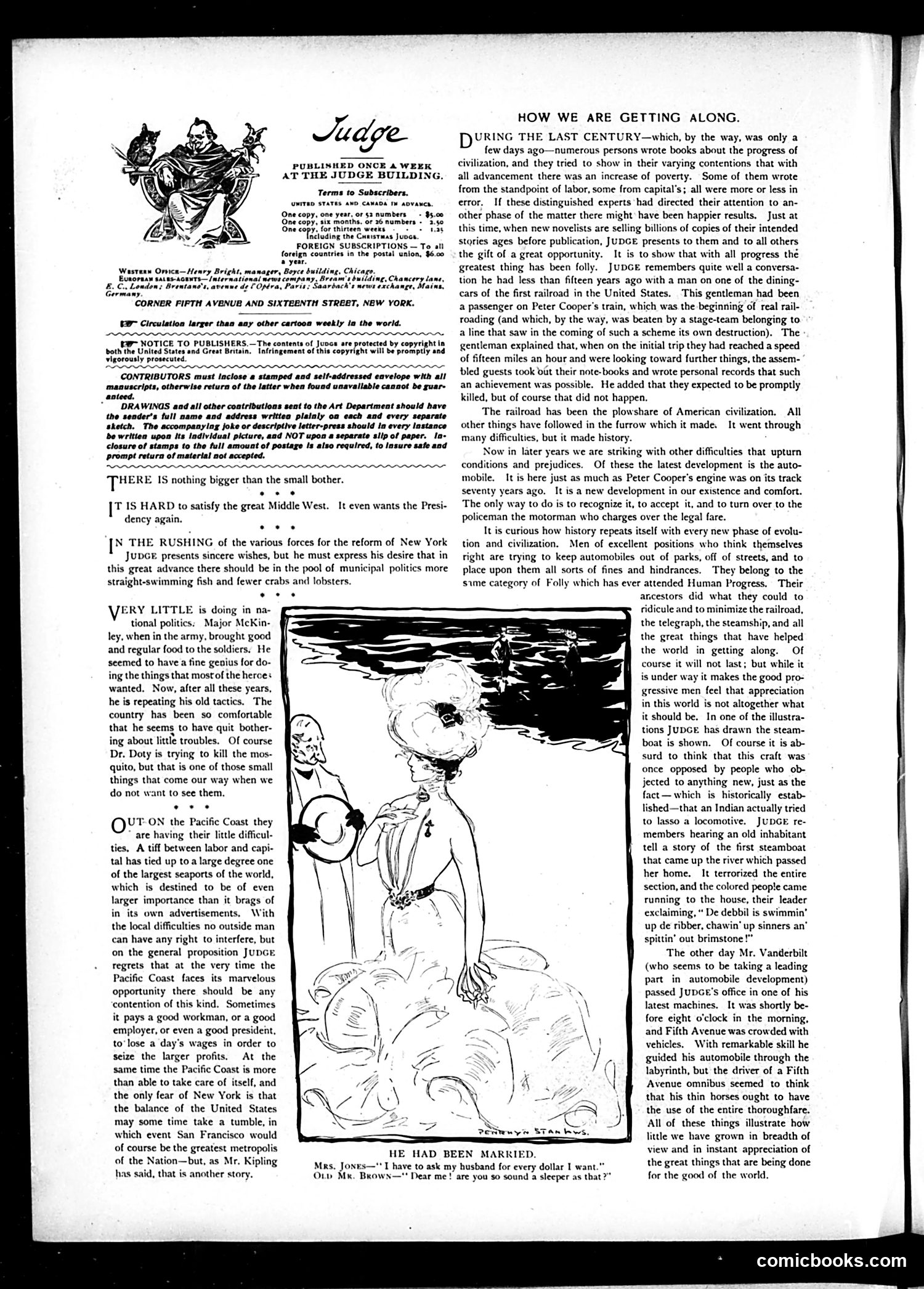
This page critiques America's progress during the railroad era. The central cartoon, titled "He Had Been Married," depicts a woman riding atop a man's shoulders, illustrating marital dependency and burden—a commentary on societal relationships during rapid industrialization. The accompanying text discusses how railroad development, despite bringing civilization, has created new social problems: labor disputes, capital conflicts on the Pacific Coast, and urban congestion (the Fifth Avenue automobile traffic reference). The satire argues that while Americans celebrate technological progress—steamboats, locomotives, automobiles—they've overlooked the human costs: poverty, labor unrest, and infrastructure strain. The "marriage" metaphor suggests progress and its consequences are inseparably bound, with society bearing an uncomfortable load.
📄 Transcribed text from this page (OCR, searchable)
Machine-transcribed from the original scan — historical spelling and the odd misread are preserved.
Sage PUBLINHED ONCE A WEEK AT THE JUDGE BUILDING. Terms to Subscribers. UNITED STATES AMD CANADA Te ADVANCS, at, oF $2 numbers months, or 26 numbers y, for thirteen w fncluding the Cuai FOREIGN SUBSCRIPTIONS — To al! jig countries in the postal union, $6.00 One copy, one One co One « Py Wasr Iding, Chicago. reams building, Chancery La: sarbach's mews exchange, Mains, * Ornicn—Henry Bright, ery s— B.C, London. Germany, CORNER FIFTH AVENUB AND SIXTEENTH STREET, NEW YORK. 7 Circulation larger than any other cartoon weekly ia the world. f9- NOTICE TO PUBLISHERS.—The contents of Juve both the United States and Great Britain. Infringement of this vigorously prosecuted. CONTRIBUTORS must taclose a stamped and self-addressed envelope with all manuscripts, otherwise return of the latter when fouad unavailable cannot be guar- anteed. DRAWINGS and all other contributions sent to the Art Department should have the sender's tall name and address writtea plalaly oa each and every separate sketch. The accompanylog joke or descriptive letter-press should Ia every lastance be writiea upon Its ladividual picture, aad NOT upon a separate slip of paper. Ia- closure of stamps to the full amount of postage Is also required, to Insure safe and prompt retura of material not accepted. protected by copyright pyright will be prompt THERE 5 nothing bigger than the small bother. eee T IS HARD to satisfy the great Middle West. It even wants the Presi- dency again. ee N THE RUSHING of the various forces for the reform of New York JUDGE presents sincere wishes, but he must express his desire that in this great advance there should be in the pool of municipal politics more straight-swimming fish and fewer crabs and lobsters. o- V RY LITTLE is doing in na- tional politics: Major McKin- ley, when in the army, brought good and regular food to the soldiers. He seemed to have a fine genius for do- ing the things that most of the heroes wanted. Now, after all these years, he is repeating his old tactics. The country has been so comfortable that he seems to have quit bother- ing about little troubles. Of course Dr. Doty is trying to kill the mos- quito, but that is one of those small things that come our way when we do not want to see them. UT-ON the Pacific Coast they are having their little difficul- ties. A tiff between labor and capi- tal has tied up toa large degree one of the largest seaports of the world, which is destined to be of even larger importance than it brags of in its own advertisements, With the local difficulties no outside man can have any right to interfere, but on the general proposition JuDGE regrets that at the very time the Pacific Coast faces its marvelous opportunity there should be any ‘contention of this kind. Sometimes it pays a good workman, or a good employer, or even a good president, to'lose a day's wages in order to seize the larger profits. At the same time the Pacific Coast is more than able to take care of itself, and the only fear of New York is that the balance of the United States may some time take a tumble, in which event San Francisco would of course be the greatest metropolis of the Nation—but, as Mr. Kipling has said, that is another story. HE Mrs. Jone: HAD BEEN MARRIED. *Lhave to ask my husband for every dollar I want.” Otv Mx. Beows—"* Dear me! are you so sound a sleeper as that?” HOW WE ARE GETTING ALONG. DURING THE LAST CENTURY—which, by the way, was only a few days ago—numerous persons wrote books about the progress of civilization, and they tried to show in their varying contentions that with all advancement there was an increase of poverty. Some of them wrote from the standpoint of labor, some from capital's; all were more or less in error. If these distinguished experts had directed their attention to an- other phase of the matter there might have been happier results. Just at this time, when new novelists are selling billions of copies of their intended stories ages before publication, JUDGE presents to them and to all others the gift of a great opportunity. It is to show that with all progress thé greatest thing has been folly. JUDGE remembers quite well a conversa- tion he had less than fifteen years ago with a man on one of the dining- cars of the first railroad in the United States. This gentleman had been a passenger on Peter Cooper's train, which was the beginning of real rail- roading (and which, by the way, was beaten by a stage-team belonging to a line that saw in the coming of such a scheme its own destruction). The gentleman explained that, when on the initial trip they had reached a speed of fifteen miles an hour and were looking toward further things, the assem- dled guests took out their note-books and wrote personal records that such an achievement was possible. He added that they expected to be promptly killed, but of course that did not happen. The railroad has been the plowshare of American civilization. All other things have followed in the furrow which it made, It went through many difficulties, but it made history, Now in later years we are striking with other difficulties that upturn conditions and prejudices. Of these the latest development is the auto- mobile, It is here just as much as Peter Cooper's engine was on its track seventy years ago, It is a new development in our existence and comfort. The only way to do is to recognize it, to accept it, and to turn over to the policeman the motorman who charges over the legal fare. It is curious how history repeats itself with every new phase of evolu- tion and civilization. Men of excellent positions who think themselves right are trying to keep automobiles out of parks, off of streets, and to place upon them all sorts of fines and hindrances. They belong to the sume category of Folly which has ever attended Human Progress. Their ancestors did what they could to ridicule and to minimize the railroad, the telegraph, the steamship, and all the great things that have helped the world in getting along. Of course it will not last; but while it is under way it makes the good pro- gressive men feel that appreciation in this world is not altogether what it should be. In one of the illustra- tions JUDGE has drawn the steam- boat is shown. Of course it is ab- surd to think that this craft was once opposed by people who ob- jected to anything new, just as the fact— which is historically estab- lished—that an Indian actually tried to lasso a locomotive. JUDGE re- members hearing an old inhabitant tell a story of the first steamboat that came up the river which passed her home. It terrorized the entire section, and the colored people came running to the house, their leader exclaiming, “ De debbil is swimmin’ up de ribber, chawin’ up sinners an’ spittin’ out brimstone!” The other day Mr. Vanderbilt (who seems to be taking a leading part in automobile development) passed JUDGE'S office in one of his latest machines. It was shortly be- fore eight o'clock in the morning, and Fifth Avenue was crowded with vehicles. With remarkable skill he guided his automobile through the labyrinth, but the driver of a Fifth Avenue omnibus seemed to think that his thin horses ought to have the use of the entire thoroughfare. All of these things illustrate how little we have grown in breadth of view and in instant appreciation of the great things that are being done for the good of the world. comicbooks.com