
Judge, 1901-09-14 · page 3 of 16
Judge — September 14, 1901 — page 3: what you’re looking at
What you’re looking at
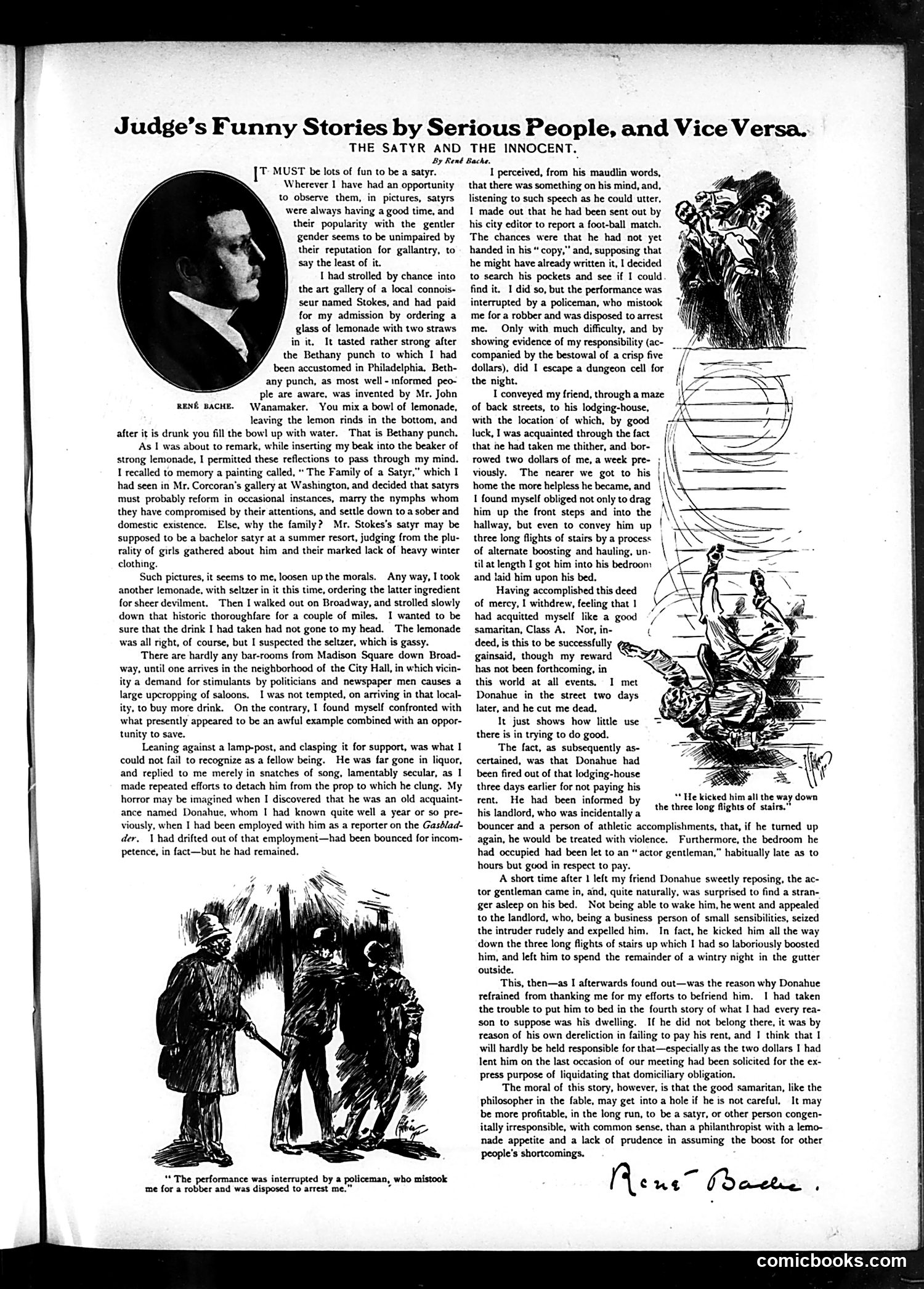
This story satirizes well-meaning charitable impulses that backfire. The narrator, a self-described "satyr" or cynic, attempts good deeds but creates worse outcomes. The main anecdote concerns rescuing an intoxicated vagrant named Donahue from the streets. After bringing him home and putting him to bed, the narrator later finds Donahue has been evicted by his landlord (whom Donahue hadn't paid rent). The landlord was a "bouncer" at a lodging house—an "actor gentleman" who violently expelled Donahue down multiple flights of stairs into the winter gutter. The satire's point: attempting unsupervised charity toward someone with deeper problems (unpaid debts, housing instability) can ironically worsen their situation. The moral warns against "philanthropist with a lemonade appetite" assuming society's ills are simple to fix.
📄 Transcribed text from this page (OCR, searchable)
Machine-transcribed from the original scan — historical spelling and the odd misread are preserved.
Judge’s Funny Stories by Serious People, and Vice Versa. THE SATYR AND THE INNOCENT, By Rend Bache. T MUST be lots of fun to be a satyr. Wherever I have had an opportunity to observe them, in pictures, satyrs were always having a good time, and their popularity with the gentler gender seems to be unimpaired by their reputation for gallantry, to say the least of it. Thad strolled by chance into the art gallery of a local connois- seur named Stokes, and had paid for my admission by ordering a glass of lemonade with two straws in it, It tasted rather strong after the Bethany punch to which I had been accustomed in Philadelphia. Beth- any punch, as most well - informed peo ple are aware, was invented by Mr. John Wanamaker. You mix a bowl of lemonade, leaving the lemon rinds in the bottom, and after it is drunk you fill the bowl up with water. That is Bethany punch, As I was about to remark, while inserting my beak into the beaker of strong lemonade, I permitted these reflections to pass through my mind. I recalled to memory a painting called, “ The Family of a Satyr,” which I had seen in Mr. Corcoran’s gallery at Washington, and decided that satyrs must probably reform in occasional instances, marry the nymphs whom they have compromised by their attentions, and settle down toa sober and domestic existence. Else, why the family? Mr. Stokes’s satyr may be supposed to be a bachelor satyr at a summer resort, judging from the plu- rality of girls gathered about him and their marked lack of heavy winter clothing. Such pictures, it seems to me, loosen up the morals. Any way, I took another lemonade, with seltzer in it this time, ordering the latter ingredient for sheer devilment. Then I walked out on Broadway, and strolled slowly down that historic thoroughfare for a couple of miles, I wanted to be sure that the drink I had taken had not gone to my head. The lemonade was all right, of course, but I suspected the seltzer, which is gassy. There are hardly any bar-rooms from Madison Square down Broad- way, until one arrives in the neighborhood of the City Hall, in which vicin- ity a demand for stimulants by politicians and newspaper men causes a large upcropping of saloons. I was not tempted, on arriving in that local- ity, to buy more drink. On the contrary, I found myself confronted with what presently appeared to be an awful example combined with an oppor- tunity to save. Leaning against a lamp-post, and clasping it for support, was what I could not fail to recognize as a fellow being. He was far gone in liquor, and replied to me merely in snatches of song, lamentably secular, as I made repeated efforts to detach him from the prop to which he clung. My horror may be imagined when I discovered that he was an old acquaint- ance named Donahue, whom I had known quite well a year or so pre- viously, when I had been employed with him as a reporter on the Gasblad- der, Vhad drifted out of that employment—had been bounced for incom- petence, in fact—but he had remained. RENE BACHE. “The me for a robber and was disposed to arrest me.” performance was interrupted by a policeman, who mistook I perceived, from his maudlin words, that there was something on his mind, and, listening to such speech as he could utter, I made out that he had been sent out by his city editor to report a foot-ball match. The chances were that he had not yet handed in his “ copy,” and, supposing that he might have already written it, I decided to search his pockets and see if I could find it. I did so, but the performance was interrupted by a policeman, who mistook me for a robber and was disposed to arrest me. Only with much difficulty, and by showing evidence of my responsibility (ac- companied by the bestowal of a crisp five dollars), did I escape a dungeon cell for the night. I conveyed my friend, through a maze of back streets, to his lodging-house, with the location of which, by good luck, I was acquainted through the fact that ne had taken me thither, and bor- rowed two dollars of me, a week pre- ; viously, The nearer we got to his || home the more helpless he became, and | I found myself obliged not only to drag him up the front steps and into the | hallway, but even to convey him up | three long flights of stairs by a process | of alternate boosting and hauling, un- til at length I got him into his bedroom k and laid him upon his bed, Having accomplished this deed of mercy, I withdrew, feeling that 1 had acquitted myself like a good samaritan, Class A. Nor, in- deed, is this to be successfully gainsaid, though my reward has not been forthcoming, in this world at all events, I met Donahue in the street two days later, and he cut me dead. N It just shows how little use = there is in trying to do good. The fact, as subsequently as- certained, was that Donahue had been fired out of that lodging-house three days earlier for not paying his rent. He had been informed by his landlord, who was incidentally a bouncer and a person of athletic accomplishments, that, if he turned up again, he would be treated with violence. Furthermore, the bedroom he had occupied had been let to an “actor gentleman,” habitually late as to hours but good in respect to pay. A short time after 1 left my friend Donahue sweetly reposing, the ac- tor gentleman came in, and, quite naturally, was surprised to find a stran- ger asleep on his bed. Not being able to wake him, he went and appealed to the landlord, who, being a business person of small sensibilities, seized the intruder rudely and expelled him. In fact, he kicked him all the way down the three long flights of stairs up which I had so laboriously boosted him, and left him to spend the remainder of a wintry night in the gutter outside. er “* He kicked him all the way down the three long flights of stairs.” This, then—as I afterwards found out—was the reason why Donahue tefrained from thanking me for my efforts to befriend him. 1 had taken the trouble to put him to bed in the fourth story of what I had every rea- son to suppose was his dwelling. If he did not belong there, it was by reason of his own dereliction in failing to pay his rent, and J think that I will hardly be held responsible for that—especially as the two dollars I had lent him on the last occasion of our meeting had been solicited for the ex- press purpose of liquidating that domiciliary obligation. The moral of this story, however, is that the good samaritan, like the philosopher in the fable, may get into a hole if he is not careful. It may be more profitable, in the long run, to be a satyr, or other person congen- itally irresponsible, with common sense, than a philanthropist with a lemo- nade appetite and a lack of prudence in assuming the boost for other people's shortcomings. - A CUE 6d athe . comicbooks.com