
A complete issue · 16 pages · 1901
Judge — August 3, 1901
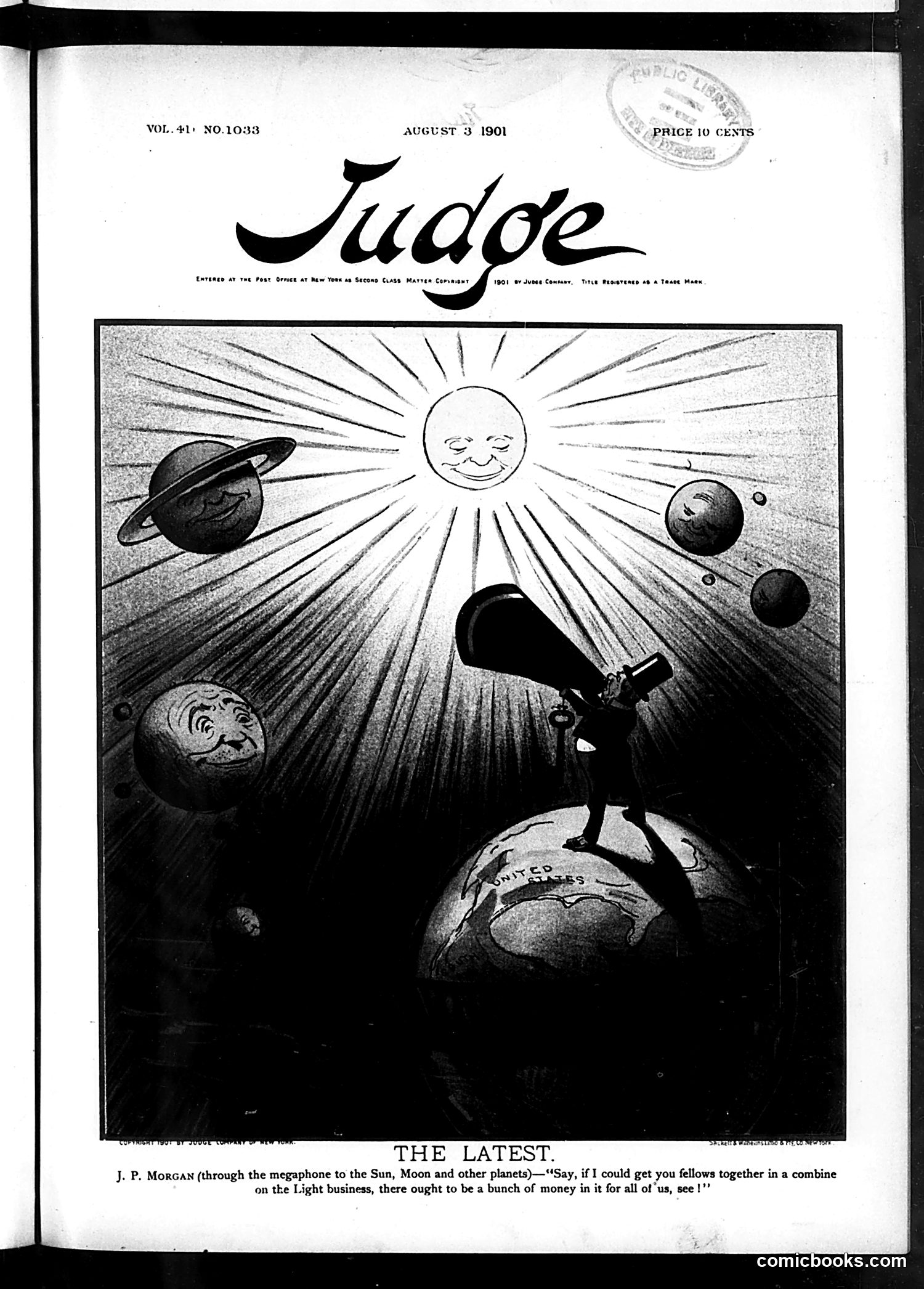
This political cartoon depicts **J.P. Morgan**, the powerful financier, attempting to consolidate control over major industrial and financial entities (represented as celestial bodies—the Sun, Moon, and planets). The satire mocks Morgan's influence and ambitions during the Gilded Age. The caption shows Morgan claiming he could combine these "Light business" entities into a profitable monopoly "in it for all of us"—a sardonic comment on how wealthy industrialists justified consolidation by claiming collective benefit, while actually concentrating power and wealth. The celestial imagery suggests Morgan's grandiose ambitions appear almost godlike or planetary in scale. This reflects contemporary anxieties about unchecked corporate power and monopoly formation in early 20th-century America.
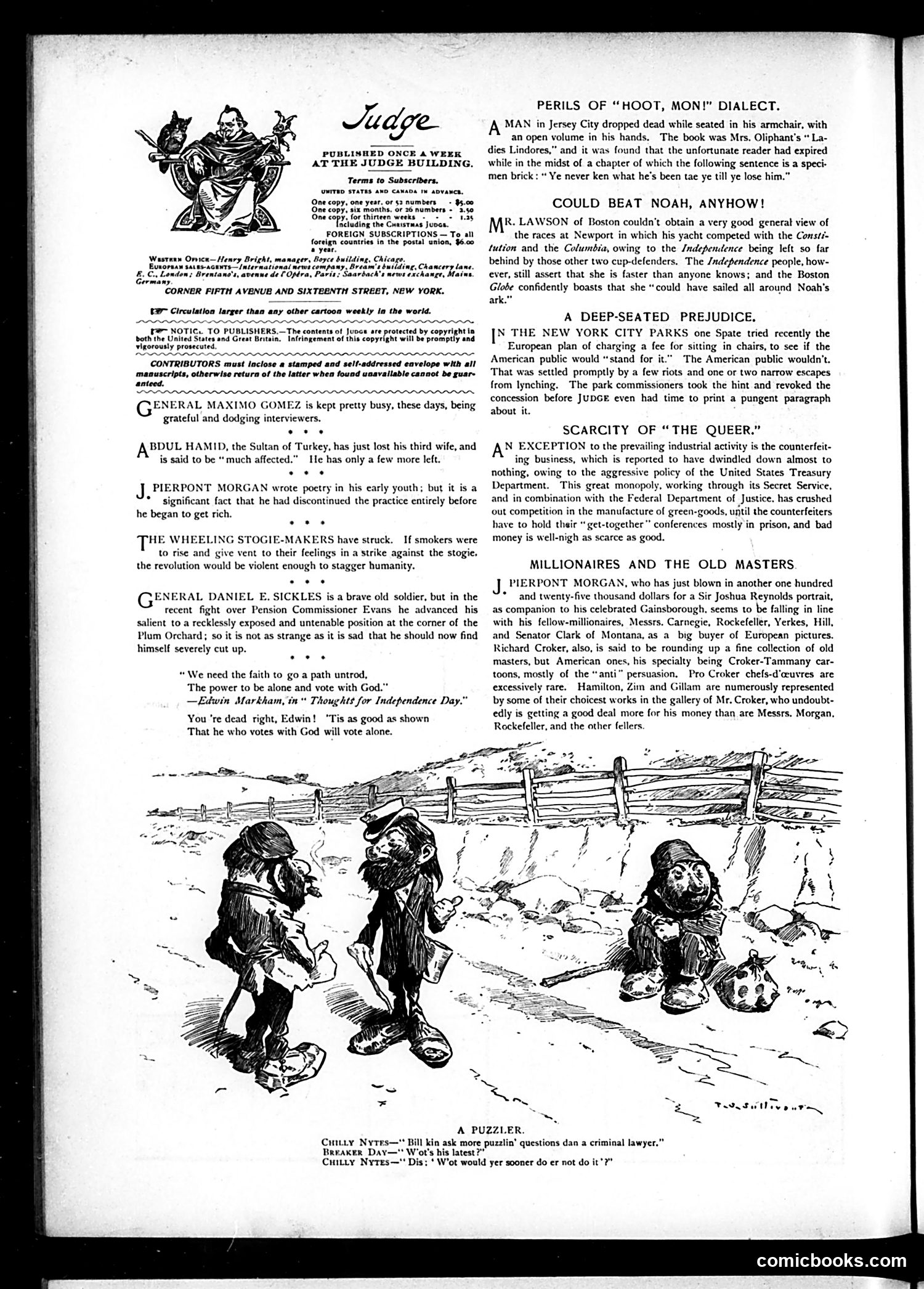
This page contains several brief satirical items and a cartoon titled "A Puzzler." The cartoon depicts three disheveled men in conversation, with the caption indicating wordplay about a criminal lawyer. The humor relies on the double meaning of "criminal lawyer"—someone who defends criminals versus someone who is themselves criminal. The text items above mock contemporary figures: Abdul Hamid (Ottoman Sultan), Pierpont Morgan (wealthy financier), and General Daniel E. Sickles (Civil War veteran). They use quick zingers about these men's personal scandals and failings—lost wives, discontinued poetry, military exposure—typical of Judge's gossipy satirical style targeting prominent public figures of the era. The overall tone is irreverent commentary on wealthy and powerful men's foibles.
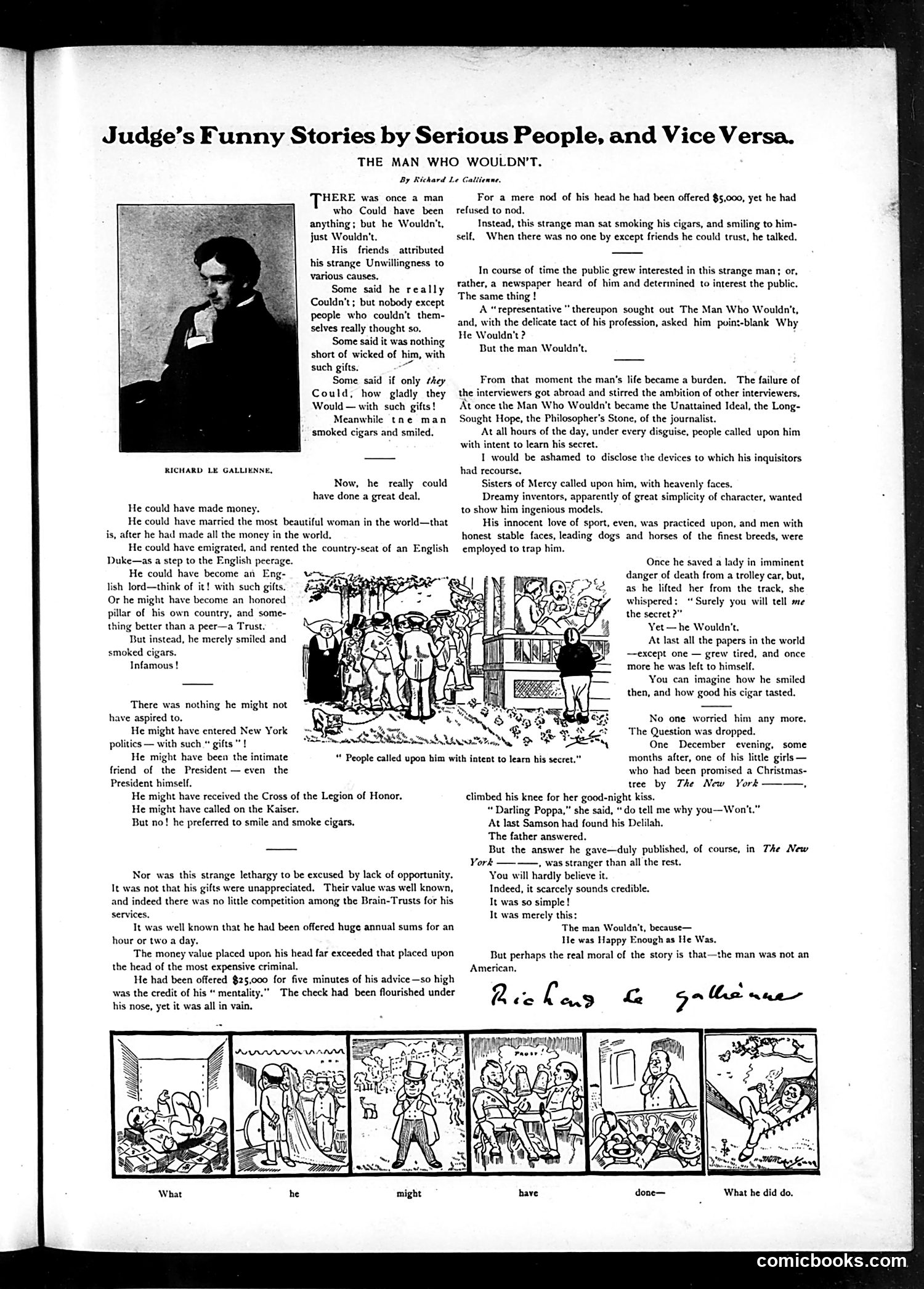
This satirical story mocks a man of peculiar principle who refuses all worldly advancement. Despite opportunities to become wealthy, marry beautifully, and gain prestigious positions—including offers from the President and various institutions—he consistently declines, claiming he "Wouldn't." The satire targets idealistic refusalism: the man smugly rejects every benefit society offers while remaining unemployed and dependent. The text suggests this represents an absurd, impractical moral stance that paralyzes action. The accompanying comic strip illustrates the contrast between what he "might have done" versus "what he did do" (presumably nothing). Judge ridicules those who reject practical engagement with society under the guise of principle, presenting such obstinacy as ridiculous self-sabotage rather than admirable integrity.
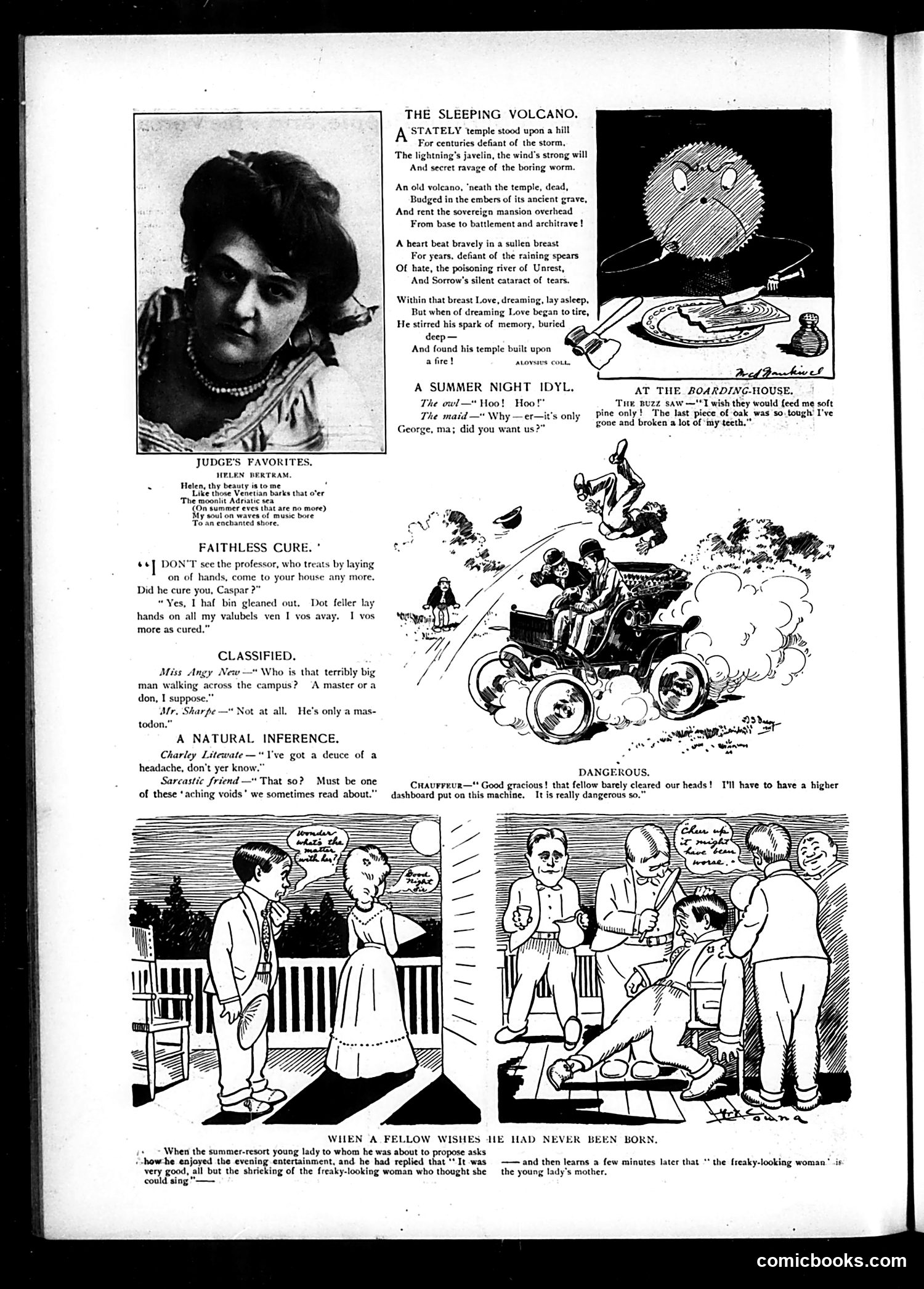
This page contains several short humorous sketches typical of early 20th-century Judge magazine's format: **"The Sleeping Volcano"** (top) is a poem about a dormant volcano harboring hidden passion—likely a metaphorical commentary on suppressed emotion or political/social tension. **"A Summer Night Idyl"** and **"At the Seashore"** are light domestic jokes about everyday situations. **"When a Fellow Wishes He Had Never Been Born"** (bottom) depicts a young man at a summer resort attempting to propose, only to have the woman reject him, revealing she's actually his mother—a shock-value punchline typical of the era's humor style. The remaining items—"Judge's Favorites," "Faithless Cure," "Classified," etc.—are brief satirical quips on minor social observations rather than political commentary. The illustrations use the magazine's characteristic line-drawing style. Overall, this page emphasizes personal/domestic humor over political satire.
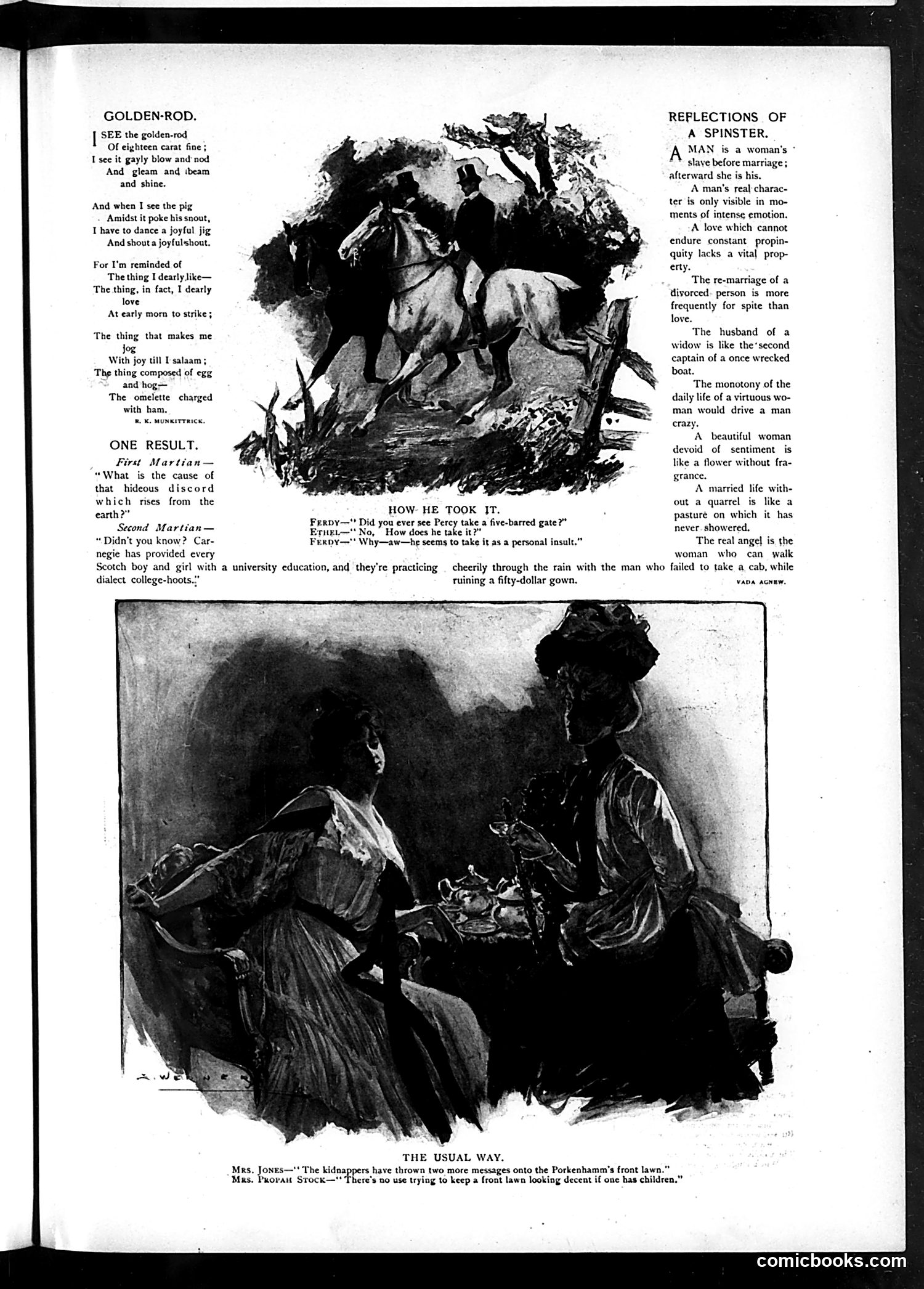
This page from *Judge* magazine contains satirical commentary on early 20th-century American life: **"Golden-Rod"**: A humorous poem celebrating ham omelets, using flowery language to mock overwrought poetic sensibility. **"One Result"**: A joke about Andrew Carnegie's philanthropic funding of education for Scottish youth. The "discord" from Earth that Martians hear is Scottish students practicing their dialect—satirizing both Carnegie's generosity and Scottish accents as comically grating. **"How He Took It"**: A brief gag about someone named Percy refusing to ride a horse over a five-barred gate, treating it as a personal insult—mocking oversensitive masculine pride. **"The Usual Way"** and **"Reflections of a Spinster"**: A domestic humor cartoon about children ruining lawn appearances, paired with cynical observations about marriage, divorce, and women's roles—reflecting period anxieties about matrimony and gender relations. The overall tone is sophisticated, class-conscious satire targeting upper-middle-class pretensions and social conventions.
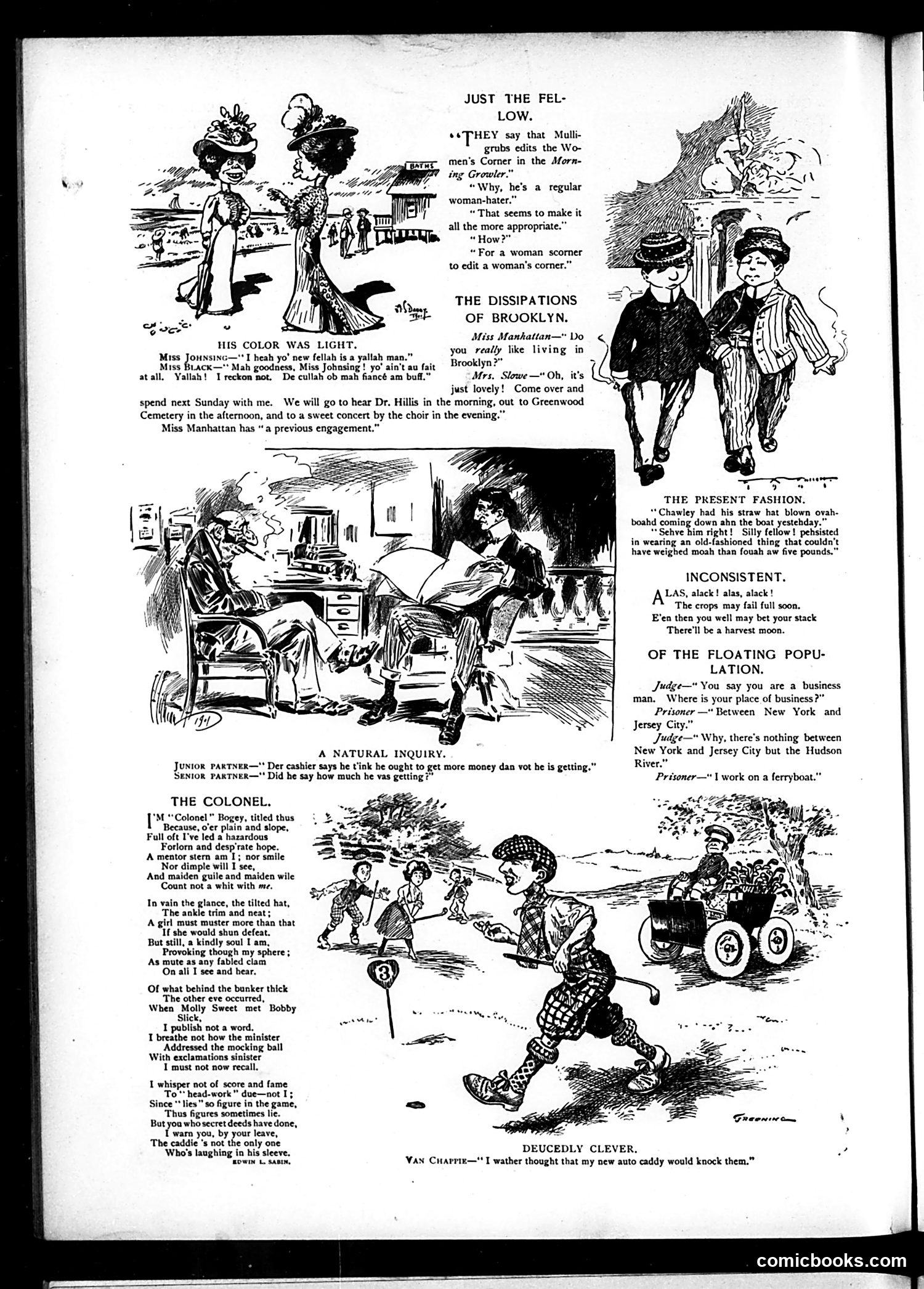
This page contains multiple satirical pieces typical of early 20th-century American humor: **"Just the Fellow"** mocks a misogynistic editor ("Mullgrubs") of a women's column, suggesting a woman-hater is perfectly suited to edit women's content—the joke being his contempt makes him ideal for the role. **"The Dissipations of Brooklyn"** contrasts Brooklyn residents' mundane weekend activities (church, cemetery visits, concerts) with Manhattan's supposedly more exciting lifestyle, satirizing Brooklyn as dull. **"His Color Was Light"** uses racist dialect humor common to the era, depicting African American characters discussing skin tone preferences in their romantic interests. **"The Colonel"** is a golf-themed poem about a stern, secretive gentleman who observes others' misbehavior but keeps quiet—poking fun at discretion and golf culture's social dynamics. **"Of the Floating Population"** jokes about a "businessman" whose workplace is literally the ferryboat between New York and Jersey City—likely referencing vagrants or those without fixed addresses. The page reflects Judge's approach: social observation through caricature, ethnic stereotyping, and class-based humor typical of the period.
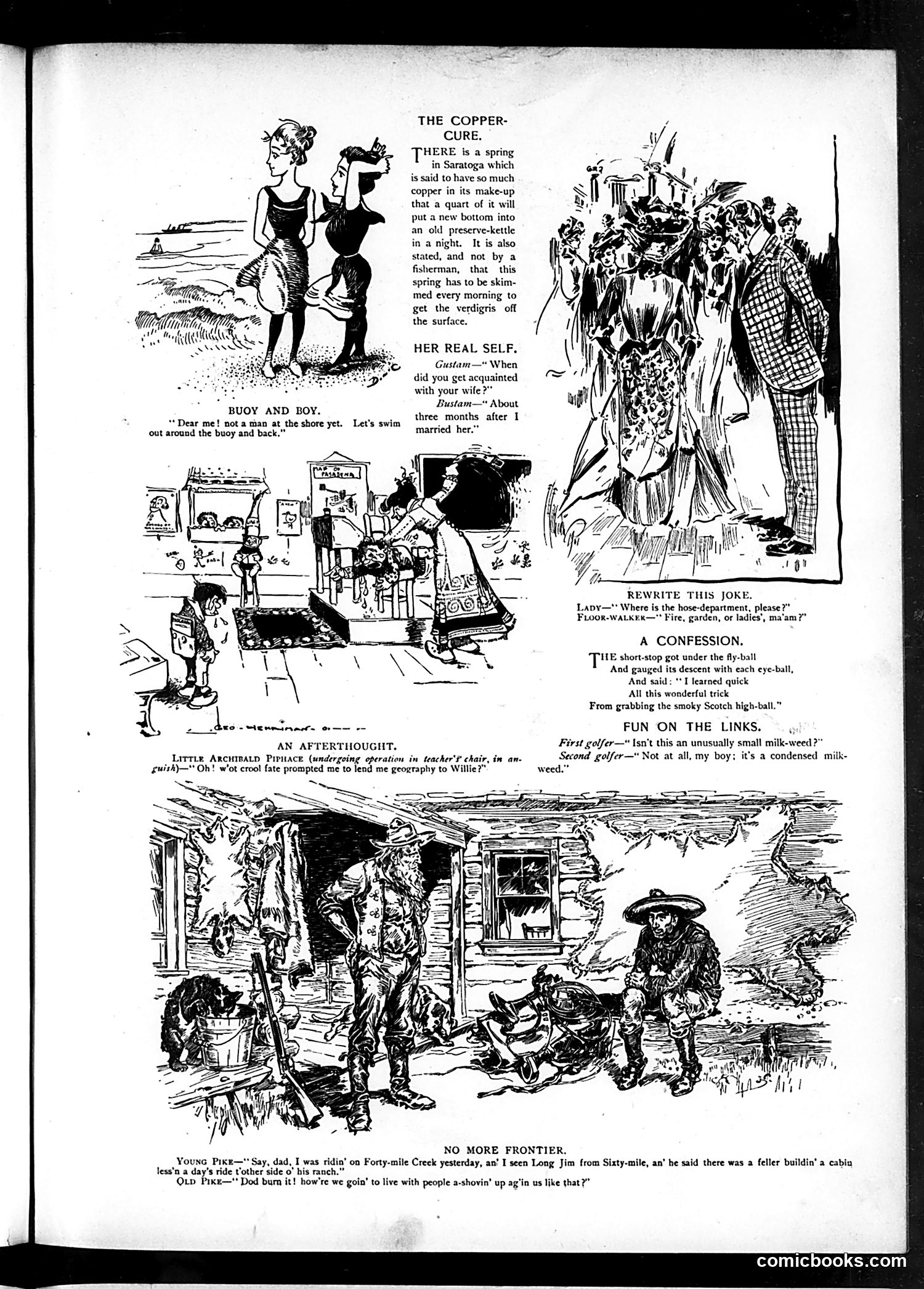
This page from Judge contains several short humorous pieces typical of late 19th/early 20th-century American satirical magazines: **"The Copper-Cure"** mocks the dubious health claims of Saratoga Springs, a popular resort town known for mineral springs. The joke exaggerates the copper content to absurd levels—claiming it can restore old cookware overnight—satirizing the era's tendency to make extravagant medicinal claims about spa waters. **"Buoy and Boy"** and **"Her Real Self"** are brief domestic comedies about marriage and courtship misconceptions. **"Rewrite This Joke"** puns on fire department terminology. **"An Afterthought"** and **"Fun on the Links"** are golf-related jokes about condensed milk and high-ball whiskey consumption. **"No More Frontier"** satirizes American frontier settlement anxieties—an old settler complains that the frontier is disappearing as neighbors move within a day's ride, reflecting real tensions about westward expansion's end. The cartoons mix visual gags with textual humor typical of Judge's satirical approach to contemporary American society.
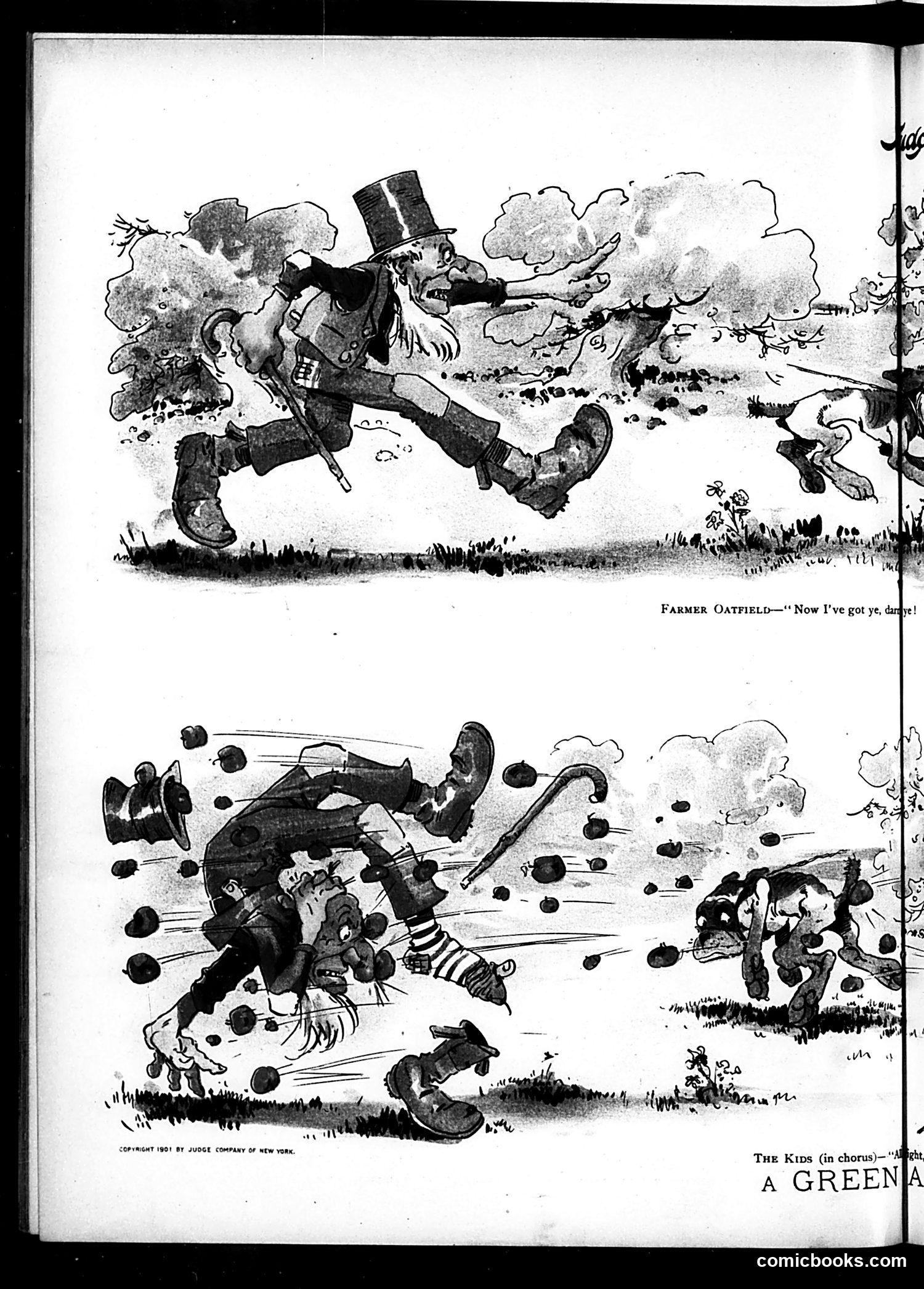
This page contains two satirical cartoons from Judge's 1901 issue. **Top cartoon:** "Farmer Oatfield—'Now I've got ye, dance!'" depicts a man in a top hat energetically jumping, apparently terrorizing rural figures. This likely satirizes political or economic policies affecting farmers—the "dance" being forced upon them. **Bottom cartoon:** "The Kids (in chorus)—'A GREENA[?]'" shows multiple figures being knocked down or scattered by objects (possibly coins or projectiles). The incomplete caption makes the specific reference unclear, but it appears to ridicule either political corruption, economic inequality, or some scandal involving children or the working class. Both cartoons employ Judge's characteristic exaggerated caricature style to mock authority figures and their impacts on ordinary people.
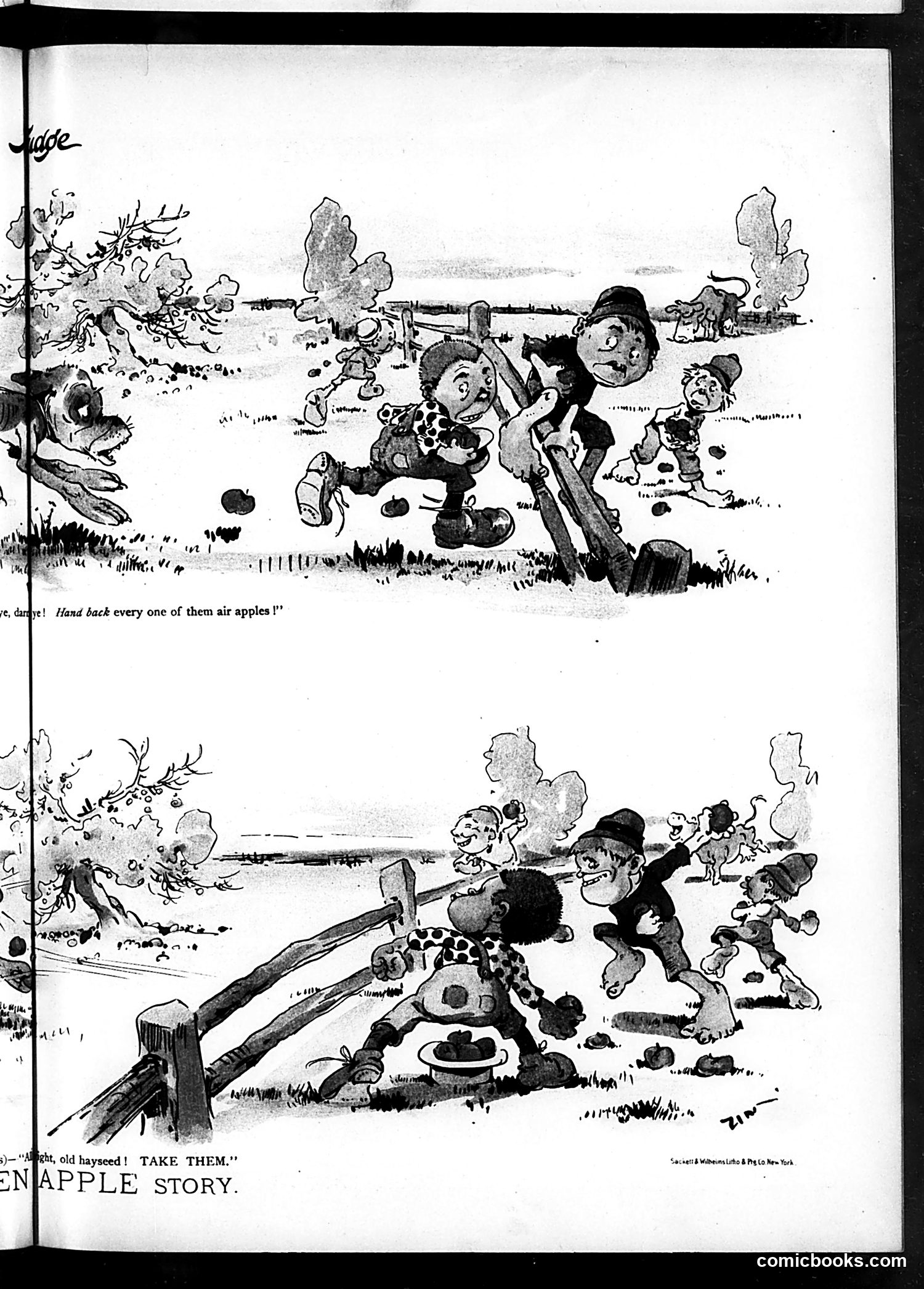
This two-panel comic depicts a rural scene where children are stealing apples from what appears to be an orchard or farm. **Top panel:** An adult (likely a farmer or orchard owner) shouts "Hand back every one of them air apples!" suggesting the children have taken fruit. **Bottom panel:** Labeled "Right, old hayseed! TAKE THEM," shows the children apparently defying authority—returning or throwing the apples back at the adult. The satire mocks rural/rustic authority figures ("hayseed" being period slang for unsophisticated farmers) and depicts the humorous conflict between property owners and mischievous children. The joke relies on the assumption that children stealing apples was common enough to be instantly recognizable to Judge's urban, educated readership as fodder for gentle ridicule of rural life and working-class conflicts.
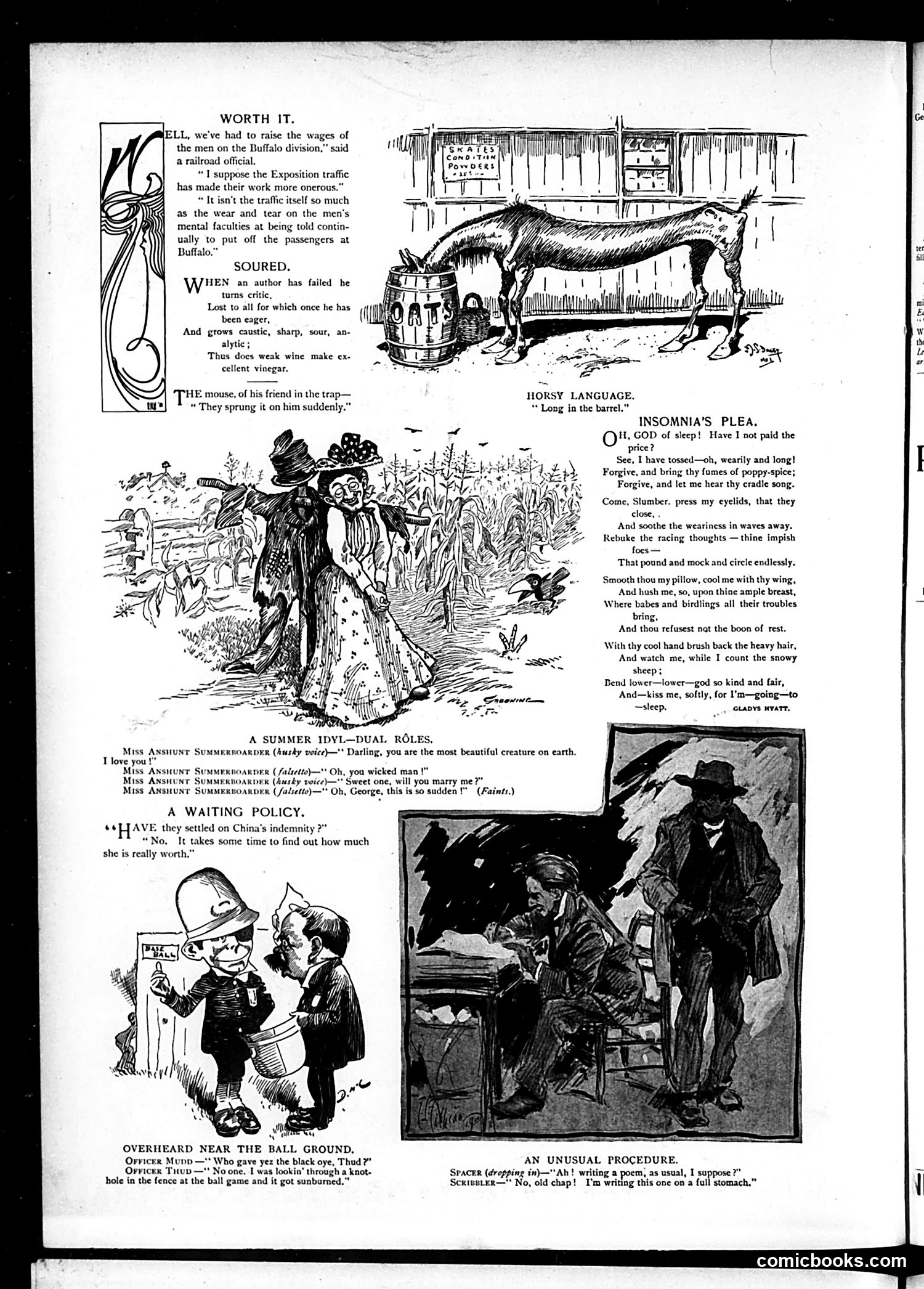
This page contains several satirical pieces typical of Judge's humor: **"Worth It"** mocks railroad workers on the Buffalo division, claiming the real mental strain isn't handling Exposition traffic but repeatedly being told to stop at Buffalo—a joke about the tedium of routine work. **"Soured"** uses a wine metaphor: failed authors who turn bitter critics are like weak wine turning to vinegar. **"Horsy Language"** appears to be a single-panel joke about horses, captioned "Long in the barrel." **"Insomnia's Plea"** is a sentimental poem to the god of sleep, depicting the speaker's struggle with racing thoughts and sleeplessness. **"A Summer Idyl—Dual Roles"** satirizes a female summer boarder performing both masculine ("husky voice") and feminine ("falsetto") personas while courting herself—mocking theatrical affectation or perhaps gender performance. **"A Waiting Policy"** jokes that China's indemnity settlement takes time because determining her "worth" is difficult—likely referencing Boxer Rebellion reparations negotiations. The page is primarily humor and light satire rather than hard political commentary.
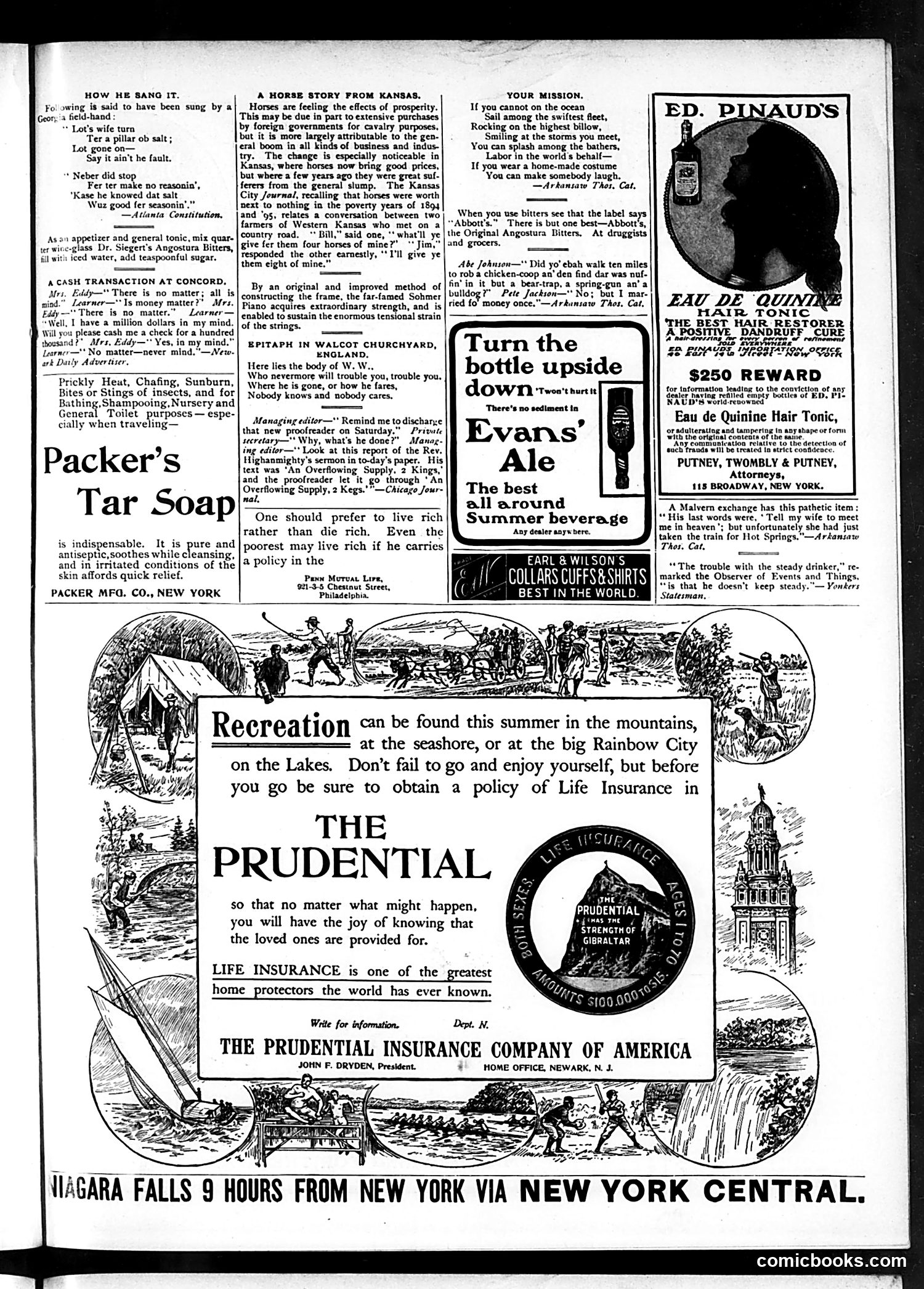
This is primarily an **advertising page** from Judge magazine, with humor content interspersed. The cartoons/jokes reflect turn-of-the-century American attitudes: **Key humor pieces:** - "How He Sang It": A dialect joke about an enslaved person—reflecting the racist humor conventions of the era - "Cash Transaction at Concord": Mocks Mary Baker Eddy (founder of Christian Science) and her claim that "all is mind" by having someone claim they have money "in their mind" - Various one-liners about poverty (Kansas horses worth nothing in 1894-95 economic depression) and social situations **The advertisements** dominate: Packer's Tar Soap, Sohmer Pianos, Prudential Life Insurance (with extensive copy about summer recreation), Evans' Ale, Earl & Wilson collars, and other products. **Overall context**: This reflects a prosperous post-depression period with heavy consumerism, while the humor relies on stereotypes (racial dialect, religious mockery) that were considered acceptable satire at the time but are offensive today.
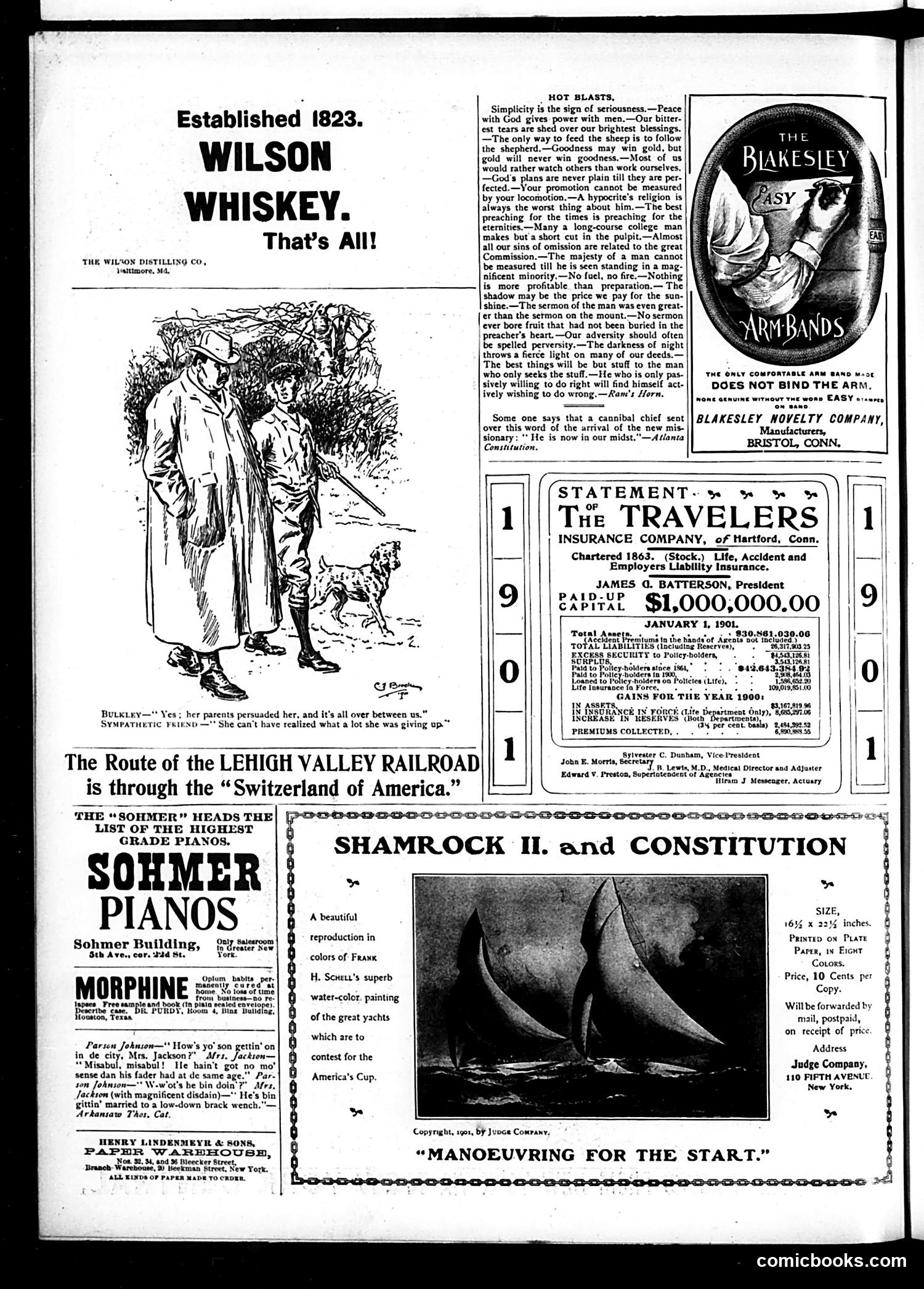
This page is primarily **advertisements and aphorisms** rather than political satire. **Main elements:** The page features **"Hot Blasts"**—a column of moral and religious quotations (sourced from *Ram's Horn*, a Christian publication). These are conventional homilies about goodness, faith, and virtue with no obvious political target. **The cartoons present:** - A small domestic sketch of "Burkley" regarding a romantic separation—gentle humor, no political content - A yacht-racing image for "Shamrock II and Constitution" (likely America's Cup related, based on text mentioning "America's Cup") **Advertising dominates:** Wilson Whiskey, Sohmer Pianos, Travelers Insurance Company, Blakesley Arm Bands, and others. **Context for modern readers:** This appears to be a standard early-1900s magazine page mixing advertisements with inspirational content. The religious quotations reflect Victorian-era moralizing common to the period. Without sharper political or satirical content, this exemplifies Judge as a general-interest publication, not purely political commentary.
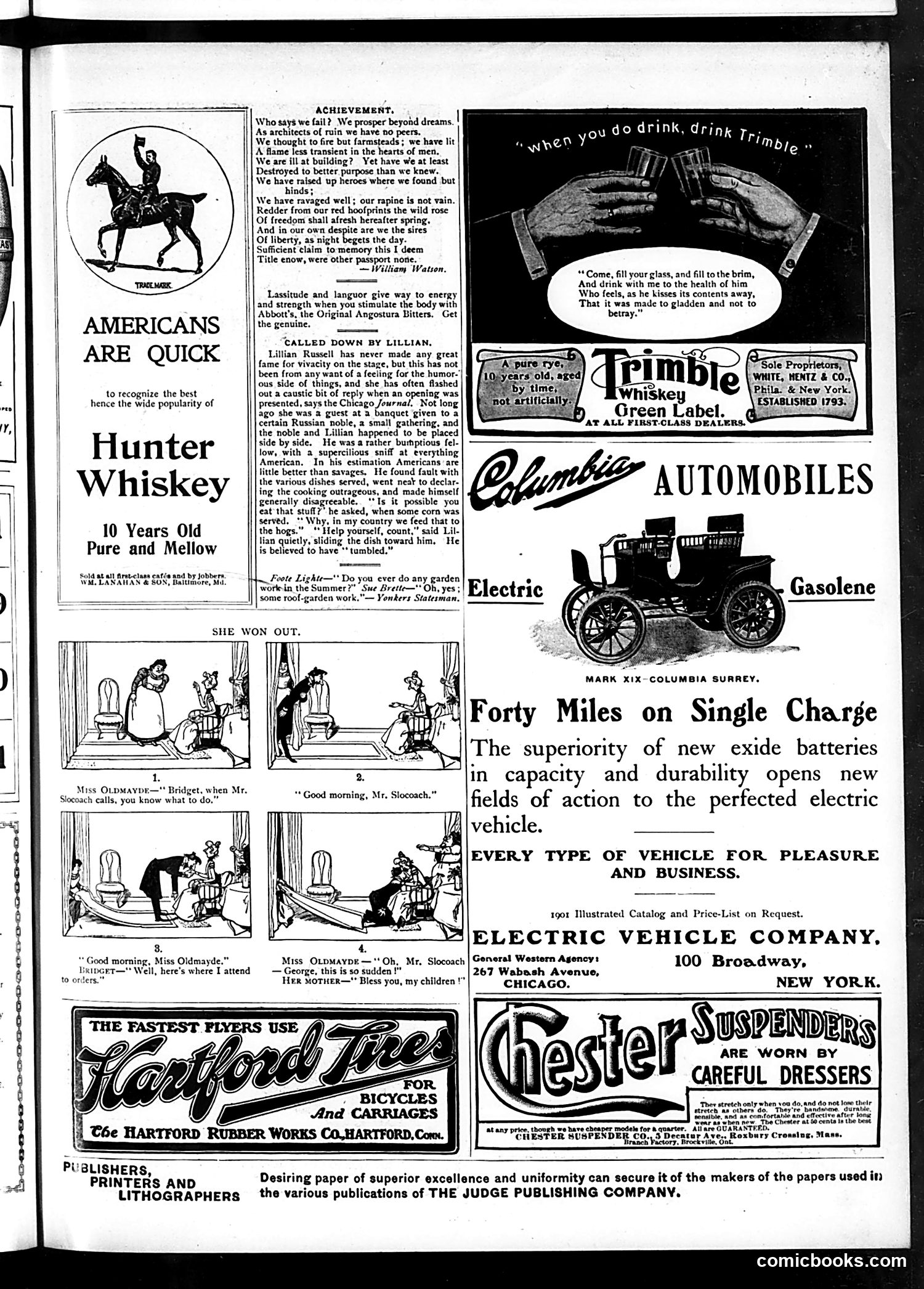
This page mixes advertisements with satirical content typical of early-1900s Judge magazine. **"She Won Out" cartoon**: A four-panel domestic comedy showing Miss Oldmayde instructing her maid Bridget to dismiss caller Mr. Slocoach, then being surprised when he arrives with unexpected news of an engagement—to her mother. The joke plays on romantic reversal and class dynamics of the era: the older woman unexpectedly wins a suitor the younger woman rejected. **"Called Down by Lillian"**: An anecdote about actress Lillian Russell outwitting a supercilious Russian nobleman at a dinner party. When he insults American food, calling it fit only for hogs, she replies by offering him the dish with the suggestion to "help yourself"—implying he belongs with the hogs. The satire targets European snobbery toward Americans. **"Achievement" poem**: A William Watson verse celebrating American destructiveness paradoxically as nation-building, praising how war and conquest create freedom and heroes from common people. The rest is period advertising (whiskey, automobiles, tires, suspenders).
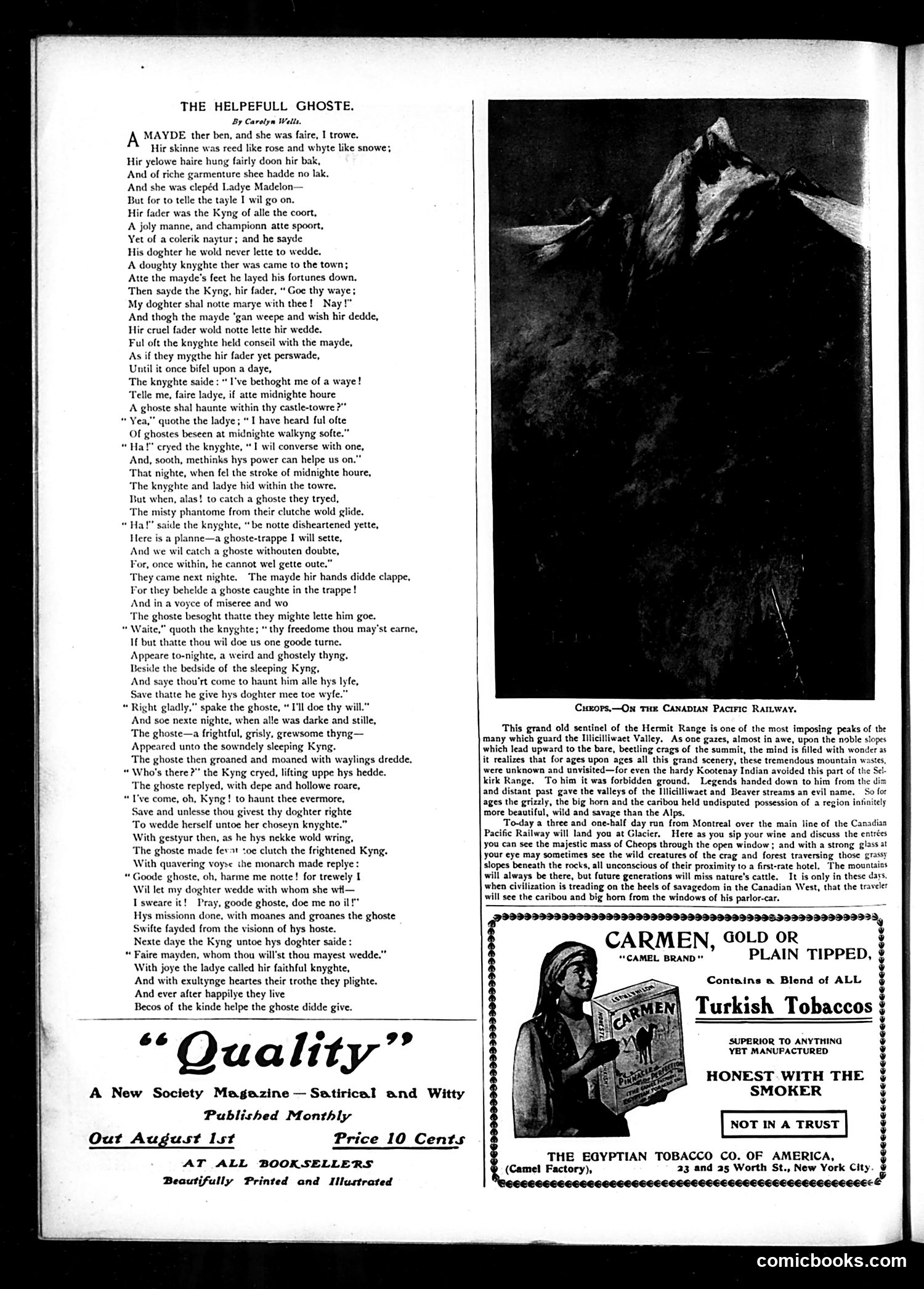
This page contains a narrative poem by Carolyn Wells, not a political cartoon. The poem is a whimsical Middle English-style tale about a knight who captures a ghost and uses it to persuade a stubborn king to permit his daughter's marriage. The satire is gentle and literary rather than political: it mocks outdated medieval romance conventions through archaic language and spelling ("knyghte," "doghter," "Yea"). The humor lies in treating a supernatural creature as a practical problem-solver—the knight literally builds a "ghoste-trappe" and negotiates with the captured phantom as a business partner. The page also advertises *Quality* magazine (10 cents, launching August 1st) and Carmen brand Turkish tobacco. This appears to be from an early 20th-century *Judge* magazine issue, mixing light verse entertainment with period advertisements.
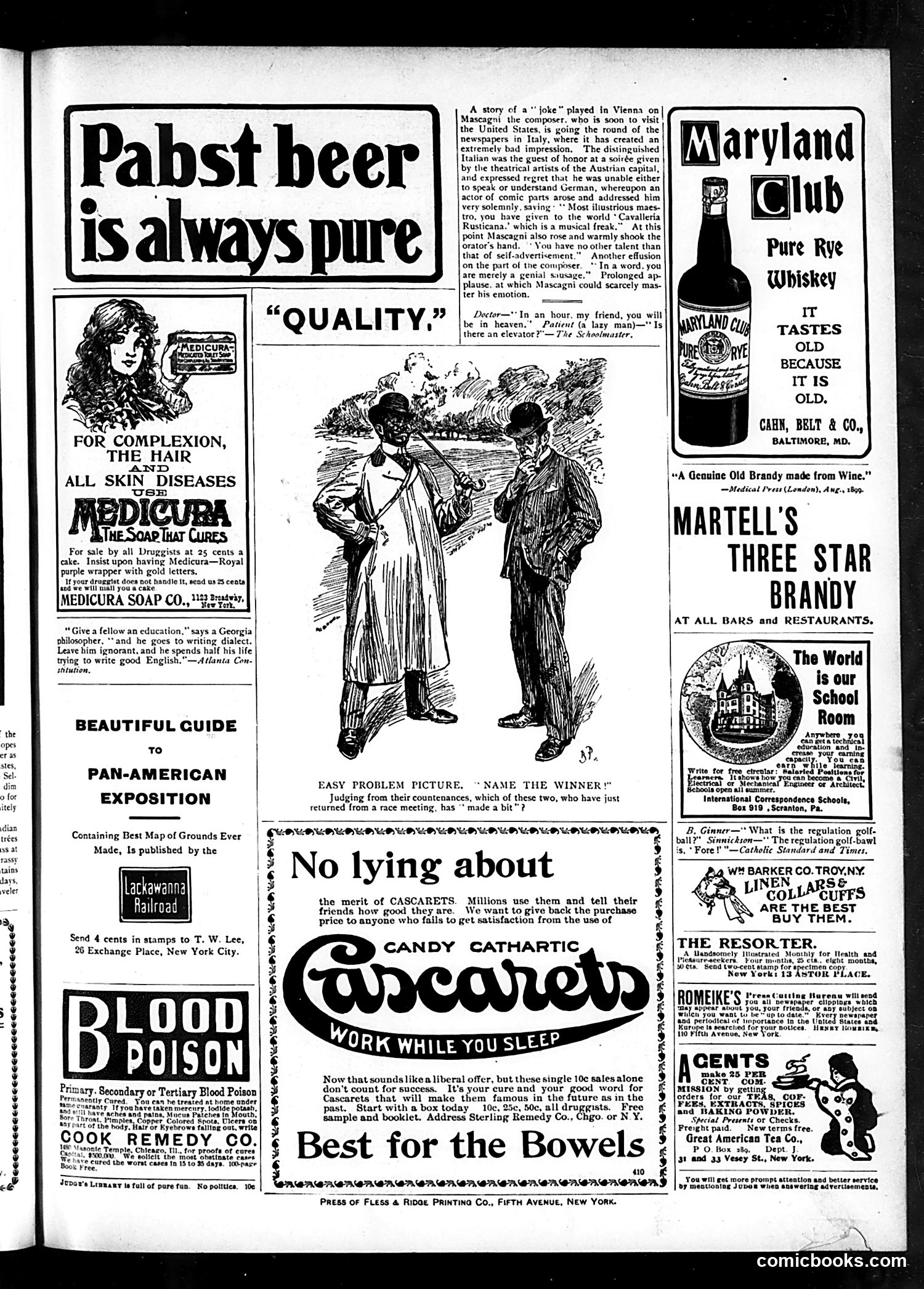
This page is primarily **advertising**, not political satire. However, it opens with a noteworthy anecdote about composer **Pietro Mascagni**, the Italian creator of *Cavalleria Rusticana* (an opera). The story describes a Vienna reception where Austrian actors publicly insulted Mascagni—calling his work a "musical freak" and him a "genial sausage"—apparently as a "joke." The anecdote notes this caused "extremely bad impression" in Italy, suggesting the satire is directed at *European theatrical rudeness* masked as humor. The remainder consists of patent medicine and consumer product advertisements typical of the era: Medicura soap (claiming to cure skin diseases), Maryland Club whiskey, Martell's brandy, Cascarets laxatives ("work while you sleep"), and blood poison treatments. The page also includes minor comic quips about golf regulations and education. **No identifiable political figures or events are referenced beyond the Mascagni incident.**
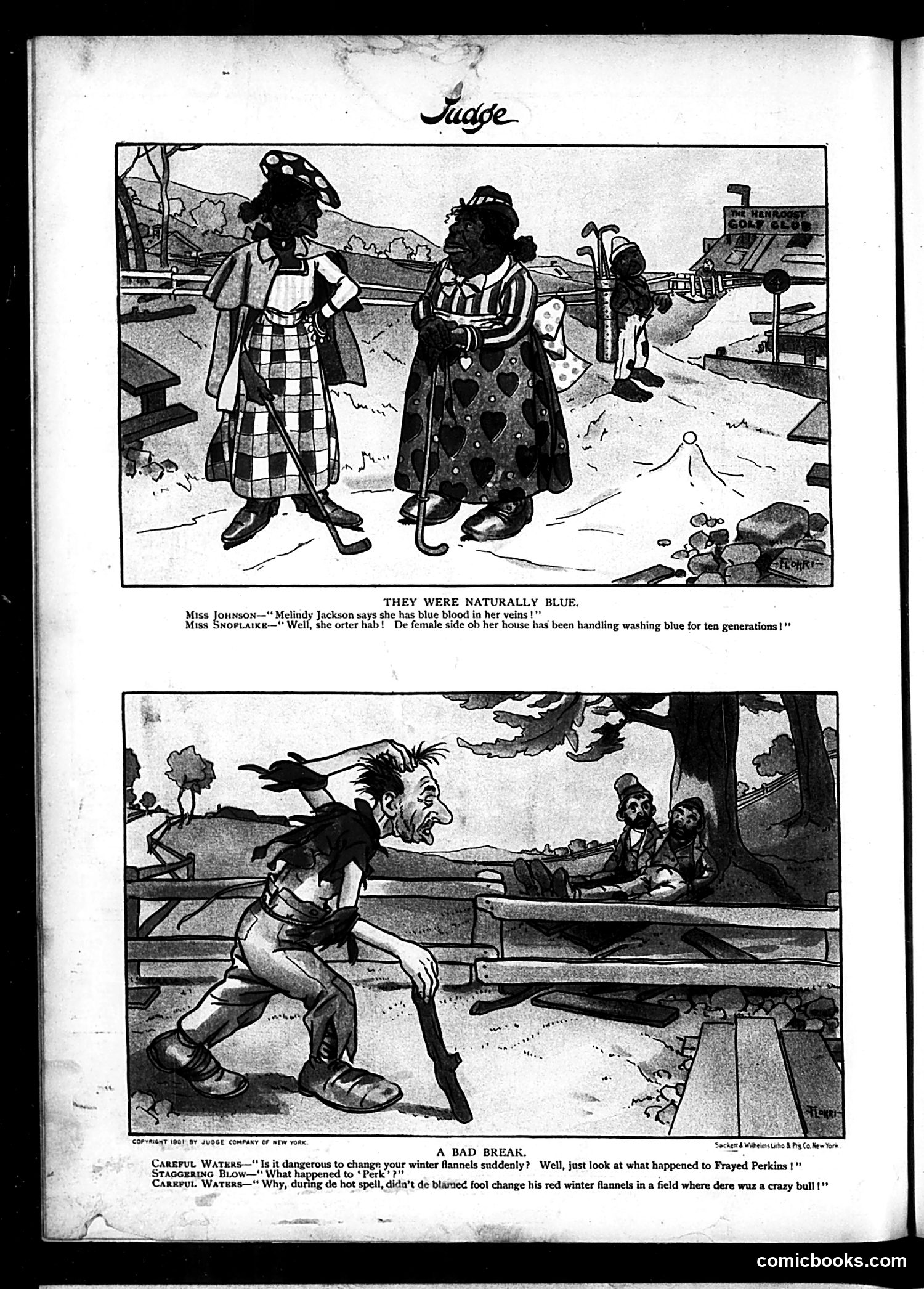
This page contains two satirical comics exploiting racist stereotypes common to early 20th-century American humor. **Top cartoon ("They Were Naturally Blue"):** Two Black women discuss a third woman's claim to "blue blood" (aristocratic ancestry). The joke relies on a pun: one character suggests the woman's family legitimately has blue blood because they've worked in laundry washing clothes with "washing blue" (a commercial laundry product) for generations. The satire mocks both pretensions to gentility and stereotypes Black people as domestic servants. **Bottom cartoon ("A Bad Break"):** Two men discuss a mishap involving someone named Frayed Perkins, who changed out of red winter flannels in a field where a bull was present. The bull apparently attacked him (likely assuming the red cloth was a threat), resulting in torn clothing. The joke plays on the phrase "a bad break" and rustic foolishness. Both comics exemplify Judge's reliance on racial caricature and slapstick humor typical of the era.