
Judge, 1901-08-03 · page 3 of 16
Judge — August 3, 1901 — page 3: what you’re looking at
What you’re looking at
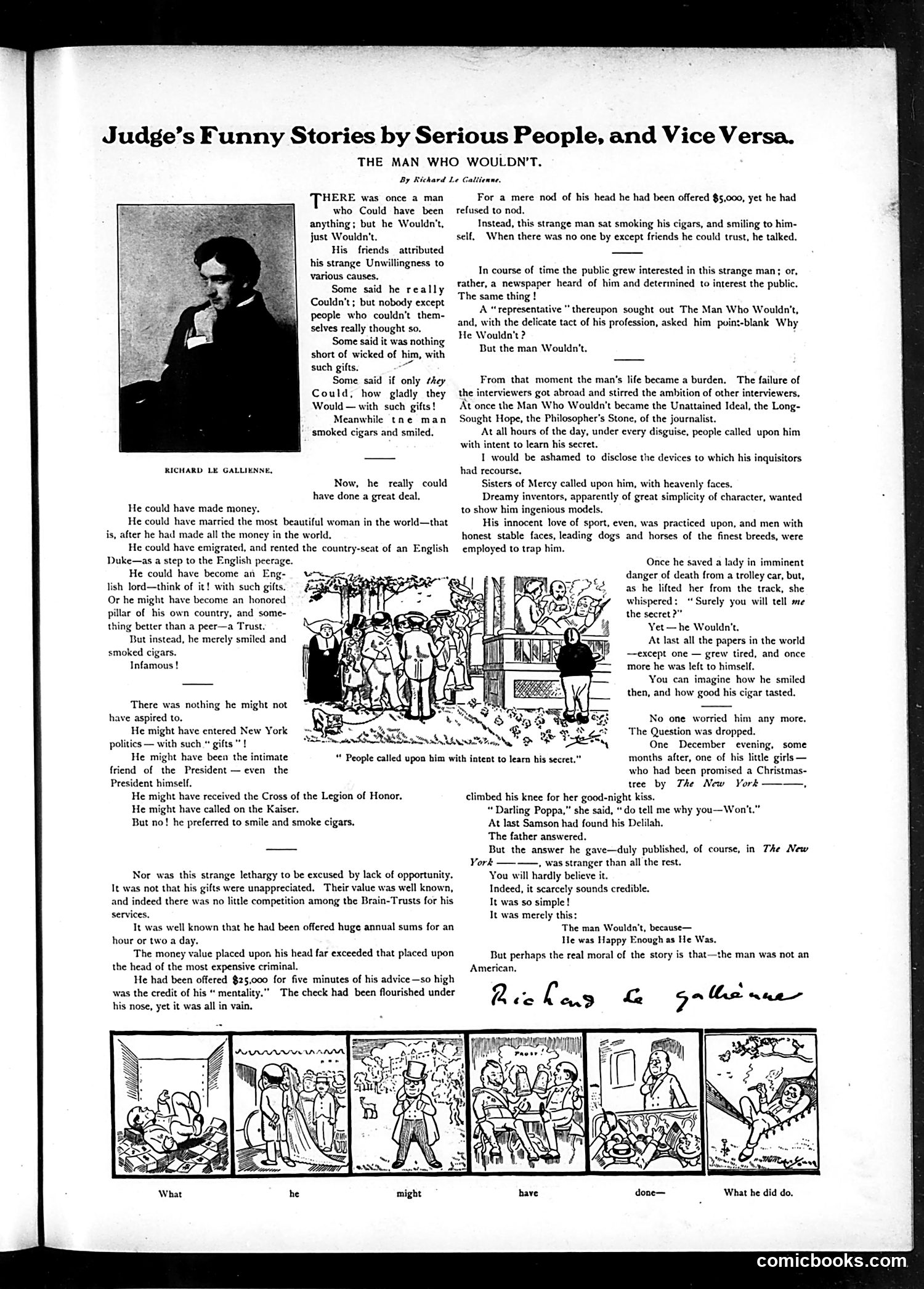
This satirical story mocks a man of peculiar principle who refuses all worldly advancement. Despite opportunities to become wealthy, marry beautifully, and gain prestigious positions—including offers from the President and various institutions—he consistently declines, claiming he "Wouldn't." The satire targets idealistic refusalism: the man smugly rejects every benefit society offers while remaining unemployed and dependent. The text suggests this represents an absurd, impractical moral stance that paralyzes action. The accompanying comic strip illustrates the contrast between what he "might have done" versus "what he did do" (presumably nothing). Judge ridicules those who reject practical engagement with society under the guise of principle, presenting such obstinacy as ridiculous self-sabotage rather than admirable integrity.
📄 Transcribed text from this page (OCR, searchable)
Machine-transcribed from the original scan — historical spelling and the odd misread are preserved.
Judge’s Funny Stories by Serious People, and Vice Versa. THE MAN WHO WOULDN'T. By Richard Le Gallienne, THERE ‘was once a man who Could have been anything; but he Wouldn't, just Wouldn't. His friends attributed his strange Unwillingness to various causes. Some said he really Couldn't ; but nobody except people who couldn't them- selves really thought so. Some said it was nothing short of wicked of him, with such gifts. a Some said if only they Could, how gladly they Would — with such gifts! Meanwhile tne man smoked cigars and smiled. RICHARD LE GALLIENNE, Now, he really could have done a great deal. He could have made money. He could have married the most beautiful woman in the world—that is, after he had made all the money in the world. He could have emigrated, and rented the country-seat of an English Duke—as a step to the English peerage. He could have become an Eng- lish lord—think of it! with such gifts. Or he might have become an honored pillar of his own country, and some- thing better than a peer—a Trust. But instead, he merely smiled and smoked cigars. Infamous ! There was nothing he might not have aspired to. He might have entered New York Ste politics — with such “ gifts"! 4 He might have been the intimate friend of the President — even the President himself. He might have received the Cross of the Legion of Honor. He might have called on the Kaiser. But no! he preferred to smile and smoke cigars. Nor was this strange lethargy to be excused by lack of opportunity. It was not that his gifts were unappreciated. Their value was well known, and indeed there was no little competition among the Brain-Trusts for his services. Tt was well known that he had been offered huge annual sums for an hour or two a day, The money value placed upon his head far exceeded that placed upon the head of the most expensive criminal. He had been offered $25,000 for five minutes of his advice—so high was the credit of his “ mentality.” The check had been flourished under his nose, yet it was all in vain. SOMME Marti” & “ People called upon him with intent to learn his secret.” For a mere nod of his head he had been offered $5,000, yet he had refused to nod. Instead, this strange man sat smoking his cigars, and smiling to him- self, When there was no one by except friends he could trust, he talked. In course of time the public grew interested in strange man; or, rather, a newspaper heard of him and determined to interest the public. The same thing ! A “representative "thereupon sought out The Man Who Wouldn't, and, with the delicate tact of his profession, asked him point-blank Why He Wouldn't ? But the man Wouldn't. From that moment the man’s life became a burden, The failure of the interviewers got abroad and stirred the ambition of other interviewers. At once the Man Who Wouldn't became the Unattained Ideal, the Long- Sought Hope, the Philosopher's Stone, of the journalist. At all hours of the day, under every disguise, people called upon him with intent to learn his secret. I would be ashamed to disclose the devices to which his inquisitors had recourse. Sisters of Mercy called upon him, with heavenly faces. Dreamy inventors, apparently of great simplicity of character, wanted to show him ingenious models. His innocent love of sport, even, was practiced upon, and men with honest stable faces, leading dogs and horses of the finest breeds, were employed to trap him. Once he saved a lady in imminent danger of death from a trolley car, but, as he lifted her from the track, she whispered: “Surely you will tell me the secret?” Yet—he Wouldn't, At last all the papers in the world —except one — grew tired, and once more he was left to himself. You can imagine how he smiled then, and how good his cigar tasted. No one worried him any more, ‘The Question was dropped. One December evening, some months after, one of his little girls — who had been promised a Christmas- tree by The New York climbed his knee for her good-night kiss. “ Darling Poppa,” she said, “do tell me why you—Won' At last Samson had found his Delilah. The father answered. But the answer he gave—duly published, of course, in The New York ——, was stranger than all the rest. You will hardly believe it. Indeed, it scarcely sounds credible. It was so simple! It was merely this: The man Wouldn't, because— He was Happy Enough as He Was. But perhaps the real moral of the story is that—the man was not an American, ‘What he did do. comicbooks.com.