
A complete issue · 16 pages · 1901
Judge — June 8, 1901
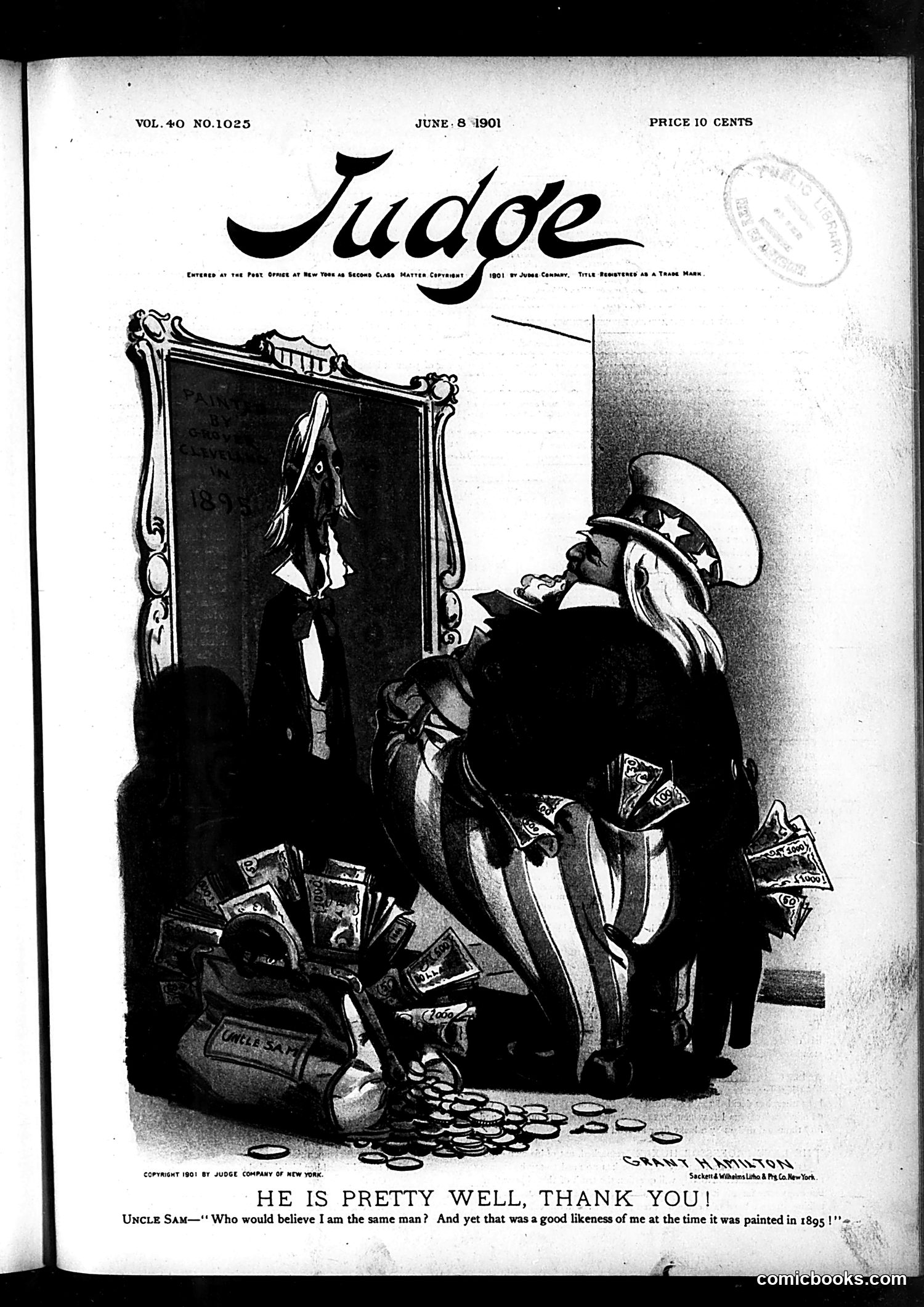
This cartoon satirizes wealth inequality and imperialism. Uncle Sam (identifiable by his starred hat and white beard) stands before a mirror examining his reflection, surrounded by money bags and scattered coins. The caption suggests he's comparing himself to a portrait from 1895—six years prior. The satire appears to critique how America's appearance has changed due to accumulated wealth from imperial expansion (the U.S. had recently acquired overseas territories following the Spanish-American War of 1898). Uncle Sam's concern about whether he still recognizes himself suggests anxiety that national character has been corrupted or transformed by greed and imperial acquisitions. The artist is Grant Hamilton, a prominent Judge cartoonist known for political commentary.
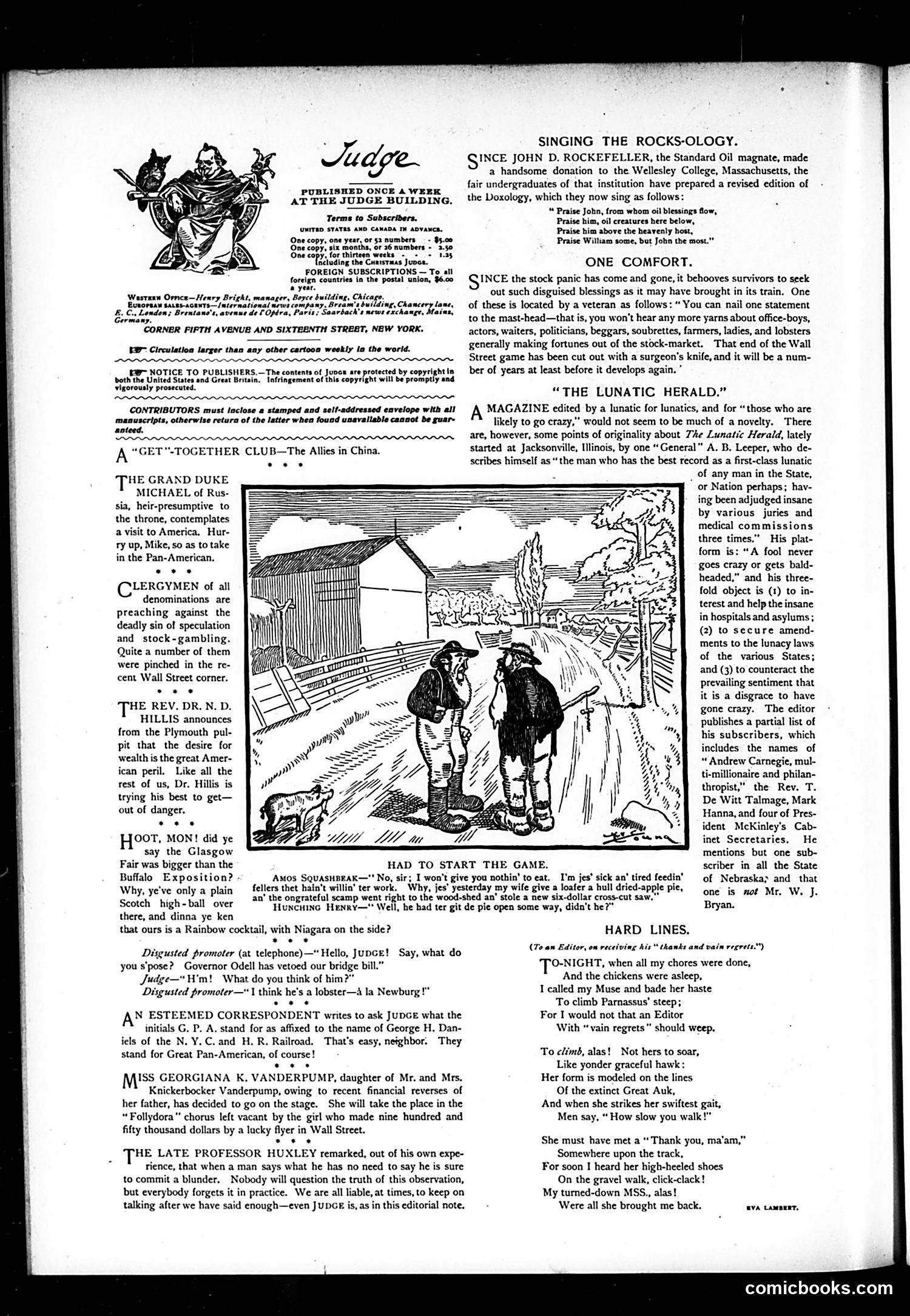
This cartoon depicts two rural figures, one identified as "Amos Squashbeak," discussing a hunting scenario. The dialogue references a wife giving a loaf of bread and a "cross-eyed saw" to steal a six-dollar crosscut saw from "the woods-shed" to sell for profit. The satire appears to target rural/working-class opportunism and petty theft during economically difficult times. The humor relies on dialect comedy ("Amos Squashbeak") and the absurdity of the scheme—trading a loaf of bread for stolen property worth six dollars. The title "To Start the Game" suggests this represents how ordinary people resort to cunning or dishonest schemes to survive economically. The cartoon reflects Judge magazine's urban satirical perspective on rural American life and behavior.
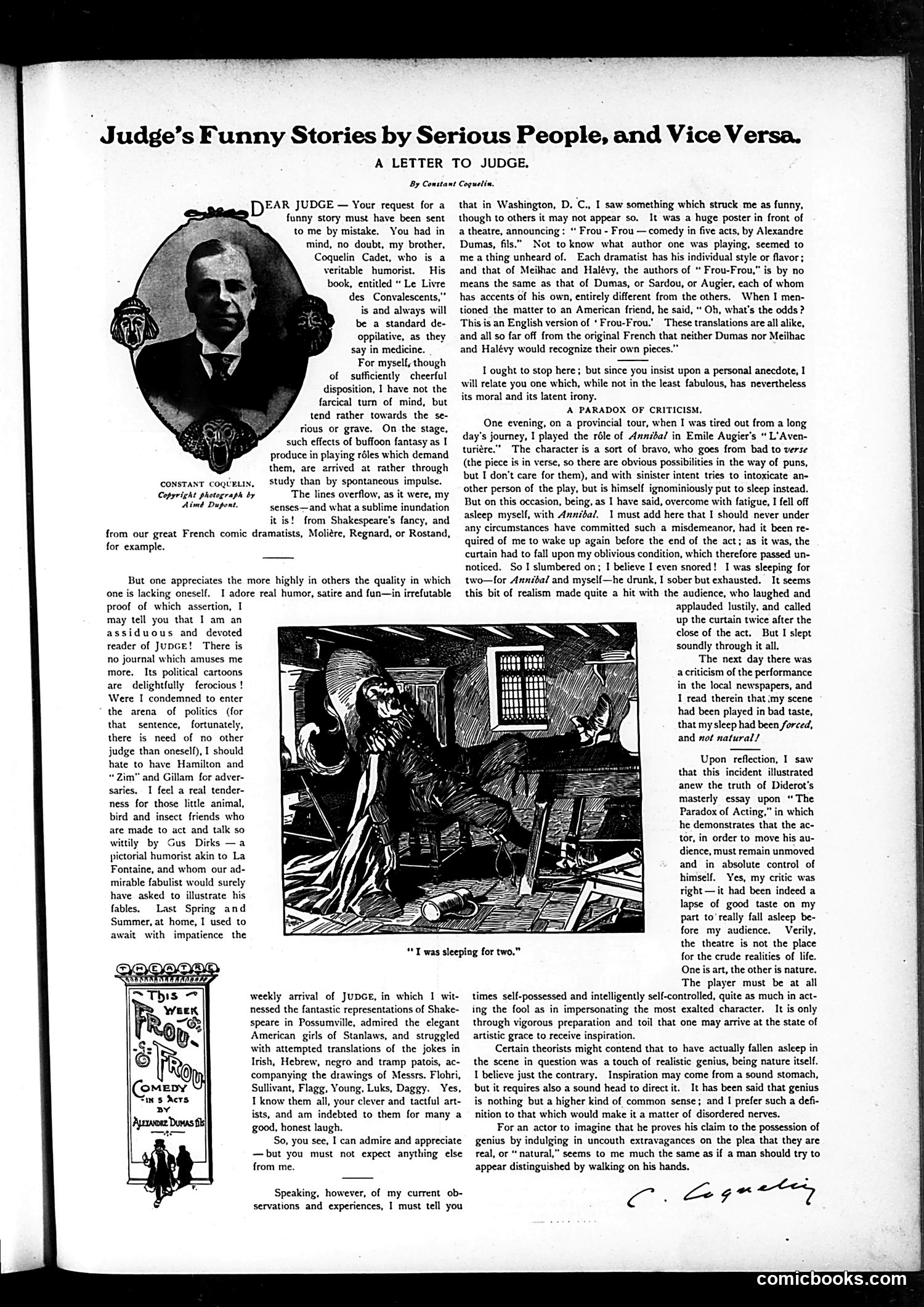
This page contains a letter from "Constant Coquelin" (a French actor) to the Judge editor about humor in drama. The accompanying woodcut illustrations show theatrical scenes—one depicting an actor in exaggerated pose, another showing what appears to be a prison or dungeon scene. Coquelin discusses the differences between French and English comedy styles, critiquing an English adaptation of a French play called "Frou-Frou." He argues that genuine humor requires wit and satire, not mere physical comedy or slapstick. He recounts falling asleep during a performance of "Amabel" and being awakened—a humorous anecdote illustrating his point about theatrical realism versus artifice. The piece essentially argues that serious actors should appreciate sophisticated humor rather than broad farce, reflecting late-19th-century debates about theatrical standards.
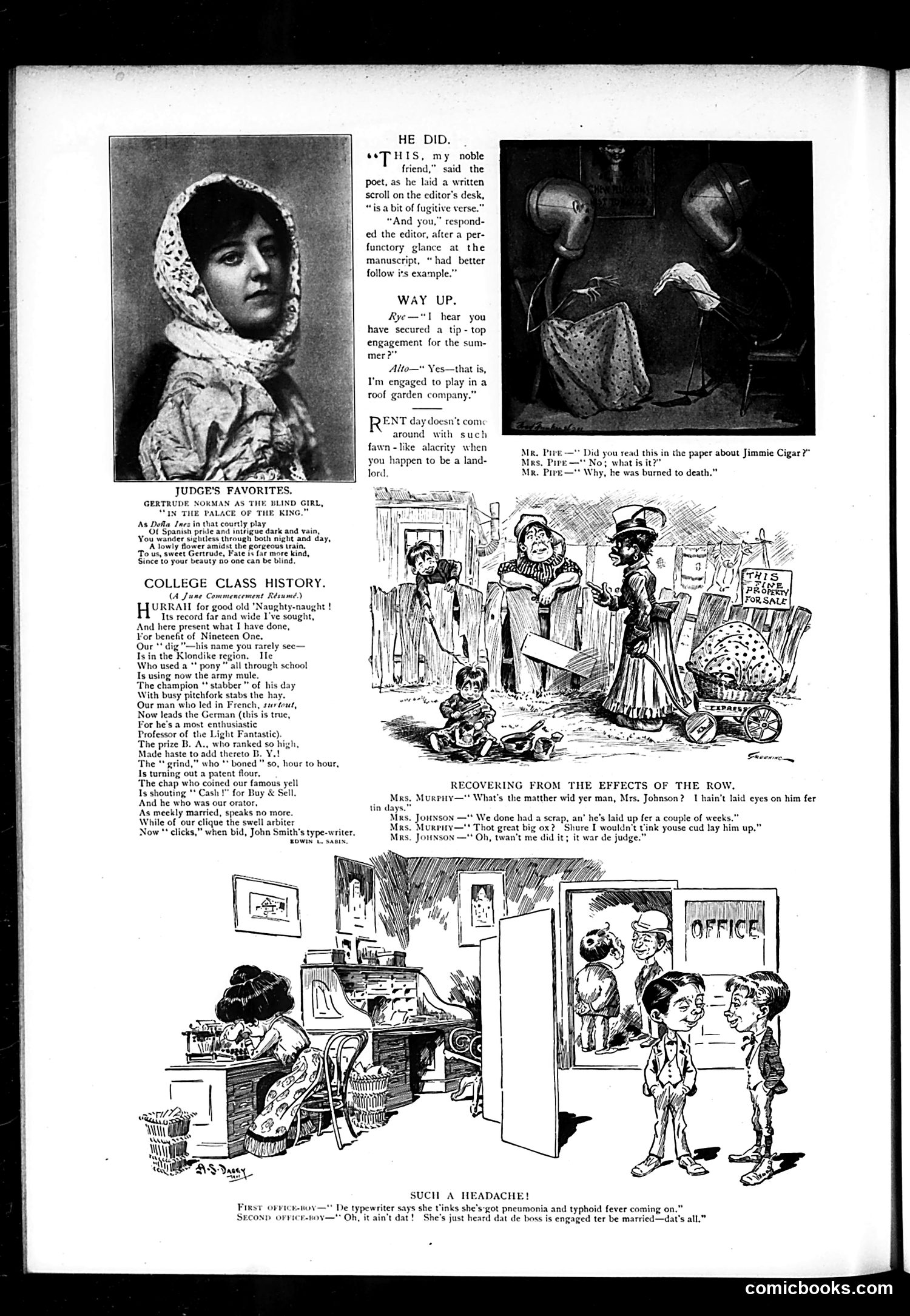
This Judge magazine page contains several unrelated humorous pieces: 1. **"He Did"** - A brief anecdote about a poet submitting fugitive verse to an editor, with the editor's dismissive response. 2. **"Way Up"** - A short dialogue joke about securing a theater engagement for summer in a roof garden company. 3. **"College Class History"** - A poem about a college class, celebrating various student achievements and nicknames. 4. **"Recovering from the Effects of the Row"** - A sketch depicting women discussing a man's injuries, with dialogue about his condition. 5. **"Such a Headache!"** - An office comedy showing typewriter troubles and marriage complications. The cartoons are simple workplace and social humor typical of early 20th-century American magazines—no specific political figures or events are referenced. The satire targets everyday domestic and professional frustrations with light comedic drawings.
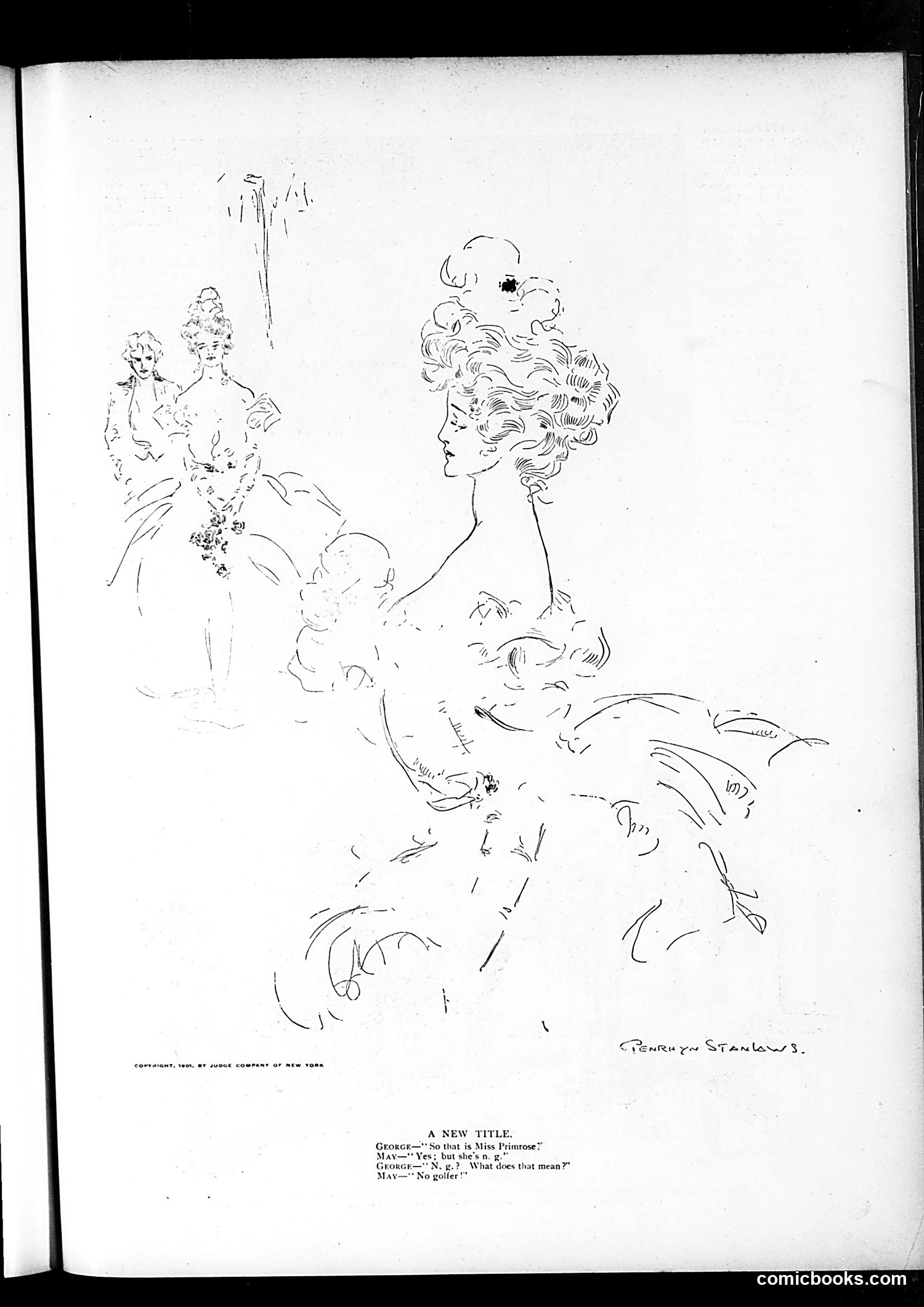
This cartoon satirizes early 20th-century society's expectations of women. A woman identified as "Miss Primrose" is being criticized not for intellectual failings or character flaws, but for a single social deficiency: she's "n.g." (no good) because she's "no golfer." The joke mocks how upper-class social standing had become dependent on participating in fashionable leisure activities like golf. For women entering these social circles, athletic prowess at golf was apparently essential to respectability—absurdly so. The cartoon critiques both the superficiality of high society's standards and the new pressure on women to master sports traditionally associated with men, reducing their worth to recreational accomplishment rather than substance.
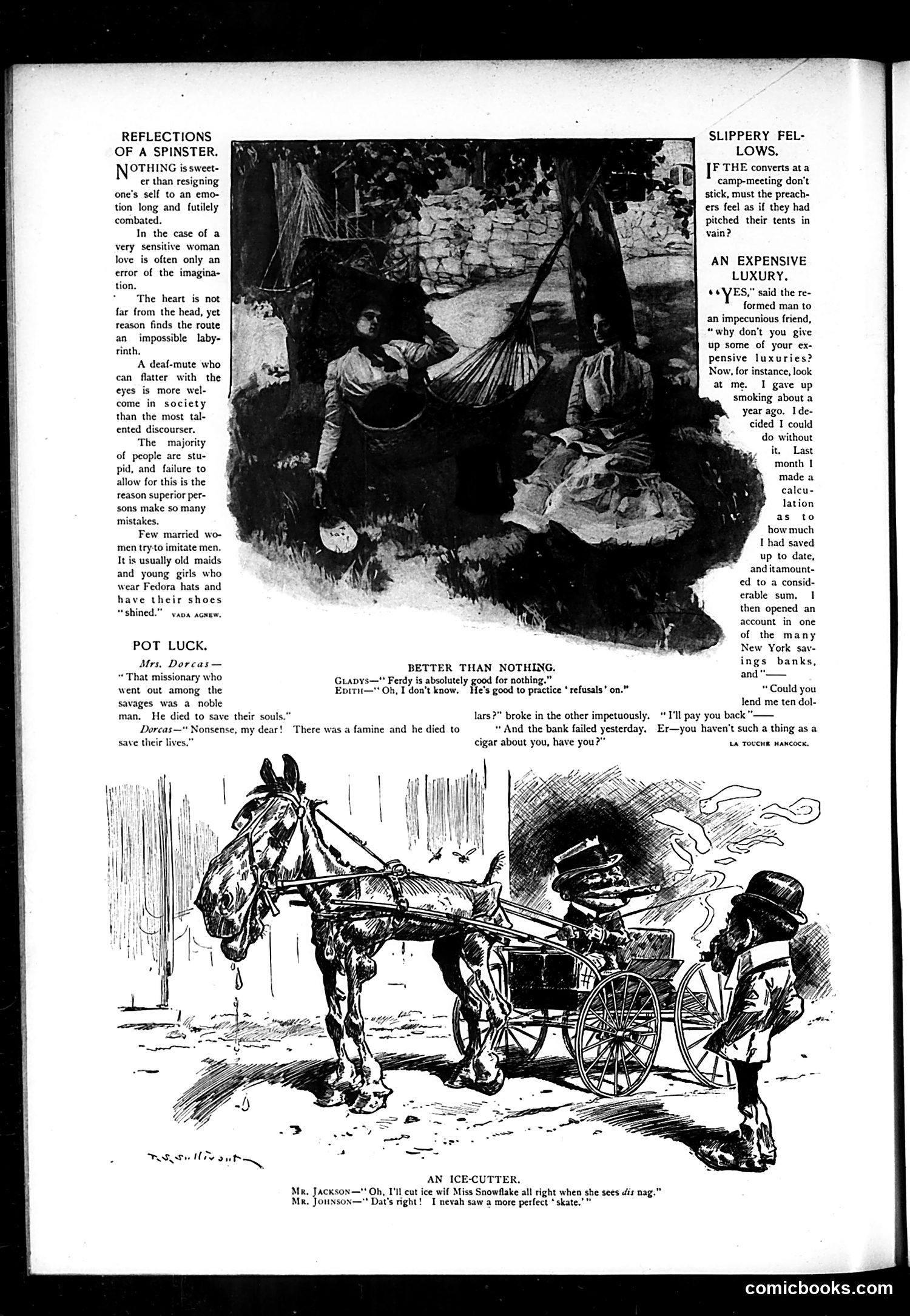
This page contains several satirical pieces typical of early 20th-century American humor: **"Reflections of a Spinster"** mocks romantic delusions—the accompanying image shows a woman daydreaming in a hammock, illustrating the text's critique that sensitive women often mistake imagination for genuine love. **"An Expensive Luxury"** satirizes reformed vices through a dialogue where a man who quit smoking calculates his savings, only to spend it all, undermining his moral superiority. **"Pot Luck"** and **"Better Than Nothing"** are brief comedic exchanges mocking romantic rejection and financial irresponsibility respectively. **"An Ice-Cutter"** features a racial caricature (common to the era) with dialogue using exaggerated dialect, making a pun on "cutting ice" (impressing someone) and "skate" (both the object and slang for an unattractive person). The humor relies on period stereotypes, social awkwardness, and wordplay typical of Judge's satirical approach to American manners and morality.
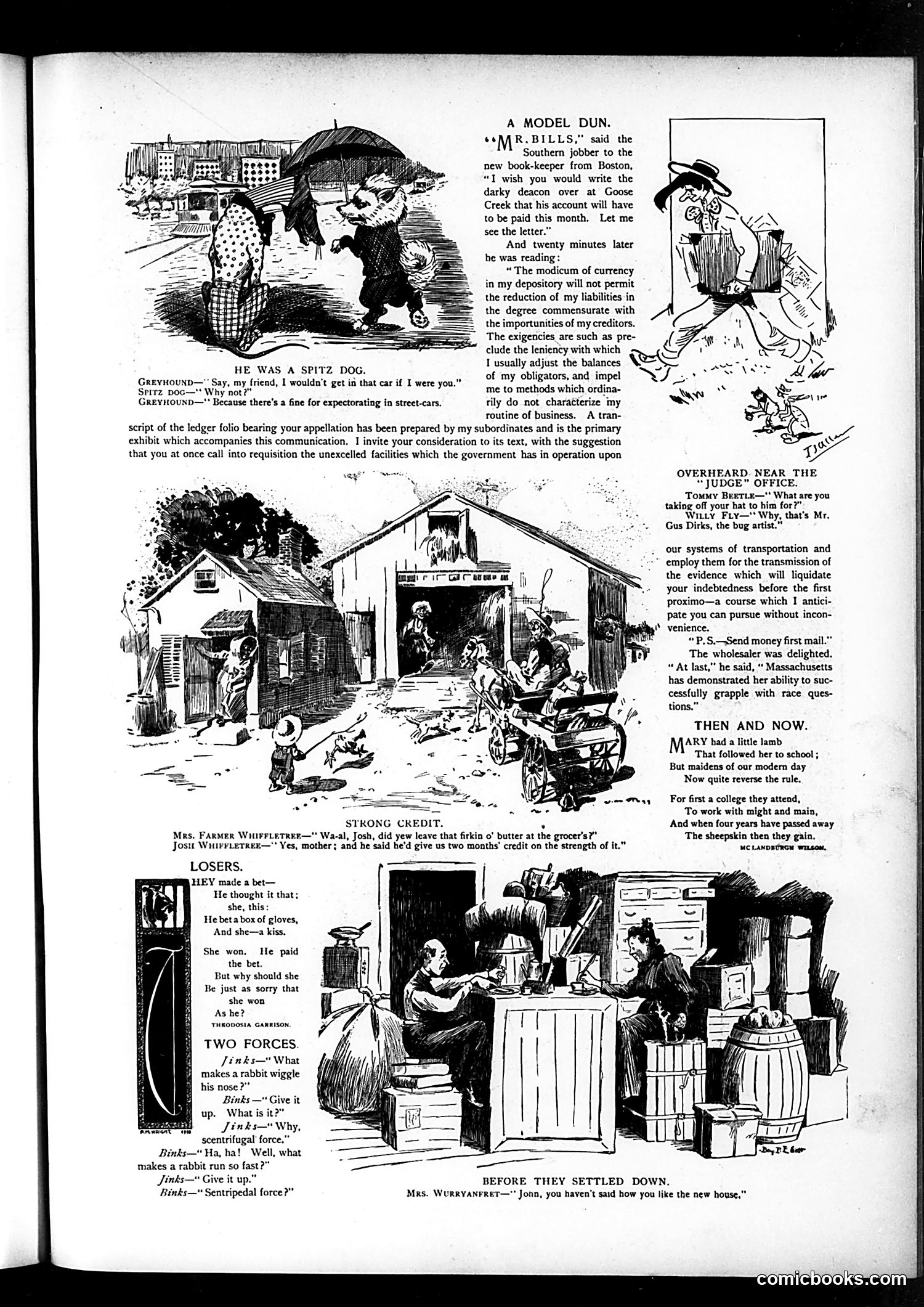
This page contains multiple satirical pieces typical of early 20th-century American humor: **"A Model Dun"** mocks a Boston clerk's pretentious language. When a Southern jobber asks him to collect a debt from a "darky deacon" at Goose Creek, the clerk writes an absurdly verbose letter using inflated vocabulary instead of plain speech. The joke satirizes Northern pretension and bureaucratic obfuscation—the clerk's ornate language makes a simple debt collection letter incomprehensibly pompous. The Southern employer appreciates it as evidence that Massachusetts has solved "race questions," which is itself satirical commentary. **Other items** include brief humor pieces: a complaint about spitting in streetcars, college-educated women reversing traditional gender roles, and puns on centrifugal/centripetal forces. The overall tone reflects Judge's satirical style: mocking class pretension, linguistic excess, and emerging social changes of the era.
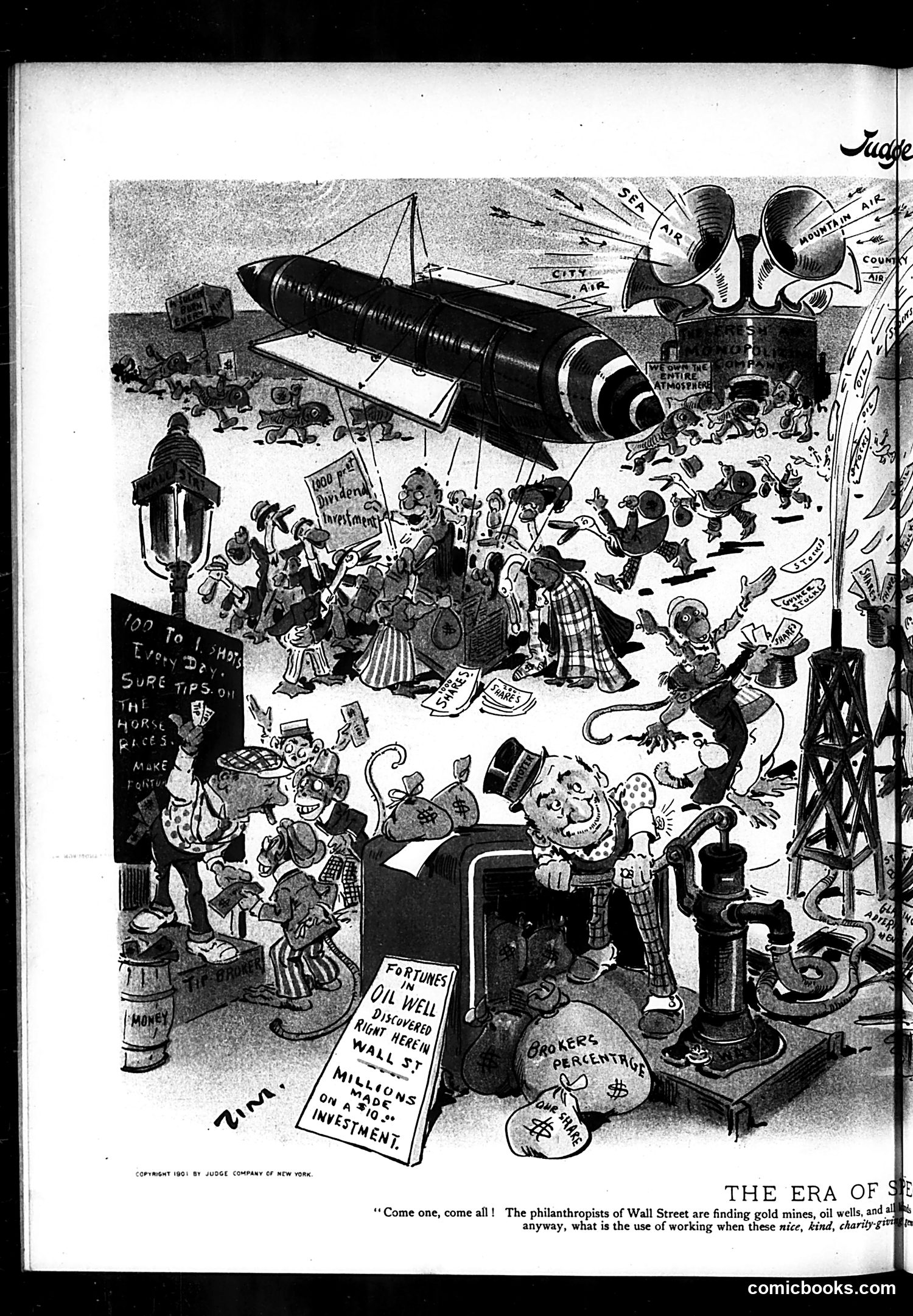
This satirical cartoon mocks Wall Street financiers disguised as "philanthropists." The central image depicts a carnival-like atmosphere where wealthy speculators gather around a massive rocket or airship labeled with financial schemes. Key elements include: - Signs advertising "Fortunes in Oil Well Discoveries," "Brokers Percentages," and "Wall Street Millions Made on $40 Investment" - Crowds of ordinary people being lured by promises of easy wealth - Street-level fortune tellers and con artists operating alongside the schemes The satire targets **stock market manipulation and fraud**, where Wall Street elites posed as charitable investors while actually promoting get-rich-quick schemes to gullible citizens. The cartoon's title, "The Era of S[?]," likely refers to speculation. The text's sarcastic tone—"what is the use of working when these nice, kind, charity-[givers exist]"—highlights how these schemes exploited working-class hope for easy fortune, revealing the era's rampant financial fraud.
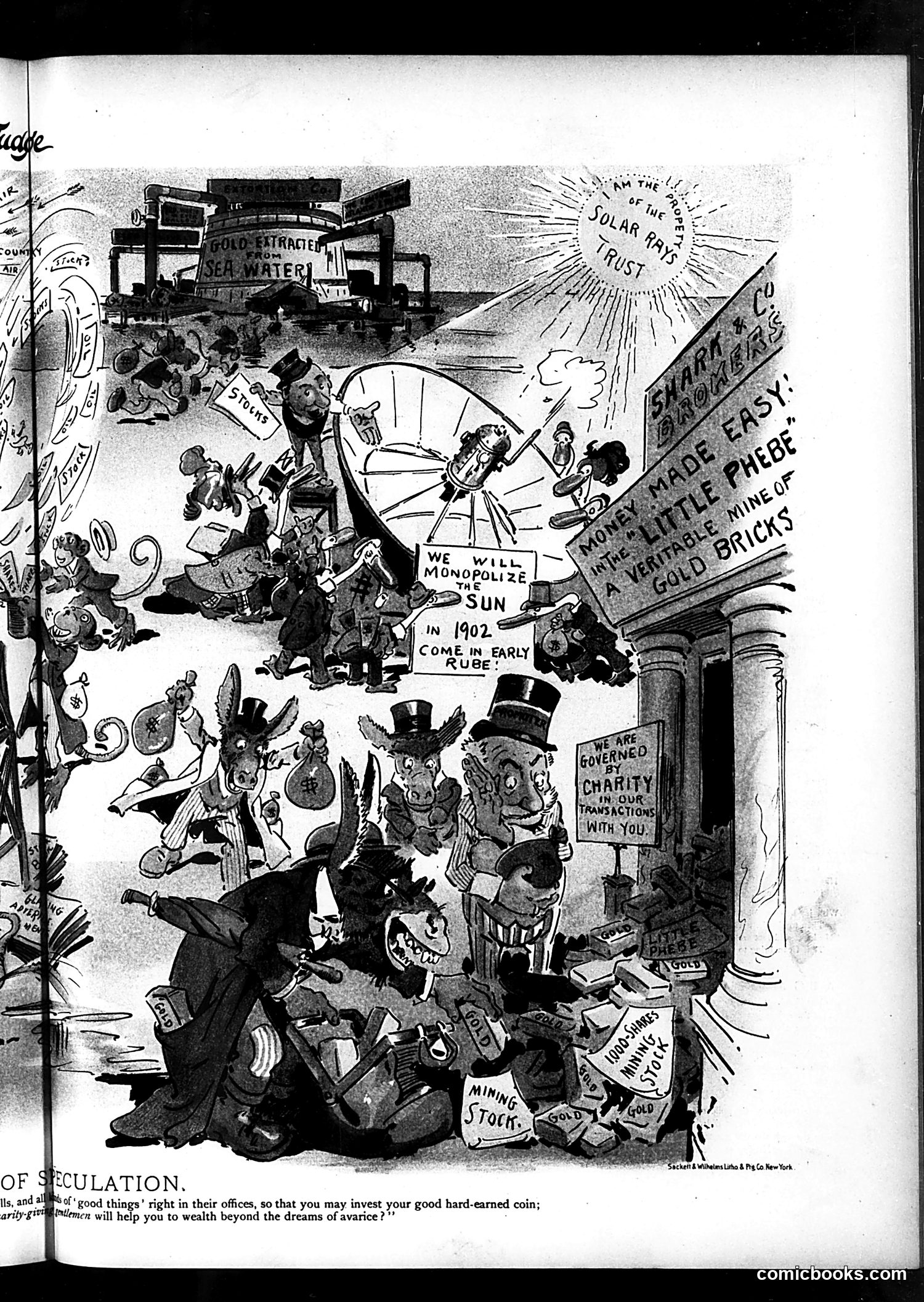
This Judge magazine cartoon satirizes fraudulent investment schemes and financial monopolies circa 1902. The imagery depicts various con artists and schemes preying on ordinary investors ("Rube"). Key elements include: - **"Solar Trust"** and **"Gold Brick"** schemes labeled at top—notorious frauds of the era - Caricatured figures representing swindlers with exaggerated features (likely ethnic stereotypes common to period satire) - A **monopoly wheel** being manipulated by fraudsters - Bottom text warns that smooth-talking promoters will help you "invest your hard-earned coin" in worthless ventures The satire mocks how wealthy operators used official-sounding names and false promises to defraud average people. The "Charity" sign on the right suggests hypocrisy—claiming benevolence while stealing. The overall message warns readers against get-rich-quick schemes.
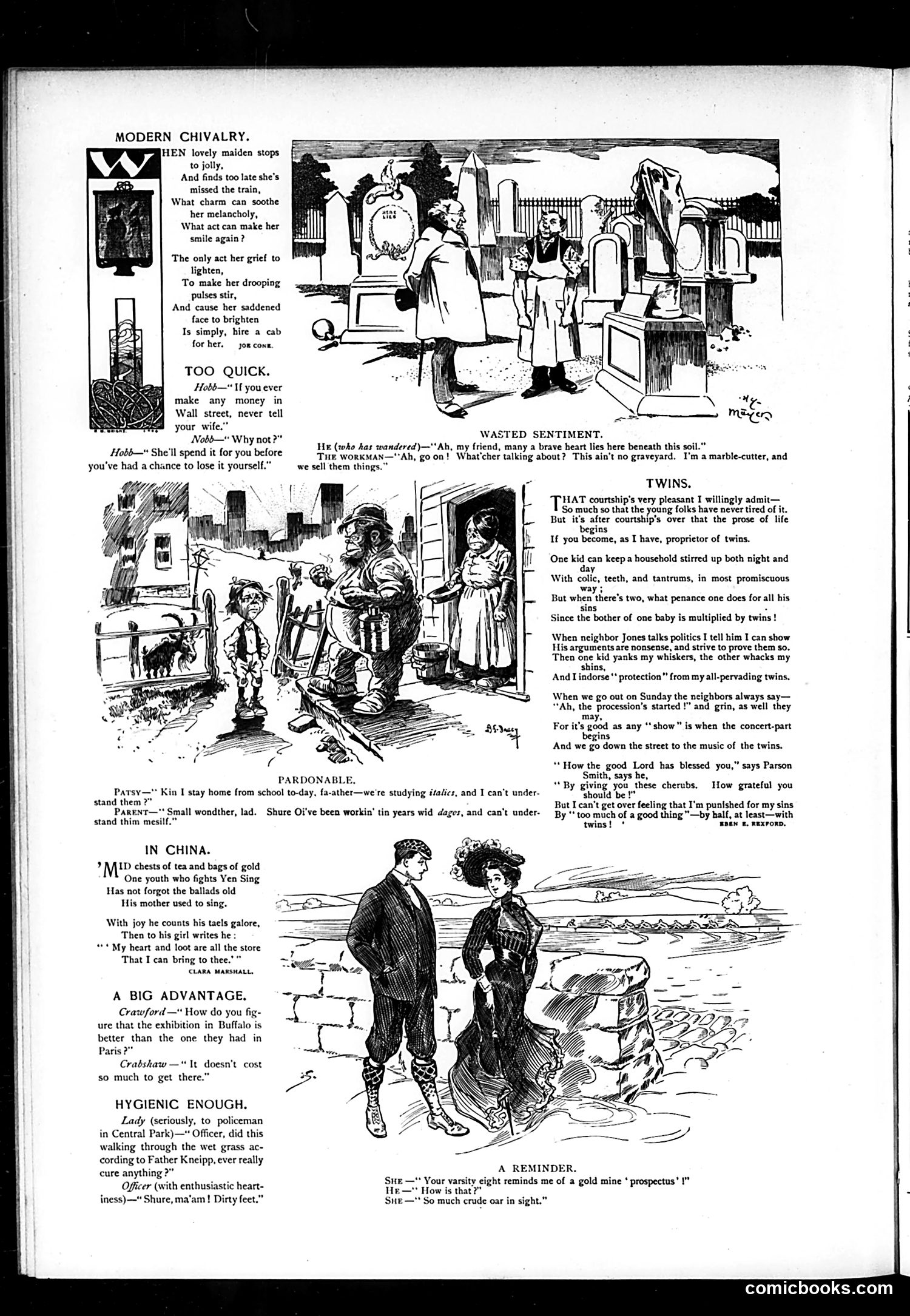
This Judge magazine page contains multiple brief satirical sketches mocking contemporary social conventions and relationships. **"Modern Chivalry"** jokes that the only way to cheer a disappointed woman is hiring her a cab—poking fun at materialistic courtship rituals. **"Too Quick"** satirizes Wall Street greed: a husband mustn't tell his wife about profits because she'll spend them immediately. **"Twins"** is a lengthy humorous poem about the exhausting reality of raising twins, contrasting romantic courtship with domestic chaos. It mocks how neighbors romanticize large families ("How the good Lord has blessed you") while the father endures constant disruption. **"Pardonable"** shows an Irish immigrant boy mimicking his laborer father's inability to understand school lessons. **"In China"** presents orientalist stereotypes of a Chinese youth counting money while sentimentally recalling his mother's songs. Other brief jokes mock Wall Street speculation, Father Kneipp's nature-cure fads, and a college rowing team's incompetence. The humor relies on period-specific references to marriage dynamics, immigrant dialect comedy, and early-1900s social preoccupations.
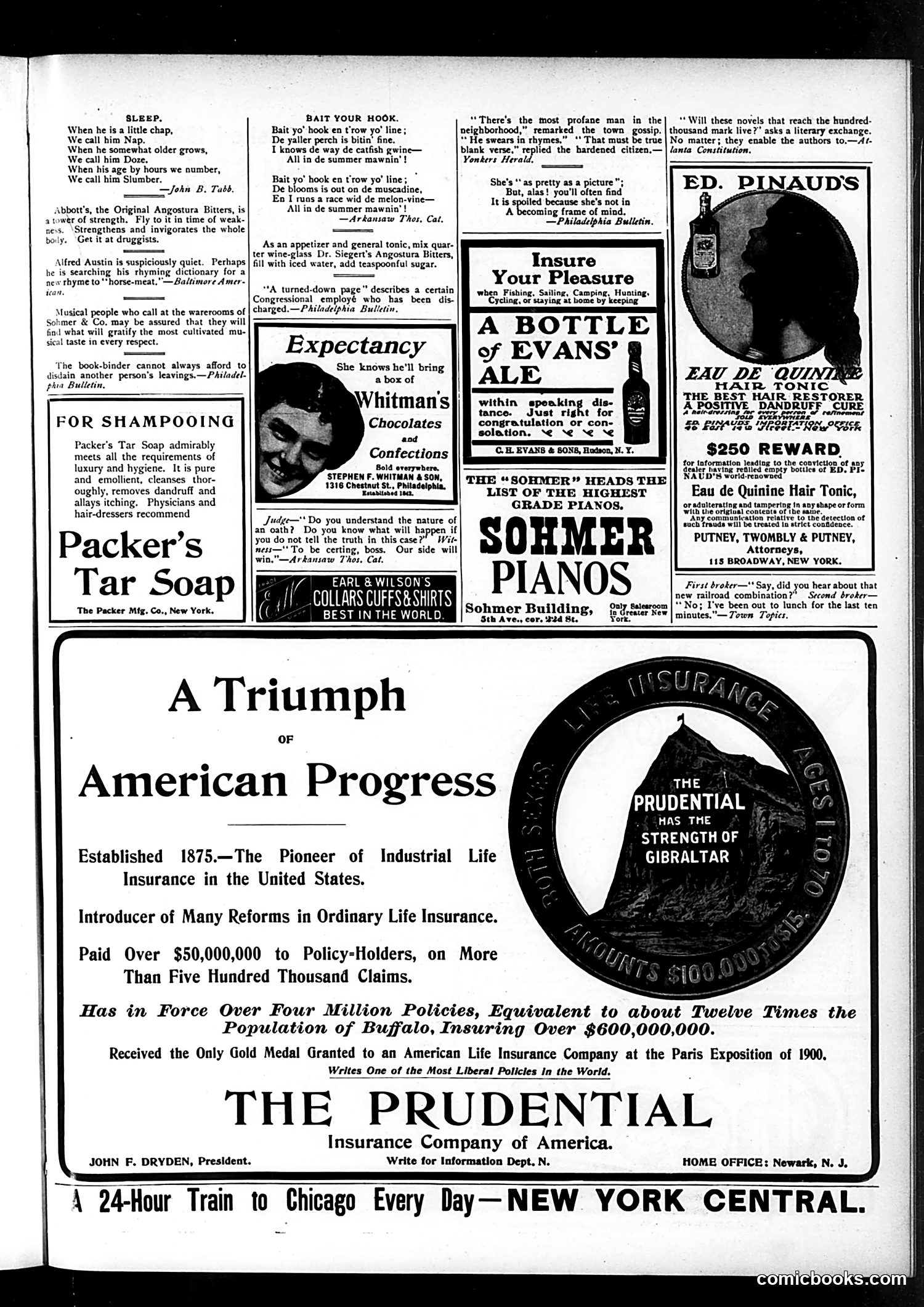
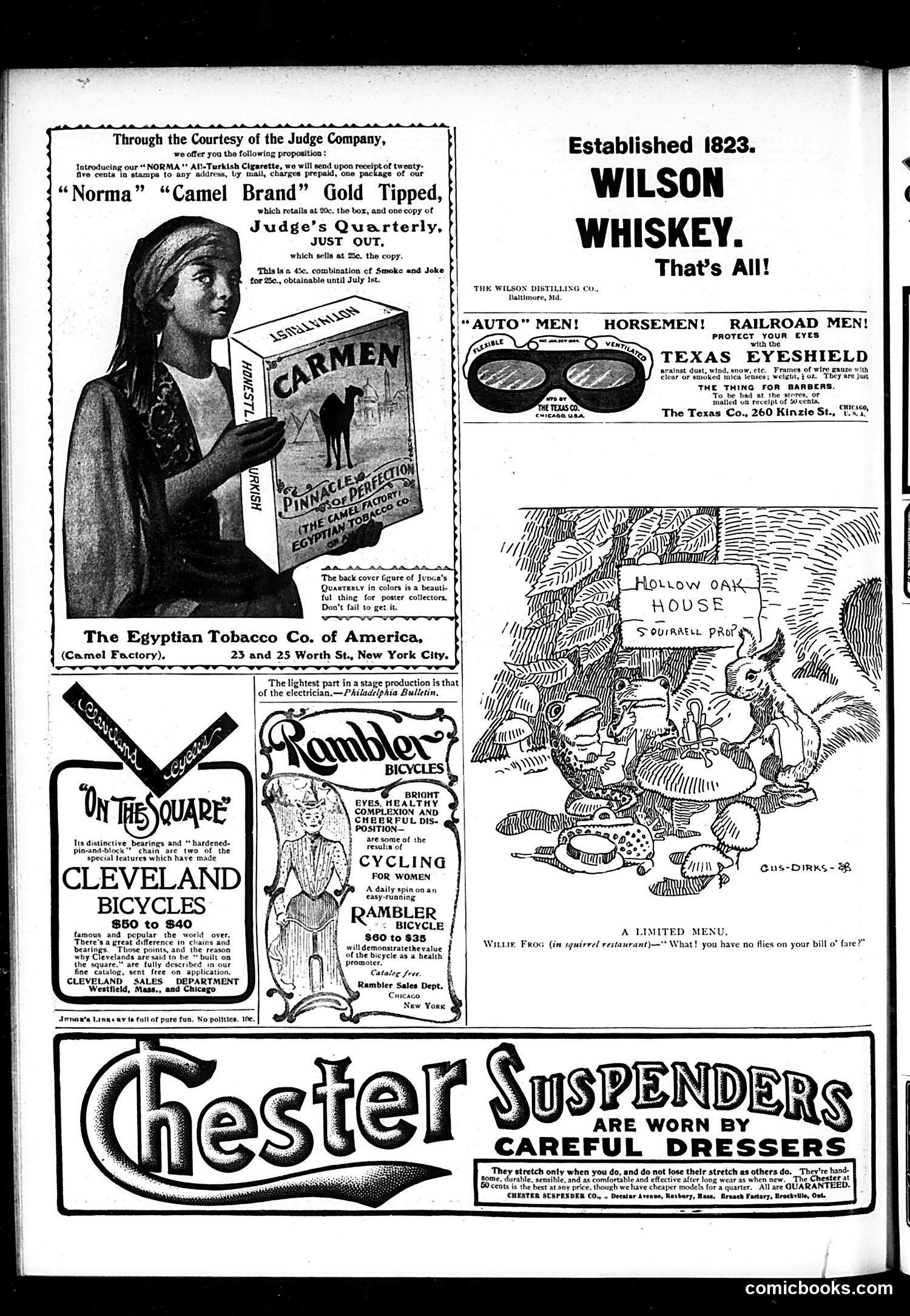
This is primarily an **advertising page** from Judge magazine, not political satire. The page features commercial advertisements for various products popular in the early 1900s: cigarettes, bicycles, whiskey, eye protection, and suspenders. The one **cartoon** present is "A Limited Menu" — a visual joke depicting a Willie Frog (an anthropomorphic character) in a "squirrel restaurant" asking why there are no flies on the bill of fare. The humor relies on the pun: flies are both insects and items on a menu ("bill of fare" means menu). It's a simple, whimsical gag unrelated to politics or social commentary. The page reflects early 20th-century consumer culture, advertising bicycles (then modern technology), cigarettes without health warnings, and industrial safety products for workers. The advertisements target specific occupational groups—railroad workers, barbers, cyclists—showing market segmentation strategies of the era.
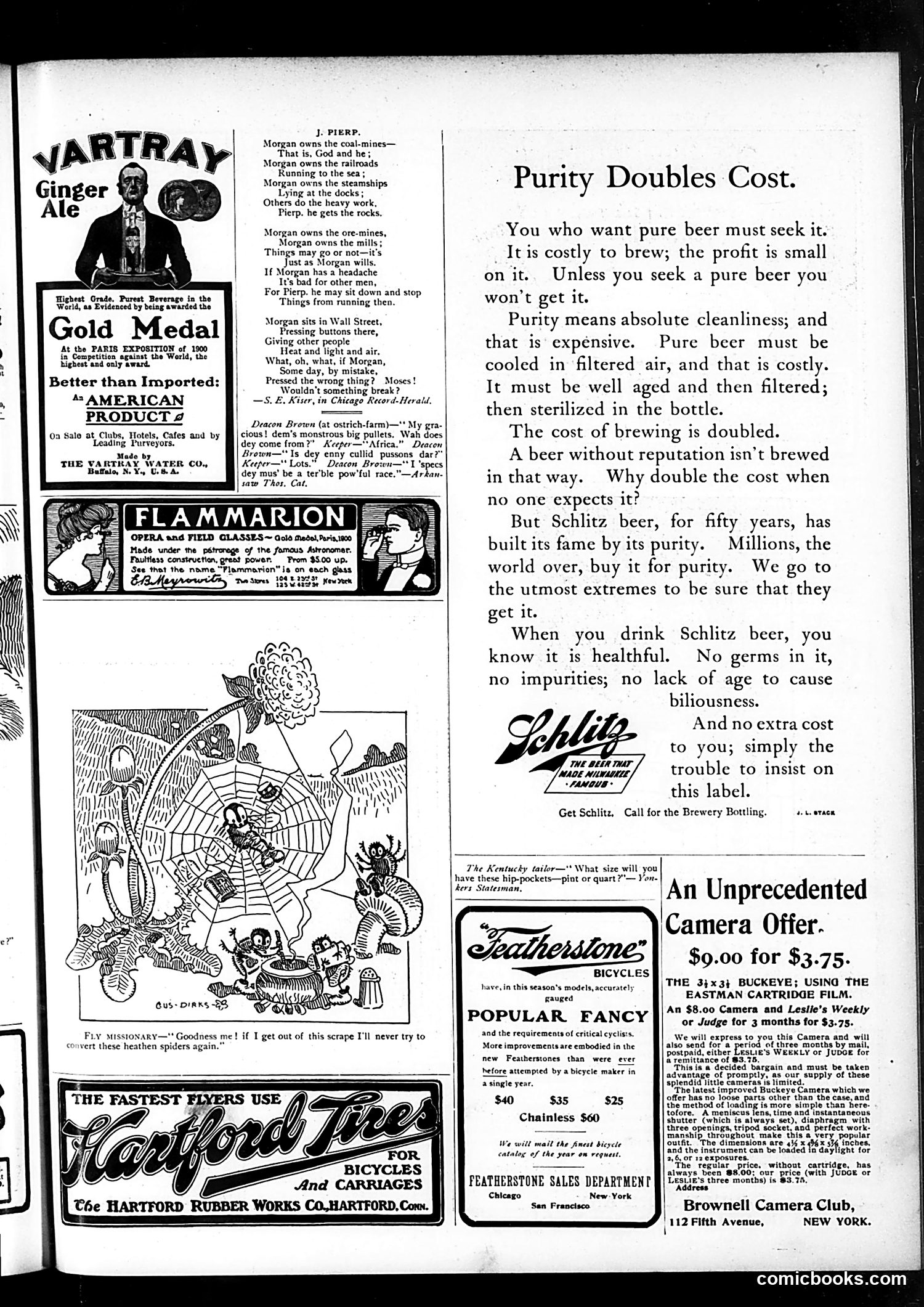
This page mixes political satire with period advertising. The main cartoon titled "J. PIERP" is a satirical poem attacking J.P. Morgan, the powerful financier. It mocks Morgan's monopolistic control of coal mines, railroads, and ore mills—suggesting he owns not just these industries but also controls the workers and profits while others do the actual labor. The repeated phrase "Pierp. he gets the rocks" is wordplay criticizing Morgan's enrichment. The poem reflects Progressive Era anxieties (early 1900s) about industrial monopolies and wealth concentration. Morgan was famous for consolidating major American industries. The page's remaining content is advertising: Vartray Ginger Ale, Flammarion opera glasses, Schlitz beer (emphasizing "purity"), Hartford bicycles, Featherstone bicycles, and a camera offer. The "Deacon Brown" dialect joke appears to mock both rural speech and racial stereotypes typical of the era's humor.
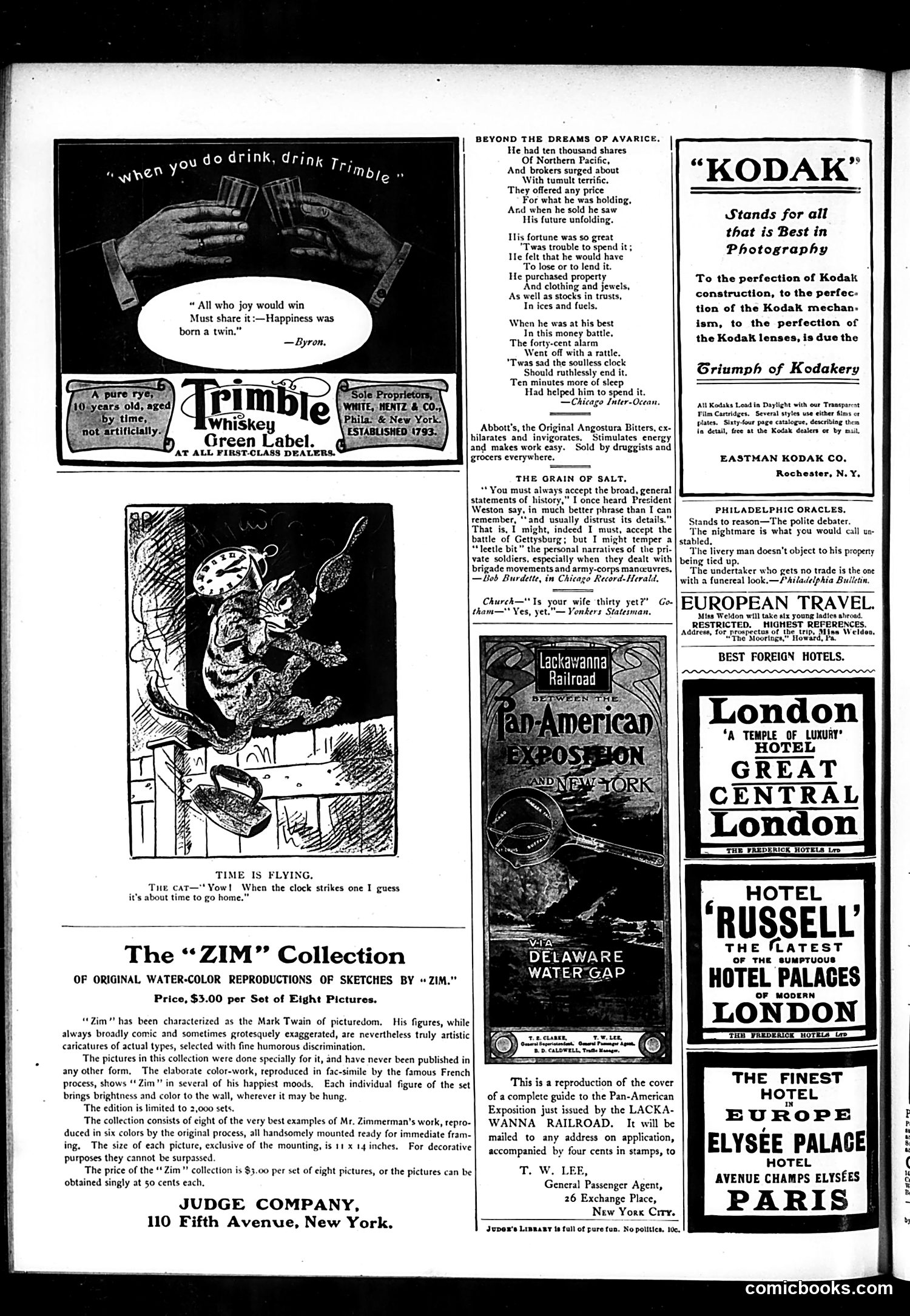
This page from the satirical magazine *Judge* contains multiple cartoons and advertisements reflecting turn-of-the-century American concerns. The top cartoon, "Beyond the Dreams of Avarice," satirizes sudden wealth from stock speculation (specifically Northern Pacific shares). It mocks the wealthy man who accumulates riches but struggles to spend them—his dilemma is interrupted absurdly when an alarm clock forces him awake, suggesting his wealth fantasy was merely a dream. Below, "Time is Flying" presents a simple visual joke: a cat remarks it's time to go home when the clock strikes, playing on the double meaning of "striking one"—both the time and the physical action. The remaining content is primarily **advertisements** for period products: Trimble Whiskey, Kodak cameras (emphasizing their superiority), travel guides, and luxury European hotels. These ads reflect the affluence of *Judge*'s readership. The page's overall tone satirizes American materialism and nouveau-riche aspirations while simultaneously marketing luxury goods to that same audience—a characteristic *Judge* editorial strategy.
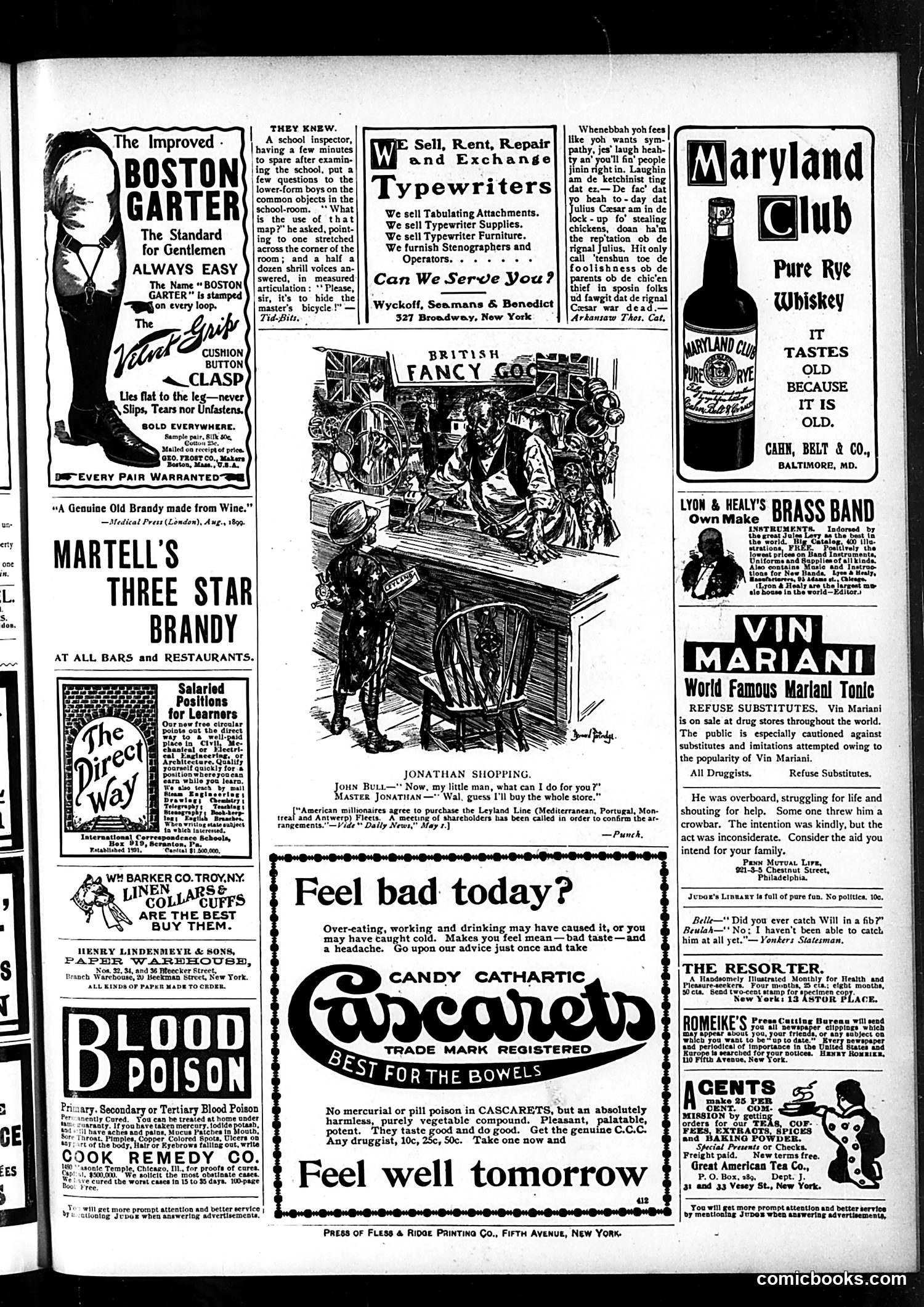
This page is primarily **advertising**, typical of Judge magazine's business model. The main content includes: ## Notable Advertisement: The central **"Jonathan Shopping"** cartoon depicts an American millionaire child telling a shopkeeper he'll "buy the whole store"—a satirical jab at American wealth and consumerism. The accompanying news note references millionaires purchasing shipping fleets, connecting the cartoon to contemporary business excess. ## Other Content: - **Product ads** for garters, brandy, typewriters, whiskey, tonics, and patent medicines (including "Blood Poison" remedy and "Cascaret" laxative) - **Small comic snippets** with minimal social commentary—mostly domestic humor about catching someone in a lie or a woman struggling in water - **"The Direct Way"** employment ad ## Historical Context: The prevalence of **dubious patent medicines** (laxatives, tonics, blood remedies) reflects pre-FDA regulation. The Irish dialect humor in one cartoon reflects period attitudes toward immigrants. The page demonstrates Judge's reliance on advertising revenue rather than sophisticated satire on this particular issue.
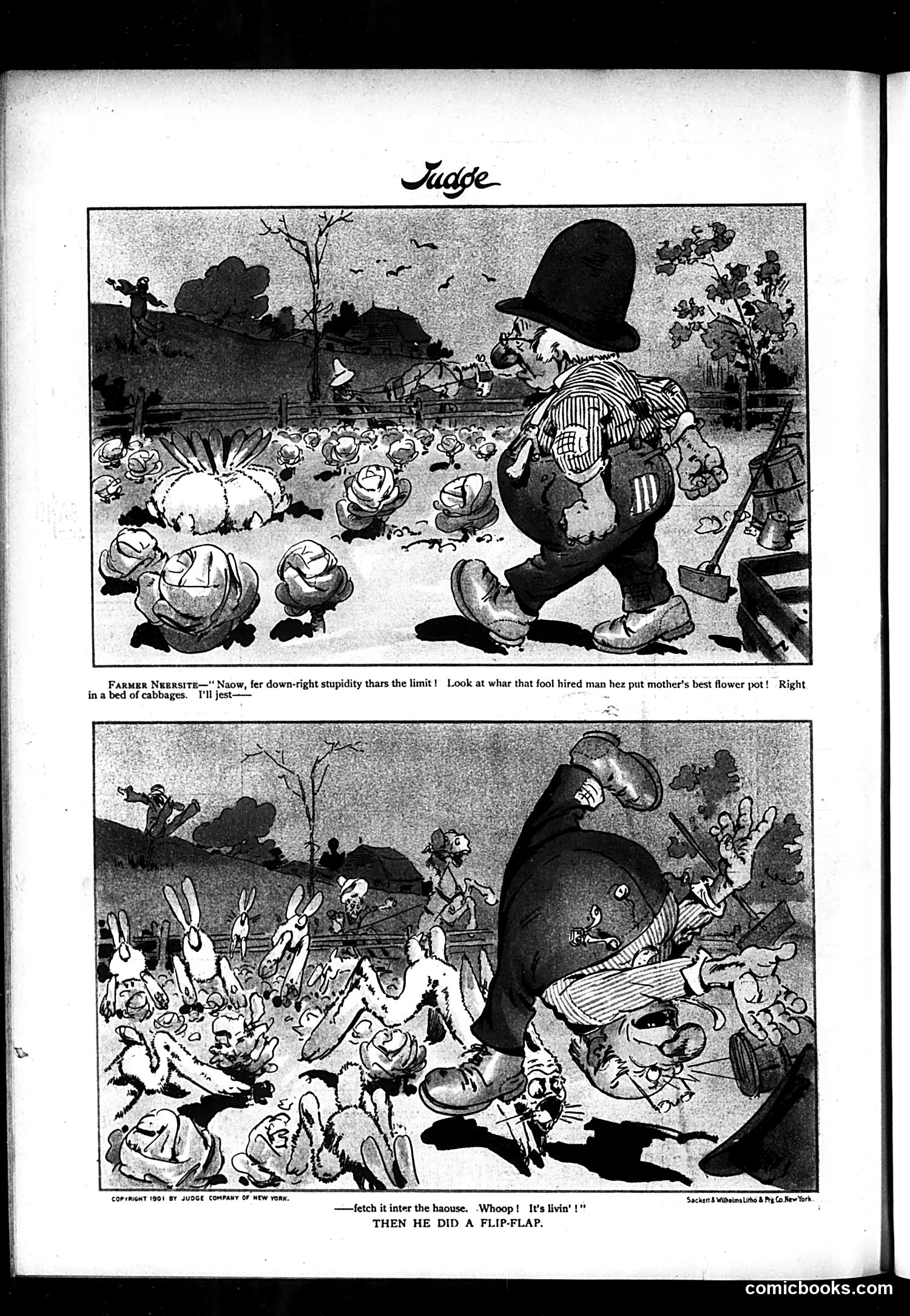
This two-panel rural comedy depicts a farmer discovering his hired hand has carelessly placed the family's best flower pot in the vegetable garden. The farmer's outrage at this stupidity sets up the punchline: when he attempts to retrieve it, the pot has become home to rabbits, which have multiplied inside it ("It's livin'!"). The humor relies on slapstick—the farmer's shocked reaction ("THEN HE DID A FLIP-FLAP") to discovering living rabbits. The satire targets rural laborers' incompetence and the absurd consequences of their carelessness, while also playing on period audiences' enjoyment of physical comedy and animal-based humor. The "Farmer Nuerstte" byline suggests a rural dialect character, typical of early 20th-century American comic conventions that often mocked rural speech and sensibilities for urban magazine readers.