
Judge, 1901-06-08 · page 3 of 16
Judge — June 8, 1901 — page 3: what you’re looking at
What you’re looking at
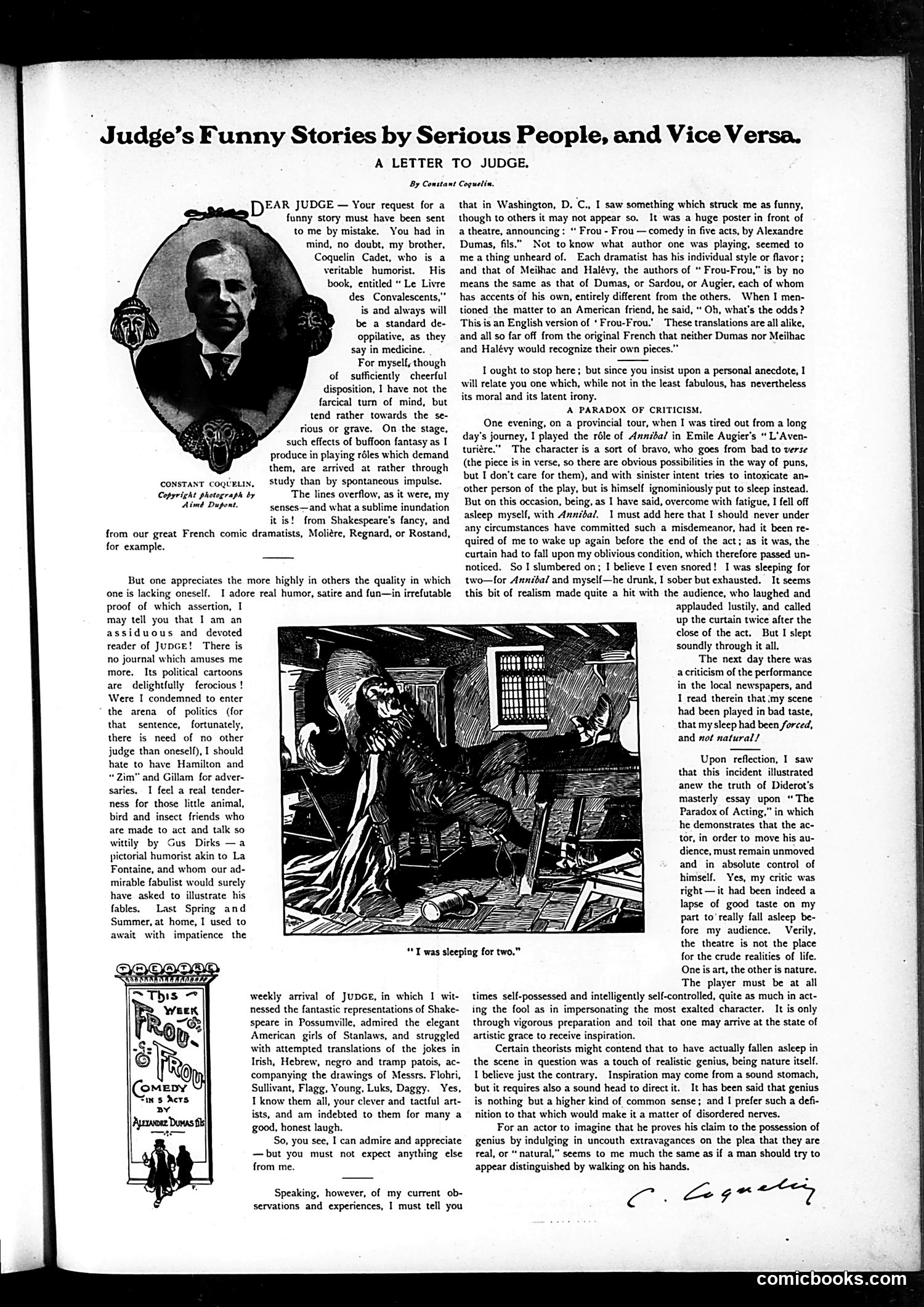
This page contains a letter from "Constant Coquelin" (a French actor) to the Judge editor about humor in drama. The accompanying woodcut illustrations show theatrical scenes—one depicting an actor in exaggerated pose, another showing what appears to be a prison or dungeon scene. Coquelin discusses the differences between French and English comedy styles, critiquing an English adaptation of a French play called "Frou-Frou." He argues that genuine humor requires wit and satire, not mere physical comedy or slapstick. He recounts falling asleep during a performance of "Amabel" and being awakened—a humorous anecdote illustrating his point about theatrical realism versus artifice. The piece essentially argues that serious actors should appreciate sophisticated humor rather than broad farce, reflecting late-19th-century debates about theatrical standards.
📄 Transcribed text from this page (OCR, searchable)
Machine-transcribed from the original scan — historical spelling and the odd misread are preserved.
Judge’s Funny Stories by Serious People, and Vice Versa. A LETTER TO JUDGE, By Constant Coguetin. EAR JUDGE — Your request for a funny story must have been sent to me by mistake, You had in mind, no doubt, my brother, Coquelin Cadet, who is a veritable humorist. His book, entitled “ Le Livre des Convalescents,” is and always will be a standard de- oppilative, as they say in medicine. For myself, though of sufficiently cheerful disposition, I have not the farcical turn of mind, but tend rather towards the se- rious or grave. On the stage, such effects of buffoon fantasy as I produce in playing réles which demand them, are arrived at rather through study than by spontaneous impulse. The lines overflow, as it were, my senses—and what a sublime inundation it is! from Shakespeare's fancy, and from our great French comic dramatists, Moliére, Regnard, or Rostand, for example. CONSTANT COQUELIN, Copyright photograph by Aimé Dupont. But one appreciates the more highly in others the quality in which one is lacking oneself. I adore real humor, satire and fun—in irrefutable proof of which assertion, I may tell you that I am an assiduous and devoted reader of JupGe! There is no journal which amuses me more. Its political cartoons are delightfully ferocious ! Were I condemned to enter the arena of politics (for that sentence, fortunately, there is need of no other judge than oneself), I should hate to have Hamilton and “Zim” and Gillam for adver- saries. I feel a real tender- ness for those little animal, bird and insect friends who are made to act and talk so wittily by Gus Dirks —a pictorial humorist akin to La Fontaine, and whom our ad- mirable fabulist would surely have asked to illustrate his fables. Last Spring and Summer, at home, I used to await with impatience the Twas sleeping for two.” weekly arrival of JUDGE, in which 1 wit- nessed the fantastic representations of Shake- speare in Possumville, admired the elegant American girls of Stanlaws, and struggled with attempted translations of the jokes in Irish, Hebrew, negro and tramp patois, ac- companying the drawings of Messrs. Flohri, Sullivant, Flagg, Young, Luks, Daggy. Yes, I know them all, your clever and tactful art- ists, and am indebted to them for many a good, honest laugh. So, you see, I can admire and appreciate —but you must not expect anything else from me. Speaking, however, of my current ob- servations and experiences, I must tell you that in Washington, D. C., I saw something which struck me as funny, though to others it may not appear so. It was a huge poster in front of a theatre, announcing: “ Frou - Frou — comedy in five acts, by Alexandre Dumas, fils.” Not to know what author one was playing, seemed to me a thing unheard of. Each dramatist has his individual style or flavor; and that of Meilhac and Halévy, the authors of “ Frou-Frou,” is by no means the same as that of Dumas, or Sardou, or Augier, each of whom has accents of his own, entirely different from the others. When I men- tioned the matter to an American friend, he said, “ Oh, what's the odds ? This is an English version of *Frou-Frou.’ These translations are all alike, and all so far off from the original French that neither Dumas nor Meilhac and Halévy would recognize their own pieces.” I ought to stop here; but since you insist upon a personal anecdote, I will relate you one which, while not in the least fabulous, has nevertheless its moral and its latent irony. A PARADOX OF CRITICISM. One evening, on a provincial tour, when I was tired out from a long day's journey, I played the réle of Annzba/ in Emile Augier's “ L'Aven- turiére.” The character is a sort of bravo, who goes from bad to verse (the piece is in verse, so there are obvious possibilities in the way of puns, but I don’t care for them), and with sinister intent tries to intoxicate an- other person of the play, but is himself ignominiously put to sleep instead. But on this occasion, being, as I have said, overcome with fatigue, I fell off asleep myself, with Annzbal. 1 must add here that I should never under any circumstances have committed such a misdemeanor, had it been re- quired of me to wake up again before the end of the act; as it was, the curtain had to fall upon my oblivious condition, which therefore passed un- noticed. So I slumbered on; I believe I even snored! I was sleeping for two—for Annibal and myself—he drunk, I sober but exhausted. It seems this bit of realism made quite a hit with the audience, who laughed and applauded lustily, and called up the curtain twice after the close of the act. But I slept soundly through it all. The next day there was acriticism of the performance in the local newspapers, and I read therein that (my scene had been played in bad taste, that my sleep had been forced, and not natural! Upon reflection, I saw that this incident illustrated anew the truth of Diderot’s masterly essay upon “The Paradox of Acting,” in which he demonstrates that the ac- tor, in order to move his au- dience, must remain unmoved and in absolute control of himself. Yes, my critic was right — it had been indeed a lapse of good taste on my part to’really fall asleep be- fore my audience. Verily, the theatre is not the place for the crude realities of life. One is art, the other is nature. The player must be at all times self-possessed and intelligently self-controlled, quite as much in act- ing the fool as in impersonating the most exalted character. It is only through vigorous preparation and toil that one may arrive at the state of artistic grace to receive inspiration, Certain theorists might contend that to have actually fallen asleep in the scene in question was a touch of realistic genius, being nature itself. I believe just the contrary. Inspiration may come from a sound stomach, but it requires also a sound head to direct it. It has been said that genius is nothing but a higher kind of common sense; and I prefer such a defi- nition to that which would make it a matter of disordered nerves. For an actor to imagine that he proves his claim to the possession of genius by indulging in uncouth extravagances on the plea that they are real, or “natural,” seems to me much the same as if a man should try to appear distinguished by walking on his hands. Cea, comicbooks.com