
A complete issue · 16 pages · 1901
Judge — May 25, 1901
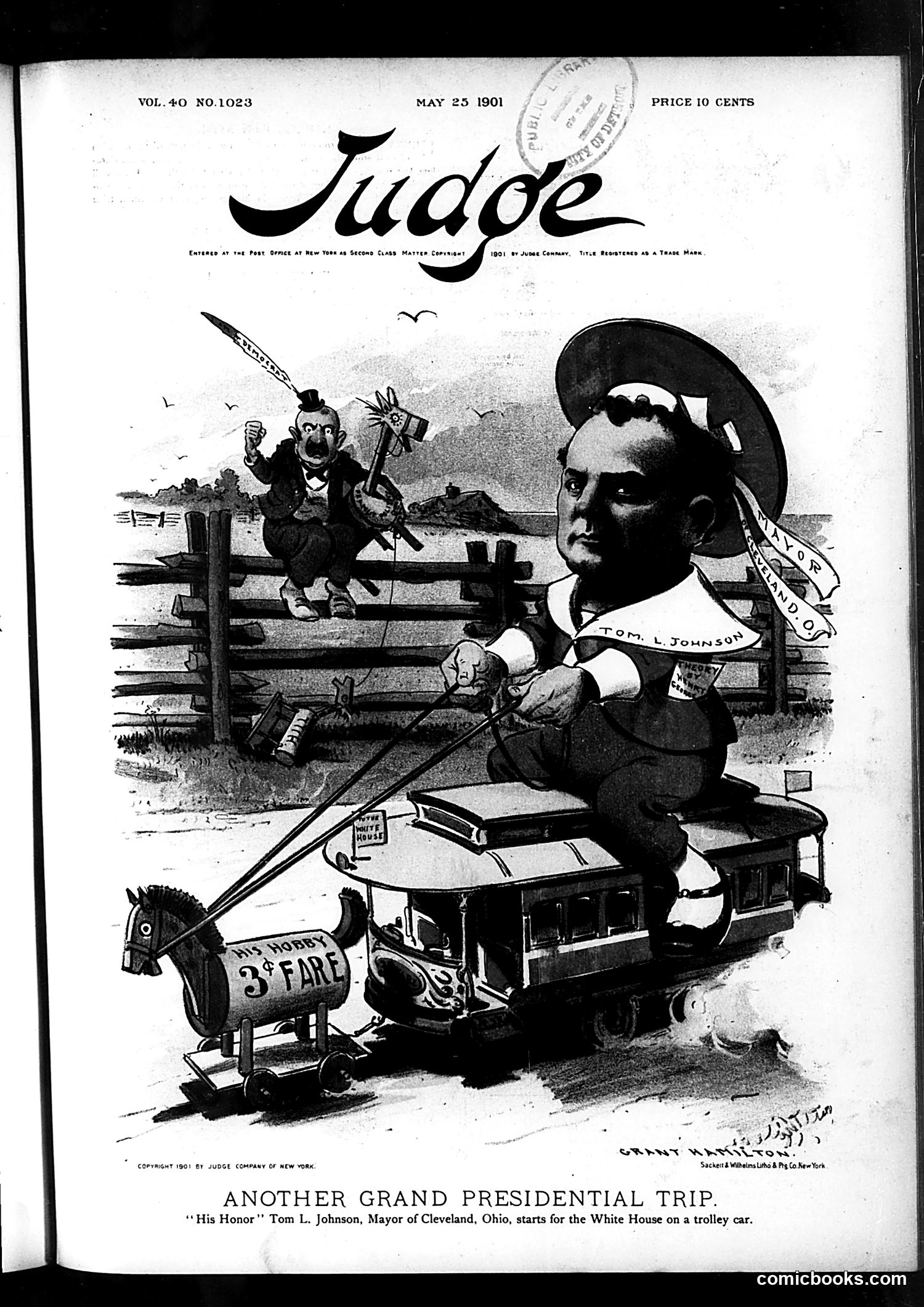
This **May 25, 1901 Judge cartoon** satirizes Tom L. Johnson, Mayor of Cleveland, Ohio. The caption reads: "His Honor Tom L. Johnson, Mayor of Cleveland, Ohio, starts for the White House on a trolley car." The joke mocks Johnson's apparent presidential ambitions through visual satire: he's depicted traveling to the White House via a small trolley car (rather than dignified transport), pulled by a donkey labeled "3-FARE" (likely referencing trolley fares). A caricatured figure with exaggerated features wields weapons in the background, possibly suggesting chaos or instability in his administration. The artist—Grant Hamilton—uses the deliberately absurd, undignified mode of transport to ridicule Johnson's political viability and mock his mayoral achievements as insufficient qualification for higher office.
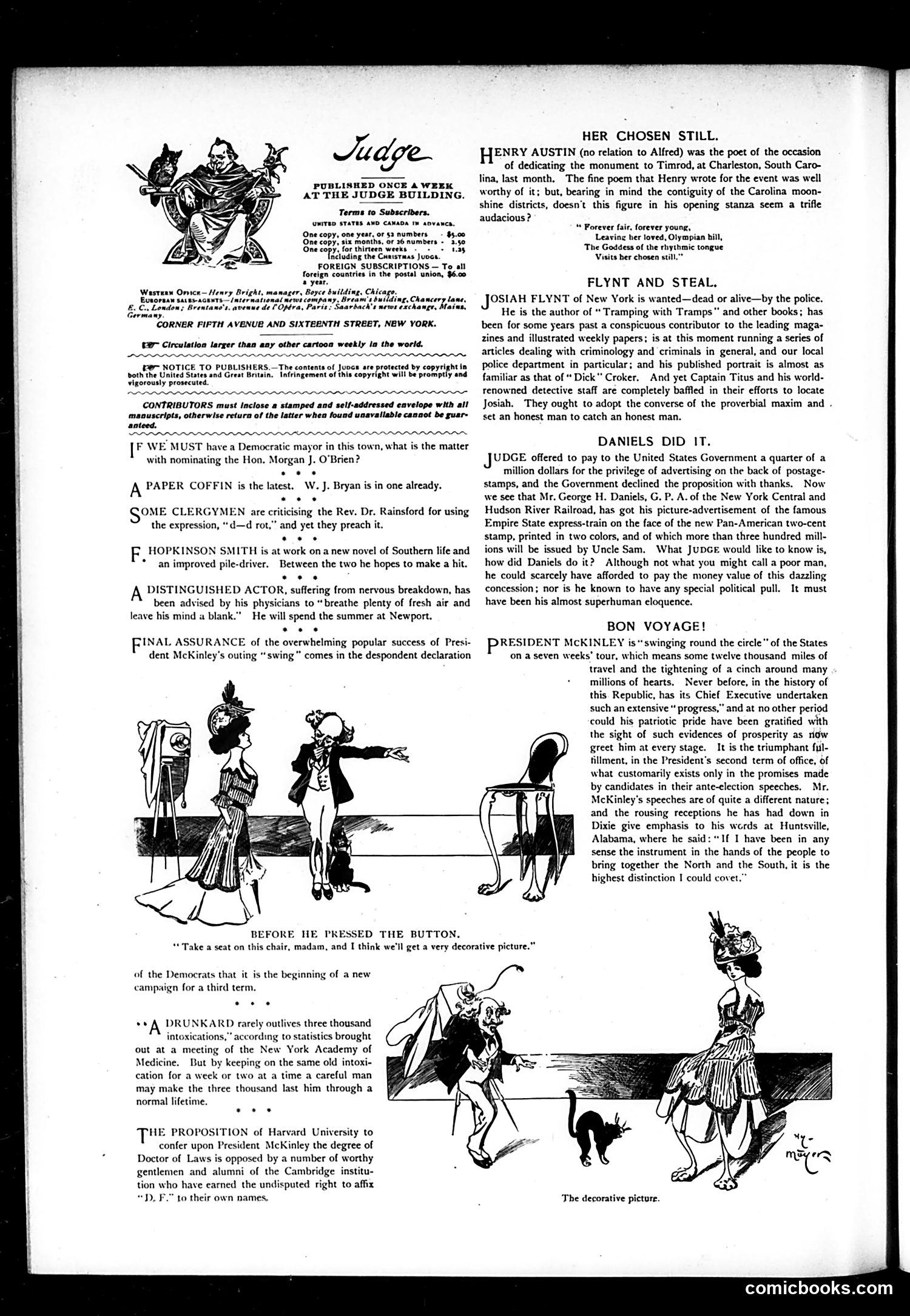
This page contains several brief satirical items typical of Judge's format. The main cartoon, "Before He Pressed the Button," depicts a woman asking a man to sit on a chair, promising "a very decorative picture"—likely satirizing photography or portraiture trends. The text items mock contemporary figures and practices: clergy criticized for poor preaching; an actor's nervous breakdown; McKinley's presidential tour generating popular enthusiasm (presented as excessive); and Harvard's dispute over awarding honorary degrees. The final item quotes statistics about alcoholism, presented as dark humor about medical topics. Without specific date attribution, the McKinley reference suggests this is from his presidency (1897-1901). The overall tone is cynical commentary on politics, society, and public figures of the Gilded Age/Progressive Era.
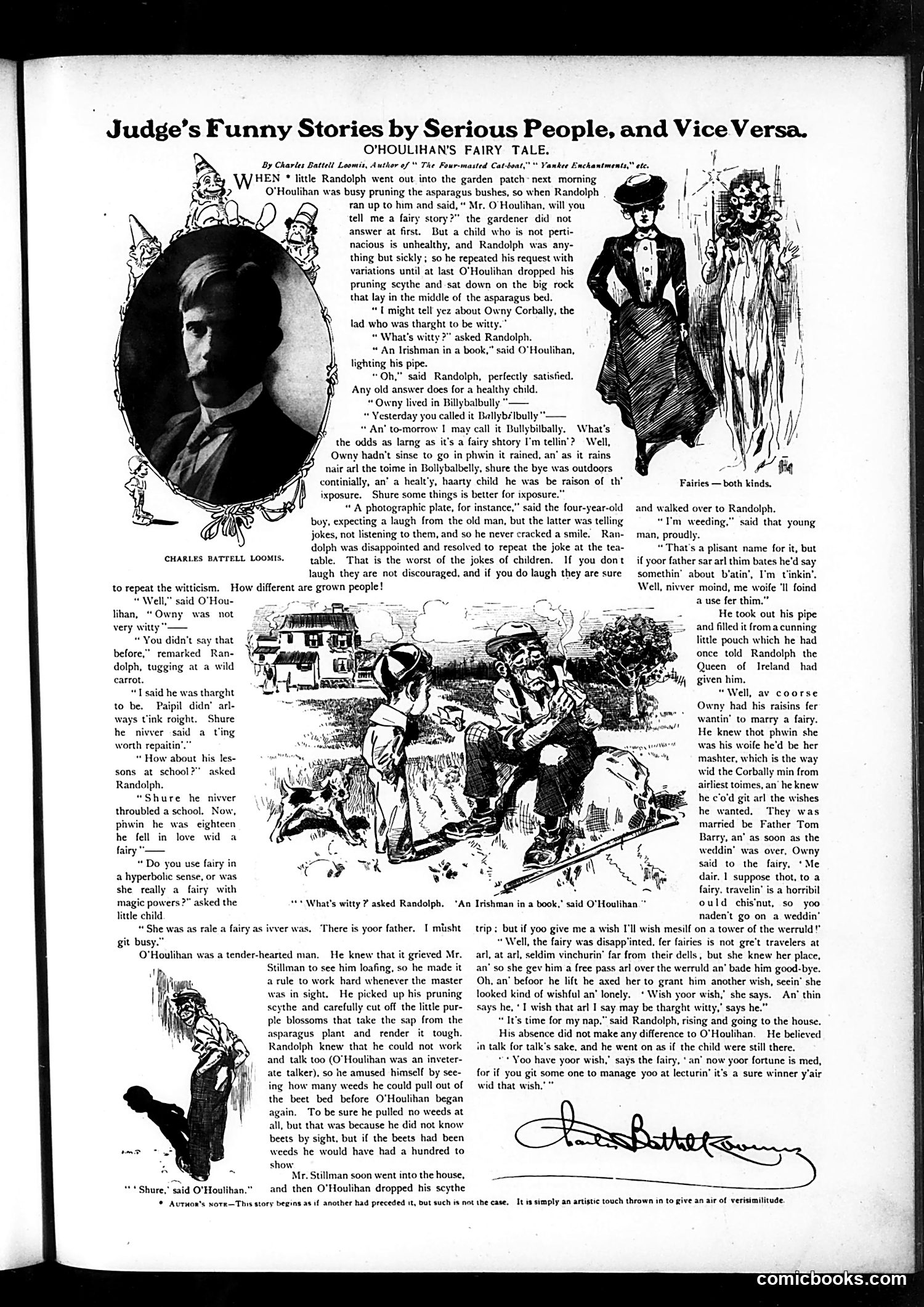
This is a humorous story by Charles Battell Loomis, not primarily political satire. The narrative concerns O'Houlihan, an Irish gardener, telling young Randolph a fairy tale about "Owny Corbally" to entertain him. The story plays on Irish immigrant stereotypes and dialect humor common to late 19th-century American magazines. O'Houlihan uses working-class Irish vernacular and folk wisdom to craft his tale, which contrasts with the refined, upper-class Randolph. The humor derives from class differences and the Irish character's attempts at storytelling rather than from political commentary. The illustrations show various characters from the fairy tale narrative.
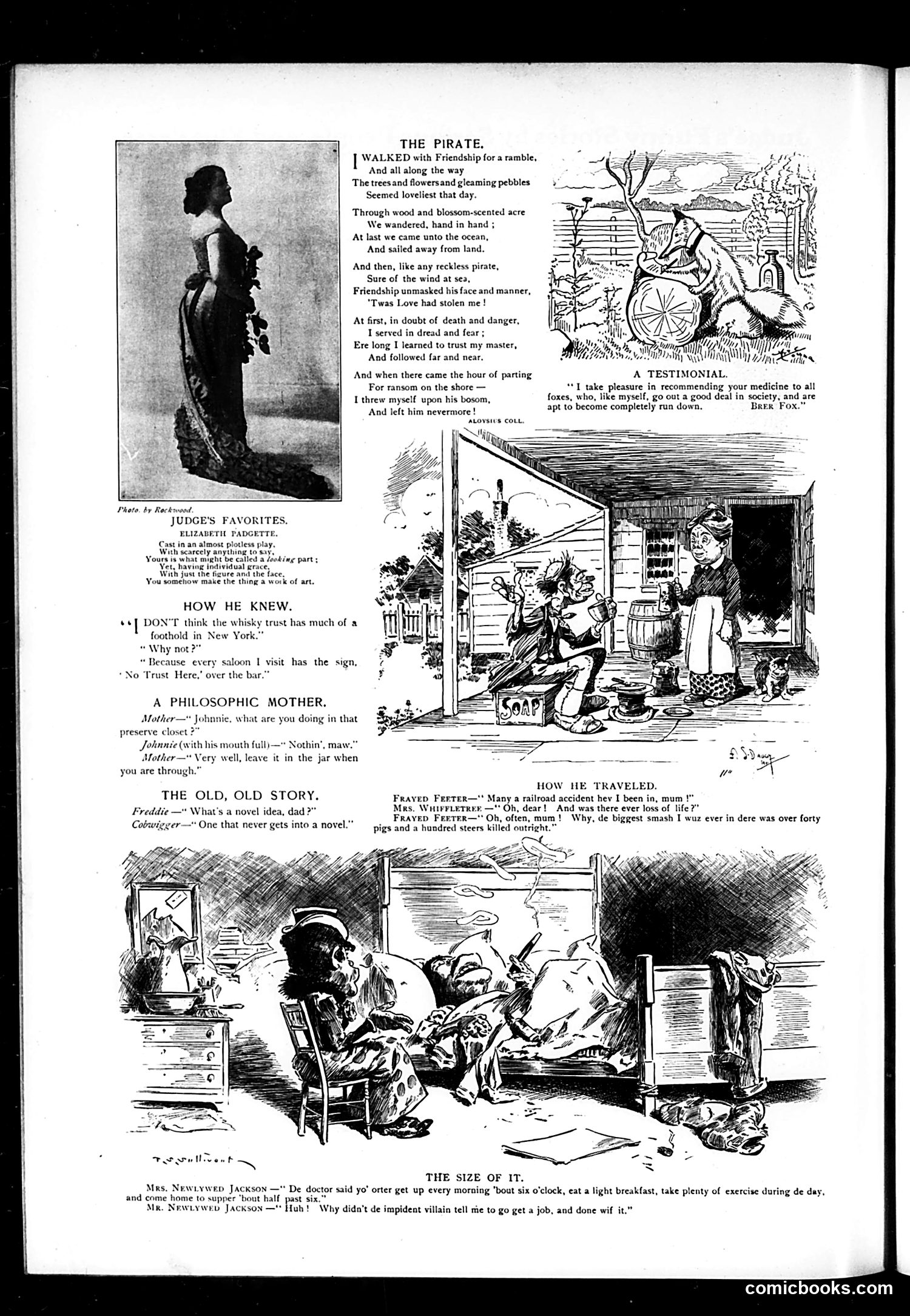
This page contains several humor pieces rather than political cartoons. "The Pirate" is a sentimental poem about a reckless criminal redeemed by love. "Judge's Favorites" highlights witty one-liners on topics like whiskey trust signs and parental discipline—typical light social satire. The cartoons mock everyday situations: "How He Knew" jokes about bar signage, "A Philosophic Mother" depicts a child's naïveté, and "The Old, Old Story" shows a father telling his son a tired anecdote. "How He Traveled" presents a traveling salesman accident scenario. "The Size of It" satirizes health advice, with a doctor's ridiculous prescription (breakfast at 6 a.m., exercise, etc.) mocked by suggesting laziness caused the problem. These are character-driven humor pieces targeting domestic and social conventions rather than specific political events.
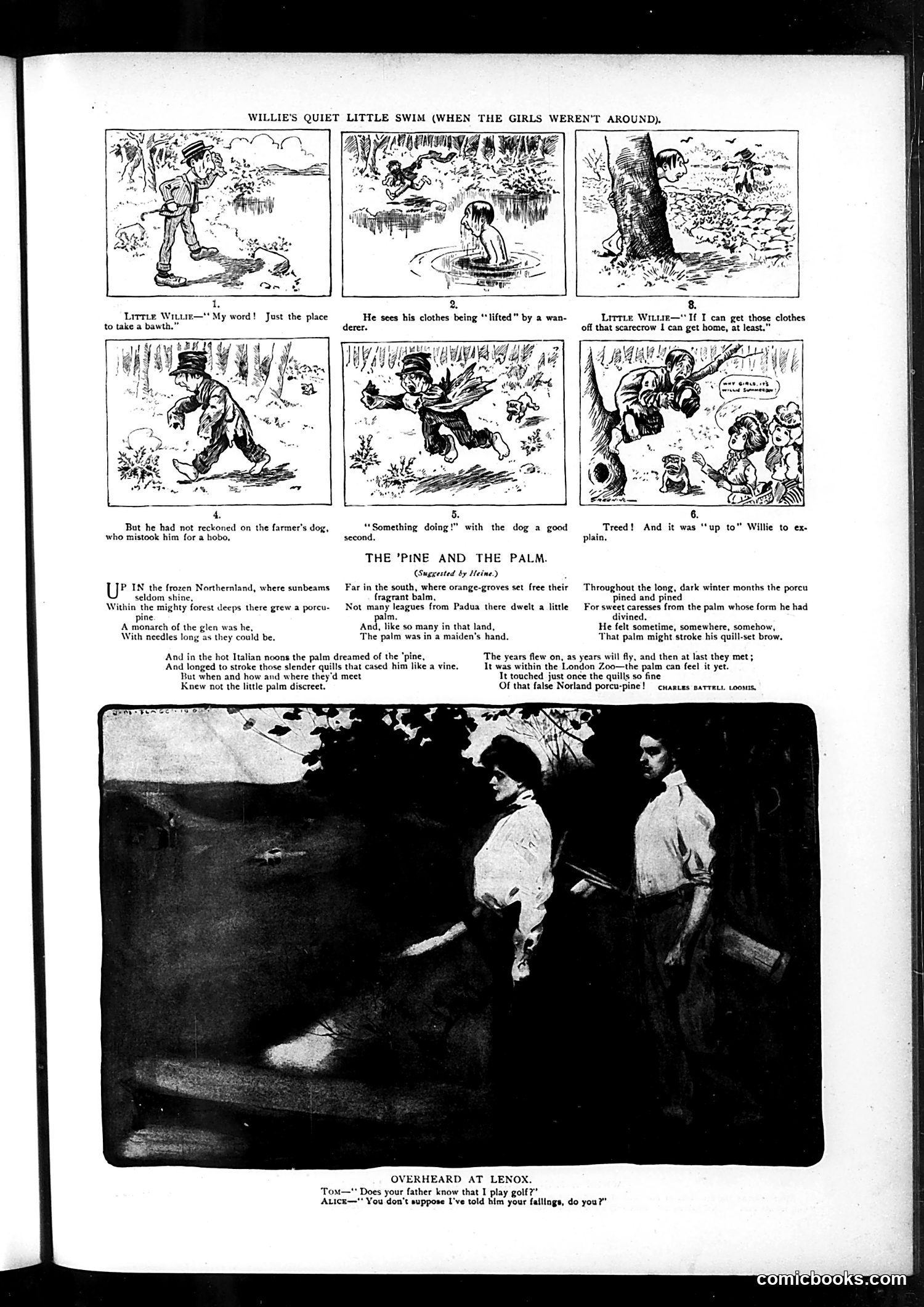
**"Willie's Quiet Little Swim"** (top) is a six-panel comic strip about a boy sneaking a swim while girls aren't present. Willie undresses by a pond, only to have a farmer's dog mistake him for a vagrant and chase him up a tree—a simple slapstick joke playing on Victorian-era social embarrassment around bathing and the unexpected consequences of his private scheme. **"The Pine and the Palm"** is a whimsical poem (attributed to Heine) about a porcupine in frozen lands yearning for an Italian palm tree. They finally meet at London Zoo, where the palm briefly touches the porcupine's quills—a romantic fantasy suggesting unlikely love transcending geography and nature. **"Overheard at Lenox"** is a brief joke: at the wealthy Lenox resort, one boy asks another if his father knows he plays golf. The reply suggests golf-playing itself is a "failing" worthy of concealment—likely satirizing golf as an eccentric or pretentious leisure activity among the elite. All three pieces are lighthearted humor typical of Judge's turn-of-century content.
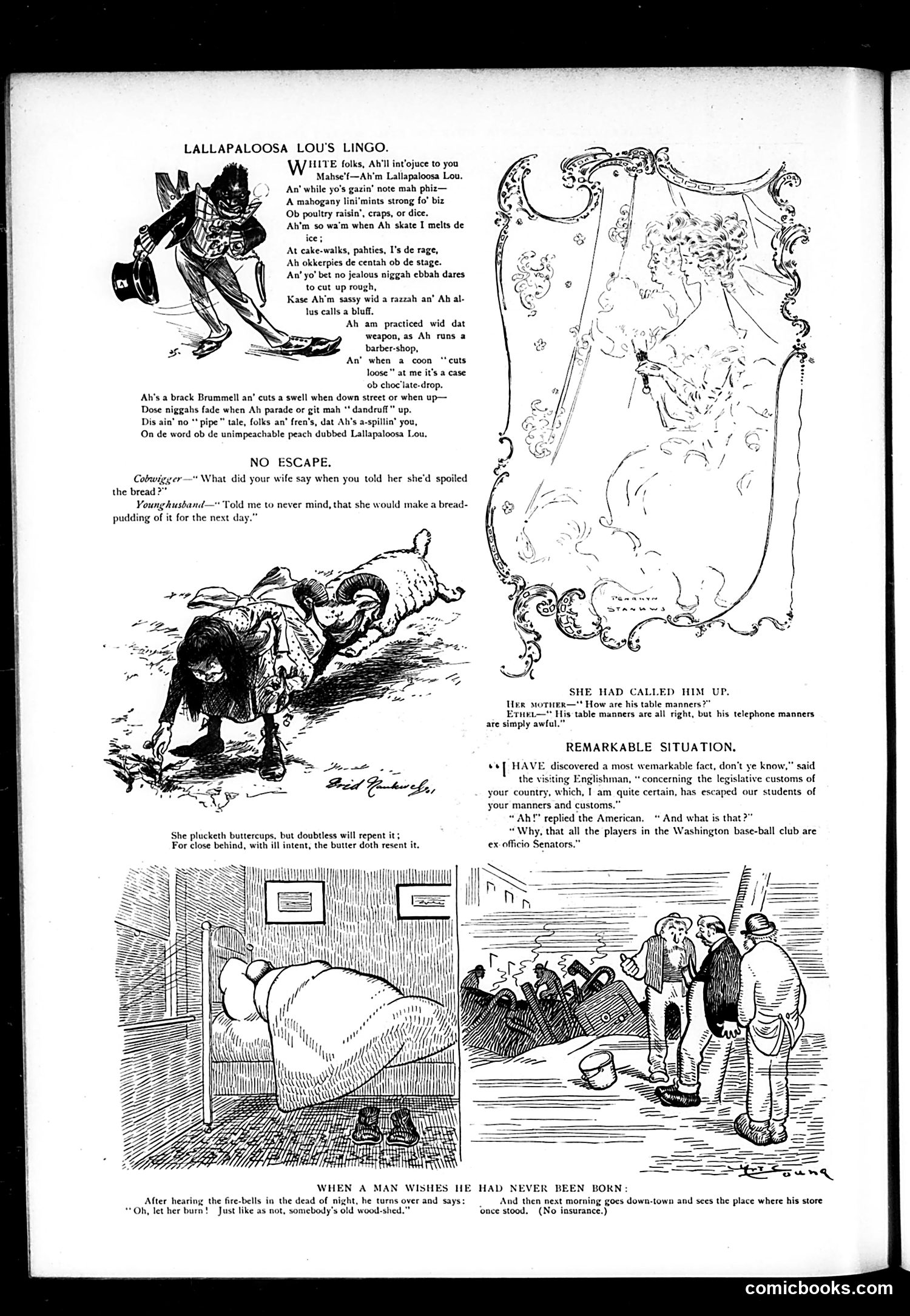
This page contains multiple satirical pieces typical of early 20th-century American humor: **"Lallapaloosa Lou's Lingo"** uses racist dialect humor (common to the era) depicting an African American character boasting in exaggerated vernacular about his prowess at dancing, fighting, and barbering—reflecting period stereotypes while mocking Black vernacular speech patterns. **"No Escape" and "She Had Called Him Up"** are brief domestic comedy sketches about marital situations—a husband facing his wife's anger over spoiled bread, and criticism of telephone manners. **"Remarkable Situation"** presents an English visitor noting that Washington baseball players hold Senate positions—likely satirizing either nepotism in government appointments or the prominence of certain politicians involved in sports. **"When a Man Wishes He Had Never Been Born"** is a dark humor piece about a man learning his store burned overnight without insurance—commentary on financial vulnerability and poor planning. The page reflects Judge's typical blend of domestic satire, ethnic caricature, and political/social observation aimed at middle-class readers.
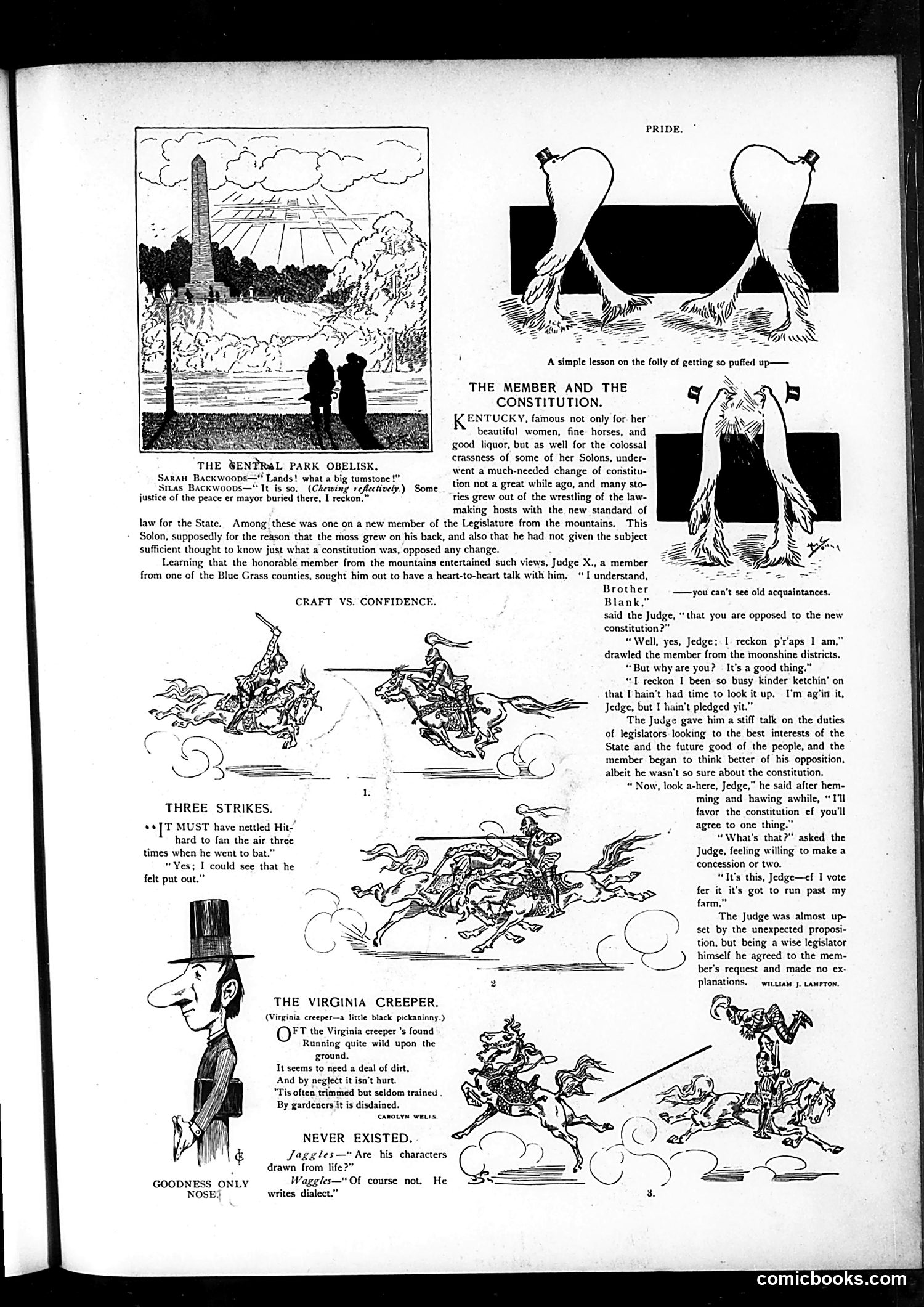
This page satirizes Kentucky legislators during a state constitutional revision (date unclear from image). The main cartoon depicts a sophisticated Blue Grass judge attempting to persuade an anti-intellectual mountaineer legislator to support the new constitution. The mountaineer opposes it simply from inertia and ignorance—he admits he hasn't studied it but remains stubborn. The joke culminates when the legislator agrees to support the constitution only if it won't interfere with his farm—a absurd condition exposing both rural parochialism and the judge's condescending willingness to compromise principle for political expediency. Side cartoons mock other regional types: "The Virginia Creeper" stereotypes Black people as wild and untrained; "Craft vs. Confidence" and "Three Strikes" appear to be unrelated humorous vignettes. The satire targets rural politicians' resistance to reform while mocking urban sophisticates for accommodating their backwardness.
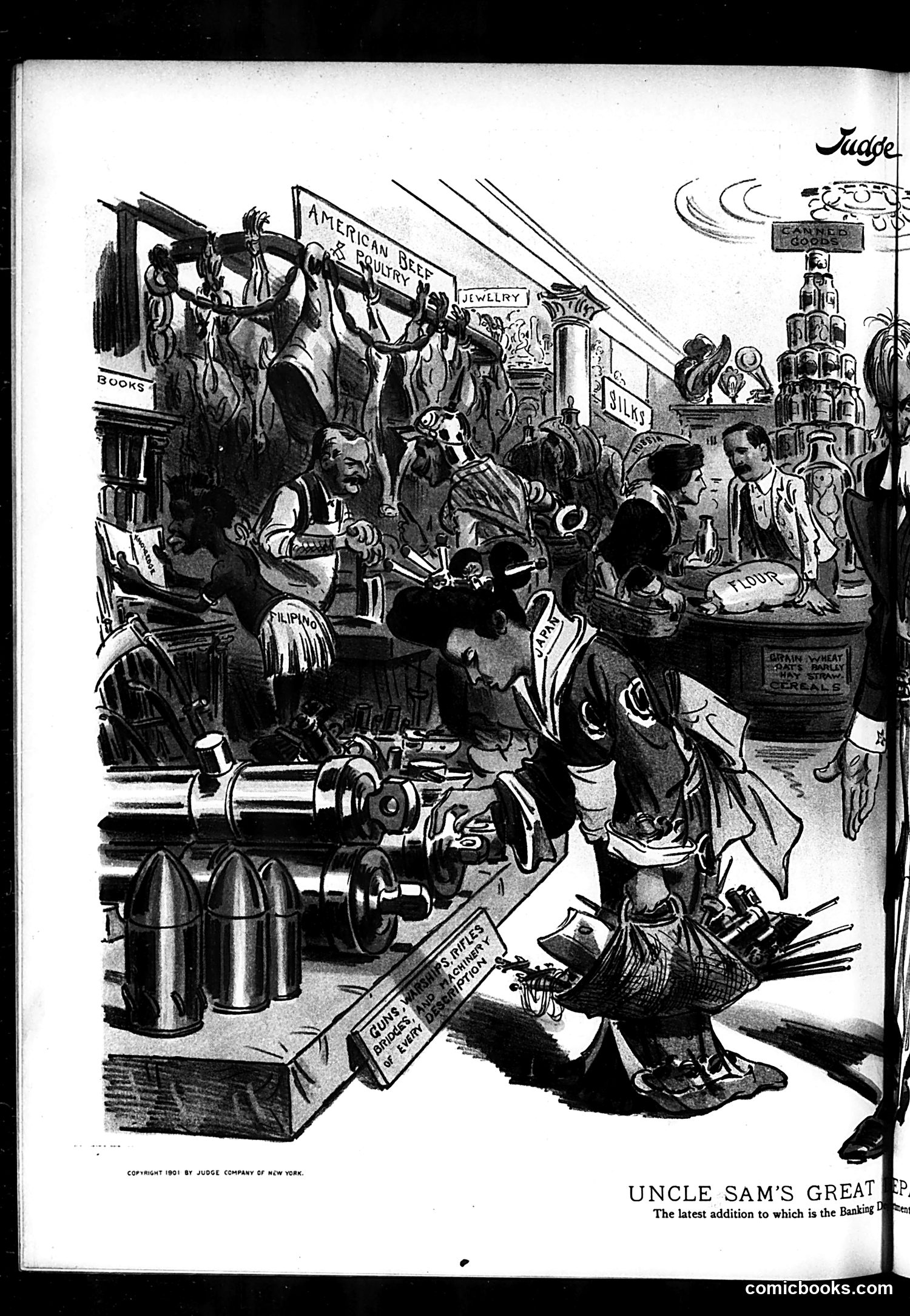
This appears to be a satirical cartoon titled "Uncle Sam's Great [Export]" (text cut off), with the subtitle noting "The latest addition to which is the Banking [System]." The cartoon depicts Uncle Sam's figure presiding over a chaotic marketplace or fair displaying American goods and commerce. Various labeled products are visible—books, beef, jewelry, silks, flour, grain, and wheat—representing American exports. Military figures and weapons (large artillery shells labeled "Munitions") are prominently featured in the foreground. The satire appears to critique American commercial and military expansion abroad, suggesting the U.S. exports not just civilian goods but also military hardware and weapons. The crowded, somewhat anarchic scene with diverse figures suggests concerns about America's growing commercial and military influence globally, likely commenting on early 20th-century American imperialism and foreign policy.
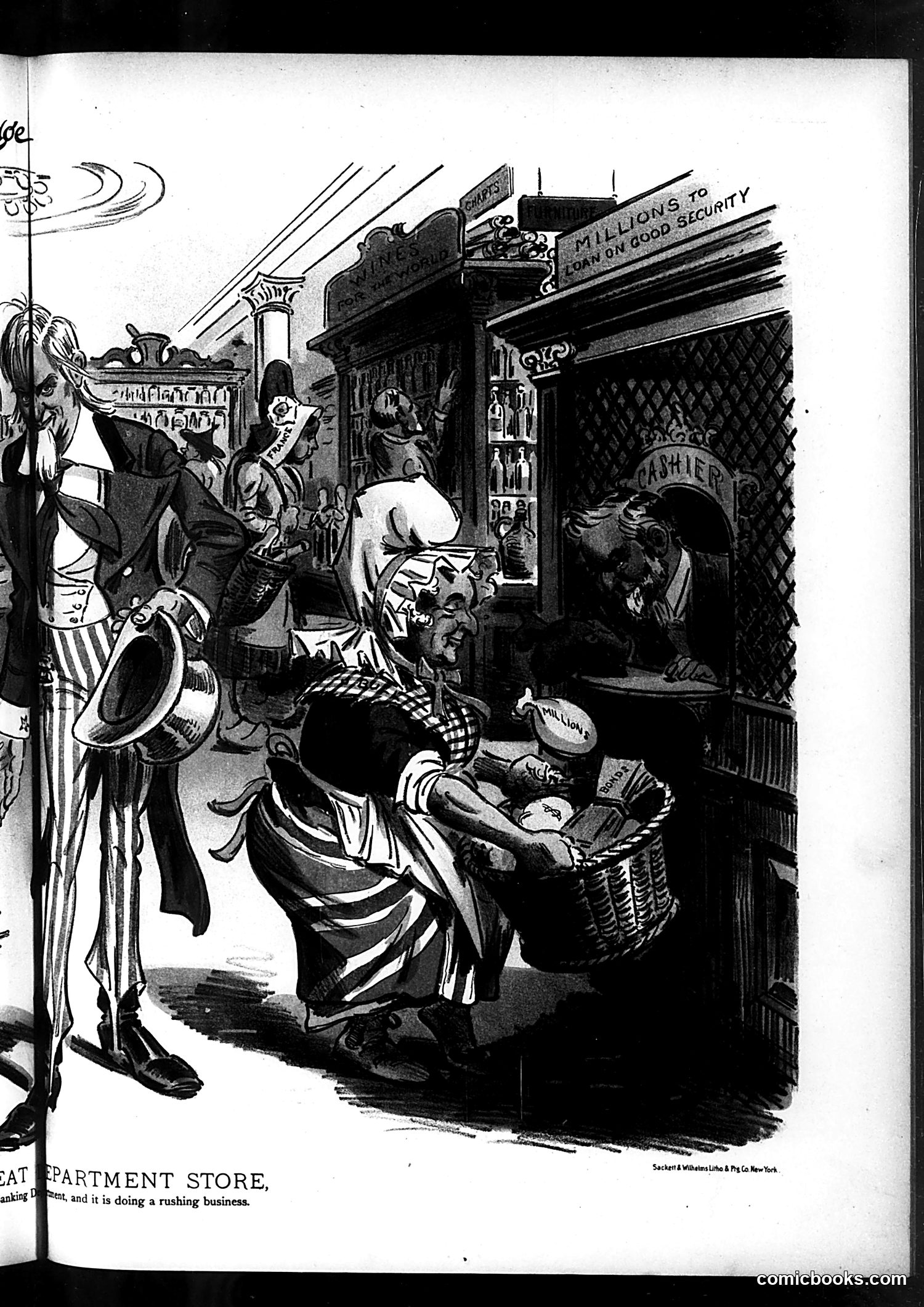
This cartoon satirizes busy holiday shopping at a department store. The scene shows crowded, chaotic commerce with exaggerated caricatures of shoppers and clerks. A woman in the foreground carries a large basket of purchases, while well-dressed figures jostle around storefront displays advertising "Million to Loan on Good Security" — suggesting financial institutions operating within retail spaces. The satire likely critiques commercial excess and the frantic materialism of holiday shopping, a recurring Judge magazine theme. The cramped, disorderly composition emphasizes how shopping transforms dignified citizens into desperate consumers. The visible loan advertisement suggests commentary on debt and credit financing fueling consumption. Without a specific date visible, the exact historical moment remains unclear, though Judge's heyday was the late 1800s through early 1900s.
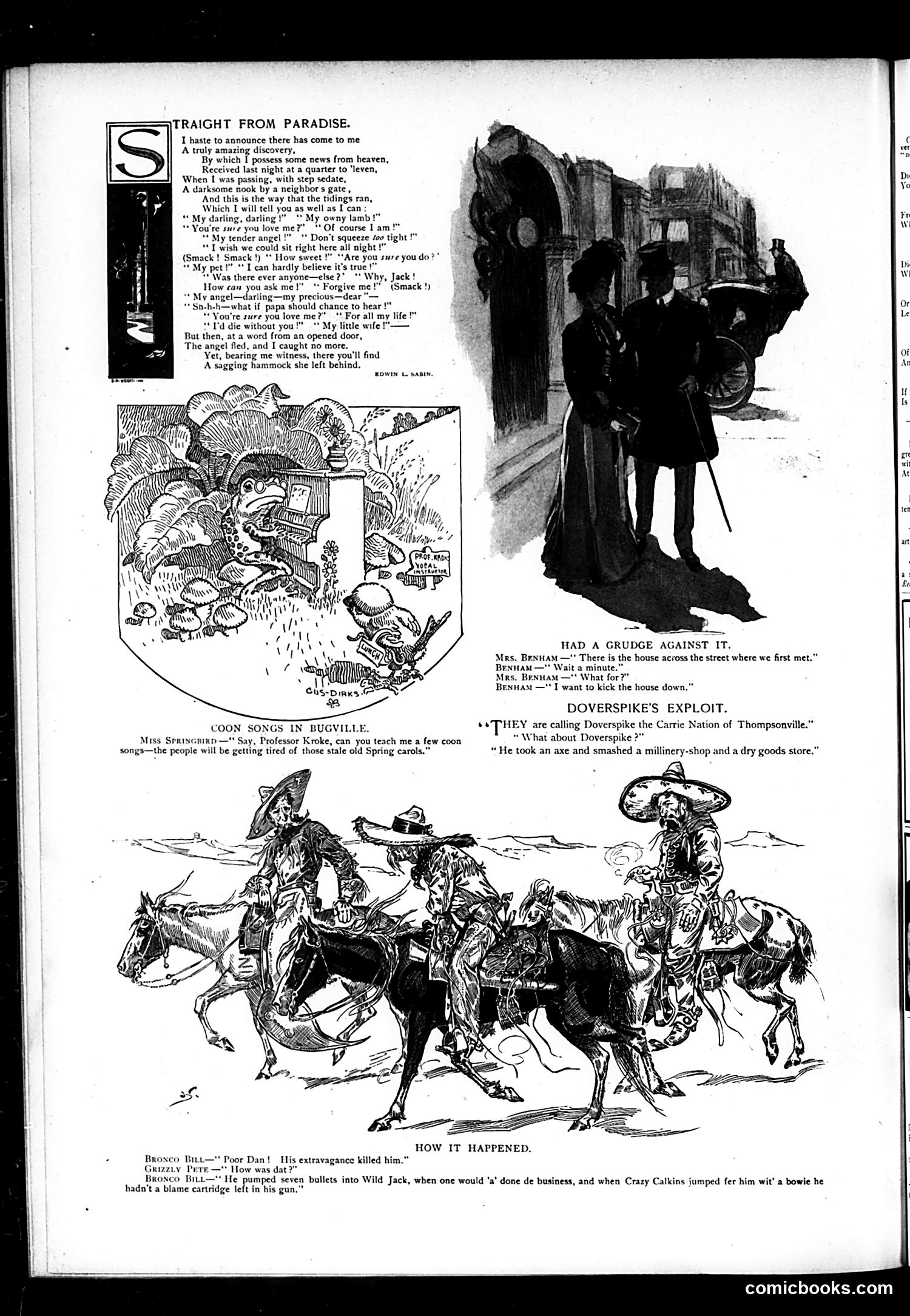
This page contains several satirical sketches mocking courtship and female activism: **"Straight from Paradise"**: A humorous poem about overhearing young lovers' intimate conversation in a hammock, where the narrator discovers evidence of their tryst. **"Had a Grudge Against It"**: A brief joke where a man wants to destroy the house where he first met a woman—suggesting romantic regret or bitterness. **"Doverspike's Exploit"**: This references the real social activist Carrie Nation, who famously smashed bars and liquor establishments with an axe during Prohibition campaigns. Here, "Doverspike" is a female figure mimicking Nation by destroying a millinery shop and dry goods store, satirizing female reform activists as destructive troublemakers rather than serious reformers. **"How It Happened"**: A Western sketch about gunfight casualties told in dialect humor. The page's overall thrust mocks romantic sentimentality and, particularly, ridicules female activism by portraying women reformers as reckless vandals rather than legitimate advocates.
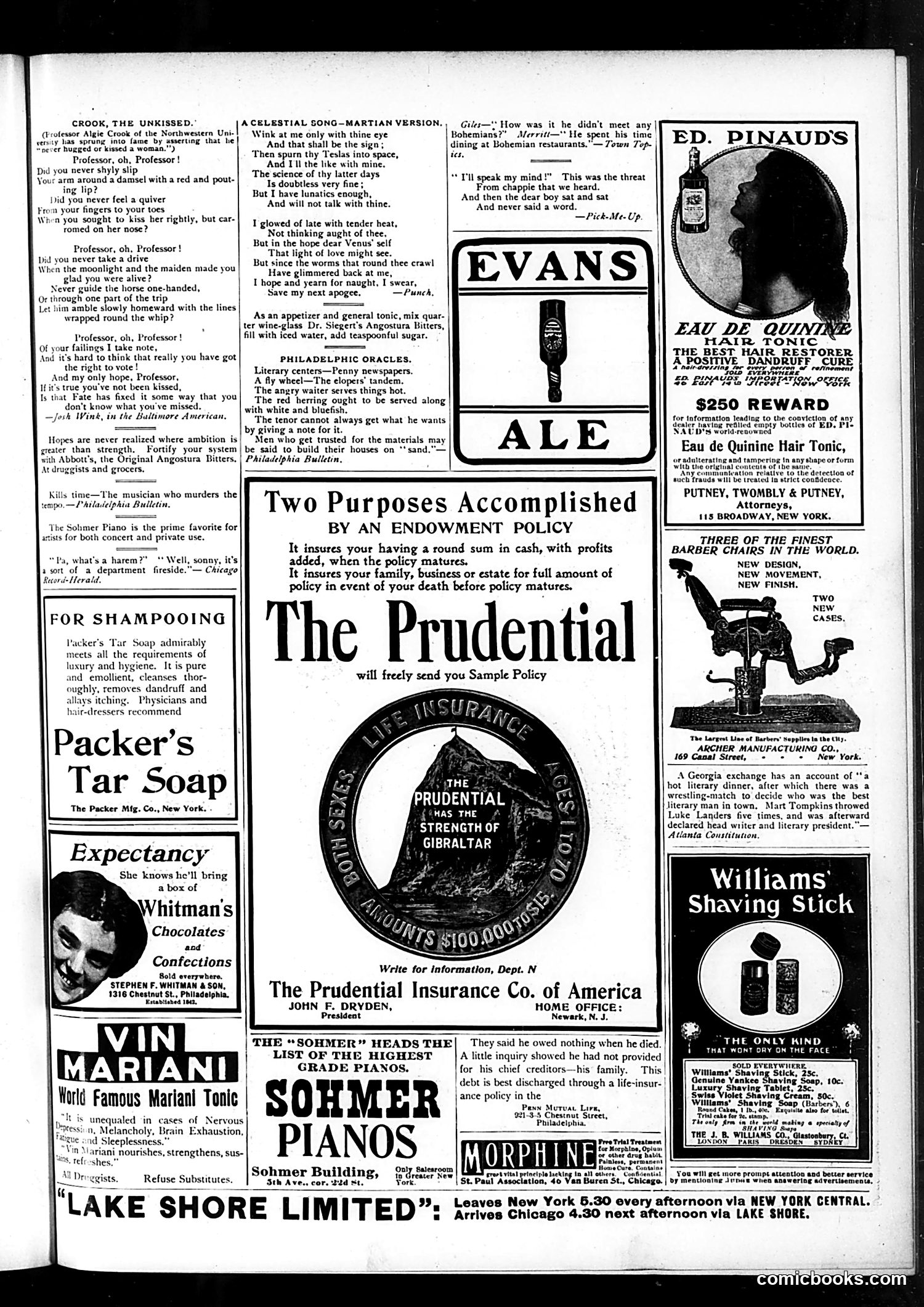
This page consists primarily of advertisements and satirical verse from Judge magazine, with minimal substantive political cartoon content. The main satirical piece is "Crook, the Unkissed," a poem mocking Professor Algie Crook of Northwestern University, who apparently claimed he had never hugged or kissed a woman. The poet sarcastically questions how someone so lacking in romantic experience can be trusted to vote—a humorous commentary on the absurdity of his claim and a mild jab at his credibility as a public figure. Other short satirical items include "A Celestial Song—Martian Version" (a parody of romantic verse) and various one-liner jokes under "Philadelphic Oracles," poking gentle fun at contemporary institutions and human nature. The remainder of the page is advertising: Packer's Tar Soap, Whitman's Chocolates, Evans (product unclear), Prudential Insurance, and Sohmer Pianos. This advertising-heavy layout was standard for Judge magazine.
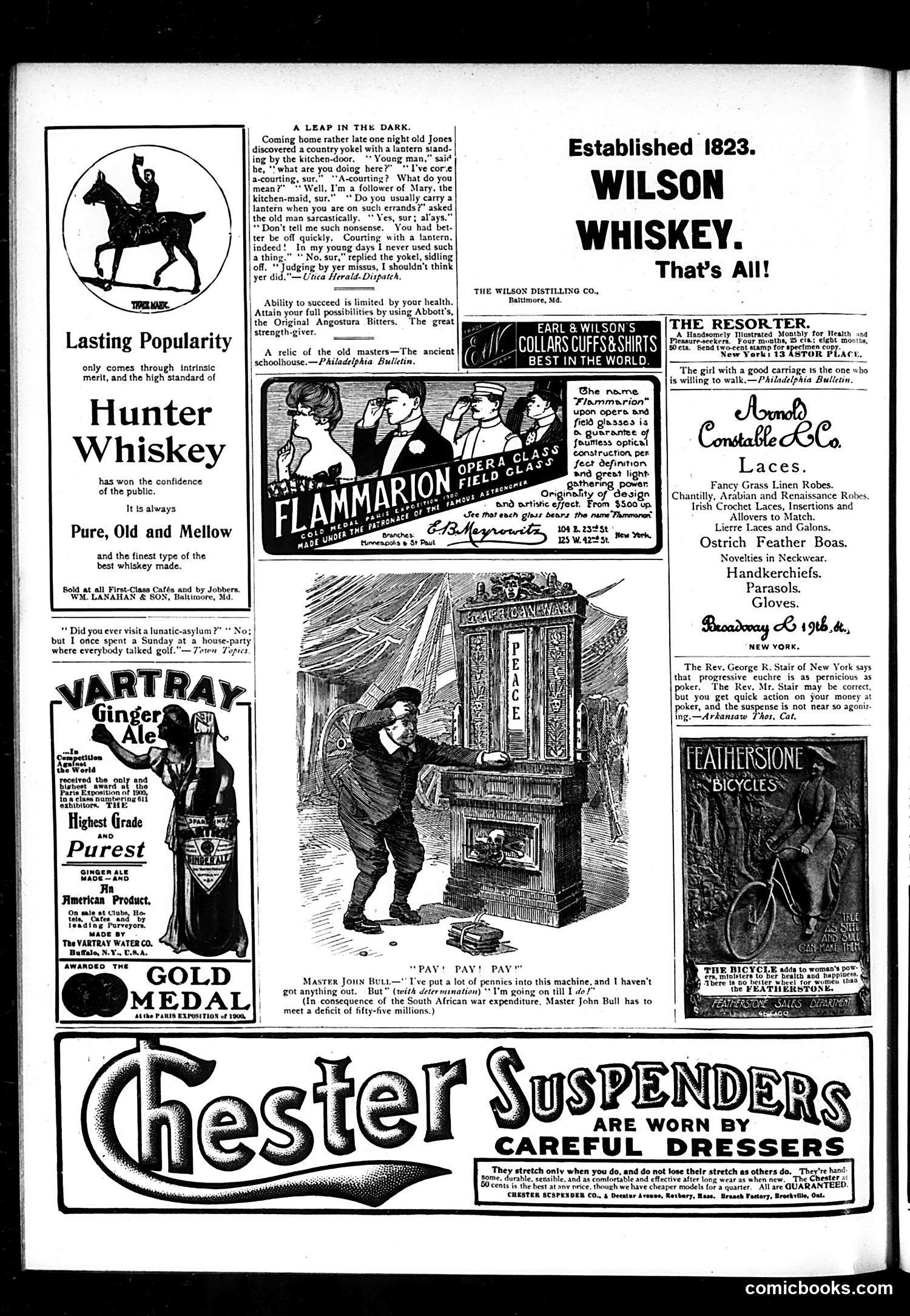
This page contains primarily **advertisements and light humor** rather than political satire. The main cartoon, titled "A Leap in the Dark," is a joke about courtship: an older man discovers a young suitor courting his kitchen maid and mocks him for carrying a lantern. The yokel retorts that the man wouldn't know about courting with a lantern—implying the man's own wife wasn't worth the effort to properly court. The significant political content appears in the small cartoon at bottom: **"Master John Bull"** (Britain personified) depositing coins into a machine, referencing Britain's financial strain from the **South African War** (Boer War, 1899-1902). The caption notes Britain faces a deficit of "fifty-five millions" due to war expenditure—a contemporary critique of the war's cost. The remainder is period advertising for whiskey, suspenders, laces, bicycles, and other products typical of early 1900s magazines.
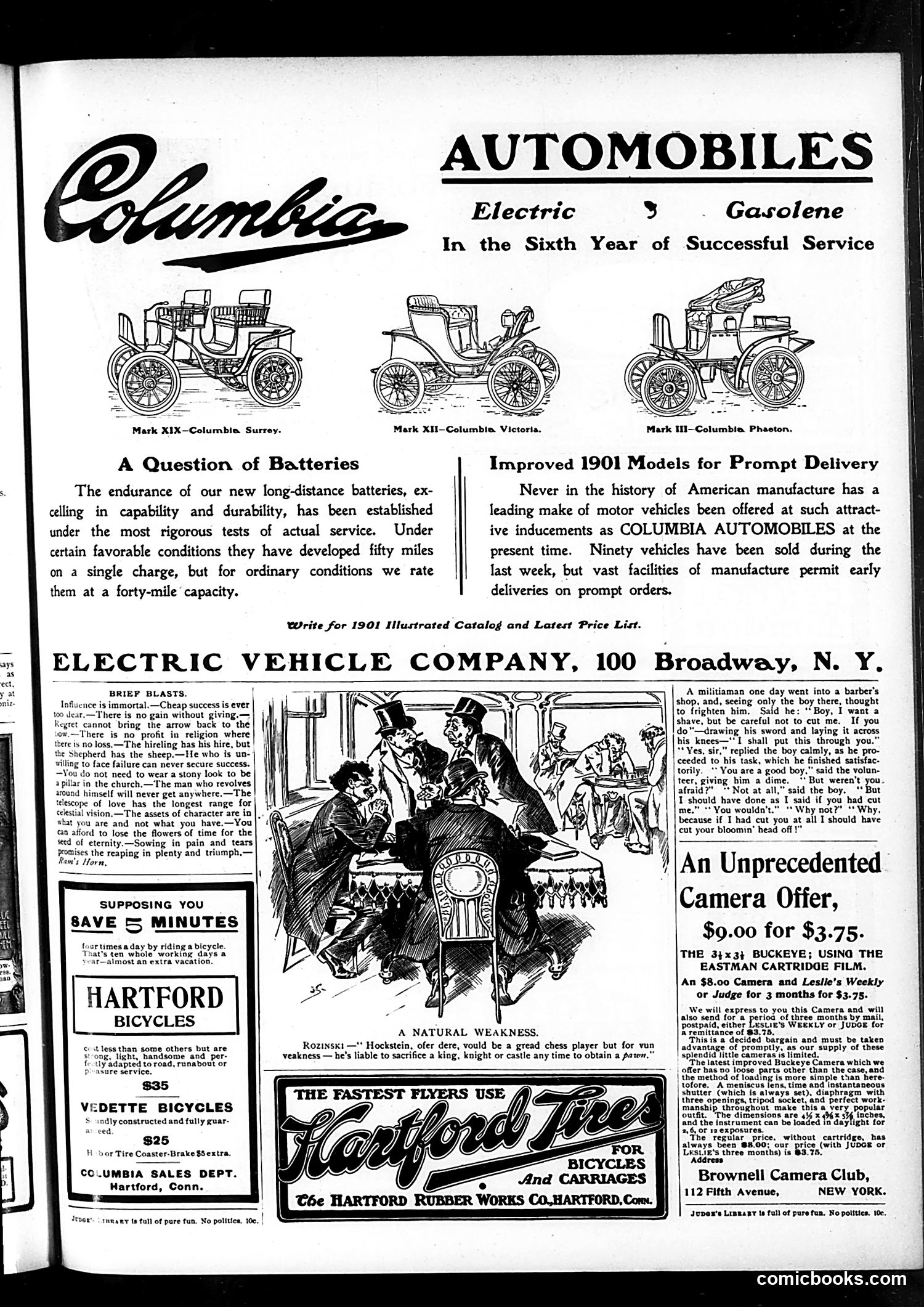
This page is primarily **advertising**, featuring Columbia electric and gasoline automobiles prominently. The automobiles section showcases three 1901 models and emphasizes their batteries' forty-mile capacity and rapid delivery availability. The page includes two cartoon jokes below the ads: 1. **"Brief Blasts"** contains a humorous anecdote about a militiaman entering a barber shop and threatening the boy barber with his sword. The joke's punchline relies on the boy's deadpan courage—he calmly proceeds, and when asked if he wasn't afraid, responds he would have "cut your bloomin' head off" if the militiaman had been cut, implying swift violent retaliation. 2. **"A Natural Weakness"** shows a chess scenario where a character named Rozinski is described as potentially great at chess except he's "liable to sacrifice a king, knight or castle any time to obtain a patron"—satirizing weakness for patronage or favor-seeking. The remaining content consists of bicycle and camera advertisements typical of early 1900s magazines.
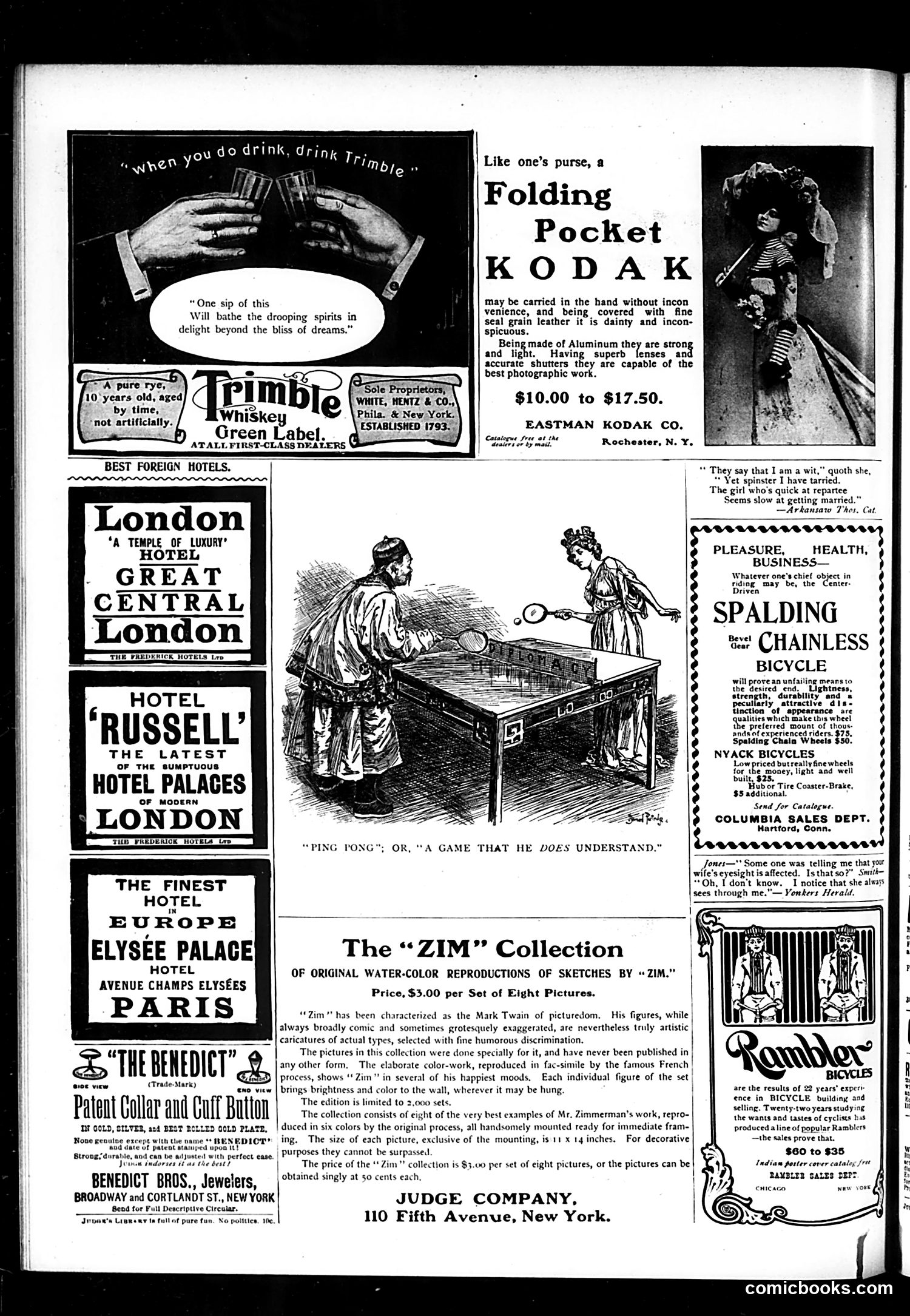
This page is primarily **advertising** from an early 1900s Judge magazine, with one notable cartoon. The main cartoon, titled **"Ping Pong"; or, "A Game That He Does Understand,"** depicts a man and woman playing table tennis. The joke appears to satirize male incompetence or limited intellect—the caption suggests this is one of the few games a particular man can grasp, implying he's not very bright. This reflects period attitudes about masculine limitations in domestic or leisure contexts. The page otherwise features era-appropriate advertisements: Trimble Whiskey, Kodak folding cameras, London hotels, Spalding bicycles, and a "ZIM" art collection (described as humorous caricatures in the style of Mark Twain). These ads target affluent readers interested in travel, photography, and leisure activities. The satirical magazine's typical audience was educated, well-to-do Americans; the advertisements reflect their purchasing interests and aspirations.
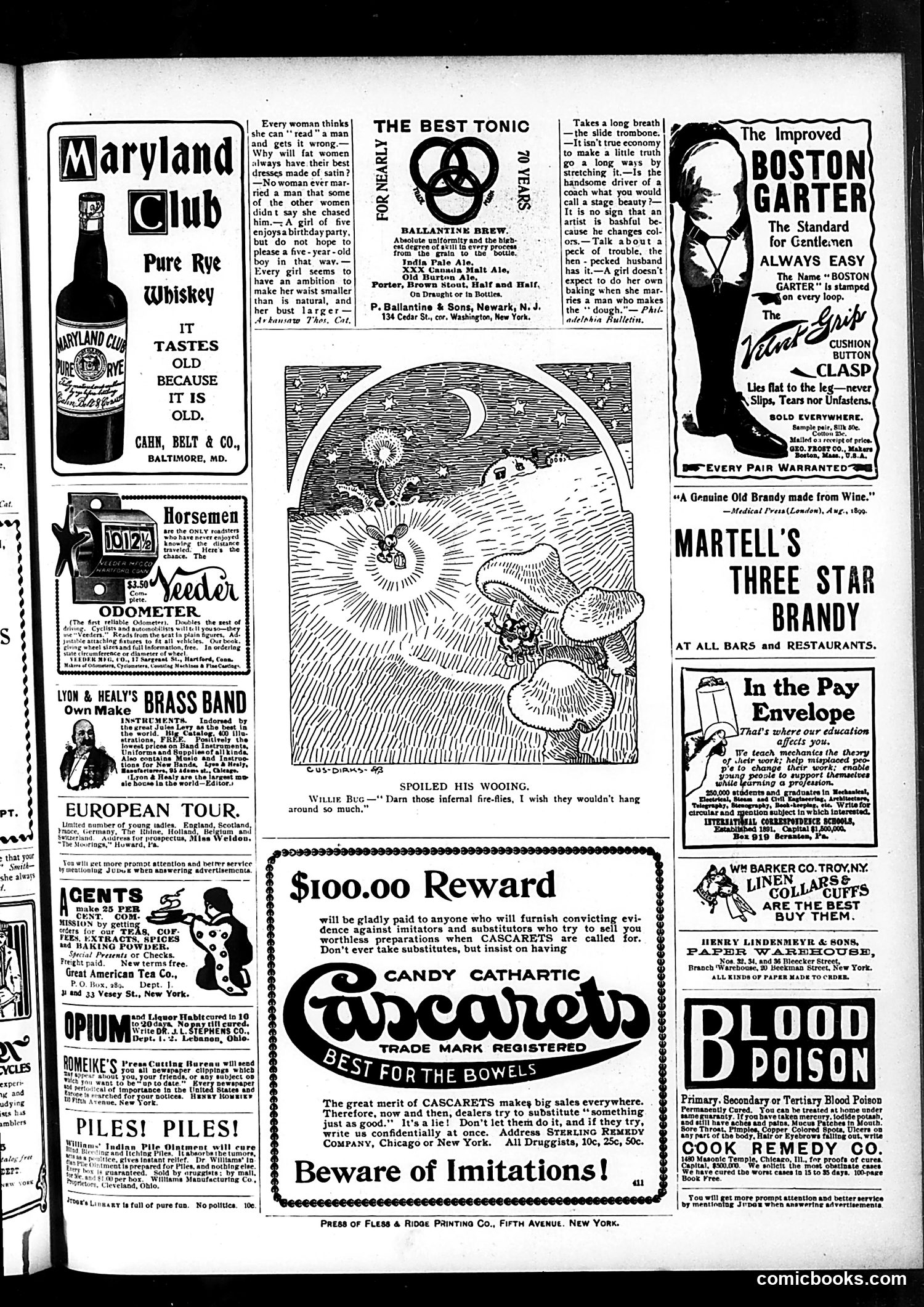
This is primarily an **advertising page** with one small cartoon. The main content consists of turn-of-the-century product advertisements (whiskey, brandy, candy laxatives, garters, odor remedies) interspersed with brief humorous quips about gender relations and marriage. The single cartoon titled "SPOILED HIS WOOING" depicts a couple in moonlight where fireflies are interfering with a romantic moment—a simple visual joke about nature's interruption of courtship. The page's humor reflects early 1900s attitudes: women are portrayed as vain (concerned with dress and appearance), less intelligent than men ("every woman thinks she can 'read' a man and gets it wrong"), and dominated by marriage ("the hen-pecked husband"). These represent casual period sexism typical of Judge's satirical approach. The advertisements themselves are notable for their claims (blood poison cures, odor elimination) that would be considered fraudulent today—reflecting an era before modern FDA regulation and medical standards.
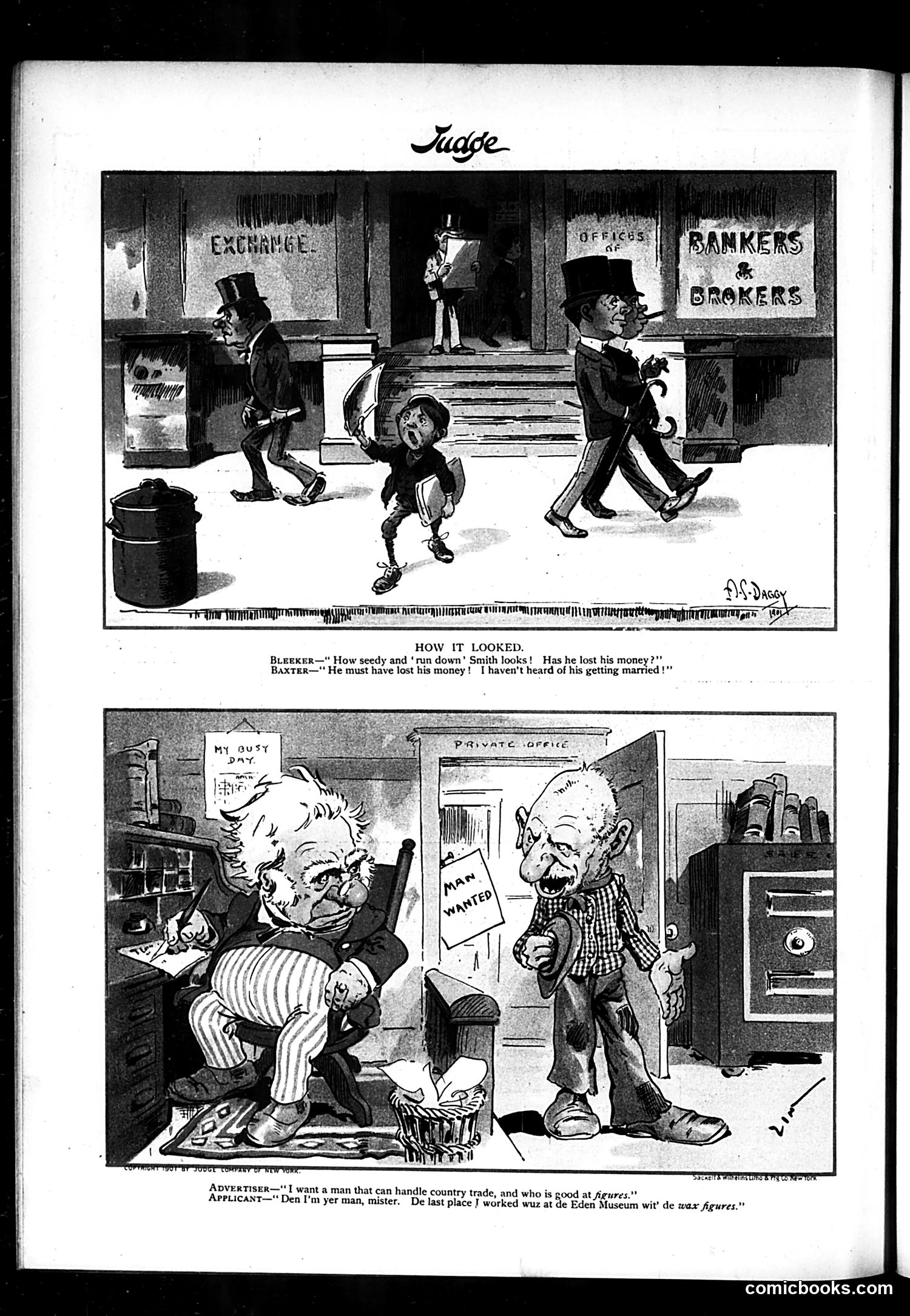
**Top cartoon ("How It Looked"):** Two well-dressed men observe a shabby third man on a city street near financial institutions (Exchange, Bankers & Brokers offices). The joke plays on assumptions about male misfortune: one man assumes the shabby appearance means lost money, while the other quips he'd expect to hear about marriage first—implying wives are financially ruinous to men. This reflects period anxieties about marriage as economically damaging. **Bottom cartoon:** An advertiser seeks someone skilled at handling "country trade" and "figures" (bookkeeping). The applicant, depicted with exaggerated ethnic characteristics and dialect, claims experience at the Eden Museum "wit' de wax figures"—misunderstanding "figures" to mean literal wax statues rather than accounting. The humor relies on period-typical ethnic caricature and the character's supposed ignorance, reflecting contemporary attitudes toward immigrants and working-class employment.