
Judge, 1901-05-25 · page 3 of 16
Judge — May 25, 1901 — page 3: what you’re looking at
What you’re looking at
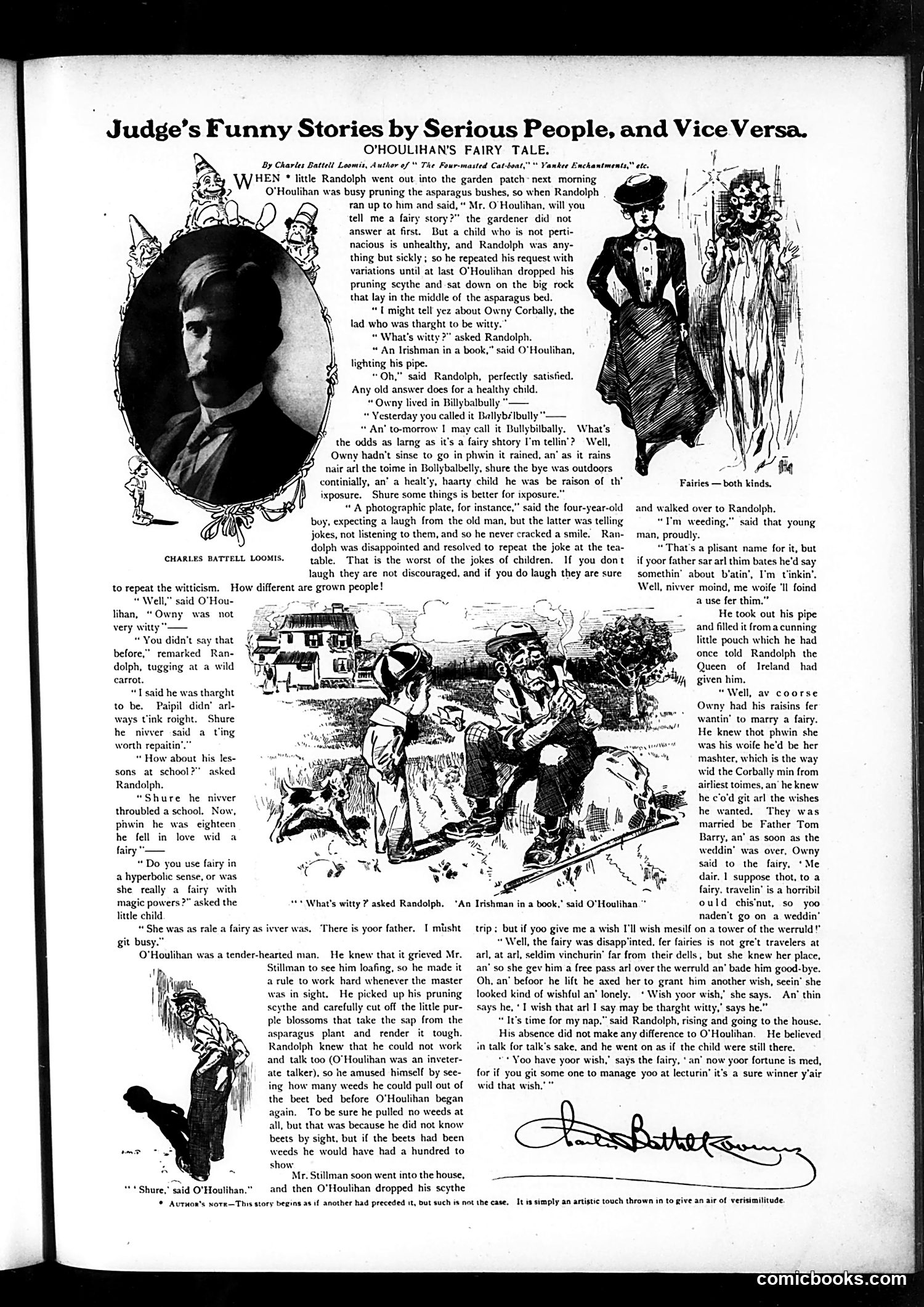
This is a humorous story by Charles Battell Loomis, not primarily political satire. The narrative concerns O'Houlihan, an Irish gardener, telling young Randolph a fairy tale about "Owny Corbally" to entertain him. The story plays on Irish immigrant stereotypes and dialect humor common to late 19th-century American magazines. O'Houlihan uses working-class Irish vernacular and folk wisdom to craft his tale, which contrasts with the refined, upper-class Randolph. The humor derives from class differences and the Irish character's attempts at storytelling rather than from political commentary. The illustrations show various characters from the fairy tale narrative.
📄 Transcribed text from this page (OCR, searchable)
Machine-transcribed from the original scan — historical spelling and the odd misread are preserved.
O’HOULIHAN’S FAIRY TALE. By Charles Battell Loomis, Author of “ The Four-masted Cat-boat, Yankee Enchantment WHEN * little Randolph went out into the garden patch next morning > O'Houlihan was busy pruning the asparagus bushes, so when Randolph ran up to him and said, “ Mr. O Houlihan, will you tell me a fairy story?" the gardener did not answer at first. But a child who is not perti- nacious is unhealthy, and Randolph was any- thing but sickly; so he repeated his request with variations until at last O'Houlihan dropped his pruning scythe and sat down on the big rock that lay in the middle of the asparagus bed. “ T might tell yez about Owny Corbally, the lad who was tharght to be witty.” “ What's witty ?” asked Randolph. “ An Irishman in a book,” said O’Houlihan, lighting his pipe. “Oh,” said Randolph, perfectly satisfied. Any old answer does for a healthy child. Owny lived in Billybalbully "— Yesterday you called it BallybéIbully "—— “ An’ to-morrow I may call it Bullybilbally, What's the odds as larng as it’s a fairy shtory I'm tellin’? Well, Owny hadn't sinse to go in phwin it rained, an’ as it rains nair arl the toime in Bollybalbelly, shure the bye was outdoors continially, an’ a healt’y, haarty child he was be raison of th’ ixposure. Shure some things is better for ixposure.”” “ A photographic plate, for instance,” said the four-year-old boy, expecting a laugh from the old man, but the latter was telling jokes, not listening to them, and so he never cracked a smile. Ran- dolph was disappointed and resolved to repeat the joke at the tea- table. That is the worst of the jokes of children. If you dont laugh they are not discouraged, and if you do laugh they are sure to repeat the witticism. How different are grown people! “ Well,” said O'Hou- aii fT lihan, “Owny was not very witty “You didn’t say that before,” remarked Ran- dolph, tugging at a wild carrot. “T said he was tharght to be. Paipil didn’ arl- ways t'ink roight. Shure he nivver said a ting worth repaitin’, “ How about his les- sons at school?” asked Randolph. “Shure he nis throubled a school. phwin he was eighteen he fell in love wid a fairy "— “Do you use fairy in a hyperbolic sense, or was she really a fairy with magic powers?” asked the little child CHARLES BATTELL LOOMIS. er Yow, “++ What's witty 7 asked Randolph. Judge’s Funny Stories by Serious People, and Vice Versa. ‘An Trishman in a book,’ said O'Houlihan.* Fairies — both kinds, and walked over to Randolph. “I'm weeding,” said that young man, proudly. “That's a plisant name for it, but if yoor father sar arl thim bates he'd say somethin’ about b‘ati T'm tinkin’. Well, nivver moind, me woife ‘Il foind use fer thim. He took out his pipe and filled it froma cunning little pouch which he had once told Randolph the Queen of Ireland had given him. “Well, av coorse Owny had his raisins fer wantin’ to marry a fairy. He knew thot phwin she was his woife he'd be her mashter, which is the way wid the Corbally min from airliest toimes, an’ he knew he c’o'd git arl the wishes he wanted. They was married be Father Tom Barry, an’ as soon as the weddin’ was over, Owny said to the fairy, ‘Me dair. | suppose thot, to a fairy, travelin’ is a horribil ould chis'nut, so yoo naden’t go on a weddin’ “ She was as rale a fairy as ivver was. There is yoor father. I misht git busy. O'Houlihan was a tender-hearted man. Ss “** Shure,” said O'Houlihan.” He knew that it grieved Mr. Stillman to see him loafing, so he made it arule to work hard whenever the master was in sight. He picked up his pruning scythe and carefully cut off the little pur- ple blossoms that take the sap from the asparagus plant and render it tough. Randolph knew that he could not work and talk too (O"Houlihan was an inveter- ate talker), so he amused himself by see- ing how many weeds he could pull out of the beet bed before O'Houlihan began again. To be sure he pulled no weeds at all, but that was because he did not know beets by sight, but if the beets had been weeds he would have had a hundred to show Mr. Stillman soon went into the house, and then O'Houlihan dropped his scythe © Autnon’s orn—This story begins as if another had preceded it, but such is not the case. trip; but if yoo give me a wish I'll wish mesilf on a tower of the werruld" “Well, the fairy was disapp’inted, fer fairies is not gre’t travelers at arl, at arl, seldim vinchurin’ far from their dells, but she knew her place, an’ so she gev him a free pass arl over the werruld an’ bade him good-bye. Oh, an’ befoor he lift he axed her to grant him another wish, seei looked kind of wishful an’ lonely.‘ Wish yoor wish,’ she says. says he, ‘I wish that arl I say may be tharght witty,’ says he.” “It's time for my nap,” said Randolph, rising and going to the house. His absence did not make any difference to O'Houlihan. He believed in talk for talk’s sake, and he went on as if the child were still there. ** Yoo have yoor wish,’ says the fairy, ‘ an’ now yoor fortune is med, for if you git some one to manage yoo at lecturin’ it’s a sure winner y'air wid that wish,’ " " she An’ thin =e It is simply an artistic touch thrown in to give an air of verisimilitude. comicbooks.com