
A complete issue · 16 pages · 1901
Judge — April 27, 1901
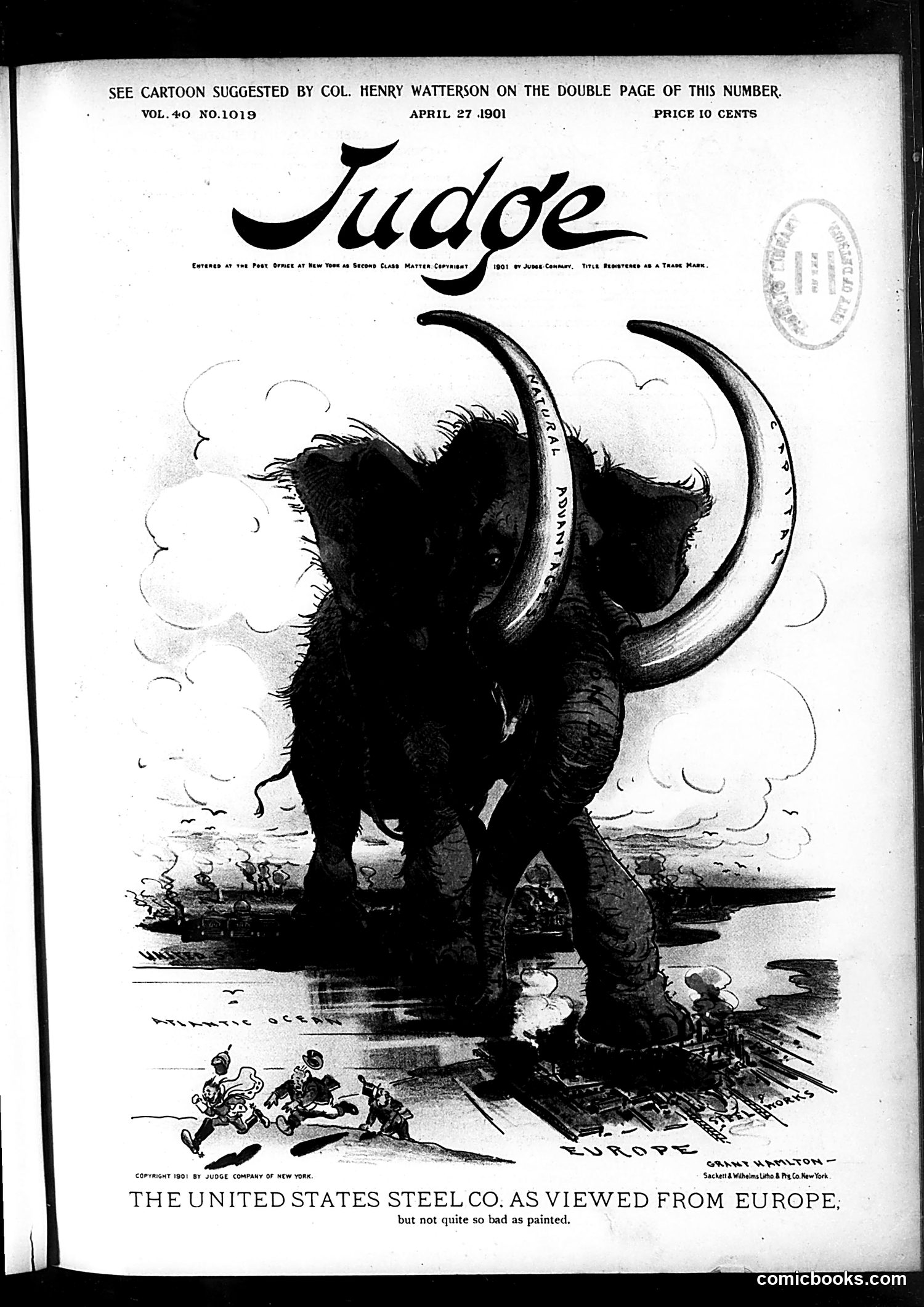
This political cartoon depicts a massive elephant labeled "FEDERAL ARMAMENT" crushing tiny European figures below, with "EUROPE" written on the ground. The satire presents the United States Steel Company as a towering industrial giant that appears threatening to European observers. The caption—"THE UNITED STATES STEEL CO. AS VIEWED FROM EUROPE, but not quite so bad as painted"—indicates this is commentary on European anxiety about American industrial and economic power. The exaggerated depiction suggests Europeans perceived U.S. Steel as dangerously dominant, though the subtitle's ironic qualification ("not quite so bad") implies Judge's editors thought such fears were somewhat overblown. This reflects early 1900s anxieties about American industrial dominance in global markets.
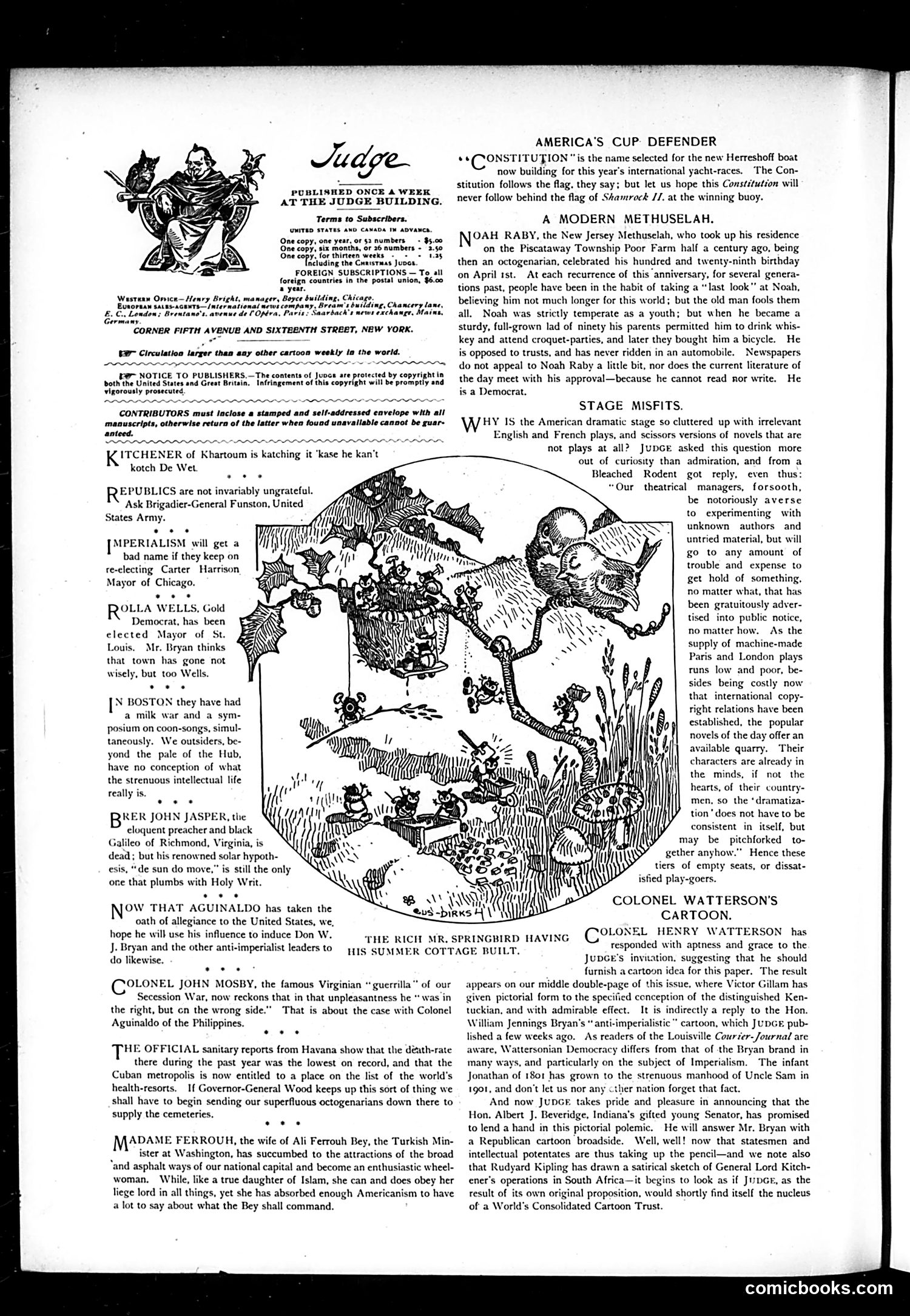
This page from Judge magazine contains several brief satirical items and a large central cartoon titled "The Rich Mr. Springfield Having His Summer Cottage Built." The cartoon depicts a wealthy man (presumably "Springfield") surrounded by workers and materials during home construction—satirizing the ostentatious building projects of the wealthy class during this era. The surrounding text items mock various political and social figures: Republican ingratitude, Democratic electoral losses, Boston's intellectual pretensions, and a "guerrilla" Colonel Mosby's contradictory Civil War claims. **Colonel Watterson's Cartoon** section discusses how the magazine invited cartoonist Colonel Henry Watterson to contribute political commentary, positioning it as a response to Bryan's recent "anti-imperialistic" criticism. The overall tone satirizes American political hypocrisy, wealthy excess, and contemporary debates over imperialism versus democracy.
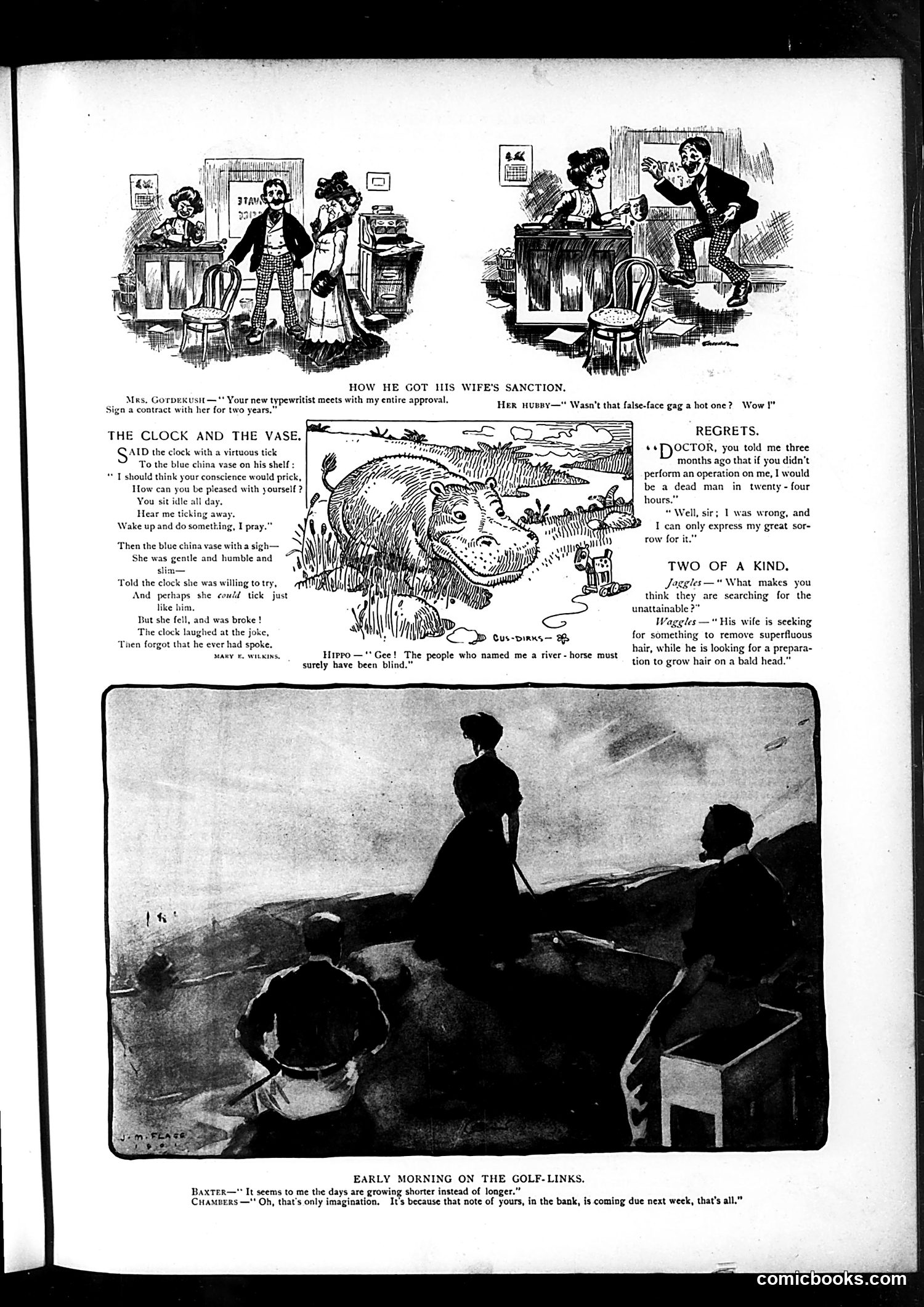
This page contains several satirical sketches and humorous anecdotes typical of Judge's late 19th/early 20th-century style. The top section shows two office scenes labeled "HOW HE GOT HIS WIFE'S SANCTION," depicting workplace dynamics and domestic approval of employment. "THE CLOCK AND THE VASE" is a narrative poem about marital conflict, where a wife breaks a vase in anger over her husband's clock-repair obsession—social satire about domestic priorities and relationships. The remaining short jokes ("REGRETS," "TWO OF A KIND") are typical period humor about marriage and gender relations. The photograph at bottom labeled "EARLY MORNING ON THE GOLF-LINKS" shows golfers, with a joke about short days and banking schedules—referencing concerns about financial institutions and leisure time. The content reflects Judge's focus on middle-class domestic and social humor.
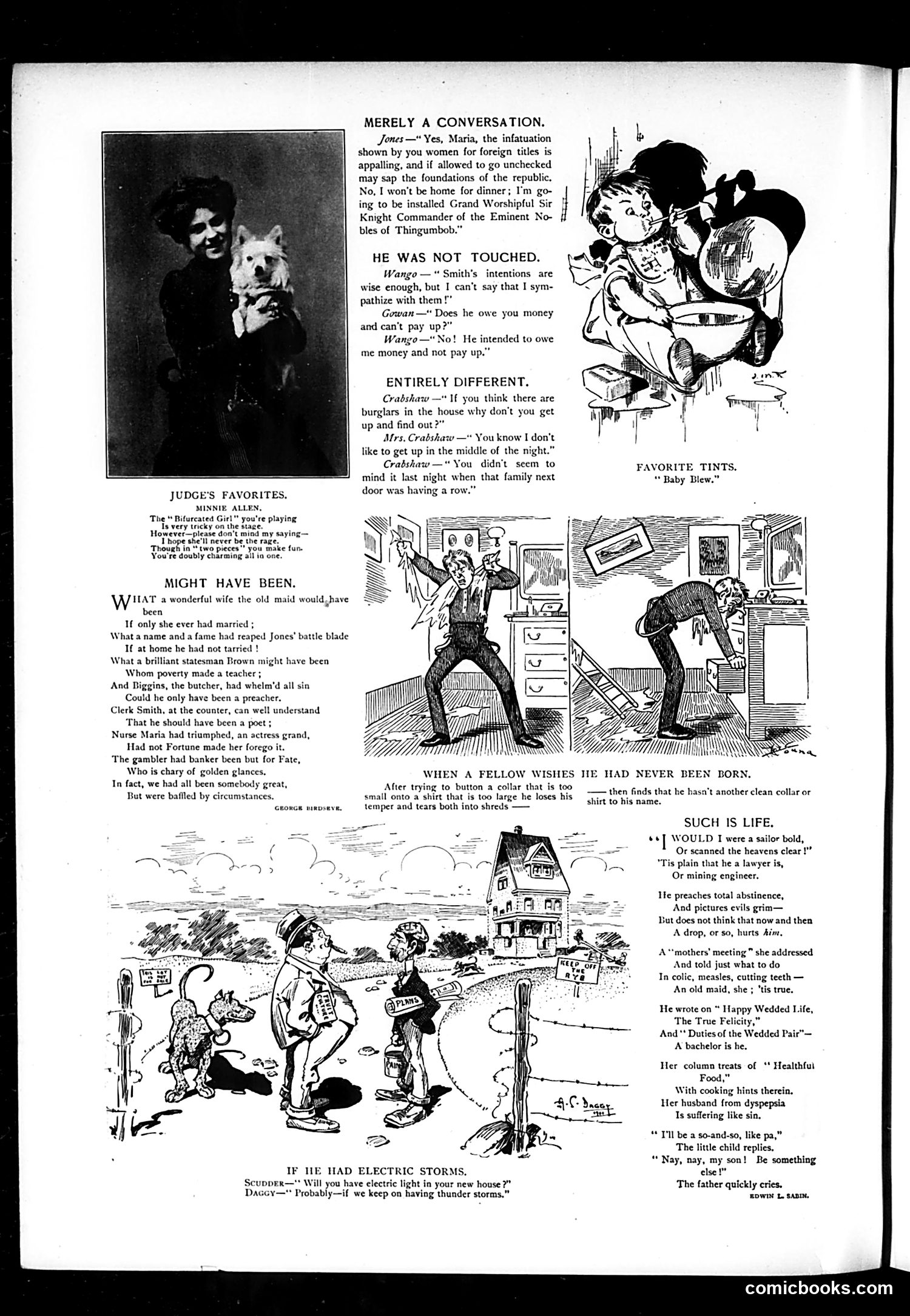
This page contains humorous prose and poetry rather than political cartoons. The content satirizes domestic life and social conventions of the era. **"Merely a Conversation"** mocks women's fascination with foreign titles and nobility, suggesting such status-seeking undermines republican values. **"He Was Not Touched"** and **"Entirely Different"** present brief comedic dialogues about money troubles and neighborly disputes—relatable middle-class anxieties. **"Judge's Favorites"** and other poems humorously contemplate hypothetical scenarios (what if the maid had married well? if someone had never been born?), using satirical verse to comment on social class, luck, and life's contingencies. **"Such is Life"** section includes various witty observations about professions and domestic situations. The cartoons illustrate these domestic scenarios with period-appropriate humor aimed at middle and upper-class readers.
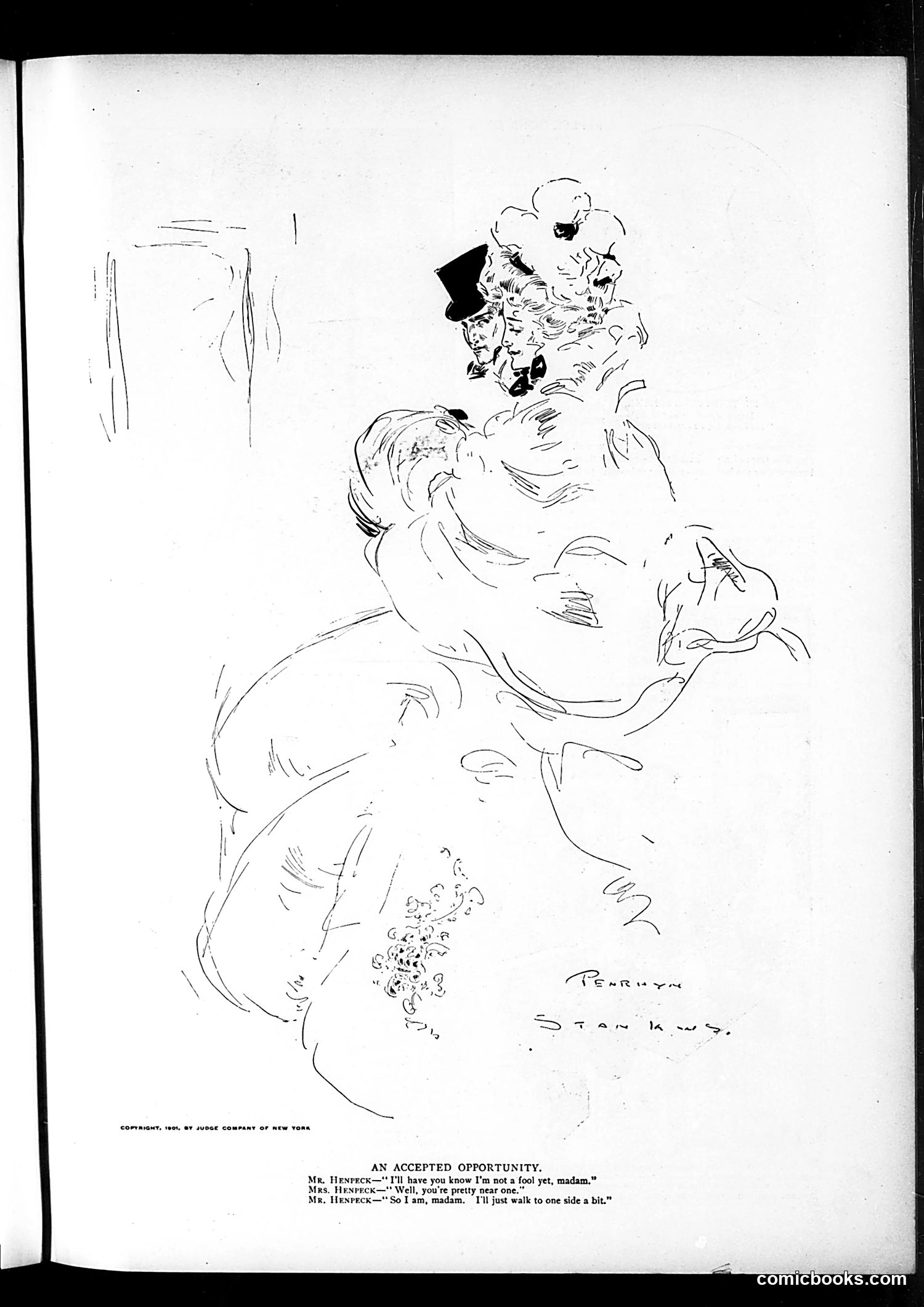
This is a domestic humor cartoon depicting a marital exchange. Mr. Henreck protests that he's "not a fool yet," to which Mrs. Henreck replies he's "pretty near one." Rather than argue, he accepts her implicit criticism and moves aside—literally stepping away from her. The satire targets male capitulation in marriage. The joke is that Henreck, faced with his wife's sharp tongue, doesn't defend himself but instead physically retreats. The title "An Accepted Opportunity" suggests he's accepting the "opportunity" to avoid domestic conflict through submission rather than confrontation. This reflects early-20th-century Judge magazine's frequent commentary on gender dynamics and marital relations, poking fun at henpecked husbands who yield to domineering wives rather than assert themselves.
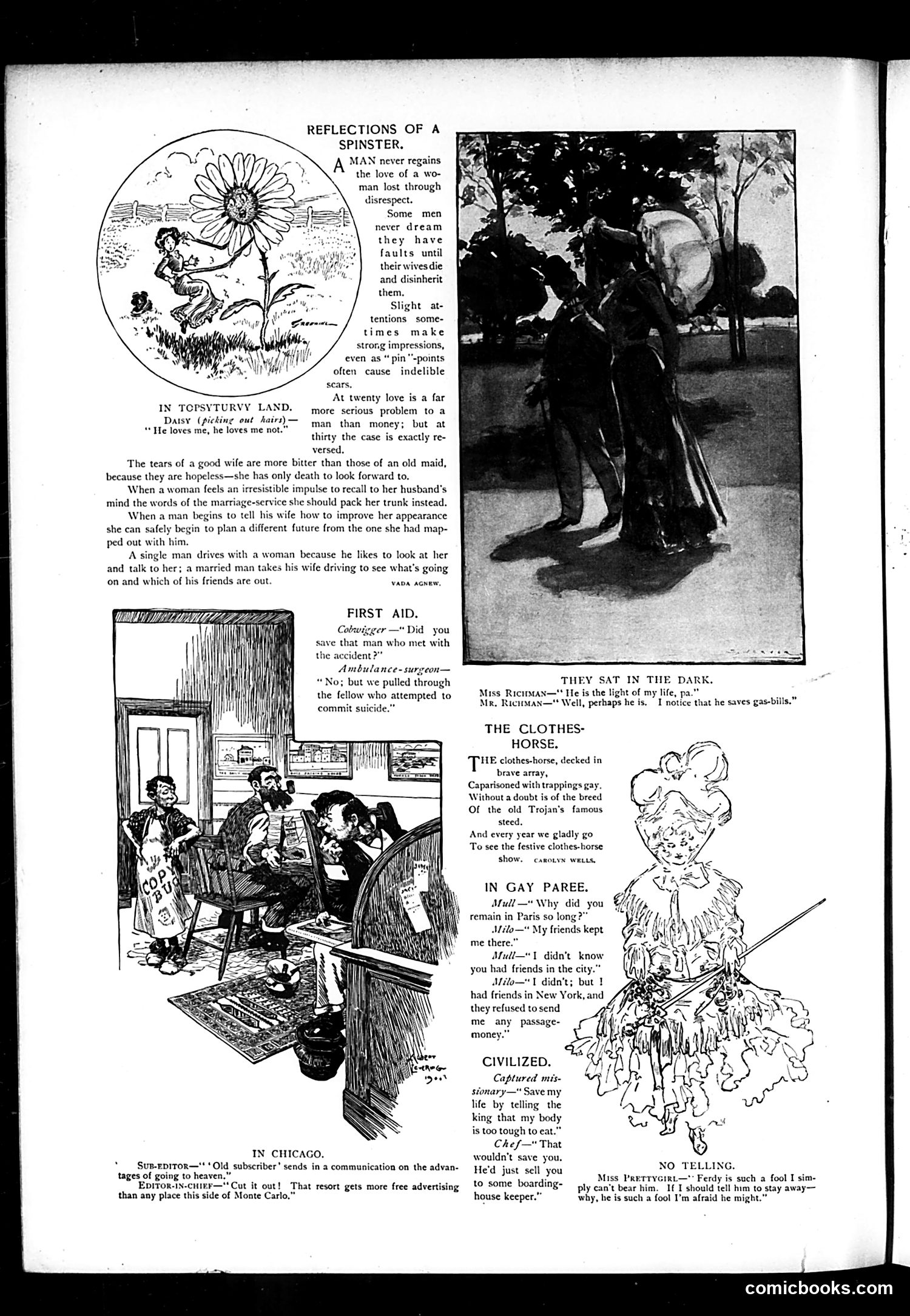
This page collects satirical observations on marriage and relationships, typical of Judge's "Reflections of a Spinster" column. The commentary mocks both men and women: husbands who neglect their wives until after death, wives who invoke marriage vows too often, and the hypocrisy of courtship versus married life ("a single man drives with a woman because he likes to look at her...a married man takes his wife driving to see what's going on"). The cartoon vignettes extend this theme: "First Aid" jokes about suicide prevention; "The Clothes-Horse" satirizes fashion shows; "In Gay Paree" mocks a man stranded in Paris because friends won't send money; and "Civilized" ridicules a captured missionary trying to save himself by claiming he's inedible. These reflect early-20th-century American middle-class anxieties about marriage, gender relations, and social pretension—all delivered through Judge's trademark biting humor aimed at recognizable social types.
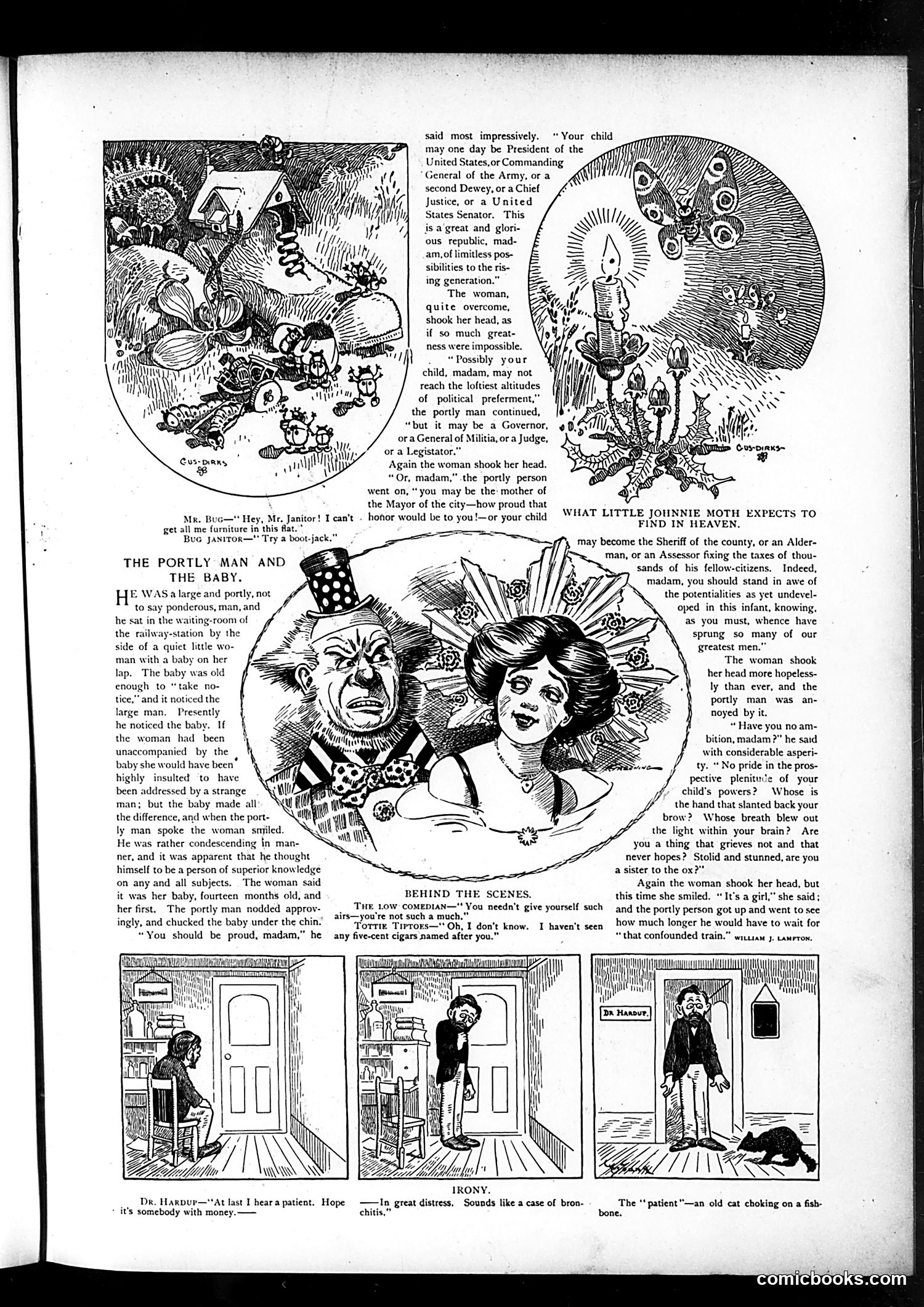
This Judge cartoon satirizes **self-important pomposity**. A condescending, wealthy-seeming man lectures a working-class woman about her infant's boundless potential—President, General, Chief Justice, Senator, Governor, Mayor. Each time he escalates his predictions, the woman shakes her head in tired resignation. The punchline: the baby is a *girl*. The woman's silent headshaking wasn't doubt but resignation to the reality that her daughter's opportunities were severely limited by gender. When she finally reveals this, the portly man's elaborate fantasies collapse instantly. The satire targets both the man's oblivious classism (projecting upper-class ambitions onto a poor woman) and the era's harsh gender discrimination. The woman's quiet, knowing smile suggests she understands her society's real limitations far better than this blustering fool.
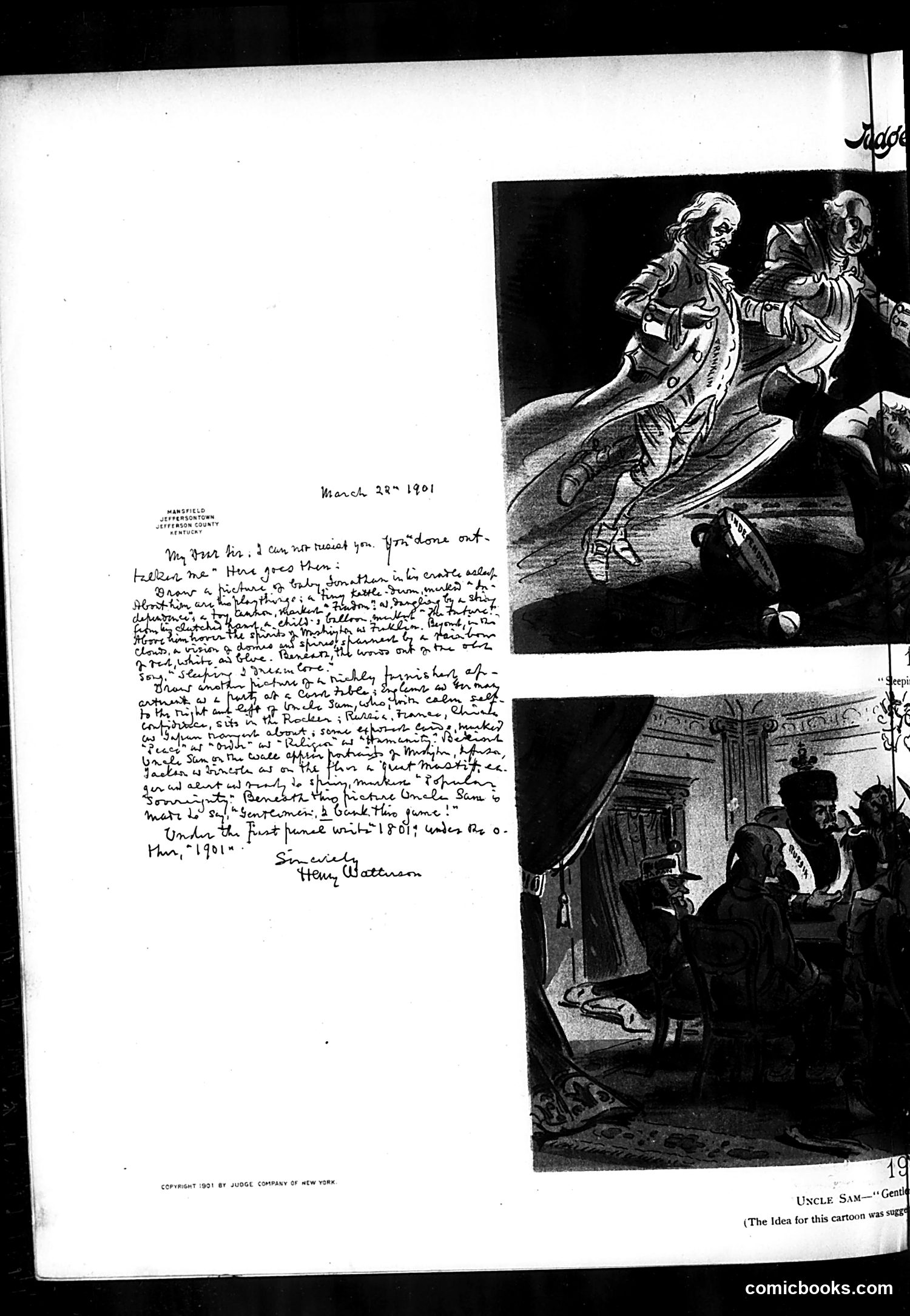
This 1901 Judge page contains a letter dated March 28, 1901, signed by Henry Watterson (a prominent newspaper editor), describing cartoon concepts to the publication. The two illustrations appear to depict **Uncle Sam** (the personified United States) in dramatic situations. The top image shows two figures in flowing robes seemingly in motion or distress. The bottom image shows Uncle Sam among what appear to be military or political figures in an interior setting. Given the 1901 date and Watterson's involvement, these likely relate to **American imperial expansion** or **foreign policy debates** of that era—possibly concerning the Philippines (where the U.S. was engaged in conflict) or other colonial ventures. The letter references specific political or military scenarios, though the handwriting is difficult to read completely. The cartoons appear satirical commentary on American foreign intervention, using Uncle Sam as the central figure representing the nation's actions or moral position.
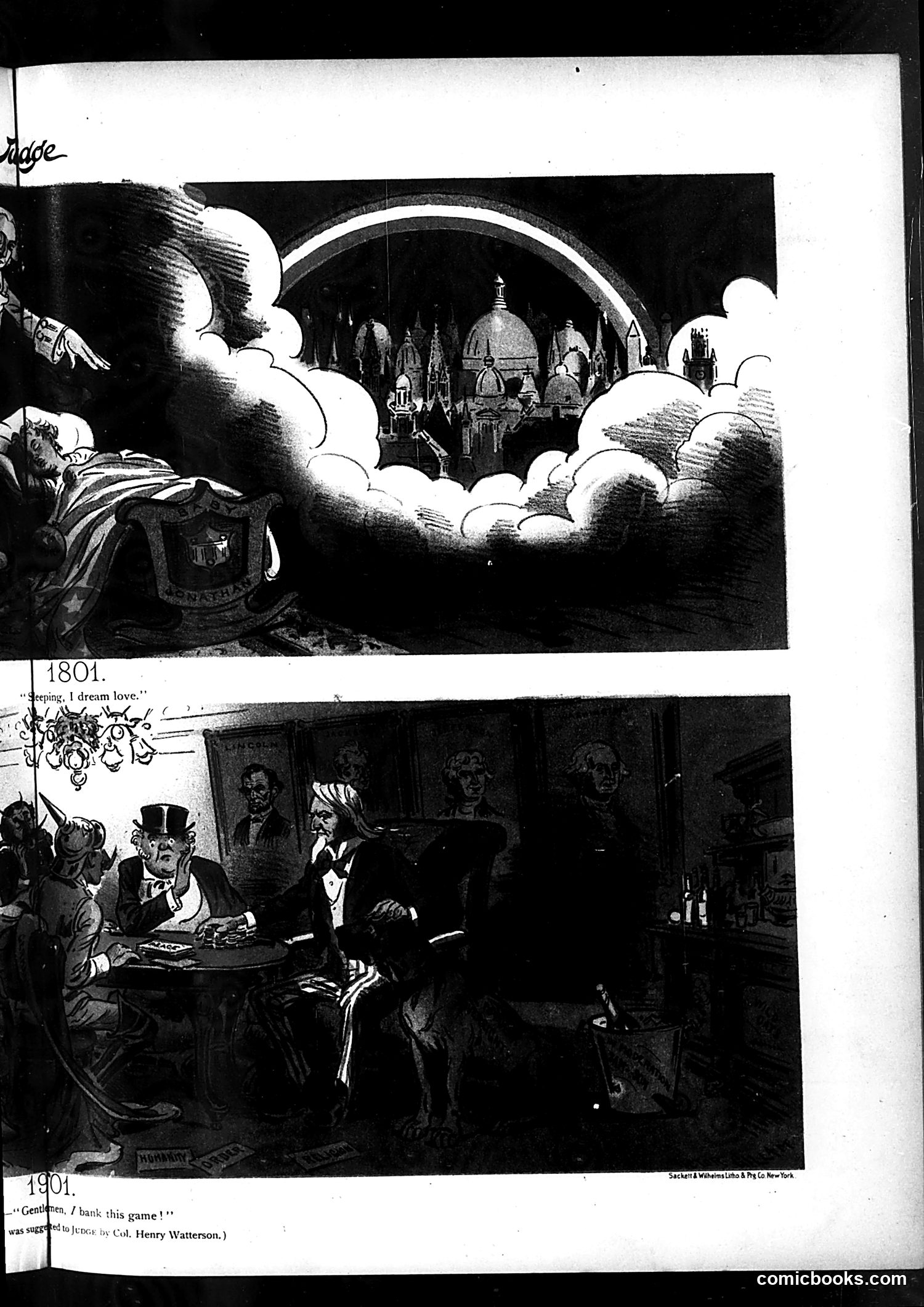
This page presents two related satirical scenes dated 1801 and 1901—a century apart. **Top panel (1801):** Shows a dreamer gazing at an idealized heavenly city with spires and dome, surrounded by clouds. The caption "Weeping, I dream love" suggests romantic or utopian aspirations. **Bottom panel (1901):** Depicts the same dreamer now awake in a mundane room with other figures, presumably card players or gamblers. The caption "Gentleman, I bank this game!" suggests harsh reality has replaced the dream. The satire contrasts romantic idealism with practical, worldly concerns—likely commentary on American society's shift from 19th-century romantic ideals to early 20th-century materialism and gambling culture. The attribution to Col. Henry Watterson (a prominent Kentucky editor) suggests this critiques social or political values of the era.
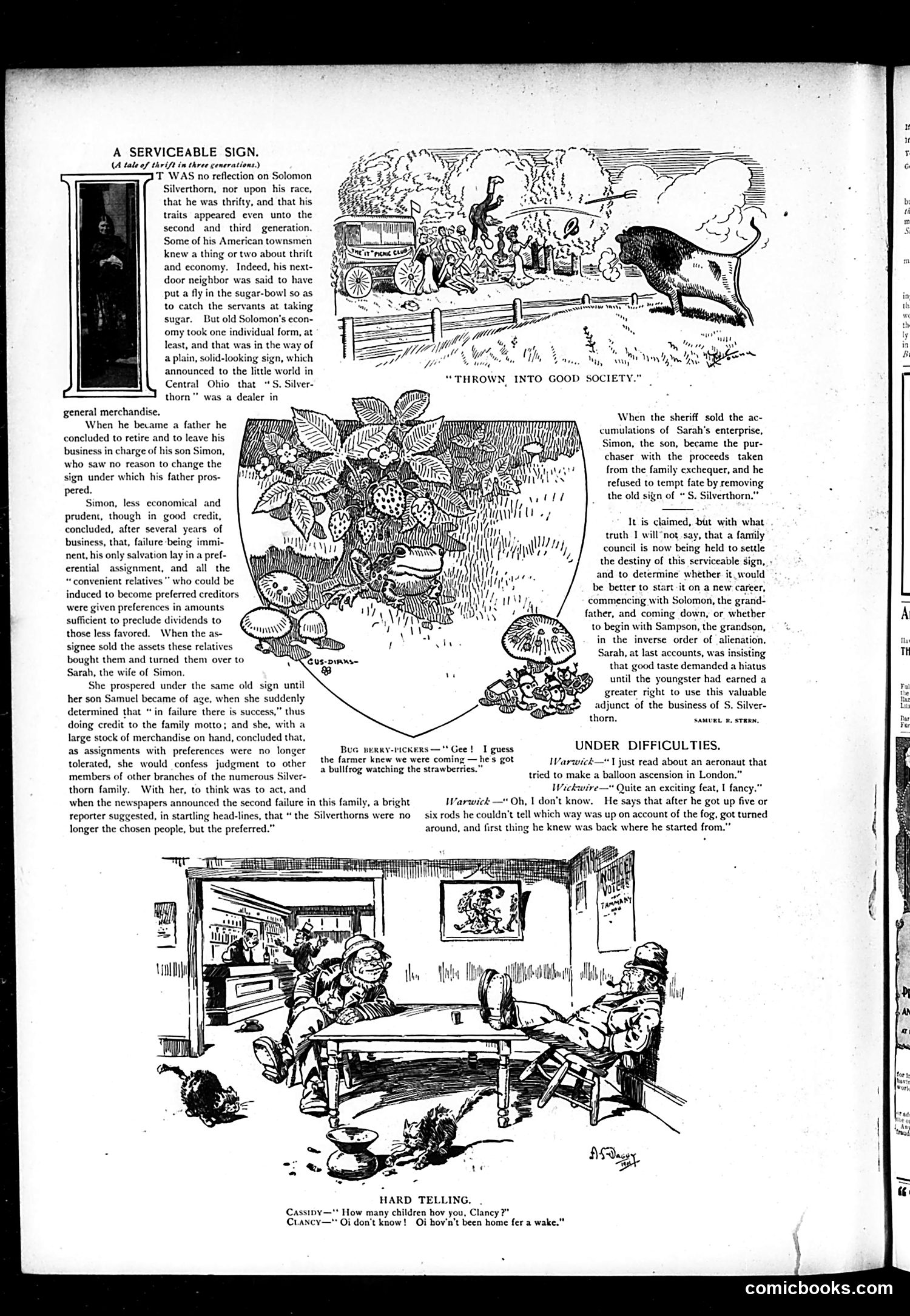
This satirical story tracks the Silverthorn family across three generations, using a shop sign as its symbol. Solomon Silverthorn, a thrifty merchant, prospers and passes his business to son Simon, who keeps the old sign despite becoming less prudent financially. When Simon fails, his wife Sarah takes over—and she too eventually fails, though her son Samuel buys back the assets using family money. The satire critiques a peculiar paradox: despite repeated business failures, the family keeps using the same sign, suggesting blind faith in inherited reputation over actual merit. The "serviceable sign" becomes ironic—it survives longer than the family's actual success. A subplot jokes about preferred creditors and legal assignments, poking fun at how families manipulate bankruptcy law to protect relatives. The cartoon illustrates the family's cycles of failure, while side-panel jokes about aeronauts and confused directions mock general human incompetence, providing light comic relief to the darker economic themes.
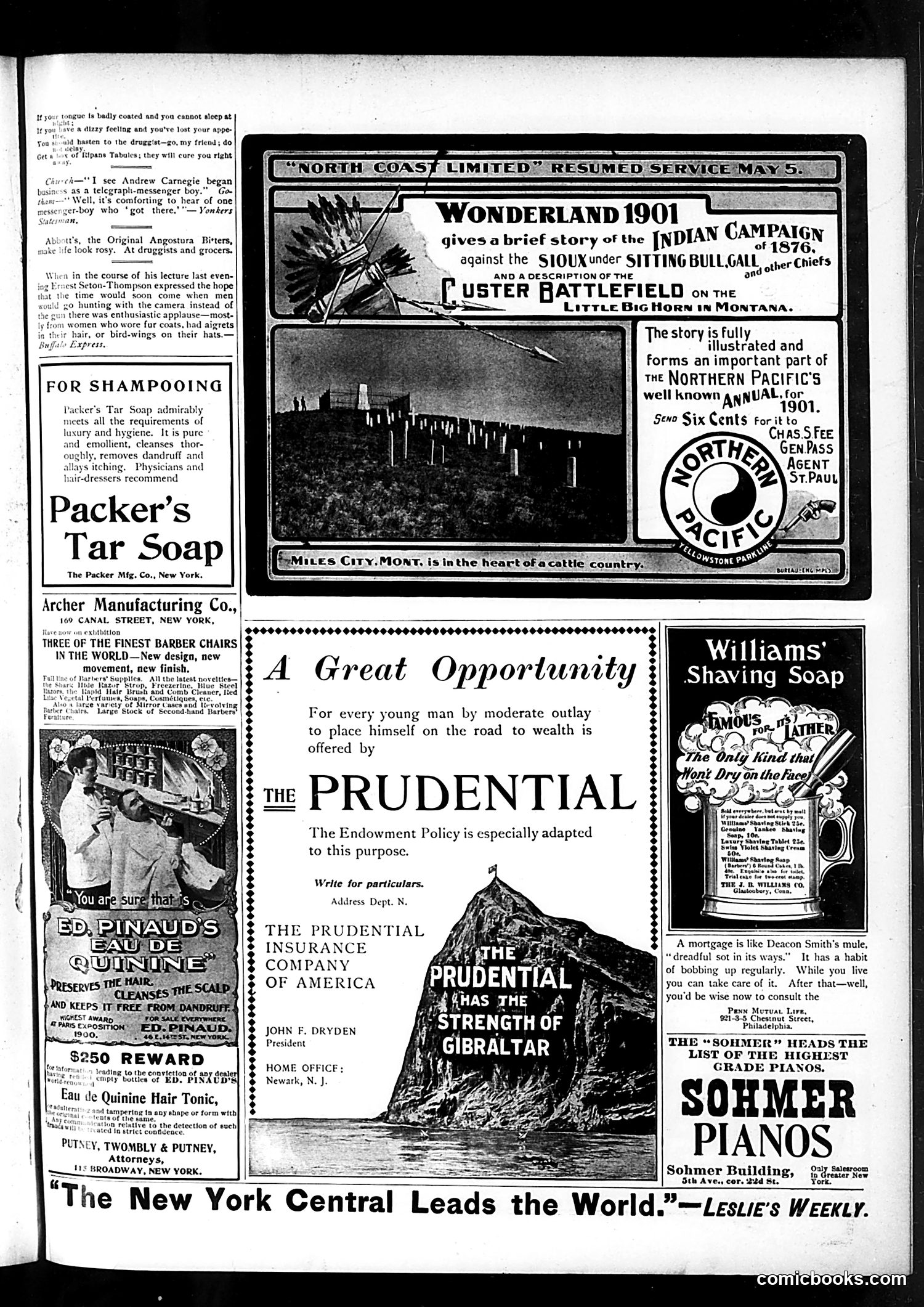
This page is primarily **advertisements and filler content**, not political satire, though it reflects early 1900s commercial culture. The main editorial content is the "Wonderland 1901" travel advertisement (top), promoting the Northern Pacific Railway's illustrated annual featuring the Indian Campaign against Sitting Bull and the Custer Battlefield in Montana—appealing to Americans' fascination with the "Wild West" and recent military conflicts. The advertisements reveal period attitudes: **Packer's Tar Soap** promises to remove "dandruff and itching"; **Pinaud's Saude Quinine** claims to stop hair loss; **The Prudential Insurance** recruits young men into wealth-building schemes; **Williams' Shaving Soap** markets masculine grooming. One small editorial joke references **Andrew Carnegie**, the wealthy industrialist who famously rose from telegraph-messenger boy—the satire being that one success story hardly validates the rags-to-riches myth. The final note mentions women wearing **fur coats and bird-wings on hats**—contemporary fashion that conservationists were beginning to criticize for decimating bird populations. Overall, this reflects a consumer-driven, commercially optimistic America in 1901.
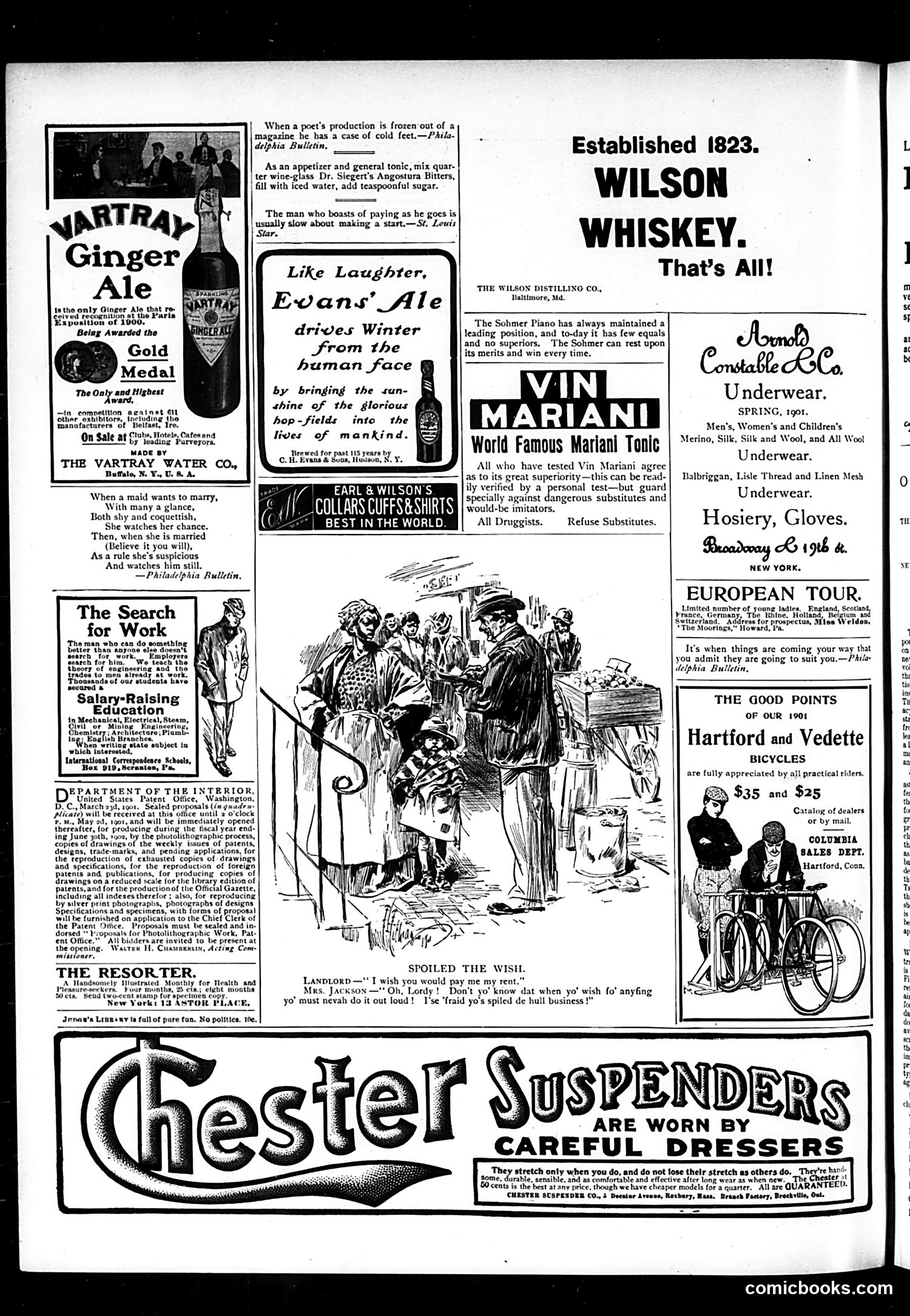
This page is primarily **advertising** from spring 1901, with brief satirical quotes sprinkled throughout—typical of Judge's format. The main cartoon, titled "SPOILED THE WISH," depicts a landlord demanding rent from Mrs. Jackson, an African American tenant. The humor relies on a racist stereotype: her concern that speaking aloud about owing money will somehow "spoil" paying it. The joke mocks Black dialect and superstitious belief, reflecting common turn-of-century racial caricatures in American humor. The page features advertisements for whiskey, bicycles, pianos, and other goods, interspersed with brief witticisms about human nature (marriage, ambition, poets). These quotes appear designed as filler content. The only other cartoon shows a street scene, but its satirical point isn't clearly legible in this image. The content reflects early 1900s attitudes toward race, class, and consumer culture typical of Judge's readership.
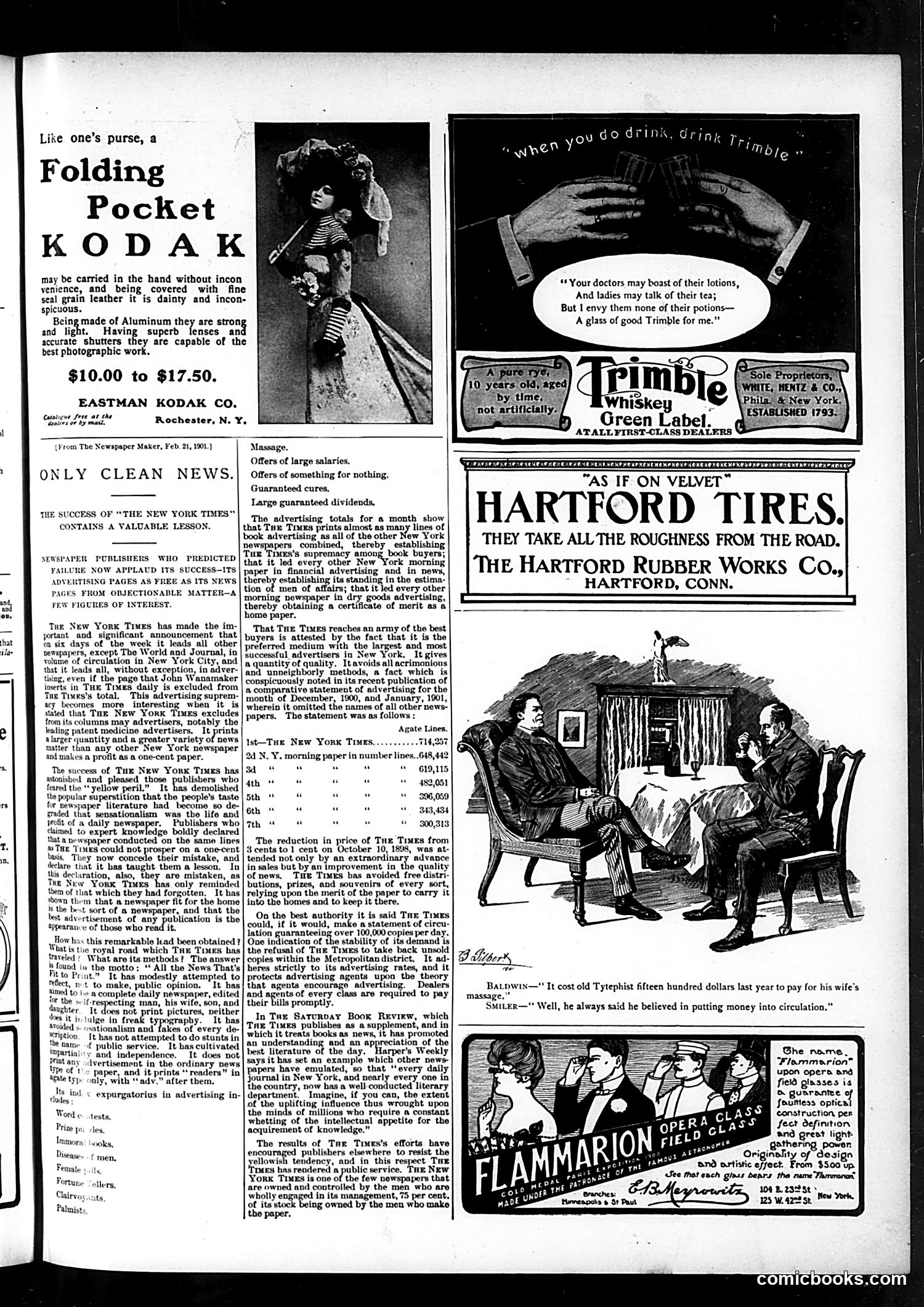
This page is primarily **advertisements and promotional content** rather than political cartoons, though it includes some illustrated ads. The main satirical elements are: 1. **"Only Clean News"** section: A commentary on *The New York Times*' commercial success despite (or because of) its exclusion of "patent medicine advertisers" and other questionable ads—implying that respectable, "clean" journalism can be profitable. 2. **Hartford Tires ad**: Features a domestic scene with a woman receiving a massage, captioned with dialogue about money and circulation—a light joke equating tire quality with proper financial circulation and well-being. 3. **Trimble Whiskey ad**: Uses a humorous testimonial claiming whiskey is superior to doctors' potions, a common advertising trope of the era. The page reflects early-1900s advertising practices and press competition, celebrating *The Times*' refusal of dubious patent medicine ads—a major public health issue of that period—as both ethical and commercially successful.
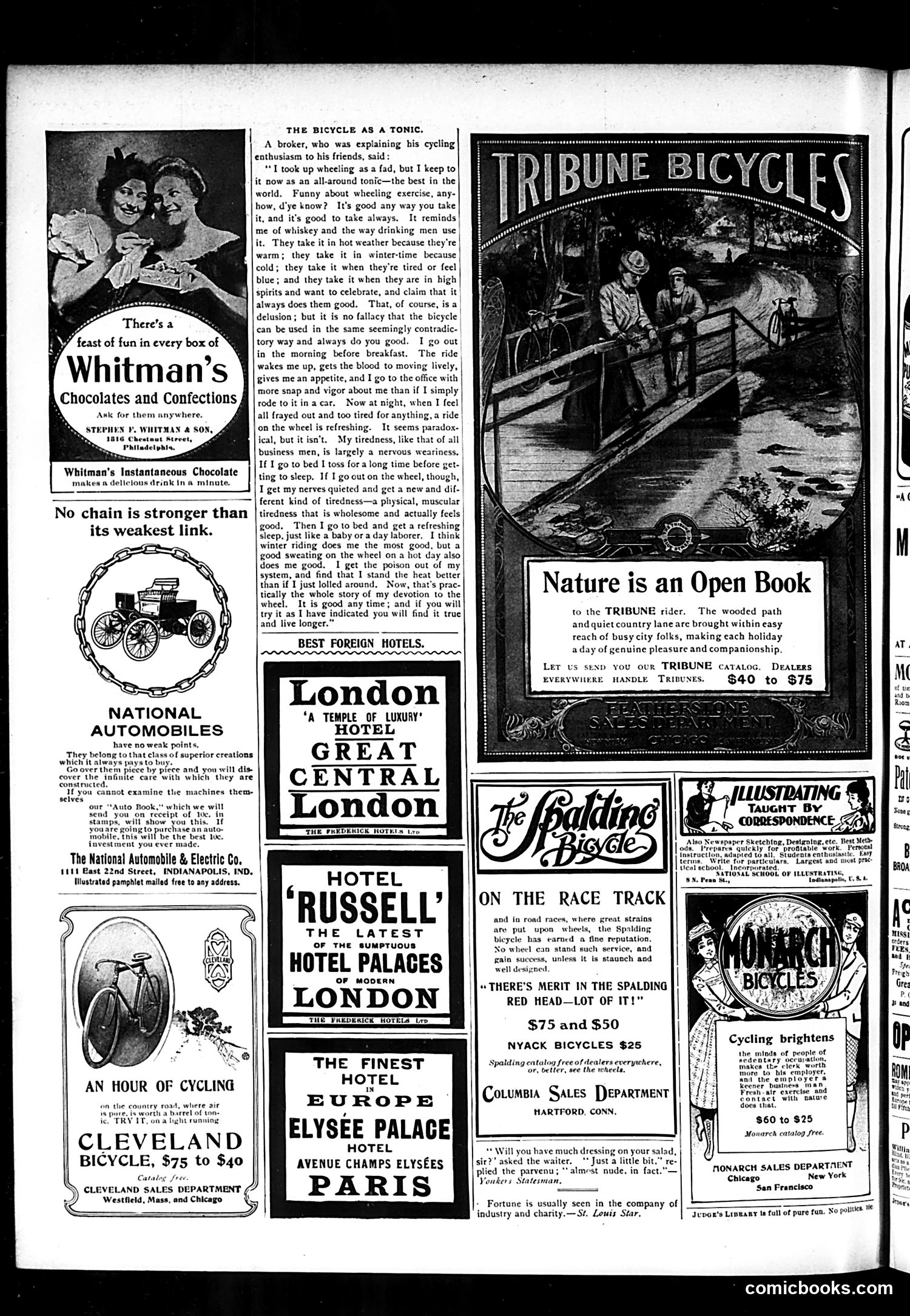
This page is primarily **advertising**, not political satire. It contains numerous bicycle and automobile advertisements from the early 1900s, along with one editorial piece. The main content is **"The Bicycle as a Tonic,"** featuring a broker explaining cycling's health benefits to friends. His argument—that bicycles work like whiskey, beneficial in any circumstance (tired or energetic, hot or cold weather)—presents cycling as a universal remedy for the "nervous weariness" afflicting businessmen. He claims riding clears "poison" from the system and provides better sleep than rest alone. This reflects genuine Progressive Era health enthusiasm: bicycles were genuinely promoted as therapeutic for urban professionals suffering stress and sedentary work. The comparison to alcohol (then more socially acceptable as medicine) grounds the pitch in contemporary medical thinking. The surrounding ads for Cleveland, Tribune, Spalding, Nyack, and Monarch bicycles reinforce this market positioning—bicycles marketed as lifestyle and wellness products for affluent urban men, priced $25–$75 (substantial sums then). No political figures or satire appear on this page.
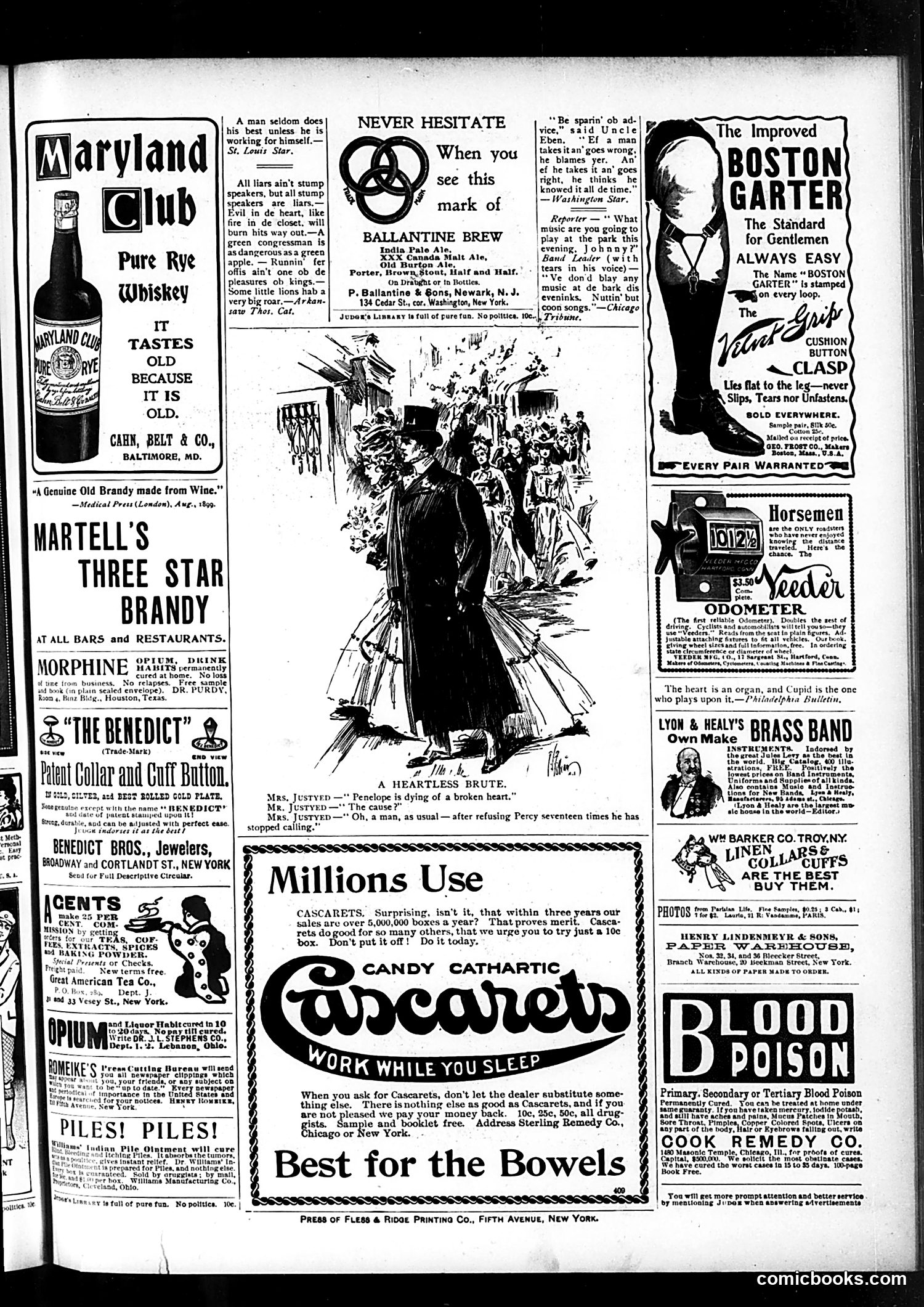
This page is **primarily advertising** from Judge magazine, with one central cartoon titled "A Heartless Brute" depicting a woman's romantic rejection. The cartoon shows a man breaking off with "Penelope," who is "dying of a broken heart." The satire targets male fickleness—the man refused her seventeen times before finally leaving, suggesting masculine emotional cruelty or indifference masked as hesitation. The humor plays on period melodrama tropes where women's fates depended entirely on male romantic choices. The surrounding advertisements are period-typical patent medicines, alcohol (whiskey, brandy, beer), and dubious remedies (opium treatments, blood poison cures, bowel regulators). These reflect Gilded Age commercialism with minimal FDA regulation—many products contained harmful substances. The scattered aphorisms at top-left satirize human nature generically rather than specific political figures, suggesting working-class wisdom about ambition, lying politicians, and personal motivation. This is primarily a **commercial publication** with light social satire rather than serious political commentary.
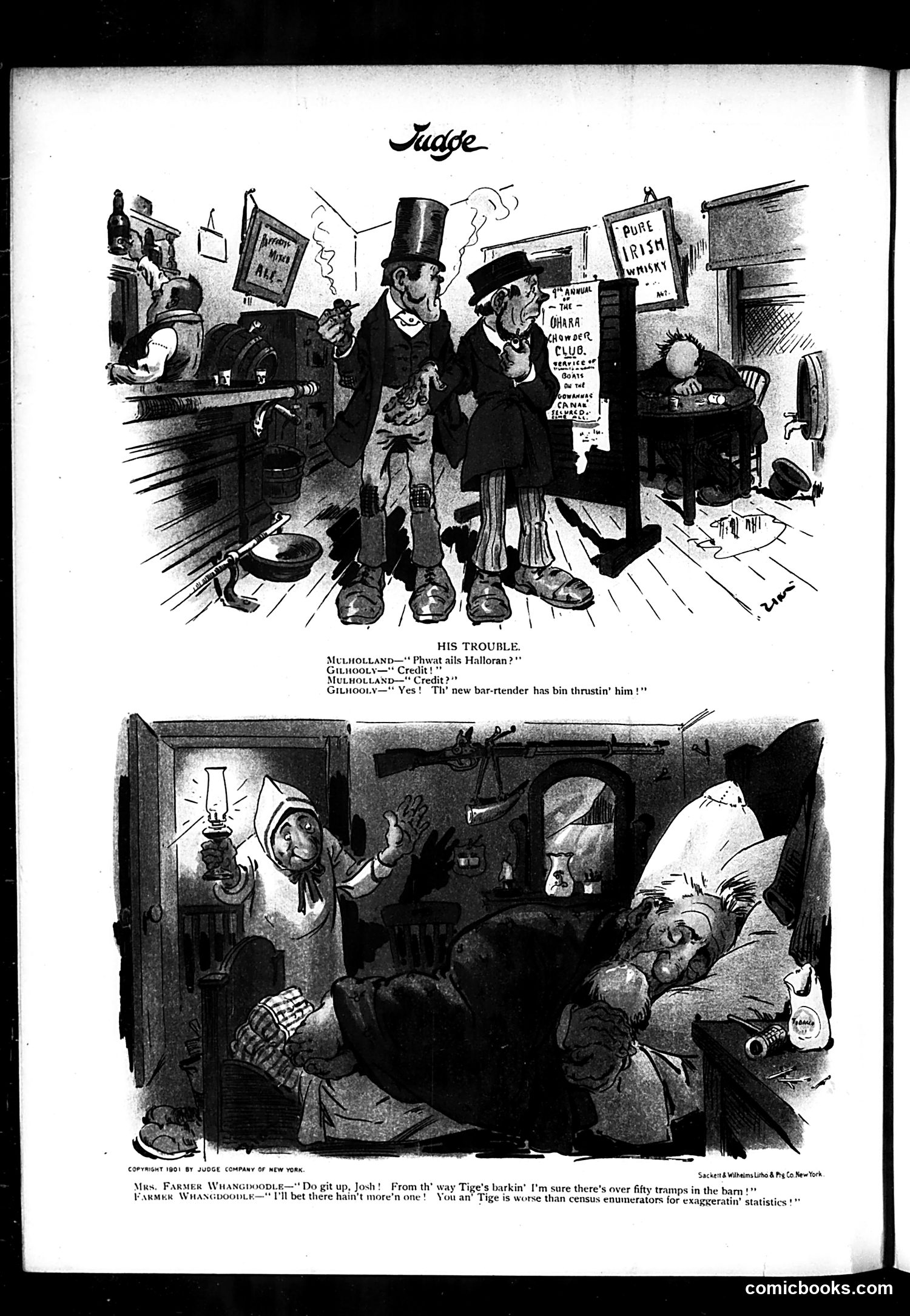
This page contains two satirical cartoons with Irish and rural American dialect humor typical of early 1900s Judge magazine. **Top cartoon:** Two Irish saloon patrons (Mulholland and Gitnooty) discuss their friend Halloran's troubles. The joke: Halloran is in debt because the new bartender extended him credit—a cautionary tale about the dangers of easy credit for working-class drinkers. **Bottom cartoon:** Farmer Whangpoople and his wife argue about tramps in their barn. She exaggerates the number ("over fifty") while he insists there's probably only one, sarcastically comparing their mutual tendency to exaggerate to census enumerators inflating statistics—a contemporary reference to census accuracy disputes. Both rely on period ethnic/rural stereotypes and heavy dialect for humor, satirizing working-class concerns about debt and rural anxieties about vagrants and unreliable statistics.