
Judge, 1901-04-27 · page 10 of 16
Judge — April 27, 1901 — page 10: what you’re looking at
What you’re looking at
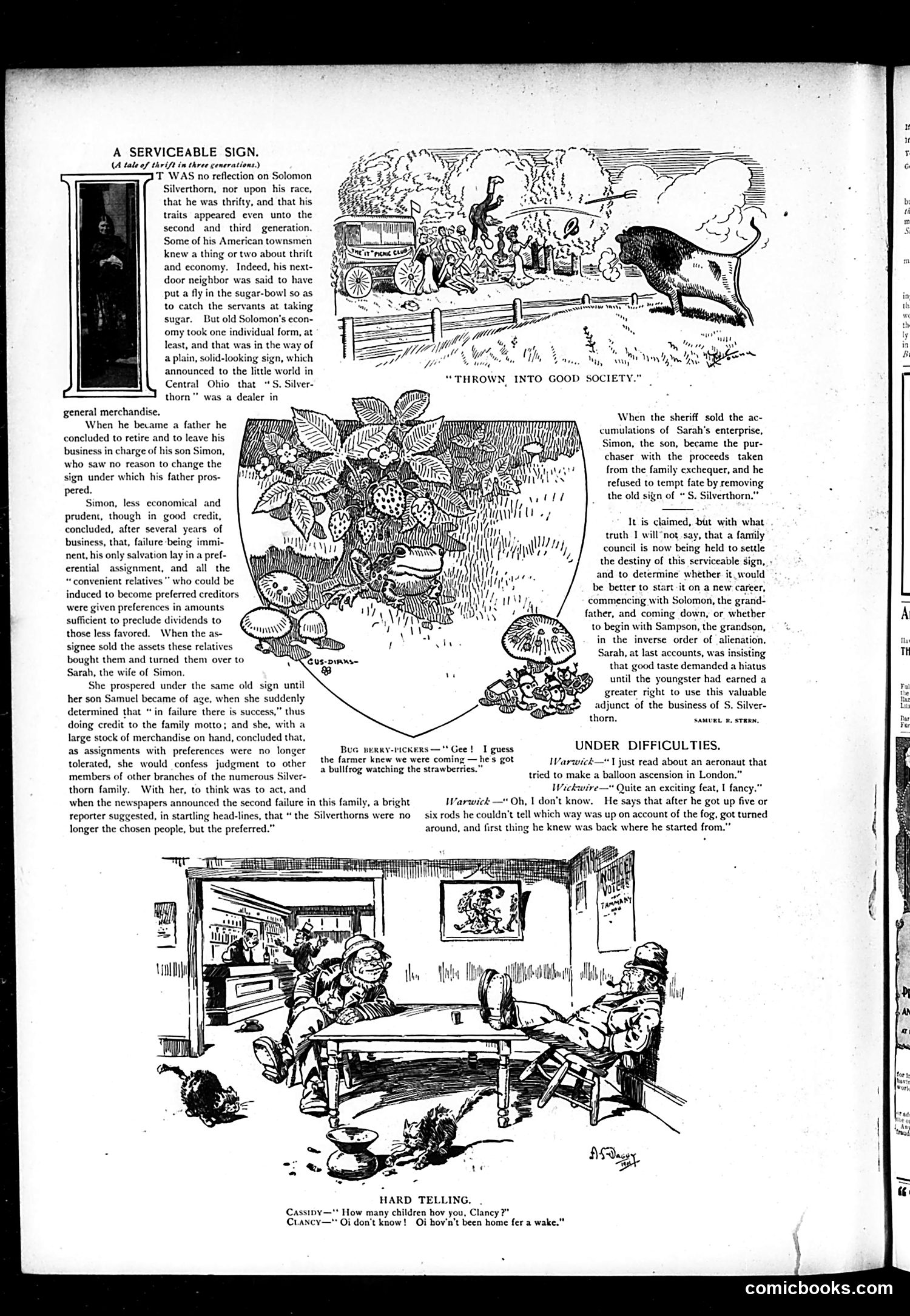
This satirical story tracks the Silverthorn family across three generations, using a shop sign as its symbol. Solomon Silverthorn, a thrifty merchant, prospers and passes his business to son Simon, who keeps the old sign despite becoming less prudent financially. When Simon fails, his wife Sarah takes over—and she too eventually fails, though her son Samuel buys back the assets using family money. The satire critiques a peculiar paradox: despite repeated business failures, the family keeps using the same sign, suggesting blind faith in inherited reputation over actual merit. The "serviceable sign" becomes ironic—it survives longer than the family's actual success. A subplot jokes about preferred creditors and legal assignments, poking fun at how families manipulate bankruptcy law to protect relatives. The cartoon illustrates the family's cycles of failure, while side-panel jokes about aeronauts and confused directions mock general human incompetence, providing light comic relief to the darker economic themes.
📄 Transcribed text from this page (OCR, searchable)
Machine-transcribed from the original scan — historical spelling and the odd misread are preserved.
A SERVICEABLE SIGN. (A fale of thrift in three generations.) T WAS no reflection on Solomon Silverthorn, nor upon his race, that he was thrifty, and that his traits appeared even unto the second and third generation. Some of his American townsmen knew a thing or two about thrift and economy. Indeed, his next- door neighbor was said to have put a fly in the sugar-bowl so as to catch the servants at taking sugar. But old Solomon's econ- omy took one individual form, at least, and that was in the way of a plain, solid-looking sign, which announced to the little world in Central Ohio that “S. Silver- thorn" was a dealer in =z general merchandise. When he became a father he concluded to retire and to leave his business in charge of his son Simon, who saw no reason to change the sign under which his father pros- pered. Simon, less economical and prudent, though in good credit, concluded, after several years of business, that, failure being immi- nent, his only salvation lay in a pref- erential assignment, and all the “convenient relatives" who could be induced to become preferred creditors were given preferences in amounts sufficient to preclude dividends to those less favored. When the as- signee sold the assets these relatives bought them and turned them over to Sarah, the wife of Simon. She prospered under the same old sign until her son Samuel became of age, when she suddenly determined that “in failure there is success,” thus doing credit to the family motto; and she, with a large stock of merchandise on hand, concluded that, as assignments with preferences were no longer tolerated, she would confess judgment to other the farmer knew we fe BuG nerny-rickers —"* Gee ! Up ln , ay “THROWN, INTO GOOD SOCIETY.” | i iit AHN af Hi AHH eae RU \ Uy I guess were coming — hes got Hayat oy When the sheriff sold the ac- cumulations of Sarah's enterprise, Simon, the son, became the pur- chaser with the proceeds taken from the family exchequer, and he refused to tempt fate by removing the old sign of Iverthorn.”” It is claimed, but with what truth I will"not say, that a family council is now being held to settle the destiny of this serviceable sign, and to determine whether it would be better to start it on a new career, commencing with Solomon, the grand- father, and coming down, or whether to begin with Sampson, the grandson, in the inverse order of alienation. Sarah, at last accounts, was that good taste demanded a hiatus until the youngster had earned a greater right to use this valuable adjunct of the business of S. Silv thorn, SAMUEL &. STERN, UNDER DIFFICULTIES. r eh IWarwick—" 1 just read about an aeronaut that a bullfrog watching the strawberries. members of other branches of the numerous Silver- thorn family. With her, to think was to act, and when the newspapers announced the second failure in this family, a bright reporter suggested, in startling head-lines, that “the Silverthorns were no longer the chosen people, but the preferred.” HARD How many children hov Oi don't know! tried to make a balloon ascension in London.” Wickwire—* Quite an exciting feat, | fancy.” Warwick —" Oh, 1 don't know. He says that after he got up five or six rods he couldn’t tell which way was up on account of the fog, got turned around, and first thing he knew was back where he started from.” TELLING. | a, Clancy?” i hov'n’t been home fer a wake.” comicbooks.com