
A complete issue · 16 pages · 1901
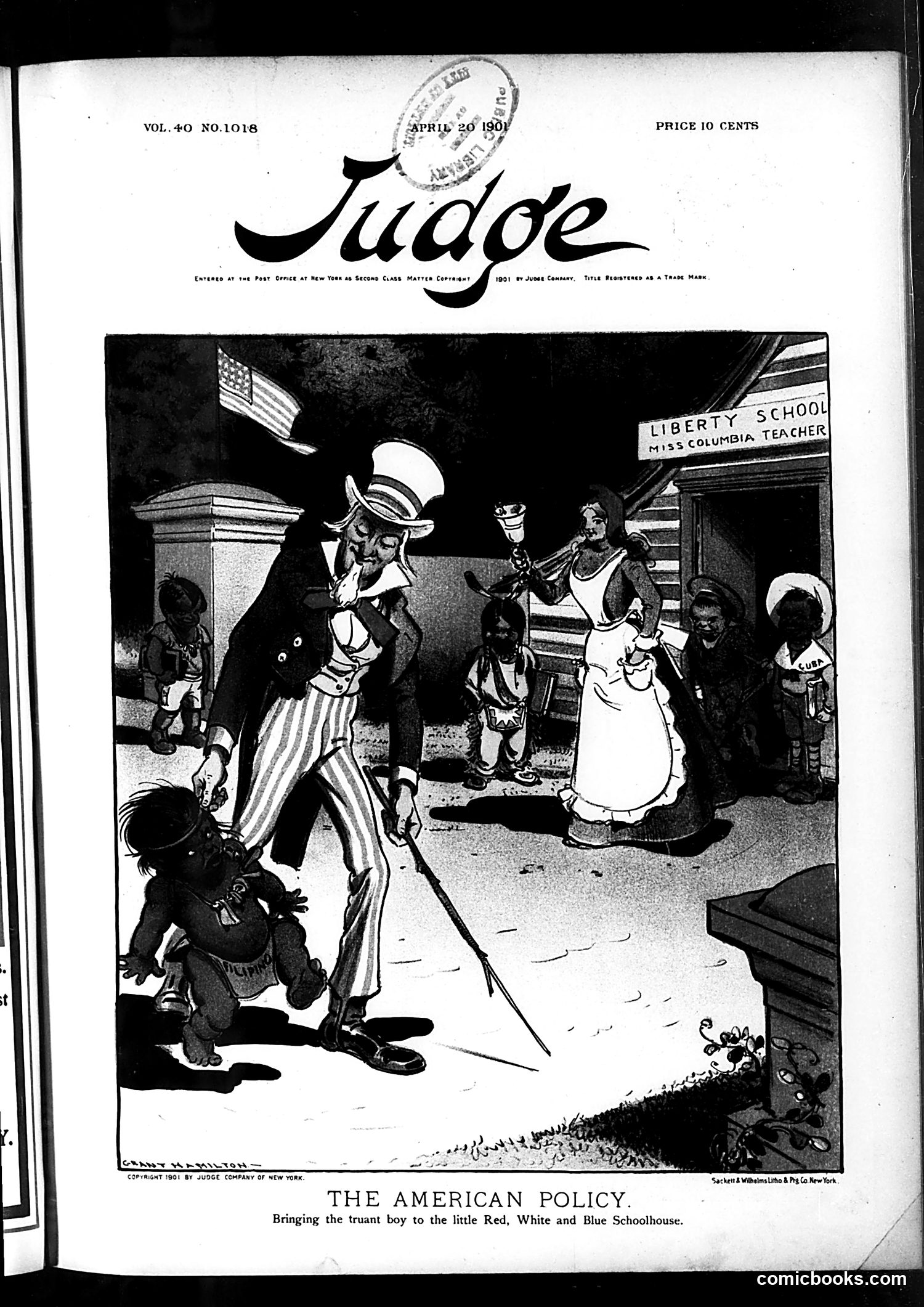
Judge — April 20, 1901
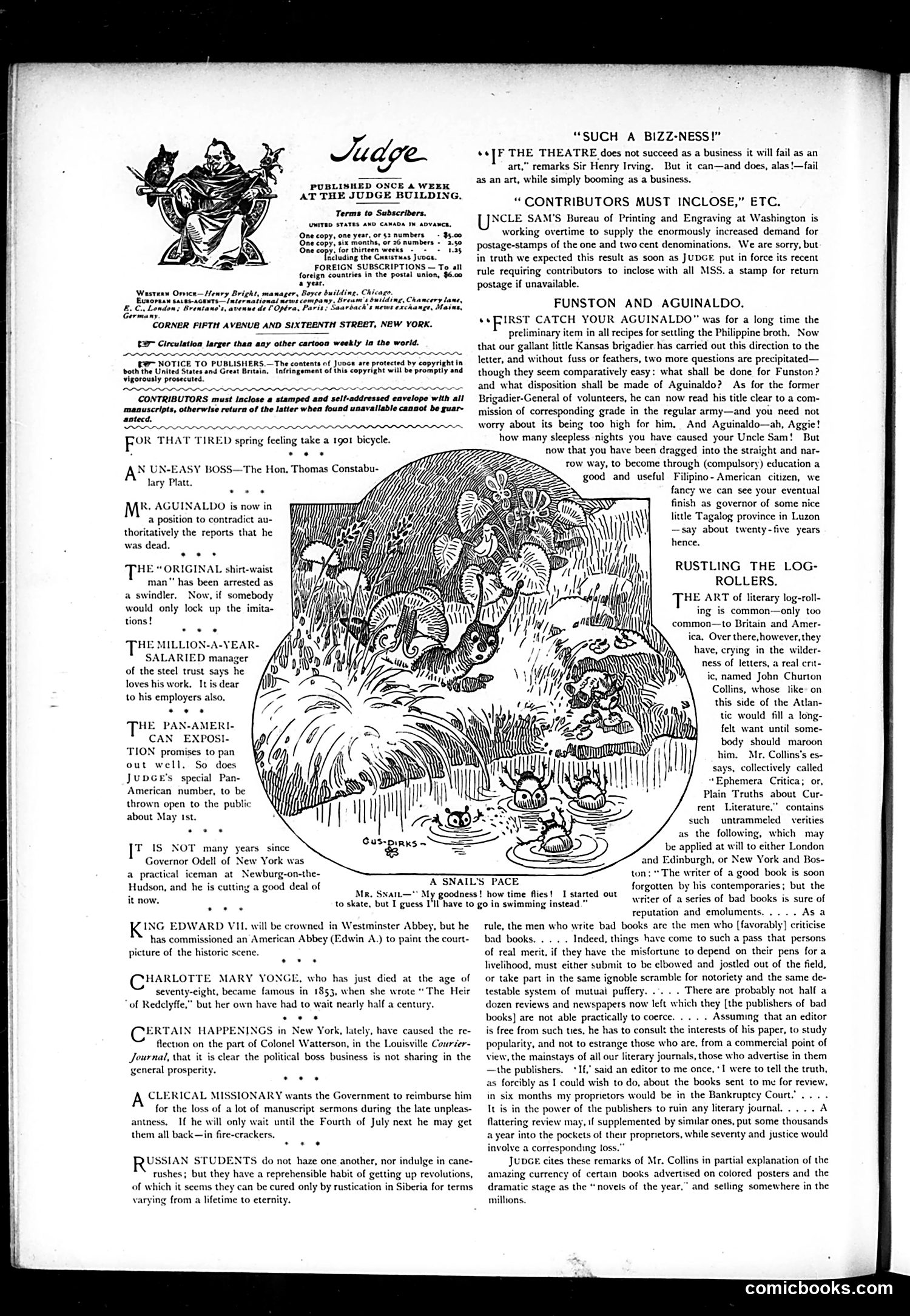
The central cartoon depicts a large snail moving slowly through shallow water, carrying what appears to be government or bureaucratic weight on its shell. Small figures around it seem frustrated by the pace of progress. This satirizes slow governmental action or bureaucratic inefficiency—a common Judge magazine theme. The snail metaphor represents how tediously slow official processes move despite public urgency or need. The surrounding text discusses various editorial matters, including complaints about literary critics, publisher disputes, and government reimbursement delays for a clerical missionary. The snail cartoon likely comments on one of these bureaucratic frustrations mentioned in the adjacent articles, though the specific historical reference is unclear without additional context about the publication date.
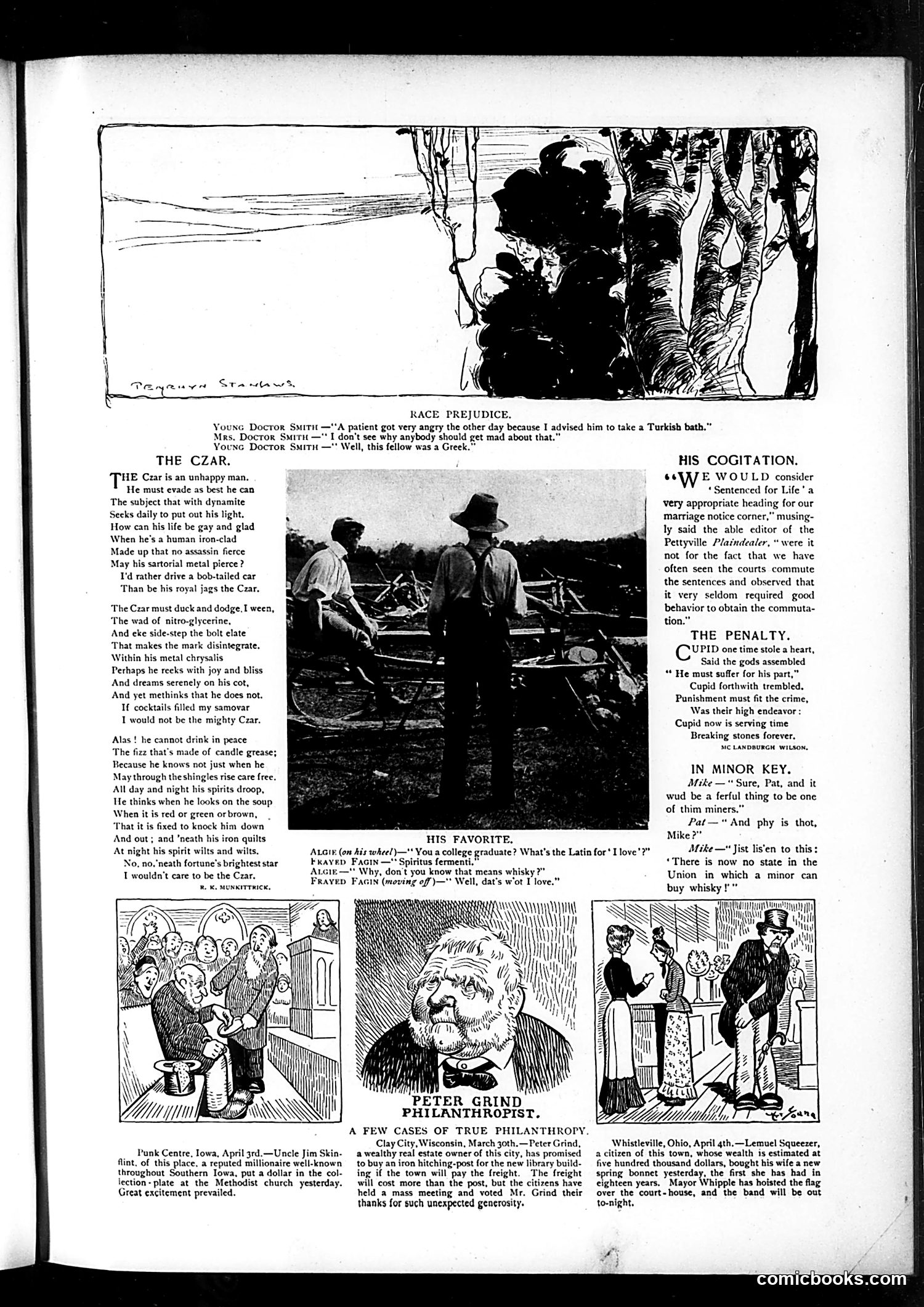
This Judge page satirizes ethnic prejudice through a dialogue between "Young Doctor Smith" and "Mrs. Doctor Smith" about a patient. The joke hinges on racial assumptions: the wife assumes the angry patient must be Turkish, but the doctor reveals he's Greek—suggesting prejudice operates regardless of specific ethnicity. The main poems ("The Czar," "His Cogitation," "The Penalty," "In Minor Key") address Russian autocracy and legal inequality, likely referencing Tsarist oppression. Bottom sections present "Peter Grind Philanthropist," documenting wealthy men's charitable acts—possibly satirizing whether such philanthropy is genuine or self-serving publicity. The overall page critiques both ethnic stereotyping and questions the authenticity of elite benevolence.
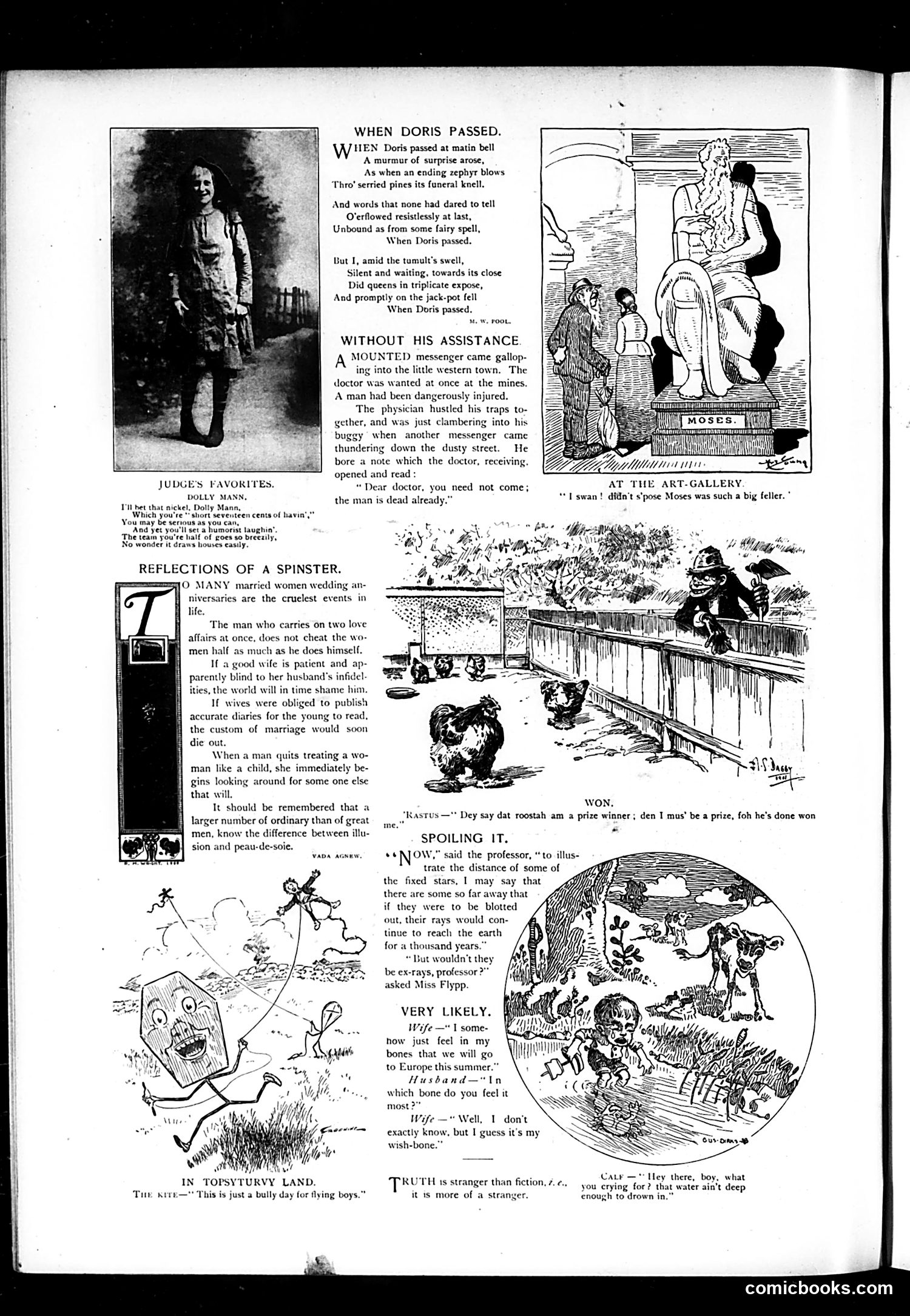
This page contains several unrelated satirical pieces and jokes typical of Judge magazine's format. **"When Doris Passed"** (top) appears to be a poem about a woman's funeral, with accompanying photograph and artistic illustration. The satire seems to mock overly sentimental funeral customs. **"Judge's Favorites"** credits a poem to "Dauly Mann." **"Reflections of a Spinster"** offers social commentary on marriage and women's independence, arguing that wives shouldn't be blindly loyal to husbands and that marriage customs need reform. The remaining pieces—"Without His Assistance," "At the Art Gallery," "Won," "Spoiling It," "Very Likely," and "In Topsyturvy Land"—are brief humorous anecdotes with accompanying illustrations, featuring domestic comedy and wordplay typical of Judge's comedic style. Without specific dates or clearer context, the particular targets of satire remain unclear.
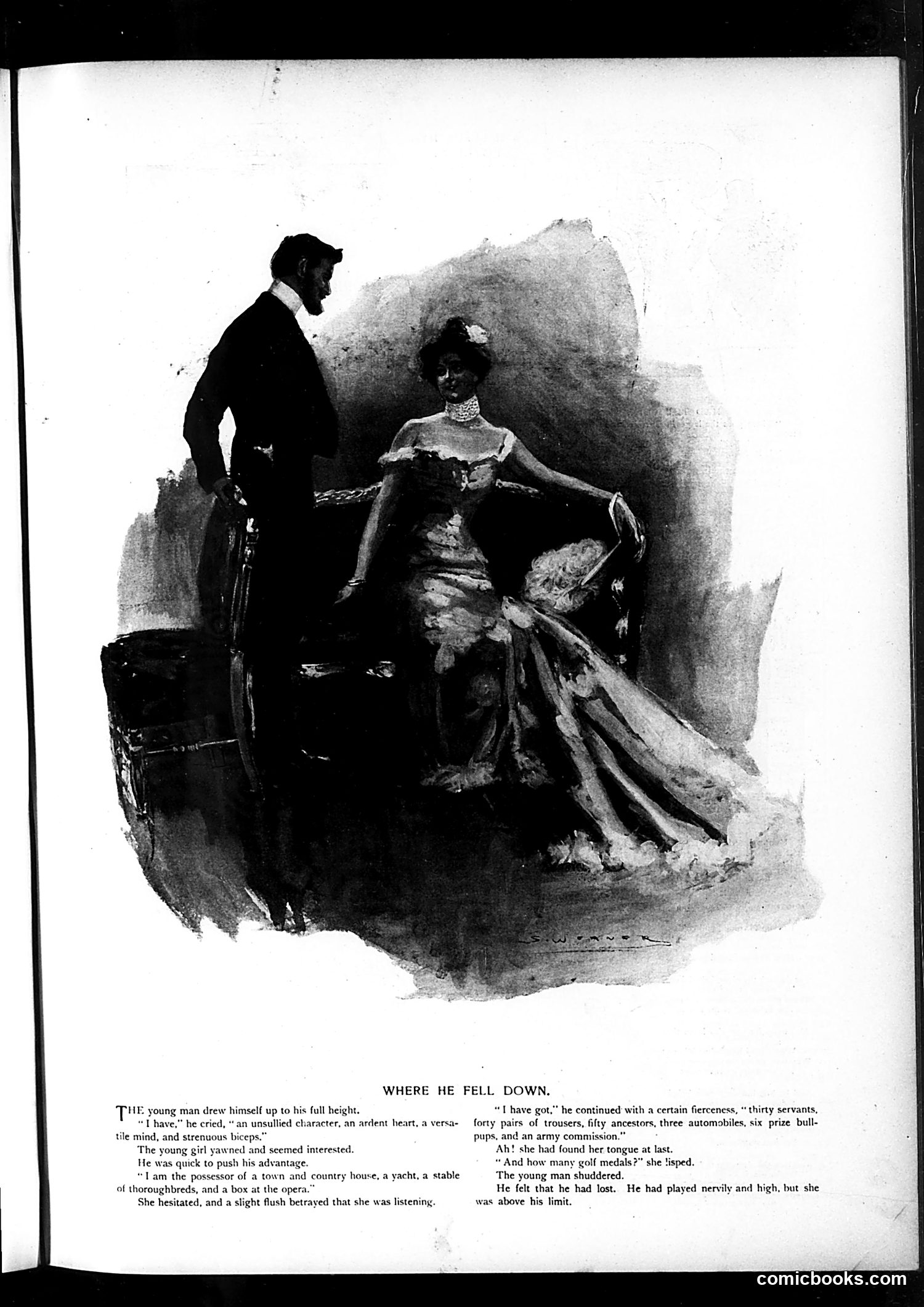
This satirical story mocks the nouveau riche courting rituals of early 20th-century America. A young man attempts to impress a woman by listing his material possessions and accomplishments—house, yacht, servants, automobiles, ancestors, and military rank. He escalates his claims, confident each item strengthens his case. The joke pivots on her single question: "How many golf medals?" His inability to answer reveals the satire's target: wealthy men who accumulate possessions but lack the *leisure activities* and social polish of the established upper class. Golf was an exclusive gentlemen's sport—a marker of both wealth AND refined leisure time. His missing golf credentials expose him as an outsider to true high society, regardless of his material wealth. The woman recognizes his social pretension immediately, and he "shudders" at his defeat. The cartoon critiques American materialism and status anxiety among the aspiring wealthy class.
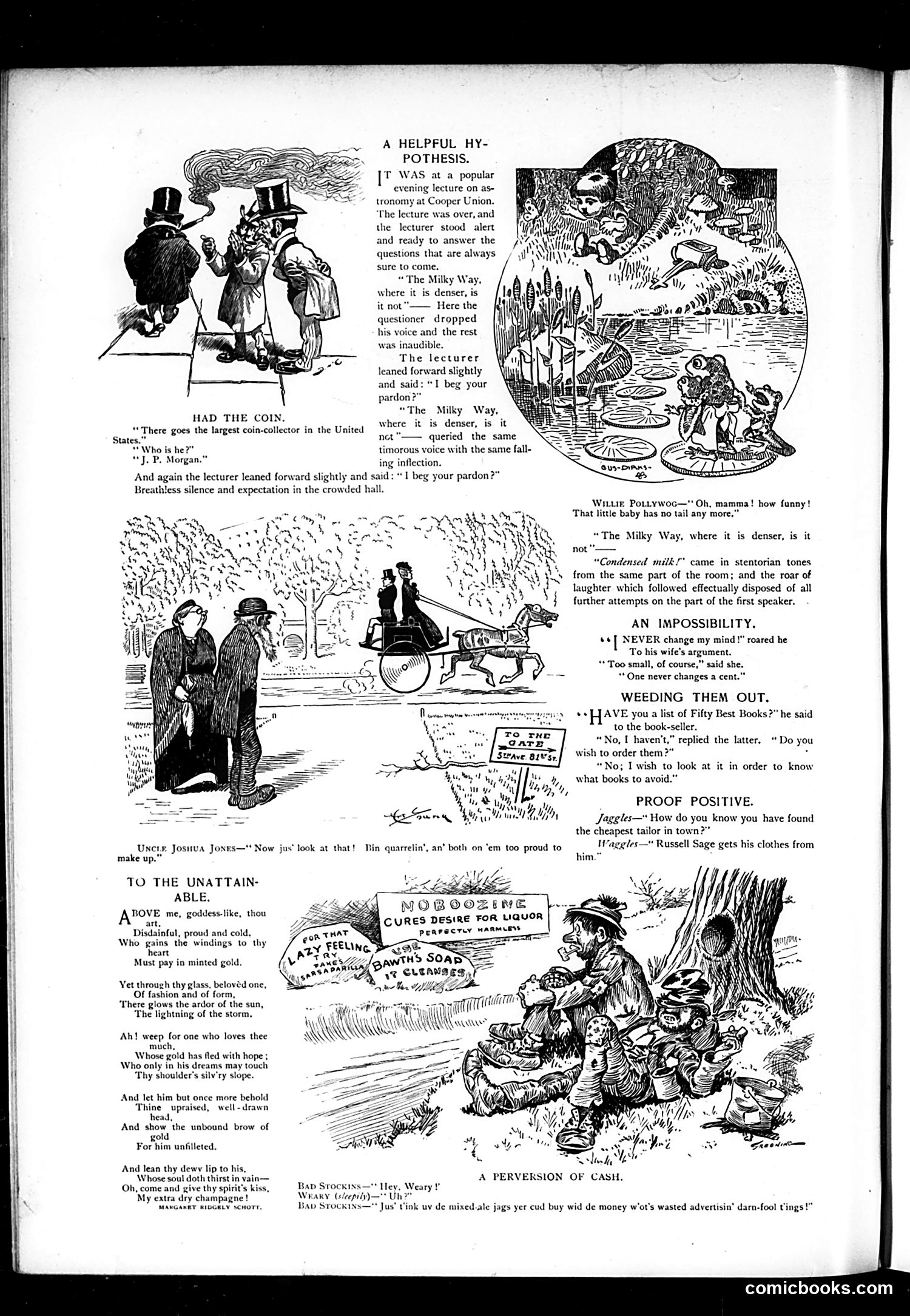
This page contains multiple brief satirical pieces typical of Judge magazine's humor: **"A Helpful Hypothesis"**: Mocks absent-minded academics. An astronomy lecturer at Cooper Union repeatedly fails to hear a questioner asking about the Milky Way. When someone finally shouts "Condensed milk!" the crowd roars with laughter—suggesting the lecturer was so inattentive he wouldn't notice the absurdity. **"Had the Coin"**: A brief jab at J.P. Morgan, the wealthy industrialist and famous art/coin collector, implying his wealth defines him. **Other sketches**: Include wordplay jokes ("One never changes a cent"), commentary on book-reading habits, and satirical verses mocking unrequited love for wealthy women requiring "minted gold." **Advertisements**: The page includes vintage product ads (Bawthn's Soap, liquor cure) integrated with cartoons—common in Judge. The overall tone reflects Gilded Age humor targeting academics, the wealthy, and social pretension through gentle ridicule and puns.
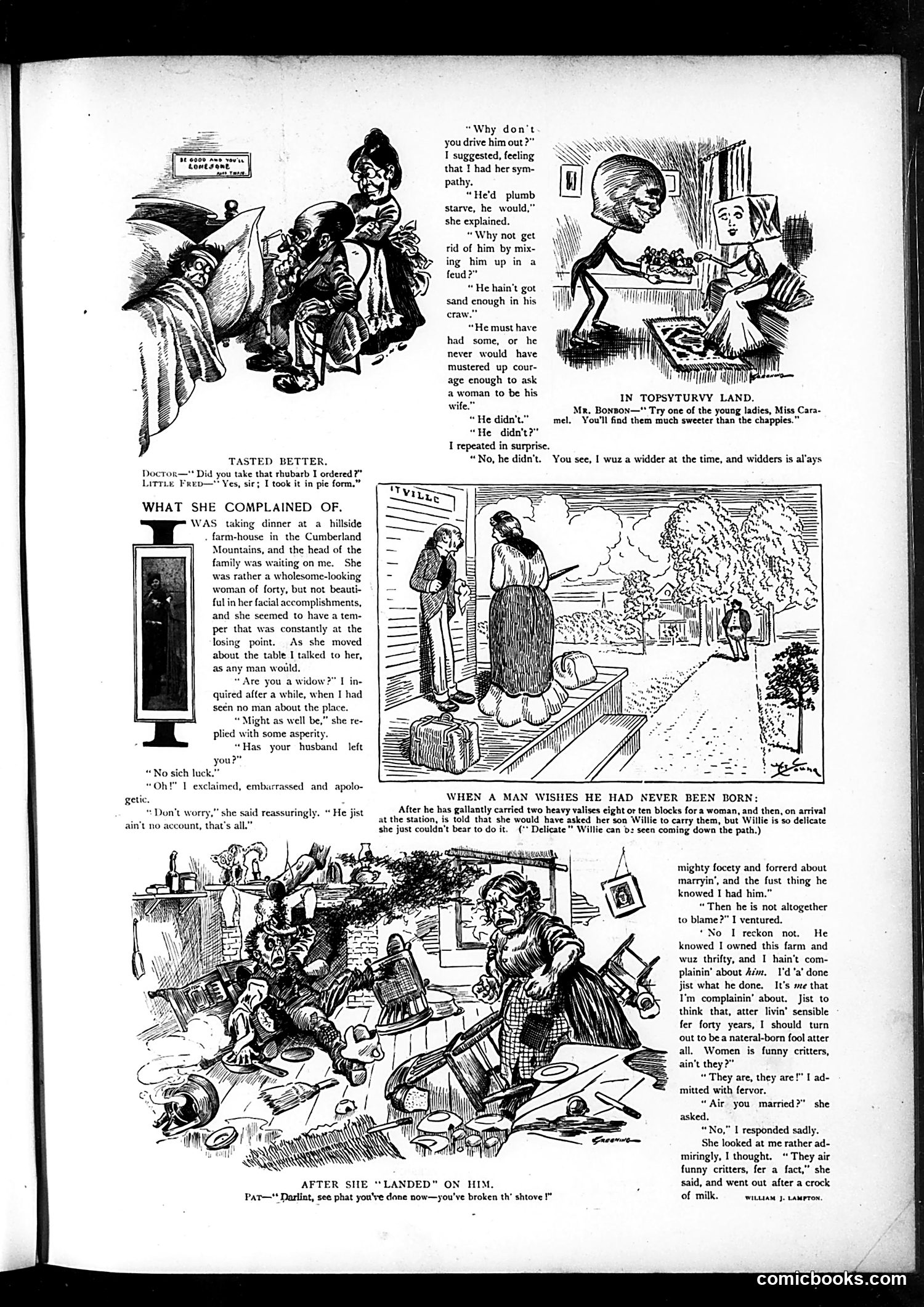
This page contains several satirical sketches mocking marriage and gender relations: **"What She Complained Of"** depicts a Cumberland Mountain woman unhappily married to a worthless man. The satire targets her predicament: she's trapped because he'd "starve" without her farm, yet he lacks the courage to have even proposed—*she* initiated the marriage. The joke reflects period anxieties about women's limited agency: even when economically superior, a woman cannot easily escape a bad marriage. **"Tasted Better"** is a brief doctor joke about a child taking medicine disguised in pie rather than straight. **"In Topsyturvy Land"** shows inverted social propriety, with Mr. Boynton recommending young women as sweeter companions than men. **"When a Man Wishes He Had Never Been Born"** depicts male gallantry backfiring: a man carries heavy luggage for a woman, only to learn she could have asked her delicate son Willie—making his effort pointless. The satire mocks both excessive chivalry and women's casual ingratitude. Overall, the page ridicules marriage dynamics and gender relations through working-class and absurdist scenarios.
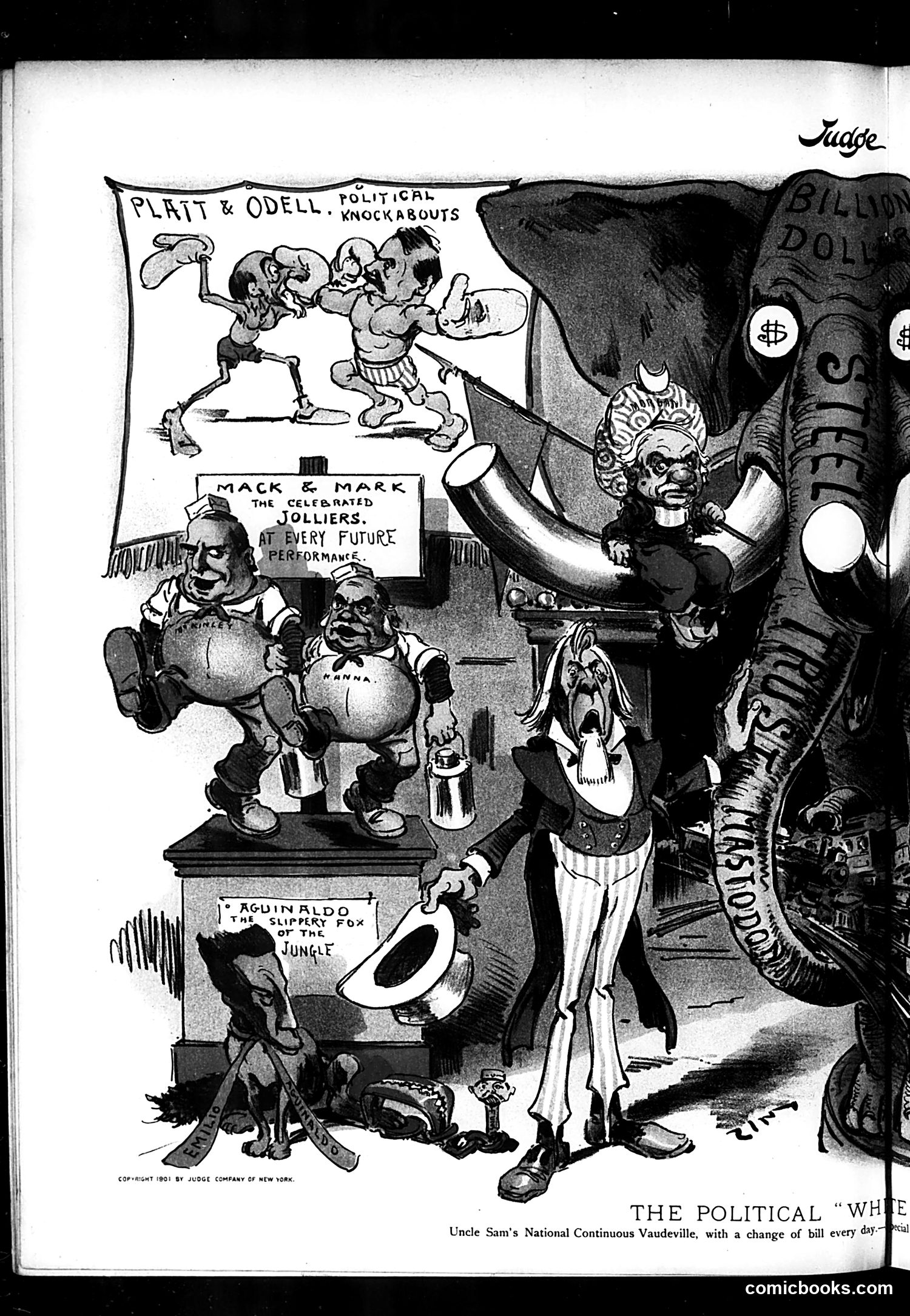
This 1901 Judge magazine cartoon satirizes American politics as vaudeville entertainment. The main image depicts Uncle Sam operating a circus/theater featuring various political "acts": **Key figures and references:** - **Aguinaldo** (bottom left): Filipino insurgent leader, referenced as "The Slippery Fox of the Jungle"—mocking the ongoing Philippine-American War - **Plait & Odell**: New York political figures engaged in "knockabouts" (slapstick fighting) - **Mack & Mark**: "Celebrated Jolliers" performing at "every future performance"—likely vaudeville performers used as political metaphors - **The elephant** (right): Standard Republican symbol, labeled with dollar signs **The satire's point:** American politics is portrayed as cheap entertainment—a continuous vaudeville show where serious issues (colonial wars, political feuds, corruption) are treated as jokes for public consumption. The "change of bill every day" suggests constant shifting scandals and diversions rather than substantive governance.
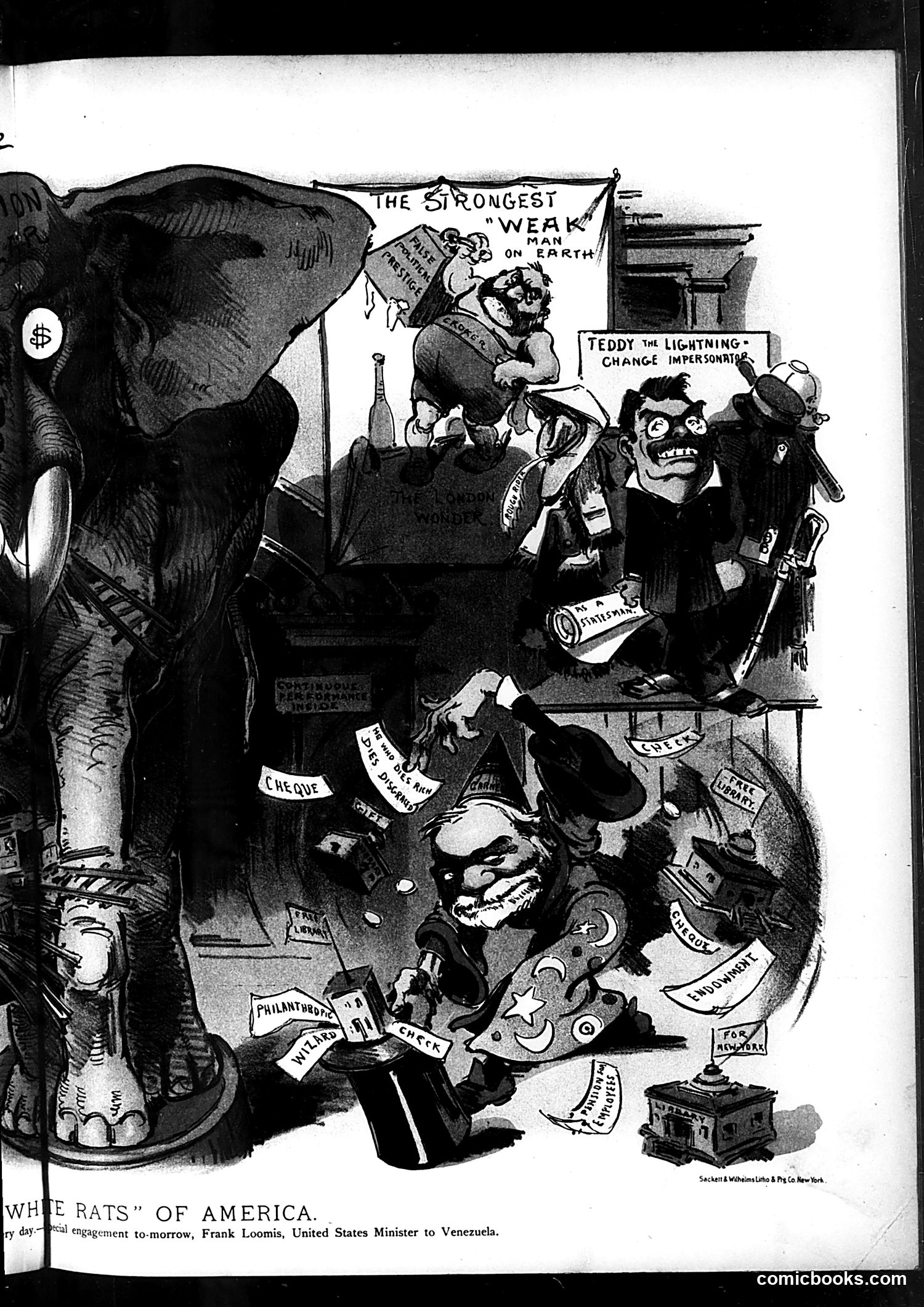
This political cartoon satirizes corruption in American institutions, depicted as large rats infesting a building. The central figure labeled "Teddy the Lightning-Change Impersonator" appears to reference Theodore Roosevelt, suggesting he presents himself as a reformer while failing to address systemic corruption. The rats are labeled with various vices: "Philanthropy," "Graft," "Cheque," and others, representing dishonest practices permeating American society. The cartoon's title, "White Rats of America," uses the rat metaphor to criticize institutional hypocrisy. The reference to Frank Loomis, U.S. Minister to Venezuela, suggests specific diplomatic or political scandal. The phrase "The Strongest Weak Man on Earth" mocks Roosevelt's inability to effectively combat these entrenched problems despite his public reformist rhetoric.
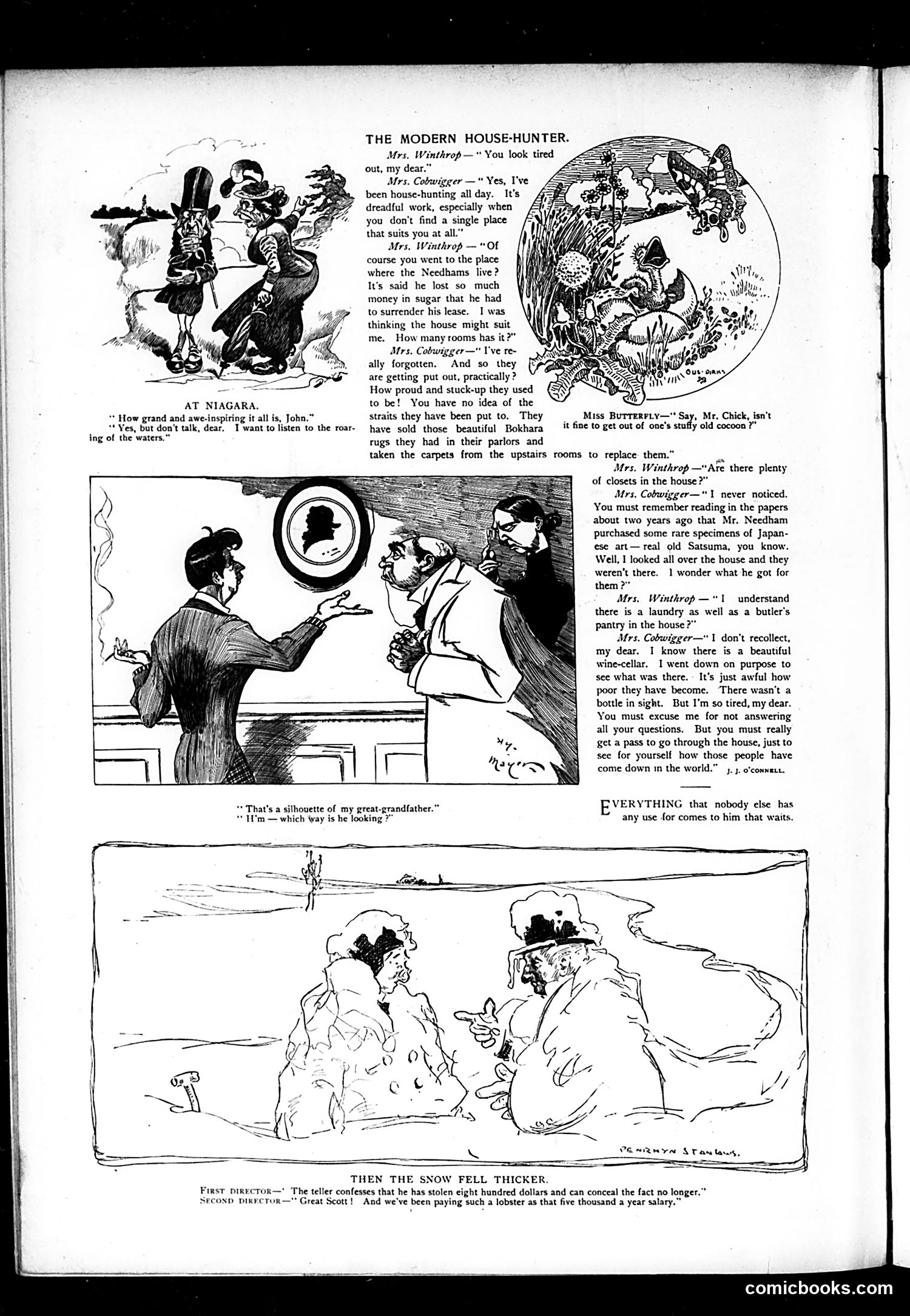
This page satirizes wealthy Americans' schadenfreude and materialistic gossip during the Gilded Age. The main cartoon depicts Mrs. Cobwigger house-hunting while eagerly discussing the Needhams' financial ruin—they've lost money in sugar speculation and surrendered their lease. Rather than sympathize, Cobwigger obsesses over what valuables they've sold: their Bokhara rugs, Japanese Satsuma art, and wine collection. She barely noticed the house itself, only the evidence of their decline. The satire targets the cruel social voyeurism of the period: wealthy women treating others' misfortune as entertainment while pretending concern. The Needhams' descent "in the world" fascinates her more than actual household features. The bottom cartoon about the embezzling teller adds related commentary: banks pay executives high salaries while lesser employees steal modest amounts—a jab at class hypocrisy.
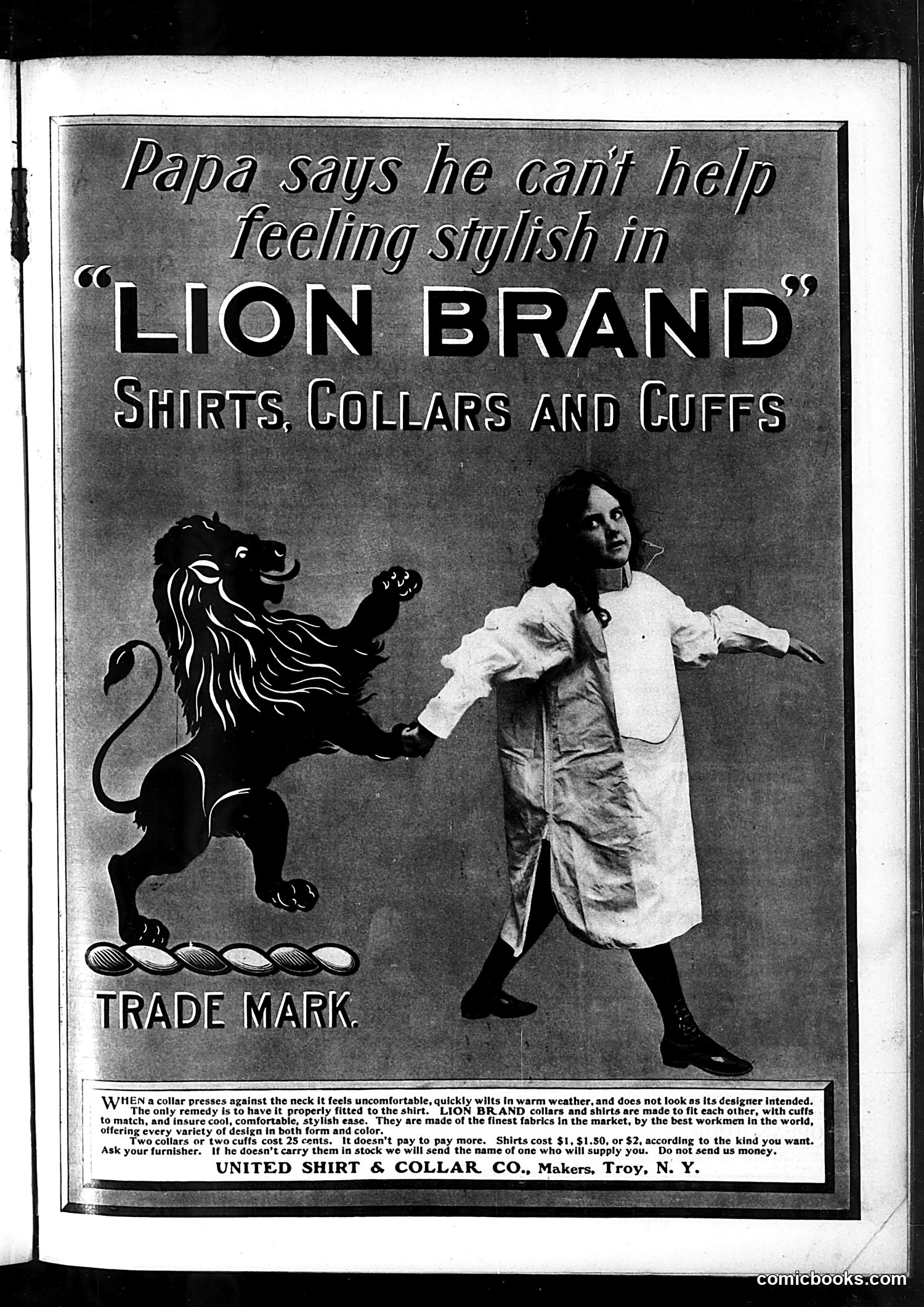
This is primarily a **product advertisement**, not political satire. It advertises "Lion Brand" shirts, collars, and cuffs made by United Shirt & Collar Co. of Troy, New York. The visual features a stylized lion (the brand's trademark) gesturing toward a man in formal dress, emphasizing the product's quality and style. The lion appears anthropomorphized to suggest sophistication. The ad's humor is light and commercial rather than satirical: it uses the playful tagline "Papa says he can't help feeling stylish in 'LION BRAND'" to suggest that wearing these products makes one fashionable almost involuntarily. The body text addresses a genuine consumer problem of the era—poorly-fitting collars that wilt and look unkempt—and proposes Lion Brand's solution: coordinated shirts and collars designed to fit together properly. Pricing and distribution information follow. This represents typical early-20th-century advertising strategy: combining brand mascotry, gentle humor, and practical product benefits to appeal to male consumers concerned with appearance.
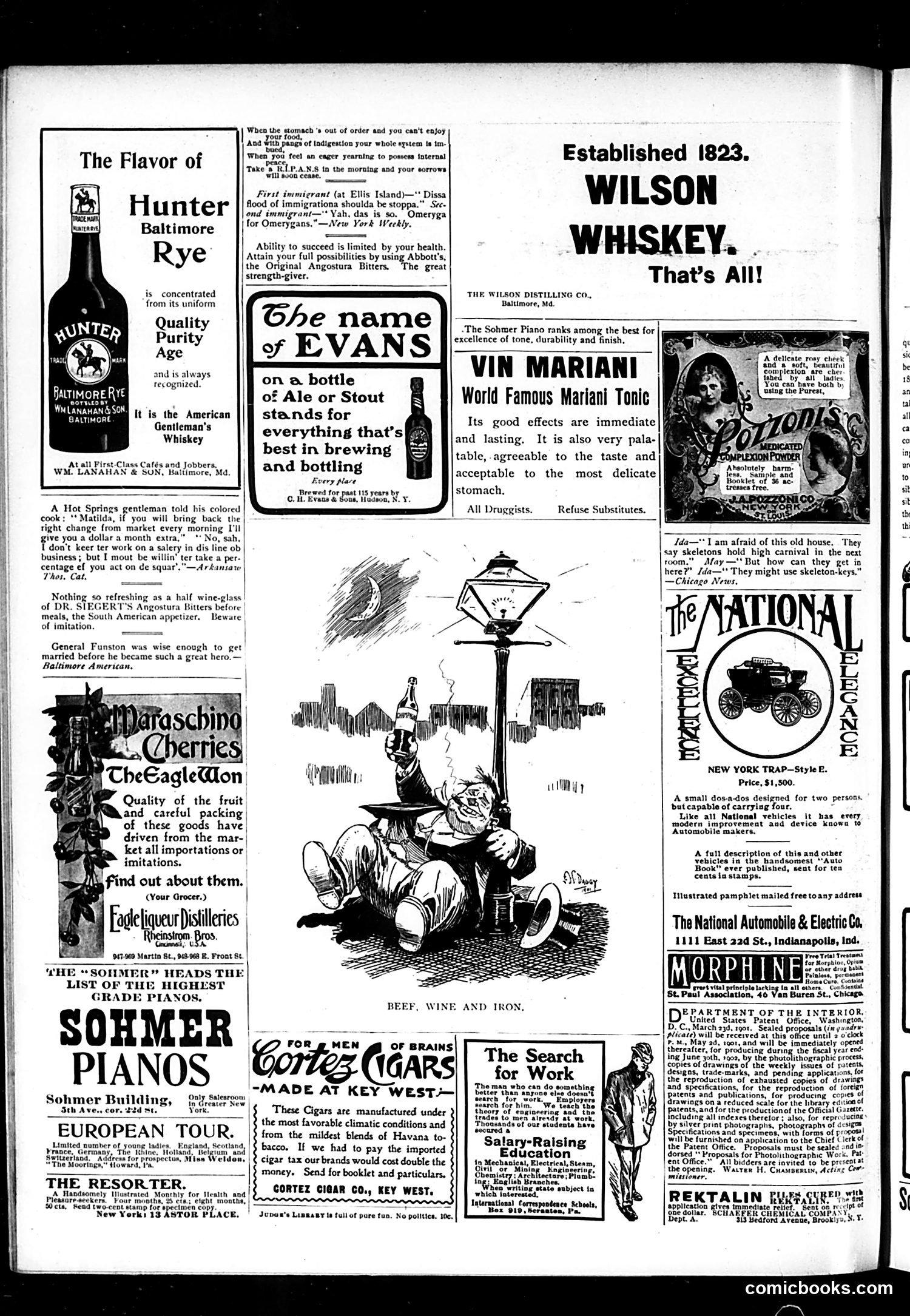
This page is primarily **advertising**, typical of Judge magazine's revenue model. The central cartoon depicts a cherub or cupid figure sitting beneath a street lamp, captioned "BEEF, WINE AND IRON"—likely promoting tonics or patent medicines promising vigor and vitality. Scattered throughout are brief satirical jokes reflecting early 1900s social attitudes: - A dialogue mocking **immigrant speech patterns** at Ellis Island, expressing anti-immigration sentiment - A joke about a **Black cook** negotiating wages, relying on racial dialect humor - A quip about General Funston (a Spanish-American War hero) that marriage was wise "before he became such a great hero"—suggesting cynicism about military fame The advertisements promote **alcohol** (whiskey, ale), **patent medicines** (Mariani tonic, Angostura bitters), **pianos**, **cigars**, and notably an early **automobile** (the National). The page reflects the era's casual racism, anti-immigrant sentiment, and faith in commercial "tonics" as cure-alls—attitudes that would be considered offensive today but were normalized in early 20th-century American magazines.
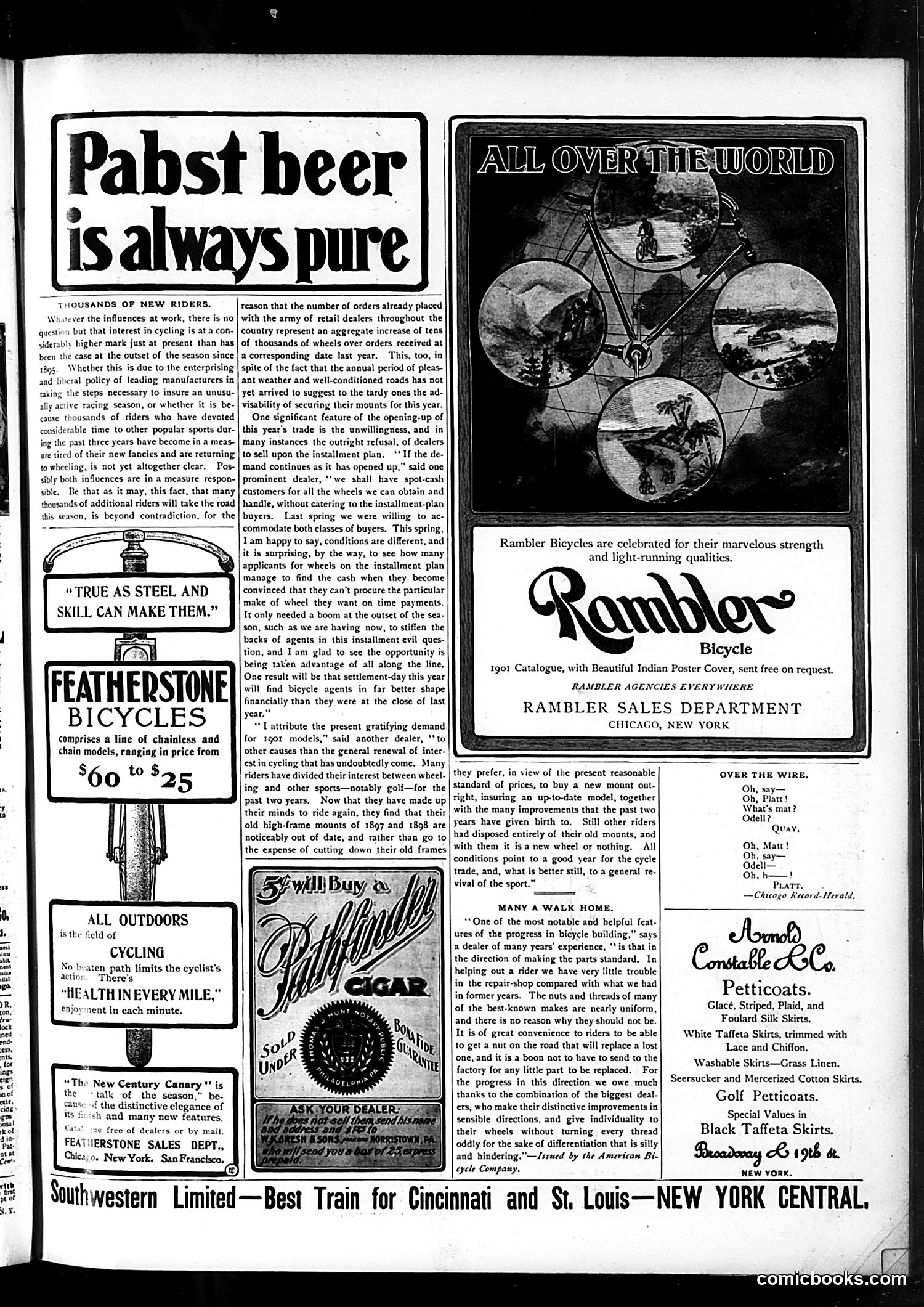
This page is primarily **advertising**, not satire or political commentary. It features bicycle and consumer goods advertisements from circa 1900, reflecting the cycling boom of that era. **Key content:** The left side discusses a surge in bicycle sales, with manufacturers and dealers reporting increased demand. Notably, dealers are refusing **installment-plan purchases**, demanding cash payment instead—suggesting economic confidence and strong demand. **Advertisements include:** - Pabst Beer (top left) - Featherstone Bicycles ($60-$225) - Rambler Bicycles (right side) - Various clothing ads (petticoats, golf wear) **Historical context:** This reflects America's "bicycle craze" of the 1890s-1900s, when cycling was enormously popular for recreation and transportation. The page's focus on cash sales over credit suggests economic prosperity during this period. The page contains no apparent political satire or caricature—it's straightforward period advertising and industry reporting.
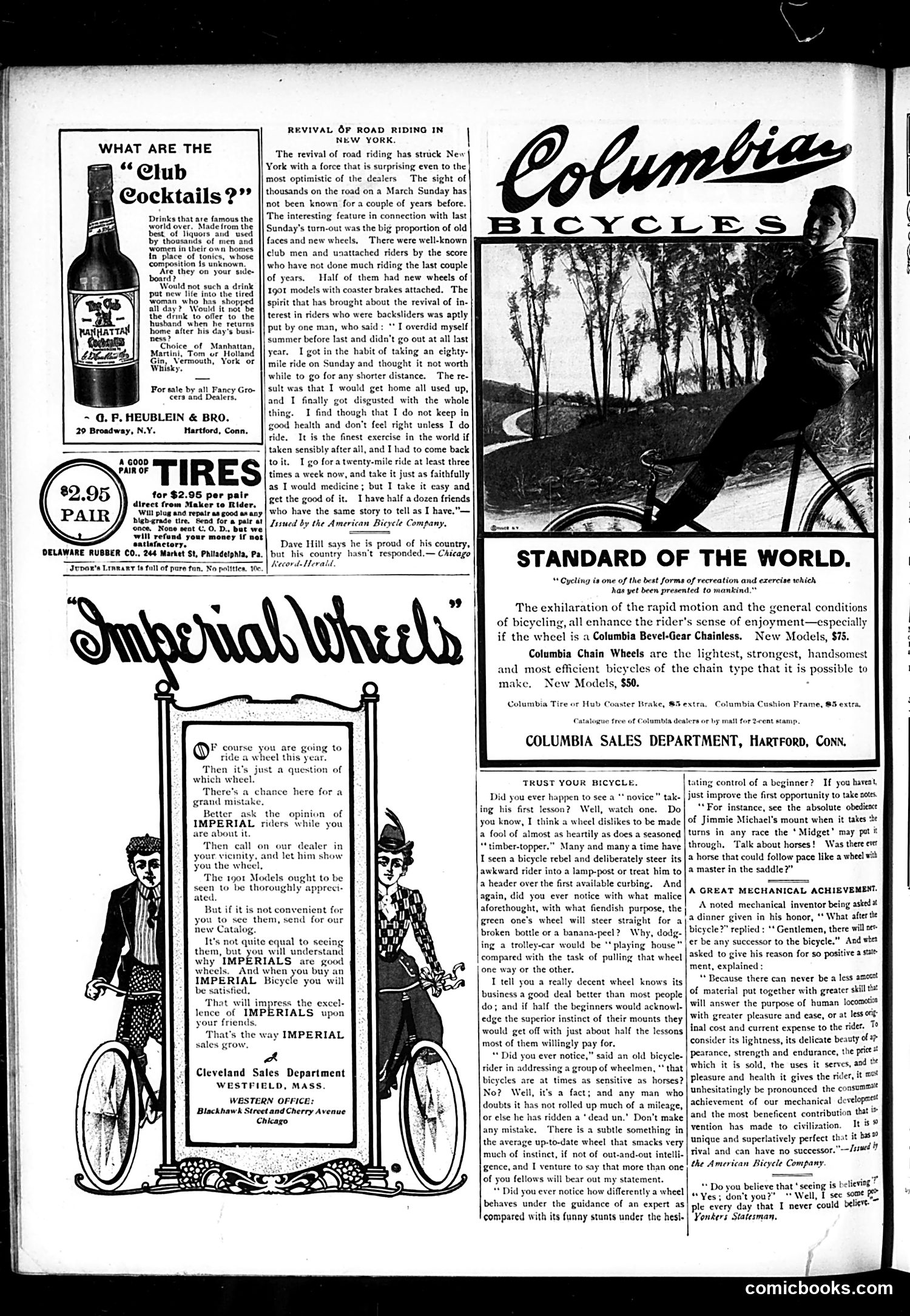
This page is primarily **advertising**, not political satire. It contains multiple bicycle and related product advertisements from the early 1900s. The main content describes a **revival of bicycle riding in New York**, noting that long-distance cycling (80-mile Sunday rides) had fallen out of favor, but is returning with shorter, more moderate 20-mile rides three times weekly. One cyclist quoted explains he abandoned cycling because he "overdid" it the previous summer, but now recognizes cycling's health benefits when done sensibly—comparing it to taking medicine. The advertisements promote **Columbia bicycles** ("Standard of the World"), **Imperial bicycles**, and **Delaware Rubber tires**, emphasizing quality and durability. There's also an ad for "Club Cocktails"—pre-mixed alcoholic drinks marketed as home tonics. The humor is minimal and situational rather than political: one brief item notes "Dave Hill says he is proud of his country, but his country hasn't responded"—a gentle jab at patriotic sentiment. This reflects early-1900s American leisure culture: cycling as both exercise and social activity, marketed alongside emerging consumer conveniences like pre-made cocktails.
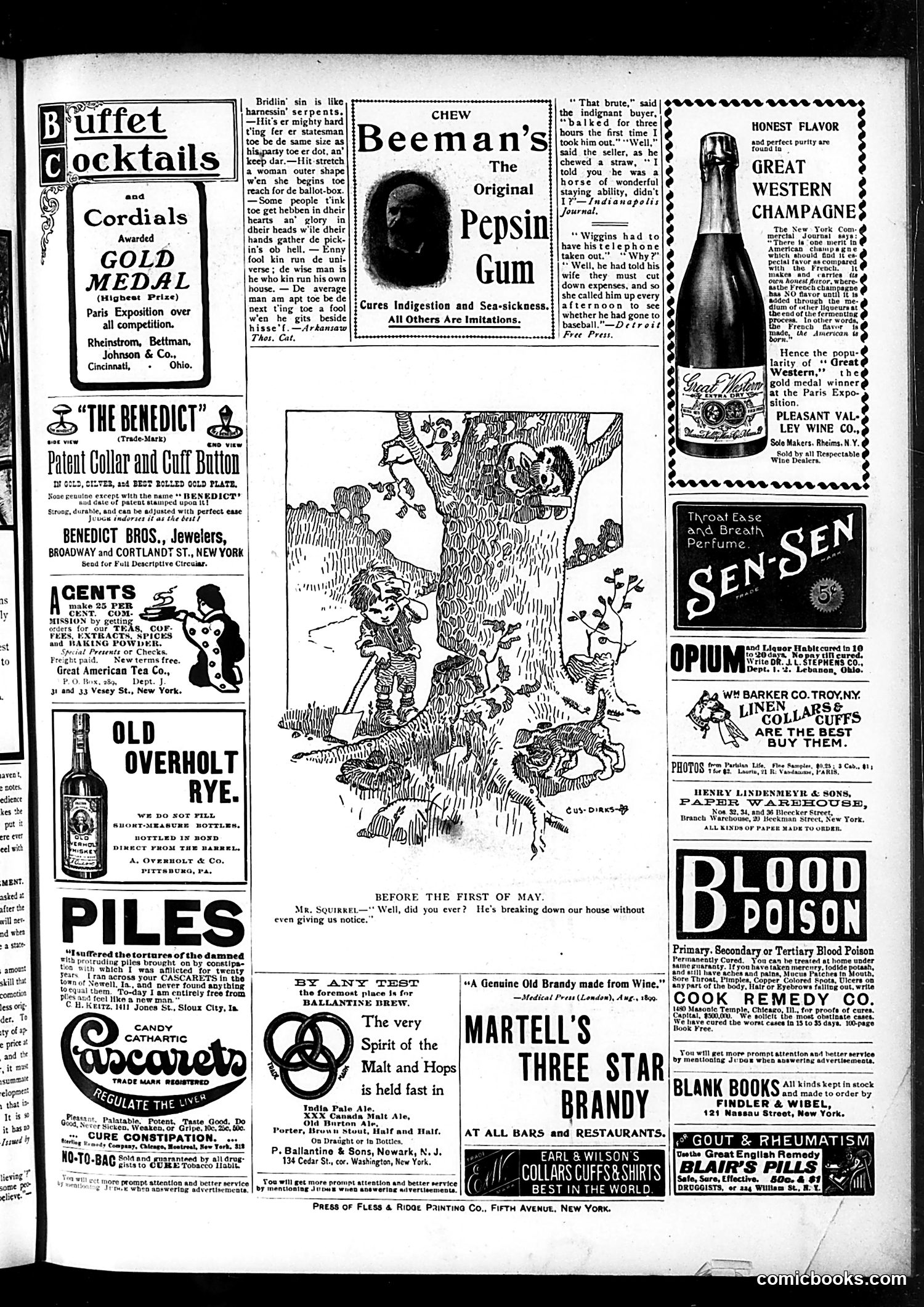
This page is primarily **advertising** with one central cartoon titled "Before the First of May." The cartoon depicts a squirrel complaining to another squirrel about a man breaking into their tree house without notice. The squirrel says, "Well, did you ever? He's breaking down our house without even giving us notice." **The satire**: This is a **housing/tenancy joke**. The cartoon anthropomorphizes squirrels as tenants, with the man as a landlord conducting an eviction or forcible entry without proper notice—a social complaint about landlords' treatment of renters. The humor comes from applying human legal/property disputes to animals, while satirizing contemporary unfair housing practices where landlords could remove tenants abruptly. The page also includes a racist dialect monologue in the left margin about "bridlin' sin" and political foolishness, typical of period Judge humor. The remainder consists of period advertisements for alcohol, medicines, and patent products—representing the commercialization of quack remedies common to early 20th-century magazines.
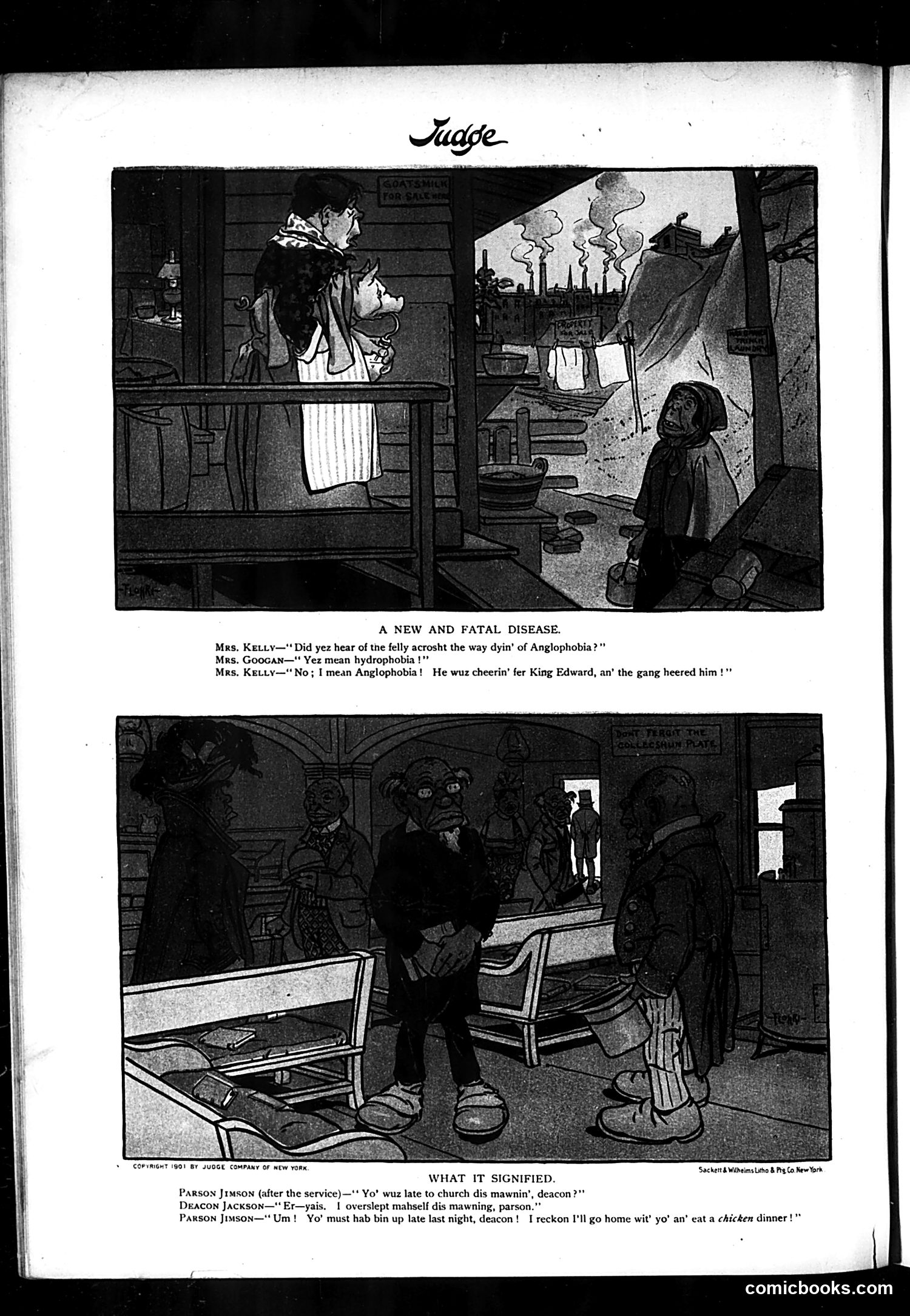
**Top cartoon ("A New and Fatal Disease"):** Uses Irish immigrant dialect to mock anti-British sentiment in working-class neighborhoods. A man supposedly dies of "Anglophobia" (hatred of England/King Edward VII) after being attacked by a gang for cheering the British monarch. The satire targets both Irish-American xenophobia and the casual street violence of urban gangs, while also poking fun at the Irish accent and pronunciation ("felly," "yez"). **Bottom cartoon ("What It Signified"):** Features African American characters (Parson Jimson and Deacon Jackson) in a racial stereotype piece. The deacon admits oversleeping; the parson infers late-night activity and invites himself to dinner, apparently expecting a chicken meal—playing on period racial stereotypes about African Americans and fried chicken. The "satire" relies entirely on demeaning caricature rather than social commentary. Both cartoons reflect Judge's era of casual ethnic and racial mockery typical of early-1900s American humor magazines.