
Judge, 1901-04-20 · page 2 of 16
Judge — April 20, 1901 — page 2: what you’re looking at
What you’re looking at
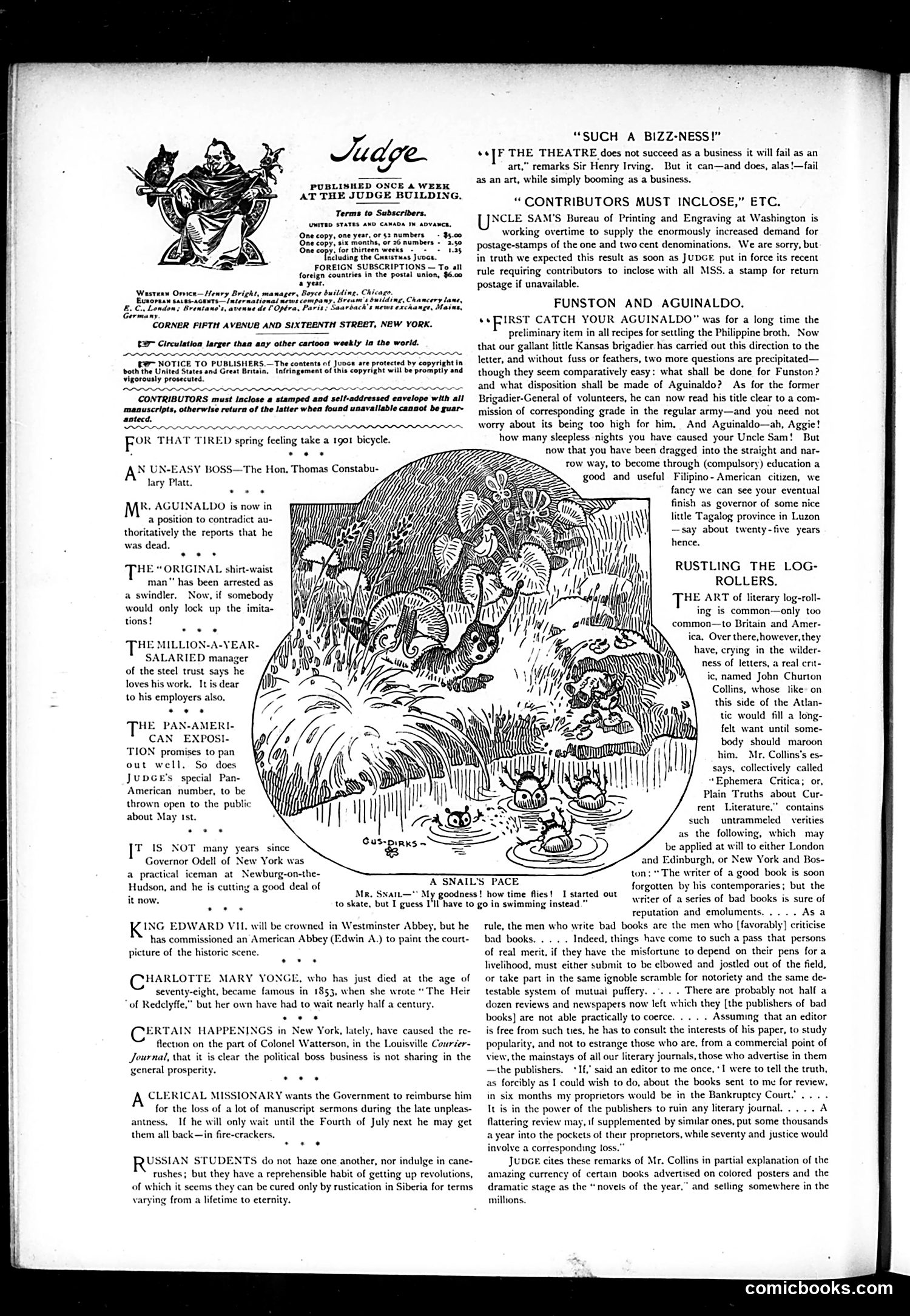
The central cartoon depicts a large snail moving slowly through shallow water, carrying what appears to be government or bureaucratic weight on its shell. Small figures around it seem frustrated by the pace of progress. This satirizes slow governmental action or bureaucratic inefficiency—a common Judge magazine theme. The snail metaphor represents how tediously slow official processes move despite public urgency or need. The surrounding text discusses various editorial matters, including complaints about literary critics, publisher disputes, and government reimbursement delays for a clerical missionary. The snail cartoon likely comments on one of these bureaucratic frustrations mentioned in the adjacent articles, though the specific historical reference is unclear without additional context about the publication date.
📄 Transcribed text from this page (OCR, searchable)
Machine-transcribed from the original scan — historical spelling and the odd misread are preserved.
PUBLISHED O: AT THE JUDG Terms to Subscribers, vrran sta ‘One copy, one year. or 53 numbers One copy, ix months, or 36 numbers ye thirteen weeks = = ding the Cunistmas Jun FOREIGN SUBSCRIPTIONS — To all foreign countries in the postal union, $6.00 a year, Wastenw Orricn—HHenry Bright, manager, Boyce building, Chicago. Evacraan saves-acents—(nternational mews company. Bream 1 butiding, Chancery Lane, zg avenue def Optra, Paris; Saarbach's mews exchange, J AMD CANADA It ADVAWCR, CORNER FIFTH AVENUB AND SIXTEENTH STREET, NEW YORK. (97- Circulation larger than any other cartoon weekly 1a the world. 12 of Juooe are protected by copyright in Ee~ NOTICE TO PUBLISHERS.—The cor Gi vent of this copyright will be promptly and both the United States and Great Britain. Infringe vigorously prosecuted. CONTRIBUTORS must Iaclose a stamped and self-addressed envelope with all manuscripts, otherwise return of the latter when found unavailable cannot be guare antecd. FOR THAT TIRED spring feeling take a 1901 bicycle. AN UN-EASY BOSS—The Hon, Thomas Constabu- lary Platt. M*. AGUINALDO is now in a position to contradict au- thoritatively the reports that he was dead. THE “ORIGINAL shirt-waist man” has been arrested as a swindler. Now, if somebody would only lock up the imita- tions! THE MILLION-A-VEAR- ALARIED manager of the steel trust says he loves his work, It is dear to his employers also, THE PAN-AMERI- CAN EXPOSI- TION promises to pan out well. So does JupGe's special Pan- American number, to be thrown open to the public about May 1st. NOT many years since ernor Odell of New York was iceman at Newburg-on-the- Hudson, and he is cutting a good deal of it now. KING EDWARD VIL. will be crowned ia Westminster Abbey, but he has commissioned an American Abbey (Edwin A.) to paint the court- picture of the historic scene. HARLOTTE MARY YONGE, who has just died at the age of seventy-eight, became famous in 1853, when she wrote “The Heir “of Redelyffe,” but her own have had to wait nearly half a century. ss ERTAIN HAPPENINGS in New York, lately, have caused the re- flection on the part of Colonel Watterson, in the Louisville Couréer- Journal, that it is clear the political boss business is not sharing in the general prosperity. . A CLERICAL MISSIONARY wants the Government to reimburse him for the loss of a lot of manuscript sermons during the late unpleas- antness, If he will only wait until the Fourth of July next he may get them all back—in fire-crackers. RUSSIAN STUDENTS do not haze one another, nor indulge in cane- rushes; but they have a reprehensible habit of getting up revolutions, of which it seems they can be cured only by rustication in Siberia for terms varying from a lifetime to eternity. ‘A SNAILS Mr. SvaiL—"' My goodness! how time flies ! to skate, but I guess I'll have to go in swimming instead.” “SUCH A BIZZ-NESS!” se] F THE THEATRE does not succeed as a business it will fail as an art,” remarks Sir Henry Irving. But it can—and does, alas !—fail as an art, while simply booming as a business. “ CONTRIBUTORS MUST INCLOSE,” ETC. NCLE SAM'S Bureau of Printing and Engraving at Washington is working overtime to supply the enormously increased demand for postage-stamps of the one and two cent denominations. We are sorry, but in truth we expected this result as soon as JUDGE put in force its recent rule requiring contributors to inclose with all MSS. a stamp for return postage if unavailable. FUNSTON AND AGUINALDO. *sBIRST CATCH YOUR AGUINALDO” was for a long time the preliminary item in all recipes for settling the Philippine broth. Now that our gallant little Kansas brigadier has carried out this direction to the letter, and without fuss or feathers, two more questions are precipitated— though they seem comparatively easy: what shall be done for Funston? and what disposition shall be made of Aguinaldo? As for the former Brigadier-General of volunteers, he can now read his title clear to a com- mission of corresponding grade in the regular army—and you need not worry about its being too high for him, And Aguinaldo—ah, Aggie! how many sleepless nights you have caused your Uncle Sam! But now that you have been dragged into the straight and nar- row way, to become through (compulsory) education a good and useful Filipino- American citizen, we fancy we can see your eventual finish as governor of some nice little Tagalog province in Luzon —say about twenty-five years hence. RUSTLING THE LOG- ROLLERS. THE ART of literary log-roll- ing is common—only too common—to Britain and Amer- ica, Over there,however,they have, crying in the wilder- ness of letters, a real crit- ic, named John Churton Collins, whose like on this side of the Atlan- tic would fill a long- felt want until some- body should maroon him. Mr. Collins's es- says, collectively called hemera Critica; or, Plain Truths about Cur- rent Literature.” contains such untrammeled _ verities as the following, which may be applied at will to either London and Edinburgh, or New York and Bos- ton: * The writer of a good book is soon forgotten by his contemporaries; but the writer of a series of bad books is sure of reputation and emoluments... . . Asa tule, the men who write bad books are the men who [favorably] criticise bad books Indeed, things have come to such a pass that persons of real merit, if they have the misfortune to depend on their pens for a livelihood, must either submit to be elbowed and jostled out of the field, or take part in the same ignoble scramble for notoriety and the same de- testable system of mutual puffery. .”. . . There are probably not half a dozen reviews and newspapers now left which they [the publishers of bad books] are not able practically to coerce. . Assuming that an editor is free from such ties, he has to consult the interests of his paper, to study popularity, and not to estrange those who are, from a commercial point of view, the mainstays of all our literary journals, those who advertise in them —the publishers. * If," said an editor to me once, ‘I were to tell the truth, as forcibly as I could wish to do, about the books sent to me for review, in six months my proprietors would be in the Bankruptcy Court.” . It is in the power of the publishers to ruin any literary journal... .. A flattering review may, 1f supplemented by similar ones, put some thousands a year into the pockets of their proprietors, while seventy and justice would involve a corresponding loss.” JUDGE cites these remarks of Mr. Collins in partial explanation of the amazing currency of certain books advertised on colored posters and the dramatic stage as the “novels of the year,” and selling somewhere in the millions. PACE I started out comicbooks.com