
A complete issue · 16 pages · 1901
Judge — April 6, 1901
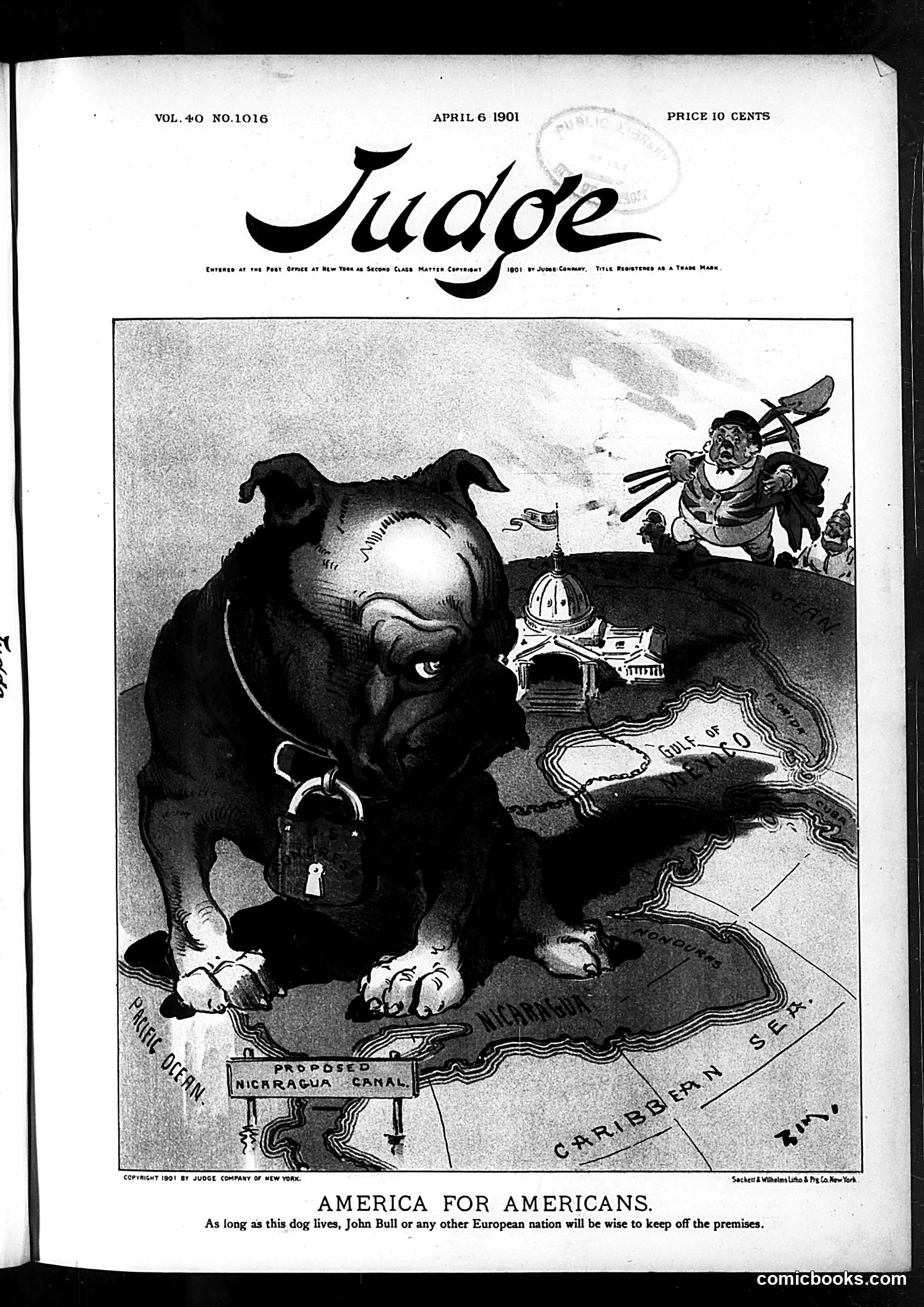
This political cartoon opposes the proposed Nicaragua Canal. The large bulldog labeled "John Bull" (representing Britain) guards the canal entrance with a padlock, while armed figures (likely representing European powers) approach from the right. The caption "America for Americans" argues that America should exclude foreign interference from the canal project. The satire suggests that if America allows European nations, particularly Britain, to maintain control or influence over a Central American canal, American interests will be compromised. The dog metaphor implies Britain will "bite" or protect its interests aggressively. This reflects early 20th-century American isolationist sentiment and debate over whether European powers should have involvement in Western Hemisphere infrastructure projects.
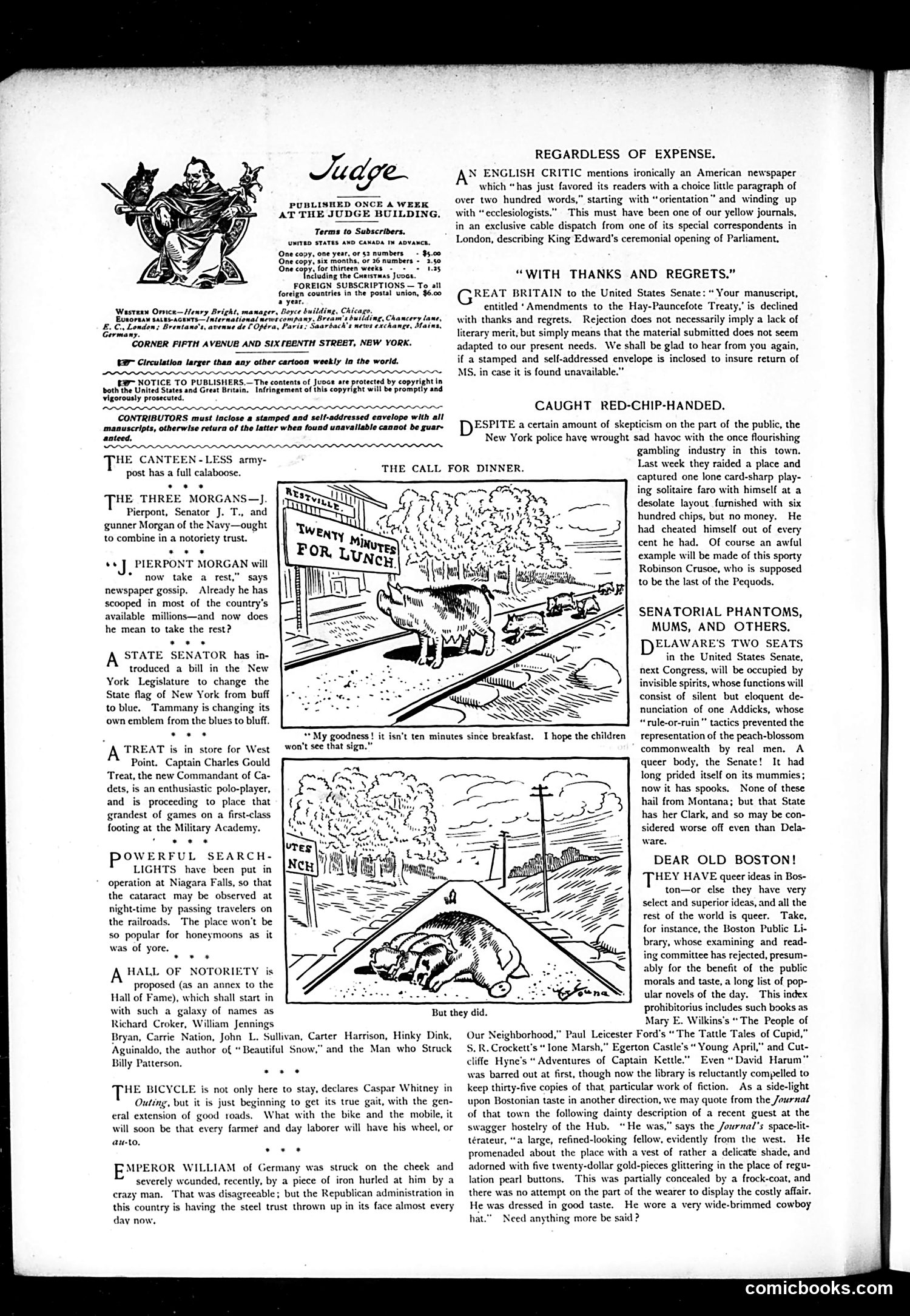
This page contains satirical commentary typical of Judge magazine's political critique. The two main cartoons show: **"The Call for Dinner"**: A large dog approaches a restaurant marked "Twenty Minutes for Lunch," illustrating the rushed pace of American urban life—a common target of satire about modern civilization's frenetic schedule. **"But they did"**: Shows a figure in what appears to be a rural or frontier setting, likely satirizing American expansion or settlement practices, though the specific reference remains unclear from context provided. The text sections include commentary on senatorial matters, Delaware's representation, and Boston's cultural institutions. The satire critiques political pretense, institutional hypocrisy, and class attitudes—characteristic of Judge's Progressive-era editorial stance. Without specific date markers visible, the exact political figures or events referenced cannot be definitively identified.
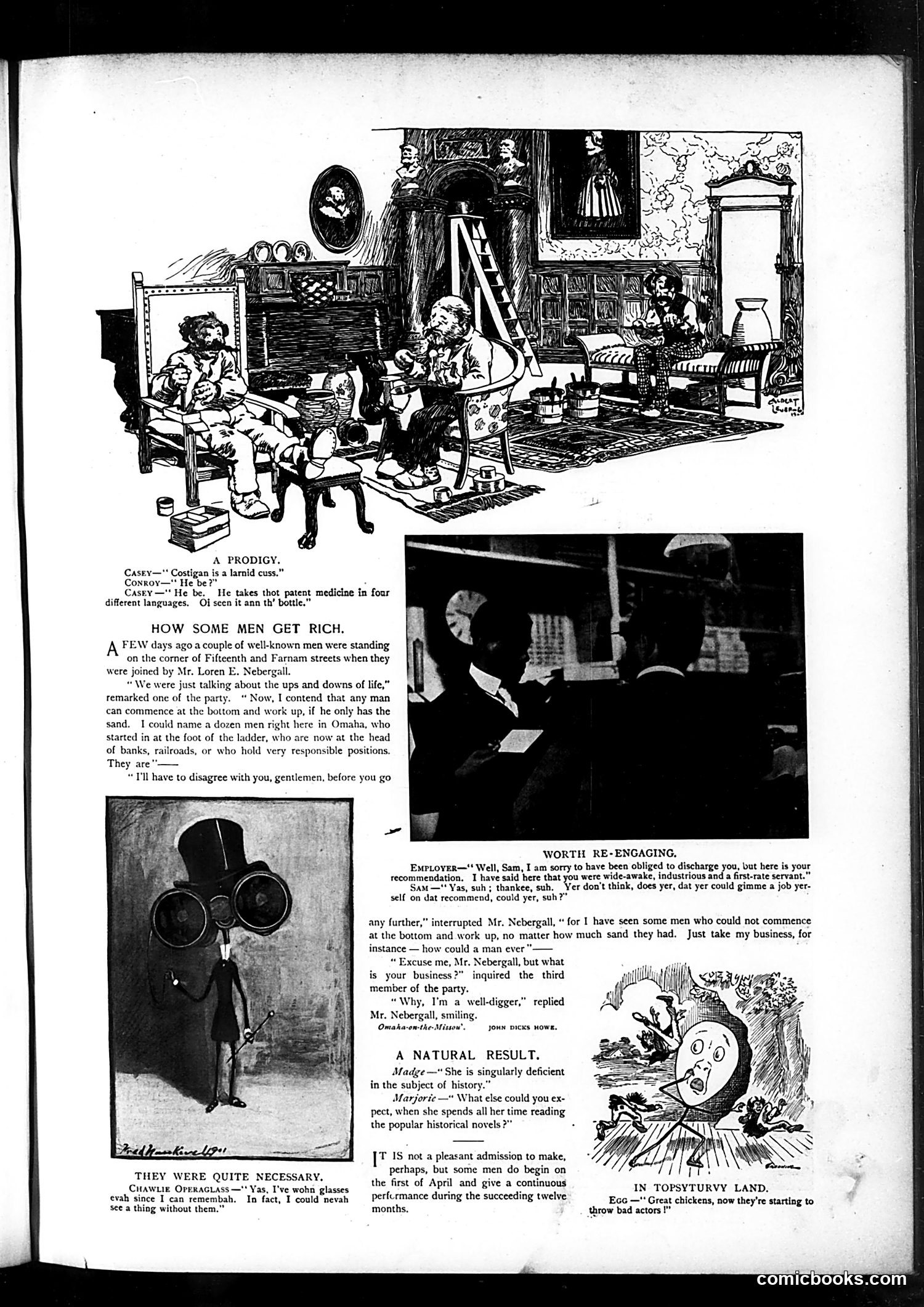
This page from the satirical magazine Judge contains several humorous sketches and dialogues: **"Prodigy"** depicts a child as a linguistic prodigy who refuses medicine unless asked in multiple languages—mocking precocious children and their pretentious parents. **"How Some Men Get Rich"** features Mr. Loren E. Nebergall discussing social climbing. The dialogue satirizes the American myth that anyone can rise from poverty through hard work, with characters disagreeing about whether this is actually possible. The accompanying photograph and illustration appear to show a well-dressed gentleman, contrasting with the discussion. **Other sketches** include "Worth Re-engaging," "A Natural Result," and "In Topsyturvy Land"—brief humorous observations about human nature and social absurdities typical of Judge's satirical style. The page primarily demonstrates the magazine's approach to social commentary through short comic scenarios rather than political cartooning.
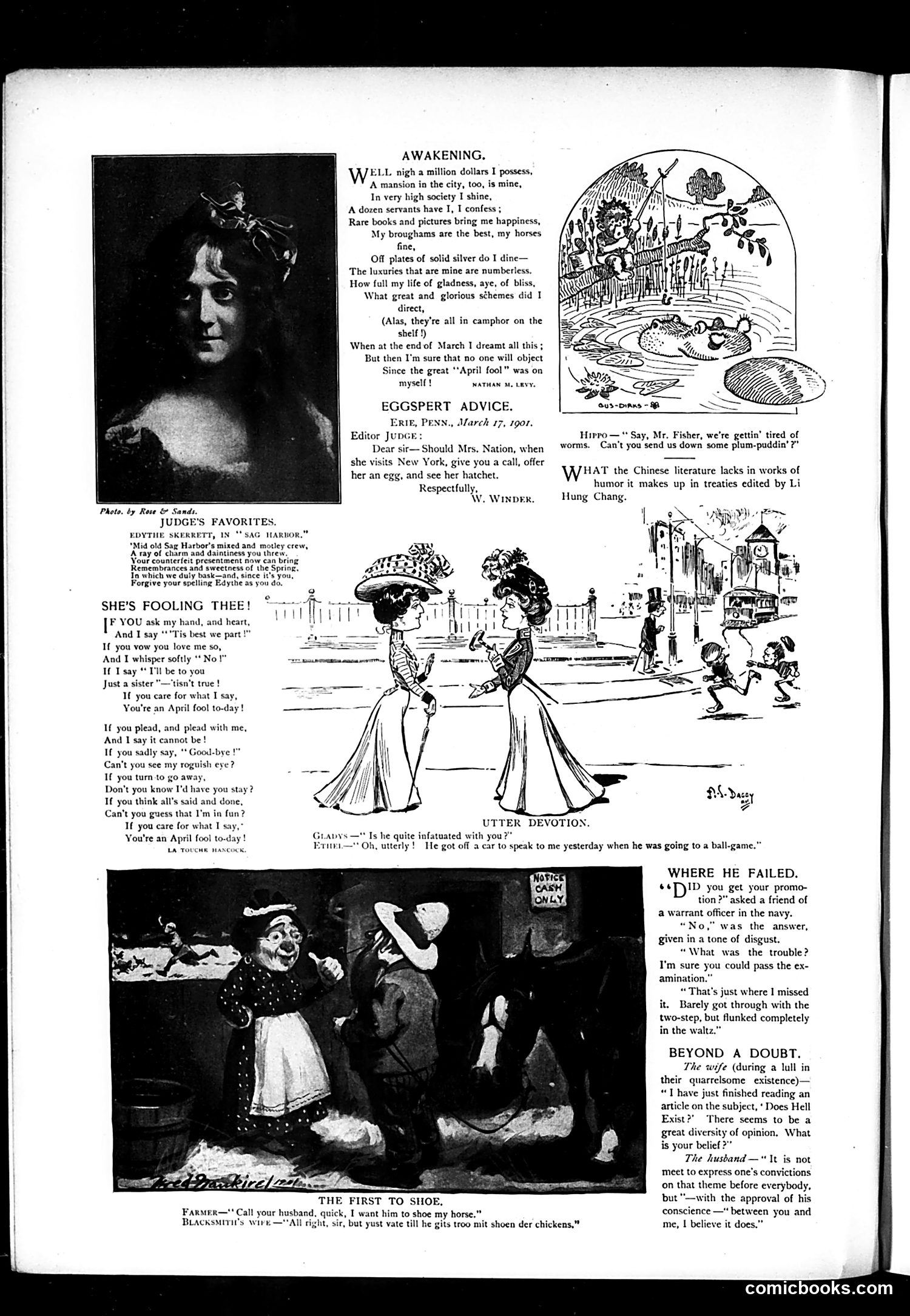
This page contains several unrelated humorous pieces rather than unified political commentary: **"Awakening"** presents a wealthy woman questioning her materialist lifestyle—a common Progressive-era critique of the leisured rich. **"Judge's Favorites"** features actress Edythe Seakert from "Bad Harbor," with a poem titled "She's Fooling Thee!"—satirizing romantic deception. **"Eggspurt Advice"** is a humorous advice column mocking pretentious expertise (the "eggspurt" pun). **"The First to Shoe"** depicts domestic conflict—a farmer demands his wife call his husband to shoe a horse; the blacksmith's wife replies the husband is occupied with chickens, suggesting conjugal neglect or miscommunication. **"Where He Failed"** and **"Beyond a Doubt"** are brief anecdotal humor pieces about marital discord and social awkwardness rather than political satire. The page emphasizes domestic and social humor over political commentary.
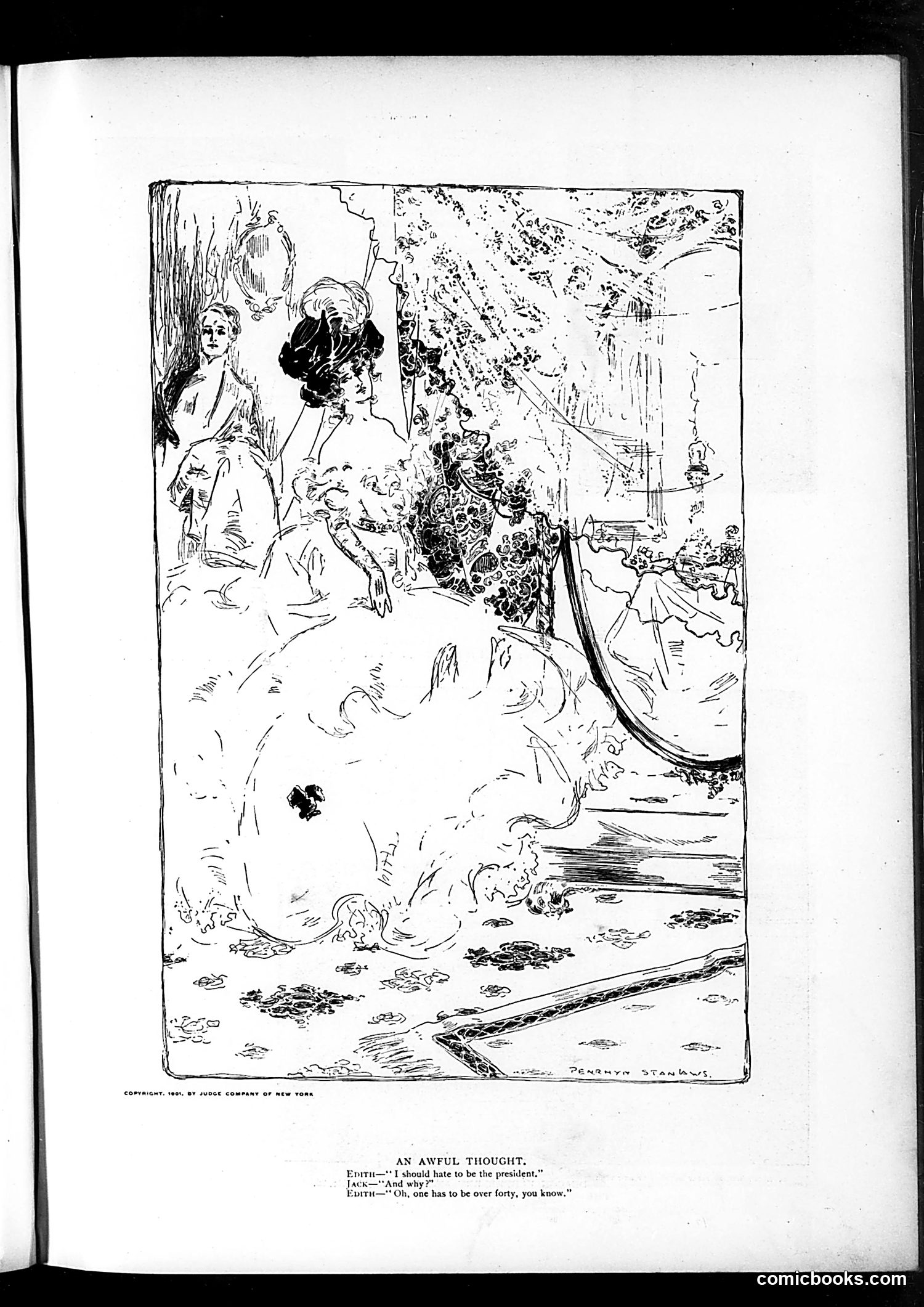
This cartoon from *Judge* magazine depicts a domestic scene titled "An Awful Thought." The dialogue suggests a woman expressing concern about her husband becoming president, with a male figure (Jack) questioning "why?" and a female figure (Edith) responding that someone "has to be over forty, you know." The satire appears to mock anxieties about presidential eligibility requirements—specifically the Constitutional mandate that presidents must be at least 35 years old. The "awful thought" likely satirizes either contemporary political anxieties about a particular candidate's age, or broader concerns about who might assume high office. The elaborate interior setting with multiple figures in formal dress suggests upper-class domestic worry about politics intruding on private life. Without knowing the specific publication date or political context, the exact target remains unclear, though it appears to critique both presidential ambition and domestic political anxiety of the era.
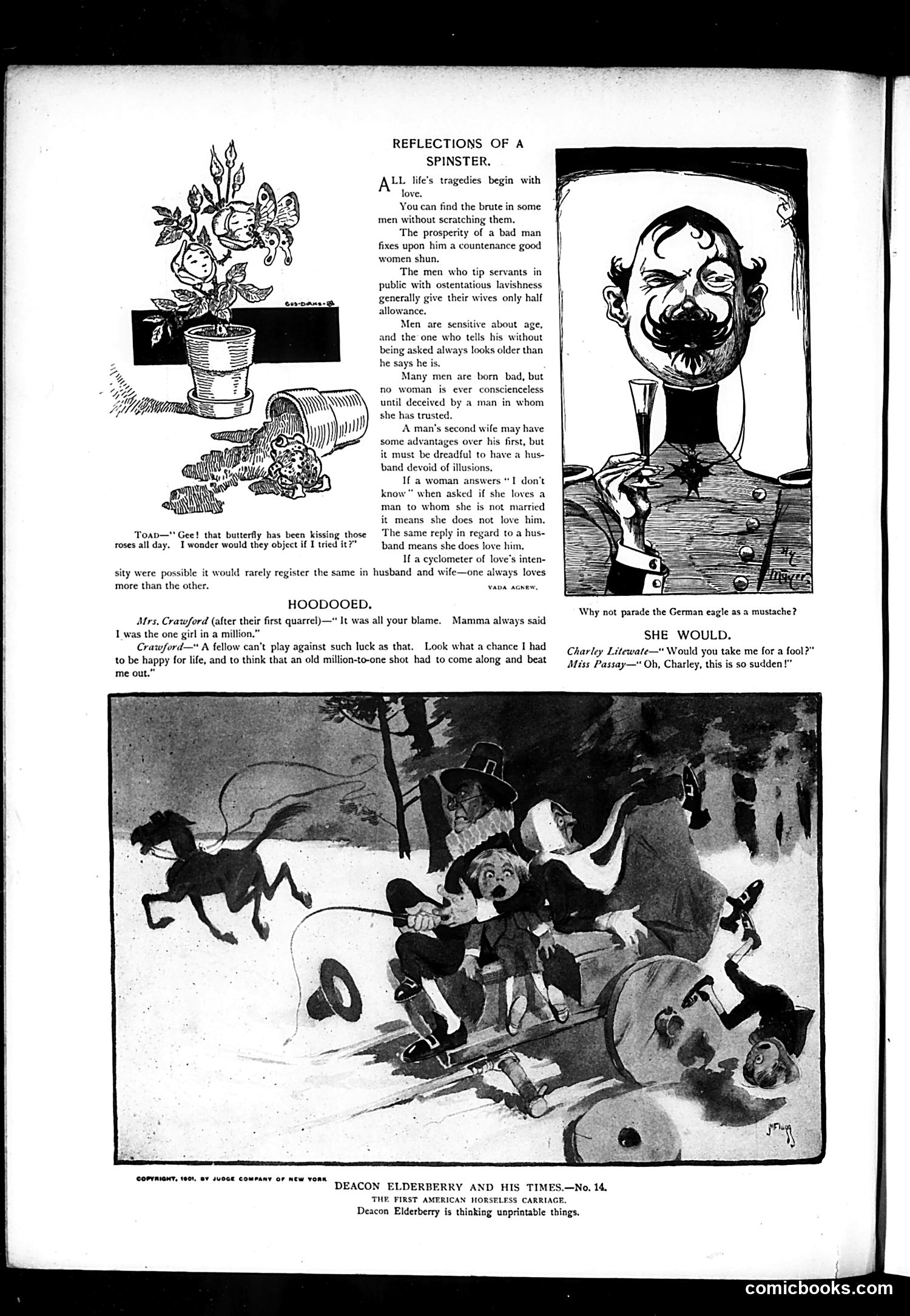
This page contains early-20th-century satirical humor targeting romantic and marital relationships. The main content includes: **"Reflections of a Spinster"**: Cynical observations about men and marriage, presumably from an unmarried woman's perspective, touching on infidelity, materialism, and the different intensities of love between spouses. **The cartoons** feature domestic humor typical of the era: - A toad kissing roses (innuendo humor) - A caricatured man's head commenting on German eagles/mustaches (unclear reference, possibly anti-German sentiment given the 1901 copyright date) - "Deacon Elderberry and His Times": Shows a man apparently disturbed by an early motorcar ("horseless carriage"), suggesting generational anxiety about new technology replacing traditional transportation The humor relies on period stereotypes about gender relations, class pretension, and technological disruption. The tone is condescending toward both women and social climbers, characteristic of early Judge magazine's satirical approach.
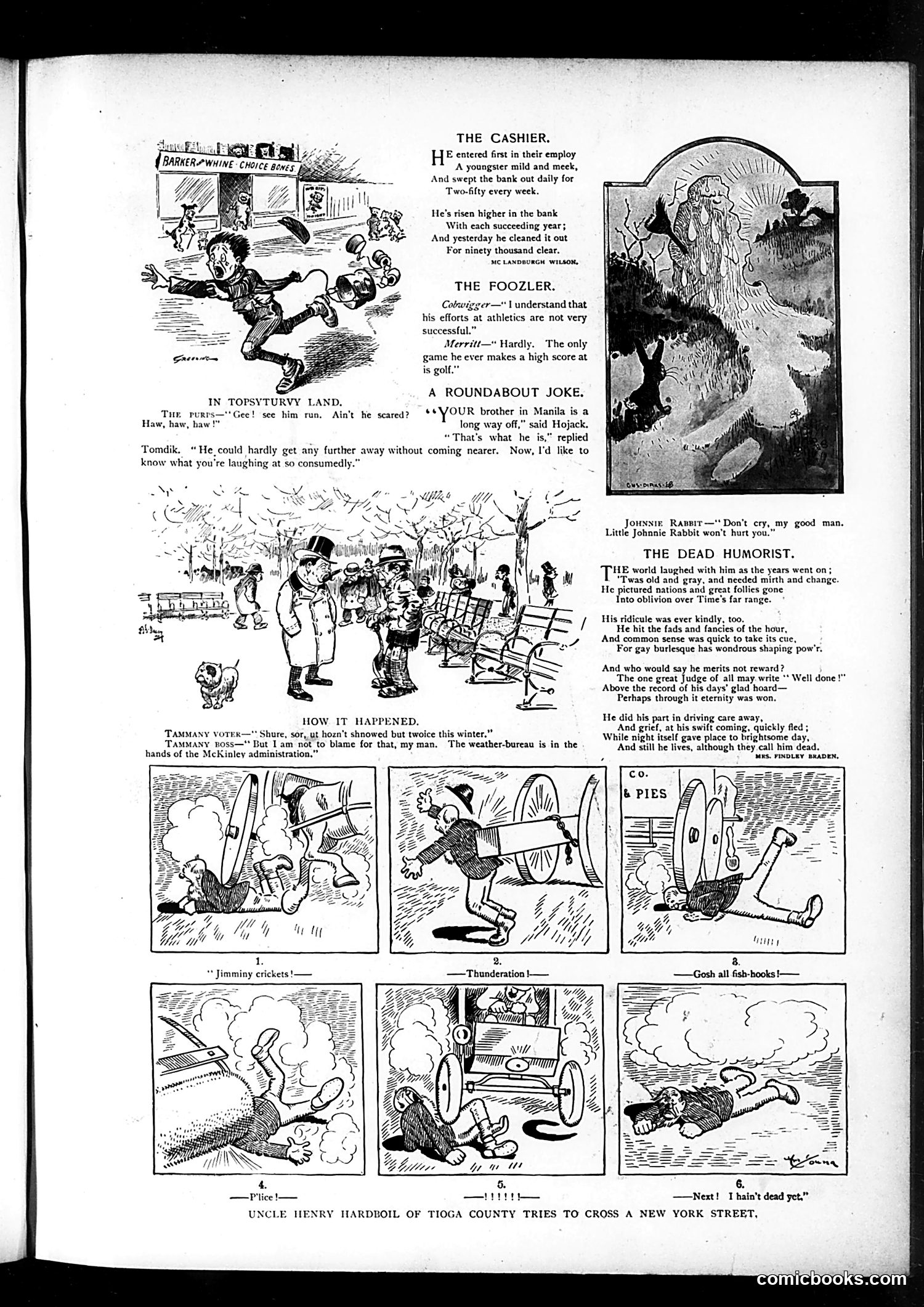
This page contains satirical commentary on contemporary American society, circa early 1900s. **"The Cashier"** satirizes embezzlement—a young bank employee rises through ranks before absconding with $90,000, mocking both financial institutions' security and employee trustworthiness. **"The Foozler"** jokes that an athletic failure's only "high score" is at golf, a genteel sport requiring no physical prowess. **"A Roundabout Joke"** plays on the Philippines being distant from America (likely referencing the recent Spanish-American War and U.S. colonial involvement). **"How It Happened"** depicts a Tammany Hall (NYC Democratic machine) operative blaming McKinley's Republican administration for snow, satirizing partisan blame-shifting. **"The Dead Humorist"** eulogizes a satirist whose ridicule improved society—possibly referencing a recently deceased cartoonist/writer. **"Uncle Henry Hardboil"** shows a rural man comically overwhelmed crossing a New York street, mocking rural/urban cultural gaps. The page emphasizes political corruption, social pretension, and generational/geographic divides characteristic of Gilded Age satire.
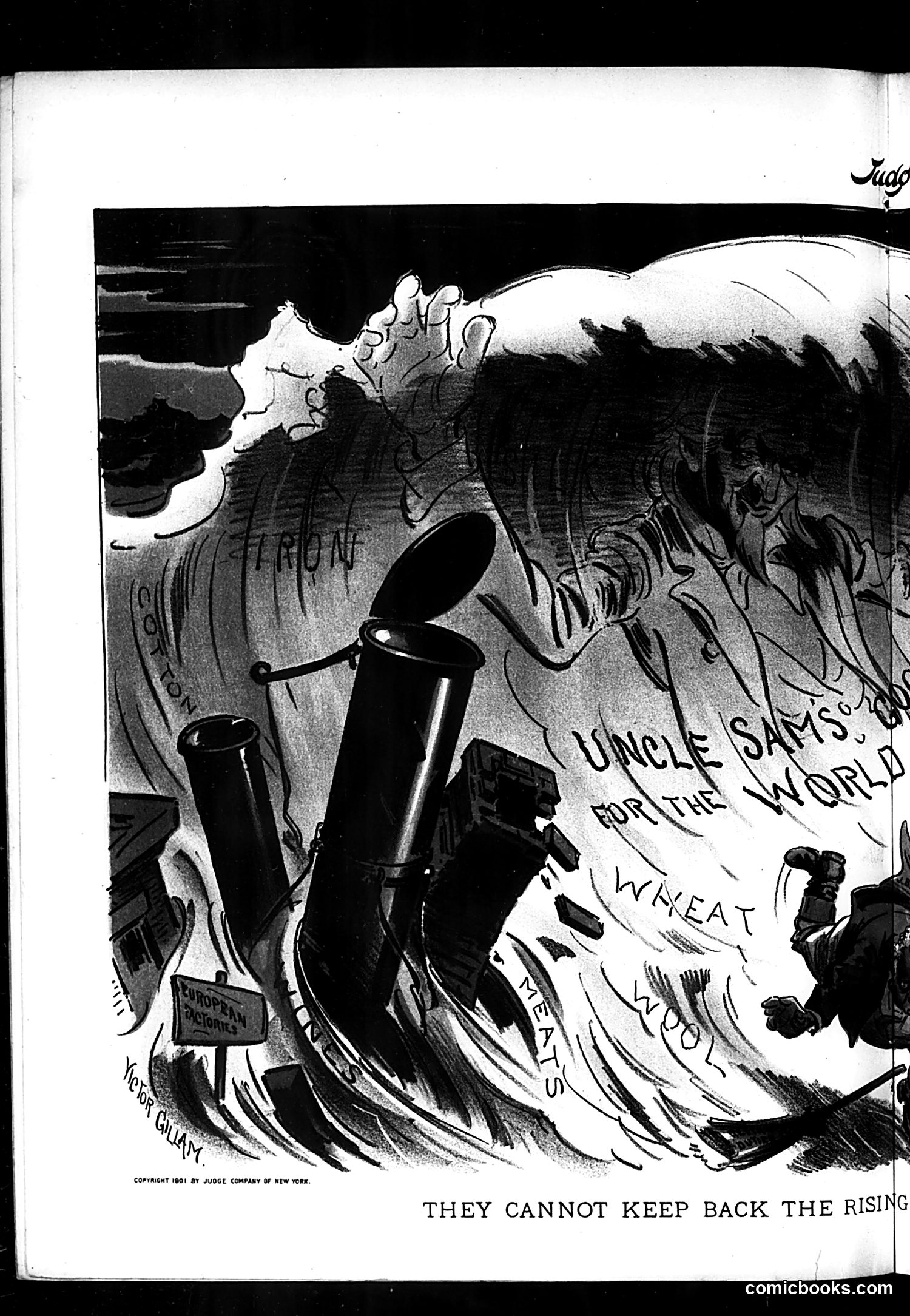
This cartoon depicts a massive wave labeled "Uncle Sam's For the World" with wheat and other supplies, overwhelming what appears to be barriers or opposition forces below. The title "They Cannot Keep Back the Rising" suggests an unstoppable tide of American agricultural abundance or aid. The cartoon likely references post-WWI American grain exports and food aid, possibly related to relief efforts in Europe or debates about American agricultural surplus reaching global markets. The figure at top appears to be a personified force (possibly representing resistance or foreign competition) trying unsuccessfully to hold back the wave. The specific historical context—date, particular policies, or nations involved—remains unclear without additional publication information, though the imagery emphasizes America's overwhelming productive capacity.
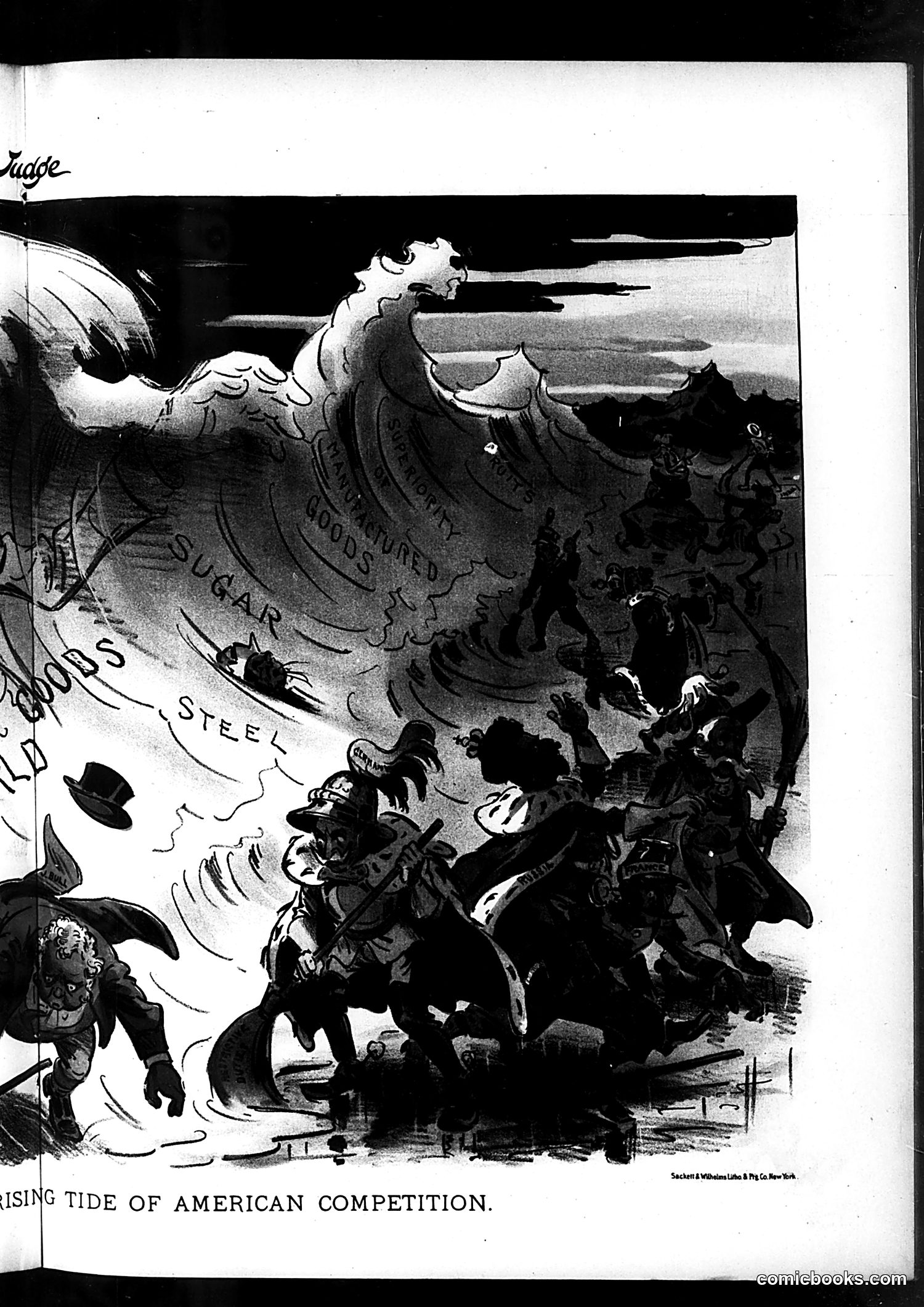
This political cartoon depicts a large wave labeled with industrial terms like "STEEL" and "GOODS" threatening foreign figures dressed in formal attire. The wave appears to represent American industrial and commercial power expanding globally. The cartoon satirizes American economic competition in international markets during the industrial era. Foreign businessmen or politicians—shown as caricatured figures in top hats—are being overwhelmed by the surge of American manufacturing and commerce. The imagery suggests both pride in American industrial might and perhaps anxiety about its aggressive expansion into world markets. The "rising tide" metaphor conveys inevitability, portraying American economic dominance as a natural, unstoppable force. The specific identities of the foreign figures remain unclear from the image alone.
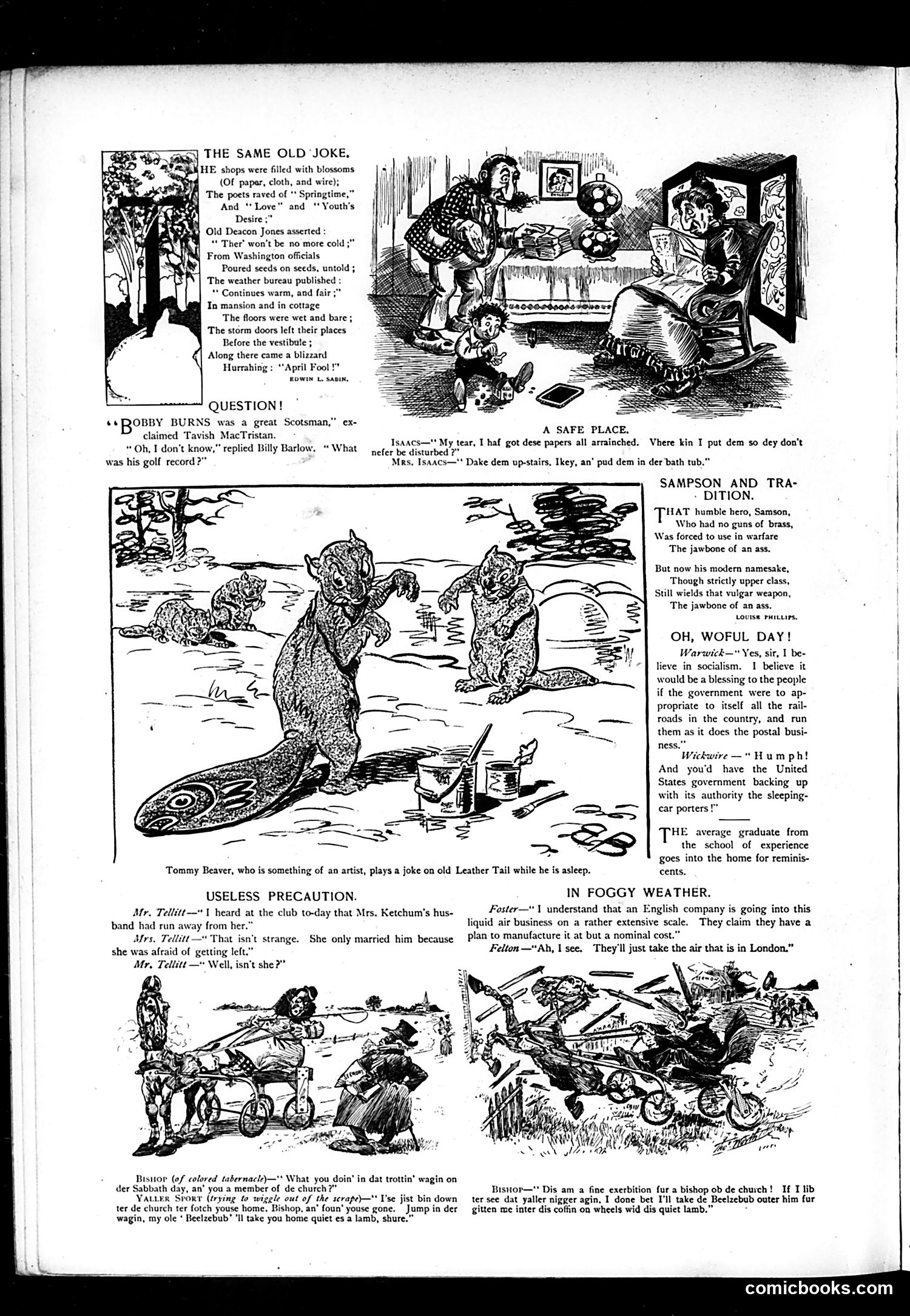
This page contains multiple satirical cartoons and jokes typical of early 20th-century American humor: **"The Same Old Joke"** mocks the perennial false spring—Washington officials promise warm weather, poets celebrate spring, yet April brings a blizzard instead. The satire targets both government incompetence and predictable seasonal disappointment. **"Question!"** is an ethnic joke playing on Scottish stereotypes (Bobby Burns) and golf, representing common period humor. **"A Safe Place"** depicts a Jewish character (Isaacs) storing papers in a bathtub—likely satirizing immigrant domestic habits or anxiety about document safety. **"Sampson and Tradition"** compares the biblical strongman to a modern socialite still using crude weapons (the "jawbone of an ass"), contrasting ancient necessity with modern affectation. **Other pieces** include political debate about socialism and railroads, a sleeping animal cartoon, and racial humor (the Bishop and "Yaller Sport" dialogue) reflecting period attitudes toward African Americans. The page represents Judge's mix of wordplay, visual gags, and social commentary targeting immigrants, politicians, and social trends.
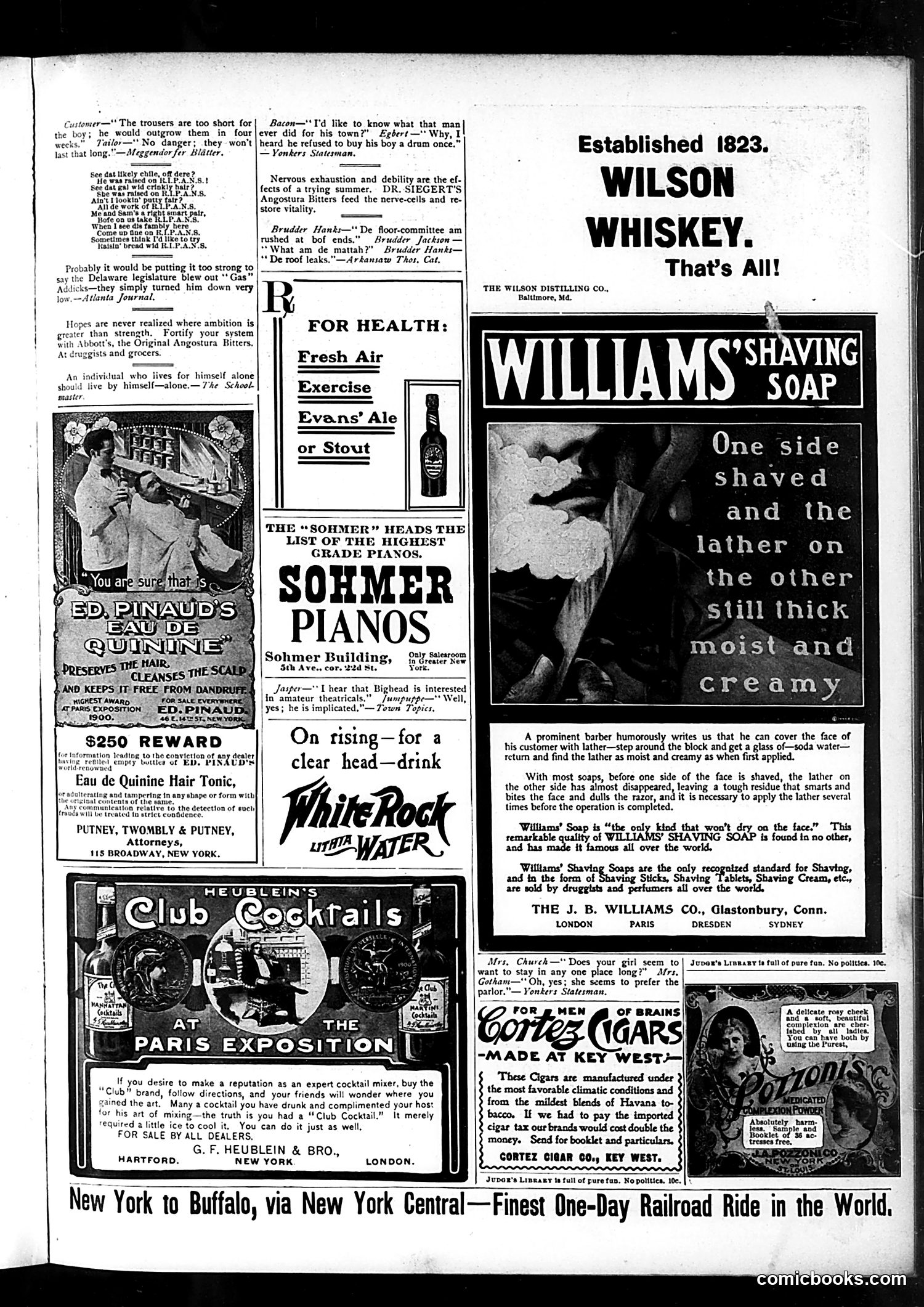
This page is primarily **advertising**, with only brief comedic snippets interspersed among product promotions. The actual satirical content is minimal: **The Cartoons/Jokes:** - A tailor-customer exchange mocking poor workmanship (trousers won't last four weeks) - A dialect piece celebrating "Fulpans" hair product's effectiveness on Black families - A brief politician joke about Delaware "blowing out Gas" (possibly referencing a political figure named Gas) - Small quips about ambition, a leaky roof, and a man refusing to buy his son a drum **Context for Modern Readers:** The "Fulpans" segment uses period-appropriate racial stereotypes and dialect humor common to early 1900s publications. The Delaware reference likely alludes to a contemporary political figure, now obscure. Most content serves merely as filler between advertisements for whiskey, pianos, shaving soap, and patent medicines—Judge's primary revenue source. The satirical edge is largely absent; this is a commercial publication masquerading as humor.
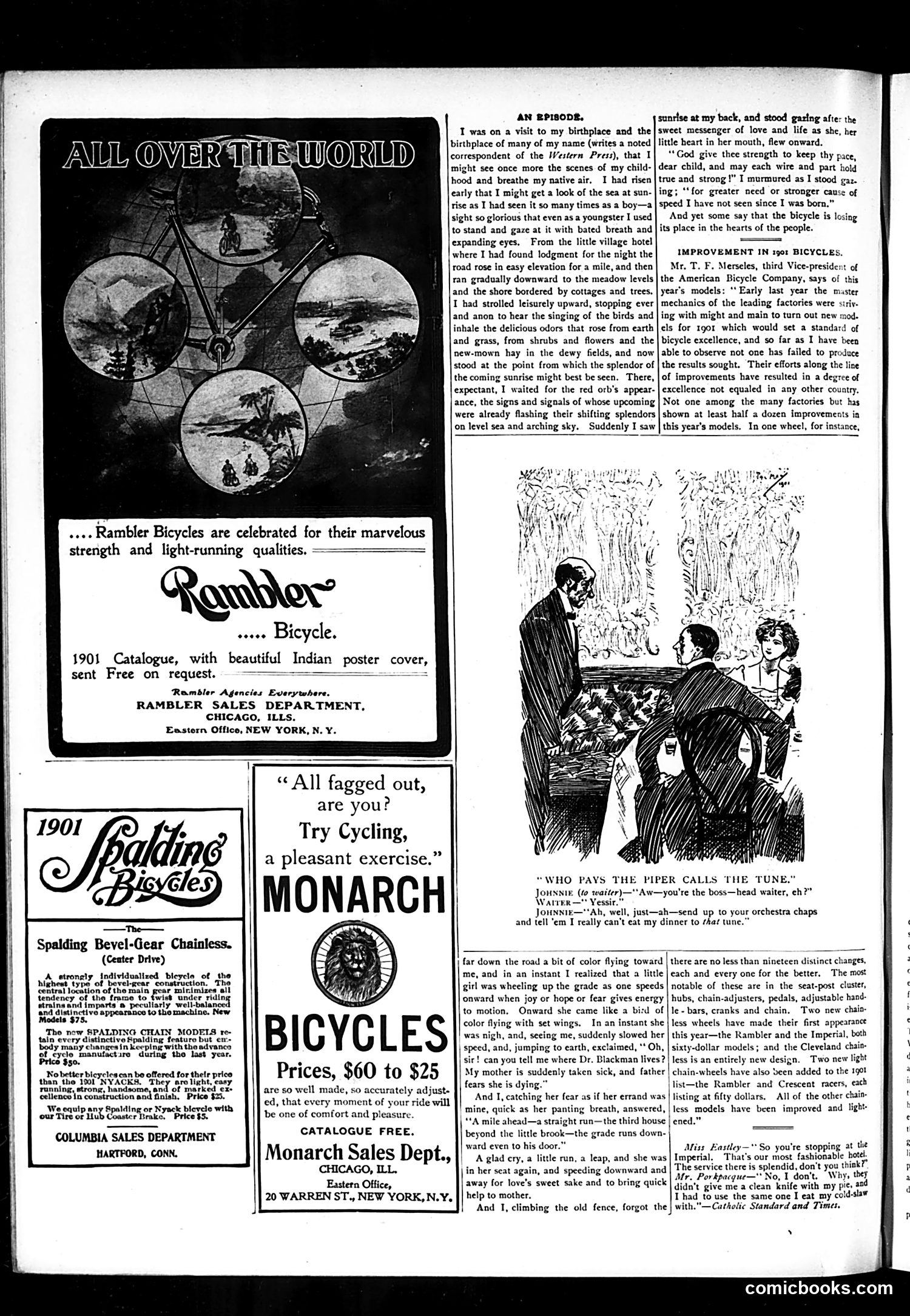
This page consists primarily of **bicycle advertisements** from 1901, with one short narrative piece titled "An Episode." The advertisements are straightforward product promotions for Rambler, Spalding, Columbia, and Monarch bicycles—not satire. The narrative "An Episode" is a sentimental story about a man revisiting his birthplace at sunrise. It describes a young girl on a bicycle rushing past him, and he admires her speed and dedication, interpreting her haste as noble purpose. The piece concludes with reflective commentary suggesting bicycles remain important to people's lives. **The satire appears implicit**: The juxtaposition of this romantic, emotional bicycle narrative against commercial advertisements suggests Judge may be gently mocking the era's *romantic idealization* of bicycles—treating them not merely as transportation but as symbols of freedom, youth, and virtue. The girl's urgent cycling becomes emblematic of progress itself. This reflects the 1890s-1900s "bicycle craze," when cycles represented modernity and social liberation, particularly for women.
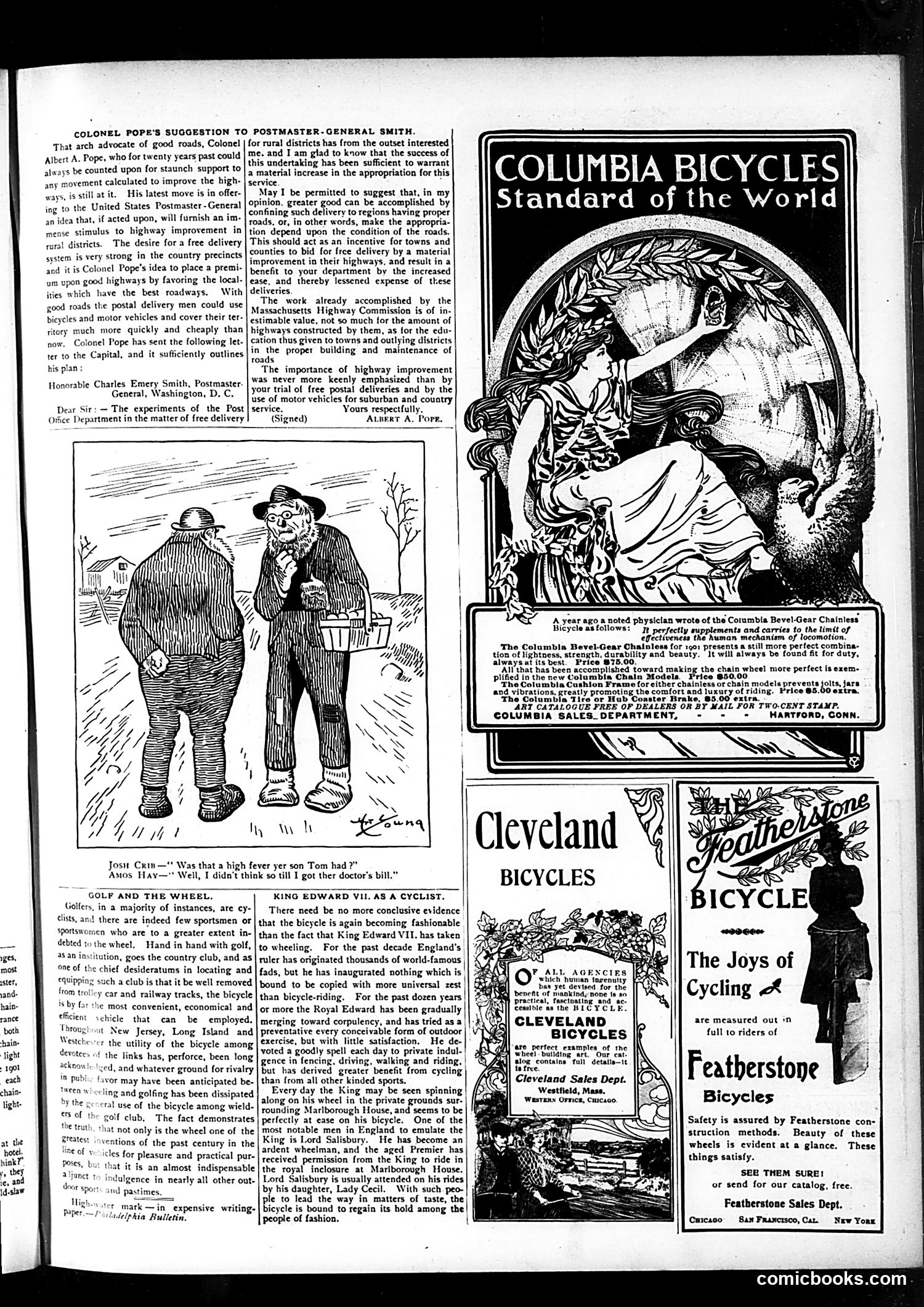
**The Main Cartoon (left):** This depicts Colonel Albert A. Pope, a prominent bicycle manufacturer and "good roads" advocate, making a proposal to Postmaster-General Charles Emery Smith. The accompanying letter (reproduced on the page) suggests conditioning rural free mail delivery on towns maintaining good roads—Pope's argument being that bicycles and motor vehicles could serve postal routes more cheaply on improved highways. **The Satire:** The humor lies in Pope's obvious self-interest: promoting road improvement directly benefits bicycle sales. The cartoon shows him pitching this idea, which frames a self-serving commercial goal as civic improvement. **Context:** This reflects early-1900s debates over rural infrastructure and the bicycle industry's significant political influence. Pope was genuinely influential in highway advocacy, but Judge satirizes the blurred line between his philanthropic rhetoric and profit motive. **Other Content:** The page also includes brief articles on golf/bicycles and King Edward VII as cyclist—all advertising bicycles and golf as leisure pursuits.
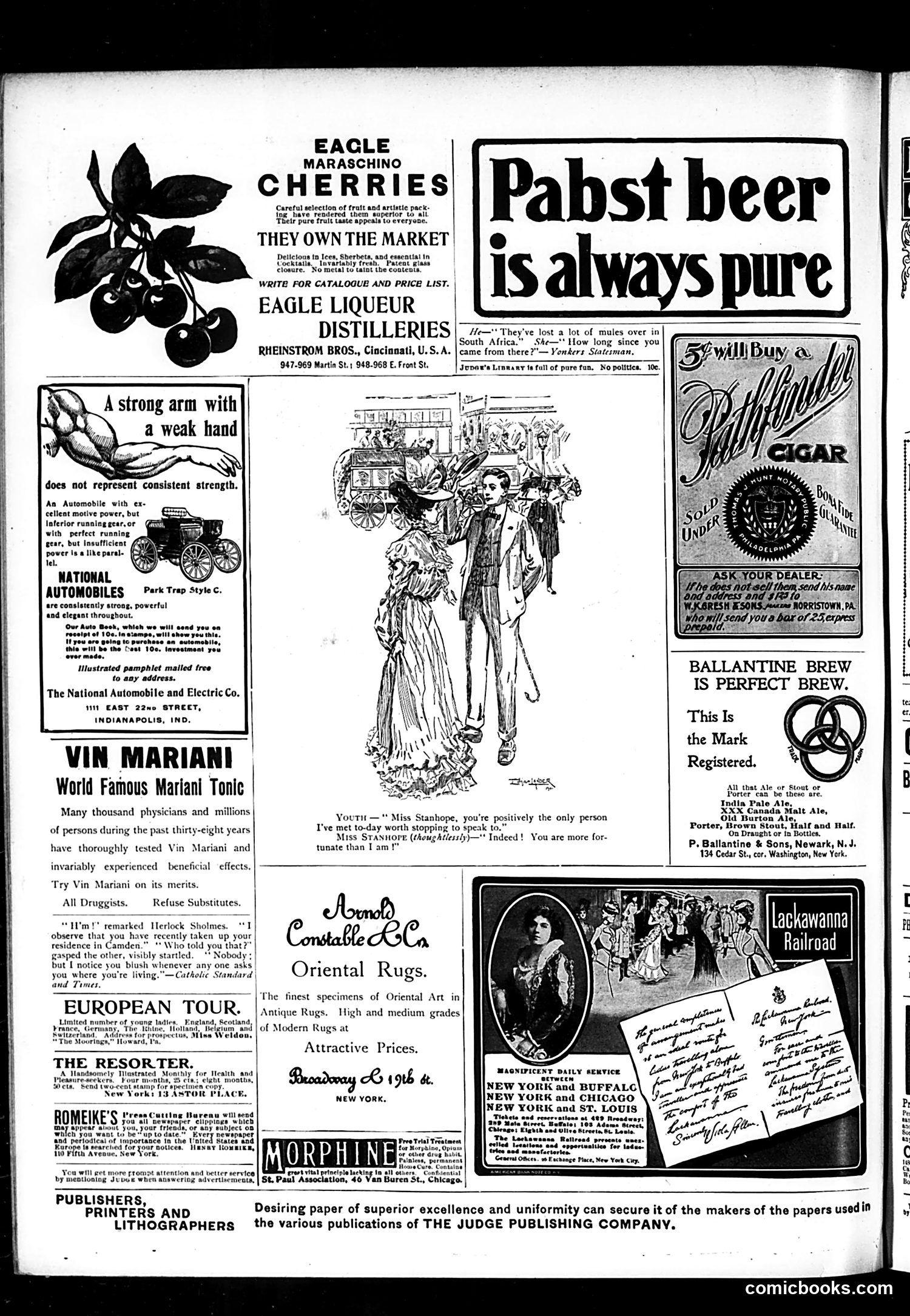
This page consists primarily of **advertisements** rather than political satire or comics requiring historical context. The one cartoon present shows a **domestic humor exchange** between a young man and woman. The man compliments the woman (Miss Stanhope), calling her "positively the only person I've met today worth stopping to speak to." She responds that he is "more fortunate than I am"—a mild joke about social interaction or romantic interest, typical of early 20th-century courtship humor. The caption credits "Yonkers Statesman." The surrounding content is commercial: advertisements for maraschino cherries, automobiles, patent medicines (Vin Mariani tonic), beer brands (Pabst, Ballantine), cigars, Oriental rugs, railroad services, and other products. These ads reflect period consumer goods and marketing approaches but contain no political messaging. **No significant political satire or caricature appears on this page.**
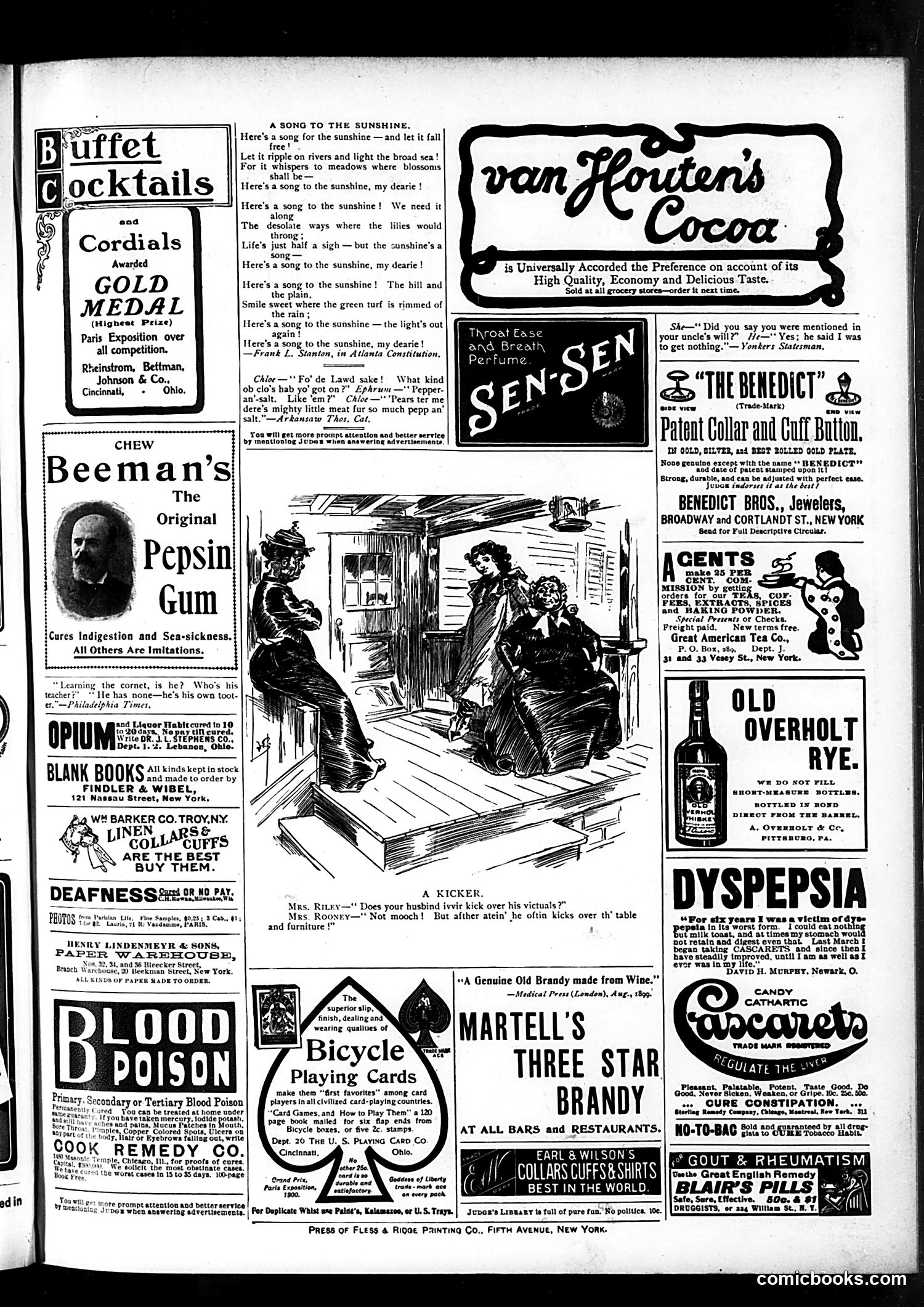
This page is primarily **advertisements** with minimal editorial cartoon content. The main visual element is a domestic scene (center) depicting a couple in what appears to be a humorous marital dispute—likely illustrating the caption about a husband kicking over furniture after dinner, a common domestic comedy trope of the era. The page contains period product advertisements for remedies and goods typical of late-19th/early-20th century magazines: patent medicines (blood poison cures, deafness treatments, pepsin gum), cordials, cocoa, brandy, playing cards, and collar buttons. Two brief text jokes appear: one about a man with no teacher except himself, and another (the "Chloe" dialect joke) using African American vernacular humor common to the period—satirizing pretentious clothing. **Notable**: The advertisements for "blood poison" and deafness "cures" reflect the era's acceptance of dubious medical claims. The overall page demonstrates how satirical magazines subsidized editorial content through patent medicine advertising.
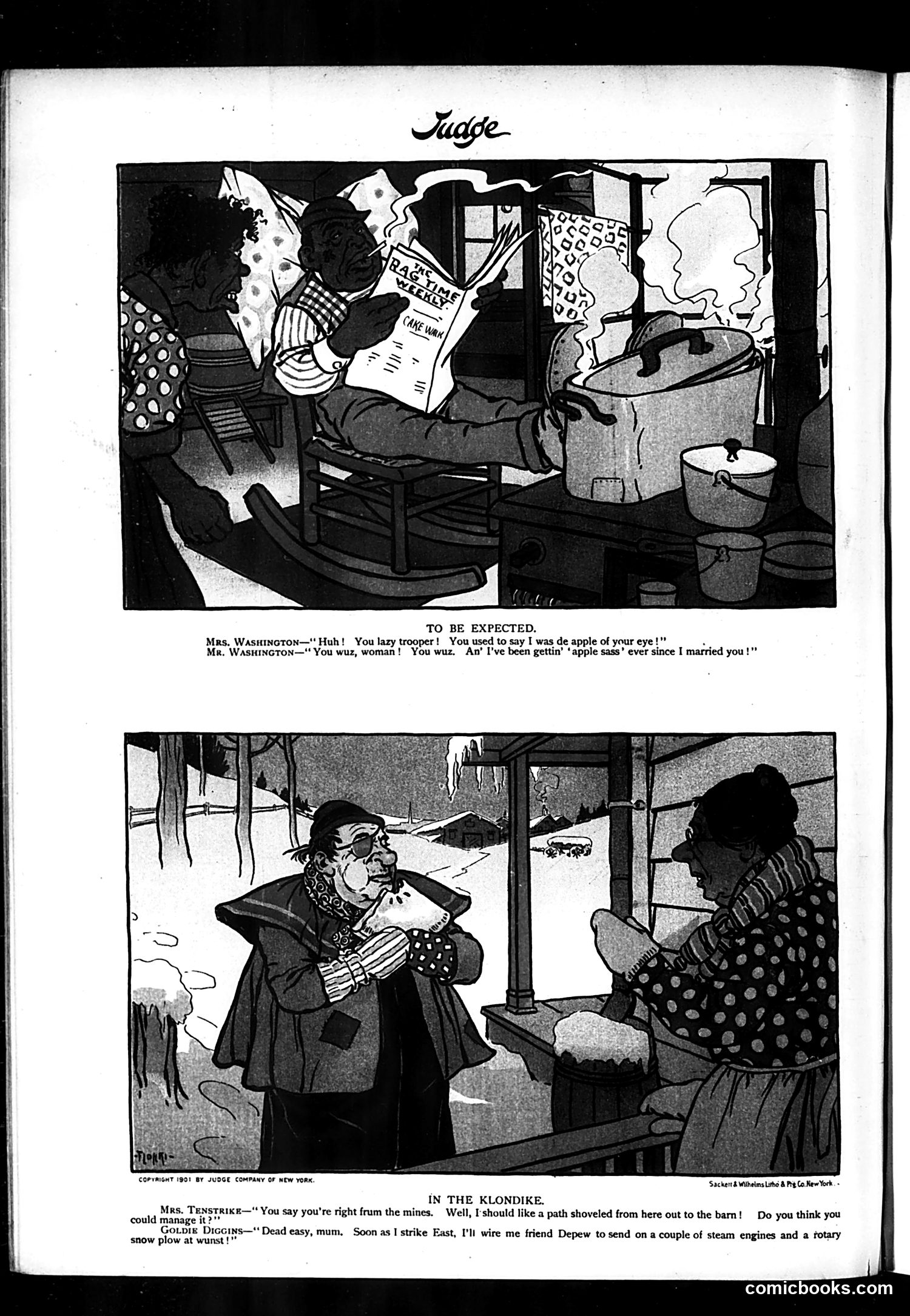
These two cartoons satirize the Klondike Gold Rush era (late 1890s-early 1900s). **Top panel ("To Be Expected"):** A husband and wife's domestic quarrel uses dialect humor. The husband, once romantic ("apple of your eye"), now complains he's been getting "apple sass" (nagging) since marriage—a common joke about wives becoming shrewish. **Bottom panel ("In the Klondike"):** A prospector returning from Yukon gold mines boasts extravagantly to Mrs. Tinstrike. When asked to shovel a path to the barn, he claims he'll wire "friend Depew" (likely Chauncey Depew, a wealthy railroad magnate) to send steam engines and a rotary snow plow—absurdly overblown for a simple task. The satire mocks nouveau-riche prospectors' pretensions and exaggerated wealth claims after striking it rich in the goldfields, contrasting their actual humble circumstances with their inflated self-importance.