
Judge, 1901-04-06 · page 2 of 16
Judge — April 6, 1901 — page 2: what you’re looking at
What you’re looking at
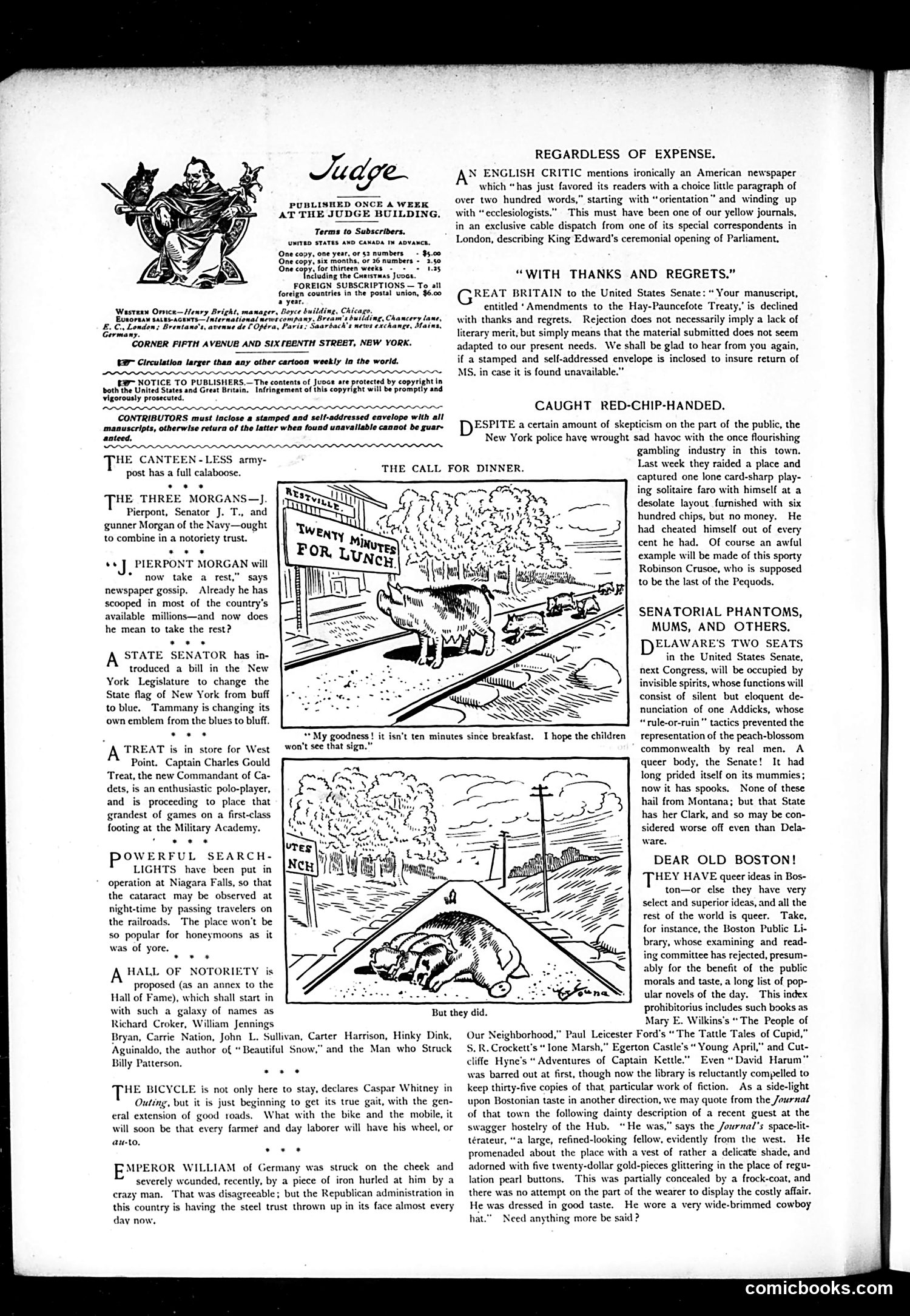
This page contains satirical commentary typical of Judge magazine's political critique. The two main cartoons show: **"The Call for Dinner"**: A large dog approaches a restaurant marked "Twenty Minutes for Lunch," illustrating the rushed pace of American urban life—a common target of satire about modern civilization's frenetic schedule. **"But they did"**: Shows a figure in what appears to be a rural or frontier setting, likely satirizing American expansion or settlement practices, though the specific reference remains unclear from context provided. The text sections include commentary on senatorial matters, Delaware's representation, and Boston's cultural institutions. The satire critiques political pretense, institutional hypocrisy, and class attitudes—characteristic of Judge's Progressive-era editorial stance. Without specific date markers visible, the exact political figures or events referenced cannot be definitively identified.
📄 Transcribed text from this page (OCR, searchable)
Machine-transcribed from the original scan — historical spelling and the odd misread are preserved.
PUBLISHED ONCE A WEEK AT THE JUDGE BUILDING, Terms to Subscribers, UNITED STATES AND CAMADA TH ADVANCE. ‘One copy, one year. or 52 numbers - $5.00 One copy, six months, of 26 numbers - 3.50 One copy, for thirteen weeks === 1.35 facluding the Cuaistaas Juoo! FOREIGN. SUBSCRIPTIONS — To all foreign countries in the postal union, $6.00 ayer. Wasrasn Ornice—Henry Bright, manager, Boyce bu Evsoraaw sains-acents—/nfermational mevr compa 2 Brentano's, avenue del Optra, Paris; Saarbac Chicago. 's butiding, Chancery lane, ews exchange, Mains, 7. CORNER FIFTH AVENUE AND SIXTEENTH STREET, NEW YORK. (27 Circulation larger than any other cartoon weekly Ia the world. f9- NOTICE TO PUBLISHERS.—The contents of Juoce are protected by copyright in both the United States and Great Britain. Infringement of this copyright will be promptly and vigorously prosecuted. CONTRIBUTORS must taclose 2 stamped and self-addressed eavelope with all manuscripts, otherwise retura of the latter when found unavailable cannot be guare anteed. THE CANTEEN -LESS army- post has a full calaboose. soe THE THREE MORGA: Pierpont, Senator J. 17 gunner Morgan of the Navy—ought to combine in a notoriety trust. see . ‘J PIERPONT MORGAN will * now take a rest,” says newspaper gossip. Already he has scooped in most of the country’s available millions—and now does he mean to take the rest? eee A STATE SENATOR has in- troduced a bill in the New York Legislature to change the State flag of New York from buff to blue. Tammany is changing its own emblem from the blues to bluff. TREAT is in store for West Point. Captain Charles Gould Treat, the new Commandant of Ca- dets, is an enthusiastic polo-player, and is proceeding to place that grandest of games on a first-class footing at the Military Academy. POWERF L SEARCH- LIGHTS have been put in operation at Niagara Falls, so that the cataract may be observed at night-time by passing travelers on the railroads. The place won't be so popular for honeymoons as it was of yore. ** My goodness won't see that sign,” A HALL OF NOTORIETY is proposed (as an annex to the Hall of Fame), which shall start in with such a galaxy of names as Richard Croker, William Jennings Bryan, Carrie Nation, John L. Sullivan, Carter Harrison, Hinky Dink, Aguinaldo, the author of “ Beautiful Snow,” and the Man who Struck Billy Patterson. THE BICYCLE is not only here to stay, declares Caspar Whitney in Outing, but it is just beginning to get its true gait, with the gen- eral extension of good roads. What with the bike and the mobile, it will soon be that every farmet and day laborer will have his wheel, or auto. MPEROR WILLIAM of Germany was struck on the cheek and severely wounded, recently, by a piece of iron hurled at him by a crazy man. ‘That was disagreeable; but the Republican administration in this country is having the steel trust thrown up in its face almost every day now, THE CALL FOR it isn’t ten minutes since breakfast. But they did. REGARDLESS OF EXPENSE. NGLISH CRITIC mentions ironically an American newspaper which “has just favored its readers with a choice little paragraph of over two hundred words,” starting with “orientation” and winding up with “ecclesiologists.” This must have been one of our yellow journals, in an exclusive cable dispatch from one of its special correspondents in London, describing King Edward's ceremonial opening of Parliament. “WITH THANKS AND REGRETS.” REAT BRITAIN to the United States Senate: “ Your manuscript, entitled ‘Amendments to the Hay-Pauncefote Treaty,’ is declined with thanks and regrets. Rejection does not necessarily imply a lack of literary merit, but simply means that the material submitted does not seem adapted to our present needs. We shall be glad to hear from you again, if a stamped and self-addressed envelope is inclosed to insure return of MS. in case it is found unavailable.” CAUGHT RED-CHIP-HANDED. DESPITE a certain amount of skepticism on the part of the public, the New York police have wrought sad havoc with the once flourishing gambling industry in this town. Last week they raided a place and captured one lone card-sharp play- ing solitaire faro with himself at a desolate layout furnished with six hundred chips, but no money. He had cheated himself out of every cent he had. Of course an awful example will be made of this sporty Robinson Crusoe, who is supposed to be the last of the Pequods. DINNER. SENATORIAL PHANTOMS, MUMS, AND OTHERS. DELAWARE'S TWO SEATS in the United States Senate, next Congress, will be occupied by invisible spirits, whose functions will consist of silent but eloquent de- nunciation of one Addicks, whose “rule-or-ruin” tactics prevented the representation of the peach-blossom commonwealth by real men. A queer body, the Senate! It had long prided itself on its mummies; now it has spooks, None of these hail from Montana; but that State has her Clark, and so may be con- sidered worse off even than Dela- ware. DEAR OLD BOSTON! THEY HAVE queer ideas in Bos- ton—or else they have very select and superior ideas, and all the rest of the world is queer. Take, for instance, the Boston Public Li- brary, whose examining and read- ing committee has rejected, presum- ably for the benefit of the public morals and taste, a long list of pop- ular novels of the day. This index prohibitorius includes such books as Mary E. Wilkins’s “The People of Our Neighborhood,” Paul Leicester Ford's “The Tattle Tales of Cupid,” S.R. Crockett’s “ lone Marsh,” Egerton Castle's “ Young April,” and Cut- cliffe Hyne’s * Adventures of Captain Kettle." Even “David Harum” was barred out at first, though now the library is reluctantly compelled to keep thirty-five copies of that particular work of fiction. As a side-light upon Bostonian taste in another direction, we may quote from the Journal of that town the following dainty description of a recent guest at the swagger hostelry of the Hub. “He was,” says the Journal's space-lit- térateur, “a large, refined-looking fellow, evidently from the west. He promenaded about the place with a vest of rather a delicate shade, and adorned with five twenty-dollar gold-pieces glittering in the place of regu- lation pearl buttons. This was partially concealed by a frock-coat, and there was no attempt on the part of the wearer to display the costly affair. He was dressed in good taste. He wore a very wide-brimmed cowboy hat.” Need anything more be said ? T hope the children le Be LEZ, comicbooks.com