
A complete issue · 16 pages · 1901
Judge — March 30, 1901
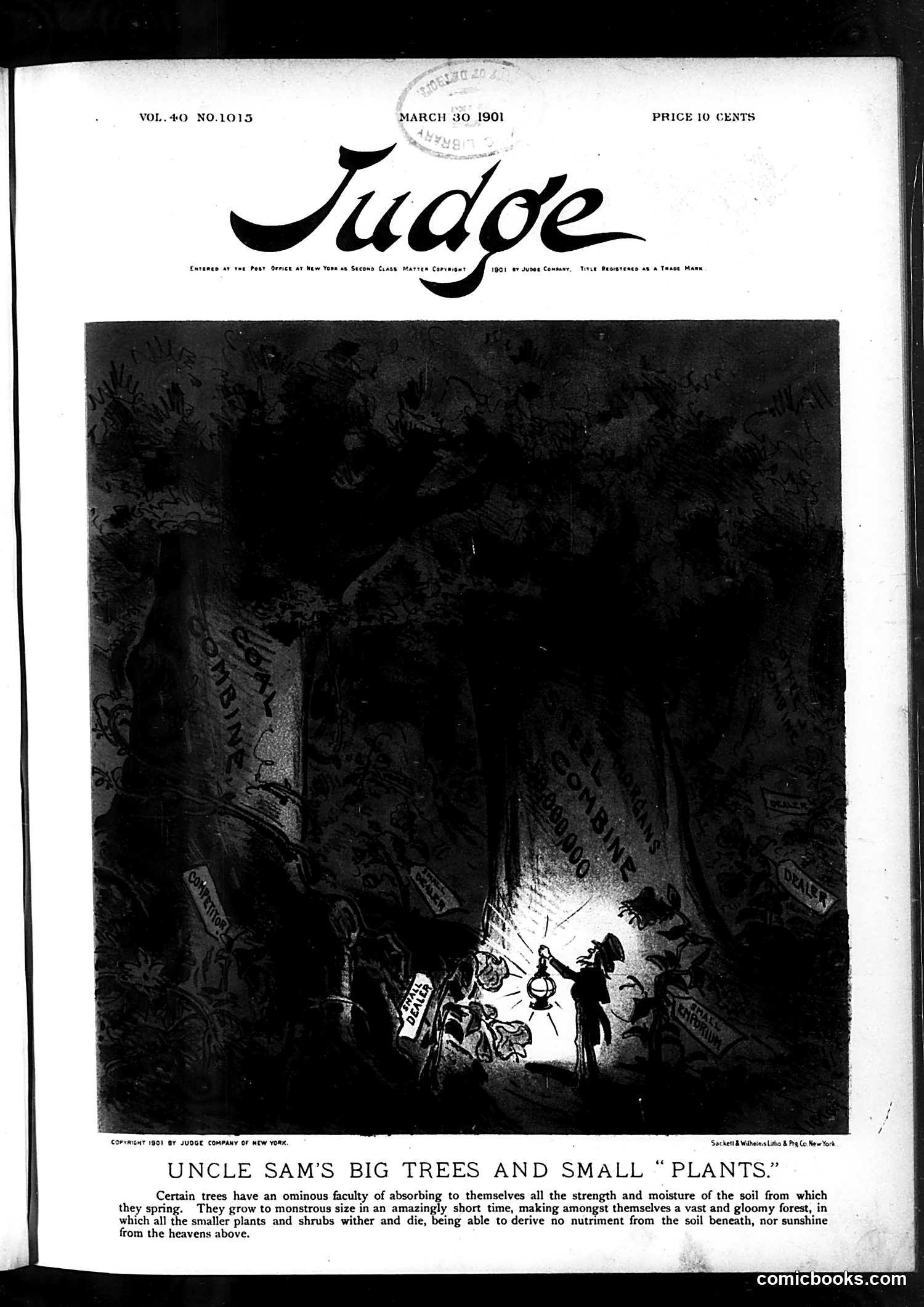
This 1901 Judge cartoon uses a natural allegory to critique American imperialism. The image shows tiny human figures dwarfed by massive tree trunks labeled (apparently) with colonial territories or possessions. The caption references "Uncle Sam's big trees and small 'plants'"—a pun playing on botanical terminology and colonial expansion. The satirical point: America's imperial acquisitions (the "plants") appear insignificant compared to the vast established power structures already in place. The figures huddled in darkness suggest colonists struggling within these massive systems. The cartoon likely critiques either the scale of American ambitions in the Philippines, Hawaii, or other territories acquired after the 1898 Spanish-American War, or the difficulty of managing such vast imperial holdings.
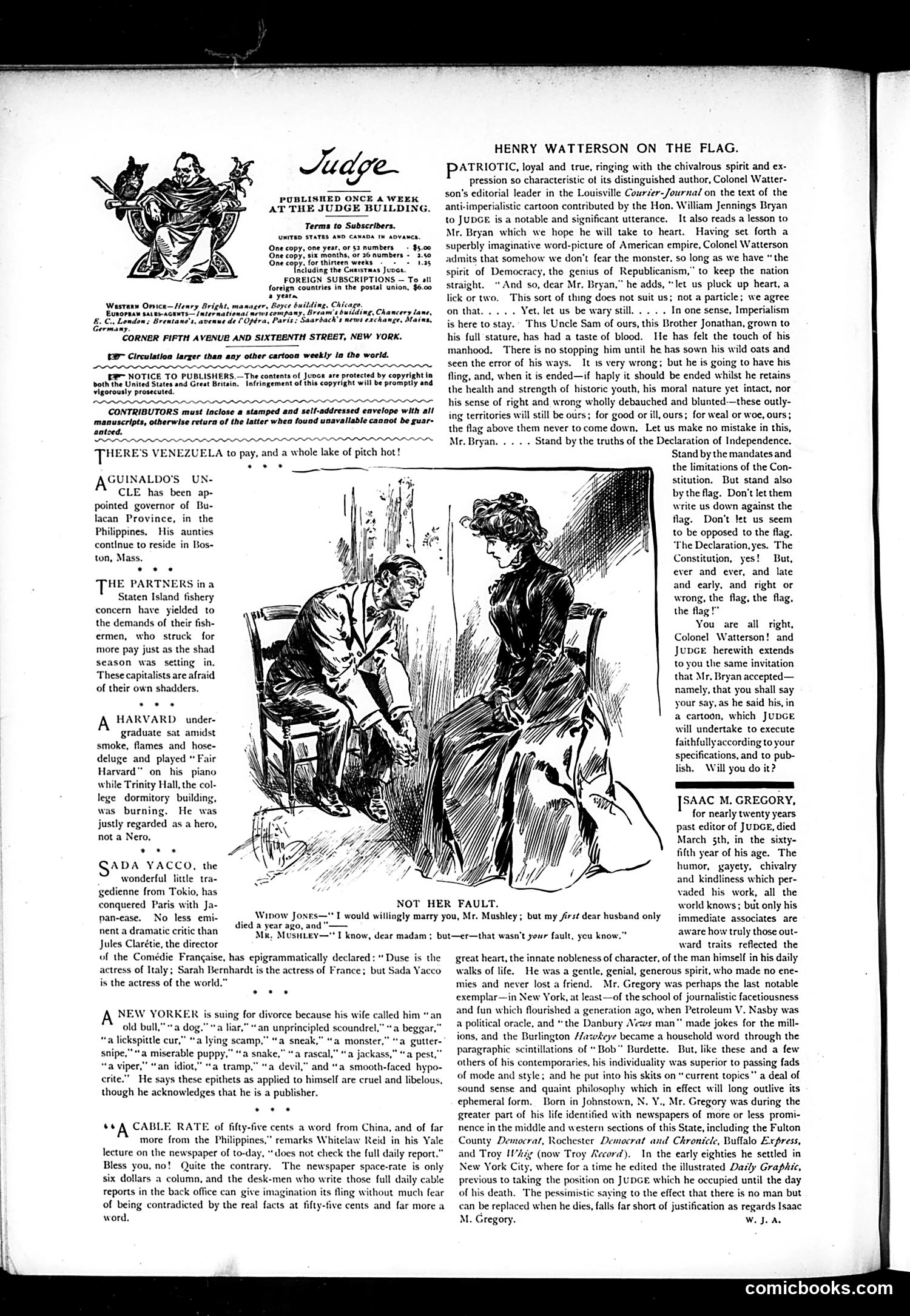
This page contains two main elements: 1. **"Henry Watterson on the Flag"** (right column): An editorial praising Colonel Henry Watterson's patriotic defense of the American flag against criticism. The text celebrates his argument that the flag represents democracy and shouldn't be disparaged, even when one disagrees with current policies. It invites Watterson to contribute cartoons to Judge. 2. **"Not Her Fault"** (center illustration): A sketch showing a couple in conflict, with the woman saying she'd willingly marry "Mr. Moseley" but her "first dear husband" won't agree. This appears to be satirizing a divorce case, likely contemporary to publication. The page also includes brief satirical items about minor public figures and incidents (Venezuelan disputes, political scandals), typical of Judge's miscellaneous gossipy commentary. Without publication date visible, precise political context remains unclear.
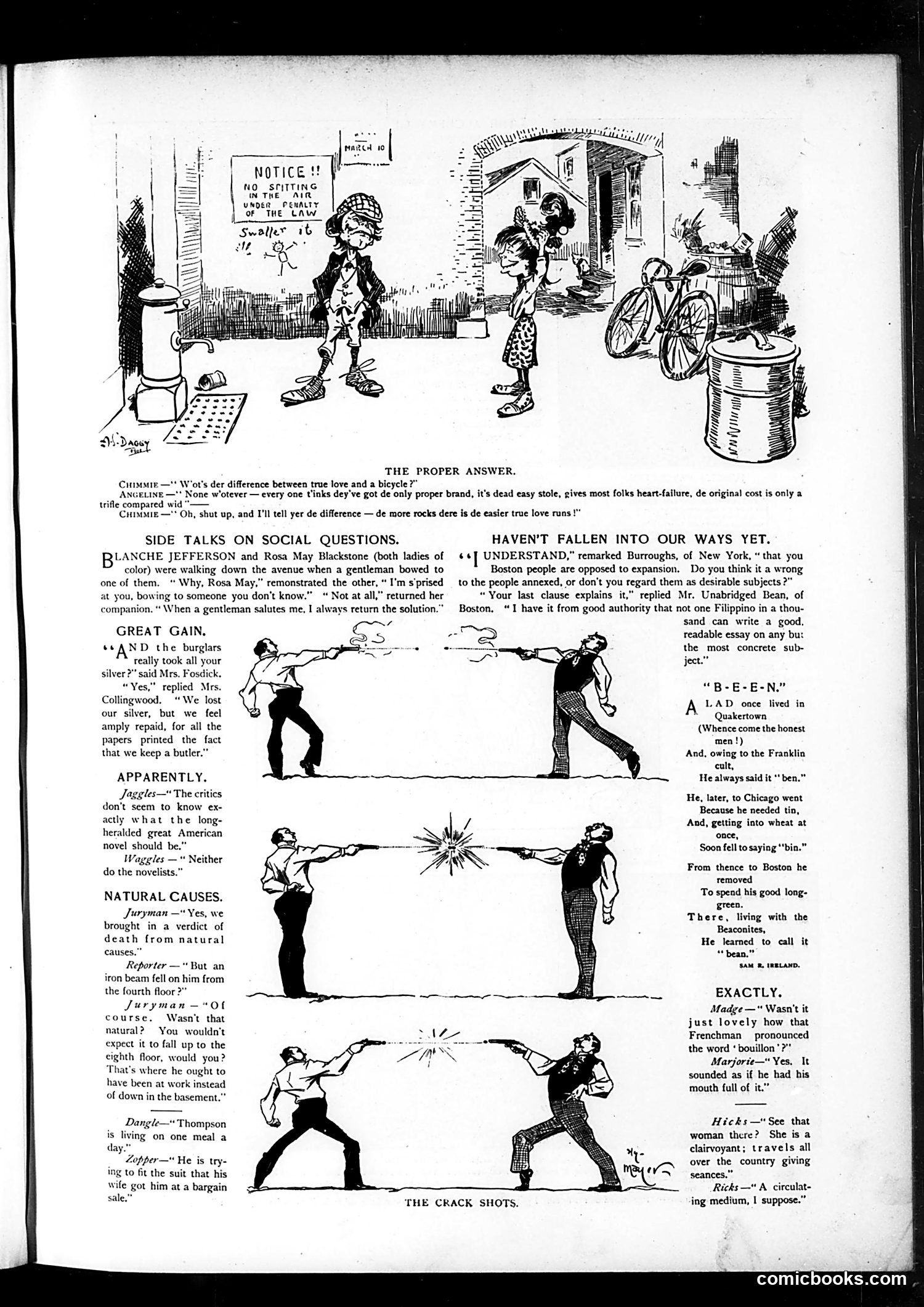
This page contains several satirical anecdotes and illustrated jokes typical of early 20th-century Judge magazine. **Top cartoon** shows children on a city street with a "No Spitting" notice, depicting social commentary on urban hygiene and child safety. **"The Crack Shots"** illustrations depict men and women in shooting poses, likely satirizing either marksmanship competitions or, more probably, the emerging women's suffrage movement—showing women engaging in traditionally male activities as social commentary. **Side sections** contain brief humorous dialogues mocking various social pretensions: wealthy people discussing burglarized silver, critics debating American literature, and workplace disputes. The humor derives from characters' self-important or illogical reasoning. The overall tone is gentle mockery of middle and upper-class American social conventions and aspirations, typical of Judge's satirical mission.
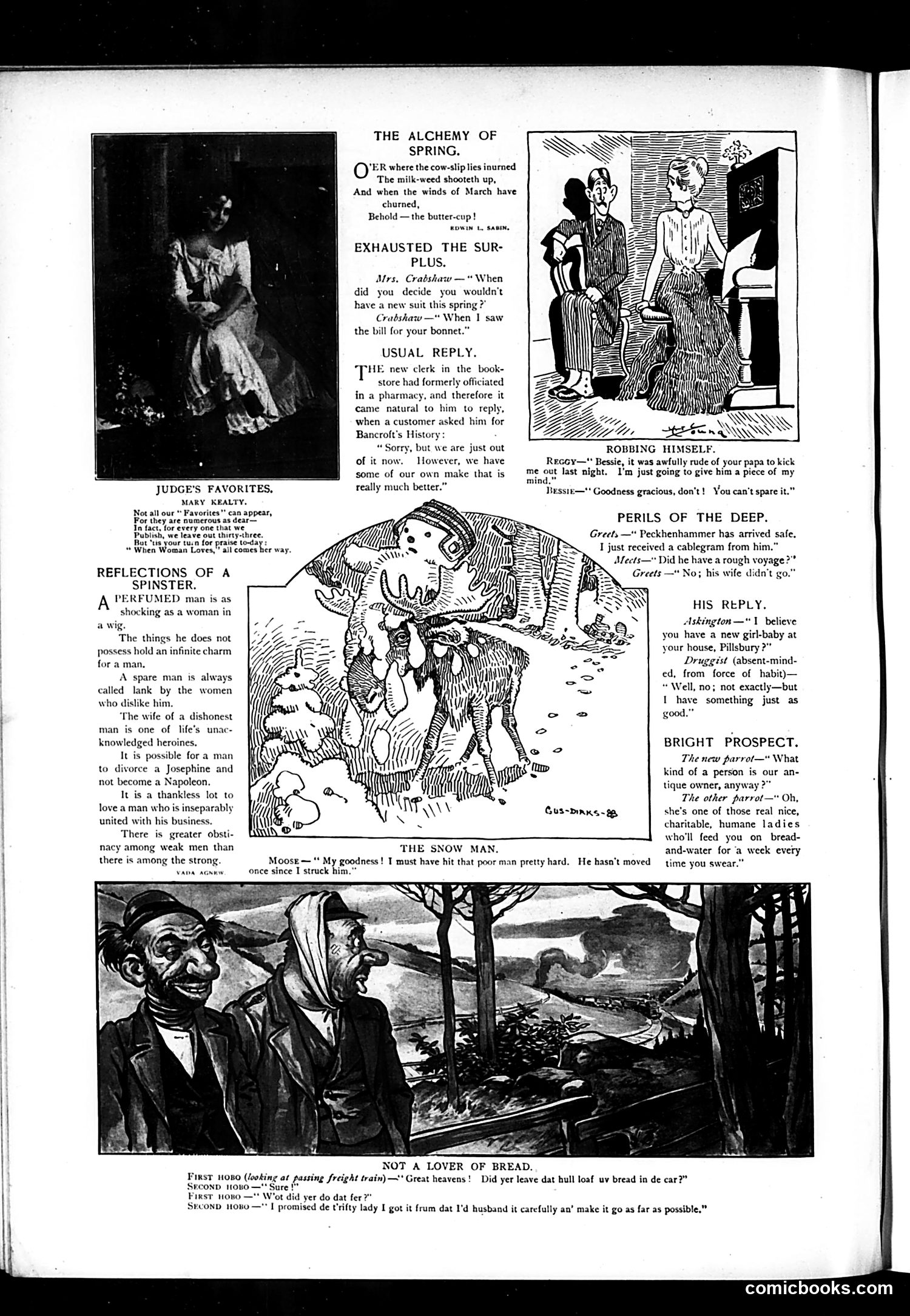
This page contains several short humor pieces and illustrations typical of early 20th-century Judge magazine: **"The Alchemy of Spring"** - A poetic observation about spring's transformative effects, citing the butter-cup flower. **"Exhausted Surplus"** and **"Usual Reply"** - Domestic humor about a woman's shopping expenses and a bookstore clerk's stock response about unavailable items. **"Robbing Himself"** and **"His Reply"** - A brief exchange about someone's past behavior. **"The Snow Man"** - An illustration showing a figure with poor people, captioned with dark humor about striking a "poor man pretty hard." **"Not a Lover of Bread"** - A final scene depicting two figures discussing bread, likely satirizing working-class concerns or domestic disputes. The page represents typical Judge content: domestic satire, social observation, and class-based humor common to the era.
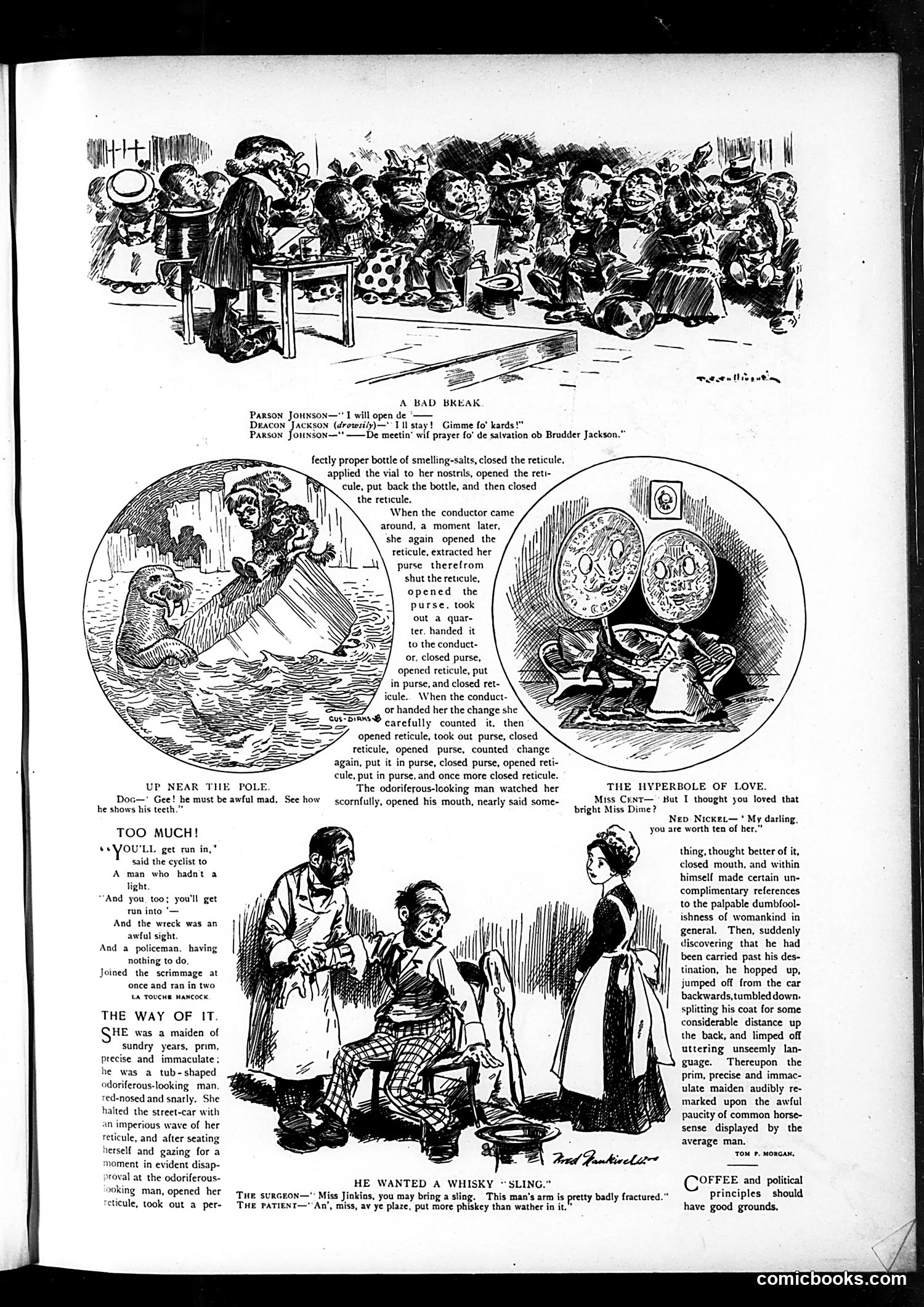
This page contains multiple short humorous sketches satirizing American social behaviors and character types: **"A Bad Break"** mocks fastidious Victorian-era women obsessed with propriety—a prim lady repeatedly opens and closes her reticule (purse) to retrieve smelling salts and count her change, embodying excessive fussiness. **"The Way of It"** satirizes class conflict and gender hypocrisy: a refined woman's contempt for an odoriferous working-class man backfires when he deliberately misses his stop and leaves injured, yet she blames his "common horse-sense" rather than acknowledging her own rudeness. **"Too Much!"** and **"Up Near the Pole"** are brief joke sketches about cyclists and arctic exploration mishaps. **"He Wanted a Whisky-Sling"** plays on miscommunication between a patient with a fractured arm and a surgeon, with bawdy double meaning. The overall theme critiques American social pretension, particularly among the respectable middle class, using exaggerated situations and working-class dialect to deflate Victorian stuffiness.
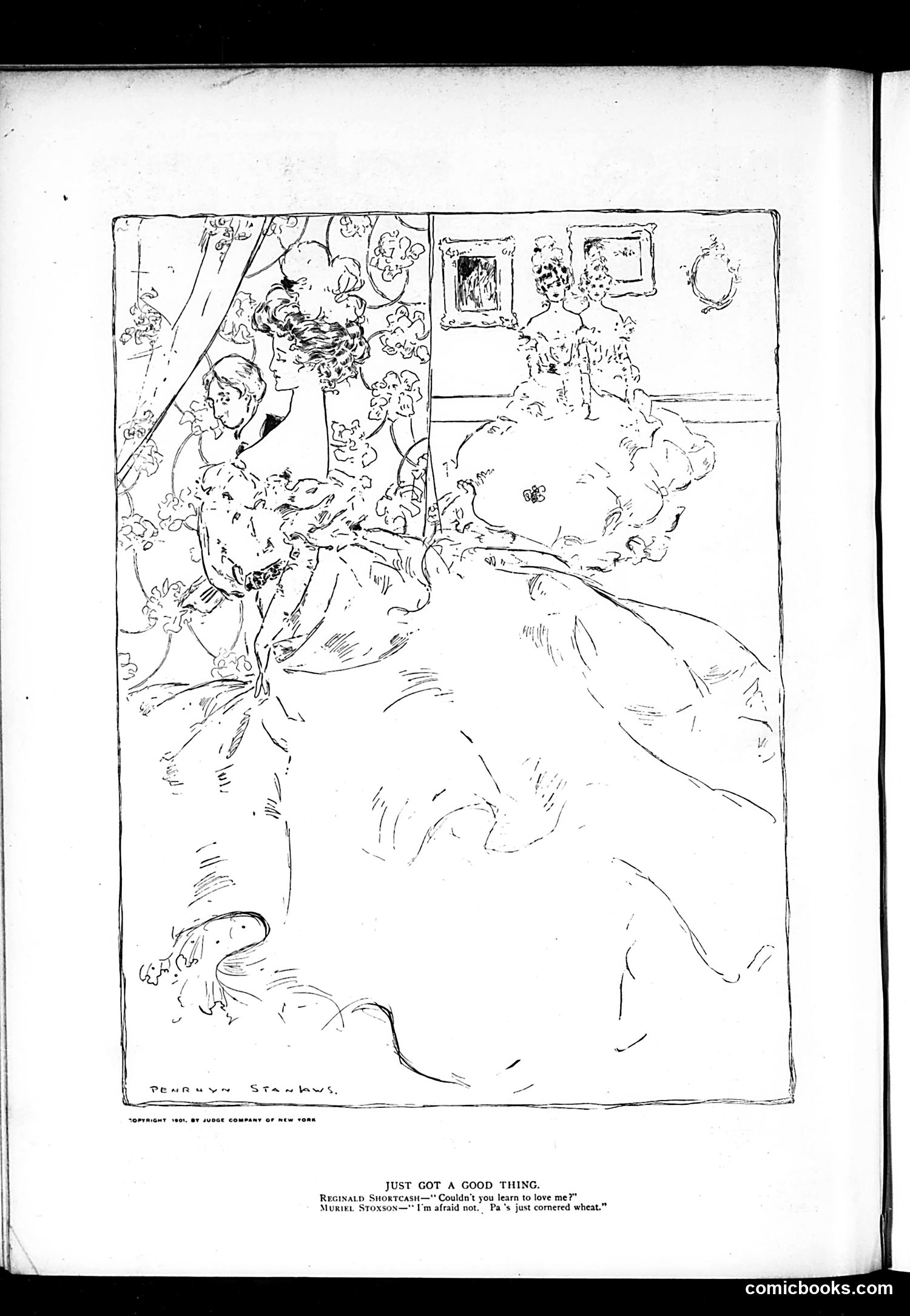
This cartoon satirizes romantic entanglement during the early 20th century. The dialogue presents a domestic scene where Reginald Shortcash asks Muriel Stokson, "Couldn't you learn to love me?" She replies, "I'm afraid not. Pa's just cornered wheat." The joke pivots on financial/commodities speculation: Muriel won't commit to romance because her father has cornered the wheat market—meaning he's monopolized wheat supplies to manipulate prices. The cartoon suggests that economic advantage (and the wealth it generates) supersedes romantic considerations in marriage calculations among the wealthy. It's satirizing both mercenary attitudes toward marriage and the era's rampant commodity speculation, implying that love takes a back seat to financial maneuvering and profit among the upper classes.
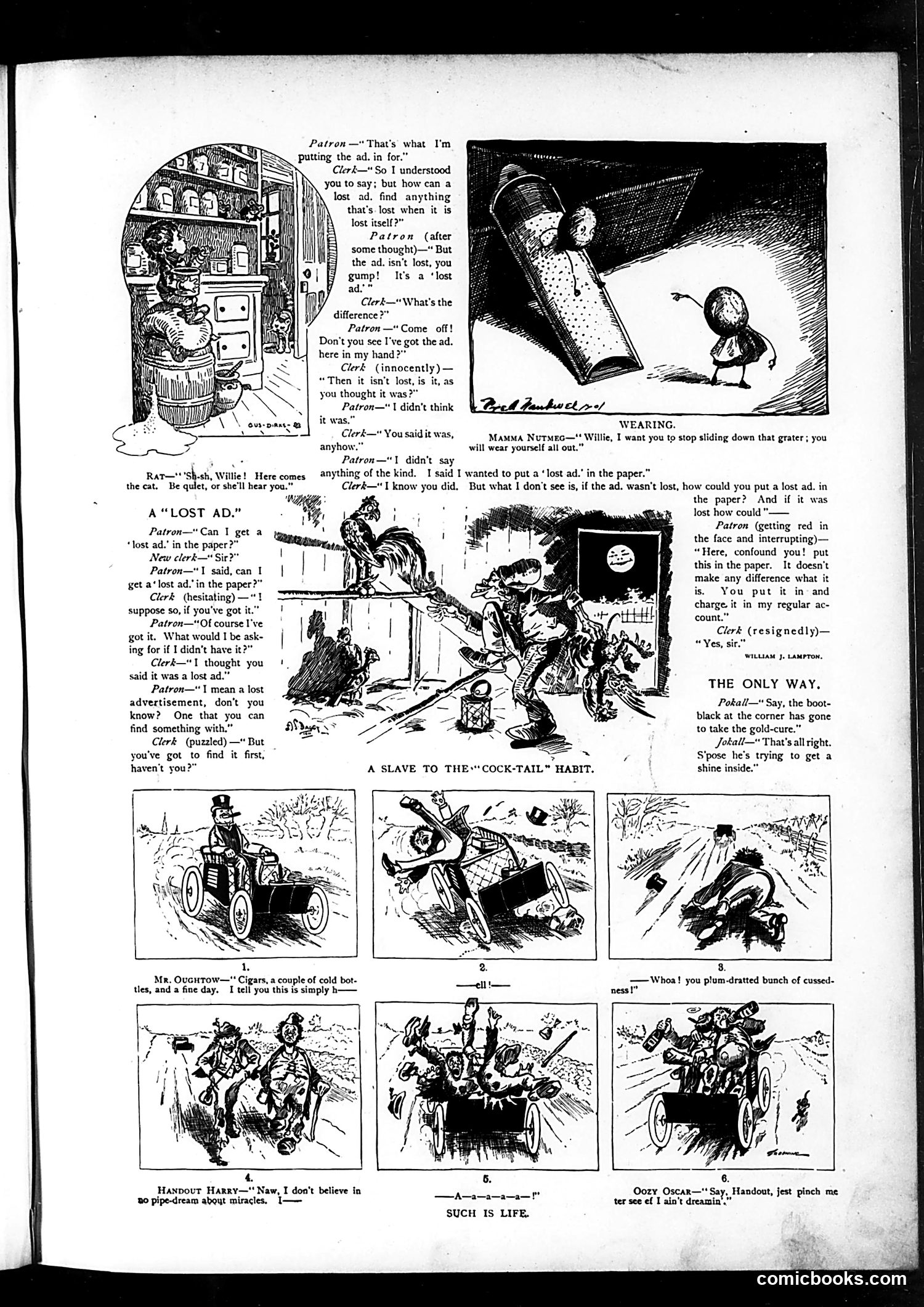
This page contains several humorous vignettes satirizing American life, primarily focused on wordplay and social commentary: **"A Lost Ad"** (main dialogue): The joke centers on a patron's circular logic—wanting to place a "lost ad" (advertisement seeking lost items) in a newspaper. The clerk's confusion is intentional satire: if the ad itself is lost, how can it help find anything? The humor mocks both miscommunication and the absurdity of certain advertising practices. **"Weaving"**: A child sliding down a cheese grater while mother warns against noise—dark humor about domestic chaos and parental priorities. **"Such Is Life"** (bottom strip): A series of comic panels showing a man in a car experiencing increasingly disastrous mishaps, ending with him upside-down. The title suggests resigned acceptance of life's inevitable troubles. **"The Only Way"**: Brief dialogue suggesting a bootblack seeking a "gold cure" (likely a reference to alcohol addiction treatment) is instead seeking to shine shoes—wordplay on "shine" (polish vs. intoxication). The page exemplifies Judge's style: satirizing American speech patterns, social pretension, and everyday misadventures through puns and observational humor.
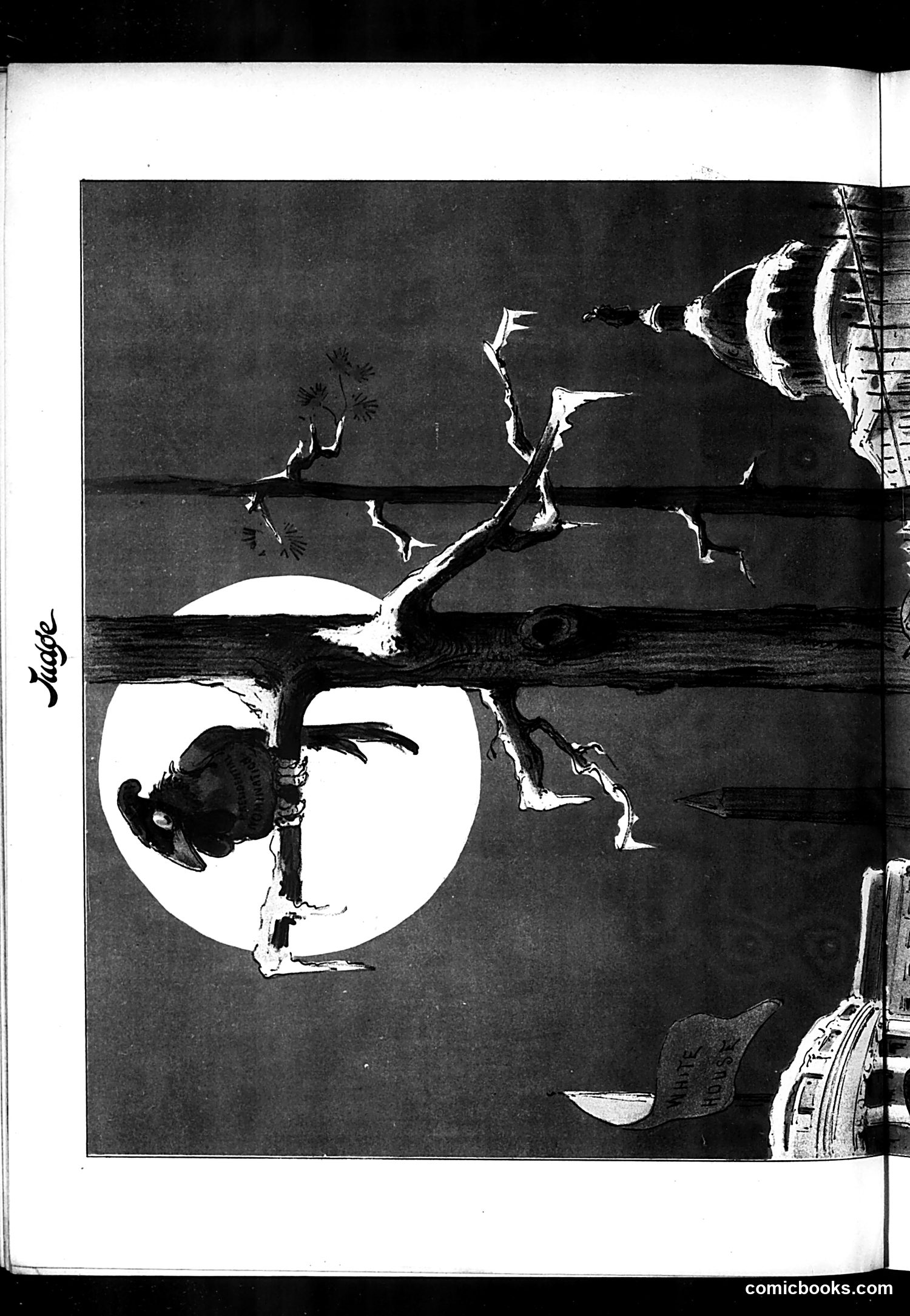
The image appears to be rotated 90 degrees, showing what looks like a satirical illustration from *Judge* magazine. The visible elements include a figure with exaggerated features against a large circular background (possibly representing the moon or sun), bare tree branches, sailing vessels with white sails in the upper portion, and ship's wheels or maritime equipment on the sides. However, without legible OCR text or clearer orientation, I cannot confidently identify the specific political figures, historical event, or satirical point being made. The maritime imagery suggests a naval or colonial theme, but determining the exact target of satire—whether political commentary, social critique, or topical humor—requires more readable contextual information than currently available from this reproduction.
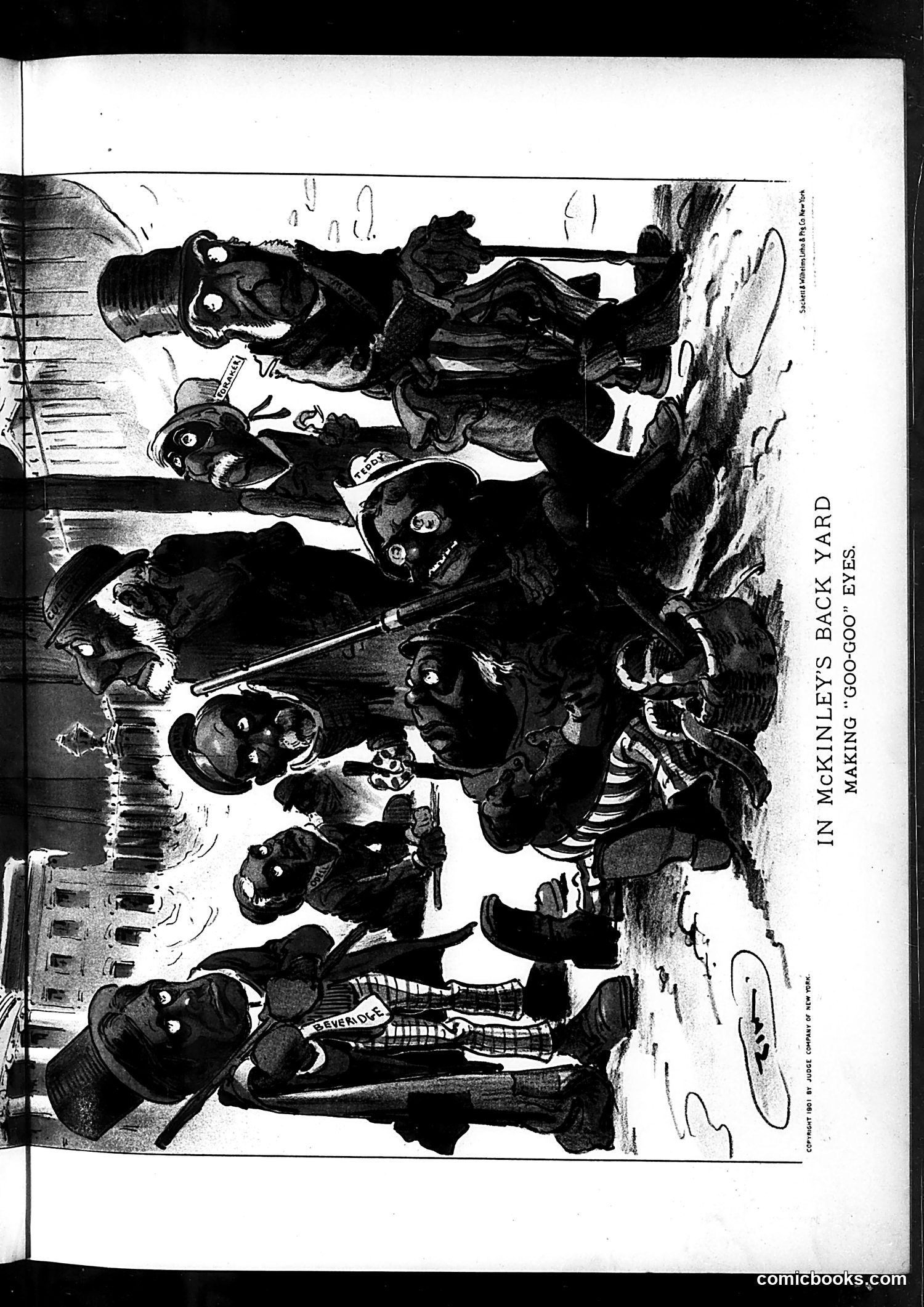
The OCR text is too corrupted to read reliably. However, the image shows a black and white cartoon titled "IN MCKINLEY'S BACK YARD—MAKING 'GOOD EYES'" (visible on the right margin). The cartoon depicts multiple figures in what appears to be a satirical scene. The title references President McKinley's administration. The phrase "making good eyes" suggests the figures are attempting to appear respectable or innocent, likely a commentary on political hypocrisy or deceptive public relations during McKinley's presidency. Without clearer OCR text or caption information, I cannot identify the specific figures or determine the exact political situation being satirized. The style and subject matter indicate this critiques McKinley-era politics, but the precise meaning remains unclear from the available information.
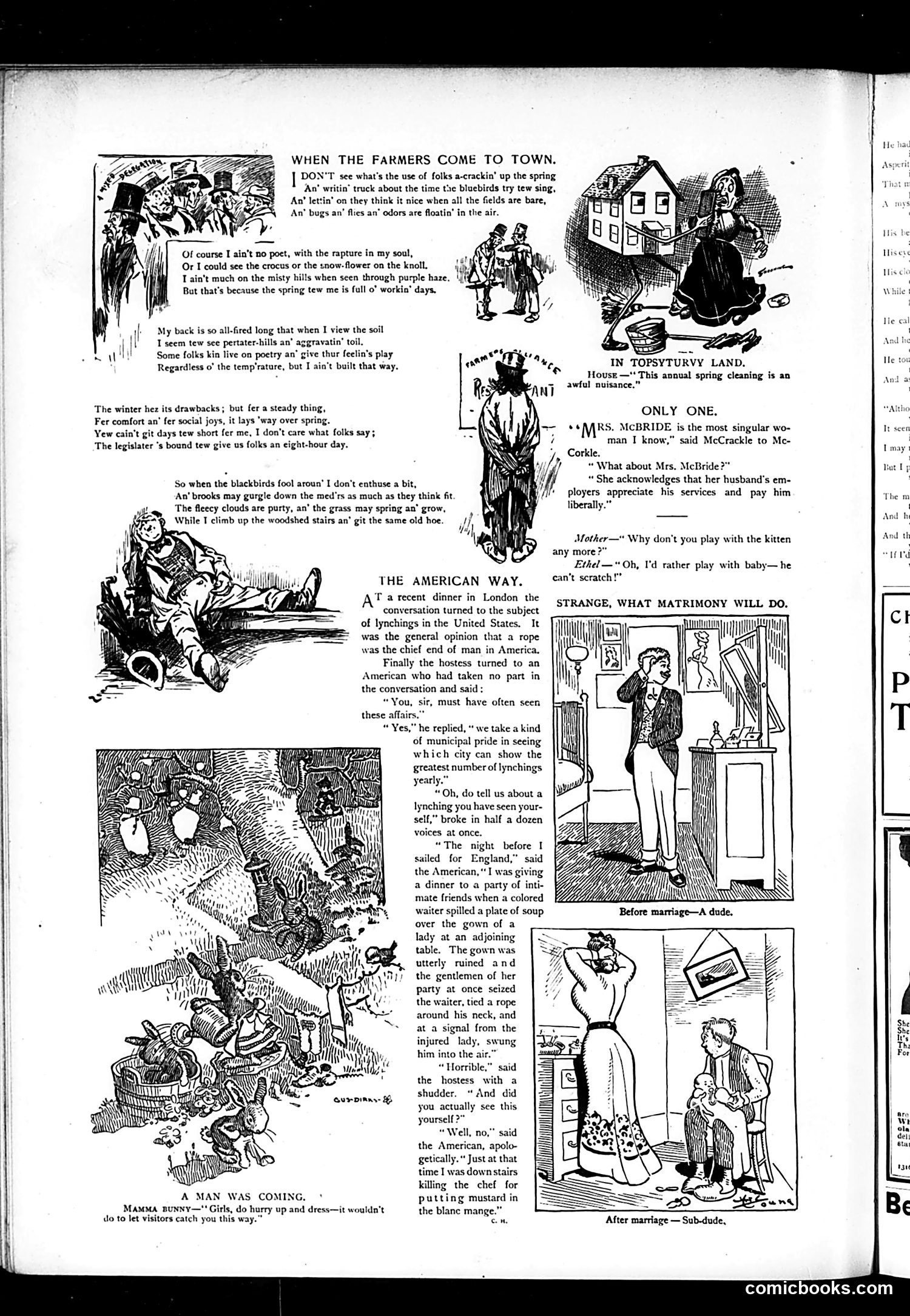
This page contains several satirical pieces targeting early 20th-century American life: **"When the Farmers Come to Town"** mocks rural laborers who romanticize spring despite its association with exhausting farm work. The farmer-speaker rejects poetic sentimentality about nature, insisting on an eight-hour workday—a contemporary labor-movement demand. **"The American Way"** is dark political satire about American lynching. A dinner-party anecdote presents an American defending his country's practice by claiming casual familiarity with mob violence. The "joke" inverts expectations: he admits he *didn't* witness the lynching because he was occupied killing his chef for a cooking mistake—implying American casual violence extends beyond racial terrorism. This is sharp criticism disguised as humor. Smaller pieces include domestic humor ("Topsyturvy Land," "Strange What Matrimony Will Do") and animal cartoons that are less satirically pointed. The cartoons' crude, period artwork and the text's dialect speech were typical Judge stylistic choices for the era.
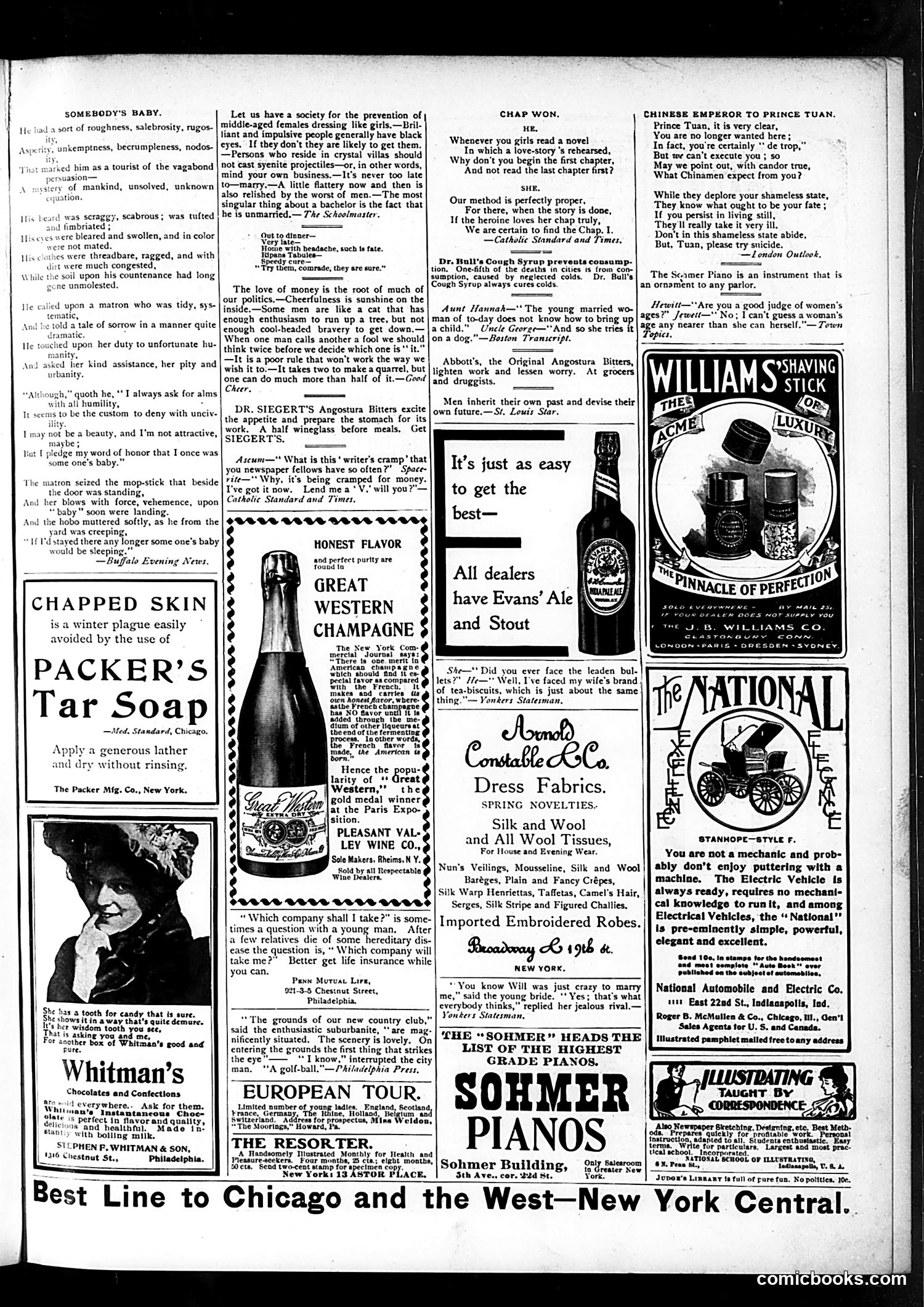
This page is primarily **advertisements and light humor snippets**, not political cartoons. The main narrative content is "Somebody's Baby," a humorous story about a vagabond asking a tidy matron for charity by claiming he "once was someone's baby." The joke: she beats him with a mop-stick, and he reflects that "if I'd stayed there any longer some one's baby would be sleeping" (dead). The page contains numerous **product advertisements** (Packer's Tar Soap, Whitman's Chocolates, Great Western Champagne, Evans' Ale, Williams Shaving Stick, Sohmer Pianos, National automobiles) interspersed with **brief aphoristic jokes** about middle-aged women dressing young, bachelors, and flattery. There is **no identifiable political satire or caricature**. The humor is gentle, domestic, and commercial—typical of Judge magazine's lighter content. The page reflects early 20th-century advertising aesthetics and conventional morality (charity-seeking vagabonds deserve mockery).
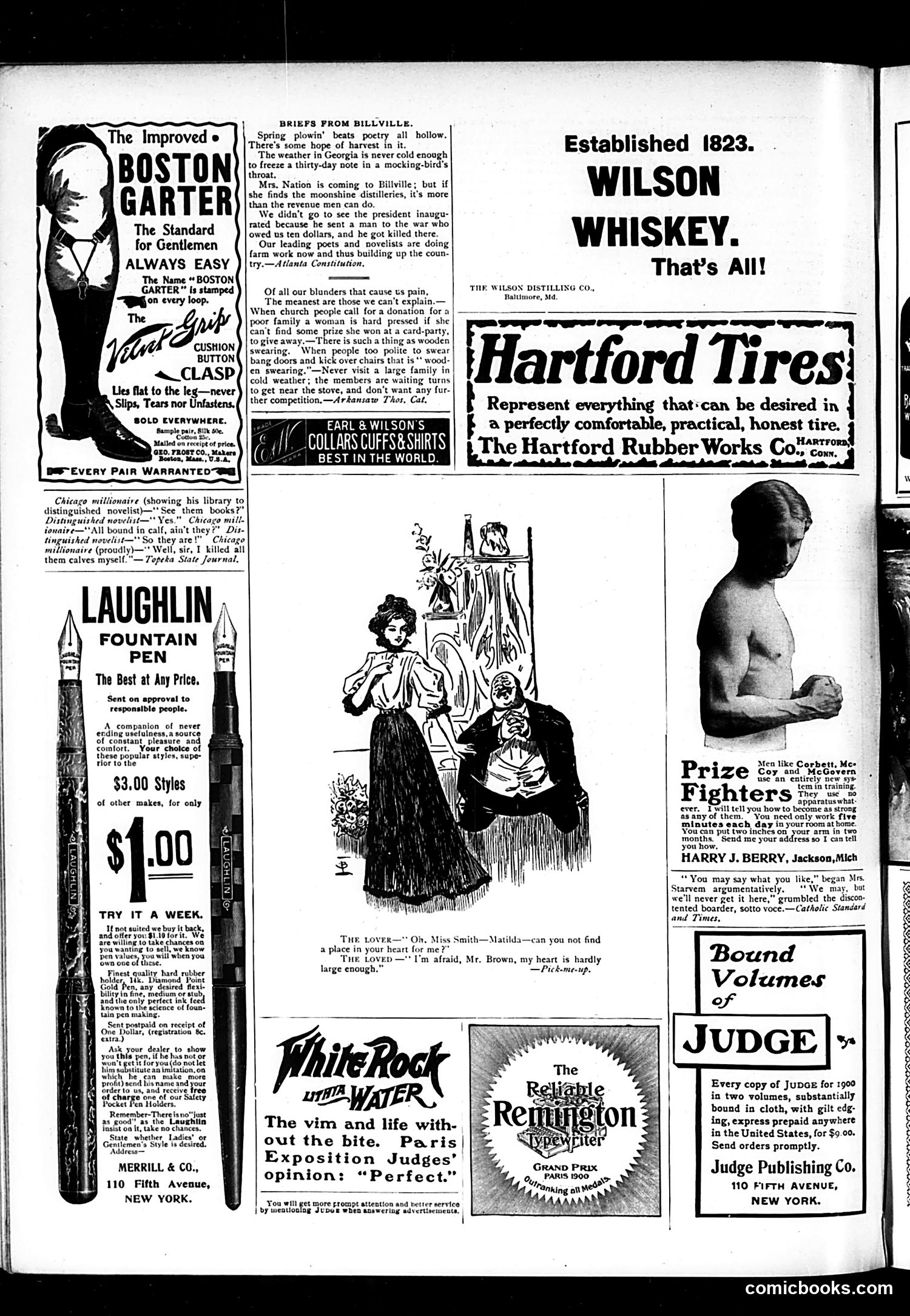
This is primarily an **advertising page** from Judge magazine, with one notable cartoon joke. ## The Main Cartoon: The prominent cartoon depicts a **Chicago millionaire showing his library to a distinguished novelist**. The joke satirizes nouveau-riche materialism and ignorance: the millionaire boasts his books are "bound in calf," then proudly reveals he personally killed all the calves himself—completely missing that "bound in calf" refers to the *binding material* (calfskin leather), not living animals. The satire mocks both the millionaire's crass wealth-flaunting and his obliviousness to cultural refinement. ## The Rest: The page contains standard period advertisements: Boston Garters, Laughlin Fountain Pens, Hartford Tires, Wilson Whiskey, and Earl & Wilson collars. There are also brief humorous "Briefs from Billville"—rural observations about spring plowing, Mrs. Nation (likely Carrie Nation, the temperance activist), and small-town life—typical filler content for satirical magazines of this era. The "Prize Fighters" advertisement recruits physical training clients by referencing contemporary boxers.
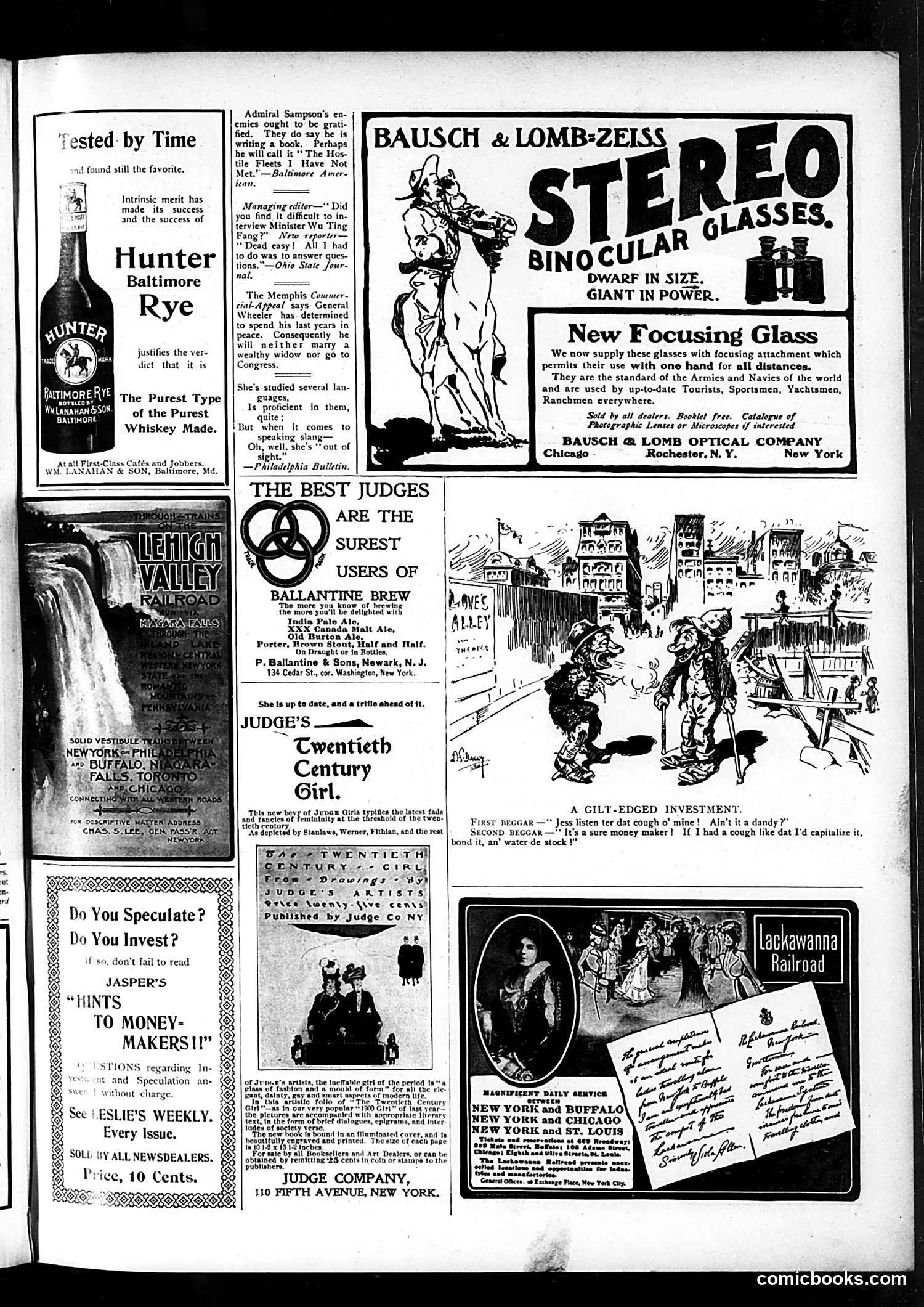
This page is primarily **advertising and light humor** rather than political satire. Key elements: **Main Cartoon:** "A Gilt-Edged Investment" depicts two beggars discussing coughing as a profitable panhandling tool—crude humor about monetizing illness for sympathy donations. **Admiral Sampson Joke:** References Admiral William Sampson (Spanish-American War naval commander). The joke mocks him for planning to write about naval battles he *didn't* fight, suggesting he had limited combat experience despite his fame. **"Twentieth Century Girl" Feature:** Celebrates the modern woman of 1900—educated in languages, fashionable, ahead of current trends. This reflects genuine cultural fascination with changing gender roles. **Advertisements:** Dominate the page—whiskey (Hunter Rye, Ballantine Brew), binoculars (Bausch & Lomb), railroad service (Lackawanna), and investment advice publications. The humor is gentle and commercial rather than sharp political commentary, reflecting Judge's evolution toward lifestyle magazine content by this period.
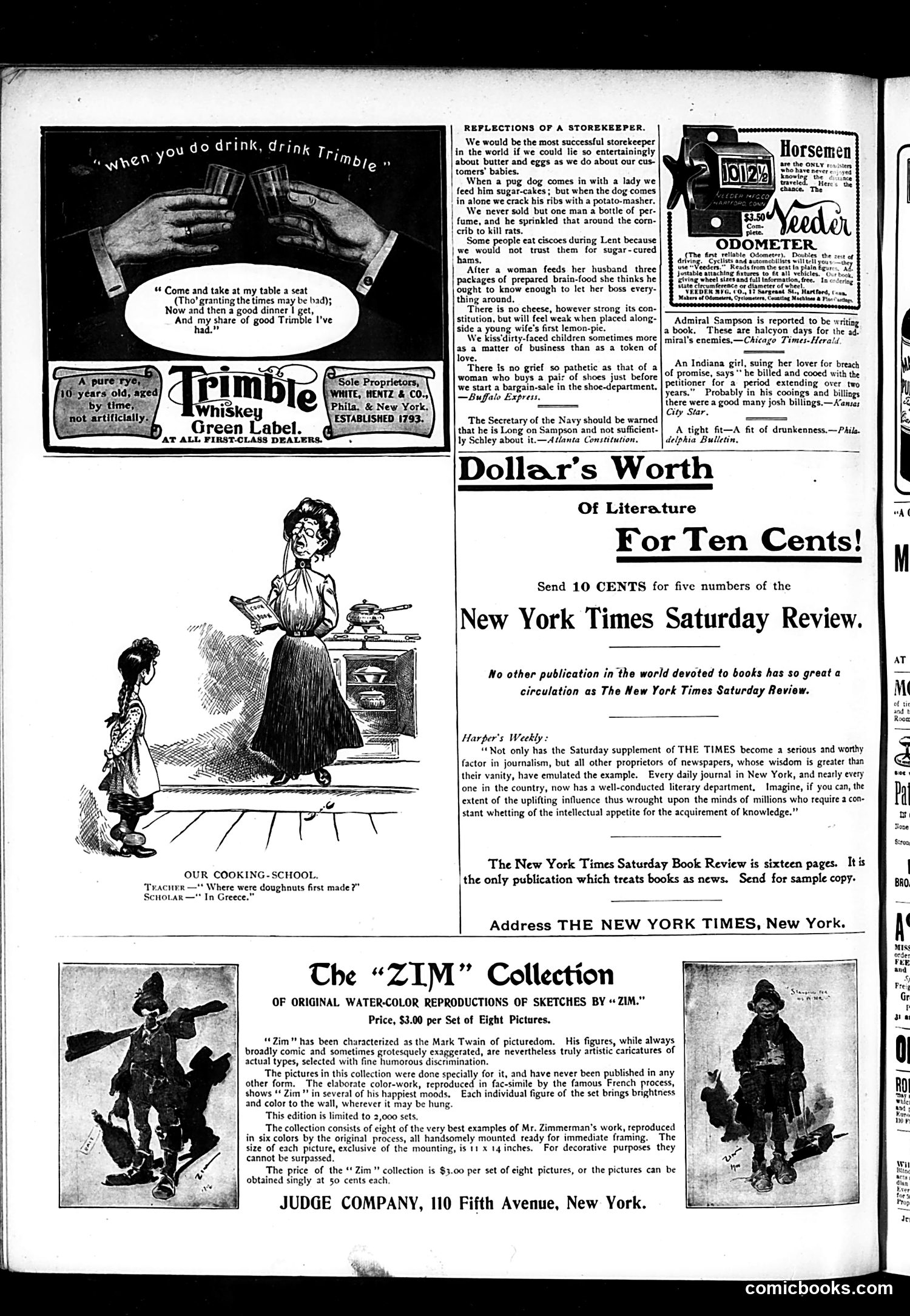
This page contains multiple advertisements and satirical content typical of Judge magazine's mix of humor and commerce. **Main Satirical Content:** The "Reflections of a Storekeeper" column offers cynical observations about retail life and human nature—humor based on the gap between public morality and private behavior. Examples include selling sugar-cakes to dogs owned by ladies while mistreating stray dogs, and exaggerating customers' babies while lying about product quality. A brief political jab references Secretary of Navy and Admiral Sampson versus Commodore Schley, a contemporary naval dispute from the Spanish-American War era (unclear from text alone which figure represents what position). **Advertisements:** The page is dominated by ads: Trimble Whiskey (with toasting figures), an odometer, the New York Times Saturday Review (emphasizing its literary authority), and "The ZIM Collection"—water-color reproductions by cartoonist "Zim," compared to Mark Twain for his caricatures. The cooking-school joke is a simple pun about doughnut origins. Overall, this appears to be a typical mixed editorial-advertising page from early 1900s Judge.
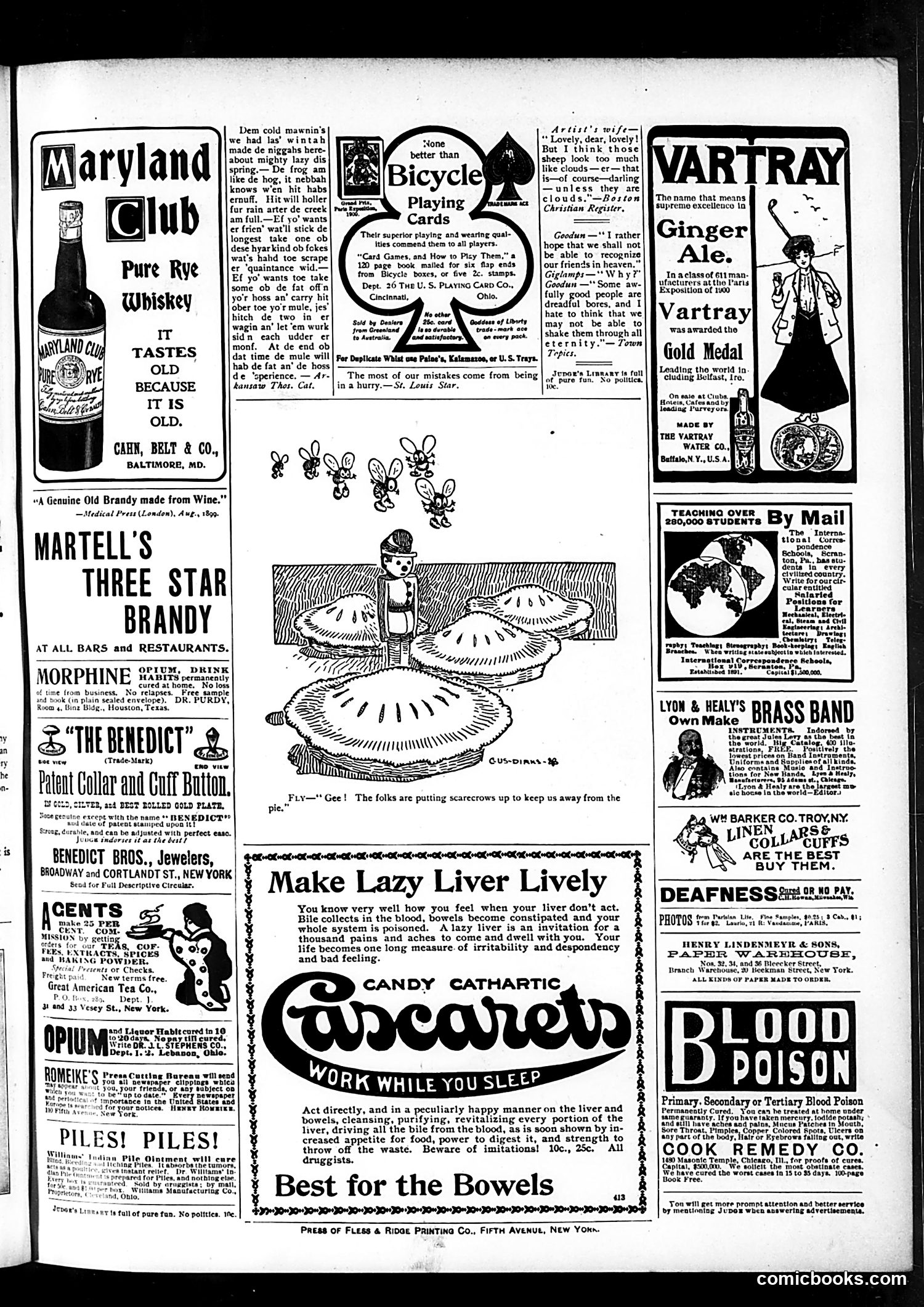
This page is primarily **advertising**, typical of Judge magazine's revenue model. The central cartoon depicts a mother duck with ducklings and a scarecrow, with the caption "Fly—'Gee! The folks are putting scarecrows up to keep us away from the pie." The joke references a common rural practice: farmers erected scarecrows to protect crops. Here, the bird family views the scarecrow as a threat to their food source rather than as protection. **Notable period elements:** - A racist dialect joke at top-left ("Dem cold mawnin's") reflecting the offensive conventions of early 1900s humor - Period advertisements for alcohol (Martell's brandy, Vartray ginger ale), dubious "remedies" (opium for morphine addiction, patent medicine for "lazy liver"), and services (mail-order deafness treatments, blood poison cures) - These ads reveal what contemporaries believed warranted public promotion and what afflictions concerned them The page reflects Judge's satirical magazine format mixed with commercial content typical of the era.
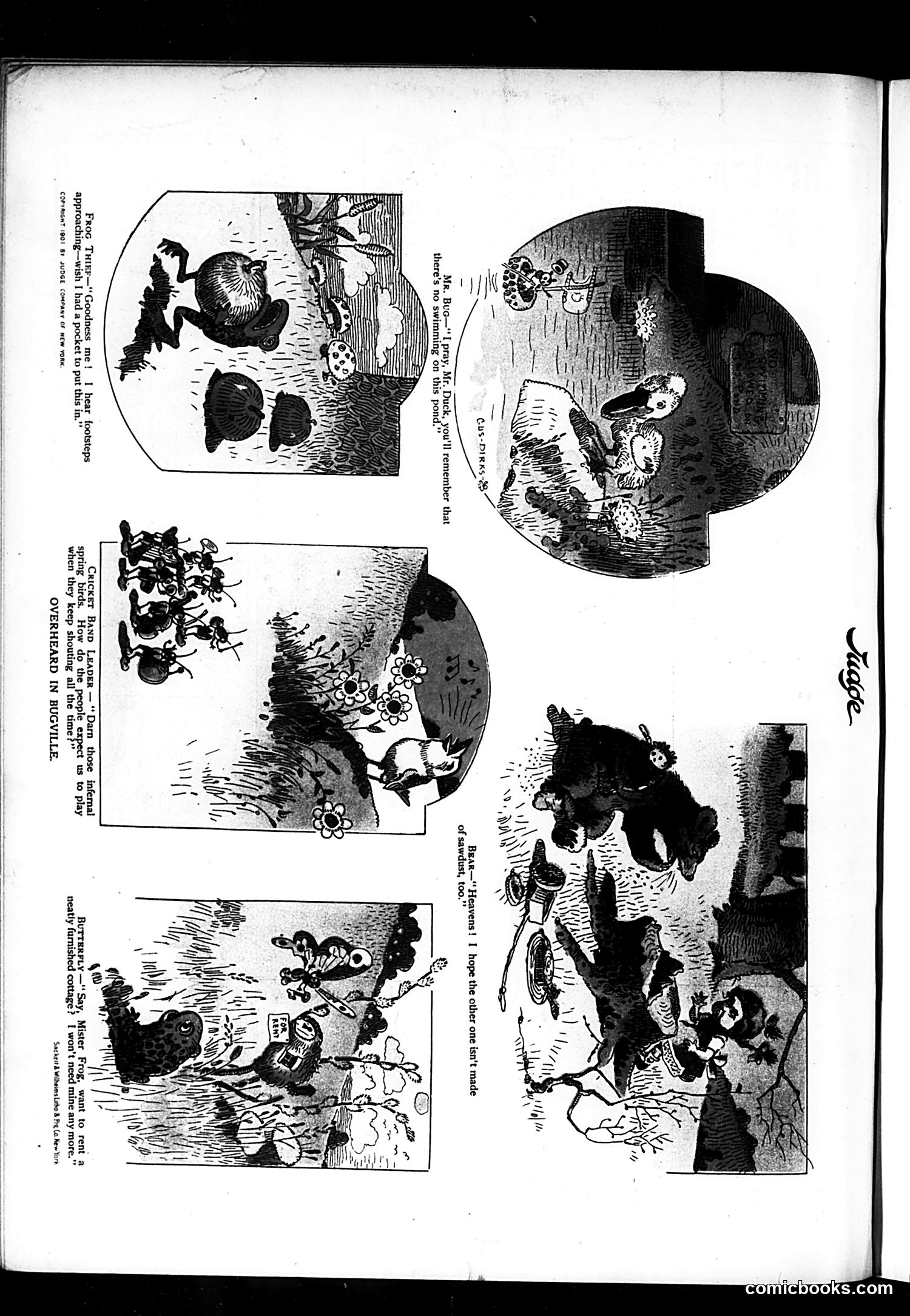
This is a whimsical anthropomorphic comic strip featuring insects with human concerns and speech. The narrative appears to involve various bugs—a duck, frog, bear, and butterfly—engaging in everyday situations rendered absurd through their insect perspective. The humor relies on incongruity: bugs discussing human problems (pocket space, sawdust composition, furnished cottages, swimming) as if they were people. Mr. Buck worries about swimming conditions; the frog frets about lacking pockets; the bear hopes his companion isn't made of sawdust (suggesting artificiality or deception among insects). The "Bugville" framing presents a parallel society where insects mirror human social anxieties and conversations. This type of anthropomorphic satire was common in *Judge* magazine—using animal characters to humorously reflect on human foibles without directly targeting specific political figures. The satire operates through absurdist observation rather than partisan commentary.