
Judge, 1901-03-30 · page 10 of 16
Judge — March 30, 1901 — page 10: what you’re looking at
What you’re looking at
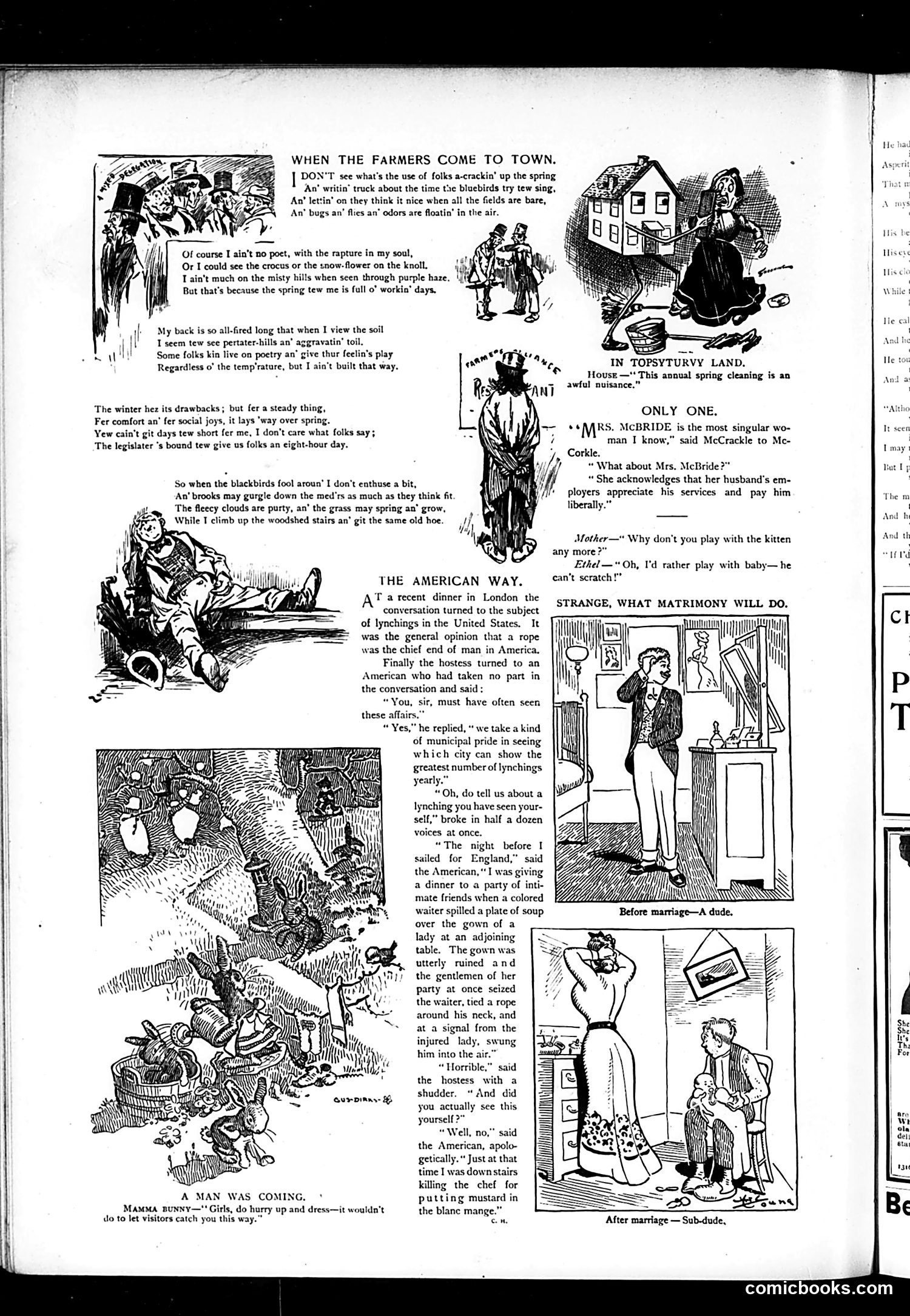
This page contains several satirical pieces targeting early 20th-century American life: **"When the Farmers Come to Town"** mocks rural laborers who romanticize spring despite its association with exhausting farm work. The farmer-speaker rejects poetic sentimentality about nature, insisting on an eight-hour workday—a contemporary labor-movement demand. **"The American Way"** is dark political satire about American lynching. A dinner-party anecdote presents an American defending his country's practice by claiming casual familiarity with mob violence. The "joke" inverts expectations: he admits he *didn't* witness the lynching because he was occupied killing his chef for a cooking mistake—implying American casual violence extends beyond racial terrorism. This is sharp criticism disguised as humor. Smaller pieces include domestic humor ("Topsyturvy Land," "Strange What Matrimony Will Do") and animal cartoons that are less satirically pointed. The cartoons' crude, period artwork and the text's dialect speech were typical Judge stylistic choices for the era.
📄 Transcribed text from this page (OCR, searchable)
Machine-transcribed from the original scan — historical spelling and the odd misread are preserved.
My back is so all-fired long that when I view the soil T seem tew see pertater-hills an’ aggravatin’ toil. The winter hez its drawbacks ; but fer a steady thing, Fer comfort an’ fer social joys, it lays ‘way over spring. Yew cain’t git days tew short fer me, I don't care what folks say; ‘The legislater ‘s bound tew give us folks an eight-hour day. So when the blackbirds fool aroun’ I don’t enthuse a bit, ‘An’ brooks may gurgle down the med’rs as much as they think fit The fleecy clouds are purty, an’ the grass may spring an’ grow, While T climb up the woodshed stairs an’ git the same old hoe. 4}, ll i f wt ns i NEN A MAN WAS COMING, MAMMA BUNNY—"* Girls, do hurry up and dress—it wouldn't do to let visitors catch you this way.” Of course I ain't no poet, with the rapture in my soul, Or I could see the crocus or the tnow-flower on the knoll. T ain't much on the misty hills when seen through purple haze, But that’s because the spring tew me is full o° workin’ days, Some folks kin live on poetry an’ give thur feelin’s play Regardless o’ the temp’rature, but I ain't built that way. WHEN THE FARMERS COME TO TOWN. | DON'T see what's the use of folks a-crackin’ up the spring ‘An’ writin’ truck about the time the bluebirds try tew sing, An’ lettin’ on they think it nice when all the fields are bare, An’ bugs an’ flies an’ odors are floatin’ in the air. THE AMERICAN WAY. T a recent dinner in London the conversation turned to the subject of lynchings in the United States. was the general opinion that a rope was the chief end of man in America. Finally the hostess turned to an American who had taken no part in the conversation and said : “You, sir, must have often seen these affairs.” “Yes,” he replied, “ we take a kind of municipal pride in seeing which city can show the greatest number of lynchings. yearly.” “Oh, do tell us about a lynching you have seen your- self,” broke in half a dozen voices at once. “The night before I sailed for England,” the American, “I was giving a dinner to a party of inti- mate friends when a colored waiter spilled a plate of soup over the gown of a lady at an adjoining table, The gown was utterly ruined and the gentlemen of her Party at once seized the waiter, tied a rope around his neck, and at a signal from the injured lady, swung him into the ai “Horrible,” said the hostess with a shudder. “And did you actually see this yourself 2” “Well, no,” said the American, apolo- getically." Just at that time I was down stairs killing the chef for putting mustard in the blanc mange.” em. Hisex Mis cle IN TOPSYTURVY LAND. Housz —“ This annual spring cleaning is an Ni awful nuisance.” ONLY ONE. : — *MBS- MCBRIDE is the most singular wo- It seen i man I know,” said McCrackle to Mc- T may: Corkle. “ What about Mrs. McBride?” / if if She acknowledges that her husband's em- i ployers appreciate his services and pay him liberally.” Mother—* Why don't you play with the kitten any more?” Ethel —“ Oh, I'd rather play with baby—he can’t scratch!” STRANGE, WHAT MATRIMONY WILL DO. Tt ‘ vi Tae said After marriage — Sub-dude, comicbooks.com