
Judge, 1901-03-30 · page 7 of 16
Judge — March 30, 1901 — page 7: what you’re looking at
What you’re looking at
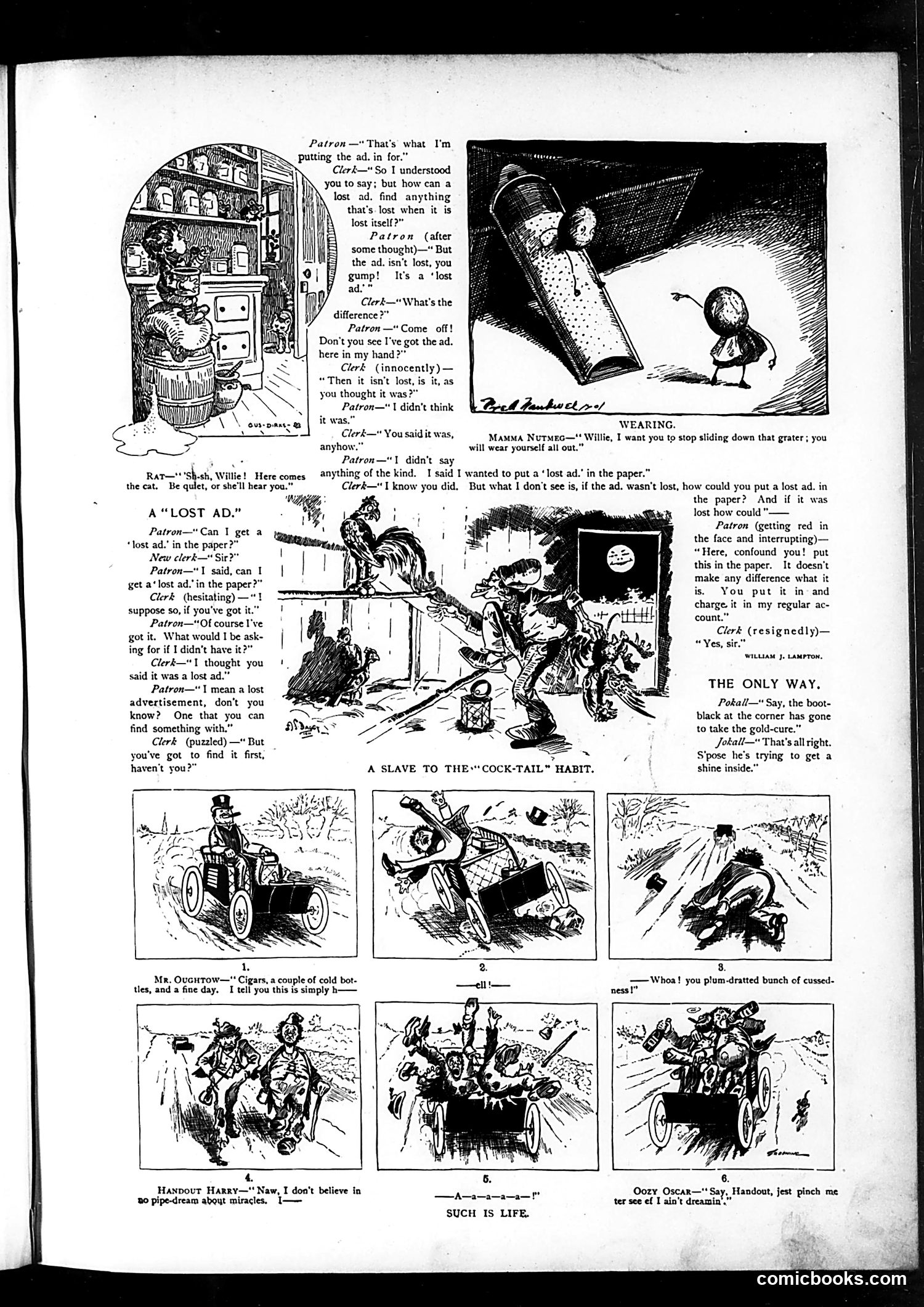
This page contains several humorous vignettes satirizing American life, primarily focused on wordplay and social commentary: **"A Lost Ad"** (main dialogue): The joke centers on a patron's circular logic—wanting to place a "lost ad" (advertisement seeking lost items) in a newspaper. The clerk's confusion is intentional satire: if the ad itself is lost, how can it help find anything? The humor mocks both miscommunication and the absurdity of certain advertising practices. **"Weaving"**: A child sliding down a cheese grater while mother warns against noise—dark humor about domestic chaos and parental priorities. **"Such Is Life"** (bottom strip): A series of comic panels showing a man in a car experiencing increasingly disastrous mishaps, ending with him upside-down. The title suggests resigned acceptance of life's inevitable troubles. **"The Only Way"**: Brief dialogue suggesting a bootblack seeking a "gold cure" (likely a reference to alcohol addiction treatment) is instead seeking to shine shoes—wordplay on "shine" (polish vs. intoxication). The page exemplifies Judge's style: satirizing American speech patterns, social pretension, and everyday misadventures through puns and observational humor.
📄 Transcribed text from this page (OCR, searchable)
Machine-transcribed from the original scan — historical spelling and the odd misread are preserved.
Patron —*" That's what I'm putting the ad. in for.” Clerk—" So 1 understood you to say; but how can a lost ad. find anything that’s. lost when it is lost itself?” Patron (after some thought)—“ But the ad. isn’t lost, you gump! It's a ‘lost ad" Cler: difference Patron —" Come off! Don't you sce I've got the ad. here in my hand?” Clerk (innocently) — “Then it isn’t lost, is it, as you thought it was?” Patron—*| didn't think it was.” Clerk— You said it was, anyhow.” will wear yourself all out." — Patron—"1 didn’t say Rat—'t'Sh-sh, Willie! Here comes anything of the kind. I said I wanted to put a ‘lost ad.” in the paper.” Bare a ee sau ‘sy "What's the WEARING. A “LOST AD.” Patron—"Can 1 get a “Jost ad.’ in the paper?” New clerk—* Sir?” Patron—"1 said, can 1 get a‘ lost ad.’ in the paper?” Clerk (hesitating) suppose so, if you've got it. Patron—"Of course 1 got it. What would I be ing for if I didn’t have it Clerk—"1 thought you said it was a lost ad.” Patron— mean a lost advertisement, don’t you know? One that you can find something with.” Clerk (puzzled) —" But you've got to find it first, haven't you?” is. Mamaa Nutazo—'* Willie, I want you to stop sliding down that grater; you the cat. Be qulet, or she'll hear you."" Clerk—"I know you did, But what I don’t see is, if the ad. wasn’t lost, how could you put a lost ad. in Wits: the paper? And if it was lost how could "—— Patron (getting red in the face and interrupting)— “Here, confound you! put this in the paper. It doesn’t make any difference what it charge. it in my regular ac- count.” Clerk (resignedly)— “Yes, sir.” THE ONLY WAY. Pokall— Say, the boot- black at the corner has gone to take the gold-cure.”” Sokall—" That's all right. S'pose he’s trying to get a shine inside.” You put it in and WILLIAM J. LAMPTON, Mr. OucHTow—"* Cigars, a couple of cold bot- tles, and a fine day. I tell you this is simply h— ness!” 8. —Whoa! you plum-dratted bunch of cussed- Hanvout Harry—“' Naw, I don’t believe in Oozy Oscar—"* Ro pipe-dream about miracles. 1— SUCH IS LIFE. y,, Handout, jest pinch me ter see ef I ain't dreamin.” comicbooks.com