
A complete issue · 16 pages · 1901
Judge — February 9, 1901
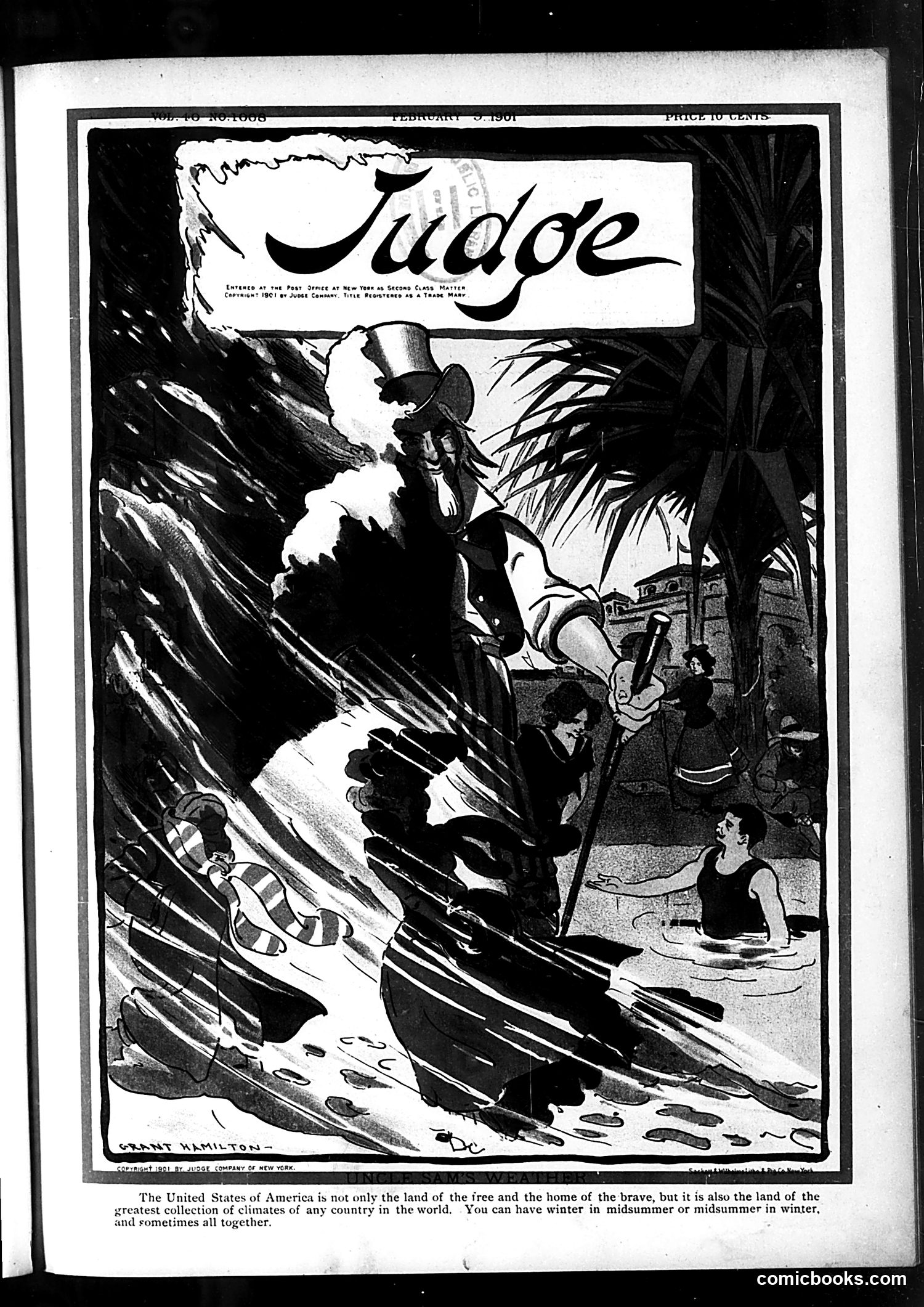
This 1901 Judge cover depicts **Uncle Sam as a giant figure** towering over a tropical landscape, appearing to oversee American territorial expansion. The smaller figures below—including what appears to be native populations and American settlers or soldiers—suggest the cartoon comments on U.S. imperialism during the early 20th century. The accompanying text emphasizes America's geographic diversity and climate variety, likely promoting nationalist pride in American territory. The cartoon's visual hierarchy, with Uncle Sam dominating the scene, reflects contemporary debates about American expansionism, particularly following the Spanish-American War (1898) and subsequent American control of territories like Puerto Rico, Guam, and the Philippines. The satire appears to critique or celebrate (depending on the editorial stance) this imperial power projection.
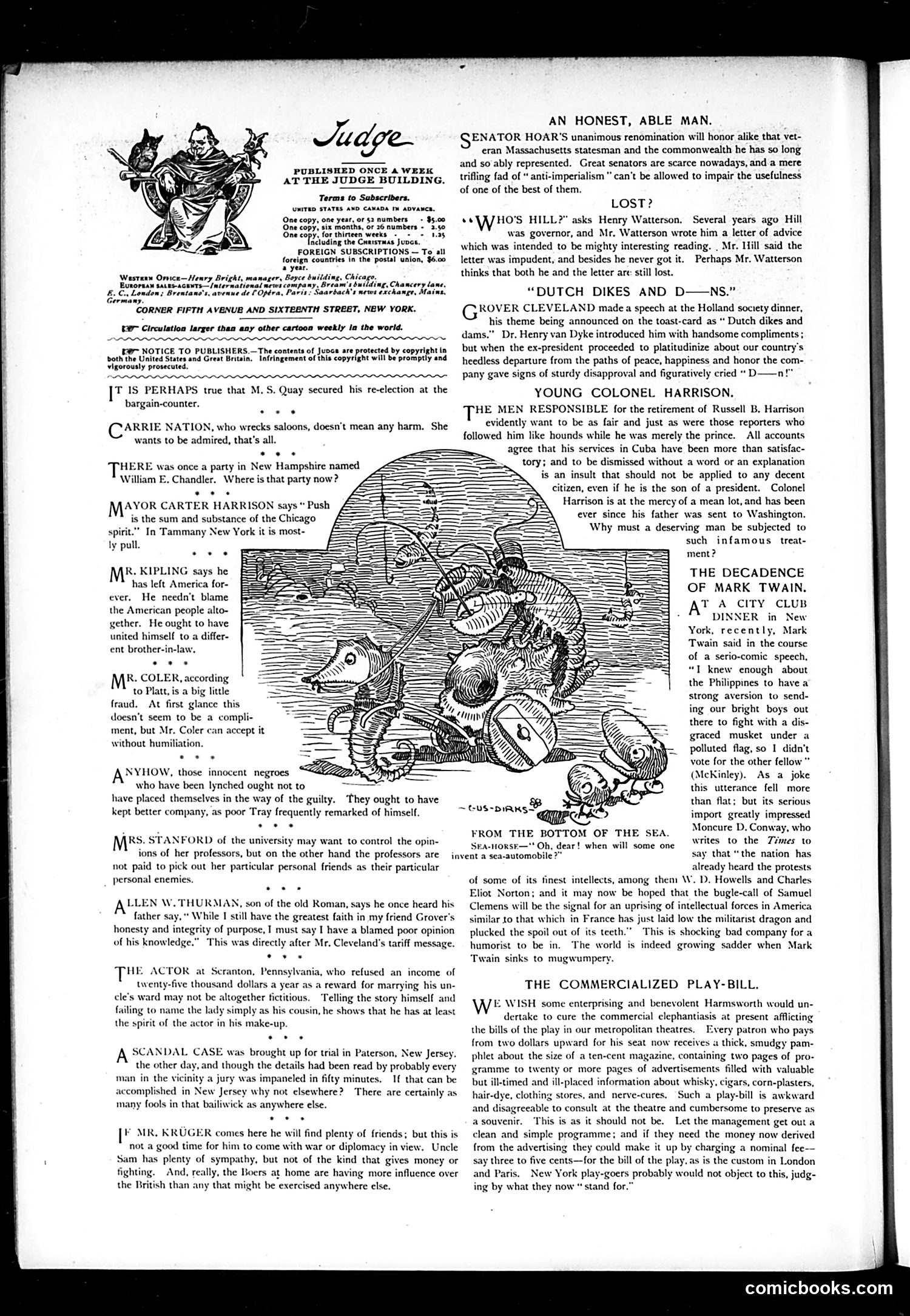
This political cartoon depicts sea creatures emerging from ocean depths, appearing to represent politicians or public figures rising to prominence. The accompanying text references Mark Twain's recent dinner speech criticizing American imperialism, particularly regarding the Philippines. Twain apparently joked that sending "our bright boys out there to fight with a disgraced musket under a polluted flag" was absurd. The cartoon likely satirizes politicians or naval figures associated with imperialist policies—possibly Theodore Roosevelt or similar expansionists—as grotesque "creatures from the depths." The joke suggests these individuals and their policies are monstrous or base, emerging from dark, murky origins rather than respectable leadership. The visual comparison demeans imperialist politicians through bestial imagery.
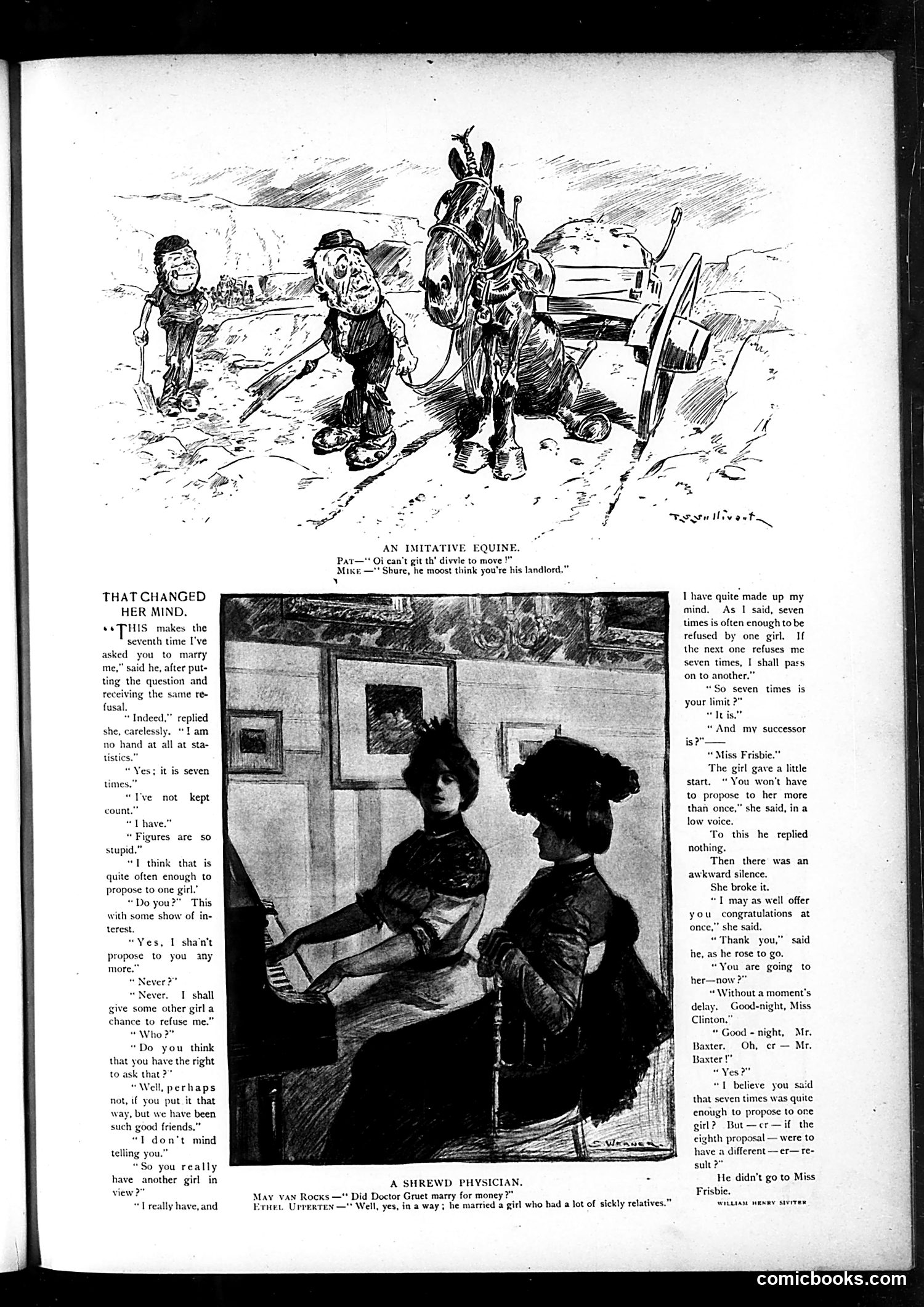
This page contains two distinct pieces: **Top cartoon "An Imitative Equine"**: Shows a man and woman with a horse-drawn cart. The joke plays on the woman's refusal to "drive" (move forward), with the man suggesting the horse is imitating her stubbornness. It's a gender-based joke about female obstinacy. **Main illustrated story "A Shrewd Physician"**: Depicts a doctor's visit involving marriage negotiations. The caption references "May van Rocks" and "Doctor Cruet" marrying "for money," with the doctor having "married a girl who had a lot of sickly relatives." The accompanying text is a comedic dialogue about proposal etiquette—specifically, how many times a man should propose before accepting refusal. It satirizes both courtship customs and mercenary marriages of the era, suggesting persistence in romantic pursuit was socially expected. Both pieces mock Victorian-era social conventions around gender and marriage.
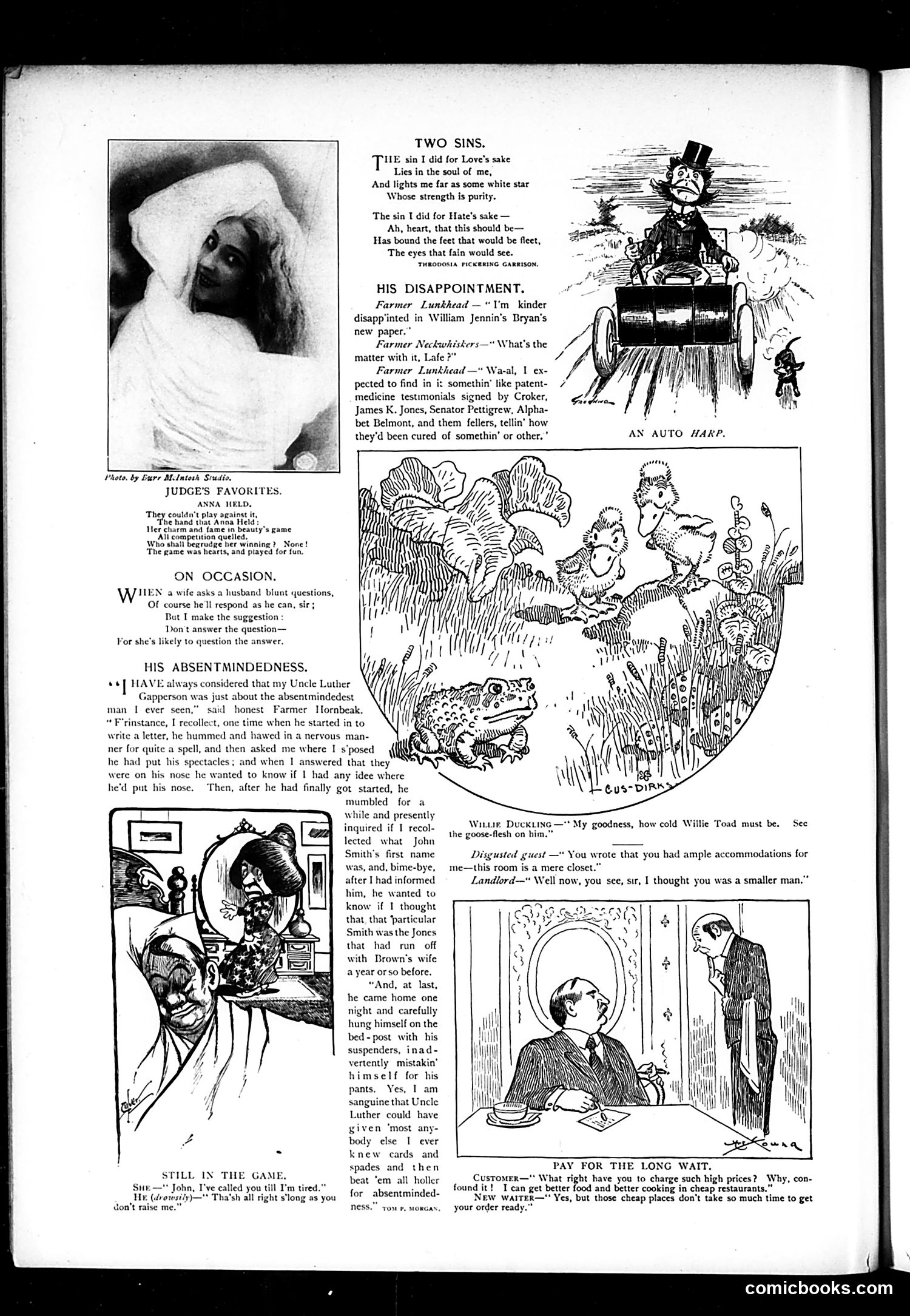
This page contains several satirical pieces targeting early 1900s American life: **"His Absentmindedness"** mocks a farmer (Farmer Hornbeak) who absent-mindedly hangs himself on his own bed post, confusing it with his spectacles—absurdist humor about rural forgetfulness. **"His Disappointment"** references William Jennings Bryan's newspaper, satirizing readers expecting patent medicine testimonials from famous figures like Senator Pettigrew, suggesting gullible public appetite for celebrity endorsements. **"Pay for the Long Wait"** depicts a customer complaining about restaurant overcharges and slow service, typical Progressive-era criticism of urban dining establishments. The cartoons employ working-class characters and domestic situations to critique American consumer culture, rural simplicity, and commercial dishonesty—recurring Judge magazine themes targeting both elite deception and common-folk naïveté.
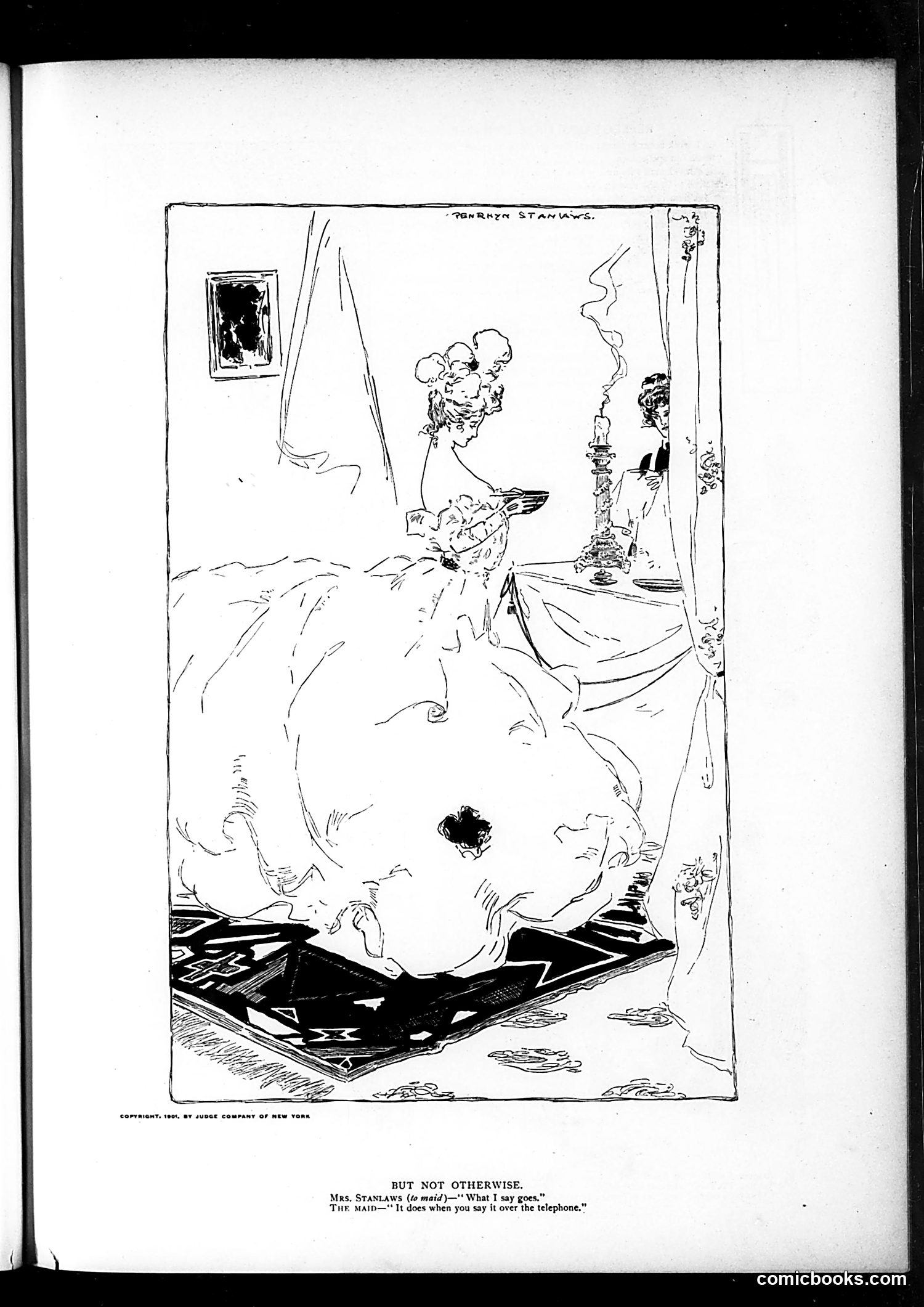
The OCR text is largely corrupted and unreadable. Based on the image and caption alone: This is a humor cartoon titled "But Not Otherwise." A maid tells Mrs. Stanlaw, "What I say goes," while Mrs. Stanlaw responds, "It does when you say it over the telephone." The joke satirizes the power dynamics of domestic service in the early 20th century. It suggests that maids—typically working-class women with limited authority—could exercise unexpected control over their employers through telephone communication. By speaking over the phone rather than face-to-face, the maid gains authority she wouldn't otherwise possess. The cartoon likely comments on how new technology (the telephone) disrupted traditional hierarchies in households, or humorously exaggerates the maid's boldness to her employer.
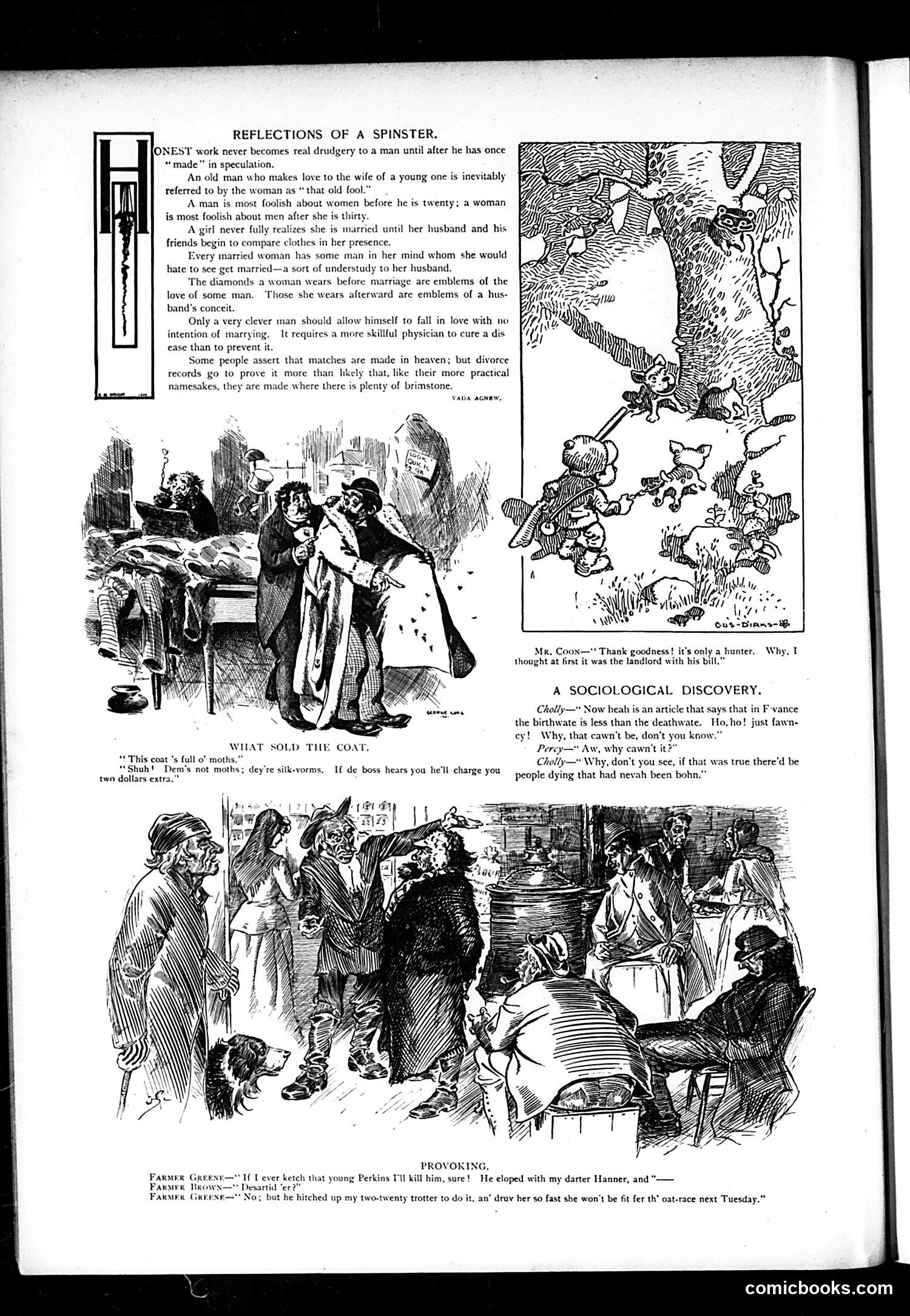
This page contains satirical commentary on marriage and gender relations typical of late 19th/early 20th-century American humor. **"Reflections of a Spinster"** presents cynical observations about romantic relationships—mocking older men pursuing younger women, suggesting women are foolish about men after thirty, and claiming divorce is as "made" as matches, just "where there is plenty of brimstone" (hell). The cartoon vignettes mock Victorian social pretensions: one depicts a shabby man attempting to sell a moth-eaten coat by rebranding the damage as "silk-worms"; another shows a wealthy hunter being mistaken for a debt-collecting landlord; a third ridicules an affected upper-class "Cholly" who can't grasp basic logic about population. **"Provoking"** depicts a farmer outraged less that a young man eloped with his daughter than that the suitor damaged his prize racing trotter. The humor relies on class anxiety, gender stereotypes, and the assumption that materialism and social climbing were universal human motivations—all normalized satirical targets of the era.
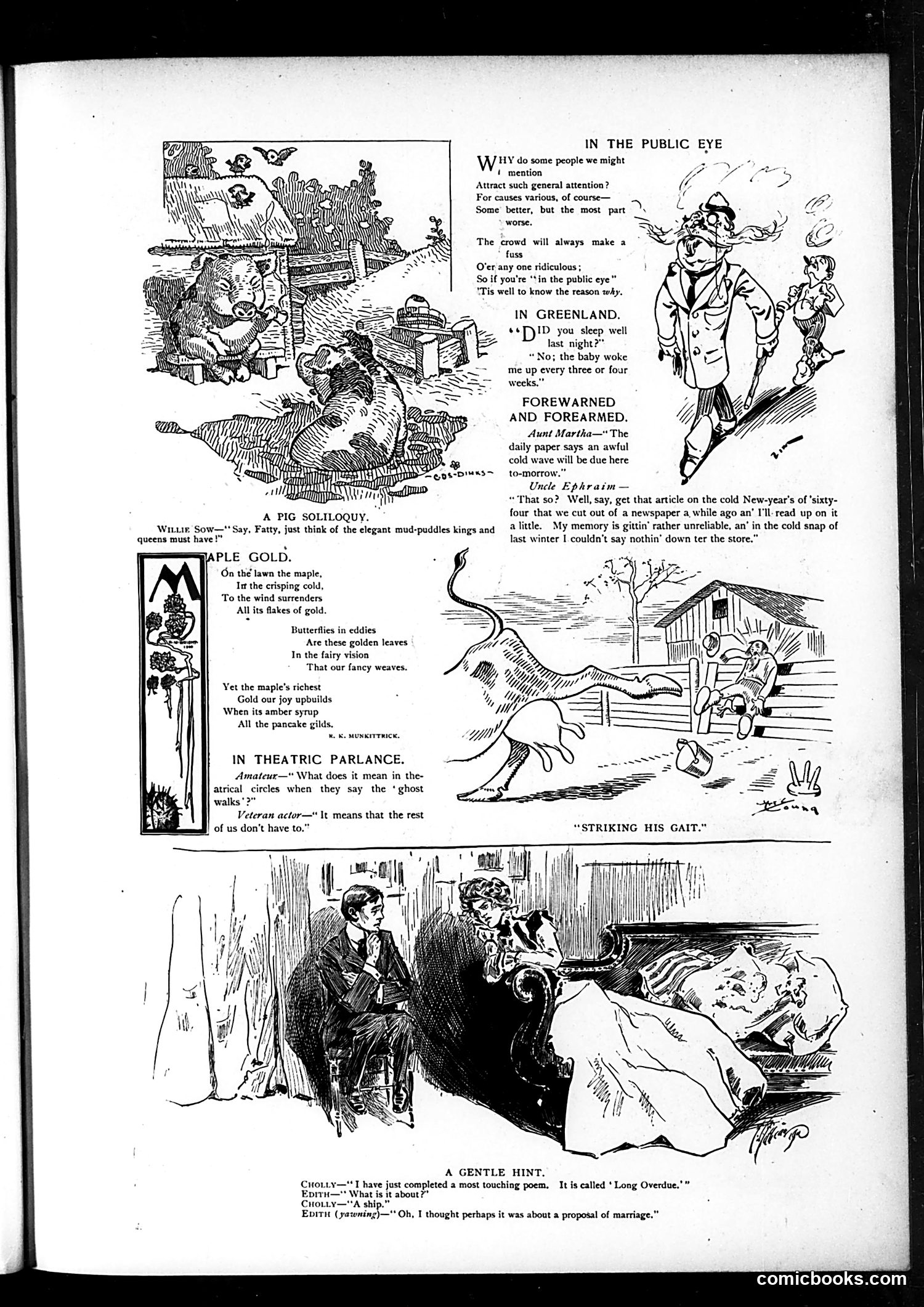
This page collects light satirical humor typical of early 20th-century American magazines: **"In the Public Eye"** — A meta-commentary on celebrity and notoriety, suggesting people attract attention for both good and bad reasons. **"In Greenland"** — A domestic joke about sleep deprivation from an infant, playing on the exotic locale for mundane complaint. **"Forewarned and Forearmed"** — Rural characters (Uncle Ephraim and Aunt Martha) plan to reuse old newspaper articles about cold weather rather than prepare anew—satirizing rural thriftiness and poor memory. **"A Pig Soliloquy"** — Gentle class satire: a pig envies aristocrats' mud-puddles, inverting typical luxury comparisons. **"Maple Gold"** — Sentimental nature poetry undercut by practical humor: the real value is maple syrup on pancakes, not aesthetic beauty. **"In Theatric Parlance"** — Theater industry joke: "the ghost walks" (payroll arrives) means actors finally get paid. **"Striking His Gait"** — Visual humor of a dog with an exaggerated posture. **"A Gentle Hint"** — Misunderstanding joke about a poem titled "Long Overdue." Overall: gentle, non-political domestic and professional humor.
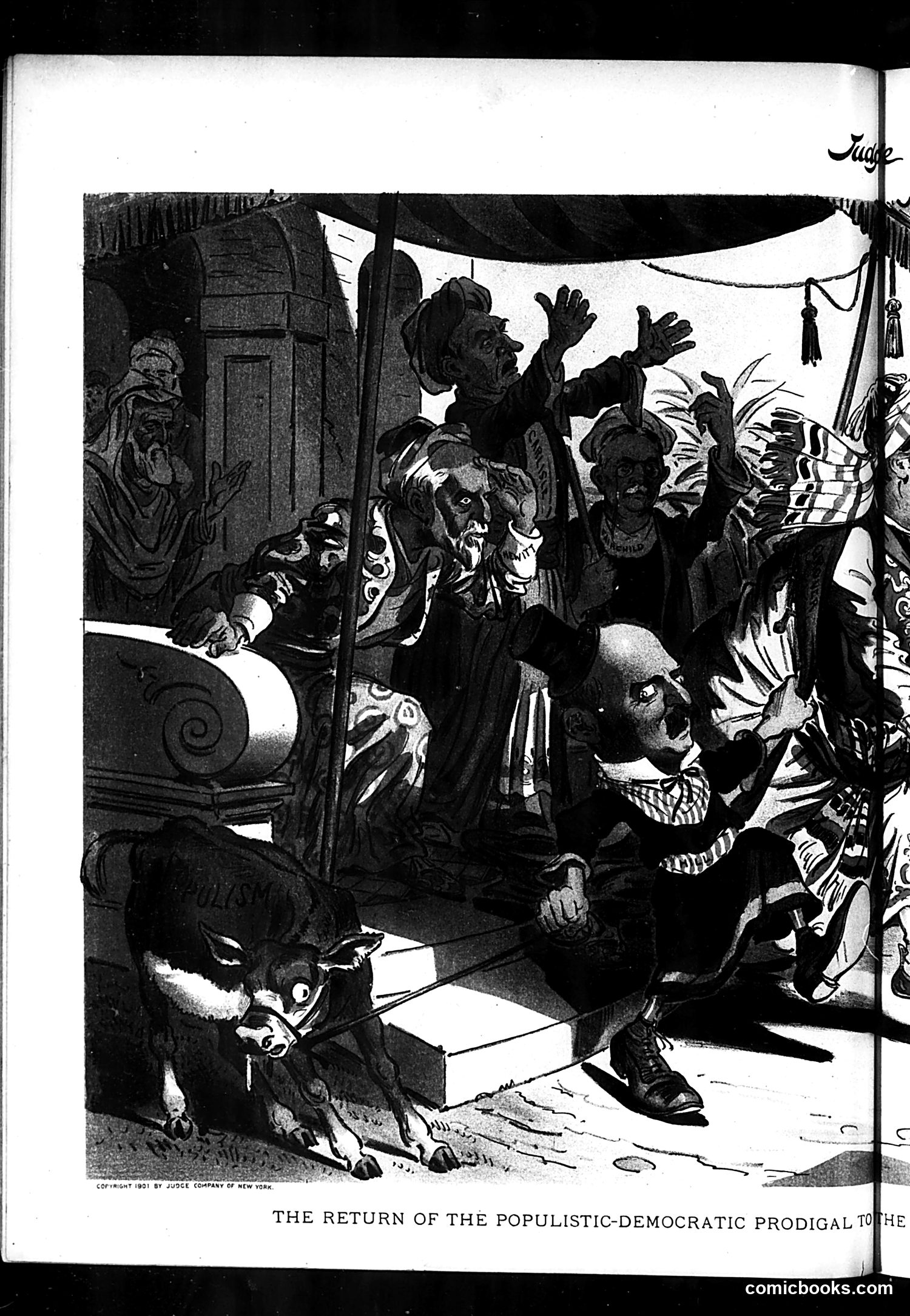
The caption reads: "THE RETURN OF THE POPULISTIC-DEMOCRATIC PRODIGAL TO THE" This Judge magazine cartoon satirizes the return of a Populist or Democratic political figure to mainstream politics. The scene depicts a theatrical, elaborate reception with costumed figures gesturing dramatically. A small dog in the foreground appears to represent common people or the masses observing this spectacle. The satire targets what the cartoonist views as insincere political theater—the exaggerated welcome-back ceremony suggests the figure's return is performative rather than genuinely meaningful. The ornate setting and elaborate costume details mock the pretentiousness of the political establishment receiving this figure. Without the complete caption, the specific identity remains unclear, but this likely references late 19th-century American populist politics and factional divisions within the Democratic Party.
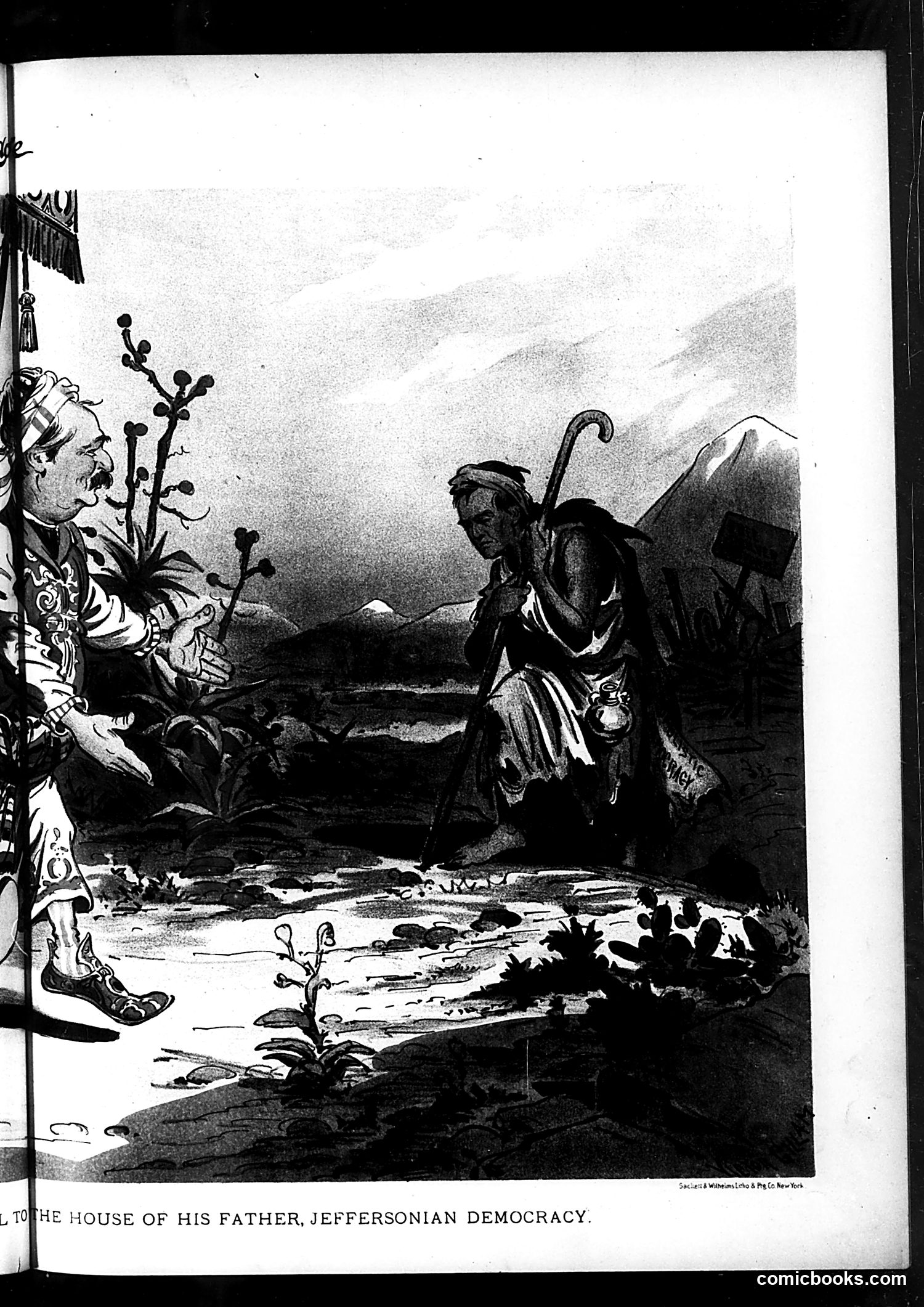
This Judge magazine cartoon satirizes the state of Jeffersonian democracy. The image depicts two figures in a desolate landscape: one appears to be an ornately dressed, imperious figure on the left (likely representing corrupted or monarchical governance), while a ragged, weary figure on the right (representing the common citizen or democratic ideals) trudges away with a walking stick and axe. The barren terrain with withered plants symbolizes the degraded state of Jefferson's democratic vision. The caption "TO THE HOUSE OF HIS FATHER, JEFFERSONIAN DEMOCRACY" suggests democracy has become abandoned or corrupted—that the current political system has betrayed Jefferson's original principles of republican simplicity and popular sovereignty. The cartoon criticizes how American democracy has devolved from its foundational ideals into something unrecognizable.
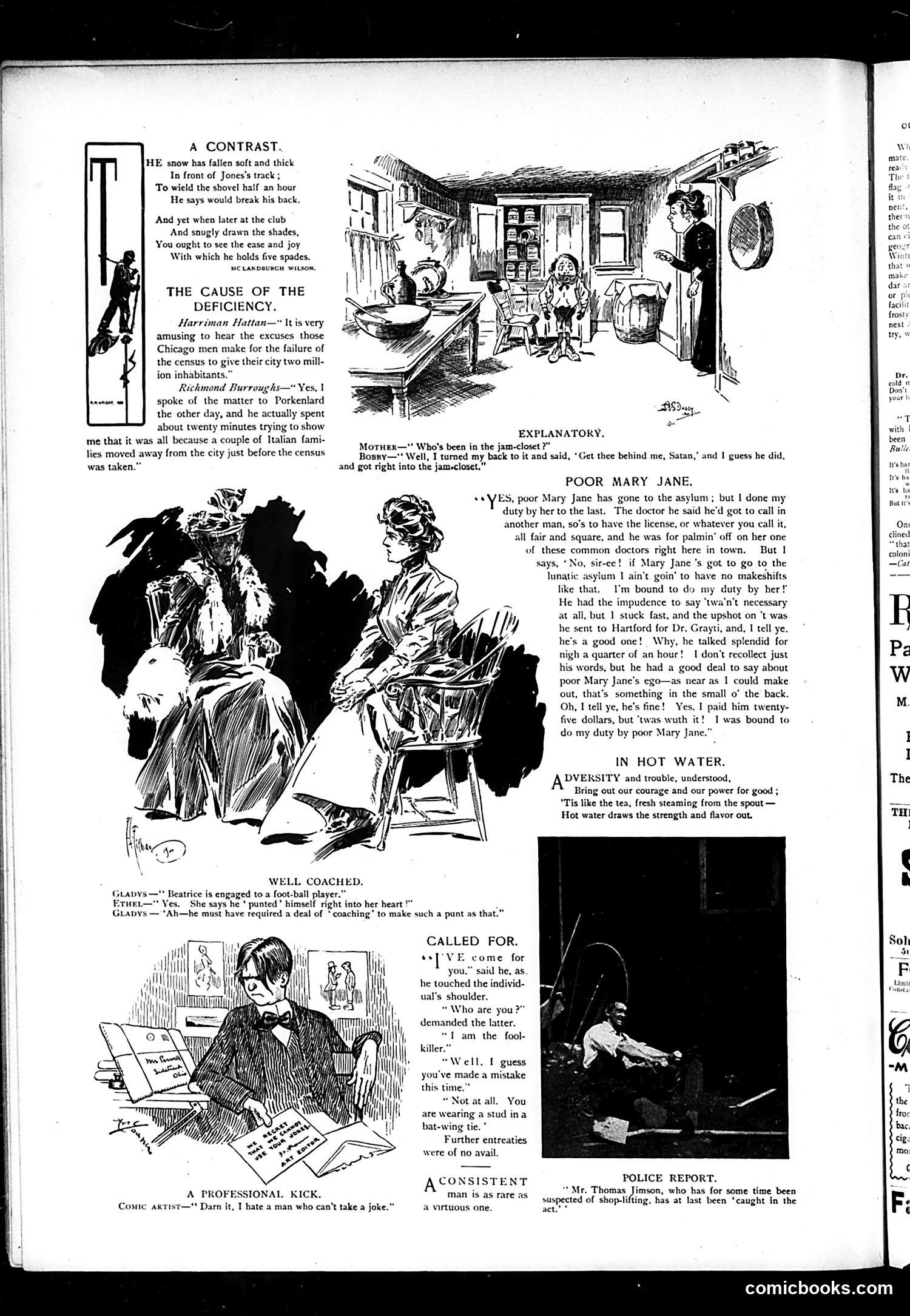
This page contains several brief satirical pieces typical of Judge magazine's style: **"A Contrast"** mocks a man (Jones) who claims his back is too weak to shovel snow but has no problem holding five playing cards at his club—suggesting laziness masked by excuses. **"The Cause of the Deficiency"** jokes about Chicago's census undercount, with characters speculating that Italian families leaving the city before the census explains why it didn't reach two million inhabitants—likely satirizing both census methodology and ethnic demographics of the era. **"Poor Mary Jane"** features a caregiver proudly recounting her expensive medical care for an asylum patient, emphasizing duty and propriety while inadvertently revealing she paid handsomely ($25) for a doctor's vague medical talk about "ego" in the patient's back—satirizing both medical pretension and working-class deference to authority. Other pieces mock foolish fashion choices and predictable romantic clichés. The page exemplifies Judge's accessible, class-conscious humor targeting American social pretension and human folly.
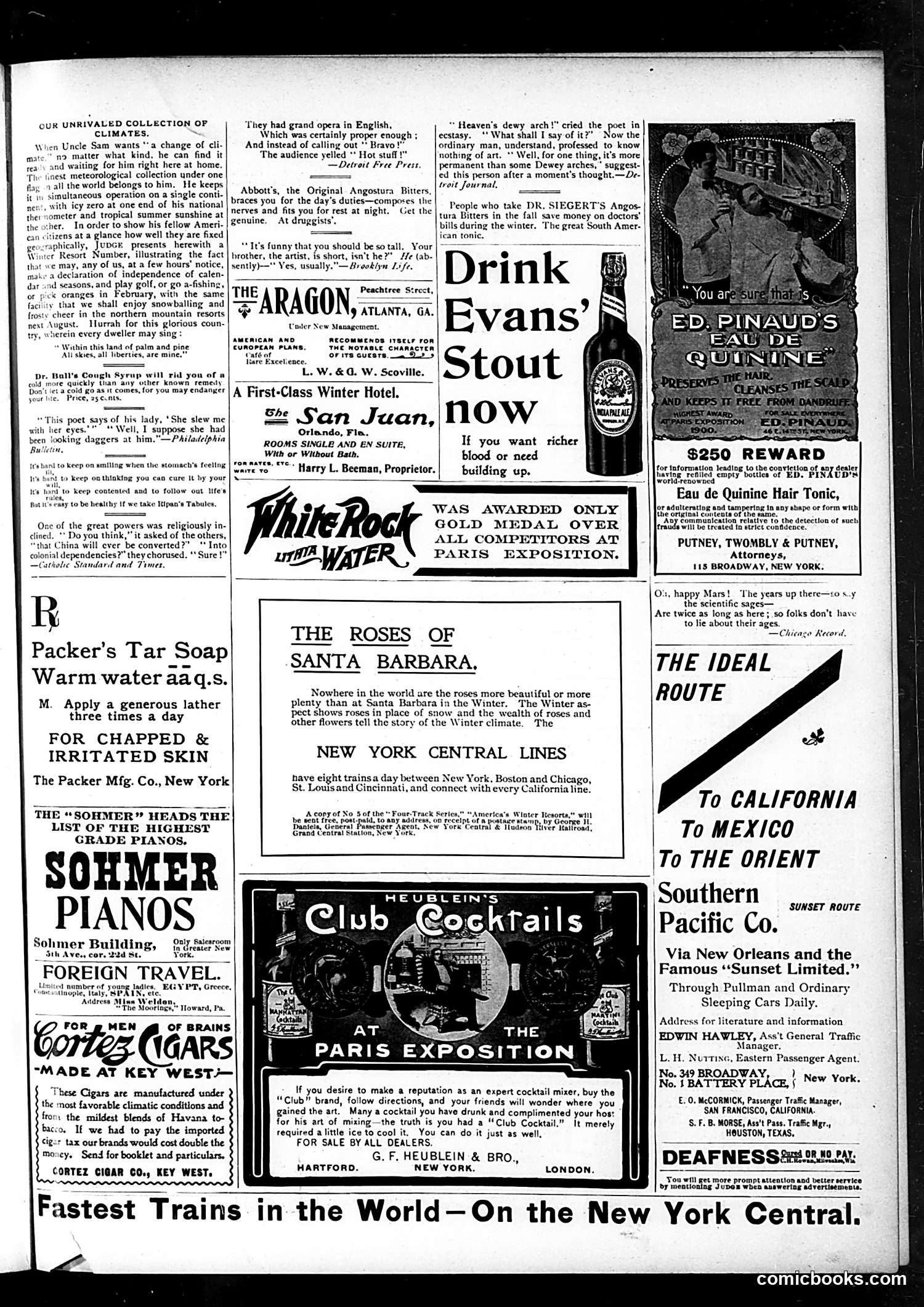
This page is primarily **advertising**—not a satirical cartoon. It's a collection of period advertisements and brief humorous snippets from Judge magazine, likely from an early 1900s "Winter Resort Number." The small joke at top mocks foreign opera audiences: Americans applaud politely in English opera, but when opera switched to English lyrics, audiences crudely yelled "Hot stuff!" instead of "Bravo"—satirizing American vulgarity and poor cultural refinement. Another brief gag references colonial expansion: when great powers ask if China will be "converted," they cynically mean colonized, not Christianized. The bulk of the page advertises winter hotels, pianos, cigars, hair tonic, and transportation services—reflecting contemporary consumer culture. The "unrivaled collection of climates" header playfully celebrates America's geographic diversity for tourism. No major political figures are caricatured. The humor is light, focusing on American cultural shortcomings and lifestyle.
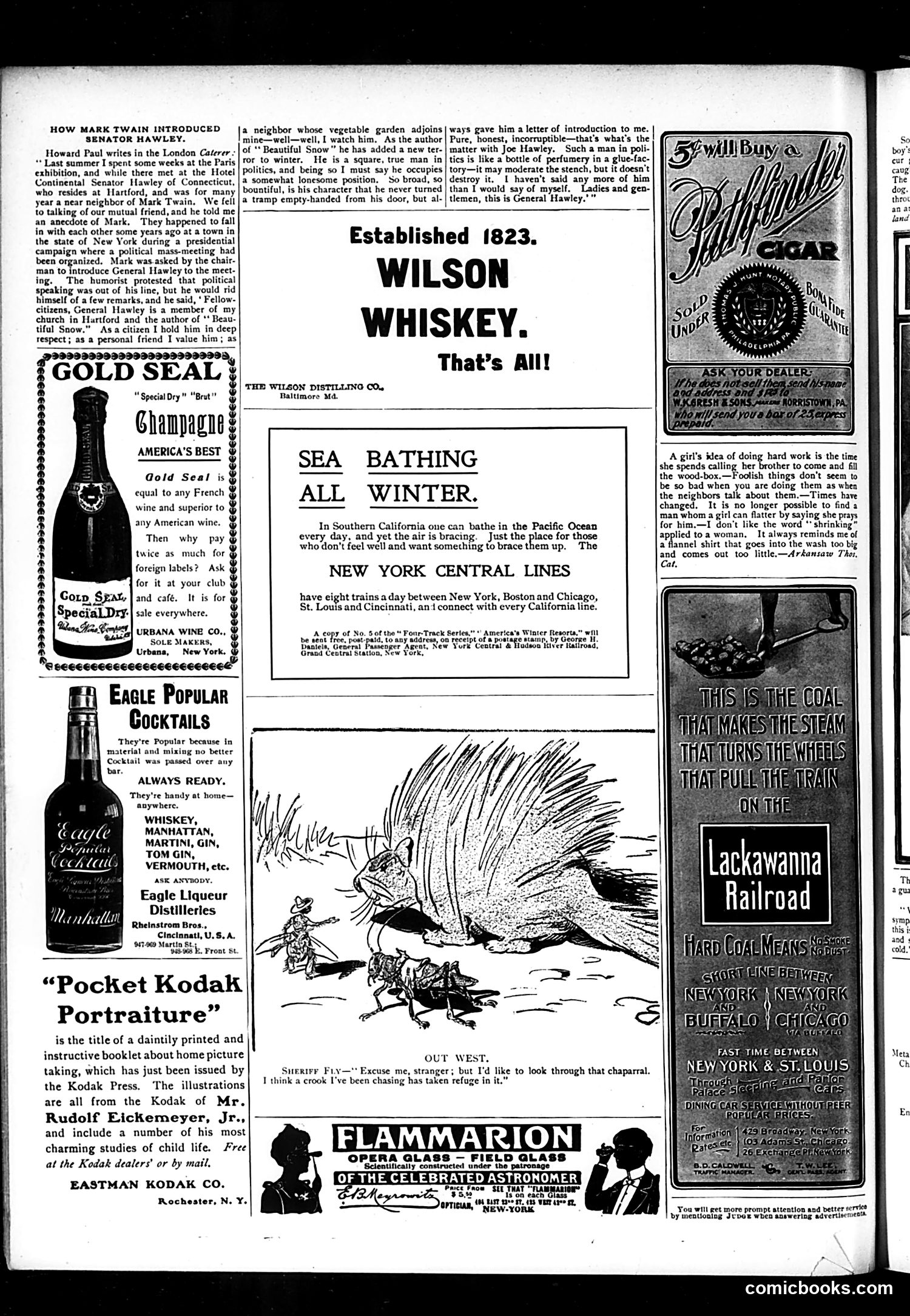
This page from *Judge* magazine is primarily **advertising** with one notable editorial content piece. The main article, "How Mark Twain Introduced Senator Hawley," is an anecdote about **Senator Joseph R. Hawley of Connecticut**. The humor relies on Mark Twain's famous irreverence: asked to introduce Hawley at a political rally, Twain describes him as a church member and author of "Beautiful Snow," but adds a backhanded compliment—comparing an honest politician in corrupt politics to "a bottle of perfumery in a glue factory." The joke satirizes the pervasiveness of political corruption; even a genuinely virtuous man seems out of place in the system. The remainder is period advertisements for **Wilson Whiskey, Gold Seal Champagne, Eagle Popular Cocktails, railroad lines, and photography products**—typical commercial content for a satirical magazine that relied on advertising revenue. A humorous section titled "Out West" includes a brief joke about a sheriff and a chaparral.
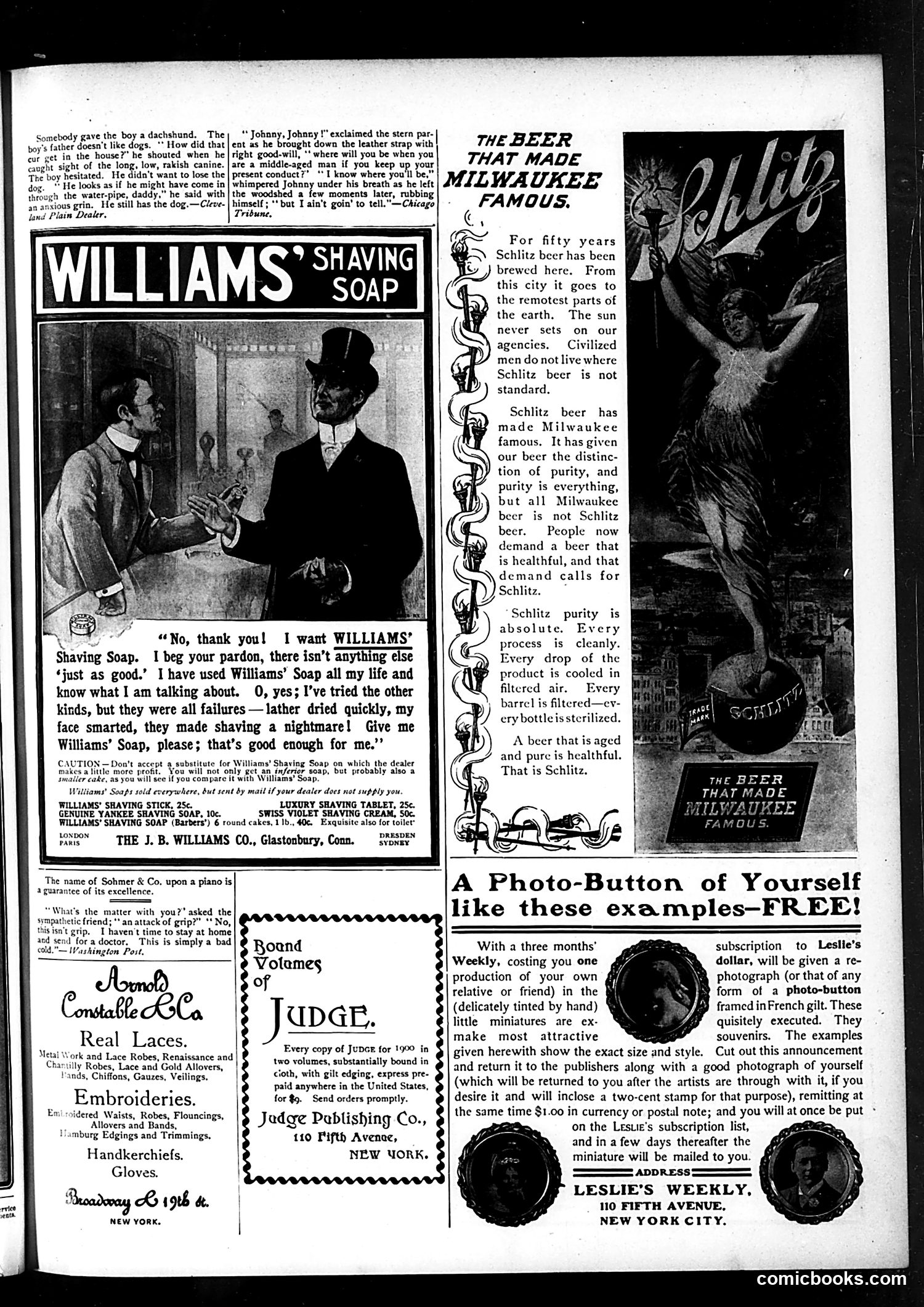
This page from the satirical magazine *Judge* contains primarily **advertisements** rather than political cartoons. The main content includes: 1. **Williams' Shaving Soap ad**: Features a testimonial from a distinguished gentleman refusing substitutes, emphasizing brand loyalty and product superiority—a common advertising trope of the era. 2. **Schlitz Beer ad**: Proclaims Milwaukee's beer as world-famous for "purity," suggesting competitors lack this quality. The copy reflects early 1900s marketing emphasizing hygiene and health benefits. 3. **Two brief humorous anecdotes** at the page's top: One about a boy with a dachshund (mocking its appearance), another about corporal punishment—light domestic humor typical of *Judge*. 4. **Leslie's Weekly promotion**: Offering photo-button souvenirs with subscriptions. The page demonstrates how *Judge* functioned: mixing satirical humor with paying advertisements that mimicked the magazine's comedic tone to appeal to readers.
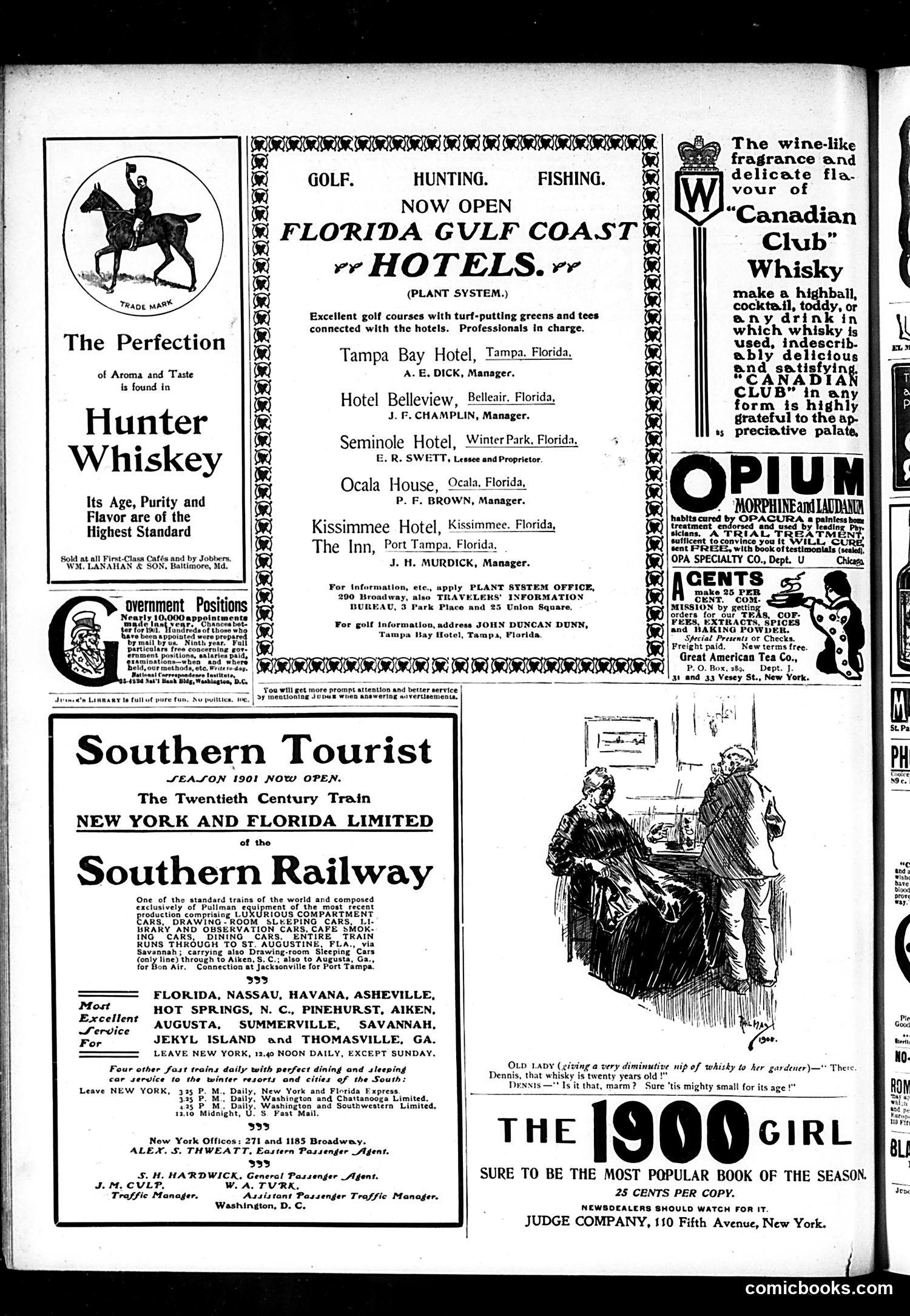
This page is primarily **advertising and promotional content** rather than editorial satire. The advertisements promote Florida tourism (golf, hunting, fishing), whiskey brands (Hunter, Canadian Club), patent medicines (Opium), and railroad service (Southern Railway's "Twentieth Century Train"). The **only cartoon** appears at bottom right: an elderly woman gives a tiny measure of whiskey to her gardener named Dennis, claiming it's twenty years old. Dennis replies it's "mighty small for its age"—a joke about stinginess. The humor is gentle domestic comedy, not political satire. The page reflects **1901 America**: wealthy leisure travel to Florida resorts, patent medicines sold without regulation (opium is advertised casually), and the casual class dynamics of employer-servant relationships presented as humor. The "1900 Girl" book advertisement suggests contemporary interest in modern femininity. This is a **commercial advertising page**, not a satirical or political one.
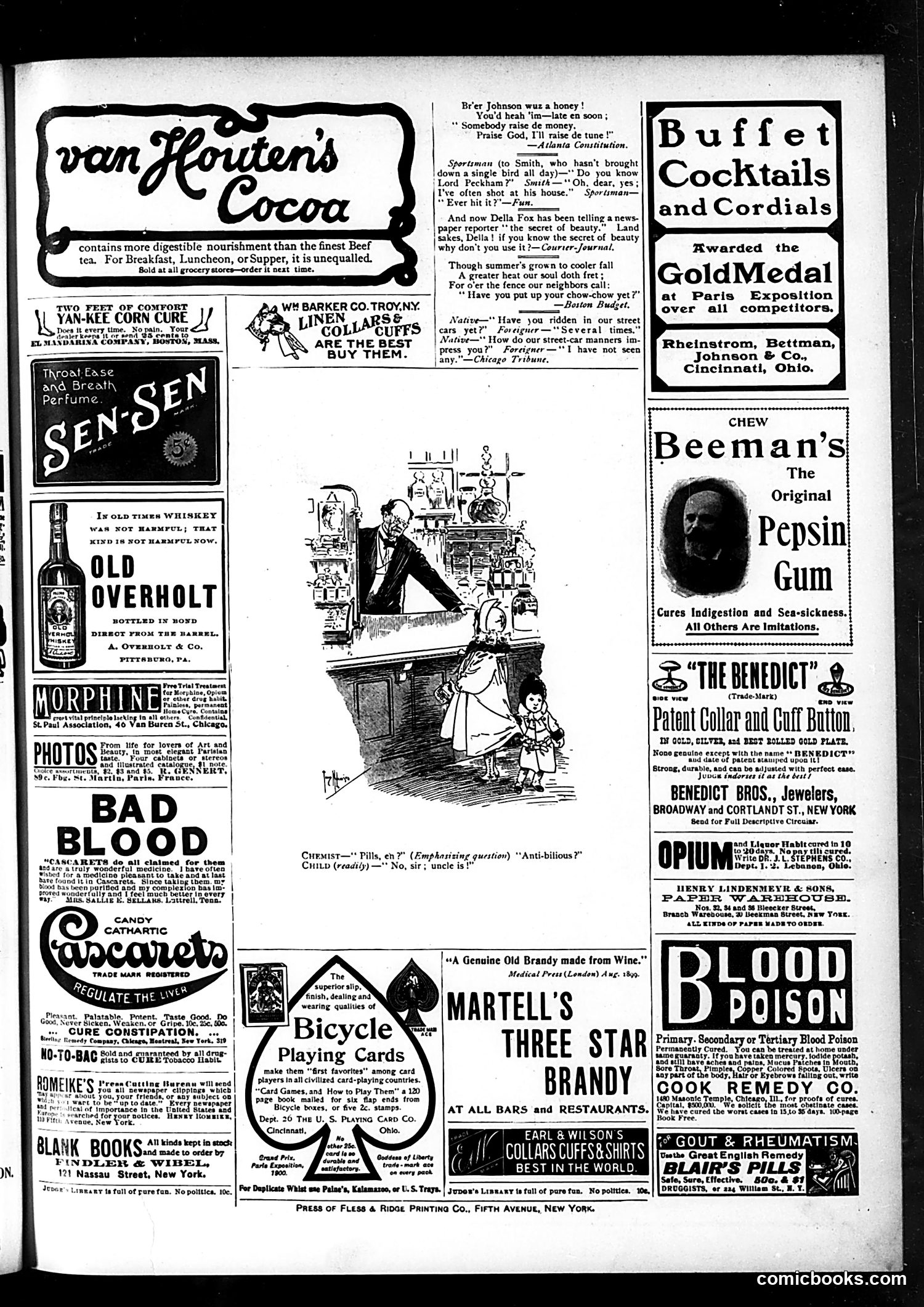
This page is primarily **advertising**, with one small satirical cartoon embedded among patent medicine and consumer product ads. The main cartoon depicts a domestic scene: a chemist or pharmacist presenting pills to a child, with dialogue reading "Pills, eh?" (Chemist) and "No, sir; uncle is!" (Child). The joke relies on a visual pun—the child mistakes the chemist's medicinal pills for candy or treats, suggesting the uncle (rather than the pills themselves) is the real "medicine" or solution to the child's ailment. The page reflects the **early 20th-century patent medicine era**, dominated by unregulated products claiming to cure everything from "bad blood" to gout. Most advertisements make exaggerated health claims (Beeman's Pepsin Gum "cures indigestion," blood poison treatments, morphine products). The satirical content is minimal; this appears to be a typical Judge issue balancing light humor with profitable advertising space—a common magazine practice of the period.
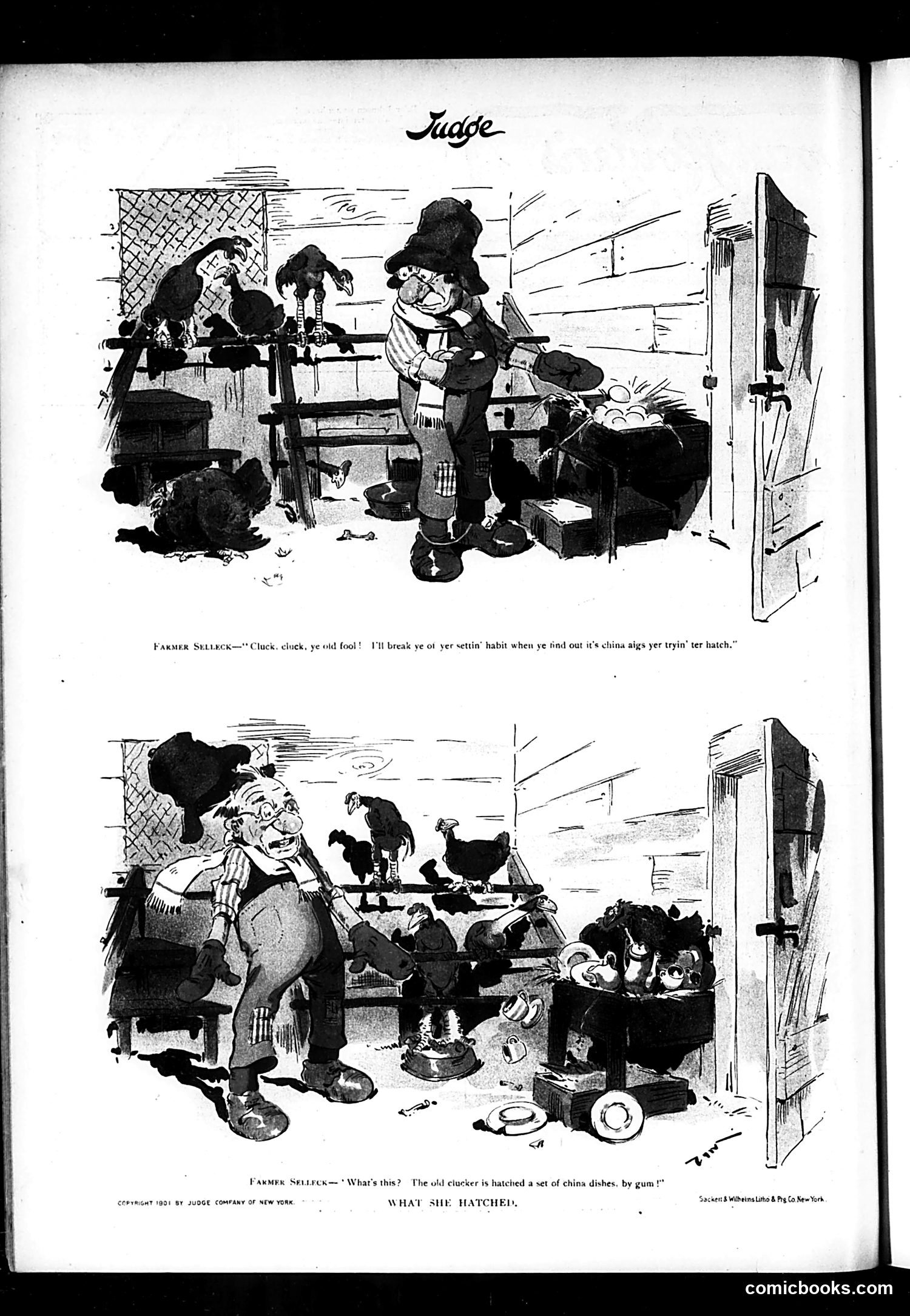
This two-panel satirical cartoon from *Judge* magazine jokes about a farmer's hen hatching china dishes instead of eggs. **The Setup:** Panel one shows Farmer Selleck threatening an old hen, saying he'll break her of her "setting habit" when he discovers she's been trying to hatch china eggs instead of real ones. **The Punchline:** Panel two reveals the absurd result—the hen has actually *hatched* a complete set of china dishes. **The Satire:** The cartoon appears to be mocking rural farmers or country folk as gullible or foolish enough to believe such an impossibility could occur. The humor relies on the visual absurdity: a hen "succeeding" at an impossible task, making the farmer look foolish for his earlier threat. The crude caricature style and subject matter are typical of *Judge's* working-class humor from this era. No specific political reference is evident—it's simply comedic commentary on rural life and stupidity.