
Judge, 1901-02-09 · page 2 of 16
Judge — February 9, 1901 — page 2: what you’re looking at
What you’re looking at
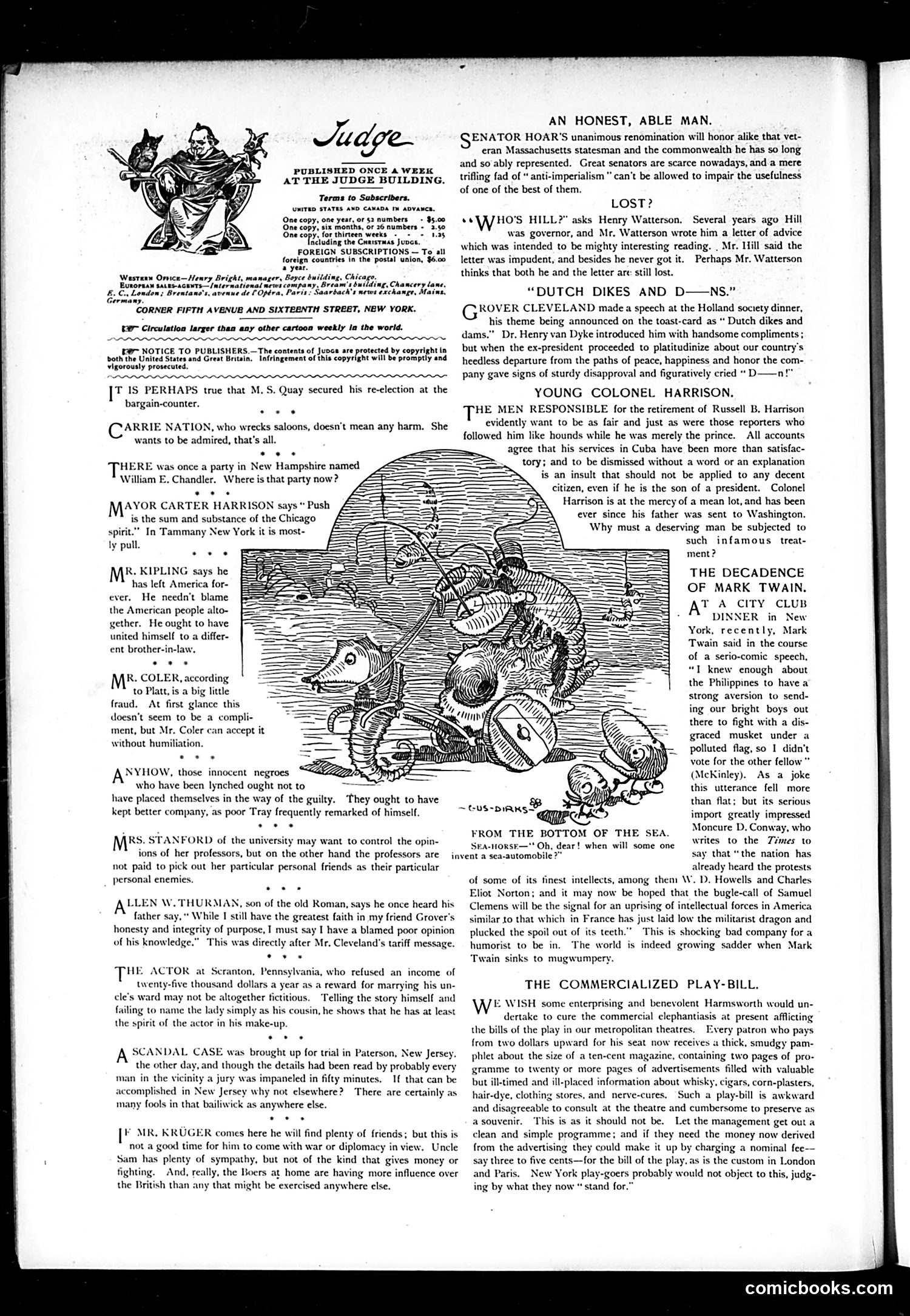
This political cartoon depicts sea creatures emerging from ocean depths, appearing to represent politicians or public figures rising to prominence. The accompanying text references Mark Twain's recent dinner speech criticizing American imperialism, particularly regarding the Philippines. Twain apparently joked that sending "our bright boys out there to fight with a disgraced musket under a polluted flag" was absurd. The cartoon likely satirizes politicians or naval figures associated with imperialist policies—possibly Theodore Roosevelt or similar expansionists—as grotesque "creatures from the depths." The joke suggests these individuals and their policies are monstrous or base, emerging from dark, murky origins rather than respectable leadership. The visual comparison demeans imperialist politicians through bestial imagery.
📄 Transcribed text from this page (OCR, searchable)
Machine-transcribed from the original scan — historical spelling and the odd misread are preserved.
PUBLISHED ONCE 4 WEEK AT THE JUDGE BUILDING. Terms to Subscribers. UNITED STATES AND CANADA I ADVANCE, ‘One copy, one year, or $2 numbers = $5.00 One copy, six months, of 26 numbers - 3.50 One copy, for thirteen weeks = = = 1.35 facluding the Cunistmas Juocs. FOREIGN SUBSCRIPTIONS — To all foreign countries in the postal union, $6.00 a year. Wasraxn Ornice—Henry Bright, manager, Boyce build EURoraan satus-acuwTs—/ntermational mews compan E. C., London; Brentano's, avenue del Opéra, Paris: CORNER FIFTH AVENUE AND SIXTEENTH STREET, NEW YORK. Chicago, Br lding, Chancery Saarbach's news exchange, Me '297- Circulation larger than any other cartoon weekly Ia the world. E¥7- NOTICE TO PUBLISHERS.—The contents of Juocs are protected by copyright in both the United States and Great Britain. lafringement of this copyright will be promptly and vigorously prosecuted. Ree I IS PERHAPS true that M.S. Quay secured his re-election at the bargain-counter. wee ARRIE NATION, who wrecks saloons, doesn’t mean any harm. She wants to be admired, that’s all. eee HERE was once a party in New Hampshire named William E. Chandler. Where is that party now? MAYOR CARTER HARRISON says“ Push AN HONEST, ABLE MAN. ENATOR HOAR'S unanimous renomination will honor alike that vet- eran Massachusetts statesman and the commonwealth he has so long and so’ably represented. Great senators are scarce nowadays, anda mere trifling fad of “ anti-imperialism " can’t be allowed to impair the usefulness of one of the best of them. LOST? *6\JHO'S HILL?” asks Henry Watterson. Several years ago Hill was governor, and Mr. Watterson wrote him a letter of advice which was intended to be mighty interesting reading. . Mr. Hill said the letter was impudent, and besides he never got it. Perhaps Mr. Watterson thinks that both he and the letter are: still lost. “DUTCH DIKES AND D——NS.” GROVER CLEVELAND madea speech at the Holland society dinner, his theme being announced on the toast-card as“ Dutch dikes and dams.” Dr, Henry van Dyke introduced him with handsome compliments ; but when the ex-president proceeded to platitudinize about our country's heedless departure from the paths of peace, happiness and honor the c pany gave signs of sturdy disapproval and figuratively cried * Dn YOUNG COLONEL HARRISON. HE MEN RESPONSIBLE for the retirement of Russell B, Harrison evidently want to be as fair and just as were those reporters who followed him like hounds while he was merely the prince. All accounts agree that his services in Cuba have been more than satisfac- tory; and to be dismissed without a word or an explanation is an insult that should not be applied to any decent citizen, even if he is the son of a president. Colonel Harrison is at the mercy of a mean lot, and has been is the sum and substance of the Chicago ever since his father was sent to Washington. spirit.” In Tammany New York it is most- Why must a deserving man be subjected to ly pull. such infamous. treat- ment? R. KIPLING says he has left America for- ever, He needn't blame THE DECADENCE OF MARK TWAIN. the American people alto- Al A CITY CLUB gether. He ought to have united himself to a differ- ent brother-in-law, Mé: COLER, according DINNER in New York, recently, Mark Twain said in the course of a serio-comic speech, “I knew enough about to Platt, is a big little the Philippines to have a fraud. At first glance this doesn't seem to be a compli- ment, but Mr. Coler can accept it without humiliation. Si Sm ASYHOW, those innocent negroes <p} Tirso who have been lynched ought not to —> have placed themselves in the way of the guilty. They ought to have kept better company, as poor Tray frequently remarked of himself. RS. STANFORD of the university may want to control the opin- ions of her professors, but on the other hand the professors are not paid to pick out her particular personal friends as their particular personal enemies. ALLEN W. THURMAN, son of the old Roman, says he once heard his father say," While I still have the greatest faith in my friend Grover’s honesty and integrity of purpose, I must say I have a blamed poor opinion of his knowledge.” ‘This was directly after Mr. Cleveland's tariff message. HE ACTOR at S twenty anton, Penn: ia, who refused an income of five thousand dollars a year as a reward for marrying his un- cle’s ward may not be altogether fictitious. ‘Telling the story himself and failing to name the lady simply as his cousin, he shows that he has at least the spirit of the actor in his make-up. A SCANDAL CASE was brought up for trial in Paterson, New Jersey. the other day, and though the details had been read by probably every man in the vicinity a jury was impaneled in fifty minutes. If that can be accomplished in New Jersey why not elsewhere? There are certainly as many fools in that bailiwick as anywhere else. [F MR. KRUGER comes here he will find plenty of friends; but this is not a good time for him to come with war or diplomacy in view. Uncle Sam has plenty of sympathy, but not of the kind that gives money or fighting. And, really, the Boers at home are having more influence over the British than any that might be exercised anywhere else. invent a sea-automobile ?” strong aversion to send- ing our bright boys out there to fight with a dis- graced musket under a polluted flag, so I didn’t vote for the other fellow ” (McKinley). As a joke this utterance fell more than flat; but its serious import greatly impressed Moncure D, Conway, who writes to the Times to say that “the nation has already heard the protests of some of its finest intellects, among them W. 1D. Howells and Charles Eliot Norton; and it may now be hoped that the bugle-call of Samuel Clemens will be the signal for an uprising of intellectual forces in America similar to that which in France has just laid low the militarist dragon and plucked the spoil out of its teeth.” This is shocking bad company for a humorist to be in. The world is indeed growing sadder when Mark Twain sinks to mugwumpery. ~cus-pians? FROM THE BOTTOM OF THE SEA. Sea-HoRsE—"' Oh, dear! when will some one THE COMMERCIALIZED PLAY-BILL. WE WISH some enterprising and benevolent Harmsworth would un- dertake to cure the commercial clephantiasis at present afflicting the bills of the play in our metropolitan theatres. Every patron who pays from two dollars upward for his seat now receives a thick, smudgy pam- philet about the size of a ten-cent magazine, containing two pages of pro- gramme to twenty or more pages of advertisements filled with valuable but ill-timed and ill-placed information about whisky, cigars, corn-plasters, hair-dye, clothing stores, and nerve-cures. “Such a play-bill is awkward and disagreeable to consult at the theatre and cumbersome to preserve as a souvenir. This is as it should not be. Let the management get out a clean and simple programme; and if they need the money now derived from the advertising they could make it up by charging a nominal fee— say three to five cents—for the bill of the play. as is the custom in London and Paris. New York play-goers probably would not object to this, judg- ing by what they now “ stand for. comicbooks.com