
A complete issue · 16 pages · 1900
Judge — November 17, 1900
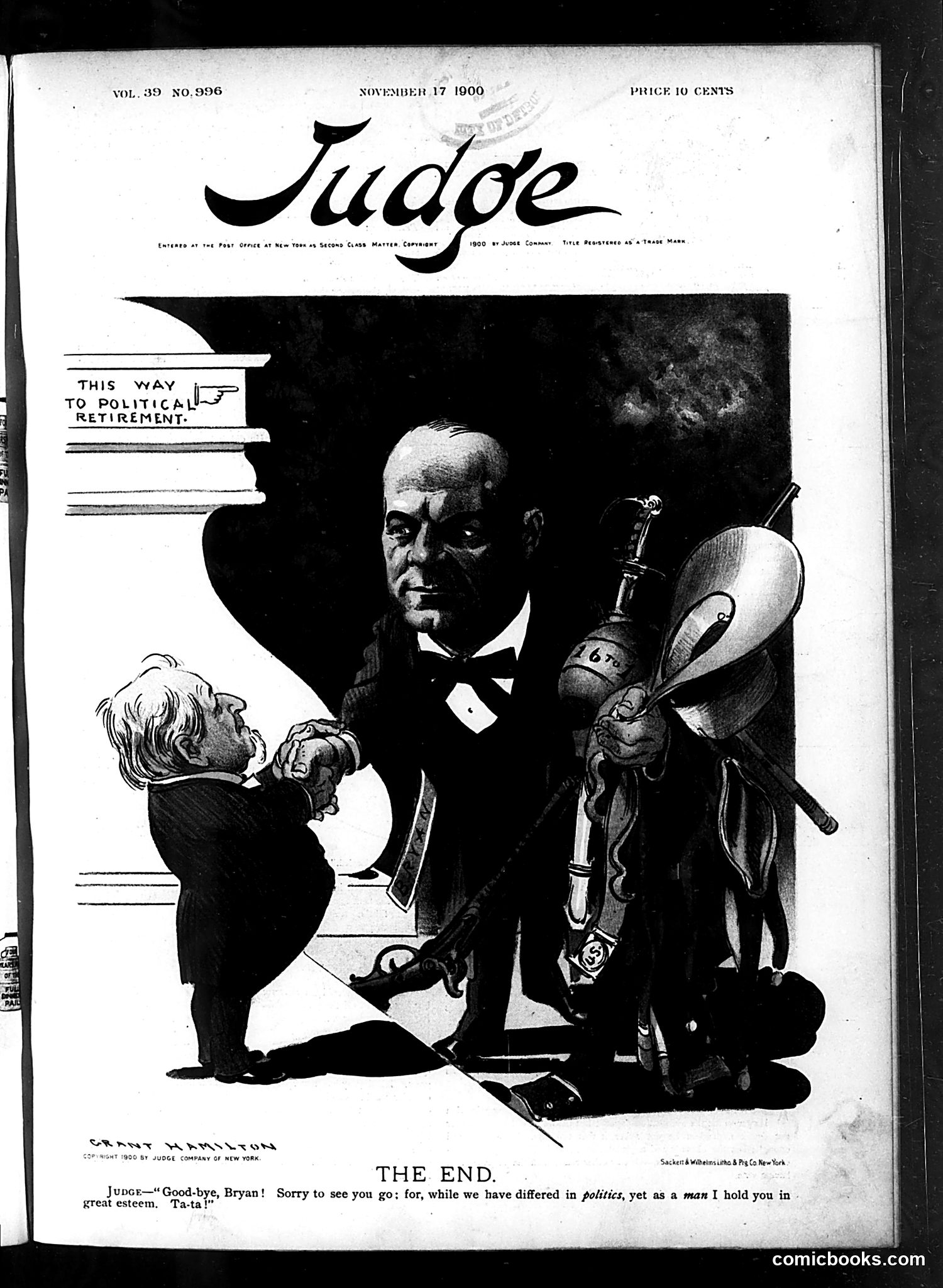
This political cartoon depicts "The End" of William Jennings Bryan's political career. The central figure (labeled as a judge) bids farewell to Bryan, shown as a small figure on the left holding a ballot. The judge holds various political tools and weapons—likely representing Bryan's failed campaigns and political strategies. The sign reads "THIS WAY TO POLITICAL RETIREMENT," indicating Bryan's exit from active politics. The caption states the judge respects Bryan personally despite their political differences. This cartoon marks Bryan's retreat from the 1908 presidential race, which he lost. The satire suggests Bryan's political methods and repeated campaign failures have exhausted their effectiveness, necessitating his withdrawal from frontline politics.
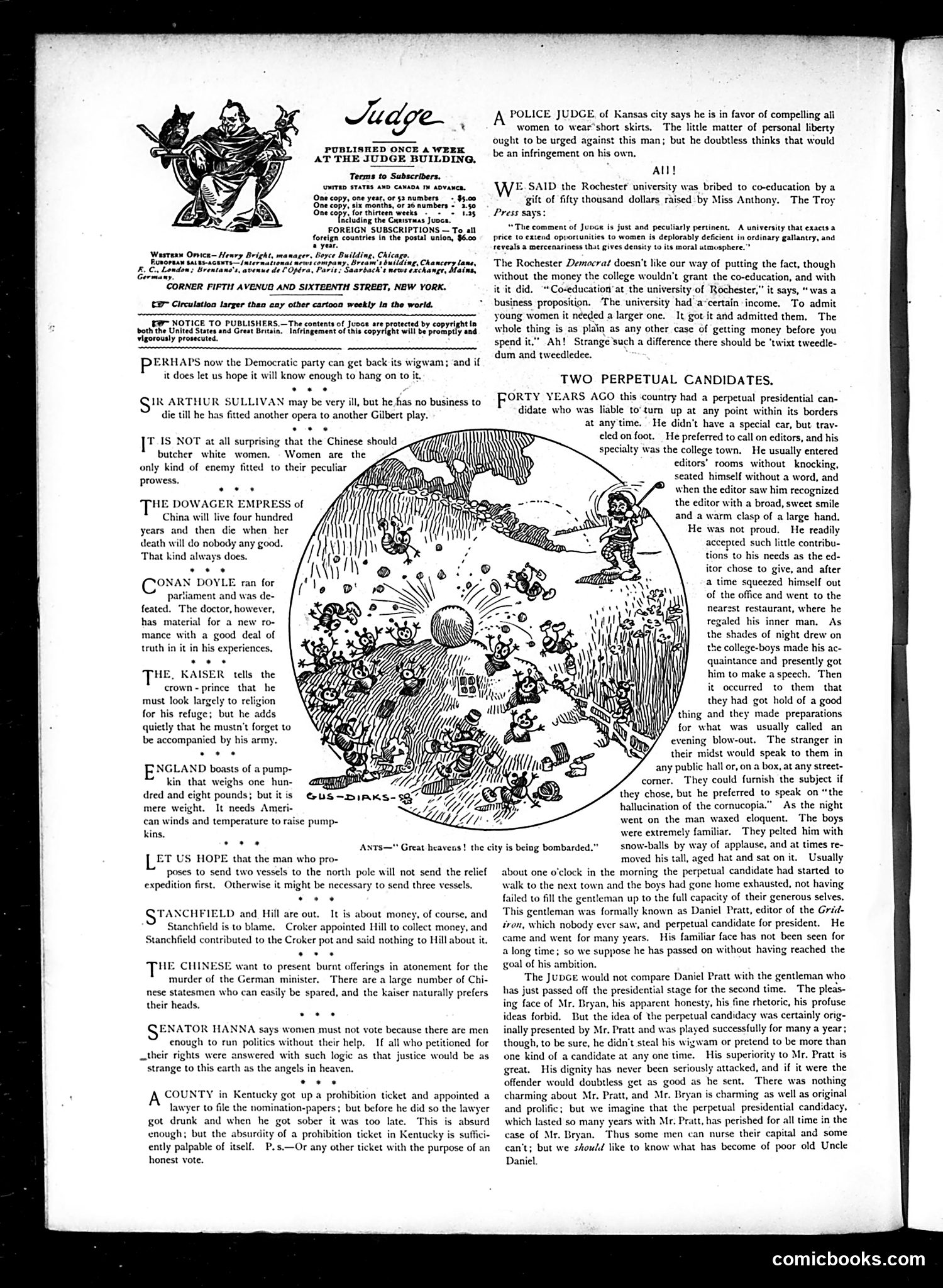
The main cartoon depicts a large figure labeled "ANTS—'Great heavens! the city is being bombarded'" being attacked by smaller figures representing various social problems or criticisms. This appears to be political satire about urban disorder or civil unrest. The accompanying article "TWO PERPETUAL CANDIDATES" discusses presidential candidates who repeatedly run for office without success—specifically referencing figures named Pratt and Bryan who have run multiple times. The satire mocks their persistent candidacies despite repeated electoral failures, suggesting they lack realistic hope of winning yet continue anyway. The cartoon and text together critique both political persistence in the face of failure and urban social chaos, using exaggeration and visual metaphor typical of Judge magazine's style.
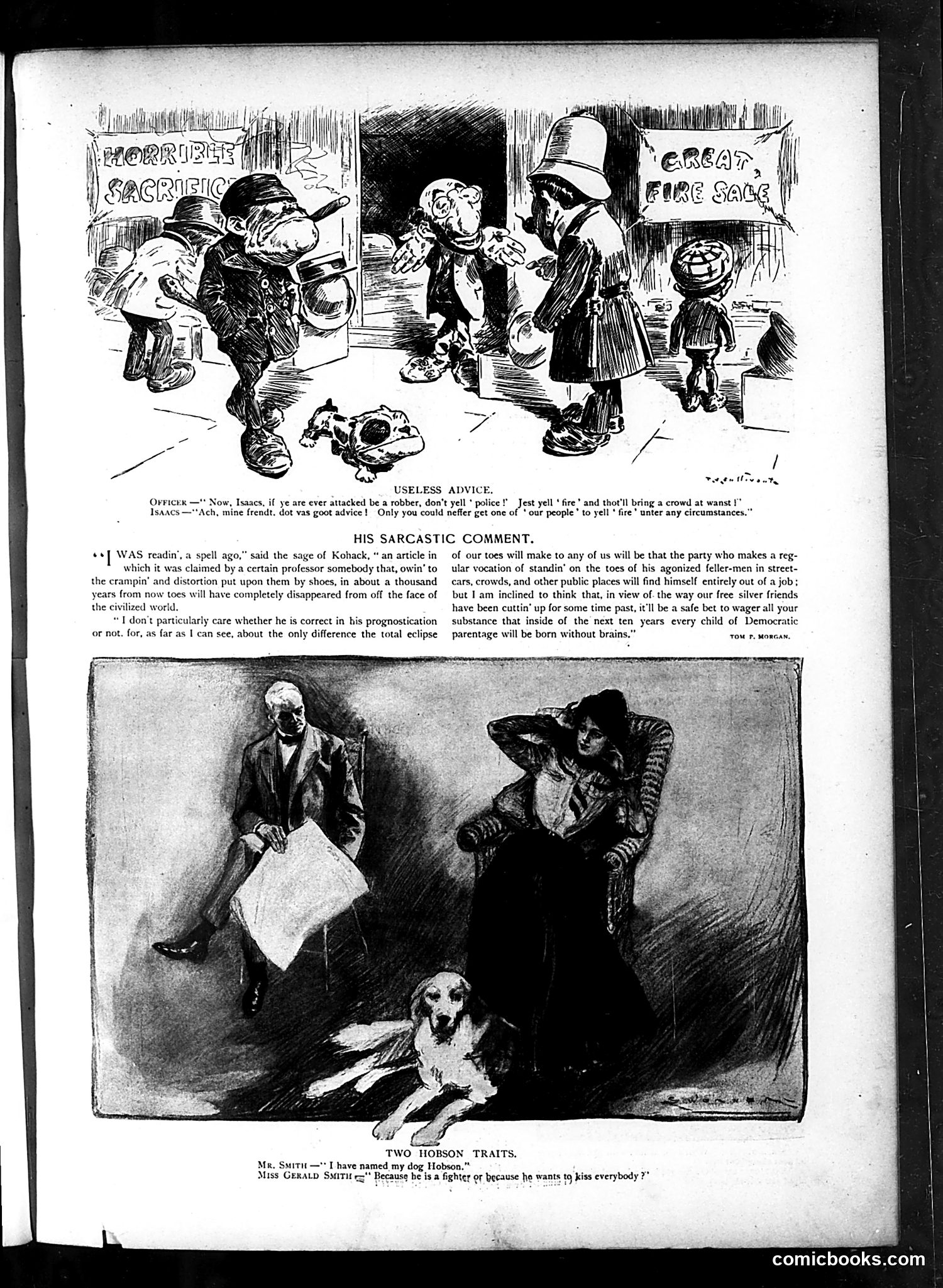
**Top Cartoon - "Useless Advice":** This depicts street vendors hawking dubious remedies during what appears to be a crime wave or social crisis. Signs advertise "Horrible Sacrifice" and "Great Fire Sale." The satire mocks both the vendors profiting from public fear and the absurdity of their "solutions"—yelling "police" or "fire" won't actually help victims of robbery. It's commentary on exploitative opportunism during social disorder. **Bottom Cartoon - "Two Hobson Traits":** A man presents his dog, named "Hobson," claiming the name reflects either that the dog is a "lighter" (possibly a street criminal) or wants to "kiss everybody." The joke plays on "Hobson's choice" (no real choice) while satirizing someone's character through their pet-naming logic. The specific "Hobson" referenced remains unclear without additional context.
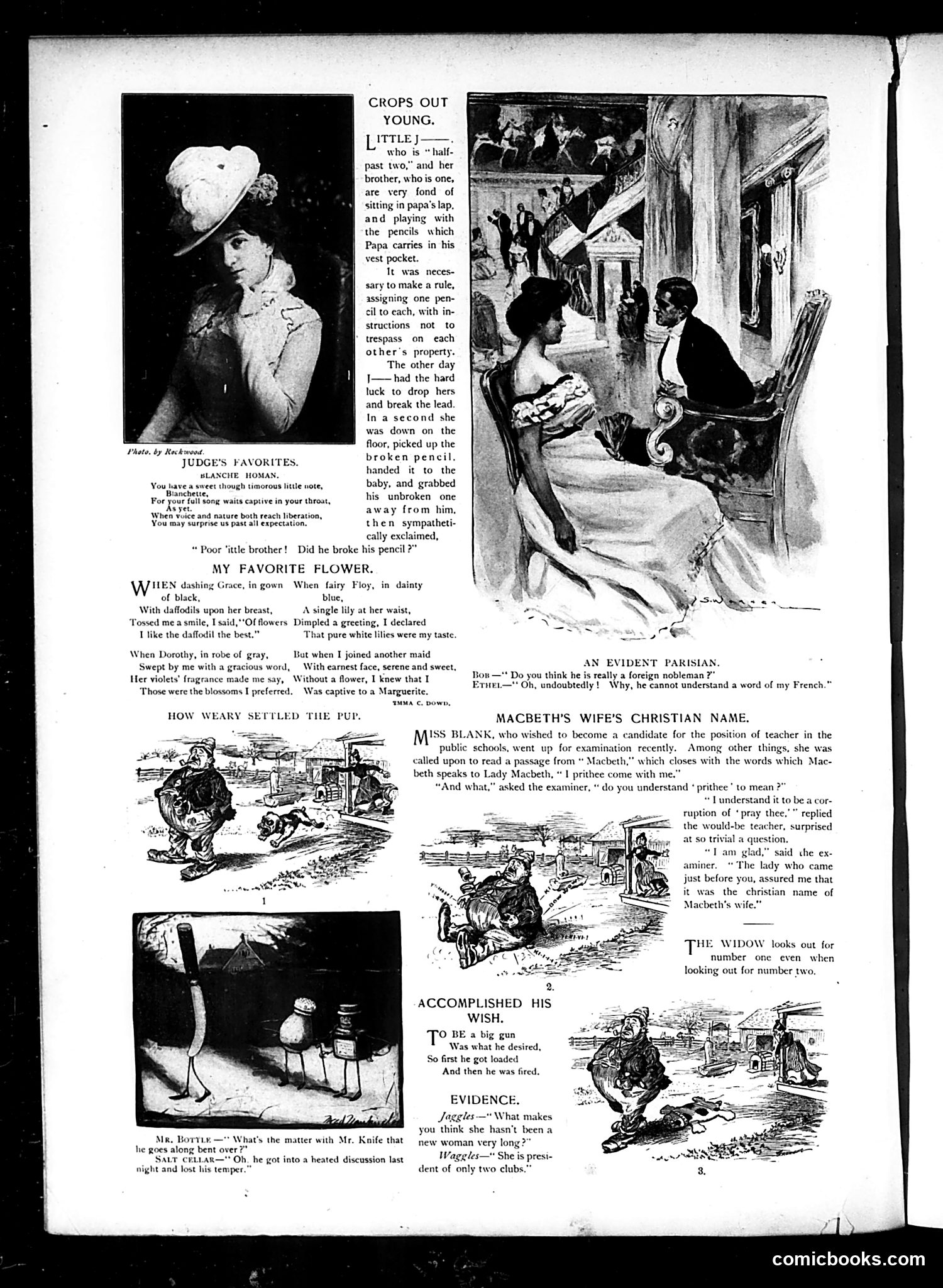
This page contains several unrelated humorous pieces typical of early 20th-century Judge magazine: 1. **"Judge's Favorites"** - A portrait of a fashionable woman in an elaborate feathered hat, accompanied by poetry praising her as an ideal woman. 2. **"My Favorite Flower"** - A poem about flowers and romantic preference, illustrated with period artwork. 3. **"How Weary Settled the Pup"** - A comic narrative with illustrations about settling a dispute over a dog, depicting working-class characters in domestic conflict. 4. **"Macbeth's Wife's Christian Name"** - A satirical anecdote mocking a schoolteacher candidate who misinterprets Shakespeare, confusing "prithee" (archaic English) as a name. 5. **"Accomplished His Wish"** and **"Evidence"** - Brief humorous dialogues about courtship and club membership. The page demonstrates Judge's mix of social satire, domestic humor, and literary mockery.
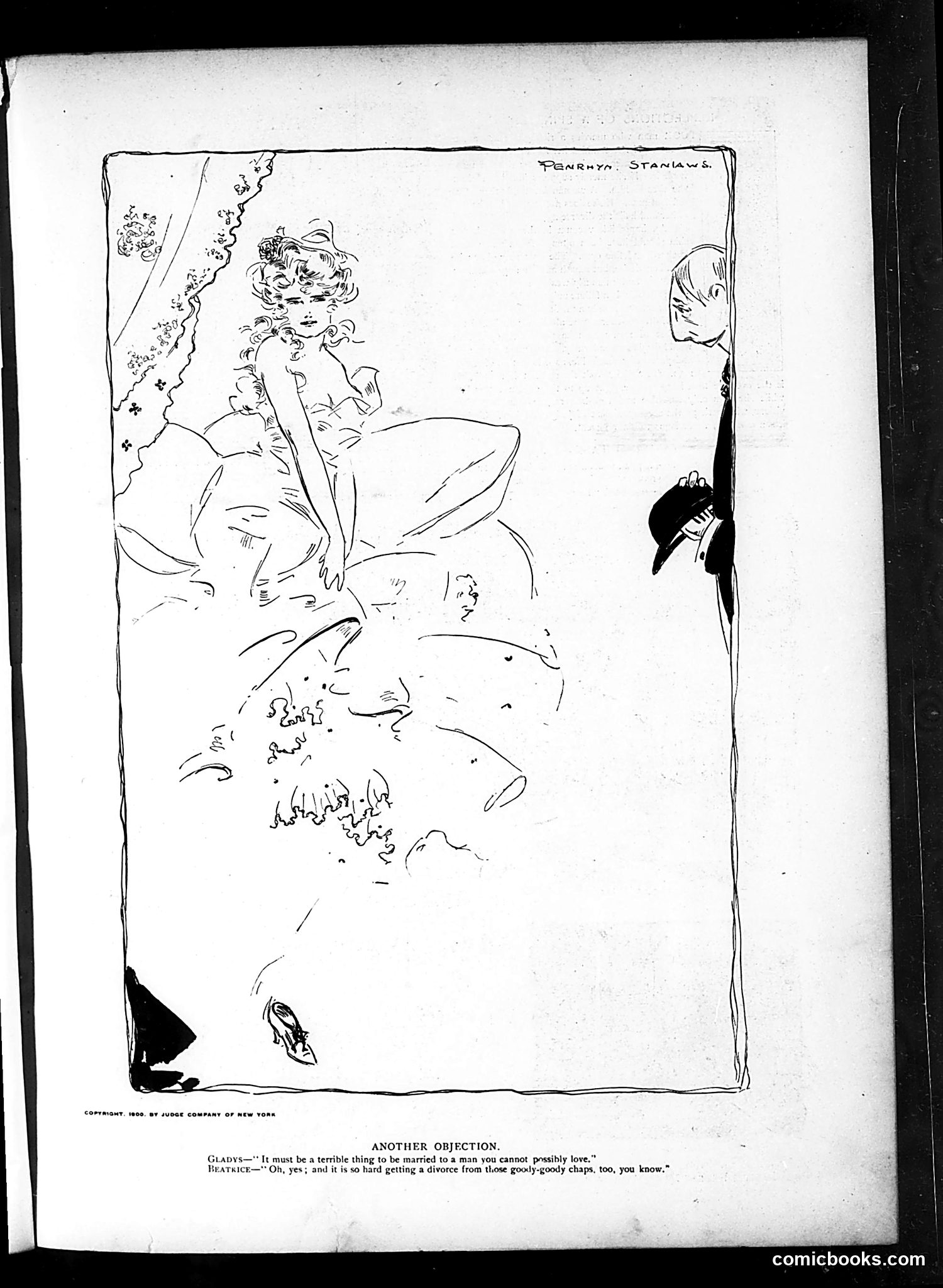
This cartoon satirizes divorce difficulty in early 20th-century America. Two women—identified as "Gladys" and "Beatrice"—discuss marriage problems. Gladys sympathizes about being married to an unloved man; Beatrice agrees, adding that divorcing "goody-goody" (respectable, morally upstanding) husbands is especially frustrating. The joke targets the legal and social barriers to divorce during this era. Even when marriages were unhappy, women faced difficulty obtaining divorces, particularly from men with good reputations who could contest proceedings. The cartoon mocks both the absurdity of being trapped in loveless marriages and the hypocrisy of supposedly virtuous men fighting to keep their wives legally bound. This reflects genuine Progressive-era debates over divorce reform and women's marital rights.
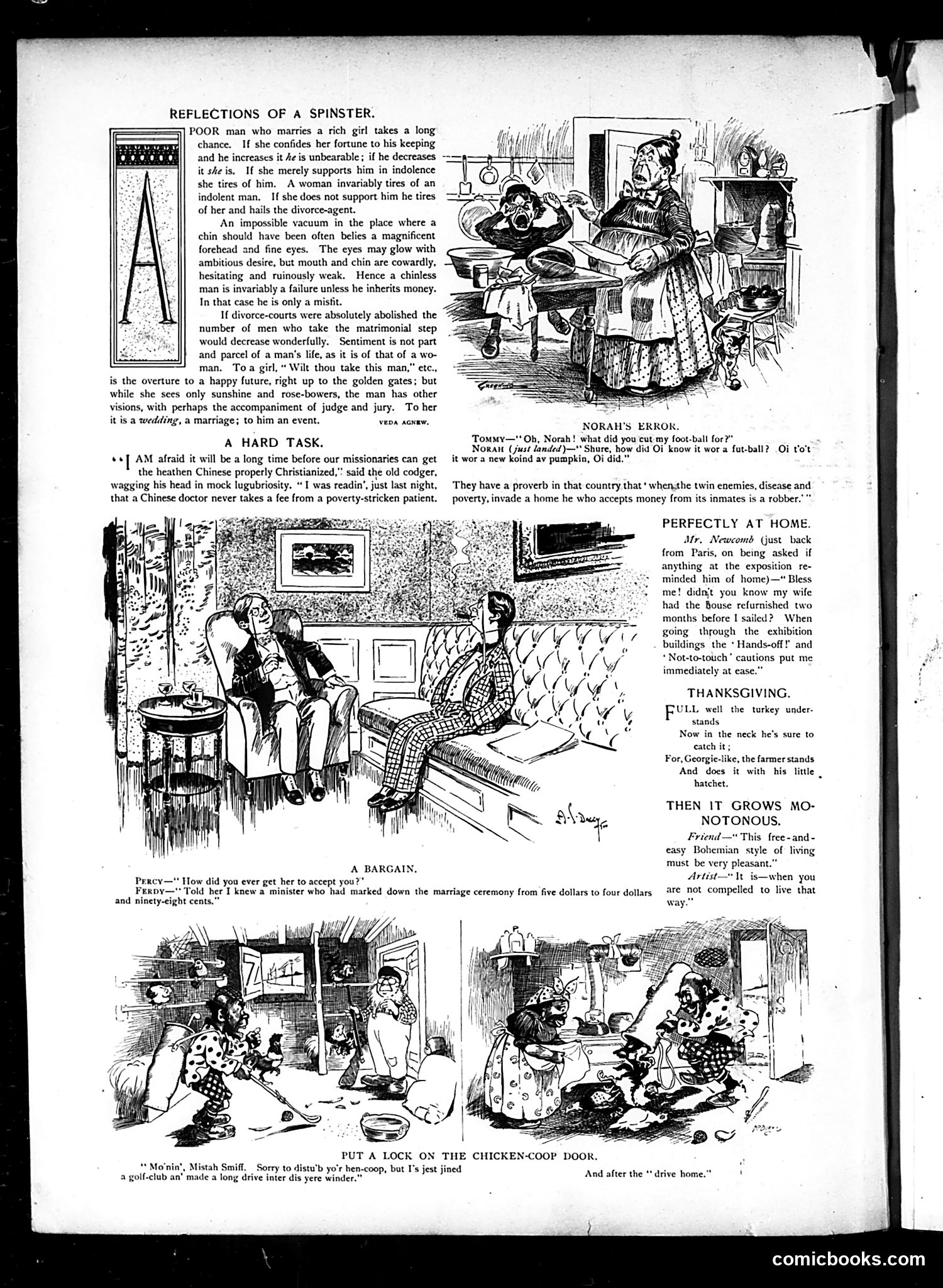
This page contains multiple satirical pieces typical of early 20th-century humor: **"Reflections of a Spinster"** presents cynical observations on marriage and male character. The author (Veda Agnew) argues that wealthy marriages fail regardless of outcome, and that "chinless men"—physically weak-looking men lacking strong jawlines—inevitably fail unless born wealthy. This reflects period anxieties about masculinity and class. **"A Hard Task"** satirizes missionary work in China by noting Chinese doctors' ethical practice of not charging poor patients, implying this contradicts Christian charity—suggesting the "heathen" are already morally superior. The remaining pieces are brief joke scenarios: a mismatched couple's bargain marriage, an Irish immigrant ("Norah") mistaking a football for a pumpkin, a nouveau-riche husband whose refurbished home mirrors a Paris exposition, and a Black man ("Mistah Smifl") hitting a golf ball through a farmer's window. The humor relies on period stereotypes about immigrants, race, and social climbing, reflecting Judge's audience and editorial perspective.
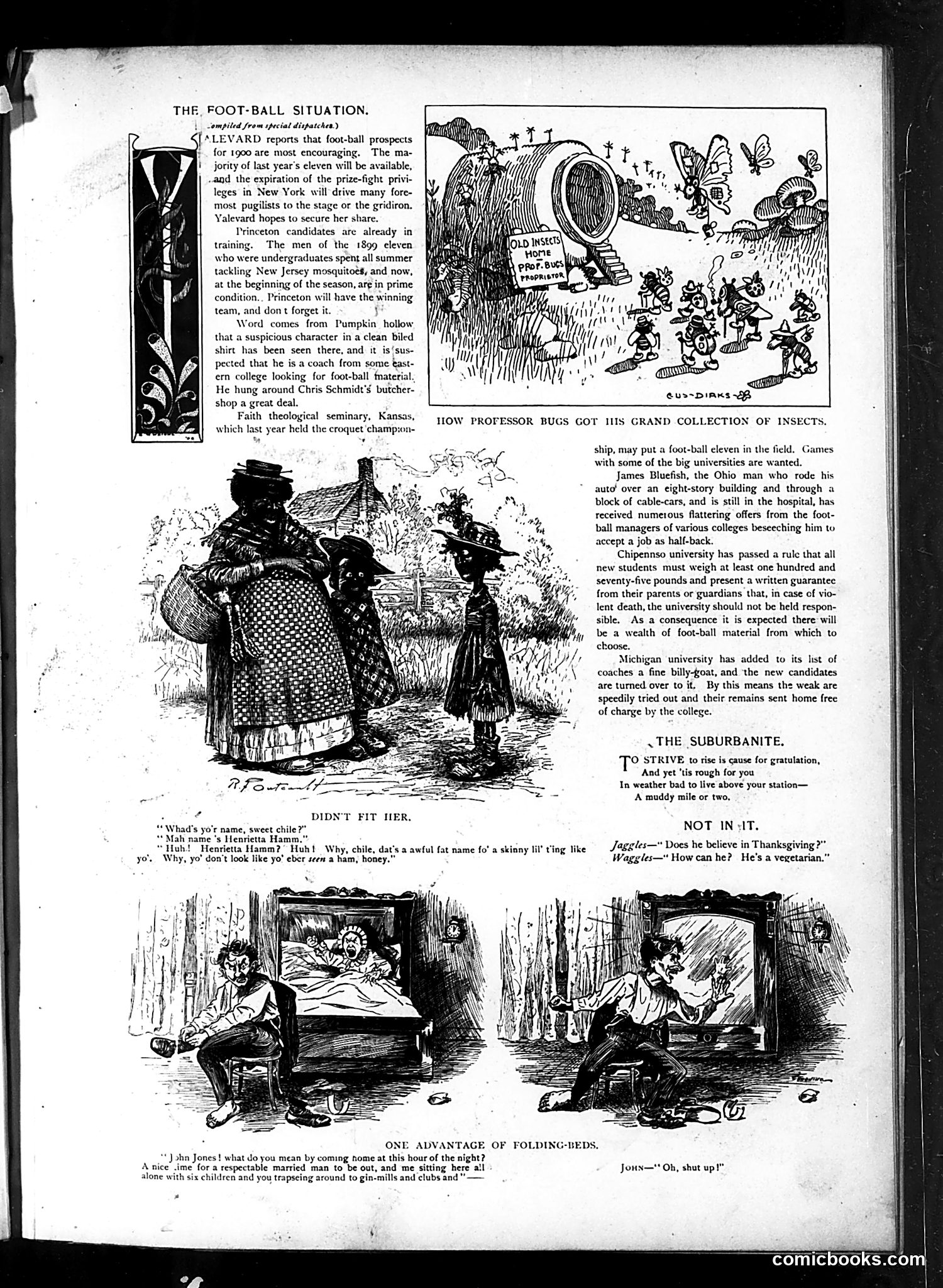
This page satirizes the explosive growth of college football in 1900 through mock "reports" from major universities (Harvard, Princeton, Michigan, Chippennso). The humor works on multiple levels: **Main satire:** Universities are portrayed as absurdly desperate to field winning teams. The jokes escalate from plausible (recruiting coaches) to ridiculous (Michigan hiring a billy-goat to "try out" weak players, with their remains sent home; Chippennso requiring parents to guarantee universities aren't liable if students die violently). **Context:** This reflects the era's genuine concern that college football was becoming dangerously brutal—a legitimate cultural anxiety about injuries and deaths in the sport. **Side content:** Minor humor pieces mock suburban commuting, racial dialect jokes, and domestic disputes—typical period magazine filler. The cartoons and jokes collectively critique how institutions prioritized football victory over student safety and decorum.
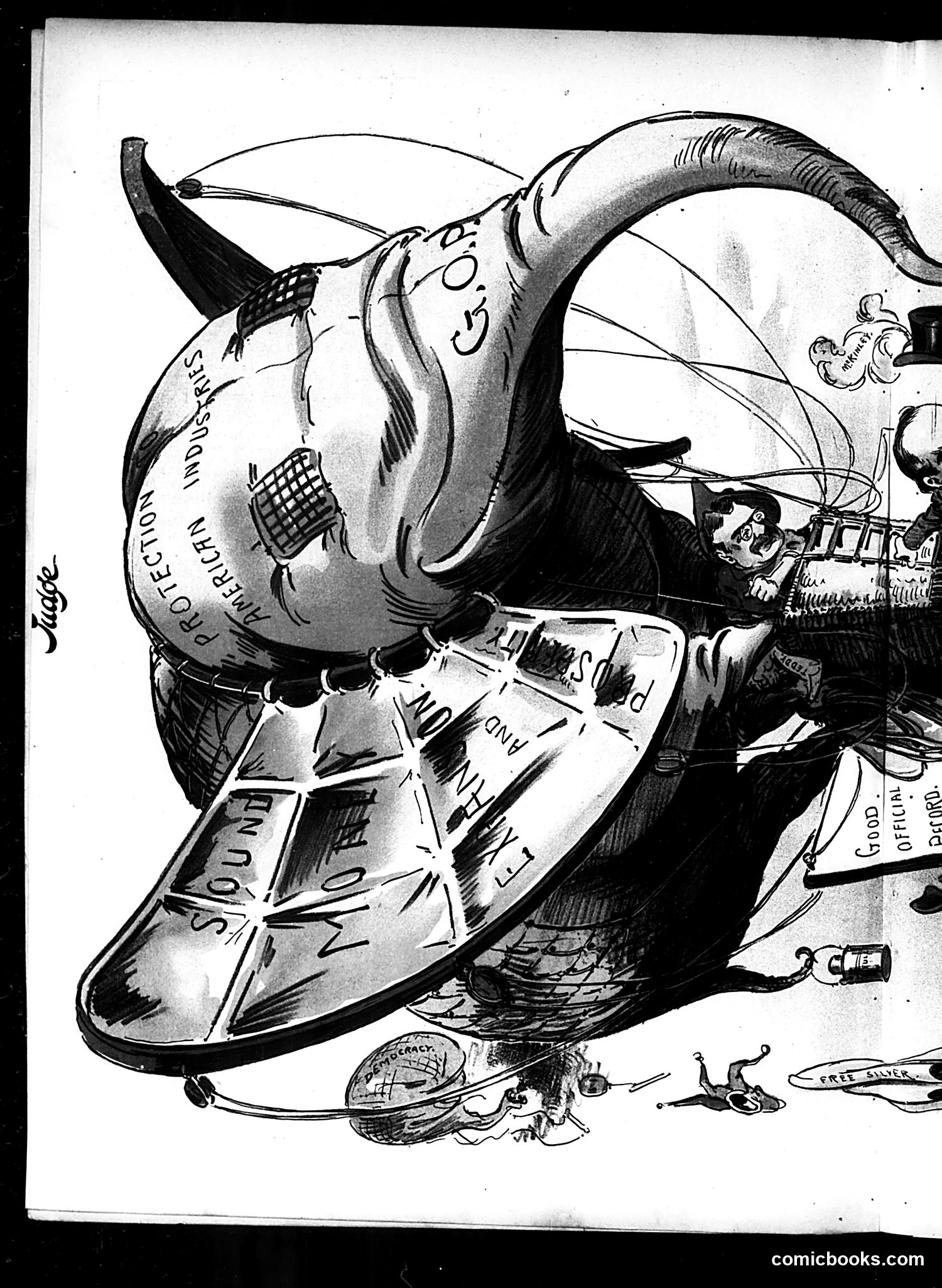
This political cartoon depicts a large elephant (the Republican Party symbol) being ridden or controlled by a military figure in uniform. The elephant appears bloated or overstuffed, labeled with text suggesting issues like "protection" and "reciprocity"—trade policy debates of the era. The satirical point appears to criticize Republican control by military or imperialist interests, or conversely, the Republican Party's military expansion policies. The small figures beneath suggest the common people being trampled or overshadowed. The OCR text is too degraded to read clearly, limiting precise interpretation. However, the imagery suggests criticism of either militarism within the GOP or the party's imperial/protectionist policies dominating American politics. The cartoon's style and Judge magazine's context suggest this likely dates to the late 19th or early 20th century, during debates over American imperialism and trade protectionism.
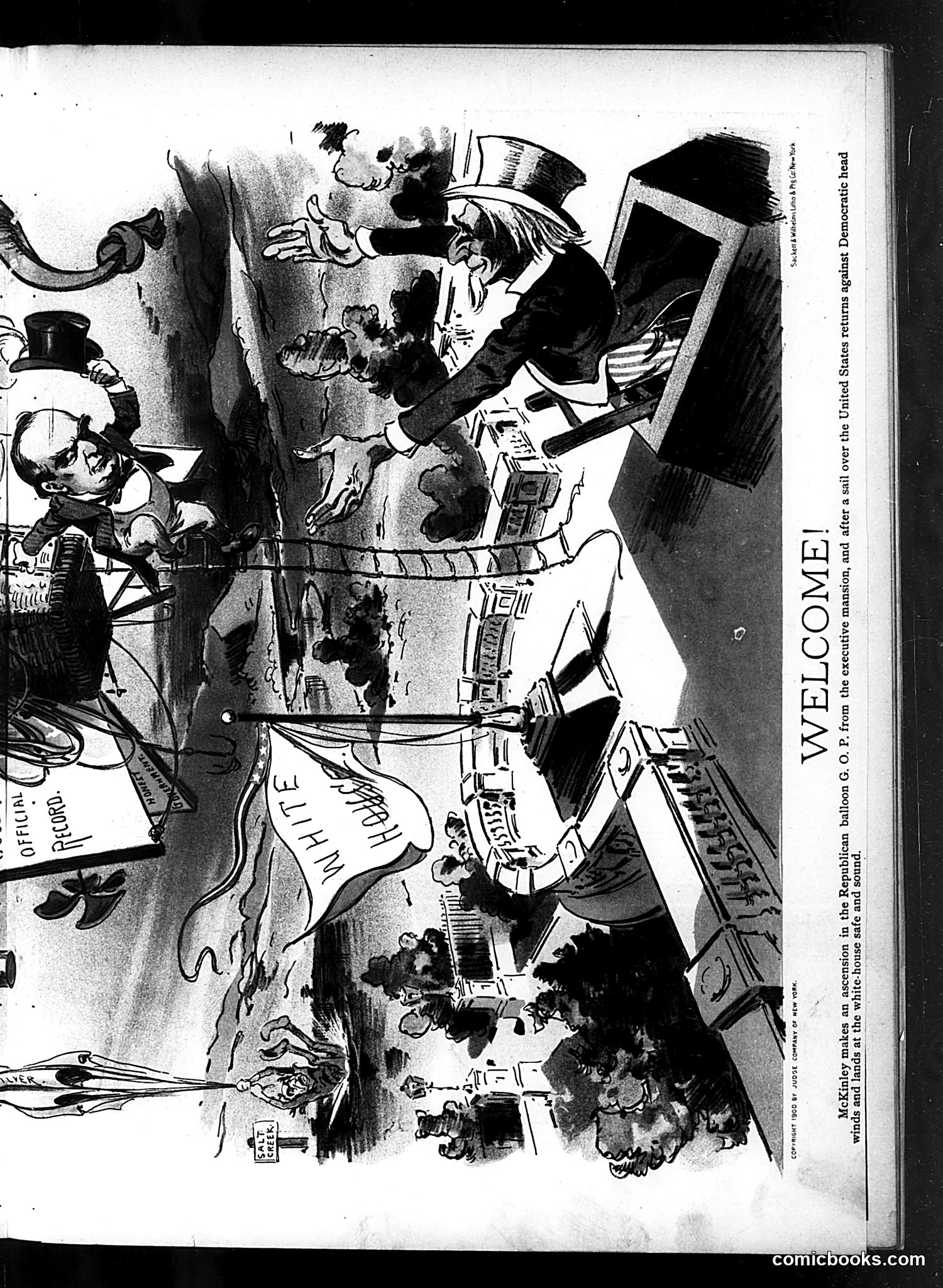
This **Judge magazine cartoon titled "WELCOME"** appears to depict a satirical scene of diplomatic reception, likely from the early 20th century based on the art style. The image shows figures in formal dress and top hats greeting what appears to be a visiting dignitary or political figure. The cartoon's point seems to be satirizing formal diplomatic protocols or international relations of the era—possibly mocking the elaborate ceremonial welcome given to a particular foreign official or politician. However, the OCR text is severely corrupted and unreadable, making it impossible to identify the specific figures, the political situation being referenced, or the precise target of the satire. Without legible text identifying the individuals or context, I cannot reliably determine which historical figures or events are being caricatured. To properly explain this cartoon's meaning to a modern reader, clearer source material would be needed.
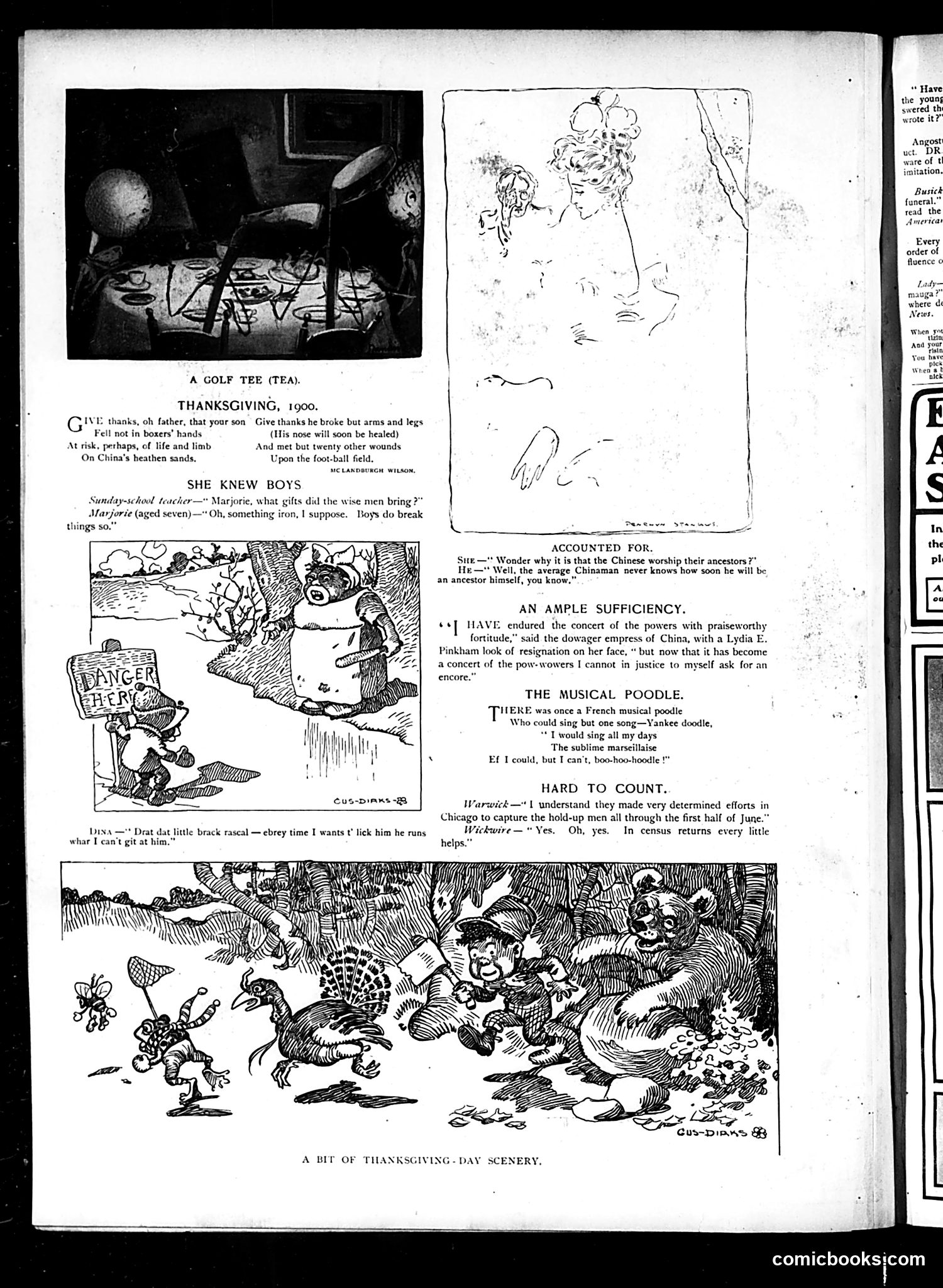
This 1900 *Judge* page satirizes contemporary American issues through multiple cartoons: **"Thanksgiving, 1900"** references the Boxer Rebellion in China, where American soldiers fought. The poem darkly jokes that a son injured in boxing or football is safer than military service in China—contemporary readers would recognize this as commentary on the ongoing conflict. **"She Knew Boys"** mocks children's logic: a seven-year-old assumes "wise men" brought iron tools because boys break things, conflating the biblical Magi with practical domestic experience. **"Accounted For"** uses ethnic stereotyping (unclear dialect) to joke about Chinese ancestral worship—suggesting Chinese life expectancy was so poor, anyone might soon *become* an ancestor. **"The Musical Poodle"** appears to ridicule French nationalism or Franco-American cultural tensions, suggesting even a dog would prefer French patriotic songs but is forced to sing "Yankee Doodle." The page blends topical political humor (Boxer Rebellion, census-taking) with crude ethnic jokes typical of the era's satirical magazines.
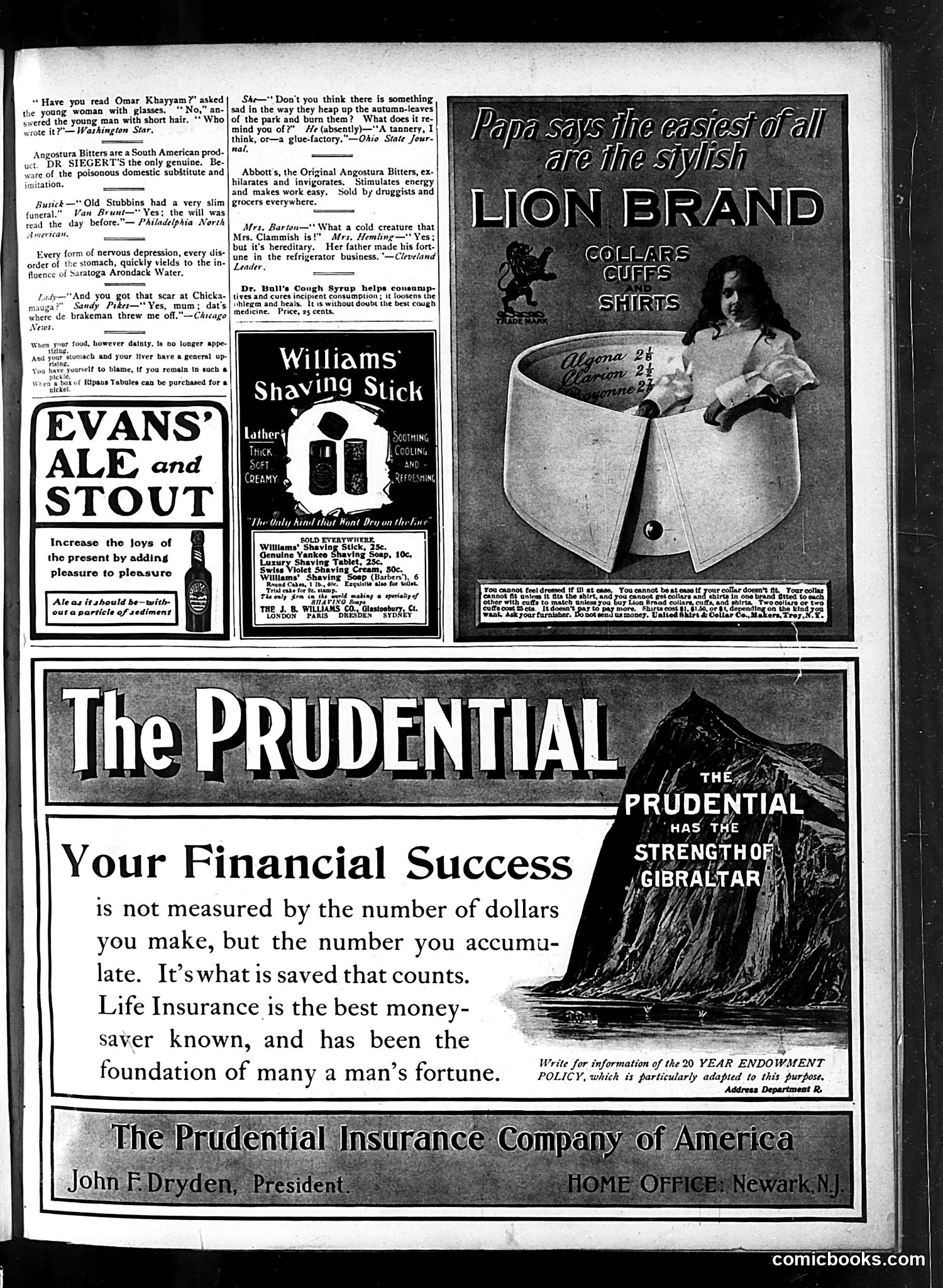
This page is primarily **advertising** with a few short joke items at the top. The jokes are typical early-20th-century humor: one plays on a woman's ignorance (not knowing Omar Khayyam wrote his own work); another uses a "straight man/punchline" format where a woman's romantic observation about burning autumn leaves gets a mundane, unpoetic response about tanneries. The **advertisements** reflect period concerns: - **Angostura Bitters, Williams Shaving products, Dr. Ball's cough syrup**: patent medicines and grooming products marketed with vague health claims - **Evans' Ale and Stout**: alcoholic beverage - **Ripans Tabules**: digestive remedy - **Holbrand Collars/Cuffs**: men's fashion - **Prudential Insurance**: The largest ad emphasizes life insurance as wealth-building through savings—targeting middle-class aspirations during an era before Social Security The page reflects early-1900s consumer culture, when magazines like *Judge* monetized satirical content through advertisements for products we'd now consider dubious or unnecessary.
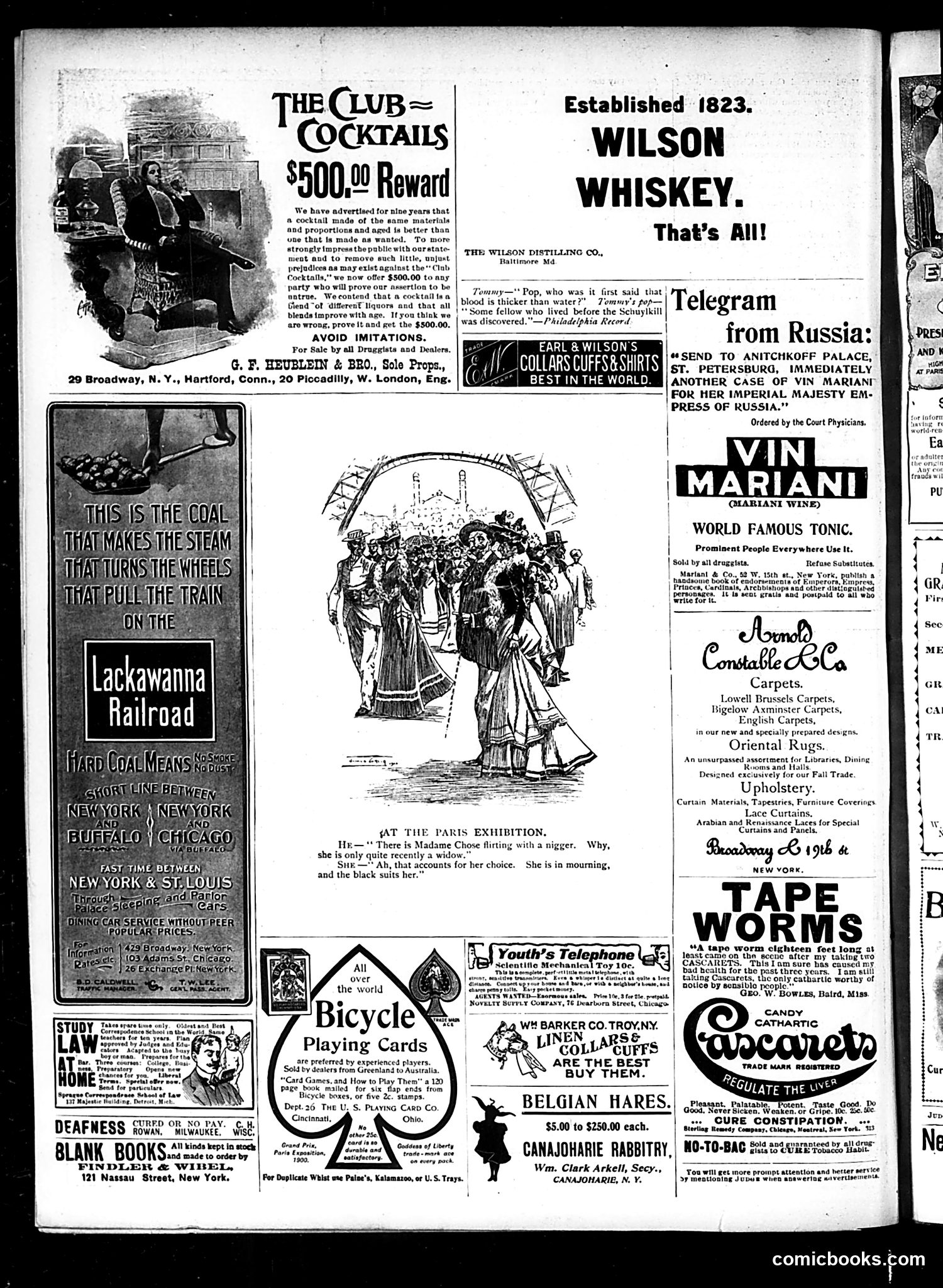
This page is primarily **advertising**, not political satire. However, one cartoon merits attention: **"At the Paris Exhibition"** depicts a racist joke about a white widow flirting with a Black man. The "humor" relies on the offensive premise that a woman in mourning would choose a Black suitor because "the black suits her"—a cruel play on words equating Black skin with mourning attire. This reflects the deeply racist attitudes of the era when Judge was published. The page otherwise showcases period products: Wilson Whiskey, Vin Mariani (a cocaine-containing "tonic"), tapeworm remedies, bicycle playing cards, and Belgian hares. The advertisements reveal contemporary consumer culture and patent medicine practices, including products we'd now recognize as dangerous (tapeworm treatments, cocaine tonics). The only non-advertising item is the racist cartoon, which demonstrates how casual bigotry was embedded in "humor" publications of this period.
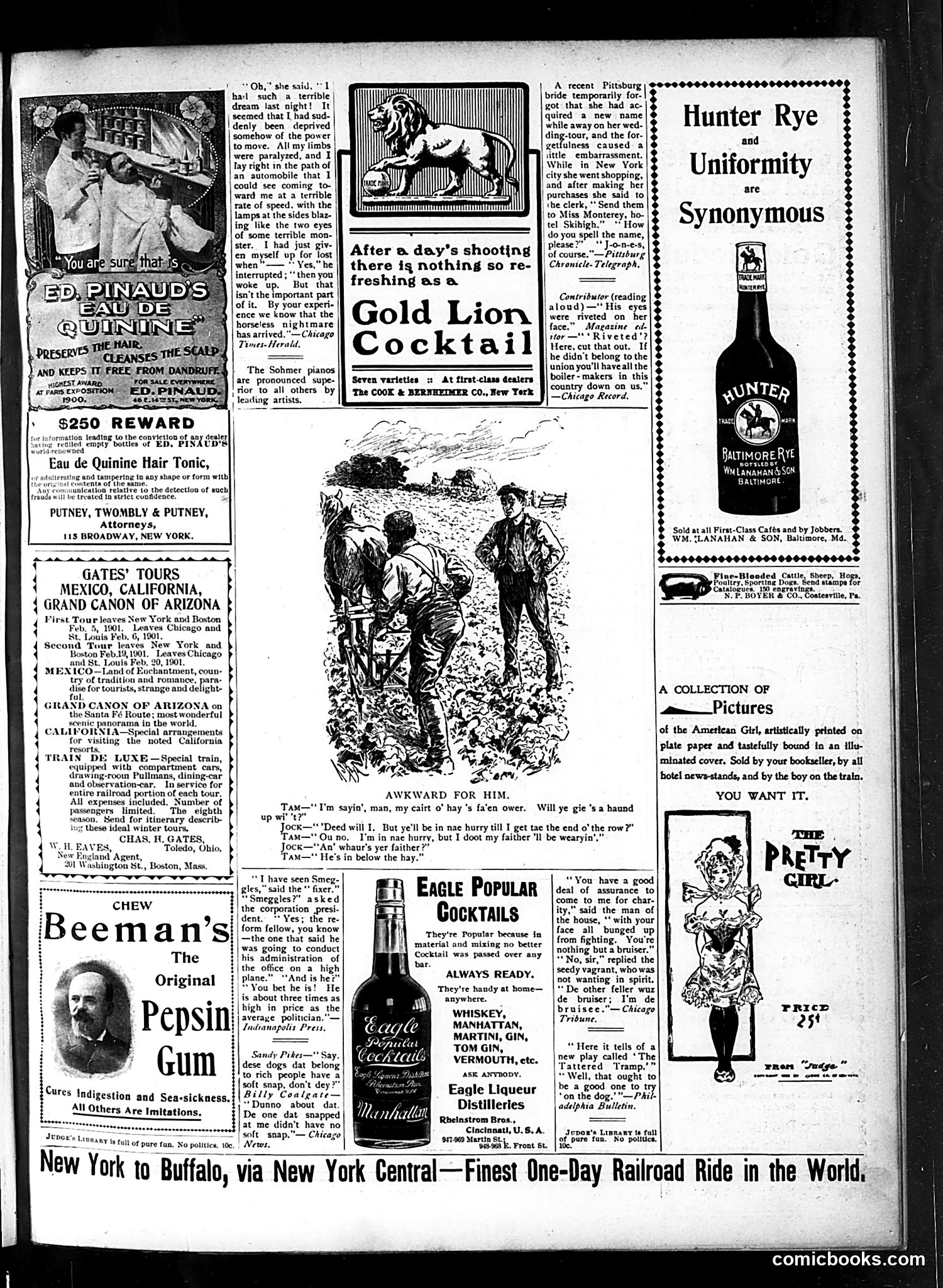
This page is primarily **advertising and miscellaneous content** rather than a cohesive political cartoon or satirical narrative. The central visual element is "**Awkward for Him**"—a rural Scottish dialogue (rendered in dialect) depicting two farmers discussing a hay accident. One has overturned his cart; the other delays helping until finishing his own row. The humor is situational rather than political. The remainder of the page consists of period advertisements (Gold Lion Cocktail, Hunter Rye whiskey, Beeman's Pepsin Gum, railway tours) and brief anecdotes, including one about a Pittsburgh bride who forgot her new married name while shopping—conventional domestic humor of the era. There is **no clear political satire or contemporary event reference** visible. The content reflects Judge's mixed editorial approach: one rustic comedy sketch surrounded by commercial advertisements aimed at an affluent readership.
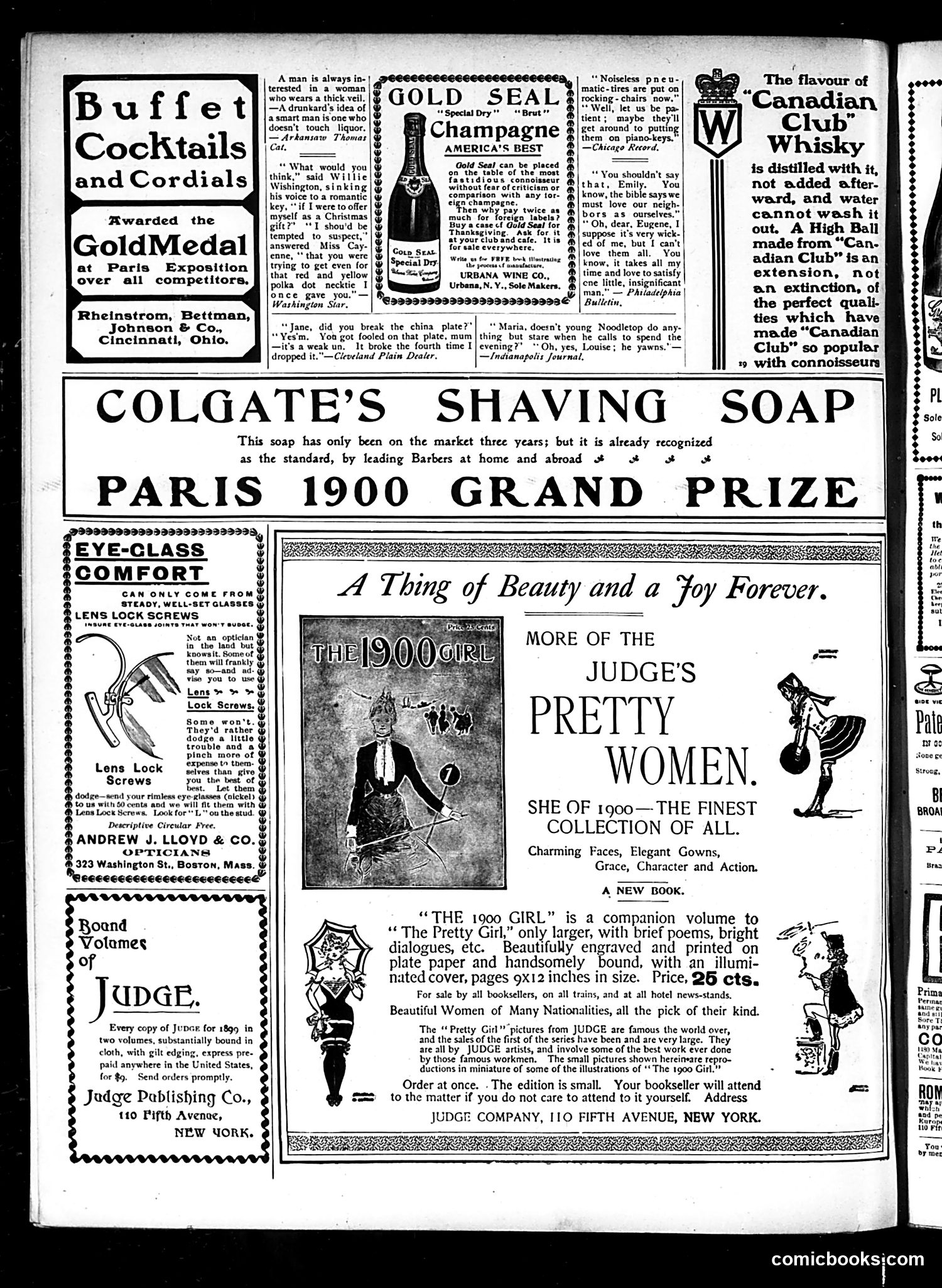
This page is primarily **advertising**, not satire or political commentary. It contains several small humorous anecdotes and product advertisements typical of Judge magazine circa 1900. The page includes: - **"Buffet Cocktails and Cordials"** ad (upper left) - **Gold Seal Champagne** ad with a brief joke about a man's interest in women - **Canadian Club Whisky** ad (top right) - **Colgate's Shaving Soap** ad promoting its Paris 1900 Grand Prize - **Lens Lock Screws** ad for eyeglasses - **"The 1900 Girl"** book advertisement (large center), promoting a illustrated volume of women's portraits The brief humorous snippets scattered throughout are generic domestic jokes (wives breaking plates, young men yawning on dates) rather than political satire. They serve primarily to fill space between advertisements. The page reflects early 1900s consumer culture and gender attitudes rather than offering social or political critique.
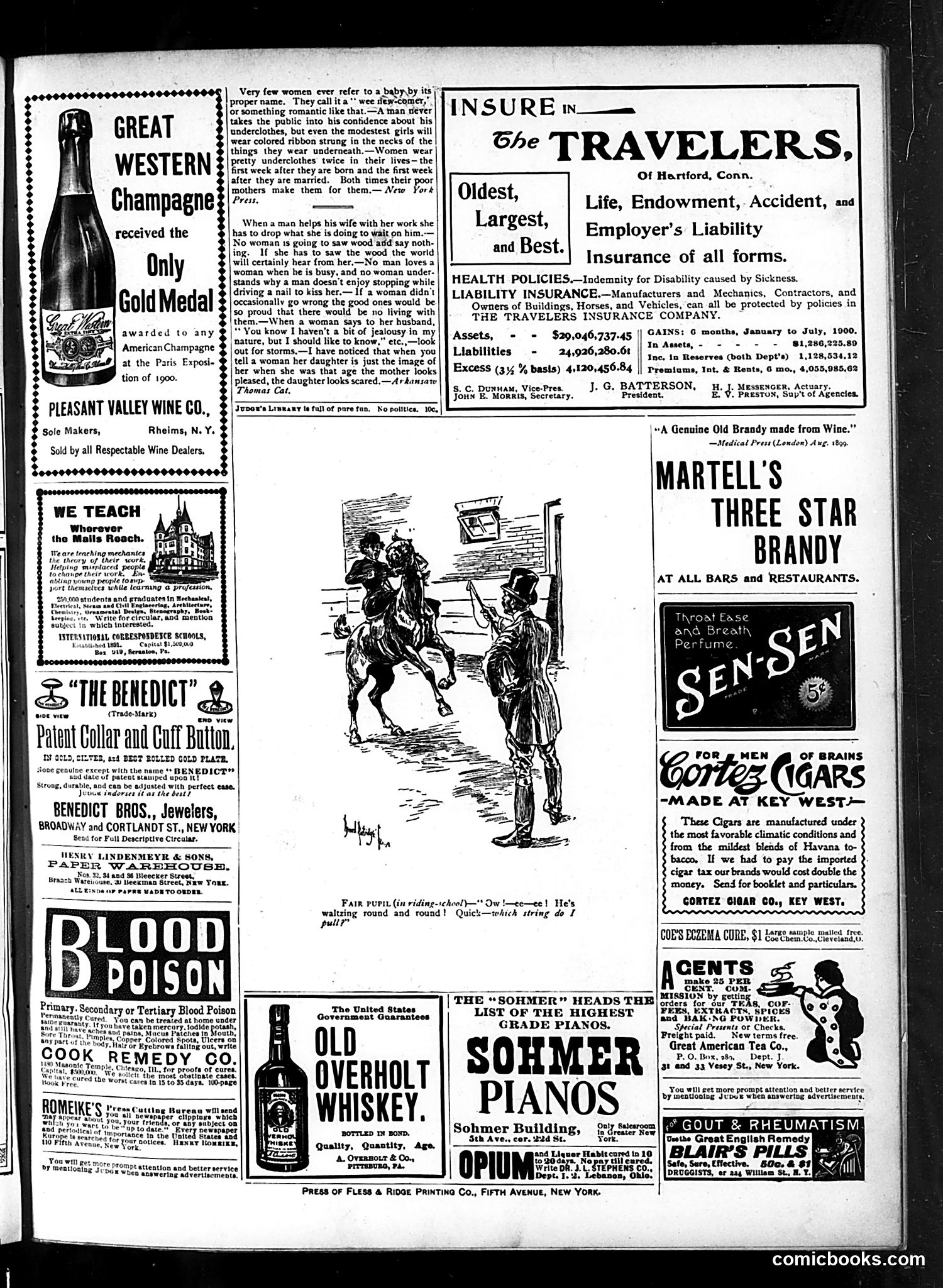
This single-panel cartoon depicts a riding instructor's confusion during a lesson. A student on horseback is circling uncontrollably, and the pupil asks the instructor which rein to pull to stop the horse, sarcastically describing the spinning motion as "waltzing." The humor is straightforward physical comedy: the novice rider has lost control, the horse is executing an unintended spinning motion that resembles dancing, and the panicked rider doesn't know which rein controls which direction. The cartoon mocks both the horse's apparent independence and the rider's basic lack of horsemanship. The illustration style is typical of Judge magazine's line-drawn cartoons from this 1900 period. Beyond the riding lesson itself, there's no apparent political or social satire—it's simply observational humor about incompetent equestrian novices, a relatable subject for early 20th-century urban readers familiar with riding culture.
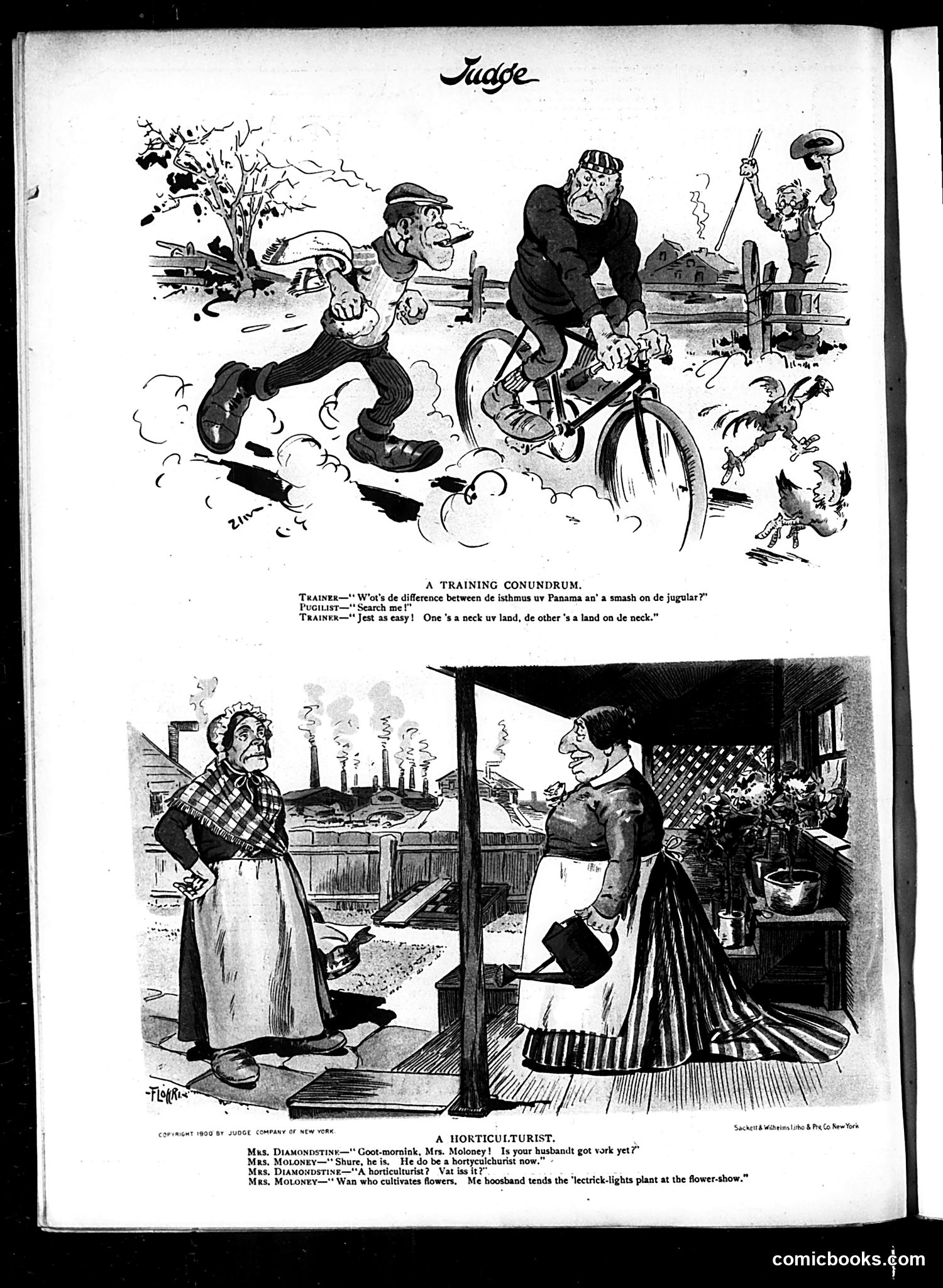
This page contains two separate satirical cartoons from Judge magazine (copyright 1922). **Top cartoon ("A Training Conundrum"):** Features a boxing trainer instructing a fighter using a pun. The joke plays on "neck of land" (the Panama Isthmus, then a contemporary geopolitical focus) versus "land on the neck" (a boxing punch to the neck). It's wordplay humor about boxing training. **Bottom cartoon ("A Horticulturist"):** Shows two working-class immigrant women (indicated by dialectal speech patterns). One boasts her unemployed husband now has work as a "horticulturist" (flower cultivator). The punchline reveals he merely tends electric lights at a flower show—a humorous class commentary on working-poor men inflating their job titles to appear respectable. The ethnic stereotyping and dialect humor reflects period attitudes toward immigrant populations. Both cartoons use exaggerated facial features typical of early 20th-century caricature style.