
A complete issue · 16 pages · 1900
Judge — August 18, 1900
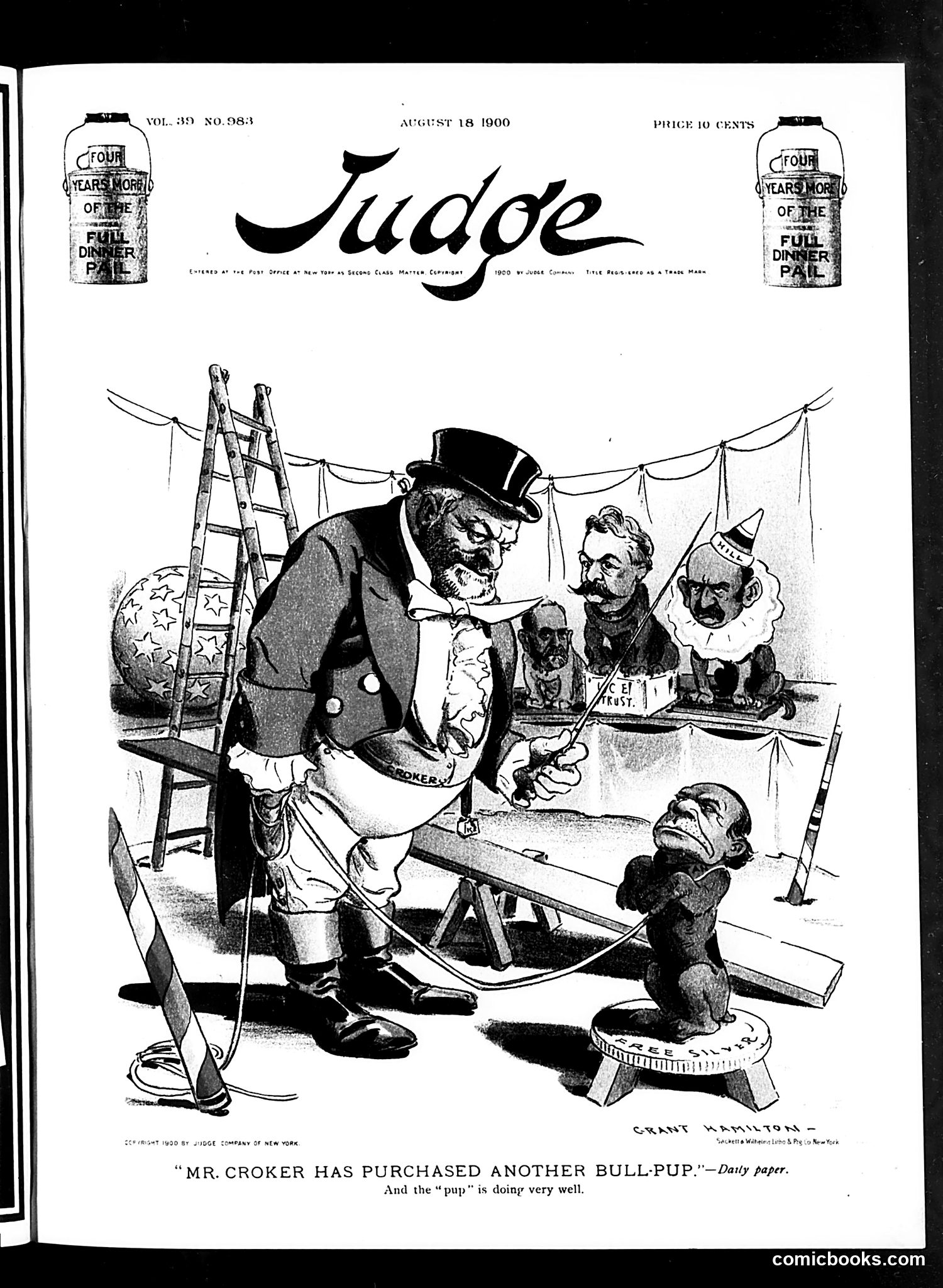
This political cartoon satirizes **Mr. Croker** (likely Richard Croker, Democratic boss of Tammany Hall) as a charlatan "purchasing another bull-pup"—political slang for a gullible voter or naive follower. The caricatured figure on the left, dressed as a confidence man or hustler, examines a small monkey or ape-like creature labeled "Croker's Latest," while onlookers (possibly representing newspaper editors or political figures) watch from a decorated booth. The stethoscope suggests medical charlatan theatrics. The cartoon mocks Croker's ability to manipulate the electorate through false promises or deceptive schemes. The "pup" doing "very well" implies voters are thriving under his control—or ironically, that they've been successfully duped. The carnival-like setting emphasizes the artificiality of machine politics.
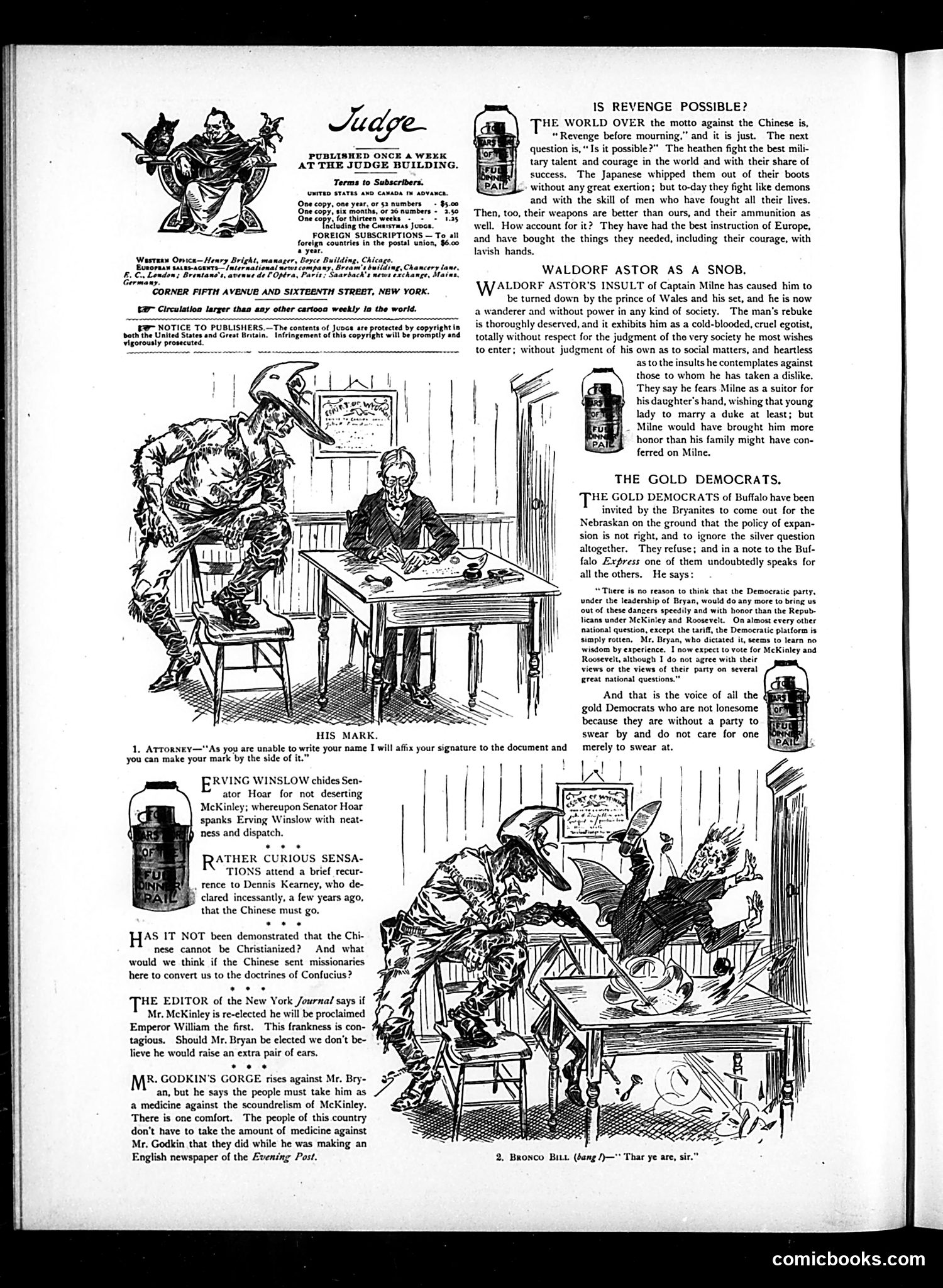
This page contains three distinct satirical pieces from Judge magazine: **"Is Revenge Possible?"** discusses Japan's military superiority over China, questioning whether the Chinese can effectively retaliate given superior Japanese training and weaponry. **"Waldorf Astor as a Snob"** mocks Waldorf Astor's rejection of Captain Milne as a suitor for his daughter, portraying Astor as an arrogant aristocrat who disrespects those without social standing. **"The Gold Democrats"** satirizes Democratic politicians who refuse to support William Jennings Bryan's silver platform, showing them as unprincipled party members willing to abandon core Democratic positions for personal gain. The cartoons use exaggerated caricature and satirical dialogue to criticize perceived hypocrisy and class snobbery among the wealthy and politically powerful during the McKinley era.
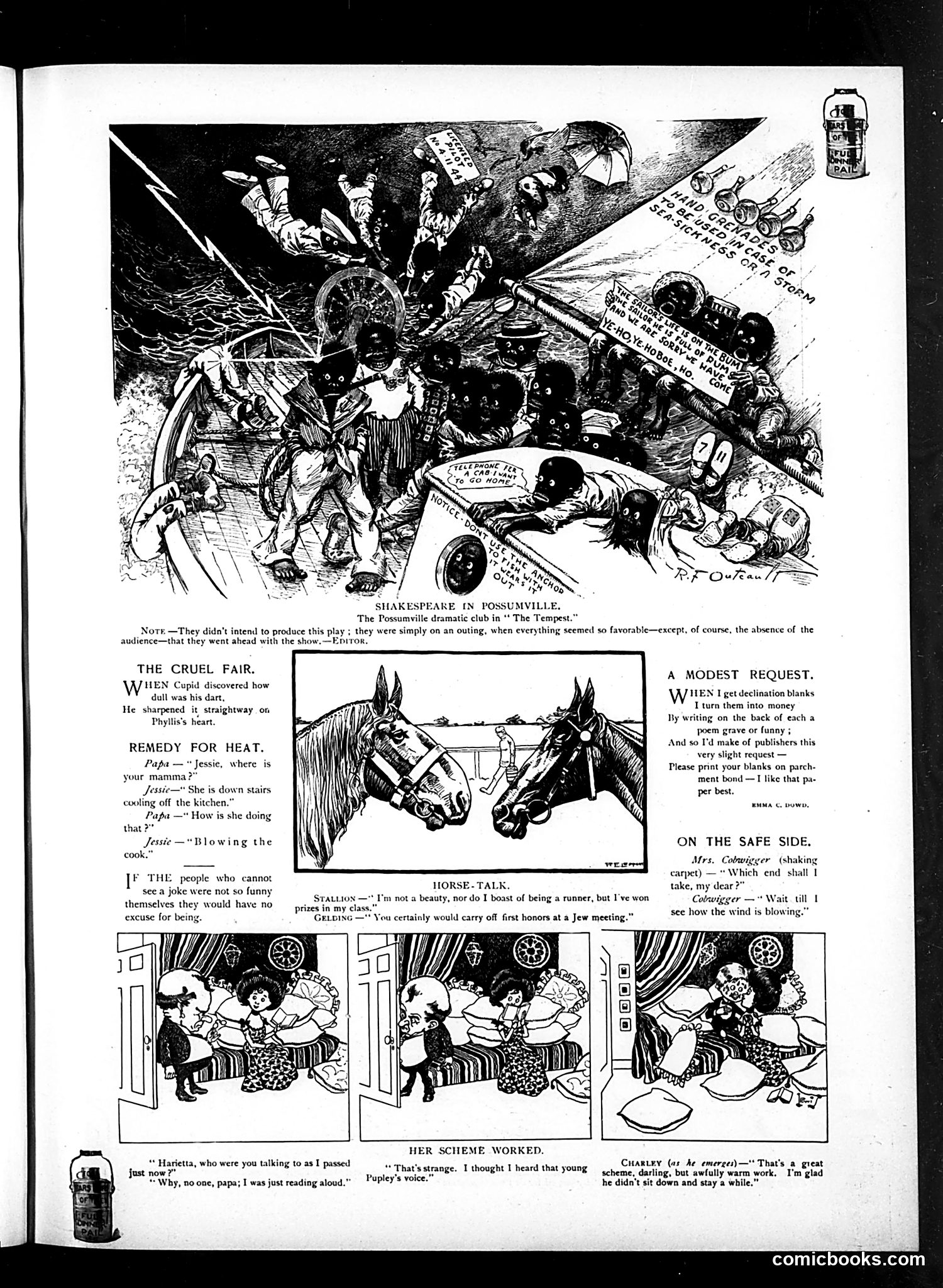
This page contains several unrelated humorous items rather than a unified political cartoon. The top illustration, "Shakespeare in Possumville," satirizes a dramatic club's amateur production of *The Tempest*, with anthropomorphic possums performing the play—likely mocking pretentious local theater groups attempting Shakespeare. Below are three brief comic dialogues: "The Cruel Fair" (romantic humor), "Remedy for Heat" (domestic comedy about a woman cooling the kitchen), and "Horse-Talk" (a stallion boasting about winning prizes at a Jewish meeting—unclear what this references specifically). The bottom three-panel comic strip, "Her Scheme Worked," shows a domestic scenario where a woman's ruse successfully deceives her husband into thinking he overheard her voice while reading alone. Overall, this is light, domestic humor with no apparent political content—typical of Judge's miscellaneous entertainment section.
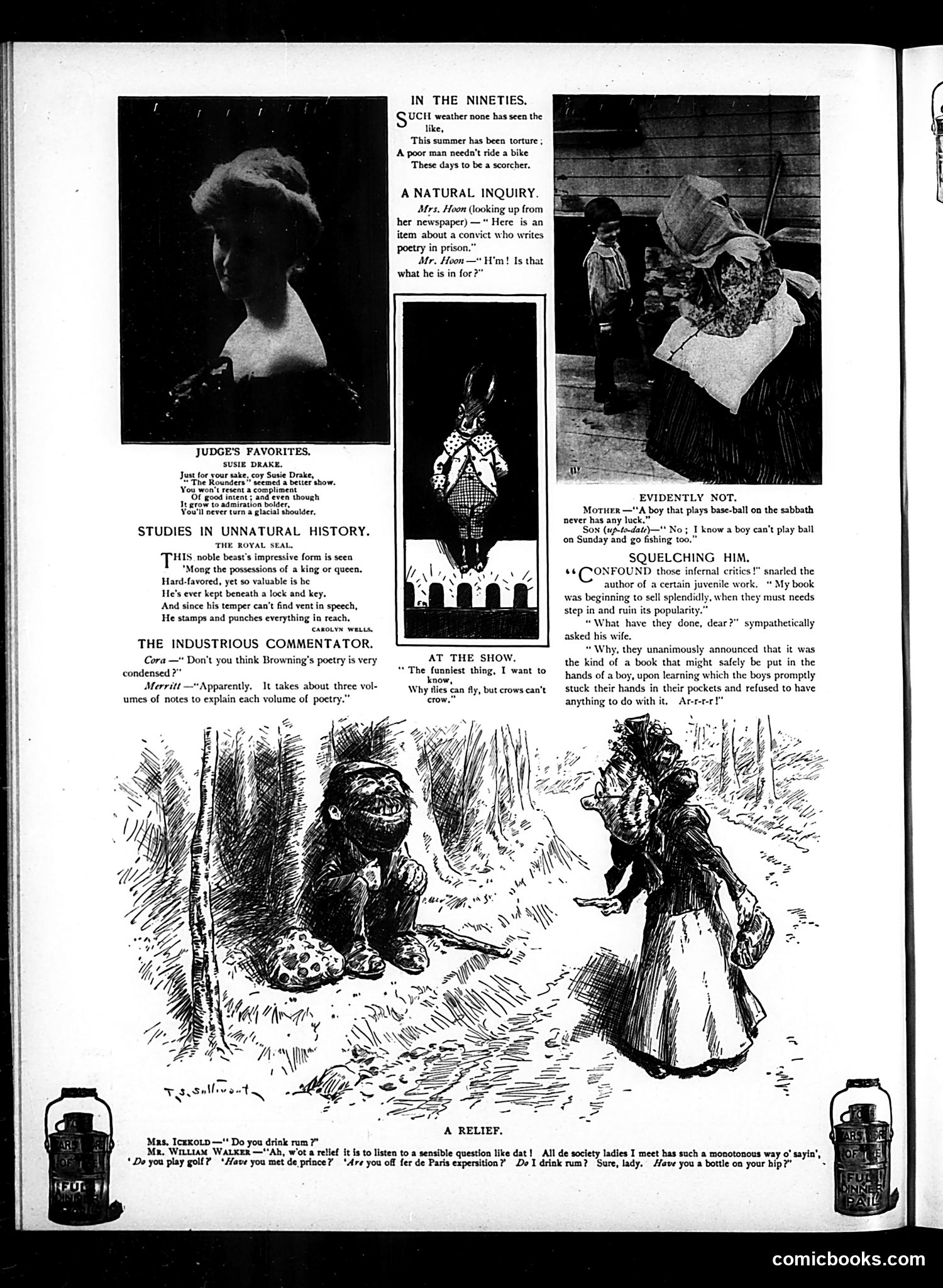
This page contains several satirical pieces from 1890s Judge magazine: **"Judge's Favorites" and "Studies in Unnatural History"** mock public figures through caricature and verse, though specific identities aren't clear from the visible text. **"A Natural Inquiry"** jokes about a woman asking a man about poetry in prison—satirizing either a literary figure or the absurdity of discussing refined topics in crude contexts. **"A Relief"** (bottom cartoon) shows a woman encountering what appears to be a tramp or vagrant. The dialogue references rum, Paris, and social pretension, mocking upper-class hypocrisy and the disconnect between wealthy ladies' moral standards and actual behavior. The overall page uses visual caricature and witty dialogue to criticize social hierarchies, gender conventions, and class contradictions typical of 1890s satirical humor.
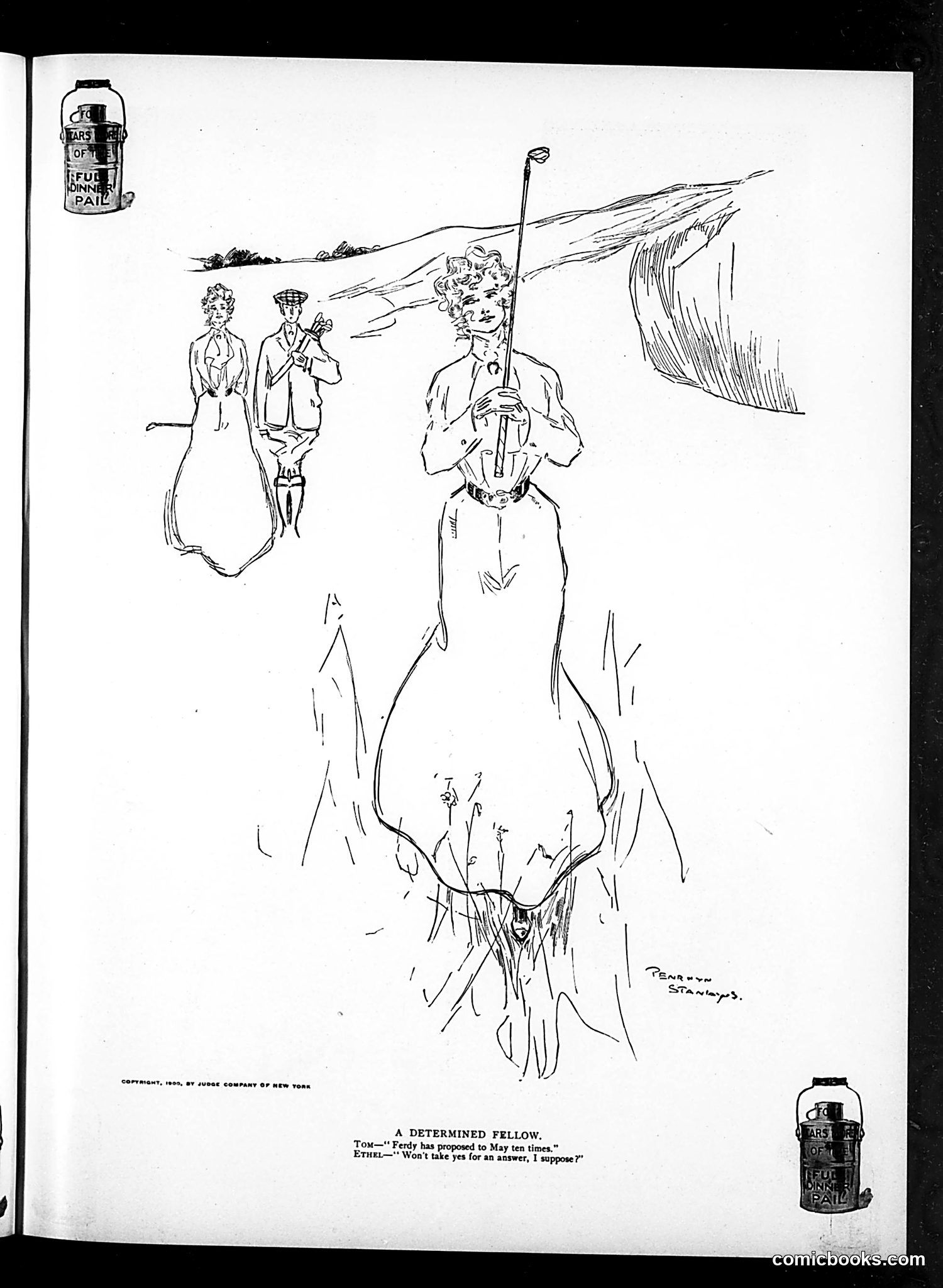
This cartoon satirizes a man's stubborn persistence. The caption reads: Tom says "Ethel has consented to May ten times," while Ethel responds "Won't take yes for an answer, I suppose?" The image shows a determined figure climbing upward (depicted as ascending from a chasm or difficult terrain) while a woman and what appears to be a military or uniformed man observe from above. The joke plays on the man's relentless pursuit despite repeated rejections—he keeps proposing marriage to "Ethel" despite her refusing ten times. The cartoon mocks both his determination and her exasperation with his refusal to accept her answer. It's a commentary on masculine persistence in courtship that borders on harassment, presented as comedic material typical of early-20th-century Judge magazine humor.
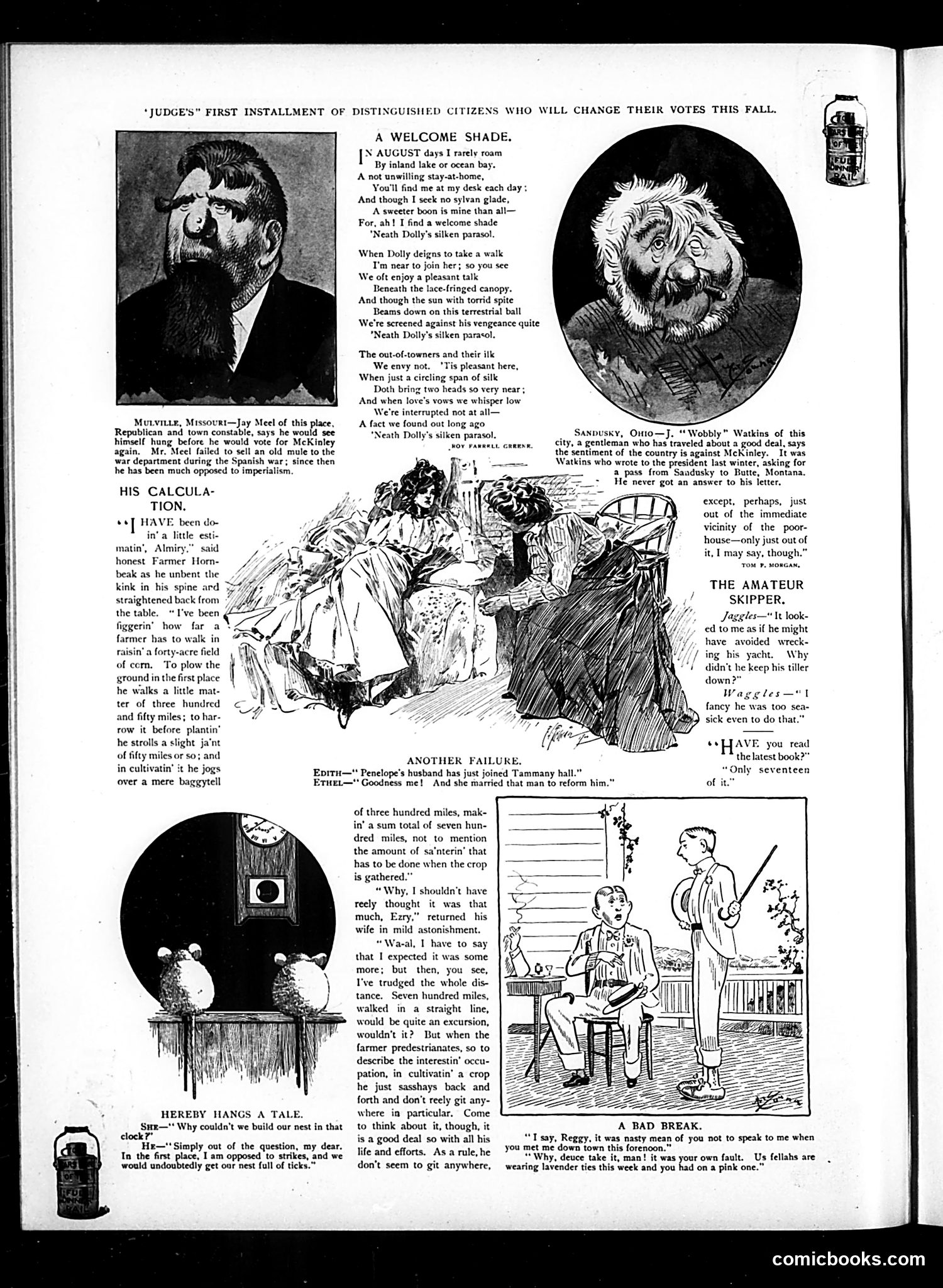
This page from Judge satirizes late-19th-century American politics and social attitudes. The header references voters changing their votes "this fall," suggesting an election context (likely 1900, given McKinley references). **Political content:** Two brief items mock Republicans who oppose McKinley—a Missouri constable angry about losing military contracts during the Spanish-American War, and an Ohio man ("Wobbly" Watkins) whose letter to the president went unanswered. The satire mocks these disaffected voters as petty and self-interested rather than principled. **Social humor:** Other pieces target farmers' mathematical ignorance ("His Calculation"), failed marriages, and incompetent yacht-owners—typical Judge fare mocking middle-class pretension and incompetence. **"Welcome Shade"** is sentimental romantic verse about courting under a parasol—lighthearted period romance. The page is primarily satirical commentary on voter attitudes during a McKinley-era election, combined with domestic humor typical of the magazine's style.
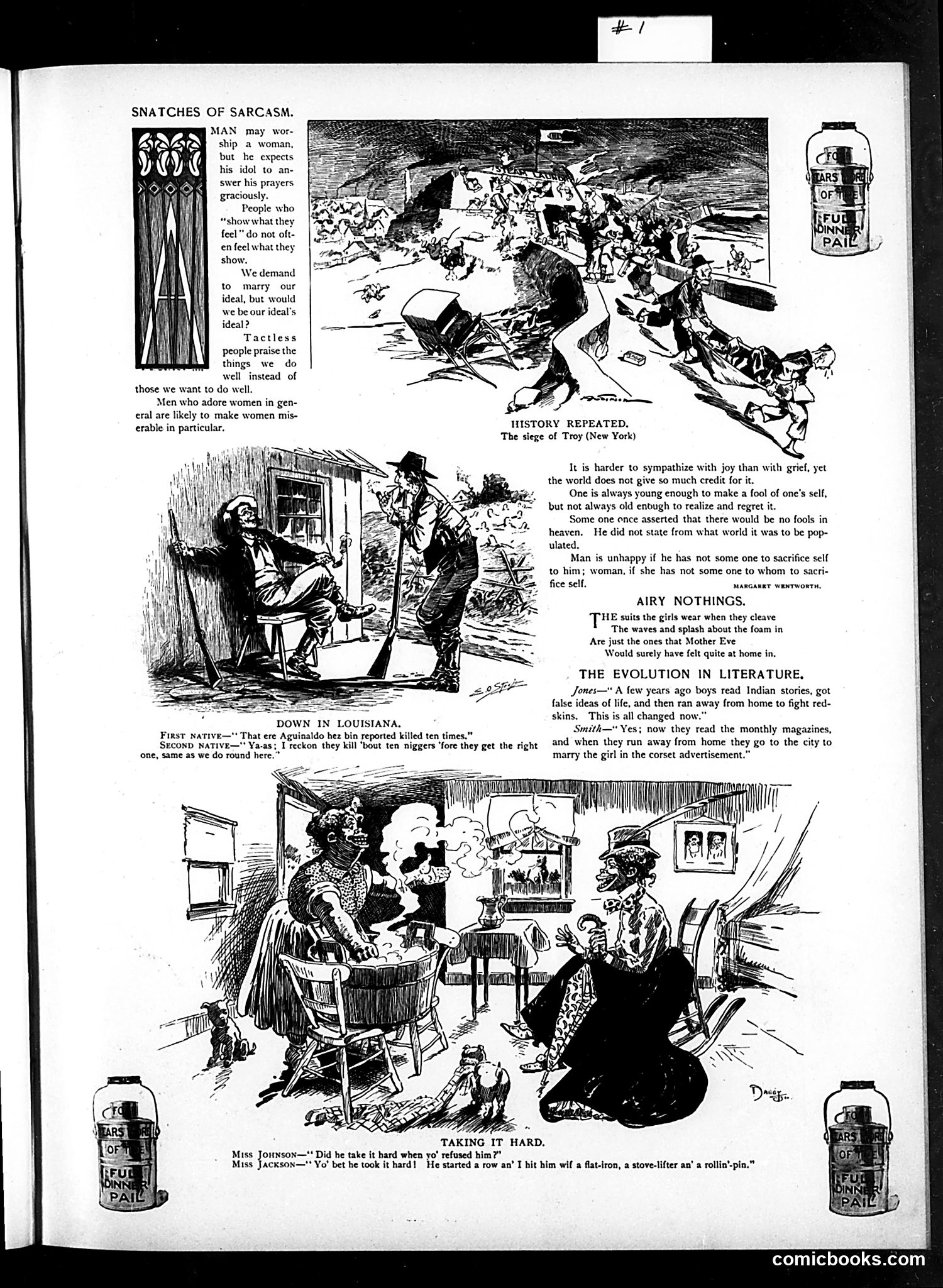
This page collects satirical observations on human nature, gender relations, and contemporary culture. The opening section contains cynical aphorisms about courtship and hypocrisy—men worship idealized women but expect obedience; people praise strengths rather than acknowledge weaknesses they want to improve. "History Repeated" references the Trojan War as parallel to modern romantic conflict in New York. "The Evolution in Literature" mocks how boys' reading habits have shifted: previously, adventure stories inspired runaways seeking danger; now magazine advertisements promote superficial romance, with young men fleeing to cities to pursue women based on corset ads. "Down in Louisiana" appears to contain offensive racial stereotypes in dialect, reflecting period attitudes. "Taking It Hard" presents a humorous domestic dispute where a woman violently rejects a suitor's advances. The page uses satire to critique vanity, changing youth culture, and romantic folly—typical Judge magazine fare targeting middle-class readers.
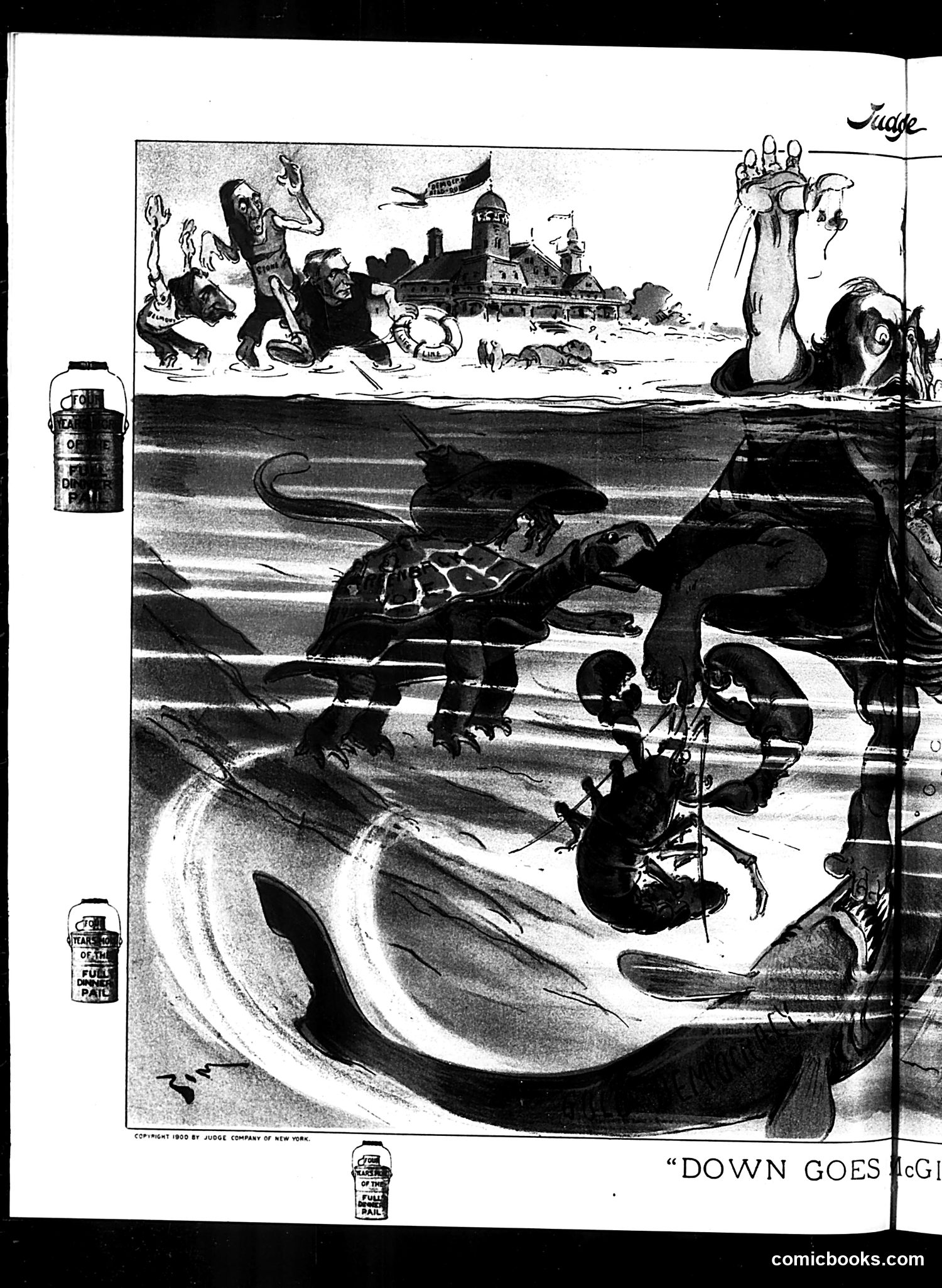
This Judge magazine cartoon uses aquatic imagery to satirize what appears to be the decline of a political figure or entity identified as "McGI" (likely a surname). The upper panel shows caricatured figures on shore—possibly politicians or public figures—appearing distressed or celebrating. The lower panel depicts large fish or sea creatures (possibly symbolizing political forces or consequences) submerging in turbulent water, with the caption "DOWN GOES McGI." The cartoon employs the common satirical convention of drowning or sinking to represent political defeat or downfall. Without the publication date visible, the specific historical context remains unclear, but the style and Judge magazine's satirical nature suggest commentary on a notable political event or scandal from the early 20th century. The anthropomorphic creatures and dramatic rendering emphasize the severity of the depicted downfall.
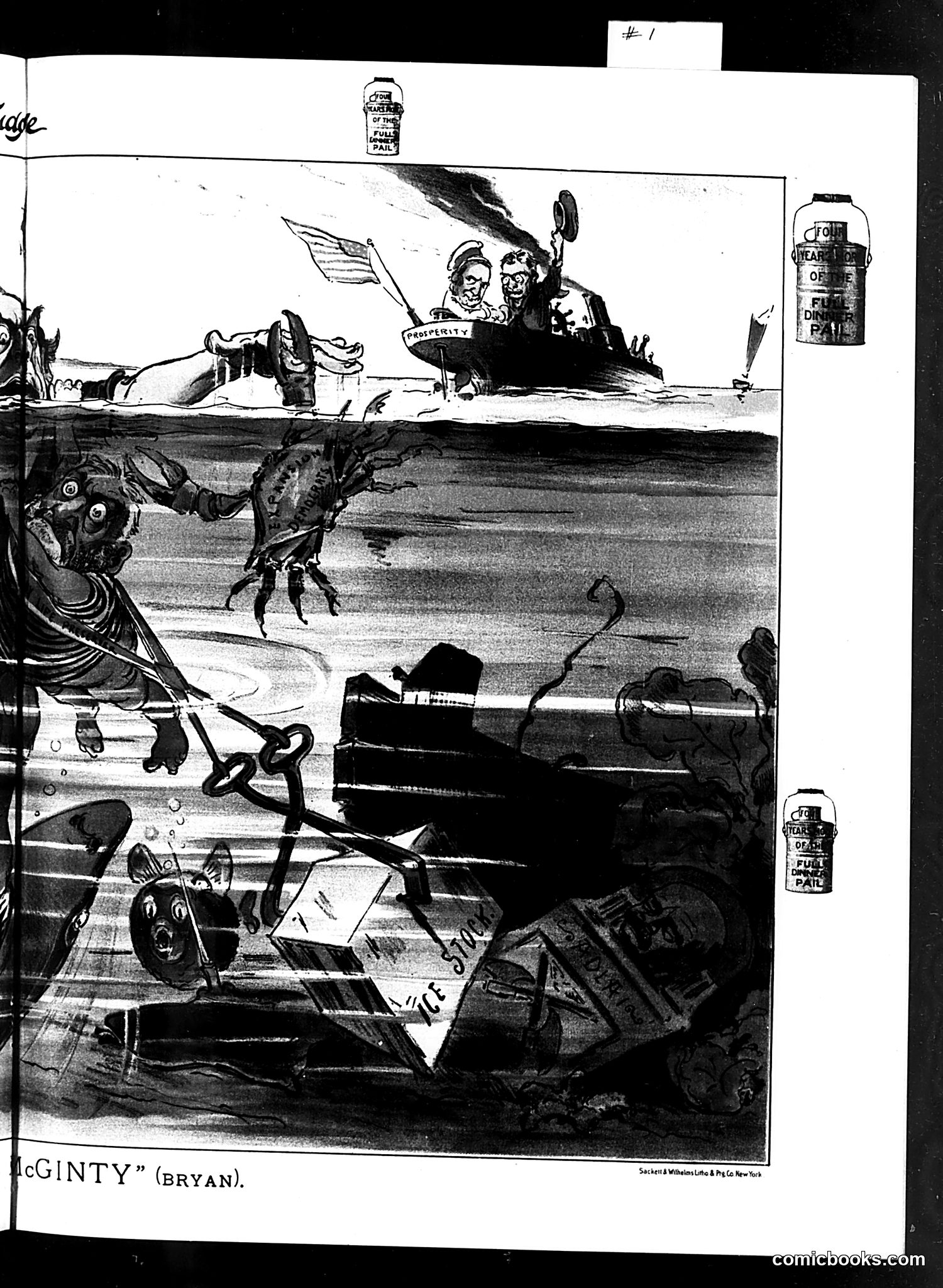
This Judge magazine cartoon titled "McGinty" (by Bryan) depicts an underwater scene with caricatured figures in a boat above and various sea creatures below. The two figures in the boat appear to be politicians or public figures, suggesting a satirical commentary on political navigation through troubled waters. The sea creatures and chaotic underwater scene likely represent political obstacles, opposition, or societal chaos that the figures must navigate. The "McGinty" reference may indicate this concerns a specific political figure or incident, though the exact historical context is unclear from the image alone. The overall satire appears to comment on political instability or the difficulties of governance during this period. Without additional historical information, the precise political figures and events referenced remain uncertain.
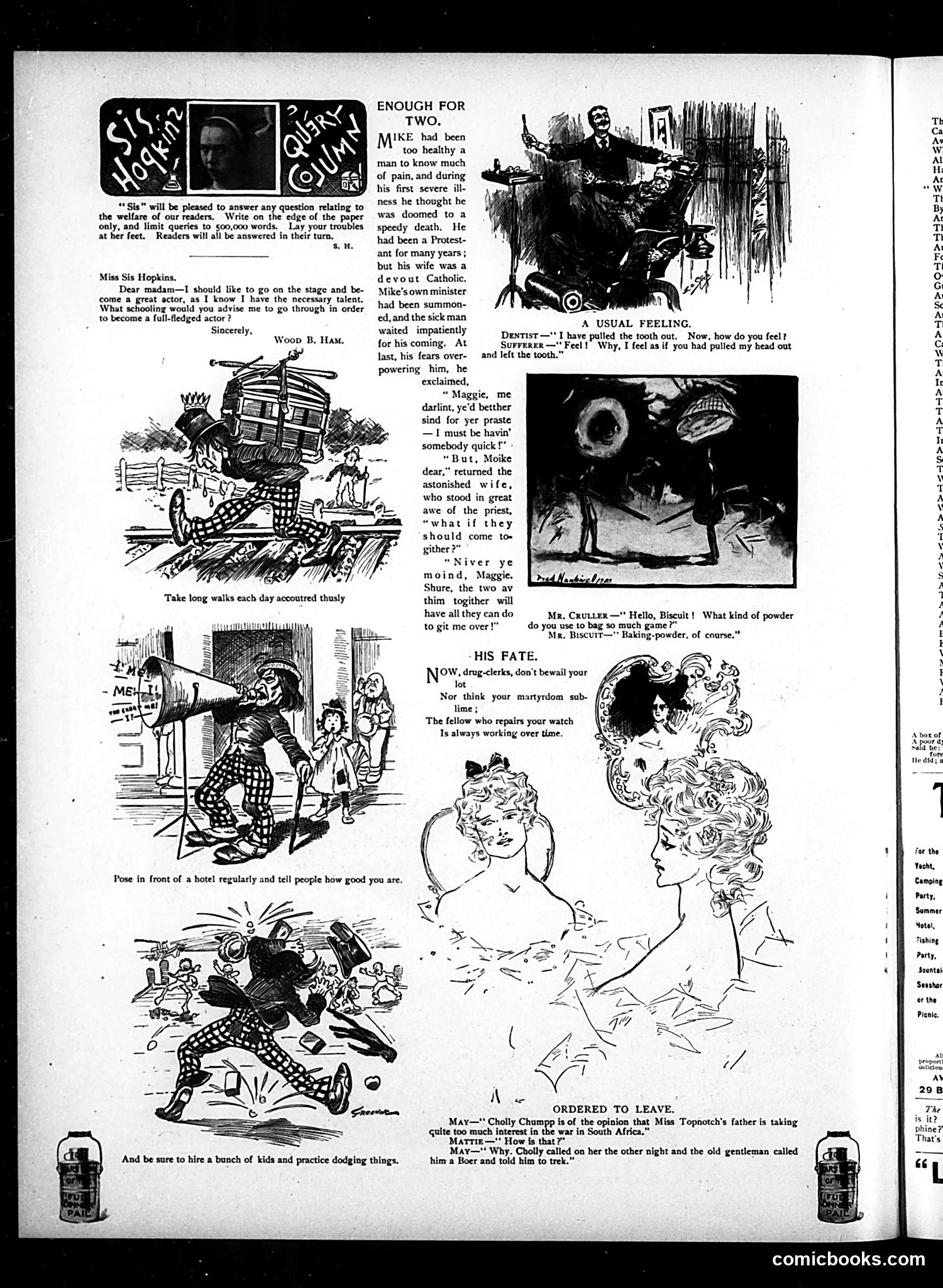
This page contains multiple unrelated humorous pieces typical of Judge's format: **"Enough for Two"** depicts a dying Irish Catholic man (Mike) whose wife fears summoning both his Protestant minister and Catholic priest simultaneously—joking that together they'll be "all they can do to git me over," implying both religions might claim him or create chaos. **The dentist cartoon** uses a common joke format: after tooth extraction, the patient quips he feels as if his entire head was removed while the tooth remained—inverting expected pain locations for absurdist humor. **"His Fate"** is a light verse mocking store clerks' complaints, suggesting watch repairmen work "over time" (pun on overtime/clock repairs). **"Ordered to Leave"** references the Boer War (South Africa conflict), joking that a girl's father called her suitor a "Boer" and told him to "trek"—contemporary political wordplay using the war as comedy material. The page also includes advice column "Sis Hopkins" and various period illustrations. These represent typical early-1900s satirical humor: ethnic stereotypes, puns, romantic situations, and topical references to contemporary events.
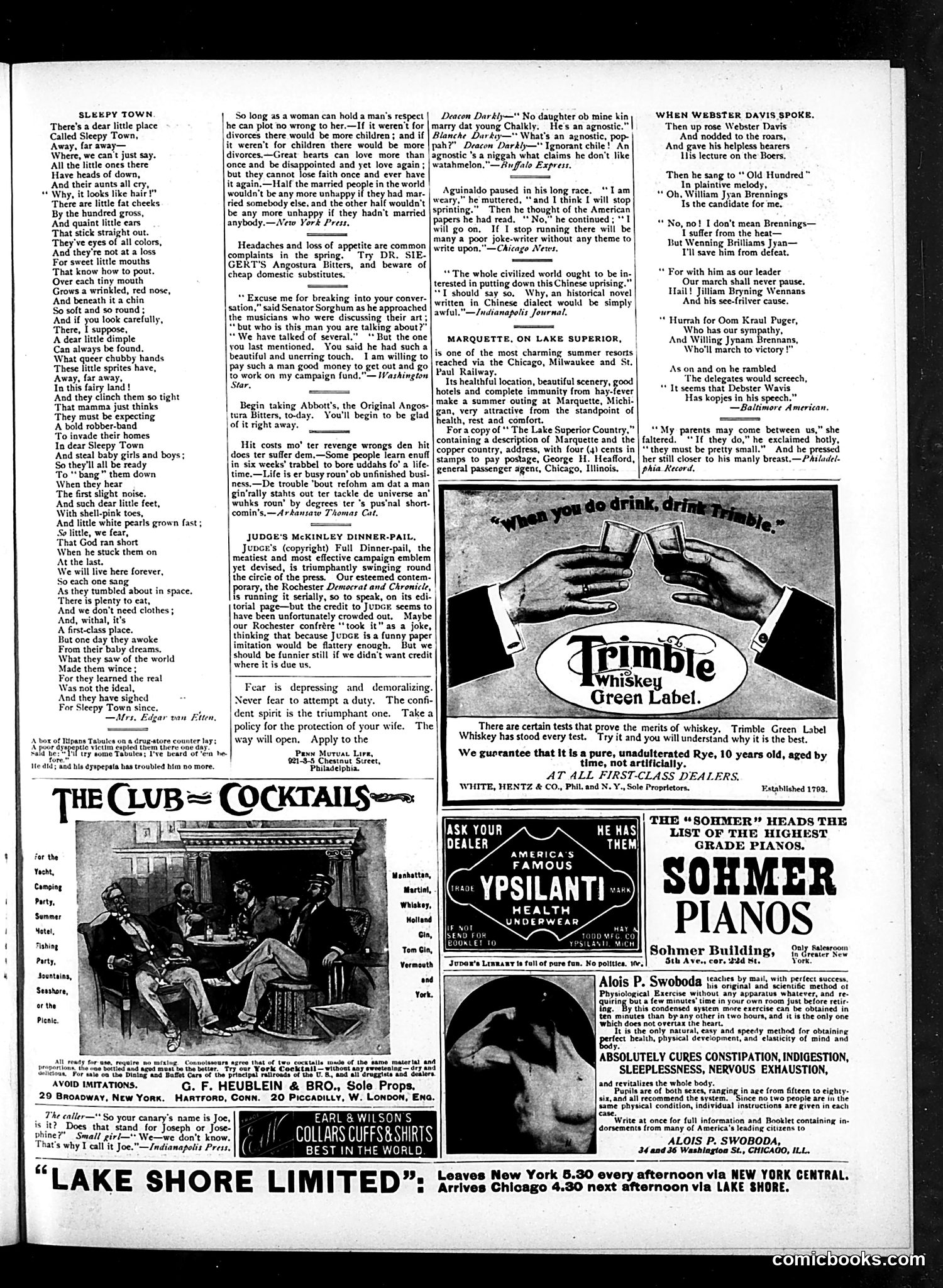
This page contains primarily **advertising and light satirical content** rather than political cartoons. The main literary piece is "Sleepy Town," a sentimental poem about idealized infancy that contrasts children's innocent dreams with harsh adult reality—a common Victorian-era theme reflecting anxieties about lost innocence. The satirical content includes brief quips and jokes, such as Senator Sorghum attempting to hire a talented musician for his political campaign (mocking politicians' exploitation of talent), and dialect humor featuring "Arkansaw Thomas Cat" offering rustic folk wisdom (typical of early 1900s publications). The page is dominated by **advertisements** for Trimble Whiskey, Sohmer Pianos, Ypsanti health products, and other goods—reflecting Judge's role as a commercial publication. Notable is a reference to **McKinley's "Full Dinner-Pail"** campaign emblem (from William McKinley's 1900 presidential campaign), suggesting this page dates from that election cycle. The joke implies Judge created this popular symbol but wasn't properly credited. Overall, this is a typical magazine page mixing editorial content with revenue-generating advertisements.
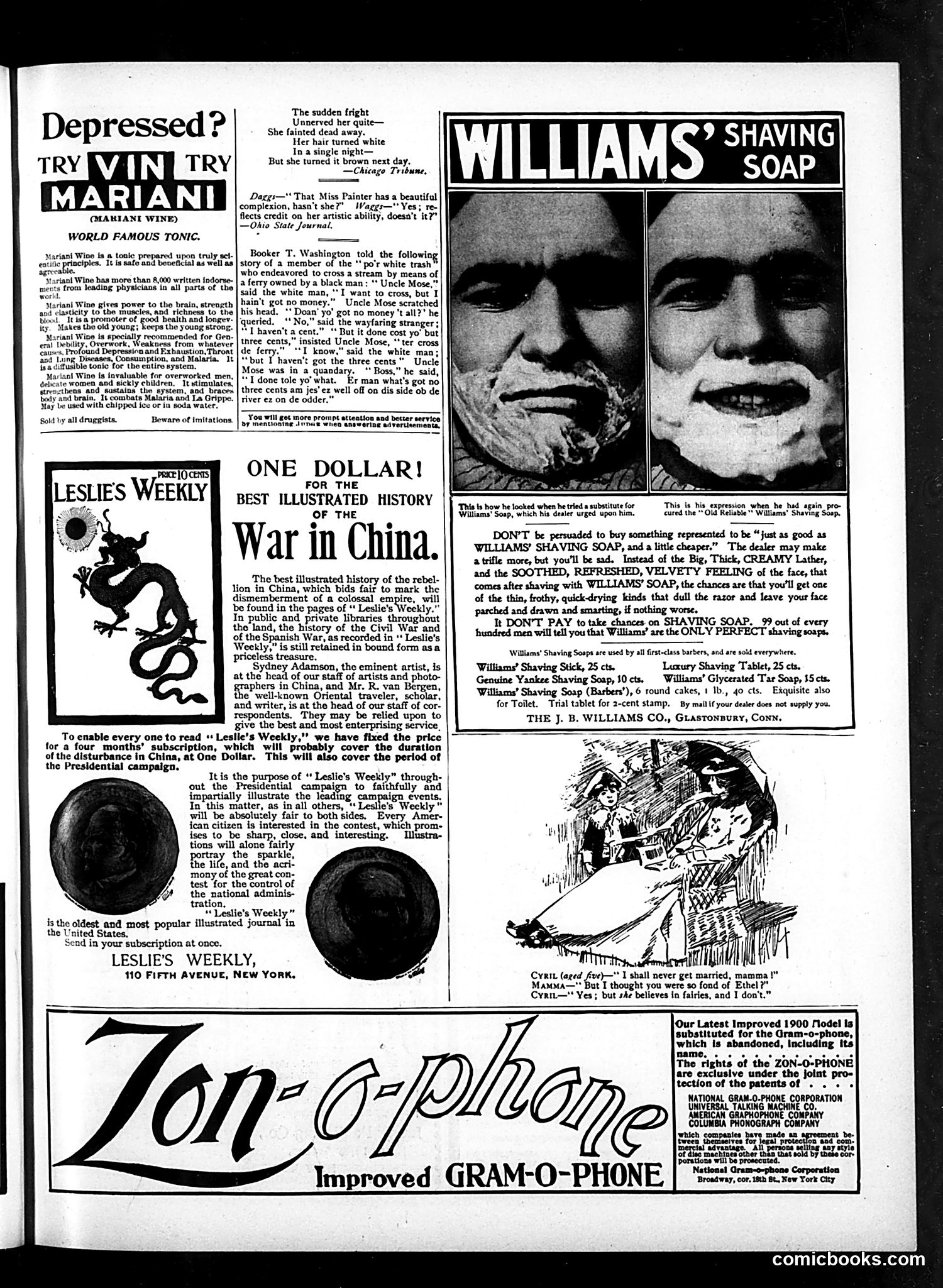
This page primarily contains **advertisements** rather than political cartoons, though it includes one notable satirical anecdote. ## Key Content: **The Booker T. Washington Story**: A brief narrative about a poor white man trying to cross a ferry owned by a Black man ("Uncle Mose"). The story portrays the Black ferryman as shrewd and the white man as destitute—a reversal of typical racial hierarchies of the era. This appears to satirize white poverty and the pretensions of "poor white trash" while presenting the Black character as economically superior and clever. The dialect used reflects period conventions (and prejudices). **Product Advertisements**: The page is dominated by ads for Mariani Wine (a "tonic"), Leslie's Weekly (covering the Boxer Rebellion in China), Williams' Shaving Soap, and the Zon-o-phone phonograph. The shaving soap ad uses before/after images to mock inferior products. **Historical Context**: The China reference dates this to around 1900, during the Boxer Rebellion. The racial dynamics and dialect reflect turn-of-the-century attitudes. The page is primarily commercial rather than explicitly political satire.
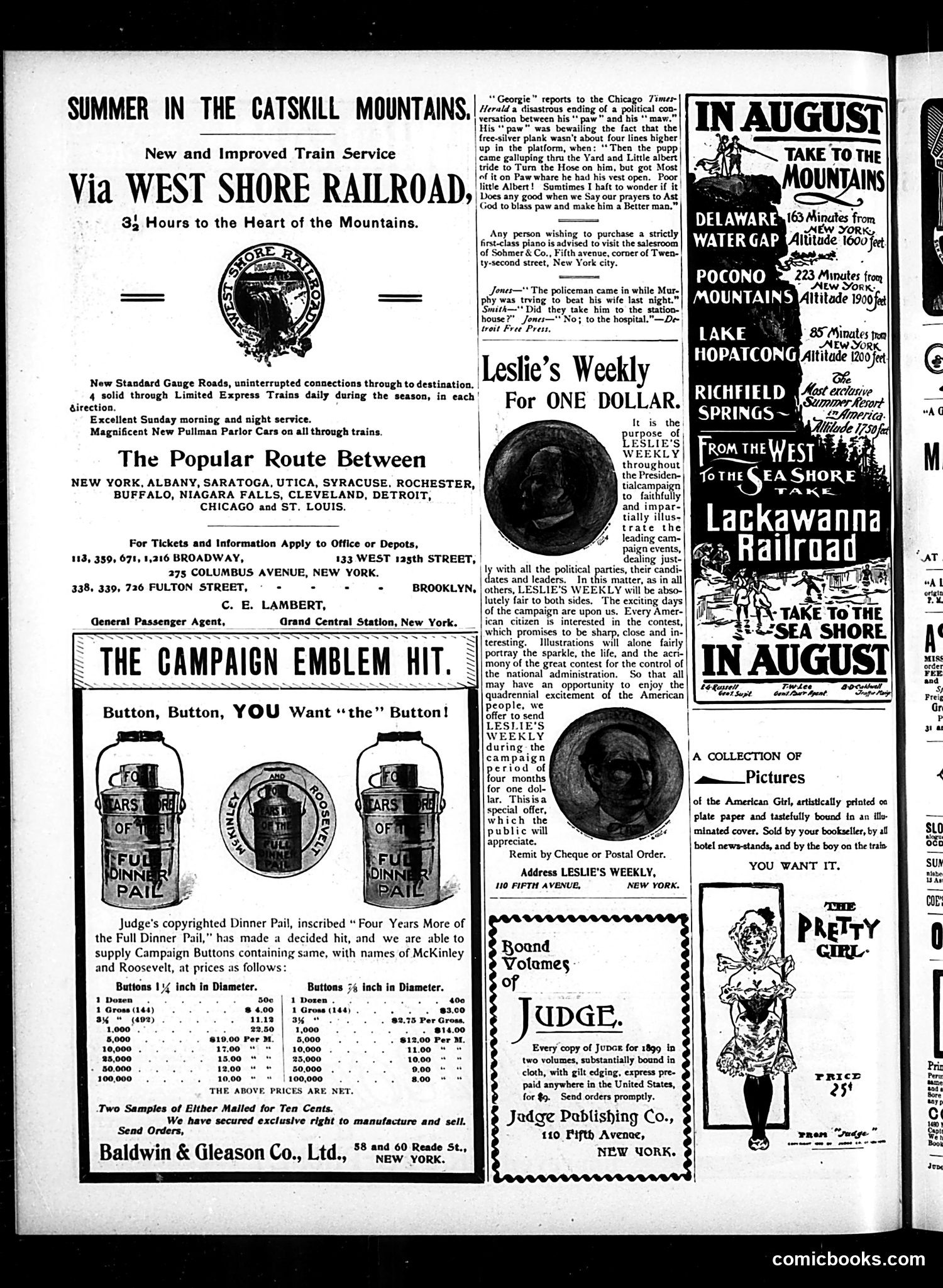
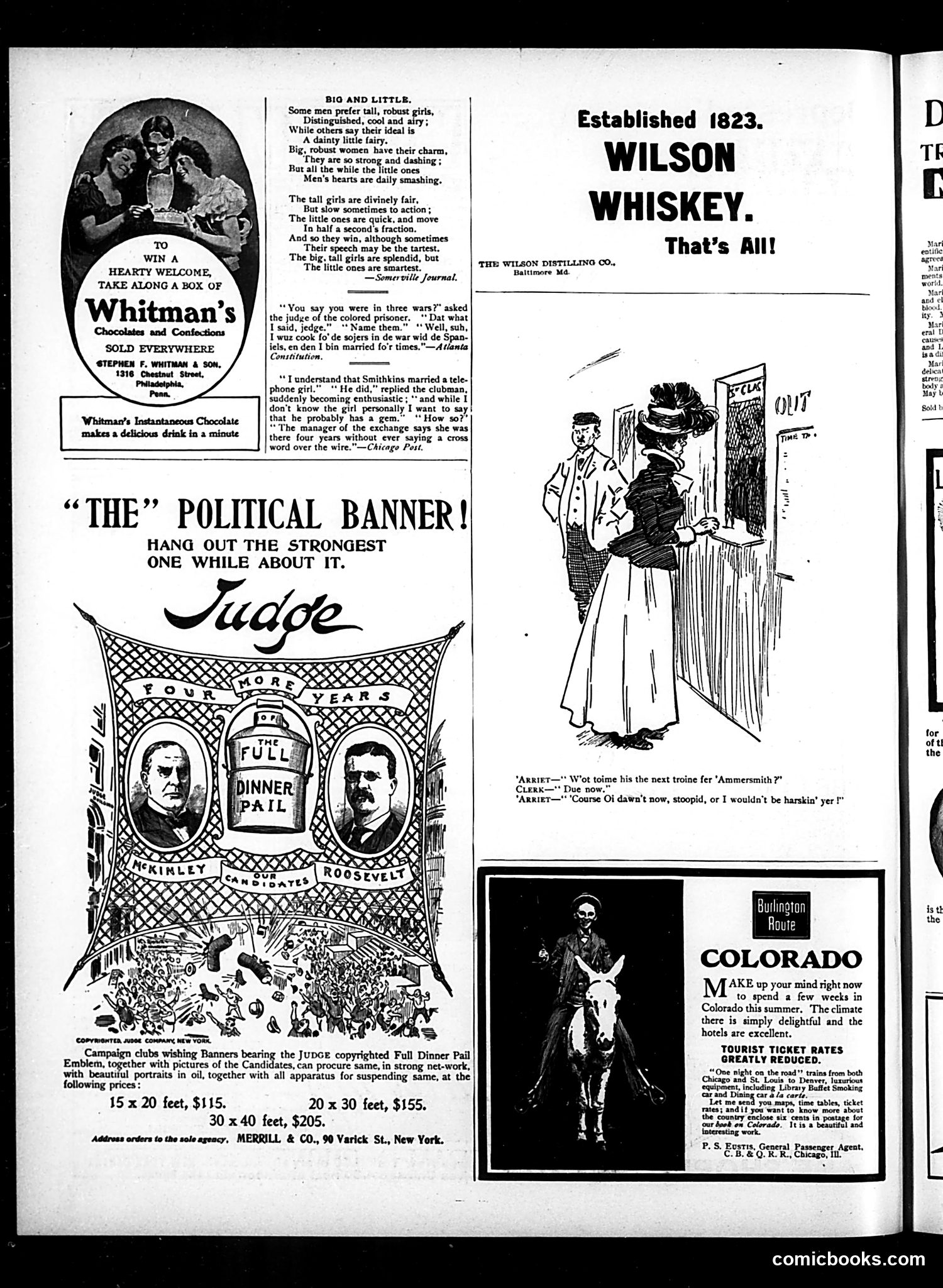
This page primarily contains **advertisements and promotional content** rather than political cartoons, but reveals 1900 campaign messaging. The most significant political content is the **"Full Dinner Pail" campaign button** section. This references the **1900 McKinley-Roosevelt presidential campaign**, using "Four Years More of the Full Dinner Pail" as a slogan—suggesting economic prosperity under Republican administration (implicitly contrasting with Democratic hardship). **Leslie's Weekly** advertisement emphasizes the magazine's "absolutely fair" coverage of the presidential campaign, promising to showcase excitement of the "quadrennial" contest fairly to both parties—standard editorial claims of neutrality. The page also includes **humorous anecdotes** about domestic life and working-class situations (policeman, beaten wife, rural train encounters), typical of Judge magazine's satirical humor targeting contemporary American experiences. Overall, this reflects **1900 election-year magazine content**, blending commerce, campaign messaging, and period humor.
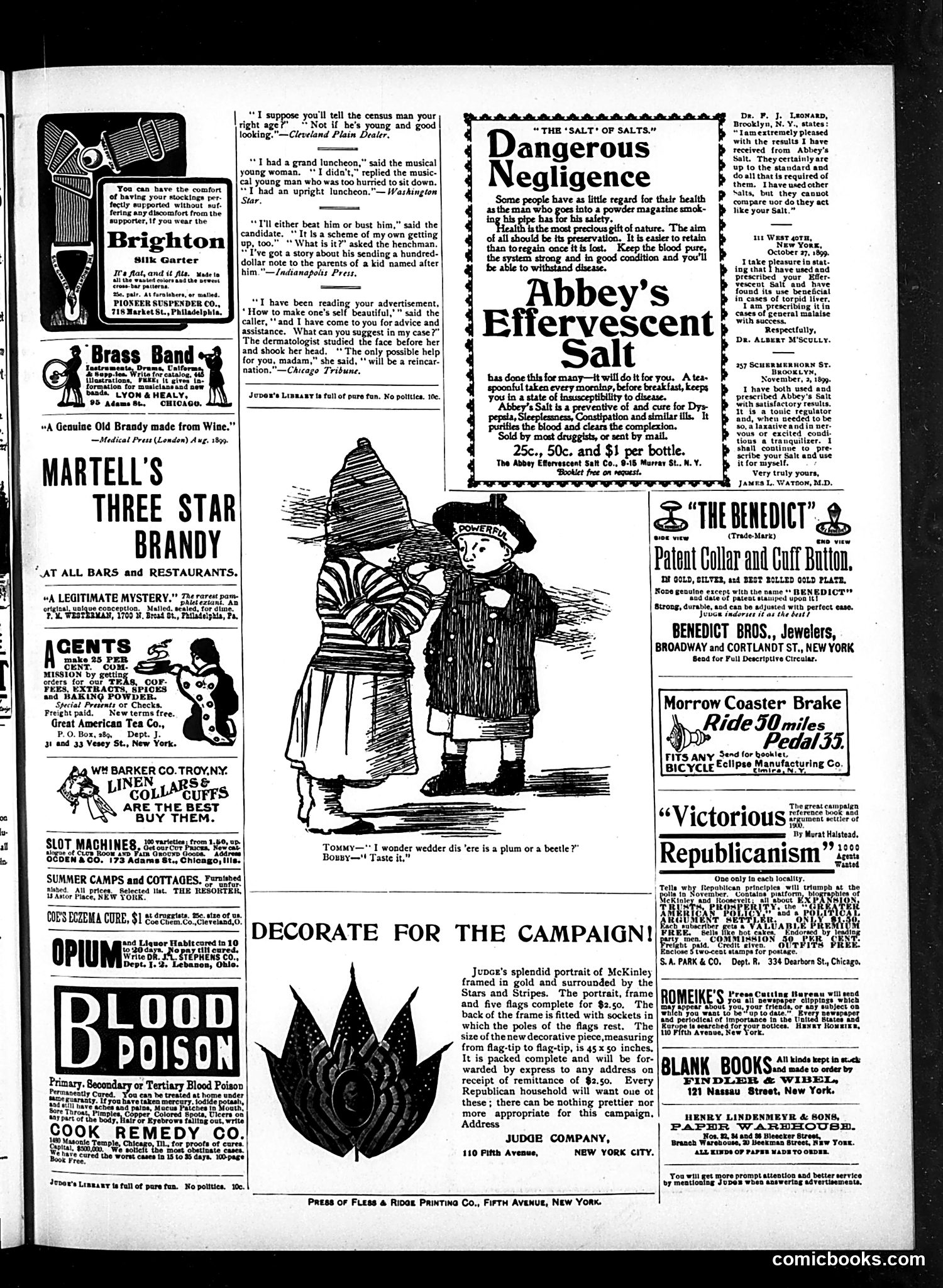
This page is primarily **advertisements and filler jokes** rather than political satire. The central cartoon depicts two figures—appearing to be a woman and child in period dress—with the caption "TOMMY—'I wonder wedder dis 'ere is a plum or a beetle?' BOBBY—'Taste it.'" This is a simple visual gag about urban food adulteration or contamination, a legitimate concern of the era. The substantive content focuses on **Abbey's Effervescent Salt**, a patent medicine advertised as a cure-all for digestive issues and general malaise. Medical testimonials from doctors appear prominently, reflecting common marketing practices of the period before FDA regulation. Surrounding this are numerous other advertisements: Martell's brandy, silk garters, hair remedies, and various commercial products. The miscellaneous jokes scattered throughout address dating, politics, and workplace humor of unremarkable nature. The page contains **no significant political commentary or satire**—it's primarily commercial matter typical of turn-of-century magazine filler.
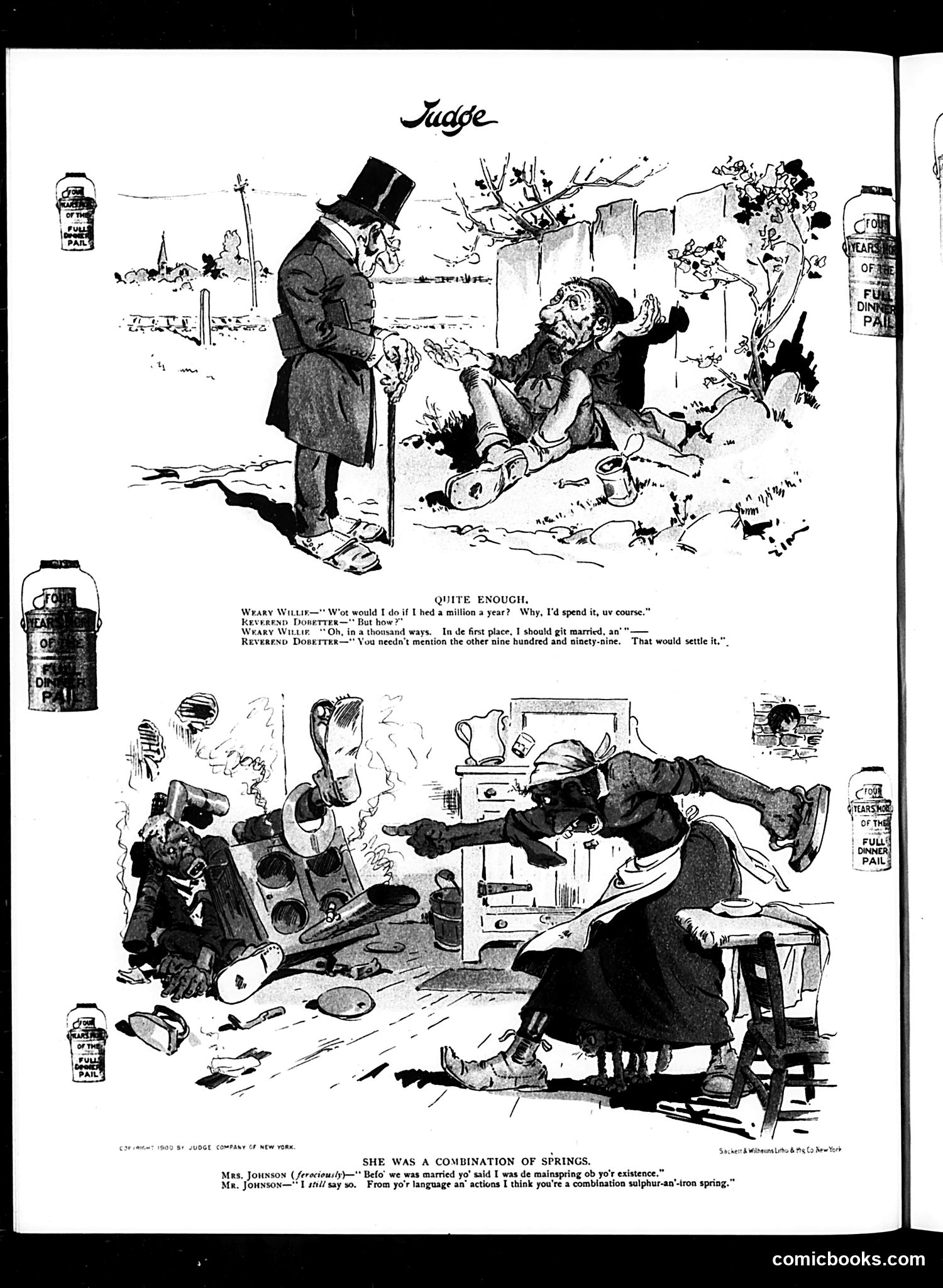
This page contains two separate Judge cartoons satirizing marriage and domestic life. **"Quite Enough"** (top): A well-dressed judge encounters a homeless "Weary Willie" who claims he'd marry if given a million pounds yearly. The judge cuts him off, suggesting marriage itself would consume all that wealth—a jab at the expense of matrimony and wives' spending habits. **"She Was a Combination of Springs"** (bottom): A quarreling married couple where the husband reinterprets his pre-marriage compliment about his wife being "the mainspring of [his] existence" as actually meaning she's a "sulphur-and-iron spring"—a caustic reference to mineral springs with medicinal/laxative properties. The bitter wordplay mocks her sharp tongue and quarrelsome nature. Both cartoons employ late-Victorian/Edwardian-era domestic humor, portraying marriage as financially ruinous and contentious, with wives portrayed as spenders and nags. This reflects period attitudes toward marriage and gender roles.