
Judge, 1900-08-18 · page 7 of 16
Judge — August 18, 1900 — page 7: what you’re looking at
What you’re looking at
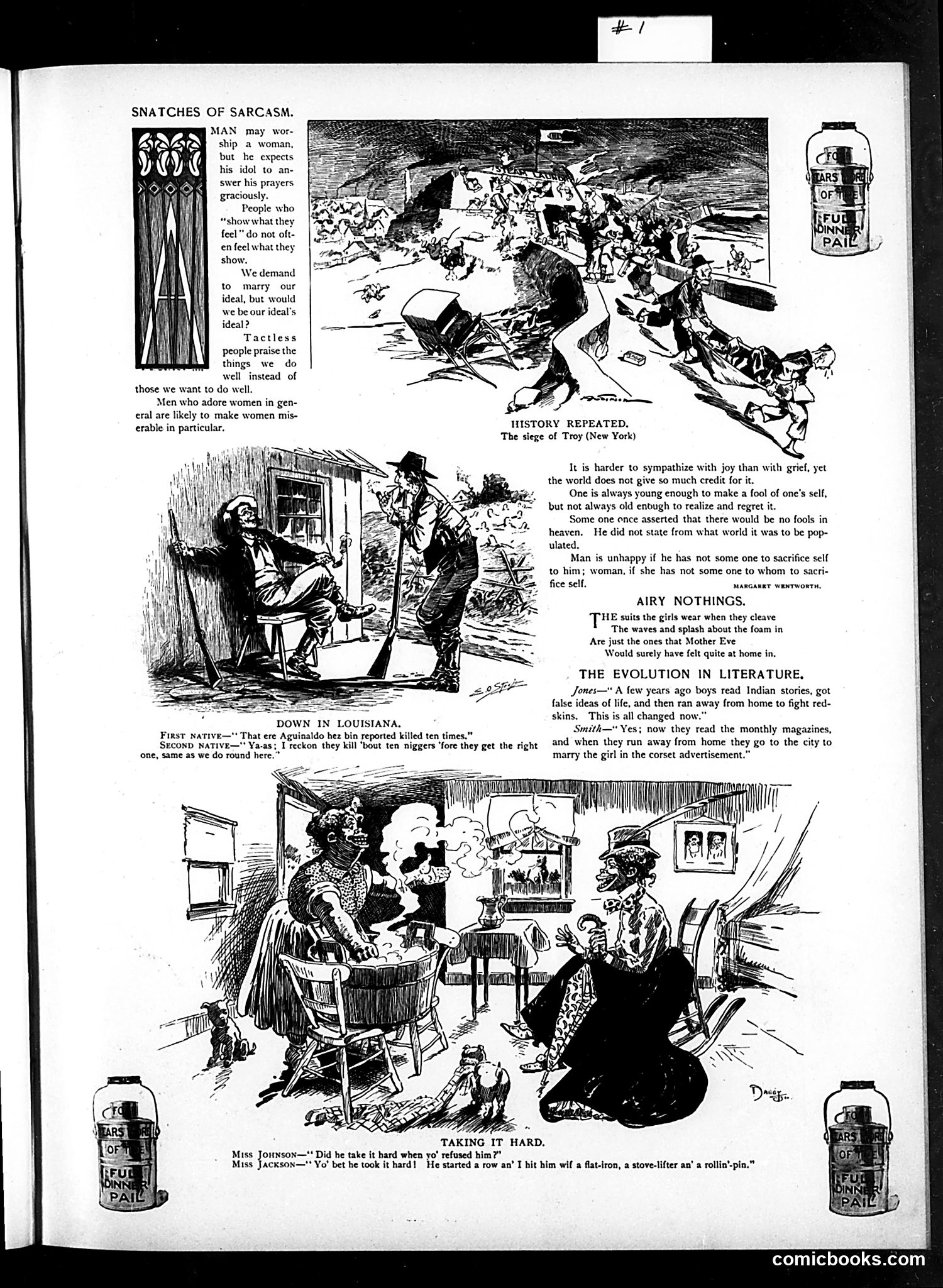
This page collects satirical observations on human nature, gender relations, and contemporary culture. The opening section contains cynical aphorisms about courtship and hypocrisy—men worship idealized women but expect obedience; people praise strengths rather than acknowledge weaknesses they want to improve. "History Repeated" references the Trojan War as parallel to modern romantic conflict in New York. "The Evolution in Literature" mocks how boys' reading habits have shifted: previously, adventure stories inspired runaways seeking danger; now magazine advertisements promote superficial romance, with young men fleeing to cities to pursue women based on corset ads. "Down in Louisiana" appears to contain offensive racial stereotypes in dialect, reflecting period attitudes. "Taking It Hard" presents a humorous domestic dispute where a woman violently rejects a suitor's advances. The page uses satire to critique vanity, changing youth culture, and romantic folly—typical Judge magazine fare targeting middle-class readers.
📄 Transcribed text from this page (OCR, searchable)
Machine-transcribed from the original scan — historical spelling and the odd misread are preserved.
SNATCHES OF SARCASM. MAN may wor- ship a woman, but he expects his idol to an- swer his prayers graciously. People who “show what they feel" do not oft- en feel what they show. We demand to marry our ideal, but would we be our ideal’s ideal? Tactless people praise the things we do well instead of those we want to do well. Men who adore women in gen- eral are likely to make women mis- erable in particular. HISTORY REPEATED. The siege of Troy (New York) It is harder to sympathize with joy than with grief, yet the world does not give so much credit for it. One is always young enough to make a fool of one’s self, but not always old endugh to realize and regret it. Some one once asserted that there would be no fools in heaven, He did not state from what world it was to be pop- ulated, Man is unhappy if he has not some one to sacrifice self to him; woman, if she has not some one to whom to sacri- fice self, MARGARET WRNTWORTH. AIRY NOTHINGS, THE suits the girls wear when they cleave ‘The waves and splash about the foam in ‘Are just the ones that Mother Eve Would surely have felt quite at home in. THE EVOLUTION IN LITERATURE, Jones— A few years ago boys read Indian stories, got false ideas of life, and then ran away from home to fight red- = . skins. This is all changed now.” : DOWN IN LOUISIANA, — — Smith—"Yes; now they read the monthly magazines, First Native—" That ere Aguinaldo hez bin reported killed ten times. ashen! dey vay from ti he ci SECOND NATIVE—"* Ya-as; I reckon they kill "bout ten niggers “fore they get the right nd when they run away from home they go to the city to one, same as we do round here.” marry the girl in the corset advertisement.” He ally ——— ¢ eemson ay ‘4 (ae TAKING IT HARD. Miss Jonnson—'* Did he take it hard when yo' refused him?" Miss Jackson—"* Yo' bet he took it hard! He started a row an’ I hit him wif a flat-iron, a stove-lifter an’ a rollin’-pin.” comicbooks.com