
A complete issue · 16 pages · 1900
Judge — May 26, 1900
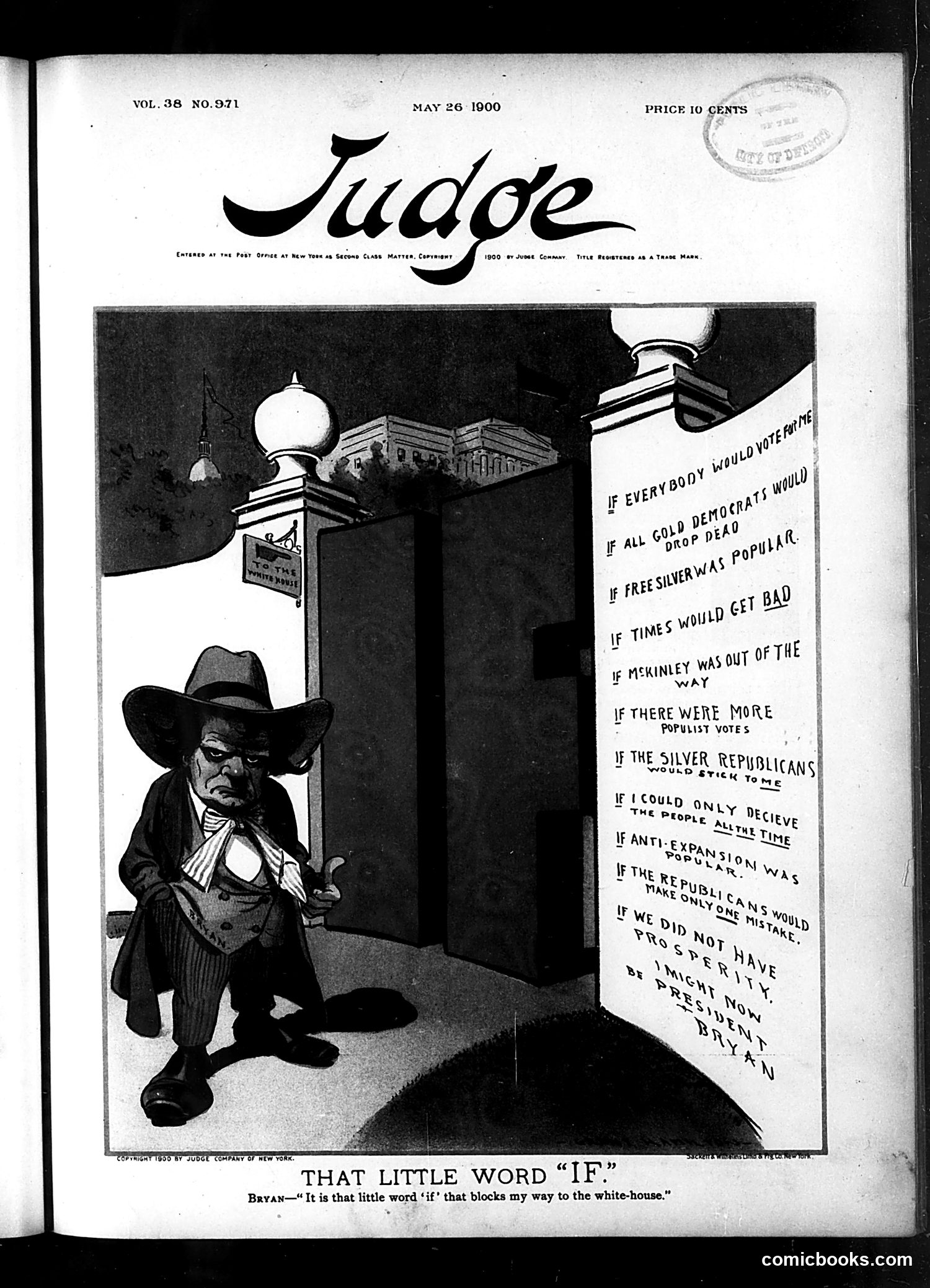
This 1900 *Judge* cartoon satirizes William Jennings Bryan's presidential ambitions. The caricatured figure (labeled Bryan) stands before a door marked "To the White House," blocked by a large word "IF" listed repeatedly with various political conditions. The satire mocks Bryan by suggesting his path to the presidency requires numerous improbable scenarios: if everyone voted for free silver, if Democrats united, if McKinley were defeated, if populist votes materialized, etc. Each conditional represents obstacles Bryan faced. The point: Bryan's election depends on so many unlikely "ifs" that it's practically impossible. The cartoon criticizes both Bryan's viability as a candidate and the fractured state of opposing political forces in 1900, the election year when McKinley (the incumbent Republican) ultimately defeated Bryan again.
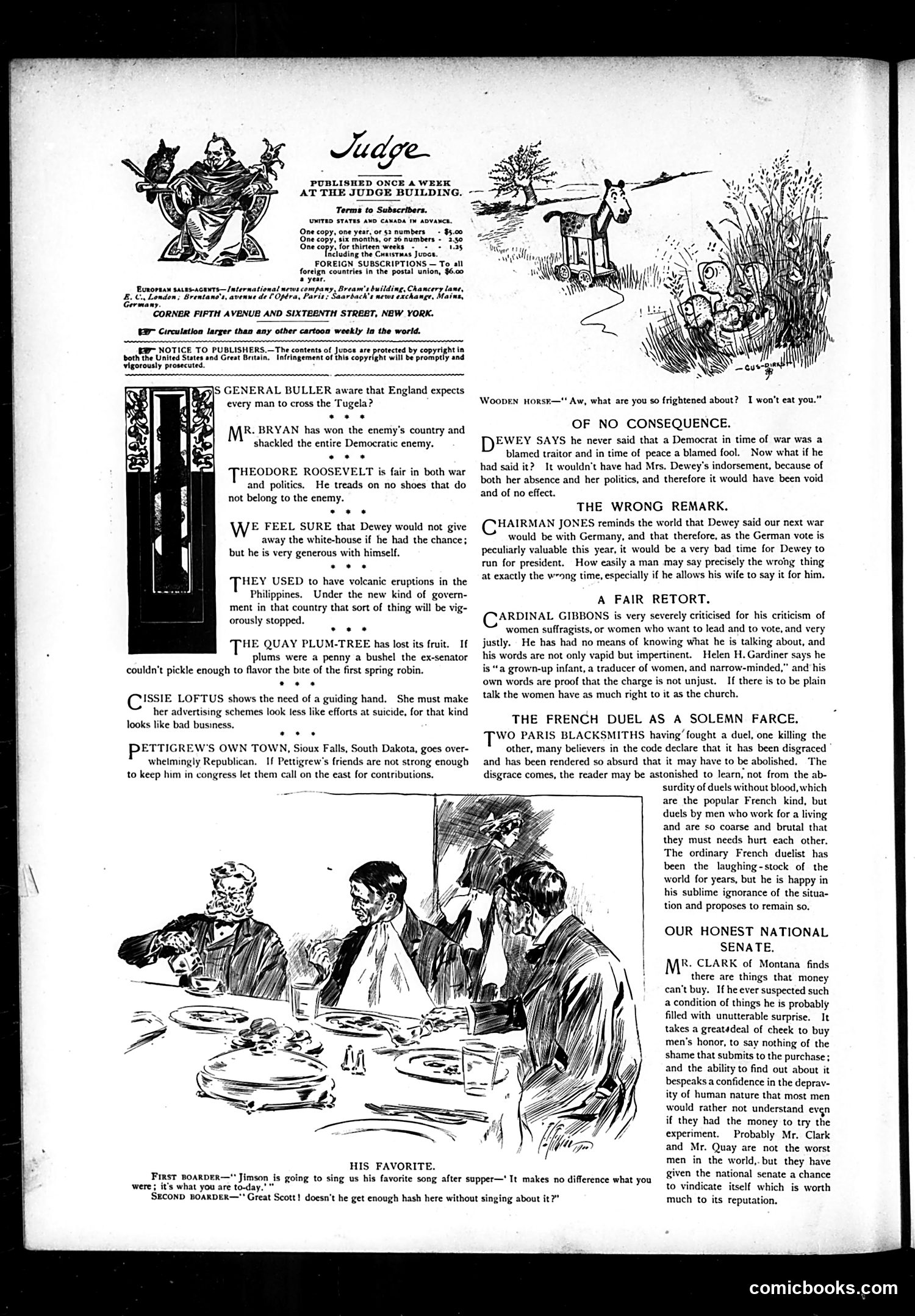
This page contains several political commentaries from early 20th-century America: **"General Buller Aware"** — References General Redvers Buller, a British commander, likely criticized for military failures (appears to relate to the Boer War era). **"Theodore Roosevelt"** — Praises Roosevelt's balanced approach to both war and politics, contrasting him favorably with other leaders. **"Dewey Says"** — Criticizes Democratic presidential candidate Dewey for calling war Democrats "traitors," arguing such rhetoric lacks practical consequences. **"Chairman Jones"** — Satirizes a political figure for suggesting Germany would prefer Dewey as president (possibly referencing 1944 election). **Lower cartoon** — Depicts three men at a dining table in what appears to be social satire, with accompanying dialogue about singing and hash (specific reference unclear). The overall tone reflects wartime political debate and partisan critique typical of American satirical journalism.
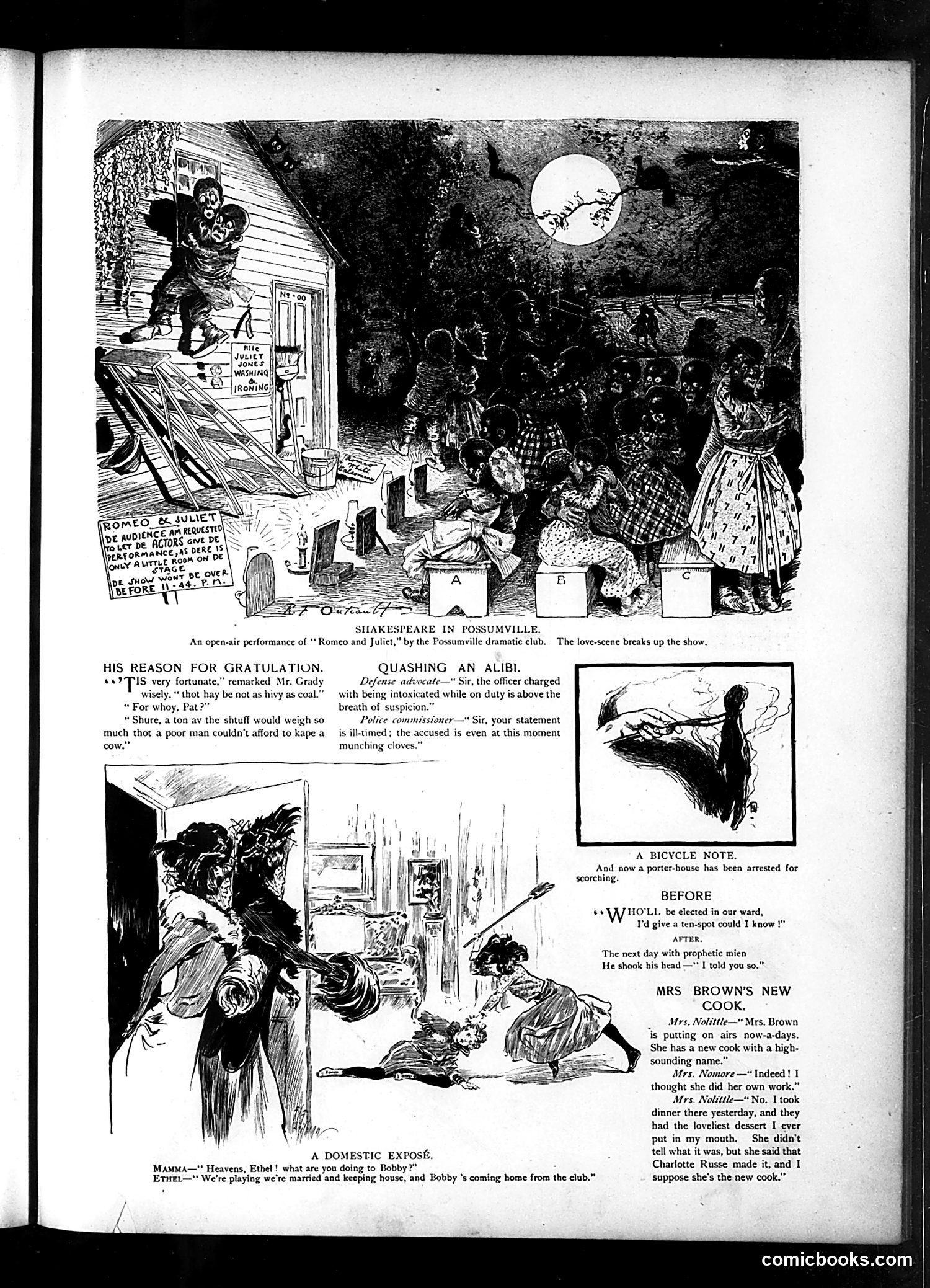
This page contains several unrelated satirical items typical of early 20th-century Judge magazine: 1. **"Shakespeare in Possum ville"** — An illustration mocking an amateur outdoor theatrical production of *Romeo and Juliet*, with the caption noting "the love-scene breaks up the show," suggesting the performance is chaotic or interrupted. 2. **"His Reason for Gratulation"** and **"Quashing an Alibi"** — Brief joke items about legal/police matters involving suspicious behavior and questionable testimony. 3. **"A Bicycle Note," "A Domestic Exposé," and "Mrs. Brown's New Cook"** — Short humorous anecdotes about everyday domestic and social situations. The page is primarily humor-focused rather than politically charged, reflecting Judge's mix of domestic comedy, social observation, and light satire of ordinary American life.
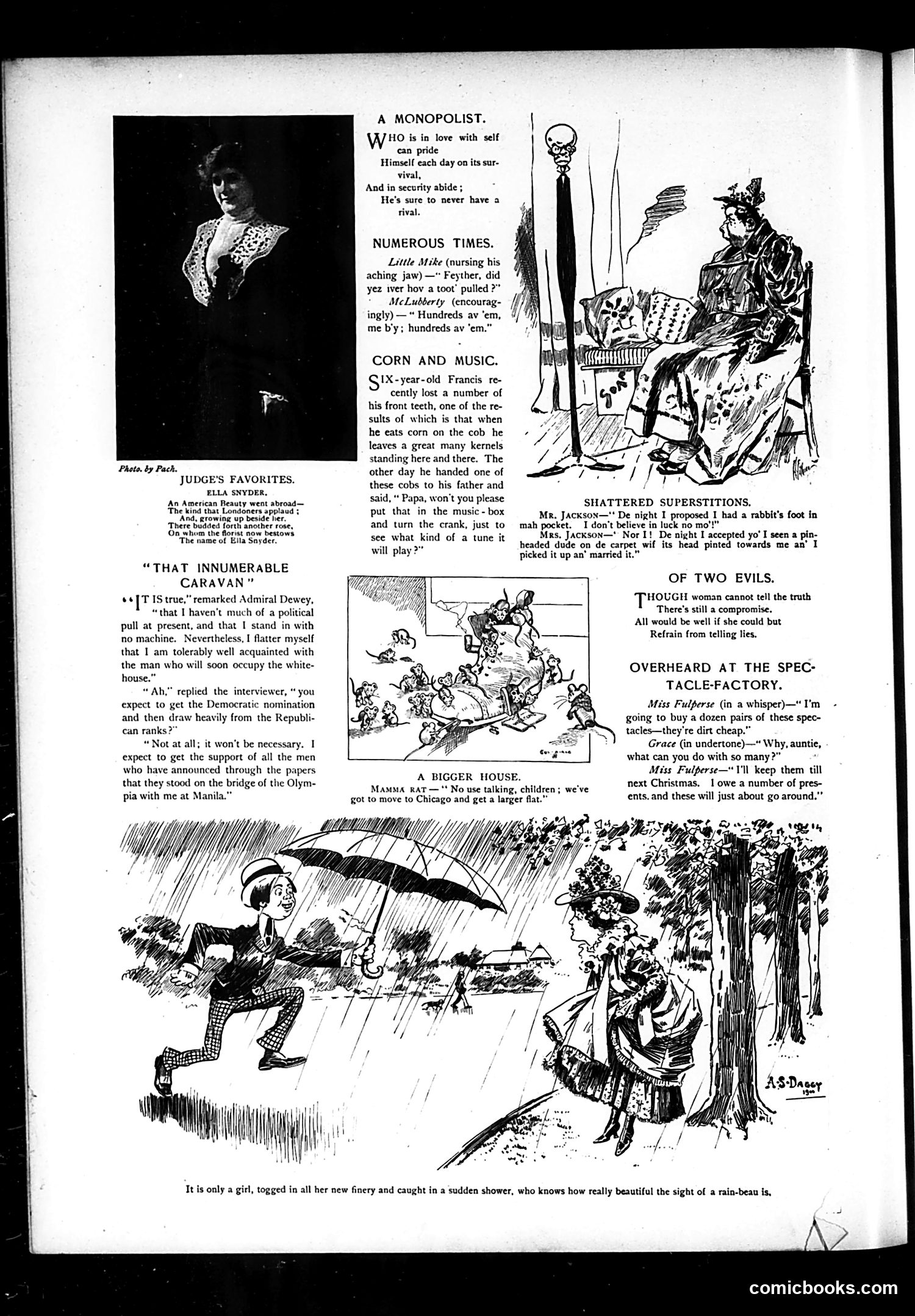
This page contains several satirical pieces typical of Judge magazine's humor: **"A Monopolist"** mocks self-satisfied wealthy individuals who believe themselves unrivaled. **"Corn and Music"** is a light anecdote about a child losing teeth and receiving a music box in exchange. **"That Innumerable Caravan"** features Admiral Dewey discussing political support, likely referencing the Spanish-American War hero's potential presidential ambitions. The satire suggests politicians exaggerate their backing. **"A Bigger House"** shows a family relocating to Chicago, humorously implying they need more space. **"Of Two Evils"** offers brief moral commentary about women's choices. **"Overheard at the Spectacle-Factory"** jokes about cheap eyeglasses. The large illustration depicts someone in rain with an umbrella—a visual gag about seeing beauty in unexpected situations. Overall, the page mixes political commentary with domestic humor typical of early 20th-century American satire.
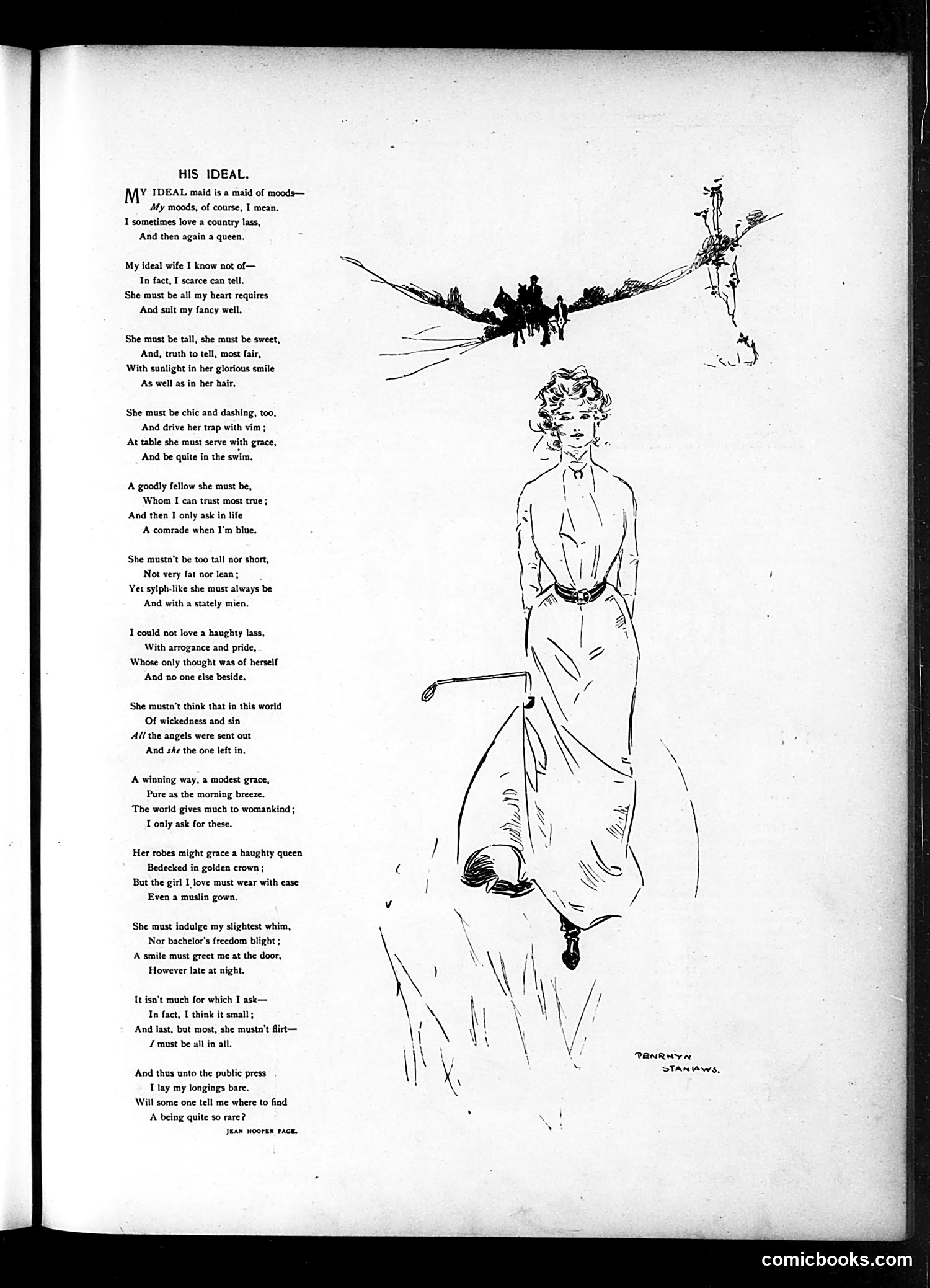
This poem satirizes male romantic ideals through exaggerated contradiction. The speaker catalogs an impossible list of female qualities: she must be both a "country lass" and a "queen," tall yet not too tall, sweet yet chic and dashing, modest yet graceful, capable yet subservient to his whims. The satire's punch arrives in the final stanzas: he demands she indulge his "slightest whim" without limiting his "bachelor's freedom," and crucially, "she mustn't flirt—I must be all in all." The closing plea to the "public press" to find "a being quite so rare" underscores the absurdity—no such woman exists. The accompanying sketch of an idealized woman reinforces this: she's the visual embodiment of impossible perfection. The cartoon mocks men's unrealistic, often contradictory expectations of women, particularly the demand for simultaneous independence and complete devotion. Credited to Jean Hooper Page, it critiques masculine entitlement and fantasy.
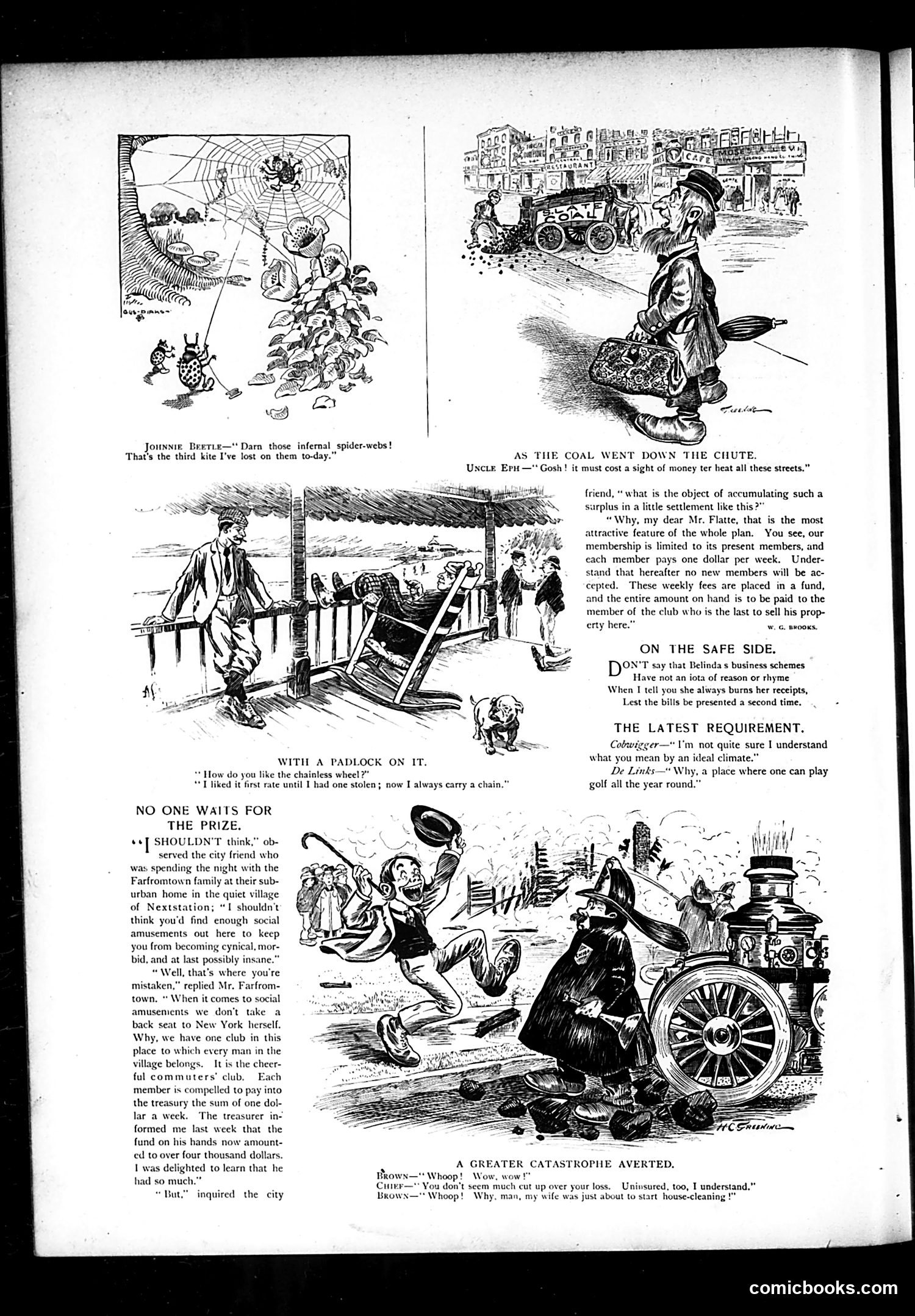
This page contains several social satires typical of early 20th-century humor magazines: **"No One Waits for the Prize"** (main story): Satirizes suburban commuter culture and get-rich-quick schemes. A village "Cheerful Commuters' Club" charges members $1 weekly, promising the accumulated fund to whoever sells their property last—a scheme with no real winner since someone must eventually leave. The satire mocks both suburban pretension and financial scheming disguised as community benefit. **Smaller cartoons** poke fun at: - Urban heating costs ("As the Coal Went Down the Chute") - Business women's questionable practices (burning receipts to avoid bills) - Golf obsession among the wealthy ("ideal climate") - An insurance misfortune narrowly avoided when house-cleaning plans prevent a loss The overall theme critiques American materialism, suburban aspirations, and dubious financial arrangements presented as legitimate community activities.
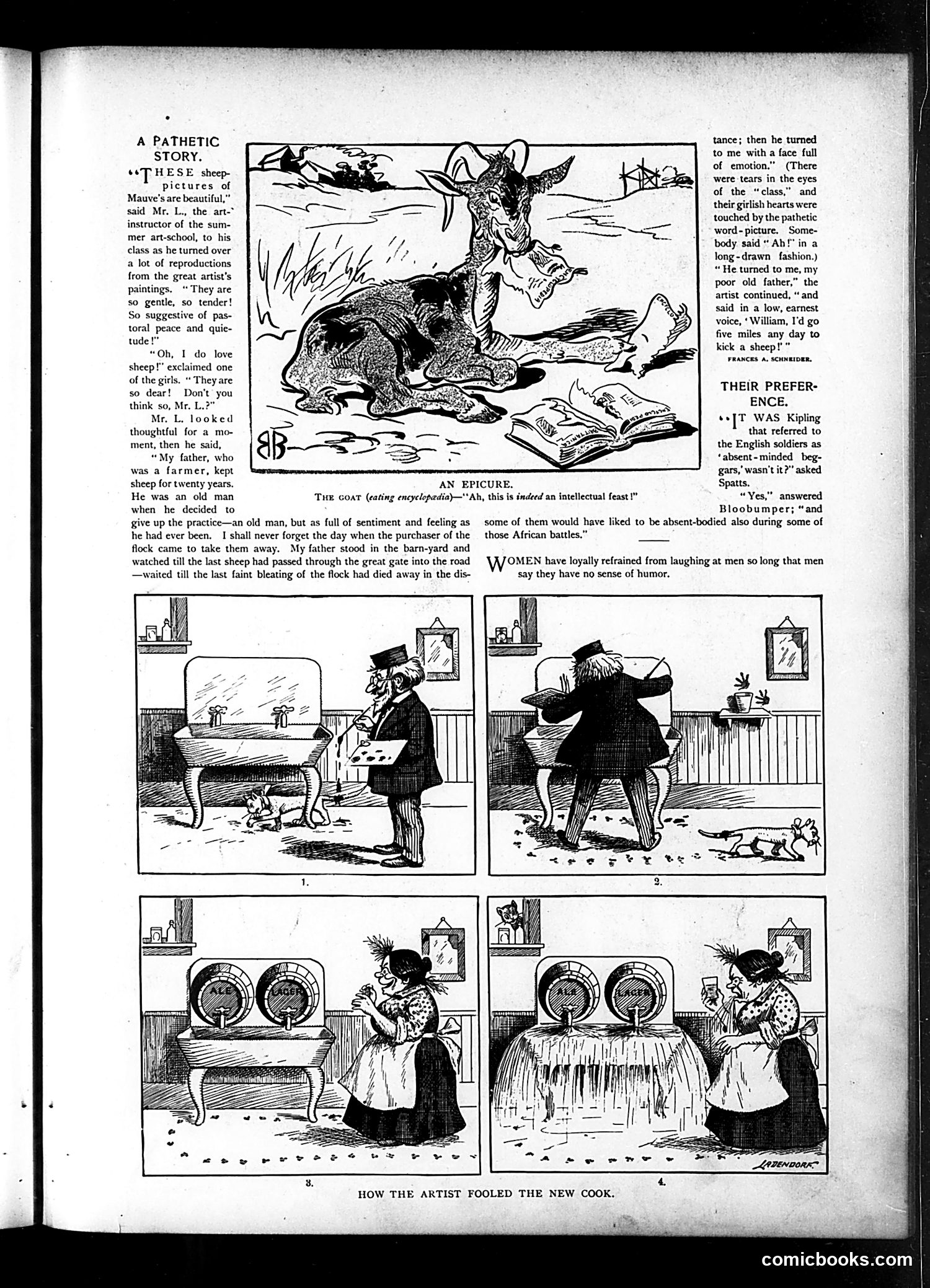
**"A Pathetic Story"** presents an art instructor moved to tears describing a sentimental sheep painting to his students. When asked if he loves sheep, one girl enthusiastically agrees—only for the instructor to reveal his farmer father kept sheep for twenty years before selling them off. The punchline: the instructor then callously states he'd "go five miles to kick a sheep," deflating the sentimentality entirely. The satire targets affected artistic emotion and the pretense of refined feeling. **"An Epicure"** shows a goat eating an encyclopedia, captioned as enjoying "an intellectual feast"—a straightforward joke about animals lacking discrimination. **"How the Artist Fooled the New Cook"** (four-panel comic, bottom) appears to depict someone (likely the artist character) playing a prank on a new cook using household items, though the specific trick remains visually unclear. The page's recurring theme mocks artistic pretension and sentimental affectation popular in the period.
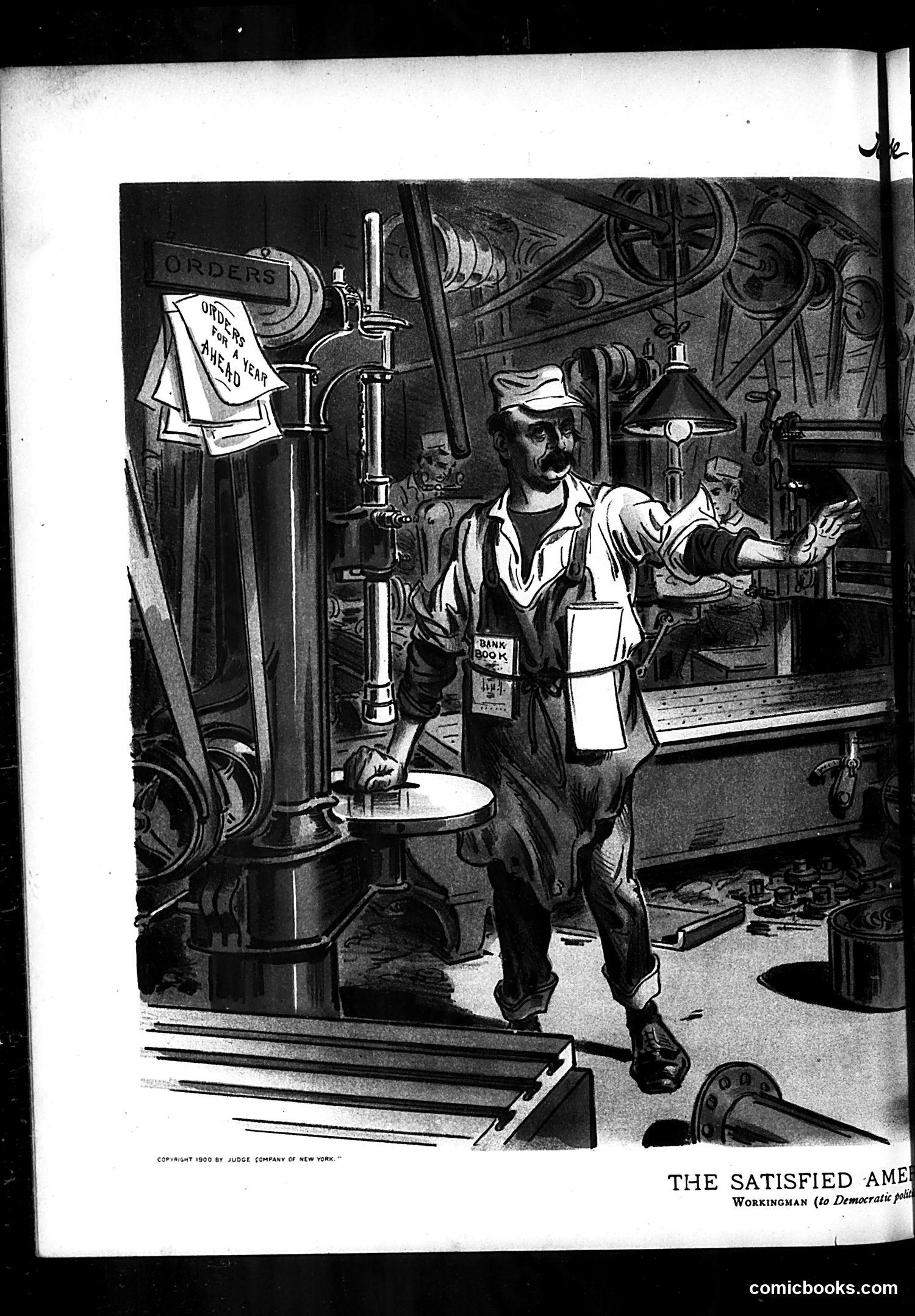
This appears to be a political cartoon titled "The Satisfied American Workingman" with a subtitle referencing Democratic policy. The image shows a factory worker in early 20th-century attire, standing confidently in an industrial setting filled with machinery, gears, and pulleys. A sign reading "ORDERS A YEAR AHEAD" suggests economic prosperity and job security. The cartoon's message is satirical praise for the working class under Democratic governance—suggesting that Democratic policies have created favorable conditions: steady employment, forward orders, and worker satisfaction. The industrial backdrop emphasizes manufacturing and labor. The "copyright 1903 by Judge Company of New York" indicates this relates to early-1900s Democratic political messaging about their economic record, likely promoting Democratic candidates by celebrating worker prosperity and confidence in the party's stewardship of American industry.
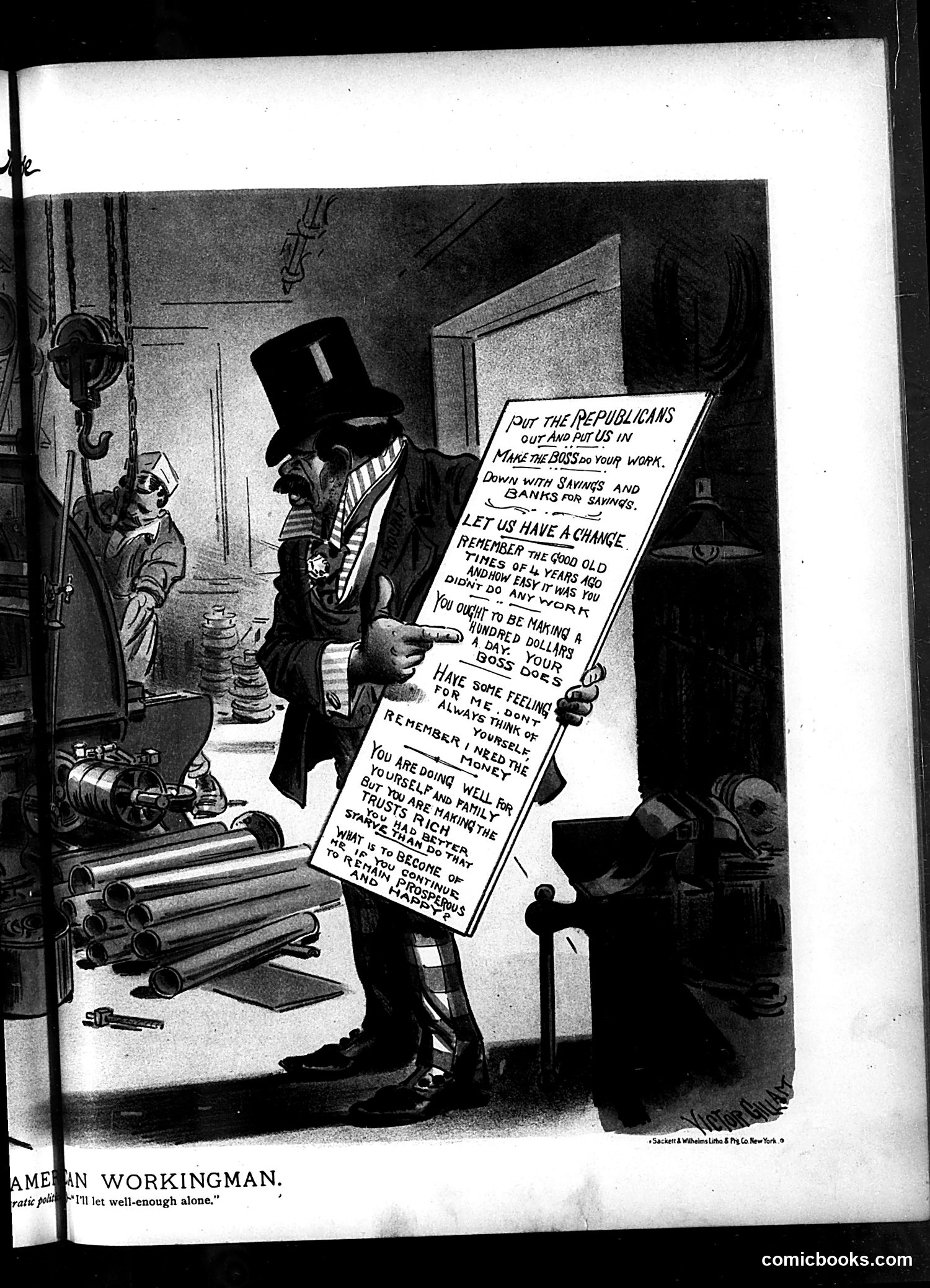
This Judge magazine cartoon satirizes Republican political messaging to working-class voters. A caricatured figure (representing a Republican politician or party representative) holds a lengthy placard addressing "the American workingman," urging him to "let well-enough alone" and vote Republican. The sign's text uses patronizing language, referencing past hardships ("good old times of a year ago") and dismissing workers' current grievances about wages and conditions. The factory setting with pipes and industrial equipment emphasizes this targets actual laborers. The satire suggests Republicans were cynically attempting to manipulate working-class voters by: - Minimizing their real economic struggles - Appealing to nostalgia rather than offering solutions - Asking workers to accept the status quo ("let well-enough alone") The exaggerated features and condescending tone mock what the cartoonist saw as dishonest political pandering during what appears to be an election cycle.
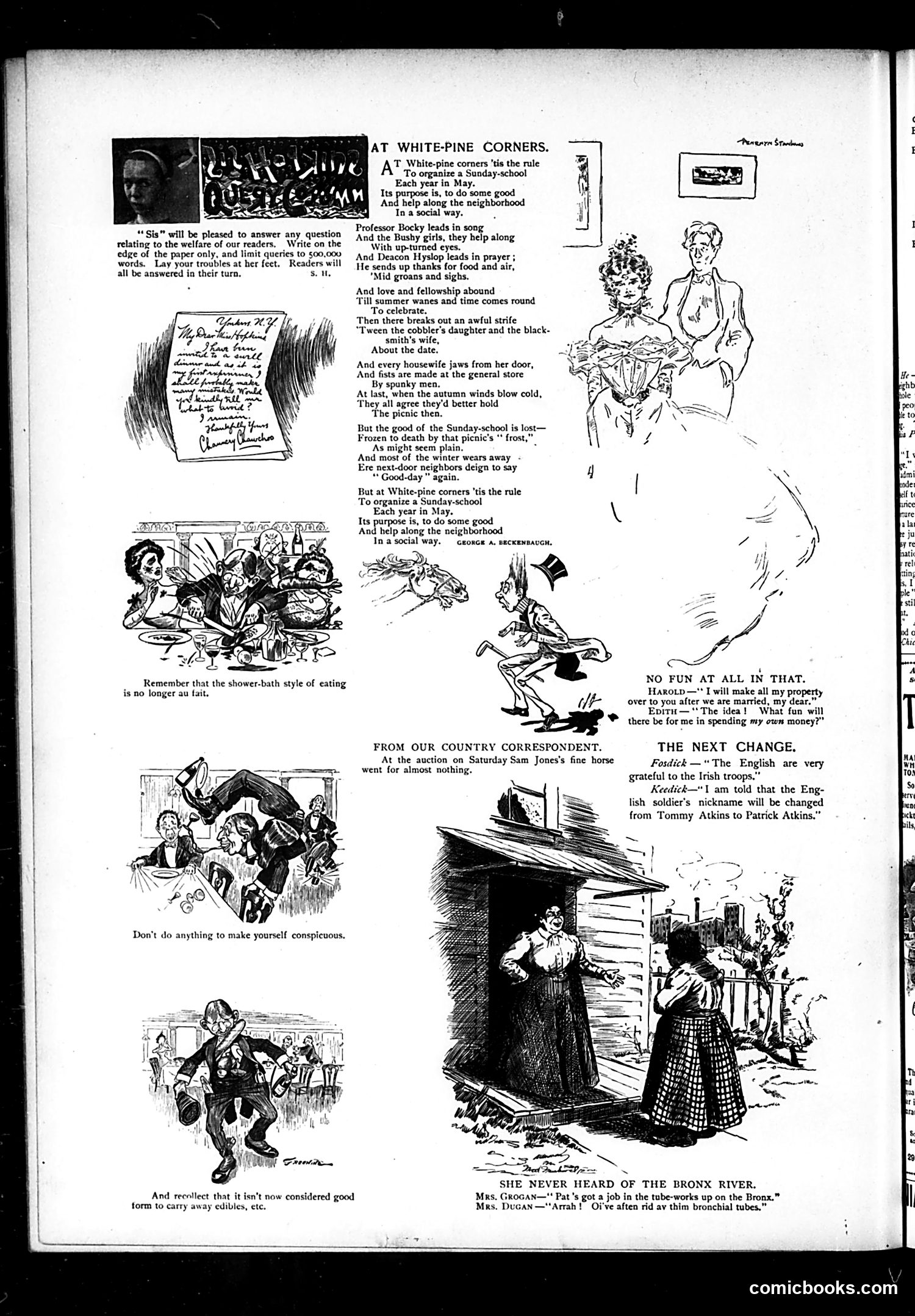
This page contains several satirical pieces typical of early 20th-century American humor: **"At White-Pine Corners"** is a rural comedy poem mocking small-town social dysfunction. A Sunday-school organizing committee descends into petty squabbling between the "cobbler's daughter and the blacksmith's wife" over picnic dates, causing neighborhood feuds that last all winter. The satire targets provincial pride and how minor disputes destroy community goodwill. **"The Next Change"** jokes about Irish soldiers in British service. The humor plays on the nickname shift from "Tommy Atkins" (British soldier slang) to "Patrick Atkins"—reflecting Irish recruitment into WWI forces, with ironic suggestion that Irish soldiers are now essential to the British military. **"She Never Heard of the Bronx River"** is a dialect joke where Mrs. Dugan misunderstands "tube-works" (subway construction) as "bronchial tubes" (lung passages). The humor derives from malapropism and working-class Irish immigrant speech patterns. The other cartoons mock social etiquette changes and romantic expectations around marriage contracts.
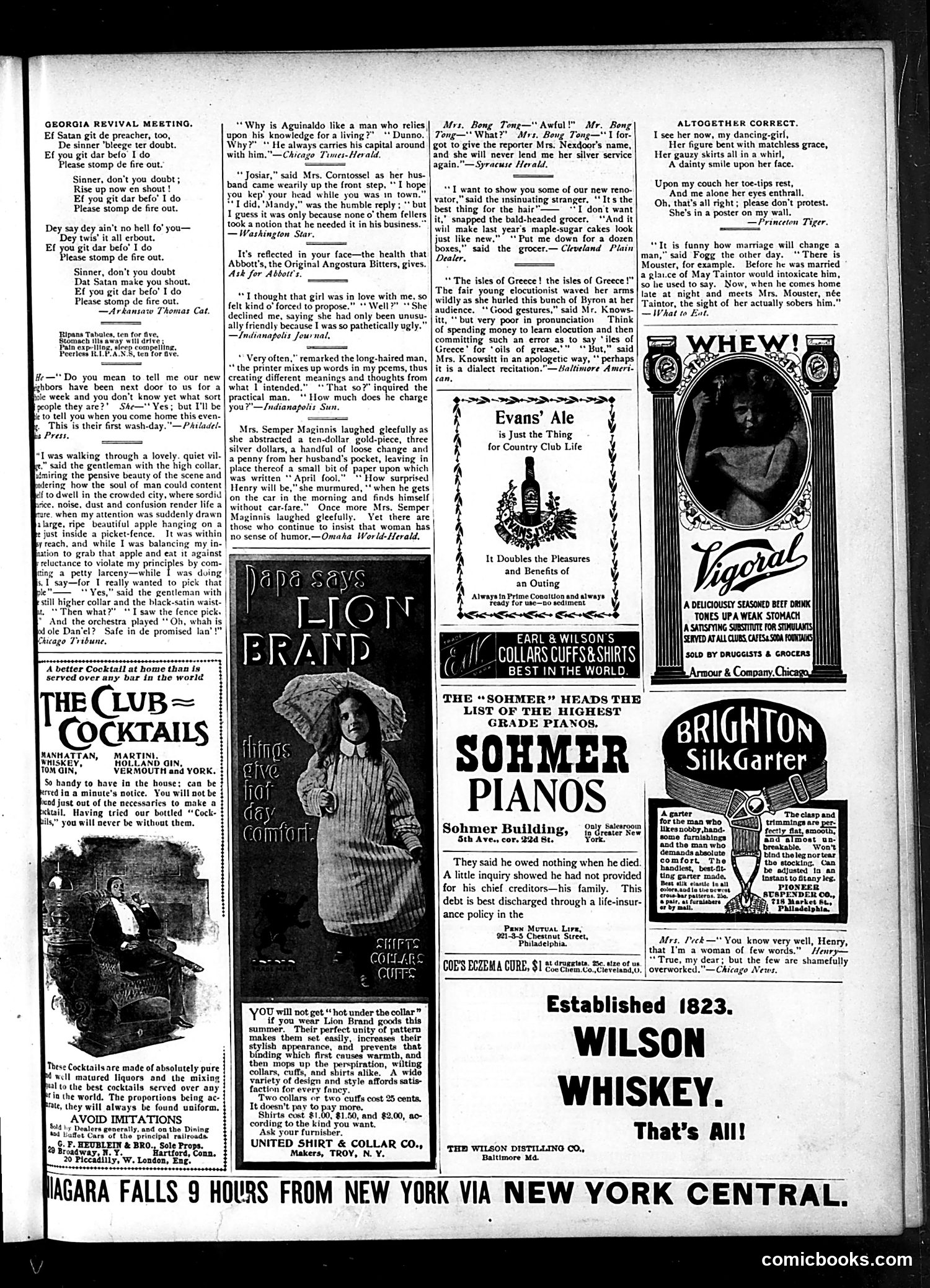
This page is primarily **advertising with minimal editorial content**. The dominant feature is a poem titled "Georgia Revival Meeting" in dialect, depicting a Black Southern religious service with repetitive calls to "stomp de fire out." The dialect humor reflects late 19th-century satirical conventions common to Judge magazine. The page is otherwise filled with commercial advertisements for alcohol (Wilson Whiskey, Evans' Ale, Vigoral beef drink), clothing (Lion Brand collars, Brighton Silk Garter), pianos (Sohmer), and patent medicines (Ripans Tabules, Abbott's Bitters). Small humorous anecdotes appear between ads—jokes about neighbors, rural apple-stealing, and household pranks. **Historical context:** This reflects Judge's typical format mixing light satire with consumer advertising. The dialect poem would have been considered entertainment by contemporary white audiences, though it reinforces period racial stereotypes. The advertisements reveal what products were marketed to middle-class readers of this era.
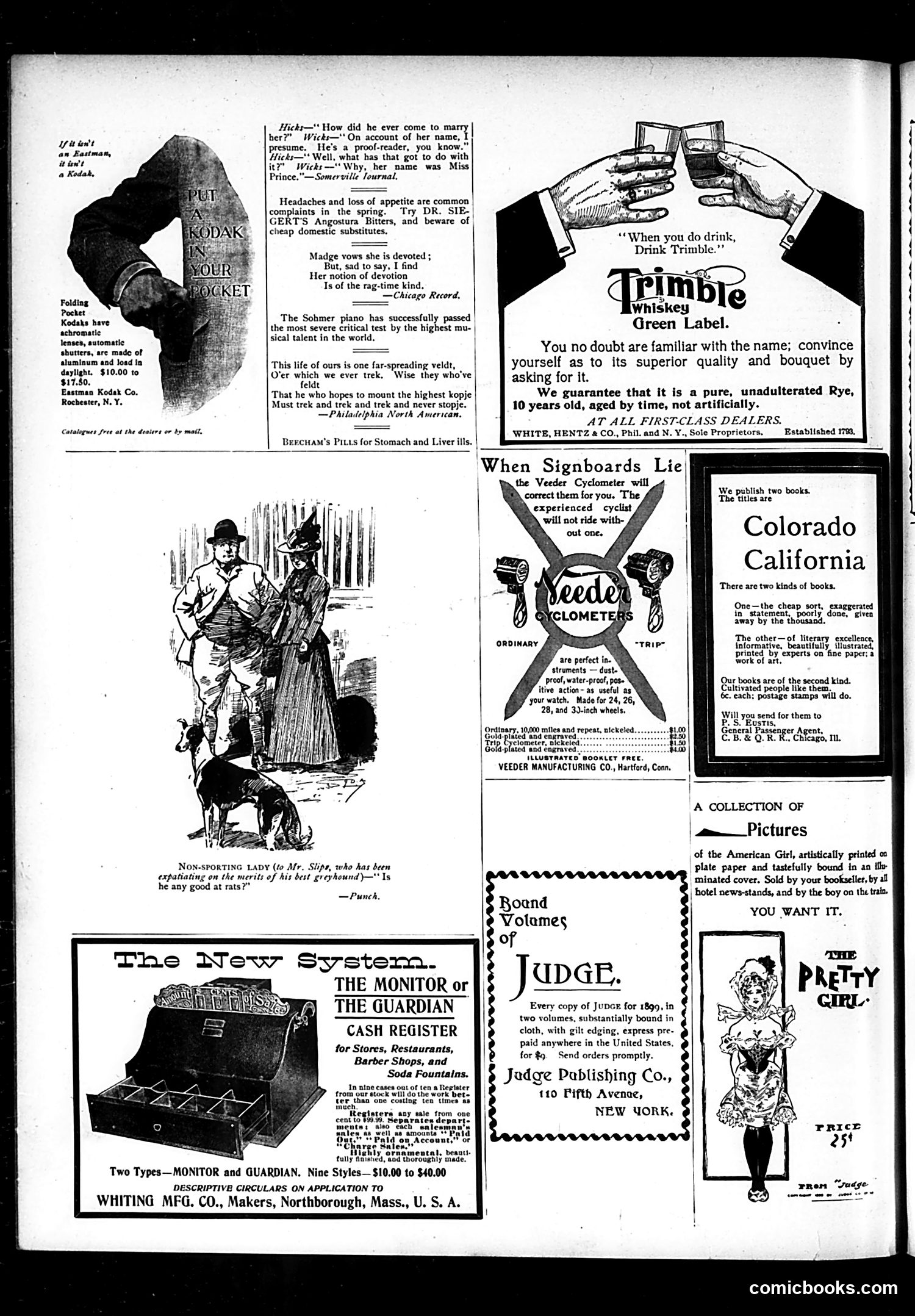
This is primarily an **advertising page** from Judge magazine, with one small cartoon joke. The sole humor content is a brief exchange ("Hicks" and "Wicks") about a man marrying a woman named Miss Prince. The joke: he's a proofreader, so he married her because her name lacked the letter "s"—a pun on "Prince" vs. "Prints." This is wordplay humor typical of early 1900s publications. The rest comprises advertisements for consumer products and services: Kodak cameras, patent medicines (Beecham's Pills, Angostura Bitters), pianos, cash registers, whiskey, cyclometers (bicycle odometers), and books. Several ads include decorative illustrations or small vignettes, but these are commercial rather than satirical. One illustration shows a non-sporting woman with a greyhound, accompanying text about the dog's racing abilities—likely advertising the breed's value. The page reflects Judge's dual function: satirical publication and advertising vehicle for late-Victorian American consumer goods.
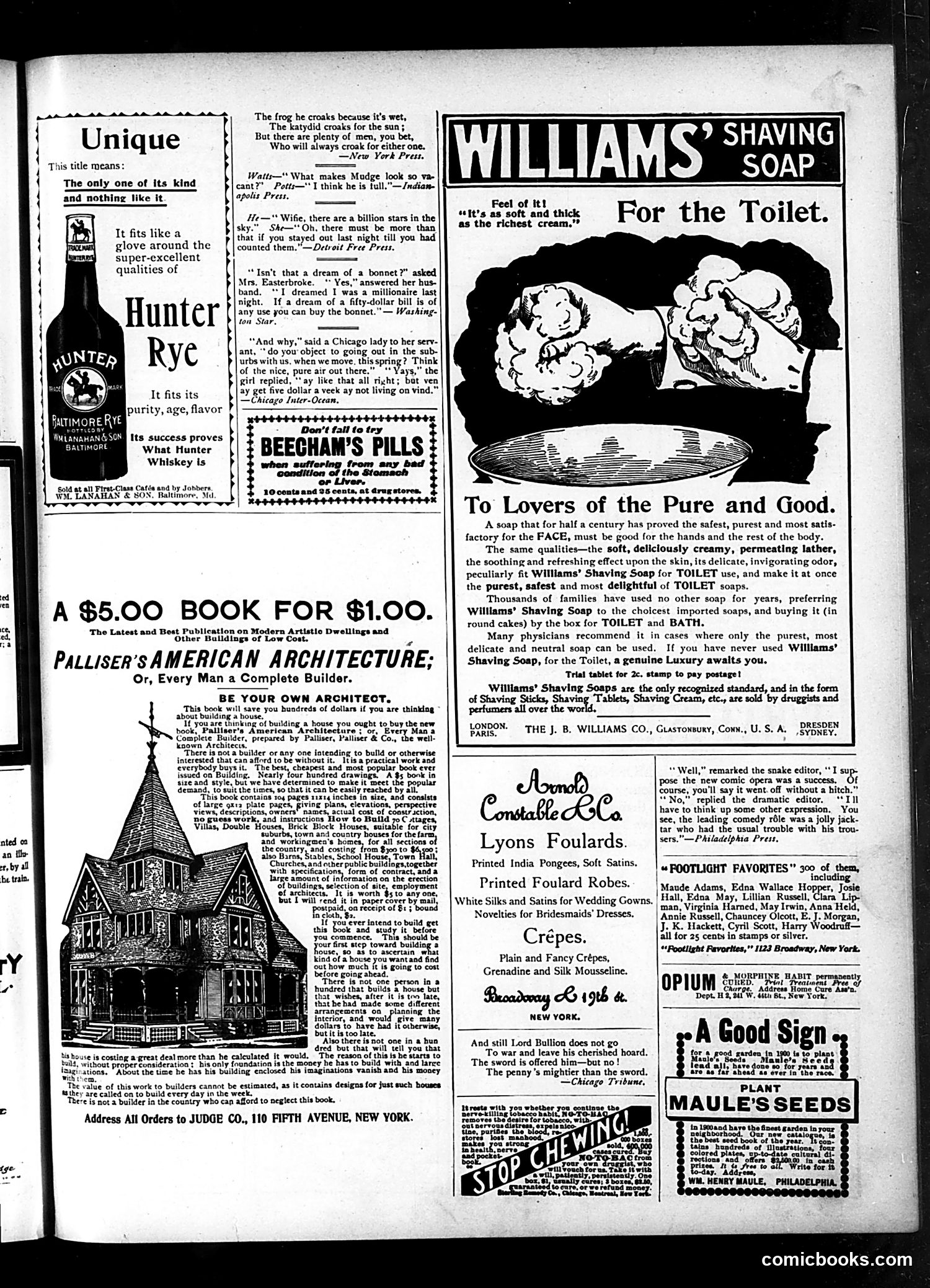
This page is **primarily advertising** with brief satirical humor pieces interspersed. The main content includes: **Humor Sections:** Short joke items ("Unique," "Hunter Rye") mock everyday situations—wives scolding husbands for staying out late, servants rejecting suburban moves for better wages, husbands unable to afford wives' bonnets. These reflect early 20th-century domestic tensions and economic disparities. **Advertisements:** Williams' Shaving Soap, Beecham's Pills, Maule's Seeds, and a prominent book advertisement for "Palliser's American Architecture" dominate the page. The architecture book ad appeals to aspiring homebuilders by promising to save money and provide practical designs—targeting working and middle-class readers. **No political cartoons or caricatures are visible** on this page. The satire is gentle and domestic, reflecting common social anxieties of the era: marital dynamics, class consciousness, and the aspirations of ordinary people to own homes. The page captures Judge's dual purpose: entertaining satirical commentary alongside profitable advertising revenue.
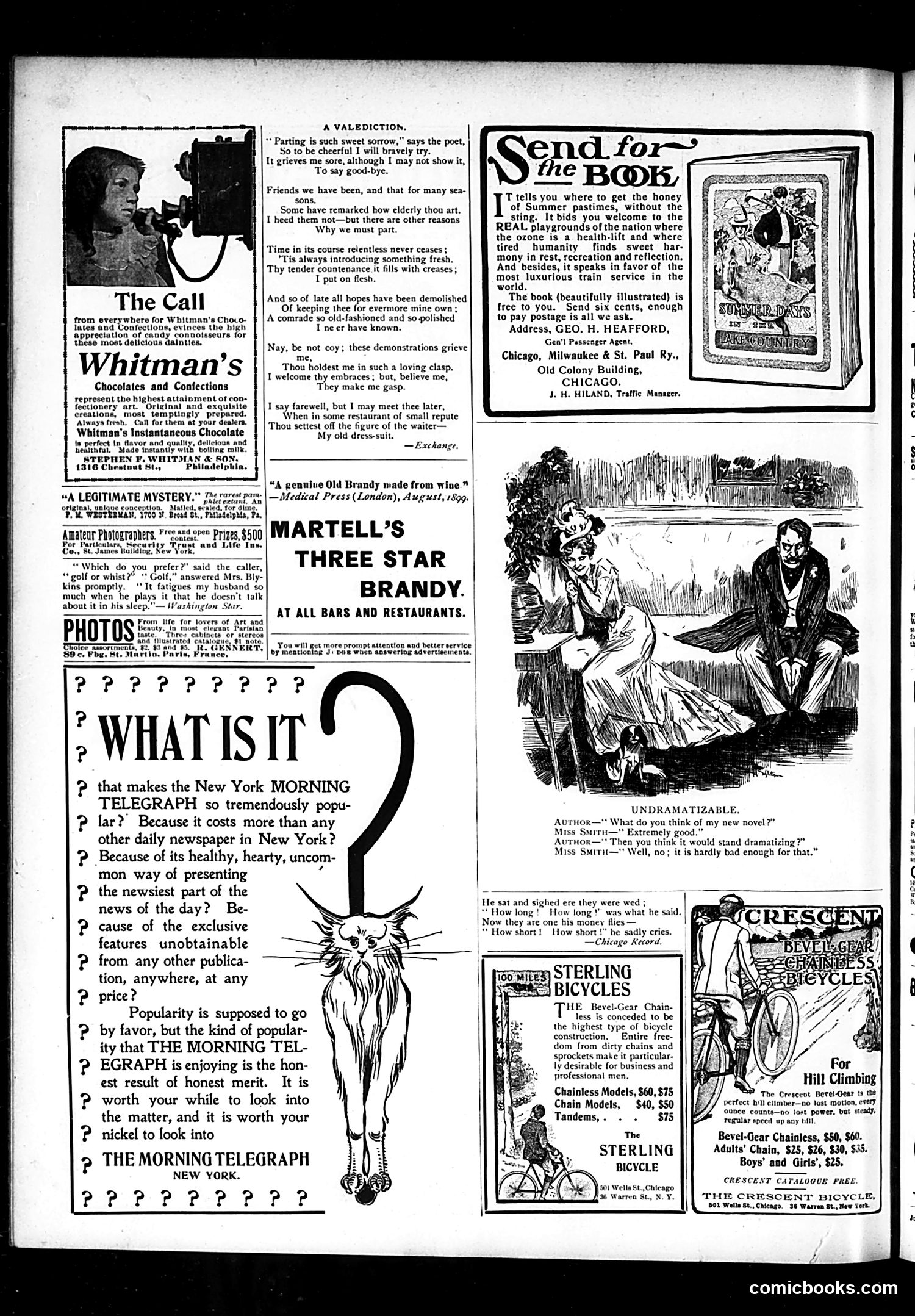
This page from *Judge* magazine is primarily **advertising and light satirical content**, not political cartooning. **Main Elements:** 1. **"A Valediction"** (top left): A humorous poem about parting with an old dress suit, personifying the garment as an aging companion. The joke: the suit is too worn and creased to wear anymore. 2. **"Undramatizable"** (center-right): A brief comic dialogue where an author asks if his novel could be dramatized for theater. The punchline mocks his own work—the critic says it's "hardly bad enough" for stage adaptation, suggesting even mediocre novels make better plays. 3. **Advertisements dominate**: Whitman's Chocolates, Martell's Brandy, Sterling Bicycles, Crescent bicycles, and the *New York Morning Telegraph* newspaper all feature prominent ads with illustrations. 4. **The large question mark figure** promotes the *Morning Telegraph*, listing reasons for its popularity (exclusive features, quality reporting). **Historical Context:** This reflects late-19th/early-20th-century magazine culture—*Judge* mixed satirical humor with substantial advertising revenue. The jokes are gentle, society-focused satire rather than political commentary.
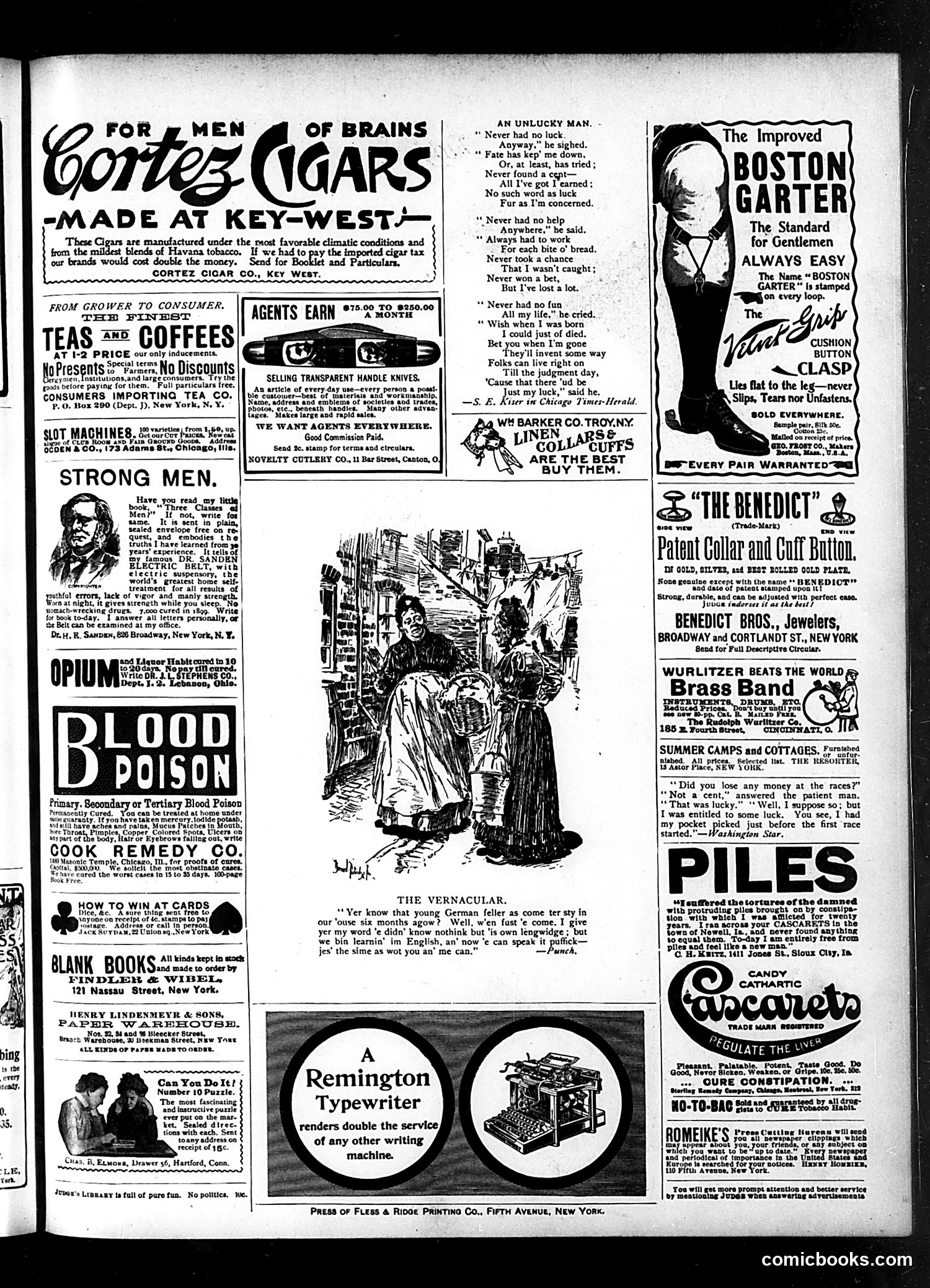
This page is primarily **advertisements and filler content**, typical of early 1900s magazines. Key items include: **The Main Cartoon** ("The Vernacular"): A dialect-humor piece mocking German immigrants' English acquisition. It presents stereotypical speech patterns to suggest a German lodger has learned colloquial English, playing on period xenophobia and class anxiety about immigrant assimilation. **Advertisements reflect era concerns:** - Patent medicines (opium cures, blood poison treatments, electric belts for male vitality) - Products targeting "weak" men and immigrant anxieties - A Remington typewriter ad **"An Unlucky Man" poem**: Uses working-class dialect to depict fatalism and resignation to poverty—common themes in Gilded Age humor about the laboring classes. **Social context**: These ads and cartoons reveal early 1900s anxieties: immigrant integration, masculine vigor fears, poverty acceptance, and "cure-all" medicine culture. The tone treats working-class speakers and immigrants as objects of comedic derision rather than dignity.
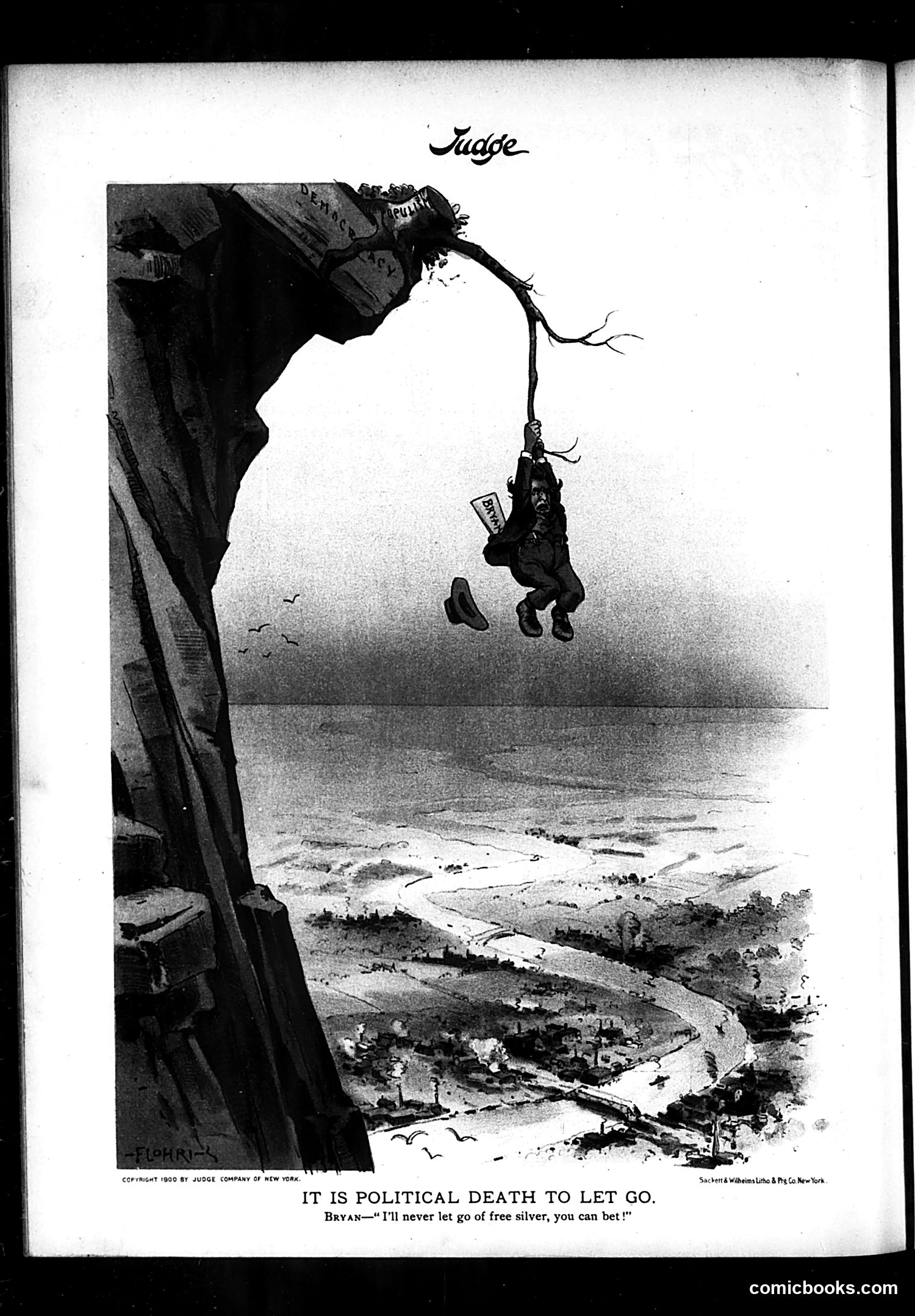
This 1900 Judge cartoon depicts William Jennings Bryan clinging to a vine labeled "free silver" while dangling over a vast landscape far below. The caption quotes Bryan insisting he'll never abandon free silver policy. The satire criticizes Bryan's stubborn commitment to free silver—a monetary policy advocating unlimited coining of silver—which had become politically toxic. The cartoon suggests that Bryan's refusal to "let go" of this failed platform dooms him politically (hence "political death"), yet he clings regardless, unable to change course despite the perilous consequences shown by the dizzying drop beneath him. The image mocks Bryan's inflexibility and suggests his political career hangs by a thread due to his dogmatic adherence to an unpopular policy position.