
Judge, 1900-05-26 · page 2 of 16
Judge — May 26, 1900 — page 2: what you’re looking at
What you’re looking at
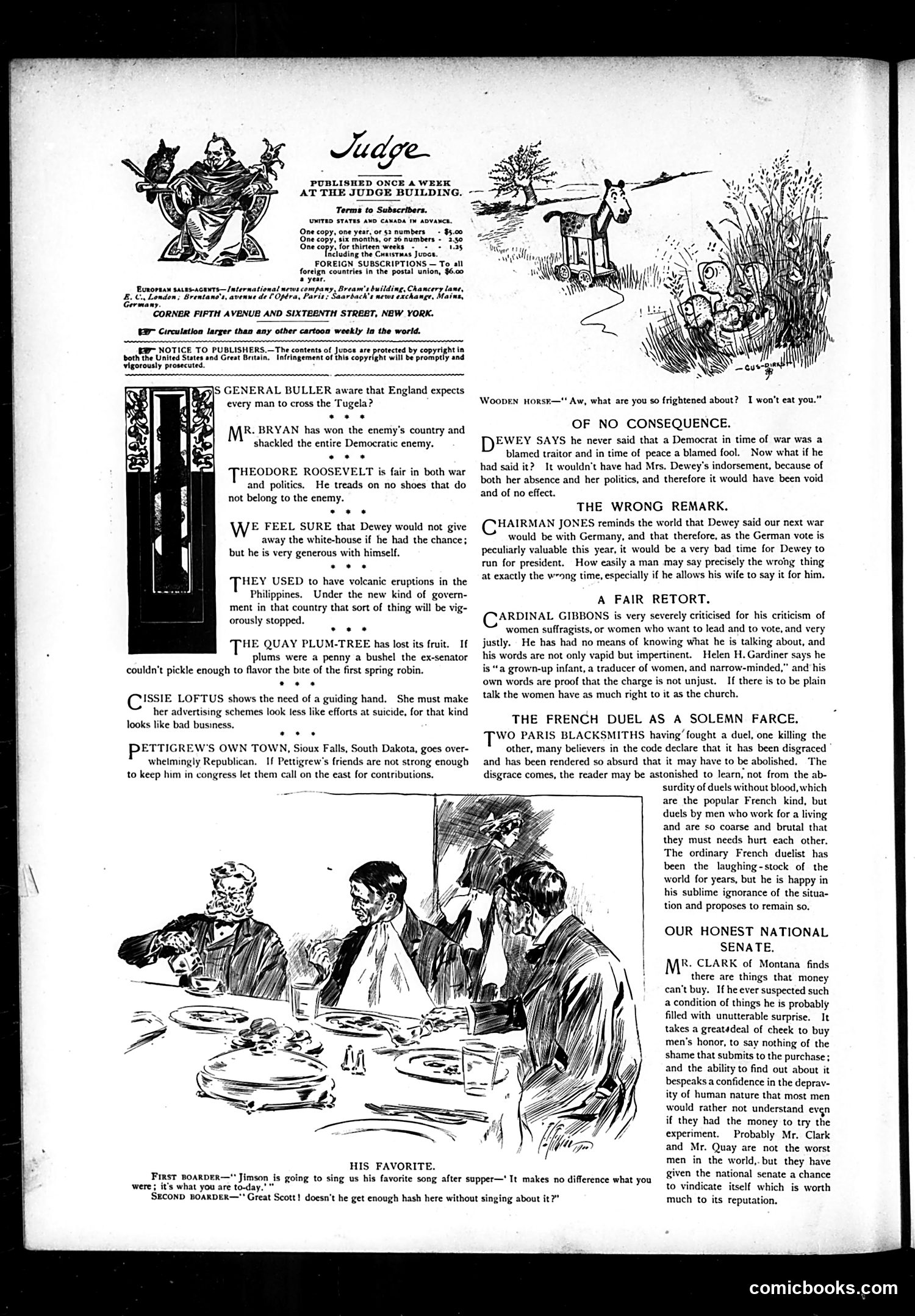
This page contains several political commentaries from early 20th-century America: **"General Buller Aware"** — References General Redvers Buller, a British commander, likely criticized for military failures (appears to relate to the Boer War era). **"Theodore Roosevelt"** — Praises Roosevelt's balanced approach to both war and politics, contrasting him favorably with other leaders. **"Dewey Says"** — Criticizes Democratic presidential candidate Dewey for calling war Democrats "traitors," arguing such rhetoric lacks practical consequences. **"Chairman Jones"** — Satirizes a political figure for suggesting Germany would prefer Dewey as president (possibly referencing 1944 election). **Lower cartoon** — Depicts three men at a dining table in what appears to be social satire, with accompanying dialogue about singing and hash (specific reference unclear). The overall tone reflects wartime political debate and partisan critique typical of American satirical journalism.
📄 Transcribed text from this page (OCR, searchable)
Machine-transcribed from the original scan — historical spelling and the odd misread are preserved.
PUBLISHED ONCE A WEEK AT THE JUDGE BUILDIN' Terms to Subscribers. UNITED STATES AND CANADA IH ADVANCE. One copy, one year, or $2 numbers Qne copy, six mor ‘One copy, for thirteen weeks - Including the Cuaistaas Juoce. FOREIGN SUBSCRIPTIONS — To all foreign countries in the postal union, $6.00 a year. Eurortan sass-acents—/nternational meres company, Bream’s building, Chancery lane, B, Ca London; Brentanss, avenue del Opéra, Paris; Saarbach's news exchange, Main, many. CORNER FIFTH AVENUE AND SIXTEENTH STREET, NEW YORK. (7 Circulation larger than any other cartoon weekly Ia the world. EW NOTICE TO PUBLISHERS.—The contents of Juoce are protected by copyright in both the United States and Great Britain, Infringement of this copyright will be promptly and vigorously prosecut 9S GENERAL BULLER aware that England expects every man to cross the Tugela? R. BRYAN has won the enemy's country and shackled the entire Democratic enemy. eee THEODORE ROOSEVELT is fair in both war and politics. He treads on no shoes that do not belong to the enemy. WE FEEL SURE that Dewey would not give away the white-house if he had the chance; but he is very generous with himself. eee THEY USED to have volcanic eruptions in the Philippines. Under the new kind of govern- ment in that country that sort of thing will be vig- orously stopped. HE QUAY PLUM-TREE has lost its fruit. If plums were a penny a bushel the ex-senator couldn't pickle enough to flavor the bite of the first spring robin. ISSIE LOFTUS shows the need of a guiding hand, She must make her advertising schemes look tess like efforts at suicide, for that kind looks like bad business. eee PETTIGREW'S OWN TOWN, Sioux Falls, South Dakota, goes over- whelmingly Republican. If Pettigrew’s friends are not strong enough to keep him in congress let them call on the east for contributions. Woopen Horsk—'* Aw, what are you so frightened about? I won't eat you.” OF NO CONSEQUENCE. EWEY SAYS he never said that a Democrat in time of war was a blamed traitor and in time of peace a blamed fool. Now what if he had said it? It wouldn't have had Mrs. Dewey's indorsement, because of both her absence and her politics, and therefore it would have been void and of no effect. THE WRONG REMARK. CHAIRMAN JONES reminds the world that Dewey said our next war would be with Germany, and that therefore, as the German vote is peculiarly valuable this year, it would be a very bad time for Dewey to run for president. How easily a man may say precisely the wrong thing at exactly the wrang time, especially if he allows his wife to say it for him. A FAIR RETORT. CARDINAL GIBBONS is very severely criticised for his criticism of women suffragists, or women who want to lead and to vote, and very justly. He has had no means of knowing what he is talking about, and his words are not only vapid but impertinent. Helen H. Gardiner says he is “a grown-up infant, a traducer of women, and narrow-minded,” and his own words are proof that the charge is not unjust. If there is to be plain talk the women have as much right to it as the church. THE FRENCH DUEL AS A SOLEMN FARCE, WO PARIS BLACKSMITHS having’ fought a duel, one killing the other, many believers in the code declare that it has been disgraced and has been rendered so absurd that it may have to be abolished. The disgrace comes, the reader may be astonished to learn, not from the ab- surdity of duels without blood, which HIS FAVORITE. First RoARDER—" Jimson are the popular French kind, but duels by men who work for a living and are so coarse and brutal that they must needs hurt each other. The ordinary French duelist has been the laughing-stock of the world for years, but he is happy in his sublime ignorance of the situa- tion and proposes to remain so. OUR HONEST NATIONAL SENATE, M®- CLARK of Montana finds there are things that money can’t buy. If he ever suspected such a condition of things he is probably filled with unutterable surprise. It takes a greatédeal of cheek to buy men’s honor, to say nothing of the shame that submits to the purchase; and the ability to find out about it bespeaks a confidence in the deprav- ity of human nature that most men would rather not understand evgn if they had the money to try the experiment. Probably Mr. Clark and Mr. Quay are not the worst men in the world,.but they have given the national senate a chance to vindicate itself which is worth much to its reputation, RS is going to sing us his favorite song after supper—' It makes no difference what you were; it’s what you are to-day,’ SECOND BOARDER—"* Great Scott! doesn’t he get enough hash here without singing about it?” comicbooks.com