
Judge, 1900-05-26 · page 4 of 16
Judge — May 26, 1900 — page 4: what you’re looking at
What you’re looking at
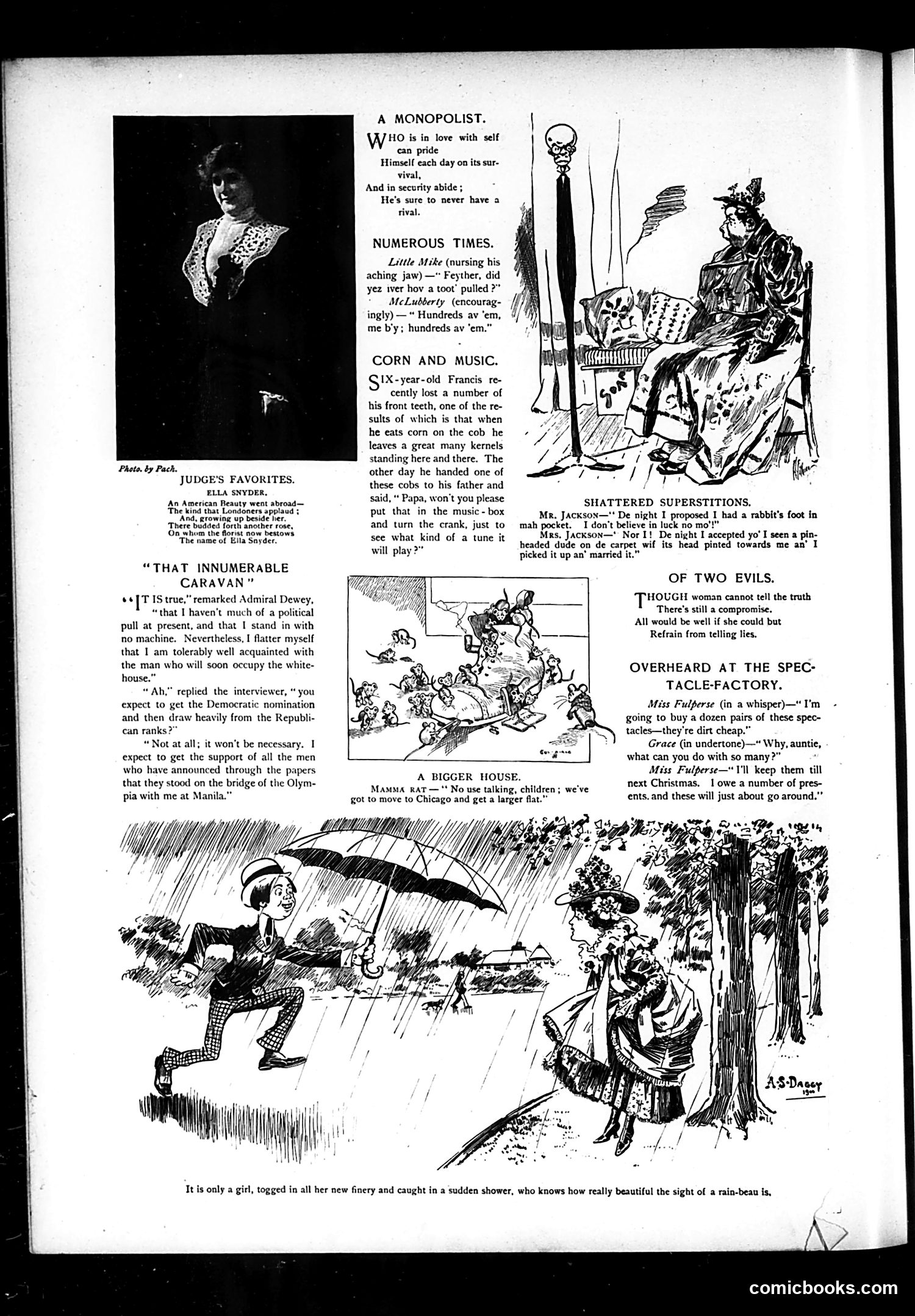
This page contains several satirical pieces typical of Judge magazine's humor: **"A Monopolist"** mocks self-satisfied wealthy individuals who believe themselves unrivaled. **"Corn and Music"** is a light anecdote about a child losing teeth and receiving a music box in exchange. **"That Innumerable Caravan"** features Admiral Dewey discussing political support, likely referencing the Spanish-American War hero's potential presidential ambitions. The satire suggests politicians exaggerate their backing. **"A Bigger House"** shows a family relocating to Chicago, humorously implying they need more space. **"Of Two Evils"** offers brief moral commentary about women's choices. **"Overheard at the Spectacle-Factory"** jokes about cheap eyeglasses. The large illustration depicts someone in rain with an umbrella—a visual gag about seeing beauty in unexpected situations. Overall, the page mixes political commentary with domestic humor typical of early 20th-century American satire.
📄 Transcribed text from this page (OCR, searchable)
Machine-transcribed from the original scan — historical spelling and the odd misread are preserved.
Photo, by Pach. JUDG! FAVORITES. ELLA SNYDER, ‘An American Beauty went abroad— ‘The kind that Londoners applaud ; And, growing up beside her. ‘There budded forth another rose, On whom the florist now bestows ‘The name of Ella Sayder. “THAT INNUMERABLE CARAVAN” +4] T IS true,” remarked Admiral Dewey, “that I haven't much of a political pull at present, and that I stand in with no machine. Nevertheless, I flatter myself that I am tolerably well acquainted with the man who will soon occupy the white- house.” “Ah,” replied the interviewer, “ you expect to get the Democratic nomination and then draw heavily from the Republi- can ranks?” “Not at all; it won't be necessary. I expect to get the support of all the men who have announced through the papers that they stood on the bridge of the Olym- pia with me at Manila.” Mi A MONOPOLIST. HO is in love with self can pride Himself each day on its sur- vival, And in security abide ; He's sure to never have a rival. NUMEROUS TIMES. Little Mike (nursing his aching jaw) —" Feyther, did yez iver hov a toot’ pulled 2” McLubberty (encourag- ingly) —“ Hundreds av ‘em, me b’y; hundreds av “em.” CORN AND MUSIC, G!X- year-old Francis. re- cently lost a number of his front teeth, one of the re- sults of which is that when he eats corn on the cob he leaves a great many kernels standing here and there. The other day he handed one of these cobs to his father and said, “* Papa, won't you please put that in the music -box and turn the crank, just to mah pocket. see what kind of a tune it SHATTERED SUPERSTITIONS. Mr. Jacksox—"' De night I proposed I had a rabbit's foot in T don't believe in luck no mo'!" Mrs, Jackson—' Nor I! De night I accepted yo" I seen a pin- “al play?" headed dude on de carpet wif its head pinted towards me an’ I will play? picked it up an’ married it.” A BIGGER HOUSE. Mamaia RAT —‘* No use talking, children ; we've got to move to Chicago and get a larger flat.” LMM, OF TWO EVILS. HOUGH woman cannot tell the truth There's still a compromise. All would be well if she could but Refrain from telling lies. OVERHEARD AT THE SPEC- TACLE-FACTORY. Miss Fulperse (in a whisper)—" I'm going to buy a dozen pairs of these spec- tacles—they're dirt cheap.” Grace (in undertone)—“ Why, auntie, what can you do with so many?” Miss Fulperse—“Vl keep them till next Christmas, 1 owe a number of pres- ents. and these will just about go around.”’ comicbooks.com