
A complete issue · 20 pages · 1900
Judge — March 17, 1900
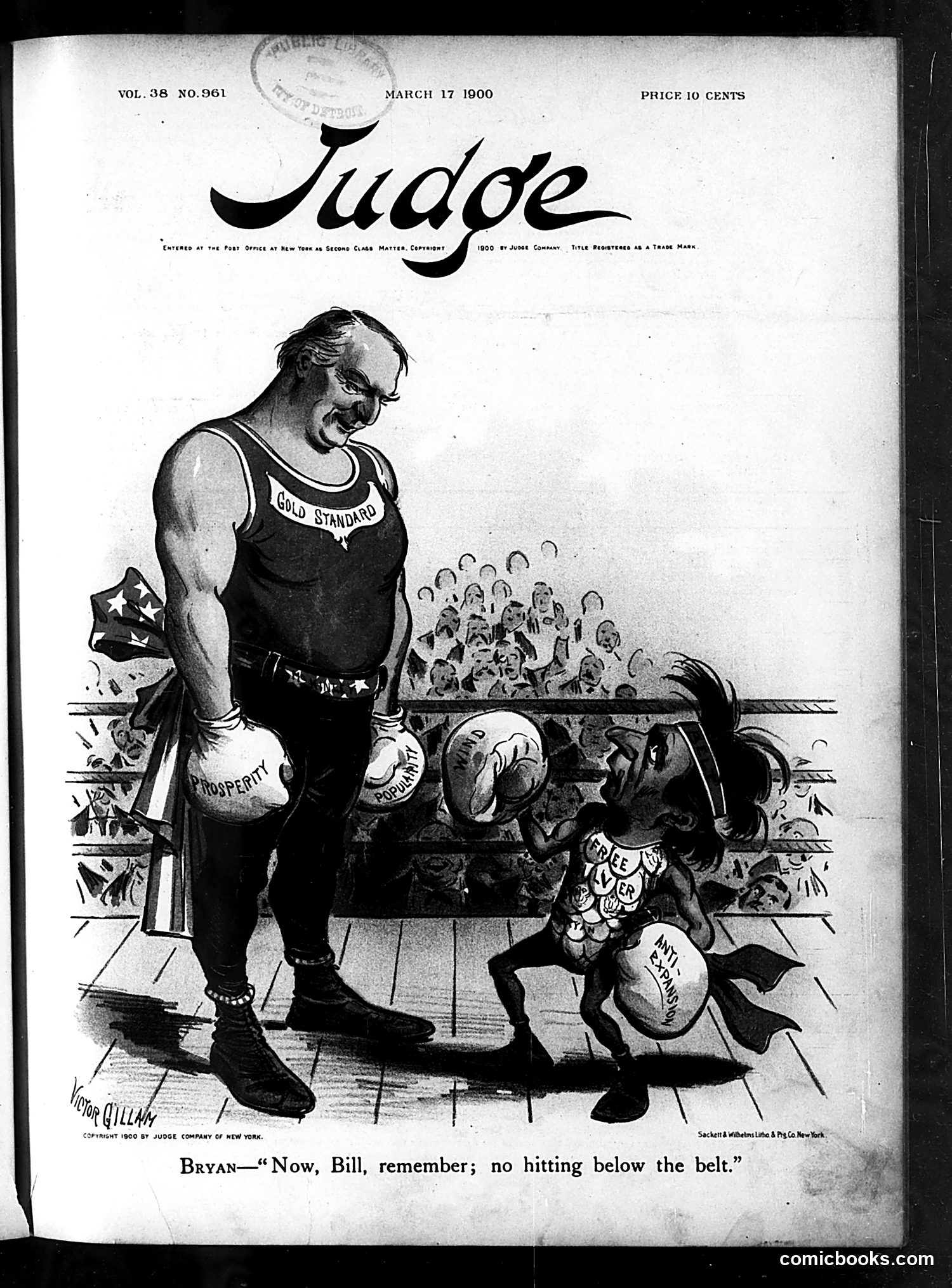
This cartoon depicts a boxing match scenario with satirical political meaning. A large man labeled "Gold Standard" (wearing glasses) instructs a smaller opponent labeled "Bill" (likely William Jennings Bryan, the Democratic politician who opposed the gold standard) with the caption: "Now, Bill, remember; no hitting below the belt." The cartoon mocks Bryan's political stance on monetary policy. The spectators visible in the background suggest public interest in this political "fight." The boxing ring metaphor represents the political debate of 1900, when the gold standard versus free silver coinage was a major campaign issue. The satire suggests that Bryan should follow gentlemanly rules while fighting an inherently powerful establishment position, implying his challenge is futile or unfair.
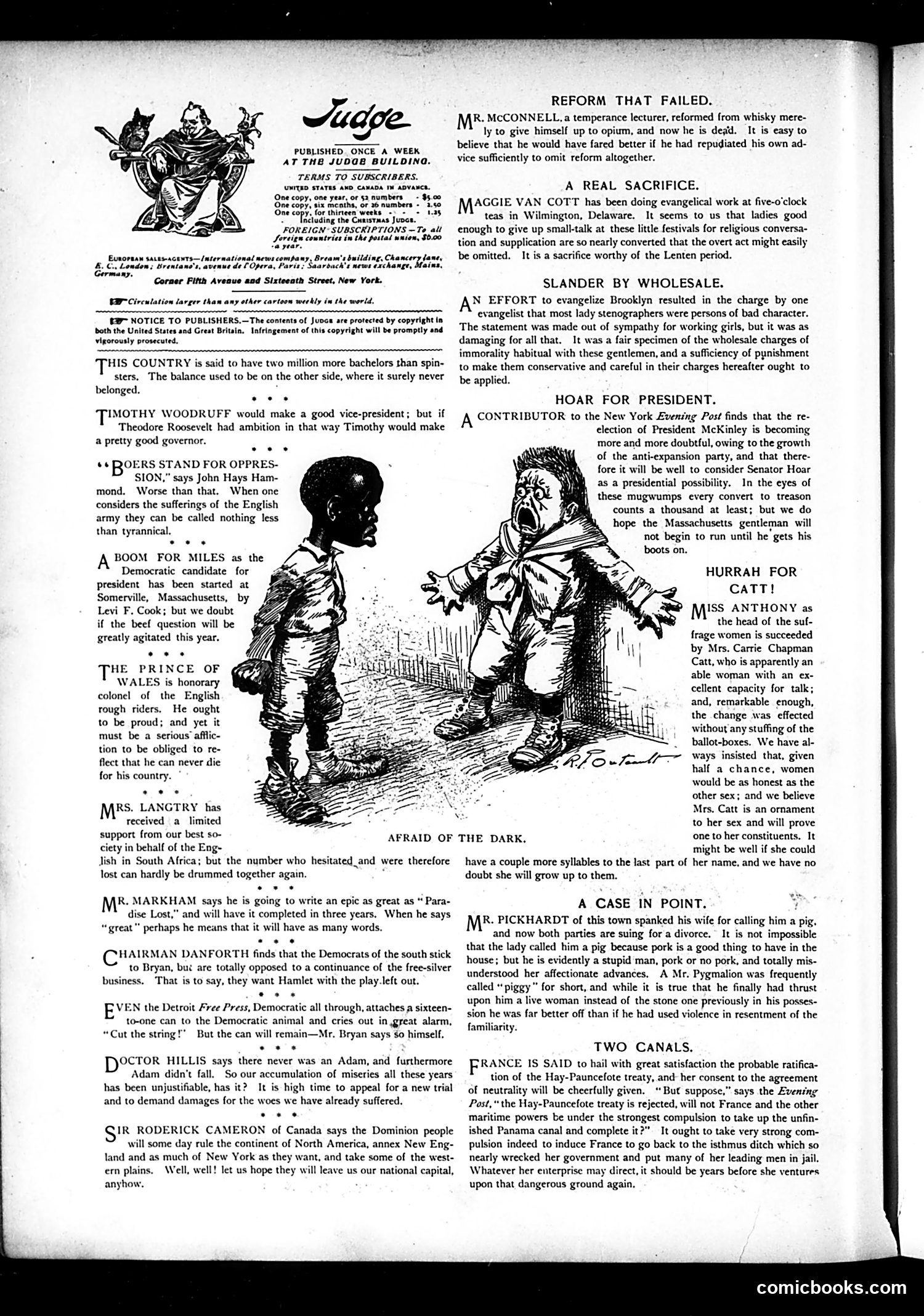
The central cartoon titled "AFRAID OF THE DARK" depicts two figures in conflict—one appears to be a caricatured Black man and another figure. The accompanying text discusses President McKinley's re-election becoming "more and more doubtful" due to growth of the "anti-expansion party," suggesting this references late 1890s American political debate over imperial expansion. The cartoon likely satirizes anxieties about anti-expansion political movements challenging McKinley's policies. The racial caricature and title "AFRAID OF THE DARK" suggest commentary on American attitudes toward colonialism and race, though the exact satirical point requires more historical context about the specific political moment and Judge magazine's editorial stance. The page contains multiple brief political commentary items typical of the magazine's format.
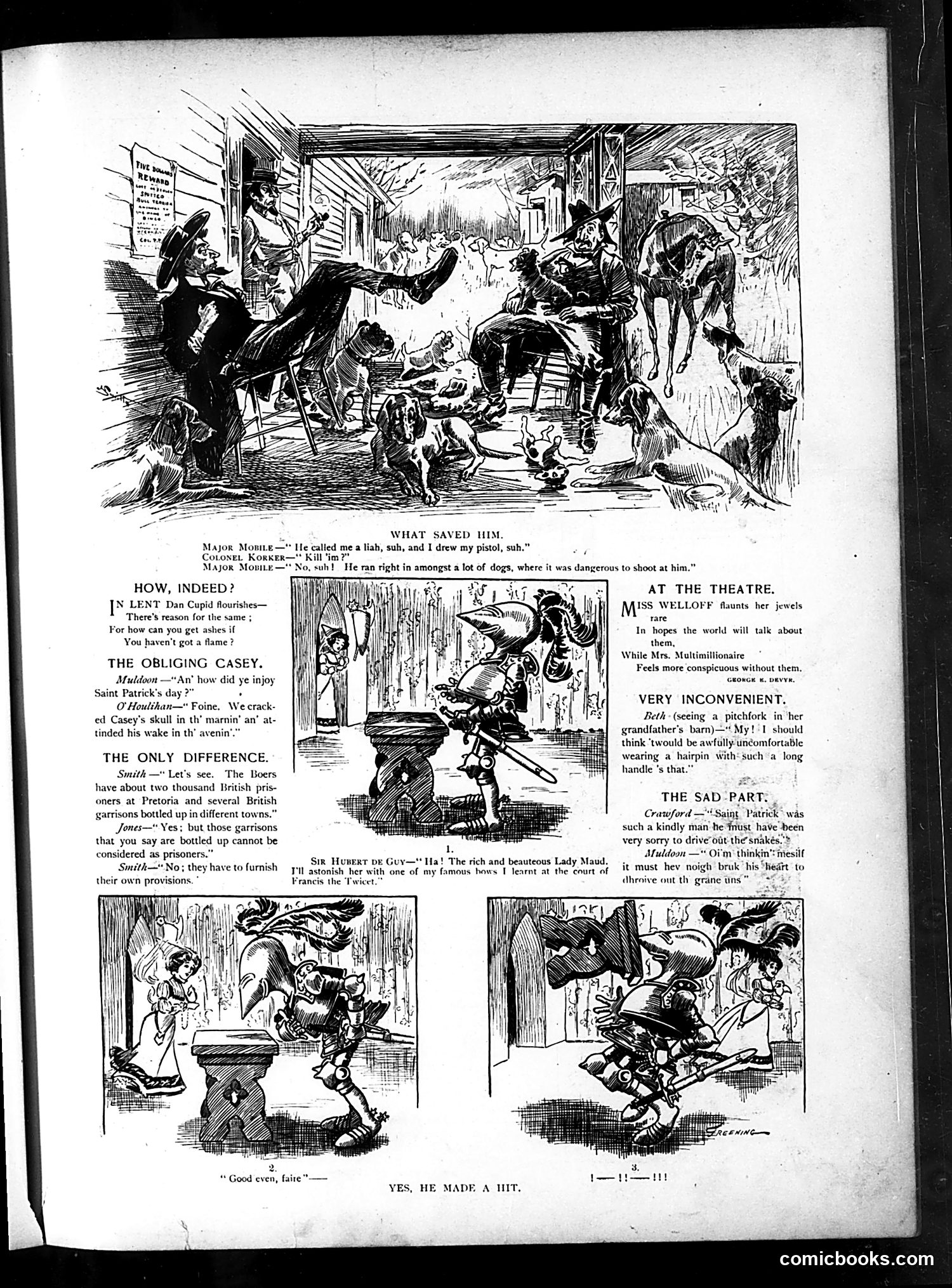
This page contains several brief humorous dialogues and sketches typical of Judge magazine's satirical style. The top illustration depicts a street scene with well-dressed men and dogs, accompanying "What Saved Him"—a joke about a man being safer among dangerous dogs than among "a lot of dogs" (likely a slang reference to rowdy men or competitors). Below are four separate comic vignettes with dialogue jokes about social situations: a gambling case, theatrical inconveniences, and romantic complications. The sketches mock Victorian-era social pretensions and domestic life. The specific political references are unclear without additional context, but the overall tone targets upper-class manners, romantic entanglements, and social embarrassments—typical Judge content from the late 19th or early 20th century.
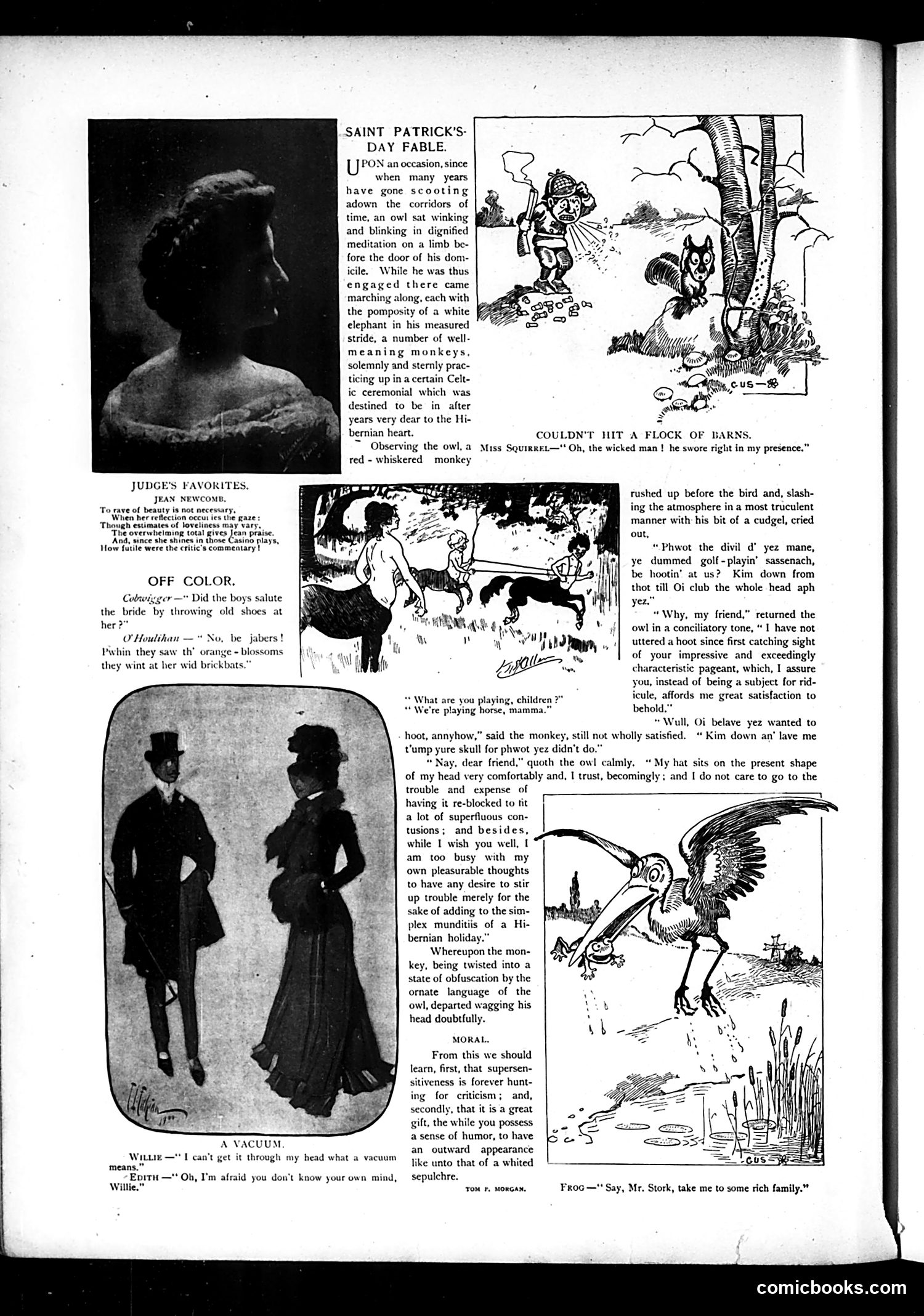
This page contains several distinct satirical pieces: **"Saint Patrick's Fable"** features a leprechaun encountering well-meaning monkeys practicing a "Celtic ceremonial" before his door. The owl insults the monkey's pretensions, suggesting satire of Irish-American cultural performances or ceremonies that appear ridiculous to outsiders. **"Off Color"** and **"A Vacuum"** are brief joke exchanges about social faux pas—one regarding saluting at a wedding, another about not understanding one's spouse's mind. **"Judge's Favorites"** contains conventional witticisms about beauty and appearance. The page's main satirical target appears to be Irish-American cultural displays and stereotypes, using animal characters to mock self-conscious performances of ethnic identity. The overall tone is light, society-focused humor typical of Judge magazine's approach to contemporary social behavior.
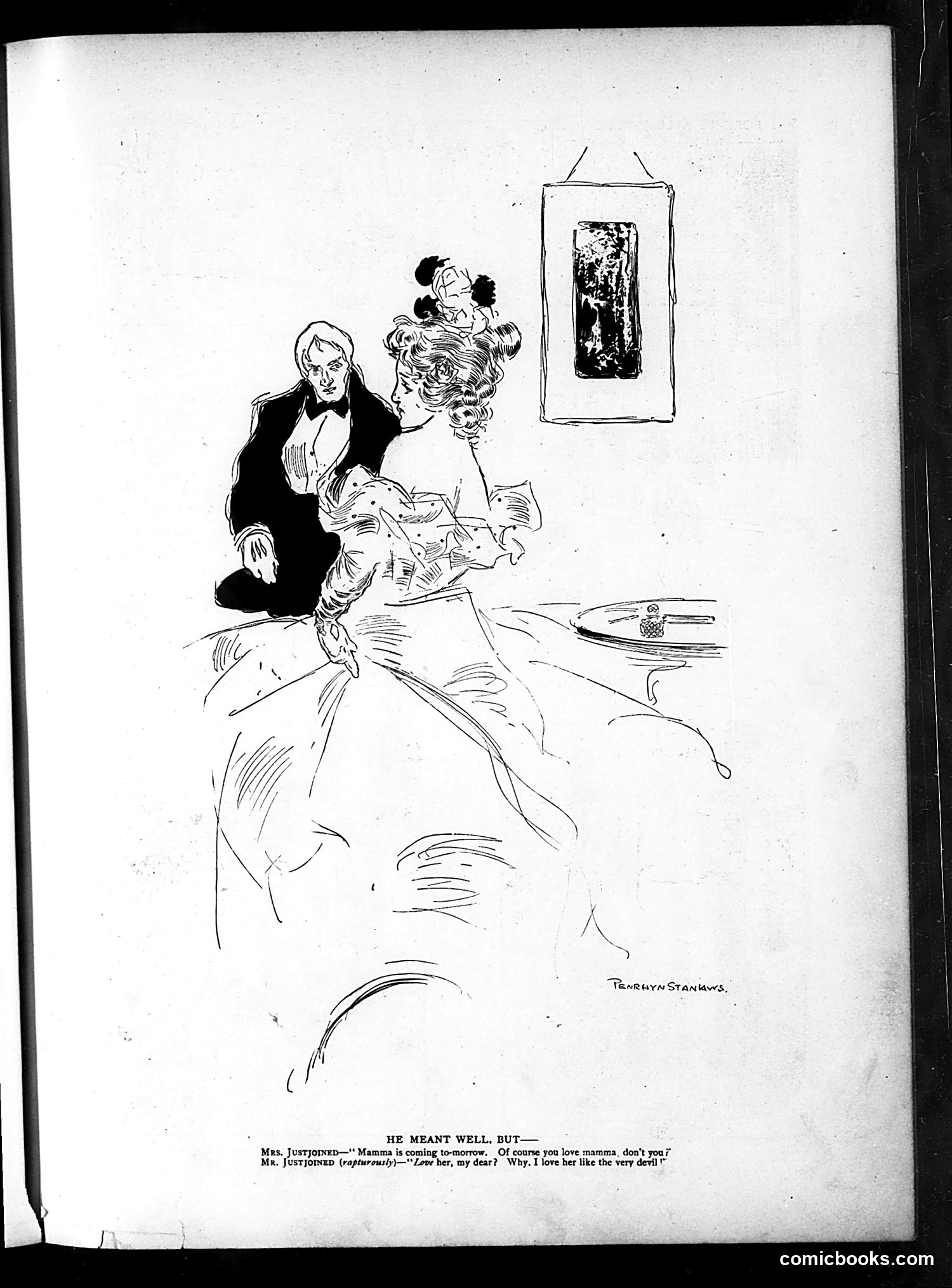
This is a satirical cartoon from *Judge* magazine showing a domestic scene. A well-meaning husband enthusiastically declares he loves his mother-in-law "like the very devil," while his wife looks dismayed at his poor word choice. The satire hinges on the husband's malapropism—he intends to express deep affection but uses an expression that actually conveys demonic or negative feelings. The cartoon mocks the tension between mothers-in-law and sons-in-law, a perennial source of domestic humor. His earnest but tactless declaration reveals the awkwardness underlying in-law relationships, even when genuine goodwill exists. The framed portrait on the wall likely represents the approaching mother-in-law, intensifying the wife's concern about his unfortunate phrasing. The joke targets male social clumsiness and marital discord.
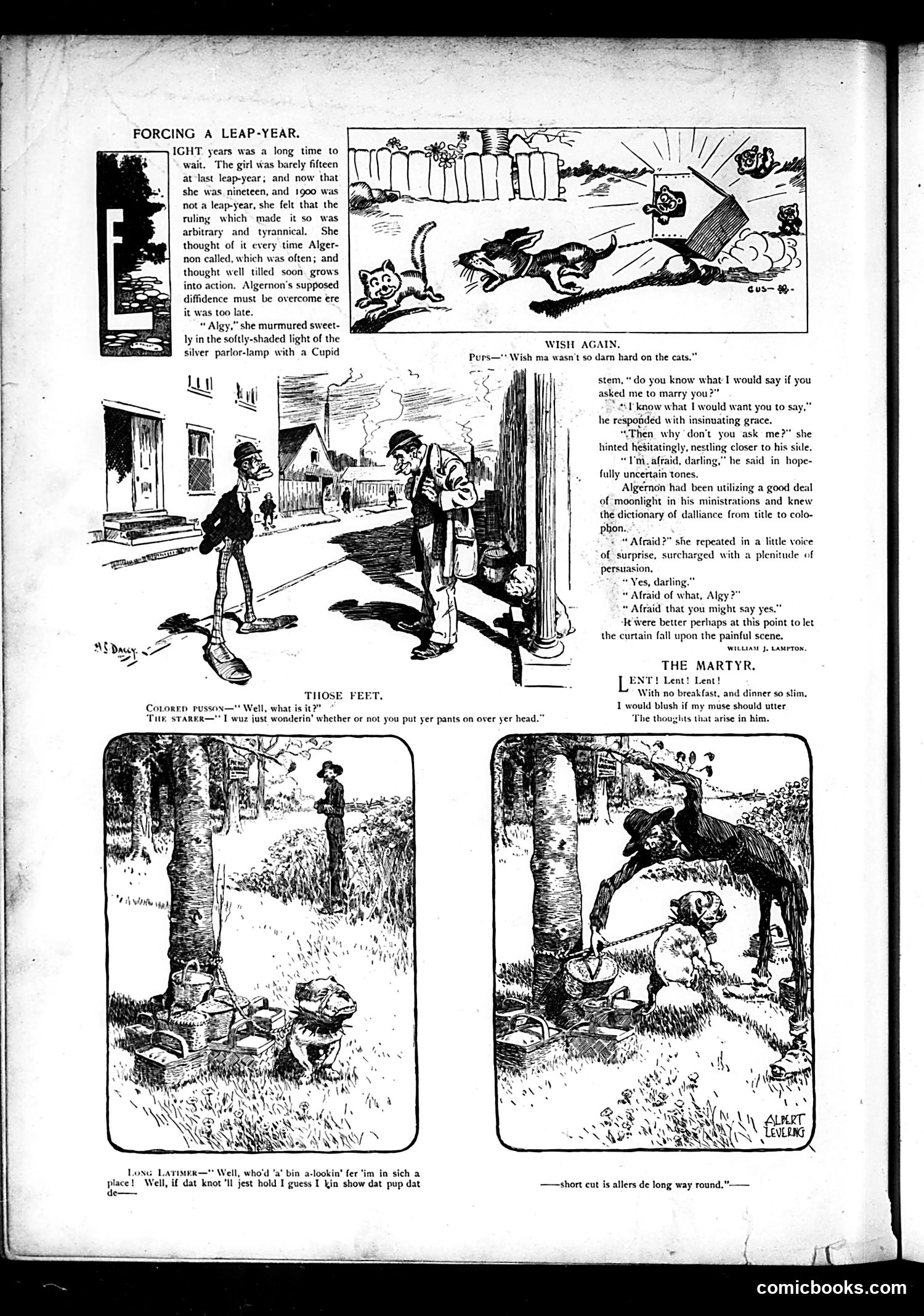
This page satirizes gender roles and courtship customs of the 1890s-1900s. The main story mocks a young woman (age 19) frustrated that 1900 isn't a leap-year—traditionally, leap-year allowed women to propose to men. She attempts to overcome her suitor Algernon's feigned shyness, but he deflects with practiced charm, refusing to commit even when given opportunity. The humor targets both her impatience with Victorian courtship formality and his transparent romantic evasion through flattery. The smaller cartoons ("Those Feet," "Wish Again," "The Martyr") are separate jokes: one about removing pants, another about a cat's complaint, and one about Lenten fasting privations. These are typical satirical magazine fare—brief, topical humor without deep political content.
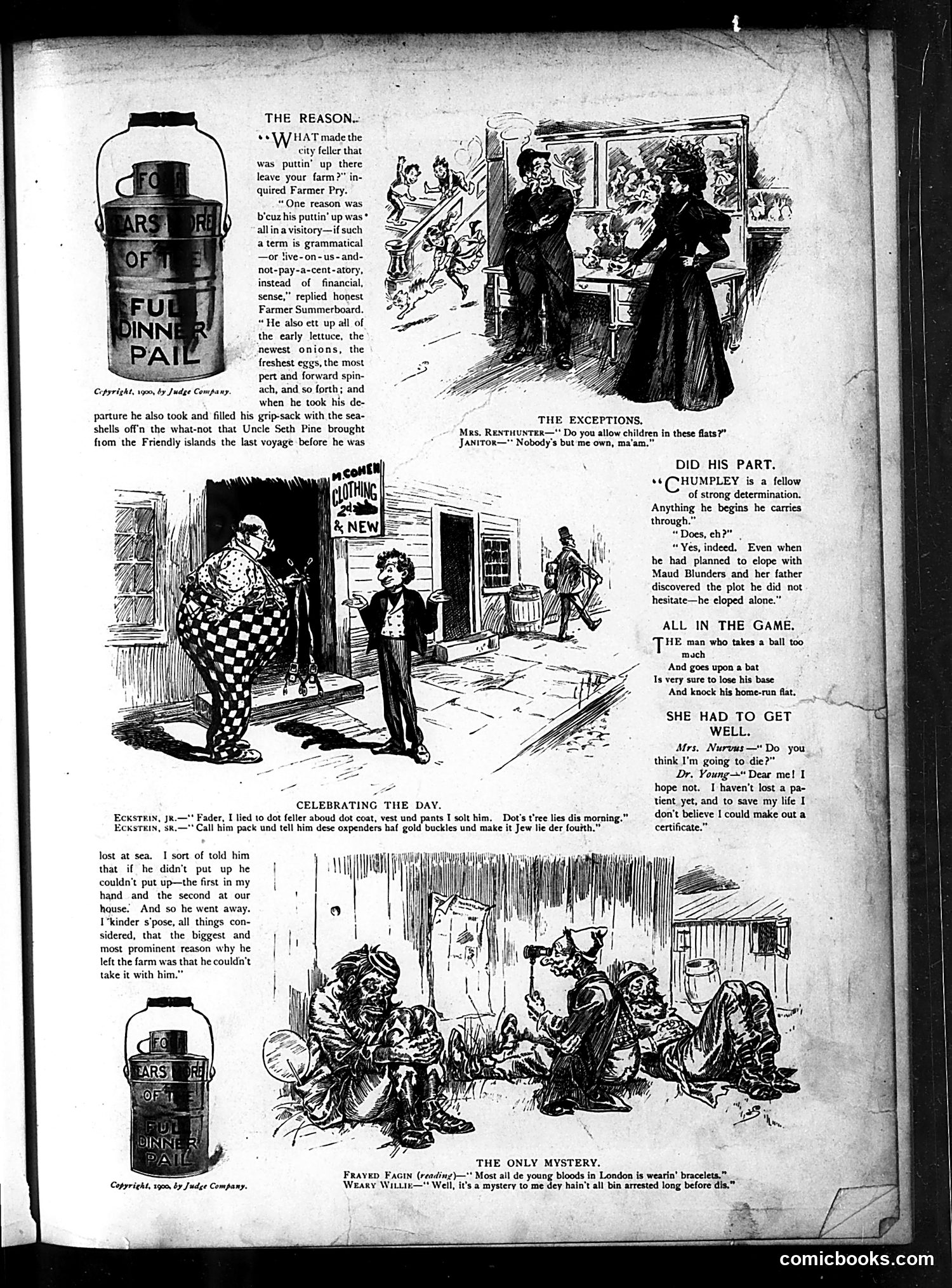
This page from Judge (circa 1900) contains multiple satirical sketches mocking rural and urban life of the era: **"The Reason"** depicts a farmhand's complaint about a city visitor who overstayed his welcome, ate the farm's produce, and stole souvenirs—a common theme satirizing city folks' poor manners in rural settings. **"Celebrating the Day"** features thick German-dialect speech mocking immigrant laborers, showing a worker bragging about defrauding a customer through lies about clothing quality—stereotyping immigrants as dishonest. **"The Only Mystery"** jokes that London's young men wearing bracelets should have been arrested, implying such adornment was socially unacceptable or associated with criminality. The other sections ("Did His Part," "She Had to Get Well," "All in the Game") are brief satirical quips on human nature and social pretense. Overall, the page reflects Judge's approach: gentle mockery of class differences, ethnic stereotypes, and social conventions of Gilded Age America.
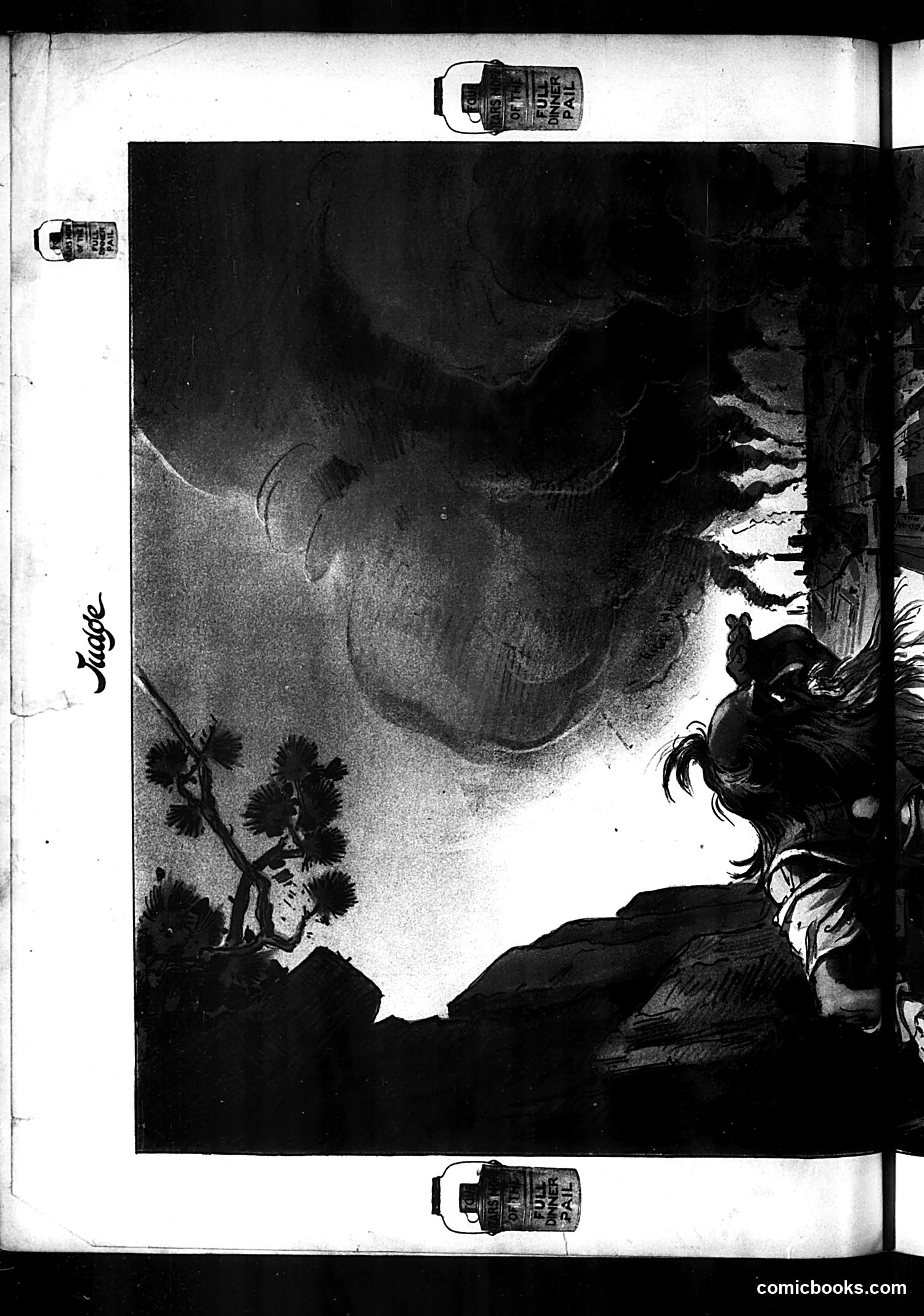
I can see this is a silhouette-style illustration from *Judge* magazine, but the OCR text provided only contains "comicbooks.com," which appears to be a watermark rather than actual magazine content. The image shows a dramatic nighttime scene in silhouette: a figure on the right observing what appears to be a large moon or celestial body in the sky, with desert vegetation (possibly Joshua trees or cacti) visible on the left. The artistic style suggests early-to-mid 20th century satirical illustration. Without the actual article text or caption from the original *Judge* page, I cannot definitively identify what political or social commentary this cartoon intends. To properly explain the satire's meaning to a modern reader, I would need the accompanying text that contextualizes the imagery.
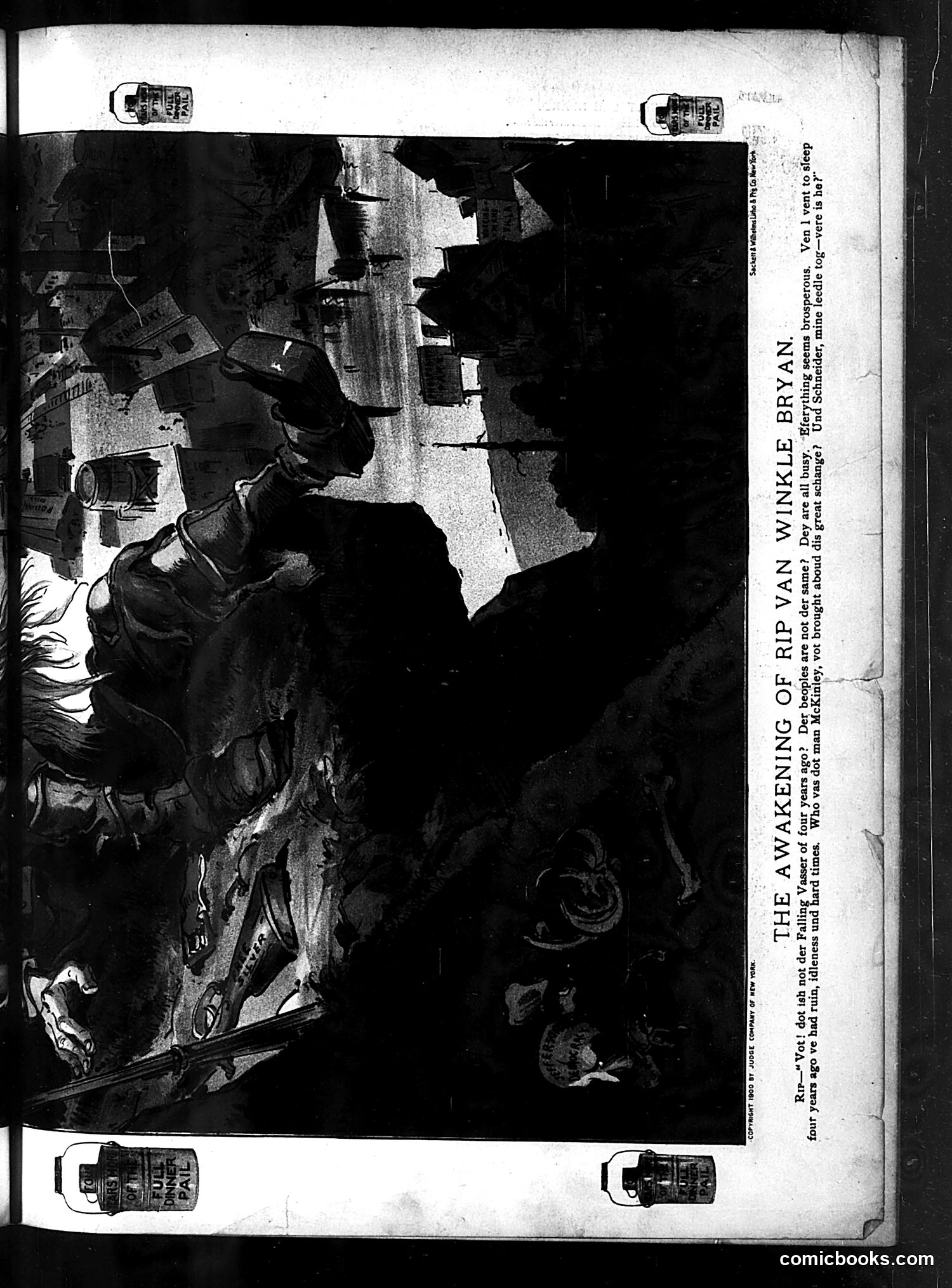
This Judge magazine cartoon satirizes William Jennings Bryan, the three-time presidential candidate who lost elections in 1896, 1900, and 1908. The title references Washington Irving's "Rip Van Winkle"—suggesting Bryan has been politically asleep or irrelevant for years. The satire depicts Bryan as an outdated figure awakening to find the world has moved on without him. The cartoon mocks his persistent but unsuccessful political ambitions and suggests his ideas are antiquated. By invoking Rip Van Winkle—who slept through decades—Judge implies Bryan is a relic from an earlier era trying to remain relevant in modern politics. The heavily obscured OCR text prevents fuller interpretation, but the visual metaphor is clear: Bryan's political career, like Rip's sleep, represents a disconnect from contemporary reality.
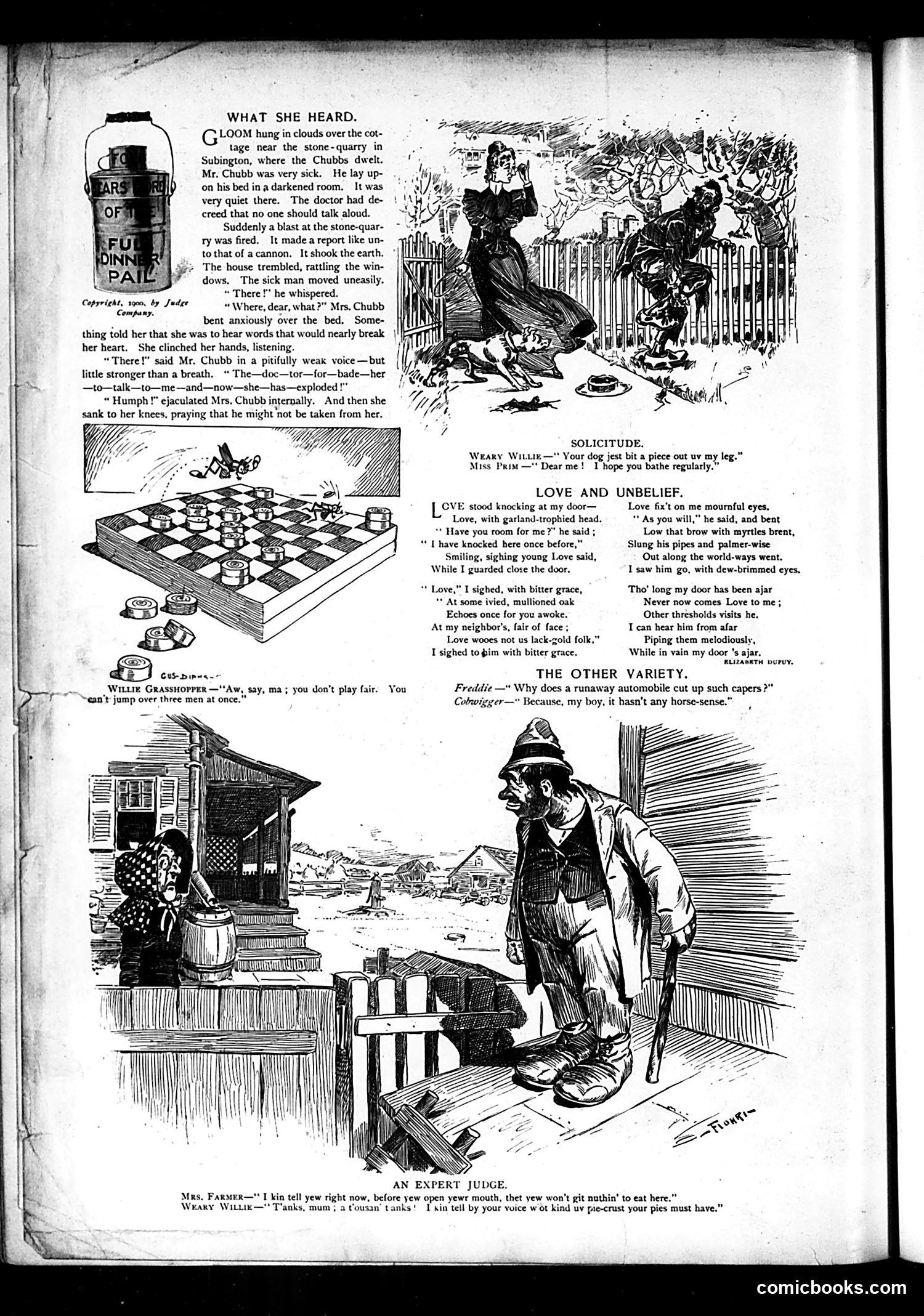
This page contains three distinct satirical items typical of early 1900s humor: **"What She Heard"** is a domestic comedy about a sick Mr. Chubb who, during enforced silence on doctor's orders, hears a quarry blast and misinterprets it as his wife Mrs. Chubb "exploding"—a joke on the expectation that wives should remain silent. The humor exploits period anxieties about women's speech and marital dynamics. **"Solicitude," "Love and Unbelief,"** and other brief items are standard magazine fillers—short jokes, poetry, and quips with accompanying illustrations. **"The Other Variety"** contains two one-liners: one about a grasshopper's jumping ability, another using the pun "horse-sense" for a runaway automobile lacking control. **"An Expert Judge"** depicts Weary Willie (a recurring vagrant character) and Mrs. Farmer in a class-based humor scenario where Willie's shabby appearance allows him to "judge" pie quality by crust sound alone—satirizing both rural simplicity and vagrant cleverness. The page reflects Judge's focus on domestic satire, wordplay, and social observation rather than direct political commentary.
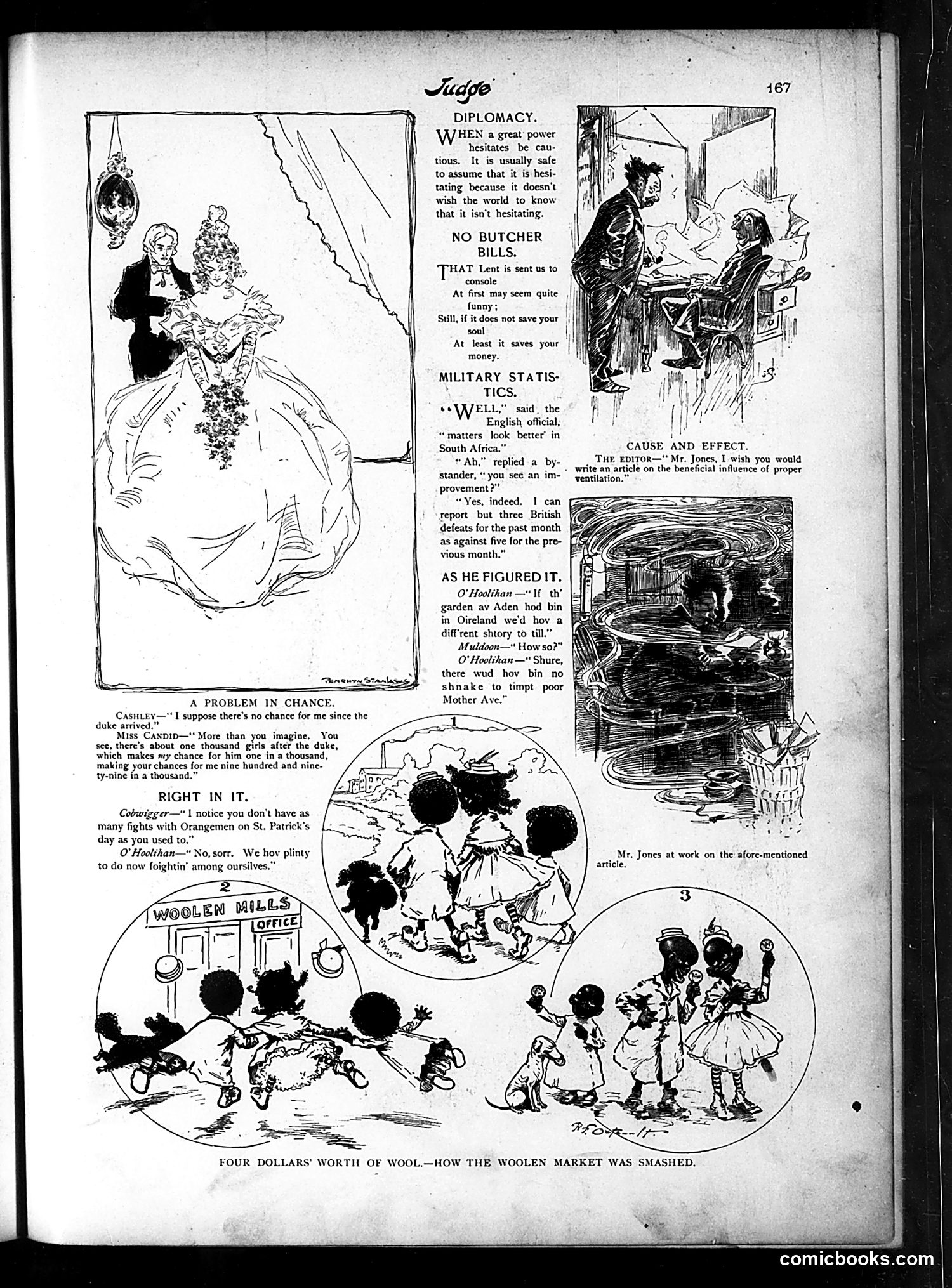
This page contains several brief satirical pieces commenting on early 1900s issues: **"Diplomacy"** mocks great powers' hesitation in international affairs—suggesting it masks indecision they don't want revealed. **"No Butcher Bills"** jokes that Lent (the Christian fasting period) at least saves money if not souls. **"Military Statistics"** satirizes British reporting on the South African War (likely the Boer War). An English official claims "improvement" because there are fewer British defeats this month than last—absurd spin on military failure. **"As He Figured It"** features Irish dialect characters discussing the Garden of Aden, making a pun about Ireland's legendary snakes. **The bottom cartoon** about wool market collapse and the "woolen mills office" appears to reference economic disruption, possibly from trade or tariff issues affecting American textile manufacturing. The overall tone is typical Judge satire: mocking political incompetence, military overconfidence, and economic disruption through humor and caricature.
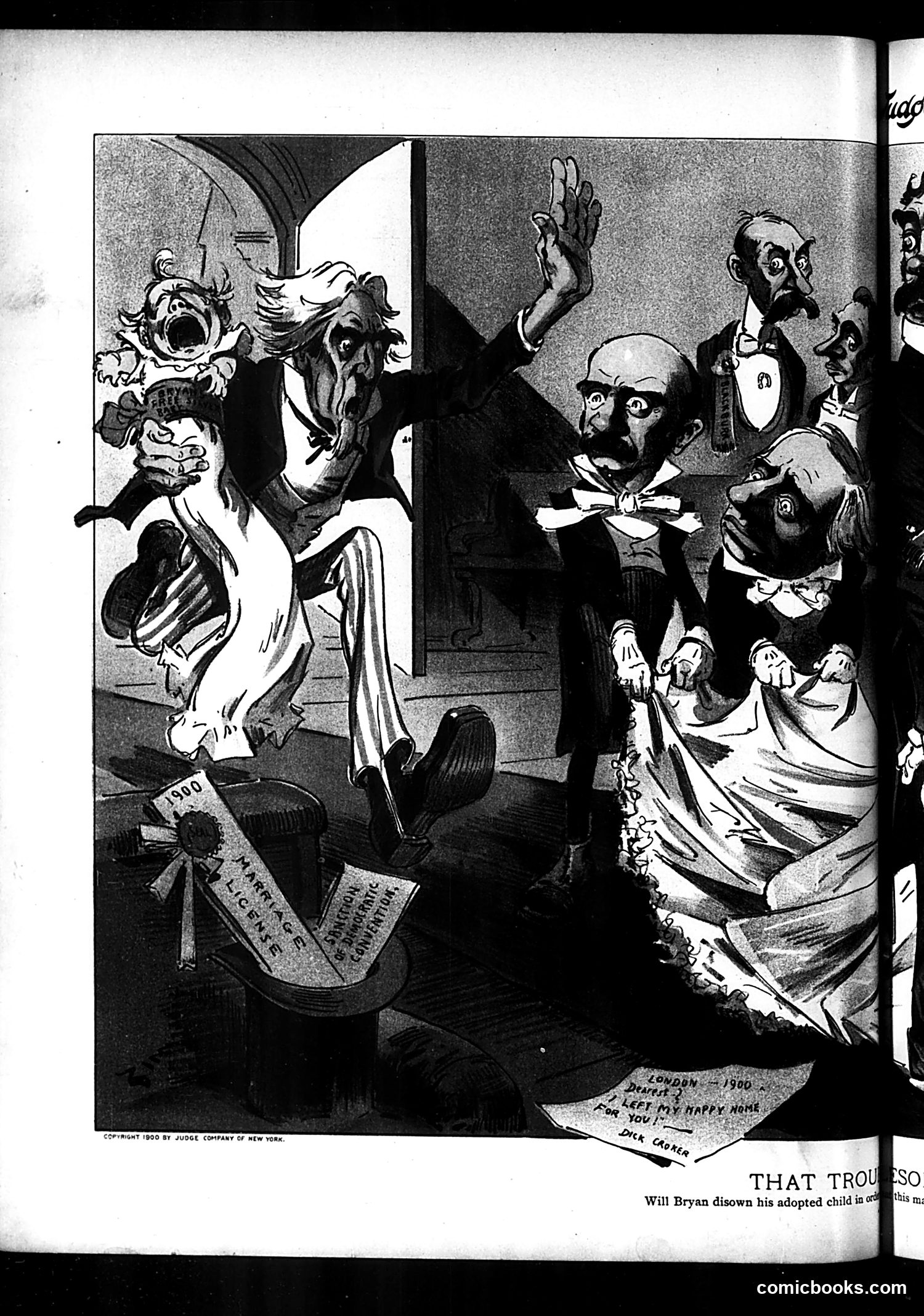
This 1900 Judge magazine cartoon appears to satirize William Jennings Bryan, the Democratic presidential candidate. The left panel shows a distressed figure ejecting or disowning something labeled "1900" (likely representing Bryan's political position or campaign). The right panel depicts well-dressed figures in what appears to be a formal setting, seemingly reacting to or witnessing this rejection. The cartoon's title references Bryan "disowning his adopted child," suggesting Bryan is rejecting or distancing himself from a previous stance or policy position he had previously championed. The exaggerated, dramatic expressions and gestures typical of Judge's satirical style emphasize the hypocrisy or inconsistency being mocked. The exact political issue being referenced remains unclear from the visible text alone.
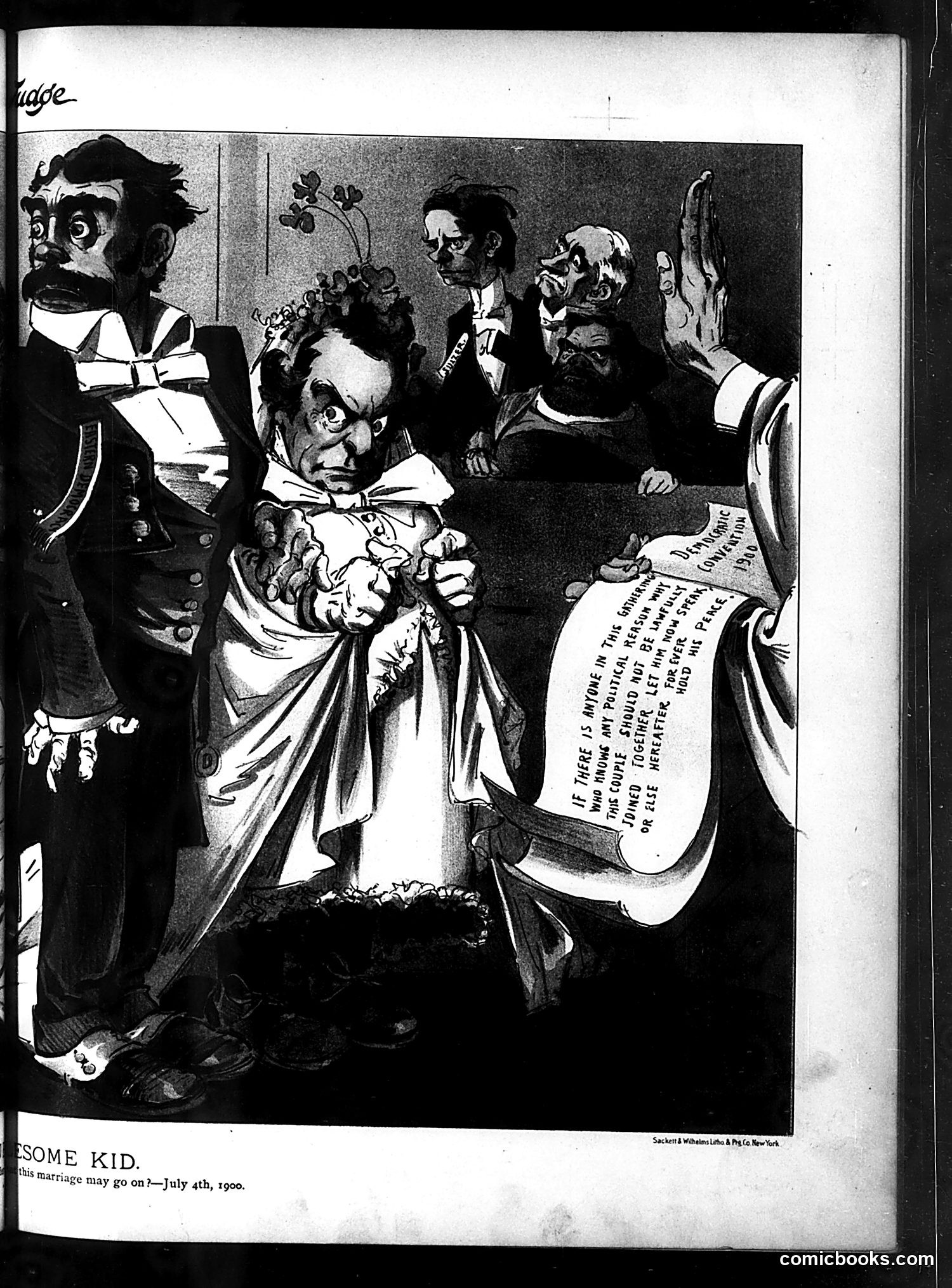
This political cartoon satirizes an uncertain marriage or union scheduled for July 4th, 1900. A grotesquely caricatured child figure in formal dress stands among several demonic or devil-like figures in formal attire, suggesting the "marriage" involves sinister forces or corrupt politicians. The visible text on a scroll reads partially: "IF THERE IS A MINE IN THE GOVERNMENT..." indicating this concerns political corruption or hidden dangers within government institutions. The date—July 4th, 1900, American Independence Day—adds ironic weight to commentary about threats to American democracy or institutions. The "some kid" likely represents the nation's future or innocent citizens facing a compromised political system, while the devilish figures represent corrupt politicians or special interests conspiring to undermine proper governance.
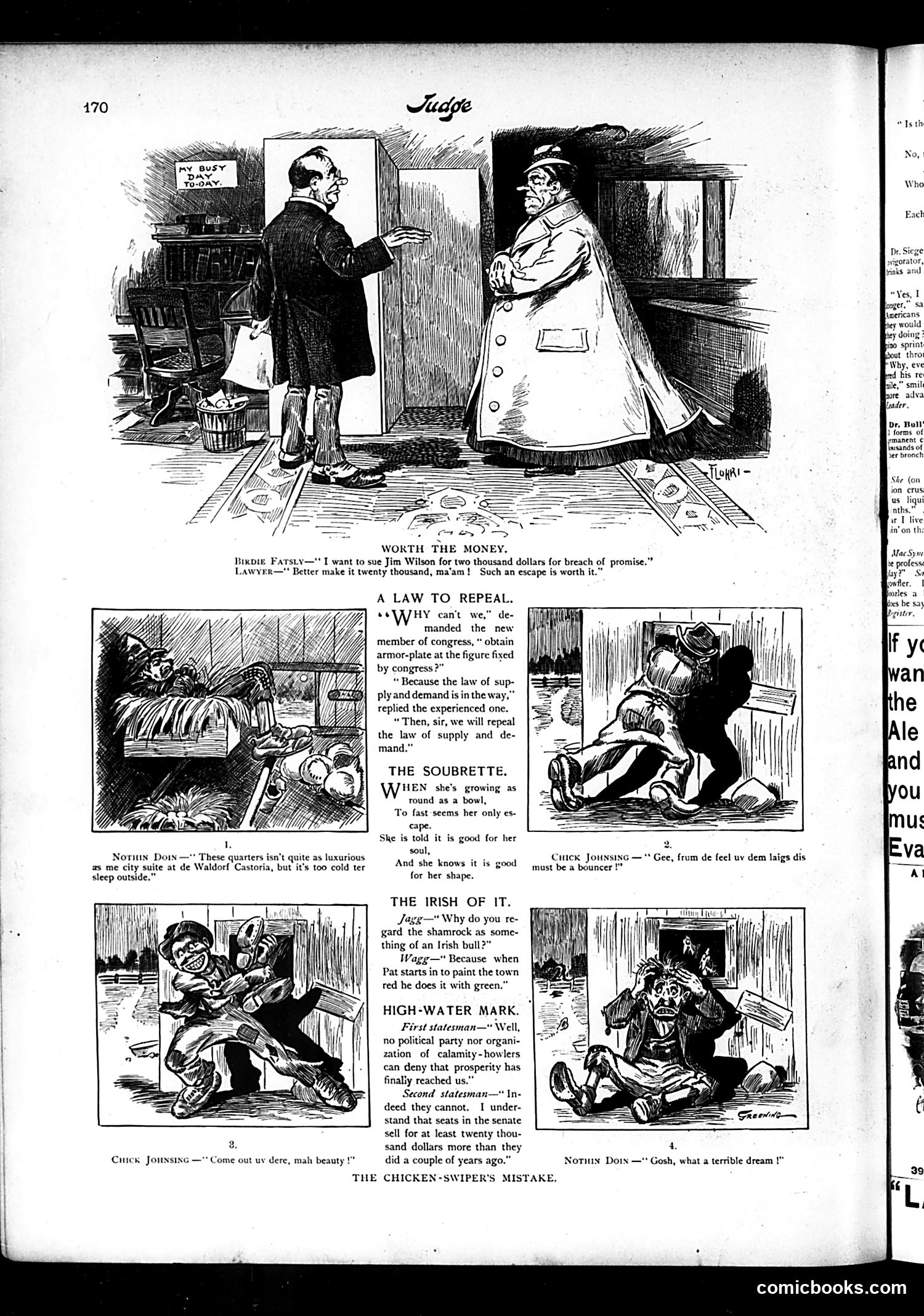
This page from *Judge* contains multiple satirical cartoons targeting early 20th-century American politics and social issues: **"Worth the Money"**: A lawyer advises a woman suing for breach of promise to demand twenty thousand dollars instead of two thousand—the "escape" from marriage being worth the premium. This satirizes both matrimonial litigation and contemporary attitudes toward marriage. **"A Law to Repeal"**: A naive congressman proposes repealing the law of supply and demand to obtain cheaper armor-plate for Congress. This mocks congressional economic ignorance and protectionist politics. **"High-Water Mark"**: Two politicians discuss how Senate seats now sell for inflated prices, satirizing political corruption and the commodification of office. Other sections include ethnic humor stereotypes ("The Irish of It," "Nordin Doin") and character sketches typical of the era's comedic conventions. The cartoons collectively critique governmental inefficiency, corruption, and social pretension through exaggerated visual caricature and wordplay.
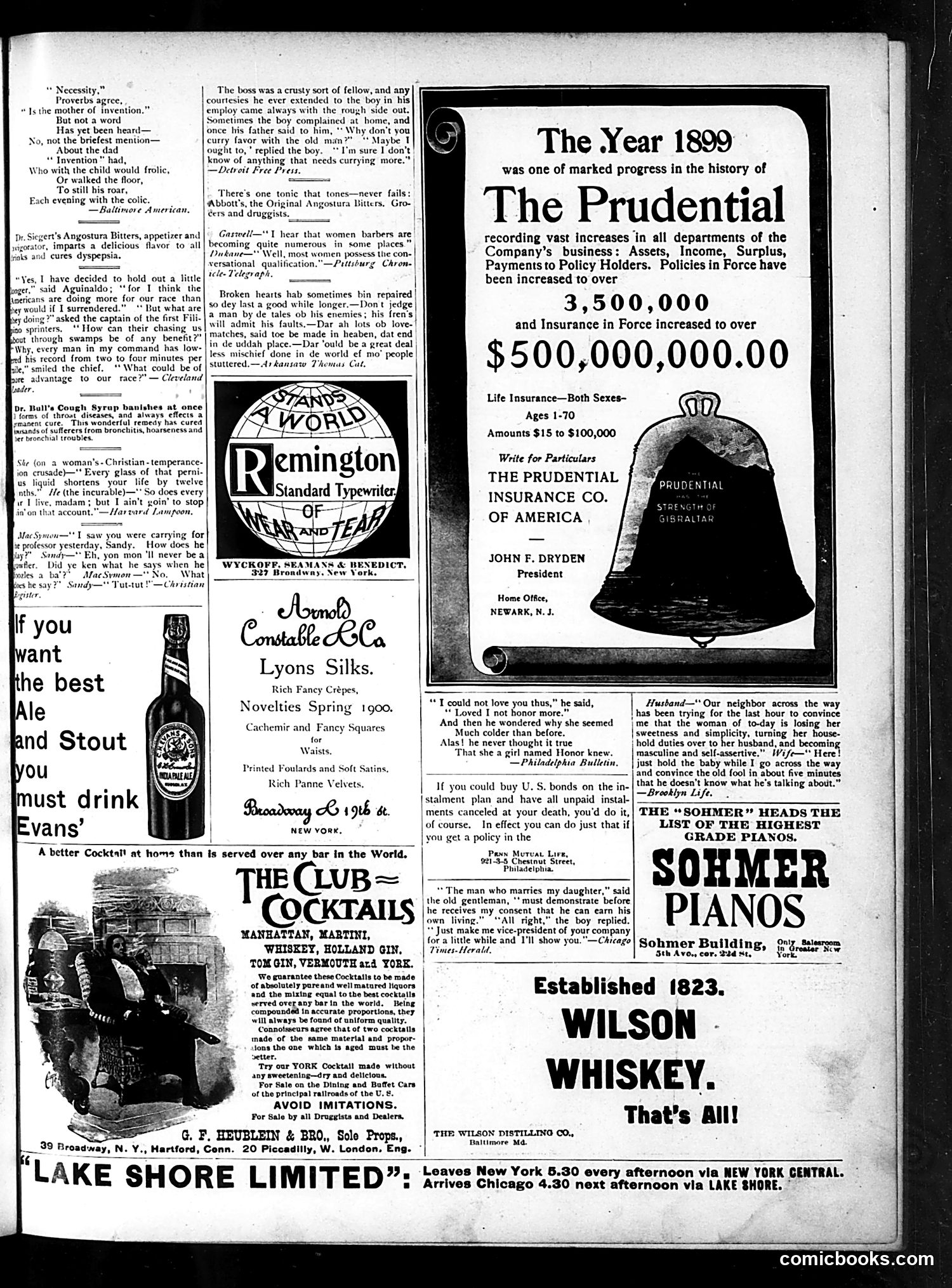
This page is primarily **advertising with minimal editorial content**. The main cartoon-related material consists of brief humorous anecdotes rather than political satire. The visible jokes target: 1. **Gender roles**: A quip about fathers never receiving credit for parenting ("invention" of fatherhood), contrasting with mothers' recognition 2. **Philippine-American War context**: A reference to Aguinaldo (Filipino resistance leader) claiming his forces benefit the race more than surrender would 3. **Women in the workplace**: A comment on female barbers becoming "numerous," with a sexist joke about women's conversational nature 4. **African American dialect humor**: Period-typical racist "plantation dialect" jokes about broken hearts and heaven The page is dominated by **product advertisements**: Angostura Bitters, Remington typewriters, silk fabrics, cocktail mixers, and notably, **The Prudential Insurance Company** (celebrating $500 million in force), along with Sohmer Pianos and Wilson Whiskey. The satirical content is light and apolitical compared to typical Judge material—mostly domestic humor rather than commentary on current events.
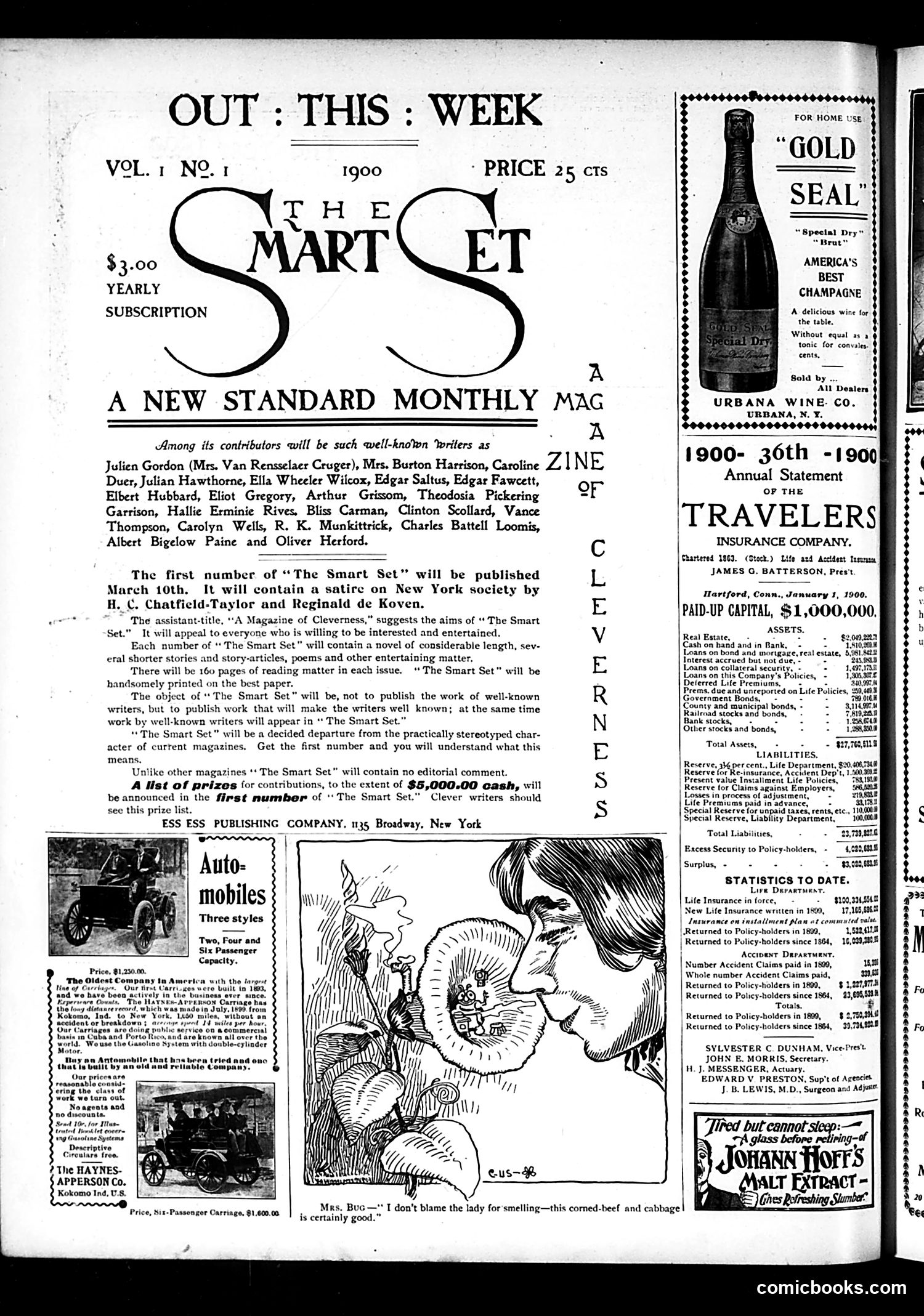
This is primarily a **title/announcement page for a new magazine** called "The Smart Set," launching March 10, 1900. The page showcases the publication's literary ambitions by listing prominent contributors (well-known writers and poets of the era). The **cartoon** at bottom center depicts "Mrs. Bug" — a caricatured woman with exaggerated features smelling something unpleasant. The caption jokes that she can't blame "the lady" for the smell of corned-beef and cabbage. This appears to be ethnic/class humor common to the period: the implication is that corned-beef and cabbage was associated with working-class Irish immigrants, and the cartoon mocks both the food and those who ate it. The surrounding advertisements (automobiles, champagne, insurance) are typical period content. This page is **mostly promotional material** rather than satirical political commentary, representing Judge magazine's dual function as both humor publication and advertising vehicle.
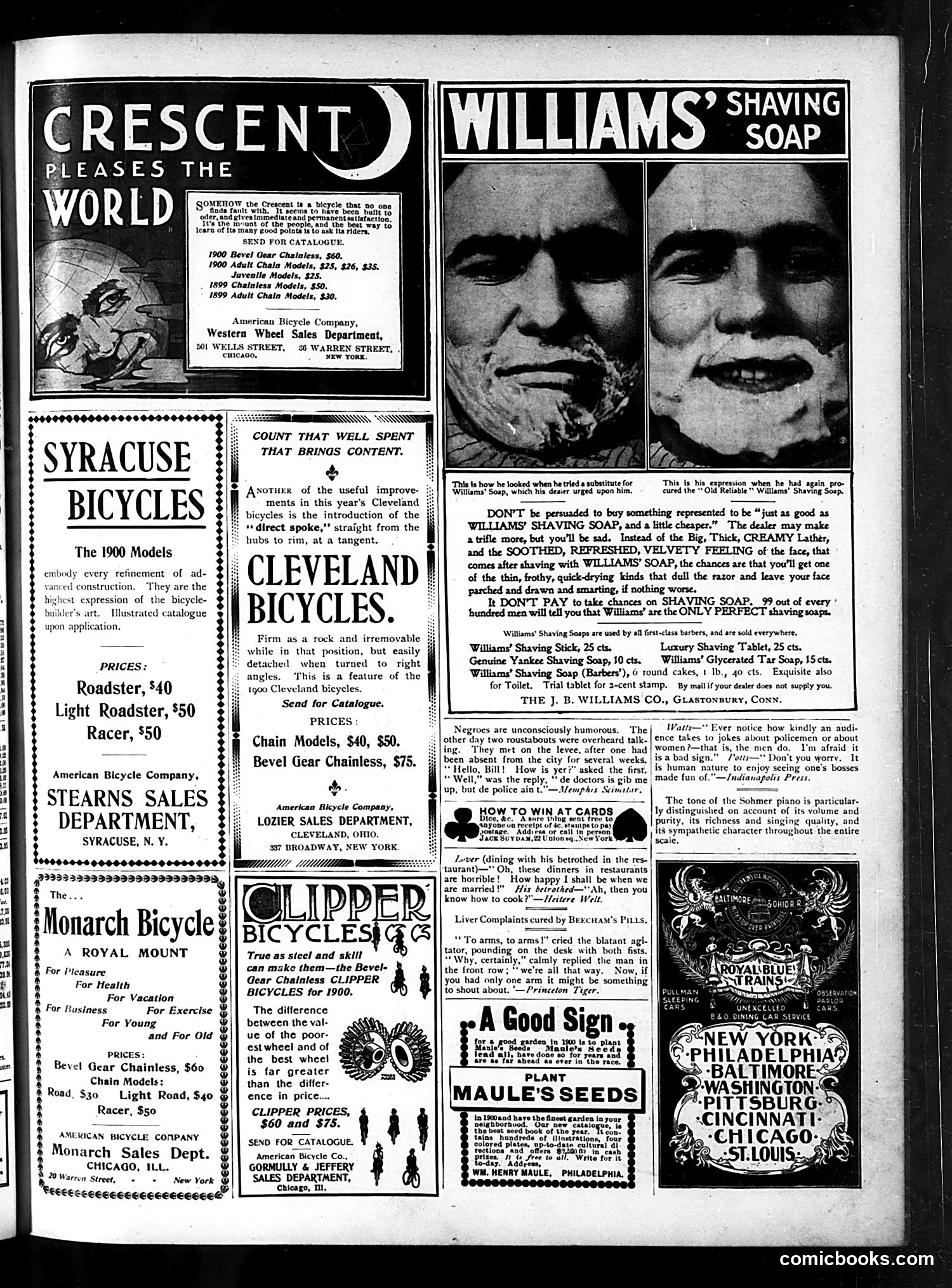
This page is primarily **advertising**, featuring bicycle and shaving soap ads typical of 1900s trade publications. The notable content includes a **Williams' Shaving Soap advertisement** using before-and-after photographs of a man's facial expression to advertise product superiority. The copy explicitly warns against cheaper substitutes, claiming Williams produces superior "creamy lather" and prevents skin irritation. This reflects period advertising tactics using comparative claims and visual testimony. The page also contains bicycle advertisements (Syracuse, Cleveland, Monarch, Clipper brands) and smaller humor pieces, including a racial stereotype joke about "unconscious" Negro humor involving dock workers, and generic jokes about policemen and marriage—typical filler content for Judge magazine. **No political satire or editorial cartooning appears here.** The page represents standard commercial advertising and light humor typical of early 1900s periodicals, with the shaving soap ad being the most prominent editorial content.
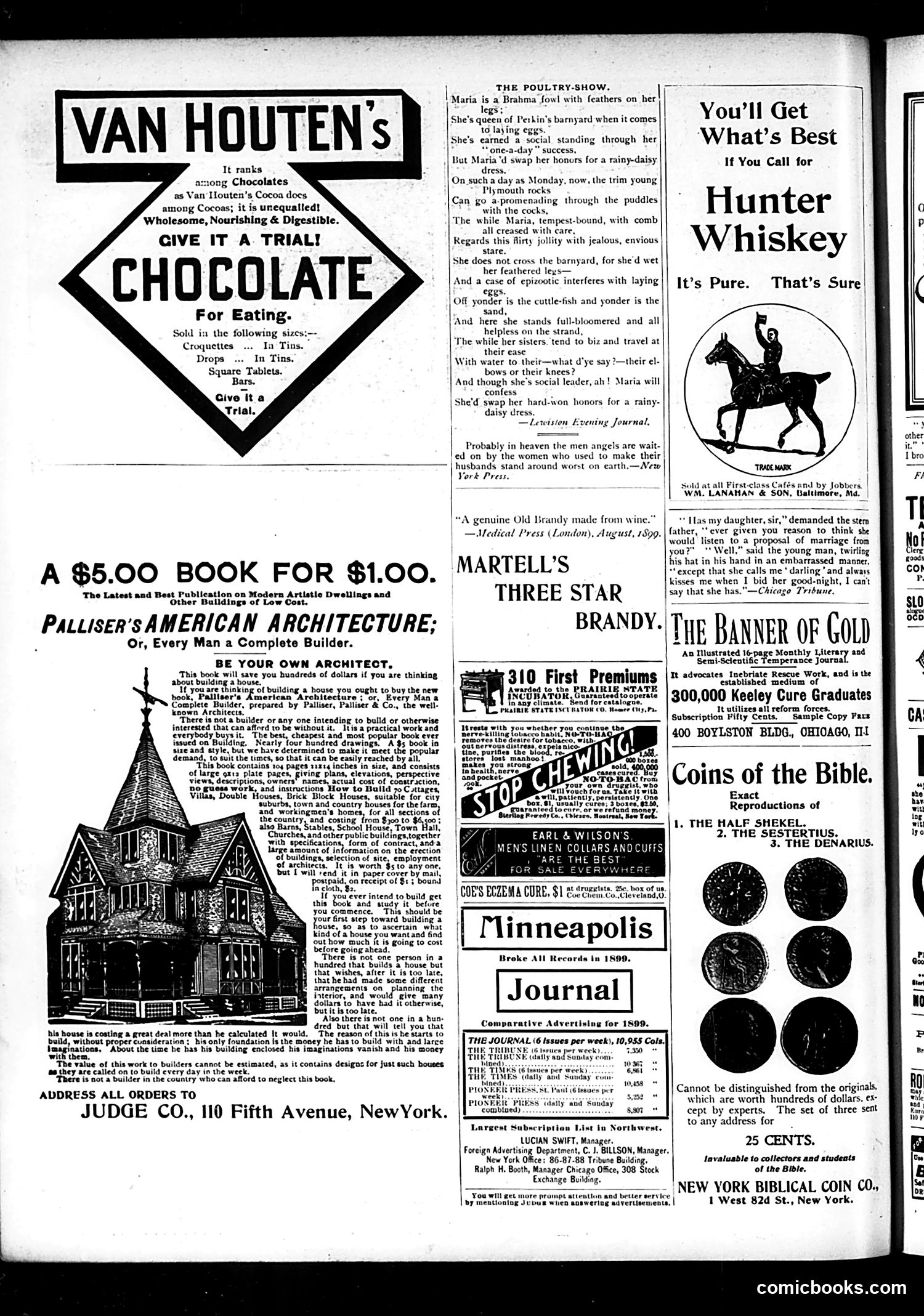
This page is primarily **advertisements and product promotions** rather than political satire. The main content includes: **Van Houten's Chocolate** ad promoting their cocoa product as superior to competitors. **Palliser's American Architecture book** — a how-to guide for building homes, priced at $1.00 (down from $5.00). The text emphasizes practicality for ordinary builders and homeowners. **Minor content**: A poem titled "The Poultry-Show" about a hen named Maria; ads for Hunter Whiskey, Martell's Brandy, the Minneapolis Journal, and biblical coin reproductions. **Social context**: These ads reflect late-19th century American consumer culture — affordable how-to books for self-improvement, mass-marketed branded goods, and practical home-building guides targeting middle-class readers. The architecture book's emphasis on affordability and "every man" building his own home reflects democratic ideals of the era. This appears to be a typical Judge issue page mixing satirical editorial content with lucrative advertising revenue.
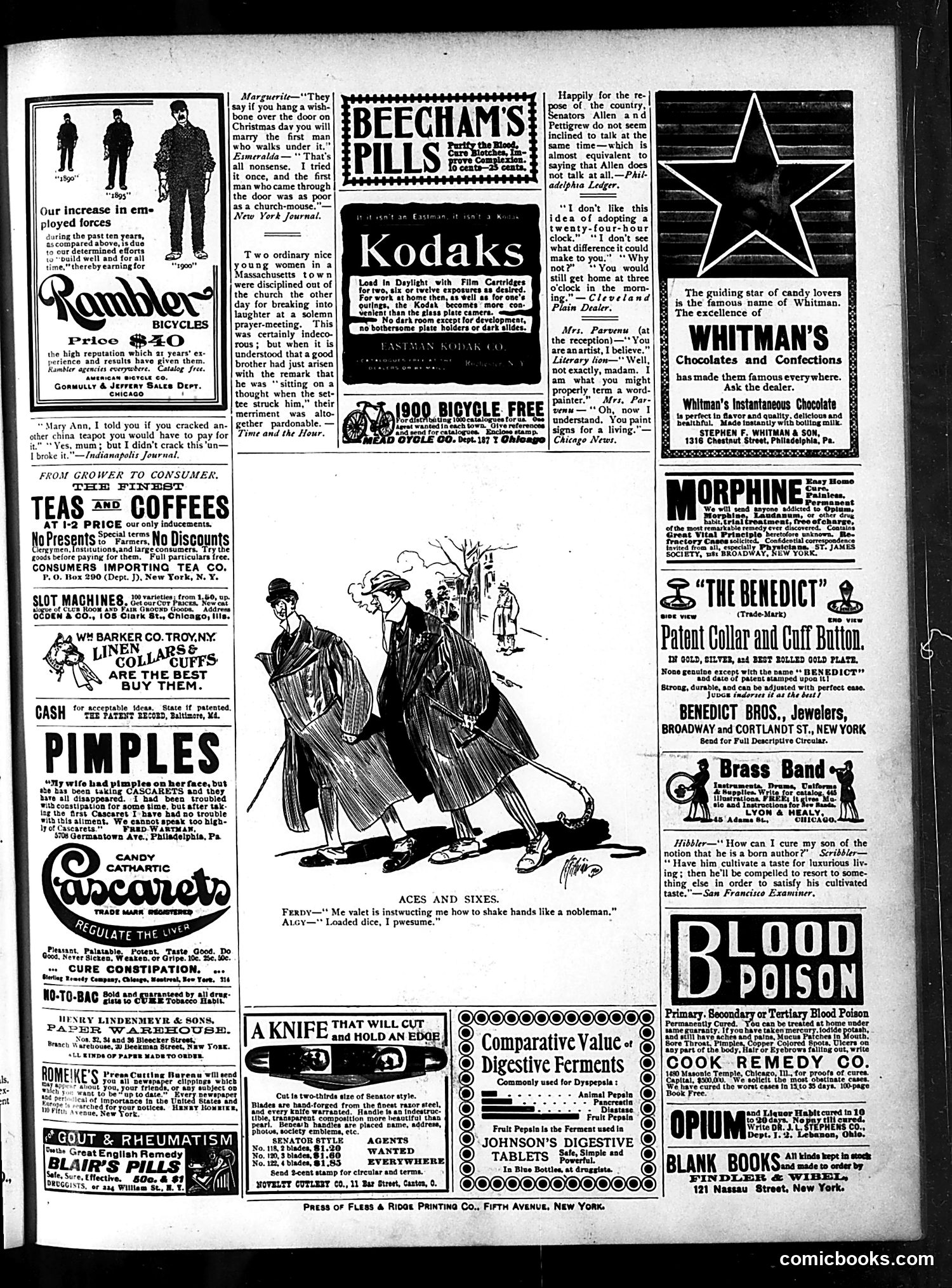
This page is primarily **advertising** with one central cartoon titled "Aces and Sixes." The cartoon depicts two men in formal dress. One (Perry) explains his valet is teaching him "how to shake hands like a nobleman." The other (Algy) responds: "Loaded dice, I presume." **The joke:** Perry is attempting to acquire upper-class manners through instruction—a common theme of social-climbing satire in this era. Algy's quip about "loaded dice" suggests Perry's efforts at gentility are as fraudulent and deceptive as cheating at gambling. The implication is that nouveau-riche social climbers cannot authentically become "noble" through mere coaching; their pretensions are fundamentally dishonest. This reflects late-19th/early-20th-century anxieties about class mobility and the perceived phoniness of wealthy upstarts imitating aristocratic behavior. The cartoon mocks both the aspiration and the idea that such transformation is possible.
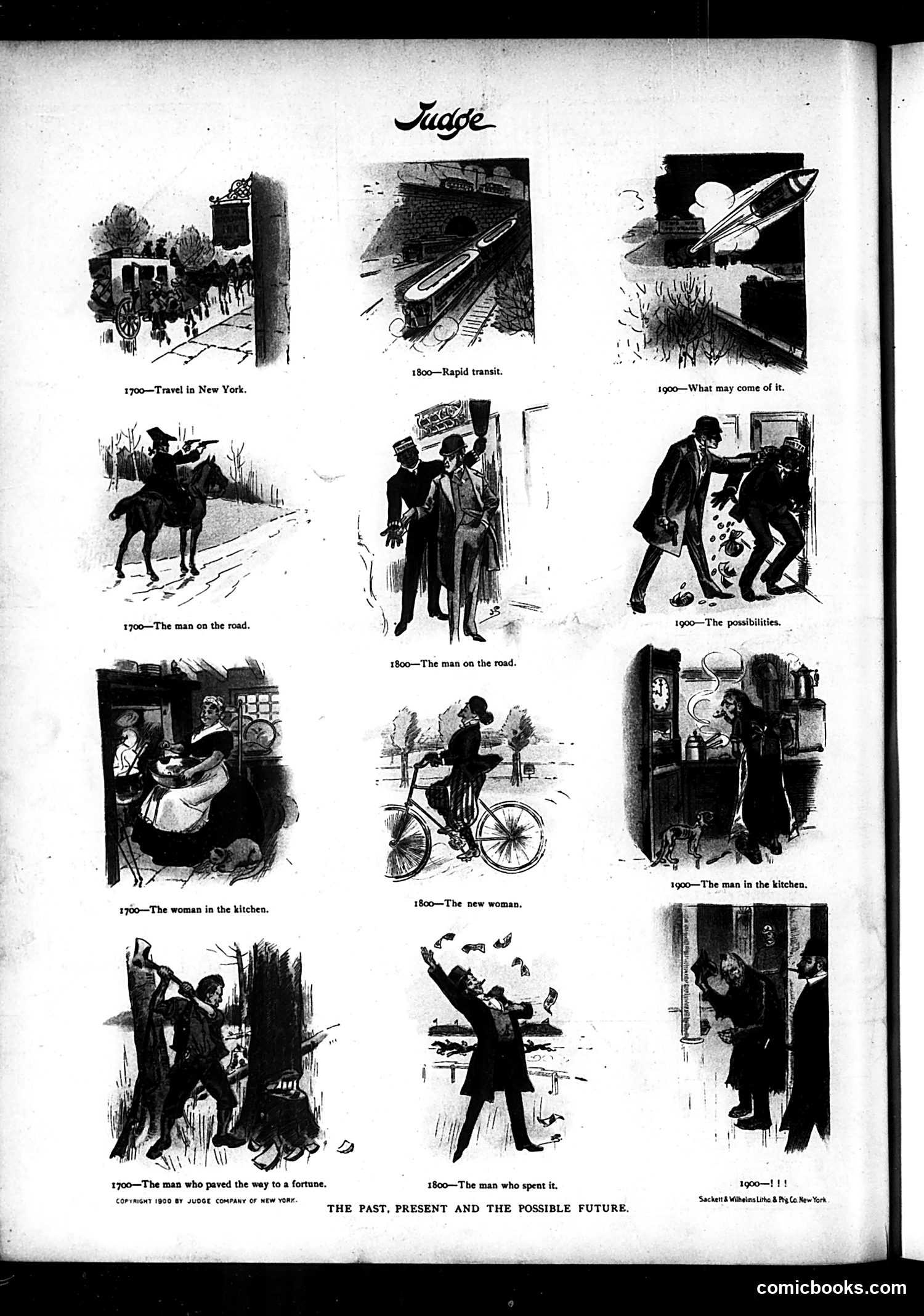
This satirical cartoon tracks wealth across three centuries using parallel vignettes. In 1700, a man laboriously builds fortune (shown paving roads, traveling, working). By 1800, his descendant squanders it frivolously. The 1900 panel shows "!!!!"—suggesting catastrophic consequences, likely poverty or ruin. The joke critiques inherited wealth and generational decline: hard work creates riches, but idle heirs destroy them. Other scenes contrast past and present life (travel, labor, domestic roles, technology like bicycles and rapid transit), emphasizing how modernity changes society. The "possible future" appears to be financial collapse resulting from wasteful present behavior—a morality tale about wealth management that resonated with Judge's upper-middle-class readership circa 1900.