
A complete issue · 16 pages · 1900
Judge — February 10, 1900
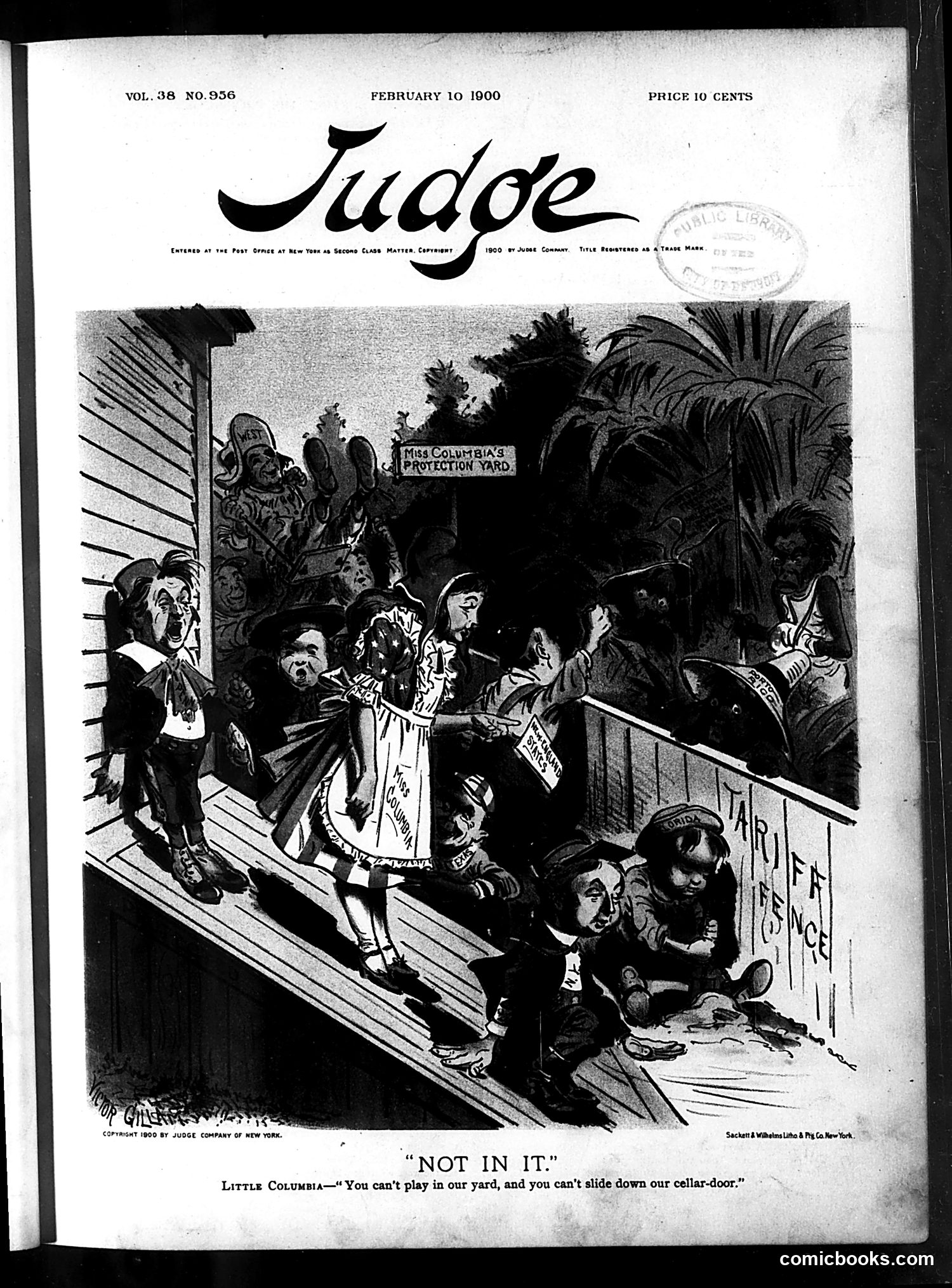
This political cartoon satirizes American isolationism regarding the Boer War in South Africa. "Little Columbia" (representing the United States, shown as a child) is excluded from a yard where adult figures—apparently representing European powers—are engaged in conflict over South Africa. The caption, "You can't play in our yard, and you can't slide down our cellar-door," uses playground language to mock America's exclusion from imperial competition in Africa. The "Miss Columbia's Protection Yard" sign suggests the U.S. attempts self-imposed neutrality and protection from Old World entanglements. The cartoon critiques either American isolation or European rejection of U.S. involvement in colonial affairs, depending on perspective. The artist is Cesare Biseo (signature visible).
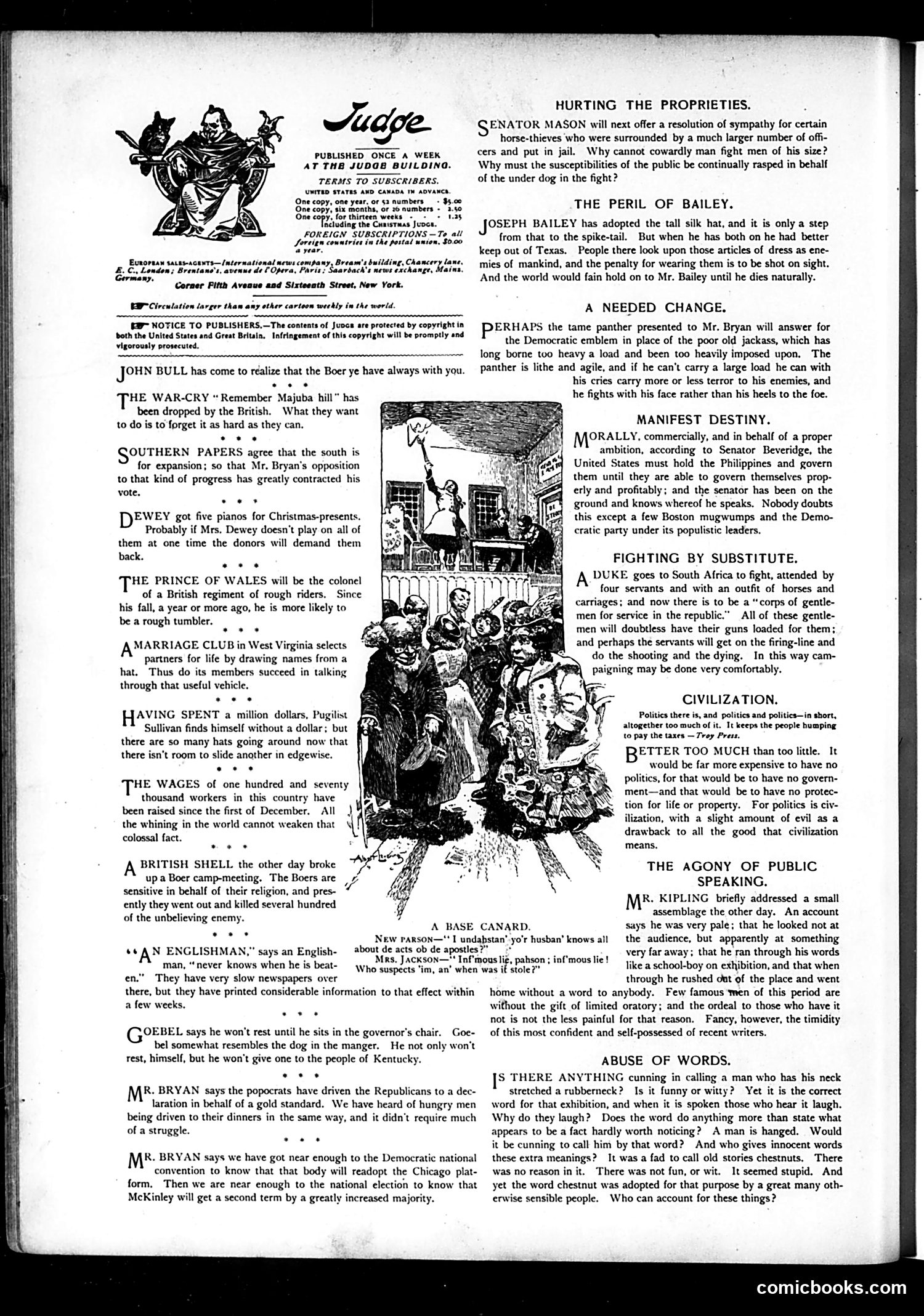
This page contains multiple brief political commentary pieces rather than a single cartoon. The central illustration depicts a chaotic street scene with multiple figures in apparent conflict or disturbance. Key articles reference: - **Senator Mason** offering sympathy resolutions for jailed officers - **Joseph Bailey** adopting a tall silk hat (likely mocking his pretensions) - **Bryan** and Democratic politics regarding the Philippines - **Dewey** receiving pianos as Christmas gifts - British colonial governance and the Boer War ("Majuba bill") The "Base Canard" section discusses local New York politics. Overall, the page satirizes prominent politicians of the era (likely early 1900s) through brief jabs at their perceived hypocrisy, vanity, or political positions. Without clearer context on specific events, precise political meanings remain partially unclear, though the tone is consistently mocking.
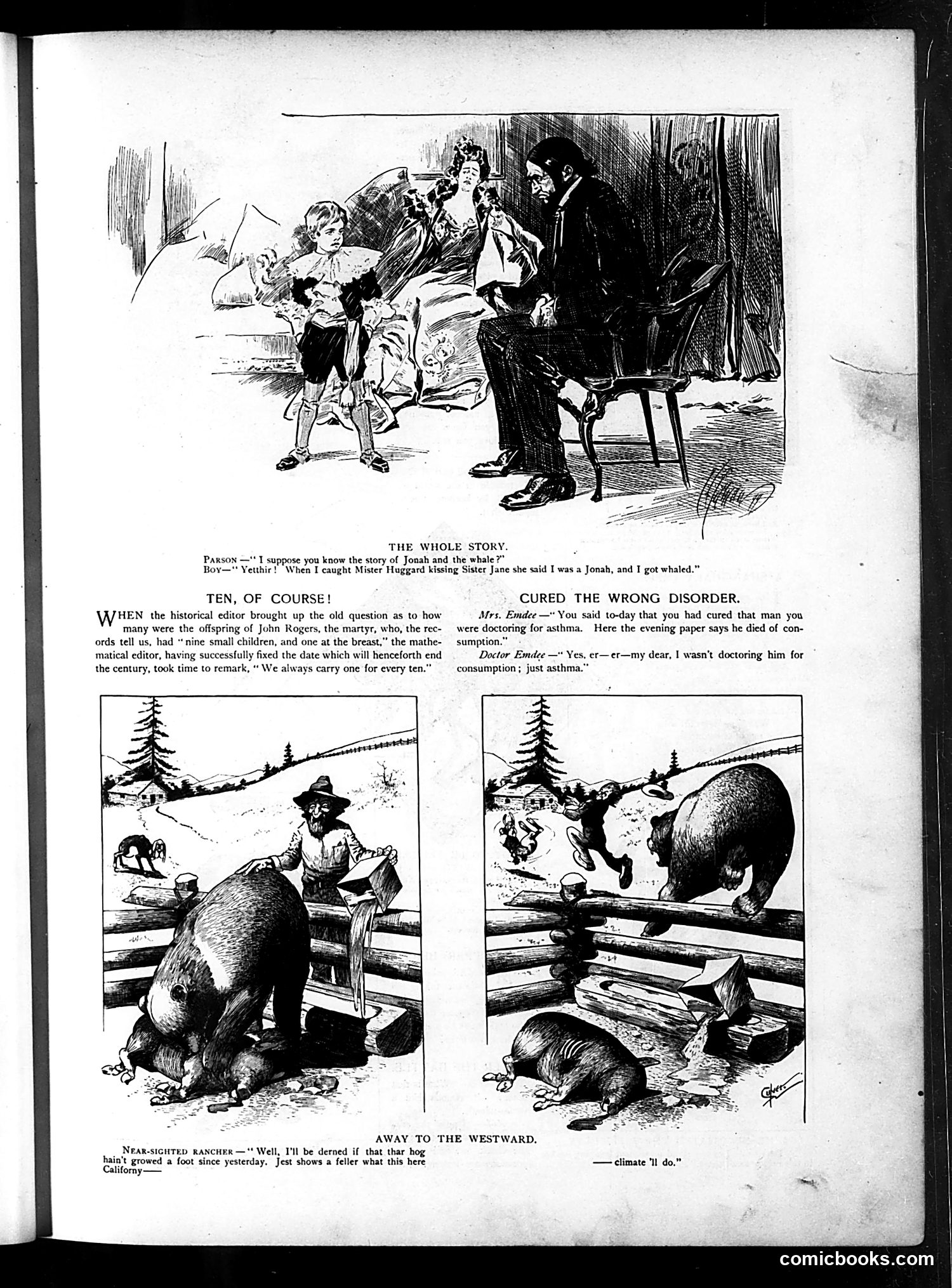
This page contains three distinct satirical pieces: **"The Whole Story"** (top): A domestic scene where a parson relates how he mistakenly told Miss Haggard she resembled Jonah when catching her fishing. The joke plays on the biblical whale story. **"Ten, of Course!"** (middle): A dialogue satirizing a historical editor's arbitrary decision to date John Rogers' martyrdom by always adding "one for every ten"—mocking pedantic historical methodology and editorial guesswork. **"Away to the Westward"** (bottom, two panels): A slapstick sequence showing a near-sighted rancher with a hog, culminating in the animal escaping. The humor derives from physical comedy and frontier mishap. The page exemplifies Judge's typical mix of domestic humor, intellectual satire, and visual gags aimed at educated, urban readers of the Gilded Age era.
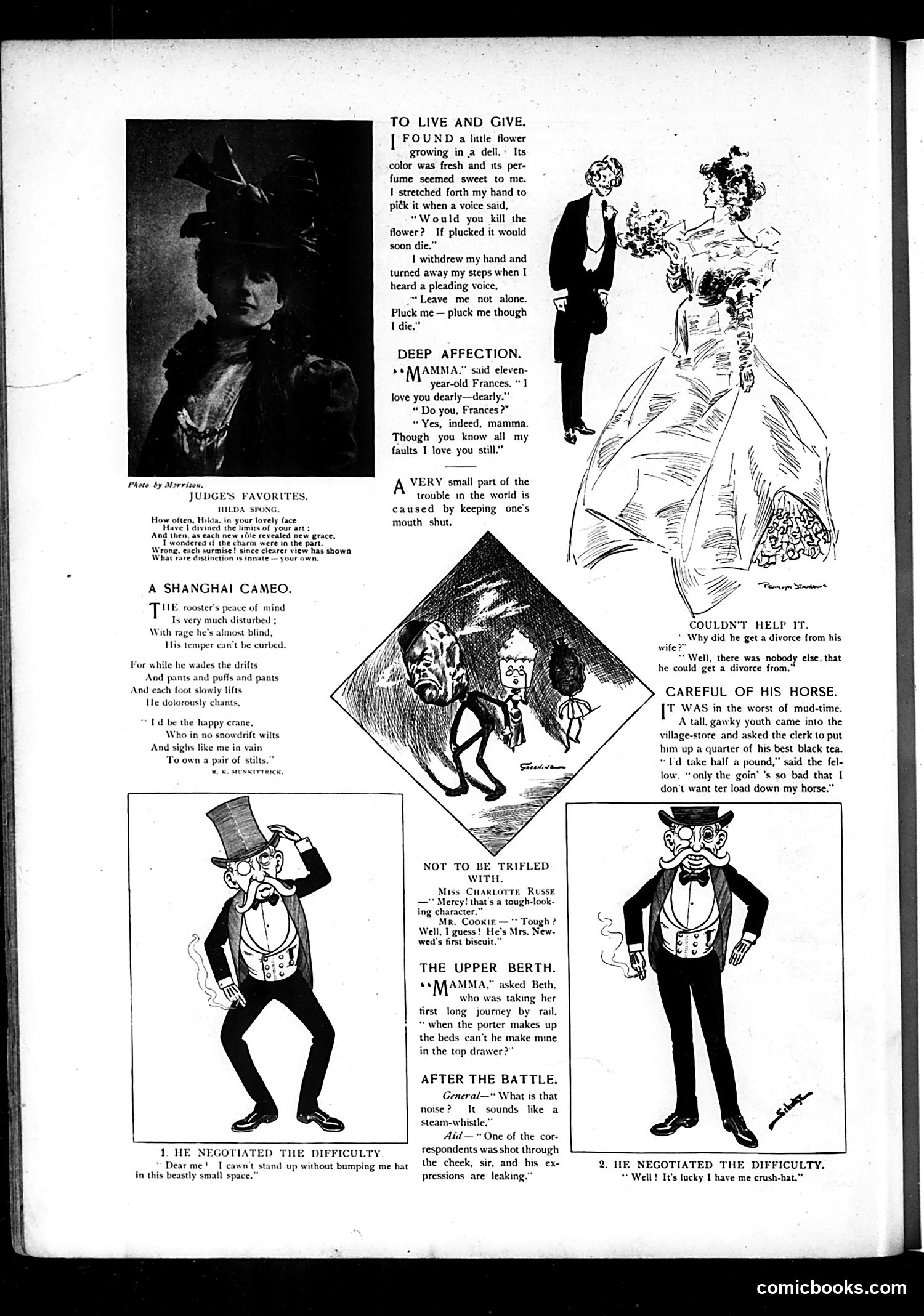
This page from *Judge* magazine presents humor sketches about domestic and social situations typical of early 20th-century life. The cartoons mock various social anxieties: "To Live and Give" satirizes sentimentality about flowers and relationships; "Deep Affection" jokes about a child's conditional love for her mother; "A Shanghai Cameo" appears to reference colonial life; "Couldn't Help It" concerns divorce; "Careful of His Horse" mocks a poor man's misplaced priorities (valuing his horse over his wife); and "The Upper Berth" satirizes railway travel discomforts. The sketches labeled "He Negotiated the Difficulty" (appearing twice) suggest comedic solutions to embarrassing social situations—one involving cramped quarters, another involving a hat (likely concealing an injury). The humor relies on class commentary and domestic absurdities rather than specific political references.
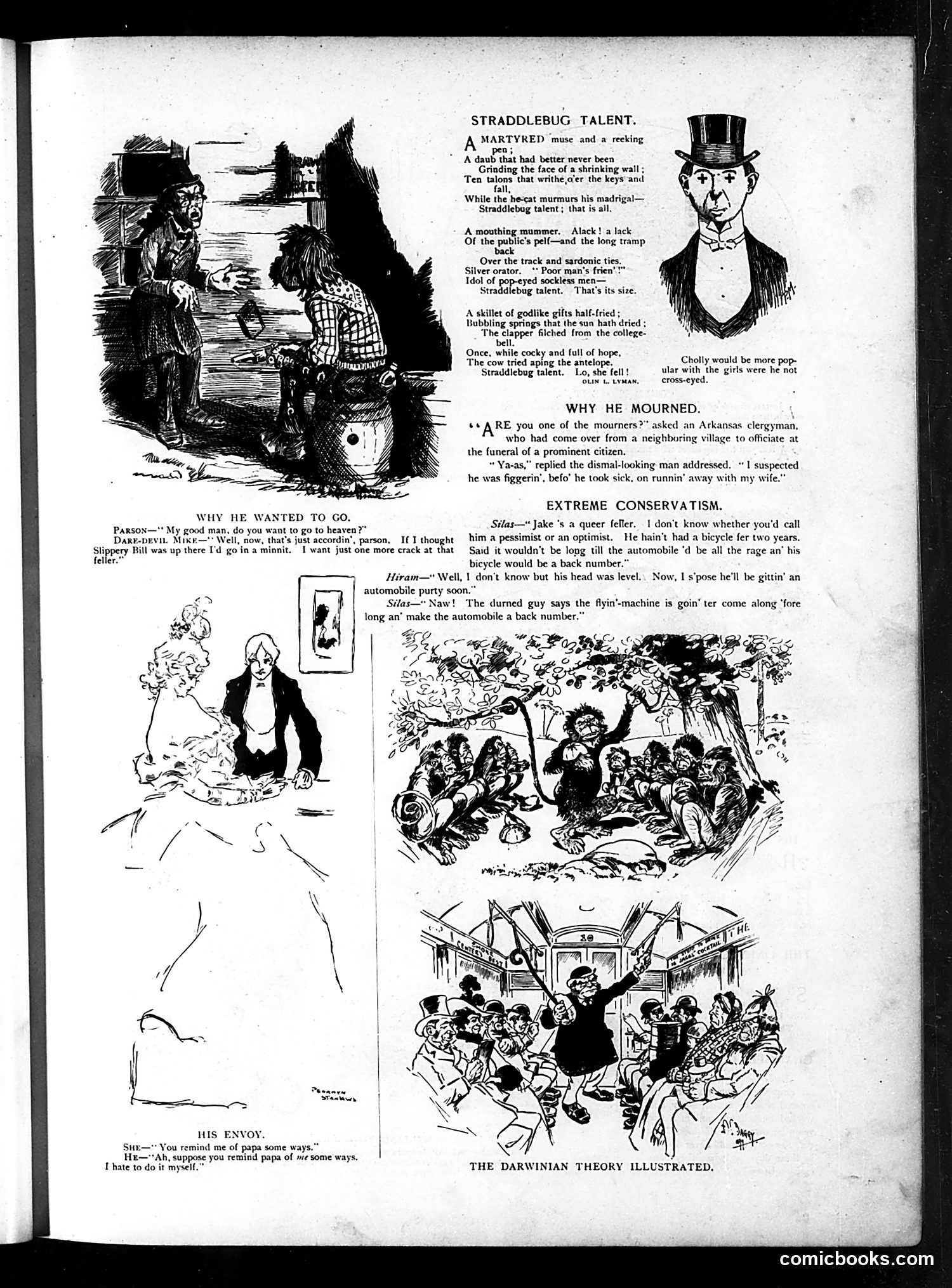
This page contains several unrelated humorous pieces typical of Judge magazine's satirical style: **"Straddlebug Talent"** mocks mediocre artistic pretension—the "straddlebug" represents someone attempting grand artistic expression (poetry, painting, music) but lacking genuine talent, just going through the motions. **"Why He Wanted to Go"** presents a darkly comedic rural dialogue where a man wants heaven partly to escape an unwanted rival—likely a cuckolding scenario played for laughs. **"Why He Mourned"** uses similar rural dialect humor, with a man suspecting the deceased was planning to run off with his wife. **"Extreme Conservatism"** satirizes excessive caution about new technology: a character so pessimistic about automobiles being replaced by flying machines that he won't adopt either innovation—mocking technological anxiety and paralysis. **"The Darwinian Theory Illustrated"** (bottom cartoon, unclear context) appears to reference evolutionary theory through some social observation. The material reflects early-20th-century American humor: rural/dialect comedy, technology anxiety, marital infidelity jokes, and artistic pretension mockery were Judge's stock subjects.
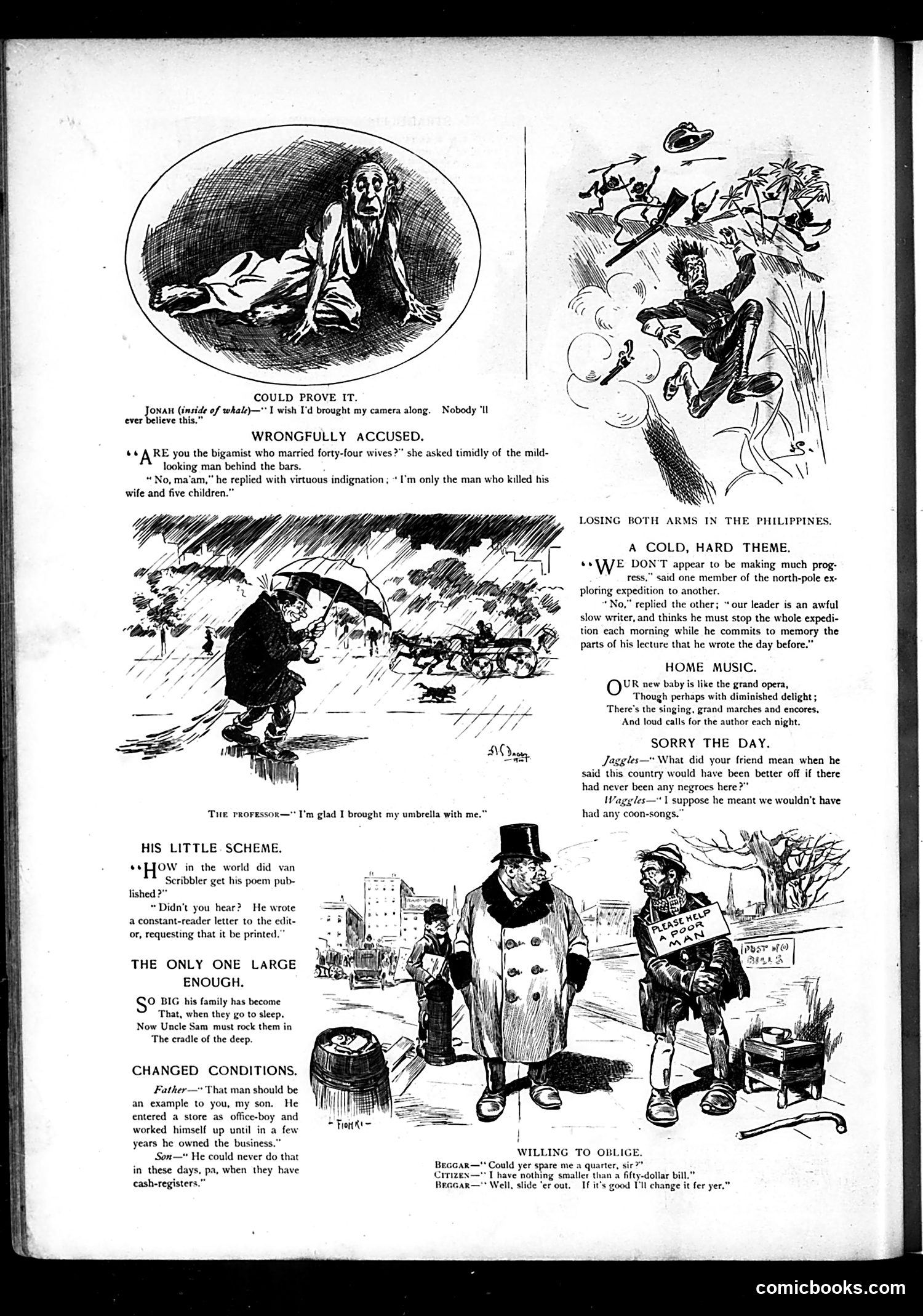
This page collects several brief satirical jokes and cartoons typical of Judge's humor: **"Wrongfully Accused"** mocks judicial injustice—a man accused of bigamy protests he's merely a murderer of his wife and children, as if that's a *better* crime. **"Losing Both Arms in the Philippines"** satirizes the ongoing Philippine-American War (post-1898), criticizing an expedition leader who delays progress by constantly stopping to write and memorize lecture material rather than focus on the mission. **"Sorry the Day"** uses racist humor (common to the era) suggesting African Americans' only cultural contribution is "coon-songs." **"His Little Scheme"** jokes about vanity publishing—a man gets his poem printed by writing a fake reader letter praising himself. **"The Only One Large Enough"** uses "Uncle Sam" (America) as metaphor: the nation has grown so large it requires a crib "of the deep" (ocean)—possibly referencing territorial expansion. Other items mock family life, Arctic exploration, and economic mobility. The page reflects Judge's mix of political commentary and light social satire.
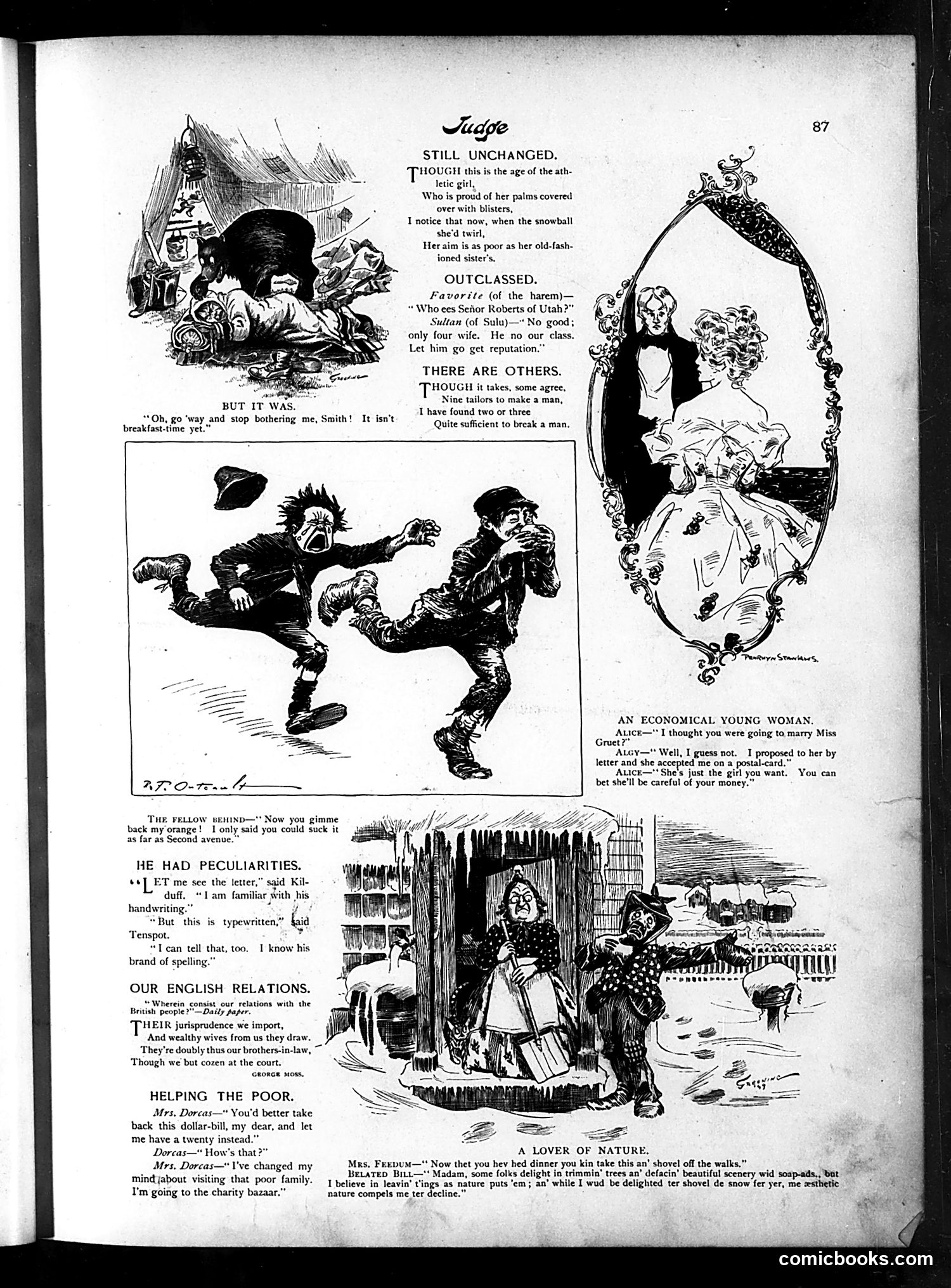
This page collects short satirical pieces mocking contemporary social trends and stereotypes: **"Still Unchanged"** jokes that despite the "athletic girl" craze of the era, women's athletic abilities haven't actually improved—their snowball aim remains poor. **"Outclassed"** references the Sultan of Sulu (Philippines), suggesting that even colonial subjects view Americans as socially inferior; the Sultan dismisses a Utah man (Roberts) for having only four wives. **"There Are Others"** plays on the saying "it takes nine tailors to make a man," suggesting just two or three tailors suffice to destroy one—likely referencing social-climbing tailors or fraudulent tailors. **"An Economical Young Woman"** satirizes women's penny-pinching; she accepts a marriage proposal via postal card to save money, suggesting she'll obsessively guard the husband's finances. Other pieces mock English relations, poverty charity, and Irish immigrant laborers resisting work. The humor relies on period stereotypes about class, nationality, and gender roles.
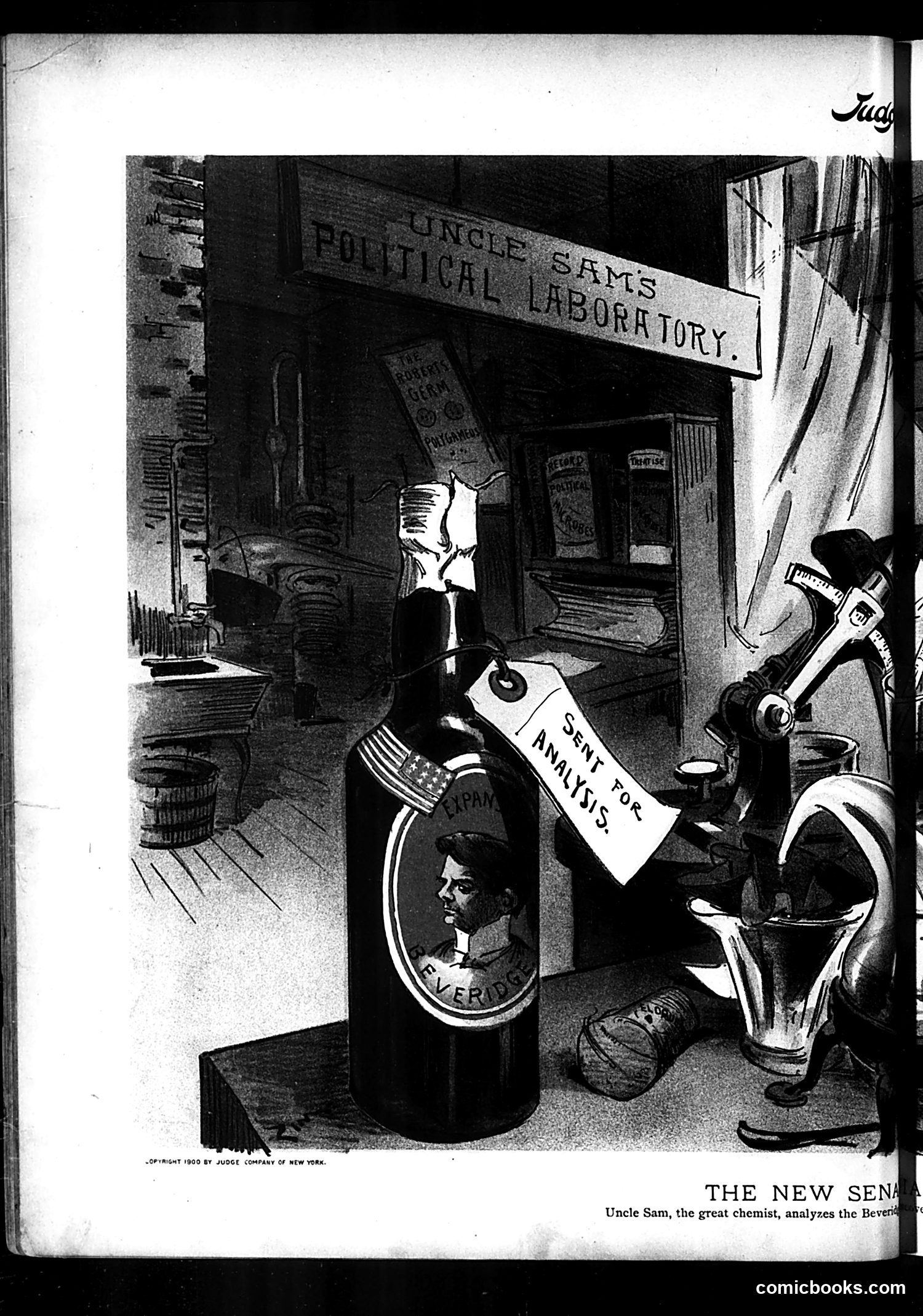
This cartoon satirizes American politics through a chemistry metaphor. Uncle Sam, personified as a chemist, analyzes "the Beverage"—likely referring to a political figure or policy of 1900. The laboratory setting (labeled "Uncle Sam's Political Laboratory") suggests scientific scrutiny of political matters. The bottle labeled "Beveridge" appears to reference a specific political figure or proposal under examination. The setup implies Judge magazine is critiquing how politicians or their policies are being evaluated or "analyzed" by the American public or government. The cartoon's tone suggests skepticism about political figures or initiatives of the era, using the chemistry metaphor to suggest rigorous public scrutiny or judgment of political "substances."
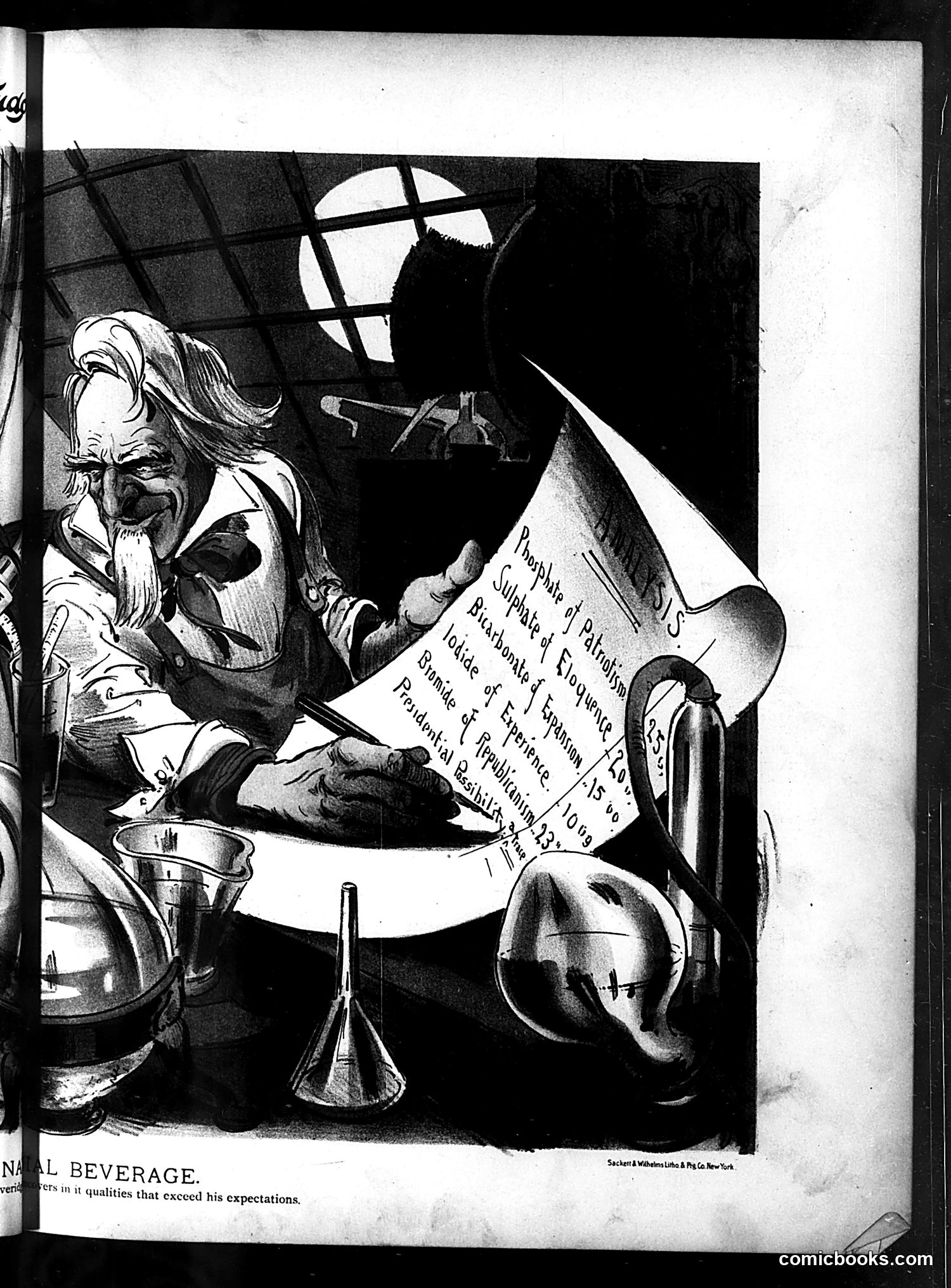
This appears to be a satirical cartoon about alcohol consumption, likely from the Prohibition era or debates surrounding it. The image depicts an elderly, bearded man examining what looks like a bottle or document listing various alcoholic beverages ("Beer," "Whisky," "Bourbon," and other drink types are visible on the scroll he holds). The cartoon's title references "vital beverage," using ironic language to comment on alcohol's perceived importance to certain demographics. The disheveled appearance and exaggerated facial features suggest mockery of those who considered alcohol essential. The glass and drinking implements visible reinforce the beverage theme. Without the magazine's date clearly visible, the specific political context remains unclear, but this satirizes attitudes toward drinking and alcoholism among a particular social group.
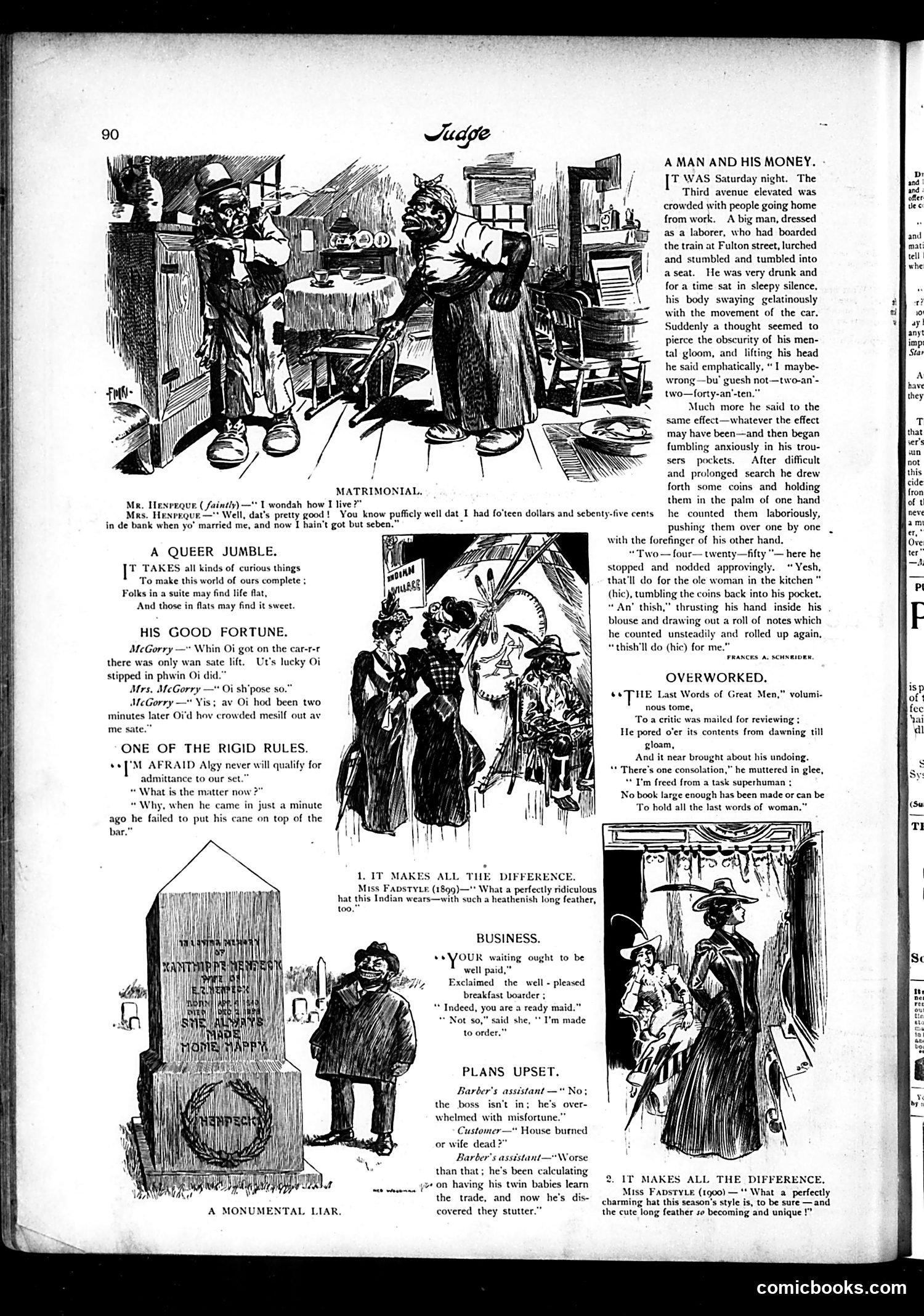
This page contains multiple short satirical sketches typical of Judge's format, mocking contemporary social customs and gender dynamics: **"A Man and His Money"** depicts a drunk laborer on the elevated train carefully dividing his wages—some for "the ole woman in the kitchen," the rest for himself—illustrating working-class attitudes toward domestic finances and marital inequality. **"Matrimonial"** and **"His Good Fortune"** feature Irish immigrant characters (indicated by dialect spelling), poking fun at working-class struggles and luck. **"One of the Rigid Rules"** satirizes upper-class social pretension—the rigid etiquette requirement of placing one's cane atop the bar. **"It Makes All the Difference"** (appearing twice) mocks the hypocrisy of fashion-conscious women: identical feathered Indian headdresses are deemed "ridiculous" and "heathenish" in 1899 but "charming" and "unique" by 1900, purely because fashion changed. The page reflects Judge's focus on class commentary, immigrant stereotyping, and critiques of feminine superficiality—typical of late 19th-century American satire.
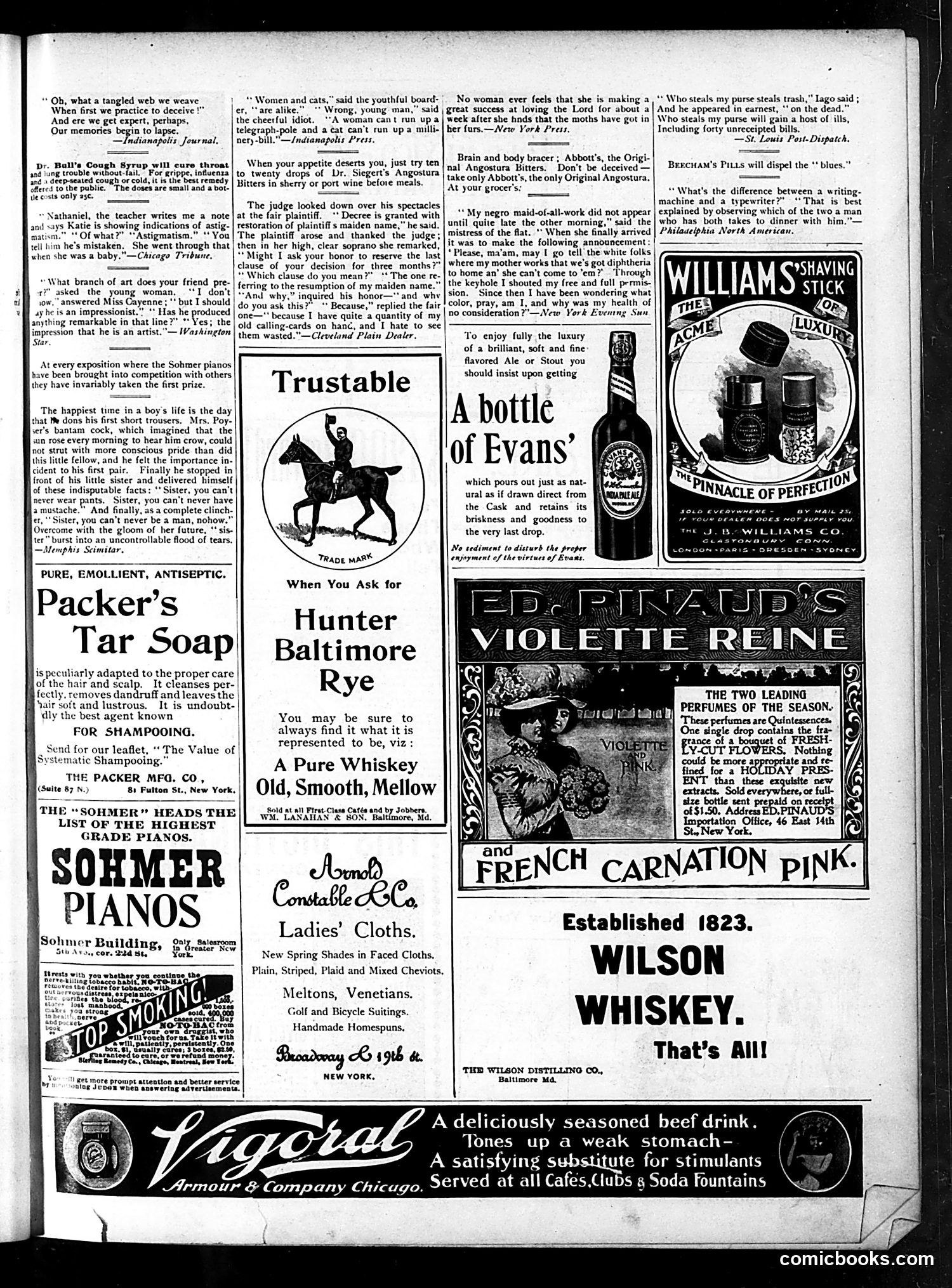
This page from *Judge* magazine contains satirical text pieces and advertisements rather than a traditional political cartoon. The central content consists of three humorous anecdotes: 1. **The astigmatism joke**: A parent misunderstands the medical term "astigmatism" as something their child already experienced, confusing it with a commonplace childhood occurrence. 2. **The impressionist joke**: A play on the word "impression" — a character is called an "impressionist" artist, but the punchline reveals he merely makes a false impression of being an artist. 3. **The judge's decree anecdote**: A newly divorced woman asks the judge to delay finalizing her maiden name restoration so she can use up old calling cards with her married name. The humor throughout relies on wordplay and social commentary about marriage and propriety rather than overt political satire. The surrounding advertisements promote period consumer goods (pianos, whiskey, soap) typical of early 20th-century publications.
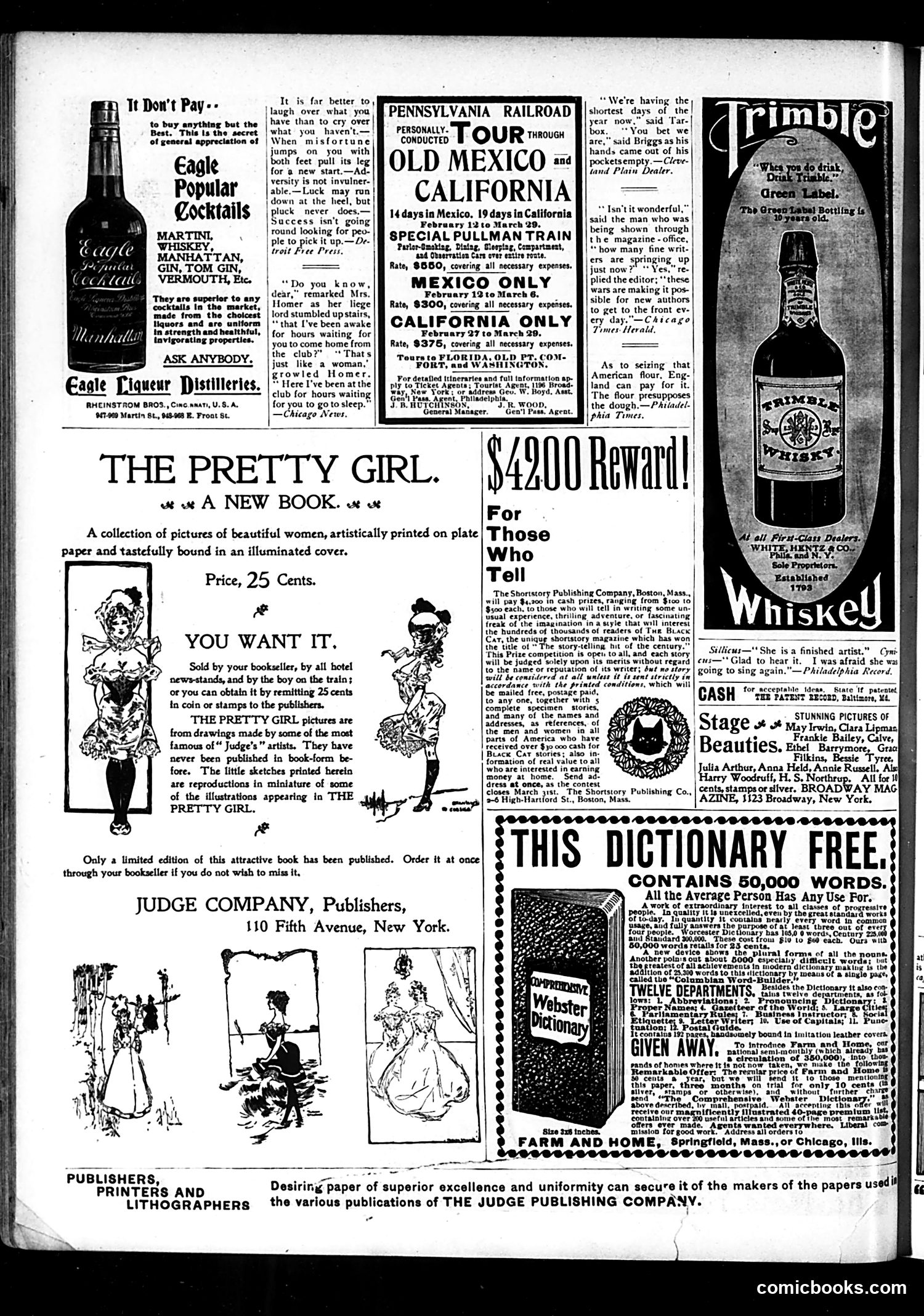
This page is primarily **advertising and promotional content** rather than political satire or comics requiring historical context. The visible elements include: **Advertisements:** - Eagle Popular Cocktails (liquor) - Trimble Whiskey - Pennsylvania Railroad tours to Mexico and California - "The Pretty Girl" book (25¢ collection of female portraits) - A $4,200 reward offer from Shortstory Publishing Company for submitted stories - "Master Dictionary" (50,000 words) promotional offer - "Stage Beauties" theatrical imagery **Brief Humor Items:** Small comic anecdotes appear scattered throughout (the "It Don't Pay" column, Homer returning late from the club), but these are generic domestic humor rather than political satire. **No identifiable political figures or cartoons** are present on this page. It represents typical early 20th-century magazine layout: satirical writing mixed with period advertisements for liquor, travel, books, and promotional contests—reflecting common commercial practices of the era.
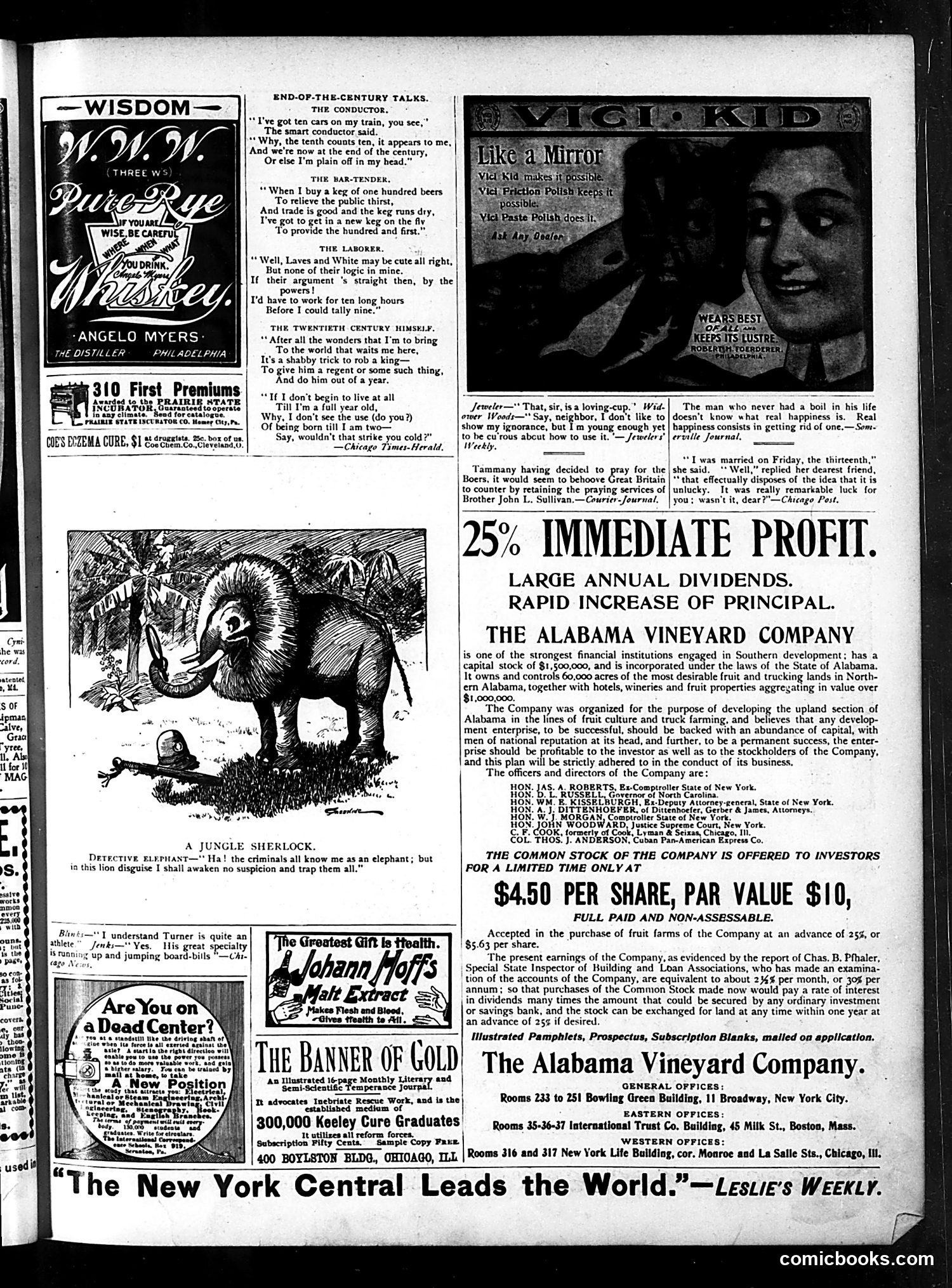
This page contains several short satirical pieces mocking "end-of-the-century" logic puzzles (apparently a popular form around 1900). **"End-of-the-Century Talks"** features four characters—a conductor, bartender, laborer, and "the Twentieth Century Himself"—who present deliberately flawed arithmetic to mock muddled thinking about the century's transition. For example, the conductor counts ten train cars but insists the tenth car represents a "tenth" count, leading to confusion about whether the century ends at 99 or 100. **"A Jungle Sherlock"** shows a detective elephant disguised as a lion to catch criminals, a straightforward joke about mistaken identity. The remaining content is mostly **advertising** (whiskey, patent medicines, and investment schemes), with brief humorous anecdotes interspersed. The page reflects Judge's blend of satirical commentary on contemporary confusion about the new century with commercial advertisements.
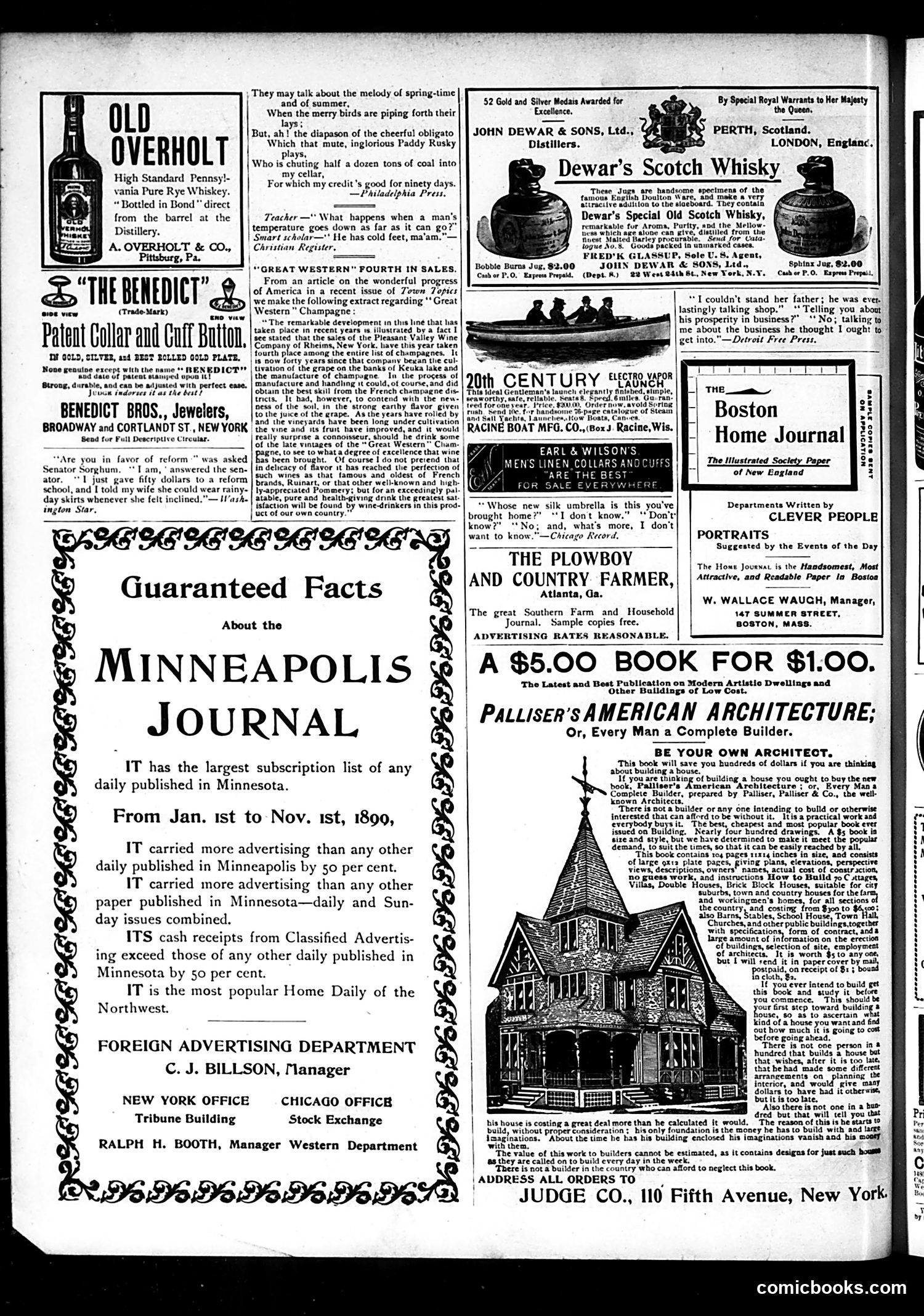
This page is primarily **advertising and promotional content** rather than political satire or comics. The main editorial cartoon appears at the top left: a brief, gentle joke about "Old Overholt" whiskey, contrasting the "melody of spring-time" birdsong with an Irish laborer ("Paddy Rusky") noisily shoveling coal into a cellar—a class-based humor playing on stereotypes of Irish workers and working-class noise versus refined aesthetics. The bulk of the page consists of **product advertisements**: whiskey (Dewar's Scotch, Old Overholt), jewelry (Benedict Bros.), architecture books, and champagne. There's also a small joke about a teacher asking what happens when temperature drops ("He has cold feet"), and a brief marriage joke about a husband discussing business. The "Guaranteed Facts About the Minneapolis Journal" section is self-promotion by the publication itself, claiming superior circulation and advertising revenue. Overall, this is a **typical Judge magazine layout**—mixing light humor with extensive advertising—rather than substantive political or social commentary.
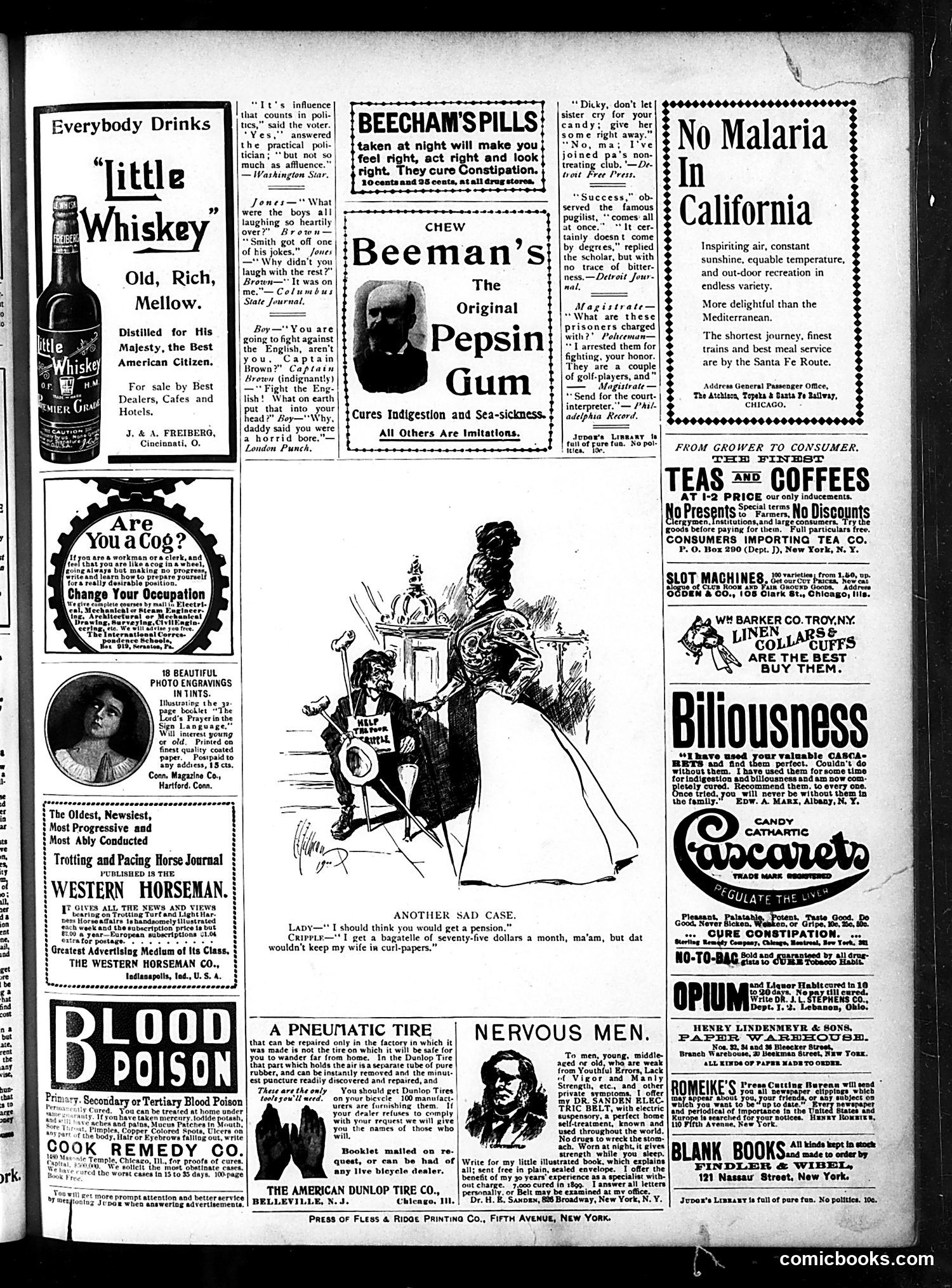
This page is primarily **advertising**, typical of early 1900s publications. The central cartoon—labeled "Another Sad Case"—depicts a wealthy woman dismissing a pension-seeking man, illustrating economic class disparity. She offers him a "bagatelle" (trinket) of seventy-five dollars monthly, which she considers meager while remaining indifferent to his hardship. The surrounding advertisements reveal period concerns: patent medicines (Beecham's Pills for constipation, Cascalets for billiousness), dubious remedies (blood poison "cure"), and occupational advice promising escape from manual labor. A California tourism ad promotes health benefits—reflecting the era's belief in climate as cure-all. The satirical content critiques economic inequality and the era's reliance on quack medicines and get-rich-quick schemes. The "Are You a Cog?" ad's promise to help workers "change your occupation" ironically highlights workers' desperation for advancement in industrial America. Overall, this reflects Gilded Age anxieties about class, health, and economic mobility.
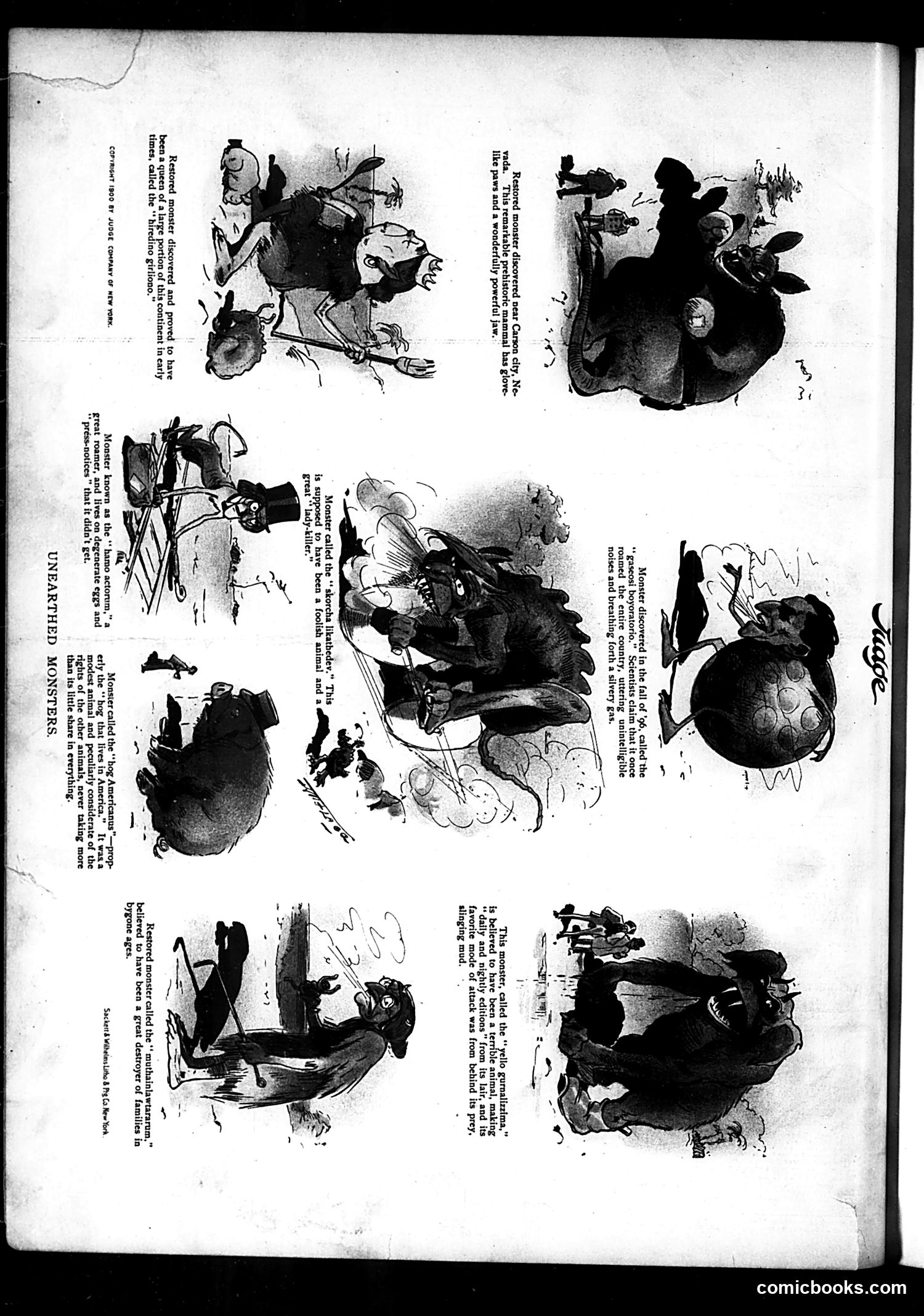
This is a mock-scientific cartoon mocking contemporary American figures and industries through fake "prehistoric monster" discoveries near Carson City, Nevada. Each "restored monster" is actually a caricature of contemporary social types: - **"Hired-ino Girliono"**: likely references chorus girls or actresses exploiting their fame - **"Hamo Actorum"**: the ham actor—a mediocre performer living on press notices he didn't deserve - **"Hog Americanus"**: a self-centered businessman hoarding resources - **"Yello Gurnalizzima"**: yellow journalism—sensationalist newspapers making multiple daily editions and attacking rivals with mudslinging - **"Muthainlawtararum"**: mother-in-law figure, a stock character blamed for destroying families The satire ridicules contemporary vices (sensationalism, greed, ham acting, family interference) by presenting them as extinct monster species—suggesting these social problems are prehistoric relics that should be dead but persist.