
A complete issue · 16 pages · 1899
Judge — December 2, 1899
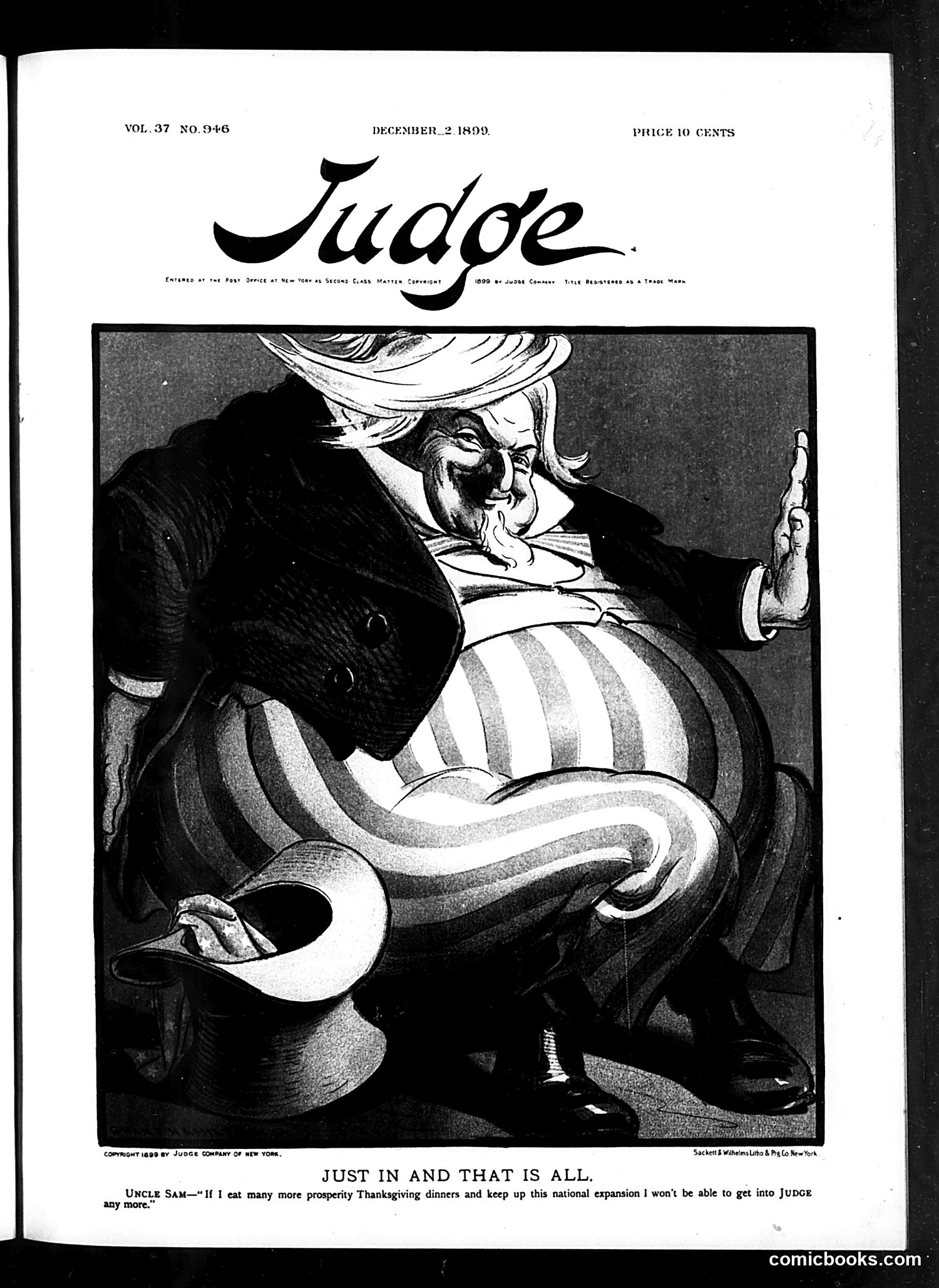
This December 2, 1899 **Judge** cartoon depicts Uncle Sam—identifiable by his characteristic tall hat and goatee—struggling with an enormously swollen belly marked with horizontal stripes (representing the national treasury or budget). He holds a bottle, appearing distressed. The caption quotes Uncle Sam saying he cannot eat more prosperous Thanksgiving dinners while maintaining "national expansion" without going bankrupt. This satirizes the fiscal strain of American imperialism during the Spanish-American War era (1898) and subsequent territorial acquisitions. The bloated belly represents government spending on military expansion and overseas colonization draining national resources. The cartoon critiques the unsustainability of aggressive expansionist policies combined with domestic prosperity spending.
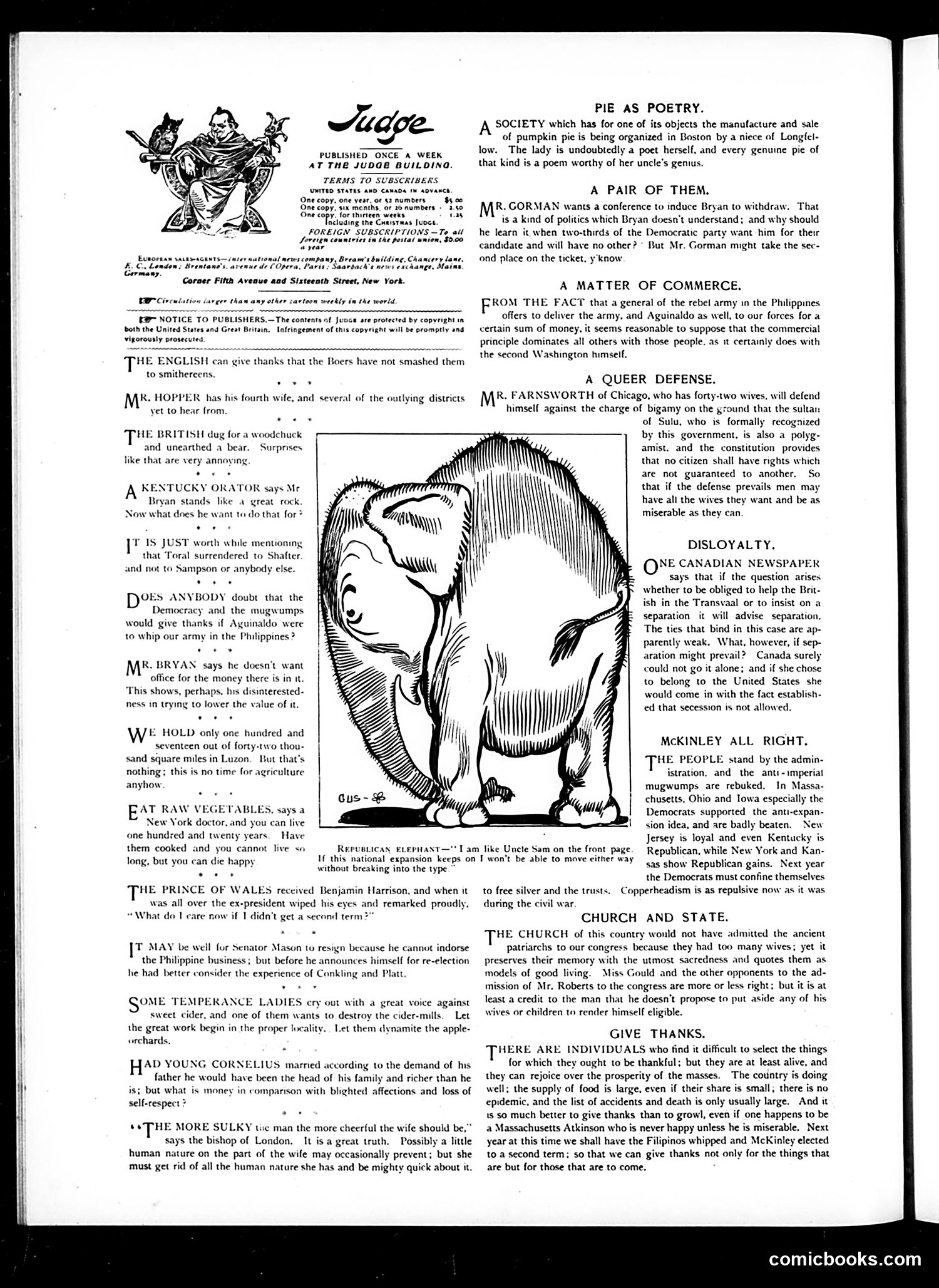
The main cartoon depicts an **elephant labeled "Republican elephant"** struggling to move forward, with a caption stating "I am like Uncle Sam on the front page. If this internal expansion keeps on I won't be able to move either way without breaking into the type." This appears to reference **Republican Party internal divisions** during the early 1900s, likely related to expansionist foreign policy debates. The elephant symbolizes the GOP, while the cramped positioning suggests the party felt constrained by competing factions—possibly between imperialist expansionism advocates and isolationists. The accompanying text items discuss Philippine politics, McKinley's administration, and church-state separation issues, confirming this page addresses early 20th-century American political conflicts over imperialism and domestic policy.
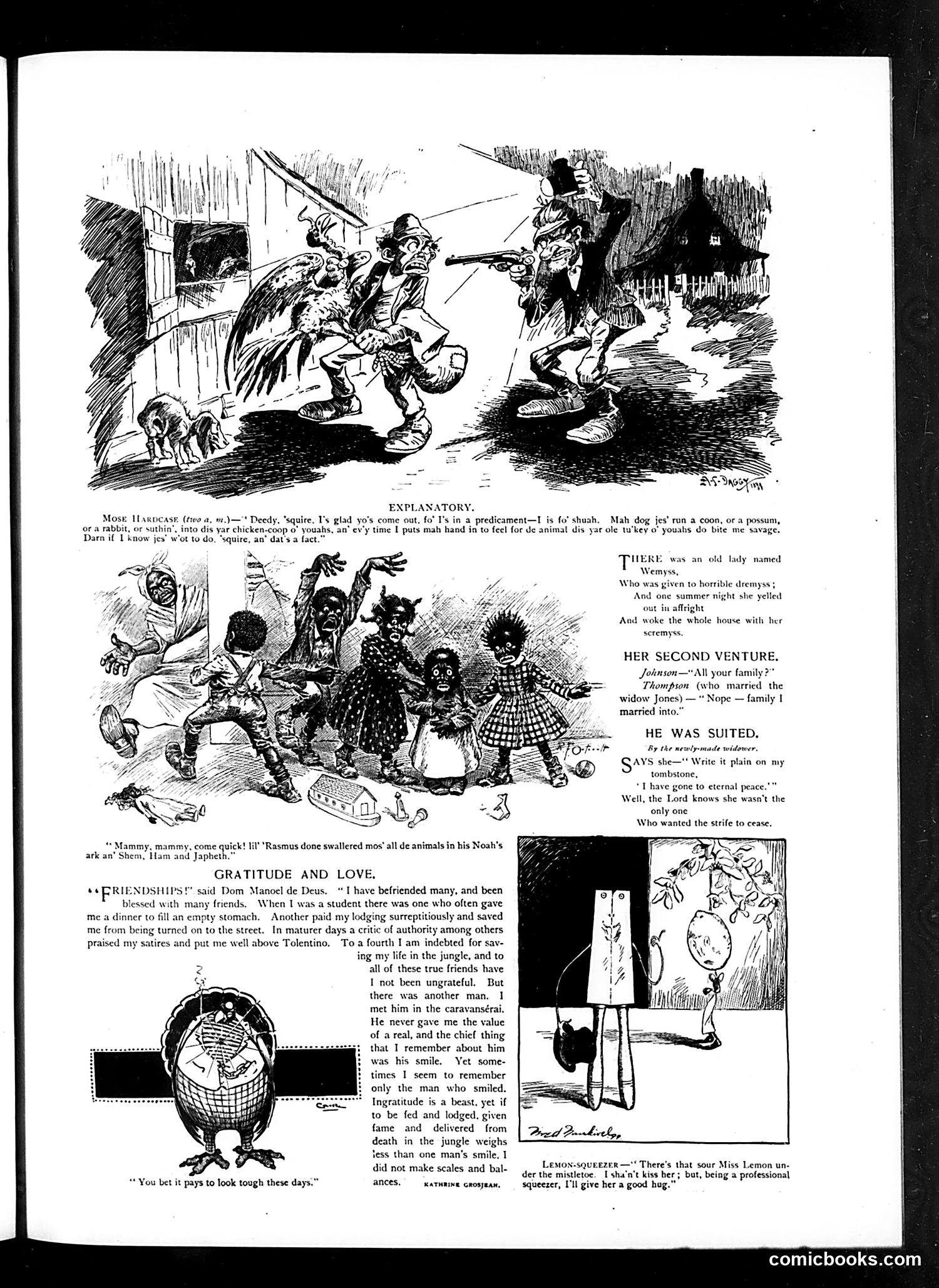
This page contains multiple satirical pieces rather than a single coherent political cartoon. The top illustration titled "EXPLANATORY" depicts what appears to be a confrontation involving caricatured figures with exaggerated features—likely ethnic stereotypes common to early satirical magazines—discussing animal behavior in crude dialect. Below are several short humorous anecdotes and verse pieces including "HER SECOND VENTURE," "HE WAS SUITED," and "GRATITUDE AND LOVE," which appear to be social commentary on relationships and character rather than political satire. The illustrations throughout use heavy cross-hatching in typical late 19th/early 20th-century style. Without specific historical context about when this issue was published or knowledge of Judge magazine's immediate editorial focus, I cannot identify specific political figures or events referenced with certainty.
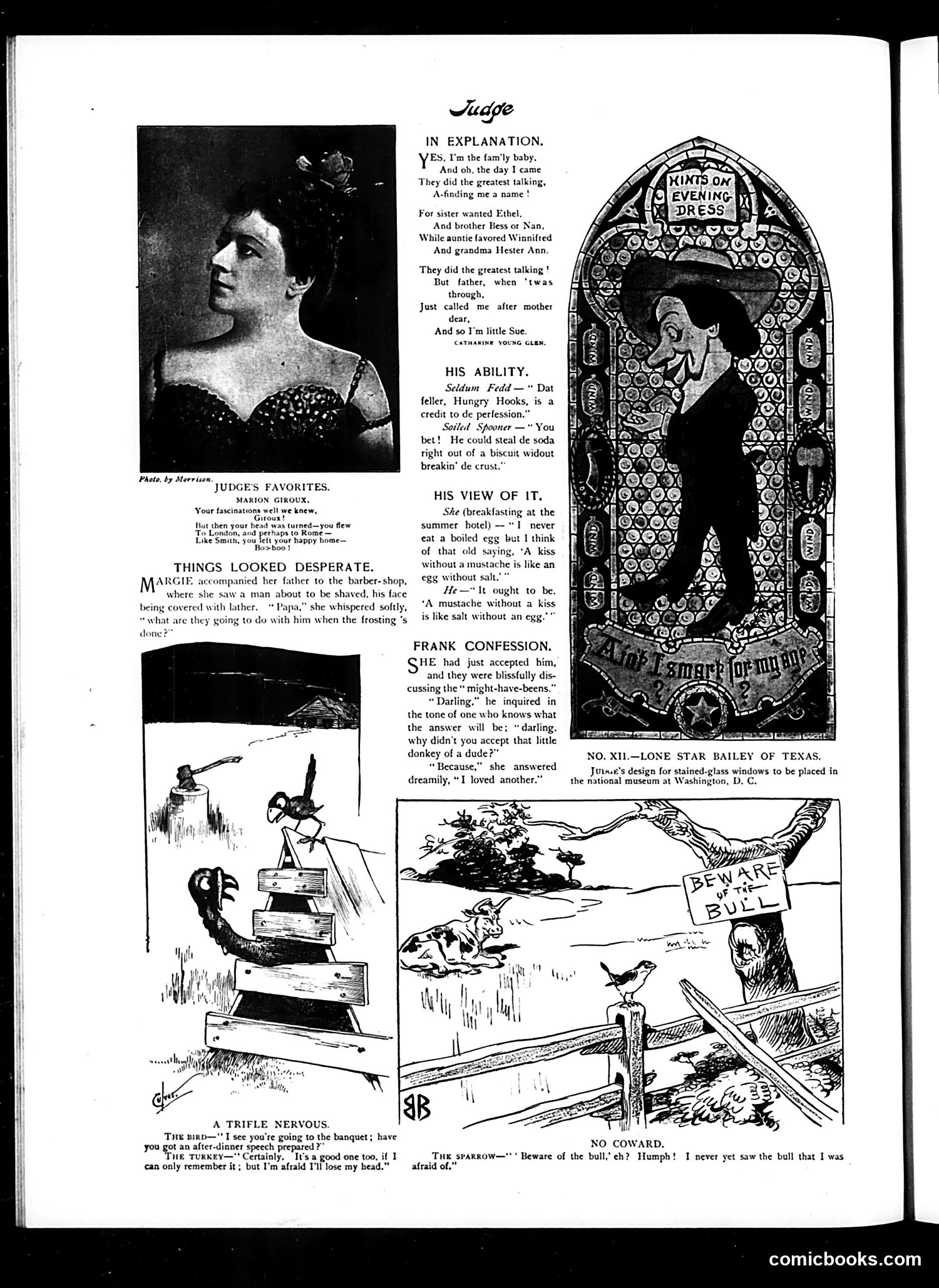
This page contains humor pieces and illustrations rather than political cartoons. The main content includes: **"Judge's Favorites"** — a portrait section of apparently notable figures with witty commentary about their characteristics. **Social humor sketches** — "Things Looked Desperate," "His Ability," "His View of It," and "Frank Confession" present domestic or social situations with humorous dialogue, likely poking fun at courtship customs and male-female relationships. **Two cartoon illustrations** at bottom: "A Triple Nervous" depicts someone anxious about attending a banquet, while "No Coward" shows a sparrow near a "Beware of the Bull" sign, making a joke about fearlessness. The overall tone is light social satire focused on manners, romance, and human foibles rather than political commentary. The stained-glass window advertisement for "Kinks on Evening Dress" occupies significant space.
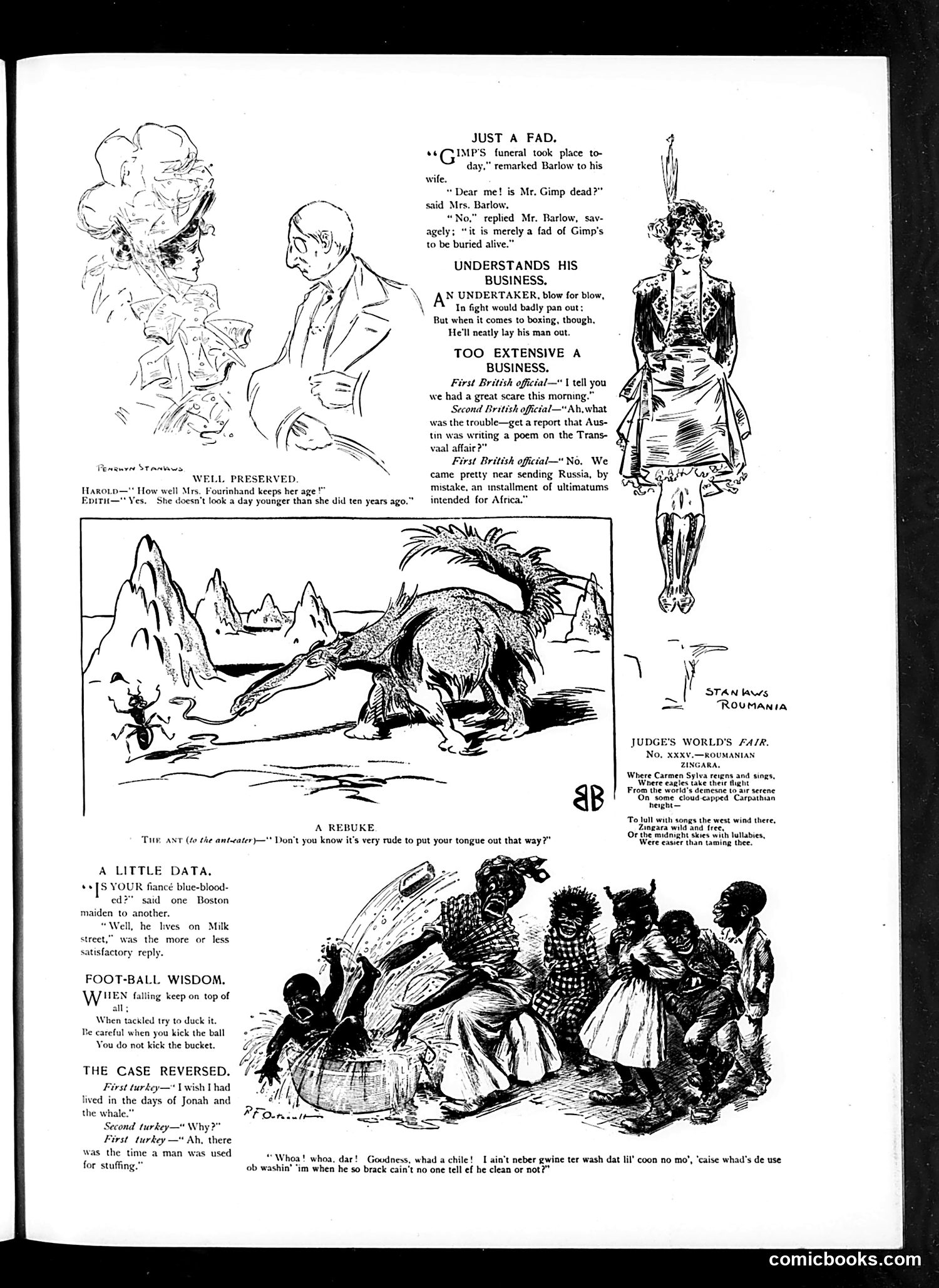
This page contains multiple brief satirical pieces typical of Judge's format: **"Just a Fad"** mocks the practice of being buried alive, presented as a trendy affectation rather than a genuine death. **"Understands His Business"** is a pun: an undertaker excels at "laying out" bodies, just as boxers do their opponents. **"Too Extensive a Business"** satirizes British colonial overreach during the Boer War era, joking that sending ultimatums (formal demands) to Africa was nearly confused with sending poetry about the Transvaal conflict—suggesting Britain's imperial interventions were becoming absurdly excessive. **"Judge's World's Fair"** celebrates Carmen Sylva (Queen Elizabeth of Romania), presenting her mountain realm romantically. The remaining items are brief quips on social pretension ("Well Preserved"), Irish-American stereotypes ("A Little Data"), and football humor. **The bottom illustration** depicts racist caricature with problematic dialect, reflecting the magazine's period prejudices. These pieces prioritize wordplay and light social mockery over serious political commentary.
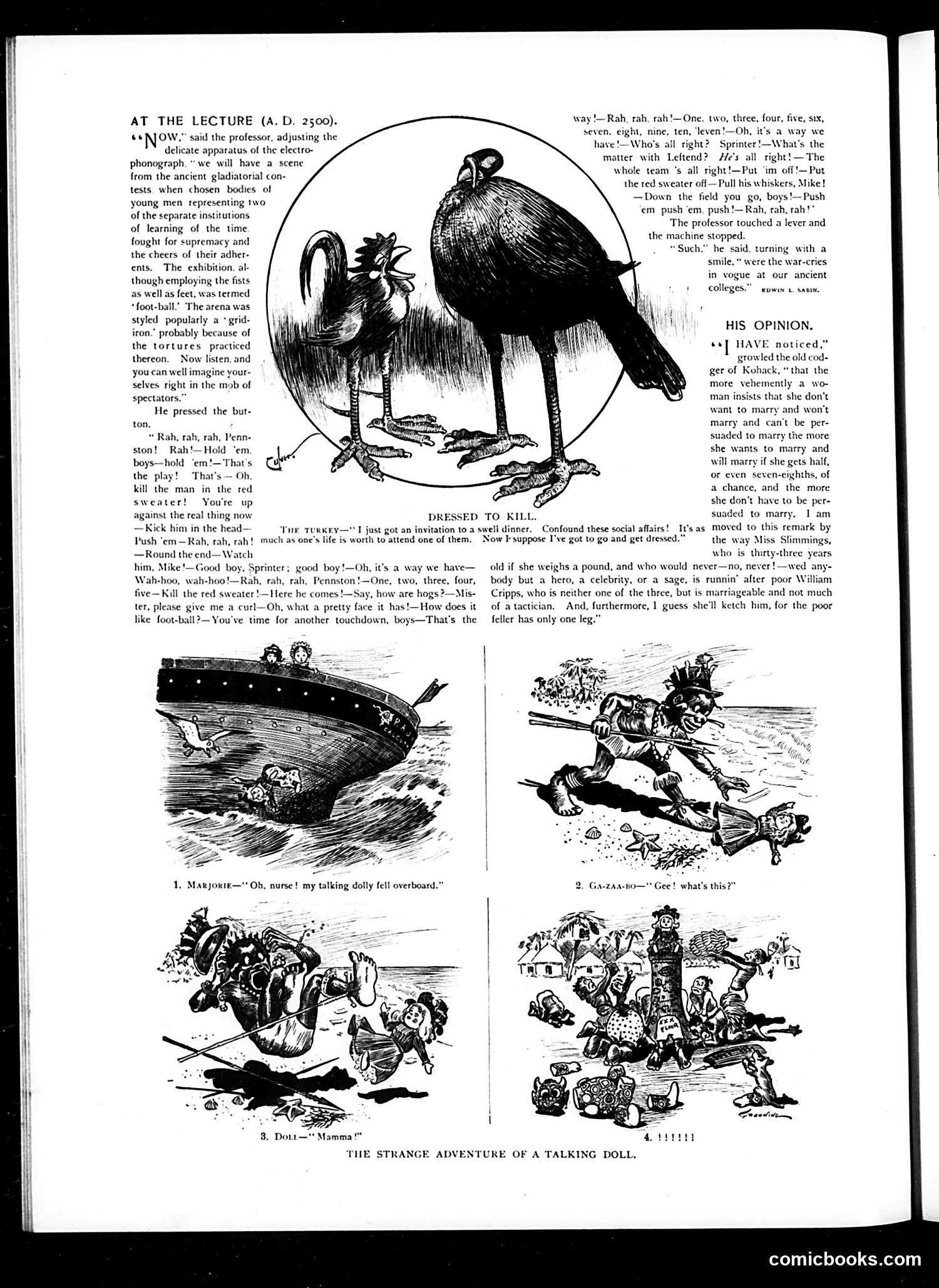
This page contains satirical commentary on American college football and courtship customs. **"At the Lecture (A.D. 2500)"** imagines a future professor playing a recording of a college football game as a historical artifact—treating violent, chaotic sports fandom as ancient barbarism. The satire mocks contemporary football's brutality (references to "kill the man," "kick him in the head") and the frenzied chanting of spectators, suggesting the sport is primitive and absurd. **"His Opinion"** presents a curmudgeonly character's cynical observation about women's marriage intentions: those who most vehemently claim they don't want to marry are actually most eager to do so. The specific example ridicules a thirty-three-year-old woman pursuing an ordinary, disabled man (with "only one leg") despite claiming to want only heroes or celebrities. Both sections use exaggeration and irony typical of *Judge* magazine's social criticism—mocking contemporary American institutions (athletics and courtship rituals) as foolish or hypocritical.
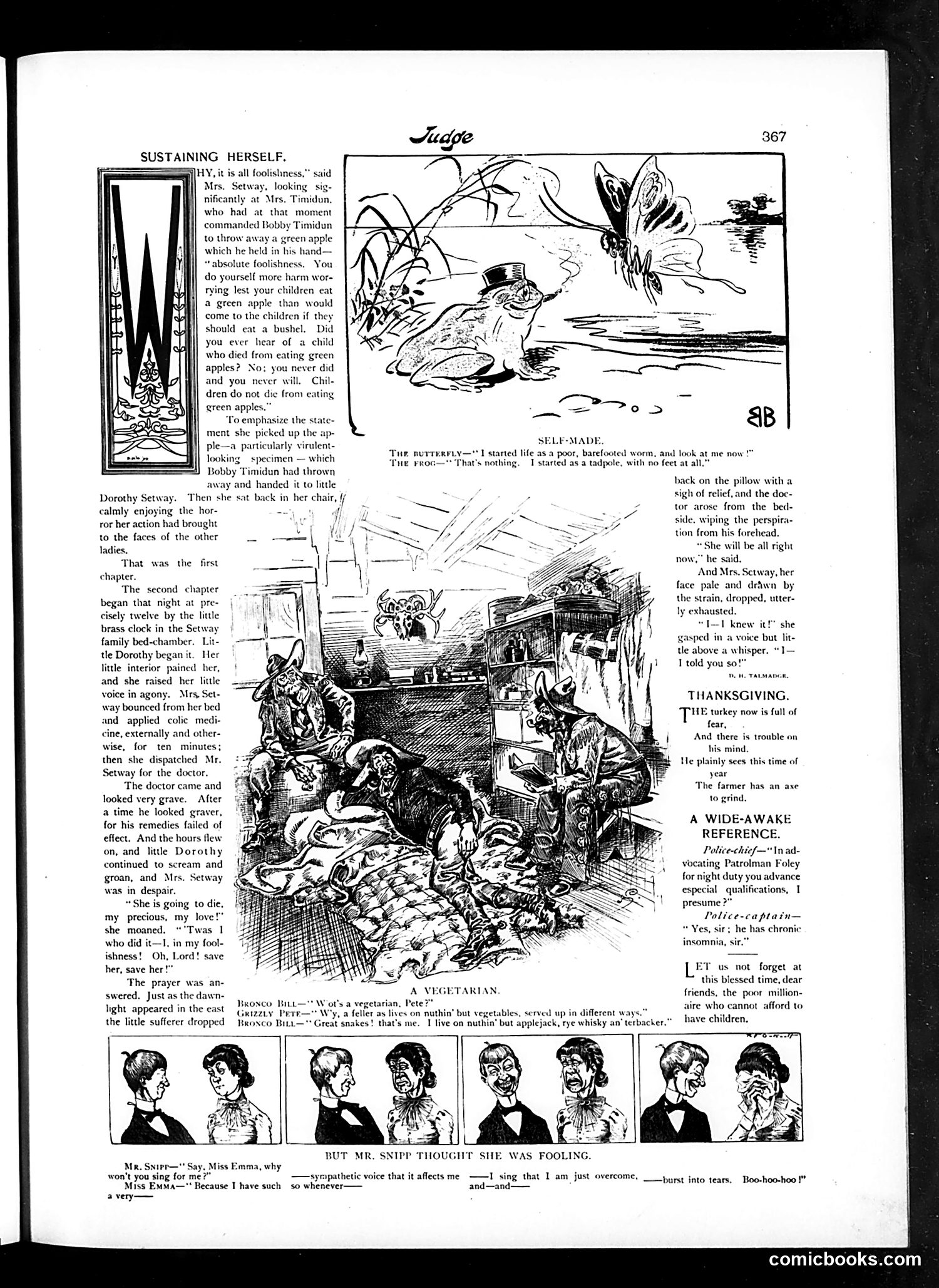
This page contains several satirical pieces mocking middle-class anxieties and social pretensions circa early 1900s. **"Sustaining Herself"** ridicules overprotective parenting. Mrs. Setway boasts that green apples don't harm children, then gives one to little Dorothy to prove it. The irony: Dorothy becomes gravely ill that night, forcing Mrs. Setway to frantically call a doctor. The satire targets parents who make reckless decisions to appear worldly while endangering their children. **"Self-Made"** shows a butterfly and frog in a boasting contest about overcoming humble origins—absurdist humor mocking the Victorian "self-made man" narrative. **"A Vegetarian"** presents characters discussing a man who claims to live only on vegetables but actually subsists on alcohol (applejack, rye whisky, tobacco)—satirizing health faddists and hypocrites. **"Wide-Awake Reference"** jokes about police nepotism, with a captain recommending an unqualified officer for night duty based on having "chronic insomnia." Throughout, Judge satirizes middle-class pretension, poor parental judgment, and institutional incompetence.
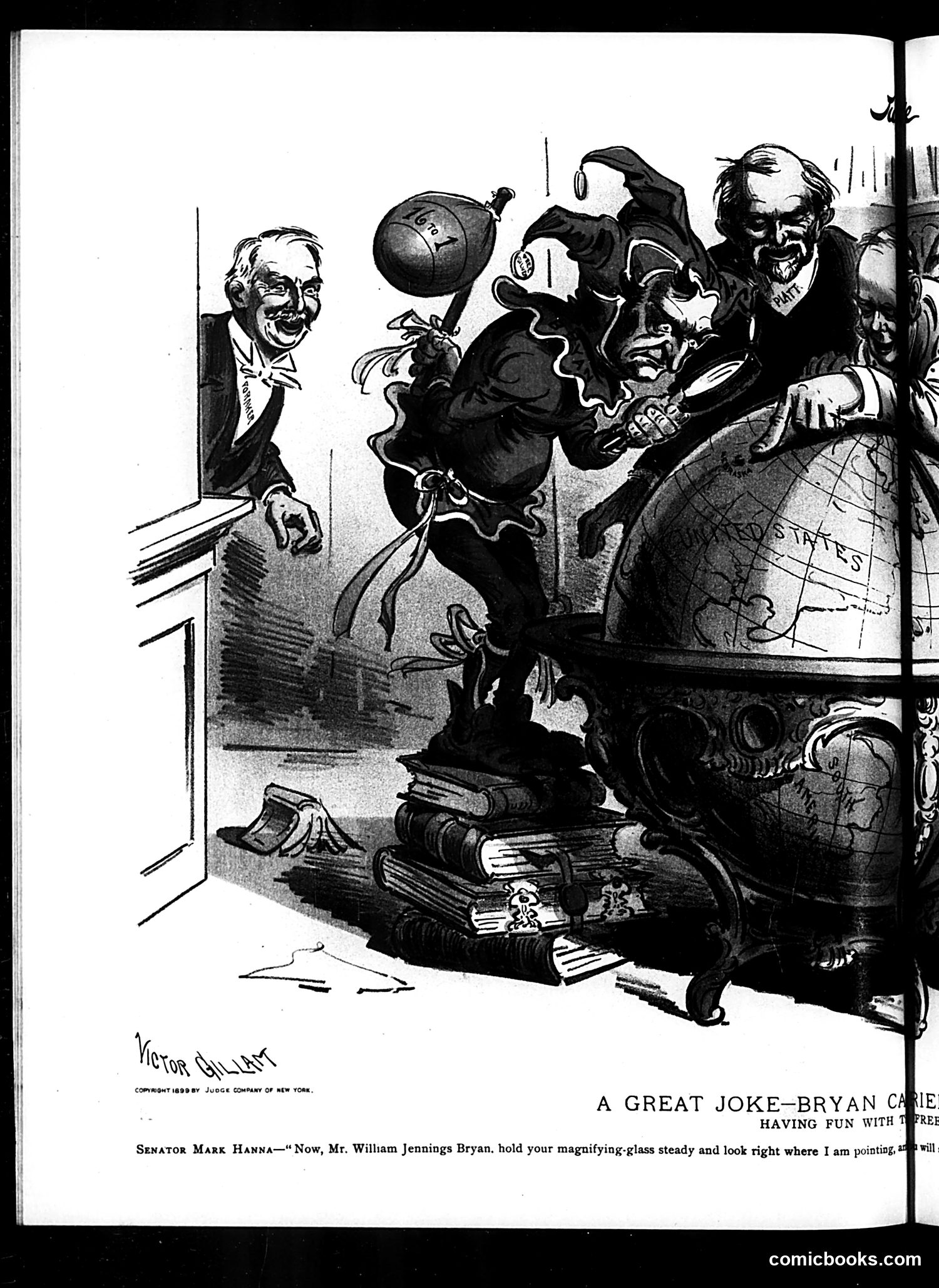
This is a political cartoon from Judge magazine (copyright 1899) satirizing William Jennings Bryan, the three-time Democratic presidential candidate. Senator Mark Hanna, a powerful Republican political operative, is depicted showing Bryan and other political figures a globe or spherical object through a magnifying glass—suggesting they're being fooled or manipulated into seeing something that isn't there. The cartoon's title, "A Great Joke," indicates Republicans viewed Bryan's political platform (likely his free-silver monetary policy) as absurd delusion. Hanna was known for orchestrating William McKinley's campaigns against Bryan. The caricatured figures and mocking tone reflect the deep partisan animosity of the 1896-1900 election era, with the cartoon ridiculing Bryan's political vision as illusory or fraudulent.
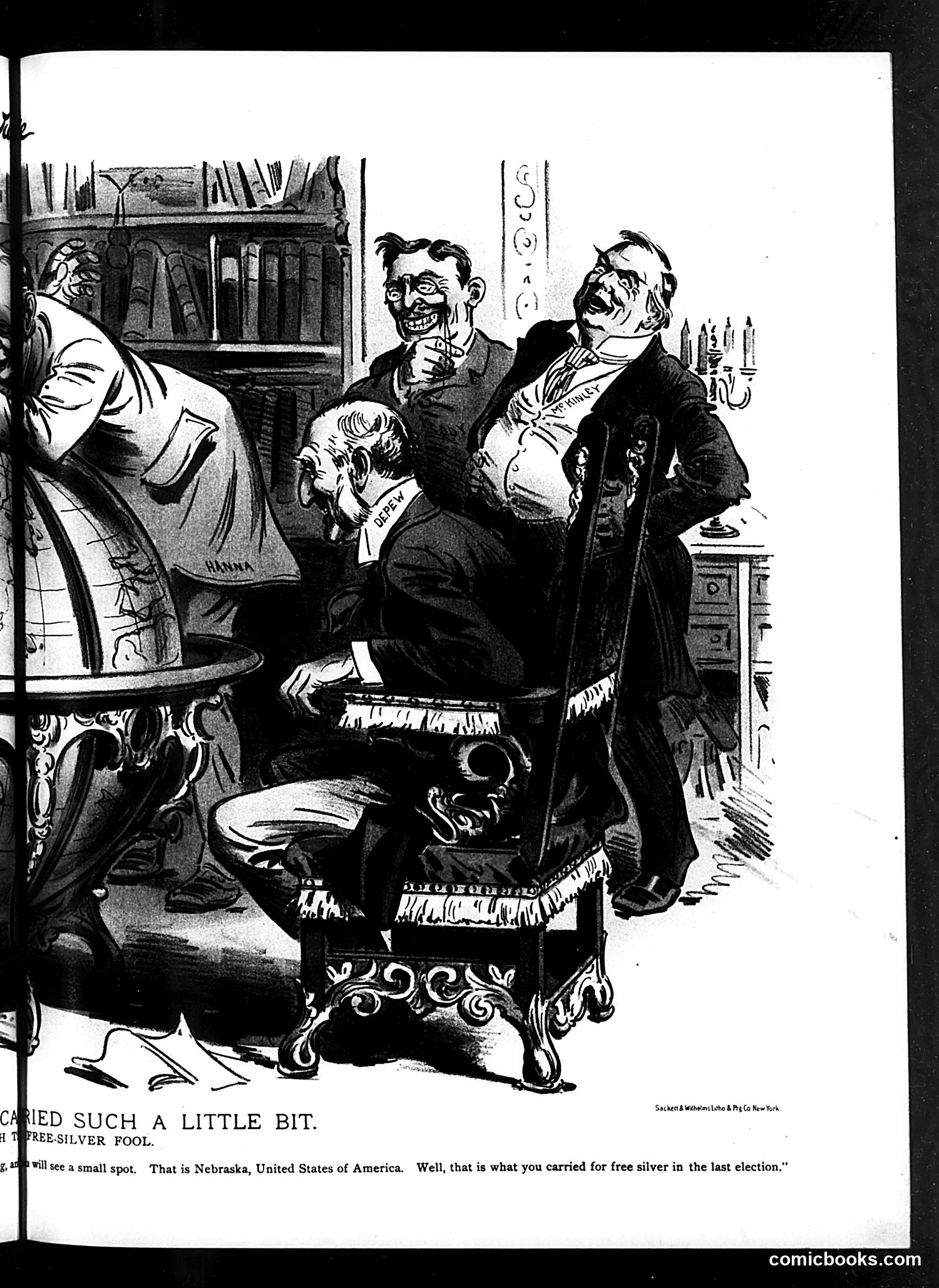
This political cartoon satirizes the free silver movement, likely from the 1890s. The scene shows wealthy, well-dressed men in an ornate interior mocking a foolish supporter of free silver (monetary policy favoring unlimited silver coinage). One man points to a globe, indicating Nebraska—a small spot—claiming that's all the free silver advocate "carried" in the recent election, suggesting the policy lost decisively. The cartoon ridicules free silver supporters as naive fools led astray by populist rhetoric, while depicting the opposition (likely representing Eastern establishment and business interests) as sophisticated and victorious. The caricatured faces and exaggerated expressions emphasize the satirist's contempt for the free silver position and those who championed it.
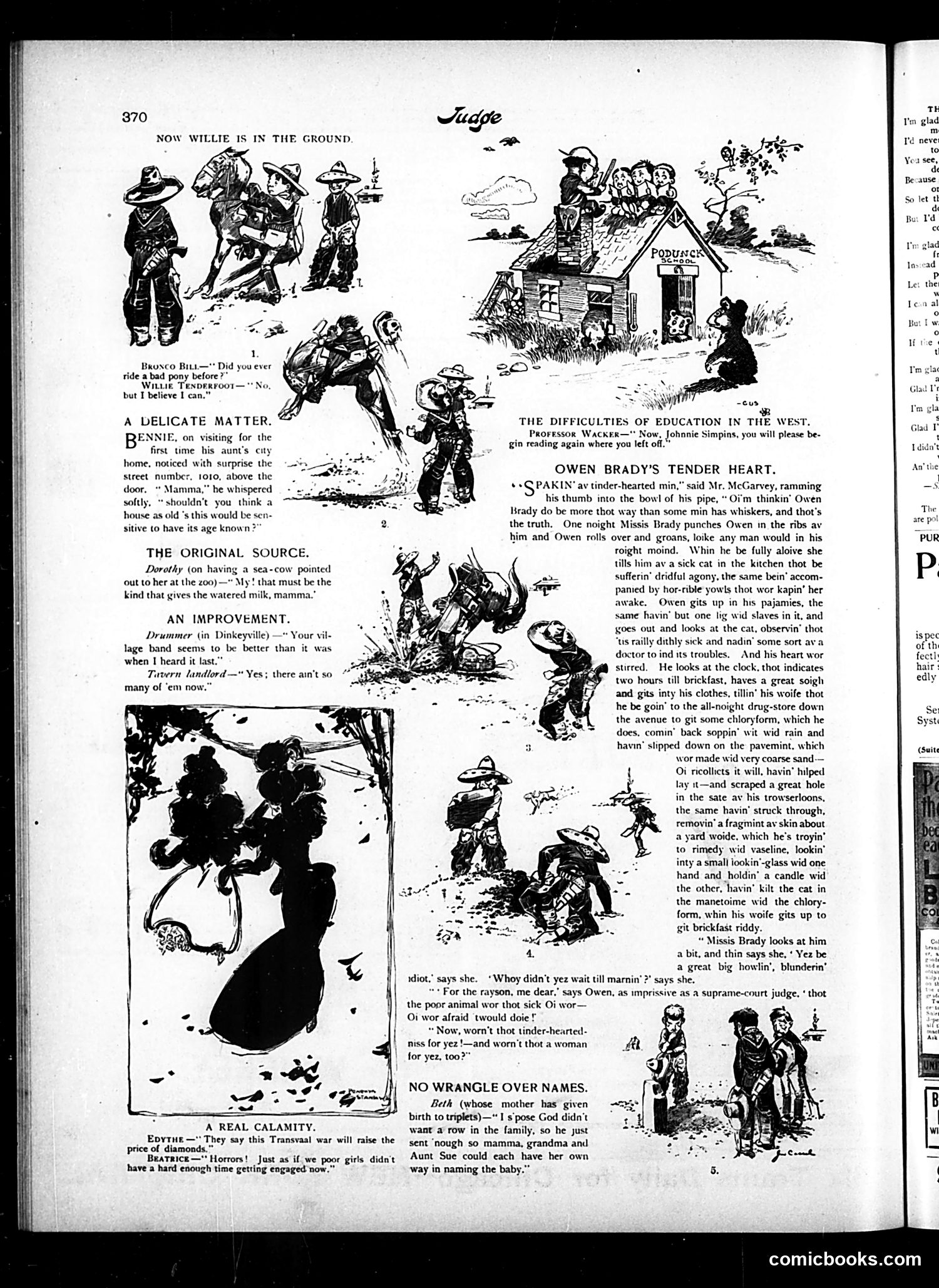
This page contains multiple short humorous sketches typical of Judge magazine's satirical style: **"Now Willie Is in the Ground"** and **"A Delicate Matter"** appear to be brief comic scenarios involving working-class characters (Bronco Bill, Jimmie) in Western settings, poking fun at rough frontier behavior and social awkwardness. **"Owen Brady's Tender Heart"** is the longest piece, satirizing sentimentality in a rural Western context—specifically mocking a tough ranch hand's unexpectedly gentle nature toward animals and people, contrasting his rough exterior with his sentimental interior. The remaining sketches—"The Original Source," "An Improvement," "A Real Calamity," and "No Wrangle Over Names"—are brief domestic or social humor pieces without clear political content. The cartoons use exaggerated character types and dialect to generate humor typical of early 20th-century American satire.
This page features a narrative poem about a politician who lost an election but claims he's relieved. The speaker insists he never expected to win and is glad to be free of political office demands, though the text hints his claims ring false—he mentions the opposition used "boodle" (bribery/corruption) to defeat him. The satire targets the common political excuse-making: candidates who lose elections publicly claim they didn't want the position anyway, didn't have time for it, or are grateful for their defeat. The poem's speaker repeatedly protests his indifference while revealing his actual disappointment and resentment ("I'll beat that shyster yet"). The page is primarily filled with period advertisements (Angostura Bitters, Trimble Whiskey, pianos, carpets), which was standard for Judge magazine. The satirical content occupies roughly one-third of the page, characteristic of the magazine's mixed editorial-commercial format.
This is primarily an **advertising page** from Judge magazine, with minimal editorial cartoons. The page consists largely of product advertisements (Kodak cameras, Remington typewriters, Hunter Whiskey, patent medicines) and newspaper promotion. The few editorial elements are brief **humorous anecdotes** rather than political cartoons: - A joke about composer John Philip Sousa's name being essential to his fame - Dialogue between two rural Englishmen commenting on rain - A quip about opera singer Adelina Patti producing an opera for her new husband's financial benefit - A poem about young lovers There's also a small cartoon titled **"Desperate Householder"** showing someone trying to sell a monkey, joking about disposing of unwanted pets. The page reflects Judge's typical format: satirical short pieces mocking contemporary social conventions, celebrity culture, and human behavior—aimed at educated, urban readers. No specific political figures or major events are referenced.
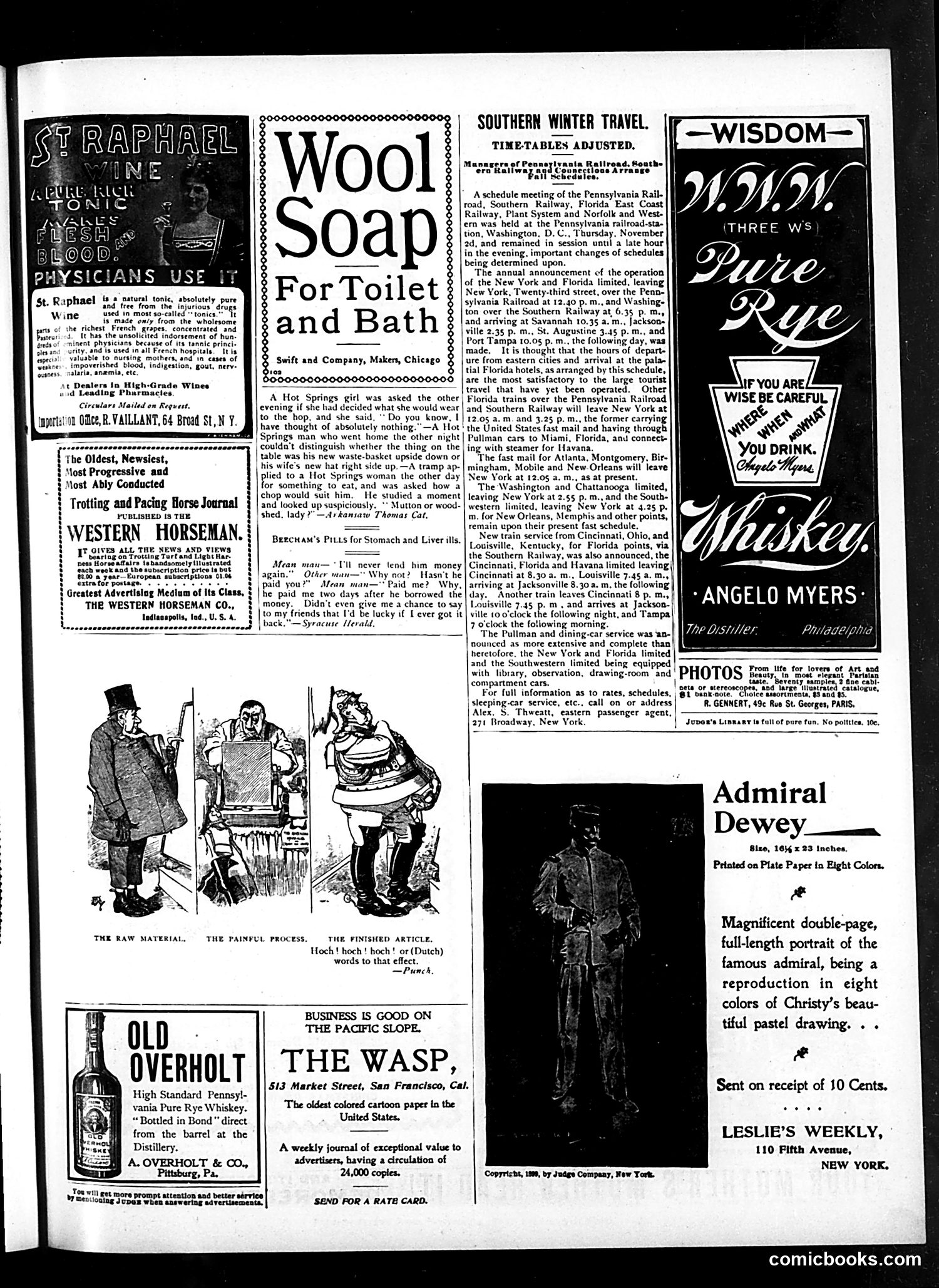
This page is primarily **advertising with minimal editorial content**. The only substantial cartoon appears at bottom-left, showing three figures labeled "The Raw Material," "The Painful Process," and "The Finished Article"—a before-and-after joke about domestic labor or manufacturing, with the punchline referencing transformation. The page is dominated by advertisements for patent medicines (St. Raphael Wine Tonic, Beecham's Pills), whiskey (Old Overholt, Angelo Myers), and trade publications (Western Horseman, The Wasp newspaper). There are brief humorous anecdotes about Hot Springs and Mean Men, typical of Judge's filler content—light social comedy with no apparent political satire. The substantive editorial content is a dry railroad schedule announcement regarding Southern winter travel, reflecting Judge's era when such practical information appeared alongside humor and advertising.
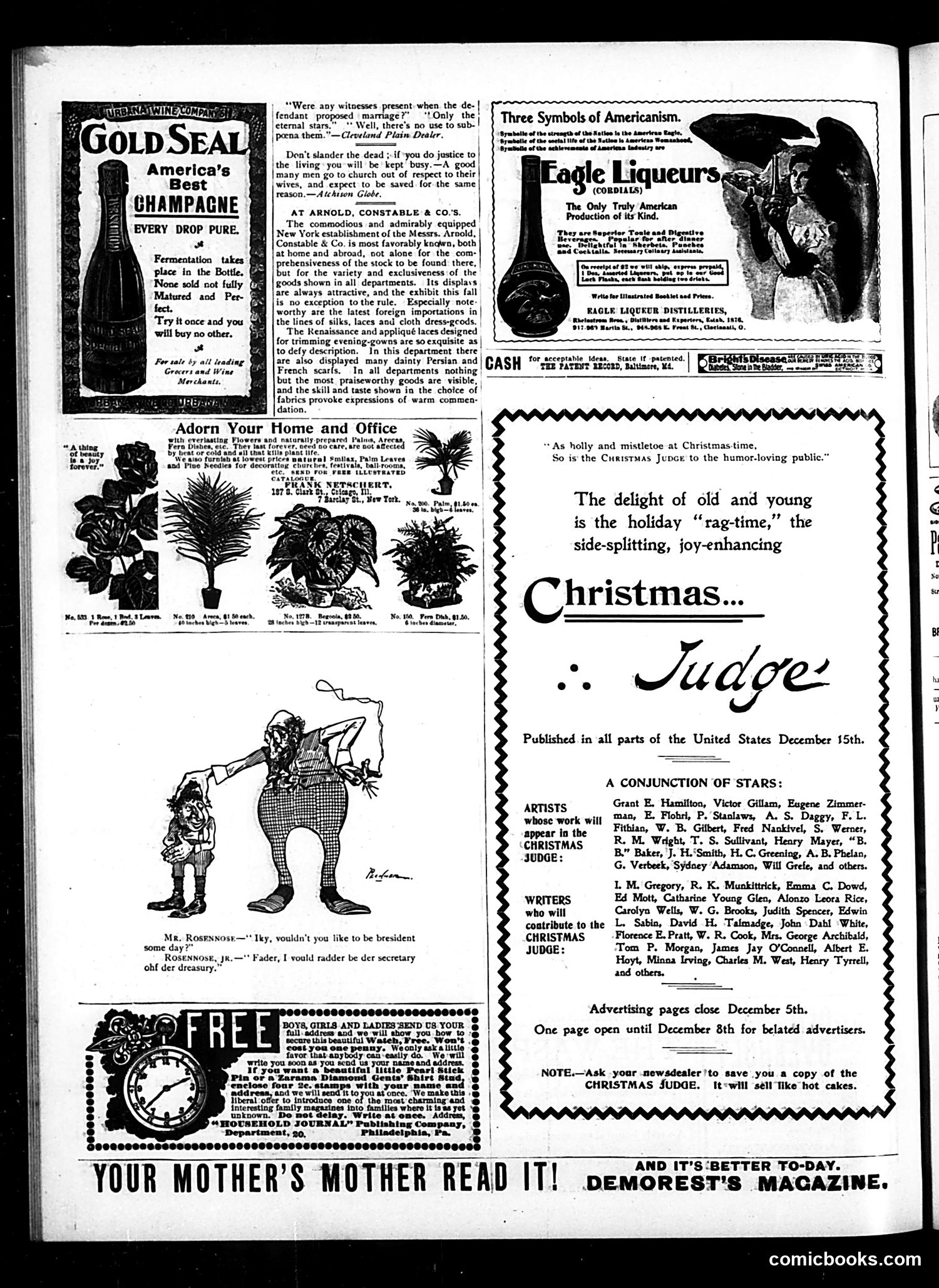
This page is primarily **advertising and promotional material** for the Christmas issue of *Judge* magazine, with minimal political satire. **The Main Cartoon:** The small illustration at bottom-left shows two figures in what appears to be a **Yiddish-dialect joke**. A child asks Mr. Rosennose if he wants to be president; the adult responds he'd "radder be der secretary obf der dreasury" (rather be secretary of the treasury). This is ethnic humor playing on German-Jewish immigrant speech patterns—common in period satire. The joke's point is unclear from context alone. **The Advertisements:** Most of the page hawks luxury goods (Gold Seal Champagne, Eagle Liqueurs, potted plants) and promotes the upcoming Christmas issue of *Judge*, which promises contributions from noted cartoonists and writers. **"Three Symbols of Americanism"** (top right) advertises Eagle Liqueurs as symbolizing American industry alongside the Eagle and American Womanhood—straightforward advertising patriotism. The page reflects *Judge*'s identity as a commercial magazine blending mild satire with advertising rather than hard political commentary.
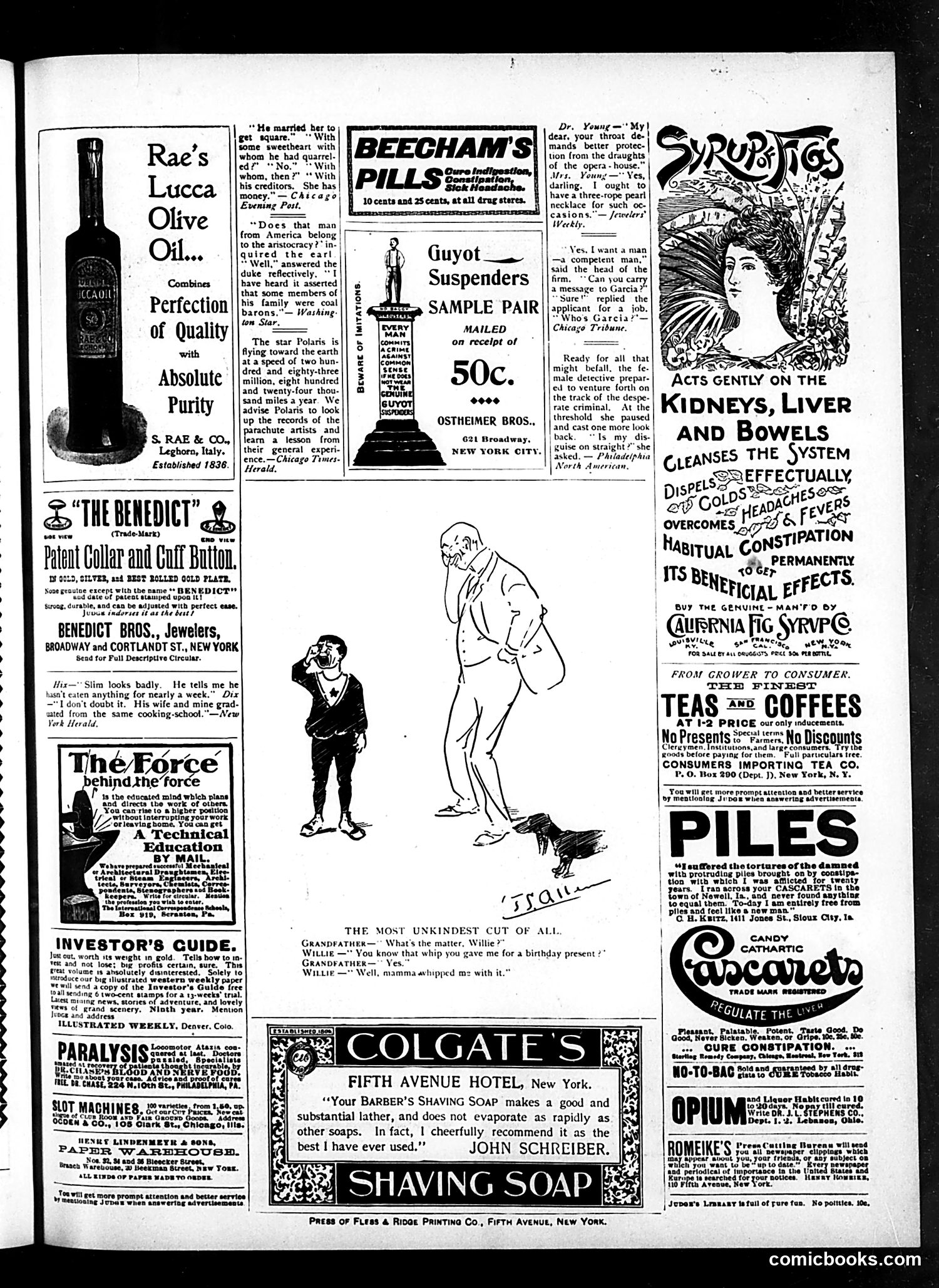
This page is primarily **advertisements and comic jokes** rather than political cartoons. Here's what's notable: **The Main Cartoon ("The Most Unkind Cut of All"):** Shows a grandfather and grandson discussing a birthday whip the grandfather gave. The joke: the boy's mother used it to whip *him*—a dark humor joke about corporal punishment of children, then socially acceptable. **Other Jokes on the Page:** Include workplace humor ("Message to Garcia"), marital teasing about jewelry and infidelity, and a comedy bit about a female detective worrying whether her corset is straight before pursuing criminals—mocking women's vanity. **Context for Modern Readers:** This is 1900s-era humor reflecting period attitudes: casual acceptance of child beating, gender stereotypes (women obsessed with appearance), and class humor about wealthy Americans. The page is mostly patent medicine and product ads (piles cure, shaving soap, tea), which Judge magazine relied upon for revenue. No significant political satire appears here.
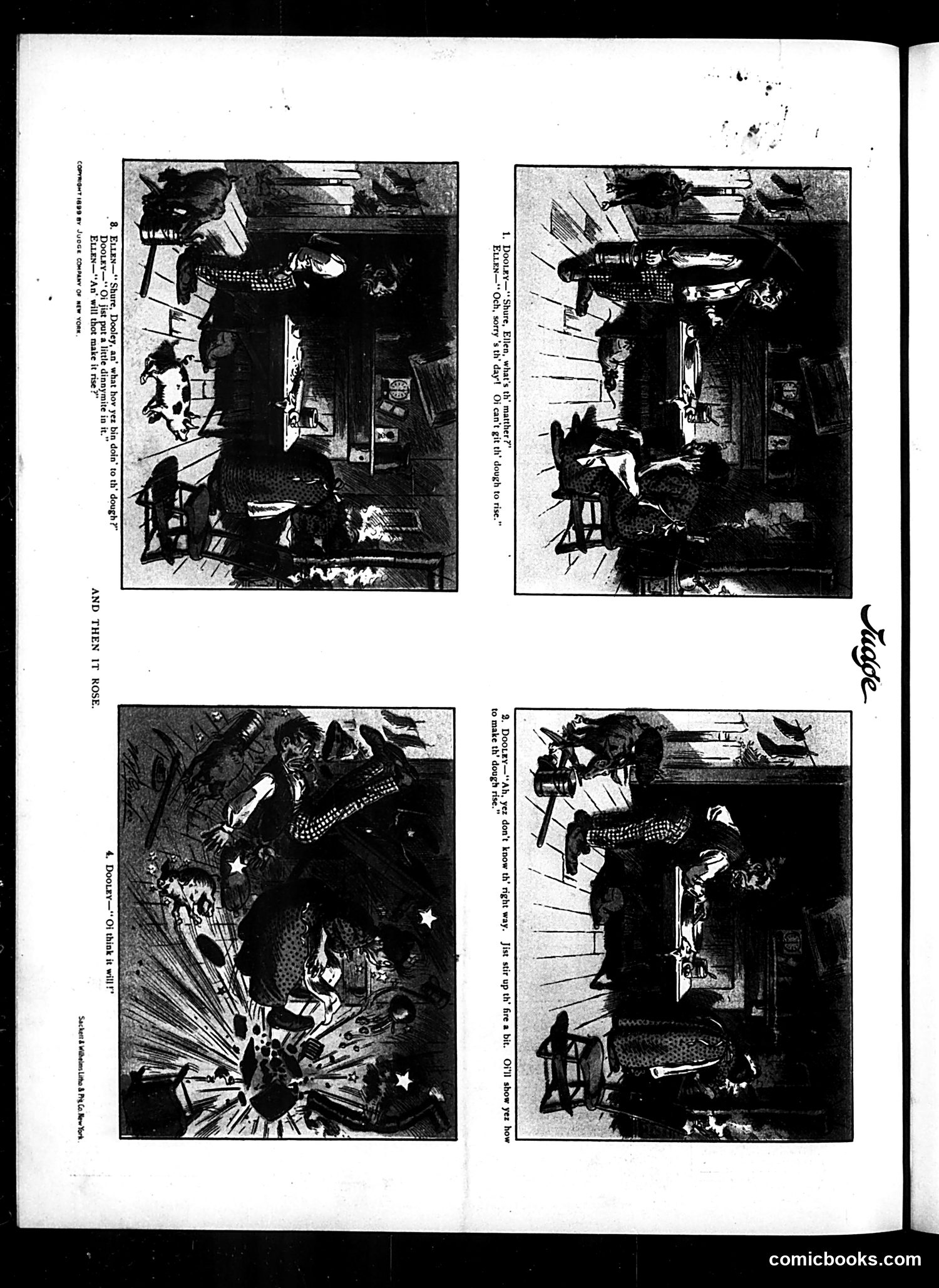
This Judge magazine cartoon satirizes Irish immigrant domestic workers through ethnic stereotyping. Two women named "Dooley" and "Ellen"—identified by their Irish dialect spellings ("Shure," "Och," "Oi")—are shown in a kitchen preparing dough. The joke plays on a double meaning: while they discuss making bread dough rise, the final panel shows an explosion, suggesting the dough (or their efforts) literally "rose" violently. This appears to reference fears about Irish immigrants and anarchist/radical activity popular in late 19th-century American satire. The cartoon mocks both Irish accents and, implicitly, anti-immigrant anxieties about dangerous foreign elements in American households.