
A complete issue · 16 pages · 1899
Judge — October 28, 1899
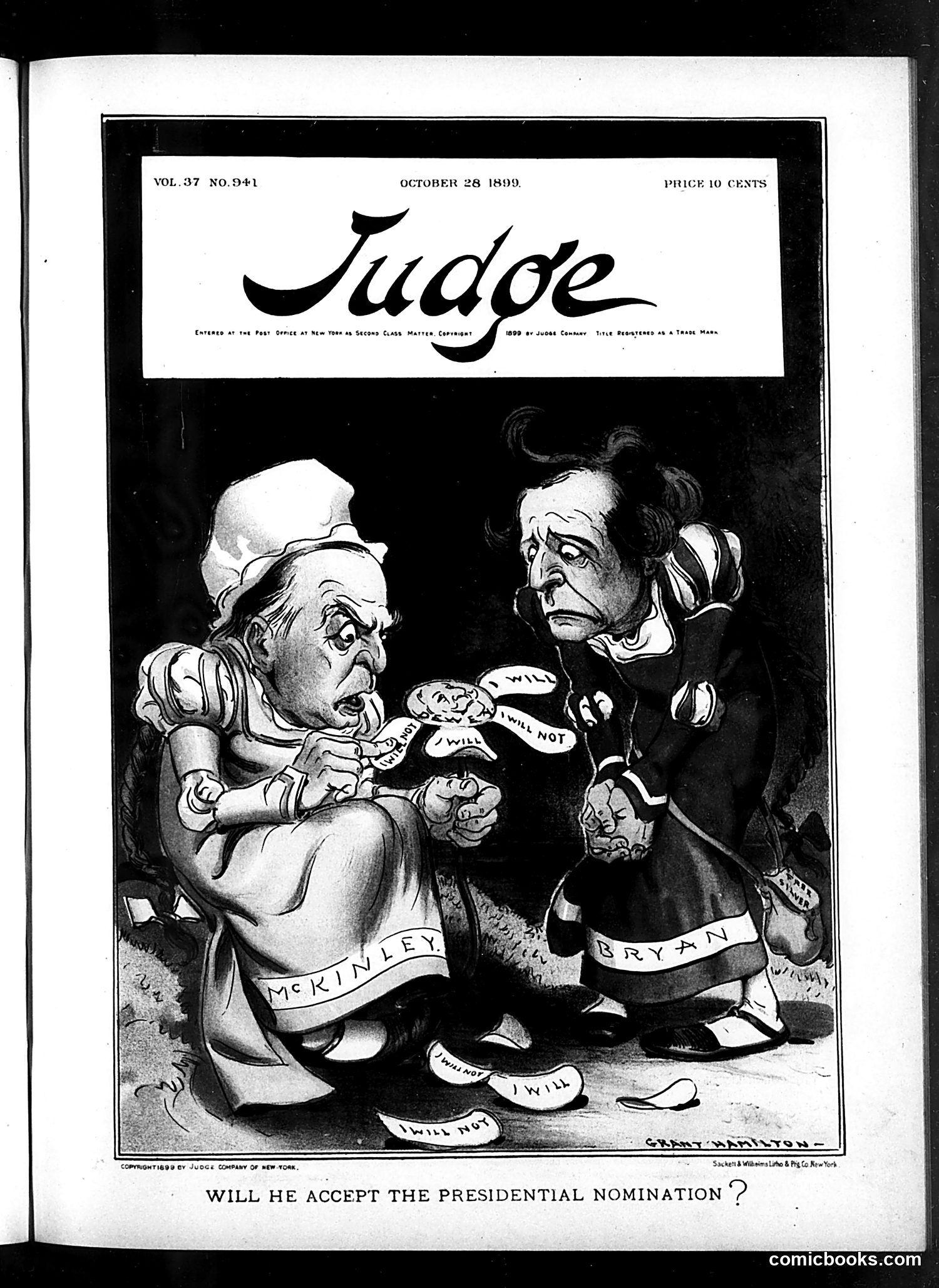
This political cartoon depicts two caricatured figures labeled "McKINLEY" and "BRYAN" engaged in a tug-of-war over what appears to be a presidential nomination or acceptance. The labels reading "I WILL" and "I WILL NOT" suggest disagreement over accepting a presidential nomination. This references the 1900 U.S. presidential election. William McKinley (Republican incumbent) and William Jennings Bryan (Democratic challenger) were the major candidates. The cartoon satirizes uncertainty about whether Bryan would accept the Democratic nomination for his second consecutive presidential run. The exaggerated facial expressions and physical struggle humorously depict the political tension of the nomination process during this election cycle.
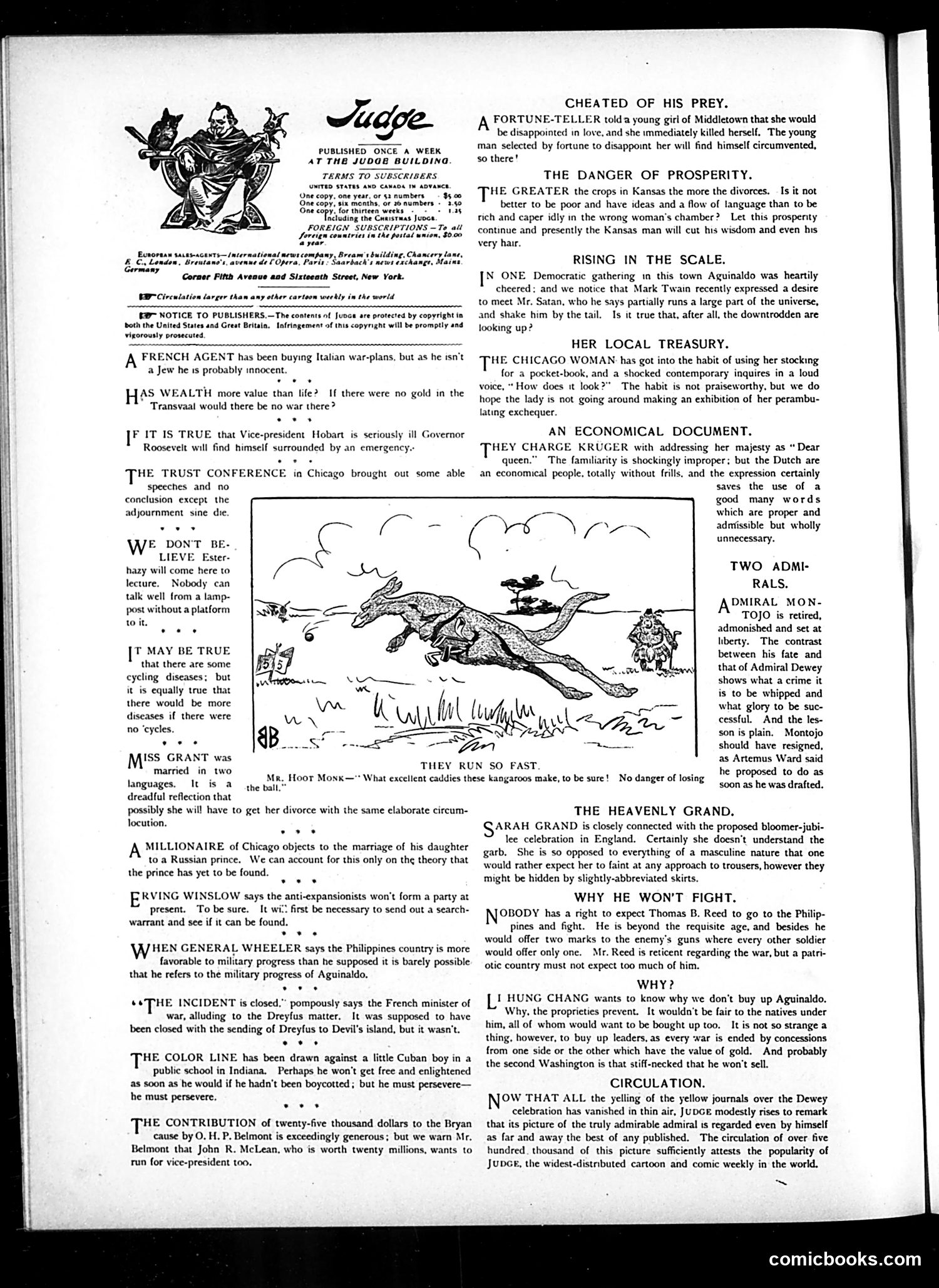
The main cartoon "They Run So Fast" depicts kangaroos in rapid motion, with the caption attributing the dialogue to "Mr. Hoor Monk" about "excellent cadies these kangaroos make, to be sure! No danger of losing the ball." This appears to be a sporting joke rather than political satire—likely referencing golf or a similar ball sport, where kangaroos' speed is humorously imagined as useful for retrieving balls. The humor relies on the absurdity of using animals as sports equipment. The surrounding text consists of brief satirical commentary on various topics: Roosevelt's health, Dutch addressing (about a woman named Kruger), Admiral Montojo's retirement, and general social observations. These are typical *Judge* editorial snippets rather than cohesive arguments, reflecting the magazine's format of scattered commentary on current events.
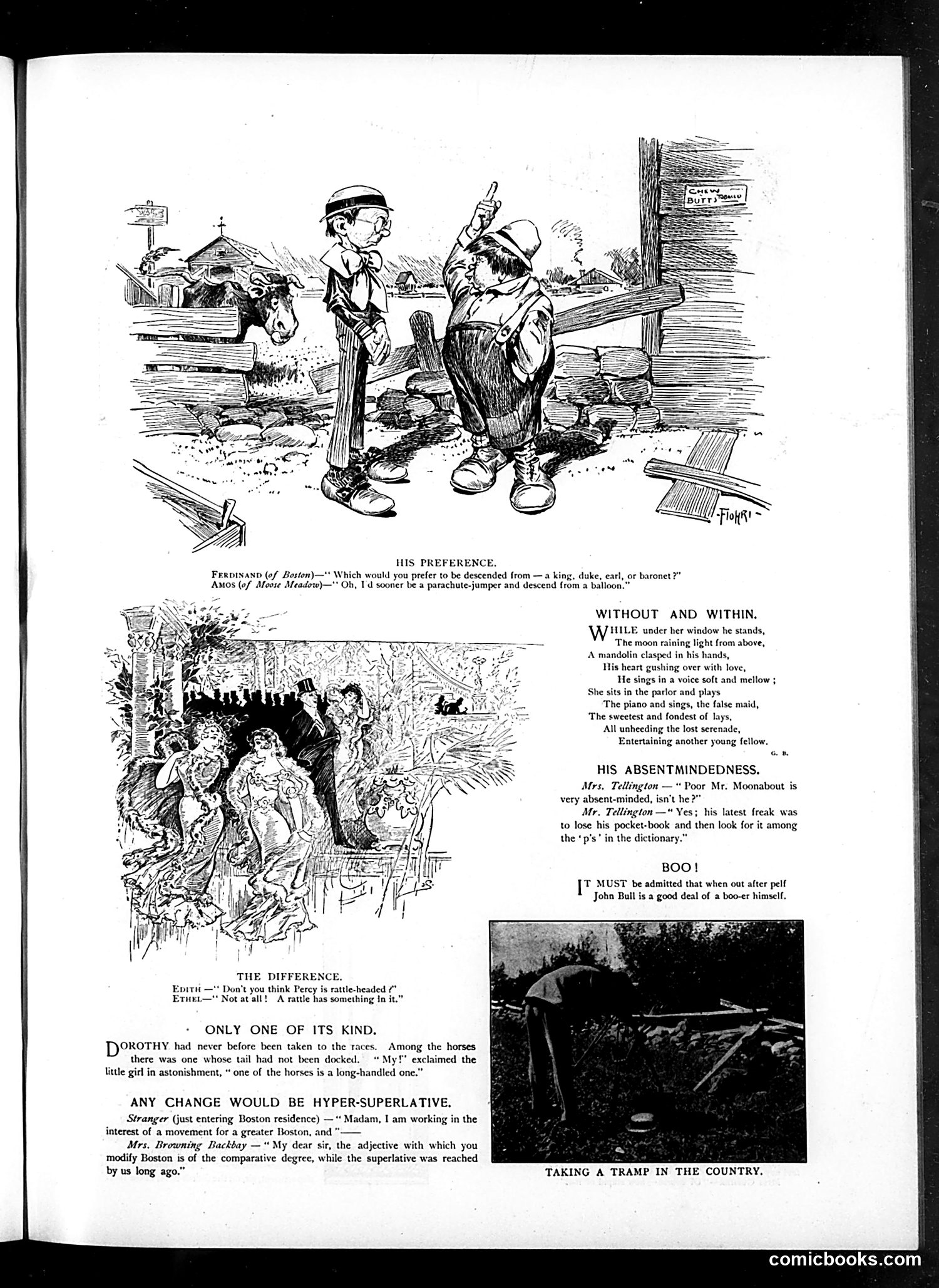
This page contains several brief humorous items rather than a single political cartoon: **"His Preference"**: A joke about Ferdinand of Bulgaria choosing between military ranks—preferring to descend from a "king, duke, earl, or baronet" rather than from a balloon, mocking his apparently questionable lineage. **"Without and Within"**: A sentimental poem about a woman playing mandolin and piano by a window while a man serenades her outside. **"His Absentmindedness"**: A brief joke about Mr. Moonabout losing his pocket-book while searching for it. **"Boo!"**: A one-liner about John Bull (Britain) being a "boozer." The remaining items are similarly short satirical quips. The page appears typical of Judge's light humor format rather than focused political commentary.
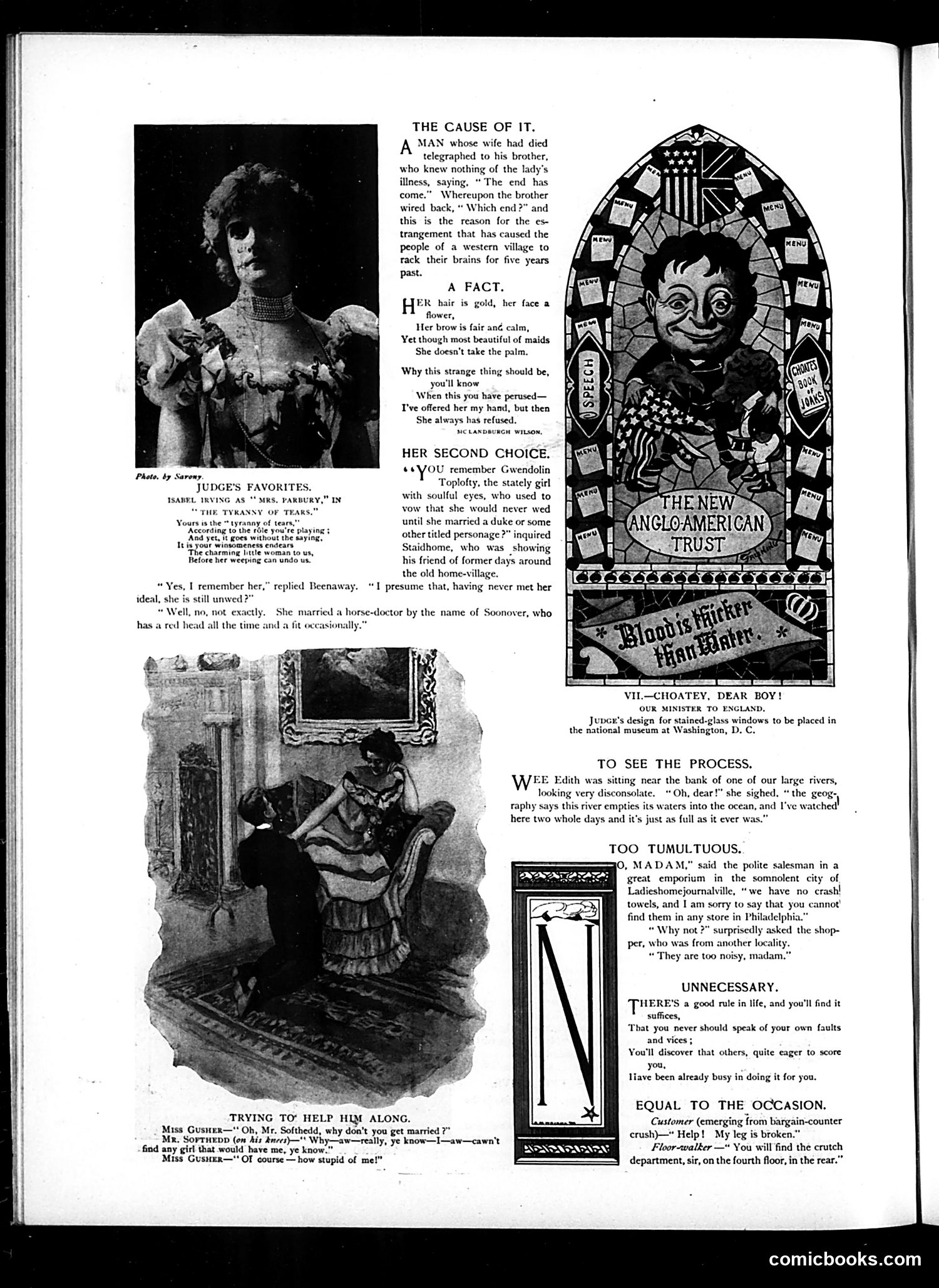
This page contains several satirical pieces typical of early 20th-century humor magazines: **"The Cause of It"** mocks a man's confusion about a family tragedy—a wife's death—which he attributes to a brother's cryptic telegram. The satire targets male obtuseness regarding emotional communication. **"A Fact"** and related sections present brief, witty observations about women's behavior and social expectations, particularly regarding marriage and romantic choices—standard Judge fare poking fun at gender relations. The illustrated anecdotes ("Trying to Help Him," "Too Tumultuous," etc.) depict everyday awkward social situations: customers requesting impossible items, class differences, and minor mishaps. These showcase Judge's specialty: gentle mockery of American middle-class life and social pretension rather than hard political satire. The stained-glass window advertisement announces Judge's design contribution to a national museum, promoting the magazine's cultural relevance.
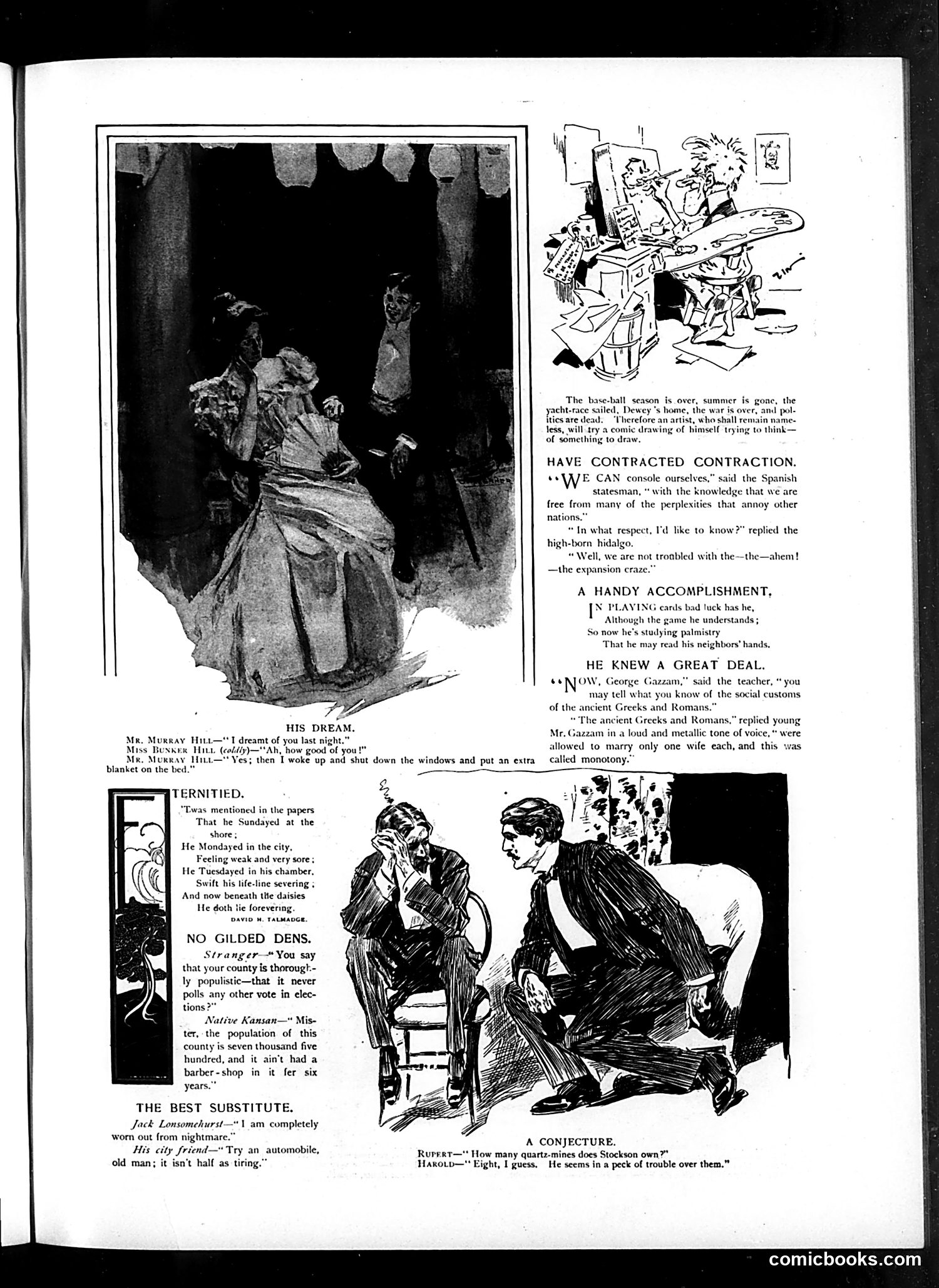
This page contains several brief satirical sketches typical of Judge's humor: **"His Dream"** mocks romantic disappointment—a man dreams of a woman but finds her so unattractive he closes windows against the cold upon waking. **"No Gilded Dens"** references Populism, a major 1890s political movement. A Kansan boasts his county votes exclusively Populist, never supporting other parties—satirizing the movement's rigid ideological uniformity. **"He Knew a Great Deal"** plays on a student's malapropism: George Gazzam defines the Greeks' and Romans' monogamy as "monotony"—a pun suggesting marriage itself is tedious. **"A Conjecture"** implies Stockson owns multiple mines but faces legal troubles ("a peck of trouble"), possibly referencing mining industry disputes of the era. **"The Best Substitute"** jokes that automobiles are as exhausting as nightmares—reflecting early skepticism about this new technology. The page's introductory note acknowledges the post-Spanish-American War period (Dewey referenced) when political satire dried up, forcing cartoonists to find other subjects.
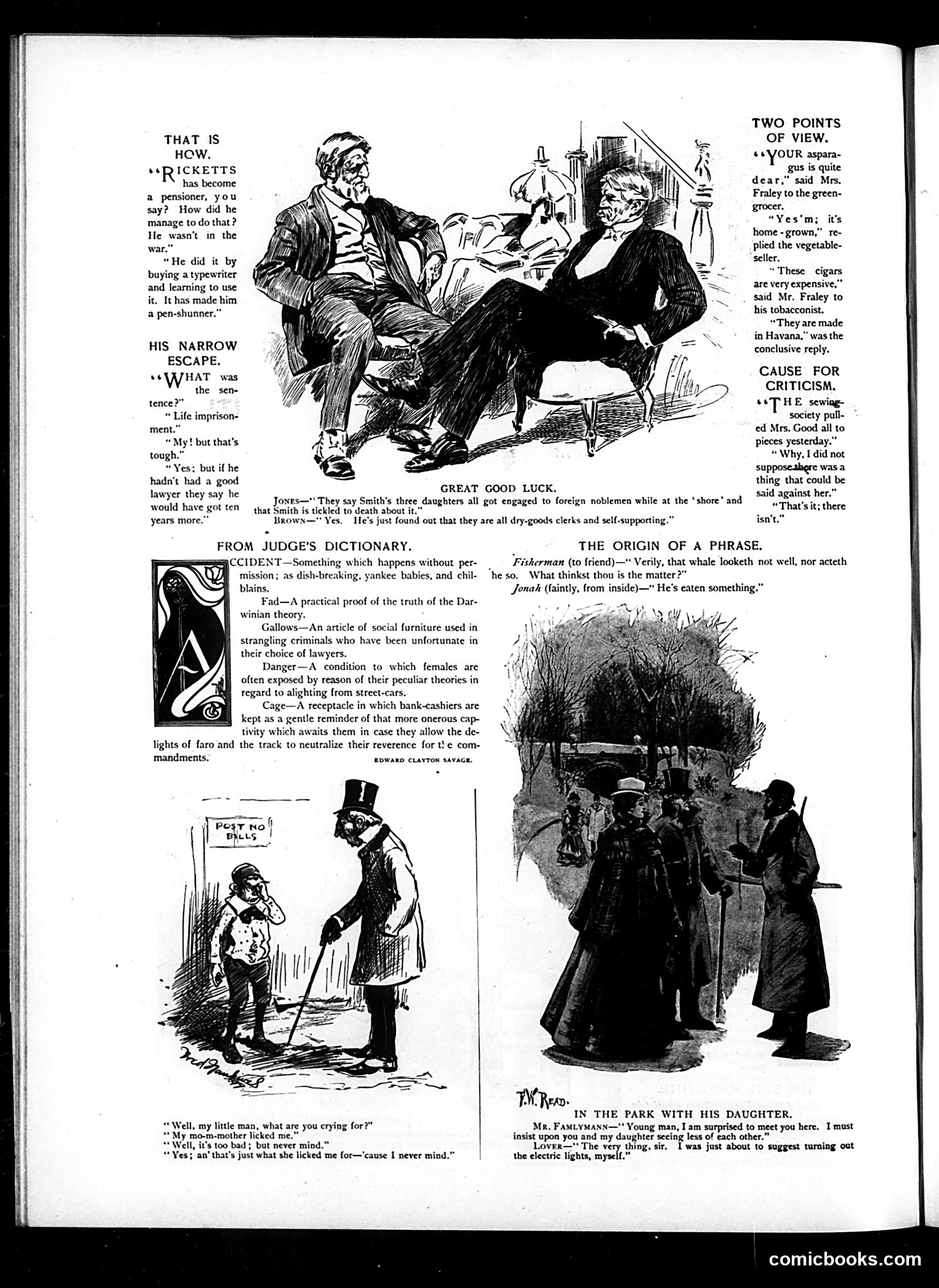
This page contains several satirical vignettes typical of early 20th-century American humor: **Main cartoon** ("Great Good Luck"): Mocks the social-climbing aspirations of the middle class. Smith's daughters become engaged to foreign "noblemen" at the shore—seemingly prestigious matches. The joke: they're actually just dry-goods clerks (shop workers), making the engagements worthless despite Smith's pride. **"Two Points of View"**: Gentle satire on consumer culture. Asparagus and cigars are expensive because they're "home-grown" or "from Havana"—origin itself justifies high prices, regardless of actual quality. **Dictionary definitions**: Satirizes contemporary society—"Fad" as proof of Darwinian theory (people blindly follow trends), "Gallows" and "Cage" mock the legal and financial systems. **Park scene**: A young suitor suggests turning off electric lights to spend time alone with a young woman—her father agrees, but only because he wants the same privacy, inverting the expected moral lecture. The overall tone: satirizing pretension, commercialism, and Victorian social conventions.
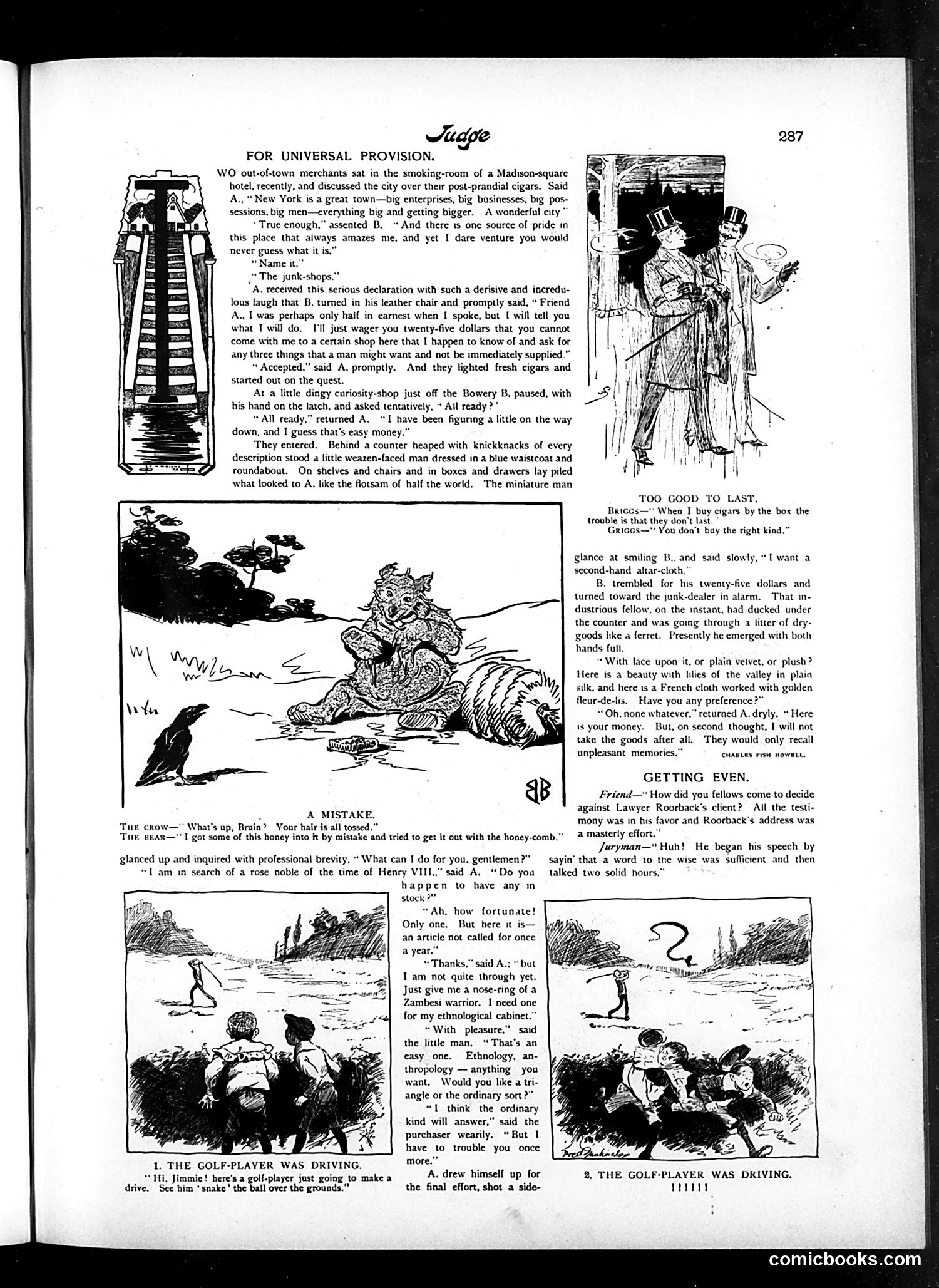
This page contains three satirical pieces: **"For Universal Provision"** (main story): Two merchants wager over a New York junk shop's inventory. When one customer demands absurdly specific items—a 16th-century rose noble coin, a Zambesi warrior's nose-ring, a second-hand altar cloth—the shopkeeper produces each instantly. The satire mocks both the implausible comprehensiveness of junk shops and New York's boastful claim to fulfill any need. The story's humor relies on the exaggeration of urban abundance. **"A Mistake"** (crow cartoon): A crow complains to a bear about honey in its hair; the bear admits using a honey-comb to remove it. Simple physical comedy without political content. **"Getting Even"** (jury anecdote): A juryman explains they ruled against a lawyer whose client had testified favorably—but the lawyer's long-winded rebuttal annoyed them into revenge. This satirizes jury unpredictability and legal pomposity. The page reflects turn-of-century American urban humor and skepticism toward institutions.
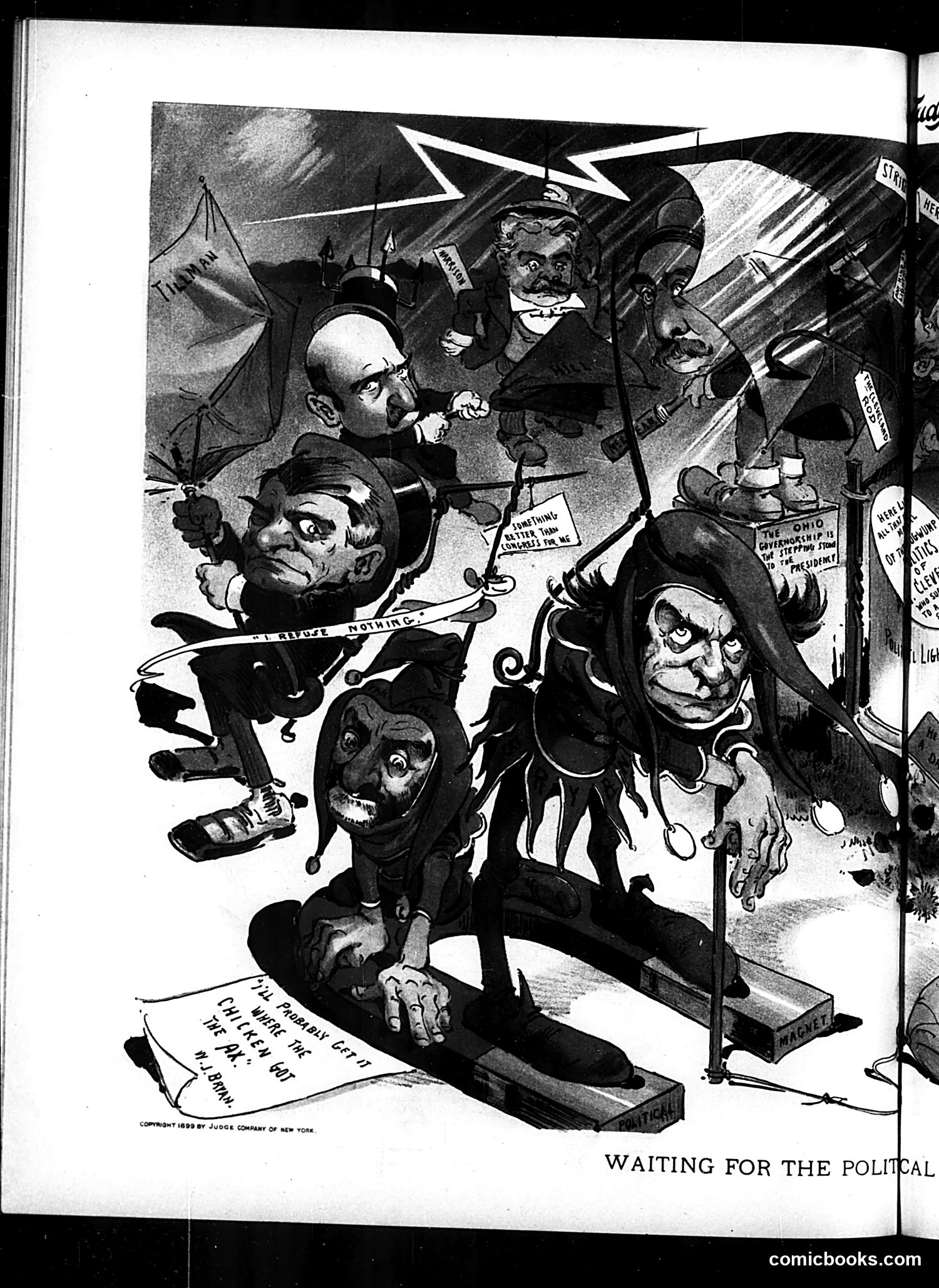
This satirical cartoon depicts several caricatured political figures—rendered with exaggerated features typical of early 20th-century Judge magazine style—apparently waiting or gathering in what appears to be a backstage or interior setting. The figures carry umbrellas with lightning bolts, suggesting they're bracing for political storms or conflict ahead. The title "Waiting for the Political" suggests these figures are anticipating some significant political event or announcement. Various labels are visible on signs within the cartoon, though specifics are difficult to read clearly in this reproduction. Without clearer visibility of individual labels or the specific publication date, I cannot definitively identify which particular political figures or moment this references. The style and composition suggest commentary on political maneuvering or uncertainty during a significant electoral or legislative period.
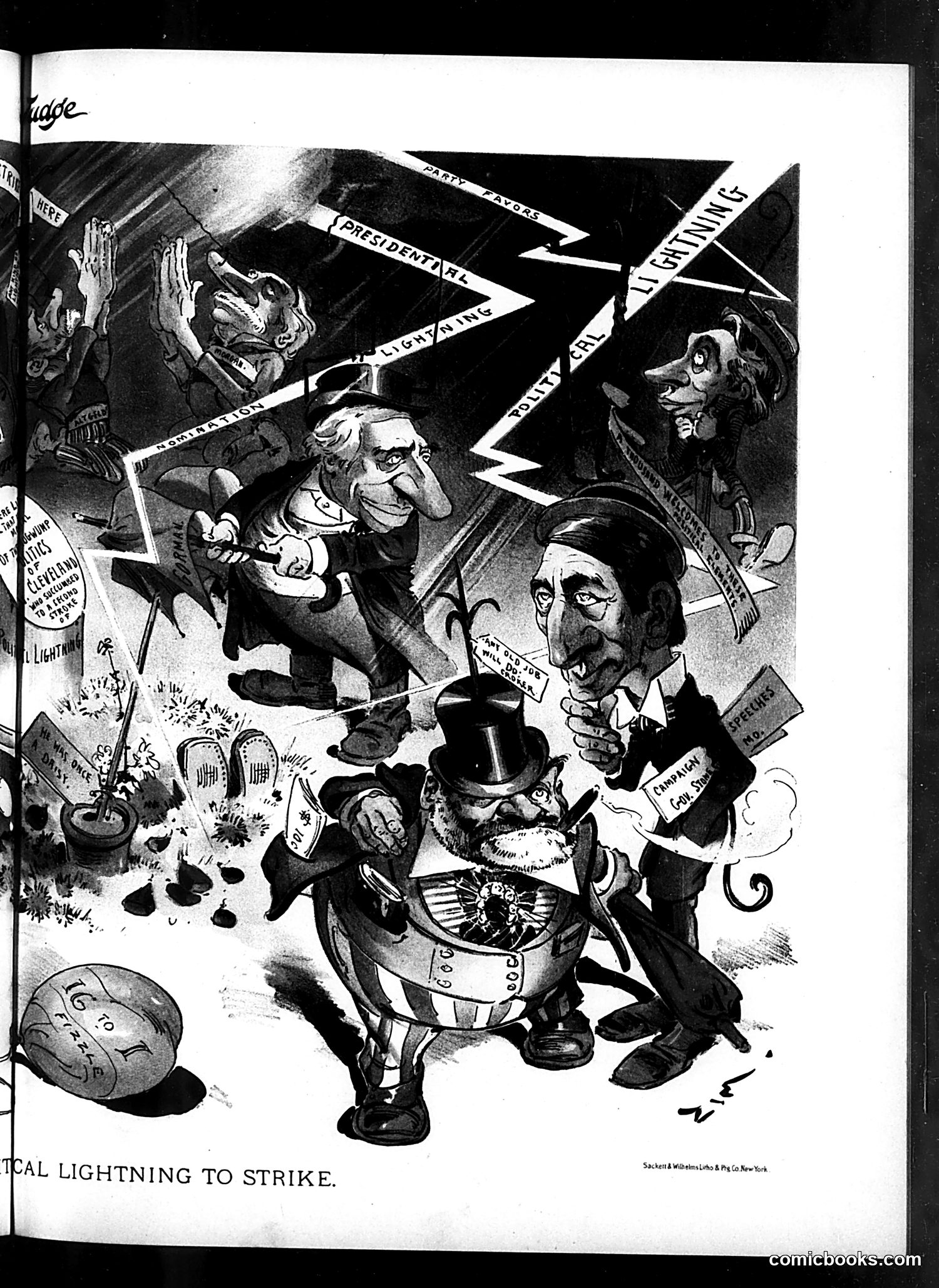
This Judge magazine cartoon depicts several caricatured political figures awaiting some imminent crisis or conflict. The central figure wears military dress and holds papers labeled "PRESIDENCY" and what appears to be campaign-related materials. Lightning bolts labeled "PRESIDENTIAL," "LIGHTWING," and "CRIMINAL" streak across the composition, suggesting threats converging on political leadership. The exaggerated caricatures and ominous visual language—with shadowy figures reacting to electrical strikes—imply scandal, legal danger, or political instability threatening the administration. Without the publication date visible, the specific crisis referenced is unclear, but the satire targets executive vulnerability to multiple simultaneous threats during what appears to be a contentious political moment.
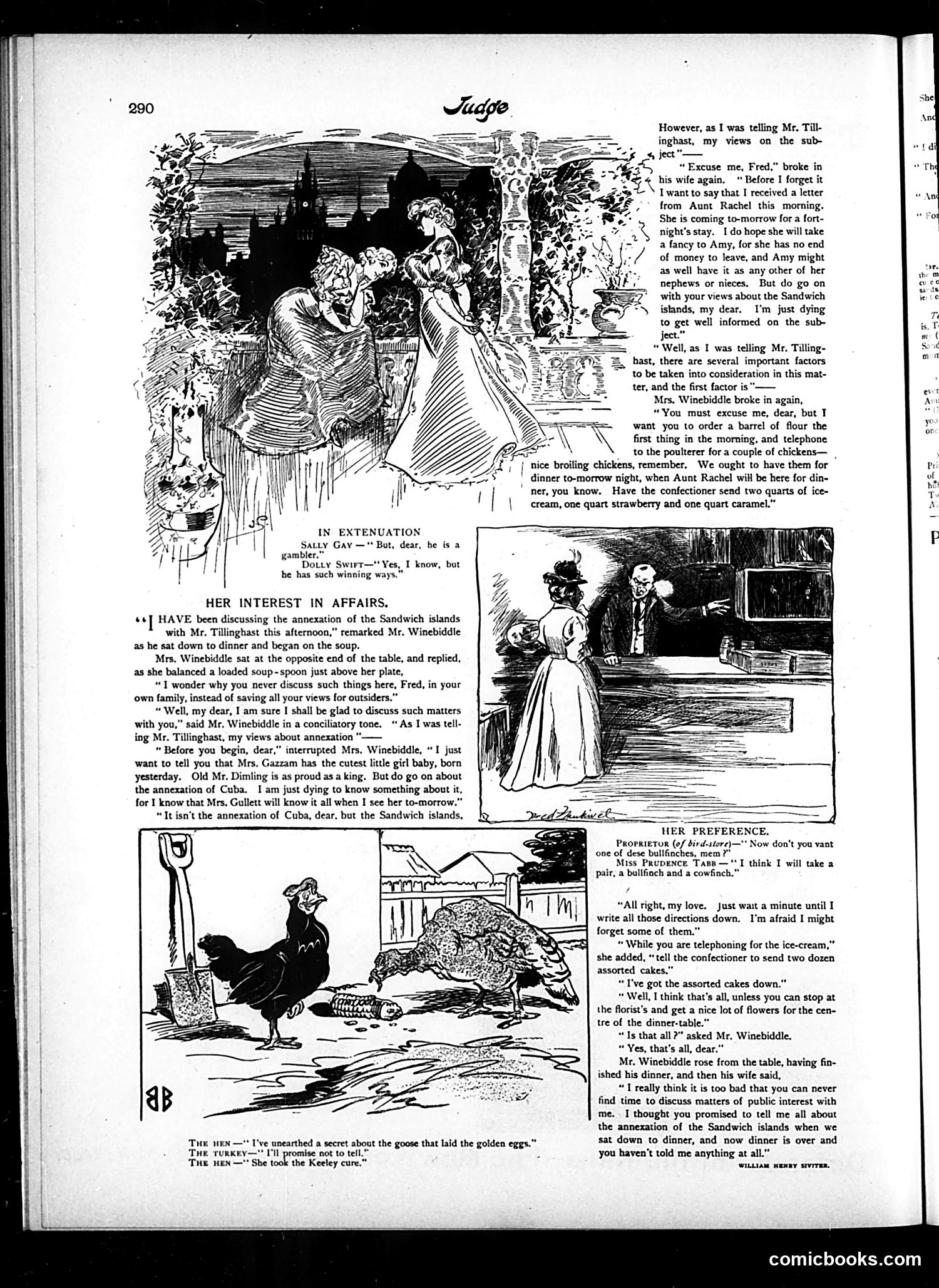
This page satirizes **marital dynamics and women's supposed lack of interest in serious matters**—a common early 20th-century stereotype. **Main cartoon**: Mr. Winebiddle attempts to discuss the **annexation of the Sandwich Islands** (Hawaii), a genuine political issue of the era. His wife Mrs. Winebiddle repeatedly interrupts with domestic tasks—ordering flour, chickens, ice cream, arranging for Aunt Rachel's visit—then complains he never discusses important affairs with her. The joke: she simultaneously dismisses politics while demanding he explain it. **The satire's point**: Women are portrayed as self-contradictory—claiming intellectual engagement while prioritizing household management, gossip (Mrs. Gazzam's baby), and financial interests (Aunt Rachel's inheritance). **Supporting vignettes** mock similar dynamics: a woman praising a gambler for his "winning ways," and another mixing animal preferences ("bullfinch and a cowfinch"). The humor relies on period assumptions about women's limited intellectual capacity and domestic preoccupations.
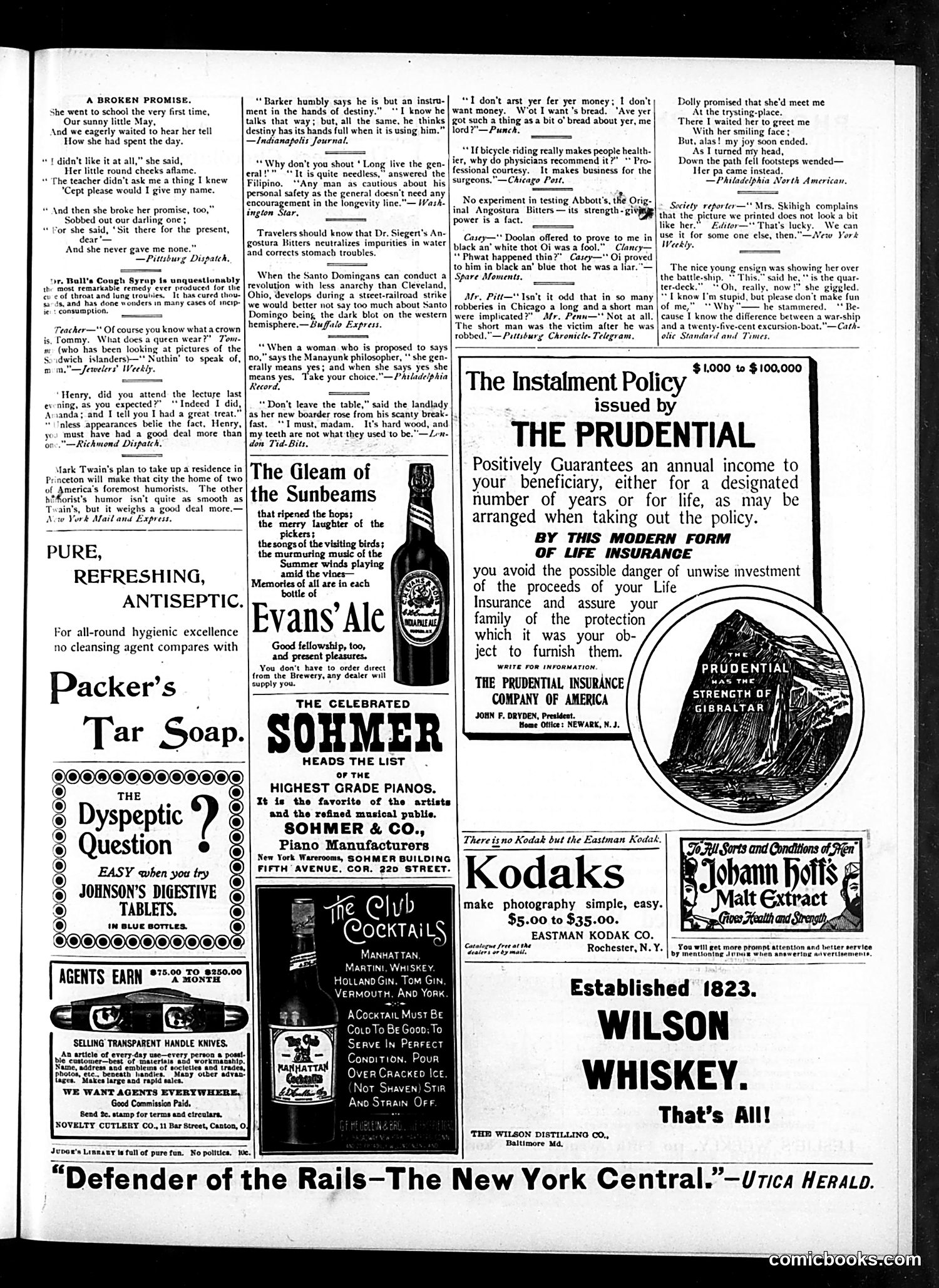
This page is primarily advertisements and brief comic items/jokes typical of *Judge* magazine. There are no significant political cartoons to analyze. The humor relies on wordplay and social observations of the era. A notable piece involves a schoolgirl's misunderstanding: she complains the teacher "broke her promise" by saying "Sit there for the present, dear" but never gave her the gift ("present"). Other items mock current events (Santo Domingo, Cleveland street-car strikes), poke fun at gender relations and courtship, and include dialect humor featuring Irish working-class characters. The advertisements reveal period concerns: digestive remedies, life insurance through The Prudential, cameras (Kodak), whiskey, soap, and piano manufacturers. This reflects both the target audience's anxieties and the magazine's commercial orientation. The page contains no clearly identifiable political figures requiring caricature analysis.
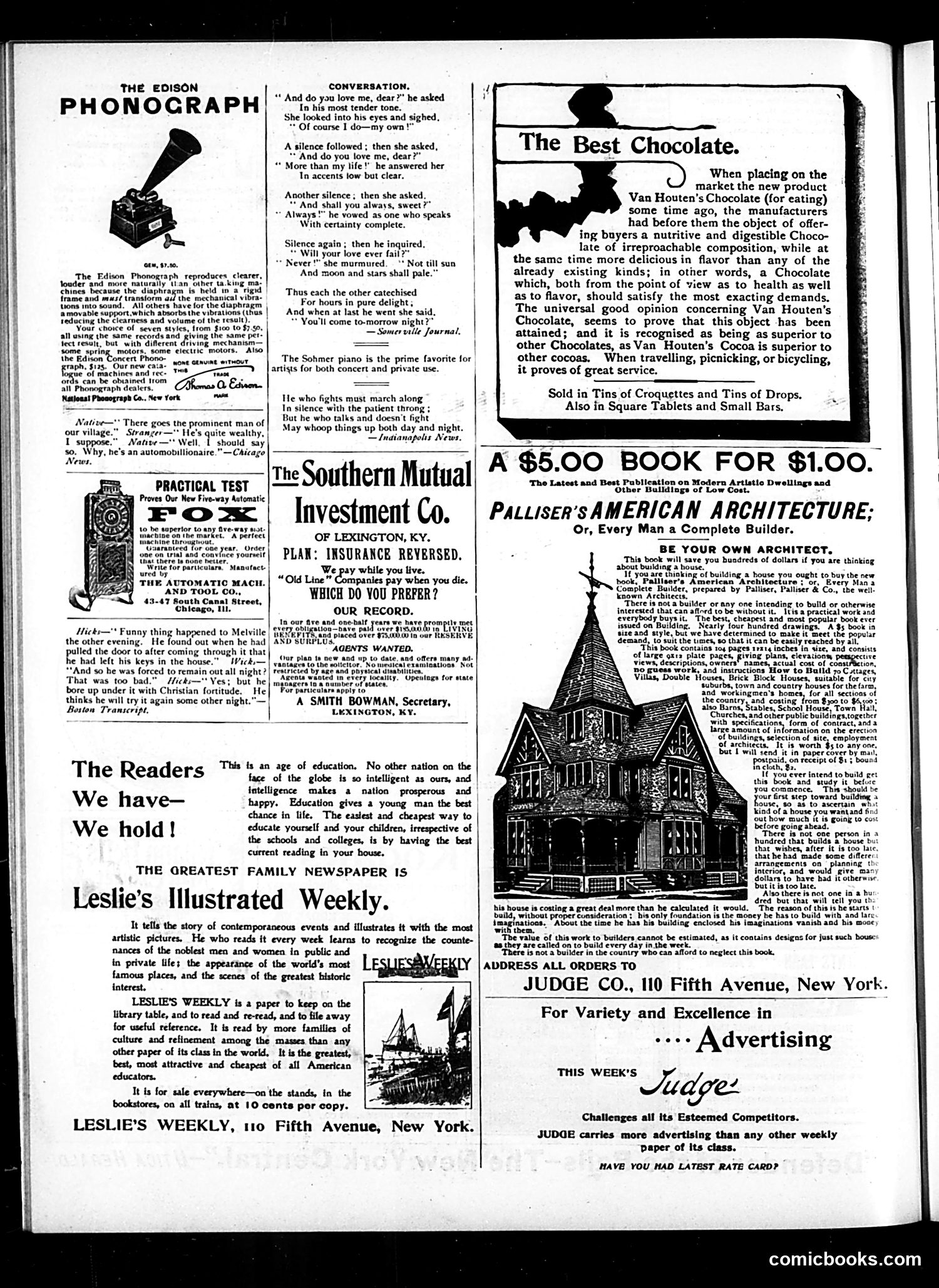
This page is primarily **advertisements and filler content** rather than political satire. The main cartoon is "The Edison Phonograph Conversation"—a gentle joke about the newly-invented phonograph's limitations. A man plays a recorded love declaration to his sweetheart, who responds with genuine questions. The humor lies in the mechanical nature of recorded sound: the phonograph can play back "I love you" endlessly, but cannot engage in actual dialogue. This references the novelty and limitations of Edison's 1877 phonograph technology. The page also contains advertisements for investment companies, chocolate, architectural books, and Leslie's Weekly magazine—typical late-19th-century periodical content. No significant political or social satire is evident. The "automobillionaire" joke is a light gag about newly-wealthy automobile owners, not political commentary. The page reflects the era's fascination with new technology (phonographs, automobiles) presented through advertising and mild domestic humor rather than sharp satire.
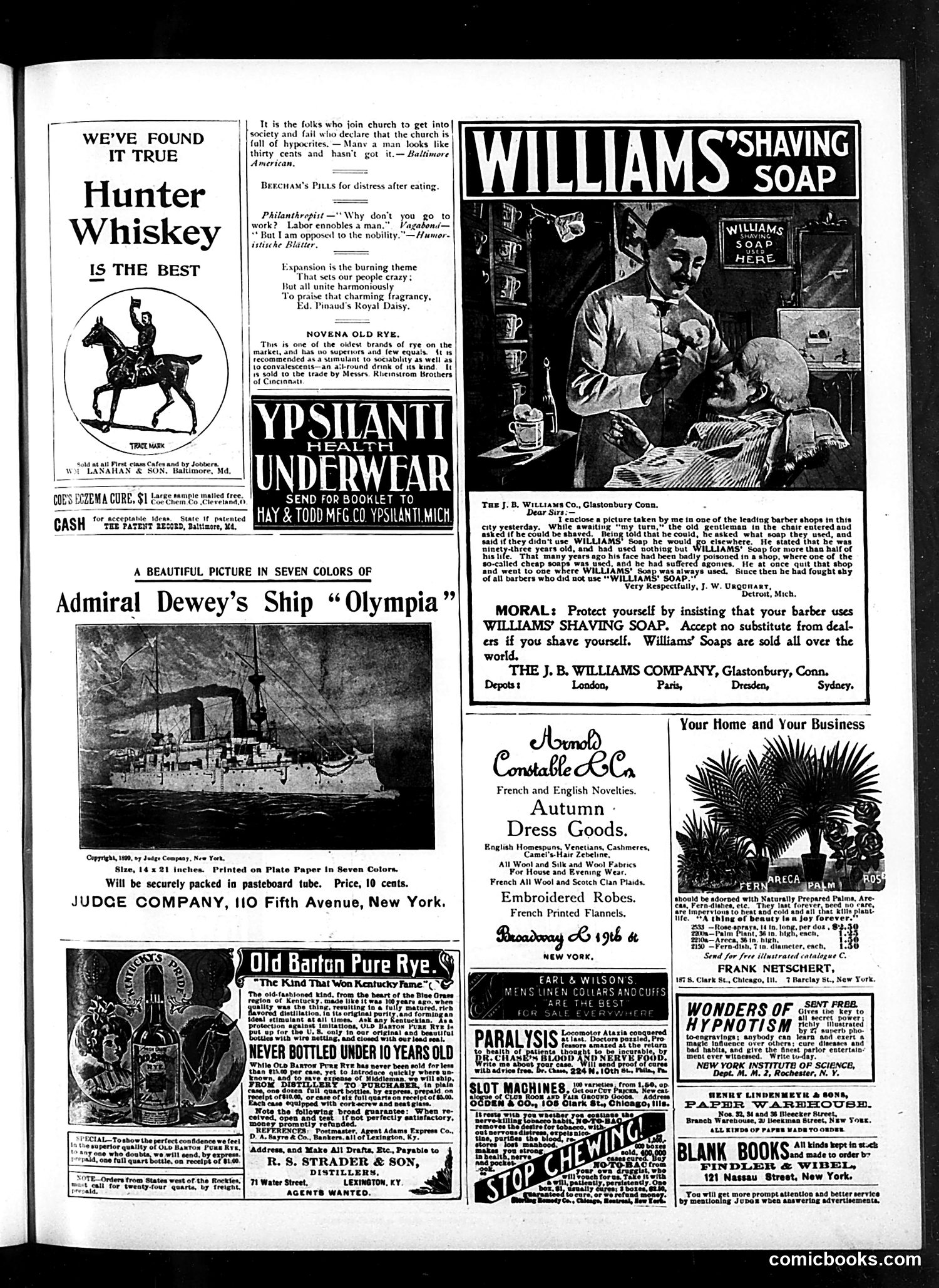
This page is primarily **advertising**, not editorial cartoons. It's a dense collection of classified and display ads typical of Judge magazine circa 1890-1900. Key content includes: **Notable ads:** - Hunter Whiskey and Old Barton Pure Rye (competing whiskey brands—Prohibition was a contentious social issue) - Williams' Shaving Soap (with a testimonial about an elderly man's loyalty) - Admiral Dewey's Ship "Olympia" (referencing the Spanish-American War hero) - Ypsilanti Health Underwear and Arnold Constable dress goods (consumer products) **Small humor pieces** interspersed include mild jokes about church hypocrisy and labor disputes, reflecting era social concerns. The page reflects **turn-of-century American consumer culture and attitudes**: whiskey promotion (before Prohibition), proprietary health products, militarism (Dewey's ship), and traditional gender roles in advertising (women's clothing, men's underwear marketed separately). No significant political cartoons or satire dominate this particular page—it's a commercial issue.
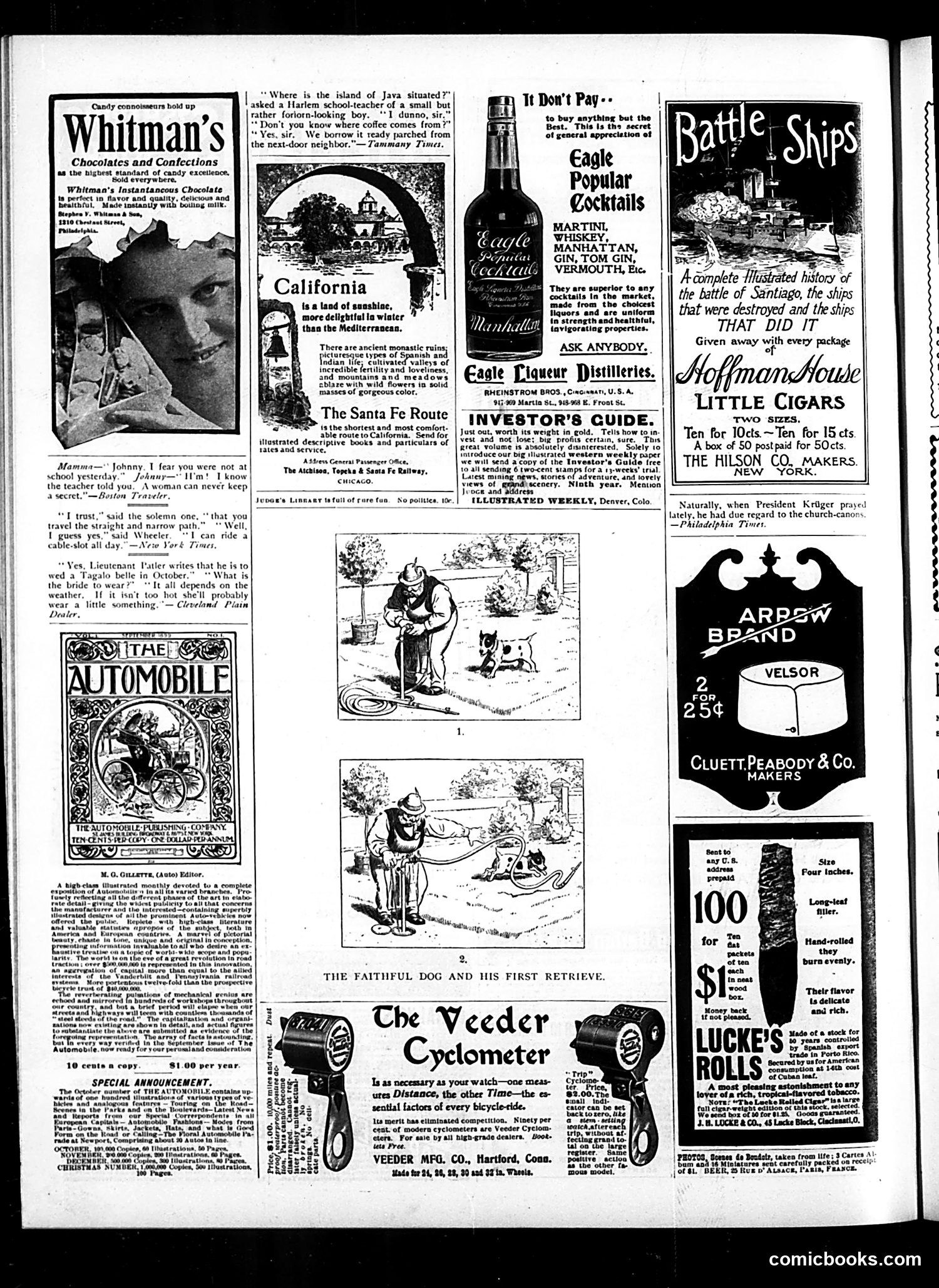
This page is primarily **advertising**, with a few short jokes interspersed. The cartoons and satirical content are minimal. The notable satirical elements include: **"The Faithful Dog and His First Retrieve"** — A two-panel cartoon showing a man with a dog retrieving what appears to be a shoe or similar object. This appears to be gentle humor about hunting/sporting dogs rather than political satire. **Brief jokes** reference contemporary figures: one mentions a **Tagalo bride** (Philippines, relevant post-Spanish-American War), another jokes about **President Kruger** (Paul Kruger of the Boer Republic, prominent during the Boer War era), and one references **Harlem school-teacher** racial/ethnic humor typical of the period. The page is otherwise dominated by product advertisements: Whitman's chocolates, Eagle liqueur, railroad travel, a cyclometer, and various tobacco/cigar products. The layout and content suggest this is from the early 1900s, when Judge regularly mixed advertising with satirical commentary. The satire present is mild and domestic rather than hard-hitting political commentary.
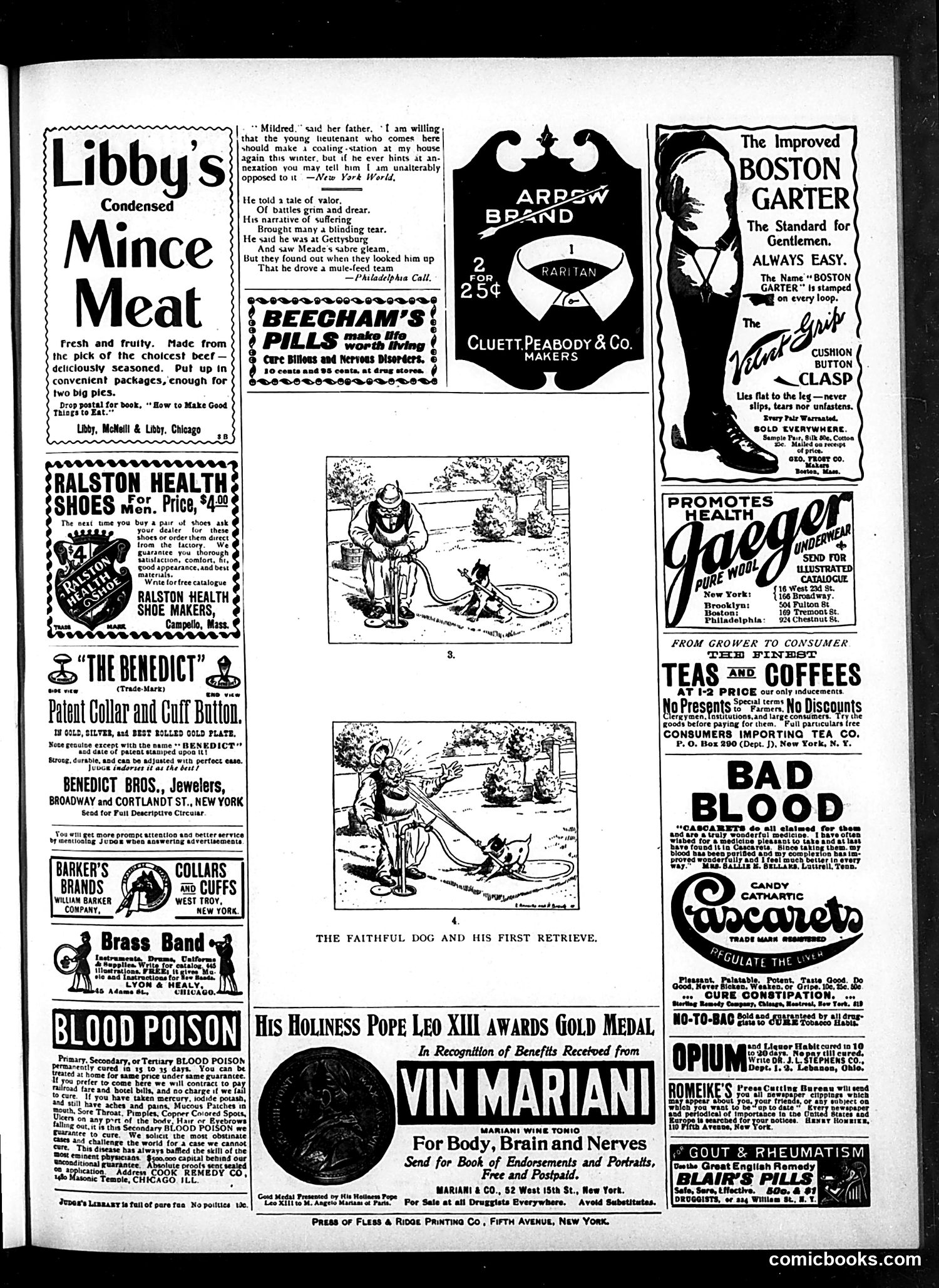
This page is primarily **advertising**, typical of early 20th-century magazines. However, it contains two notable editorial cartoons: ## "Mildred" Cartoon A brief joke about American expansion: A father permits a young lieutenant to visit frequently ("coaling-station"), but forbids any hint of "annexation"—a clever double meaning referencing both romantic intentions and the era's imperialist expansion debates. ## "The Faithful Dog and His First Retrieve" Two sequential panels show a hunter and dog retrieving a duck. The humor appears gentle—likely about the dog's first successful hunt, appealing to sporting enthusiasts. The page also includes a substantial advertisement for **Vin Mariani** wine tonic, featuring "His Holiness Pope Leo XIII" awarding a gold medal, claiming benefits for "Body, Brain and Nerves." This represents the era's patent medicine marketing, often making dubious health claims with celebrity/authority endorsements. The remaining content consists of standard product advertisements (shoes, collars, medicines) typical of the period.
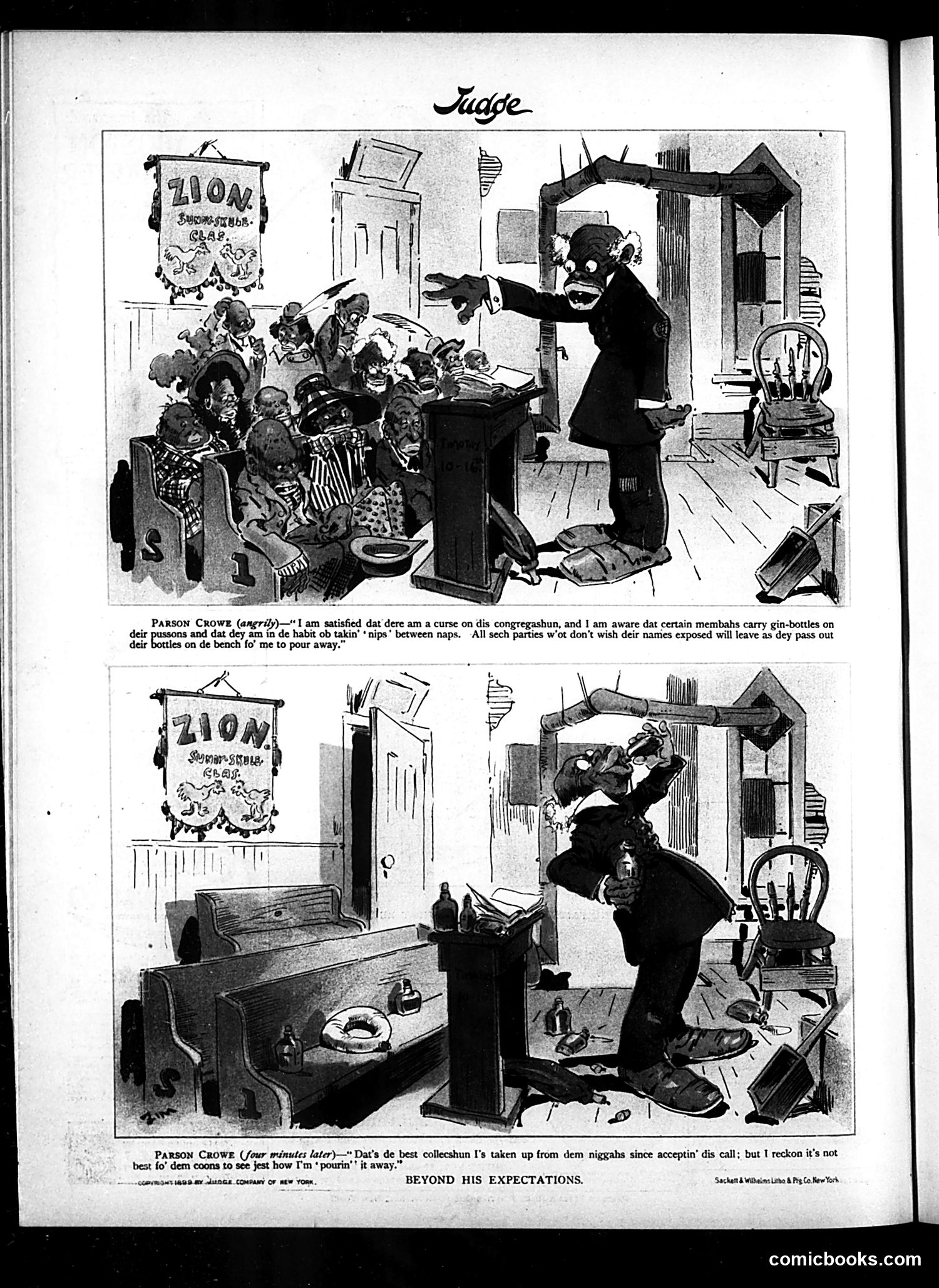
This two-panel Judge cartoon satirizes a Black church pastor (Parson Crowe) using deeply offensive racial caricature and dialect. **The "joke":** In panel one, the pastor announces he'll collect alcohol bottles from congregation members to "pour away." In panel four minutes later, he's secretly drinking the confiscated liquor—his stated moral purpose inverted into personal benefit. **The satire targets:** The cartoon relies on racist stereotypes portraying Black clergy as hypocritical, dishonest, and alcoholic. It mocks both the pastor's deception and implies the congregation's assumed drinking habits. **Historical context:** This reflects late 19th/early 20th-century white satirical magazines that routinely denigrated Black Americans through exaggerated dialect, caricature, and scenarios designed to demean. The "Zion" church banner establishes the religious setting for maximum ironic effect. The cartoon is offensive by modern standards and exemplifies how period satire often weaponized race.