
A complete issue · 16 pages · 1899
Judge — October 14, 1899
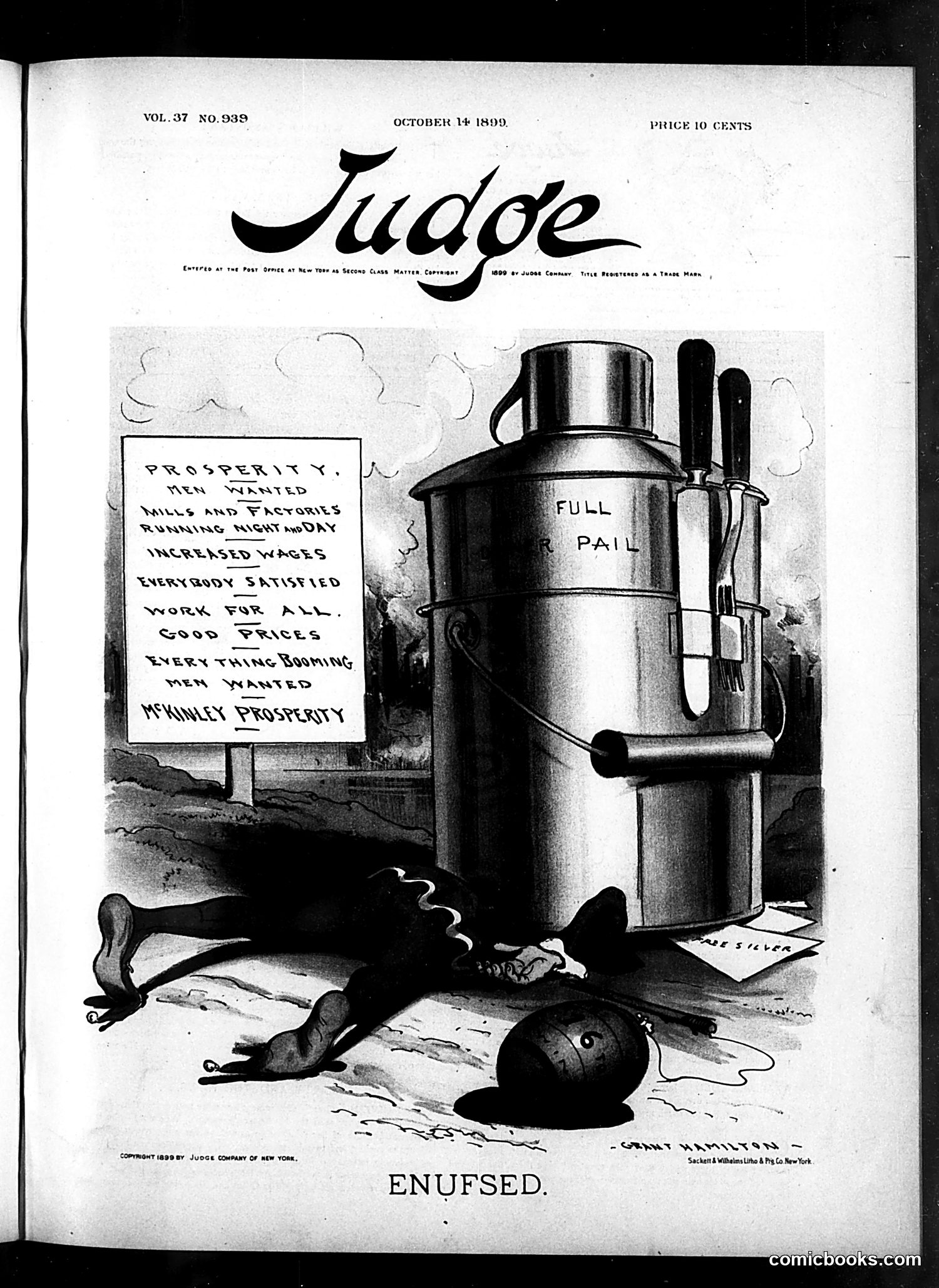
This political cartoon satirizes the McKinley administration's prosperity rhetoric during the 1899 period. The sign advertises "Prosperity" with promises of work and good prices, but the large cauldron labeled "Full Pail" appears to be a trap or container—likely representing McKinley's policies or claims. The dead animals at the base suggest workers or citizens have been harmed or "enufused" (exhausted/finished off) by these promises. The cartoon mocks the gap between optimistic government messaging about economic booming and actual working-class conditions. The title "Enufused" plays on "confused"—suggesting citizens are both fed up with and bewildered by prosperity claims that don't match their experience.
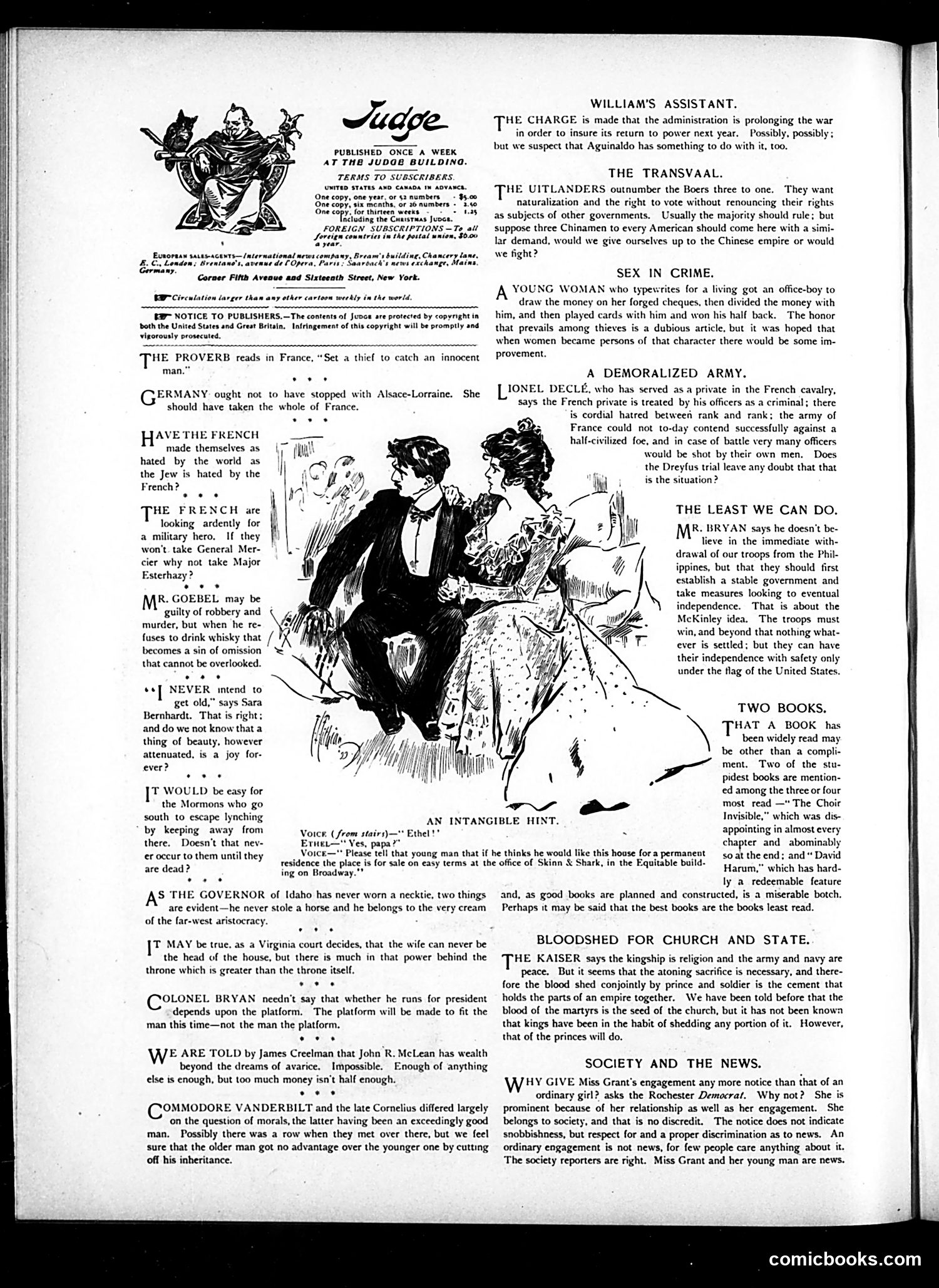
The central cartoon, titled "An Intangible Hint," depicts a well-dressed man and woman in conversation, with dialogue suggesting he's proposing permanent residence arrangements. The satire appears to target contemporary social attitudes about unmarried cohabitation and respectability, particularly the woman's concern about propriety. The surrounding editorial sections address various political and social issues of the era, including: critiques of prolonged warfare (possibly WWI), debates over immigration and voting rights for foreigners, commentary on French military practices, discussion of Philippine independence, and observations about Mormon practices. The overall tone is satirical commentary on American politics, foreign policy, and social mores, typical of Judge magazine's approach to contemporary affairs.
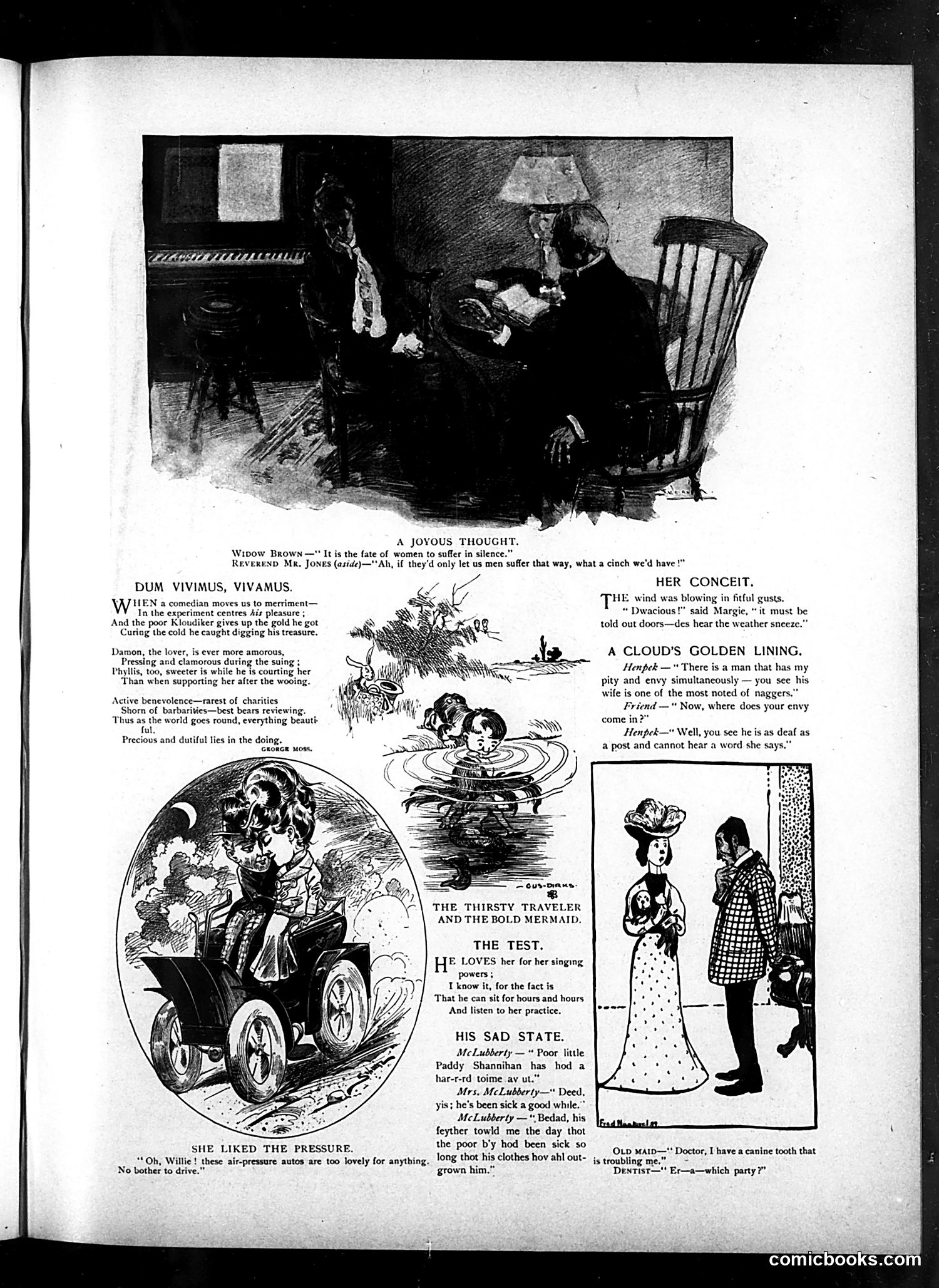
This page contains several unrelated humorous sketches and brief comic dialogues rather than a unified political cartoon. The content includes: **"A Joyous Thought"** - A domestic scene satirizing women's expected silence, with a widow and reverend discussing male suffering. **"Dum Vivimus, Vivamus"** and other titled pieces appear to be short satirical poems or jokes about everyday social situations—poverty, courtship, and character flaws. **Illustrated vignettes** show Victorian-era domestic scenes: a woman in a motorcar, children in water, a doctor's visit regarding dental problems. The overall tone mocks social pretensions, gender relations, and human foibles typical of early 20th-century American humor. Without specific historical context or identifiable political figures, these appear to be general social satire rather than commentary on particular events or politicians.
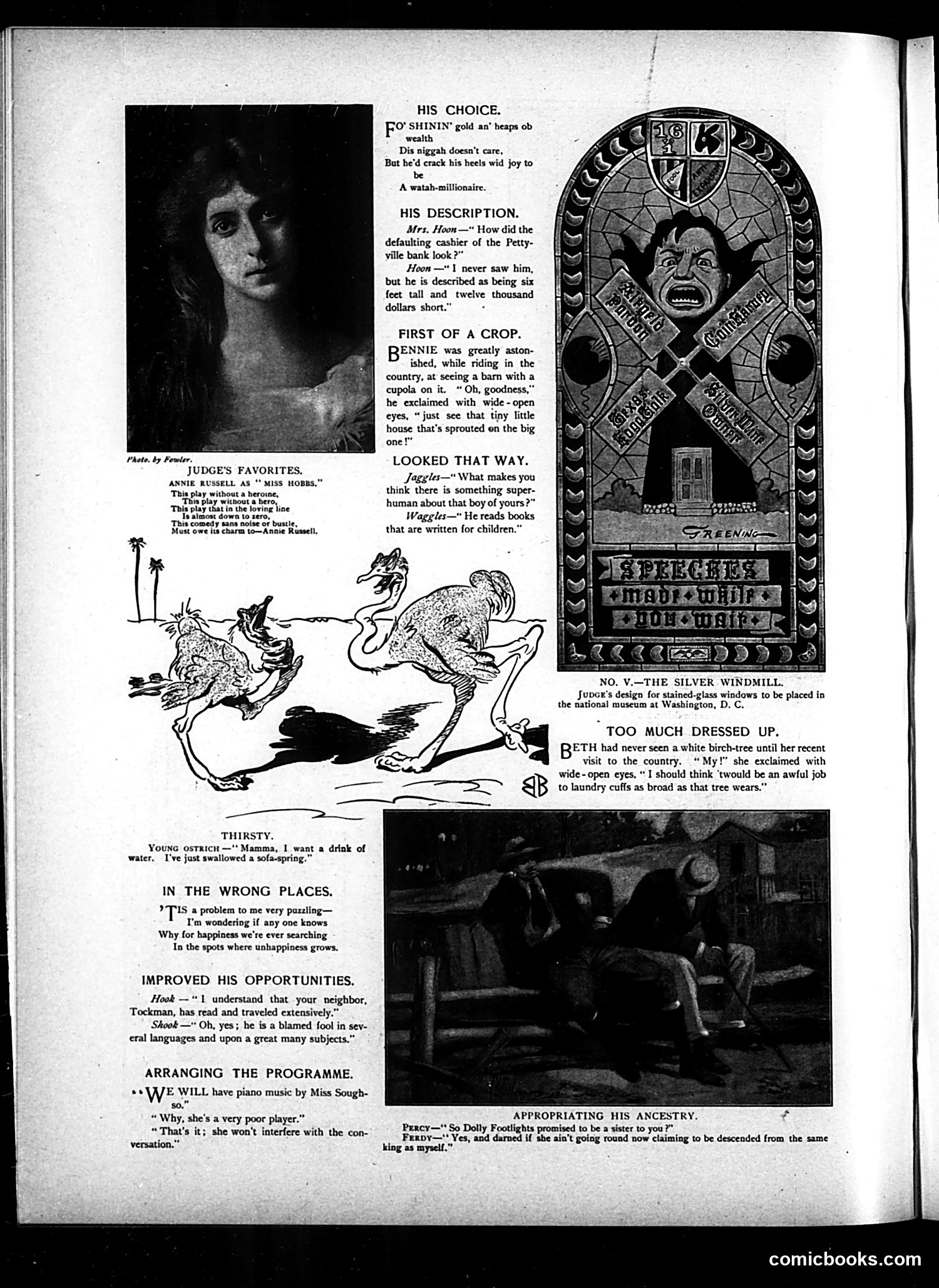
This page contains primarily **humorous social commentary and anecdotes** rather than political cartoons. The sections include: **"His Choice"** — A joke about a man wanting to become wealthy rather than virtuous. **"Judge's Favorites"** — A tribute to actress Annie Russell, praising her talent. **Various short jokes** addressing social foibles: a woman amazed by a small house ("First of a Crop"), someone reading children's books ("Looked That Way"), complaints about laundry and dress ("Too Much Dressed Up"), and other domestic/social humor. **"Appropriating His Ancestry"** — A dialogue joke about someone falsely claiming noble lineage. The cartoons feature **ostriches and domestic scenarios** illustrating the jokes. This appears typical of Judge's humor: **lighthearted satire of middle/upper-class social pretensions and domestic situations** rather than hard political commentary.
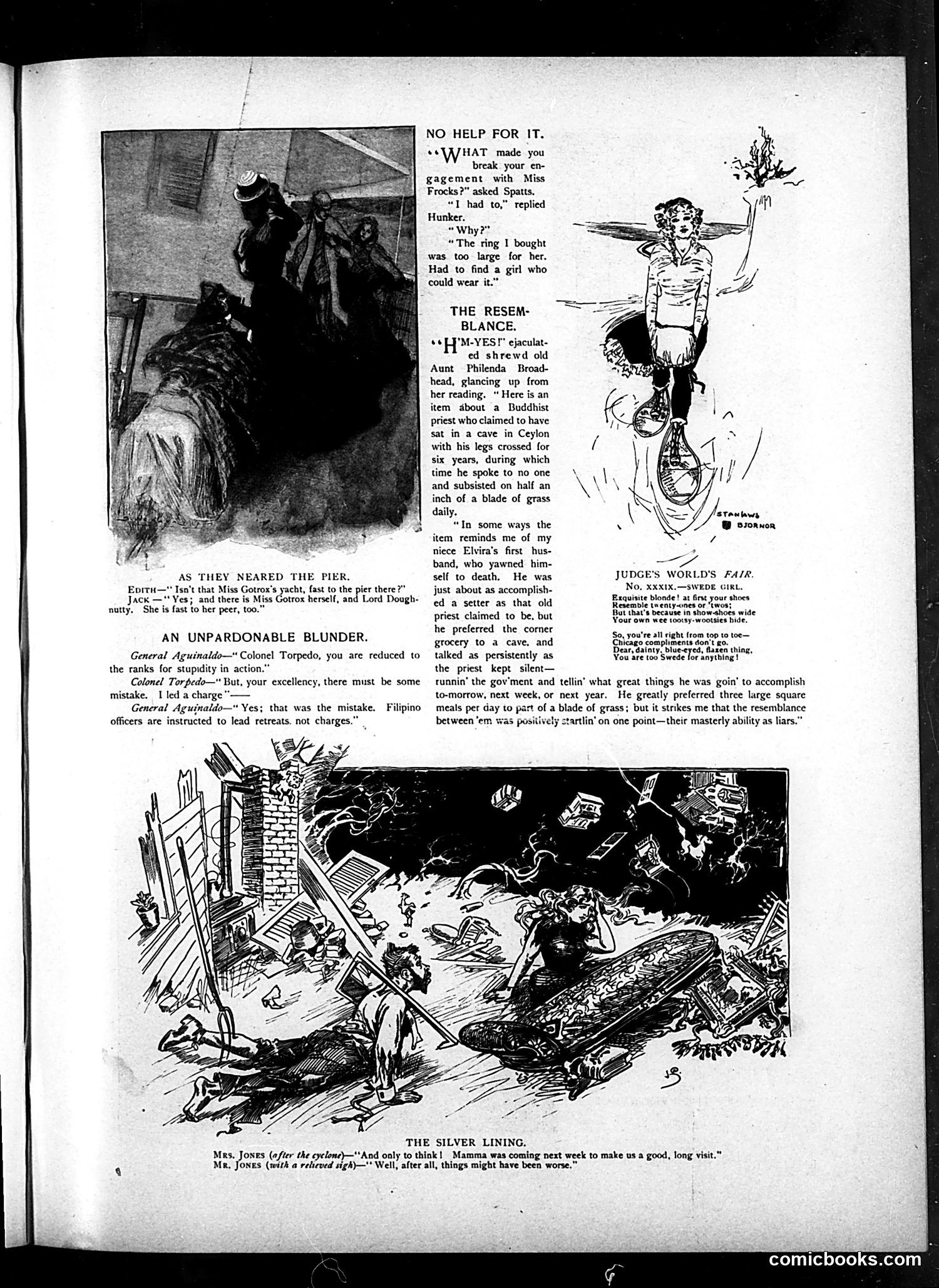
This page contains multiple satirical pieces reflecting early 1900s American concerns: **"An Unpardonable Blunder"** mocks General Aguinaldo (Filipino revolutionary leader during the Philippine-American War) by suggesting Filipino officers were trained to retreat rather than charge—a jab at perceived military incompetence and colonial-era racial stereotyping. **"No Help for It"** is a light romantic comedy: a man broke his engagement because the ring was too large for his fiancée, forcing him to find another woman to wear it—simple social satire about dating and materialism. **"The Resemblance"** features Aunt Philenda comparing a Buddhist monk's ascetic discipline to her niece's late husband, who was equally silent but preferred idleness and gossip to spiritual practice—satirizing hypocrisy masked as virtue. **"Judge's World's Fair"** and **"The Silver Lining"** are minor pieces on appearance and optimism. The page blends political commentary (Philippine conflict), personal relationships, and character humor typical of Judge's satirical approach.
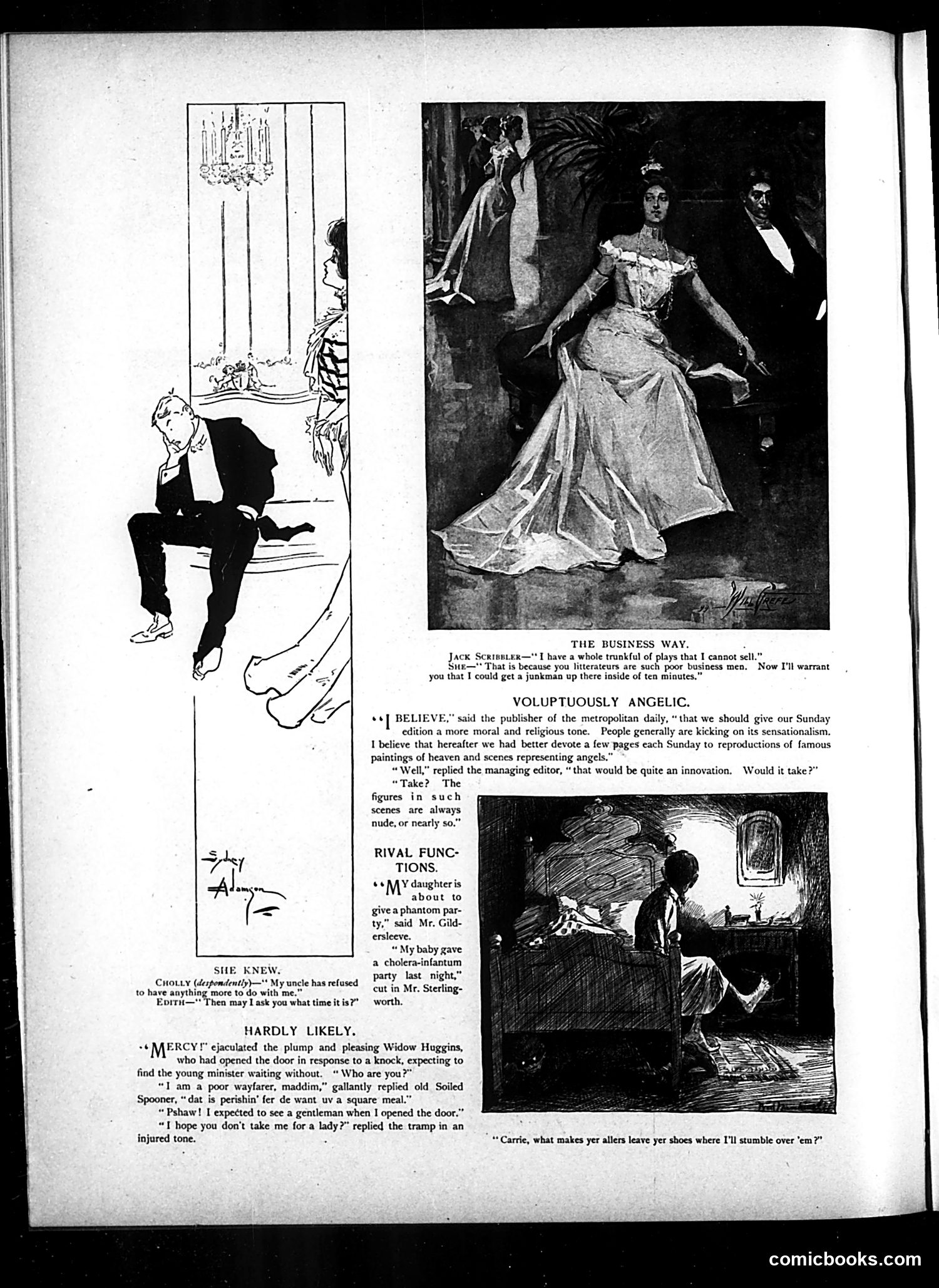
This page contains four separate satirical vignettes typical of early 20th-century American humor: **"The Business Way"**: A playwright complains he can't sell his plays. A junkman boasts he could sell them better—mocking both struggling artists and aggressive salesmen who oversell worthless goods. **"Voluptuously Angelic"**: A newspaper publisher proposes Sunday editions featuring religious paintings of angels and heaven to seem more moral. The managing editor notes such classical paintings typically depict nude figures—satirizing hypocritical attempts at respectability that backfire. **"Rival Functions"**: Two brief domestic anecdotes about social embarrassment (a phantom party, a cholera incident). **"Hardly Likely"**: A tramp seeking food tells a widow he's a "poor wayfarer." When she expresses disappointment he's not a gentleman, he indignantly asks if she mistakes him for a lady—mocking class pretensions and gendered assumptions. The humor relies on irony, misunderstandings, and social commentary about business ethics, respectability, and class distinctions in Edwardian America.
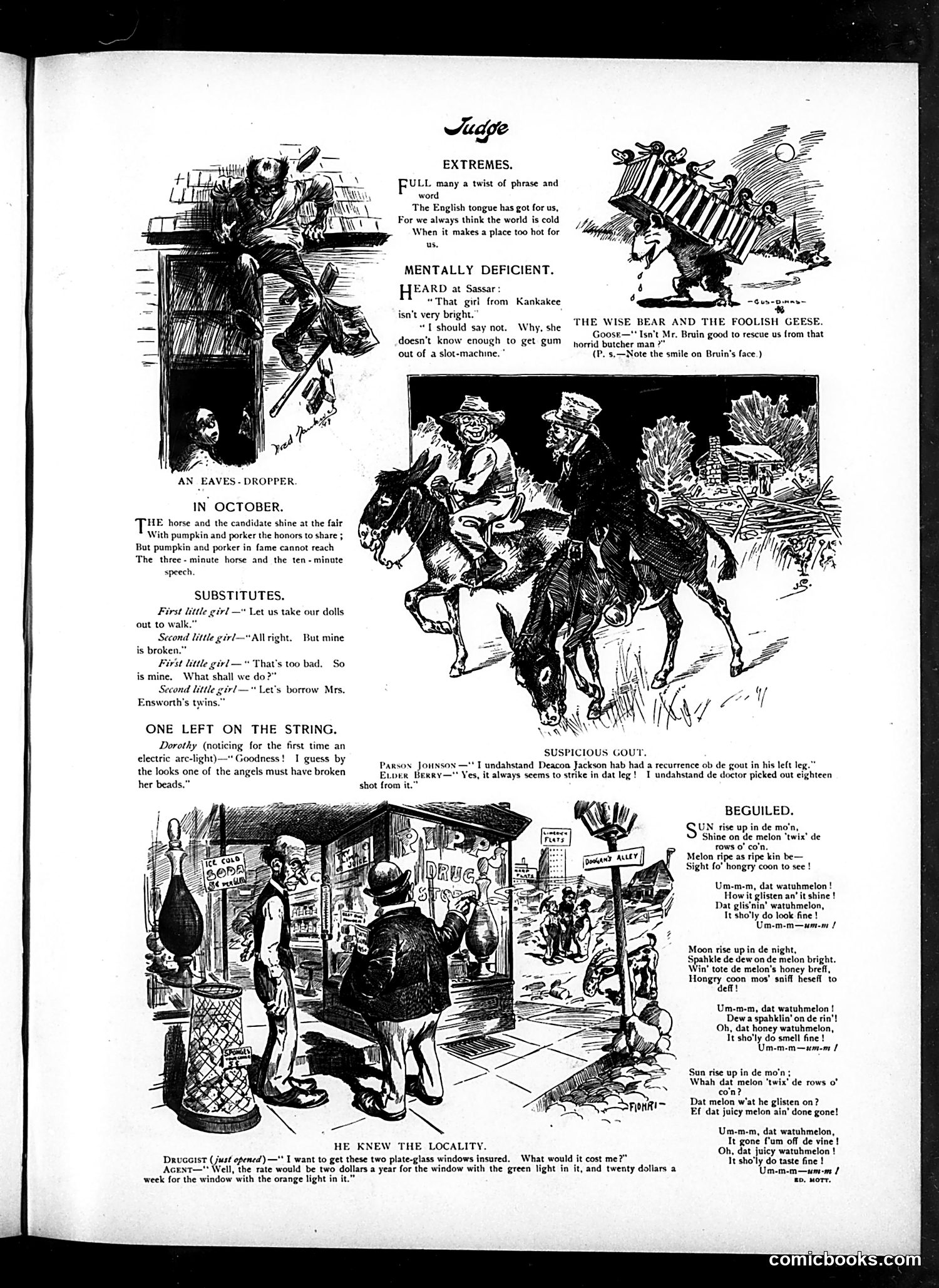
This page contains several satirical sketches mocking social stereotypes and contemporary figures circa early 1900s: **"Mentally Deficient"** ridicules a girl from Kankakee, Indiana, suggesting regional prejudice against Midwesterners. **"The Wise Bear and Foolish Geese"** appears to be Aesop's fable commentary, likely social satire about gullible people trusting untrustworthy figures. **"In October"** jokes about political candidates—comparing their verbose speeches ("ten-minute speech") to horses at county fairs, mocking campaign rhetoric. **"Beguiled"** uses racist dialect ("coon," "watuhmelon") depicting African Americans obsessed with stealing watermelons—a deeply offensive period stereotype presented as humorous. **"Suspicious Gout"** references a character ("Deacon Jackson") with gout, likely mocking African American religious figures. **"He Knew the Locality"** is a straightforward joke about insurance rates in dangerous neighborhoods (implied by the "orange light"—likely a red-light district). The racial content reflects Judge's regrettable historical prejudices.
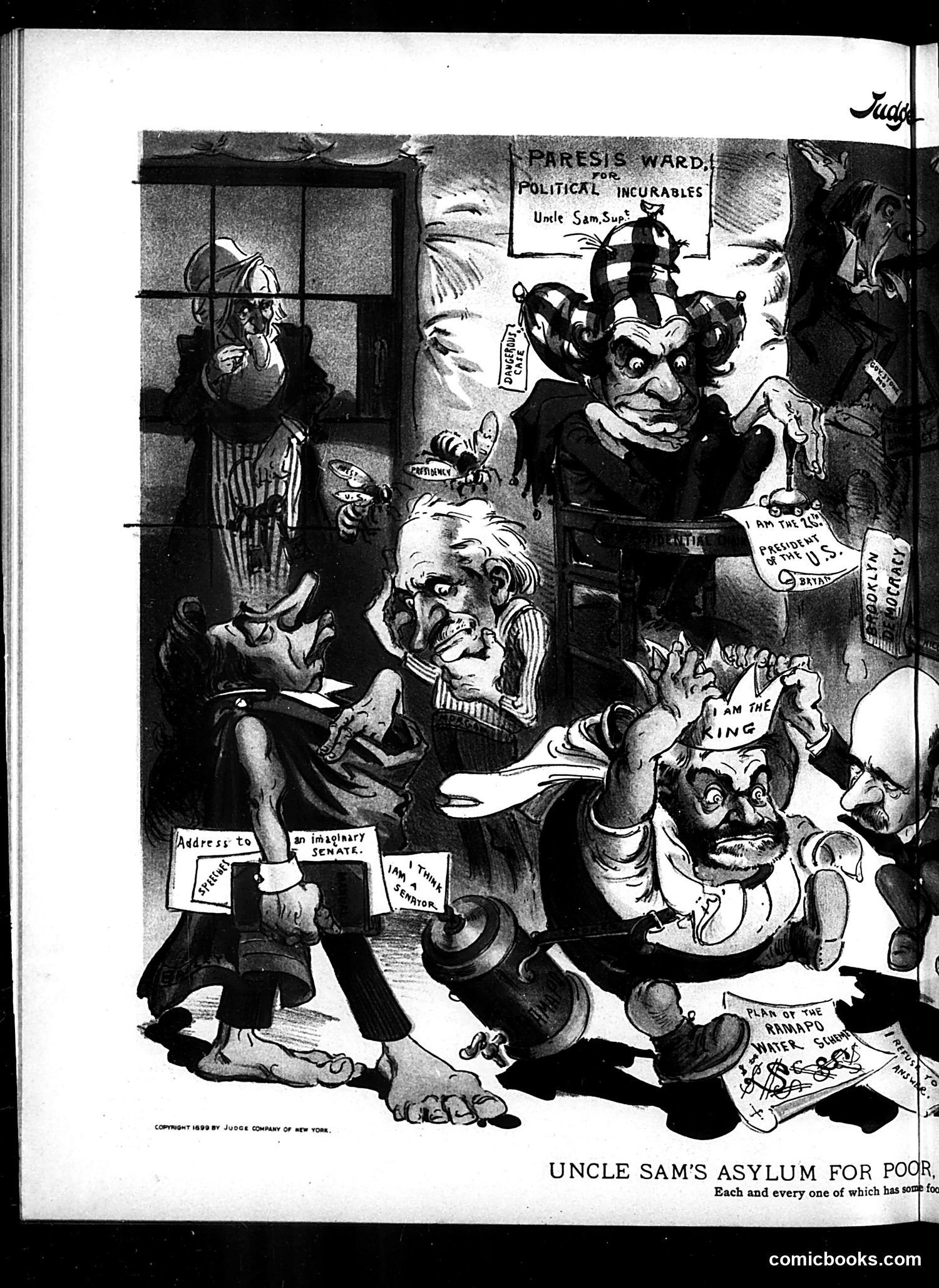
This 1899 Judge cartoon satirizes American political leadership as an asylum for the mentally unfit. The central figure appears to be Uncle Sam running an institution where various political figures are depicted as deranged patients—exaggerated with grotesque facial features and wild behavior typical of period caricature. The "Paresis Ward" sign references general paresis of the insane (neurosyphilis), suggesting the politicians are literally diseased/corrupt. Labels visible include references to political scandals and issues of the era, including what appears to be commentary on imperialism ("I am the King") and domestic political failures. The satire suggests American governance has become an asylum run by the incompetent, with each politician afflicted with some specific "incurable" malady—a scathing critique of late-19th-century politics, likely referencing specific scandals from 1898-1899, though the exact references are partially unclear in this reproduction.
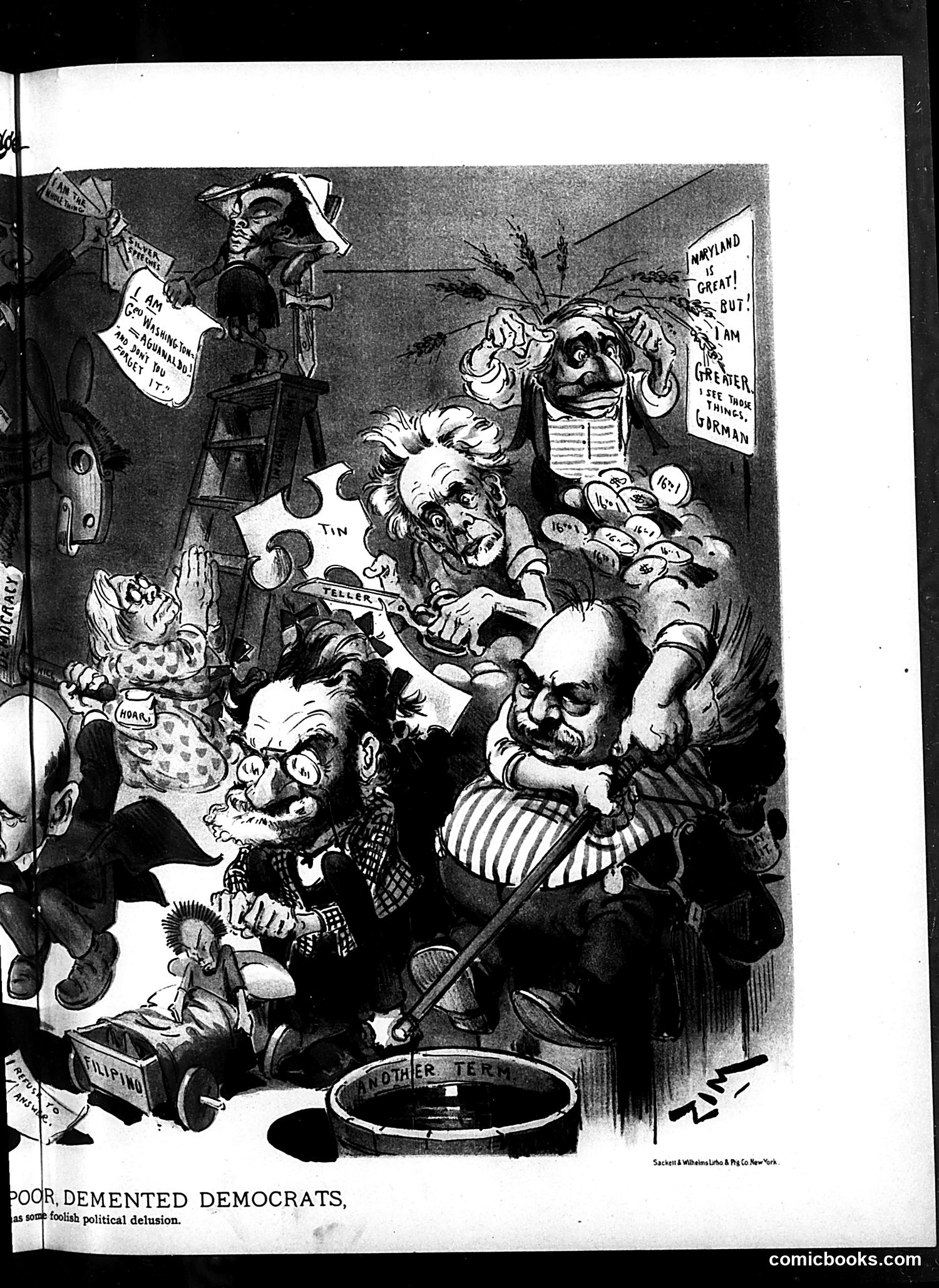
This political cartoon satirizes Democratic Party leaders as mentally unstable fools. The caricatured figures appear to be prominent Democrats, depicted with exaggerated features typical of Gilded Age satirical art. They're shown in chaotic, nonsensical activity—some juggling, others gesturing wildly—suggesting their political positions are illogical or absurd. References visible include labels like "TIN," "MARYLAND IS GREAT," and "DORMAN," though specific identities remain unclear from the image alone. One figure holds what appears to be campaign materials. The cartoon's message is straightforward partisan attack: the opposition party suffers from delusion and incompetence. Without knowing Judge magazine's publication date, we cannot identify which specific Democratic policies or events prompted this mockery, but the tone reflects the harsh, personality-driven political satire common in late 19th-century American humor publications.
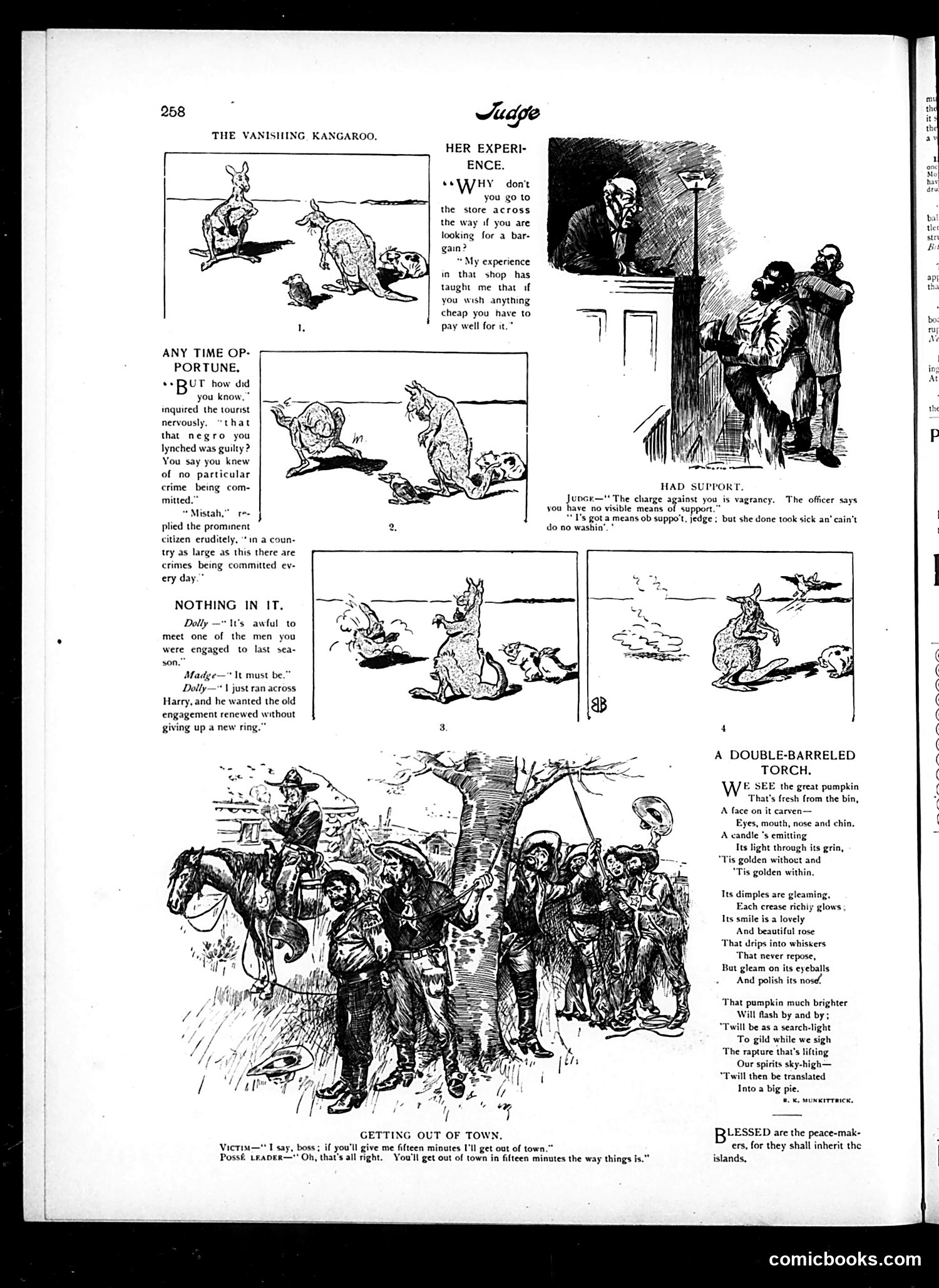
This page contains several satirical cartoons and humorous sketches typical of Judge magazine's social commentary: **"The Vanishing Kangaroo"** mocks lynch mob violence by depicting kangaroos (representing mob justice) discussing how they lynched someone without knowing if he was guilty. The prominent citizen defends this by claiming crimes happen constantly anyway—satirizing the rationalization of extrajudicial killing. **"Getting Out of Town"** depicts a Black man being chased out by a posse, with dark humor about the speed of his departure. This reflects post-Reconstruction racial violence and forced displacement. **Other sketches** include domestic humor ("Nothing in It" about broken engagements) and consumer commentary ("Her Experience" about pricing). **"A Double-Barreled Torch"** is an ornamental poem about jack-o'-lanterns. The page reflects late 19th/early 20th-century American anxieties: racial violence, consumer capitalism, and courtship customs. The satirical approach targets mob justice and social pretense rather than explicitly condemning them.
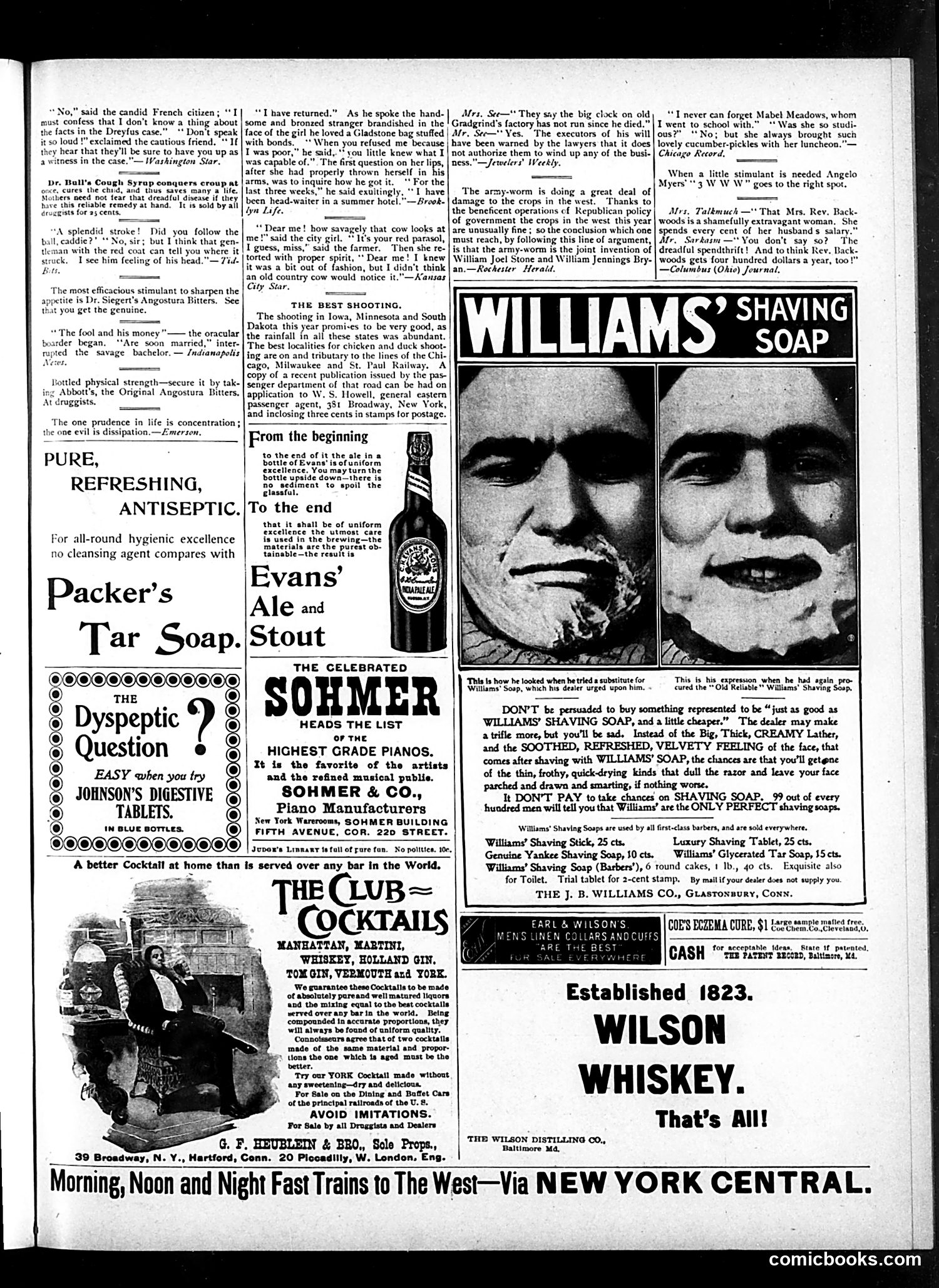
This is primarily an **advertising page** from Judge magazine, with minimal editorial content. The scattered text snippets at top are brief jokes typical of the magazine's humor style—mostly observational comedy about courtship, fashion mishaps, and social etiquette (a farmer mocking a city girl's parasol; a suitor returning with wealth). The page is dominated by **product advertisements** from the Gilded Age/early 20th century: patent medicines (Packer's Tar Soap, Dr. Ball's Cough Syrup, Abbott's Bitters), alcoholic beverages (Evans' Ale and Stout, Wilson Whiskey, Club Cocktails), a piano manufacturer (Sohmer & Co.), and Johnson's Digestive Tablets. The most visually prominent content is a **Williams' Shaving Soap advertisement** featuring before-and-after facial photographs emphasizing the product's benefits. This reflects period advertising conventions using comparative imagery. No identifiable political figures or social satire appears on this page—it's a commercial venture showcasing products targeting affluent male readers through the magazine's pages.
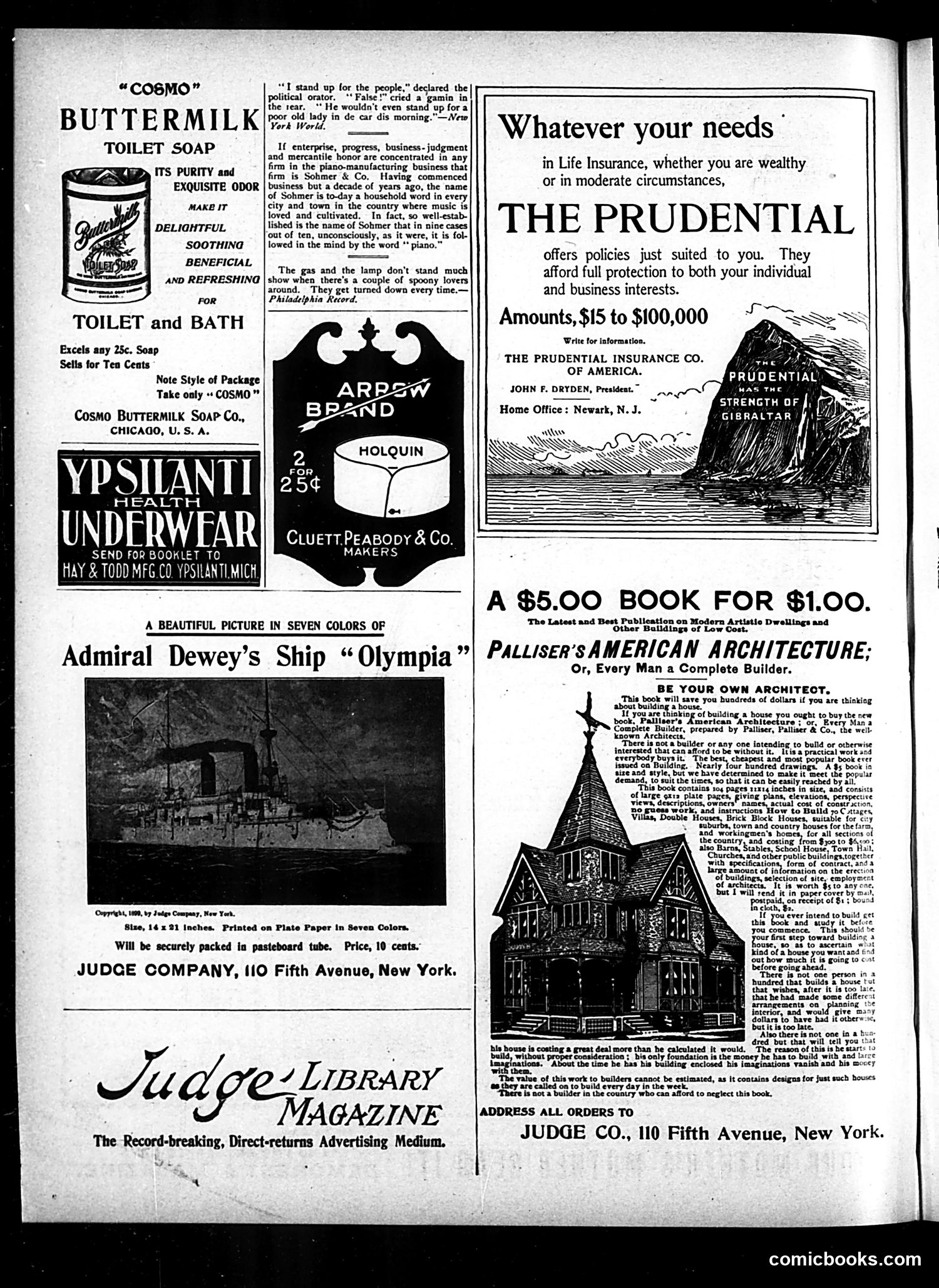
This is primarily an **advertising page** rather than a satirical cartoon page. However, it contains one brief satirical item: The small text excerpt quotes a political orator claiming "I stand up for the people," which a street urchin ("gamin") immediately deflates by pointing out the orator wouldn't even stand up for an elderly woman on a streetcar. This is **social satire about political hypocrisy**—the gap between politicians' grand rhetoric about serving ordinary people and their indifference to basic human decency in everyday life. The rest of the page consists of period advertisements for consumer goods (Cosmo soap, Ypsilanti underwear, Arrow brand clothing) and services (Prudential Insurance, Judge Company's print services), plus a promotional image of Admiral Dewey's ship *Olympia*—likely referencing the Spanish-American War hero's fame circa 1898-1900. The architectural book advertisement offers practical building guides for middle-class homeowners.
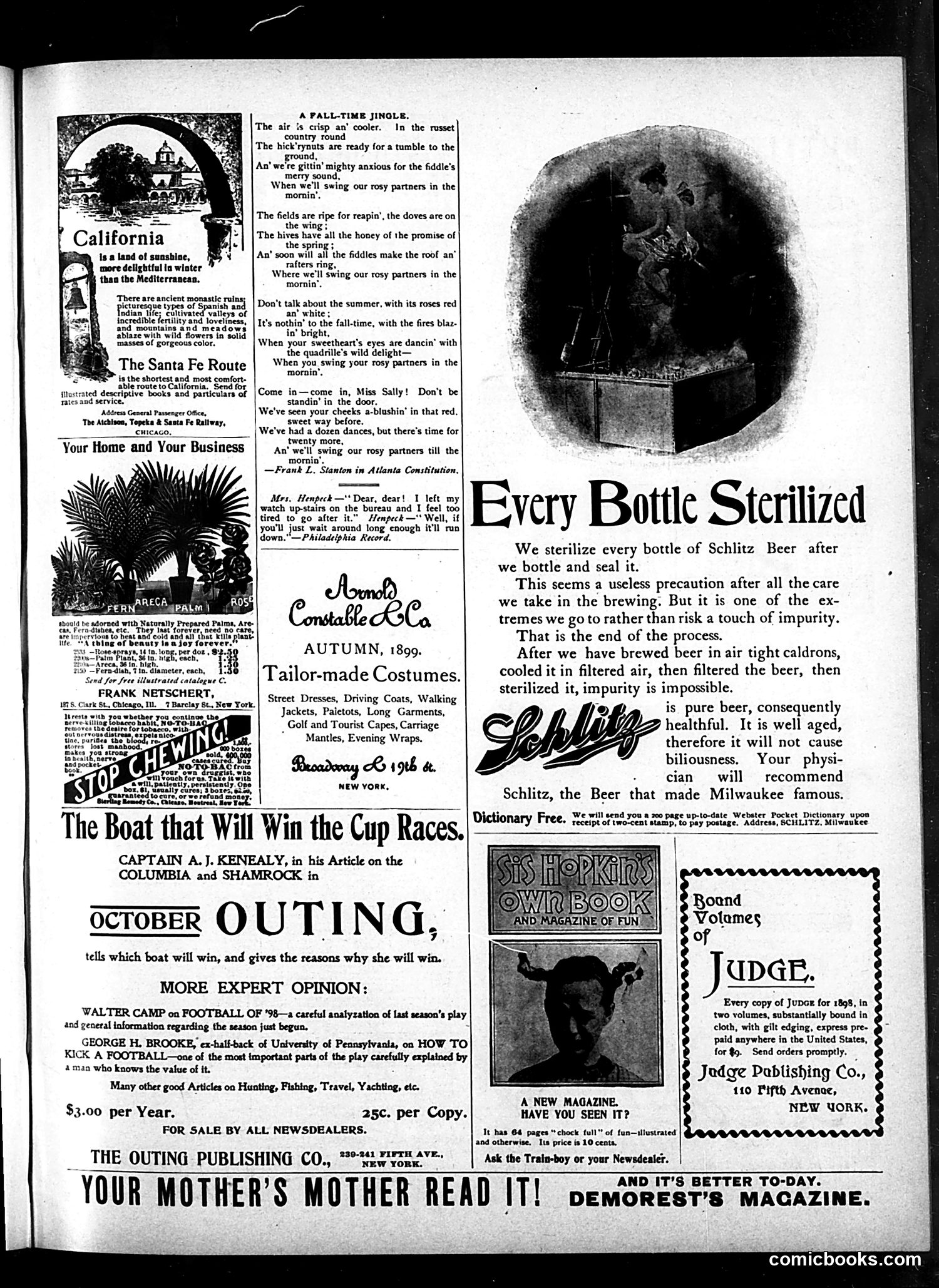
This page is primarily **advertising and promotional content** rather than satirical editorial material. The main notable content includes: 1. **"A Fall-Time Jingle"** — a sentimental rural poem celebrating autumn dancing and courtship, typical of the era's nostalgic Americana. 2. **Multiple ads** promoting travel (Santa Fe Route to California), tailor-made costumes, and *Outing* magazine. 3. **A brief joke** about "Mrs. Henpeck" — a hen-pecked husband telling his nagging wife her watch will eventually "run down" if she waits long enough. This represents period gender humor mocking wives as nagging and husbands as passive. 4. **Schlitz Beer advertisement** emphasizing sterilization and purity — a selling point for the era when beer quality and safety were consumer concerns. 5. **Judge magazine's own promotions**, including *Hopkins' Own Book* and references to upcoming articles on America's Cup yacht racing. The page reflects 1899 consumer culture and demonstrates how Judge mixed entertainment with commercial content to fund its publication.
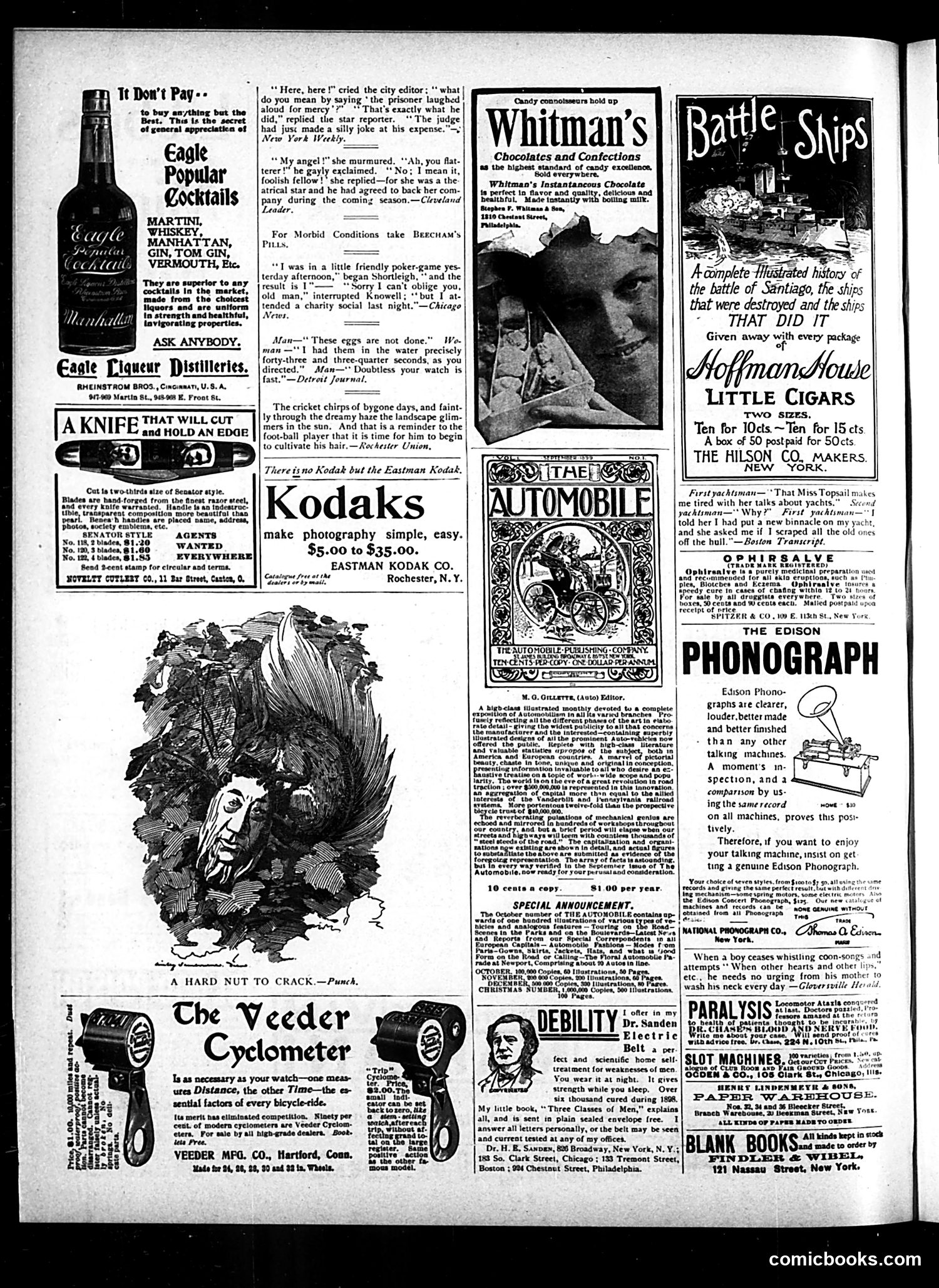
This is primarily an **advertising page** from Judge magazine, with minimal editorial content. The small text snippets are humorous one-liners typical of the era's satirical style. **The jokes** are mild observations on everyday life: a newspaper editor criticizing a reporter's phrasing of a prisoner's reaction; a romantic exchange where a woman mistakes flattery for genuine compliment; a poker player's excuse about attending charity; a domestic dispute over egg-cooking timing; and a reminder that football players should grow their hair. **The advertisements** reflect early 20th-century consumer goods: Eagle liquor cocktails, Kodak cameras, the Veeder Cyclometer (bicycle odometer), The Automobile magazine, Edison Phonographs, and various other products. The imagery emphasizes these as modern conveniences and status symbols. **Historical context**: This page captures a moment when photography, automobiles, and recorded sound were novel consumer luxuries marketed to middle-class readers. The humor is gentle domestic satire rather than political commentary.
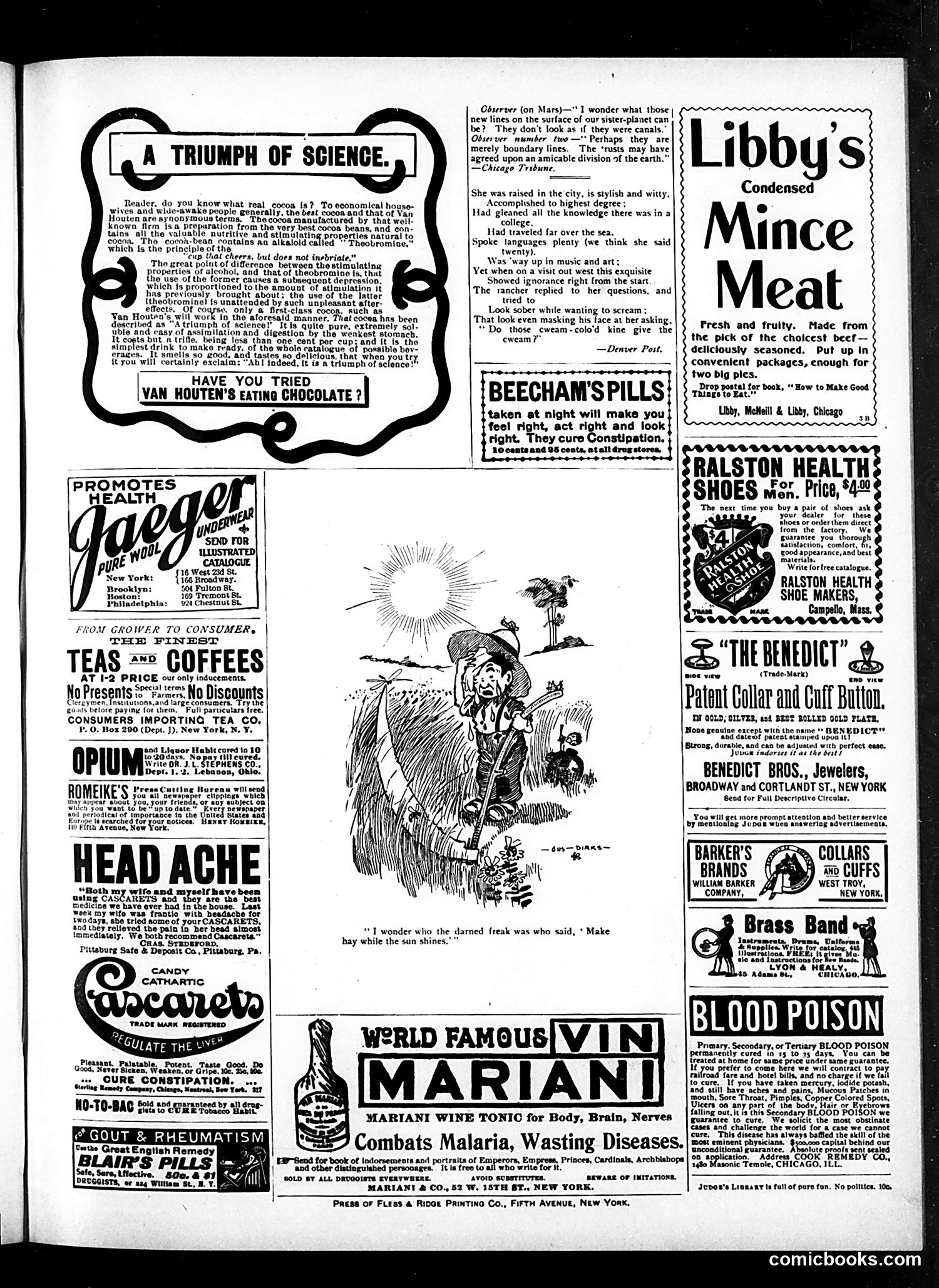
This page is primarily **advertising**, not editorial or satirical cartoon content. However, it contains one small cartoon at the center. ## The Cartoon The single illustration depicts two Martian observers discussing lines visible on Mars's surface. One wonders if they're "canals" (referencing the famous 1877 astronomical speculation by Giovanni Schiaparelli about Martian canals). The other suggests they might be "boundary lines" between regions, humorously implying Mars has territorial divisions like Earth. **The satire**: This is gentle mockery of contemporary public fascination with Mars exploration and the speculative idea of Martian civilization. It satirizes the tendency to project human concerns (property boundaries, nations) onto extraterrestrial geography. ## Advertisements The page is dominated by period patent medicines and consumer goods typical of early 20th-century magazines: cocoa, pills for constipation/headaches, teas, shoes, jewelry, and patent medicines (including opium and treatments for "blood poison"). These ads reveal the era's unregulated medical marketing and consumer culture.
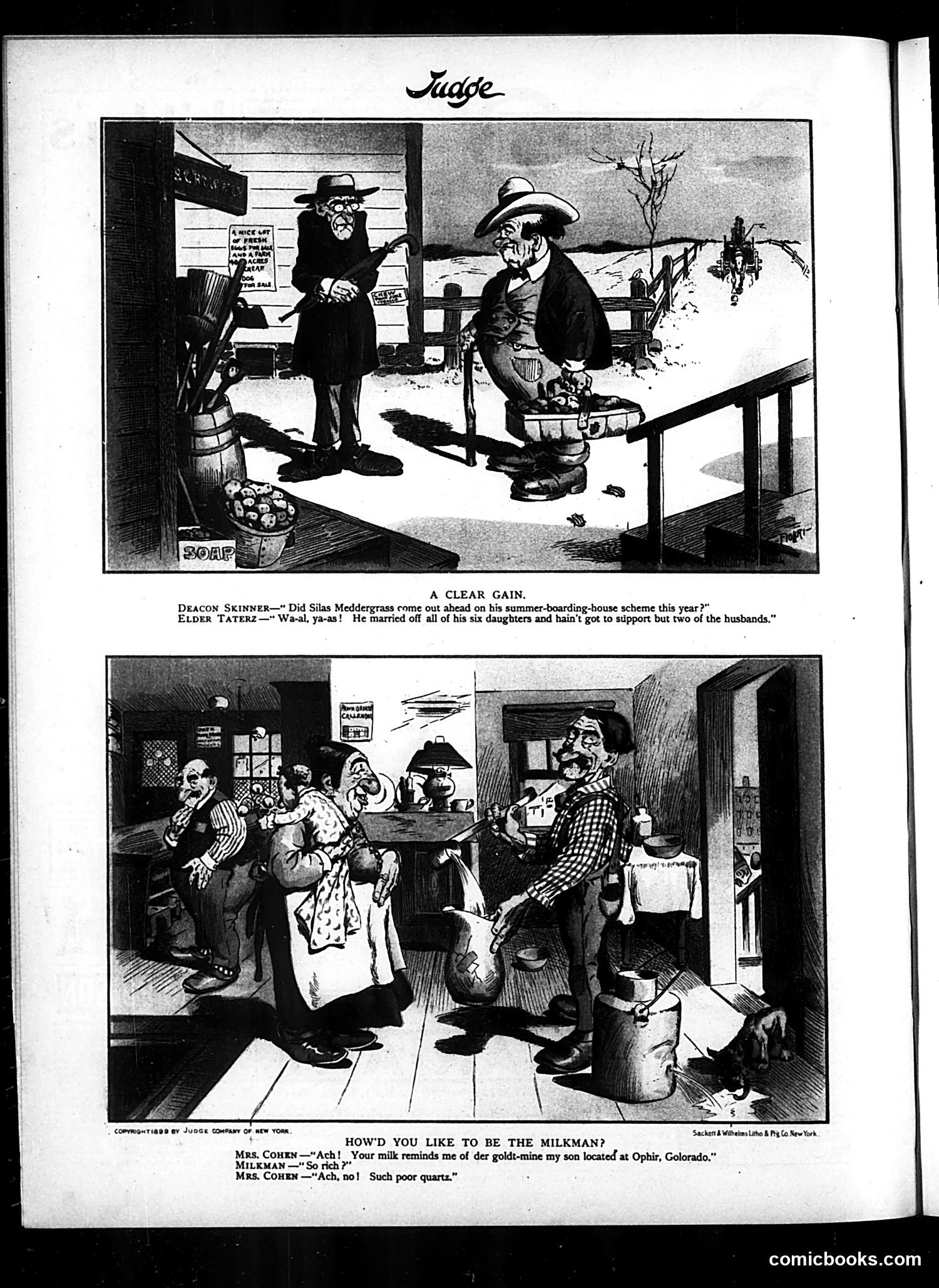
**Top cartoon ("A Clear Gain"):** Rural characters discuss a boarding-house scheme where a man profited by marrying off six daughters—he now supports only two husbands instead of six daughters, a financial "gain." The joke plays on rural attitudes toward daughters as financial burdens. **Bottom cartoon ("How'd You Like to Be the Milkman?"):** Mrs. Cohen complains the milkman's milk quality reminds her of poor-quality ore from her son's gold mine in Ophir, Colorado. The milkman responds that the ore was even worse. The joke relies on ethnic stereotyping—using Yiddish-inflected speech ("Ach!") and a Jewish name to create humor around immigrant experiences and business dealings.